All i can say is everything in this picture was as deliberate as i know how to make it, without planning it at all, and it contains symbolism both public and private. With reference to my signature quotation, (see below) it makes use of what the negative spaces offered me without leaving any in the end.
“There is no negative space, only the shapely void. Hold your hands out, cup the air. To see the emptiness you hold is to know that space loves the world.” P. Wagner
(for those who are not familiar with WWII, over the gates over Auschwitz, the notorious concentration camp where Jews and many other despised groups were taken to be tortured and killed, were emblazoned the words: ARBEIT MACHT FREI, or “work will set you free,” which was of course a lie and a horrible joke, because it was only meant to kill you at what was not a labor camp but just a death camp. )
PSYCHIATRIE MACHT FREI?
Psychiatrie Macht Frei? Mixed media anti-psychiatry picture, 24″by 19″
Psychiatrie Macht Frei? Mixed media anti-psychiatry picture, 24″by 19″
Electroshock, variously known as electroconvulsive therapy, ECT, shock treatment, or simply shock, is the practice of applying 70 to 150 volts of household electric current to the human brain in order to produce a grand mal, or generalized, seizure. A course of ECT usually consists of 8 to 15 shocks, administered every other day, although the number is determined by the individual psychiatrist and many patients receive 20, 30, 40 or more.
Psychiatrists use ECT on persons with a wide range of psychiatric labels, from depression to mania, and have recently begun to use it on persons without psychiatric labels who have medical diseases such as Parkinson’s disease.
A conservative estimate is that at least 100,000 persons receive ECT each year, and by all accounts this number is growing. Two-thirds of those being shocked are women, and more than half of ECT patients are over the age of 65, although it has been given to children as young as three. ECT is not given at all in most state hospitals. It is concentrated in private, for-profit hospitals.
ECT drastically changes behavior and mood, which is construed
as improvement of psychiatric symptoms. However, since psychiatric symptoms usually recur, often after as little as one month, psychiatrists are now promoting “maintenance” ECT—one electrical grand mal seizure every few weeks, given indefinitely or until the patient or family refuses to continue.
THE EVIDENCE FOR ECT BRAIN DAMAGE
There are now five decades of evidence for ECT brain damage and memory loss. The evidence is of four types: animal studies, human autopsy studies, human in vivo studies which use either modern brain-imaging techniques or neuropsychological testing to assess damage, and survivor self-reports or narrative interviews.
Most of the studies of the effects of ECT on animals were done in the 1940s and ’50s. There are at least seven studies documenting brain damage in shocked animals (cited by Friedberg in Morgan, 1991, p. 29). The best known study is that of Hans Hartelius (1952), in which brain damage was consistently found in cats given a relatively short course of ECT. He concluded: “The question of whether or not irreversible damage to the nerve cells may occur in association with ECT must therefore be answered in the affirmative.”
Human autopsy studies were done on persons who died during or shortly after ECT (some died as a result of massive brain damage). There are more than twenty reports of neuropathology in human autopsies, dating from to 1940s to 1978 (Morgan, 1991, p. 30; Breggin, 1985, p.4). Many of these patients had what is called modern or “modified” ECT.
It is necessary to clarify briefly here what is meant by “modified” ECT. News and magazine articles about ECT commonly claim that ECT as it has been given for the past thirty years (that is, using general anesthesia and muscle-paralyzing drugs to prevent bone fractures) is “new and improved”, “safer” (i.e. less brain-damaging) than it was in the 1940s and ’50s.
Although this claim is made for public relations purposes, it is flatly denied by doctors when the media is not listening. For example, Dr. Edward Coffey, head of the ECT department at Duke University Medical Center and a well-known advocate of ECT, tells his students in the training seminar “Practical Advances in ECT: 1991”:
The indication for anesthetic is simply that it reduces the anxiety and the fear and the panic that are associated or that could be associated with the treatment. OK? It doesn’t do anything else beyond that…There are, however, significant disadvantages in
using an anesthetic during ECT…The anesthetic elevates seizure threshold… Very, very critical…
So it is necessary to use more electricity to the brain, not less, with “modified” ECT, hardly making for a safer procedure. In addition, the muscle-paralyzing drugs used in modified ECT amplify the risks. They make the patient unable to breathe independently, and as Coffey points out this means risks of paralysis and prolonged apnea.
Another common claim of shock doctors and publicists, that ECT “saves lives” or somehow prevents suicide, can be quickly disposed of. There is simply no evidence in the literature to support this claim. The one study on ECT and suicide (Avery and Winokur, 1976) shows that ECT has no effect on the suicide rate.
Case studies, neuroanatomical testing, neuropsychological testing, and self-reports that remain strikingly similar over 50 years testify to the devastating effects of ECT on memory, identity, and cognition.
Recent CAT scan studies showing a relationship between ECT and brain atrophy or abnormality include Calloway (1981); Weinberger et al (1979a and 1979b); and Dolan, Calloway et al (1986).
The vast majority of ECT research has focused and continues to focus on the effects of ECT on memory, for good reason. Memory loss is a symptom of brain damage and, as neurologist John Friedberg (quoted in Bielski, 1990) points out, ECT causes more permanent memory loss than any severe closed-head injury with coma or almost any other insult to or disease of the brain.
Reports of catastrophic memory loss date to the very beginning of ECT. The definitive study of ECT’s memory effects remains that of Irving Janis (1950). Janis conducted detailed and exhaustive autobiographical interviews with 19 patients before ECT and then attempted to elicit the same information four weeks afterwards. Controls who did not have ECT were given the same interviews. He found that “Every one of the 19 patients in the study showed at least several life instances of amnesia and in many cases there were from ten to twenty life experiences which the patient could not recall.” Controls’ memories were normal. And when he followed up half of the 19 patients one year after ECT, there had been no return of memory (Janis, 1975).
Studies in the 70s and 80s confirm Janis’ findings. Squire (1974) found that the amnesic effects of ECT can extend to remote memory. In 1973 he documented a 30-year retrograde amnesia following ECT. Freeman and Kendell (1980) report that 74% of patients questioned years after ECT had memory impairment. Taylor et al (1982) found methodological flaws in studies that purport to show no memory loss and documented deficits in autobiographical memory several months after ECT. Fronin-Auch (1982) found impairment of both verbal and nonverbal memory. Squire and Slater (1983) found that three years after shock the majority of survivors report poor memory.
The highest governmental authority on medical matters in the United States, the Food and Drug Administration (FDA), agrees that ECT is not good for your health. It names brain damage and memory loss as two of the risks of ECT. The FDA is responsible for regulating medical devices such as the machines used to administer ECT. Each device is assigned a risk classification: Class I for devices that are basically safe; Class II for devices whose safety can be assured by standardization, labeling, etc.; and Class III for devices which pose “a potential unreasonable risk of injury or illness under all circumstances. As a result of a public hearing in 1979, at which survivors and professionals testified, the ECT machine was assigned to Class III. There it remains today, despite a well-organized lobbying campaign by the American Psychiatric Association. In the files of the FDA in Rockville, Maryland, are at least 1000 letters from survivors testifying to the damage that was done to them by ECT. In 1984 some of these survivors organized as the Committee for Truth in Psychiatry to lobby for informed consent as a way of protecting future patients from permanent brain damage. Their statements challenge the assumption that survivors “recover” from ECT:
Most of my life from 1975-1987 is a fog. I remember some things when reminded by friends, but other reminders remain a mystery. My best friend since high school in the 1960s died recently and with her went a big part of my life because she knew all about me and used to help me out with the parts I couldn’t remember. (Frend, 1990)
I haven’t had a shock for over ten years now but I still feel
sad that I can’t remember most of my late childhood or any of my high school days. I can’t even remember my first intimate experience. What I know of my life is second hand. My family has told me bits and pieces and I have my high school yearbooks. But my family generally remembers the “bad” times, usually how I screwed up the family life and the faces in the yearbook are all total strangers. (Calvert, 1990)
As a result of these “treatments” the years 1966-1969 are almost a total blank in my mind. In addition, the five years preceding 1966 are severely fragmented and blurred. My entire college education
has been wiped out. I have no recollection of ever being at the University of Hartford. I know that I graduated from the institution because of a diploma I have which bears my name, but I do
not remember receiving it. It has been ten years since I received electroshock and my memory is still as blank as it was the day I left the hospital. There is nothing temporary about the nature of memory loss due to electroshock. It is permanent, devastating, and irreparable. (Patel, 1978)
ECT AS TRAUMATIC BRAIN INJURY
Both psychiatrist Peter Breggin (Breggin,, 1991, p. 196) and
ECT survivor Marilyn Rice, founder of the Committee for Truth in Psychiatry, have pointed out that minor head injury as a result of trauma often occurs without loss of consciousness, seizures, disorientation, or confusion, and is thus much less traumatic than a series of electroshocks. A better analogy would be that each individual shock is the equivalent of one moderate to severe head injury. The typical ECT patient, then, receives at least ten head injuries in rapid succession.
Proponents as well as opponents of ECT have long recognized it as a form of head injury.
As a neurologist and electroencephalographer, I have seen many patients after ECT, and I have no doubt that ECT produces effects identical to those of a head injury. After multiple sessions of ECT, a patient has symptoms identical 😮 those of a retired, punch-drunk boxer.. .After a few sessions of ECT, the symptoms are those of moderate cerebral contusion, and further enthusiastic use of ECT may result in the patient functioning at a subhuman level. Electroconvulsive therapy in effect may be defined as a controlled type of brain damage produced by electrical means. (Sament, 1983)
What shock does is throw a blanket over people’s problems. It would be no different than if you were troubled about something in your life and you got into a car accident and had a concussion. For a while you wouldn’t worry about what was bothering you because you would be so disoriented. That’s exactly what shock therapy does. But in a few weeks when the shock wears off, your problems come back. (Coleman, quoted in Bielski, 1990)
We don’t have a treatment. What we do is inflict a closed-head injury on people in spiritual crisis.. .closed-head injury! And we have a vast literature on closed-head injury. My colleagues are not eager to have literature on electroshock closed-head injury; but we have it in every other field. And we have considerably more than people are allowing for here today. It is electrical closed-head injury. (Breggin, 1990)
There has never been any debate about the immediate effects of a shock: it produces an acute organic brain syndrome which becomes more pronounced as shocks continue. Harold Sackeim, the ECT establishment’s premier publicist (anyone who has occasion to write about or refer to ECT, from Ann Landers to a medical columnist, is referred by the APA to Dr. Sackeim) states succinctly:
The ECT-induced seizure, like spontaneous generalized seizures in epileptics and most acute brain injury and head trauma, results in
a variable period of disorientation. Patients may not know their names, their ages, etc. When the disorientation is prolonged, it is generally referred to as an organic brain syndrome. (Sackeim, 1986)
This is so expected and routine on ECT wards that hospital staff become inured to making chart notations like “Marked organicity” or “Pt. extremely organic” without thinking anything of it. A nurse who has worked for years on an ECT ward says:
Some people seem to undergo drastic personality changes.
They come in the hospital as organized, thoughtful people who
have a good sense of what their problems are. Weeks later I see
them wandering around the halls, disorganized and dependent. They
become so scrambled they can’t even have a conversation. Then
they leave the hospital in worse shape than they came in.
(Anonymous psychiatric nurse, quoted in Bielski, 1990)
A standard information sheet for ECT patients calls the period
of most acute organic brain syndrome a “convalescence period” and warns patients not to drive, work, or drink for three weeks (New York Hospital-Cornell Medical Center, undated). Coincidentally, four weeks is the maximum time period for which proponents of ECT can claim alleviation of psychiatric symptoms (Opton, 1985), substantiating the statement made by Breggin (1991, pp. 198-99) and throughout the ECT literature that the organic brain syndrome and the “therapeutic” effect are the same phenomenon.
The information sheet states as well that after each shock the patient “may experience transitory confusion similar to that seen in patients emerging from any type of brief anesthesia.” This misleading characterization is belied by two doctors’ published observations of patients after ECT.(Lowenbach and Stainbrook, 1942). The article begins by stating “A generalized convulsion leaves a human being in a state where all that is called the personality has been extinguished.”
A compliance with simple commands like opening and closing the eyes and the appearance of speech usually coincide. The first utterances are usually incomprehensible, but soon it is possible to recognize first the words and then sentences, although they may have to be guessed at rather than directly understood…
If at this time patients were given a written order to write their name, they would not ordinarily follow the command…if then the request was repeated orally, the patient would take the pencil and write his name. At first the patient produces only scribbling and has to be constantly urged to continue. He may even drop back into sleep. But soon the initial of the first name may be clearly discernible…Usually 20 to 30 minutes after a full-fledged convulsion the writing of the name was again normal…
The return of the talking function goes hand in hand with the writing ability and follows similar lines. The muttered and seemingly senseless words and maybe the silent tongue movements are the equivalent of scribbling.. .But as time goes on it “is possible to establish question and answer sessions.. .From now on, the perplexity of the patient arising from his inability to grasp the situation pervades his statements.
He may ask if this is a jail. ..and if he has committed a crime.. The efforts of the patient to re-establish their orientation almost always follow the same line: “Where am I.”… know you” (pointing to the nurse)… to the question “What is my name?” “I do not know”…
The patient’s behavior when asked to perform a task such as to get up from the bed where he lies demonstrates another aspect of the process of recovery.. .he does not act according to voiced intentions. Sometimes urgent repetition of the command would set off the proper movements; in other cases beckoning had to be initiated by pulling the patient from the sitting position or removing one leg from the bed.. .But the patient then frequently stopped doing things and the next series of actions, putting on his shoes, tying the laces, leaving the room, had each time to be expressly commanded, pointed out, or the situation had to be actively forced. This behavior indicates lack of initiative…
It is possible, indeed likely, that a patient and her family could read the entire information sheet mentioned earlier and have
no idea that ECT involves convulsions. The words “convulsion” or “seizure” appear not at all. The sheet states that the patient will have “generalized muscular contractions of a convulsive nature”.
Recently Dr. Max Fink, the country’s best-known shock doctor, offered to let the media interview a patient right after a course of electroshock… for a fee of $40,000 (Breggin, 1991, p. 188).
It is common for persons who have received ECT to report being “in a fog”, without any of the judgment, affect, or initiative of their former selves, for a period of up to one year post-ECT. Afterwards they may have little or no memory of what happened during this period.
I experienced the explosion in my brain. When I woke up from the blessed unconsciousness I did not know who I was, where I was, nor why. I could not process language. I pretended everything because I was afraid. I did not know what a husband was. I did not know anything. My mind was a vacuum. (Faeder, 1986)
I just completed a series of 11 treatments and am in worse shape than when I started. After about 8 treatments I thought I had improved from my depression.. . I continued and my effects worsened. I began experiencing dizziness and my memory loss increased. Now that I had the 11th my memory and thinking abilities are so bad I wake up in the morning empty-headed. I don’t remember many past events in
my life or doing things with the various people in my family. It is hard to think and I don’t enjoy things. I can’t think about anything else. I can’t understand why everyone told me this procedure was so safe. I want my brain back. (Johnson, 1990)
LONG-TERM EFFECTS OF ECT ON COGNITIVE AND SOCIAL FUNCTIONING
The loss of one’s life history–that is, loss of part of the self–is in itself a devastating handicap; but added to this unique quality of ECT head injury are the cognitive deficits associated with other types of traumatic brain injury.
There is not now nearly enough research on the nature of ECT cognitive deficits, or of the impact of these deficits on social roles, employment, self-esteem, identity, and long-term quality of life for survivors. There is only one study which examines how ECT (negatively) affects family dynamics (Warren, 1988). Warren found that ECT survivors “commonly” forgot the very existence of their husbands and children! For example, one woman who had forgotten she had five children was furious when she found out her husband had lied to her, telling her the children belonged to a neighbor. Husbands frequently used their wives’ amnesia as an opportunity to reconstruct marital and family history, to the husbands’ advantage. Clearly, Warren’s study suggests there is much to explore in this area.
There is currently no research which addresses the question of how best to meet the rehabilitative and vocational needs of ECT survivors. One such study, proposed but not implemented in the 1960s, is described in Morgan (1991, pp. 14-19). Its hopeful conclusion that “with enough data, it may some day be possible to deal therapeutically with ECT-damaged patients, perhaps with some radically new approach to psychotherapy, or direct re-education or modification of behavior” has, a generation later, not come to pass. Funding sources such as the National Institute on Disability and Rehabilitation Research must be encouraged to sponsor such research.
The research which exists shows that sensitive psychometric testing always reveals cognitive deficits in ECT survivors. Even given the differences in available testing methods, the nature of these deficits has remained stable over 50 years. Scherer (1951) gave tests of memory function, abstraction, and concept formation to a group of survivors who had received an average of 20 shocks (using brief-pulse or square wave current, the type that is standard today) and to a control group of patients who did not receive ECT. He found that “lack of improvement as between pre- and post-shock results may indicate that shock has injured the patient to the extent that he is unable to achieve his premorbid intellectual potentialities, even though he can shake off the intellectually debilitating effects of the psychosis.” He concluded that “harmful organic results in areas of intellectual function.. .may nullify the partial benefits of the treatment.”
Templer, Ruff and Armstrong (1973) found that performance on
the Bender Gestalt test was significantly worse for persons who had received ECT than for carefully matched controls who had not.
Freeman, Weeks and Kendell (1980) matched a group of 26 ECT survivors with controls on a battery of 19 cognitive tests; all of the survivors were found to be significantly cognitively impaired. The researchers attempted to attribute the impairment to drugs or mental illness, but could not do so. They concluded that “our results are compatible” with the statement that ECT causes permanent mental impairment. The interviews with survivors revealed almost identical deficits:
Forgetful of names, gets easily sidetracked and forgets what he was going to do.
Forgets where she puts things, can’t remember names.
Memory poor and gets confused, to such an extent that he loses jobs.
Difficult to remember messages. Gets mixed up when people tell her things.
Said she was known in her bridge club as the “computer because of her good memory. Now has to write things down, and misplaces keys and jewelry.
Can’t retain things, has to make lists.
Templer and Veleber (1982) found permanent irreversible cognitive deficits in ECT survivors given neuropsychological testing. Taylor, Kuhlengel and Dean (1985) found significant cognitive impairment after only five shocks. “Since cognitive impairment is such an important side effect of bilateral ECT, it seems important to define as carefully as possible which aspects of the treatment are responsible for the deficit,” they concluded. Although they did not prove their hypothesis about the role of an elevation in blood pressure, “It is important to continue to search for the cause or causes of this impairment. If this important side effect could be eliminated or even modified, it could only be a service to patients…” But there is no separating the so-called therapeutic effects from the disabling cognitive effects.
A study-in-progress designed and implemented by members of the National Head Injury Foundation (SUNY Stony Brook, unpublished thesis project) with the same size sample as the Freeman et al study uses a simple self-scoring questionnaire to evaluate cognitive deficits in both the acute and chronic organic brain syndrome stages. The study also elicits information about coping strategies (self-rehabilitation) and about the amount of time it takes to accommodate to deficits.
All respondents in the study indicated they suffered from common symptoms of head injury both during the year after ECT and many,
many years afterwards. The average number of years since ECT for
the respondents was twenty-three. 80% had never heard of cognitive rehabilitation.
Only one-fourth felt they had been able to adjust to or compensate for their deficits by their own efforts. Most indicated they were still struggling with this process. Of those few who felt they had adjusted or compensated, the average number of years to reach this stage was fifteen. When those who had adjusted or compensated were asked how they did it, the most frequently cited answer was “hard work on my own.”
Respondents were asked if they would have liked acknowledgment of or help with their cognitive problems during the year after ECT, and whether they would still like help regardless of how long ago they had been shocked. All but one of the respondents said they would have wanted help in the post-ECT year, and 90% said they still wanted help.
In the last several years with the increased availability of neuropsychological testing, increasing numbers of ECT survivors have taken the initiative where researchers have failed, and have had testing done. In every known case, testing has shown unmistakable brain dysfunction.
Patients’ accounts of cognitive deficits from diverse sources
and across continents remain constant from the 1940s to the 1990s. If these people are imagining their deficits, as some shock doctors like to claim, it is unthinkable that patients over five decades should all imagine exactly the same deficits. One cannot read these accounts without calling to mind the description of minor head injury in the National Head Injury Foundation brochure “The Unseen Injury: Minor Head Trauma”:
Memory problems are common.. .You may be more forgetful of names, where you put things, appointments, etc. It may be harder to learn new information or routines. Your attention may be shorter, you may be easily distracted, or forget things or lose your place when you have to shift back and forth between two things. You may find it harder to concentrate for long periods of time, and become mentally confused, e.g. when reading. You may find it harder to find the right word or express exactly what you are thinking. You may think and respond more slowly, and it may take more effort to do the things you used to do automatically. You may not have the same insights or spontaneous ideas as you did before.. .You may find it more difficult to make plans, get organized, and set and carry out realistic goals…
I have trouble remembering what I did earlier this week. When I talk, my mind wanders. Sometimes I can’t remember the right word to say, or a co-worker’s name, or I forget what I wanted to say. I have been to movies that I can’t remember going to. (Frend, 1990)
I was an organized, methodical person. I knew where everything was. I’m different now. I often can’t find things. I’ve become very scattered and forgetful. (Bennett, quoted in Bielski, 1990)
These words eerily echo those of the ECT survivors described by Dr. M.B. Brody in 1944:
(18 months after 4 shocks) One day three things were missing, the poker, the paper, and something else I cannot remember. I found the poker in the dustbin; I must have put it there without remembering. We never found the paper and I am always very careful of the paper. I want to go and do things and find I have already done it. I have to think about what I am doing so that I know I have done it.. .it is uncanny when you do things and find you cannot remember them.
(One year after 7 shocks) The following are some of the things I forget: the names of people and places. When the title of a book is mentioned I may have a vague idea that I have read it, but cannot remember what it is about. The same applies to films. My family tells me the outlines and I am able to remember other things at the same time.
I forget to post letters and to buy small things, such as mending and toothpaste. I put things away in such safe places that when they are needed it takes hours to find them. It did seem that after the electric treatment there was only the present, and the past had to be recalled a little at a time.
All of Brody’s survivors had incidents of not recognizing familiar people:
(One year after 14 shocks) There are many faces I see that I
know I should know quite a lot about, but only in a few cases can I recall incidents connected with them. I find I can adjust myself to these circumstances by being very careful in making strong denials, as fresh personal incidents constantly crop up.
38 years later, a woman who had 7 shocks wrote:
I was shopping in a department store when a woman came over to me, said hello and asked me how I was. I had no idea who she was or how she knew me.. .1 couldn’t help feeling embarrassed and helpless, as if I were no longer in control of my faculties. This experience was to be the first of many encounters in which I would be unable to recall people’s names and the context in which I knew them. (Heim, 1986)
The deficits in storing and retrieving new information associated with ECT may severely and permanently impair learning ability. And, just as the NHIF brochure states, “Often these problems are not encountered until a person returns to the demands or work, school, or home.” Attempting to go or return to school especially overwhelms and commonly defeats ECT survivors:
When I returned to classes I found I couldn’t remember material I had learned earlier, and that I was totally unable to concentrate… My only choice was to withdraw from university. If there was one area in which I had always excelled, it was in school. I now felt like a complete failure and that I’d never be able to return to university. (Heim, 1986)
Some of the things I tried to study was like trying to read a book written in Russian—no matter how hard I tried I could not get the sense of what the words and diagrams meant. I forced myself to concentrate but it continued to appear gibberish. (Calvert, 1990)
In addition to destruction of entire blocks of pre-ECT memories I have continued to have considerable difficulty in memory with regard to academic pursuits. To date, of embarrassing necessity I have been forced to tape-record all education materials that require memorization. This has included basic classes in accounting and word-processing materials. I was forced to retake accounting in 1983. Now, I am again forced to retake a basic one-semester course in computerized word processing. Currently, I am finding it extremely embarrassing and hurtful when fellow classmates (however innocently) refer to my struggles in grasping my study materials, thusly: “You are an AIR-BRAIN!” How can I explain that my struggles are due to ECT? (Winter, 1988)
I started school full time and found I did much better than
I could imagine remembering information on field placement and classes—but I couldn’t understand what I read or put ideas together—analyze, draw conclusions, make comparisons. It was a shock. I was at last taking courses on theory.. .and ideas just didn’t remain with me. I finally accepted the fact that it was just going to be too much torture for me to continue so I quit my field placement, two courses, and attended only one discussion course until the end of the semester when I withdrew. (Maccabee, 1989)
It is often the case that the ECT survivor is disabled from
her or his previous work. Whether or not a survivor returns to work depends on the type of work previously done and the demands it makes on intellectual functioning. The statistics on employment of ECT survivors would seem to be just as dismal as statistics on employment of head-injured persons in general. In the SUNY survey, two-thirds of the respondents were unemployed. Most indicated that they had been employed prior to ECT and unemployed since. One elaborated:
At the age of 23 my life was changed because after ECT I experienced disabling difficulty understanding, recalling, organizing and applying new information and also problems with distractibility and concentration. I had ECT while I was teaching and because my level of functioning had changed so dramatically I quit my job. My abilities have never returned to pre-ECT quality. Pre-ECT I’d been able to function in a totally individualized sixth-grade classroom where I designed and wrote much of the curriculum myself. Due to the problems I had after ECT I never returned to teaching. (Maccabee, 1990)
A nurse writes of a friend at one year post-ECT:
A friend of mine had 12 ECT treatments in September-October 1989. As a result, he has retrograde and anterograde amnesia and is unable to perform his work as a master plumber, cannot remember his childhood and cannot remember how to get around the city where he has lived all his life. You can imagine his anger and frustration.
The psychiatrists have been insisting that his problem is not ECT-related but is a side effect of his depression. I have yet
to see a severely depressed person fight so hard to regain their ability to think clearly and be able to go back to work again. (Gordon, 1990)
She has stated clearly the impossible situation of ECT survivors. There can be no help for them until there is recognition of the traumatic brain injury they have sustained and its disabling effects.
REHABILITATION
ECT survivors have the same needs for understanding, support,
and rehabilitation as other head injury survivors. If anything, it could be said that their needs may be greater, since the massive retrograde amnesia unique to ECT can precipitate an even greater crisis of identity than occurs with other head injuries.
Neuropsychologist Thomas Kay, in his paper Minor Head Injury: An Introduction for Professionals, identifies four necessary elements in successful treatment of head injury: identification of the problem, family/social support, neuropsychological rehabilitation, and accommodation; Identification of the problem, he says, is the most crucial element since it must precede the others. Tragically at this time it is the rule rather than the exception that for ECT survivors none of these elements come into play.
This is not to say that ECT survivors never successfully build a new self and a new life. Many courageous and hardworking survivors have—but they have until now always had to do it alone, without any help, and it has taken a sizable chunk of their lifetimes to do it.
As time goes on, I have made a great effort to regain the maximum use of my brain by forcing it to concentrate and to try to remember what I hear and read. It has been a struggle… I feel like I have been able to maximize the undamaged parts of my brain.. .I still mourn the loss of a life that I didn’t have. (Calvert, 1990)
Survivors are beginning to share their hard-won strategies with other survivors, professionals who would help them would do well to listen to those whose daily business, even decades after ECT, is surviving.
I tried a course in general psychology, which I’d had As on in college. I quickly discovered that I couldn’t remember anything if I just read the text.. .even if I read it several times (like four or five). So I programmed my materials by writing out questions for each sentence and writing the answers on the back of the cards. I then quizzed myself until the material was memorized. I have all the cards from two courses. What a stack… I memorized the book, practically… and worked five to six hours a day on weekends and three or four during the work week… It was quite different from when I was in college. Then, I read things and remembered them. (Maccabee, 1989)
She also describes her own cognitive retraining exercise:
The main exercise consists primarily of counting from 1-10 while visualizing, as steadily as possible, some image (object, person, etc.) I thought of this exercise because I wanted to see if I could practice using the right and left sides of my brain. Since I began this I think I read that that isn’t what I was doing. But, it seemed to work. When I first started the exercise I could hardly hold an image in mind, much less count at the same time. But I have become quite good at it and I relate it to an improved ability to deal with distractions and interruptions.
Similar exercises, in fact, are practiced in formal cognitive rehabilitation programs.
Often self-rehabilitation is a desperate, trial-and-error process that takes many lonely, frustrating years. A woman describes how she taught herself to read again after ECT, at age 50:
I could process language only with difficulty. I knew the words, how they sounded, but I had no comprehension.
I did not literally start at “scratch”, as a preschooler, because I had some memory, some understanding of letters and sounds—words—but I had no comprehension.
I used TV for newscasts, the same item in the newspaper, and tried to match these together to make sense. Only one item, one line. Try to write it in a sentence. Over and over, again and again.
After about six months (this was daily for hours), I tried Reader’s Digest. It took me a very long time to conquer this–no pictures, new concepts, no voice telling me the news item. Extremely frustrating, hard, hard, hard. Then magazine articles. I did it! I went on to “For Whom the Bell Tolls” because I vaguely remembered I had read it in college and had seen the movie. But it had many difficult words and my vocabulary was not yet at the college level, so I probably spent two years on it. It was 1975 when I felt I had reached the college level in reading.(I started in 1970.) (Faeder, 1986)
One survivor for whom the slow process of rehabilitation has taken two decades expresses the hope of many others that the process might be made easier for those being shocked in the ’90s:
I might never have thought that rehabilitation was something that ECT patients could benefit from until I was examined in 1987, at my request, at a local psychogeriatric center because I worried that perhaps I had Alzheimer’s disease because my intellectual functioning still caused me problems. During the psychological testing, which extended over a period of two months due to scheduling problems, I observed that my concentration improved and I functioned better at work. I reasoned that the “time-encapsulated” efforts to concentrate and focus my attention carried over. The tests were not meant to be rehabilitative, but they somewhat served this purpose—and convinced me that sequential retraining or practicing of cognitive skills could be beneficial to ECT patients. Of course, this was almost 20 years after ECT…
I hold a responsible, though poorly paying, job as an administrative assistant for a professional organization—performing at tasks that I never thought I would be able to do again. I might have been able to do them earlier if I’d had rehabilitation training. At this time I am concerned about the plight of ECT patients who are still struggling. While these ECT “complainers” are at risk of becoming increasingly depressed—and perhaps suicidal—because
of their disabilities, professionals continue to argue about whether or not ECT causes brain damage using insufficient and in some cases outdated data.
I wish that some brain trauma research and rehabilitation
center would accept a few ECT patients and at least see if practicing or “reprogramming” of cognitive skills could result
in improved performance. (Maccabee, 1990)
In 1990, three ECT survivors were treated in the cognitive rehabilitation program of a New York City hospital. Slowly, attitudes and preconceived ideas are changing.
ECT IN THE ’90s
ECT has gone in and out of fashion during its 53-year history; now on the wane, now making a comeback. Whatever happens in this decade (ironically designated by President Bush the Decade of the Brain), ECT survivors cannot afford to wait until a favorable political climate allows them the help they need. They need it now.
There are some hopeful signs. The 1980s saw an unprecedented boom in ECT (medical malpractice) lawsuits citing brain damage and memory loss, to the point where settlements are steadily increasing for those with the stamina and resources to pursue legal redress. The ECT machine remains in Class III at the FDA. ECT survivors are joining head injury support groups and organizations in record numbers.
State legislatures are toughening ECT laws, and city councils
are taking courageous stands against ECT. On February 21, 1991, after well-publicized hearings at which survivors and professionals testified, the Board of supervisors of the City of San Francisco adopted a resolution opposing the use of ECT. A bill pending in the New York State Assembly (AB6455) would require the state to keep statistics on how much ECT is done, but its accompanying strongly worded memorandum opens the door for stricter measures in the future. In July 1991 the Madison, Wisconsin city council proposed a resolution to recommend a ban on the use of ECT. (Shock was banned in Berkeley, California in 1982 until the local psychiatrists’ organization overturned the ban on a technicality.) The council’s Public Health Committee unanimously agreed that accurate information about the effects of ECT on memory must be presented to patients, and they are writing a resolution to contain full and accurate information. And in August 1991 ECT survivors testified, and a manuscript containing accounts of memory loss by 100 survivors was presented, at hearings in Austin, Texas, before the Texas Department of Mental Health. Subsequently the Department’s regulations were revised to contain a stronger warning about permanent mental dysfunction.
A CONCLUSION
It is difficult, even in so many pages, to paint a full picture of the suffering of ECT survivors and the devastation experienced not only by the survivors but by their families and friends. And so the last words, chosen because they echo the words of so many others over the years, belong to a former nurse estranged from her husband and living on Social Security Disability, fighting in the legal system for redress and working with an advocacy group.
What they took from me was my “self”. When they can put a dollar value on theft of self and theft of a mother I would like
to know what the figure is. Had they just killed me instantly the kids would at least have had the memory of their mother as she
had been most of their lives. I feel it has been more cruel, to
my children as well as myself, to allow what they have left to breathe, walk, and talk.. .now the memory my kids will have is of this “someone else” who looks (but not really) like their mother. I haven’t been able to live with this “someone else” and the life I’ve lived for the past two years has not been a life by any stretch of the imagination. It has been a hell in the truest sense of the word.
I want my words said, even if they fall on deaf ears. It’s not likely, but perhaps when they are said, someone may hear them and at least try to prevent this from happening again. (Cody, 1985)
REFERENCES
Avery, D. and Winokur, G. (1976). Mortality in depressed patients treated with electroconvulsive therapy and antidepressants. Archives of General Psychiatry, 33, 1029-1037.
Bennett, Fancher. Quoted in Bielski (1990).
Bielski, Vince (1990). Electroshock’s Quiet Comeback. The San Francisco Bay Guardian, April 18, 1990.
Breggin, Peter (1985). Neuropathology and Cognitive Dysfunction from ECT. Paper with accompanying bibliography presented at the National Institutes of Health Consensus Development Conference on ECT, Bethesda, MD., June 10.
Breggin, Peter (1990). Testimony before the Board of Supervisors of the City of San Francisco, November 27.
Breggin, Peter (1991). Toxic Psychiatry. New York: St. Martins Press.
Brody, M.B. (1944). Prolonged memory deficits following electrotherapy. Journal of Mental Science, 90 (July), 777-779.
Details of Electrotherapy (undated). New York Hospital/Cornell Medical Center.
Dolan, R.J., Calloway, S.P., Thacker, P.F., Mann, A.H.(1986). The cerebral cortical appearance in depressed subjects. Psychological Medicine,16, 775-779.
Faeder, Marjorie (1986). Letter of February 12.
Fink, Max (1978). Efficacy and safety of induced seizures (EST) in man. Comprehensive Psychiatry, 19 (January/February), 1-18.
Freeman, C.P.L., and Kendell, R.E. (1980). ECT I: Patients’ experiences and attitudes. British Journal of Psychiatry, 137, 8-16.
Freeman, C.P.L., Weeks, D., Kendell, R.E. (1980). ECT II: Patients who complain. British Journal of Psychiatry, 137, 17-25.
Friedberg, John. Shock Treatment II: Resistance in the 70s. In Morgan (1991) pp. 27-37.
Frend, Lucinda (1990). Letter of August 4.
Fromm-Auch, D. (1982). Comparison of unilateral and bilateral ECT: evidence for selective memory impairment. British Journal of Psychiatry, 141, 608-613.
Gordon, Carol (1990). Letter of December 2.
Hartelius, Hans (1952). Cerebral changes following electrically induced convulsions. Acta Psychiatrica et Neurologica Scandinavica, Supplement 77.
Heim, Sharon (1986). Unpublished manuscript.
Janis, Irving (1950). Psychologic effects of electric convulsive treatments (I. Post-treatment amnesias). Journal of Nervous and Mental Disease, III, 359-381.
Johnson, Mary (1990). Letter of December 17.
Lowenbach, H. and Stainbrook, E.J. (1942). Observations of mental patients after electroshock. American Journal of Psychiatry, 98, 828-833.
Maccabee, Pam (1989). Letter of May 11.
Maccabee, Pam (1990). Letter to Rusk Institute of Rehabilitation Medicine, February 27.
Morgan, Robert, ed. (1991). Electroshock: The Case Against. Toronto: IPI Publishing Ltd.
Opton, Edward (1985). Letter to the members of the panel, NIH Consensus Development Conference on Electroconvulsive Therapy, June 4.
Patel, Jeanne (1978). Affidavit of July 20.
Rice, Marilyn (1975). Personal communication with Irving Janis, Ph.D., May 29.
Sackeim, H.A. (l986). Acute cognitive side effects of ECT. Psychopharmacology Bulletin, 22, 482-484.
Sament, Sidney (1983). Letter. Clinical Psychiatry News, March, p. 11.
Scherer, Isidore (1951). The effect of brief stimulus electroconvulsive therapy upon psychological test performances. Journal of Consulting Psychology, 15, 430-435.
Squire, Larry (1973). A thirty year retrograde amnesia following electroconvulsive therapy in depressed patients. Presented at the third annual meeting of the Society for Neuroscience, San Diego, CA.
Squire, Larry (1974). Amnesia for remote events following electroconvulsive therapy. Behavioral Biology, 12(1), 119-125.
Squire, Larry and Slater, Pamela (1983). Electroconvulsive therapy and complaints of memory dysfunction: a prospective three-year follow-up study. British Journal of Psychiatry, 142, 1-8.
SUNY (State University of New York) at Stony Brook (1990- ) Dept. of Social Work. Unpublished masters’ thesis project.
Taylor, John, Tompkins, Rachel, Demers, Renee, Anderson, Dale (1982). Electroconvulsive therapy and memory dysfunction: is there evidence for prolonged deficits? Biological Psychiatry, 17 (October), 1169-1189.
Taylor, John, Kuhlengel, Barbara, and Dean, Raymond (1985). ECT, blood pressure changes and neuropsychological deficit. British Journal of Psychiatry, 147, 36-38.
Templer, D.I., Veleber, D.M. (1982). Can ECT permanently harm the brain? Clinical Neuropsychology, 4, 61-66.
Templer, D.I., Ruff, C., Armstrong, G. (1973). Cognitive functioning and degree in psychosis in schizophrenics given many electroconvulsive treatments. British Journal of Psychiatry, 123, 441-443.
Warren, Carol A.B. (1988). Electroconvulsive therapy, the family, and the self. Research in the Sociology of Health Care, 7, 283-300.
Weinberger, D., Torrey, E.F., Neophytides, A., Wyatt, R.J. (1979a). Lateral cerebral ventricular enlargement in chronic schizophrenia. Archives of General Psychiatry, 36, 735-739.
Weinberger, D., Torrey, E.F., Neopyhtides, A., Wyatt, R.J. (1979b). Structural abnormalities in the cerebral cortex of chronic schizophrenic patients. Archives of General Psychiatry, 36, 935-939.
Winter, Felicia McCarty (1988). Letter to the Food and Drug Administration, May 23.
For copyright information, contact Linda Andre, (212) NO-JOLTS.
“The world is charged with the grandeur of God.” Gerard Manley Hopkins
As an older adult with severe double vision, no depth perception, and “convergence insufficiency,” I saw a special Vision Therapy trained optometrist for about a year. The experience I write about below happened just before I ended treatment.
Early one morning, well before day lightened behind the fence of trees to the east, I went to move my snowed-in car to make way for the plows. As the automatic door opened, letting me out into the cold, I could see that falling snow against the street lamps made sparkles and sparks. I headed towards the car, thinking of nothing but the cold. Then, brain clicked, like the flip of a switch, and something in my vision changed. Instead of seeing the snow fall in a sheet, curtain-like, in front of me as I always had before, I now walked inside it, as if in a snow globe, separate flakes plummeting around me, each on a different plane, riding a separate moving point in space as it fell.
Startled, I blinked my eyes, thinking the curtain would close in again. Nothing. I looked down at a snow-covered bush next to me on the sidewalk. The ends of its bare twigs were lightly mounded, contrasts heightened, the whiteness of the snow and twigs gently vibrating with laser-etched clarity and precision of detail. I can only describe what came over me then as a feeling of connectedness, of affection for the universe. I smiled as I stood there, realizing that I was seeing depth, I was seeing space, and the spaces between things, for the first time. At least for the first time that I could remember, for the first time since who knows how long. That was all, and it was everything.
I had a dream once that I never forgot, a dream in which I actually ate chocolate. I tasted it and I swallowed it, and in which I stroked a cat and was able even in the dream to feel the soft silkiness of its warm fur. Both of these acts, though in reality mental, not physical, took enormous effort, even courage. I felt, while sleeping, that if I were to break the spell of whatever made these experiences “forbidden,” neurologically speaking, something would happen. It was not clear to me at the time of this dream whether it would be catastrophic or miraculous, and as a result, while I managed to push through those barriers, even in sleep, my apprehension, indeed my terror, was immense.
This experience in the snow felt very similar. Space, I saw with sudden breath-taking enlightenment, is not negative. The “negative space” artists speak so passionately of doesn’t exist. Space is a real, solid kind of stuff that gives definition and substance to matter. In fact, if space, the medium that surrounds everything, changed the ordinary boxwood in the snow before me into a burning bush of miracles, what couldn’t it do?
Now, I must admit that contemplation of snow-covered shrubbery and buried cars and yellow street lamps, among other things, in sub-freezing temperatures has never been my favorite way to spend an early morning, yet it was a long time before I went indoors. When finally, rubbing my hands to warm them, I made my way to my computer to jot down some notes, I put my fingers out and, was immediately taken by the fact that my hands went outwards into space! The very sight of the keyboard elevation made my heart ache. What could be lovelier than the fact that keys themselves protruded above the keyboard? The words were palpable and delicious, not just with possibility but with reality: outwards,protrude, elevate, above. My typing fingers — they hovered in a tangible space over the keys, and I could see that there was a space between my fingers and the keyboard. Indeed it was a small miracle the way space gave form to those small squares, indented just slightly to fit the pads of my fingertips! All this was too much for me and alone in my room I found myself laughing aloud. Suddenly, the entire world was friendly.
I went around my apartment. Look at this! Look at that! I couldn’t pry my eyes from things. Dish towels announced themselves, as their threads stood up, cupped and rounded by space, each one loved into being by the fact of the empty air that surrounded it. Folds struck me as the most beautiful objects I had ever seen. Folds in terrycloth fabric differed utterly from folds in other fabrics. Even paper bent around an angle, embracing a fold, allowed sculpted space on each side to nearly bring tears to my eyes. Who would have thought that material, bent, could become a form of such magnificence?
And on it went. Doorknobs yearned, reaching out from doors into space. Bookshelves provided welcoming recesses, intimate and implicit with corners, as if saying, Come in, we will protect you. There were delicious concavities in every spoon! My circuit of the room over and over would have been ridiculous, had not everything been so lovely, and so thoroughly devastating.
Snow-covered bushes computer keyboard, a hand extended into the air — I understood in an instant that it was space, this lovely positive space, that sculpts the entire world, just as a sculptor carves stone. I knew then that it is only because most people get so used to depth perception all their lives that they lose all ability to perceive the beauty of space, to see how much space quite literally embodies.
Later the vision faded and as my eyes relaxed, my ability to see “3-D” was lost. But I still remember, towards the end of the experience, how as I looked into an empty wastebasket I was bowled over to understand that it had a rounded interior. The sheer “interiority” of it, the fact that the space inside it implied roundedness so matter-of-factly that I did not have to feel it to know this– why hadn’t I understood any of this before? It struck me as a terrible failure and yet the most transcendent discovery of my life. I knew then that if the world was charged with the grandeur of anything, it must be a positive, optimistic Shaper of things and that this Shaper is the world’s, the universe’s, Creator, which we instead call, as if it were nothing, “empty space.”
Could it be possible that most people will never have an opportunity to experience such overwhelming love for spoons and doorknobs and computer keys or even for hands above the paper or every possible human nose that sticks out into space? If so, it might even be the reason we humans have let ourselves destroy our environment, the most precious matter in the Creative Space around us.
Because we did not understand how space is our Creator, we have destroyed it and ourselves in the process. How could we have done otherwise? We did not know because we could not see. And if we could not see, how could we know the truth: that Space is Love that creates the world and makes us and all matter beautiful.
I did this chair tonight with drawing Vine charcoal I made in the grill. I peeled wild grape vine then roasted the pieces in wired-together tin box pierced with a nail to let out the gases, for an hour..Inside after that was nice black vine charcoal!
The Second piece is my drawing in progress of which I will try to post a few stages..I have not come anywhere near to finishing it! Nor do Have any idea what it will look like when done!
This is is an imaginary scene at New Britain General Hospital in Connecticut, where i was in the spring of 2014, but no doctor, not even Michael E Balkunas, MD the director of W-1 the psychiatric unit there, would actually administer an injection. No, that is dirty “hands-on” work, which only a nurse does. Nurses, however, may not “touch” patients at NBGH, so guards are employed for THAT dirty work. I was informed by the head nurse at W-1 that guards are supposed to hurt the the patients, literally, in order to subdue them so nurses can inject them, before seclusion, with three punishment drugs while they are still “out”…i.e. post-near-strangulation, which is what they did to me. Of course, this is all denied, and patients are conveniently labelled liars, so the guards and nurses get away with everything and no one is ever found out. I suspect this all continues to this day, since they have no reason or motivation to stop. Of course, Psychiatrists are not RD’s, Real Doctors, in that they don’t treat real diseases. That is their problem…But lucky for them, they are Prescribers, so they fit the bill for “doctor” as I describe below.
Why do you see a doctor, tell the truth. Is it because she can give you more information than you can find on the internet? Is it because she provides you with more real hands-on care than you can get anywhere else? Truly? Or is it to confirm, by specialized testing or with too-expensive-to-own instruments or equipment what you have already checked out for yourself on the internet and just need to have confirmed or denied? Truth to tell, isn’t the only real reason you visit a doctor these days to get a prescription? Because you already know what is or may be wrong with you, and perhaps you already know what script you need for the problem you have, but the sad truth is you cannot write for that danged illness or condition yourself, can you?
No, only the esteemed doctor can write that script, the one who is in hock up to his or her ears for his useless medical education (an education that I assure you — because I have been there — they will forget most of shortly after leaving their internship (now called the first year residency –that one year is the only time they will ever really need it). We believe we need our doctors, but think about it, do we really? I always thought i needed my check-up every year, but I have gone a few years without one, and have I come down with any dread disease from not having a “physical” as they are called? Nope. In fact, I have scarcely come down with a cold. And when I do catch a cold, I KNOW not to go to any doctor, nor even the APRN i call my doctor… Why? Because they might be foolish enough to ply me with antibiotics, which only deal with bacteria. I have known for years that ALL colds are viral and NOTHING treats viruses. So far, not even the vaunted Tamiflu treats viruses. Tamiflu turned out to be as bogus as it was elite and expensive! Also because the doctors are told to ply their patients with largely useless vaccines like the yearly changing flu vaccine. I had this last year for the first time, only to find out it was worthless against that year’s flu virus. I think I won’t bother to get the pneumococcal pneumonia vaccine, which they are supposed to offer to all clinic visitors over 65. And why? Check out this aside which follows:
_______________________________________________
About pneumococcal pneumonia, since we are being told just to have this vaccine, each one of us after age 65 What is it about this, and is it so terrible to get it? Here is what this dread disease is all about, or at least what the first google search brought up:
“Pneumococcal pneumonia (lung infection) is the most common serious form of pneumococcal disease. Symptoms include:
Fever and chills
Cough
Rapid breathing or difficulty breathing
Chest pain
Older adults with pneumococcal pneumonia may experience confusion or low alertness, rather than the more common symptoms listed above.”
Now, I am not saying it sounds FUN, and maybe some people really ought to be protected against it, but all of us? This is NOT Ebola or small pox they are vaccinating against but no one tells us when they pressure us that we have a big choice or a reasonable choice NOT to have this vaccine…They simply recommend getting it, period. Well, I say, Here you are folks. Get the news and READ all about it. Look before you leap!
_______________________________________________
So, we only really, to my mind, need doctors for a few necessities, and I do not include prescriptions among them, because frankly that is a manufactured one, and could and should be remedied, by an act of congress permitting others to write scripts for us, even if the writing of such papers remains limited to a “royal” few (of course, why would They allow everyone to prescribe for themselves? The American population is smart enough to elect their own government and decide who is to be their president, but we are definitely too stupid to decide what to put into our own bodies, lest we poison ourselves, right? And even given the proper resources, like, say, the ever popular and, hmmm, accurate, since drug research is ALWAYS truthful, right? but even given our use of that accurately research-based PDR, we could never discover for ourselves what drug would safely treat our ailments, no, because we are too stupid. We could not even find out by asking around for advice from those who might know more than we do…
No, of course not, we Americans are just silly enough to want to poison ourselves with accidental cancer chemotherapies and radiations, right? So naturally we should ONLY let doctors with education choose to prescribe when we get poisoned and irradiated. I myself would definitely prefer to let another person poison me than do so myself,…
OR WOULD I???
Wait just a minute. Am I really that stupid? Are we all really that stupid? (I was, I admit, that stupid for many many years…I trusted the medical profession and believed all their lies…But I was stupid, as I said. Only stupid people believe a lie, thrice told, so yes, I confess, I was among the most stupid people still alive today, and frankly I cannot believe that I survived, given the nearly terminal degree of my stupidity!)
Here’s a little secret no MD will ever tell you. I left medical school in 1978 in my second year. I tried to keep up in the following years, but it was difficult at the time, because the books were expensive and kept getting updated every year. One major textbook, one updated edition of that textbook in any year, might cost upwards of $100.00 or even $200 and that was in a single subject alone, not to mention the several others necessary for a full enlightenment on the subject. Did I mention staying current with journals? Did you know how much it costs to subscribe to even a few choice medical journals if you are not part of a large group practice or a university? Again, one subscription can cost hundreds of dollars a year ( not to mention trying to find time to read the articles)
But, but but… since then, and frankly ever since the miracle of the internet, medical education has gotten easier to stay up on, and easier for anyone, even a stupid American, (yes YOU, did you know that! I bet you did!) to learn. Yes, this is the little secret your doctor will never tell you and does not want you ever to find out and it is god’s honest truth: Medical education is open to all and free of charge, right out there, everything you need to know, on the internet. It is not and will never again be arcane knowledge only doctors can learn in their special club for Moronic Dickheads (MDs).
Don’t let your doctor, or your moronic dickhead, tell you otherwise, because she or he will just be lying to protect her or his income…which I admit is a huge thing to be losing even a particle of, and I am sad that they need so much income…But hey, come down to our level, guys and dames, cuz you need to see how we, the other 99%, lives and, well, you know….
I have been appalled, seeing a doctor or APRN in the past just how much MORE than them I know, because you know, I do keep up on the information by internet and I bother to…and you know what else, they don’t need to because, well, they have the power to prescribe.
The power to prescribe is, quite simply POWER. They don’t need anything else. All they need to keep their power is the money to renew that prescriber’s license, and money enough to buy the world goes along with the license anyway.
So there you have it.
Except in the case of specialty surgeons, should you want to avail yourself of those services, and in only a few rare instances would I suggest it, some extreme bodily trauma — which many EMTs can treat as well as, or better than, MDs ( but the MDs won’t admit this) and in some critical ER care but there RNs usually do it better than MDs being longer experienced, and kinder, too.
Perhaps there are some other special cases where school-educated MDs truly can do some real good (please note that I leave psychiatry, that QUACK profession, utterly out of this discussion) but in general let’s stop calling/ treating our doctors as if they are specialized “providers of health care” or even as “providers of health care information”. All they really are is providers of PRESCRIPTIONS and that alone. They are Prescribers.
You know, I would love to have that power, MD prescribing power, more widely distributed. Then maybe it would be cheaper to get a script for, say, the anti-migraine drug, sumatriptan, for 60 tablets of which Walgreen’s pharmacy just tried to charge me nearly $1200.00. This was the exact same 60 tablets of the generic sumatriptan, yes, not a brand, that I found on the internet in Kentucky for, get this, around $64.00! Now Walgreen’s is not paying even a decently priced $900.00 for this sumatriptan which they “have” to then mark up for me, no, they buy it cheap then just decide that they can charge me this much for it, or I will bloody well do without! If I had not gotten “prior approval” from Humana Part D, for a “dose increase” that merely concurred with the PDR’s 2/day recommendation, Walgreens would never have filled the script. All this just in order to let me have 9 days of headache treatment per month! If I am unlucky enough to have 10 headaches this month, what happens? You guessed it, I am fucked! But Walgreens claims their hands are tied, that they can do nothing…Nothing my ass. They choose what they charge the customer, and they do not NEED to charge me $1200.00 for tablets that cost them $64.00. They choose to do so…
So I say, FUCK Walgreens and their collusion with Big Pharma and the Little-Big Pharmas and the HUGE-BIG prescribers,… and also fuck all these prescribers who charge us $300.00- $600.00 for a 15 minute visit, just to get their piece of the pie. We all know what is going on. I certainly do. I know whom I have to use to get my prescriptions, and I know why….But I hate this routine and I think it is WRONG, wrong, wrong. I do not think my provider knows more than i do. Moreover, I KNOW that whatever and whenever she knows more, I can find out and read for myself and learn about it on the net. I know her brain power is no greater than mine. She might at the moment be more informed about a certain subject, but not for long!
Stay informed, do not prove that Americans are as stupid as the drug companies and doctors think we are. Take back your lives and for cripes’ sake, take back your health. Take back your life-mind-health for the sake of your selves! DOWN WITH DOCTORS. We do not need them.
Aside from the fact that it is really stupid and cruel to say this to a student taking your course on creativity, and I was stupid enough to listen to him without objecting…Aside from all that, when Robert Fritz says artists can’t use art to work out their problems, I say, Balderdash! SAYS WHO? SAYS WHO?!!!
Can you imagine what the world would be like without artists who did NOT work out their problems in and through their art? A world without the likes of, and I am just selecting a few very famous examples from all over the art world:
Edvard Munck’s numerous depictions…
Edvard Munch, “The Scream”
Just in case you doubt that he was rendering his emotional turmoil in pastel and paint, he wrote these sentences on the frame of one of the four known original versions of what the world now knows as
The Scream:
I was walking along the road with two friends – the sun was setting – suddenly the sky turned blood red – I paused, feeling exhausted, and leaned on the fence – there was blood and tongues of fire above the blue-black fjord and the city – my friends walked on, and I stood there trembling with anxiety – and I sensed an infinite scream passing through nature.[9]
And where would the world of poetry be without Sylvia Plath. Surely it would be a milder and less rich place without her magnificent and moving poem, “Daddy”, which I will quote only in part below:
“You do not do, you do not do
Any more, black shoe
In which I have lived like a foot
For thirty years, poor and white,
Barely daring to breathe or Achoo.
Daddy, I have had to kill you.
You died before I had time——
Marble-heavy, a bag full of God,
Ghastly statue with one gray toe
Big as a Frisco seal
And a head in the freakish Atlantic
Where it pours bean green over blue
In the waters off beautiful Nauset.
I used to pray to recover you.
Ach, du…
The poem continues for several more stanzas which are well worth reading before ending with the incredible punch of:
“…So daddy, I’m finally through.
The black telephone’s off at the root,
The voices just can’t worm through.
If I’ve killed one man, I’ve killed two——
The vampire who said he was you
And drank my blood for a year,
Seven years, if you want to know.
Daddy, you can lie back now.
There’s a stake in your fat black heart
And the villagers never liked you.
They are dancing and stamping on you.
They always knew it was you.
Daddy, daddy, you bastard, I’m through.“
A contemporary poet who has for many years mined her life and traumas for art, is undeniably Sharon Olds. But one poet who made art out of exquisite spiritual agonies was the British Jesuit convert,
Gerard Manley Hopkins in the mid-1800s, who wrote what are now called The Terrible Sonnets, terrible because they portray with astonishing depth the suffering and spiritual anguish he experienced as a parish priest going through the dark night of the soul. I do not know of any poet, then or now, who has done it better.
This is one of my all-time favorites of Hopkins. But you really need to read it aloud…
Not, I’ll not, carrion comfort, Despair, not feast on thee;
Not untwist — slack they may be — these last strands of man
In me ór, most weary, cry I can no more. I can;
Can something, hope, wish day come, not choose not to be.
But ah, but O thou terrible, why wouldst thou rude on me
Thy wring-world right foot rock? lay a lionlimb against me? scan
With darksome devouring eyes my bruisèd bones? and fan,
O in turns of tempest, me heaped there; me frantic to avoid thee and flee?
Why? That my chaff might fly; my grain lie, sheer and clear.
Nay in all that toil, that coil, since (seems) I kissed the rod,
Hand rather, my heart lo! lapped strength, stole joy, would laugh, chéer.
Me? or me that fought him? O which one? is it each one? That night, that year
Of now done darkness I wretch lay wrestling with (my God!) my God.
Speaking of artists, does anyone else perhaps believe that Francisco Goya might have been working out something in this painting?
Francisco Goya, “Saturn Devouring his Son”
Francisco Goya Saturn Devouring Son
But as Robert Fritz said to me in class, and I stupidly took to heart, “ARTISTS CAN’T USE ART TO WORK OUT PROBLEMS”…
Geee, they can’t? How dumb of me to think they can and do it, all the time.
Remember Franz Kafka? Why do I think he too might have been dealing with his authoritarian father in such books as THE TRIAL, THE CASTLE, THE PENAL COLONY or a story like “The Hunger Artist”…No, that is impossible, right? After all, artists cannot and do not do such things, not real artists…Not according to Robert Fritz, who is the arbiter of all things art!
Songwriters are notorious for displaying their hearts on their sleeves, as most of us know. But VIc Chesnutt, who later committed suicide, did this in spades, with his song, “Coward.” This song is far too raw and painful to me to place it here as a sound file. But I will give you the lyrics and tell you to look for a version of Vic singing it, as no one can do it better.
The courage of the coward Is greater than all others A scaredy-cat’ll scratch ‘im If you back ‘im in a corner But I ,I ,I, I am a coward I, I, I am a coward Courage born of despair and impotence Submissive dogs can Lash out in fear and be Very, very dangerous But I ,I ,I, I am a coward I, I, I am a coward
Anyhow, I think I have made a case for stating that art — which can be used for a great many purposes, in fact can be used in whatever fashion and for whatever use you want to employ it, because truly there are no rules — most certainly one can work out one’s problems in and through using art. What better way to do so in fact? Better than taking a load of guns and shooting up the nearest _________! (fill in the blank with the most recent mass shooting locale.)
I welcome my readers to send me examples of artists who expressed themselves or used their problems to make art. I will add them to the list, especially if you provide a link to an example of their work.
Much love to all,
Pamela Spiro Wagner
Oh, I plum forgot! Here is my own example of using art to deal with problems:
Chained Burka Liberty and the Pitbull, a colored pencil drawing 17 by 22 inches by pamwagg 2014
This video is not only brilliant, it is funny as hell, and amazingly instructive to boot, especially for anyone who might need answers about what is or is not consensual sex.
Dear Readers, here I am again, some scant four months after getting out of the Vermont state hospital unit in Rutland, Vermont, after two years of nearly nonstop institutionalizations, and i am dedicated to the proposition that i will never again see the inside of another mental health facility in this state, or any other state for that matter. Nor will i allow myself to be lied to again by a practitioner of mental health care, a subject i consider almost completely bogus, both the diagnosis of so-called mental disorders and their almost universally dangerous “treatments.”
In this spirit of rejecting the mental health system, rejecting even the non-system, except insofar as I need assistance in getting out of it, and rejecting *any* and all mental illness diagnosis, i decided to take a course in creativity for five days in Newfane, Vermont, just to try my hand at something outside the usual realm of “recovery-” and or madness-oriented activities.
While this ended up being, frankly, a bust — for reasons i will explain, i can report that i really liked the people i met there, some of whom came from as far away as the UK. As for the course itself, I feel that a requirement of valor means that i leave this at “the less said, the better.” I admit, however, that the teacher, a certain Robert Fritz of self-proclaimed international renown, seems to have been taking out his private pique on me ever since the course ended, for leaving the class early, on a few days, and for not praising him lavishly, or even, god knows, “enough.”
So be it, so be it. If he is so small as to exact such petty revenges, i myself need not stoop to his level.
Alas, the course ended up depleting me deeply and the sole worthwhile lesson it left me with concerned “structural tension.” This, Fritz repeated literally ad infinitum, or at least ad nauseam, all day long for five days, 8 hours a day. Sadly, the one time we did worthwhile hands-on practice, when he *first* outlined this notion and gave us a narrative structure — take point A and reverse it to point B (with a character, crisis and certain developing plot points) around which to easily design a monologue — Fritz then gave us an hour to write a piece in the voice of a single person, and was rewarded when every single person in the class wrote what i thought was a professionally competent piece, this was never to be repeated.
How much more he could have taught us and built on that, had he used the example of what we had learned and done and our confidence to “grow on and go on…” but instead he opted only for more of the same old same old, which was just going over the same ground again and again, with analyzing music video after music video but doing it FOR us, not even having us participate in any meaningful way. Readers, it truly appeared that class participation in any real sense was simply too threatening for this teacher, who was not one of those who felt he could learn anything from his students, no matter their age and life experiences…
No more recriminations on my part. I could not have known this would happen, especially since we were provided no clues, no syllabus, no handout that gave any hint as to Robert’s plans…I went in every day, every single day, and to every session with (dimming but) renewed hope that things would change, right to the last session of the last day…To my dismay and disappointment and growing exhaustion, it never did.
At least i enjoyed the monologue- writing exercise. The following was mine, which is fiction, though it was based on someone i know pretty well (and he knows who he is! )
_____________________________________
I, Winton Wooster the third, had sex for 30 years with one man and one man only, Arturo, whom I’d met in Culinary Arts school and absolutely despised. It took me another three years and five other men, one woman, and an Electrolux, before I came to realize that it was Arturo to whom I was attracted and loved with all my heart and soul and body. “Over The Rainbow” sung by Izzy Kamakawiwo’ole was our song.
Some people think gay men can’t be monogamous. That is so not true, so not true. I might have been promiscuous before Arturo, but A.A, that is After Arturo, I never looked away, that is until…well, how do I explain this?
It all started with cars. And collections. Collections of cars. And collections of everything else under the sun. I had the car collection, and I had the other collections. I had Kewpie dolls and Christ statuettes and I had spoons and books of spoonerisms, and I had jackknives and jack-in-the-boxes, I had bowls and bowling ball collections. If there was something to be collected, I collected it and more. I collected art and books, and books of art and china and vintage Chinese clothing and if you think there was no space left in my three-story house, that is saying nothing. I rented space in several other houses, my clients’ houses, which I cleaned each week, and those were soon filled with my collections as well. As for the cars? I had seventeen cars and that was only after culling them down from a high of thirty-seven.
As for Arturo? He had one. One car, and no collections. Only an affection for zinnias, which he called the gay flower and he grew tons of them, for me. His car was named Ada, and she was a 1987 Toyota Tercel. I always said I didn’t think they still made the Tercel that year, but he showed me the papers and proved that they had. Ada was pale yellow, a custom color, and still had the original fabric on her seats and the same original everything, just a tad creaky and fading. I joked with Arturo that we too were creaky and fading. Now, to tell a gay man of 55 that he is beginning to fade and creak is dicey at best, but we were not just old lovers, we were practically brothers, so the degree of his taking offense surprised me. But then he retorted that I shouldn’t talk, since I needed Viagra more often than not and that was only when I managed to get interested enough to take it.
Oooh, that got me where it hurt. But he wasn’t wrong. The thing is, I had once had enormous sex drive along with everything else but along the way, things seem to have just dissipated. I don’t know why exactly. But it was that remark that crystallized an amorphous dissatisfaction into the huge lump of cruel coal it was: Arturo was the source of my problems and my discontent. If I hadn’t been supporting him, if he didn’t live in my house, I would have more space for my things, and furthermore I would find someone I could, frankly, feel something for and well, get it up for. Period.
The end of our partnership came one night during a quarrel about my car collection, which was occupying several other garages as well as parking spaces in town. Several times a year during snow storms we had to play a desperate game of move the cars – in order to stay ahead of the tow trucks and the tickets to get them out of wherever they might be impounded. Arturo was sick of this, and frankly so was I and I wanted, I proposed, and I had actually had the plans secretly approved by the town zoning board, to build a giant garage in the back yard, a “garage-mahal” that would house my entire car collection on site. The problem was that in order to finance it, I wanted Arturo to pay rent, to help out, that is, with my second mortgage.
Arturo was hurt and he said so in no uncertain terms. He had lived with me and paid me in so many other ways, he told me, how could I do this to him? He cooked, he cleaned and he shopped and he did everything in the house to have made it a home for us and now I expected him to pay rent like a mere tenant? Firmly and obdurately I stood my ground and said, yes.
With tears in his eyes, for which I admit I felt a small pang, but not as big a pang as I ought to have, he turned around, climbed the stairs to our bedroom and packed a suitcase. Then I heard him tread the stairs downward, open the front door, and close it with a thud.
I was such a cad I did not even ask him where he was going or see him off. I felt a relief just to be rid of him. I can’t even say why. It was only the next morning that I discovered, in the small car shed I was planning within the week to tear down and replace with my garage-mahal, Arturo’s pale yellow Toyota Tercel, which he had left behind, for reasons I did not know and could not divine. After he didn’t pick it up for a month, I decided that he likely could not afford the payments or the gas, now that I was not paying for everything. Nevertheless, I could not bring myself to get rid of it, so I paid the insurance and made sure the registration was up to date and kept it on the first floor of the new enormous garage that was soon built on the back of my property.
I did not hear from Arturo at all after that. I learned from friends that he was renting a small first floor apartment on the outskirts of town, in exchange for taking care of the owners’ property. He was rumored to have neither phone nor email. I did not try to contact him but got absorbed instead in my own busy-ness.
In the garage-mahal there was room for all of my vehicles, all the ones in driving condition, including the Bentley for which I had paid only $22,000.00 but kept in mint condition. I had some cars on lifts and others were withdrawn down into specially constructed rooms underground. Only my special fire engine red Mustang and Arturo’s Tercel were in the front bay, readily available for driving.
I spent many of my leisure hours polishing and cleaning the cars, as the house had gone to seed, ever since Arturo was not there to pick up after me or sort the collected items. Also, it was – to be honest — lonely. I was able to have sex after Viagra, yes, but then only to have the Electrolux as my partner — what was the point? I gave up sex altogether. But that made me feel even worse. I tried the gay dances and party scene, and once even an “orgy” that a friend urged me to go to. But all of that just made the loneliness worse.
One night in the summer, sitting in a deck chair, under the bright LED lighting in the garage-mahal, I thought I heard someone’s radio playing a yard away. I got up to listen and heard our favorite song, “Over the Rainbow” performed by Izzy. I stole down the street, and listened to the radio on a porch nearby, and found myself standing in a clump of tall bright-petalled flowers as if by coincidence. No coincidence, I thought, there are no coincidences.I am a total cad, but I can’t let this be. I have left the love of my life and I need him back.
I ran back to the garage-mahal and jumped into the red Mustang, but the starter just made a coughing sound, as if it had just then given up the ghost. “Damn!” I yelled, then I realized that Arturo’s Tercel was still insured and ought to be drivable. Ought to be. Hell, yes, why not?
It was. As if it knew just where it was going the Tercel seemed to drive me all by itself to a small pink stucco house on the edge of town, a house surrounded by trees and with planters filled to the brim with zinnias. To this day I don’t know how it was that Arturo happened to be there, or why he did not seem surprised or even taken aback that I’d come. But without questioning anything, he just smiled warmly, opened the door and opened his arms.
The poem below is the introduction to my third book, and my second book of poems, this time with art, which should be published in the spring of 2017 by Sundog Poetry and Green Writers Press, both Vermont publishers. Wowee!!! I am thrilled. Tamra Higgins of Sundog has generously said that she wants to make sure that I have an art show and reading at the time of the book launching. Moreover I believe that Sydney Lea, Vermont’s wonderful former poet laureate, who had agreed to write the forward for it when it was still going to be published by CKP will still do so for the new publishers. I feel especially blessed!!!
I am very much a novice watercolorist and these are two beginning paintings.
J
TO THE READER
who may be sitting as I am
in a green recliner with a cup of tea
staring out through the porch
to a darkened streetlamp outside the diner,
with a book in her lap, mine, I hope
the only one I feel I should have to mention
if I mention a book in a poem I write;
to the reader, the nitpicker, the one
who may be wondering why
on p. 47 there are two ands, one
right after another, and whose fault that is;
and to the reader, who may be tired
after a long ride home on the bus
after dark and a meal not worth mentioning
who picks up my book but finds his eyes
closing before he has opened the cover,
I say: Forgive me
I am only a writer sitting in a green recliner
with a cup of tea, I can’t explain
those two ands or the mysterious
streetlamp or warm the feet of a tired
reader in his bed. I can only put music on
and tell him stories to make movies
turn in his head, to let him wake
with the sudden understanding that poetry
may be all it takes to make a life—
well, my life at any rate, and maybe his,
and maybe the nitpicker’s and yours, too,
staring through the porch to the streetlamp
where what happens so mysteriously is poetry—
and the whole night is wrapped
in the words spoken by two strangers
meeting there, or not spoken, which is poetry too,
and all of us who listen are waiting
for the music of what is to happen.
Living in a hospital is like living in an Ice Hotel
where all the appointments beneath the furs and fleece
are hard frozen to the floor
Like Ice Hotel staff, the nurses try their best
to be kind, to find compassion for those suffering
here on their sub-zero beds.
But really, they have their warm lives elsewhere.
The psychiatrist knows better. She visits briefly
once a day at the height of the sun, chewing her Vitamin D,
and encourages Hotel visitors to Happy Talk
and Life Skills. If she fails to ease their suffering
in any part, it is because she does not see it, blind
to the fact that the beds are frozen pallets that chill
to the bone. She sees only the furs and warm fleeces.
She cannot fathom why one would not rise and walk
under her cheerful ministrations after a few nights
spent on a banquette of ice. Only the aides
are savvy enough, being low-paid and long-working,
to bring in oil lanterns and hot water bottles.
The patients love them and when finally it comes time
to leave, strange how difficult it is to say good-bye
to even the hardest corner of this place.
_________________________________
luckily i no longer live in a hospital but in a little corner of paradise, in Brattleboro Vermont. And soon I will be writing you about my place. All week i had a headache, which was a beach that was decidely not Miami. But I stopped taking the Abilify on a whim, and wouldn’t you know, immediately the headache ceased. I cannot tell anyone this, because they will become up in arms at my stopping a “necessary medicatoin” but if I do not tell anyone, and things go just fine, won’t that be funny as hell? I think so. And that is precisely what happened when I stopped the Zyprexa, the last time. Everything was fine fine fine,. for six months, and never stopped being fine. I mean I did just as good off it as on it, and we never started it with any good being done, again.
But no negativity from me today. Instead I will leave you with the sunny face painting I did for a member of BRattleboro TIme Trade, in preparation for a papier mache sun we want to work on. Love to all of you!
Sun Face Painting By Pamela Spiro Wagner – plan for papier mache sculpture
Please note that i am reposting this frorm a week ago as it got accidentally deleted, but i cannot repost the comments. Anyone who wishes to recomment is welcome to.
It all started when i bodily “escorted” the nurse,KJ out of my bathroom, where I had situated my mattress, and had her leave my lunch on the table outside. I had been vocalizing loudly and softly virtually only the three words, “oswall wistofi matootam” for days uncontrollably, and over the past hour i had screamed at the top of my lungs from my room, which the nurse had to have heard but made no response. When she simply left my lunch at the table, i felt utterly ignored and abandoned, and in a rage of certainty that she was plotting against me, picked up the cup of coffee and threw it straight at her. With unusual accuracy, it found its target in her center. My next lob hit only the wall.
In certainty of repercussion, i slammed my door and waited. Soon the usual code was called, but instead of burly men bursting in the door, i heard them packing up the sitting area for quite some time, and it knew it took them some several minutes to prepare an injection of my medications. But my terror only increased, so i grabbed a chair to defend my self. Finally they opened the door. KJ in an oh so nice voice said, “pam, i have medication for you.” And they quickly grabbed the chair and four men upended me and laid me on the floor near the bed frame, which was covered in my artwork and books. It took quite some time for the staff to methodically pack up all items they feared, apparently, might go flying at them afterwards ( though if proper protocol had been followed from tHe first, nothing would have).
This proper protocol, by the way, had been developed by another nurse and i after much discussion of my detailed advanced directive and my intense horror of locked seclusion and mechanical restraints, both of which i have experienced in abundance and usually for discipline or convenience, almost never for any truly emergent reason. That said, i believe the first nurse, KJ had lost her temper with me, and decided not to follow this protocol on the unit because she wanted to punish me, as will be demonstrated by what followed.
Having brought the two IM medications with her, which the protocol for agitation we had worked out calls for, she eventually called for the men to deposit me on the bed frame so she could inject them, one in each leg. She did so. Then, instead of having them keep me in a protective hold for as long as i needed to calm myself and potentially fall asleep, which usually took little more than 10-15 minutes, she said, she was having everyone leave and locking me alone in my emptied room. I screamed aloud at this. “I have an advanced directive! You cannot do that!” I pleaded but they forced the door closed against me and locked it.
I screamed to no avail and then started hitting my head in terror against the door in an effort to get them to open it. This worked in a short time, and three aides were sent in. We sat on the bed frame and they actually held my limbs, i thought in such a way as to comfort me. Little did i understand the truth, because even as i very quickly calmed down, soon through the door, the same angry nurse pushed a big prison-issue restraint chair. She yelled at me, “now you are going to have to sit in this!!!
I yelled back, “No!!! No restraints. My advance directive says so!”
I want to interrupt here to quote the government’s own research. SAMHSA’s issue brief #1 March 2010 on promoting alternatives to the use of seclusion and restraints says:
“…the use of seclusion and restraint has often been perceived as therapeutic to consumers. This misconception has been challenged and refuted. Increasing research has identifed the role of trauma in mental and addiction disorders. Research into trauma and trauma-informed care identify common themes about the impact of trauma and how traumatic life experiences can impede an individual’s ability to manage his or her own behaviors or engage in appropriate behaviors in the community.
“Also, there is a common misconception that seclusion and restraint are used only when absolutely necessary as crisis response techniques. In fact, seclusion and restraint are most commonly used to address loud, disruptive, noncompliant behavior and generally originate from a power struggle between consumer and staff. The decision to apply seclusion or restraint techniques is often arbitrary, idiosyncratic, and generally avoidable . Moreover, some studies indicate that seclusion and restraint use leads to an increase in the behaviors staff members are attempting to control or eliminate.”
But they grabbed me and forced me into that chair and despite my struggles and terrified screams of protest they forced nine straps around my body, yes, 9-point restraints because K— J—-, RN, was still angry with me and refused to utilise our calming no-restraints, no seclusion protocol. This protocol had not only helped me but had also since then, so i was told, been used to calm and help other agitated patients without seclusion cells or mechanical restraints after i insisted that the unit staff start doing their “best to avoid restraints” with everyone, not just for me because my A.D insists on it.
Once strapped in to that horrendous chair, i screamed at the nurse, “You are just punishing me!” And calmly, she answered back, “Well, you threw hot coffee at me, what do you expect but punishment!?”
Then she walked out of the room, leaving two aides in the room to tighten the straps so tight that i could not move and felt the circulation in one hand go dead.
In horror, i shrieked for help. I pleaded for anyone to help me, for god’s sake. What the hell were they doing to me?!? Please just help me, someone!!? It upset the other patients to hear this just outside my room. I even begged them to put me in regular 4-point restraints on a bed where at least i could relax and fall asleep. Why hadn’t the nurse not brought me to the seclusion room to begin with, where the walls and door were all were padded if she was not going to follow the protocol?
In the end, it took two hours and two episodes in that terrible chair before they freed me.
That evening, as a response to the trauma, i defecated on the rug in the dining area, and painted with feces on the wall.
Surely this is no way to treat an animal, let alone a troubled psychiatric patient, especially not when there is already a calming,non-violent protocol set up to deal with her when she is agitated?
I say, chairs like this need to be trashed. Once a hospital orders one — and where do they get them? From prison suppliers!) they will use it. They say they use it for emergencies only, but as i have shown, once they have such a chair, it will be used abusively–always, always, always.
The only way to end seclusion and restraints is to stop it now and. For good. The more hospitals dilly-dally saying, soon, we will when we can, they will never stop. There will always been someone to say, no, what about this or that. But abuse is abuse and restraints are abusive by definition. Stop the use of a restraint chair and bed and all use of mechanical restraints by stopping. And then you will find a way to deal with problems arising that work better.
The painting i did below depicts the chair they held me in, minus the waist strap but with the toe restraints.
“There is no negative space, only the shapely void. Hold your hands out, cup the air. To see the emptiness you hold is to know that space loves the world.” P. Wagner
Pamela Spiro Wagner
rutland regional medical center
Rutland vt 05701
These are the latest fractured portraits and artpieces i have done at Rutland Regional Medical Center’s PICU. The portraits are not meant to be recognizably anyone, unless of course, they are. The set of small oil pastels were just experiments. The last picture is a gouache painting, about 22″ by 36″. The others are about half that size and in colored pencil.


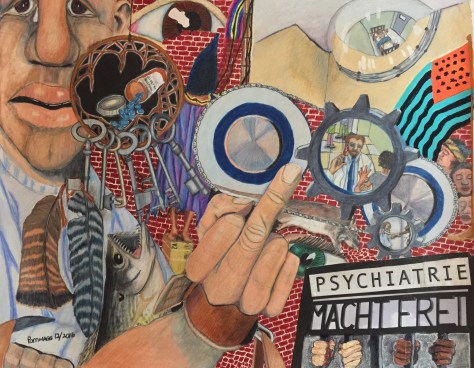


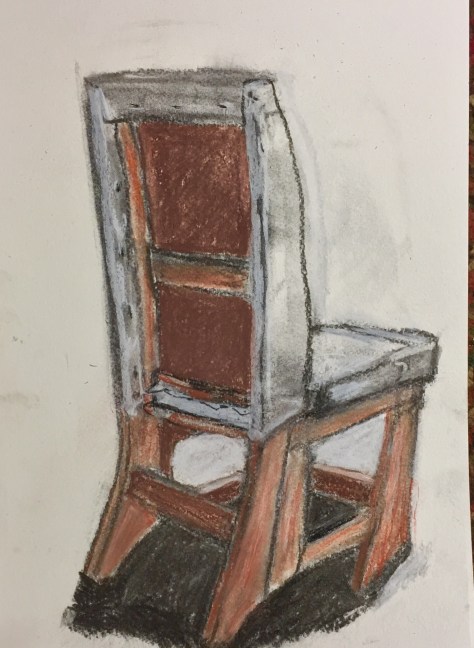
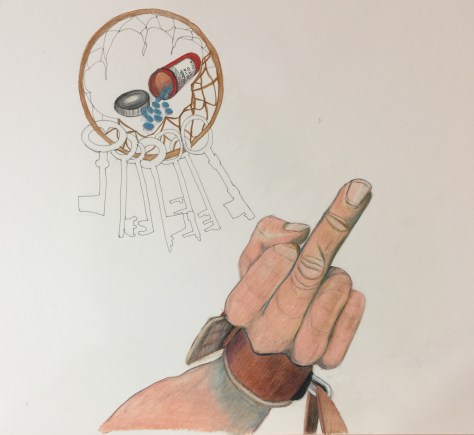
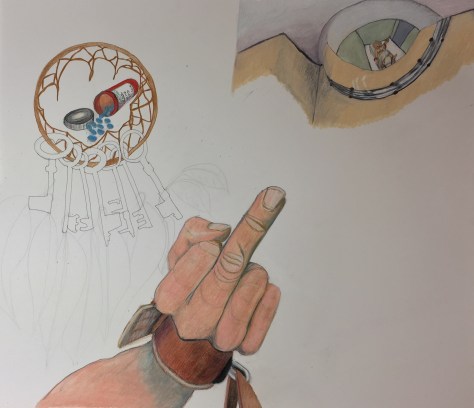

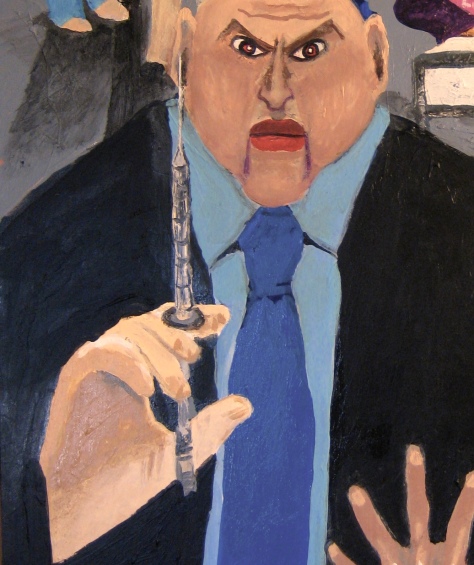





 J
J

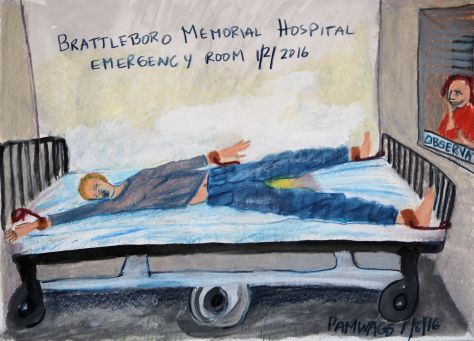



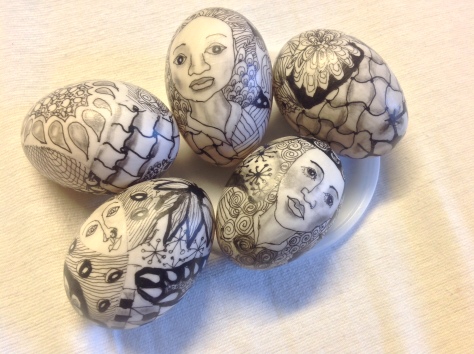 Zentangled easter eggs!

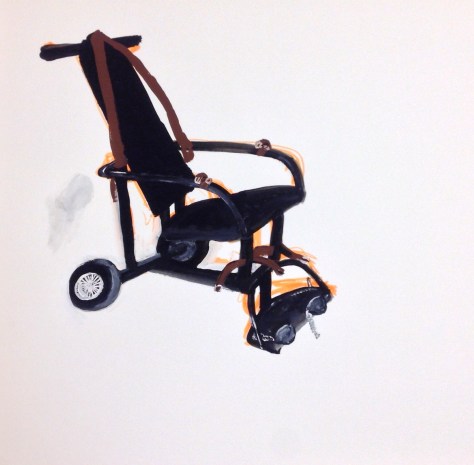




 P
P WAGblog: Dum Spiro Spero