Tag Archives: Recovery

So You Thought Your Genes or Drugs Cause Drug Addiction? Read This and Think Again

 
Johann Hari Headshot

FROM THE HUFFINGTON POST:

The Likely Cause of Addiction Has Been Discovered, and It Is Not What You Think

By Johann Hari

It is now one hundred years since drugs were first banned — and all through this long century of waging war on drugs, we have been told a story about addiction by our teachers and by our governments. This story is so deeply ingrained in our minds that we take it for granted. It seems obvious. It seems manifestly true. Until I set off three and a half years ago on a 30,000-mile journey for my new book, Chasing The Scream: The First And Last Days of the War on Drugs, to figure out what is really driving the drug war, I believed it too. But what I learned on the road is that almost everything we have been told about addiction is wrong — and there is a very different story waiting for us, if only we are ready to hear it.

If we truly absorb this new story, we will have to change a lot more than the drug war. We will have to change ourselves.

I learned it from an extraordinary mixture of people I met on my travels. From the surviving friends of Billie Holiday, who helped me to learn how the founder of the war on drugs stalked and helped to kill her. From a Jewish doctor who was smuggled out of the Budapest ghetto as a baby, only to unlock the secrets of addiction as a grown man. From a transsexual crack dealer in Brooklyn who was conceived when his mother, a crack-addict, was raped by his father, an NYPD officer. From a man who was kept at the bottom of a well for two years by a torturing dictatorship, only to emerge to be elected President of Uruguay and to begin the last days of the war on drugs.

I had a quite personal reason to set out for these answers. One of my earliest memories as a kid is trying to wake up one of my relatives, and not being able to. Ever since then, I have been turning over the essential mystery of addiction in my mind — what causes some people to become fixated on a drug or a behavior until they can’t stop? How do we help those people to come back to us? As I got older, another of my close relatives developed a cocaine addiction, and I fell into a relationship with a heroin addict. I guess addiction felt like home to me.

If you had asked me what causes drug addiction at the start, I would have looked at you as if you were an idiot, and said: “Drugs. Duh.” It’s not difficult to grasp. I thought I had seen it in my own life. We can all explain it. Imagine if you and I and the next twenty people to pass us on the street take a really potent drug for twenty days. There are strong chemical hooks in these drugs, so if we stopped on day twenty-one, our bodies would need the chemical. We would have a ferocious craving. We would be addicted. That’s what addiction means.

One of the ways this theory was first established is through rat experiments — ones that were injected into the American psyche in the 1980s, in a famous advert by the Partnership for a Drug-Free America. You may remember it. The experiment is simple. Put a rat in a cage, alone, with two water bottles. One is just water. The other is water laced with heroin or cocaine. Almost every time you run this experiment, the rat will become obsessed with the drugged water, and keep coming back for more and more, until it kills itself.

The advert explains: “Only one drug is so addictive, nine out of ten laboratory rats will use it. And use it. And use it. Until dead. It’s called cocaine. And it can do the same thing to you.”

But in the 1970s, a professor of Psychology in Vancouver called Bruce Alexandernoticed something odd about this experiment. The rat is put in the cage all alone. It has nothing to do but take the drugs. What would happen, he wondered, if we tried this differently? So Professor Alexander built Rat Park. It is a lush cage where the rats would have colored balls and the best rat-food and tunnels to scamper down and plenty of friends: everything a rat about town could want. What, Alexander wanted to know, will happen then?

In Rat Park, all the rats obviously tried both water bottles, because they didn’t know what was in them. But what happened next was startling.

The rats with good lives didn’t like the drugged water. They mostly shunned it, consuming less than a quarter of the drugs the isolated rats used. None of them died. While all the rats who were alone and unhappy became heavy users, none of the rats who had a happy environment did.

At first, I thought this was merely a quirk of rats, until I discovered that there was — at the same time as the Rat Park experiment — a helpful human equivalent taking place. It was called the Vietnam War. Time magazine reported using heroin was “as common as chewing gum” among U.S. soldiers, and there is solid evidence to back this up: some 20 percent of U.S. soldiers had become addicted to heroin there, according to a study published in the Archives of General Psychiatry. Many people were understandably terrified; they believed a huge number of addicts were about to head home when the war ended.

But in fact some 95 percent of the addicted soldiers — according to the same study — simply stopped. Very few had rehab. They shifted from a terrifying cage back to a pleasant one, so didn’t want the drug any more.

Professor Alexander argues this discovery is a profound challenge both to the right-wing view that addiction is a moral failing caused by too much hedonistic partying, and the liberal view that addiction is a disease taking place in a chemically hijacked brain. In fact, he argues, addiction is an adaptation. It’s not you. It’s your cage.

After the first phase of Rat Park, Professor Alexander then took this test further. He reran the early experiments, where the rats were left alone, and became compulsive users of the drug. He let them use for fifty-seven days — if anything can hook you, it’s that. Then he took them out of isolation, and placed them in Rat Park. He wanted to know, if you fall into that state of addiction, is your brain hijacked, so you can’t recover? Do the drugs take you over? What happened is — again — striking. The rats seemed to have a few twitches of withdrawal, but they soon stopped their heavy use, and went back to having a normal life. The good cage saved them. (The full references to all the studies I am discussing are in the book.)

When I first learned about this, I was puzzled. How can this be? This new theory is such a radical assault on what we have been told that it felt like it could not be true. But the more scientists I interviewed, and the more I looked at their studies, the more I discovered things that don’t seem to make sense — unless you take account of this new approach.

Here’s one example of an experiment that is happening all around you, and may well happen to you one day. If you get run over today and you break your hip, you will probably be given diamorphine, the medical name for heroin. In the hospital around you, there will be plenty of people also given heroin for long periods, for pain relief. The heroin you will get from the doctor will have a much higher purity and potency than the heroin being used by street-addicts, who have to buy from criminals who adulterate it. So if the old theory of addiction is right — it’s the drugs that cause it; they make your body need them — then it’s obvious what should happen. Loads of people should leave the hospital and try to score smack on the streets to meet their habit.

But here’s the strange thing: It virtually never happens. As the Canadian doctor Gabor Mate was the first to explain to me, medical users just stop, despite months of use. The same drug, used for the same length of time, turns street-users into desperate addicts and leaves medical patients unaffected.

If you still believe — as I used to — that addiction is caused by chemical hooks, this makes no sense. But if you believe Bruce Alexander’s theory, the picture falls into place. The street-addict is like the rats in the first cage, isolated, alone, with only one source of solace to turn to. The medical patient is like the rats in the second cage. She is going home to a life where she is surrounded by the people she loves. The drug is the same, but the environment is different.

This gives us an insight that goes much deeper than the need to understand addicts. Professor Peter Cohen argues that human beings have a deep need to bond and form connections. It’s how we get our satisfaction. If we can’t connect with each other, we will connect with anything we can find — the whirr of a roulette wheel or the prick of a syringe. He says we should stop talking about ‘addiction’ altogether, and instead call it ‘bonding.’ A heroin addict has bonded with heroin because she couldn’t bond as fully with anything else.

So the opposite of addiction is not sobriety. It is human connection.

When I learned all this, I found it slowly persuading me, but I still couldn’t shake off a nagging doubt. Are these scientists saying chemical hooks make no difference? It was explained to me — you can become addicted to gambling, and nobody thinks you inject a pack of cards into your veins. You can have all the addiction, and none of the chemical hooks. I went to a Gamblers’ Anonymous meeting in Las Vegas (with the permission of everyone present, who knew I was there to observe) and they were as plainly addicted as the cocaine and heroin addicts I have known in my life. Yet there are no chemical hooks on a craps table.

But still, surely, I asked, there is some role for the chemicals? It turns out there is an experiment which gives us the answer to this in quite precise terms, which I learned about in Richard DeGrandpre’s book The Cult of Pharmacology.

Everyone agrees cigarette smoking is one of the most addictive processes around. The chemical hooks in tobacco come from a drug inside it called nicotine. So when nicotine patches were developed in the early 1990s, there was a huge surge of optimism — cigarette smokers could get all of their chemical hooks, without the other filthy (and deadly) effects of cigarette smoking. They would be freed.

But the Office of the Surgeon General has found that just 17.7 percent of cigarette smokers are able to stop using nicotine patches. That’s not nothing. If the chemicals drive 17.7 percent of addiction, as this shows, that’s still millions of lives ruined globally. But what it reveals again is that the story we have been taught about The Cause of Addiction lying with chemical hooks is, in fact, real, but only a minor part of a much bigger picture.

This has huge implications for the one-hundred-year-old war on drugs. This massive war — which, as I saw, kills people from the malls of Mexico to the streets of Liverpool — is based on the claim that we need to physically eradicate a whole array of chemicals because they hijack people’s brains and cause addiction. But if drugs aren’t the driver of addiction — if, in fact, it is disconnection that drives addiction — then this makes no sense.

Ironically, the war on drugs actually increases all those larger drivers of addiction. For example, I went to a prison in Arizona — ‘Tent City’ — where inmates are detained in tiny stone isolation cages (‘The Hole’) for weeks and weeks on end to punish them for drug use. It is as close to a human recreation of the cages that guaranteed deadly addiction in rats as I can imagine. And when those prisoners get out, they will be unemployable because of their criminal record — guaranteeing they with be cut off even more. I watched this playing out in the human stories I met across the world.

There is an alternative. You can build a system that is designed to help drug addicts to reconnect with the world — and so leave behind their addictions.

This isn’t theoretical. It is happening. I have seen it. Nearly fifteen years ago, Portugal had one of the worst drug problems in Europe, with 1 percent of the population addicted to heroin. They had tried a drug war, and the problem just kept getting worse. So they decided to do something radically different. They resolved to decriminalize all drugs, and transfer all the money they used to spend on arresting and jailing drug addicts, and spend it instead on reconnecting them — to their own feelings, and to the wider society. The most crucial step is to get them secure housing, and subsidized jobs so they have a purpose in life, and something to get out of bed for. I watched as they are helped, in warm and welcoming clinics, to learn how to reconnect with their feelings, after years of trauma and stunning them into silence with drugs.

One example I learned about was a group of addicts who were given a loan to set up a removals firm. Suddenly, they were a group, all bonded to each other, and to the society, and responsible for each other’s care.

The results of all this are now in. An independent study by the British Journal of Criminology found that since total decriminalization, addiction has fallen, and injecting drug use is down by 50 percent. I’ll repeat that: injecting drug use is down by 50 percent. Decriminalization has been such a manifest success that very few people in Portugal want to go back to the old system. The main campaigner against the decriminalization back in 2000 was Joao Figueira, the country’s top drug cop. He offered all the dire warnings that we would expect from the Daily Mail or Fox News. But when we sat together in Lisbon, he told me that everything he predicted had not come to pass — and he now hopes the whole world will follow Portugal’s example.

This isn’t only relevant to the addicts I love. It is relevant to all of us, because it forces us to think differently about ourselves. Human beings are bonding animals. We need to connect and love. The wisest sentence of the twentieth century was E.M. Forster’s — “only connect.” But we have created an environment and a culture that cut us off from connection, or offer only the parody of it offered by the Internet. The rise of addiction is a symptom of a deeper sickness in the way we live — constantly directing our gaze towards the next shiny object we should buy, rather than the human beings all around us.

The writer George Monbiot has called this “the age of loneliness.” We have created human societies where it is easier for people to become cut off from all human connections than ever before. Bruce Alexander — the creator of Rat Park — told me that for too long, we have talked exclusively about individual recovery from addiction. We need now to talk about social recovery — how we all recover, together, from the sickness of isolation that is sinking on us like a thick fog.

But this new evidence isn’t just a challenge to us politically. It doesn’t just force us to change our minds. It forces us to change our hearts.

Loving an addict is really hard. When I looked at the addicts I love, it was always tempting to follow the tough love advice doled out by reality shows like Intervention — tell the addict to shape up, or cut them off. Their message is that an addict who won’t stop should be shunned. It’s the logic of the drug war, imported into our private lives. But in fact, I learned, that will only deepen their addiction — and you may lose them altogether. I came home determined to tie the addicts in my life closer to me than ever — to let them know I love them unconditionally, whether they stop, or whether they can’t.

When I returned from my long journey, I looked at my ex-boyfriend, in withdrawal, trembling on my spare bed, and I thought about him differently. For a century now, we have been singing war songs about addicts. It occurred to me as I wiped his brow, we should have been singing love songs to them all along.


The full story of Johann Hari’s journey — told through the stories of the people he met — can be read in Chasing The Scream: The First and Last Days of the War on Drugs, published by Bloomsbury. The book has been praised by everyone from Elton John to Glenn Greenwald to Naomi Klein. You can buy it at all good bookstores and read more at www.chasingthescream.com.

Johann Hari will be talking about his book at 7pm at Politics and Prose in Washington DC on the 29th of January, at lunchtime at the 92nd Street Y in New York City on the 30th January, and in the evening at Red Emma’s in Baltimore on the 4th February.

The full references and sources for all the information cited in this article can be found in the book’s extensive end-notes.

If you would like more updates on the book and this issue, you can like the Facebook page: https://www.facebook.com/chasingthescream

Don’t Worry, Be Happy, and Dance, Cry, Hum along!


If this doesn’t make you happy, I am very sorry…I myself despite a massive migraine and fears of vascular bleeds found mysefl directing a virtual orchestra in the midst of my pain and by the end, PooF! magically it was GONE! Miracle of miracles!

8D

Photos of Vermont Cottage, and of the Artist, Herself

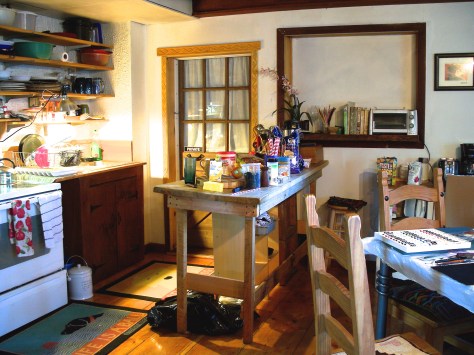
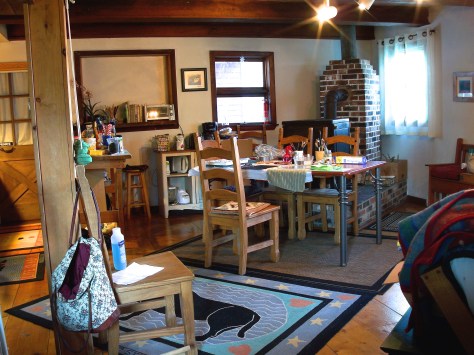
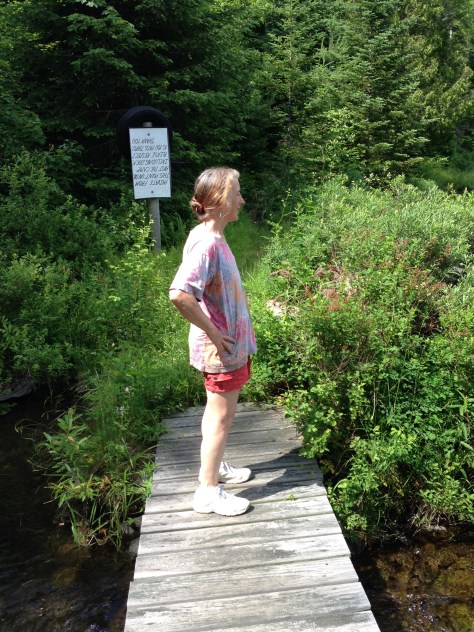
I thought I would post a few pictures of where I have been living these past few weeks, both how it was this past summer and what it looks like now. And me, too. Since most of you likely have no idea what I look like unless you have read DIVIDED MINDS and of course those photos, the most recent in them, was the author photo taken some ten years ago in 2004.

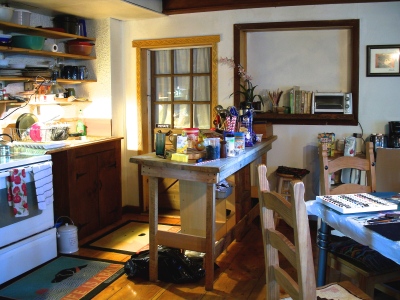
Carriage House Kitchen area summer 2014

summer 2014

Dining/arts area of carriage house Summer 2014

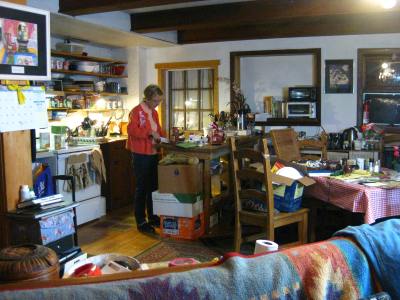
The above photo is the cottage kitchen area and dining/arts area as they were this summer, before I brought all my stuff up here. It was much less cluttered then and lighter! Below photo is the dining and “arts” area where Lydia and I did our artwork and where most of Dr Geuss was made…

The next photo is from the summer, me holding the brown paper beginnings of Dr Geuss (actually this was when Lucy Goosey was rather far along…(trust me! ) Nevertheless if you look hard enough you will see that I am just holding the wings on — I have not yet figured out how to secure them.

Pam with Lucy Goose  (Dr Geuss-to-be)
Pam with Lucy Goose (Dr Geuss-to-be)

As it turned out what I decided to do was to drill a hole through each wing, after Lydia and I painted them, a hole right through a painted dot, then a hole into the body (I think we decided to drill maybe three holes per side about a quarter inch in diameter. ) I sawed chopsticks from supper the night before into little dowel pieces maybe 2 inches long, then I pushed the chopstick dowels into these holes, along with glue, thereby attaching the wings permanently to the body. I thought it was a rather ingenious if not elegant solution to the problem, especially as glue and papier mache solution itself was not going to hold them in the position I wanted.

The only other way I had solved this sort of problem before had been in the out-held arm of Dr John Jumoke. Then I just “smooshed” and actually used Plaster of Paris, which I would not do again. Gypsum (P of P) would just have added weight to the held out wings of the goose, which would not have been good, nor for a sculpture that by its very nature needed to be easy to move.

Anyhow when I was done, I was very pleased when I offered it, through Cyndi my therapist to the Human Services Department in Vermont’s Northeast Kingdom (St Johnsbury) and they were nice enough to accept it.

This was not a given. Hartford’s Children’s Hospital had refused two sculptures on the pretext that they were a “fire hazard” even though for the two days they were on display there apparently they were wildly popular.

Pam with Dr Geuss in NEK Human Services Dept -- Children's Area

Well to finish out this saga, the photo of me with Dr GEuss above is in the children’s department where it started out, but apparently the kids wanted to “ride” it so instead my therapist there who is artistic herself made a lovely table for it, and they put it out in the front reception area for everyone to see. I was thrilled to see this when I came back and first arrived there for an appointment from The Care Bed.

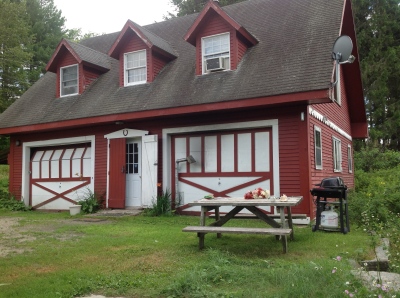
Mt Harmony Farm Carriage House 2014 Summer

The building (above) is the carriage house (or cottage) I live in, as it was last summer. The sooty part of the wall is from the pellet stove, which I am using now in the winter with great satisfaction. But even though it was nearly 0°F last night I still prefer to bundle up in clothing than to use a lot of pellets or keep the house too warm and get a headache! So I keep the stove at “1” rarely even a “2” and have not yet even turned on the upstairs electric heat…On the left, behind the bent door, is the “garage” where the farm and snow clearing equipment are kept…

This next photo is one I snapped not at all by accident of the white donkey, who looked to me just like a unicorn peering from behind the trees! I love this picture because it captures the magic of the past summer and why I fell in love with the NEK and Sheffield and this farm and its owners, Marc and Steffi, and VERMONT!!!!

Unicorn Heres loooking at you

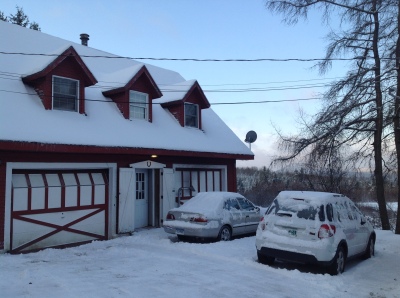
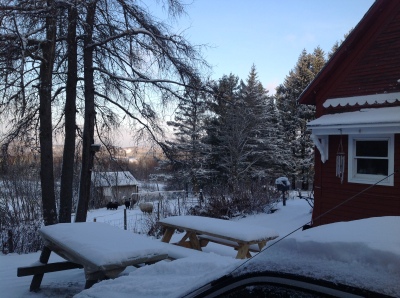
I can’t recall if I posted these next few on Wagblog or only on FB but here is the farm after our first snowfall a week ago (actually it was not at all our first at all, only the first big one I was present for). We had a foot of snow at Thanksgiving again and more last night on top of this apparently unnamed “mountain”!

Snow in November at Mt Harmony Farm!
Mt Harmony Sheep in Snow November 2014
Farmhouse and sunrise on snow in Vermont 2014

Finally a few photos of Wag herself in her new Vermont digs, doing her “thang.”

Pam at table drawing a small sketch before she starts painting

Pam Wagner Nov, 2104

(below)

Pam dressed to the nines and pretending to paint for the camera…In reality I never change out of my grungy gray tee shirt and jeans, and would never paint in such good clothing!

The Artist, dressed to nines and pretending to paint for the camera!
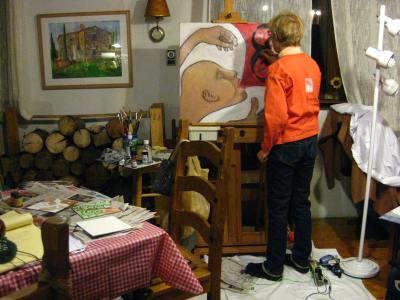
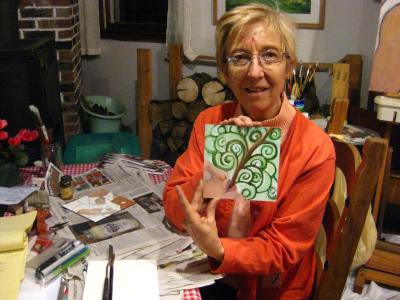
Pam Wagner with new 6" square oil painting based on Don Miguel Ruiz book, THE FIFTH AGREEMENT
Pam Wagner with new 6″ square oil painting based on Don Miguel Ruiz book, THE FIFTH AGREEMENT

Pam displaying results of her oil painting adventures, a picture based on a a very short book that means more to her than almost any other, THE FOUR AGREEMENTS by Don Miguel Ruiz and his newest, written with his son, THE FIFTH AGREEMENT…

Painting is “Sometimes a Dreamer has a New Dream”

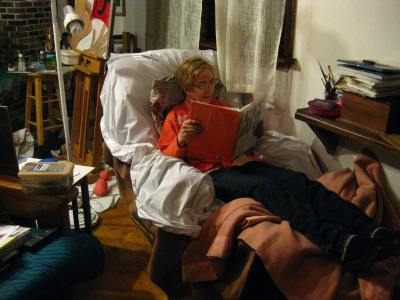
In Recliner, reading about artist, Alice Neel

Above is Pam in recliner in Vermont cottage, reading about one of her favorites artists, Alice Neel…

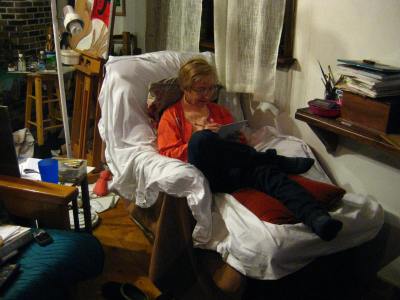
Pam, drawing in  recliner
Pam, drawing in recl

Drawing in recliner

Cooking up a storm with T=day leftovers, nov 2014

(Above) Kitchen area in winter time….Pam W cooking, late at night in November, 2014

You can see that since I came back from the summer it has gotten a lot more crowded….I brought as much as I could pack into a 14 foot truck and gave everything else away. Which was a lot. I donated ALL my furniture to FreeCyclers, including my bed and my recliner. ALL my books went to a teacher at the Cheshire Correctional Institute or their library, except a few precious ones, including the Alice Neel volume. And most of my other items except for art supplies and art work, and cold weather clothing and a few expensive items I knew I would not want to have to purchase anew. But most of my things had been bought at thrift store to begin with and many years ago to boot, so it would have cost more to lug them with me to Vermont than to buy them again, used, once I got settled there.

All the furniture that you see was there when I got here and belongs to the owners, Marc and Steffi. Of all that you see, only the artwork on the walls, and the easel, and the white floor three-bulb lamp are mine…

Frankly I would love to “downsize” even more than this, but do not know how (except for clothing, which is all used and while I like what I have I NEVER wear it)…I have used nearly everything I brought with me, and if I have not, it is only because Marc and Steffi have something here. However, when I go somewhere else, which may NOT be fully furnished, I know I will be glad that I did not toss everything in a fit of pique with “stuff”.

Sorry about this mundane post. I needed to make these photos for my mom, who is experiencing dementia and may not even quite know where I am. I did make taped phone calls that go out to her every night at the same time, telling her that I love her and am moving to Vermont, but I have not been able to contact her “in person” otherwise, since I cannot call her and she is no longer able to do email . So I will write her a letter and enclose these photos. I figured why not also show them to my readers…(and I hope not bore them to tears at the same time!!!

8D

Love,

pam

Papier Mache Art and Recovery: An Update on Thanksgiving 2014

I wrote some or most of this in 2009 but I want to rewrite and update it..

Art, capital A, saved my life. It did more than that. Art gave me a new life, new hope, and something to get up for in the morning. It’s not that I’ve stopped writing. But I had been writing in a vacuum for a long time and needed an outlet for my creative urges that involved more than just my brain. Oh sure, writing involves the hands, too. But not in the way I mean. What I needed was, well, what do I mean? In some sense I needed more activity, if only because my poor brain shuts down and goes to sleep whenever I read, and it simply capitulates to narcolepsy whenever I am sedentary. I have indeed tried standing up while reading and writing, but this doesn’t work for someone whose feet swell very easily. And I find that standing up is just more distracting than anything.

But also  I felt an intense to make things, create objects or works of art that could be seen and touched and even smelled and if scratched or thrown to the ground, heard. I had no idea in 2009 that in 2014 I might even write a couple of rap songs before I succumbed to the impulse to retreat into self-imposed total mutism. If I were VIncent Van Gogh, I might even want to taste my art, but I will try to stick to real culinary arts when that urge overtakes me as I do not at the present time wish to be poisoned by cadmium red etc. Nevertheless, despite my lifelong love for words, I still wanted to create something physical, not just an imagined  or recalled world in words, however long-lasting.

I have always needed to work with my hands. I once wrote a poem called Hand Hunger which some silly psychoanalytic candidate insisted was sexual rather than seeing the references for what they clearly were, to making and creating and building with the hands, to MANUAL LABOR and not to — (sheesh!) masturbation! I mean, how stupid and dim can you get?

Anyhow, I needed to make something or do some sort of craft or artwork. Fearing/Knowing that I could not do “real art,” (YASS,that was ME only a few years ago, telling myself that I could never paint a face! Listen up all ye who think YOU can not  do art!) that I was not the stuff of which true artists are made, I always gravitated towards the crafty side of things. (But pray tell, what stuff is that, Pamela?)

So even when I – on a manic whim – dove into sculpture, creating that llama-in-a-day, Dolly the Llama,

Dolly the Llama at show


the result was mostly folk art, which is to say, unsophisticated, rustic, and at best a craft-like work. Sure, I was pretty proud that I’d made a lifesize animal that actually stood up firmly on its own four legs. But with a deli-container-head (underneath the papier mache) and huge mailing tube body, scarcely concealed, big enough to have once held a large amateur telescope, it didn’t look much like a llama. In fact, the result was not much more than that tube covered with a few layers of paper and glue, and all of it painted red. Nevertheless, I was happy enough with “Dolly the llama.” I have to confess though that it took me a entire year after the psychosis and mania were treated to finish her. Her saddle blanket have fooled many into tugging at the finge to see if it is real or not. a trompe-l’oeil — eye fooling — success that pleased me no end.

But a year-in-the-making was too much time to complete a craft or artwork, even a life-size llama. I came to dread the work by the time I got to applying the last few strokes of paint. You really need more drive than that to do art, but I didn’t seem to be able to sustain the energy or enthusiasm for much of anything. in fact, I’m not at all sure how I managed to write even my part of the book DIVIDED MINDS given those obstacles.

Then, during my hospitalization in 2007 it seems one obstacle was overcome: on Abilify plus the Abilify-tempering Geodon I suddenly had both energy and stamina* (see bottom of post for a later 2014 discussion of this). Or perhaps it is simply that the medications enabled a “well me” to come out, someone who could sustain an artistic effort, even if it was for the very first time. Given a different life I would have been doing this sort of thing all along had I known it was possible, had I had that kind of stamina… But I didn’t think about this, no, for me there was no looking back.

What I did not know at the time I wrote those words back in 2009, or at least  the connection I was unable to make, was that I had actually been on that same antipsychotic drug combination for a several years before this sudden transformation. But in late 2007, however, a small vascular malformation in my frontal lobe hemorrhaged. This was a small bleed, to be sure, but I later felt and some doctors have also agreed this was not impossible, that the timing was such that the bleed itself might in some sense have been responsible for the sudden production of Decorated Betsy

Decorated Betsy: Lifesize Papier Mache


and as my new-found compulsion to do art as well as the felt inability to stop…


Since that time I have jokingly said, “Well, a little brain damage (in the right place) never hurt anyone.” Of course, that is indeed only a joke. because brain damage almost always DOES hurt people. But in this case it seems to have wrought a miracle in my life.


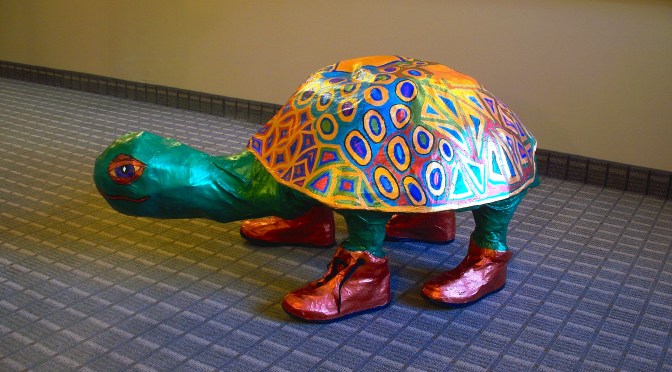
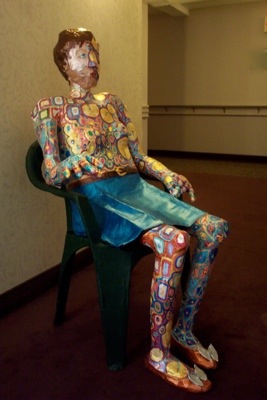
Over the years since Dec 2007,  I have created many pieces, large and small, from bowls to two large tortoises and two geese, even a  “crazy fruit” bowl. Also a large seated man, a child detachable from her hassock (not quite finished) and several small birds. My female sculpture, the Decorated Betsy, even won a NAMI national contest on creativity and mental illness. But why tell you about them. I will upload a few photos instead.

I am going to try to show you them chronologically, but without the  many bowls I have made along with way, except for a few that are particularly special to me. Note that all the sculptures incuding a few that are not shown here, have been donated to someone or some organization, However if anyone is interested in purchasing a new sculpture, I  do accept commissions.

This is the Dream Tortoise, otherwise known as Yurtle the Turtle, which is about 3 feet in diameter. It was my second animal, but my first turtle.


DreamTlooking up

The prescription that this brightly clad psychiatrist holds in his hand reads: Dr John Jumoke, Rx: Art, Poetry, Music.  I thought, well, that  is one shrink even I wouldn’t mind seeing!

Psychiatrist Dr John Jumoke with Rx for Art, Poetry and Music


Trudy, papier mache child seated on paper mache hassock
Trudy, papier mache child seated on paper mache hassock, donated along with Dr Jumoke to Otis Library in Norwich CT.


Crazy Fruit Bowl with Mini-Melon
Crazy Papier Mache Fruit Bowl with Mini-Melon


Papier Mache Goose for Ruth
Papier Mache “Herr Goose” commissioned by Ruth S, one of my favorite artists and mentors.


Herr Goose after revisitation for repairs...Click on the photo to make a close up and you will notice neck "feathers and the difference it makes with old fully decorated version.
Herr Goose after revisitation for repairs…Click on the photo to make a close up and you will notice neck “feathers and the difference between this and the no-gold fully decorated version.


African Queen of Paranoia, without the large gold cascading earrings that I made for her but which catch the light too much to photographed.
African Queen of Paranoia, finally photographed with the large gold cascading earrings that I also made for her. Reminiscent, so i have been told, of the bust of Nefertiti…


African Queen of Paranoia (reminiscent of Nefertiti)
African Queen of Paranoia (reminiscent of Nefertiti) You can see that this resemblance was purely accidental, The bust was mostly an exercise in balance!


Papier Mache Bowl, painted with  slimemold motif and papier mache apple
Papier Mache Bowl, painted with “slimemold fruiting bodies and plasmodium” motif, also papier mache apple


Bird in Cage - Papier mach by Pamela Spiro  Wagner
“Standish” Bird in Cage for Tim – Papier mache by Pamela Spiro Wagner
Wading BIrd
Wading BIrd-given to Joyce Kamenitz, MD. Paper bird painted with nail polish, made by Pamela Spiro Wagner, placed on cellophane covered mirror with stones and soil mixed with polyurethane and glued to mirror.


papie-mache bird in tree banches made for sister by pamela spiro wagner,
Papier mache hummingbird bird in tree branches made for sister, Martha, by pamela spiro wagner,


Dr Geuss:  large Papier Mache Goose  made for the Northeast Kingdom of Vermont's Human Services
Dr Geuss: large papier mache goose made for the Northeast Kingdom of Vermont’s Human Services Approximately 3 feet tall


Tim with Papier Mache Turtle I made for him
Finaly, my dear friend and art collector, Tim with papier mache Turtle I made for him (so you can get an  idea of the size) Turtle’s head is large but the photo was also taken at angle so it looks larger…Notice copper sneakers, two of them with laces!


*As for Abiilify and Geodon “causing” my stamina and better endurance? I dunno what to say? I have little social stamina even now. But I stopped the Geodon almost as soon as I restarted it. I just feared taking any drug that prolongs the QT interval, one, and isn[t  even approved in Europe for heaven’s sake! Why is that? I can think of two reasons. One is that it is NOT effective at all, not even enough for them to fake-believe it, or two, it is too dangerous for the Europeans even to subject their mentally ill to it.  There may be other reasons why the European Union declined to approve Ziprasidone, but I cannot think of any other obvious reasons.


As for the Abilify, well, I have taken it, more or less, since I was in Care Bed, largely because they got me onto it and I am scared, frankly to stop it…And yet, I do have to “get myself” to take it each and every day, stop myself from simply removing it from the slot in the pill tray that it is in…I should. slowly, but I am afraid, I confess. My therapist at the Northeast Kingdom Human Services told me yesterday that I came extremely close to having been forced into the hospital this month…and she is worried about me if I do not take the fricking drug. But I do not believe it does a danged thing for me, nothing bad either, nothing bad that tis obvious at any rate…But what will it do down the road, and what was that stuff going on with my mouth when I was OFF it??? I want to know but I know no one will tell me or even test me for TD, because they do not want to KNOW…They do not want toi know if the  drug is causing brain damage because of the consequences of their KNOWLEDGE both from me and for them.

FUCK THEM and FUCK ME. I don’t know what to do. Everyone has an opinion and everyone has a different opinion and because I do NOT TRUST MYSELF to know myself or my needs, I listen to everyone at least temporarily. I listen to everyone! But I cannot trust what anyone, any one single person tells me, because I do not actually trust any single person to know a goddam thing about it OR to tell me the fucking truth. That  is the problem. Even Nancy, the APRN, who admitted that the drugs were imperfect and very broad targeting, etc seemed to be too enthusiastic for them, rather than trying to find a way NOT to use them. But that may have been because I myself raised a stink about their having taken a WHOLE bottle of expensive pills (GEODON) from my bags at CARE BED and not returned them to me,…I did not like that one bit.

i mean, I am not going to overdose or sell the meds, but I want what I came in with, and they are MY pills, goddam it! Wh=at right does ANY one have to take them from me! So i partly agreed to the Geodon just to get my bottle of pills back, only then it turned out that they wanted to give me a weekly tray so I would try to be compliant …so I did not get the entire bottle only a week’s worth which I frankly am not even taking.


I do not want to take any pills except for what I FEEL in my soul I need! I NEED 1) methylphenidate, or I cannot stay awake to do anything, esp not to drive any farther than 10 minutes  away, if even that. I start yawning about 15 minutes after I wake up…You may think this is a bad drug for someone with a propensity for psychosis but having narcolelpsy is NOT my fault…I cannot stay awake for the life of me. And that was true well before I ever took any other drug. 2) I need topiramate because I really fear seizures, and because if it just reduces my headaches by one a week, it is worth it. I take severall vitamins in larger than usual  but not mega-doses. I take a very small dose of a thyroid medication also, which I would not want to stop…Do I NEED Abilify or Geodon? Some people who have known me for  years and in and out of hospitals say “Yes, absolutely!” some others say, No, not if you reduce the dose very very slowly..”


I do not have ANY inkling myself, none at all, but I want to believe NOT…I do not feel that these drugs do a thing at all frankly. Except bad things, especially in the case of Geodon. I do not usually like it when people tell me what to do, but I wish wish wish in this case that SOMEONE with influence would indeed tell me what to do. Precisely..and convince me. But no one is in that position, not any more. I am just alone and fucked…My therapist practically said, no she DID say: f you end up in the hospital it will be no one’s fault but your own, because you won[ take the Abilify….What sort of thing is that to tell me??? Should I just accept that and be quiet or what? Is she right? I didn’t like it one bit. I felt utterly abandoned and scolded and also basically told, well, you heard! It WILL BE YOUR FAULT! YOU TAKE THOSE PILLS OR WE BLAME YOU!!!!


Enough of this shit…I should, I suppose, have written something about my gratitude for this lovely holiday, the original one that presaged a wholesale slaughter of our good “Indian” buds we had over for the first T-day…ha ha ha.  And how grateful I am for this wonderful country that treats everyone “equally” and with compassion and kindness (justice? Oh well, we need not mention JUSTICE, need we?Justice goes without saying, don’t it???) Ha ha ha, of course if you are melanin-challenged you might not agree that justice nor social compassion…But some folks in MO, and a certain MO town these past few days and nights have come to a different understanding about such things.


Okay enough for the “holy-day” chatter from me for now.


Gotta go pace the driveway.


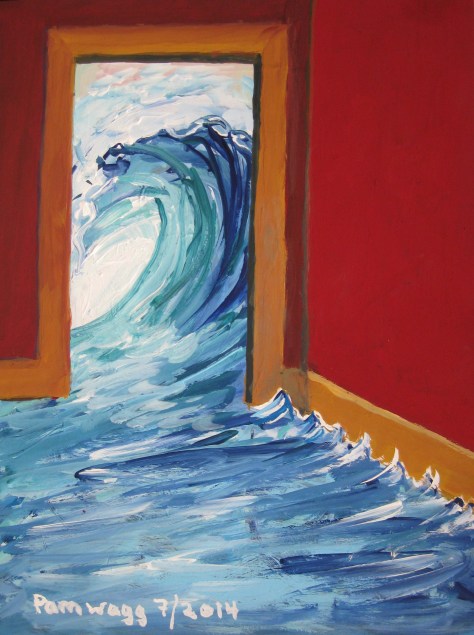
Because Sometimes There is a Dreamer with a New Dream…

Dreaming  a New Dream
Dreaming a New Dream by Pamela Spiro Wagner (“pamwagg”) 11/2014

Talk About Abilify with Pamela

ARC_Talk_About_Meds_Banner_Pamela


I have been asked, by The Recall Center http://www.recallcenter.com, see also http://www.recallcenter.com/xarelto/side-effects/ to “talk about my medications” so here I am, talking about my “favorite psychotropic drug, NOT..”: Abilify.


Why do I take Abilify?


I take Abilify, well, why do I take Abilify? I was prescribed Abilify because of the diagnosis of schizophrenia many years ago, and I usually take it along with another anti-psychotic drug (Geodon). But frankly the reason that I, I myself, take Abilify for now has nothing to do with psychosis or schizophrenia. I take Abilify simply and only because I have this weird feeling that it helps me write and do art. Ever since I have been taking it, or the two drugs together, I have had no trouble doing art at any time or even writing when I want to. The extra plus is that I can finish longer term projects, ones that I start on one day and have to finish over time. In the past this was a problem, but it seems to not be so difficult for me any more. I do not know for certain whether this is due to the effects of the Abilify/Geodon combination, but it feels like it, since I was never capable of finishing projects so easily and reliably before then. On the other hand, I believe that I can do these things myself now, and that once I get used to living here, in my new state of Vermont, I will choose to sloooowly go off the medications for good.


How do I remember to take my medicine?

In truth, I often forget to take my medications, but for the past thirteen years I had a Visiting Nurse come to remind me. And now that I live in another state, where this service is not available, I have a med tray that is delivered weekly. I hope that I will be able, by seeing this tray openly on display on my table, to remember to take the ones I want. At least for as long as I want to take them.


I have been asked about side effects of this drug, but I would say, 1) all “side effects” of drugs are the effects of the drug, and you cannot tell a person that she is only suffering “side effects” especially if they are serious enough to cause distress. 2) there are very serious and troubling effects possible with Abilify, so my experience is not necessarily typical 3) I used to feel very irritable on Abilify, but no longer 4) usually I add Geodon to help me sleep and calm the anxiety that Abilify can induce


Where do I go for Medical support? I just a few weeks ago moved to Vermont, so I do not yet have a Primary Care Provider, but I do have a psychiatric nurse practitioner who will see me – so far, at any rate – once a month. For medical issues, at this time, I do not know whom I will see, but in Connecticut I used to have an APRN at a doctor’s office. I also was able to get to an Urgent Care center easily, in CT. That is not possible here in rural VT. So in the event of a medical emergency, I do not know exactly what I would do, except call 911 and hope for the best!


Before taking Abilify, or ANY anti-psychotic drug, here are the questions that I think you should ask your doctors: You should ask, first of all, why he or she is prescribing an anti-psychotic medication for you. Does he or she believe you are psychotic? If not, why prescribe such a powerful and possibly devastating drug? And if so, why? Doctors should be willing to answer this openly and honestly and if they will not, then I do not believe that you should listen to their advice, but get a second opinion. You never know who might derive financial gains from prescribing a medication that is not available generically. Also, why is your doctor not being honest with you? I would never feel comfortable in a situation like that…


Ask your doctor what to expect after taking this drug and when to expect the effects, good or bad. What does he or she anticipate you will experience as a benefit and what he or she thinks you might experience on the down side? Ask them to be honest about this and why they feel it is worth the cost/benefit ratio to you.


Abilify is extremely expensive and non-generic until 2015, when a generic form is scheduled to become available. So if you can, I would ask your doctors about why they are prescribing this particular drug and not another. There may be very good reasons for it, such as a low incidence of weight gain, and little sedation, at least at doses below 15mg. Nevertheless, I would want to be certain that there were no financial inducements such as stock holdings in the pharmaceutical company involved etc.


There are ALWAYS risks involved when you take pscho-active medications, or any drug, but anti-psychotic drugs can be especially problematic for some people. Even though Abilify causes fewer problems with massive weight gain, for many people this is not always the case and weight gain as well as Type 2 diabetes, with or without weight increase has been known to occur on Abilify. Over-activation and irritability have been reported frequently, in my experience. And many people I know who have taken Abilify have told me that they have trouble sleeping if they take it at night.


Published research suggests that 30mg of Abilify is no more “effective” than 15mg. From my own experience, I can only say that at 15 mg Abilify is quite activating but at 20-30mg it becomes suddenly sedating and less helpful. This is why so many people refer to Abilify dosing as “Less is more.” They mean in some sense that the lower doses work better than the higher ones, unless the sole goal is sedation, in which case I would say there are better drugs for that purpose and safer ones.


As for drug interactions, I am not aware of any important ones.


Finally, the three main things I wish I knew before taking Abilify are what I wish I’d known before I took ANY anti-psychotic drug many years ago: that if I took what they gave me, and kept taking it, 1) I might be disabled for the rest of my life 2) it might induce chronic/episodic psychosis – i.e. stop the natural process of recovery in its tracks 3) NOT that my brain’s neurochemistry was already “out of balance” but that my brain and its neurochemistry would be changed and destabilized by the drug itself…


That is what I wish I knew before taking Abilify. Before I take any drug from now on, I will find out these things and determine for myself whether the cost/benefit ratio really makes sense.


But on the whole I would say that NO DRUG developed in the last 20 years has been adequately or honestly researched for any pharma company to make a claim about either its efficacy or its safety. NONE. So I would on that basis probably never take a new drug from now on. There is not a drug company out there that I trust to have done ANY new brain research, since it’s all based on junk and garbage theories that arose from “back researching” Thorazine, which was bogus in the first place. So why would I want to take a drug that was developed from research coming out of that cesspit?


I am 62 years old. I am NOT suicidal and I certainly do not want MDs with murder on their brains to euthanize me with their psycho-drugs, or to use me as some guinea pig to determine how much control they can have over people…NO MORE DRUGs, NO MORE DOCTORS, NO MORE HOSPITALS AND HOSPITAL ABUSES.


I may take a couple of drugs today in order to survive the transition from CT to VT, but you must understand that my brain was already damaged from the years of having been given them against my will. So I HAVE AN ALREADY DAMAGED BRAIN, from the medications I’ve already taken.


I do not advise anyone with a more or less intact brain to take an anti-psychotic drug, not ever, not if you can avoid it and certainly not for “the rest of your life.” NEVER take any drug on an ongoing, “forever” basis. ALWAYS re-evaluate your need for it.


And that is all I am going to say about Abilify. If you take Abilify for “depression” you have come to the wrong place. Nevertheless, I have written a blog post just for you. Do a search on “Add Abilify” and you should find it. But you won’t like it any more than this one. Sorry about that.


THANK YOU, MICHAEL EDWARD BALKUNAS, MD FOR EVERYTHING!!!! Along with my GOOGLE + REVIEW of NEW BRITAIN GENERAL HOSPITAL

I would put my entire New Britain General Hospital chart online except that i only have access at this time to a small portion of my MAY–JUNE 2014  record as they decided that 1000 pages was too many to send to my psychiatrist the first time around. She  requested the entire chart, but lazily they sent the discharge summary and the ED chart. In the meantime we have put in an immediate request for the rest and they said they are sending those ASAP.

Interestingly, the first page of the ED report states that availability of Advance Directive is “unknown.” Nevertheless, the ED triage notes state, with apparent disapproval and resentment, that “pt presents with details instructions [sic] on how to provide her care..” ie the advance directive (which it seems was immediately disregarded as an insult to their knowledge)…

ED Nurses note by “Seneilya… RN Assumed care of patient. Patient arrived via EMS after VNA called for increased anxiety. EMS reports patient refused to speak but wrote down, “Sunglasses block hate. I don’t want to hurt anybody.” On admissions patient refused to speak to this RN. Patient pointed at her head when asked why she was here. Patient nodded “yes” when asked if she was hearing voices but refused to answer other questions. …(next sentence indecipherable)

Report given to Beth RN who assumed care of patient…

At 15:19 Beth RN wrote the following:

“Pt not responding verbally to this nurse, this nurse looked through her art book and placed it back on her stretcher then pt picked it up and slammed it down on the stretcher and pointed her finger at the book. Unable to get pt to communicate. Pt pulled sheets over her head. Pt still in street clothes, will pt [sic] as is until examined by MD.”

What is not said here is that this nurse, “Beth” never asked me whether she might look at my artbook. She simply took it as her right to look at it, and then did so. She refused to allow me any means of communication, however, but demanded that I speak to her. When I was unable to do this, she did not inquire in any fashion as to why I was not speaking nor apparently make any inquiries from anyone else as to why this was so. If she had provided me with means to write I might have been able to tell her what had happened in the previous two weeks at home. Instead, she was so furious at my lack of speech that she belligerently refused to permit any other mode of communication but made assumptions that were extremely detrimental.

I was later given a hospital gown and told to dress myself or I would be forcibly assisted in doing so.

This is what Beth RN records what happened after I was provided with a meal that I could not eat because it was not vegetarian. Note that before this, I had begged gesturally for a means to communicate and all such implements had been outright refused me. This had led to my slamming the artbook on the stretcher in frustration and pulling the sheets over my eyes, effectively silenced.

Now with my meal, I at last had a means to write.

“Pt ate nothing,” Beth RN reports, “[but she] wrote messages with ketchup and French fries, ‘I need a crayon.” This nurse told pt she needs to speak because she can, pt threw everything on her table on the floor, food juice, etc. Pt then picked up fries from the floor and started eating them and gathered more and putting them in the bed with her and kicked the other food away in the OBS area.”

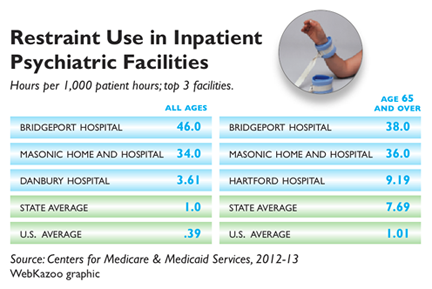
“Pt went to the BR, seen coming from the BR with paper towels then pt observed writing with her finger on a paper towel with something, first thinking it must be ketchup, then maybe jelly, then this nurse go up to check and pt found to be writing with her own feces, some paper was able to be removed, other paper with large piece of BM pt through at this nurse. Pt moved to room 42 [seclusion] then pt got OOB and snuck around corner and tried to attack this nurse from behind, public safety was able to get to pt first, pt to be medicated and restrained. Pt licking feces off fingers, would not let nurse wash her hands…”

Now I want to tell my side of this story because they invented this story out of whole cloth. Yes, parts of it are true, but out of order and not the way Beth related it. This is important because the way she wrote it makes me seem like I spontaneously attacked her out of the blue, which never happened. However, I was also privy to a conversation by the so called Public Safety officers, AKA Guards, who in front of me decided to create this story in order to justify restraining me, because they simply wanted an excuse.

What really happened was that due to my needing to communicate, I wrote my needs with ketchup on the paper box the meal came in, but that was taken away from me, and Beth, rather than telling/asking me to speak came up to me with a NOTE she had written to me (the irony of this is beyond belief except that it is true!) saying, “I will not speak to you or give you anything to write with until you start speaking to me…” Oh GOD! It was incredible. At this point, I was livid and also desperate to write so I had no choice but to use my own feces, which didn’t strike me as awful as it might have…What other choices did I have???? None at all.

So I did as she wrote and I tried to write journal entries about what was happening to me on paper towels with my own fecal material. This of course did not go over too well. However, I never snuck up behind Beth and tried to assault her. What happened was what I wrote in the second rap song. She snuck up on me and simply SNATCHED my artwork book out from under me and raced away with it, holding it up in triumph. I was so furious, without even a thought as to any possible consequences, that I raced behind her intending only to snatch it back. That was all. I never assaulted her, I never so much as touched her. I only grabbed for the book that she had not asked for from me. PERIOD.

That was when they dragged me to “Room 42” and when the guards, holding me down, decided they wanted an excuse to restrain me, and though one of them cautioned that they really had no reason to do so, the other told him not to worry, “we’ll find a reason.” And as I learned shortly thereafter from accusations made by Dr Balkunas, they did so.

But an accusation made isn’t necessarily true, as we all know, and just because Dr Balkunas accused me of LYING or of making up a story doesn’t mean that was true either. He never asked me what did happen. He never tried to find out the real events of that evening, he simply designated me as manipulative and “volitional” essentially a prime-time liar…Which meant that this started a snowball of a disaster in the making. Because by the time he finally saw me on the W-1 Psych Unit the next day, he had already made the decision not to let me communicate by writing and therefore he meant not to let me tell him what was going on from the first. He had decided not to recognize the extreme state of desperation and frustration this induced, but to see only violence and willfulness and to deal with this by punishing me with torture. PERIOD.

But I am getting ahead of myself. Michael E Balkunas, MD , the self- proclaimed god of W-1, claimed to have been there when this happened, when the guards said that I just shot up off the gurney and attacked Beth, the nurse, from behind. But the record does not bear this out. In fact, he never saw me at all until the next day and all the orders were written by other physicians. Dr Balkunas’s name is not even mentioned until the afternoon of May 13 when it says only that he was at my bedside to evaluate me. Even then, from what I recall, I was so sedated after multiple forced meds that I was unable to answer any question. I was unable to speak in any event, so given the face that he refused me the tools to write with, this was as unproductive an evaluation as possible.

I was to be admitted to W-1 on the basis of his snap judgments from that evaluation,: from which he drew the diagnosis that I had a probable “borderline personality disorder.”

How could he possibly diagnose a personality disorder, something that takes time to discern in a person, after seeing me after such an extremely traumatic circumstance, for less than three minutes? In point of fact, what likely happened was that he took an immediate disliking to me, and decided to diagnose me with something that in his mind justified his egregious treatment of me as well as his immediately not allowing me to write instead of speaking. I cannot otherwise explain his behavior . Nor can I understand his apparent surprise at mine when I did not respond to him as he expected. Why did he think I would respond positively when he refused to speak to me unless I was verbal? Why did he think that coercion would bring about a positive reaction? Did he truly think this would be helpful and restorative? I doubt it. I think he just didn’t like me and so he opted as most men do to abuse and punishe me out of rage. Because he was fed up, he lost his temper with me from the get-go…

I recall thinking about the rage  in his voice and how out of control he sounded as he sent me to “Seclusion! Seclusion! “ He actually screamed this directive to the guards as they deliberately grabbed my torn rotator cuff which they had been told about in the emergency room (so they would use it to their advantage) propelling me headlong down the hallway. “Restraints! Restraints!” he shouted in a shrill and angry voice.This was retributive and nothing else. He was furious and I was going to learn not to fuck with Michael Edward Balkunas, head of the W-I general psychiatry unit in the Hospital of Central Connecticut in New Britain or he would know the reason why!

But don’t let me put words in Dr. Michael Edward Balkunas’s mouth. Here is what he wrote, in his words. He wrote, surprise, surprise that “while in seclusion I would often scream” . Yet he states with apparent resentment that I had brought items with me “such as a large advanced directive” The nursing notes repeat this as if this is an evil thing, and proceed to disregard every item on it with relish. Not only that but Balkunas from the first accuses me of behaving with “volition” although he does not actually adduce any facts or observations to back up this thinking, except that I brought with me the large advance directive and a published book of the art work I had done.

This artbook, by the way, was was kept from me the entire time I was on the unit on the pretext that it would be very harmful for  the other patients if they were to see it.I was led to believe that the mere glimpse of my artwork would hurt them. This was emphasized to me so many times that I felt  guilty not only for having brought it with me, but for having drawn the pictures at all. The RNs seemed to enjoy my feeling so bad about it….

Balkunas further claims that he “asked if I would like to speak to him, PLEASE” but what he fails to note is that he refused to permit me any mode of communication other than verbally and that he peremptorily walked out on me when I could not utter a word. He notes that, Yes, I did throw my bed-clothes at him, but does not mention that he would not even look at my gestures in response.. Instead, he stood up in disgust and turned on his heels and strode out.

I admit that having already been so abused in the ED I was hideously upset at being unable to make him stay, unable even to make him HEAR me, that I did the only thing I could do to MAKE ANY NOISE at all, WHICH WAS TO THROW THINGS…

Both my brother and my psychiatrist claim that they told him pointblank not to draw baseless and dangerous conclusions from my traumatized behavior, that he would be making a mistake and would injure me badly if he did so. But he was of course the superman that all in-hospital psychiatrists are, the MR RIGHT that can finally fuck* you and get it right. SO he took one look at me and said, THAT IS OBVIOUSLY A CASE OF BPD if ever I saw one… Of course! And NATURALLY Michael E Balkunas is MR RIGHT, The one who fucks* you and you finally thank him for it, OF COURSE!

So THANK YOU Michael E Balkunas, You FUCKED* me OVER royally and you must have enjoyed it, because you fucked* me up the ass too. And I had to thank you in the end, didn’t I? Thanking you for fucking* me was the only I could earn my way to discharge, You forced* me to bend over and beg you to fuck* me up the ass and then Thank you again for abusing me just like any asshole who abuses women. You murdered* me, and halfway through slicing* my throat you made me beg you to fuck* me, and I did because it was the only hope I had that you might let me off with my life…Finally, with my throat half sliced* and my asshole fucked* wide open, you said, OKAY, now you can leave, you are free, you can go home now. I have had my way with you so go away…

So THANK YOU FOR FUCKING* WITH ME MICHAEL EDWARD BALKUNAS MD, GOD, THANK YOU FOR LETTING ME GO….I owe you my life, because you let me go and you didn’t in fact murder my body, I am still alive, though barely, you only tortured me and you only fucked* me and murdered my soul. You killed my spirit but you did leave my body somewhat intact so I could walk out of there and for that I had to pretend to be grateful and to thank you every day for a week, so I mouthed the words, Thank you Michael Balkunas for fucking* me and letting me leave stll alive….

But I wish you had killed me dead. Instead, you manipulated me into thanking you, for fucking* me over. You didn’t kill me quite. You made me thank you and thank you and thank you…and so now what do I do, you asshole- fucker*, but live with the torture you inflicted and wish you would crawl into your early grave somewhere and explode into a ball of maggotry.

*metaphorically, of course, but in a very real way nonetheless…So I feel it every day and wish I were dead! Note that in every other instance where an * is missing I usually mean my words literally and without any sense of metaphor whatsoever.

NOTE that this is the link to my  GOOGLE + review that I posted shortly after my stay at New Britain General Hospital..I think I was rather measured in my appraisal, after all was said and done.

https://plus.google.com/u/0/109362057307724485552/posts/ak5CU7s3qL1

For Sensitive Bodies and Sensory Overload: A Weighted Blanket

When I first spent time at Natchaug Hospital, at the time when Sharon Hinton, APRN, was still the director of nursing and it was a decent non-abusive hospital (in 2011 and 2012), I learned about weighted blankets and the amazing benefits to be gained from their use when stressed, upset, and in need of self-soothing or calming. Not everyone benefits, I gather, but if you suffer from PTSD or any of these other disorders. you might find a weighted blanket useful.

  • ADHD/ADD
  • Alzheimer’s
  • Anxiety Disorder
  • Aspergers Syndrome
  • Autism or ASD
  • Bi-Polar Disorder
  • Brain Trauma Injuries
  • Cerebral Palsy
  • Dementia
  • Down’s Syndrome
  • Epilepsy and Seizure Disorders
  • Fetal Alcohol Syndrome (FAS)
  • Insomnia
  • Parkinson’s Disease
  • Pervasive Development Disorder
  • PTSD
  • Restless Leg Syndrome
  • Rett Syndrome
  • Sensory Integration
  • Sensory Processing Disorder
  • Tourette’s Syndrome

One problem with buying  a weighted blanket for most of us however is the cost. If you don’t have $400.00 dollars on hand, it can be prohibitive to get the best or even a full-size heavy blanket. I don’t know about you, but a mere lap-size thing doesn’t do it for me, even though they tout the uses. I tried one at Yale for lack of anything better, and it did nothing at all but feel like a pillow on my lap. This was ridiculous. They would have done much, much better if they had handed me a real live cat and not pretended to be doing something useful with that silly piece of fabric.

The heavy full-size blanket, on the other hand, was great. It felt like a cocoon or a huge hug that held my entire body without restraining me. I could move around in it, and yet it held me warmly and gently. Nothing kept me in against my will and I could get out from under whenever I wanted to. In fact, the nurses made me leave before I was ready. They actually took it away after twenty minutes which was silly. This was way too short and arbitrary a time in which to keep the blanket on me. I was NOT used to it by then or calmer. Not at all. I wanted to stay inside it  and needed it on me longer. But they said the protocol was for 20 minutes on and 20 minutes off so the person didn’t accommodate to the weight. Silly reasoning. Why didn’t they ask if I felt better or was calmer? Or ask me some other question.

Anyhow, here are the directions and photos for making your own homemade weighted blanket. It is quite easy and inexpensive, and you only need to do a little hand-sewing, or if you prefer, just use some heavy-duty glue (E6000 is the best), and velcro. Both ways are fully washable.

Directions for Making A 15 pound Weighted Blanket:

The first two photos show half of the “inside, or under side, of a kingsized coverlet that I sewed Dollar Store (2 for $1) microfiber washcloths onto, making pockets. (BTW pay no attention to the the shoelace ties and buttons, which never worked but were part of a first experiment…) I placed the fuzzy side of the washcloths facedown. This is important because when I glued velcro’s stiff bristled half, face up, to the blanket at the pocket tops, the microfiber washcloth gripped it perfectly, so there was no need  for the softer side of velcro on the inside of the pocket itself.

Handmade weighted blanket with microfiber pockets for rice bags
Handmade weighted blanket

Next, (see the close-up photo) I filled quart size freezer bags (a box for  $1 at The Dollar Store) with 1/2 to 1 pound of raw rice, depending on the weight wanted, and then double-bagged these. Note: my blanket has 15 pockets but I’ve found that 15 pounds of rice is actually heavier than I personally want, despite what I thought…).Depending on your own body weight, you could prefer between 10-25 pounds of rice. The chart I found said that a person weighing 112 pounds might need 10-15 pounds and a person weighing 185 pounds would need approximately 25 pounds of weight. On the other hand, the hospital never allowed anything more than a mere 10 pounds, erring on what i consider an absurd side of caution for all…So you can gauge your needs from that.

Be aware however, that despite what a 15 pound bag of raw rice might saw on its side, it usually contains much more than 15 pounds so weigh each bag you fill carefully, don’t just divvy up a bag of rice into equal parts.

Rice Bag for weighted blanket

Fill the pockets with the rice bags and press-seal the washcloths against the velcro. Flap the other half of the blanket (final photo) over the pocketed half and use as a twin size weighted blanket. It works fine like this, but you could add velcro to the blanket sides themselves if you  wanted to seal it up completely.

Weighted Blanket Open


Weighted Blanket, Closed
Weighted Blanket, Folded Closed

By the way, for gluing the velcro I used the E6000 glue, outside on the driveway on a plastic sheet, on a sunny day…I would not use anything else, but don’t do it inside without plenty of good ventilation as it is poisonous and you use a lot.

Good luck and feel free to email me or comment if you need help or have any questions. Sorry if I didn’t provide enough details but I didn’t want to overwhelm you here. I would be happy to provide more privately or in the comment section if anyone is interested.

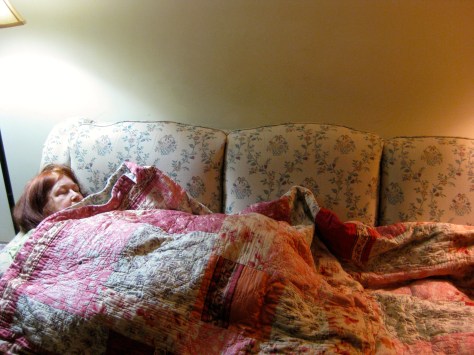
M sleeping under my homemade weighted blanket


A Poem for My Aging Mother

My poor mother is suffering from dementia at 87 and it is very sad and difficult to watch her decline. I will write more if I can at some later time about it but for now I want just to post a poem I wrote for her years ago and then rewrote completely recently.


Over the years we have had some troubled times. Because my father disowned me for some thirty-five years, she had to make a choice between him and me, essentially, and the one she made was obvious. I was out of the house by then and I am not sure it ever really occurred to her to make any other choice, but who knows? I do not. In any event, I bear her no bad feelings for this, I do not think. Though had I been “her son” with schizophrenia i believe the outcome and her choices might well have been very different, as they always were when it came to my brother.


But that is water under the bridge. The choice was made and I was sacrificed. That said, perhaps it is a good thing, I dunno. If she had given up her life for me,  I might never have developed any independence at all, or written the poems and books I have.  I might never have discovered my art abilities. Who knows? No one knows, of course, what their “alternate futures” might have  held. We can only work with what we have and the cards we are dealt. We can’t make others choose on our behalf. Much as we might wish them to.


I never wanted my mother to give up her life for me. I felt guilty enough, just for being the way I was. The worst thing in the world would have been for her to make any sacrifice for me at all. For anyone to have done so would have been damaging to me. So I am glad that everyone went on their way, because otherwise I would have had to kill myself in apology.


I could say much more but I am sleepy so without further fanfare, the poem:


PHONE CALL TO MY MOTHER AT SIXTY


I have not thought of you all day.

A March wind rattles the wires,

wishing you a belated happy birthday.

You are sixty, my grandfather ninety,

my younger sister thirty,

but if there is significance in that,

a syzygy, some conjunction in the heavens

I have yet to figure it out.

Your husband answers, my father,

aligned against me north-north,

between us implacable silence.

So we sidestep confidences,

suspecting he is listening in

until in the distance the line clicks

like a playing card in the spokes.

But even so, how carefully we speak,

expelling words of fragile allegiance

each of us pretending not to know

what the other is thinking.


Suddenly you confide, you feel old:

the baby is thirty, you don’t like

your new job, you miss teaching,

the exuberant children, their bright

and lazy charm. There is so much to do,

so little time. Before it is too late


you want to captain a boat to the Azores,

learn cabinet-making — you have the tools,

a lathe, a power saw, inherited from your deaf father

who never heard you speak

but built you a fabulous dollhouse

and taught you, at ten, to sink the eight ball.


Could I ever confide that I, too, feel old? At thirty-five

you had a husband, four children,

a career in the wings. Older by a decade, I rent

a single room and have no prospects

beyond the next day’s waking.

Instead I carefully quote Joseph Campbell’s

advice: follow your bliss.

And I remind you Aquarians always step

to a different drum’s thunder.

You like these clichés,

and laugh, repeating them, then you say

with a sudden spontaneous sincerity

that moves me how good it is to talk with me.

I think of all the times we have not spoken,

how at sixty it would be nice

to have a daughter to talk with

instead of friends wakened in the night,

reaching over husbands or wives,

to answer the phone, “Hello? Hello?”

their wary voices expecting

death or disaster.


You are tired, you say now,

you have an early appointment.

We promise each other a date for lunch.

But I will not call for a long time.

Or perhaps I will call the next day.

Before you hang up, you let slip

it’s your wedding anniversary, one

marked by some mundane substance —

stone, carbon, foil, rope.

Should I congratulate you, I wonder,

or console you? Finally, we say good-bye.

Across the wires I think I hear

your voice crack, but it could be the wind

or a bad connection.

Trauma and Its Sequelae: A Hospital Poem on Abuse by Michael Edward Balkunas MD

TRAUMA AND ITS SEQUELAE…


Written months after my 4-week admission to the psychiatric unit, W-1, at New Britain General Hospital/ Hospital of Central Connecticut, in 2014 where I was “treated” and abused by Dr. Michael Edward Balkunas, MD


Nine days after your worst hospital stay ever

you are still wearing the shades

that protect others from you

though no one else believes they are in danger

Those staff however wrote you up

as “assaultive” and dangerous to self

and others. But they didn’t mean it the way

you do now and their description of your

behavior was neither accurate nor truthful

Often they lied, as liars do,

just for the sake of convenience.


Now you are a week away from meeting new “cousins”

who await your vacation in northeastern Vermont,

a place magically named the Kingdom

and the recuperation your mind-body badly needs.

Still unable to let go, you perseverate over

the half-nelson grip of sadistic guards

bent on eliciting pain.

What happened to the nurses’

“healing touch,”

their concern for “the dignity, worth,

and uniqueness of every individual”,

or their “primary commitment

to the patient?”


When the guards forcibly stripped

then four-pointed you to an bare mattress

they were just replaying their favorite rape

yanking each limb wide

to expose, degrade, humiliate.

Never mind the nurses’ vow to protect

the vulnerable. The official hands-off policy

protected only their own asses.


So how do Truth and Forgiveness Programs proceed

when so many refuse to acknowledge wrong?

The hospital broke every humane rule;

they only stopped short of murder

because you submitted,

nick of time. Yet they had the last word:

stuffing your screams

when they muted the intercom

and slammed the door between you

and the mandatory one-to-one observer.


No one ever is there to bear witness, is there?

That point has always been the point,

from Daddy to doctors.

and all the hairdressers and nurses in between.

They’ve made a religion of secrecy

and no one wants to know

what they don’t want to know.


Call it “our family’s business,”

call it “a private cut and shampoo,”

or just call it, discreetly, “treatment”–

but they can always do what they want to, to you.                          .

When they break you, they declare

you’re just “one of the family,”

no different from anyone else,

now that they’ve finally fixed you for good.

HOW TO PREVENT A CHOKING FIT

1. CLOSE YOUR MOUTH AND BREATHE THROUGH YOUR NOSE.

This will make you realize you CAN breathe just fine and immediately stop the panic.

2. WHILE BREATHING THROUGH YOUR NOSE, gently try to push the food item back up into your mouth, or swallow it if you can.


I figured this out while living alone. I would panic when I felt myself choking. It works like a miracle, because it is usually a spasm in the upper throat, near your mouth, and not a closed off pharynx that causes coking sensationss. You just have to understand that you CAN still breathe through your nose and that will end the panic. Once the panicky feelings are over, everything is easier to deal with and you can usually spit out the food or even find a way to swallow it. But at least you realize that you are not imminently going to die, which is a good thing to know.


Hope this advice helps someone. If it does, I would love some feedback. I have offered it to friends, and they have loved it, found it useful too, so I know it works.


Best wishes to all,


Pam

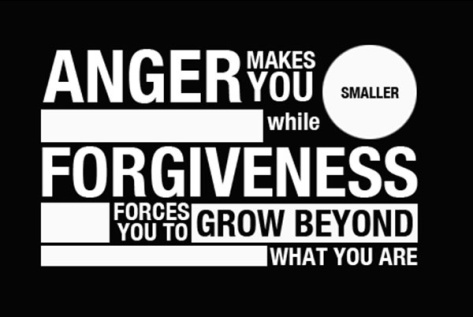
Poem about Radical Forgiveness


Forgiveness or anger? Its your choice....
Forgiveness or anger? Its your choice….

TO FORGIVE IS…

To begin and there is so much to forgive

for one, your parents, one and two,

out of whose dim haphazard coupling

you sprang forth roaring, indignantly alive.

For this, whatever else followed,

innocent and guilty, forgive them.

If it is day, forgive the sun its white radiance

blinding the eye;

forgive also the moon for dragging the tides,

for her secrets, her half heart of darkness;

whatever the season, forgive it its various assaults

— floods, gales, storms of ice —

and forgive its changing; for its vanishing act,

stealing what you love and what you hate,

indifferent, forgive time;

and likewise forgive its fickle consort, memory

which fades the photographs of all you can’t remember;

forgive forgetting, which is chaste and kinder

than you know; forgive your age and the age you were when happiness was afire in your blood

and joy sang hymns in the trees;

forgive, too, those trees, which have died;

and forgive death for taking them, inexorable  as God; then forgive God His terrible grandeur, His unspeakable Name

forgive, too, the poor devil for a celestial falll no worse than your own.

When you have forgiven whatever is of earth, of sky, of water, whatever is named, whatever remains nameless


forgive, finally, your own sorry self, clothed in temporary flesh,

the breath and blood of you already dying.

Dying, forgiven, now you begin.


by Pamela Spiro Wagner in “We Mad Climb Shaky Ladders” (Cavakerry Press 2009) also featured in “Divided Minds: twin sisters and their Journey through  schizophrenia.”

New Poem: On Not Speaking

ON NOT SPEAKING


When I went temporarily mute at age sixty,

it sparked no visual wonders.

After decades schooled by dictionaries,

vocabulary categorized the world:

“precipice,” “acrid,” “blanch;”

words even defined my senses.

But one can fall into

speechlessness for reasons

beyond pathology

though these may not seem reasonable

to people who believe that only talking things out

or about them makes sense.

Speaking or not, I knew

when silence was less insane

than trying to be heard

by those who would rather hurt me

than pay attention.

But if, as they say, silence is so eloquent,

why couldn’t anyone hear

what I so desperately didn’t say?


Beyond Recovery: Stage Five

I want to reblog this brilliant post by Anne C. Woodlen and then i will add my own editorial comments if i can in a later post or edit. In the meantime, i think it speaks for itself and says just about what i would want to tell a lot of young people newly diagnosed with bpd or did or add or even bipolar disorder and getting on disability, preparing for a life “in the system” – it sucks and it isn’t worth it unless you are floridly psychotic. And even then, don’t believe what they tell you about antipsychotic drugs. There ain’t no such medication, only sedatives that may or may not quiet things down temporarily. The only way out is through, if you can do it with a wise and caring guide and community. Don’t get stuck as i am, on multiple antipsychotic drugs, addicted to them so that getting off them only means you get more psychotic than ever. Psychosis need not be a lifelong problem, but it certainly will be if you keep taking high doses of the drugs and never explore other options.

annecwoodlen's avatarBehind the Locked Doors of Inpatient Psychiatry

Hello,

My name is Dustin and I live in Michigan. When I was seventeen years old my mother put me in a psychiatric hospital called Forest View. The abuse I felt violated me to the core! I felt like I was being raped having to submit to all the rules, the bullying and the emotional abuse. To have your dignity removed when you are an innocent patient and just want genuine, kind, gentle care, and get unprofessional jerks who you can tell are fake and just care about getting paid is a horrible experience.   If anything it only caused me more traumas with the trauma that I already had. I am now twenty-two years old and live on disability while also living my life as a hermit because now I am afraid of people due to the awful treatment I endured.  I was diagnosed with Borderline Personality Disorder by a REAL…

View original post 856 more words

TooGoose Lautrec, the Papier Mache Goose and How I will Miss Vermont, the state of my Dreams…

Pam with unfinished paper mache goose, TooGoose Lautrec....
Pam with unfinished paper mache goose, TooGoose Lautrec….    


Across the driveway llive some great people...
Across the driveway live some great people…


Kitchen and work area in cottage


More of Work area and art area
Stephanie is "gods gardener" or so I call her!
Stephanie is “gods gardener” or so I call her!
Steffie at the state park


As my time here comes to an end, I will miss it and my neighbors terribly., I don’t know what I will do without them, and Lydia my wonderful companion. Returning to Connecticut with its horrible hospitals and indifferent treatment just feels like a disaster waiting to happen. I want to move to Vermont but I don’t know how I can make that happen. I have felt amongst friends everywhere here, but isolated completely for years in CT, despite my lovely dear friends there, I wish I could bring them all up to VT with me!


AUDIO Interview with Pamela Spiro Wagner: WNPR on Connecticut Hospitals’ Use of Restraints and Seclusion

(***SEE PAMELA’S COMMENTS AT BOTTOM OF PAGE…)

Connecticut Hospitals Responding to Psychiatric Restraint Numbers

“They don’t want you to get out. They pull [restraints] as tight as possible to the sides of the bed.”
Pamela Spiro Wagner

Pamela Spiro Wagner’s apartment is full of art she’s made while in psychiatric care. One piece dominates the room. It looks like a painting at first. It shows a threadbare seclusion room and a restraining bed.

“That’s made of Vogue magazines. If you look at it, you’ll see there’s a little label of Prada leather on the leather restraints, which was done on purpose,” Wagner said. She made it while alone in a hospital seclusion room. The magazines were the only art supplies she had.

Wagner has schizophrenia. She’s been in and out of Connecticut hospitals for decades, and she knows what it’s like to be restrained. “They use leather, or rubber, or plastic, or whatever restraints that they wrap around your wrists, usually tight because they don’t want you to get out. They pull them as tight as possible to the sides of the bed,” she said.

Wagner was put in four-point restraints. That means each limb is bolted to the bed, and she said she’s stayed there for nearly a day at a time. “I would just scream from the base of my lungs,” she said, “like the screams that if you had any heart, your heart would break if you heard me scream.”

“Restraint is Pretty Traumatic”

Patricia Rehmer, Commissioner of the Connecticut Department of Mental Health and Addiction Services, said the department has cut down on restraint since receiving a federal grant in 2008. “We know,” she said. “The literature is clear; the clients are clear. Seclusion and restraint is usually a pretty traumatic event. If we had our way, there would be no seclusion and restraint. We’d love to get to zero, but that’s not always possible.”

Credit WebKazoo / Connecticut Health I-Team

The Department of Mental Health and Addiction Services oversees state hospitals in Bridgeport, New Haven, Hartford, and Middletown. Rehmer said that because patients stay longer at state hospitals, doctors and nurses have more time to work with them on ways to avoid restraint. “Frankly, there are differences between our hospitals, our hospital beds, and general hospital beds, for example,” she said.

Read C-HIT Report: State Restrains Psychiatric Patients at High Rate

Restraining or secluding patients used to be commonplace in psychiatric facilities, but ten years after a series of deaths nationwide, there’s been a push to lessen the time patients spend restrained. Federal data released earlier this month showed that Connecticut’s rates of restraint are still high compared to most of the country – more than double the national average. The state ranks eleventh nationwide, and third for use of restraints among the elderly.

Connecticut Institutions Adapt

Bridgeport Hospital topped the list statewide. The hospital has a large geriatric unit, and the numbers were high for elderly patients.

“We realized about a year and a half ago that we were really having a problem,” said Ryan O’Connell, Bridgeport Hospital’s vice president of performance and risk management. He pointed out that the numbers only go up to the middle of 2013, and said that the hospital started changing its practices since then. “It was much more common for us to go to some type of restraint,” he said.

O’Connell said the image of the barren room and four leather straps is all wrong at Bridgeport. They’re mostly trying to keep patients with dementia from wandering off and into danger. “I think it’s really important,” he said, “that nobody thinks that we were tying people down [by their] hands and feet.”

Bridgeport is moving toward something called comfort rooms, with colorful wallpaper, toys, games, or comfortable furniture. They’re becoming common alternatives in a lot of institutions, like Connecticut Valley Hospital in Middletown — a state hospital that cut back on using restraints by about 88 percent in the past decade.

In 2002, a patient died after being restrained at CVH. The hospital conducted investigations after the death, but Director Charles Dike said they’d already decided to make a change before it happened. “Our target is to make sure we use it as sparingly as possible, only when it is absolutely necessary, and that we discontinue it as quickly as possible,” he said.

CVH started using comfort rooms years ago. Dike said that instead of putting a patient in restraints, they try to encourage a patient to spend a little time alone doing something relaxing. He said, “If somebody says to me, when I’m not doing so well, I like to go into my room and play music, and that helps me calm down…” He said that nurses will remember, and bring it up if the patient starts to lose control.

Dike doesn’t expect to stop using restraints. He said there will always be outliers — patients who come straight from emergency rooms and prisons.

Ellen Blair is the nurse director at Hartford’s Institute of Living, which is part of the Hartford Hospital system. Figures for 2013 show Hartford Hospital restrains patients at a little over the state average, but she said they’ve cut back since then thanks to new training programs and more comfort rooms.

Blair said that when a patient does go into restraints, they’re looked after. “I personally go and make sure I know that patient,” she said. “We all talk about it at least every couple of hours, because we don’t want to keep it going any longer than we have to.” She said patients aren’t left alone, and that restraint is only used as a last resort when patients are dangerous to themselves or others.

“Every day,” Blair said, “we come here thinking, okay, we’re going to have a good day. We’re going to prevent people from getting agitated and having to go to that level.” Restraint, however, remains a last resort these hospitals said they don’t plan to take off the table entirely.

AVENGING ANGEL: NEW ART

Avenging Angel in Gouache - Abstract approximately 7 by 8 inches
Avenging Angel in Gouache – Abstract approximately 7 by 8 inches


Lots to say about the situation I am in up here in Vermont, where my assistant, the person hired to help me and make sure things go okay turned out to be a common criminal. But I am too tired and worn out by having to deal with the mess left in her wake to write about it. Suffice it to say that she stole my debit/credit card number and racked up multiple charges, was apparently drinking even in the mornings without my knowing it, and driving me at the same time. She had a hand bag full of narcotics not all of them prescribed to her, but even if they had been, what was she doing, taking narcotics and drinking and driving?!


Things were even worse than that, but as I said, I am exhausted and cannot go into it all now. Needless to say, she has been fired and is gone, is out of here…But she has left a mess and misery in her wake all around. What a mess maker! And I think she was the one who was stealing from me all the while last winter when I had people staying with me to prevent a hospitalization…Why did  I once trust her implicitly? Where do I find these people and WHY do I trust them at all?


I should have known something was wrong when I saw her handbag full of Percocet and Xanax and VIcodin and fentanyl patches etc. It was ridiculous…and then to have her buy a case of beer? But I thought “well, a beer once in a while is harmless.”…I didn’t know she was drinking at breakfast and also while driving…I am such a dimwit!

Avatar therapy for persecutory auditory hallucinations: Can It Work?

Sometimes the voices are so loud, you just have to scream...Collage made at Yale Psychiatric Hospital 2013, from scraps of magazines and glue.
Sometimes the voices are so loud, you just have to scream…

Novel ‘Avatar Therapy’ May Silence Voices in Schizophrenia

Deborah Brauser

July 03, 2014

LONDON ― A novel treatment may help patients with schizophrenia confront and even silence the internal persecutory voices they hear, new research suggests.

Avatar therapy allows patients to choose a digital face (or “avatar”) that best resembles what they picture their phantom voice to look like. Then, after discussing ahead of time the things the voice often says to the patient, a therapist sits in a separate room and “talks” through the animated avatar shown on a computer monitor in a disguised and filtered voice as it interacts with the patient.

In addition, the therapist can also talk by microphone in a normal voice to coach the patient throughout each session.

In a pilot study of 26 patients with treatment-resistant psychosis who reported auditory hallucinations, those who received 6 half-hour sessions of avatar therapy reported a significant reduction in the frequency and volume of the internal voices ― and 3 reported that the voices had disappeared altogether.

“Opening up a dialogue between a patient and the voice they’ve been hearing is powerful. This is a way to talk to it instead of only hearing 1-way conversations,” lead author and creator of the therapy program Julian Leff, MD, FRCPsych, emeritus professor at the Institute of Psychiatry in London, told meeting attendees.

Dr. Julian Leff

“As the therapist, I’m sharing the patient’s experience and can actually hear what the patient hears. But it’s important to remind them that this is something that they created and that they are in a safe space,” Dr. Leff told Medscape Medical Newsafter his presentation.

Two presentations were given here at the International Congress of the Royal College of Psychiatrists (RCPsych) 2014 the day after the study results were released in the print edition of Psychosis.

Regaining Control

According to the investigators, 1 in 4 people who hear phantom voices fail to respond to antipsychotic medication.

Dr. Leff explained that this program started a little more than 3 years ago, after he had retired “and could start thinking clearly again.” He had been interested in the phenomenon of phantom voices for more than 40 years.

“Our mind craves meaningful input. That’s its nourishment. And if it’s deprived of nourishment, it pushes out something into the outside world,” he said. “The aim of our therapy is to give the patient’s ego back its mastery over lost provinces of his mental life.”


The researchers used the “off-shelf programs” Facegen for the creation of the avatar faces and Annosoft LIP-SYNC for animating the lips and mouth. They also used a novel real-time voice-morphing program for the voice matching and to let the voice of a therapist to be changed.

In fact, Dr. Leff reported that one option the program provided changed his voice into that of a woman.

After a patient chose a face/avatar from among several options, the investigators could change that face. For example, 1 patient spoke of hearing an angel talk to him but also talked about wanting to live in a world of angels. So the researchers made the avatar very stern and grim so that the patient would be more willing to confront it.

Another patient chose a “red devil” avatar and a low, booming voice to represent the aggressiveness that he had been hearing for 16 years.

For the study, 26 participants between the ages of 14 and 74 years (mean age, 37.7 years; 63% men) were selected and randomly assigned to receive either avatar therapy or treatment as usual with antipsychotic medication.

The length of time for hearing voices ranged from 3.5 years to more than 30 years, and all of the patients had very low self-esteem. Those who heard more than 1 voice were told to choose the one that was most dominant.

Pocket Therapist

Dr. Julian Leff shows examples of faces used in avatar therapy at RCPsych 2014.


During the sessions, the therapist sat in a separate room and played dual roles. He coached the participants on how to confront and talk with the avatars in his own voice, and he also voiced the avatars. All of the sessions were recorded and given to the participants on an MP3 recorder to play back if needed, to remind the patients how to confront and talk to the auditory hallucination if it reappeared.

“We told them: It’s like having a therapist in your pocket. Use it,” said Dr. Leff.

All of the avatars started out appearing very stern; they talked loudly and said horrible things to match what the patients had been reportedly experiencing. But after patients learned to talk back to the faces in more confident tones, the avatars began to “soften up” and discuss issues rationally and even offer advice.

Most of the participants who received avatar therapy went on after the study to be able to start new jobs. In addition, most reported that the voices went down to whispers, and 3 patients reported that the voices stopped completely.

The patient who confronted the red devil avatar reported that the voice had disappeared after 2 sessions. At the 3-month follow-up, he reported that the voice had returned, although at night only; he was told to go to bed earlier (to fight possible fatigue) and to use the MP3 player immediately beforehand. On all subsequent follow-ups, he reported that the voice was completely gone, and he has since gone on to work abroad.

Another patient who reported past experiences of abuse asked that his avatar be created wearing sunglasses because he could not bear to look at its eyes. During his sessions, Dr. Leff told him through the avatar that what had happened to the patient was not his fault. And at the end of 5 sessions, the phantom voice disappeared altogether.

Although 1 female patient reported that her phantom voice had not gone away, it had gotten much quieter. “When we asked her why, she said, ‘The voice now knows that if it talks to me, I’ll talk back,’ ” said Dr. Leff.

“These people are giving a face to an incredibly destructive force in their mind. Giving them control to create the avatar lets them control the situation and even make friends with it,” he added.

“The moment that a patient says something and the avatar responds differently than before, everything changes.”

In addition, there was a significant reduction in depression scores on the Calgary Depression Scale for Schizophrenia and in suicidal ideation for the avatar participants at the 3-month follow-up assessment.

A bigger study with a proposed sample size of 140 is currently under way and is “about a quarter of the way complete,” Dr. Leff reports. Of these patients, 70 will receive avatar therapy, and 70 will receive supportive counseling.

“In order for others to master this therapy, it is necessary to construct a treatment manual and this has now been completed, in preparation for the replication study,” write the investigators.

“One of its main aims is to determine whether clinicians working in a standard setting can be trained to achieve results comparable to those that emerged from the pilot study,” they add.

“Fascinating” New Therapy

“I think this is really exciting. It’s a fascinating, new form of therapy,” session moderator Sridevi Kalidindi, FRCPsych, consultant psychiatrist and clinical lead in rehabilitation at South London and Maudsley NHS Foundation Trust in the United Kingdom, told Medscape Medical News.

Dr. Sridevi Kalidindi

“I think it is a novel way of approaching these very challenging symptoms that people have. From the early results that have been presented, it provides hope for people that they may actually be able to improve from all of these symptoms. And we may be able to reduce their distress in quite a different way from anything we’ve ever done before.”

Dr. Kalidindi, who is also chair of the Rehabilitation Faculty for the Royal College of Psychiatrists, was not involved with this research.

She added that she will be watching this ongoing program “with great interest.”

“I was very enthused to learn that more research is going on with this particularly complex group,” said Dr. Kalidindi.

“This could be something for people who have perhaps not benefitted from other types of intervention. Overall, it’s fantastic.”

International Congress of the Royal College of Psychiatrists (RCPsych) 2014. Presented in 2 oral sessions on June 26, 2014.

Psychosis. 2014;6:166-176. Full text

Original Article From MEDSCAPE:

http://www.medscape.com/viewarticle/827797?nlid=60566_2051&src=wnl_edit_medn_psyc&uac=63563AN&spon=12

Curling Ocean Waves in Red Room: Painting in Gouache

 Curling Ocean Wave in Red Room - Painting in Gouache
Curling Ocean Wave in Red Room – Painting in Gouache


Not sure what to make of this painting, but I enjoyed doing it…What do you think? It is 8 by 12 inches, approximately, in gouache on Ampersand board (essentially gessoed masonite).

Luna Moths rescued for another day….in Vermont

Luna Moths are Giant Silk Moths, Actias, which live after eclosing from their pupae only about 4-7 days.
These are Giant Silk Moths, Actias Lunas, which live after eclosing from their pupae only about 4-7 days.

These huge 3-inch to 5-inch moths are not endangered but you have to find them after midnight in or near the woods, before the birds eat their bodies in the early hours of the morning. If you can preserve them for another nighttime, you may rescue these mouthless, non-eating creatures for their prime task, which is mating. The males live to breed and will mate and mate again, but the female, once she has mated, will go on to lay eggs anywhere she can until she is eaten or simply dies at the end of summer. When you rescue a single male you can almost hear the noise made by the rasping bristling antennae as it searches for the scent of the female, which is the one that gives off pheromones of desire for the male, then waits for a mate to come calling on her.


Steffie rescued these two from her house’s outer walls. And I photographed them inside the bucket where they were safe, we thought, until one got scared or attracted by the scent of a female and flew off (despite it being the middle of the morning when they are almost always inert.) The other survived over the day and was revived the next night in order to go out and to find a mate.