All posts by Phoebe Sparrow Wagner

Artist, author, poet

Disorderly Vision Produces Disorderly But Productive Thinking? (Or am I just Imagining Things?)

Glasses, glasses, glasses, but none to help me see through the confusion of dancing and doubling of sites, scenes and texts!You would think that one of the many different pairs of glasses, with some specialized  lenses or prisms or bi-focal, or tri-focal or something would help me see through the confusion as I state it in the title above of “dancing and doubling” of images and scenes and texts, oh, especially text, both on-line and hard copy…Or perhaps it simply matters more to me that I cannot read, especially because in two weeks or so I have three or four readings coming up in the space of one week and I fear that I will not be able to simply see my poems on the page. If that should occur, and I do not manage to have each and every poem by heart, what will I do?  It so happens that Dr O, or Mary will be at two of the readings, so I can alert her to the problem and ask her to be prepared to (hmmm?) take over for me, at least until it seems that I might be able to resume — though why I could resume I don’t know, since the problem simply recurs immediately and it is only my ability to cope that matters, and by coping I mean my ability to navigate a page of text that has literally gone wild on me, with one line rising up upon another, obliterating it or merging with it, or most commonly simply interspersing with it so I cannot quite make out either one separately and can only try to peer at the paper sidewise as if that could help me parse them out. It of course does nothing, and the words do not separate themselves into readable lines. No, more likely, the words themselves interact and disperse into bits of words or letters, which themselves dance and double and shimmer.

Oh, it feels hopeless to discuss the matter of vision and what to do about it should I have trouble two weeks from now. So much could happen in those 14 days that nothing is predictable. For instance, I am managing to write this now, without a great deal of tortuous movement and agonizing, though not without trouble — so at this very moment, I could see myself getting through a poetry reading without surrendering to virtual blindness — at this hour of, hmm, at 1AM is it morning or nighttime? Well, I slept from 7:30PM until 11:30PM...Half the night, enough to “take the edge off” my sleepiness. At 11:30 then, for the first time all day,  I took a Ritalin, though I had gotten through from 6:30AM -7:30PM of the previous day without any (why? just to prove I could, but without accomplishing anything too). So why now, at 11:30PM? Why in the middle of the night, which to most people would seem the least logical time?

Why? Because I wanted these hours, my time, to be productive, and for that I had to be truly awake and alert, not merely marginally so. (My touchstone of true alertness for years has been how interested I feel…I now know that in my natural state I am never bored, so when I feel a sudden lack of interest in my usual pursuits, that’s when I know I’m getting sleepy. There is no earthly reason why I should have suddenly lost my ordinary passion or fascination, no reason, except that I have become sleepy and sleepiness persents itself as a lack of focus and interest, i.e. as boredom. I am not really bored, I mean only that as a younger person I associated boredom with sleepiness and so whenever I fell asleep doing something I thought I liked, I took that an as indication that I “didn’t really enjoy it after all,” that obviously it bored me. Otherwise, why else would it make me fall sleep? Despite my initial feelings of interest, I evaluated each choice against the proof positive of my falling asleep (which happened whenever I did anything sedentary, including studying), “proof” that I was — the greater truth — bored by it, “proof” that as John Berryman’s poem about “liking valliant fine art” suggests, I had few “internal resources.” Each time I went in for something I thought might spark an interest or fascinate me, as indeed the initial consideration of it did (I cannot give only a few examples, because even just starting in college the choices overwhelmed me, like a penny candy display before a child who has only five pennies to spend. Likewise, there were too many courses and directions I wanted (passionately) to explore, rather than too few. And I could see myself enjoying every one of them, from philosophy to geology!

That was true for me the unexperienced but so far as I knew or thought about it, alert freshman. I still believed that my falling asleep at the movies and during classical music concerts and even simply listening to music I couldn’t sing along with, or in classes where I was not allowed to knit while I listened to the teacher…

For me the senior, there was no longer any penny candy in the display, only a few largely indigestible rounds of “hard tack” that were the very few requirements my “major” required for graduation. I’d actually chosen my major (“Ancient and Medieval Culture” because of its very few requirements and because I’d already fulfilled most of them without meaning to. But the fact that I graduated at all in 1975, that remains a mystery. I had only 27 Brown credits, with a 28th I was fighting for for Spanish taken at the Yale Summer Language Institute, which Brown had warned me in advance it would not grant credit…no matter how well I did. This was their policy, and since Brown only required 28 credits, one credit per full course, rather than most schools bare minimum of 32 or 36,  they felt they had a right to insist upon all 28 credits all coming from Brown. I don’t want to go into this here, but I did graduate, and I do not know how or what happened, only that a friend called me after my advisor told her to, and while I had no cap or gown and did not attend, I recieved a diploma, Phi Beta Kappa and my advisor’s encouragment (so much for how well he knew me) in my new life as a pre-med student…More sedentary than ever, more proof I was bored, and more ambivalence about what I had chosen for my lifetime career…

But for the most poignant example, because for me the most painful, take that for years, in fact for as long as I remained an active, if amateur, field botanist  (from age 19 until age 39 or even 49 or so, when Lyme disease laid me low), I assumed that while I was devoted, enthusiastic and extremely, even uncannily talented, someone who could recognize and spot a plant I’d never seen before and know everything there was to know about it that one could possibly learn from a glimpse at a guide book, then later a taxonomy chart, and any brief, say 2-page, description as to its medicinal or gustatory uses. Yet I also “knew” that I could never learn plant physiology, or anything technical o biological within plants, such as  genetics (important if I want to explore taxonomy) or biochemisrry (important for just about everything else). I knew this was true largely because they “so bored me, they put me right to sleep.” And so, despite an IQ of around 165, so I’d been told, I felt I could not study botany more deeply than the literal surface of plants, because  it would put me to sleep…i.e. I was so inadequate in my internal resources that a deeper pursuit of understanding bored me to sleep…

Can you can imagine how I felt, coming to self-understanding of such a dismal sort? And believe me, I was devoted to honesty, at least about myself, to myself.

But I have strayed widely, and perhaps have so diverged from my inital topic, which I vaguely recall started with an image of glasses, as to have rendered it irelevant… Hah! But let me see if I can wend my way back. My discussion of glasses no doubt was in reference to whether or not I could successfully accomplish the poetry readings coming up in 2 or 3 weeks. Which somehow lead to a discussion of my being up at — well, it is now nearly 3AM, so I am awake and alert, having taken Ritalin 2+ hours ago, and I do not feel I have mis-used it, writing this. A discussion of being up and taking the Ritalin, no doubt. Taking the Ritalin… and  (althought what follows seems relevant, it was in fact written earlier than all that precedes it) –>

feeling for the first time all day (meaning the entire 24 hour cycle), during the hours when I usually am the most alert and productive, I could not bear wasting time, not even in service of proving to Li that I could in fact forgo Ritalin. (Sure, I am able to do without it, I am not addicted to it I can prove that, if necessary (though to combine doing without it, along with taking Zyprexa is  singularly cruel and unusal punishment. The Zyprexa is incredibly sedating for me, so I could never use the intellectual powers it endows me with, simply because I am too sleepy taking it (this has ALWAYS been the problem, and was one reason why Dr O always increased the Ritalin when I took Zyprexa, rather than attempted to decrease it. Another thing that Li does not understand was that Dr O never decreased my Ritalin or made any effort pro forma to do so. For me it was simply one medicine in her armamentarium, and if it worked the best, so be it. She was not even averse to giving me Adderal when and if I told her I wanted to try it. She was completely agreeable to anything I needed in the battle for alertness, and never once accused me to abusing drugs or worse absusing her willingness to prescribe for me. In point of fact, she was right. Why should she accuse me of anything, when all I wanted was what she wanted? As much alertness and “on” time as possible, within the limits imposed by my narcolepsy coupled with the super-sedating effects of Zyprexa. It was because of her absolute trust in me that I felt I could trust her, i.e. trust that if we lowered the Ritalin dose when I did not need it that would not preclude raising it again, if I needed it again.  Because of that trust, I could tell her when I no longer needed the dose she was giving me and it was in that fashion that we cut it down from a high of some Adderal plus both ER and regular Ritalin five times a day — this was when I was taking some 35mg of Zyprexa — to only 20 mg of regular Ritalin PRN, of which I rarely take all 5 pills. And she was right, I never got addicted…In point of fact, I was not even habituated, as we discovered as I went on cutting back and back.

One thing Dr O always understood was my need to feel secure in terms of this medication, not to feel that I was ever in danger of its being taken away from me because a new doctor had decided I was either addicted or for the umpteenth time and without proof decided I didn’t have narcolepsy. I do not know how to convince anyone but Li at a minimum ought to listen to the taped Voice of Narcolepsy at the New York Times Health section…These patients speak well on behalf of those ordinary people with my condition, Narcolepsy without Cataplexy. So many docs are unwilling to grasp the notion that many many people suffer — and suffering it truly is — from TRUE narcolepsy, even though we do not have cataplexy. Despite the numbers cited, I myself believe that the reverse is true, that N without C is far more prevalent than N with C…And that better tests, shorter and more discriminating diagnostic tests than long stays at a sleep center will find that Narcolepsy is more comon than people ever thought. (Every time I tell someone I have narcolepsy, they tell me of a ceertain person in their family who falls asleep “just like that”…but was never taken to a sleep specialist etc). Few people and fewer doctors are aware that the falling asleep with one’s face falling into a plate of spaghetti is just a myth, and that narcolepsy has many different faces, just as anxiety, or ADHD or schizphrenia does…Why so many seem satisfied with that myth, and do not question it is beyond me, but they don’t, or it is the rare internist or primary care doc who bothers to question the received wisdom that questions the patient’s motives in asking for Ritalin, rather than the doctor’s compassion in failing to  so much as take a sleep history or approach the patient with an open mind…

Dr O knew that I had for way too long been treated as a drug addict when in fact I needed the precise medication other docs considered merely placative. She refused to go that route, and never made it an issue. Even in the hospital, every hospital I went to, she was able to persuade them to give it to me…It was only Li who was not committed to my taking it, disbelieving perhaps that I have narcolepsy (again, again! Why must I put up with this? Is it worth it, or should I go elsewhere, perhaps to a sleep medicine clinic to handle my Ritalin instead of trusting Li to do so…because clearly he cannot be trusted to believe me, to believe Dr O, to believe anything, or even to want to find out!). Why now, when I could have/should have (except that I have spent all the day in a kind of avoidant daze) gone back to sleep, if necessary by taking a dose of Xyrem, as prescribed, why did I take Ritalin at 1AM and stay up writing especially since Li is trying to “wean” me off the Ritalin?

WHY indeed? Why the f–king hell is he trying to “wean me off the Ritalin in the first place, when it was helping me function so well that most people had no idea I had a disability at all? Why question my meds when they are working so well? I’d say to anyone who wants to then interfere, merely for the sake of not using a “potentially addictive drug,” for Chtist’s sake, don’t break what is nicely repaired already. It doesn’t seem necessary, given how well things were going in general. And when they fell apart, I told everyone and him what was wrong: the ABs needed to be changed. I have said that again and again, ever since the hospitalization in February, but nobody is listening to me. I told Dr L then and there that the Bicillin and the Minocycline was not a good combination, that for some reason the two ABs were inadequately treating the three toughstone symptoms, cardinal symptoms in my case, in the sense that if they are taken care of, I seem to be safe from a relapse, but if they are still present, I am not. In point of fact, every single time one of these three symptoms appears or fails to disappear, I eventually wind up in the hospital, either in the spring or in the fall, without fail! (Did I make it through this past spring, or was that when I was in St F/Mt S and trying to tell them that the Minocycline/Bicillin was not aduquate even then? I’d have to look back to see…)

Anyhow, stopping the Ritalin may seem to be fixing something that wasn’t broken, but instead is rather to be breaking something that was functioning extraordinarily well…I mean, if I was writing and doing art and relatively happy and content, why ruin that by stopping one of my essential medications as an outpatient, just because the in-patient docs thought I ought not to take it there? I think Li is in fact trying to stop it for just that reason, because it seemed to be unnecessary inside the hospital, just because there, under those hothouse conditions, having no requirements but sleep, I “did okay.” But doing okay “inside” which is to say, within the protective walls and given the constraints (to say “constraints” is barely a euphemism) of that  sort of an institution is scarcely the same as to do okay or even well outside those walls. I didn’t need to stay awake there, or do anything there, and in fact could sleep at will. And so I did, much of the day in fact, every day! If I then needed to sleep at night, well, I could ask for “something for anxiety” anytime, though in point of fact, I mostly could sleep then too. Much of the three week stay was spent sleeping, and when I did not, I was so paranoid that sheer fear and that adrenalin rush kept me going. Near the end of my stay, I became somewhat manic, hypomanic clinically as Li diagnosed it when he saw me. I couldn’t shut up and my speech was — and I felt this as well — pressured. That is a very good word for it, indeed. There was an internal feeling of pressure to get words out in a rush, an unpleasant need to say things, as if they had especial importance and absolutely had to be expressed, even though if I thought about their content, which of course I could not really do in such a state, there was in fact nothing particularly urgent to them.

Well, I am getting tire finally of writing here, and yet I have not finished. I quickly then let me summarize. Because of this recent pressure of speech, coupled with some manic energy put into actually cleaning up this place, and getting more painting and such done, though still hypo manic not truly manic, Li felt something ought to be done to “bring me down” — I am not quoting him so much as quoting the idea…Anyhow, first he suggested stopping the Ritalin, which was okay temporarily, since I already felt enough adrenalin and did not want to add more to my own felt pressure of speech and heart beat. But I had and have no intention of this being anything but temporary…Then he wanted to increase the Topomax, which he said would also decrease the pressure and help hypomania, at the same time that it might help any appetite increase that came with our adding back some Zyprexa, which in his opinion, and of course Elissa the RN’s insistence, was the best drug for me…So far they have only gotten to 2.5mg but even Li has suggested 5mg if I will agree.  Now that I have summarized the pharmacological plans for me (including with this, the ultimate decreasing to 0 of my Ritalin) Let me say right here and now, that I will not stand for a rigid “fixing” of the Ritalin problem…

Below I have summarized a few absolute requirements for a psychiatrist, if I am to trust him or her, or continue to see him or her:

One requirement of any psychiatrist I see is that he agree the Ritalin is a necessary medication for an illness, which is narcolepsy, with which I was diagnosed by a sleep specialist at the Sleep Disorders Center at Norwalk Hospital (records available) and it needs to be understood between us that he will not in the middle of therapy decide suddenly to meddle with it (unless I agree and do so not under duress, or decide myself not to take it); it needs to be understood absolutely and without any fishiness or unspoken mistrust, that I am NOT a drug seeker, and that I have narcolepsy, a genuine neurological disease, which needs to be treated, independently of any other illness I might suffer from, so that my being given Ritalin is not dependent on whether or not I agree to take any other drug like Zyprexa etc. though taking Zyprexa might in fact influence the dosage of Ritalin needed.The Rx needs to be permanent as well as flexible according to my needs, which may increase as well as decrease as the ilness waxes, wanes and responds to other drugs and illnesses. Ritalin, however, is never to be used as some sort of bargaining chip…

Argh, Icannot write another word, and in fact, I feel as if I am giving up on a personal letter I was writing to a specific someone. If you are that he or she, you know who you are…I do not!

Rest assured, or at least rest. If I made too many typos and other errors of eloquence or diction, I shall clean them up tomorrow, so reread this then, if you read this today…Be forewarned, it will change between the two times.


Added on Oct 31.


I have decided not to redact the above, but to leave it as is, with all its typos and lacunae and infelicities of grammar and thought. I was writing spontaneously, as I believe was evident enough and I don’t see why that is not adequate for a post once in a while. I would just like to add a clarifying detail or two. What I think I forgot to explain was that between the post on Zyprexa/cancer treatment I experienced a three week hospitalization, which happened very suddenly, though of course, as I mentioned, my visiting nurse had been alert to the possibility of it, even perhaps the inevitability, for at least two weeks…If you understand that, some of this discussion and the one to come above, will seem a little more undersandable.


I will now go to a new post and continue there.

Can Anti-psychotic Drugs Treat Cancer?

According to an article in Medical News Today, researchers in Australia have found that antipsychotic drugs seem to have the ability to kill cancer cells, especially those found in the lung, brain and breast.

It seems that antipsychotic drugs in general, and especially Orap, or pimozide, an especially objectionable first generation drug — according to those who have taken it — and Zyprexa are particularly good at preventing such cancers, or so it seemed to those studying those schizophrenic persons who have taken them over the years.

This is strange, given that it is well known that those with schizophrenia and other major mental illnesses tend to die a good 25 years before their peers, though who knows how such results may have been skewed by such deadly illnesses as depression and anorexia. This is not to say that individuals with schizophrenia do not die early, by suicide as much as for purely medical reasons, but do we know that they do or do not die of cancer, when they die earlier than the so-called mentally healthy? And if not of cancer, what do they in fact die so early because of?

An interesting question, because if it is of the other usual culprits like heart disease and diabetes, then such drugs as Zyprexa are a double edged sword, protecting one from cancer even as it may induce the same metabolic syndrome of obesity, diabetes, heart disease etc that will kill them instead. Much good that does! For cancer patients, however, who do not have schizophrenia or Bipolar I, and who already suffer from cachexia and lack of appetite, the appetite stimulation of Zyprexa would be a good thing, even as it treats the cancer itself.

Who knows? It would be wonderful — it seems to me — for there to be other uses, perhaps just as important uses for Zyprexa than as an antipsychotic. Then it would not be under the threat — due to Lilly’s admittedly reckless indifference at best, and ruthless manipulating at worst– of being taken off the market which it seems often to be, what with so many lawsuits afflicting the company with regard to it. And what a boon to us who have suffered from the worst of the side effects. If we can manage somehow to solve the weight gain effects of our drugs, perhaps we will eventually outlive those who do not or cannot take them due to the side effects that THEY experience, which we ourselves may not.

Anyhow here is the article itself, should you wish to read it.

Fighting Cancer With Anti-Psychotic Drugs

13 Aug 2009   

The observation that people taking medication for schizophrenia have lower cancer rates than other people has prompted new research revealing that anti-psychotic drugs could help treat some major cancers.

A preliminary finding in the current online issue of the International Journal of Cancer reports that the anti-psychotic drug, pimozide, kills lung, breast and brain cancer cells in in-vitro laboratory experiments.

Several epidemiological studies have noted the low rate of cancer among schizophrenic patients. These studies found, for example, that these patients have lower rates of lung cancer than other people, even though they are more likely to smoke.

Genetic factors and the possibility of reduced cancer detection in patients have been considered and over the past decade anti-psychotic drugs have been suggested as possible mediators of this effect.

In the new study, pimozide was the most lethal of six anti-psychotic drugs tested by a team from UNSW and the University of Queensland. Rapidly-dividing cancer cells require cholesterol and lipids to grow and the researchers suspect that pimozide kills cancer cells by blocking the synthesis or movement of cholesterol and lipid in cancer cells.

Analysis of gene expression in test cancer cells showed that genes involved in the synthesis and uptake of cholesterol and lipids were boosted when pimozide was introduced.

To test the idea that pimozide acts by disrupting cholesterol homeostasis, the researchers combined pimozide with mevastatin, a drug that inhibits cholesterol production in cells. The two drugs were more lethal in combination against cancer cells than when either drug was used alone.

“The combination of pimozide and mevastatin increased cancer cell death,” says UNSW researcher Dr Louise Lutze-Mann, a co-author of the study. “We needed a lower dose of each drug to kill the same amount of cells.”

Although side-effects are associated with the use of high doses of these drugs – such as tremors, muscle spasms and slurred speech – these effects are considered to be tolerable in patients where other treatments have failed and the drugs will only be used short-term. These side-effects would be reduced if the drugs were used in combination with a lipid-lowering drug, such as mevastatin.

The researchers have also investigated the effects of olazapine , a “second-generation” antipsychotic drug, and found that it also kills cancer cells but has a better side-effect profile. When administered to patients, it accumulates in the lung, which suggests that it may prove to be most useful in treating lung cancer.

The researchers are now testing these drugs on tumour cells from brain cancers since these tumours are extremely difficult to treat and are frequently associated with poor patient prognosis. Patients diagnosed with glioblastoma, for example, survive less than one year.

The results are very promising as these drugs are greater than 50-fold more effective at killing glioblastoma cells than the chemotherapeutic drug currently in use. The researchers are also investigating the effects of these drugs on cells derived from drug-resistant childhood cancers where current chemotherapy has failed.

Another hopeful prospect is an investigation of another group of drugs, called SERMs, which are similar in structure to the antipsychotic drugs but have far fewer side-effects associated with them.

Source:
Dr. Louise Lutze-Mann
University of New South Wales


Article URL: http://www.medicalnewstoday.com/articles/160600.php

Main News Category: Schizophrenia

Also Appears In:  Breast Cancer,  Cancer / Oncology,  Lung Cancer,


Afrikan Queen of Paranoia

Quene of Paranoia

Afrikan Queen of Para--

Mary Neal Tells Her Story

I am going to try to embed the youtube videos of Mary Neal telling the story of what happened to her severely mentally ill (but non-violent) brother Larry M Neal in Shelby County Jail, TN, but I am not sure if it will embed or not. Here goes nothing! Ah! It did work, So the top one is first and the second one is last. PLEASE WATCH. and then go to the website mentioned in the post below this one and see more details of what is going on. This never ought to happen in the United States, it is evil, but it does, and it happens far too often. I think Johnnie Cochran would turn over in his grave if he knew what had happened to and within his firm after his death…

Thanks, everyone!

Incarcerated and Mentally Ill: Larry Neal’s Story

Larry Neal might have been just another chronically mentally ill man living in Shelby County, Tennessee, perhaps not living very well, because he didn’t take his meds so he was often disruptive and committed petty crimes like loitering and panhandling and even “theft” — if you call pilfering supermarket grapes in plain sight of the clerks “theft.” He had been in the hospital, he had been in the hospital a looong time, from the age of 9 through age 28 or more because of mumps-induced case of schizophrenia, which is to say, known brain damage. But we all know what happened to the large state mental hospitals in the 60s and 70s: they dumped most of their patients onto the streets, unprepared  to deal with the world, and the world quite unprepared to deal with them. For many it made for a more than merely difficult situation and for some it was literally the beginning of the end of their lives.

This was the case for Larry, though of course no one close to him knew it at the time. When it happened, and indeed precisely what happened to him, no one in his family or his circle of relatives and friends knows today. All they know is that in 2003 he was picked up by the police for another of his petty infractions and instead of being dropped off at home, he was taken to the local jail where he was held, unbeknownst to anyone, and despite their many inquiries about his whereabouts, for 18 days. Despite the family’s putting out Missing Persons alerts, no one told them that he was in police custody, not until the 18th day, when the police admitted that Larry had died while detained — because deprived of his heart meds, his psych meds, bad treatment, abuse?  No one would say.

The very fact that no one would tell them anything forms a big part of this story and why it continues to haunt Larry’s family today. There seemed to be a cover-up and a potent conspiracy against their knowing anything about what happened from the very first.

I could tell you the rest of this very disturbing story, but I think it is much better told by Larry’s sister, Mary Neal, who knows all the details and relates it with better accuracy than I ever could. That said, I am going to refer you to her website and encourage you to read the entire thing, lengthy though it is. Mary is and was Larry’s champion and she continues to advocate for all the mentally who are incarcerated and against the practice of incarcerating those with psychiatric disabilities at all. Her website is truly worth reading, even though it is upsetting because of the profound injustices perpetrated on both Larry as well as his survivors.

I hope as many of you as possible will also want to sign Mary’s petition and write your congressional representatives about getting better treatment for incarcerated psychiatric patients.

http://www.WrongfulDeathofLarryNeal.com

Finally, last but far from least, here is a powerful poem Mary shared with me in the comments section in this blog recently. Alas, it is buried so far back that you might not see it. Because of this I asked if I might post it here. I think it is terribly a propos of this story but also of just how poorly those with a chronic psychiatric condition are treated compared to, say, Michael VIcks’ dogs… This is not to say that the dogs should not be rescued and treated well, only that Larry Neal and people with mental illness ought to be given at a minimum equal compassion.

DOG JUSTICE

by Mary Neal

Too bad you weren’t a dog, my Brother
In my heart, I cried
Many more people would care about you
And wonder why you died

You had no spots or floppy ears
You never fetched a ball
Instead, you were a human being
But poor, black, and flawed

You died in jail for mental illness
I know down in my heart
Your death would be investigated
If only you could bark

Dog deaths get swift justice
Their abusers are sent to jail
Poor Mama would have closure now
If you’d had a wagging tail

But you were made in God’s image
And some day, I have no doubt
The mentally ill and American dogs
Will have at least equal clout

(All rights reserved.)  Mary Neal

You can contact her at : Marylovesjustice@gmail.com

Vision Therapy, Art and Wonder

The following may repeat some of what I have written before, though expressed rather differently. I “purloined” it from a letter I wrote to someone I once knew, who I hope will forgive me if he ever visits this blog and recognizes it here.

____________________________

Life continues to present many challenges, which both the poetry book and Mary’s introduction to WE MAD CLIMB SHAKY LADDERS illuminate , I suppose, in some detail. But among the thrills and wonders of these last few years of recovery are two that are related to one another but which I would never have dreamed of in relation to me.

I speak of vision, one — of depth perception —  and two, of art. I don’t know if you have heard of the recent science memoir by Sue Barry called, Fixing My Gaze, in which she describes her strabismus  and her work in vision therapy. Apparently the book has become quite popular, at least around here, after a review in the Hartford Courant (Barry lives not far from Northampton, MA). Strangely enough, I have been writing for the past year about, among other things, my own experience in vision therapy trying to achieve stereopsis .  I believe I must have had “3-D vision” at some point, since I did not have strabismus as a child. At least not to the same extent as Barry, and I think I did when very young “see” what others said they saw through those Viewmaster toys (you must remember those binocular viewers with the “3-D” slides?). My later lack of 3-D vision never bothered me, apparently, and I never knew that I was missing anything, until I developed frank double vision about four or five years ago. My optometrist told me I probably had had unrecognized intermittent exotropia since childhood, but that my eye muscles had been somewhat stronger then and so my vision had stayed single. She could not say however if it had indeed been binocular, that is to say that I had used both eyes in seeing.. In any event, it was only when I was given prism glasses in 2008 and in February suddenly experienced brief, brief flashes of stereopsis that I understood what most people see, what I had in  fact  gone for so long without seeing. The world was suddenly, achingly more beautiful than — well, than anyone else seemed to recognize:

The first time on the Broad Street Green I passed the huge tree with its bark “sticking out” I was stunned, stopping dead in my tracks to stare at the reddish burnt sienna ridges that had suddenly leapt out at me. Stark, knifelike and jagged, the crusty surface was backlit by an early setting sun in such a way that  it all seemed limned with light. A gentle roughness edged the troughs and depressions. Spawned from the cortex wood, the bark strained and stretched. I could scarcely believe how the air gently touched and tasted each indentation and projection of bark — as if saying, “I love you, I love every inch of you and my kisses, my airy bearhug proves it.” Just as surely as I knew the air loved that bark, I knew that space, the “emptiness” that cups and holds everything in its place safely,  adores matter. This struck me as neither bizarre nor even uncommon, only obvious. What was strange and unfortunate to me was the fact that no one I spoke to about this experience seemed to know what I was talking about…

I cannot tell you (or anyone else for that matter, except perhaps Sue Barry, or Oliver Sacks) how much “space loves us” and everything it touches. Space is what gives us as a gift to ourselves..And when I saw it, saw space for the first time I fell in love with matter, and with the hollows and shapeliness of everything. I wanted to do nothing but gaze upon the world without touching it or or talking for at least a week…I wanted to walk around in silent solitude, experiencing space without interruption, to see without the interposing of frivolous conversation how incredible it was that you write words with pens held above the paper; that when you see a sign or a billboard, there is — and you are as certain of this as of any delusion —the knowledge that there is  flatness to it, and that “more space” lies beyond it…Someone’s nose which reaches out in space is far more interesting than their voice, and the way a hand extends outward can be the most lovely thing seen…Indeed, I would tell people quite spontaneously how beautiful they looked, the way their noses projected from their faces, or their hands suddenly coming out at me…

Oh, it is so impossible to convey the sheer — well, even now there are no words for this, no words beyond that single inadequate word, beauty, for which there seems to be no useful synonym. All I can say is that while I felt no better about myself, I certainly fell in love with the substance of the world! Who can say, What is the matter with the world? Seriously? All is the world is the matter, and that matter is more exquisitely lovely and worthy of being preserved than even many principles — Free trade, capitalism, rugged individualism above socialism in any and all forms etc —  Americans feel they have  a right to hold so dear…
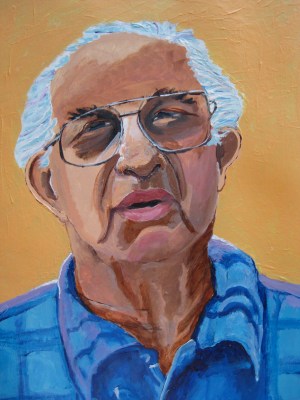
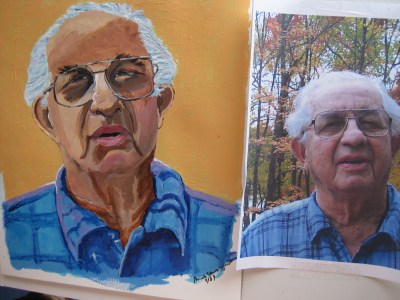
As for Art? In my cooler moments I reduce it to “medicine”, to symptomatology…thinking perhaps this amazing talent, so unexpected and newfound, has merely to do with the Temporal Lobe Epilepsy or seizure disorder with which I was diagnosed after having ECT about 3-5 years ago. I don’t know. (I read in SEIZED by Eve La Plante that not only are there personality changes but one can acquire sudden artistic abilities and interests, almost full-blown after developing TLE..so who knows?) Perhaps not. In any event, (I should mention that this is my theory little mentioned to anyone at all…Not sure to whom I should talk…) starting in 2007 I took up lifesize papier mache sculpture in a serious way, and just a week ago suddenly, VERY suddenly, discovered that I could paint portraits, just like that…I had never done a portrait before, rarely even tried to draw, had always said I couldn’t draw or paint for beans. Then one instant I felt drawn to paint (with which I had always decorated my papier mache, with swirls and colors but not true representational painting) and to doing “real art”. I “decided” I would paint a young man, and then went ahead and fearlessly did so (see first attachment)…Since then I have done one portrait a day. Some imaginary, some from photos…And I have no idea, had no idea I could do so at all! Frankly, ditto the sculpture, though I am getting used to that ability now that I have several to my name…(see two other attachments for examples of earliest pieces).
I hope you won’t mind all this “Wow is me” stuff…I’m not usually so impressed with myself, I assure you. However, while I am at it, I want to send you three newer poems. I actually dislike most of the illness poems in the book, and want you to see what I have been doing more recently,  since the DIVIDED MINDS book was finished in 2003. I hope these poems speak for themselves. The “Epithalamion” one got a lot of chuckles, and ought to, when read properly (best out loud). I read it at my twin’s wedding. “To the Reader” will be the first poem in my second book, the opener, though perhaps not as “welcoming” as “How to read a Poem”.  And the vision therapy one is about what I have been doing in order to regain stereopsis. Which by the way really works, vision therapy that is, despite the skepticism of most ophthalmologists, who never bother to try it out, just condemn and contemn it out of hand, because it is done by ODs not MDs….VT has to be continually practiced though or like me you can lose the ground you gained after a while. Now I struggle to gain it back. I vow to  keep practicing. I do not think I can go without the exercises not after having gotten my eyes to do what they should do. It is so discouraging now to be back at nearly square one, I must admit…

Compulsive Eating and Zyprexa (updated)

ALL EYES ARE UPON US

This is my ALL EYES ARE UPON US papier mache sculpture head — It should easily be finished by the time I am having a poetry reading and exhibit in Mystic on November 15th. I would like to exhibit it with the others if possible. It is the newest of my work and therefore the one I am most proud of. I am not completely clear just where I am going with it, but I do know not to worry, that inspiration will come to me eventually. Indeed, some already has; I am starting to place a tri-folded American flag underneath her ( yes it is a woman…) arms, as if she is hugging it for dear life…Why? not sure, but I believe my subconscious has a message for me there…I will decipher it and rest of it later, when I am through. However, my thoghts on the “meaning” is never the last word on it. I expect my viewers to do the same, that is, interpret the sculpture according to their own lights, according to the vicissitudes, or the longstanding truths of their own lives, not mine. It should mean whatever they want it to mean, according to their own life experiences. All of which is to say, There is no right answer, no real meaning here, only the sculpture’s evocative power to suggest this to one person and that to another.

Now regarding this post’s title, Compulsive Eating and Zyprexa: I had a rough week two weeks ago, during which I did something self-destructive though along too familiar lines with a “fagot” of cigarettes tied together with thread and simultaneously lighted. There was talk of the hospital to “keep me safe” if nothing else, but I saw no point, and indeed there was none. No hospital had ever proven they coud truly keep me safe: I have attempted and successfully hurt myself sometimes seriously almost everywhere I’ve been sent to, including breaking a carefully supervised mirror in a make-up compact and slicing my wrist open. My visitng nurse knew and agreed but made me agree to take a PRN of Zyprexa for a while. I didn’t really fight this. As  you, Readers, know, Zyprexa is a drug abut which I am extraordinarily ambivalent. It is both the single most helpful and effective drug I have ever taken, nearly a miracle medication, if not precisely that, but also the absolute pits in terms of a side effect I hate more than any.  I have not yet figured out how to tolerate this love/hate relationship I have with the drug. For instance, despite hating the single worst side effect, I very much appreciate being able to read, read, read, to concentrate and pay attention and remember..

Oh, perhaps it feels subtle the effect that Zyprexa produces, the therapeutic one, the helpful effect . In actuality, though, the change in my behavior is immense, not to mention on some very fundamental thought patterns. I don’t actually recognize at first that all of it is drug-induced: I just sit down and decide to pick up a book — that all by itself is unusual for all that it feels natural. But so too is the astonishing fact that I feel interested instead of listless and fearful that I won’t “get” it, that I wont be able to attend,  and upon opening the book, the fact that every word seems to flow,  my mind fluid and absorbent and the words just pour, the words and the sense and the meaning, well, if I weren’t so absorbed in it, I would be amazed… But I think, Why haven’t I read before now? Why,  when it is so easy, have I not been doing this all along? ( I have forgotten that it was NOT this easy until I took the Zyprexa…). But the difference between then — not reading, and now — being able to attend and absorb and read — is not subtle at all. It is marked and significant. I finish books and articles, instead of merely dabbling in them. And I remember what I read, instead of most of the content flying in one ear and out the other.

But the same effect that brings about the therapeutic effect, unfortunately and seemingly by the same mechanism, induces the unwanted and horrid side effect of an insatiable appetite. Just as subtle and my being able to read, I scarcely notice at first that i want to eat more than usual. I simply feel increased desire for food, and think nothing of it, since wanting food is normal, right? It is only when I recognize, when I realize that it is constant, and occurs immediately after I have just finished a full dinner plate that I  begin to associate it to the new medication. My weight quicky increases, but because the food desire feels like me, as if it is simply native to me, I cannot justify it as purely drug induced, but am ashamed of my new lack of self-discipline and my also new tendency to compulsive overeating. Even when I know for certain it is all “chemistry” –and begin to tie ALL obesity therefore to chemistry to the effect of body chemistry that is out of whack, either congenitally or induced by the environment, perhaps by  igesting the wrong foods themselves. What if eating high fructose corn syrup, already associated (the reasons are still unclear) with obesity, changes one’s chemistry to produce a malignant positive feedback that only induces more obesity ad infinitum as long as one continues ingesting it? Even when I know for certain that my increased and uncontrollable appetite is pure “chemistry” it doesn’t fully relieve either my shame or my latent anger at what ‘I have done to myself.”

I have been off Zyprexa for many months now, and have rarely needed or taken a PRN, but thought it makes a noticeable and positive difference, it is the already evident weight gain I cannot/WILL not tolerate  (Truth is, it showed no sign of ending even at 160 pounds the last time I took it). My friend Joe who has taken it for years developed another very common “side effect” of this drug, diabetes, on top of ALS… So I am between the Scylla of “negative” and/or cognitive symptoms — poor concentration and inability to pay attention, the lack of a certain spark in my life AND Charybdis  — the whirlpool of an uncontrollable urge to eat up everything in my refrigerator right after I have already had a full meal, the wild animal panic if I cannot, and the lack of concentration induced in its place because all my mind can focus on is “What can I eat now???” It is a panic I feel in my hands, especially along the backs of them, more than anywhere. I certainly do not eat out of even imagined hunger. I know that. I feel FULL, in most cases because when I am hungry I usually will eat sensibly… But when smitten by the drug-induced food-seeking behavior after a  full meal, I can even tell myself out loud, “You aren’t hungry, you don’t need to eat”…this piece of bread, or cheese, or fruit, whatever is in my hand. I listen too, I put the food back at once, and wash my hands, and go back to the living room to read or do my art or whatever I was occupied in doing before I was seized by this compulsion. But literally no more than 10 or 20 seconds later, another food impulse will propel me from my seat to the refrigerator, and if not consciously thwarted I will eat. And eat, and eat. Not like a bulimic, mind you. No, I take one piece of fruit or bread or cheese (I did not last as a vegan, alas, because I felt sick and dizzy living on fruit and green and colored veggies) and a knife and a plate, and sit in a chair, and cut it up and eat it reasonably slowly while I read. But soon I am finished and ready to read again “solo.” That is when the tension starts building to another threshold over which I feel it is impossible to climb in safety.

What I do instead, is follow this ritual, with another just like it a couple of minutes later, and then a couple of minutes after finishing the second and ditto the third and fourth and… Before you know it I have eaten so many calories up to a certain point, a set point if you will, where finally the switch flips off and my “hunger” goes off, and so does the food-seeking…I can now settle down and get something done. but until the threshold is reached and surpassed, I cam think of nothing but eating. The cure for it, the only remedy, is that I must be sure to short circuit the cycle by taking Xyrem and forcing myself to go to bed after supper. And I must NOT eat all day and evening except for coffee and diet soda (luckily the Zyprexa induces food-seeking behavior and not real hunger, so I am not tortured as long as I do not break my fast), until right before bed I allow myself to take a few bites. If I do not eat at all, I do not feel like eating and the cravings do not even begin. It is when I do take the first bite, just like an alcoholic, that all bets are off and all the control gates to hold back the flood open.

I still think that Zyprexa induced eating and 15 mg of Abilify-induced lack of appetite would be a great way to study the science of appetite, what causes compulsive eating and what breaks that cycle and stops appetite and interest or uncontrollable interest altogether. I would agree to be that guinea pig but I’d aso say that plenty of people could do so…I don’t see why others would not react as I do, especially a plenty of people have had the same weight gain reaction as I.

I will try to continue my discussion of this topic soon, as I want to research it a bit and I have some further thoughts on the subject. However, at the moment I needs must get other work done…

TTFN

Oh yeah, by the way, Li and I had a decent discussion abut TLE during one of my recent visits and it made me feel better about him, for the time being. At least he is going to consider it, though he told me it never rules out schizophrenia as there are always a percentage of those with TLE that concomitantly have schizophrenia as well.