All posts by Phoebe Sparrow Wagner

Artist, author, poet

Saphris trial plus Poem

Sorry for the long absence. I was in yet another Connecticut hospital for 6 weeks,  and as usual it was horrible. I admit that they — the staff — must have hated me as much as I hated most of them as well. I do not think that they understood quite how much I was “not myself”  most of the time I was there. Luckily, perhaps, the weekend doctor was one who had treated me years ago and for several years at that, and she said quite openly that she had never seen me like that and knew something was wrong. But the other staff did not know me and so they took my rage and irritability as “bad behavior,” as one nurse called it. Why it didn’t occur to them that there was something strange about the fact that I didn’t even remember from day to day what had happened or what “I did” I do not know.

Anyhow, now I am  on a trial of Saphris but I do not think it is going well. I cannot motivate myself to do much of anything, including writing, reading or any kind of art. I even look at my beads and wonder what on earth ever possessed me to want to do jewelry making. I am hoping that I will be switched back to Abilify soon (not Zyprexa on which, after the hospital, I gained at least 10 pounds). At the very least it must be added to the mix. Otherwise I do not know what I will do. Dr B and the visiting nurse probably will not agree, feeling as they do that it does not work for me. But I think it does and frankly I will not take anything else, so it is the Abilify and the Geodon, or the Abilify and the Saphris, or nothing at all.  There is nothing else that works at all that I will take.

I will also add that after struggling to feel that Dr B was helping me, and that he “cared,” I have decided that we do not work well together. Maybe some other male psychiatrist and I would, but for now I am switching over to a female doctor, Dr C.. She seems very nice, and if she and I do not work out, there is yet another that seems promising. But so far I felt very good about Dr C right from the start.

So for now that is all that I have the energy to write. For the short time that I was on Zyprexa right out of the hospital I wrote a poem called, “How to Swim: Poetry Manual #2”, and I wish I could share it here, but I have sent it out for possible publication and I do not think the magazine would appreciate it if I printed it here first (they are fussy about things like that, alas.) So I will leave you with one that I think will go into my second book but which I probably won’t publish before then instead.

ARTICLES OF FAITH

Black ice. An accident’s chain-

reaction like toppled dominoes,

and you steer into a skid

on the frictionless slick

missing, by the merest sleet needle,

a chrome-crumpler 28 cars long. It’s night,

your face glows dashboard green

touched with gold as we pass

streetlights in review.

Someone up there

must be watching out

for us, you say, meaning you,

me, and this carcass of a 1986 Chevy,

in ‘03 still too good to let go.

But it is something more than

mischief in me when I remind you

of the 28 drivers whose cars accordioned

in the whiplash of impact.

Was the the big guy upstairs

not watching out for them, then,

or worse, deliberate in his neglect?

But this is not a theological poem,

it is only a prayer whistled

devil-may-care into the void

by a nonbeliever who knows nothing

is guaranteed save that none of us

will survive our lives. The pile-up

behind us, we’re wowed breathless

by the nearness of our miss

and though there’s still

the matter of those hapless 28,

even I whisper Thank God!

to still my trembling hands.

(When I pasted that in it came out in double space, but it was meant to be single spaced. Not sure  how it will appear in the blog…)

That’s all I have the energy for tonight. When I have a little more, I will get back to you. Please do not give up on me. Thanks.

Pam

“Am I a horrible person?”

I received this comment a few days ago, and I wonder if anyone — somebody, please? — has a response for the person who wrote it. This wrenching question seems to me to embody one of the most painful and awful choices that siblings and even parents of people with severe mental illness may sometimes feel they have to make in order to save their own lives and their own sanity….Or not. What do people think?

“I have a schizophrenic brother, he became ill at 27,
and it was a terrible time. My brother is now 54 years old, my parents have long since died. I have no
relatives that care about him or me. I have to tell
someone I don’t know where my brother is, he was in a
group home and was told he could no longer live there
this home was horrifying. I tried all my life to help
my brother, I had no life, I finally just had to let
him go, I pray god is watching over him. Do you think
this makes me a horrible person?

4 Answers from comment section:

#1 Wow.
I want to respond – though I’m sure how. It can very difficult to find the right words sometimes.

You asked: “Do you think
this makes me a horrible person?”
No. I do not. Caring for someone with mental illness is a very difficult road to follow. It can take so much out of you and from you…that there is simply nothing left to give.
If you are unable to care for yourself properly, meet your own personal needs (physically, spiritually, & mentally) – then how can you expect to do it for someone else?

I can’t imagine what a difficult choice this was for you.

Best wishes,
~V.

#2  I ask myself this question as well. My wife is suffering with a serious mental illness. Her diagnosis is major depression with psychotic features, although bipolar has not officially been ruled out. I’ve been writing about my experiences as a care provider. It’s not easy. I don’t want to quit or walk away from her, but it’s not necessarily easy to keep going. I plan on continuing to blog about my experience as the family member who is trying to help, so that people like this reader can hopefully find some encouragement.
And I don’t think that this person is a horrible person at all.

#3

Hi Pam,

No, I do not think that this person is a horrible person at all for detaching from her brother’s problems. Whether we like it or not, we have to find the solutions to our problems. Her brother has to do what we all at some point have to do: reach out for help. He has the ability to do this. I’m sure of it. And I know it isn’t easy, but it is possible. Sometimes the best form of help comes not from family members, but from virtual strangers who have dealt with similar problems or are in the helping professions. The people who are closest to us can carry emotional baggage and this can both get in the way of helping and result in hurt feelings. But the people who are not so involved in our personal lives can often give a fresh perspective and can be genuinely helpful. This takes the pressure off all concerned. Ideally, family members should be able to provide some support, but not if it robs them of their own well being. I agree with V. if you don’t take care of yourself, how can you be of help to anyone else?

#4  The person writing to Pam described themselves as having “no life at all”.  This sounds depressing and sad.  They sound like the quality of their life is so bad, that they couldn’t take on the burden of seeing to the quality of their brother’s life.

I see in my family that my sister is weakened by a slight touch of the schizoaffective disorder that I have, and perhaps my brother as well.  But I am also confident that they would not desert me, as fragile as they might be.  This gives me strength and confidence to live, because I am dependent on the kindness of others, be it the government, or my husband, or my parents, or my siblings.  I cannot provide a roof over my head or feed myself.  I cannot work for a living.  If it weren’t for charity from the people who love me, I would be homeless.

I don’t think this person is horrible, I think that they are in pain, and they have burdened themselves with even more pain by turning their back on their brother.  One of the ways to have a fulfilling life is to do charity, is to be giving, and to go the distance for someone other than yourself.  How proud this person would be if they had saved their brother!  Suddenly, they would indeed “have a life”.  They would have been a hero.

This writer has traded their brother for a large helping of guilt.  I don’t intend to increase or decrease the feeling of that guilt.  But I know that if I had my brother’s life in my hands, I would not trust him to God, I would do what ever I could to tend to his welfare.  My meager resources would be used, my emotions might be stretched, my patience would be tested, and yes, the life of another human being can be a heavy load, but I would take that load and offer if it were the only thing I had, the living room sofa!  I know that social services would come to my rescue, although it may take a long time for them to be mobilized.  I know a schizophrenic in my area that had to wait two years for a government funded apartment.  But the apartment eventually came, and now he is safe and secure.

Doing what is right can be hard.  Following your heart can lead you into a wilderness that is unforeseen and perhaps, terrifying.  But I know my heart, and it would never tell me to turn my back on either my brother or sister.  In fantasizing about helping them, I can only believe the final result would be satisfaction.  And knowledge that the heart has won.

The Mentally Ill in Prison and Out-patient Commitment Laws

Dear Pam,

Thank you for the link to the Dr. Manny Show. There are indeed many faces of mental illness. Some people have mild cases and are able to work and function at the same level as anyone else.

Congress passed mental health legislation in 2008 providing for workers who have psychiatric dysfunctions to be covered under their employers’ health insurance at the same rate as employees with physical illness (certain exclusions apply). That was a positive step. However, acute mental patients do not benefit by that law, because severe mental illness is often too debilitating for victims to work, especially without the psychiatric treatment they need. In fact, people with acute schizophrenia, bipolar disorder, PTSD, and other conditions frequently resist treatment even when it is available to them.

Unfortunately, 1.25 million mentally ill Americans are currently imprisoned for offenses ranging from simple vandalism or disturbing the peace to murders. Last January, Rep. Eddie Johnson (D-TX 30) introduced H.R. 619, a congressional bill to resume Medicaid coverage for inpatient psychiatric care for patients in crisis and for people who require long-term containment in a secure treatment environment (such as patients who have done violence).

H.R. 619 is an important bill that deserves our support. It was largely the removal of Medicaid funding several decades ago that led to criminalizing mental illness. That in turn led to many other problems, such as overcrowded prisons and a burdensome prison budget. Hundreds of thousands of acute patients were “de-institutionalized” in the 60’s and 70’s only to become homeless and/or prisoners. Thousands of acute mental patients continue to be dismissed from mental hospitals and prisons without subsistence assistance and provisions for continuous monitoring and treatment under programs like Kendra’s Law.

Assisted Outpatient Programs like Kendra’s Law have been proved to reduce homelessness, arrests, hospitalizations, and incarcerations by up to 85% (among New York participants, compared to their circumstances three years before becoming program participants). The impressive rate of reduced arrests and incarcerations also indicates that community safety was improved significantly as less crime was done, and it also follows that the prison budget was lessened by helping patients with living arrangements and mandating continuous psychiatric care for ex-offenders and former inpatients who often lack the wherewithal to make wise treatment choices and avoid psychiatric crises.

Assistance to the Incarcerated Mentally Ill (AIMI) supports Rep. Johnson’s bill, H.R. 619, as well as NAMI, Treatment Advocacy Center, and many other mental health advocates who believe resuming funding for inpatient treatment is best for patients and for America. In fact, 100% of police officers I polled agree that prison is not the place for severe mental patients, where they comprise 60% of the inmates kept naked in solitary confinement cells.

I solute Congresswoman Johnson, a former psychiatric nurse, for introducing H.R. 619, and I hope everyone who is concerned about human and civil rights will support the bill and end the discriminatory practice of punishing Americans for being sick. I pray for another bill to be introduced to address the second cause of mental illness having been criminalized in America – the lack of continuous care and subsistence assistance for released prisoners and former inpatients. Kendra’s Law should be applied nationwide so that acute mental patients will be treated, not punished, for having a common, treatable health condition that requires monitoring and care just as diabetics and heart patients receive.

Inpatient hospitalization was not included under the national health care plan, so it is very important to pass H.R.619 as a separate bill. Please write an email to your representatives tomorrow and ask them to co-sponsor the resumption of Medicaid for psychiatric hospitalization and to institute Assisted Outpatient Treatment progams, which would not only be more fair and humane to sick people and their families, but would also save taxpayers billions each year as our prison rolls decrease.

Thank you, Pam, for this forum and for the useful information that WagBlog always has. I will share the link to the Dr. Manny Show with many people at my Care2 Sharebook and at FreeSpeakBlog, where we often publish mental health news as well as other matters that have to do with promoting human rights for prisoners.

Mary Neal
Assistance to the Incarcerated Mentally Ill
http://www.Care2.com/c2c/group/AIMI

PS Please VOTE for H.R.619 to replace prisons w/ hospitals for acute mental patients. The link below will take you to OpenCongress.org where you can use your voice to say to our elected officials, “We care about the least of these, His brethren: naked, sick prisoners.” (Matt.25:36) http://www.opencongress.org/bill/111-h619/show

While many Americans celebrate the health care reform bill’s victory, please agree that millions of citizens should not be left imprisoned or live under the threat of prison because their health care needs were omitted. Put the “NATIONAL” into health care reform by supporting H.R.619: Medicaid funding for psychiatric hospitals instead of prison cells for mentally challenged people – a change that will save money and restore lives!

Thanks in advance for voting. Please invite others!

___________________________________________________

Dear Mary

I think you know that I was quite ill until starting in 1996 when Zyprexa came out, but not truly until 2005,  when a complete transformation occurred. However, when I relapse, I “relapse good” — as my medical record from the October hospitalization attests, with nearly constant locked seclusion or restraints for 6-8 days etc. Nevertheless, I am with you, though reluctantly, as I also know how terrible the side effects are of some of the older medications are as well as the newer ones, and the horrible state of affairs when a harried or burned out psychiatrist simply rams them down your throat without consultation at least after the acute psychosis resolves and you are able to discuss such things.

When I was in Manchester Hospital, I begged to be put back on my anti-convulsants and the Abilify/Geodon combination that had served me well for many months, believing, with reason, that I was suffering from a flare-up of my neurological Lyme disease, an illness that had always and invariably produced severe psychiatric symptoms. I needed, I knew, an increase of those drugs rather than a wholesale change to the “old drug” Trilafon. But did the doctor listen to me? No, he did not, despite my  ability to say as much to him, my psychosis consisting not of incoherence but of paranoia and command hallucinations to  harm myself in order to atone for being the Devil…I could and did argue with him, vehemently, and steadfastly, refusing to take the Trilafon, until he instituted a standing restraints order for every time I was non-compliant.

These are the sorts of things that trouble me about  forced treatment and/or outpatient commitment laws. It is not that I think people suffering from severe psychiatric illness do not need or deserve treatment, only that the treatments available are not always effective or tolerable. And until they are, I am not sure that the only way to go is only to force medication on everyone willy-nilly, not, at least against their protestations of extreme discomfort. At the very least every effort must be made to find a medication or medication combo that keep the psychosis at bay while making the person as comfortable as is humanely possible…which is difficult when a psychiatrist is saddled with a hundred patients to see in a week. It took Dr O and me six years or more to find  the right combination of drugs, and to titrate them precisely enough to treat my symptoms,  reducing them significantly while keeping unpleasant side effects to a minimum.

There is much about the treatment of the mentally ill that is so disgusting I cannot begin to cover them all here, though your comment is very thorough, which is why I have put it up  as a regular post. I appreciate your links to sites that do so as well. You did not mention one horrific situation: where under-utilized supermax prisons now house “uncooperative mentally ill prisoners” whose lack of compliance or cooperation is due solely to their illness. Though it is well-known that such brutal conditions drive “normal” or reasonably sane prisoners to insanity, can you imagine the brutality of forcing a psychotic individual to reside in such isolation? (Note however that in years past, as you know, isolation and seclusion of disruptive patients in hospitals was also the norm, since “overstimulation” from the outside world was considered to cause their agitation…I have been in hospitals where, in bare seclusion rooms, I was not permitted access to letters or phone calls, visitors or even reading material. As for restraints, they too were inhumane as I was shackled SPREAD- EAGLE, to the four corners of the bed and not, as even then was considered proper, with my legs straight and my arms in position by my side. This treatment moreover was considered normative for agitated psychotic patients rather than cruel in the extreme  as recently as the 1980s in some municipal hospitals in Connecticut.

I  recommend the book, THE DAY THE VOICES STOPPED, by the late Ken Steele, who wrote of his experience as a 14 year old with the savage isolation policies in NY hospitals in the 60s and 70s,  treatment that today seems literally incredible.

Well, I thank you for your contribution to my blog, Mary. You are welcome here at any time. I will post as many of your comments as I can.

Sincerely,

Pam W

Foxnews.com Dr Manny Show: The Many Faces of Mental Illness

Sorry sorry sorry, Let’s try that again! Here is the proper link to the Dr Manny Show, which ought to be correct “in perpetuity”!

http://video.foxnews.com/v/4056071/the-many-faces-of-mental-illness/?playlist_id=86899

Jane Crown Poetry Radio

Okay, all you poetry fans of mine, and anyone out there who reads this in general! This is a rather late announcement, but this Sunday at 5pm Eastern time (you will have to make the proper adjustments if you live in other time zones) Jane Crown, at http://www.janecrown.com will be doing a 90 minute interview with me http://www.janecrown.com/archive_radio/Pamela_Sprio_Wagner.mp3 that will be part personal interview and part poetry reading  both from WE MAD CLIMB SHAKY LADDERS as well as new poems, and she may possibly include some reading and/or discussion about my memoir DIVIDED MINDS: Twin Sisters and their Journey Through Schizophrenia. I hope as many of you as possible will listen, and if you are not interested in poetry will listen out of interest in schizophrenia, as we certainly will speak of that.

By the way, Jane tells me that the show will be archived and “available forever” so if you cannot sit and listen for 90 minutes this Sunday, do not worry as you can do so at any time and for any length of time. Just follow the link or do a search for Jane Crown and radio or poetry and you should find it without trouble.

______________________________________________________________

Now for an update: Well, first of all, let me say that I want to write an update but first I need to start my review of the poems I am going to read on Sunday, and read a little of DIVIDED MINDS, so I can recall what got into the book out of my 400pp original manuscript and what was cut. So forgive me if I put the update and rest of this post off for a few hours and get back to it maybe after 11 pm tonight. Or if not then, as I must get up early tomorrow, then I will write a new post tomorrow. For now, suffice it to say that I feel extraordinarily HAPPY!

Book of the Year Finalist

Hi All,

Apparently We Mad Climb Shaky Ladders (CavanKerry Press, Feb 2009) my book of poems about living with schizophrenia, has been nominated a finalist for ForeWord Magazine’s 2009 Book of the Year (in the Poetry category). I dunno what this means, and I doubt highly that it will win, but I am very happy and grateful to have been made a finalist at all. The results will be announced on May 25th  at the BookExpo American, wherever and whatever that is. I’ll keep you posted, or perhaps you can keep me posted…

Here’s the cover of the book just in case you don’t know what it looks like:

Schizophrenia: Dr Manny Show on FOXNEWS.com (new link)

This is a link to the Foxnews.com Dr Manny show episode that was filmed in January. I think it is self-explanatory. Credit goes to Jessica Mulvihill, who did the interview, which was one of the best I have ever been “subjected” to (I have not yet found a word that adequately describes the process of being an interviewee…What do you call it when you have been interviewed, besides subjected to it? Any suggestions?) Anyhow, it was, despite the word, a very interesting and enjoyable interview experience.

http://video.foxnews.com/v/4056071/the-many-faces-of-mental-illness/?playlist_id=86899

Hospital Art Donation

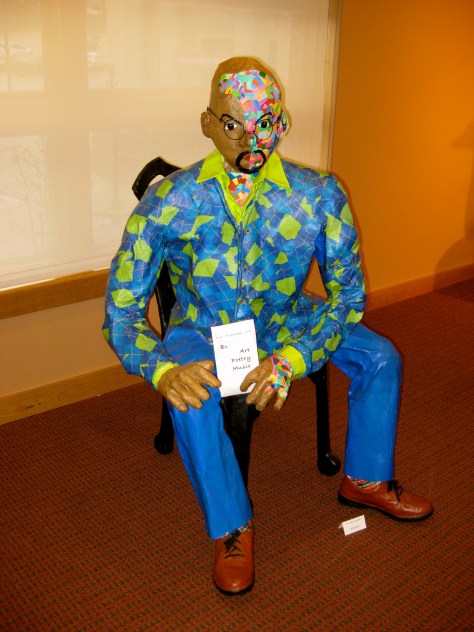
I have decided to donate my completely lifesize sculptures, Dr John Jumoke, with his prescription pad reading : Rx Art, Poetry, Music,

Dr John Jumoke with Prescription for Art Poetry and Music

and the little girl, Trudy, his patient, to any hospital or clinic or doctor’s office that has room for them and can display them. If you are such an office or organization etc and would like to discuss the ins and outs of this, please contact me via http://artid.com/turtleworks.

Poem: Life without Hope of Parole…

STATE PROPERTY

The Walls: what prisoners call the Washington State Penitentiary at Walla Walla

Freeworld: everything beyond the Walls

For A.

You’ve been owned by the State

since you can’t remember when,

body, mind and what’s left of your spirit

shackled to a prison more shattering

than the Walls, where at 18 you ended your life

in the freeworld. Hadn’t the big house

always beckoned, ever since the first time

you entered a home and found it

no refuge but a place of pain

and abuse, of neglect so battering

you ran straight into the arms

of a detention center

where at least no one pretended to care?

Who cared anyway about just another

juvenile delinquent with a mouth

to feed? It was hard to say

when mere delinquency — a word

that meant only that you’d left,

that you’d “left completely”

but left what was left to the imagination,

left home, left hope behind, left off caring —

turned from trying to survive to the criminal.

Homeless, hungry, no better educated

than an arrested ten-year-old,  you

stole bread, stole something middle class

and valuable and we, a nation

of Javerts, were too righteous to split hairs

and see you. But somehow an innocent

was killed and now you are up against the wall

in Walla Walla, amidst the teem

and clangor of that crazy

noise-filled space, with no hope, no hope

of freedom and even if it kills you

this time you swear you will redeem yourself,

reclaim and save yourself from the death

of that which still remains humane

in you. One aching brick at a time,

some walls are built, others torn down.

Outside the canteen window,

snowy egrets build their nests,

a beaver slaps the water with its tail.

I don’t remember exactly what happened to place Andy (not his real name)  and his sister in the care of the State, but I know that certain authorities found them huddled in the bathroom of their house or apartment, hungry and dirty and frightened, and from then on nothing was the same. They were separated, for one thing, and Andy lost track of his sister for years. Foster care was a travesty. Though there are, I know, many good foster families and truly giving and loving people who do fostering out of the goodness of their hearts,  Andy did not meet those. Most of the time his  foster parents only wanted the extra cash and he was lucky if he was fed adequately and had a bed of his own. He was often beaten and had to work for his food. Desperate, he made the first mistake, but one that probably set him on the road towards the situation he is in today. He ran away. But for a foster child, a ward of the State, running away is truancy, a juvenile offense and several such episodes, he was considered incorrigible and sent to reform school, where he learned only more survival tactics and more violence.

You see where I am going with this? It may be true that some boys rise above this, some boys find it within themselves to turn their lives around and make something of themselves…But I do not believe that they do it themselves. I believe that some caring adult, someone, anyone, steps in and makes them believe in themselves. Andy never had that. He knew only abuse and more abuse, in the many homes he resided in and later in the various juvenile  centers to which he was sent.

Finally, in a home as a teenager, he turned 16 and , he was an adult in the eyes of the state, no longer their problem, and he was turned out onto the street, unceremoniously, with no skills, no money, voila, no — nothing, but the clothes on his back and was told to get a job and make a life…This is crazy of course. Totally and completely crazy. But that is what happens, at least in Andy’s state, and I suspect in more states than I want to know about. Where do you go when, on your 16th birthday, your foster family wakes you early in the morning, and instead of presenting you with a special birthday breakfast and a birthday present, tells you to dress and get lost, get going, you’re an adult now and not worth anything to them anymore? I cannot imagine what on earth I would do.

Andy fell back on the skills he learned in reform school, like petty thievery (how else was he to get food?) and lying. And he ran with a crowd doing much the same thing. I do not know where or how he coped otherwise, nor where he slept, whether it was indoors or out of doors, nor for how long. I only know that at one point things escalated, and there was a gun involved, or perhaps it was a knife, but in any event, an innocent person was stabbed, or shot, and of the entire group only Andy was apprehended. But Andy was no snitch, and so he said nothing when pressed to tell who his “accomplices” had been, not even when threatened with a life sentence. which is what, in the end he received: Life without HOPE of parole. At age 18. Life without HOPE…

What does that sort of sentence mean, precisely? Well, for one, it means Maximum Security, because all long sentences are put into Max, esp lifers. It also means that at least in Andy’s prison, they wouldn’t bother to educate him or allow him to study for his GED, let alone a college degree. Why waste the money or the time on someone who was never getting out, never returning to the freeworld? It meant a lot of things, but mostly it meant hopelessness. And that was the hardest thing to deal with. That and the fact that you owned nothing, that you could count on keeping nothing, that nothing was yours. At any moment, everything you had in your possession could be confiscated, trashed during a cell search or simply ruined by flooding of the tier by prisoners protesting various atrocious conditions of their incarceration.

Andy knew that if he was to survive, he had to give up all attachment to things, to  everything outside himself, and to know that he was himself, a person, and that no one could take that away from him. He had to know that he could rely on himself alone, and to trust that, no matter what they did to him. And they did plenty. You can read about the Hole, but what really happens there, and even beforehand is truly an abomination. During a cell extraction for instance,  the squad, preparing to overpower the resistant convict, terrifies by virtue of their appearance and their “firepower.” To say that pepper spray is used is to deliberately mislead the public into thinking that the procedures are relatively harmless. A huge blast in the face of a chemical that makes one feel as if one is suffocating and cannot see is applied through the door window, until the convict is gasping and on his knees. Then the real extraction occurs, with an entire team subduing the prisoner, hogtying him in some instances, and removing him from the cell, which will later be trashed during a search.

People are disappeared, people are beat up, people die during a cell extraction, or simply when the guards are angry or sick of someone they can’t easily control and the death is hushed up. People die and nothing is said when a new prisoner is shown to the bunk they once occupied…

Andy has written a book length manuscript about his experience in the worst prison in his state, and  the entire book follows a prisoner through one day in the life of the main character. I think it is magnificent. Andy went from a 7th grade education to writing like a college grad, teaching Spanish, and many other accomplishments, including authoring two book-length manuscripts and a full-length play. I am hoping to find a publisher to take a look at his novel/ memoir. If you know of anyone who might be interested, would you please get in touch with me?

Update on The Hug

Okay, so I was sort of wrong about Roy. He was disappointed about the hugging and kissing business, yes, but the real reason I had not heard from him was because he was holed up in his rooms, sick as a dog. That had not occurred to me (as usual); it had not even crossed my mind that there might have been other circumstances preventing him from immediately responding to my notes. No, in a trice I jumped to the worst conclusion of all, that he was, in a sense, “dumping me” — though we were hardly an “item” having had but two conversations face to face (still, why was he kissing me then?) — and all because I wasn’t giving him what he wanted…

Anyhow, I do feel better having told him my feelings, and having asserted my right to say no to hugging me, because now he knows that I do not want even that much physical contact, whether or not he had meant it to go any further. I talked to Lee about it as well at the very end of a troubled visit yesterday and he shared with me a little about “most men,” which was (something I didn’t know) that they tend to express their feelings physically, and that they also take rejection of offered embraces personally. So he suggested that Roy might have taken my refusal to hug him as a personal rejection. He suggested too that I write him a short note explaining that it was nothing about Roy himself at all, and telling him how much I enjoyed his conversation and so forth. Maybe I could feel things out and see if there wasn’t more there than I thought…It was, I think, good advice, even if, as it turned out, Roy was sick rather than rejecting me.

By the way, Thank you, Karen Sorensen, for your comment on yesterday’s post. And my congratulations on your lovely website and incredible artwork. I commend and recommend to anyone who sees this note that you check out Karen’s site which is listed in my blogroll.

New Poem: The Rape of the Hug

THE RAPE OF THE HUG

How

do you say no to an honest hug

from a good man who likes you and wants

perhaps to love you? Does he

completely understand

how you have spent your life in institutions

and only entered the adult world at age 53?

You still have so much to learn

about being a person outside of a hospital…

Does he – does anyone? – know how dangerous

even loving human contact is

how all contact is rape

even the gentle hugs you have

been tutored to give relatives and friends.

You only withstand them and hand them over

but you do not like them.

Though you know no harm is intended

if done, when he prolongs the hug, stands closer

and turns his head towards yours

you sense the threat

of a kiss you can’t for fear of hurting his feelings

though you feel no feeling

of wanting it

refuse.

Roy (not his real name, though there is no chance of his seeing this) and I communicated  almost exclusively by means of notes passed under one another’s doors for a long while. Oh, we would pass in the foyer or in the elevator and occasionally exchange greetings or ask how the other was doing, but we never had much in the way of conversation. I was always going somewhere or coming home from seeing Joe or Cy and was much too tired to want to talk. Also it was awkward to have a conversation in such a public place, what with the bored biddies in this place being so nosey and overly interested in what we might say to one another, however harmless.

You have to understand that this building has 250 units for the elderly and disabled, but it is in essence a community, and though some people like me keep to themselves, we nonetheless cannot help but recognize many of the downstairs regulars who sit in the lobby or in the community rooms and watch comers and goers and gossip about nothing all day long. Or gossip and spread rumors and hateful talk. There is a “circle of friends” that I hear is rather in-bred and exclusive with which I have nothing to do, being uninterested. But I know that others feel left out of it, and are in fact excluded. The Circle holds dinners downstairs and each member pays $5 a month for dues but they charge non-members $20 if they want to join them for any one dinner. I cannot imagine why anyone would, but there you have it.

Anyway, to get back to the tale (and I am telling it, mind you, because I am trying to get my mind off much more serious matters, of which I cannot speak at the moment…) Roy had not put any notes under my door for a few months when suddenly one appeared a  couple of weeks ago. I had been feeling extremely troubled, and still am, so the note was welcome, as Roy has a philosophy of life that is very salutary and calming. Even if I cannot share it, that is, even if I find myself unable to trust it or believe that for instance this earth and this life is merely a school where we learn what we need to learn before we shed it and go on to what we need to learn next, even if I cannot believe that, I still like to hear him talk about it (in his notes). I responded and told him honestly how I felt, and what was going on that Lee, my doctor was concerned about as well. Roy responded by appearing at my door with a set of CDs — no, he couldn’t stay but he wanted me to listen to them, he thought they might be helpful — from the Dalai Lama discussing how science, specifically quantum physics and religion, especially TIbetan Buddhism complement one another.

No, perhaps memory doesn’t serve. Perhaps that was the time he did come in, did stay and we talked for about an hour before he had to leave. It was a very enjoyable conversation and I told him so. I told him specifically that he was not at all like Jacques, who came frequently to lecture me and pontificate about Thomas Merton and force his own poetry on me and never let me get a word in edgewise and if I did, gave it no thought or response. Our conversation, I said to Roy, had been an actual sharing, a con-versation in the real sense, not a monologue, and I appreciated that.

When he left he asked me to accompany him to the door, I said, sure, and got up, but felt a slight frisson, suspecting why he had asked. Indeed, I was correct, for at the door he turned and opened his arms for a hug. Not knowing how to refuse, and feeling unable to, I let him hug me, and tried to respond, though it was difficult and he sensed that, saying, “It can’t be that bad…” with a laugh. But he held on a long time, much too long for my comfort. Not that I was comfortable in the first place.

Then he said goodbye with a smile and blew me a kiss and left.

Well, that was that. He continued to sent me notes and one asked me to lend him my book of poetry. I left one in a paper bag at his door, telling him he could keep it. He hung the paper bag back on my door with a note that contained only a big smilie and an exclamation point.

I listened to one CD of the five he had lent me. It was difficult to pay attention, but I eventually managed to do so, washing dishes. Then one evening Roy knocked on my door (he has only a state-issued cell phone with very limited minutes on it) and I let him in. Again we had an enjoyable conversation and again when he left…well, the poem tells that tale.

But this time, well, I had to tell him how I felt. I knew that it would do me and him no good if I simply went along with this and pretended. I could not do it again, and just continue to feel raped. Things would eventually progress to a point where I could not tolerate even pretending…So I sent Roy a note explaining that while he had read both my books and thought therefore that he knew me well, I knew much less about him, and that he needed to go much slower.  I did not enjoy hugging, not yet, and I was not experienced and did not know the ways of the world. I also said that I was used to rejection and would not fall apart if he never came back. I expected rejection from everyone so it would be nothing new. If he rejected me, well, that would also tell me something about him I should know now, before we got too close. I put the note under his door, and waited to see if a small yellow piece of paper, or even several, came back.

Well, I waited all the next day, and the next and the next. But no note came. Yesterday I returned the CDs in the same handled paper bag, and no note came. So I guess I know what Roy was all about, don’t I? It upsets me, as I liked him and thought he was deeper than someone just trying to get into my — well, you know the expression. I hate to think that that was all he was interested in, but maybe that is what motivates all men, after all. I do not know, truly, I do not. I have not had enough experience to know.

It is not that it had to be a platonic erelationship, I was willing to learn about relationships that were more than that, only that it and I needed time to grow. He ought to have known that, having read DIVIDED MINDS. But apparently like the men who forced sex on me in my younger years, he thought that he was different or better or — something. Well, he isn’t, wasn’t, and I learned my lesson, again.

Depression or Sadness?

One day I am up, or part of the day at any rate, and the next day I am down, or the next part of it. I can be cheerful in one moment and crying the next, and it takes little to bring on the tears, but equally little to cheer me up when I am in the mood to be cheered. I feel like a windmill, turning whichever way the winds of my moods blow, and not like the old creaky Dutch ones, but the shiny winged new ones that turn on a dime, shifting as quickly.

Usually what brings on the tears are thoughts of death, but do the thoughts precede the crying and sadness or the sadness precede the blackened thoughts? A good question.  Would I be thinking about the imminent end of the world and my role in it, and thinking of it so often and so desperately were I not already sad? Or does merely the thought of it, and the constant reference to global warming naturally stirs thoughts of it in me,  make me sad? One thing I know is that once I think and am sad, in whatever order those two occur, I start crying, desperately, torrentially, if not sobbing then the tears pouring down my cheeks in silence…

A wise friend suggested I try an exercise in distancing myself from the sadness, by taking a large waterglass and trying to catch my tears when I cry so hard. She says the suffering in the world all comes from a sense of loss, from not understanding that the nature of the world is impermanence, is all things changing…She says that all time is simultaneous, that there is no past or future, except what we choose to focus on. She tells me a lot of things that are difficult to understand.

Right now I am sitting in my living room/bedroom with all the furniture emptied and  crowded into the center around my recliner and TV because the painters are coming to paint on Wednesday and the only person who could help me move things had to come on Saturday. So now I have to live this way for the next few days, with nothing to do but use the computer or watch television, because most of my books, which I cannot read anyway, are packed away in the studio. That is now so full that I couldn’t paint or make jewelry or do art of any sort even if I wanted to. And in any event, I have been physically ill for several days so little appeals to me but lying rather listless in my big chair and stroking my cat! 8D

What a life, what a life…But I lie here thinking about the planet and I think about how I desperately need to find some hope, for myself, for the world, for my thinking about the world and my role in it, in its ending…and I wonder: am I sad or am I depressed? Is there a difference? Is it substantial? And does it matter? It matters that the world is ending, if it is. But is it? I believe it is. But many people, who I think are in  denial and in the dark, think that is nonsense. It matters a great deal if the world is ending, especially if it is my fault. It matters a great deal to me! But most people tell me that it is not my fault, and so far none have said that it is… Most venture only to say that the world will go on, with or without us, and perhaps it is okay if it’s without us…In any event, nobody — well, perhaps one alone of all my friends — seems as desperate and as hopeless as I about the situation, and we are both so hopeless we cannot help each another, only drown in one another’s tears.

Oh how we cling to what is, by that other friend’s definition, impermanent, ever-changing. As Heraclitus said, the world is “an ever-igniting fire, by measures being kindled and by measures going out.”

But is it depression or sadness? I have not felt truly well since I got out of M Hospital in the fall. Oh, I have felt better, and I have felt worse, but I have not felt consistently good, no. And I cannot shake this persistency of ready tears. My psychiatrist did not understand this until the day the tears fell in his office, along with my confession of how hopeless I felt about the world and its imminent demise, how guilty I felt about it. I was surprised at the alacrity with which he pushed an antidepressant on me, since I had not cried so before in his presence, not that I can recall. I thought he might have wanted to discern more of a long-standing pattern….But he scarcely gave me a chance to object. Just “suggested it” then reminded me that our time was up for the week, and he would see me “next week, same day, same time” same channel etc. I was to call him if any problems arose or I needed anything at all in the meantime. But i still had the new prescription to take too, and my visiting nurse would most likely want me to take it as directed. Since I was mostly an obedient patient, and since I wanted to feel better as well, I took it, having no particular objections to that medication. But has it done any good? Oh, I didn’t cry as much for the next few days, and we all thought, Oh, my what a wonderful drug, it has worked so very quickly!

But of course, no drug works that fast. If anything at all, it was a placebo effect. But likely as not, it was simply that other matters intervened and  the end of the world was put on hold as I dealt with matters closer to the facts of everyday life than teleology. Not that the “end of humanity” needs to be the equivalent to the “end of times” but to me if felt that way. Anyhow, I suspect that to those who deal with matters of “teleology,”  the end of times  and the end of humanity may mean much the same thing too, probably. (Who would care about teleo- anything were humans no longer around to think about such things?)

A month later, though, (and the dosage remains minimal, which may or may not be related to this) I still cry torrential tears at thoughts of death, dissolution and the devastation of the planet. I still feel overwhelming sadess upon hearing of anyone’s death, and mere advertising skits can make me tearful if emotional enough in the wrong way…Embarrassing as that is to admit. On the other hand, though, I can still write, I can still paint, and I can still make jewelry and cook and go over to visit Joe and  on and on. I may not always feel like it, but I do it, and that is what is important. And when I do art and write and  cook and so on, I make myself feel better, at least temporarily. So those are antidepressants in and of themselves, yet I could not do them at all, I think, without a certain level of energy above depression.

But as I started this, I go up and I go down, down, down. And maybe that is key, that I am not always depressed, just that I am easily dragged into the slough of despond by thoughts of bleak and utter despair, and whence those come, I do not know. Maybe from reality, cold and hard as a concrete floor, or maybe from imagining the worst. But no one  knows what will happen. The worst is only one of an infinite number of possibilities…

Global Warming: Poem for Vigil

FRIDAY NIGHT VIGIL

Shivering, we struggle to keep our candles’ thin
flames alive as we gather, nineteen of us together
in the darkness of an approaching storm,
hoping the small flakes will not turn to ice
beneath our tires on the drive home.
But an icy wind keeps snuffing out each flicker
so we just stand, our signs alone aloft to passing traffic,
standing for the stand we take: for the changing world,
for a last chance at change. We stand for photos,
taken from across the streaming street –
and we smile into the night and show our signs.
One car beeps, a driver gives the V-sign in support,
but most drive on without a word or sign
that they have heard or seen a thing, or even recognized
we’re standing here for anything but hopeless causes.
My hands, frozen, release their glass and candle with a crash,
sending shatters glinting across the sidewalk. Someone
with safer gloves, stoops to sweep the shards away…
How lovely is the world today, even dying.
Though it’s all we have (and lord knows, it’s more
than we can handle) we stand here in this freezing dark
against the darkness and light one candle.

That is about all of the true story of the vigil, and about all that happened…We stood there and the traffic passed, and photos were taken and my frozen fingers dropped the glass holding my candle oh so greenly..Period. It was not without feeling or meaning for the individuals who stood there even though it felt utterly useless to me, and I was only there because a dear friend suggested it as an antidote to hopelessness. As she sees it, the only way to defeat despair is to take action, which is, I suppose, to paraphrase Hamlet’s soliloquy.  Now Hamlet goes on to talk about  death, and eventually to abjure suicide. But taking action did not help me much. Or if it did, the very loss of the glass in my hand, that crash to the sidewalk in the freezing dark, seemed to me the last straw, though none could tell it then. Indeed I  would never dream of showing it. But to me it was emblematic of the hopelessness of the endeavor, how it was all coming crashing down upon our heads, the great environmental movement, and nothing, nothing! would be saved on our grand sweet planet but sulfur-eating bacteria, black smokers, and undersea tubeworms. Nothing to be done now but to move inland and try to survive the cataclysm.

Except of course that not even that could be done, because nowhere is one safe, not really.  Tell me, where would you run to when tornados of category 5 tear up the heartland and when they do not, floods of epic proportion alternate with devastatng dust-bowl droughts?  When inland migration would put such a stress on cropland that famine results, and the slow, agonizing death that comes from it. The southwest? Where there is little water and temperatures already  soar past 115° in summer and sometimes higher? What happens when they hit 130°F? Would you  try the California west coast, with its record breaking wildfires and its ditto mudslides? And what exactly happens to rock that has been too quickly  affected by acidification  — does it really remain stable? What about in a region affected by vulcanism like the Northwest? Do we know for certain that  human forces do not change volcanic activity and purely geologic forces on and in the earth? Do not be so certain…But the east coast, surely you would not escape there, what with its sinking coastlines and/or rising sea levels from Florida to Maine…I do not mean to be a doom-monger, but I am indeed despairing, because I see a future of  chaos in the streets and madness and  fear on the faces of people wild to save themselves or at least their children and knowing in their hearts that they can do nothing…

STOP. Why am I going on like this…I do not wish to scare people who believe in hope and optimism. I do not wish to infect everyone else with MY despair. That is not my desire or intent. If I am hopeless, why make others feel it too? There is no point, even if I am right in my knowledge and/or my predictions. I cannot change anything, so why force  anyone to feel as bad as I already do? Perhaps Hamlet was right to suggest that “to take arms against a sea of troubles and by opposing end them” is not necessarily a bad course. It may be nobler than giving up, even if the action is useless in the end.

Do you know that I have scarcely followed the doings at Copenhagen, except cursorily, because I pretty much know that whatever happens it will be too little, too late…and that no matter what, the agreements reached will never, never! even approach the deep cuts in emissions needed to reduce present CO2 levels to the 350 parts per million that we need to regain sustainability on the planet. No, what I’ve heard is that the best of agreements settle for reaching and maintaining 550 ppm. let whatever happens to us at that level, happen.

God forbid we should radically alter the flow of the world’s economic thinking and activity, or even just the purposes towards which entrenched capitalism directs its self-interest! God forbid that Americans NOT be urged to buy buy buy “new carbon” in order to re-set a gobal capitalism and ever surging standard of living. God forbid that Americans should be told that their diamond standards — of living, of buying, of — well, everything, should actually be reduced…that they cannot in fact buy everything shiny and new, that used items are good items and trading between those that want to throw away goods and those that need them is a terrific idea, and much better than flying new carbon, and expending huge amounts of hydrocarbons in the process, from halfway around the world; that lawns are a terrible thing and vegetable gardens are beautiful, even postage stamp size or on the roof. There is so much we could do, if we are hopeful, if we are optimistic, if we believe that doing something is worthwhile and that we can in fact save the world.

Let’s try, let’s do something now. Maybe it is too late. Maybe it is useless. But we cannot sit around doing nothing, can we? That way lies madness and despair. We all die. It’s a given. Why not live now, knowing that something — even if it is only  the proverbial drop in the leaky bucket — can be accomplished, and  knowing that as long as we breathe there is always hope.

Dum spiro spero.

Stereopsis or 3-D Vision: The Pure Experience


SPACE, MATTER, LOVE

The world is charged with the grandeur of God.”  Gerard Manley Hopkins

December, first snow, 2009

Who hasn’t said, “You don’t know what you are missing,” when speaking of something she believes another ought to experience– sky-diving, say, or a certain exotic brand of coffee or the pleasures of her favorite restaurant. Because I was unaware for years that I lacked depth perception this was literally true: I did not know what I was missing because I no longer remembered what I had lost. I had in fact no idea there was anything to lose. But with prisms in my glasses, and after months of vision therapy and eye exercises, experiencing 3-D, or stereopsis as it is properly called, was as spectacular as it was elusive of description. Nevertheless, I am nothing if not a writer and so I do my best to put it into words and show you.

Early this morning I went to move my car from the snowed-in parking area and found myself at 5 a.m. alone outside. The street lamps next to the building were on. I could clearly see snow falling against the dark sky as I headed towards the lot. Suddenly there was a nearly audible click in my brain and everything changed. I felt as if I were in a snow globe, inside the snow, separate flakes plummeting around me, each on a different plane, riding a separate moving point in space as it fell.

I looked at a bush with its bare twigs, the ends of which were mounded with snow.  The contrasts in it were heightened, with the boundary between the blackness of twigs and the white snow crisper than I’d ever seen it. Everything was silent. Along with the exquisite clarity and precision of detail, a rush of affection for the universe knocked me breathless.  I stood there smiling. Had I ever seen anything more beautiful than what space had done to this bush with its twigs of snow?  This was not the negative emptiness of which some art critics spoke so passionately, but something positive like an embrace. It is difficult to convey what I mean by this: when we speak of space we usually mean the empty gap between masses, between physical entities or things that matter –after all, isn’t that why we call them matter? But in this instance, I meant space as sculptor of reality, and as artist and sculpture both. Space was the loveliest thing I had ever perceived. It had mass and, by virtue of its own volume, gave substance to the objects surrounding it.

But I could not yet put all this into words. At the time I just smiled, and gazed at the bush and twigs and sidewalk and streetlamp in a kind of dazed wonder.

I went back inside to write at my computer. Just as I sat down and put my hands out — out! how lovely that my hands went out into space, I thought –  the keys on the keyboard drew my eyes to them. My heart ached at the sight of the fraction of an inch between each key and the computer. The space that was their height above the computer took on a numinous quality that would not let me withdraw my gaze. My typing fingers too. Not only that, but the sheer fact that they were above the keys, the space between fingers and keyboard, then the way embodied space gave form and substance to the small squares –indented just slightly to fit the pad of a fingertip – all this made me laugh with tenderness and delight. I was full of bubbles. Why, the entire world was friendly!

I circled my rooms, hypnotized by space, by how space made everything important. How profoundly dishtowels spoke to me, saying, Towel, Towel. The threads stood up, cupped and defined by emptiness, each one loved into being by the artistry of space. Terrycloth folds were utterly different from a fold in paper and yet that folded paper, bent on an angle around a “shapely void,” struck me as infinitely loving. The sculpted space on each side of the fold was so exquisite it brought tears to my eyes. On I went. Doorknobs yearned, reaching out from doors into space. Bookshelves provided a welcoming recess, intimate and implicit with corners, as if saying, Come in, we will protect you. What a delicious concavity each spoon was, a miracle!  My circuit of the room would have been ridiculous, had not everything been so lovely, and so thoroughly devastating.

Mere words hardly serve to describe how I perceived. I felt seized by joy, by delight and yes, by an overwhelming love for all that my eyes alighted on – snow-covered bush, computer keyboard, a friend’s hand extended  in comfort. I know that most people understand the first and last, but few are mesmerized by spoon or towel or indentation of computer key. This troubles me. It is easy to love nature or one’s friends. But I suspect overpowering love for every literal thing is not prosaic. Space sculpts the world, and I was abruptly and unexpectedly given the gift to love all of it. Surely such a gift is available to everyone, yet it seems inaccessible, except largely to those crazed by either drugs or illness. Or to others who have regained, even temporarily, long-lost depth perception. Perhaps because so many have always seen space, they have lost the ability to perceive how beautiful it is and to feel how it embodies.

Later these visions, these perceptions faded along with my new but brief ability to perceive depth at all. But I remember near the end looking into a certain receptacle and being bowled over to see that it had a rounded interior. The sheer “interiority” of it, as well as the fact that it implied roundedness so matter-of-factly that I didn’t have to feel it to know it: why hadn’t I understood before? It struck me as sad and yet the most transcendent discovery of my life. If the world was charged with the grandeur of anything, then that something was the positive, optimistic Shaper of things, their Creator, which we instead call, as if it were nothing, “empty space.”

This is a tragedy and not merely for the individual of normal vision, but for humanity, most of whom will never experience a love for spoons and doorknobs or computer keys or hands above the paper or, by extension, love of every object and every nose and every creature in this world, of every thing and all matter, which is shaped by the Space that loves us. This may be the reason we have done what we have done to the environment, the precious matter in the Creative Space around us.

Because we could not see and therefore could not feel how space is the Creator and loves the matter of the world, we have destroyed it, and ourselves in the process. How could we have done otherwise? We did not know.  We did not see. And we could not feel the truth: that Space is Love and loves the world and makes us, and all matter, beautiful.

Narcolepsy and Sleepiness: I wake and sleep and sleep and sleep

I am always sleepy. I am always sleepy.  I am always sleepy.

That said, my best time, if I have had enough sleep the day/night before, is after midnight. Dr O — whom if you recall I now refer to as Mary in most other contexts, since she is no longer my doctor and has temporarily retired from the “business” or is “on sabbatical” as she calls it — told me once that the notion of some people being “night owls” and some being “early birds” is a real phenomenon and not just a myth, that in fact there are reasons why certain people like me prefer the hours post-midnight and feel most alert and alive then, and why I claim that it is then that I get my best work done. As I understand it, there are actual “chemicals” — I hate that generic term for more specific biological substances! — which impel a person towards sleep and that these are at their lowest in the morning and constantly building up during the day until for most people, or at least for those whose drive to sleep peaks at around 10 or 11pm or so, the sleep pressure is such that they feel the urge to sleep and usually do so easily around that time. (I think this is modified somewhat by the fact of artificial light and that in fact were we bound by (some would say limited to) the natural cycle of daylight, our “sleep chemicals” might take on another pattern, pushing us to sleep whenever it got dark enough that sleep was our only recourse. Of course, we still don’t really know why we sleep at all, but the fact that there is nighttime, that it is too dark to see in and do anything in, or was before we acquired artificial means to light up the darkness, and that there is nothing to do then except sleep seems to me to be reason enough. Better sleep than fidget! And better sleep than try to venture outside of your warm cave and get yourself killed in the dark…

But as I was saying, I am always sleepy. Or almost always. Sometimes, when my medication is actually helping me, and when I have added to it a strong cup of coffee (often it seems that the coffee is a more effective alerting agent than the methylphenidate, oddly enough, since I can easily sleep through 40mg of the latter but not through the 150mg of caffeine in a cup of coffee …) I feel somewhat able to get things done. No, I can’t read, or not very often. Reading more than a few pages is usually beyond my concentrating abilities. This is partly because my eyes, with their strange tendency to conflate inability with lack of desire, reject it and partly because reading simply overwhelms all the powers of any alerting agent to keep me awake: To sit down and read and stay awake seems literally impossible. However, years back, in the 1990s and early 2000s, when I took Zyprexa 35mg, reading was massively important to me, more important to me than any other activity I could imagine (due to the Zyprexa having wakened me to the world…). Dr O, who became my sleep specialist as well as my psychiatrist in 2000 and so was able to monitor both my schizophrenia as well as my narcolepsy, was aware of this and treated it with both methyphenidate SR and ER and Provigil and sometimes Adderall as well. These in varying combinations plus the Zyprexa were at least helpful. I remained sleepy, and continued to suffer from hypnogogic/hypnopompic hallucinations — that is, REM intrusions into waking states, or dreaming while awake, and not just when getting up or falling asleep but in the middle of the day — but I was alert enough to read as much as I wanted to, at least during part of the day.

Now, however, my eyes refuse to let me read, even when it might be possible. And when I do  at least try to read, that is, when other activities such as writing are possible and so reading ought to be as well, I find myself falling asleep because of eye strain and fatigue. Talk about a vicious circle. Yet I will work around both of those in order to write! Weird…Even now I can barely see what I am writing, have to contort myself to “get around” the confusion of dancing and shimmering letters, but I continue to write nonetheless, as my eyes do not refuse to do that. Yet they do and would refuse to read someone else’s blog, especially anything longer than a short paragraph, if that.

Sleep sleep sleep and that well known “ravell’d sleeve of care” as in Shakespeare’s MACBETH:

“…Sleep that knits up the ravell’d sleeve of care, The death of each day’s life, sore labour’s bath, Balm of hurt minds, great nature’s second course, Chief nourisher in life’s feast….”

Balm of hurt minds…Indeed, yet I did not sleep well last night. I was both too upset and riled, and too raveled or would we say, unraveled by the things that I felt I had to do to please too many people. I didn’t, I thought, have the right, or the wherewithal to say No to anyone,  I didn’t know how, I didn’t feel, after I had said “Yes, I will, I would, I can, I should,” to then say, essentially, “F—K off,” and “No, I won’t after all.” Well, of course, to say, “No, I can’t,” is not necessarily to say, “F—k off!” to any one, but I was feeling that way. I felt so angry but also so terribly tired and so overwhelmed and crazed by people demanding of me more than I could cope with and then just that one inch more that I thought I would die…and then, and then…it was basically “F—k you, everyone! I cannot take it anymore. I quit!”

Luckily I didn’t tell anyone that, not exactly, and not in the middle of the night.  I didn’t even call Lee and tell him that I felt overwhelmed and unable to take it any longer.  I cried, yes,. And I wrote emails to people I could scream to, in  despair without jeopardizing our friendships or my freedom…I always have to worry about that! (*Nor did I admit to anyone  — except one pen-friend — that I also feel, frankly, obese, so obese that I want to —but I won’t say it, won’t say it, won’t say it…All I will say is that I hate myself and that I will never again take either the Zyprexa or 30mg of Abilify. If I had known that the additional 15mg of Abilify would make me gain 20 pounds in 6 months I never would have agreed to stay on it after the hospital stay last spring. If I hadn’t taken it after I got out, I would not be in this horrible situation now. No one, least of all the visiting nurse who presses both drugs on me in the name of keeping me sane (hah), seems to understand  how insane it makes me) But I have digressed yet again…

I was speaking of how tired and over-committed I was,  and how I felt that I could not say, “No, I cannot do this, that or the other” to anyone, most especially after I had made a commitment, however unwilling– or even unwittingly. That is not to say that I did not want to do all of what I had to do, only that  I had signed up for too much and now had to draw back and decide what my priorities were. Even those I wanted to do, I had to choose among as well. But I wasn’t calm enough to think this last night, let alone to do such choosing.

Instead, though I had taken my Xyrem, the sleep medicine for narcolepsy that usually zonks me right out, and had taken it early, I tossed and struggled with the green microfiber cushions of my recliner for about an hour, trying to find  a tunnel into sleep, so that I could forget my woes for a while. But it was, as you can imagine, useless, even with the Xyrem. So instead of fighting the green any longer, and tearing holes in it, I turned the lights back on and pulled the lever and sat up again. To my small satisfaction, I discovered that I had in fact slept a  little in my tossing, and that it was 3 a.m. and not just midnight. Good, so I was not going to be up the entire night. At least I could say that I’d slept a few hours…But I was wide awake now. So instead of brooding the more, I decided to…well, there were some poetry contests with December 31 deadlines, so I started the long process of finding poems and making duplicate copies and such to enter those…and it was in doing that, and cleaning the apartment, that the night finally came to an end…

Today, of course, I suffered from extreme sleepiness, until now, when it is nearly midnight, and I am awake again. Go figger.

Seclusion and Restraints: Observations from the other side

Here’s what my friend Josephine knows about what happened in October, having been my designated “contact person”:


According to Jo, I was admitted on Wednesday around noon. Apparently the nursing staff called her, as well as Lynnie, as my emergency medical sheet instructs.


She comes up to see me that evening, bringing with her some clothing and toiletry items etc. and while she is there she makes it clear to the staff that she is my “caretaker” and is to be told everything so that she can contact my family, when the need arises…(This seems to work, as it turns out, as she will be kept in the loop, thank god.) Anyhow, I am doing relatively fine, though the nurses say I refuse to take the medication the doctor prescribed, which concerns them. Apparently there are plans already being made for a hearing to force me to do so.


Before I fast forward to the weekend, when Josephine next sees me. I want to interlace here what I do recall, which is one conversation with the doctor, in his office, during which he tells me that he wants me to take Zyprexa.  “Have you heard of that drug before?” But then memory gets fuzzy, because I am back in bed,  in a bedroom I think is a double, though I am not sure, because I know that for most of my stay it is a single right off the nurses station where they can keep an eye on me, and just as he leaves, I raise up on one arm and scream, “I will NOT take Zyprexa, you F—ing bastard!” Dr Z stops in his tracks, looks back at me, and says, rather mildly, “That’s not very nice.” I finish off with, “Fu– you!” He has heard this before, clearly, turns on his heel and leaves.


The next memory I have must occur also before Josephine returns. I am sitting in a room with Dr Z  and someone I think is a judge or a hearing officer. A woman sits on my left, perhaps a patient advocate or a nurse, I do not know.  I recall specifically that Dr Z (whose name I only learn after I am discharged) seems to have spoken to the folks down at N hospital where Dr O practiced because he quotes what I recognize is their Axis II diagnosis, word for word.  This was created specifically for me by Dr O. in addition to paranoid schizophrenia and always struck me as  malarky but was a sore point too, and cruel as it seemed to blame my illness on me. (I had many words with her about it, and I challenged her  to prove it was true. She agreed it did not hold water, since it was only “true” in hospital, and so was just a convenience to satisfy  staff unhappy with my uncontrollable behavior — yes, there too, and equally unremembered!)


Nevertheless, it was written in my chart at N hospital and so now it is repeated as if gospel. In addition, the doc decides that he has seen, in two or threee days and five to ten minute interviews with me, “absolutely no evidence of narcolepsy, and no reason to treat for it.” He believes that my sister’s attempts to influence my treatment,  giving him my history of medication responses etc. constitutes improper interference and should not be permitted under any circumstances.


After that, I lose all interest in the discussion, knowing it is not going to go in any direction that will be in my interest, that I am being treated by someone who neither knows me nor cares to learn enough to treat me properly. Furthermore, having been taken off all the medications I have come in on (except oddly enough for my Lyme disease antibiotics) as having been “ineffective, by definition, otherwise you would not be here,” I am already feeling drowsy and distant, at a remove from the proceedings and not quite caring what happens. The proceedings come to an end when the hearing officer, or whoever he is rules in favor of the doctor, who wants to force me to take, not Zyprexa but Trilafon, 8 mg BID (twice a day) or Haldol by injection if I refuse. I may object and say I will not do so and will only take the damned Haldol kicking and screaming. Or perhaps I say nothing.  I don’t really know.  I may  only think this, but it is a prescient remark, or thought, in any event.


Memory becomes a series of refrigerator-dim flashes. I vaguely recall one incident: literally kicking and screaming while being held down for an injection by any number of security personnel…But even this memory constitutes no more than just an impulse of light on the confrontation, as if I am looking down on my body as I struggle with the guards, no more. Then just blankness.


What Joesphine tells me next is that she returns on Saturday, bringing my poetry book. She is appalled at the change in me and asks the nurses, “What happened to Pam?!” I am not merely irascible, she says, but explosive. I am mean and I am violent to the point that I will not let anyone  come near me. If they attempt to I lash out, not just verbally but physically as well, any number of times actually slapping, smacking or in some fashion hitting the nurse of aide trying to take my vital signs or give me medication. She tells me that even when I appear to be deep in thought, sleepy or sedated, I can in an instant rouse myself to fury and explode, launching into a tirade of invective and even physical abuse.


At the same time, I am ataxic ( one nurse gives me red  slipper sock to warn staff that I constitute a “risk of falling” but these are soon lost and not replaced) and while I can be wild and have the strength of a rabid animal, at times I have trouble simply getting myself out of a chair. Once, a big security guard, seeing Josephine struggle to help pull me up from the recesses of a deep armchair, comes over to help and I go berserk. Suddenly violent, I take a swing at him, swearing  and screaming at him as if he were the one to have attacked me, rather than the other way around.


Once Josephine looked into my bedroom before she was shooed into the day area with me, where all visiting was supposed to take place, she saw that restraints — big leather cuffs — had been placed on my bed. According to her, they were used as frequently as every time I got medication or even every night in order to keep me from — well, I do not know what! But I can only imagine, given how she tells me I behaved. I do know that restraints are only supposed to be used in cases when violence is imminent or uncontrollable by any other means. Now she does assure me that they were, so far as she could see, only two-point restraints, the wrist ones, but that they were actually placed on my regular bed horrifies me, since it implies that they were to be at the ready and expected to be used, i.e. they were not simply an emergency appliance to be acquired from a rarely used, locked cabinet unopened for months at a time.


As an aside, I discovered when I arrived home, many just healing scars on my left leg that were not there before I was hospitalized. Yet I also remembered telling a nurse at the hospital that of all the places I had been, their unit was definitely the most safe, the most secure. I felt that it would be most difficult indeed to hurt myself there, as there were very few opportunities and almost no chances were taken…So how can I square that with these scars? I cannot remember when or how I acquired them. I only know that the summaries of my chart mention that I did injure myself, early on, which resulted in four-point restraints at least once (another being the slip-knot episode already described). But with what, and why I have no idea. Probably because of command hallucinations, and self-hatred. But that is only my surmise.


I “came to,” I rose to the surface of my insanity only once or twice that I recall, once to see my father sitting by my bed (why was he allowed  to visit in my room?) and Josephine standing there while I screamed something. I remember she abruptly left. After that, the darkness closed over me again.


The only other time I surfaced was when they dropped me on the seclusion room linoleum…about which I have written in some detail. But even then, I cannot really remember if it was one whole incident, or two or three amalgamated by a trick of the brain’s confabulatory instinct, and  the passage of time into a single coherent tale.


Then there is my journal , which tells a story that in its own way corroborates this one. Usually when I am hospitalized at least in recent years I  keep a detained record of everything going on around me for reasons of paranoia if nothing else. Because of this, I can read back afterwards and understand what I was thinking or doing. This has not always been true, and during some hospitalizations, further back, I was unable to do so,  and thus do not have such a record, but I am glad when I do because it helps me piece together what happened during times that I otherwise experienced later as blanks.


However, during the two and half weeks and longer during which I was  literally out of my mind this past October (Josephine insists that I wasn’t “right” even when I got home, and that it took a good two weeks before I was truly myself again)  there is no written record, not in my journal. I wrote a little during the first few days,  going from a self-loathing that speaks of a desire to burn my face (“deface my face and face up to my sins”) mingled with psychotic ramblings to utter confusion. This is almost indecipherable and devolves suddenly on Thursday to nothing at all, represented vividly if accidentally by two blank pages. It is only on briefly on Saturday and then on Sunday, October 18th and Monday the 19th (which may have been only a continuation on Sunday, as I was still confused as to the date and time), which I firmly believe all day is “Monday the 20th,”  that I apparently find the strength and clarity to “steal” a felt marker from OT and then a memo pencil to write with. All writing utensils but crayons have been denied me previous to this, I remember that much, though I also have not been able to, have not wanted to write either or I would have done so even with a crayon.


Now, to my pleasure this marker and then the pencil is not  taken from me as too dangerous for me to have in my possession.d I begin to write. I write all day, literally. I write and write, 41 pages in one or two days. I write down everything that happens, and I write as if I know what has been happening, but really without the slightest inkling. It is clear that I have no idea what I have been through, nor what I have been like. I write of a nurse, one I clearly like, telling me I am “doing great” and my consternation at this, because I do not understand why she is telling me how I feel rather than asking me…


I write of my impending discharge, and I believe I write about how I don’t remember the last two weeks, but it doesn’t seem to bother me much. What does bother me is why no one on staff will talk to me, why people seem to avoid me, and why one male nurse seems bent on being nasty to me “for no reason.” (I may have made a point of hurting him during my weeks of insanity, that is all I can surmise as a reason for his animosity…).  I am paranoid — at one point I interpret the constant opening and closing of the weekend Dr H’s door, which I can hear from my room near the nursing station, as deliberate torture, intended to “get back at me.” When I finally get a glimpse of Dr H, I scream at him “You think I don’t know what you are doing, but I do, I do!”  He gives me a truly bemused look. I am thrown into confusion, not sure how to read it.  I  remain fairly certain, however, that he is “doing a number on me.”


(End of Part 1. I want to reread the rest of what I wrote during my last three days on the unit before discharge — then I will continue with Part 2.)

Pam W – Various photos

This is Pam W. in the spring of 2009. I am standing in front of the Inn on the Broad St Green in Old Wethersfield.

This is the famous and faithful old green recliner (Command Central) in which I do everything but Artwork and Jewelry making..I even sleep here at night.

In April 2007 I interviewed my best friend Joe for StoryCorps. This is the photo they shot of Joe, Me and Karen in front of the StoryCorps Airstream which houses the mobile soundbooth and recording studio. During the interview, which was aired on WNPR the following Friday morning, I had also to translate for Joe, who was losing his voice to ALS, amyotrophic lateral sclerosis, or Lou Gehrig’s disease. By then Karen and I were the only two who could still understand him.

My official author picture, in color rather than the B & W version on the book flap. I do not like it as much as the one being used for publicity, which has been cropped from my photo in front of the inn.

My cat Eemie, about whom this poem has been written:

TOOTH AND CLAW

With silk sufficiency the cat,

that pedigreed aristocrat,

stalks her prey, the Rattus rat

amid the sun-dazed blades of green

where grackles feed on haute cuisine,

of kibble that was meant for Eem,

my scrappy feline, who’d prefer

the tang of rodent blood and fur

while June bugs rasp and locusts chirr.

With one sure leap of grand design,

she hooks his nape and snaps his spine

‘mid cabbage rose and columbine

then daintily she sniffs the gore

and drops her tribute at my door

as if I’m her conspirator.

Seclusion and Restraints: How it feels

I remember, I remember, well, I remember very little, except in flashes of dim light, like a candle held up by which to read the fading pages of an ancient diary. I remember a sign with my name on it, taped to the door of a room, and how hard it was to find my way back, no matter how many times I made the trip. I remember a nurse with blond hair named “Patty,” whose real name, Lil, I learned only the second to last day I was there. I think I liked her, or that she treated me with kindness, and another nurse named Mary Ellen, who was kinder still, but not always there to save me.

I remember too, but again in uncertain flashes that tell me only that something happened but not exactly what: Being carried by arms and legs into a cold, empty room lined with linoleum, dropped onto my back on the floor, dressed in just two hospital johnnies and pajama pants and locked in there alone. I remember begging for a mattress, then screaming in outrage when I was refused.

This is how it goes: There is nothing in the room but me and air conditioning turned on full bore, though it is October and in the 50s outside. Why do I need johnnies or the huge pajama pants that are falling off me without ties to hold them up? Alone in that room, I take them all off, then squat to pee and take a dump. Good, that feels better. Blankness. Cold, cold. Again I scream for a blanket. Of course, nobody answers. I try to push the johnnies under me to cushion my bones so I can sleep, but the shivers prevent me from relaxing. I have to do something.

I make a long rope of the silky acetate pants then form a slip-knot and put the O over my head with the knot to one side. I pull tight, figuring it won’t take long. I sit to one side of the little window in the door, so no one sees me immediately. Finally they come running. But they don’t understand it is a slip-knot and that pulling at it only tightens it  more. I am struggling for air. A nurse yells for scissors, bandage scissors the only ones available and they cut the pants free. Still, I am in big trouble. I would tell them I only wanted to get their attention, that I just wanted a mattress and a blanket, but what good would that do? Still, do they really think their act of violence, which will follow, will solve anything? Blankness. I have been thrown onto a bed in another seclusion room. As staff and goon squad wrestle my wrists and ankles into padded cuffs, I kick and bite in protest, all of which will be written up as my being “assaultive.” In the end, it is no use.  I scream and scream until the usual injections – 5 mg Haldol and 2 mg Ativan – take the scream out of me and I finally fall asleep.

That should have been the end of it. “Wake up calm and they take you out of restraints.” That’s the name of the game. But this time, I wake and I am still in full 4-points. I ask the nurse why. “Doctor’s orders,” he says. “But that’s punishment!” I answer, shocked. “No,” he says, “restraints are therapeutic. We never use them as punishment.” “Bullshit! Dr Z is punishing me because he doesn’t like me and you know it. He is a sadist.” The nurse doesn’t answer immediately and when he does, he just says, “Go to sleep.”

I remember how they kept me in restraints for 12 hours that time. The chart summary tells me more, that I spent a good part of 5-7 days in seclusion and/or restraints, so there is a lot I do not remember. Am I better off for not knowing? That’s what some people tell me. How would you feel? Would you want to know, or not to know?

————————————————————————————

I realize that the above is simply a restatement of an earlier more detailed post, so it must be obvious that I am still very troubled by what happened. Indeed I am. I am even more troubled by my lack of memory the rest of the three weeks there…which fact was noted even in the summary of my stay, which Dr B (Li) got from the hospital the other day (in lieu of what he requested, which was my entire chart.) Memory loss has dogged me for many many years. Only now can I acknowledge it, and only because Lynnie and others witnessed it. But for so many years I felt desperately  troubled and, well, desperate to hide it, afraid lest anyone know how little I could remember of what happened from day to day. This was especially extreme when I was in hospital but even afterwards it was troubling to me; sometimes I felt I was missing half my life! People — that is to say,  doctors. nurses,aides — expected me to remember ordinary happenings, because they obviously  thought that I was responsible for what I did from one day to the next, which you are not, not in the same way, if your memory is impaired. This expectation was so stringent that I dared not admit how little I did remember of events after they passed. I thought the scant trace they left would somehow prove my evil, prove that I was a shameful deficient person. So  I desperately took cues from others about what they wanted me to “remember,” tried to “pick their brains” about whatever it was that had happened, or that I had presumably done, whatever it was that they expected me to recall. Sometimes a concrete clue might help me piece things together – say for instance if I had scars or wounds that hinted at recent self-injurious behaviors or if there were scribbling on the walls that suggested another sort…But if there were no cues, it was much harder to ferret out what was wrong. Sometimes I might have to come right out and ask, “And you are referring to…?” But I didn’t dare do that often or it would have given my lack of memory away, something I didn’t dare permit…

Now here is the other side of the story, which I find hard to square with my experience in October: one  psychiatric nurse’s account of how situations involving restraints can look to staff.


Wonderful Poem at the Merton Institute

Check out the  http://mertoninstitute.org for the source of this, but in the meantime, I think it is not illegal to reprint it here, a marvelous poem, chosen by our friend and hero, Billy Collins, for the 2008 Merton Prize for the Poetry of the Sacred. As I wrote in a letter to a friend about it: I have this secret fondness for formal poems that hide their form beneath enjambments and nonchalance and (perhaps this may sound weird) humility, as I sense this poem does…I really liked it, found it sort of Frost-like, without its insisting on the likeness. Could not find out anything more about the poet, nor any more of his works, except the single sentence that he has indeed published before…Wonder where and what.

The Orb Web
by David Culwell of Columbus, Ohio

One night I stood inside
And, through the fan-shaped window in
The front door, watched a spider spin
A web to snare, in its tried

Way, some of the mesmerized
Moths fluttering in the porch light’s glow
Like bits of paper people throw
At parties or pint-sized

Satellites. The wheel
Of a web hung beneath the right
Corner of the frame, not quite
But nearly setting a seal

Against my going out
Or someone’s coming in. Indeed
A friend was coming soon to read
My hard-spun lines about

Beauty’s fading bloom.
I need to get the broom, I thought.
But I just stood there gazing, caught
By the eight-legged loom:

An inch or so, with gray-
Brown hairs and legs with bands of brown
and yellow, it hung upside down
Laying a sticky ray.

Like a second hand
It circled, moving inward; soon
the web, which seemed a gauzy moon,
Was done, with every strand

Laid necessarily.
The web itself was like designs
On Persian rugs; I read its lines
As living poetry.

A moth flew into it
At three. It fought, wings flickering,
To free itself, but couldn’t spring
Away from the gripping knit.

The spider scuttled there
And nimbly spun the moth in silk
While another of its ilk
Flew into the snare.

The spider hardly knew,
Of course, that something like a gust
Would sweep away its work like dust
And leave no strand in view.

I looked at my watch: the time
Was near. I didn’t lift my gaze,
But walked away, trying to raise
The mettle for the crime.

Academy of Medicine – Poetry Reading for a Bunch of Shrinks?

Wowee zowee, who’da thunk it could go so well? I was more worried than usual and I had this profound dread that — I dunno — somehow disapproval and dislike and even hatred of me would reign overall. Worse, that all those shrinks would find my poetry either cold and incredible (but who are they to say?) or somehow incomprehensible at least in part….This is not just self-loathing baring its usual fangs, but my deep fear that a repeat of my encounter with Dr Z in the Hospital in October would occur, writ large, or with so many others over these past 35 years. Truth is, I am terribly frightened of most doctors, of all sorts, and this despite the fact that I am all too aware, intimately so, of how human, how terribly flawed they can be and how despicably they can sometimes behave. Even so I am aware that I “give” them — give most people — way too much power over me (I have never understood that “give” but it must be true, though it feels like they take it, forcibly), power to dominate and judge and make me feel like shit. Moreover, I am so afraid of them and their power, that I become completely paranoid about — well, any doctor, really any health care professional, from technician to nurse to doctor, I need to see these days! and my mind conjures up scenarios about how they intend to harm me, complete with delusions and hallucinations that  corroborate every such feeling.

Just this past week, for instance, when my migraine, along with vomiting up what looked like coffee grounds, put me at the emergency room again, paranoia completely took over. I still believe that they knew everything I felt and perceived, indeed were doing precisely what I “knew” they were doing …. Why I even call it paranoia I do not know, when I believe it was real. Why? Because, because, because…I have to hope and pray it was paranoia. Otherwise life would be unbearable…unbearable! I would at this point much rather be told, reassured, that nothing happened there, at the ER, and that it was “only” my paranoia, than to find out that indeed I was right all along! No, I hope to god I was wrong! And if I need to be labeled paranoid in order to be wrong, then fine, so be it. Better than to be right and find out that what I was so terrified by really was happening there all along…

But where was I? I was speaking of Wednesday night’s reading. I started out — well, the problem began — I was fine up until that point mind you! — when we entered the building because unlike the hotel, it was vast and echoing which produced an immediate physical disorientation on my part, I felt off balance and dizzied, as if under attack and anxious…I wanted to get out from under those echoes and that vastness…So I was scared simply upon entering the building and wanted to get away from it…This did not abate, and being scared almost to muteness beforehand, it only got worse, esp when Mary left me alone in a big room just off the hall where the reception was taking place. I felt then as if I were going to disappear, to implode, to die, to be killed, if she didn’t come back quickly…I didn’t know how to escape and I knew that I would have to, that I would not survive otherwise and immediately. I slunk to the wall near the door, carrying all my things, my coat and bag and my poetry. Adrenalin shot into my chest and poured down my arms and legs, preparing me for flight, when suddenly Mary returned.

I think she realized what a state I was in then, and felt bad. Which only made me feel worse, and I couldn’t talk for a few minutes.  But I made myself pull myself together and I did calm down, and made it clear that to enter the room where the reading would take plaee once full would be much harder than to do so when it was still in the process of filling. So we went in, Mary going first and fending people off (so I felt) and when I finally had a chair beneath me, I could breathe again. Just knowing I could keep my head down and stop anyone from talking to me, even if they recognized me allowed me to relax, which was what I  needed.

In this room, which had some sort of insulation that baffled the echo in the halls and open space downstairs, the disorientation passed almost at once, and the adrenalin seeped away, until it was only at the level of keeping me alert, not so much alarmed and ready to flee. I no longer felt dizzied or on the verge of hyperventilation or even, as I had, such imbalance as to the possiblity of falling. It was weird  to the max but as soon as I left that room after the event was over, I had trouble immediately, having to negotiate the space with great care, using the banister to take the stairs and even so, feeling my feet and legs uncertainly take the steps downward and feeling the alarmed feeling build up and up the longer we remained. I felt even so that I could not hear properly, though all had left and there were scarcely more than 5 or 6 of us left in the building. I was so glad when we finally got outside I barely registered that noisiness by comparison!

But I am ahead of myself! First the “event” took place.

Barbara from the Foundation that sponsors and indeed is the originator of these humanism and medicine events did a brief introduction about the  Foundation itself, then my publisher got up in her striking bright red coat, and spoke, wildly enthusiastic, about my book. In bombastic terms she praised me endlessly, until I cringed and felt no one, least of J herself could possibly believe such drivel….. I can only hope she tones it down tonight as it was way over the top…upsetting me because I felt certain she was lying to herself and making everyone laugh at me as well. Finally, she was through and gave me the signal to do my thing. Luckily I had more than cut my teeth on public speaking with our book tour for Divided Minds, so I was fine, once I got started. Of course beginning with, How to Read a Poem: Beginner’s Manual, and a few words of explanation, put most people at ease. So you better believe I start with that almost without fail. What else?  And after that my spiel and that poem, I had them…as they say — in my hand. But really, they had me! You see, I was no longer terrified, nor intimidated. Instead I was having fun and wanted only to please.

The rest of the reading went swimmingly, with Mary providing a short intro to each chronological section of the book, and me reading about 3 poems from each, That way, I could let her do some of the organizing of the reading and taking some of the pressure off me, and it eased my tension a bit, even though I guess I could have done it myself, seeing as I had done so at Mystic (though I admit, there I had also started weeping near the end, thinking about Joe as I read a poem about him. In fact, it was probably my crying during that poem there that led Marjorie to suggest I stop at the so-called forgiveness poem, rather than continue through till four o’clock as I was scheduled to.)

In fact, I do not mind crying, it is mostly others who seek to save me from my own tears who mind…They are the ones who cannot take it, who think they have to save me from embarrassing myself, them, and the world. when in fact I don’t mind crying in public, any more than I could care less where I sleep! (I have slept in some pretty weird places, including right in the middle of a labyrinth in a public garden….Could simply not walk a foot farther but collapsed into a heap and slept for a couple of hours, oblivious to the fact of people staring or otherwise wondering what I was doing there, and my family having in disgust moved on…) But at the Academy, I was prevented from crying or at least it never became an issue which at moment, is a source of relief though I do not believe it would ever truly have proved a problem to me.

The following night, I was less articulate, possibly more tired, though I hadn’t felt so, just more tongue-tied, and less quick to think or respond…Nevertheless , the audience was very kind and laughed right on cue, which is more than I can say for the shrinks, kind though they were. and which this audience was not made of particularly. They even responded better, in terms of audible laughter to In Memoriam Memoriae. Laughing at the ending, and esp at the pauses where laughter was most welcome.

Oh, I am such a ham…But in truth this is only on stage, and nowhere else. And only in terms of the truth, not as a true actor, which I cannot be for beans…I dunno how to “act act” and wouldn’t want to. What I think I like to do is be myself, but be a goofy me, or a funny me, which others call, Play acting, but is really just being goofy, and me too. Can I not be goofy sometimes, or might i not achieve that state of innocence where one can play and be irresponsible occasionally? Why must one be staid and unimaginative and awkward and nothing always…

Well, I fear I must stop here, finished or no, as my face is coming off and I simply cannot stay awake longer. I have to go to bed because I am fading and losing touch with whatever i am writing.. When the fingers threaten to fall asleep on the keyboard and the keyboard becomes invisible because you are closing your eyes against your will, you know it’s time to sleep…And so I will, myself, take this body off to bed. Sleep well and good night.