Tag Archives: Reflections

About Sacrifice and a Poem : Making Things Holy

MOSAIC

 Mosaic: a word that means from the muses, from Moses and a work of art created from broken fragments of pottery, stone or glass.
 

Even the first time, surrender was not hard,

though the grownups and mothers

with their drinks and swizzle sticks

undoubtedly thought it so when you volunteered

your only present that 10th Christmas

to a younger child who wouldn’t understand

being giftless at the tail end of a line to Santa,

nor your inherent sin in being born.

Such generosity should have stayed

between your concept-of-God and you,

but grownup admiration (you could not hope

to make your act unpublic) sullied the soap

of any generosity’s power to cleanse you.

Other atonements followed, only one

almost perfect, being perfectly anonymous

spoiled by an accomplice’s later telling.

Perfection? You never made that grade,

your terrible love for God demanding all life

from your life. No one told you, “Live a lot,”

not in words that made it matter, though

they doubtless counseled, “Live a little.”

You were always in school to be perfect,

never knowing that life is a classroom

where one learns to love flaws

by throwing bad pots, to shatter

them with careful hammer,

assembling beauty from broken things.

I do not believe I posted this poem here before. I may have but I doubt it as I was going to publish it in a print journal. Instead, I never sent it out. So instead I choose to “sacrifice” it here. (meaning: If i publish it online here I cannot do so in a print journal…so this is for you, folks!)

I am going to tell you about the child I was when I was very small, as small as I can remember. The first thing I remember about myself as a self, was…well, what do I remember? This is hard. For one thing, while I am down to only 5mg of Abilify, I still take 160mg of Geodon, but more important I still take 200mg of Topamax, an anticonvulsant that has known adverse effects on memory and cognition. Whether it actually interferes with what I can recall from childhood or not, I could not say…Perhaps ECT did that, 16 plus 5 sessions of ECT could have done a number on my brain, especially as I had active neurological Lyme disease at the time. The Lyme-literate neurologist advised strongly against ECT, but the hospital psychiatrist forced me, at least through the last 8, after I refused to go back, by getting a court order and drugging me on so much Thorazine I had no will.

Ah, but “They,” the faceless They of Authority, They say that ECT affects  only short-term memory. Well, then, I guess just being 60 years old and having gone through trauma after trauma in the present decade alone surely could have wiped out memories from a half century ago and before. Whatever is the case, I must now scour my brain to recall what I thought I could recall easily.

Marjorie M, an old friend of my father’s, related a significant story recently — about me at age 6. Given our bedroom when she stayed with our family to recuperate from surgery, while my twin sister and I camped out somewhere else in the house, Marjorie was relaxing in my twin bed, alone, when she was surprised by my little face in the doorway. “Hi, Mrs M,” she tells me I said. “Why, hello, Pammy. How are you?”  I looked at her with concern. “Are you all right, Mrs M? Are you lonely? Do you need anything?” (or something to that effect..) I am astonished that even at age 6 I knew I needed to “do this,” although I think that my mother, who disliked Marjorie intensely, was probably ignoring her and I suspect knew it even then. But Marjorie says she fell in love with me at that moment. She certainly never forgot the incident. Bless her heart…

I forgot it, likely I never knew or understood its impact. Given that I was six, I had already made the decision the year before, when Martha was born and I was five years old, that since I would never have the older sister of my own dreams, I would instead have to be the older sister I dreamed about for Martha. I made myself the promise to Martha, the day she was brought home from the hospital, that I would do everything in my power to be in Martha’s older sister the OS I would have wanted.

In all our childhood photos, until the year I turned 14 and stopped permitting photos to be taken, you see two things: I am almost always featured next to Martha, with my arms around her or somehow touching her, protective of her, and my twin sister is with the dog or otherwise occupied. Always. You might not be able to tell which twin is which from our facial features, but you can tell us apart from that. One of us is with Martha, and you know I am that twin for certain.

It is the greatest loss to me, the worst thing, the — I can only say this: I am not a quitter, but I was unable to complete that most important of assignments because of what happened to me in high school, whatever you want to call it. I either became ill, or troubled or had too many problems…whatever it was, I simply could not function well enough to do all that I promised myself (and Martha) I would do for her. I could not BE the person I needed to be, the functioning adequate teenager, in a good enough way to be a good enough older sister to her.

For instance, just take the older sister/younger sister Q and A that ought to have taken place but never did after I was 14. My own menstual periods took me by brutal surprise. In addition, I never did learn “the facts of life”  (ie sex) as we called it in those days, not for real, not so I understood them, until after college. I vaguely knew the “birds and the bees” but not really, not so I understood the fundamental mechanics of sex at a time when most teens were experimenting with relationships for real. (Not me… I went to an all-girls high school and even though it was not necessarily true for the other students, for me, sex was never on my mind, I never understood the urge or the drive, not then and frankly not ever…) Given those facts, you can see that the OS/YS tête-a-têtes about sex and dating etc just were not going to happen. I didn’t know enough, one, and two, even if I had, I was unprepared to talk about anything so intimate with anyone.

As it turned out, though, Martha had plenty of friends and soon clearly found people to talk to when I could not. Thank heavens, because if the roles had been reversed, she could have taught me plenty! Only they could not be reversed, because I was the OS and she was the YS and things had to stay that way… I think to this day, though she doesn’t say it in so many words, she misses, if not resents, losing the OS, the me she once had…She misses surely the OS promise she knew I made to her from the outset.

Oh, Martha knows it wasn’t my fault. Life is life and shit happens. But she misses me, the Pam that never quite panned out because of everything that “happened” after I turned 14, 15, 16 and then it went on and on and on…She reminded me recently that even before I was taking any medication I told her that life was a minute by minute, hour by hour, day by day struggle just to survive…and I was only 24 or 26 or…This horrified her. To this day she can scarcely bare to recall my telling her.  Or of seeing me catatonic in the State Hospital. She left crying and I think could not bear to visit again for years…

We create our reality, people tell me. Our thoughts are very powerful…If so, I created from a very young age, a very harsh reality, one where in cahoots with a punitive God, I had learned over the years I had to be selfless to the point of self-obliteration, as well as nearly mute. But not so mute as to be noticeable…because if you were noticed then you were not completely self-less. (I told you it was a harsh world…) I had to speak just enough so as to NOT be noticed, but never about me or my concerns. ONLY about others…and then listen to their problems ONLY. I had to be a pair of ears pinioned to the wall. Wear drab no-color colors, unnoticeable. Fade into the woodwork, but only in a way that was unremarkable…As soon as someone noticed that I was fading, it was evil! and I had to add just enough color to fade into the crowd anonymously yet again, self-lessly.

No wonder my handwriting almost disappeared into invisibility. (I would have willed my fingerprints away if I had been able to!) Can you imagine my mortification, and the self-mortification I had to practice when bank tellers noticed the minuscularity of my signature and made me sign checks a second time? They NOTICED my attempts to disappear, and in doing so, made me appear loud and big…which was bad. So the voices took it out on me, making demands that had to be answered and hidden in turn.

Why am I writing about these things? Because despite the pain it has caused me, I still believe in self-denial. I believe in self-lessly doing things for others, and in NOT being the center of our own universes ALL the time. I think a good bit of doing for and thinking about others in THEIR universes is good for the soul, so long as they do not abuse you. And I do not believe that others need to know everything good that we do. I do not think we need to broadcast every good deed on Facebook or to our friends so they know what good people we are! So what if it remains anonymous, or between God and you? Maybe even God doesn’t need to know it if you do something for someone else…and that someone else doesn’t need to know who did it either.

Live with  the anonymity. You can do it. You can be self-less once in a while and not die. Your self is strong enough tolerate not telling the world everything you do for others…Trust me. You do not need kudos, confirmations or smiles for everything you do. You just need to know that someone else is better off because you did something or gave away something you could have used, but decided to give it to someone else instead. You sacrificed something. Not that you gave it away because you could not use it but because someone else needed it more than you did.

Try it, a little sacrificing especially in the United States is a good thing to learn. But make it real, don’t do it falsely. Giving up time or giving away something you don’t use or have any need for is no sacrifice. Sacrifice: from the Latin, sacer, “holy” plus facio, facere, “to make.” Something is only a sacrifice, something is only made holy, if it is a real loss and a real gift at the same time.

UNFIT FOR WORK? Or simply Forced to be Disabled?

NPR’S “UNFIT FOR WORK”

The startling rise of disability in America

By Chana Joffe-Walt

http://www.thisamericanlife.org/radio-archives/episode/490/trends-with-benefits

In One Alabama County, Nearly 1 In 4 Working-Age Adults Is On Disability (click below to play audio)

https://phoebesparrowwagner.com/wp-content/uploads/2013/05/20130322_atc_05.mp3

In One Alabama County, Nearly 1 In 4 Working-Age Adults Is On Disability


Expanded Definition Of Disability Created Million Dollar Opportunity For Lawyers

Moving People From Welfare To Disability Rolls Is A Profitable, Full-Time Job

Kids May Stay On Disability If Their Parents Rely On The Check

Americans On Disability Play An Increasingly Important Role In The Economy

Thanks to Donna for pointing out this story at NPR. You can get the written story by Chana Joffe-Walt if you prefer to read it at: http://apps.npr.org/unfit-for-work/

If anyone feels moved to comment on this story or add to the discussion that I started yesterday under the video of Reshma’s recovery from schizophrenia,  and Donna added to with her comments, please feel more than welcome to do so. If I get enough, I will create a new post out of them.

NOTA BENE: if you are a regular or even intermittent follower of Wagblog, and think that you have something to add here, and would like to contribute a post regularly or simply once in a while, please contact me. I am in the process of inviting contributors to Wagblog, but do not know everyone who might be interested in doing so. So if you are a human, and interested, let me know who you are. Send an introduction with your best writing as I cannot accept contributions I will have to edit to the point of rewriting…and umm, we have certain standards here, ahem, ahem, ahem. 8)   

Update: All is well

104_3423

This is the drawing I finally finished that I did at the horrible torture chamber of the Institute of Living. There are all sorts of hidden things in it that you must rotate it to see fully…

Hi Everyone, Sorry to worry Lady Quixote and anyone else. I was in Yale New Haven  Psychiatric Hospital for last several weeks. A much better stay by far of which I have much to say. But I am recuperating for the next few days as I just got home a couple of days ago. Forgive me for being so out of touch, but even making a long distance phone call was nearly impossible from there…Luckily, the staff and doctor treated me and everyone with immense kindness, gentleness and dignity and respect, so I got what I needed, which was some weeks of healing. Praise whatever force of the universe you believe in for that! More to come as soon as I am able to write more and many thanks for all your concern and your patience.

Pam

Body Bagged, 4-pointed, Secluded and Tortured — All in the name of Treatment?


IMG_0002IMG_0004

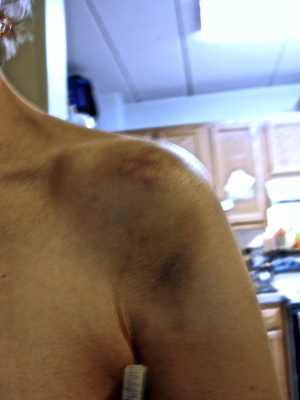
The above is are just some bruises of many I received during my month-long course of “psychiatric treatment” at the Hartford Hospital’s Institute of Living, on the unit called Donnelly 2 South. In  Connecticut, the Institute of Living, first known as the Retreat, and once quite famous as a posh sanatarium for the rich and famous though this is no longer true, was first made famous by  Clifford Beers, I believe, who wrote about similiar torture he underwent there just a hundred years ago in the book, A Mind That Found itself.
 

After burning my face with cigars and cigarettes, I spent the last month in Connecticut’s well-known Institute of Living (yeah the dangerous 6th month was JANUARY not February but nobody thought to check my math) being beaten up and trussed like a pig in four-point restraints almost daily for many many hours. Why did they deal me this sort of treatment? Why? Because “You do not follow directions”.


I DID NOT FOLLOW DIRECTIONS so they beat me up and tied me, shackled me with leather and metal cuffs  to a bed for dozens upon dozens of hours.! Get that? I was disobedient, so they shackled me to a bed as an excuse for treatment!


After this experience, I LOST ALL FAITH in the ability of any institution to do anyone any good who has a mental illness or sickness of the mind, or any emotional disorder or whatever you wish to call it. I GIVE UP! I will kill myself if anyone ever tries to send me back to such a cesspit of a place. I do not care if it is appointed like the Taj Mahal. NO ONE who works there is uncontaminated by the evil infecting such places and they are ALL EVIL EVERY SINGLE ONE. I have NEVER been to a hospital where the people are kind and well meaning and where the treatment is actually kind and decent. Once in a  while a single person, such as the Middlesex Hospital occupational therapist  Christobelle Payne, may stand out in memory as being a rare human being of warmth and dignity and  caring, but otherwise, they all to a one fail the test of being decent human specimens and all fail royally to be even normally humanly responsive to suffering persons. They are in it for the money and a cushy job, and don’t you forget it if you go into a psycho hospital, DO not expect to get well there. Expect PILLS, and directions (ie ORDERS) that you HAVE To follow or ELSE.


Get out of there as quickly as possible, because your life depends on it. I am serious. DO NOT LINGER expecting care and treatment or to feel better no matter how helpful it might want to seem.


Furthermore. if you are a young person, do not listen to the sweet seductive advice that some may give you that you woul do well to go for “disability” and social security payments. THAT Is a load of total crapola and the worst thing anyone could tell anyone under the age of 50. I am so angry and broken at the moment that I cannot speak more. But if I can later on, I will say more to explain. At the moment, I have to attend to too many PHYSICAL bruises and to find a way back to sanity on my own, havin been driven to the brink of near extinction by one of the best known hospitals in this state. At the moment I am both rigid with rage and so confused and broken that I scarcely know how to continue, or whether I even want to. Why bother? Why bother? How can people be such  monsters, and in such monstrously powerful places and ways. I hurt so deeply and feel I will never trust an single person ever again when they say, Come let us help you. You need our help.  YOUR help? Like being raped, I need your F—ing help!


GO jump in a lake of snot is what I should say to all of you so called helpers. I’d rather die. Go F— yourself.

I am Asexual, I am not an Amoeba

Let me state this plainly so there is no misunderstanding: I am tired of people thinking there is something wrong with me just because I do not have a husband or boyfriend/lover or even a girlfriend/lover or a love-interest of any kind. I am not interested in sex and have never been interested in sex for whatever reason. This does not distress me and it never would have in the past, had others not insisted that it ought to. I have finally come to the conclusion that being asexual — definition: having no interest in a sexual relationship with another person — is okay.

I am not unhappy. I get a lot done and I am likely more satisfied by my life as an asexual than someone who is sexual and without a partner. I am never lonely. And I have tons of friends. (At least 16 friends — all of whom I adore — came to my 60th birthday party!)

It has taken me, via a tortuous up and down path, a long time to come to this position. And there may well be those who shake this foundation yet, as other people’s opinions, alas,  still manage to have a strong effect on me. I have never told openly the story I am now going to relate, but I think it is time. It should be an eye-opener and a warning to those who believe they have the right, even the duty to “help” a young person discover “her true identity…”

As some of you know, a very long time ago, I was a student in a medical school in Connecticut. The two years I attended med school were extraordinarily difficult ones for me and I admit now that even as I matriculated, I “knew” at an almost conscious level that I would never get through. I didn’t honestly want to be a physician. Not really. Oh, yeah, I thought I could be a good psychiatrist. I knew that I understood people and mental illness enough to empathize  and help others. But the notion that I could successfully get through four years of med school and four years of residency in order to achieve that goal was something I also knew would be impossible, even as I nominally attempted to undertake it. I had no choice. It was what you did in my family. And there was no question in my mind that I could work at a “regular 8-hour a day job.” I simply didn’t have the stamina either interpersonally or physically. I didn’t know why, I just didn’t. (I also didn’t understand that I had narcolepsy, so I construed my constant drowsiness as “boredom” for everything.)

So there I was in med school, without the ability to make friends or any interest in relationships, especially having just broken up with Bruce, the one boyfriend I had had and with whom I had sex (because he pushed it). I hated it…which was why I broke it off. I know I was noticed. I felt noticed. Possibly because I made little effort to be friendly, possibly because my narcolepsy made me noticeable. I don’t know. It is not that I was or am a striking person at 5′ 3″ and 105 lbs…hardly! Perhaps it was my mere aloneness that struck people. I dunno.

Things were hard to start with, but then the voices started up telling me to hurt myself and I acted on their commands, frequently. I had horrific nightmares nightly. And I could not stay awake in class or to study no matter what I did. People had all sorts of advice and jokes for me but no understanding. They gave me No-Doz and Vivarin for my birthday, which precipitated a caffeine-toxic all-night-up of horror. They took photos of “Rip van Winkle” sleeping on the med school lobby couch and published it in our newsletter. No one knew what was really going on, at home, at night, in my bedroom when the voices took over.

I had a run-in with the student health doctor, Dr E, to whom I had gone about possible Reynaux (sp?) Syndrome. When she saw certain scars on my body she became concerned and spoke with the psychiatrist I was seeing at the time. Dr S, who was a cold man who seemed to dislike me from the start, was angry at our next appointment for “parading” my wounds and warned me against ever doing so again.

I went back to Dr E and told her what Dr S had said. She seemed perturbed and gave me the name of a therapist that she said she often referred “troubled students” to. I might consider seeing Tamara instead of Dr S.  The other students liked her a lot, Dr E said. What were their problems? I asked. Dr E shook her head and responded, Not so very different from yours.

I sit nervously in the waiting room, hoping that Tamara will be so late she won’t have time to see me today after all. I feel sick to my stomach and wonder why I’ve come. Five minutes late, ten minutes late. I am just about to leave when a very pregnant woman opens the door to the office and welcomes me in. I do not look at her face but whisk myself inside, trying not to guess how many more weeks she has.

Before she asks me anything, Tamara says, “Now, I see girls who like girls and boys who like boys. You’re okay with that?”

What is she talking about? I don’t understand. Girls who like girls? I like girls, I like boys. Why shouldn’t I be okay with it? So I say, yes. And assume that even so, she sees people whose issues are very different…

I didn’t ask her. I simply assumed that she had other interests. And went on from there. But it was critical, because I did not get that she was conducting therapy as if I had agreed that I was a lesbian, and yet I had made no such admission. I did not even understand what she was getting at.  Why was she so coy? Why didn’t she just come out and ask me whether or not I was gay and then tell me that she only treated lesbians and gays with issues around their sexuality?

As it turned out, she had no idea that I was not in fact assenting to her coy proposition that I “liked girls.” On the contrary, if she had asked me point blank, I would likely have said, “Me? No way. I am not even interested in boys. I couldn’t care less about sex. I like, but don’t love, boys and girls…so to speak.” But the operant word, clearly, was not “like” at all, but love, as in “making love.”

Actually, in point of fact, I would not have been able to respond at all, if I remember my former self accurately. I was nearly mute much of the time, esp in therapy, and when I did speak it was often very cryptically and with difficulty making myself clear. This may account for the misunderstanding that so horrified me in what follows.

It was a crazy-making psychotherapy for about 6 months. I had no idea what notion she was operating under, because I didn’t know what kind of therapy she “did.” Likewise, if she knew the least thing about me, it was completely mis-colored by her mis-understanding of me as a lesbian. So when one afternoon she “told” me that she empathized with me, because I had had a sexual relationship with my previous psychiatrist…I hit the roof.

“WHAT? What the F— are you talking about?!” I nearly leapt out of my chair.

“It’s okay Pam, I understand,” she soothed me.

“It is NOT okay! I never said anything of the sort!  This is YOUR filthy mind!  I’m out of here. Go to hell!” And with that I got up and walked out. I realized then that she was nuts.  Somehow she had gotten the entirely wrong idea, but I didn’t understand how. It made no sense to me. Where on earth had she fashioned that notion? I certainly had never said any such thing…

Then her statement “I treat girls who like girls…” came back to me. And I understood more. Dr E surely knew Tamara’ orientation, her clinical expertise, so Dr E must have believed that I needed to talk about conflicts about my “homosexuality,” about coming to terms with being a lesbian, unbeknownst to me. So she had set it up that I see Tamara, believing that she knew me better than I knew myself. But what right had she to do that? And how would she know whether or not I was a lesbian? Just because I was a conspicuous loner? How dare she? She knew nothing about me! What she had done was a violation of me as bad as any man who wanted to have sex just to prove he was Mr Right!

I spent a lot of time after that utterly paranoid that I might be gay, feeling that I must be gay, certain that I was gay…I even came to the point that I  accepted it eagerly. But it was never true. It was just another identity forced on me by others who would not let me be. Who would not accept that I simply have never had interest in sex or sexuality beyond a pervasive non-sexuality. My libido, my psychic energy, is invested in other things, in art, in science and in life, but not in erotic interests. And you know what? Being non-sexual or asexual doesn’t make me an amoeba or less than human.

At least 1% of humanity is asexual, has always been asexual, permanently. That’s a LOT of people. We may not be the norm, but there are enough of us out there to rate your acknowledgement and the respect you would pay to any other human being. That’s all we ask, that’s all I ask. And for you not to try to change me just because you do not like it or understand my way of being. Thank you.


(For anyone who was reading the other post when it disappeared, sorry! There was a problem!!!!)

Guns R Us…Why should Sandy Hook Surprise Us?

Don't shoot!
Don’t shoot!

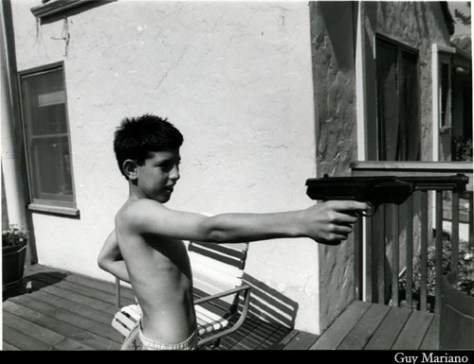
We are what we do. As a society we are what we teach our children to do. And we are no better than what we allow to happen by our inaction, if we don’t act to stop it. Our gun laws permit, nay, they encourage gun use by everyone, they enthusiastically promote gun ownership and usage, and they turn a blind eye to gun ownership and usage by those who should never lay their hands on a toy gun, much less a loaded one.

Guns kill. They are not decorative or ornamental items. They are not collectors items. So let’s not fool ourselves. It may take a human agent to pull the trigger, but it is the bullet from a gun that kills. And get this straight: when a gun kills 20 little kids, it matters not whether the slugs come from a sig sauer, a glock, a .22. or a Saturday night special, what kills is a gun that does the only job it was designed to do.

0-1

When it comes right down to it, it is far too easy to kill someone when you have a gun, any gun: if you push or punch someone because you are angry, it is likely that he or she will be bruised, but they will live. It is only when there is a gun attached to your fingers that lethality comes attached as well. GUNS KILL PEOPLE. People using GUNS KILL PEOPLE, but people without guns do not so frequently kill people.

Let’s face it, Adam Lanza would have found it extraordinarily difficult to have murdered 20 children and 8 adults in less than an hour without his two handguns. The guns literally empowered him to do what he did. Without his guns, he would likely not even have attempted such a deed. Guns made him a god to grant and take away life, and in a moment of passion, he decreed that 28 people would lose theirs. Now, I don’t even believe doctors should be playing god, so I am horrified that all it takes is a gun, and Everyman has the power to do what only god should be in charge of.

Check out the website created after the Newtown, Connecticut, kindergarten shooting this afternoon, http://wearebetterthanthis.org, sponsored by the Brady Campaign to Prevent Gun Violence. God bless them,  I fully support the Brady Campaign. However, I am not sure we — whoever we are — are truly better than any “this”…Who are we anyway, and what proves that we are actually better than we witness happening around us?

The stats are ominous and more than distressing. And they speak volumes about whether perhaps it’s just a big fantasy, our being any better than the murderers among us.

For one thing, you should know that while there are 34, 589 hardware stores in the United States, there are more than 129,817 licensed firearms dealers as of Aug 2012 .  Of those, 51,438 are retail gun stores, 7,356 are pawn shops and 61,562 are collectors. The rest are manufacturers and importers of firearms and destructive devices.

There are also 80,000 ice cream parlors. Ice cream does 18 billion in sales a year, which isn’t bad considering an average ice cream cone costs only between $2 and $4. An average Glock 17, “America’s favorite gun,” costs around $500.00 You do the math and then tell me how easy it will be to convince gun dealers to change their ways…

JAKEgmGun

But right now, why should they bother? Guns are great business! In 2010 the National Instant Criminal Background Check System (NICS) ran 16,454,951 background checks for firearms purchases.  Only a small number of these purchases (78,211 or 0.48 percent) were denied. During Obama’s first term, and well before it ended, more than 50 million background checks had been run by the NCIS. This was a bonanza for the gun industry compared to the same 3.5 year period under George W Bush, when “only” 28 million such checks — background checks are an index of the demand market — were run. So clearly, if guns in the hands of the wrong people kill, chances are that more guns had to be getting in the hands of more wrong people than ever during the last four years…many many more.

Note that it doesn’t matter how many guns are purchased at one time, there is only one background check per purchase. After that, what you do with the guns and how many you have purchased at one time, is your business and yours alone… Oh and lest you think the so-called “mentally ill” would be screened out by the NCIS background check, think again. Being “adjudicated mentally ill” and barred from buying a gun is not at all the same thing as simply seeing a shrink or even being hospitalized in a general hospital, with or without your consent for 15 days.

I have been kept in a hospital against my will for even longer, but I have not been formally adjudicated mentally incompetent, or if I ever was, now that I am OUT of the hospital, I am no longer considered non compos mentis, and I could buy myself any gun I wanted to.

Frankly, I think that is only right. Why should some angry redneck be able to buy himself a Glock 17 semi-automatic handgun and I, peaceable and very, very unlikely even to pick it up, let alone use it, could not buy a sweet little .22? Furthermore, I would be far more likely to use it ON MYSELF not on others…

This last is a notable case in point, because unbelievably, suicide far exceeded homicide as the cause of gun fatalities at least in 2005. In 2005, 5.75/100,000 people committed suicide with a firearm, whereas “only” 3.43/100,000 people caused firearms homicides in that same year. Since in 2012, the suicide rate has hugely increased, probably due to PTSD in returning veterans, this ratio likely has only increased.

Approximately 34 persons are felled by guns each and every day in the US. According to the FBI Uniform Crime Report, between 2006 and 2010,  47,856 people were slain by gunfire in the U.S., more than twice as many as were killed by any and all other means.

Whether or not the suicidal mentally ill should have access to guns – and just how to prevent it, just how to define who is mentally ill would be a huge problem — I see a bigger problem with an angry man of any stripe being able to purchase a handgun. Anger is a big spur to impulsive behavior and impulsivity and guns decidedly do not mix.

So I ask you: How can we be better than Friday afternoon’s Glockencatastrophe if we buy or permit/encourage the purchase of so many more handguns than ever? We are a gun culture, we worship guns,  we hav a national love affair with guns. What do we expect?

You know, one of the first rules of writing fiction is, if you “plant” a gun in the early scenes in a story, it must go off by the end…Similarly, if we have and are a gun culture, who are we not to expect to be a culture of shootings? We have the guns, how can we expect people, both good and bad, not to use them?

During the Newtown shooting, from what I gather, the shooter killed himself after he shot all the 28 other victims…All the high tech and paramilitary heavy weaponry with which the police have equipped themselves did zilch in the end to prevent mass murder. No, 20 small children and 8 adults were quickly and savagely murdered, a horrific act accomplished largely so it appears with two handguns, a plastic and metal glock and a sig sauer. The shooter supposedly had access to a Bushmaster combat rifle it is not clear that he used it for the killings.

Whatever is the case, things will become clearer in the coming days as the police reveal more information.

Perhaps I should be softer and sadder right now, perhaps I should not bring up things like slugs and guns and such at this moment. Forgive me for not wailing and beating my breast or crying but many more are doing that tonight elsewhere, so I am just going to save my breath for rage on behalf of those poor murdered children and the eight  others…Any more  tears added to that ocean would just be wasted salt and water.

Art: Killer Nurse and Placid Seascape

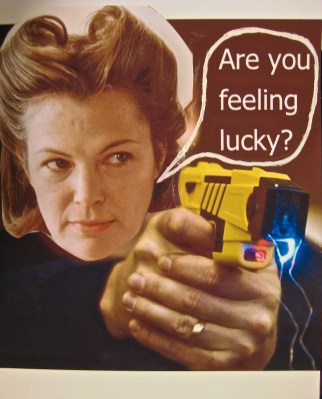
We all know what happened next…8.5 by 11″ © Pamela Spiro Wagner All rights reserved.
Boats at Evening, after Monet, 11 by 14″ © Pamela Spiro Wagner All rights reserved.

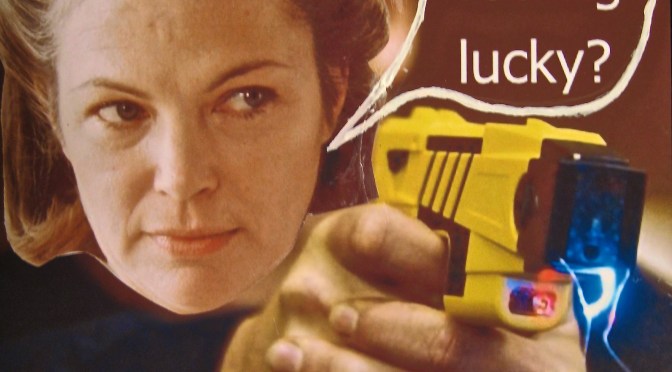
I do not have a lot to say tonight after yesterday’s marathon writing session, but I wanted simply to share my latest artwork. The first one, the collage, is going to be part of a talk I give to a group in December…I won’t say to whom or where just yet. All I will say is that this is how most psychiatric nurses deal with patients: “You do what I say, or else…”

The seascape on the other hand was simply a doodle I did one day while looking through an art book. I saw this Monet of boats at Argenteuil and thought I would sort of copy it, though not really. I just didn’t have any boats or water nearby to paint, so I figured I would use his painting as a model, a close one, though I clearly did my own thing with it…(And I am no Monet!).

Miracles: Four Life Changing Events

©Jesse Taylor (Own work) [CC-BY-SA-3.0 (http://creativecommons.org/licenses/by-sa/3.0)%5D, via Wikimedia Commons
Okay, so as a friend suggested, maybe there have been five not just four miracles, with the most recent miracle having occurred, and ongoing, about three weeks ago. But more on that later. First, a definition of miracle, so we are all clear on what I mean here.

CS Lewis, a popular Christian writer of the twentieth century and still known for his Narnia Chronicles, wrote that “a miracle is something that comes totally out of the blue…” Now, he meant something extremely unlikely, like a virgin female giving birth to a child. Now, apparently, this has been observed at least once in modern times. If you don’t believe it, and can understand the technical language, you can read the following abstract as proof. Then you can decide whether or not virgin birth still counts as a miracle:

Fertil Steril. 1992 Feb;57(2):346-9 .

Chimerism as the etiology of a 46,XX/46,XY fertile true hermaphrodite.

Source: Department of Obstetrics and Gynecology, Chicago Lying-In Hospital, Illinois.

Abstract

OBJECTIVE: To determine the conceptional events resulting in a 46,XX/46,XY true hermaphrodite and to report the first pregnancy in a 46,XX/46,XY true hermaphrodite with an ovotestis… (see the rest of the abstract at PubMed)

Another thinker, British mathematician John Edensor Littlewood, suggested in what became known as Littlewood’s Law that statistically individuals should expect one-in-a-million events (“miracles”) to happen to them about once a month. By these calculations, seemingly miraculous events are actually commonplace.

And of course there is the dictionary definition of miracle, which is the one commonly accepted by both religious people who believe in miracles, and those who do not believe in their existence, but who do accept the definition of the word.

mir·a·cle/ˈmirikəl/

–A surprising and welcome event that is not explicable by natural or scientific laws and is considered to be of divine origin

OR

–A highly improbable or extraordinary event, development, or accomplishment

I myself would add a third, and relevant definition, or qualifier, which is “if it occurs in an individual person’s life, the event produces changes, beyond any that could have been imagined prior to the miracle, in a positive direction wholly unexpected and therefore regarded as miraculous.” To be cured from a terminal or crippling illness is of course a miracle. But so too to my way of thinking would be remission from a future-destroying addiction or mental compulsion. Needless to say, complete reversal of a severe mental illness would count as a miracle. And I can think of others that might be counted as less effulgent but just as miraculous.

Given those broader categories of miracles, then, I will proceed to tell you of mine. I do not know what the Course on Miracles is all about, nor anything of the Miracle classes offered online. If there are similarities, I dunno what it means, except that we came up with our thoughts completely independently. I have spoken of the following things as miracles for many years now without any familiarly with the C.O.M or any other such program.

So, onward to my First miracle. (Alas, I fear I will have to deal with the Second Miracle and the Third, Fourth and Fifth in following posts as this one is already getting long enough and will be longer by the time I am finished.) The first miracle concerned, as some readers may remember, plants, wild plants, field botany, in short, the wonders of the wild green world. But not just that, no, it was the discovery in myself, utterly unanticipated, of a bizarre and wonderful ability to simply know, almost without any idea how I knew it, any plant I came across. In fact, I must have seen them, if briefly, in some plant book or field guide, but it was truly uncanny, my ability to instantly recognize and categorize whole families and genera and then the species within them just by casually looking at any plant, flower or tree I saw, having but  glanced at a simple sketch or pencil drawing of a plant the night or even a week before seeing it in the wild.

I once wrote about this miracle in my first blog at http://www.schizophrenia.com. Although the essay has a less than happy ending that has nothing to do with miracles, I will reprint the essay in its entirety here. Suffice it to say that the pivotal moment,  the chairotic moment and miracle that surrounds “Prunella,” which I describe early in the piece, changed my life forever.

WILDFLOWERS ON THE ROAD TO DAMASCUS

Thirty years ago, I took the natural history course purely for exercise. I figured, what better way to stay in shape than to get credit for it? At the time, I couldn’t tell a maple from an oak, let alone one old weed from another, and it wouldn’t be easy. But just to keep off the flab would be a benefit in its own right. Since the prospectus promised daily field trips, no mention of love or awe or wonder, the last thing I expected was a miracle.
Showing up for the first day’s trip, I wore old tennis shoes of the thin-canvas Keds variety. I had no idea L.L. Bean’s half-rubber hiking boots were de rigueur for a course of this kind. What god-awful-ugly shoes just to walk in the woods! I thought in horror. Right then, I realized I’d made a huge mistake and it was too late to change my mind — I’d have to stick it out for the whole semester. I knew for sure I was going to be more miserable getting “exercise” than I ever would have with my thighs turning to mush, safe in the college library.

The teacher, Miss G, took off stomping down the path and we tramped on after her. I was last, straggling behind, half-hoping to get lost so at least I could head back to civilization. Before we’d gotten far, she halted, peering intently at something near her feet. She waited for us to catch up and gather round her, then pointed at a weed. “Heal-all. Prunella vulgaris,” she announced sternly and without passion. “Vulgaris means ‘common.’ Learn names of both genus and species. Be forewarned, ‘Heal-all’ by itself will not be an adequate answer on your quizzes.”

She stepped aside so we could take a better look. As instructed, one by one the class dutifully wrote down a description and the two names we’d been given. I was still at the back, waiting my turn without the least enthusiasm, let alone the anticipation of what, in those days, we called a “mind-blowing” experience.
“Come on, now, don’t be shy. Step up and look for yourself,” Miss G scolded me, pushing at my elbow to propel me closer.

Finally the clump of students cleared out and I had a better view. For some reason, I found myself actually kneeling in front of the weed to look at it close up. Then it happened. As if the proverbial light bulb flashed on over my head, I understood what Miss G meant when she’d said: “Weeds are only wildflowers growing where they aren’t wanted.”

Prunella, I know now, is no more than a common mint, found in poorly manicured lawns or waste ground. Yet, with its conical head of iridescent purple-lipped flowers and its square stem – on impulse, I’d reached out to touch it and discovered an amazing fact: the stem wasn’t round! – Heal-all was the single most beautiful thing I’d ever seen. The world went still. There was only me and the flower and the realization I’d fallen in love.

Since one of my other courses concerned the history of early Christianity, I knew immediately what had happened. Like Paul on the road to Damascus, I’d been struck by unexpected lightning. I’d been converted. I put away my notebook, knowing I didn’t need to write down a word, knowing I’d never forget “common Prunella” as long as I lived.

There were other miracles in my life after that, but none came close to the thunderbolt that knocked me flat the afternoon I saw, truly saw, that homely little mint for the first time. “Sedges have edges and rushes are round and grasses have nodes where willows abound.” Yes, I learned such mnemonics, which helped me as much as the next person when a plant was hard to identify. But I discovered in myself an amazing feel for botany that was like sunken treasure thousands of feet beneath the ocean. Once I knew it was there, I had merely to plumb the depths, more or less unconsciously, and gold would magically appear.

I went walking in the woods every chance I got and carried Peterson’s guides with me even into town, checking out the most inconspicuous snippets of green that poked through the sidewalk cracks. The first time I came out with a certain plant’s genus and species before Miss G told the class what we were seeing, she looked at me oddly.  I began repeating this performance until once she even allowed me to argue her into changing her classification of a tricky species. If I still hung back behind the group as we walked, it was no longer from reluctance. I was simply too entranced, looking at each tree, to keep up the pace.

By December, as the semester was coming to a close, Miss G had begun using me as her unofficial assistant, asking my opinion whenever there was a question as to what was before us. Oh, I confess, I never did get the knack of birds. It was the trees and wildflowers that stole my heart entire.

At the end of the semester, we received course evaluations in lieu of letter grades. I opened mine eagerly, expecting praise. Instead, Miss G was terse and unenthusiastic: “Pamela faithfully attended every field trip, but for most of the course she failed to share her insights and established expertise with the rest of the class.” End quote. “Failed to share her established expertise“? What was she talking about? Did she think I’d already known everything she taught us? How could she not understand what she’d done for me, introducing me to little Prunella, how I’d learned everything I knew after that moment, not before?

It was the worst evaluation I’d ever gotten, the injustice of which struck me to the marrow. I went to her office to explain and found a sign on her door saying she’d been called away on a family emergency and would not be returning until the next semester. But I wasn’t returning for the second semester. I was transferring back to my original school.

I caught my ride home, spending four hours crammed into the back of an old Volkswagen bug with two other students, wordless with indignation that replayed and reverberated through my mind. How could she think such a thing? I couldn’t stop writing a letter of protest in my head as the highway flowed endlessly beneath us.

I did write Miss G, finally, explaining all she’d awoken in me, emphasizing the magic I’d discovered in her class, my new-found joy and amazement. At the end of March I got a reply, but no apology, no hint that she understood she’d misunderstood. Not even appreciation for my gratitude towards her and what her course had done for me. Just a brisk, no-nonsense note, little better than a form letter. I had the impression that she didn’t quite remember who I was, that I was just another faceless student writing to her about a natural history course she’d taught perhaps forty times in her long career as a teacher.

Whether she knew who I was or even recognized what she’d done for me mattered little in the end. What did matter was that when I met homely little Prunella, I discovered the whole world in a common weed.

©Pamela Spiro Wagner, 2004

The next posts, or in the following weeks, I hope to cover the other four miracles. If you are interested in them, and I fail to follow through, feel free to “goose” me with a reminder. My mind is a sieve and I rarely remember anything without a string tied to my thumb! 8D

Poem about Forgiveness,Translated into Chinese

TO FORGIVE IS

To begin  要寬恕的實是太多

and there is so much to forgive:  頭一樁要算

for one, your parents, one and two,  你父母那麼偶然的一或二次

out of whose dim haphazard coupling  於幽暗中的契合

you sprang forth roaring, indignantly alive. 你呱呱來臨,憤然降世

For this, whatever else followed, 為此, 為這帶來的一切

innocent and guilty, forgive them.  無意也好作孽也罷,寬恕他們.

If it is day, forgive the sun  若是白天,寬恕太陽

its white radiance blinding the eye;  原宥它的奪目光芒

forgive also the moon for dragging the tides,  亦要寬恕月亮帶來的潮汐

for her secrets, her half heart of darkness;原宥它的弔詭.它的暗晦

whatever the season, forgive it its various  管他冬夏秋春.寬恕季節的多端侵擊

assaults—floods, gales, storms  水患,疾風,暴風雪

of ice—and forgive its changing;  原宥它的更替變易

for its vanishing act, stealing what you love  它的掠奪行徑

and what you hate, indifferent,  把你所愛所恨無情的奪去

forgive time; and likewise forgive its fickle  寬恕時間

consort, memory, which fades  同樣地原宥它的變易不忠,連記憶也不放過

the photographs of all you can’t remember;  以至你把擁有的拍照忘得一乾二淨

forgive forgetting, which is chaste  寬恕失憶

and kinder than you know;  它實是忠貞和比你所認知的仁厚得多

forgive your age and the age you were  寬怒年齡

when happiness was afire in your blood  原宥當年的你,那時幸福在血液沸騰

and joy sang hymns in the trees;  喜樂在樹 叢間高唱聖歌

forgive, too, those trees, which have died;  寬恕那些逝去的樹木

and forgive death for taking them,  原宥奪走它們的死亡

inexorable as God, then forgive God  若感上主不仁,則寬恕上主

His terrible grandeur, His unspeakable原宥祂畏人的堂皇和禁說的名字

Name; forgive, too, the poor devil  亦勿忘寬恕那倒霉的撒旦

for a celestial fall no worse than your own.  他那屬天的失足並不比你的過犯糟糕

When you have forgiven whatever is of earth,  當你把地上天上水裡

of sky, of water, whatever is named,  有名的無名的

whatever remains nameless,  通通寬恕了

forgive, finally, your own sorry self,  最後切記寬恕

clothed in temporary flesh  那包裝在短暫肉體內

the breath and blood of you  血氣正在消亡的

already dying.  悔疚的你

Dying, forgiven, now you begin.  垂死,被寬恕的你,現在要重新開始.


By Pamela Spiro Wagner, “Divided Minds” 胡思亂想

Chinese Recreation/Translation by Kenneth Leung Sep 3rd 2012, Labour Day Scarborough,  Ontario


—————————————–

I received the email below very recently, explaining the poem above. The only thing missing is the translation of the title, which segues on purpose directly into the first line, and so it too is essential. I hope that Jackie’s father might one day provide that title line. Nevertheless, I am thrilled that anyone likes the poem enough to translate it. Thank you so very much, Kenneth Leung. And thank you Jackie, for sharing it with me and allowing me to share it here.

“Hi Pamela,

“I recently picked up your book “Divided Minds” and I couldn’t put it down.  Thank you for sharing your story with the world.  I’m an Occupational Therapist working in community mental health on an ACT team, so I interact regularly with people with schizophrenia.  Your story allowed me to see how difficult it is to first accept a diagnosis of schizophrenia, and then the difficulties of adhering to treatment.  I especially love your poem on forgiveness and shared it with my dad, who translated it into Chinese.  I thought you might be interested in posting it on your blog so Chinese readers can enjoy it.

“Blessings,

“Jackie Leung”

To Kill or Not to Kill: Physician-Assisted Suicide?


My brother visited me recently and for some reason we got into a discussion about whether or not we supported physician-assisted suicide. We differed on the fundamentals: Phil, aka Chip, supports assisted suicide in every sense of the word. He thinks that it should be legal for a physician to prescribe a lethal medication essentially for anyone who asks.


This horrified me. Wait, he went on to explain. In his opinion, everyone should have to push a button upon waking in the morning in order to stay alive. If you failed to push it, you die. Meaning that the day would begin with everyone choosing to live, thus having to take responsibility for making that choice. We would start with the premise that every person who “wakes up alive” has chosen to live and cannot claim rightly to be suicidal…I guess that Chip as a psychiatrist, feels too many of his patients do not want to live, but also do not sincerely want to die, and he thinks that they need to acknowledge the latter. That might be good, but I also know that there are those who are so depressed that in their involuntarily mentally incapacitated state, they might not be able to press the “I want to live” button, and thus would die, even though in a healthier frame of mind, they would have chosen to live…

For me, I agree that when terminally ill, a person should have the right to end his or her life, and should be able to do so without interference from authority, legal or medical. I also think that in certain cases, palliative or hospice care helps with this, and already has done, silently and as it were secretly for years: the administration of a sedating dose of morphine when the time is right goes a long way towards assisting a person’s “dying process.” Not a lethal dose mind you, but a dose to “ease breathing” and one from which the physician and all witnesses understand the person will likely never awaken.

(My friend Joe is another case entirely. They turned off his ventilator and dosed him with morphine after 4 years with ALS. I firmly  believe that they murdered Joe outright, against his will…But no more will be said of that at the present time.)


On the other hand, let’s face it, if you really want to commit suicide, it is easy to do so if you are able-bodied and not terminally ill: just jump in front of a bus, or out of a tall building’s window. There are a dozen sure-fire ways and they have been used for millennia as an easy way out. The problem is for those who are physically so debilitated that they literally cannot “jump” or swallow the pills or whatever. Yet  unless they are forcibly nourished and hydrated through a feeding tube, they can always refuse food or liquid, which it seems is not agonizing after all. That is according to what recent research and personal witness (my own) have indicated. When my friend Lynn L died – essentially from not a refusal to take liquids– she did not suffer acutely from deprivation but seemed slowly to cross into a never-never land. She simply drifted off to an endless sleep and passed away.


The idea that a physician could freely prescribe an overdose of a lethal drug to any someone who came asking for it, that just strikes me as the height of 1) irresponsibility and 2) cruelty, by someone whose job, after all, is characterized by the Hippocratic Oath: primum non nocere or “First do no harm.” If killing  a patient is not doing harm, then I do not know what is. I simply do not understand how bloodying one’s hands in the act of killing, no matter how good one’s intentions, cannot but badly affect any so-called healer.


Surely there are other ways to deal with a person’s pain and suffering than to throw up one’s hands and say, well, I cannot help you feel better or live longer, so I will simply shoot or poison or – whatever – you so you feel nothing and don’t have to deal any longer.This completely disregards the inherent value of the struggle itself, and the promise of something worthwhile, if only at the very end  at the moment of dying, in having faced the suffering and undergone it fully.


Look, I do not like or want anyone to suffer agony in the last stages of life, and am all for morphine use, liberal or sparing, depending on the patient’s desires and needs. But there is no absolute value in complete suffering or pain relief, not in my book. For me, I insist that I must feel my own feelings, and in that quest, I must decide to feel the pain, emotional or otherwise, rather than dull it with drugs or anything else. Yes, it hurts, but the hurt somehow feels better because it is mine and real, and not the forced dull nothingness of being drugged out of it.


If you have other thoughts about this, do feel free to share them in the comments section. In the meantime, I found this article on the very same subject at Medscape Psychiatry. It was written by ethicist and psychiatrist, Ronald  W. Pies, MD and may be found in its original form at this link:


http://www.medscape.com/viewarticle/771274

Medscape Psychiatry > Ethics in Psychiatry


Do We Need ‘Thanaticians’ for the Terminally Ill?


Ronald W. Pies, MD


Posted: 09/26/2012


The Ethical Dilemma of Physician-Assisted Suicide

My 89-year-old mother had been losing ground for some years, experiencing what geriatricians sometimes call “the dwindles.” Toward the end of her life, she was beset by a deteriorating heart; an inability to walk; and occasional, severe gastrointestinal pain. My family got her the best medical treatment available — eventually including home hospice care — and she generally maintained a positive attitude throughout her long downhill slide.


But one day, as I sat beside her bed, she seemed unusually subdued. “Honey,” she said, “How do I get out of this mess?” I had a pretty good idea of what she was really asking me, but I deflected her question with another question: “Ma, what ‘mess’ do you mean?” I asked. “It’s all right,” she replied, smiling sadly, “I’ll manage.”

My mother was doing what she had always done: sparing her children from pain. In this case, it was the pain of dealing with the waning days of her life and the frustration of knowing there was no easy escape from the burdens of dying slowly. “Ma, I’ll always make sure you are getting enough treatment for your pain,” I added, taking her hand — knowing that the prospect of unremitting pain is often an underlying fear of terminally ill persons.


Yet, unspoken in my mother’s question was the issue of so-called physician-assisted dying, sometimes called “physician-assisted suicide” — an enormously heated controversy both outside and within the medical profession. In my home state, Massachusetts, the issue has come to the fore, owing to a November ballot initiative for a measure that would allow terminally ill patients to be prescribed lethal drugs.[1] A closely related bill (H.3884) has also come before the Massachusetts Legislature’s Joint Committee on the Judiciary.


Similar to laws already on the books in Oregon and Washington state, the proposed Massachusetts law builds in numerous “safeguards”: For example, patients would be required to submit their request in writing twice, and those requests must be 15 days apart. As reported recently in the New York Times,[2] fears regarding widespread overuse or abuse of the so-called “death with dignity” laws in Oregon and Washington have largely failed to materialize, at least according to some studies.


Nevertheless, the Massachusetts Medical Society (MMS) has long been opposed to physician-assisted suicide. In March 2012, the MMS President, Dr. Lynda Young, testified before the Joint Committee[3] and did not mince her words. Allowing physicians to participate in assisted suicide, she stated, “…would cause more harm than good,” and she argued that “…physician-assisted suicide is fundamentally incompatible with the physician’s role as healer.” Instead, Dr. Young asserted, the physician’s role should be to ensure that the terminally ill patient “…continue[s] to receive emotional support, comfort care, adequate pain control, respect for patient autonomy, and good communication.”


With considerable ambivalence, I agree with Dr. Young. In my view, terminally ill but mentally competent patients should be at liberty not only to refuse further medical treatment, but also to end their own lives — for example, by refusing to accept liquid or solid food. Contrary to a widespread belief, voluntary refusal of food and fluids does not result in an agonizing or painful death, according to a2003 report in the New England Journal of Medicine.[4] Indeed, medical ethicist Dr. Cynthia Geppert informs me that voluntary refusal of food and drink is now considered an accepted approach to dying in palliative care.


As Dr. Thomas Szasz has argued in his book, Fatal Freedom: The Ethics and Politics of Suicide,[5] a liberty is not the same as a right, because the latter entails a reciprocal obligation on someone else’s part. (If I have a right to free speech, the state has a reciprocal obligation to protect that right.) Moreover, the liberty to commit suicide does not entail the “right” to have one’s physician prescribe a lethal dose of medication. Indeed, Dr. Szasz believes that “physician-assisted suicide” is really a euphemism for “medical killing” — more technically, “heterohomicide” on the part of the physician.


While I disagree with Dr. Szasz on many issues in psychiatry, I think his analysis here is essentially correct. Physician-actuated heterohomicide, in my view, is “fundamentally incompatible with the physician’s role as healer.” I believe that permitting physicians to write prescriptions for lethal drugs will eventually erode the trust that all patients should place in their physicians. More than a euphemism, “physician-assisted suicide” may be a contradiction in terms. And in my view, the very concept violates both the implicit ethical contract between physician and patient, and that between the physician and society.

To be clear: None of this means that physicians should collude in the cruel and unnecessary prolongation of dying, as is often seen in hospital settings. As physician and ethicist Dr. Fred Rosner has argued,[6] “To prolong life is a [commandment], to prolong dying is not.” Thus, in the Jewish medicoethical tradition, “removing impediments to death” is sometimes acceptable — that is, discontinuing treatments that needlessly prolong the dying of a suffering, terminally ill patient, but without actively bringing about the patient’s death. (The distinction between “letting” someone die and “making” someone die was supported in the 1997 US Supreme Court case of Vacco v Quill,[7]which upheld New York State’s ban on assisted suicide.)


But what about those suffering, terminally ill, mentally competent patients who will not choose to end their lives by refusing food and drink and instead seek out “assistance” from healthcare professionals? Again, I do not believe that medical professionals should participate in assisting a patient’s suicide. But I sometimes wonder whether society ought to permit somebody to do so.


For lack of a better term, let’s call such a hypothetical individual a “thanatician.” Let’s posit that carefully trained and closely monitored thanaticians would be permitted to provide medically screened, dying patients the same type of lethal medication now prescribed by physicians in Oregon and Washington — under essentially the same restrictions and safeguards.


But wait: Isn’t this proposal a cop-out? Doesn’t it merely place the moral issue of assisted suicide in the lap of the nonphysician, allowing the dying patient’s physician to shuffle off with a clear conscience? Even worse: Would the use of such death-dealing personnel amount to abandonment of the patient, as Dr. Geppert recently suggested to me?


Still other questions arise. As my colleague Dr. James L. Knoll has suggested, might not the training, monitoring, and supervising of thanaticians create more problems and headaches than it would solve? Finally, doesn’t the very notion of “thanaticians” suggest that we have lost faith in what Dr. Knoll rightly calls “the intensely personal journey” of doctor and patient?


I, too, struggle with these questions and find no easy answers. I suspect that at present, the best approach to the dying patient is through the skills of the palliative care physician. Palliative sedation, for many terminally ill patients, may be a viable alternative to managing suffering without ending life. Moreover, a careful psychiatric assessment of patients requesting physician-assisted death is always indicated, because major depression may distort the patient’s judgment as death approaches.


How we deal with terminally ill patients is a painful topic that I never discussed with my mother, who was fortunate enough to have excellent home hospice care in her final days. But I believe this is a discussion we urgently need to have.


Acknowledgment: I wish to thank Cynthia M.A. GeppertMD, PhD, and James L. Knoll IV, MD, for their valuable comments on earlier drafts of this article. The views presented here, however, are solely my own.


Psych Meds: Are We Crazy to Take Them?

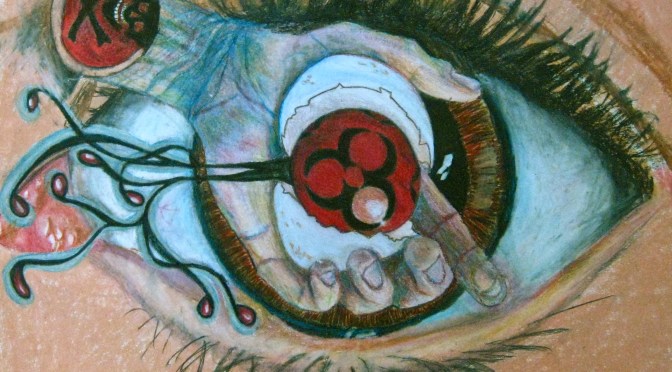
We are broken in so many ways. Here I am naked in the seclusion room in the left lens, and the right lens is broken over the biohazard sign, a symbol that stands for so many dangers…© All rights to this picture are reserved. Please contact me if you want to use it for any reason.

On Medscape yesterday they ran an article/video by a Dr Jeffrey Leiberman, lamenting the failure of three psychotropic drugs –one for the treatment of schizophrenia, and the others  for Alzheimer’s — to pass beyond either phase 3 or phase 2 clinical trials. This is part of what Leiberman had to say (please note that the emphasis is decidedly mine…)


“The brain is an organ that is orders of magnitude more complex than any other organ in the body. The brain has 100 billion cells. Each of the areas of the brain is organized cytoarchitecturally differently, and the cells connect via over 30 trillion synapses. Compare this to the heart, the liver, the gastrointestinal system, or the lungs, and there is no comparison in terms of complexity and intricacy. In addition, given the fact that we are developing treatments for brain disorders that affect mental function and behavior, the animal models that are an essential component of biomedical research and drug development are limited, because how can lower species like rodents model the complexity of human behaviors and mental disorders that we are trying to correct pharmacologically?


“In addition, the biomarkers we use to signal the effect of the treatment or prove the target engagement of a molecule at the desired location in the brain or protein in the brain are still in development and not fully validated. Thus, the complexity of the brain and the limitations of existing tools make the prospects of certainty in drug development [for brain disorders] more questionable than in other organ systems and disease areas. “Certainly the research community and the National Institutes of Health (NIH) understand the importance of redoubling our efforts to develop treatments for this important group of disorders. The NIH has recently established a new Institute, NCATS, or National Center for Advancing Translational Science, which has as part of its core mission drug discovery and development. In addition, various other Institutes have put out RFAs [request for applications]; this includes the National Institute of Mental Health, which has initiated a series of what are called the “fast programs” to identify drugs that exist within the pharmaceutical industry and may no longer be under development, but can be repurposed for study for specific disorders. A quick, rigorous study using a fast-fail strategy can determine whether these agents have the potential for further development.


“New efforts are coming from the biomedical research community as well as the NIH to spur drug development. I hope this will act as a catalyst for the pharmaceutical and biotech industries to not despair or back away from the risk of developing drugs in these areas, but rather to find the resources to support drug-development programs for these disorders.


“What is the benefit? Anyone who works with psychiatric patients knows that there are tremendous unmet clinical needs, whether in schizophrenia, depression, bipolar disorder, autism, or Alzheimer disease. With these needs come tremendous market potential, so for those who stay the course and persevere, there will be very lucrative rewards .To me, this seems like a great opportunity, and I think our partners in the private sector should appreciate this. I look forward to partnering with them to try and work in a way that uses their precious resources most efficiently but still serves our scientific goals and the needs of our patients. Thank you for listening.”


Yes, I noted the last statement, that he wants to serve science and his patients, but i could not help but feel great dismay at the other statements, including the first, that largely states what I already suspected: using animals to prove anything about human brain disorders or states of mind is downright ridiculous. All you can say about a rat’s “schizophrenia” is that it appears to  “behave” in some fashion that looks similar to someone who is psychotic…but how would you know if a rat is psychotic, or hallucinating or thinking in a delusional fashion?


Come on? How would you know if a rat had negative symptoms of schizophrenia, or was depressed, or simply felt lethargic because  it was hungry or drugged or sleepy or some other physiological reason. Well, you likely could not! Using animals that can not communicate with us to model human mental functioning is downright silly, and yet it seems to have only just occurred to Dr Leiberman, perhaps in his own disappointment with the glutamate-dampening anti-schizophrenia drug that just went bust…I dunno.


Once again, having read about how they are using Ketamine to treat 6-12 years olds with bipolar illness (mind you, I am not convinced that the children are actually Bipolar, only that more and more kids are being diagnosed because conveniently shrinks are allowed to drug them with Abilify and Seroquel and other adult antipsychotics and the drug companies push it on them, pay them for using it etc)


I believe that the use of psychoactive drugs and the rampant use of them is more often inappropriate than not. Truly.   The very idea that Abilify and Seroquel are prescribed willy nilly for everything from insomnia to mild anxiety is just plain SCARY. Has anyone out there taking these drugs even bothered to read the side effects, or do they no longer care what they are taking? Obesity no longer scares anyone, but what about diabetes and high blood pressure, nope, I guess not, since those are epidemic too.


It truly astounds me how both  those drugs, not to mention a whole host of other powerful drugs are being pushed on the American public, but we are a public that LOVES to take drugs rather than deal with problems by, well, looking at ourselves and thinking about what our responsibilites are and how we might change things…and doing some hard work and hard thinking about things…No, god forbid, why not just take a pill and forget about everything else, and if the pill doesn’t do anything, well, then, probably we are incurably ill and need to take those useless pills for the rest of our lives, because if we didn’t take them we might might might be even worse than we are taking them, right?


Not! Why do we take drugs that don’t help us, or that we do not notice any benefit from (though the shrinks are always willing to point out to us how much better “you are feeling”), drugs that might even make us feel worse in other ways.


Some people who are depressed lose all sexual enjoyment and functioning from their antidepressants, but refuse to stop the drugs because they are afraid…even though the drugs themselves make little difference in their mood, but their lack of sexual pleasure and responsiveness surely has…in a negative way. Why do they continue taking the pills? Hope? Obedience? Uncertainty? Perhaps all three…They may hope that if they take the antidepressant just a little longer, the side effects will “go away” as their doctor likely assured them, and they naturally want to be an aobedient and good patient, so they keep complying. And of course, depressed as they still are, uncertainty about the future plays a huge role, since how do they know that things wouldn’t get even worse, should they cease taking these pills that the doctor says not only will help them but somehow noticeably is helping them, whether they feel it or not.


Argh. I am reading a book, Rethinking Madness, by Paris Williams,  PhD. and it is a very interesting take on psychosis and the treatment of it. He suggests that it is NOT always a lifelong condition, or that one breakdown means that one needs to be on medication for life, or in fact that even with repeated psychotic episodes, one can be on intermittent medication and at low doses. I have difficulty reading, myself, so I have not read far along, but the first case study discussed a man who became psychotic suddenly in the late 60s or early 70s when he was threatened with the draft. After that he was ill for a long period of time, in and out of madness until he met the “right doctor” at age 28 or so. I believe it was then that he made the slow transition off all medication and since he was 35 or so has been off meds altogether. And has been well. Recovered, in every sense that matters, completely.


Everything about his history would today dictate that he never be taken off meds, and would mitigate against his ever dreaming of working in the mental health system, let alone as a worker in a state hospital. Yet this is where he has been employed for many years…(I may misremember some details, but that is the gist of it.) I could scarcely wrap my mind around such an outcome…it seemed that amazing.


Yet, I cannot be envious, because I know how often I tried to get off my medications, and because I did not know how, I likely induced a recrudescence of psychosis without even understanding that was what was happening. And naturally, they put me back on the drugs again…It was not my fault, just how it was in those days. I didn’t know, and they still don’t! Even now, though, I do not know if I could get off the meds.


But in my case, I am not sure I want to, largely because I function so well on them. I write, I do art, I sleep well, I am not obese, I have no chronic physical health problems because of them…So I have no pressing need to get off the antipsychotics, nor the anti-seizure meds, which I may need due to temporal lobe epilepsy anyhow. I would like to get off the sertraline, yes, and we are working on that. But why fix what ain’t broke at this particular time? I mean, I only got out of the danged hospital a month ago, and it would seem a little, er, crazy to fiddle with things this soon, much as I wish I could. On the other hand, I don’t mind taking these meds, because by and large, I believe, frankly, that my body has re-established some kind of homeostasis and has adapted to the lowered dopamine…so it has ramped up production to a different balance, meaning that I am fine where I am, but would risk a massive overload should I stop cold turkey.


OTOH, I do not yet understand the absolutely immediate improvement in all my mental capabilities when I take Zyprexa. Yes, I eat and eat and eat. But I can read and pay attention to people telling me things to movies and the TV and just “intake” in a way that I cannot now and have not in years…And it is literally within 2 doses. That cannot be a matter of homeostasis so what is it? Can Zyprexa be the ONLY drug that actually has some beneficial effects? I doubt it. So what is it?   Anyhow, any comments on these points would be appreciated. I don’t mind if you want to argue to the contrary, if you feel it strongly. I am here to hear different points of view as well. Though you know of course that I may “argue” with you back! All in friendship and good cheer.

A Mental Health Meeting of the Minds: Natchaug Hospital Administrators Get Gold Stars

This is the front entrance to Natchaug Hospital, a photo I cribbed from their Facebook page. I am trying to paint it, but that will take a while so for now, this will have to do…Hope I am not infringing a copyright. However, as this post is all about Natchaug it is good publicity too!

After I wrote my early September post “Open Letter to Deborah Weidner MD”https://wagblog.wordpress.com/2012/09/02/open-letter-to…chaug-hospital/  ‎about my stay at Natchaug Hospital in August, I received a phone message  one Saturday afternoon not long afterwards from none other than Dr Weidner herself. She left her cell phone number and asked me to call her back. Her voice was neither angry nor upset, quite the contrary, she sounded very pleasant. So, despite my heart’s clangor in my ears at the same time as it drove nearly into my esophagus with its nervous pounding, I sat down and decided to make the call “without further ado.”

“May I speak to Deborah Weidner?” I asked the voice who answered, intentionally using her first name, so she would not think I was calling on unequal terms, i.e. as a patient.

She responded, and addressed me as “Ms Wagner,” which made me feel better at once. Then, before I said a word, and believe you me, I was not going to be the first to speak in any event, she said (and I quote from a less than perfect memory here, so this is not verbatim), “I read your blog post. You are such a gifted writer. It was really a wonderful piece…” Or words to that effect.

I was both stunned and amazed. Certainly I was amazed this was the self-same “head honcho” who had essentially, so I’d felt in August, been against me at the hospital along with so many others in charge, the MD who had – I felt – given up on me, called me “a borderline”*** and gotten rid of me at the earliest possible opportunity. She could, back in August, so easily have tried to help, tried to find out what had gone wrong and make things better. But it seemed to me at the time that she had simply gone along with the general ill-will towards me and dumped me, no matter how troubled I still was.

Note that when I say, “general ill will” I mean exclusively “the management” — the doctors and social workers and APRNs…those who did the diagnosing and disposing. From the nurses and mental health workers I felt nothing but great support and goodwill, almost to a one (minus, of course, my abusers). Even of the nursing supervisors I found only that single really awful one…at least to my face.

But as for Dr Weidner, I’d felt that she too had decided to “blame the victim” instead of taking responsibility for the very real traumas, which certain “bad egg” hospital staff had inflicted on me…

However, be that as it may, it is all water that has sluiced beneath the bridge, and so as I said, I was stunned to receive Weidner’s phone call. I was even more astonished to perceive such humanity and even warmth from this woman against whom I had conceived such animosity and from whom I had felt the same.

Here she was not only praising my writing skills but speaking approvingly of a blog post that concerned my very negative month-long stay in “her” hospital.

We talked for a while. She may not have known it but I was trembling, both with anger and with anxiety. It took me some time to calm myself, to feel safe enough to answer any of her questions. Finally, she said what she evidently had called about to begin with. “I wonder if you would consider coming back to talk with me and a few other interested people here at Natchaug.  I would really love to speak with you.”

I was dumbfounded for a minute. But only for a minute. Then I found my voice, and as soon as I did, I responded with enthusiasm. “Yes, absolutely. I would love to do that. Thank you. I would be more than happy to speak to you and anyone else who would listen to me.”

“Thank you, Ms Wagner. We really want your input, we want to make Natchaug a better place and I think your insights can help us to do that.”

After we hung up, I was beaming. I felt so filled with light that my smile must have been big and bright as a beneficent Halloween pumpkin. I immediately went downstairs to the 7th floor to share the news with my friend of 30 years, a friend who had been appalled when I came home in August in such terrible shape.

_________________________________________________

Well, that meeting took place yeseterday, Friday, at 9am. Brityn, my case manager drove me out to Natchaug, and I brought with me the oil pastel painting I’d done while there, the view of the nurses station from my room. I am donating it to the adult unit mental health workers’ breakroom, after Brian, the patient relations advocate, who is both intelligent and caring and an extraordinary listener, displays it somewhere publicly for a time.

When we got there, we were met by the director of nursing, John O, APRN. Shortly thereafter Dr Kline came along and we went into a little room off the lobby. I was a  taken aback at first when, while waiting for Dr W,  John and Dr Kline started talking with Brityn, as if she were the only person in the room, as if, “professional to professional,” they could ignore me, a mere patient once again.

This was unconscionable. I was the person with whom they ought to have been concerned, and instead they directed themselves wholly to Brityn. It also felt infantilizing. Why didn’t they even greet me or ask how I was doing since I’d left Natchaug? They could have at the very least made small talk with me. Instead, they chatted with Brityn, someone who is not only my junior by about 30 years, but with whom they’d had no prior interactions whatsoever and whom they didn’t even know. It was insulting.

I dunno. Maybe I was too sensitive. Maybe they just wanted to include Brityn…But it didn’t feel that way to me. It felt like they were talking to her as a way to avoid talking to me, a way to simply bypass chatting with me.

To their credit, however, when I mentioned it – “You know, I am here and I am a person too. You could at least include me in the conversation…” — they apologized. But even now I do not believe they understood the problem. They thought it was perfectly acceptable — since Brityn had driven me (I wonder how they would have behaved had I simply been able to drive myself!) — to treat me as merely a patient, a “charge,” and to treat Brityn as their equal, the other professional, the only one on equal standing with them. Well fork them…It cost me a lot to go up there, not even to talk about what they did to me. Do they really think I am OVER it? They ought to be ashamed of themselves.

But I will let that go as well.

Soooo, down to tin tacks, which turned out to be the golden glue of the meeting itself.

Dr Weidner, small and blond and –somehow I want to call her “open-faced” — she seemed not to hide a lot, had what looked like a genuinely interested and caring face, though naturally psychiatrists are trained to achieve this appearance. Nevertheless, I did trust her sincerity.

This time I cannot recall if she called me Pam, or nothing at all. I do not think she called me Ms Wagner, though.  I pointed out that since I understood that the post I’d written, the “Open Letter” had essentially “gone viral” in terms of the Natchaug Hospital staff itself, I didn’t feel I needed to talk much about what had happened in August. I had written all about it in detail. Or most of it…Mostly what I thought I should talk about was “How to make Natchaug a better place.”

I did that, and in fairly great detail. I will write a separate blog about all those suggested changes, and changes which would apply in spades to other hospitals. But for now, I just want to report on the meeting itself.

Dr Weidner seemed to take careful notes  and when I had finished I was simply “blown away” when she said, “Pam you have so much to tell us, and are such a good teacher, but there are only the three of us here today. How would you feel about coming back and talking to the entire medical staff? Your experience as a patient and your ability to articulate it would be just invaluable for many more of us to hear.”

Well, I almost laughed in sheer belief and pleasure. “Of course. I would love to. I do public speaking and would have no problem with that. Anything at all that I could do to make Natchaug a better place would be fine with me.”

Dr Weidner also wanted to know what they could have done to make my own stay less traumatic “from the start,” especially how they could have relieved or prevented my becoming mute for so long.

I told her that from the instant that the first episode started, when that nurse or whomever said to me, “Take your hands out from under the blankets!” I felt so betrayed, felt indeed that I was back at Hallbrooke being tortured by those two abusive staff members (who were actually reprimanded for their behavior) that I became mute at that very instant.

Would I have taken Ativan despite my psychiatric advance directive’s proscription against its use? Yes, had someone gently explained its use and suggested I take it to help my mutism, just a small dose, I would have at least considered it.

But no one presented  Ativan as an option…I do not believe anyone even knew about it. Except of course to force it on  me against my will during the Seclusion event I described in the earlier post. Not until Dr Cappiello insisted that I ask Dr Pentz to prescribe it, and that was only after I had been unable to talk for 8 days.

As for the mutism itself? They — Dr Pentz and some of the other docs and APRNs — insisted that I deliberately chose not to speak, that I could have if I wanted to. But in point of fact, I could not get myself to speak, I woke every morning with no “inclination” to speak and no felt ability to break that barrier…and therefore I truly could not speak at all. In fact, it took hours, and maybe two doses of Ativan before I was able to speak at all even when I did take it.

After a few more words of conversation, the meeting broke up and Brityn and I headed towards the car, with the expectation that we would come back again so I could speak to a larger group of Natchaug personnel.

So that was my reconciliation with Natchaug and I left feeling like a million dollars. Even Brityn told me it was the best appointment she had taken anyone to that week.

You know, my sole worry — and I felt a frisson even as we talked about it and my worries were not immediately allayed — was when I asked if I could ever be readmitted, ie as a patient. I know, I know, why would I even want to? Dr Weidner said she didn’t think I’d ever want to come back. According to her, that’s what I’d written in my blog post. But in  fact, what I said was that I didn’t think I would ever be taken back. I was considered such a PITA, why would they want me? And also because I could not see anyone for a doctor but Dr Andrei, and it seems dubious that she would see me. Why I do not know. But so be it. I liked her, never had any problems with her. But I must have done something wrong. This is twice that they have refused to assign me to her.

In truth though, 1) I have NO WHERE ELSE TO GO, no where else I could possibly begin to trust or feel safe, nowhere do I have even a history of feeling and being safe and 2) say that they do change, where else would I want to go?

In any event, since I can work with neithe Pentz nor the other doctor on the unit, because of “conflicts of interest” (i.e. he still has “feelings for me” from our days in med school together) that leaves only Dr Andrei, and I dunno if she would accept me onto her service. So, even if theoretically they would take me back – which didn’t seem at all certain, not from the vibes I got from Dr Weidner — I don’t have any idea who could see me if I were admitted.

(What the fork!  I would be stuck in a snake pit like Hartford Hospital’s Institute of Living only to be brutalized again. When push comes to shove and I might need or want to be re-admitted, frankly I wouldn’t expect the admitting MD Natchaug to give a damn, no matter how many times I’d spoken to people there and how much I might have taught them. As soon as I need their help as a patient,  frankly, I expect I’d simply to be abandoned to my fate somewhere else.)

Well, of course I will still help Natchaug,. How could I not want to help them? I want to help EVERY hospital in the state become as good as Natchaug and even better. But it sucks all the same.

———————————————————————————

*** Finally I want to make a brief comment about the specific words “a borderline” used early in this post, because every time I hear this phrase it makes my blood sizzle. Not only is very insulting, it stigmaties. I may not have borderline personality disorder, but I know what is meant when someone calls a person “a borderline,” and it is invariably  takes the place of PITA, Pain in The Ass.

There is a difference, a huge difference between understanding the very real travails that a person with such a personality disorder undergoes daily, the emotional suffering that afflicts that person, and simply calling them names because you find them troublesome.

Empathy goes a long way, especially with someone who suffers from BPD. The idea of calling someone “a borderline” is tantamount to saying, “I suffer from YOU.” A disgusting statement if ever I heard one, one most often made by mental health professionals. Doctors who use the words, “a borderline” need 1) re-education in language and its nuances, but 2) and much more important, a re-education in COMPASSION.

Of course, that’s just IMHO…and who am I?

I’m Nobody! Who are you?

by Emily Dickinson

I'm Nobody! Who are you?
Are you – Nobody – too?
Then there's a pair of us!
Don't tell! they'd advertise – you know!

How dreary – to be – Somebody!
How public – like a Frog –  
To tell one's name – the livelong June –  
To an admiring Bog!

Think Before You Press Send!

Do you really want to press that Send button?

“Woe is money,” I once wrote to someone in a nearly somnolent state, before my handwriting drizzled down slant into a puddle of Bic blots. Now, you could say such a thought was  brilliant, not the dreamtalk of a narcoleptic letter-writer. But narcoleptic I am, and I learned over the years not to trust my sleepy brain to spew brilliance when I am not fully alert.

However, once email came along, maintaining such discipline became more difficult. As an author, a blogger and formerly an inveterate letter-writer, I correspond easily and with many people. But night-owling and narcolepsy go down about as well as swallowing a piece of hair; many is the time I have carelessly pressed “Send” and out went, well, nonsense instead of carefully conceived coherency.

I’ve had too many computers and lost too many of those emails to quote them directly, but here is an example that should give you pause: “We had been in the next room when suddenly the woman I sat next to…Where is it? Too much snow having to get out of the No, no not me, not me! Godawful smell the bumper rubber, the, the, oh it’s Manny, from TV, the foxes. Ha ha, I’m joking with the mostest hostess… [Coming to] where was I?”

Anger is another reason I’ve learned not to press Send. I recently responded to emails from my family with some thoughtless expletives that were ill-chosen and unnecessary. Since my father estranged himself from me for 35 years before reconciling seven years before his recent death, I know how feuds can become a family tradition and might have ignited another. No need to oxygenate any flickerings. As the slogan goes: Anger is like holding a hot coal in your mouth…Think about it. Better to scribble that anger, and those expletives, by hand in a journal…It’s good exercise and burns the fire of that energy and will hurt no one.

Email is a quick axe, a guillotine, but like any honed blade, it can kill. Save any email for forgiveness and understanding. It will make the journey – yes, in packets, but in that miracle of email they will reunite for peacemaking. That is worth years of goodwill with people you love more than you hate, trust me.

But why should you trust me? Because I’m the one who wrote “Woe is money” and dreamtalk or not, it is sort of brilliant after all. Maybe I didn’t send it out, but then, there was no Send button in those days or perhaps I would have. Too bad. It might have gone viral and become an expression of common currency.

Open Letter to Deborah W., MD, Chief Medical Officer, of N Hospital

It has been a week since my discharge from the Adult Unit at N Hospital. After a week of recuperation and stabilization at home I feel compelled to write you via the open forum of a letter on this blog. It may or may not get your attention directly but I feel certain it will be read by someone on the N staff. Perhaps that way it will eventually reach your eyes. If not, so be it.

Our encounter on Monday the 27th of August was extremely brief and not particularly noteworthy. While I have much to say that never got said then, I owe you nothing, and by the same token, expect nothing from you either. That said, to any of my readers who want to understand the intent: I write partly in my defense against what I feel were gross misunderstandings (leading to unnecessary trauma), and partly to record publicly – on record as it were – what really happened over the last 4-6 weeks.

Please, Dr W, or any other reader: Do not dismiss this letter out of hand as the peevish complaints of a disgruntled but troublesome patient. I understand how you might be tempted to do so, especially because you — or at least Dr P and L.H. APRN – claimed in their infinite wisdom to be able to detect signs of an Axis II Borderline Personality disorder (despite the concomitant presence of an Axis I psychosis ). I know that labelling me “borderline” was always just another way to dismiss me and my concerns as “mere,” that is to say as meaningless or manipulative, the “mere” attention-seeking of a manipulative PITA*.

Nevertheless, it ought to have been obvious, it ought to have been needless to say — but clearly was not — that no one could possibly know what my baseline personality was like from the past four weeks at N nor in fact from any of my past four stays there. What was clear to many early on, including me, was that this hospital stay at N abounded not in norms but in extremes, from start to finish, extremes I might add both on my part and on the part of hospital staff as well.

My friends and family know that I am not generally someone who has screaming fits or throws things or strips naked and parades around in public, all modesty thrown to the wind. So too, N staff: So far as I knew or had seen since 2010, they rarely became physical with patients  and not once in all the times I had been there had physical contact devolved into anything even resembling a fight or violence. Instead, kindness, compassion and empathy were the primary tools. The best staff were as slow to lose their tempers or act on negative emotions as a live gecko was to do a cancan under the noonday desert sun.

I knew those things, and until August I believed it automatically made N a superior place, a sanctuary immune to the sorts of failings I’d found in so many other hospitals.  That was why I insisted on N this time even though it meant waiting two and a half days at W Hospital Emergency Room, never moving off the gurney in the barren cubicle I was placed in, monitored by a camera not so subtly hidden in the large TV screen. I knew of no other hospital where I could be safe, both from myself under the influence of command hallucinations, and just as important, from any staff impulses towards the use of violence to achieve control or discipline.

How could I have known that from the first morning after I arrived, staff behavior was to be stunningly “un-N-like,” as erratic and extreme as my own would turn out to be. My entire stay was in fact characterized by physical assaults by staff, punishment and trauma that began the moment I woke up that first morning.  I responded poorly to this, as anyone might, by regressing into more and more primitive behaviors. But how did “you,” that is to say, the N staff, respond to me? Not by taking a step back and seeing how things could change for the better. No, instead, you, they decided to blame the victim, to say, “She’s misbehaving, she’s ‘doing these things on purpose,’ she is volatile, unpleasant and emotionally unstable…” Et Voila! There I was, diagnosed, improperly but officially with “Borderline Personality Disorder!”

As many of my readers know, I have written extensively here, at wordpress.com, Wagblog, about psychiatric units and hospitals and have until now always held N in the highest esteem. N was always the gold standard, the touchstone against which all other  hospitals in the state were measured. I believed that N had the right ideas, the right philosophy about patient care, hired the right people and trained them properly. I trusted that the hospital understood the critical importance of trauma-informed treatment. Ever since my 1st hospitalization at N in December 2010 -January 2011, when S. H. was director of nursing, I felt I’d found a truly safe place, an asylum in the best sense of the word, where troubled patients would never be brutalized by staff more bent on coercion and a lust for power than compassionate care.

I have been hospitalized at N four times now. The first three times bore out these high expectations, but this last time was unmitigated disaster, revealing how much things have changed, and how, under the auspices of the wrong leaders even N has been willing to permit a few “bad eggs” to damage patients with impunity, rather than take an honest look at burned out employees – including those at the highest levels, RNs and psychiatrists included –keeping them tenured out of a misplaced loyalty, refusing either to re-educate them or to remove them from direct patient contact.

There were three separate instances of physical violence to which I was subjected  between July 31 and August 27th . The very first morning after I had been admitted and placed on one to one for safety, I remember I sleepily turned over in bed and scrunched down again to catch a little more sleep when the person sitting with me suddenly insisted that I place my hands outside the covers where she could see them. This was a strange request, since they had been under the covers all night, right up until that second. Dumbfounded, and freezing cold, I resisted and ignored her, fairly certain that she would not make a federal case of the request once I fell asleep. Instead, she repeated herself, louder and louder. She actually approached the bed and tried to bully me verbally into putting my hands above the bedclothes, telling me that being on constant observation required that my hands be visible at all times. This was news to me. Never in my experience at N had anyone required such a thing. I continued to resist, though any impulse to sleep had left me by then. By this point, it was strictly on principle.

Well, she was intent on winning the battle and instead of negotiating a solution called in reinforcements in the persons of two male mental health workers. Unable to verbally force me to uncover myself, they initiated physical contact, attempting to pry my blanketed fingers away from the blanket in which I had wrapped myself. The female stood aside, but continued to threaten to deprive me of all coverings if I did not comply with her order. The tussle went on. I vehemently kicked at them whenever they laid hands on me, though I spoke not a word the entire time. At last, they gave in and left me alone. I never found out why. Perhaps they saw the brutality they were inflicting on me. Or perhaps they were called off. I do not know. All I know is that that particular rule was never again inflicted on me.

After they left, and a new sitter arrived, I lay in bed, breathing hard and feeling bitterly betrayed. What the F just happened? Dismayed and disappointed, I could scarcely believe I was really at N and not at the torture chamber in the south eastern part of the state again. The consequences of this betrayal left me physically and psychologically speechless. What had happened to “my” N? Try though I might to let myself talk, I remained mute for 8 days.

I won’t go into the long and involved story of the second assault, except to say  that it involved  poor judgment on the part of my social worker and evening nurse. OTOH, an assertion of power by another nurse assigned to me nearly twenty four hours later was overkill and an act of punishment and revenge. She can deny it left, right and silly, and maybe her RN superiors believe it, especially because they have a stake in it. But I know contempt and the smile of sweet revenge when I see it, and I knew the enjoyment in her smile that Wednesday. Assault #2, which involved a rather violent physical altercation and restraint, nevertheless had a bearing on assault #3. What follows is the story of that third assault on my person. In places I quote almost verbatim from my journal entries, which I wrote at the time. When I am not quoting, I assure you that the account is very similar to the journal’s “horse’s mouth” and merely states the same things I wrote there, but with better words and fewer punctuation marks.

I do not remember how it started. I suspect I had been screaming or yelling about something. All I know is that the RN Supervisor for the afternoon, a woman I will called D came into my room after my upset and just stood there. At one point in her obdurate silence, she accused me of an unprovoked attack on it the nurse, K, who had taken revenge on me the day before. She called K  one of her “ best nurses.” Incensed at this I assured her she didn’t know the whole situation. When she said she knew enough, I told her to leave my room.

“I’m staying right here,” she said giving me a baleful look. I pointed out that I already had a 1: 1 and did not need a 2nd person in the room. She only continued glaring at me.

“Get out,” I screamed, “get out of here!”

No response. No reaction, except for a slight recoil from the loudness of my voice.

I threatened her then. I admit it and I am not proud of it. I threatened her. I took up a box of crayons and looked as if to hit her. Everyone cried out, “No, no, P!” And I put it down. But I continued to cry out, “Leave! Leave! Leave me alone!” She only stood her ground and stared.

That’s when I lost it. I picked up a chair and threatened to throw it at her. This is what she’d been waiting for. She could’ve laughed or made a calming gesture or simply backed away and let the mental health workers gently disarm me and all would’ve been well. But no, D liked to escalate rather than de-escalate, so she yelled out, “Escort her to the quiet room!” Before I could offer to walk there myself, Brad and someone else picked me up by the armpits not even allowing me to walk and dragged me.  Because they didn’t even ask me if I would walk freely, under my own steam, I fought them, twining my legs around  theirs as if to try and trip them.  Then to add insult to injury they dragged the blue therapy chair out of the room instead of leaving it there for me to rock in and calm myself. Now, inside the tiny, now empty windowless cell, despite the bright mural painted on the walls, panic rose in me. I looked around, remembering how S H had assured me that no one would ever leave me alone in there unless I wanted them too. I begged D for someone to stay in there with me. S the mental health worker saw the panic and offered to, but D was furious and ordered her out.

“No, she is to stay in here alone!” She made everyone leave, and following them out, she slammed the door shut behind her.

I was horrified. All the memories of locked seclusion returned to me in an avalanche of terror. In my mind, memory told me it would make no difference if I went to the door to beg to be let out, or for a blanket or someone to talk to. Experience, all my long experience had taught me: there was to be no mercy no help nothing would change no one would respond no help nothing no matter what I did. I was and would be abandoned to my punishment until–well–until I had no idea how long it would last. No one told me a thing. Utterly terrified, instead of banging on the door and begging for release, I backed into the farthest corner. I wanted to meld with the wall, shrink back into the wall board as far away from the room as I could get. A howl climbed my throat. I tried to hold it back but I could not. When I screamed, I screamed not to anyone or for anyone but out of sheer mortal terror, the sort of terror that any animal must feels when its leg is smashed in a trap and knows his life is coming to an end. Screaming brought no relief though. Screaming brought nothing, it certainly brought no one into the room to help me. There was only thing I could think of that would that bring relief and that was to relieve myself. So I did, in the only way I could: I stripped off all my clothing and peed a huge puddle of urine on the floor. I had to. I do not know why. Removing my underwear I found inside the crotch a forbidden pencil. I’d not been allowed writing utensils for eight long days and just that afternoon I had used this pencil to sketch my first portrait since I’d been there. I wrapped the pencil in my clothing, knowing that if someone saw it they would confiscate it again.

Too late. A commotion behind the door and they were upon me, all of them, wrestling my naked body to the floor and prying the wad of clothing from me, smashing my glasses in the process so that one lens came out of the frame.  In the melee, someone grabbed my medical bracelet right off my flailing wrist. They pinned me down. I knew what they had in mind. IM meds. But no one had offered me oral medication. “I want oral meds. I’ll take oral meds you can’t inject me, you haven’t even offered me oral meds.” I asked for Zyprexa. Not Haldol or Ativan but Zyprexa, the PRN I had on order.

They refused to get Dr. T, who signed off on the seclusion without ever seeing me, to change the emergency meds — which I didn’t really need but which were going to be ordered anyway, as a mater of course — to Zyprexa despite my psychiatric advance directive distinctly requesting no benzodiazepines of any sort. However, fearing any further confrontation, I swallowed the pills. Everyone got up and left except for the nurse supervisor. I stood up and surveyed the room. Urine ran everywhere.

“How can I stay here?” I asked her. “There’s pee all over the place.”

She surveyed the wet pads and floor. “Deal with it,” she said, and walked out, locking the door behind her again.

I was spent. There was nothing left in me to fight or scream or object. I simply lay down on the mat, amid the puddles of urine and curled up in a fetal position. Sleep never came; it was too cold for that. I just lay there, eyes open, my naked back to the window. 10 minutes passed. 15 minutes. I heard the mental health worker at the window ask the supervisor if she could let me out. “She is lying there calmly, I think she’s sleeping.”

“Give her another 10 minutes,” was the reply.

Another ten minutes went by and another.

The mental health worker kept asking if she could let me out. Finally, about an hour later, the door opened and S entered.  I didn’t bother to turn over or look at her. I scarcely raised my head.

“P?”

In a dull voice, I answered the requisite questionnaire, as if that were adequate debriefing. Then two other staff members attempted to clothe me in hospital issue johnnies, one over my front, one to cover the back. I allowed them to do this but as soon as they let me go and I was free to proceed out of the erstwhile “Comfort,” now Terror Room, I ripped off the johnnie coat covering my naked backside, and walked half-exposed to my room, deliberate and uncaring. Who gave a fork? What could they do to me now? What could anyone do to me? Fork everyone! They were dead to me. I was dead to them. It was over. It was over. I was dead meat. Just meat. I didn’t give a fork about anything.

More than any other incident, this one was the last straw. Whatever repercussions I deserved for threatening the RN supervisor that evening, however evil I felt for being the devil, there remained in me enough human pride to resist such treatment, enough to say that even I did not deserve to be treated as harshly as D had treated me. Not only did she deliberately test me, she lost her temper and I was her victim. I have reason to believe that most of the staff members who witnessed what happened that night believed she went too far. Some would actually say so in as many words to me, though others were cagey and feared repercussions should it get back to her.

All I knew was that I’d been treated like an animal. What did that supervisor or anyone else expect in response? Did she really think I would become docile and obedient, chastened, a meek and compliant patient?  Violence begets violence. It always does. From then on I was not the same. I was not better either, no. I grew markedly worse, and worst of all, no one could predict anything about my behavior. No one knew what would happen next, what I would do, when I would lash out or scream or throw things or push someone or even hurt myself…None of those behaviors were “me” or even close to my usual, or baseline, but I reiterate: what do you expect: treat a person like an animal, and you can pretty much count on getting animal behavior as a result.

Dr. W you do not know me. Dr P, for all his discharge summaries and “progress” notes (the pages of writing are all boilerplate, meaningless, and/or second or third hand information for the most part), he doesn’t know a damned thing about me. I tried to let L. H, APRN, know a little, but by the time she was involved in my treatment, you were all so intent on seeing in me this mythical borderline personality, instead of a person who had been acutely and brutally traumatized at your hospital, that it was useless for me to expect anything.  For all L’s  pretence of understanding, she had made up her mind about me before she met me. She was largely deaf and blind to everything I said that did not fit the tidy diagnostic picture: schizo-affective, with a concomitant borderline personality disorder. How convenient that you could chalk all the unit troubles up to my problem, rather than seeing it as something your hospital staff created! Blame the victim, why’ncha, instead of taking responsibility for a number of incredibly poor judgment calls on your own or your staff’s part?

Of course as many people have asked me, why do I care what you or Dr P or L H think? Well, I do not, in fact, give a flying femptogram… Mostly I care about the decent people there — the mental health workers and the nurses who did like me and made it obvious and treated me very well and made it clear they would welcome me back (though I can never return, not now.) About Dr P and LH  and the others I could give a ratzass.  But I do, or did care about N itself, once the gold standard, for me at any rate. It was the one place where I could tell other people, “Go to N – I know people will take care of you there, people will care about you there, that’s where people will treat you well.”

The even bigger tragedy is that if no one is safe from the hospital staff at N, then the likelihood is that no one is safe in any psychiatric unit or hospital in  this state. Let’s face it. Not much progress, perhaps none at all, has been made since the Hartford Courant’s series of articles in 1998 called “Deadly Restraints.” My sense is, in fact, that since Mnanaged Care took over medicine, things are actually a great deal worse…Oh, sure, I was not four-pointed during the past stay at N, no they managed not to become that brutal, so far… but I was physically restrained and manhandled during all three incidents and I have been four-pointed at nearly every other hospital in the state up till 2010. So I would hardly say that that practice has gone by the wayside. In fact, in the  Hospital Emergency Room back in July of this year, they threatened to four-point me just for making a nuisance of myself and being noisy…

So much for not using restraints. As for not using them as punishment? I believe that in every single case when I was subjected to four-point restraints from 1980-2010, they were used as punishment, as a convenience or in revenge… I state this categorically: that not in a single instance were four-point restraints ever truly necessary to keep me safe. They were only used because they were available and the culture on the unit permitted the employment of torture to control and discipline patients. Period.

Seclusion? This practice has only increased in usage so far as I can see. The difference is only that staffs are careful to call such barren quarters the Time-out Room, and are rarely apprised as to the legal definition of either seclusion or restraint. (BTW Time-out is a disciplinary measure used to train children to behave properly…since when did psychiatry decide that patients in adult units ought to be treated like misbehaving children and sent to time-out rooms? If you want to talk about empowering patients and not infantilizing them, you do not in the next sentence tell someone to go to the “time-out room” and stay “until I say you can leave.”).

What you, Dr W et al, think about me in the end is of little consequence. I know I do not have BPD and so do the people around me that matter to me. If I care about anything having to do with N it is not your opinion of me nor your judgment or your diagnosis, I care about N because while it could and should be, it is no longer a place I trust, a place where I can direct other people for safety and compassionate treatment. Because if I am not safe from myself at N, if I am not safe from the staff at N, and I mean by staff, the doctors and nurse supervisors as well as any “rogue” RN  or MHW, then no one is safe at N and no one with mental illness is safe in any psychiatric hospital or unit in the state

That, Dr W, is by far the worst tragedy of all .

___________

*PITA = Pain In The Ass

When is Schizophrenia not Schizophrenia? To Be or Not to Be…

Rossa Forbes wrote a fascinating article at the Mad in America website  —  see my permanent link — about her son’s schizophrenia diagnosis and his on-going recovery from treatment.  One thing among many struck me. She freely admits that when she learned his diagnosis, one of her reactions was to treat her son as if he were feebleminded. Not all the time, but you know how it is when someone seems out of touch or  unreachable, it isn’t difficult  to feel that maybe she or he really has lost a major portion of intellectual capacity…

But I don’t want to paraphrase, so rather than copy and paste Forbes’ piece here, I would prefer to link to it so you can read it for yourselves. While you are there, check out some of the other Mad in America stories by clicking on the Home button. Mad In America is an incredibly interesting website, and an important one. It has changed my thinking, encouraging me to continue my own investigations, pursuing thoughts that no one has ever before “permitted me.” Sometimes this feels scary even to me, dangerous too. Breaking one’s chains and shaking them off can indeed feel scary, no matter how badly one wants freedom. The only cure for it is to take the first step forward unshackled, breathing freely.

http://www.madinamerica.com/2012/06/holistic-recovery-from-schizophrenia-a-mother-and-sons-journey/

Already I have cut out one of my chains, my medications — lamotrigine–  without detrimental effect so far.  It has been a week and the one thing I was scared of, a return of the olfactory hallucinations, has not happened. I think I worried for nothing.  I still take another anticonvulsant, so as I suspected, the lamotrigine was probably overkill. Why was I on it in the first place? I do know that I never needed lamotrigine as a “mood stabilizer.” As I recall, some doctor switched me to it from valproic acid or carbamazepine which I was taking initially for the hallucinations, caused by temporal lobe seizures. He thought I was taking an anticonvulsant for mood stabilization, and never consulted me, and so from then on it was simply assumed by all the hospital personnel that lamotrigine was primarily a mood stabilizer…

________________________________________________

I am wondering about my post title. I chose it thinking about Mad in America and Rossa’s Op-Ed. And yet, she did not necessarily disavow the diagnosis, just the medical model and the treatment. At least that is how it appears, since the title of her book-to-be uses the word schizophrenia…I myself would prefer throw that baby out with the bathwater and reconsider the whole affair. Instead of trying to resuscitate a lifeless baby, perhaps we should recognize that the plastic baby doll was always lifeless, and start casting about for something real. What I mean by that is, maybe there is absolutely nothing to the notion of schizophrenia. Is it possible that we all believe there is something there, when there is nothing, nothing at all? Am I crazy to say this? I do not deny suffering. I do not deny that I myself experience phenomena and feel things and hear things and suffer. And I certainly do not deny that others feel and hear and see and experience things. They certainly have their experiences. But, and this is the heart of the matter: Just because we have these experiences, does that mean they constitute a construct, a real thing, an entity, an illness per se? Why? Why can I not have these experiences by themselves without them having to be something, without them having to be an it?

I am serious. If we did not make all these experiences into something, if we did not scoop up each little experience and mash them all into one big Thing and wrap it up and label it bad, bad, bad, and then hand ourselves over to the psychiatrists to diagnose and treat and to Big Pharma to medicate, not to mention Big Insur to rob us blind for doing nothing, if we did not allow all of that to happen because we decided that our experiences were valid experiences, not invalid and sick, but honest and real experiences that needed to be honored, taken seriously, not scorned or contemned, what would happen?

Wow, I wonder. I wonder.

Useless Psychiatric Mediation and a Poem

(Before I write this blog entry, I want to send this message:To certain people from Middlesex Hospital who read this and are following developments in my case against you please be aware that I know who you are and I am watching you. You do not and will not get away with what you did nor with what you are doing now.)

That said, let me tell all the others of you out there what happened at the mediation- meeting-that- wasn’t, this morning at Middlesex Hospital.

As you know, I have been wanting this meeting for a long time, but when I got there not only did I discover that they were playing the game of “Oh, I had no idea that you wanted a mediation meeting, I didn’t know what this meeting was about at all…” but that the CEO had actually cancelled on last Friday the people that he had arranged to meet with me.  So in fact the only people who came were administrators, not anyone who had treated or dealt with me on the unit itself, except the doctor who saw me for the last 11 days of my 6 week stay. He may have been the director of the unit, but he was hardly the main doctor I saw, despite what he claimed.

Anyhow, the meeting was extremely  — well, first of all, it was largely a waste of time, because NOTHING was said of interest to me. Except that Dr Grillo, the unit director, after I read what follows, actually had the gall to claim that restraints were  entirely appropriate…He said nothing whatsoever about what they did to me. OTOH, I can understand why. After all, he had already been told that we were writing the Department of Justice and the Joint Commission regarding his unit, so he must have felt supremely threatened. Naturally he could not have admitted wrong- doing. Not that any god, excuse me, doctor that I have ever met has ever admitted doing anything wrong or ever apologized. God forbid, a doctor apologize! No, that would be too hard and too demeaning for them to ever do.  Better that they go along and permit torture and abuse than that they admit that there was wrong done to a patient on their watch, much less that they personally even made so small a thing as a leetle eensy meestake…

Well, I know what they did to me and I know it was abusive and wrong, and so far, except for Dr Grillo and that lot, NO ONE I have ever met outside of Middlesex Hospital has ever ever agreed with him and said, Yes, in fact the use of restraints was proper and necessary, and they were right to do what they did to you.

So take that, you watchers from MH. I hope you tremble in your boots for torturing me so. Because you never apologized, and wouldn’t’ meet with me to talk about it, it serves you right whatever happens now. I came down there today , and it took all the courage I   could summon up to do so. I came down there, after two nights without sleep, just to meet with you and talk about what happened on April 28, 2012. But you couldn’t be bothered to deal with me, and so now you will deal with the DOJ and JCAHO. And too bad for you if that means that heads roll and some of you lose your gd jobs. I do not care any more. I tried, I tried to reconcile and talk with you about it, but you didn’t have the courage to do so, you wouldn’t deal with me, and so now you can deal with the powerful ones, and not me. Now I don’t give a damn what happens to you.

Meanwhile, this is what I was going to read to all of you, and what I did read to the hospital CEO and the administrative personnel, and what the advocates are sending along with the letter to the DOJ and JCAHO.

STATEMENT TO N-7 TREATMENT TEAM & CEO OF MIDDLESEX HOSPITAL et al.

Although I have a longer statement, I first want to read you a poem that I wrote about my experience here. It is only half a page long, but like any decent poem, it says a great deal in few words. The expression “Long pig” means a human being intended for eating.

TO MY PROTECTORS

I came to you fractured,

splintered to syllables,

all-fired to incinerate

the house of my body

where the devil lived.

But I was not nice,

not nice, not nice, no,

I was not nice enough

for balm and kindness,

or to win back my art

or my writing supplies,

so I upended a trashcan

on top of my head

and uniforms nailed

me, naked X, to a bed.

It gouged my brain.

Freight train. Tank.

Two years: still blank.

Nurses, doctors,

thieves: you knew, you

knew. You made of me

pulled pork, long pig

X-posed and pinioned,

not quite a specimen

for your knew the subject

and your objective  :

your satisfaction showed

as you struggled to hide

your smiles.

I was admitted to North-7 in extremis: confused, psychotic, and traumatized. Exquisitely vulnerable, my sole comforts were doing art and writing. These were also my strengths. Yet instead of using these to help me, you consistently employed them against me–withholding supplies as punishment when you felt I was not behaving nicely and worse, using loss of them as a stick when they were most needed. The first time this happened was on April 9th, nine days after I had been admitted. I had been using glue sticks freely to make a large collage for several days. Angry at me for yelling at her, one of the senior nurses whom I won’t name, decided to withhold them. She would no longer give them to me until, as she put it, “the team puts them on your treatment plan.” This frankly felt like such gratuitous punishment, and so unnecessary, not to mention counterproductive, that I could see nothing in it but petty revenge. Nevertheless, not myself and not in control, I screamed, “Fuck you!” and ran to my room. Luckily, Christobelle from OT, the one person who consistently treated me not only with understanding and kindness but with respect and dignity as well, came in shortly thereafter carrying two gluesticks. I do not know whether she knew of these new restrictions or not, but I was grateful.

On another later occasion, I had been using my soft felt-tipped markers, which my old treatment plan permitted me until 10pm. That treatment plan had been changed, however, and the new, more relaxed one said nothing about markers, so it seemed to me that I was now allowed markers in my room just like anyone else. However, around 10pm, someone called Bob came in demanding them. He threatened that if he had to ask, quote, “a 3rd time you’re in for trouble.” My pulse ratcheted upward. Uh, oh, uh oh. Why was he doing this? Was he deliberately baiting me, trying to pick a fight? He could so easily have discussed my understanding of the new plan. It wouldn’t have been so hard to figure out a compromise. After all, they were just Crayolas, not carbon steel knives. I was sick of the power plays, and sick of the way staff just wanted to control me instead of talk to me and of how they insisted on domination at all costs. Well, this time I was not going to give up without a fight, and it seemed that a fight was what Bob was itching for. Instead of negotiation and attempting to find a compromise, Bob reached out to grab me, which I construed as an assault. I screeched, “Don’t touch me!” Someone else grabbed me from behind. I kicked and punched. Someone told me later it was Ruth I kicked. In my journal I wrote this: “she was furious enough to lie and scream that I caused an uproar ‘every single night and I’m sick to death of it!’…”

I fought them then, clawing and screaming, trying in vain to resist, my body flailing as the chart itself notes, my heart hammering. Why were they doing this to me over a few markers?! I wanted to scream. Why were they being such bullies? They were hurting me! But of course there were several of them against the one of me and they were much stronger than I at 102 pounds so naturally they overpowered me. They literally dragged me to the so-called time-out room and dumped me on the floor, ordering me to calm down. Then they closed the door. No they didn’t lock it, but they kept me from leaving by leaning against the door.

You know, I don’t know why you bothered calling it a time-out room. No one could use it at will. And when you put me there, I didn’t ask to go – I was forcibly dragged there — and I didn’t want to stay: you kept me there by force so it was the same thing as seclusion, literally and legally. Time-outs have to be voluntary, you have to be able to come and go if and when you want to. When it is forced, it is by definition a seclusion. Period. That cold barren room was not a time-out room. Who did you think you were you kidding?

And listen, did it never occur to you that it was always your treatment of me that generated my behavior, yes, the negative behaviors as well as when I was in control? You could have found out what was going on by talking with me. Instead, you decided to dismiss everything I said and did as manipulative and acting out so you didn’t need to listen to me. Perhaps you thought this disregard was kept secret from me, but I knew it   at the time and it caused me enormous anguish. All I wanted was to be treated like a human being. All I wanted was to talk to someone and be listened to. But all you did was make assumptions. You never checked them out with me to find out if they were true and they almost never were. Assume makes an ass out of U and me…But mostly it does terrible damage when the assumptions are wrong. I was so afraid, I was so terribly afraid, but you never knew the half of it. All you did was to dehumanize me, ignore my pain and order me to shut up and be quiet. I know I was difficult for you to quote unquote “handle.” Hell, I was difficult for ME to handle. But I do not have a personality disorder. Ask anyone who knows me. Ask my family. Ask the psychiatrist who saw me from 2000 until 2009, ask the psychiatrist I see now. But you decided that you could detect borderline traits (somehow transmogrified into the full-blown disorder upon discharge…) despite the presence of an active psychosis. By decreeing that I had such a disorder, you put me in an utterly untenable position, because then you had a justification, so you thought, for taking nothing I said at face value. To me it felt like nothing less than soul murder and I will tell you that this particular form of soul murder makes a person want to die. It makes a person want to bash their brains out in public just to get someone to acknowledge them and take them seriously.

April 28.. April 28, 2010. You wrote in my chart your interpretations of my behavior that day and of what happened. Yes, your nursing and physician notes were supposed to be objective but dispassionate as they may have attempted to sound, all observation is but interpretation. I repeat: All observation is interpretation. Now I want you to know what happened from my point of view. (I know that some of you have been snooping around, reading my blog just as you did during my hospital stay, but you will have to sit through this anyway…)

At around 7:30pm, so the evening nurse reported in my chart, I “walked into the dayroom” and if one can believe this, without any provocation I “began shoving and turning over chairs. I then, quote, “picked up the patient trash can and put it over my head.” Staff ordered me to what they called the “time-out room.” Nursing notes report that I refused and, I quote, “went to bed instead.” Because I had not followed her direct order, the nurse wrote that “security was called and patient required security to carry her to time-out room as she refused to move or walk.” No, I simply lay on my bed, mute, trembling with terror when the phalanx of guards roared in.

Despite my lack of resistance, the guards physically took hold of me – unconcerned apparently with my known history of rape and of recent trauma — and took me from my bed where I was calming myself in the least restrictive environment. They physically carried me to the seclusion room and together with staff they forcibly prevented me from leaving.

This is what I wrote in my journal: “It was (freezing in that room) and they wouldn’t give me a blanket so I didn’t stay long…This only led to more goons pushing me back… this time strong-arming me and forcing me to a seated position on the mattress before quickly leaving but not locking the door.”

The nurse wrote this: “Patient refused to stay in time-out room… Patient attempted to shove staff, kicked at staff to get out of room. Patient was instructed several times to sit on mattress and stop pushing at and kicking staff. Patient refused. Seclusion door locked at 7:55pm.”

At this point both records state that I stripped off all my clothing. But the official records record only that fact, and that I then “was changed into hospital garb” and that I immediately stripped these off too. In my journal I wrote something else in addition that is rather revealing: Left alone in that room, I decided, and I quote, “they’d have to give me a blanket if I was [naked] so I quickly undressed and just hid under the mattress for warmth. This caused a stir for some reason and I was forced to put on hospital pj’s and lie down on the mattress. This would not do, not without a blanket which they continued to refuse me.” So once again I took them off and got up and tried to push through the woman barring the [temporarily] unlocked door. She called for reinforcements and they came. In fact, they came en masse.

“At this point” my journal continues, “they again subdued me and told/asked me why I was fighting. I said [it was] because I needed someone to talk to. That was all I wanted, just someone to talk to. One guard seemed taken aback. All these personnel hours wasted when all I wanted was a half hour of one person’s time? It seemed to strike him as ludicrous as it did me….

“Why don’t you just ask to use this room when you feel anxious or upset?” he then asked me.

“I do, I have!” I replied

“Well?

“They always say it has to be reserved for an emergency.”

He seemed completely flummoxed by that reasoning but there was no arguing with Policy so he fell quiet. Finally they decided to leave, telling me to be quiet and lie down.

I did. I did. But I was cold and I begged for a blanket.

“Sorry, it is too dangerous. You will have to sleep without one.””

Why was it so dangerous when I was on one to one and had an observer at all times? It made no sense. And why wouldn’t they just give me a sweatshirt and socks then? Or turn up the heat. How did they expect me to sleep, I was too cold!”

But this last categorical refusal was just too much. No, no blanket, no nothing. Just shut up and freeze. “That was it, I’d had enough! I dashed at them head-first and they parted, only to grab my arms and try to stop me. Someone twisted my right arm and held it behind my back, but I knew how to get him to stop it, so I tried to bite him and he briefly loosened his grip. I twisted my own arm back to me and my left pinky, held, closed tightly onto something, hooked so tightly it wouldn’t budge. My legs, the right one, grabbed the thin leg of a woman behind me, making her lean back off-balance and lose her grip on me. Then I switched to holding both my legs in a death grip around the legs in front of me. It didn’t matter one iota that [I had taken off my clothes again to get a blanket and] was naked…Anyhow, they eventually overpowered me.”

As one guard shoved me onto my stomach on the hard floor, his knee in my back, he muttered in my ear, “You bite me, I’ll teach you a lesson you won’t forget!” Then he mashed my cheek hard against the dirty linoleum till I was breathing dust.

I knew he was capable of hurting me, they all were. I also knew that people can die during prone restraint as the Hartford Courant and others have documented. Adrenalin flooded me, my pulse threatened to rocket out of control but I knew I had to calm down. Very deliberately, I forced myself to lie still, barely breathing.

Fortunately, when I stopped resisting, they released me and let me sit up. Someone gave me a sheet to cover me. The room cleared, except for a tech who was on 1:1 with me. She apparently was now allowed to talk with me, and for this I was supremely grateful. We conversed calmly. The door to the seclusion room had been left open, a big relief.

However, people were still talking in low voices outside the door. I heard someone trot down the hall, heard the open-and-shut of a cabinet door. I asked my 1:1 what was going on. “Don’t worry. They are just getting you some meds or making up a bed for you.”

“A bed?” I said. That gave me a bad feeling…Then I understood what was going on.  “Uh, uh. They can’t put me in restraints, I am calm and it is illegal to restrain someone who is not a danger to self or others. You know that.” I repeated it loudly, loud enough so the other staff could hear me. I began to tremble, but forced myself to remain as composed as I could, mustering all the arguments I could against the use of restraints. A nurse entered the room then and asked me to come down the hall. Did I need an escort or could I walk there by myself. “Oh I can walk by myself. But you can’t put me in restraints, I am calm.” I was barely able to speak. I felt dizzy and short of breath but I tried desperately not to show it because I was afraid that if she knew how terrified and upset I was that it would actually give them justification. Nevertheless, I followed her to the empty room — my heart went cold, I could feel urine leak — I felt like “dead man walking” when I saw that in fact they had fastened four-point restraints to the bed.

I entered the room filled with staff members and guards. I told them over and over that I was calm and willing to take PRN meds. I said I knew they were punishing me and that they knew it too. No one contradicted me. The nurse in charge ordered me to lie down on the bed. I protested. She threatened that if I didn’t “they would assist me.” I was terrified of another assault. In fact I was so terrified just of the physiological consequences of fear itself – the flood of adrenalin and painful tachycardia — that I made myself get it over with. I lay down on the bed. Gritting my teeth, I said nothing even when they pushed aside most of the sheet that covered me.

I meant to remain silent. I meant to remain completely still in order to shame them. But when they pulled my wrists right over the edges of the bed, shackling them painfully below the level of the mattress, and spread- eagled my ankles to the corners of the bed, I broke that silence and objected — vociferously. I was appalled at their barbarity but my protests did nothing. I fell silent and let them do what they wanted. Finally satisfied, they trooped out, some of them actually smiling, leaving me alone in the room. I fell asleep quickly, a narcoleptic stress reaction. Nevertheless, no one returned for an hour. They extracted a pledge of obedience from me before taking off the shackles.

“When they released me,” I wrote in my journal, “my back hurt so badly I could barely walk and…my scapula muscles felt as if they had been separated. ‘I plan to sue you for doing this to me.’ I said as calmly as I could as I left the room. Nobody reacted.”  As I wrote in my journal the next morning, “I woke in severe pain, the muscles in my chest felt torn from those that connect it to the shoulder… the pain went clear through to the scapula.”

That was not the end of it. Once you treat a human being in such a fashion, all bets are off as to how she behaves from then on. I no longer cared what you did to me after that. When you threatened me with restraints a few days later, I dared you to do it. I egged you on and so you did. My capitulation showed subsequently when I stripped naked multiple times, even voided on the seclusion room floor and smeared urine on the walls. You reduced me to an animal. I hope you were pleased with the results.

From what I witnessed, many of you — on the nursing staff at any rate– took no pleasure in your jobs. You apparently didn’t want to work in psychiatry, and wanted nothing more than peace and quiet and an easy day’s work. When one of you actually screamed at me, after that staff assault occasioned because I didn’t hand in my crayons on time, that you were “sick and tired” of listening to me every night, that was stupid and nonsensical. How can any hospitalized psychiatric patient be expected to worry about what makes a nurse comfortable?  By rights it should be the other way around.

I think what it comes down to at the North-7 secure unit is that you expected patients to meet your needs and make you happy and you tried to force us to. In my case, and in at least one other patient’s that I witnessed, you even tried to physically assault us into doing so. But what a farce. Patients in the outer unit warned me to get out of there; they told my friends they were worried staff would hurt me. They were right. By the time I was discharged, I had almost no memory of what had happened over the previous 6 weeks. It is only in the last couple of months that anything has returned to me. Yet every single day since my discharge, when I least expect it, something triggers a thought or bodily memory of my stay here and instantaneously my heart starts hammering, I get dizzy because I can’t breathe, and I tremble and cry just thinking about it because I’m right back in that seclusion room and April 28th is happening all over again…

Now, I don’t expect to recognize any of you. How could I? I still don’t remember much except those episodes I wrote about, and some little snippets here and there. I am told that some of you will be nursing staff on N-7 and some my so-called treatment team. Well, if you were my treatment team and you just turned a blind eye to what went on, for that you are just as guilty as if you accomplished the acts yourselves. Of course, the worst of it mostly took place in the evenings, in relative secrecy and when few were around. But if you knew it was happening nonetheless and If you approved, well, then, I have nothing to say except shame on all of you.

I felt helpless and utterly alone. Frightened beyond belief. No one defended me, no one helped me or came to my rescue. No one except Christobelle Payne. Christobelle treated me with compassion and kindness. She always made sure that I had gluestix and magazines for my artwork, even when your every impulse was to withhold them as punishment. I cannot tell her how grateful I was and how grateful I remain to her for treating me so humanely. I have never forgotten the oasis of kindness she provided in your North-7 desert.

Apparently no one else on the unit understood how to behave humanely or to treat patients with respect, or no one else gave a damn.

Punishment is the nature of what you did to me. You lost your tempers and you punished me.  The result was that you permanently damaged and traumatized me. I believe you did what you did absolutely on purpose and I believe you did not care what the consequences would be to me.

Some of you deserve to lose your jobs because of it and because of what I’d venture to guess you have been doing for a long time to other patients.  Perhaps you will. You all need to be thoroughly retrained, if that is even possible. Certainly the secure side of the unit needs to be completely reorganized and re-staffed. But that is not my job. You’ll find out what will happen after the Department of Justice and the Joint Commission do their thing.

I hope you remember me and what you did to me for a very long time. Unfortunately, I know I may never be able to forget you. I wish I could, believe me, I wish I could.

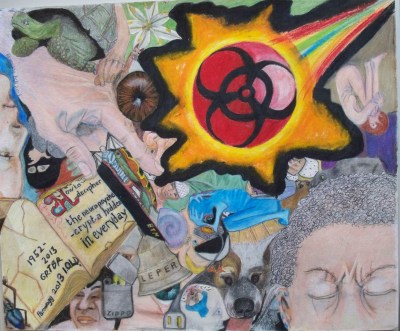
New Artwork on Display Soon

This piece and many others will be on exhibit at the Wethersfield, Connecticut public library from May 1- June 30, 2012. Another new small sculpture below will be in the display case, along with The African Queen of Paranoia, which may be seen if you do a search for it on this blog site or go to my photobucket artwork site, and small jewelry or pill boxes I made with reproductions of my artwork on the tops.

I made this bird because I wanted simply to make a hummingbird. But after I did so, it reminded me of the poem “Of Mere Being” by Wallace Stevens.

Of Mere Being

by Wallace Stevens

The palm at the end of the mind,
Beyond the last thought, rises
In the bronze decor.

A gold-feathered bird
Sings in the palm, without human meaning,
Without human feeling, a foreign song.

You know then that it is not the reason
That makes us happy or unhappy.
The bird sings. Its feathers shine.

The palm stands on the edge of space.
The wind moves slowly in the branches.
The bird’s fire-fangled feathers dangle down.

Speaking of Wallace Stevens, here is a poem I wrote that one of  Stevens’ lines inspired. It will be in my next book, LEARNING TO SEE IN THREE DIMENSIONS (saison d’enfers means “season of hell”)

THE SONG OF THE ANT

by Pamela Spiro Wagner

“For the listener, who listens in the snow…”
Wallace Stevens

In those days I was always cold
as I had been a long time, mindful of winter
even at the solstice of my high summer days

always, always the crumb and crust of loss
and near-loss of everything held dear
before the saison d’enfers and the ice to come

But there was the wind
There was still the wind making music,
and I, at one with the quirky stir of air

bowing the suppliant trees
bowing the branches of those trees for the sound
of songs held long in their wood

Changes change us: rings of birth, death, another season
and we hold on for nothing and no reason
but to sing.