Artist Trading Cards: Egg, Goose, Frog and more…

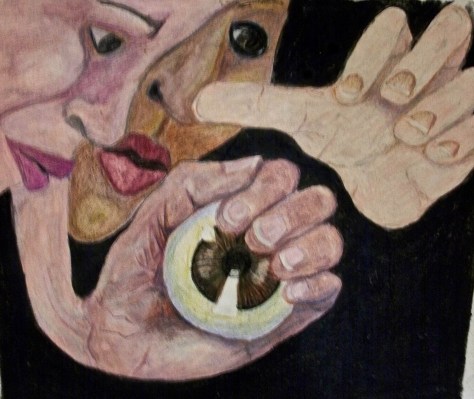
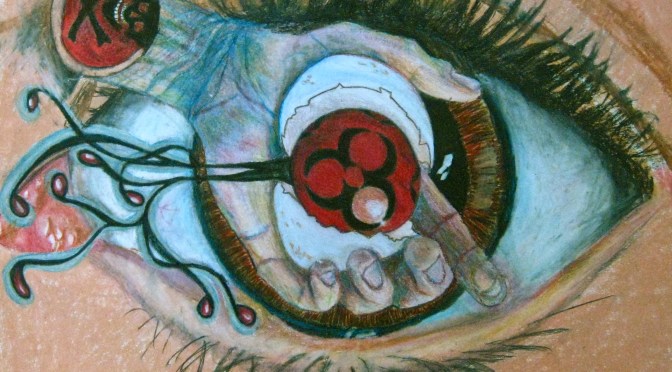
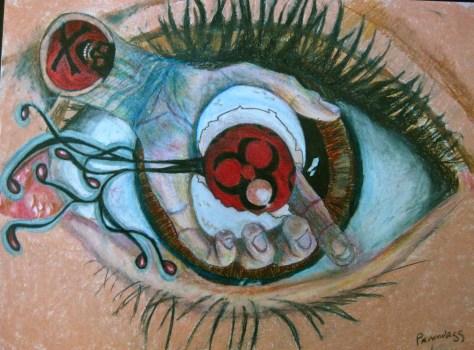
Flying Goose, Eye in Eggshell, Blue-spotted Frog, and Face/Eye Abstract


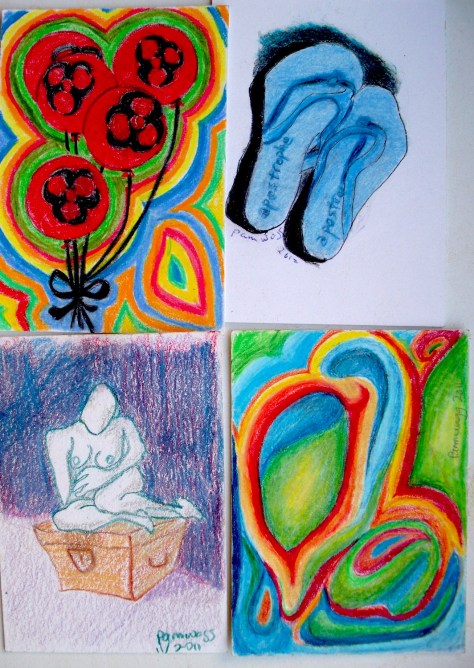
All of these “trading cards”, 2.5 inches by 3.5 inches. Many were done at Natchaug Hospital and  are original one of a kind art. They are for sale. Tell me which one(s) you would like. We can work it out. (Payment is always in art supplies equivalences, by the way. No “cash” or other monetary payments accepted.)


Purple Cone flowers,  Best in Show, No Exit from the Bin, and Mighty Manfred Makes an Entrance


Biohard Balloons; Blue Flipflops; cartoon nude; vivid abstract


Blue cup and Saucer; Man in Flower; Woman in ruffles with earrings


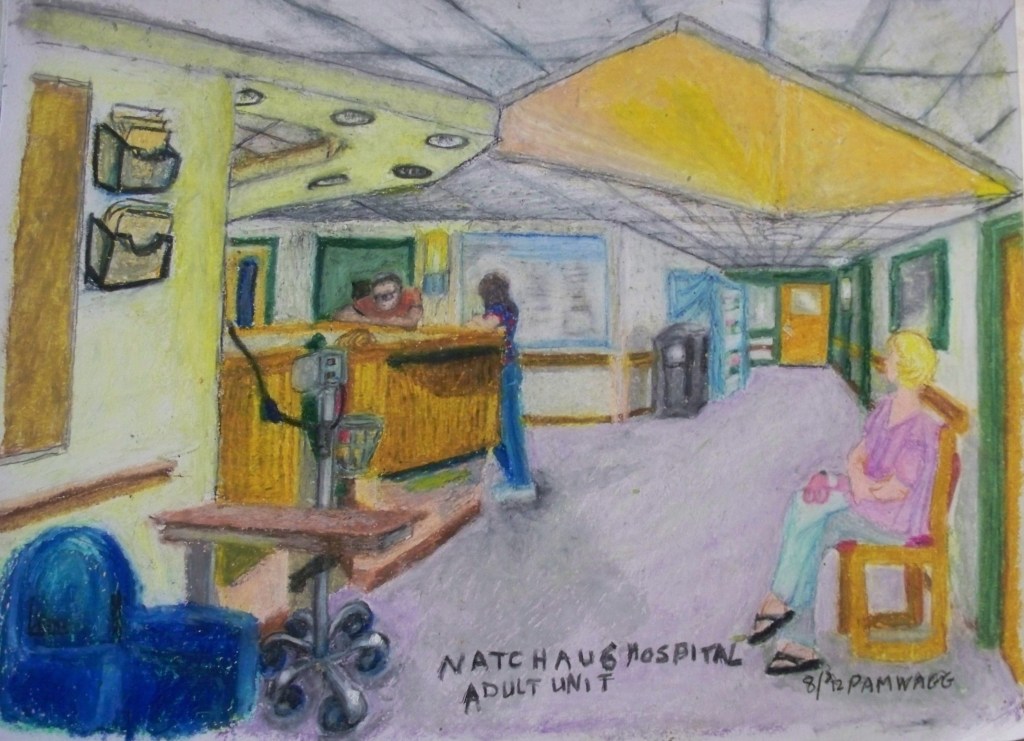
Natchaug Hospital and Trauma-related artwork (plus…)

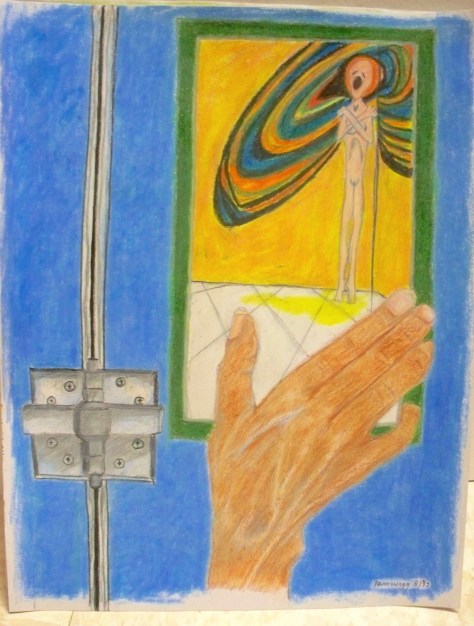
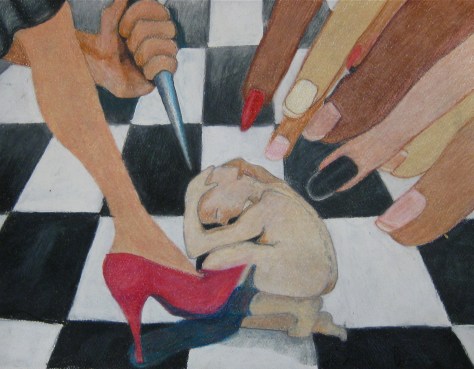
This is how I felt after one incident, #2, which involved a very physical “altercation” and restraint, and actually culminated the next night in that seclusion event I wrote about yesterday.
I call this picture “utter” because 1) I was unable to speak or utter any words for 8 days after the first physical assault on my person, and because I felt utterly — well everything, betrayed, abandoned, impotent, hopeless, helpless once they locked me alone in that seclusion room…
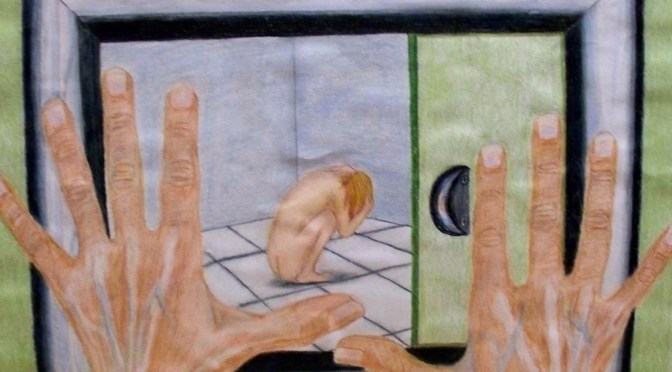
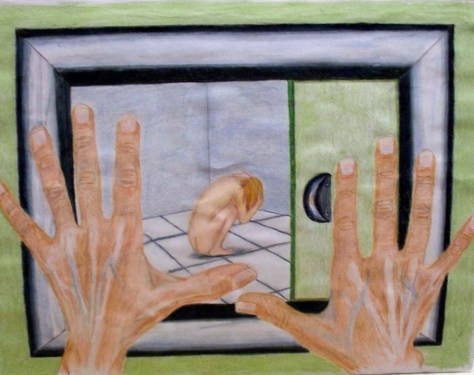
This is a more “controlled” as it were depiction of the seclusion incident, done a few days later, but still obsessed with it (largely because NO ONE would honestly discuss it, or let me. They just wanted me to forget it, leave it alone…No one would even admit taking part it in, but flatly denied even being on duty that night.

This was a picture I finally finished at Natchaug…Not trauma related. I call it Wonder.
“Up for Interpretation” – a birthday present for my friend Tim.


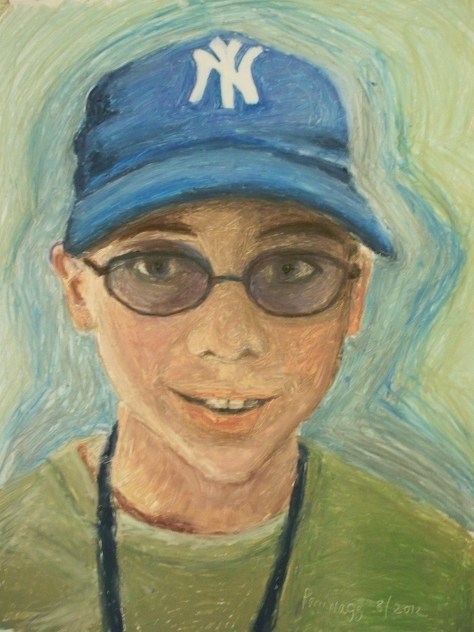
Portrait of her son, and present for my favorite visiting nurse


Open Letter to Deborah W., MD, Chief Medical Officer, of N Hospital

It has been a week since my discharge from the Adult Unit at N Hospital. After a week of recuperation and stabilization at home I feel compelled to write you via the open forum of a letter on this blog. It may or may not get your attention directly but I feel certain it will be read by someone on the N staff. Perhaps that way it will eventually reach your eyes. If not, so be it.

Our encounter on Monday the 27th of August was extremely brief and not particularly noteworthy. While I have much to say that never got said then, I owe you nothing, and by the same token, expect nothing from you either. That said, to any of my readers who want to understand the intent: I write partly in my defense against what I feel were gross misunderstandings (leading to unnecessary trauma), and partly to record publicly – on record as it were – what really happened over the last 4-6 weeks.

Please, Dr W, or any other reader: Do not dismiss this letter out of hand as the peevish complaints of a disgruntled but troublesome patient. I understand how you might be tempted to do so, especially because you — or at least Dr P and L.H. APRN – claimed in their infinite wisdom to be able to detect signs of an Axis II Borderline Personality disorder (despite the concomitant presence of an Axis I psychosis ). I know that labelling me “borderline” was always just another way to dismiss me and my concerns as “mere,” that is to say as meaningless or manipulative, the “mere” attention-seeking of a manipulative PITA*.

Nevertheless, it ought to have been obvious, it ought to have been needless to say — but clearly was not — that no one could possibly know what my baseline personality was like from the past four weeks at N nor in fact from any of my past four stays there. What was clear to many early on, including me, was that this hospital stay at N abounded not in norms but in extremes, from start to finish, extremes I might add both on my part and on the part of hospital staff as well.

My friends and family know that I am not generally someone who has screaming fits or throws things or strips naked and parades around in public, all modesty thrown to the wind. So too, N staff: So far as I knew or had seen since 2010, they rarely became physical with patients  and not once in all the times I had been there had physical contact devolved into anything even resembling a fight or violence. Instead, kindness, compassion and empathy were the primary tools. The best staff were as slow to lose their tempers or act on negative emotions as a live gecko was to do a cancan under the noonday desert sun.

I knew those things, and until August I believed it automatically made N a superior place, a sanctuary immune to the sorts of failings I’d found in so many other hospitals.  That was why I insisted on N this time even though it meant waiting two and a half days at W Hospital Emergency Room, never moving off the gurney in the barren cubicle I was placed in, monitored by a camera not so subtly hidden in the large TV screen. I knew of no other hospital where I could be safe, both from myself under the influence of command hallucinations, and just as important, from any staff impulses towards the use of violence to achieve control or discipline.

How could I have known that from the first morning after I arrived, staff behavior was to be stunningly “un-N-like,” as erratic and extreme as my own would turn out to be. My entire stay was in fact characterized by physical assaults by staff, punishment and trauma that began the moment I woke up that first morning.  I responded poorly to this, as anyone might, by regressing into more and more primitive behaviors. But how did “you,” that is to say, the N staff, respond to me? Not by taking a step back and seeing how things could change for the better. No, instead, you, they decided to blame the victim, to say, “She’s misbehaving, she’s ‘doing these things on purpose,’ she is volatile, unpleasant and emotionally unstable…” Et Voila! There I was, diagnosed, improperly but officially with “Borderline Personality Disorder!”

As many of my readers know, I have written extensively here, at wordpress.com, Wagblog, about psychiatric units and hospitals and have until now always held N in the highest esteem. N was always the gold standard, the touchstone against which all other  hospitals in the state were measured. I believed that N had the right ideas, the right philosophy about patient care, hired the right people and trained them properly. I trusted that the hospital understood the critical importance of trauma-informed treatment. Ever since my 1st hospitalization at N in December 2010 -January 2011, when S. H. was director of nursing, I felt I’d found a truly safe place, an asylum in the best sense of the word, where troubled patients would never be brutalized by staff more bent on coercion and a lust for power than compassionate care.

I have been hospitalized at N four times now. The first three times bore out these high expectations, but this last time was unmitigated disaster, revealing how much things have changed, and how, under the auspices of the wrong leaders even N has been willing to permit a few “bad eggs” to damage patients with impunity, rather than take an honest look at burned out employees – including those at the highest levels, RNs and psychiatrists included –keeping them tenured out of a misplaced loyalty, refusing either to re-educate them or to remove them from direct patient contact.

There were three separate instances of physical violence to which I was subjected  between July 31 and August 27th . The very first morning after I had been admitted and placed on one to one for safety, I remember I sleepily turned over in bed and scrunched down again to catch a little more sleep when the person sitting with me suddenly insisted that I place my hands outside the covers where she could see them. This was a strange request, since they had been under the covers all night, right up until that second. Dumbfounded, and freezing cold, I resisted and ignored her, fairly certain that she would not make a federal case of the request once I fell asleep. Instead, she repeated herself, louder and louder. She actually approached the bed and tried to bully me verbally into putting my hands above the bedclothes, telling me that being on constant observation required that my hands be visible at all times. This was news to me. Never in my experience at N had anyone required such a thing. I continued to resist, though any impulse to sleep had left me by then. By this point, it was strictly on principle.

Well, she was intent on winning the battle and instead of negotiating a solution called in reinforcements in the persons of two male mental health workers. Unable to verbally force me to uncover myself, they initiated physical contact, attempting to pry my blanketed fingers away from the blanket in which I had wrapped myself. The female stood aside, but continued to threaten to deprive me of all coverings if I did not comply with her order. The tussle went on. I vehemently kicked at them whenever they laid hands on me, though I spoke not a word the entire time. At last, they gave in and left me alone. I never found out why. Perhaps they saw the brutality they were inflicting on me. Or perhaps they were called off. I do not know. All I know is that that particular rule was never again inflicted on me.

After they left, and a new sitter arrived, I lay in bed, breathing hard and feeling bitterly betrayed. What the F just happened? Dismayed and disappointed, I could scarcely believe I was really at N and not at the torture chamber in the south eastern part of the state again. The consequences of this betrayal left me physically and psychologically speechless. What had happened to “my” N? Try though I might to let myself talk, I remained mute for 8 days.

I won’t go into the long and involved story of the second assault, except to say  that it involved  poor judgment on the part of my social worker and evening nurse. OTOH, an assertion of power by another nurse assigned to me nearly twenty four hours later was overkill and an act of punishment and revenge. She can deny it left, right and silly, and maybe her RN superiors believe it, especially because they have a stake in it. But I know contempt and the smile of sweet revenge when I see it, and I knew the enjoyment in her smile that Wednesday. Assault #2, which involved a rather violent physical altercation and restraint, nevertheless had a bearing on assault #3. What follows is the story of that third assault on my person. In places I quote almost verbatim from my journal entries, which I wrote at the time. When I am not quoting, I assure you that the account is very similar to the journal’s “horse’s mouth” and merely states the same things I wrote there, but with better words and fewer punctuation marks.

I do not remember how it started. I suspect I had been screaming or yelling about something. All I know is that the RN Supervisor for the afternoon, a woman I will called D came into my room after my upset and just stood there. At one point in her obdurate silence, she accused me of an unprovoked attack on it the nurse, K, who had taken revenge on me the day before. She called K  one of her “ best nurses.” Incensed at this I assured her she didn’t know the whole situation. When she said she knew enough, I told her to leave my room.

“I’m staying right here,” she said giving me a baleful look. I pointed out that I already had a 1: 1 and did not need a 2nd person in the room. She only continued glaring at me.

“Get out,” I screamed, “get out of here!”

No response. No reaction, except for a slight recoil from the loudness of my voice.

I threatened her then. I admit it and I am not proud of it. I threatened her. I took up a box of crayons and looked as if to hit her. Everyone cried out, “No, no, P!” And I put it down. But I continued to cry out, “Leave! Leave! Leave me alone!” She only stood her ground and stared.

That’s when I lost it. I picked up a chair and threatened to throw it at her. This is what she’d been waiting for. She could’ve laughed or made a calming gesture or simply backed away and let the mental health workers gently disarm me and all would’ve been well. But no, D liked to escalate rather than de-escalate, so she yelled out, “Escort her to the quiet room!” Before I could offer to walk there myself, Brad and someone else picked me up by the armpits not even allowing me to walk and dragged me.  Because they didn’t even ask me if I would walk freely, under my own steam, I fought them, twining my legs around  theirs as if to try and trip them.  Then to add insult to injury they dragged the blue therapy chair out of the room instead of leaving it there for me to rock in and calm myself. Now, inside the tiny, now empty windowless cell, despite the bright mural painted on the walls, panic rose in me. I looked around, remembering how S H had assured me that no one would ever leave me alone in there unless I wanted them too. I begged D for someone to stay in there with me. S the mental health worker saw the panic and offered to, but D was furious and ordered her out.

“No, she is to stay in here alone!” She made everyone leave, and following them out, she slammed the door shut behind her.

I was horrified. All the memories of locked seclusion returned to me in an avalanche of terror. In my mind, memory told me it would make no difference if I went to the door to beg to be let out, or for a blanket or someone to talk to. Experience, all my long experience had taught me: there was to be no mercy no help nothing would change no one would respond no help nothing no matter what I did. I was and would be abandoned to my punishment until–well–until I had no idea how long it would last. No one told me a thing. Utterly terrified, instead of banging on the door and begging for release, I backed into the farthest corner. I wanted to meld with the wall, shrink back into the wall board as far away from the room as I could get. A howl climbed my throat. I tried to hold it back but I could not. When I screamed, I screamed not to anyone or for anyone but out of sheer mortal terror, the sort of terror that any animal must feels when its leg is smashed in a trap and knows his life is coming to an end. Screaming brought no relief though. Screaming brought nothing, it certainly brought no one into the room to help me. There was only thing I could think of that would that bring relief and that was to relieve myself. So I did, in the only way I could: I stripped off all my clothing and peed a huge puddle of urine on the floor. I had to. I do not know why. Removing my underwear I found inside the crotch a forbidden pencil. I’d not been allowed writing utensils for eight long days and just that afternoon I had used this pencil to sketch my first portrait since I’d been there. I wrapped the pencil in my clothing, knowing that if someone saw it they would confiscate it again.

Too late. A commotion behind the door and they were upon me, all of them, wrestling my naked body to the floor and prying the wad of clothing from me, smashing my glasses in the process so that one lens came out of the frame.  In the melee, someone grabbed my medical bracelet right off my flailing wrist. They pinned me down. I knew what they had in mind. IM meds. But no one had offered me oral medication. “I want oral meds. I’ll take oral meds you can’t inject me, you haven’t even offered me oral meds.” I asked for Zyprexa. Not Haldol or Ativan but Zyprexa, the PRN I had on order.

They refused to get Dr. T, who signed off on the seclusion without ever seeing me, to change the emergency meds — which I didn’t really need but which were going to be ordered anyway, as a mater of course — to Zyprexa despite my psychiatric advance directive distinctly requesting no benzodiazepines of any sort. However, fearing any further confrontation, I swallowed the pills. Everyone got up and left except for the nurse supervisor. I stood up and surveyed the room. Urine ran everywhere.

“How can I stay here?” I asked her. “There’s pee all over the place.”

She surveyed the wet pads and floor. “Deal with it,” she said, and walked out, locking the door behind her again.

I was spent. There was nothing left in me to fight or scream or object. I simply lay down on the mat, amid the puddles of urine and curled up in a fetal position. Sleep never came; it was too cold for that. I just lay there, eyes open, my naked back to the window. 10 minutes passed. 15 minutes. I heard the mental health worker at the window ask the supervisor if she could let me out. “She is lying there calmly, I think she’s sleeping.”

“Give her another 10 minutes,” was the reply.

Another ten minutes went by and another.

The mental health worker kept asking if she could let me out. Finally, about an hour later, the door opened and S entered.  I didn’t bother to turn over or look at her. I scarcely raised my head.

“P?”

In a dull voice, I answered the requisite questionnaire, as if that were adequate debriefing. Then two other staff members attempted to clothe me in hospital issue johnnies, one over my front, one to cover the back. I allowed them to do this but as soon as they let me go and I was free to proceed out of the erstwhile “Comfort,” now Terror Room, I ripped off the johnnie coat covering my naked backside, and walked half-exposed to my room, deliberate and uncaring. Who gave a fork? What could they do to me now? What could anyone do to me? Fork everyone! They were dead to me. I was dead to them. It was over. It was over. I was dead meat. Just meat. I didn’t give a fork about anything.

More than any other incident, this one was the last straw. Whatever repercussions I deserved for threatening the RN supervisor that evening, however evil I felt for being the devil, there remained in me enough human pride to resist such treatment, enough to say that even I did not deserve to be treated as harshly as D had treated me. Not only did she deliberately test me, she lost her temper and I was her victim. I have reason to believe that most of the staff members who witnessed what happened that night believed she went too far. Some would actually say so in as many words to me, though others were cagey and feared repercussions should it get back to her.

All I knew was that I’d been treated like an animal. What did that supervisor or anyone else expect in response? Did she really think I would become docile and obedient, chastened, a meek and compliant patient?  Violence begets violence. It always does. From then on I was not the same. I was not better either, no. I grew markedly worse, and worst of all, no one could predict anything about my behavior. No one knew what would happen next, what I would do, when I would lash out or scream or throw things or push someone or even hurt myself…None of those behaviors were “me” or even close to my usual, or baseline, but I reiterate: what do you expect: treat a person like an animal, and you can pretty much count on getting animal behavior as a result.

Dr. W you do not know me. Dr P, for all his discharge summaries and “progress” notes (the pages of writing are all boilerplate, meaningless, and/or second or third hand information for the most part), he doesn’t know a damned thing about me. I tried to let L. H, APRN, know a little, but by the time she was involved in my treatment, you were all so intent on seeing in me this mythical borderline personality, instead of a person who had been acutely and brutally traumatized at your hospital, that it was useless for me to expect anything.  For all L’s  pretence of understanding, she had made up her mind about me before she met me. She was largely deaf and blind to everything I said that did not fit the tidy diagnostic picture: schizo-affective, with a concomitant borderline personality disorder. How convenient that you could chalk all the unit troubles up to my problem, rather than seeing it as something your hospital staff created! Blame the victim, why’ncha, instead of taking responsibility for a number of incredibly poor judgment calls on your own or your staff’s part?

Of course as many people have asked me, why do I care what you or Dr P or L H think? Well, I do not, in fact, give a flying femptogram… Mostly I care about the decent people there — the mental health workers and the nurses who did like me and made it obvious and treated me very well and made it clear they would welcome me back (though I can never return, not now.) About Dr P and LH  and the others I could give a ratzass.  But I do, or did care about N itself, once the gold standard, for me at any rate. It was the one place where I could tell other people, “Go to N – I know people will take care of you there, people will care about you there, that’s where people will treat you well.”

The even bigger tragedy is that if no one is safe from the hospital staff at N, then the likelihood is that no one is safe in any psychiatric unit or hospital in  this state. Let’s face it. Not much progress, perhaps none at all, has been made since the Hartford Courant’s series of articles in 1998 called “Deadly Restraints.” My sense is, in fact, that since Mnanaged Care took over medicine, things are actually a great deal worse…Oh, sure, I was not four-pointed during the past stay at N, no they managed not to become that brutal, so far… but I was physically restrained and manhandled during all three incidents and I have been four-pointed at nearly every other hospital in the state up till 2010. So I would hardly say that that practice has gone by the wayside. In fact, in the  Hospital Emergency Room back in July of this year, they threatened to four-point me just for making a nuisance of myself and being noisy…

So much for not using restraints. As for not using them as punishment? I believe that in every single case when I was subjected to four-point restraints from 1980-2010, they were used as punishment, as a convenience or in revenge… I state this categorically: that not in a single instance were four-point restraints ever truly necessary to keep me safe. They were only used because they were available and the culture on the unit permitted the employment of torture to control and discipline patients. Period.

Seclusion? This practice has only increased in usage so far as I can see. The difference is only that staffs are careful to call such barren quarters the Time-out Room, and are rarely apprised as to the legal definition of either seclusion or restraint. (BTW Time-out is a disciplinary measure used to train children to behave properly…since when did psychiatry decide that patients in adult units ought to be treated like misbehaving children and sent to time-out rooms? If you want to talk about empowering patients and not infantilizing them, you do not in the next sentence tell someone to go to the “time-out room” and stay “until I say you can leave.”).

What you, Dr W et al, think about me in the end is of little consequence. I know I do not have BPD and so do the people around me that matter to me. If I care about anything having to do with N it is not your opinion of me nor your judgment or your diagnosis, I care about N because while it could and should be, it is no longer a place I trust, a place where I can direct other people for safety and compassionate treatment. Because if I am not safe from myself at N, if I am not safe from the staff at N, and I mean by staff, the doctors and nurse supervisors as well as any “rogue” RN  or MHW, then no one is safe at N and no one with mental illness is safe in any psychiatric hospital or unit in the state

That, Dr W, is by far the worst tragedy of all .

___________

*PITA = Pain In The Ass

Mental Hospital: Psychiatric “Treatment” and Abuse II (Continued)

I was admitted last Tuesday night, the 17th of July I believe it was, to the Institute of Living, the psychiatric division of Hartford Hospital in central Connecticut. I do not remember this. The fact that I have amnesia for it and for most of the Wednesday following only occurred to me on Thursday, a day and a half later, when I wondered — the train of thought must have had to do with the seclusion episode that took place Wednesday evening and which I described in yesterday’s blog post — why they had been so violent with me, why they had so quickly secluded and threatened me with restraints in a situation that didn’t come within miles of “requiring” them. Surely, I thought, the staff member who admitted me, whoever that had been, had asked me a critical question, which is on every  admissions questionnaire upon entering a psych unit or hospital these days: have you ever experienced trauma or sexual assault? (or words to that effect). I could not, and still cannot, for the life of my body or soul remember anything asked or answered at that time. There’s little left in my memory beyond a vague “snapshot” of being wheeled into The Institute of Living (hence forward to be called by its nickname The Toot or by its initials, The IOL) and my understanding that I had been transferred out of the ER. Then the memory  goes blank until many hours later. Understanding only as late as Thursday that I had this gap, and pained by the violence dealt me the night before, I went up to my “contact person” and asked about my admission. Could I find out whether this question was ever asked me, and what my answers were?  At first, naturally and as a matter of course, she refused. That was SOP. Refuse, refuse, and refuse.  So as I stood there, earnest in my request, she seemed about to summarily dismiss it as just another bothersome demand from a too-demanding patient already much disliked by all. What did I expect, cooperation? But to my surprise, her misgivings and the flicker of irritation that had crossed her face at first changed to a flattened look of resignation. She agreed to read my answers to the questions to me. But that was all she would do, so don’t go expecting more than that.

As she read from the top, a few memories stirred and woke, but only temporarily.  I fear they soon faded again into the all-white-out of oblivion. Only the trauma memories remain, for they apparently are stronger than thieving Ativan. Can I push myself to remember what her reading my answers back to me recalled to mind? She told me…what? She said that I told the admitting staff member, whom I do not remember a thing about, do not even recall if that person was male or female, doctor or nurse or what…I told that person I was not homicidal, not suicidal, not hearing voices, and that I didn’t need to be in the hospital. Three answers were true, or true enough by then. After having been nearly killed in the ER the people in my head/outside of it, who tell me to do things to myself were not so relentlessly horrible in their demands…so I was indeed no longer suicidal, homicidal or in need of hospitalization. I just wanted to get out of there and go on my upcoming writing-retreat vacation.

As I recall the little I recall now, this nurse, my “contact person” read to herself a lot of the paperwork and relatively little aloud, despite her promises. I kept asking what she had read, and prompting her to read out loud, but she let forth only a few phrases. I still do not know why… though I can guess that pretty bad things are written there about me. That would not surprise me one iota. I do not really care. They will largely be lies or descriptions of that awful scene in the ER from one very biassed point of view. No one will tell MY side of the story, that’s for damn sure. Whatever is said there will be based on what the ER personnel and the guard-thugs did to me, but if my contact person believed them reading them, and never bothered to find out the half of it, then who knows what they all thought about me, or believed…Anyhow, I do not care, because they too were thuggish, professionally and psychologically.

But the big question was yet unanswered. Had I ever in fact been asked about past experience of trauma or sexual assault? Contact Person, whom I won’t name as she was at least marginally decent to me, now seemed interested in this too, having paged through the lengthy document and not found it. She seemed puzzled, said she knew it was a standard question. She started perusing the thing again from the beginning. A minute or two later, she poked a page.

“Ah, here it is. And your answer is blank.”

“So the person just skipped over it. They just skipped it!”

“It appears so. Do you want to answer it now?” She took out her pen.

“Yes, and yes. I have experienced sexual assault three times. And severe trauma due to seclusion and restraints in many hospitals.” I looked at her. She was writing. “Tell me what you wrote.

“Experienced sexual assault. Has issues with seclusion and restraint.”

“NO! I said, it was severe trauma. I have PTSD, ask my doctor. Ask, I dunno, give me a test. I cry just talking about it. My heart rate goes up just thinking about it, even though it happened more than two years ago. It was trauma, and you cannot do it to me again!” She wrote something on the paper but didn’t read it to me. She just clicked her pen off and stood.

“Now you have your answer. I have things to do. Let’s go.” With that, and no discussion of what had taken place on Wednesday night, let alone in the ER, she hurried me out of the side office so she could go back to the nursing station to do some “real work.”

——————————

I suppose there must have been some incidents of relative kindness at the Toot. There must have been exceptions to the Hartford Hospital IOL “coal dust standard.” But only Albert, a tech, stands out. Because they injected me with too much Ativan on Wednesday pm and I was discharged Friday noon, I had very little time between the ER’s monster dose and D3South’s equally large dose of Ativan-it-Away to retain much of anything but what stood out enough to stick, and really stick tight. Their puny kindnesses mostly did not, except for Albert.

On the other hand, the sheer meanness of the staff was astounding. I had a semi-meaningful interaction — though unpleasant  – in all that time with only one individual who was not programmed to speak with me. And even that started out with nastiness, though I admit it was sparked by something that was “my fault,” as you will see.

Friday morning I needed migraine meds and my 8am pills. I went to desk at 7:55 and asked for them. A nurse or tech or someone –I never knew and no one ever bothered to tell me who or what they were — lingering at the desk said that the med nurse somewhere in the back would get them. I wandered off, figuring it would take some time and she would bring them to me, which is what they did at every single place I have ever been. But no, by the time I thought about it again, realizing that she had never brought them, it was 8:45 and people were lined up for their 9:00am meds already. I signaled above them to the nurse at the med window that I had not gotten mine for 8:00am yet. She told me that of course not: I left the med station; why should she go after me? Then she indicated that I should get in line to be next…even though that meant stepping in front of someone else. Okay, so I got in line, and  – oh, I do not remember all that happened except that I became angrier and angrier with her, resenting her attitude. As a consequence, I did everything I could do to irritate her. She poured the meds at the computer, where I couldn’t see them, saying their names softly to herself so I asked to see the packaging. I didn’t trust her not to withhold or add something I didn’t want. Because I had asked for Imitex an hour before I sensed she would not include it. Well, lo and behold: No Imitrex! So I took the pills, but asked her for the Imitrex as well.

Ah, revenge time! “I will get the Imitrex at 9:00 am sharp, when it is due. That is 10 minutes from now. You can come back and wait in line then.” I just stood there, not budging. I would never stoop so low as to impugn a person’s person, but I probably let loose a few curses and most certainly raised my already angry voice a few decibels. Finally, speaking in a calm, respectful voice, a man whose name I learned was Albert came up to me asking in such a polite manner that I even looked him in the eye, to “please just lower your voice” so he could hear me tell him what the problem was.” Well, treated in such a fashion I understood he would wait for me to calm and not get angry back so I was able to take a few breaths and then make him understand what she was doing…He said, with the med nurse standing well within earshot, though I do not think he intended any manipulation, “It’s okay, don’t worry. It’s nearly nine, and I’m sure the med nurse will get your medication for you.” (I was sure of quite the opposite but harrumph! Well, what could that SOB, excuse me, DOS — daughter of a stud (med-nurse) do but give me the Imitrex now?) I might have crowed, but instead, thanks to Albert and in respect for him, I took it without a fuss and thanked him again.

This sort of treatment gives the lie to what so many providers – both individuals and insitutions — say about the goal of “empowering patients.” What bloviated BS! What they really want are not empowered patients but cowering patients, people too scared and drugged up to object or make trouble in the first place and then who continue to cower before the establishment MD’s power structures all the way to the last place.


My butt hurts from sitting slouched on a bed all day. I need a break. So I am going to post this and go outside in the cooling darkness of the Litchfield hills and drink the air. Since I have nothing I have to do here but write, I will post tomorrow about that single meaningful encounter I had while imprisoned at The Institute of Living. If I still feel it is worth writing about, which as I think about it, it may not be.

Oh, what the heck: Basically, it concerned an encounter with this female tech, a woman who in passing me in the hallway, the first time she had spoken to me so far as I knew, accused me of moral turpitude (not in those words), made a statement shaming me for my behavior on Friday morning at the medication window. What had I done?  By talking too loudly, I had made “the poor man behind [me]” cover his ears and point at his skull to communicate his displeasure. PLUS, I had made everyone wait a good 30 minutes…I knew the 30 minutes was an exaggeration, so I didn’t even touch that, but the shaming tactic got to me. I went back a few minutes later and said I wanted to speak with her. We went to a couple of lounge chairs in the hall and sat down.

“What precisely did I do that was morally wrong this morning?”

“Do you know you talked so loudly this morning that the poor little man behind you was covering his ears and pointing at his head?”

“So I should have talked more softly, but I do not have eyes in the  back of my head to see him. I could not know he was communicating by pointing at his head. It is not morally wrong not to have eyes in the back of your head, nor is it morally wrong to speak in a loud voice.”

She reiterated the case of “the poor little man behind you pointing at his head.” But I continued to press her on what was morally wrong because I didn’t have eyes to see behind me. Finally she granted that I could not help not seeing him and that it wasn’t actually a morally wrong thing to do, to yell or talk too loudly. At this point I said to her, nearly in tears because just having a calm conversation had taken such effort on my part, “Be careful what you say to someone on this unit you know nothing about. Words have power and you should use that power with care. You have NO idea how those words you spoke affected me, no possible idea…”

She gave me an intent look, almost a fearful one, as if afraid that — well, no, I don’t think she gave a damn whether or not she caused me any emotional harm. She no doubt despised me along with the rest of the nursing staff. But perhaps she suddenly appreciated how even her words were important and powerful, and carried weight and could do some good but could also do just as much psychological damage and maybe more sometimes than the loud voice that damaged mostly ear drums.


More Psychiatric Abuse in Mental Hospital and Emergency Room

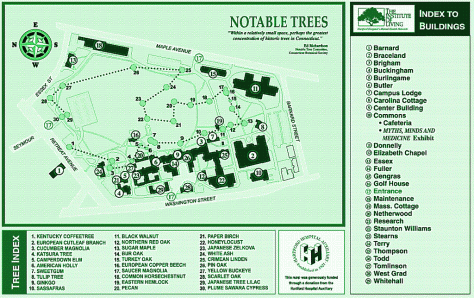
Donnelly Building is #11. But we faced Maple Ave and couldn’t see the magnolia, or the oaks or copper beech that Olmstead planted…

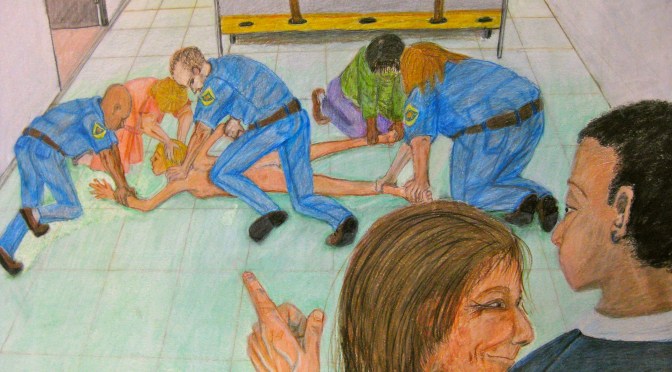
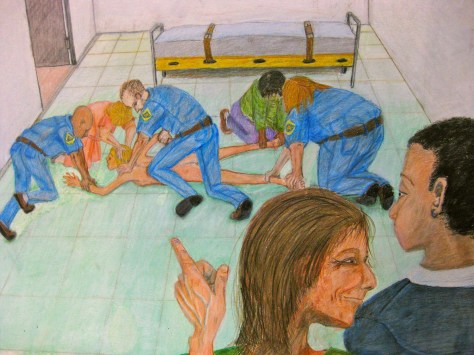
Yes, this is hospital restraint and seclusion – it really happened like this at Middlesex Hospital in 2010 (I am just reprinting it here to reprise it for edification’s sake and because it is relevant.) In fact there were many more personnel and guards involved and more men…I just didn’t know how to draw a crowded scene at the time, so I made it simple!

I admit I was angry. I admit I was loud and irritable. I admit that I may have been perceived as “difficult.” But never once did I make a verbal or gestural threat or even so much as stand on the floor or approach anyone face to face. In fact, for three hours I did nothing but lie on a gurney, quietly, and try to sleep and remain calm, hoping to…But wait. You don’t know the half of it.

Well, if my energy holds out, let me start at the beginning. Except that I do not really recall the beginning, largely I suspect, due to our good friend, Ativan. However, this much I do know: my case manager came to my apartment five days ago after I called her in extremis, just wanting to talk. She offered to come over to see me, which she has done before and left me in better shape than I was when she came. I assented, though I had some doubts about it because she seemed a bit too concerned for my good. I knew I had a writer’s week planned up at Wisdom House again in the NW corner of the state starting this weekend and didn’t want her to push the panic button.

To make that part of the story shorter, push that bright purple button she and an associate did, once they came and found me in a mess, unable to assure them properly that I was not hearing voices telling me to burn myself. Now, my plans were in fact to burn myself somehow, depending on what the voices told me. They had already instructed me to burn my leg that evening. That was partly why I had called the case manager, because I knew I would follow through. I also knew that I could not keep it a secret if I did follow their instructions, which would have ended my vacation plans prontissimo.

But when that other LCSW went out into the hall to use her phone, I knew it was under false pretenses — she said she had to cancel an appointment of hers because she was visiting me but she was clearly lying, I just couldn’t do anything about it. Just as I suspected, she called 911 to summon the police and EMTs. When they came, I objected to going to the ER, but you know of course it was “Pamela, it’s the easy way or the hard way. You are going to the hospital no matter what…” Argh, the usual story.

Worst of all — since I still don’t know whether legally they really had a right to force me — once in the ambulance, when I stated quite clearly that I did not want to go to Hartford Hospital, and this was clearly and prominently stated in my Psychiatric Advance Directive (PAD) of which I had made sure they had a copy, they dispatched me there anyway.  When I screamed my objections from the back of the ambulance van they told me that the police had instructed that they could take away all of my rights with impunity. Oooh, I did not know what to do about this, but it put me in an evaporative fury. I simply had no power.  Disaster nearly followed, and new trauma most certainly did.

Once in the ER, I was taken directly to the so called “purple pod” — the psychiatric section, and shifted onto a gurney in a curtained-off cubicle, told to change into hospital garb, which I did under duress but before I was forcibly changed by the guards, as was the threat, and was told to lie down and be quiet. I did. I submitted to a physical by an APRN that took 15-30 seconds, after which she pronounced me physically sound, ready for a psychiatric interview. Then I waited. And waited. And waited. The room — the  purple pod — began to fill, and doctors and MSWs came and went and talked to people and passed by my cubicle, but none stopped or said a word. I remained silent, still hoping my semi-comatose behavior would bolster my case, earn me a ticket out of the ER without being hospitalized.

Then another woman, middle-edged, bent over from back pain, loudly asked to talk with a doctor, complaining, “I’m tired of waiting! My back hurts!” The response was that she would not get to see Dr So and So until she was sober and the alcohol was out of her system. She returned to her gurney for a time and then again was at the nurses’ station complaining of fatigue and wanting to have her interview so she could get on her way. Once again the same reply.

This jarred me out of my complacency. I grew irritated. Why were they making me wait? I had been there hours already and had not come in drunk or on drugs or anything like it. I had been quiet, submissive, and they just ignored me. Well, I dunno what happened next precisely, but I exploded (but in some sense in a controlled fashion, because I only got down off the gurney once, in order to use the restroom…) Some cropped-haired woman with an official look and a clipboard came by and I started rationally to ask her why I had not been seen yet, and she began an answer. Unfortunately I just barreled on about how I had been waiting hours and was not drunk and not high and, and, and…And well, it snowballed from there because of course nobody at the ER is professionally trained or for that matter paid well enough to care to learn or know how to calm an agitated person down without brutalizing them….This forever surprises me, since surely they must watch TV where such situations are frequently featured.

I take it back, or partly back. They claim to be professionals. They also, get this, several staff members of the ER claimed to have read my PAD, front to back, all 17 pages of it. They volunteered this information. Yet when push came to shove, when I became agitated, which has a PAD page all its own, what happened? Abuse par excellence. First they ganged up on me, a real no-no. Then they screamed back at me. Then they threatened me. One security guard (?nurse or ?aide) actually threatened to “4-point me” just for disturbing his purple pod.  As if doing so would quiet me!

“Oh, you dare put me in restraints,” I threatened, “and I will have your ass so fast you won’t know what hit you. Middlesex Hospital tried that and now they are facing JCAHO and the DOJ so just you watch your step!!!!!” He said nothing more about four-point restraints, I can tell you that. BUT, BUT, BUT… they had other retaliatory measures in store for me, because soon thereafter a whole panoply of guards and nurses came barreling into my cubicle and rolled my gurney headlong into a secure room (soundproof and with a door that locked, a guard assured me). There while a female nurse attempted to inject my upper left arm with three drugs, two of which were on my PAD’s “forbidden drugs” list, and others restrained me, two guards viciously compressed my neck. They squeezed down hard especially on the right side, cutting off the blood supply to my jugular and carotid arteries. I knew this, I felt my eyes pop, felt blackness in my head approach. I tried to alert the nurse injecting me, could barely burble through hard-compressed lips, “I can’t breathe!” which was the only thing at the time I could think of that she would pay attention to.  That they were choking me was a concept that simply didn’t form in my brain…Tough luck. She just ignored them and me and said, “You’re all right…”

I jerked away from her then, trying to get free from the guards. The nurse yelled at me because I dislodged her needle and started bleeding. But the guards only squeezed down harder, tightening their strangulation grip. I felt certain they really were going to kill me. Then the guard closest to my right ear said something along the lines of, “That will teach you about suing a hospital and getting JCAHO involved…” I feel like I have his words verbatim, but maybe I only recall the gist of them. Whatever he actually said,  he clearly harbored enormous resentment about my complaint against Middlesex Hospital and the involvement of the Joint Commission and possibly the DOJ.

When they were through brutalizing me, the guard finally unclenched his fingers from my neck and despite my accusations, they all rushed out of the room, closing the door behind them so no one could hear me. I lay back, stunned, understanding then just how people die during restraint episodes. How close I came to being one of those statistics I can’t venture to guess. “Unfortunate ‘accidents’ happen and nobody is to blame, really, it just happens…” I imagined them saying to my family and friends. At the time it felt like an extremely close call. I knew one thing: what those guards intended, and they intended to hurt me. Perhaps in their angry zeal they would have killed me. They were thugs. They were coarse, vulgar men who had likely been judged unfit for the police academy but still wanted to wear a uniform, have authority and to carry weapons and beat people up. Understanding this and understanding just how much danger I was in was extraordinarily frightening. I do not recall anything else. I must have fallen asleep despite my terror, subdued by the cocktail of drugs I had been given.

The next thing I knew,  they were wheeling me onto a psych floor at the Institute of Living, the psychiatric hospital associated with Hartford Hospital. This Once World-Renowned Retreat for the Rich and Famous closed its doors years ago,  re-opening with the same name but as part of the city hospital. It now caters largely to Medicare and Medicaid patients like me, which is a 180° reversal. Clearly the staff, at least on the floor where they placed me, care about as much about their patients as their meager salaries/wages pay them to. Which from my fairly minimal (I have been there three times, for brief and uniformly miserable stays) but horrendous experience on Donnelly 3 South at any rate tells me cannot be more than a pittance. Either they are paid too little to give a damn about their jobs, or they are mostly all of them jaded, burned out, control freaks. At a minimum it seems they just want a cushy job and a quiet unit with untroubling patients, drugged to the hilt so they will have no problems to deal with, nothing that a seclusion room and IM meds in the butt cannot handle.

They were not prepared for me, not prepared for someone who had nearly been killed in the ER, one, and two, who really did not want to be in the hospital, let alone in their hospital. I was ornery, bitchy, and, to the maximum possible, was not ready to obey their pissant commands. No I was not. I was a human being, a very intelligent human being whatever else was going on, and they were not treating me with dignity or respect, so I would treat them much the same, or worse…Well, that won me a lot of friends, I can tell you, NOT.

They hated me at Donnelly 3 South, they really did. They despised me and made these feelings very clear, very clear indeed, retaliating and punishing me at every opportunity. It would have been, might could have been funny to watch these so-called professional nurses and psychiatric staff behaving so badly, so much like children run-amuck, they were that out-of-control, had I not been so vulnerable and so very much in their power.

But when it came time to force me into a “side room” and try to keep me from leaving it, you better believe they didn’t have an easy target in me. After my experiences in Middlesex and Manchester Hospitals, I have schooled myself on my rights, all my rights vis a vis restraints and seclusion.  And you know that I let them know in no uncertain terms what the Connecticut statutes are, how seclusion is defined and when a restraint is taking place. How they hated me for this, and hated, oh, they –you know, I really have no word strong enough for the look of razorblades in their eyes when I pointed out that they were not following the most recent Standards of Nursing Care, or worse, how Natchaug Hospital nurses do things better, or how they were using seclusion and restraint when they had no “statutory right” to do so. I think the words “statutory right” both meant nothing – “what the heck is a statute anyway?” I could feel some thinking — and everything to them, and was impressive and frightening because of this. In any event, that look of utter negativity went right through me, as if they wanted to stab my eyeballs with an ice-pick.

Needless to say, however, they managed to use seclusion and restraint on me despite my protests. When I got too noisy for them instead of trying de-escalation techniques of any sort, they proceeded first to lead me into and then to push me back to a so-called “side-room.” When I got out, they forced me bodily pushed me back inside, and closed the door against my protests and verbal preferences, vocalized clearly,  to go to the “least restrictive environment” of my bedroom to calm down. That constituted a restraint, and when they would not let me leave that room, it became, as many of my readers will know, by definition a seclusion. Then, when they forcibly held me down for an injection of the three drugs that interact badly in me, and which I had requested specifically not be given to me (alternatives were suggested in my PAD), they abrogated every right I asserted. That in itself constituted a restraint without legal justification, especially since I was nearly sleeping by the time they managed to get the injection ready and no longer even agitated. They had to physically attack me in order to RE-agitate me, to justify giving me a stat dose at all. They kept me in that “side room” guarded by someone all night.

As I freely admit, I was horrible to them, a witch, a bitch, a harridan, but they never once behaved with any professionalism, or tried any of the calming, de-escalation strategies that I suggested in my Psychiatric Advance Directive. Oh, they had a wonderful comfort room, pretty much perfect, but for the lack of a padded floor and muralled wall. But I myself had to ask to use it; it isn’t as if they offered the use of it or suggested that I return to it when agitated. In fact, they seemed pretty cagey about it, acted as if I might possibly want to “over use it” and said I could stay for a “little while.” And when the radio broke down, who gave a damn enough to find one that worked when I returned the broken one, or to get me a weighted blanket when I wanted one. I sat in the comfort room’s therapy chair — arranged backwards so you couldn’t use it to rock yourself by pressing your feet against the wall the way it is supposed to be used! Because it was cold in there (yeah, the other big problem) I asked for a blanket, the aide/tech who found me one walked partially into the room and then threw it at me! Not casually for me to catch, mind you, but at me. As if I weren’t worth the time, trouble, or effort for him to hand it to me. I don’t know what he was thinking, or not thinking, but it seemed clear that at least at that moment he didn’t give a damn about his job. Or perhaps he was sending me a message about personal dislike, which would have been incredibly unprofessional, but what can I say? It has happened before…What a soulless bastard.

If anyone out there reading this is a psych tech or nurse or employee at a psych unit or institution, you should know or must learn that matters like the blanket business, however puny they seem, do matter, they matter a lot. Never at Natchaug Hospital would anyone, tech or nurse or even attentive housekeeper dream of throwing a blanket at a patient, not in bed or in a chair or a therapy chair. No one would throw anything at a patient, not even a tissue, and most certainly not in anger or a fit of pique. Not even in momentary thoughtlessness. No, if a patient needed or wanted a blanket at Natchaug Hospital, it would be gotten, often warm from the drier, opened up and carefully draped just so over the patient’s body.

This has a huge effect and makes a massive difference largely because it is indicative of the fact that Natchaug actually has a philosophy they work with and behave according to, not one of words they just push through their teeth and get lipstick stains on. Almost always at Natchaug the staff member would cover the patient and only leave the room after making sure that same patient was comfortable. The blanket-bringer would know or have been carefully tutored that the job description included an attitude of wanting patients to be happy and to get well because Natchaug believes a troubled person can only get well when well taken care of.

You’d think, and certainly would want each and every psychiatric hospital to operate on such humane and compassionate principles, wouldn’t you? Alas, at least in Connecticut, Natchaug Hospital in Willimantic is definitely the Hope Diamond exception to what remains very much a charcoal rule. Hartford Hospital’s Institute of Living? I wouldn’t rate it much above coal dust.

To be continued…

No Meds, No Doctors: “How I deal with mental breakdowns”

This is an extremely interesting article. Not for everyone, perhaps, but well worth reading.


How I deal with mental breakdowns.

When is Schizophrenia not Schizophrenia? To Be or Not to Be…

Rossa Forbes wrote a fascinating article at the Mad in America website  —  see my permanent link — about her son’s schizophrenia diagnosis and his on-going recovery from treatment.  One thing among many struck me. She freely admits that when she learned his diagnosis, one of her reactions was to treat her son as if he were feebleminded. Not all the time, but you know how it is when someone seems out of touch or  unreachable, it isn’t difficult  to feel that maybe she or he really has lost a major portion of intellectual capacity…

But I don’t want to paraphrase, so rather than copy and paste Forbes’ piece here, I would prefer to link to it so you can read it for yourselves. While you are there, check out some of the other Mad in America stories by clicking on the Home button. Mad In America is an incredibly interesting website, and an important one. It has changed my thinking, encouraging me to continue my own investigations, pursuing thoughts that no one has ever before “permitted me.” Sometimes this feels scary even to me, dangerous too. Breaking one’s chains and shaking them off can indeed feel scary, no matter how badly one wants freedom. The only cure for it is to take the first step forward unshackled, breathing freely.

http://www.madinamerica.com/2012/06/holistic-recovery-from-schizophrenia-a-mother-and-sons-journey/

Already I have cut out one of my chains, my medications — lamotrigine–  without detrimental effect so far.  It has been a week and the one thing I was scared of, a return of the olfactory hallucinations, has not happened. I think I worried for nothing.  I still take another anticonvulsant, so as I suspected, the lamotrigine was probably overkill. Why was I on it in the first place? I do know that I never needed lamotrigine as a “mood stabilizer.” As I recall, some doctor switched me to it from valproic acid or carbamazepine which I was taking initially for the hallucinations, caused by temporal lobe seizures. He thought I was taking an anticonvulsant for mood stabilization, and never consulted me, and so from then on it was simply assumed by all the hospital personnel that lamotrigine was primarily a mood stabilizer…

________________________________________________

I am wondering about my post title. I chose it thinking about Mad in America and Rossa’s Op-Ed. And yet, she did not necessarily disavow the diagnosis, just the medical model and the treatment. At least that is how it appears, since the title of her book-to-be uses the word schizophrenia…I myself would prefer throw that baby out with the bathwater and reconsider the whole affair. Instead of trying to resuscitate a lifeless baby, perhaps we should recognize that the plastic baby doll was always lifeless, and start casting about for something real. What I mean by that is, maybe there is absolutely nothing to the notion of schizophrenia. Is it possible that we all believe there is something there, when there is nothing, nothing at all? Am I crazy to say this? I do not deny suffering. I do not deny that I myself experience phenomena and feel things and hear things and suffer. And I certainly do not deny that others feel and hear and see and experience things. They certainly have their experiences. But, and this is the heart of the matter: Just because we have these experiences, does that mean they constitute a construct, a real thing, an entity, an illness per se? Why? Why can I not have these experiences by themselves without them having to be something, without them having to be an it?

I am serious. If we did not make all these experiences into something, if we did not scoop up each little experience and mash them all into one big Thing and wrap it up and label it bad, bad, bad, and then hand ourselves over to the psychiatrists to diagnose and treat and to Big Pharma to medicate, not to mention Big Insur to rob us blind for doing nothing, if we did not allow all of that to happen because we decided that our experiences were valid experiences, not invalid and sick, but honest and real experiences that needed to be honored, taken seriously, not scorned or contemned, what would happen?

Wow, I wonder. I wonder.

Psychiatric Crisis Intervention: How to Avoid Restraints and Violence


*Note that when I write of a psychiatric crisis, I mean a patient who is not actively on street drugs. I cannot speak to any situation where someone has been taking unknown quantities of unknown chemicals. In such a situation I have absolutely no experience.

That said, I would like to tell you a few simple things about dealing with an unarmed, undrugged person who seems agitated and paranoid. It is true that I speak of myself, but I believe that the only difference between me and a two hundred fifty pound man, is only size and the fear factor. I think that there is no reason on earth why he would not respond to the following interactions just as well as I know I would.

First all of, remember that the person you are dealing with is indeed agitated, and is if paranoid  by definition terrified. Keep that uppermost in your mind, because everything you do will be evaluated by her in terms of what threat it poses. If you frighten her or threaten her, she will become much more  unpredictable, and the probability of violence increases enormously.

Never approach such a person with a show of force.Not even if she is being “loud” and disruptive. You gain nothing by such brute force methods, and you lose a great deal…Ganging up on a patient who is paranoid only puts her in the “fight” mode. After all, she is already frightened and you have cut off her only perceived avenue of “flight.”  Why  escalate a crisis situation, making it worse, upping the potential for a violent response. If the situation has already devolved into accusations, yelling and swearing — all three signs of increasing anger and desperation — that is a signal that whatever you are doing is making the paranoia worse; at such a time the best thing to do is NOT to worsen the situation by pushing back, responding with equal anger, and making demands and ultimatums. No, instead back off and WAIT. The person most likely has not had access to a weapon or anything to hurt herself or others, so patience is a virtue and can be put to good use here.

Usually a patient who is paranoid will not do anything of her own accord but try to escape the situation. But if you force the issue, if you prevent her from escaping to a comforting place or from her own feelings of fear by permitting her what she needs to calm herself, or worse, attempt to do something to her that she could perceive as an attack – for instance, if you try to force medication, or grab her or simply threaten her with a group of staff or guards approaching en masse, you may very well provoke her to respond as anyone would when attacked, i.e. with self defensive maneuvers.

Why be surprised, when several people try to rush her and grab her to hold her down for IM medication, or simply gang up on her in some misguided attempt “to calm her down,” if she then responds with apparent aggression? After all, it is several of you against the one of her and it is surely understandable that she feels threatened. Her life feels in danger and in such a situation all bets are off as to what she thinks she must do to preserve her safety.

If you really want the situation to end well, refrain from threatening or attacking her, no matter how impatient you may feel. Instead, choose one calm, unthreatened and unthreatening person, preferably of the same sex or somehow compatible with the paranoid patient’s personality, and have that person approach to a safe distance (safe for the paranoid patient, not just “safe” for the staff person or for lack of a better term, “negotiator.” The negotiator is safe so long as he or she does not threaten or attack the patient, who is much more frightened than the negotiator.

Approach to a safe distance and possibly sit down, calmly and in a relaxed position, so that she understands that you are not scared of her but also not angry or threatening. If necessary, you might indicate that the patient is speaking too loudly for you to hear her, or too rapidly, but that you are there to listen and talk, when she can lower her voice or slow down. Do not speak loudly or angrily yourself. Talk about anything at first. Don’t talk about the patient or what is going on and do not argue or demand. order or talk  about your expectations of or for her. Try to talk about calming external things. Does she like nature, art, sports, reading? Is she cold? Hungry? Can she take some deep breaths? Maybe she would like to sit down now, too? Finally, when she can, would she like to tell you what is going on? There is plenty of time, no hurry. It is important to find out what the problem is…

It may be you fear that she will attempt to self-harm or hurt someone impulsively. If the latter, keep everyone a safe distance away. And emphasize the possibility of violence so that they will stay  away until the all-clear.  Then talk to the person in a soft voice and gently remind her that you know she doesn’t want to hurt anyone, not even herself, that she is already in enough pain…What does she need, right at this very moment, to help her feel better? Then negotiate a way to get it for her, or something that will do as a substitute or an approximation.

It isn’t that hard to negotiate a calm solution to this sort of crisis, without violence or retribution, when you don’t threaten the person and are truly on her side. But you must never lie to her or to swoop down upon her immediately afterwards to put her in restraints. The point is to bring the crisis to a peaceful resolution. It is not a contest you must somehow win, and then punish her because you were scared and got angry. Exacting retribution  is unconscionable and if that is your impulse you need to have a talk with your supervisor. Negotiators and other employees who do such things need to be reassigned to other areas or other jobs. They do not belong in crisis intervention settings.

Now I am certain that you can think of other scenarios where four point restraints are absolutely essential. If so, I would like to have you describe one. We can discuss this because I am becoming more and more convinced that Seclusion and Restraints CAUSE more mental illness and suffering than they relieve. How would you feel if you found out that by putting a patient in four point restraints even once, you may have caused enough  trauma to induce more self-injurious behavior, plus PTSD? I believe this happens. I also believe that it is terribly dangerous for the sense of self and the self–esteem and the relationship between the patient and ANY  health care provider of any sort at all.  I see nothing good to come from restraints. NOTHING. I do not even see them as providing safety, not in the long run and scarcely in the short run since those who are restrained tend to become more violent not less. Why will people not learn that the “catch more flies with honey than vinegar” works with people in every instance?

But talk to me. Let me know what you think. A confession:  I once wrote an Op-Ed  for the biggest  state paper around her that suggested that restraints could be an okay form of treatment if patients were taught to ask for them voluntarily! (I cring just thinking how I toed my sister’s “party line” about the helpfulness of restraints. She learned that sort of thinking from being the attending psychiatrist at Y__ Psychiatric Institute where they taught patients to ask for wet packs or to have their wrists chained to their belts all day long… The difference between us is that she still believes in that sort of  brutality.)

“The Scream” plus an update…

  
In the midst of re-experiencing trauma, sometimes all you can do is scream, even if it is silently and only in paint…I hope this speaks to some of you who may feel as I do, often or even just once in a while. It took a lot to get this out, but I felt I did convey what I felt.

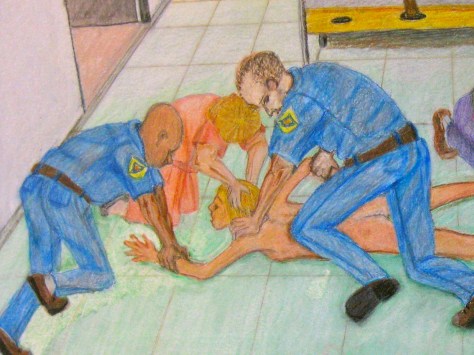
I am reposting the next one, a very painful if a not very skilled drawing, because I made some changes. I put a very mean smirk on the face of the woman in the front, who is meant to be facing us and pointing over her shoulder, though it was hard to get this in, given how little space I’d left myself… Also, I wanted to change the face of the man kneeling on me, and strength the look of the grip of the hands on me. If you compare the old version to this one, you will also note that I am purely naked here where as in the other, I have underpants on. This is the accurate one, but I didn’t understand that at the time I started the drawing. Alas, or perhaps this is good, I am rapidly recalling things I had not for two years about my experience at Middlesex. At least I remember stuff that happened BEFORE April 28th. For the other two restraints incidents, I still have no recall whatsoever or what I suspect is mostly confabulation drawn from what I read in my chart, though of course I cannot be certain. In any event, what I am remembering is not good at all, and I cry a lot…it is very difficult, and I feel so very very alone, because NO ONE understands and can talk to me, or more to the point can even stand to listen to me talk or cry about it. But it is difficult even to keep it under wraps all the time. If you have survived trauma, I think you know how it is. And that is why I avoid people when I think I cannot be “good enough company.” I don’t want to bring my friends down, but I cannot control the tears and shakes when they start…But the picture forthwith. Although it is disturbing as is, be aware that in the real incident, there was a great deal more violence, and more guards and staff members involved…these are just a paltry few. I simply didn’t know how to draw a crowd or a crowded room yet!

This is the incident before they used 4 point restraints on me that I so obsessively describe in Wagblog…Of course I take some poetic license with drawing the bed there and at the ready, as it was not there or ready or even in that room and I was quite calm and certainly no danger to anyone by the time they decided to punish me 
Takedown on N-7 Prone Restraint Detail: Me, naked — and this is a hospital?

This next picture I did as an attempt to express the guilt and shame I feel over having been traumatized at all. But I do not think I succeeded at all. Why? Because it became too intellectualized, with symbols like the Scarlet A and the guilt-crucifix, and even the hands wringing in shame, rather than pure expression…I want to do it over again if I get inspired to do so.

Shame Guilt and Ghosts is my attempt to portray my feelings of guilt at even having felt traumatized by so small an injury…but this doesn’t do it successfully, not so it seems to me at any rate.

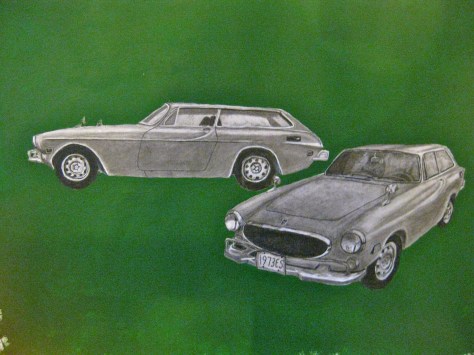
The next three drawings were just “fun” or for practice ones. The first two are presents for Tim, simply because he likes cars and is so wonderful to me. The third was an exercise in drawing two people together, and was copied from an “old master”, the name of  whom I simply cannot recall at the moment. It might have been — nope I don’t dare guess! I would have to get up and search for the book, and I ain’t gonna do that at the moment — too danged lazy. Anyhow, here are 1) two  1973 Volvo Sportswagon ES 1800 2) jaguar XJS and 3) the sketch taken from the old master’s painting.

1973 Volvo ES 1800 with British Racing Green “colour” in the background to represent the color of Tim’s car.

My third car drawing for Tim, a Jaguar XJS (I forget the date but I believe it is the mid 80s (if I am not mistaken).
Herr Goose after revisitation for repairs…Click on the photo to make a close up and you will notice neck “feathers and the difference it makes with old fully decorated version.
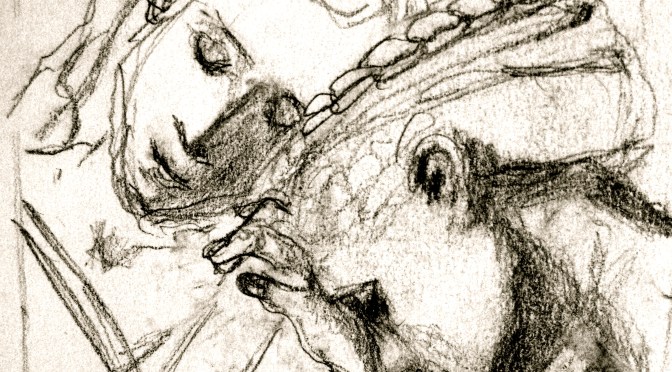
I sketched this detail from an old master’s painting found in an art book. Wanted to capture the two women together, and the angle of their heads (I actually didn’t do a very good job but there you are!)

____________________________________

NOTE: As I wrote this, “dream” talk, that is to say, nonsensical writings seemed to keep appearing in the middle of what I wrote. I seemed to find myself in another world every few minutes. I would write about that world, then “come to” and start writing about the subject below again as if nothing had happened. But when I reread the paragraph it made no earthly sense whatsoever, being an amalgam of two entirely different trains of thought. So a caveat: if some of what follows devolves into gibberish at any time, forgive me, and be patient. You can email me to alert me, if you wish, that would help. But otherwise, know that I will eventually come back more able to proofread and catch such idiocies…and fix them. For now though, you are on your own.  (The reason for these  brain blips, I think, may be, but may not, the  fact that I took a very small amount of Zyprexa today in order to be able to read and concentrate. 2.5 mg 2X a week should not make me gain weight, according to Dr C, But we thought it might do some good, without doing the usual harm. So I agreed to try it out once more, just at the minimal level as a PRN. Well, I find that I am very sleepy, have been ever since I took the pill, except for when I took a walk and for about 1/2 hour afterwards…and I do think that I slip into dreamworld while awake, and literally dream while writing this. Hence the gibberish.

*********

I have put the statement I read to the CEO and various administrators etc of Middlesex hospital on Youtube if anyone is interested in hearing it read outloud. Do a search for “Psychiatric restraints and seclusion abuse” and you should be able to find it if this link doesn’t work:  http://www.youtube.com/watch?v=vhZybDwMbzA  (I realize that I read it without much feeling, but it is hard to do so accurately and also look up at camera, and read without losing my place. Anyhow, it might be worthwhile to check it out.

The newest sorta development in the “case” this week was that a lawyer from the hospital, or someone who told my advocate he was a Middlesex Hospital lawyer, asked Wiley R (who is behind me 100%) “what does Pam want, what can we do to have her drop the complaint or withdraw her complaint to the DOJ and Joint Commission?”

Now everyone I told this to almost to a one, and immediately said this meant, “We are willing to pay handsomely in order to buy a gag order from her” I had trouble digesting such crassness, but to a one, those to whom I related the words of this inquiry told me the lawyer was insinuating something about paying me off. I mean: money. I felt slimed, completely slimed. For a few days this was the sole topic of my conversation, but to make a long story short, after I had decided to ask for several sessions with the hospital psych unit staff, educational sessions with me, to teach them how better to deal with patients, and have them experience forced restraints themselves…and so forth, my brother and I met with WR my advocate from the Protection and Advocacy (for persons with disabilities and mental illness) Office, and he informed us that the lawyer really was offering nothing, not even an official apology. Clearly, if so, then my real desire, to do hands on, face to face work with the staff that had so tortured me, was going to be out of the question, utterly forbidden. So we just decided in practically the same words, to let them “swing” in the wind.

In point of fact, when WR said that the DOJ might bring them up “on charges” if it was warranted, I asked him why I didn’t do that myself. He looked at me, and then narrowed his vision looking at a point beyond me. “Hmm, let me ask around and I’ll see what we can do.” I hastened to assure him that it wasn’t malpractice I was after. I knew that I had no real case, even if the statute of limitations hadn’t just run out a week or a few weeks ago. After all, what lawyer is going to take me on  one a contingency basis, and what jury would find for me in any event, seeing as how I did not die in their “care” nor suffer “grievous BODILY injury” which of course is all that counts…as usual. I am not sure what sort of case I would have in any sense of the word now at all…But as I told him, that is in his hands, and certainly is his bailiwick  (and if not his than that of  my lawyer-friend, Sharon Pope’s. If there are other “cases” to be made of any sort, I am more than game, I am ready and on alert to go and do whatever is needed in the pursuit of justice and reform of the Middlesex Hospital psychiatric system. It was really shameful, and despite the Public Health Department’s so called investigation, it was such a shameful joke, that despite WR’s impassioned plea to investigate MY case, and the psych unit in particular, they did no such thing. All they did was go back to spring 2011 (ie looked at the records of the entire hospital, or one of two representative records from most of the units, except for Psych so far as I could determine…) and do a random case study to look for general evidence of irregularities. Sure, they found some, and one case even involved the ER use of unnecessary or at least excessive use of restraints in a dually diagnosed young man…

But NOTHING was even looked at that had anything to do with what they did to me, or even the psych unit in particular. NOTHING was specific to my complaint, so I don’t know how they expected this  evaluation to give them any sort of reasonable results. They may or may not have censured or sanctioned the hospital. I did not read the entire huge file of support the bill got over the years. But I got the drift and the worst punishment meted out for repeated violations seemed to me to be a whipping on the wrist with a flimp ramen. Period.

Yet I was punished by the psych unit staff time and time again.

I know, I know! I was loud, I was angry, I was impossible to “handle” — I know this. Partly this was par for the course for a Lyme disease flare up for me. But I think Lyme wasn’t all of it. Why else was I so irascible (aside from them giving me Abilify without the requisite Geodon…) if not in response to perceived and real threats from them? I am not generally irritable and snappy at Natchaug, and never was at Hartford Hospital in the 80s and 90s. ONLY at hospitals where the standards of care are coercion and control and abuse is the name of the game do I react with anger and hostility…I wonder why.

More to tell, more to say, but as I wrote in the first paragraph above, sleep is overwhelming my desire to do just about anything. I will try to get back to this asap.

Different kind of artwork for me: Car Picture for Tim

Okay, this is for the boys!

1956 Mercedes Benz 300c 4-door sedan: What can I say, except Tim owns one and it is truly a cool car, if you care about cars! Anyhow it is my very first car drawing, so I am rawther proud of it.

_____________________________________________________

Some sad news that I only feel able to share now, is that  I had to put my beloved cat of 17 years to sleep on Friday last…and it was truly awful. I didn’t understand that it would be so fast. The vet injected something in Eemie’s vein, and she lifted her head as if in curiosity — then put it down — I asked how long it would take, and the vet said softly, “She’s gone…” I burst into tears, having had no understanding that in fact she wasn’t curious, she had been taking her long last breath. Oh god, I miss her so. I keep wondering where she is when I get up in the morning, and when I get home from wherever I have gone out to, I feel that someone is missing, that I need to feed her, and find her… and then I realize I don’t have a companion any longer, that Eemie is no longer…I am tearful even as I write this, and I wish I could post the video that a friend made of us a week or two before she became seriously disabled. She was ill, yes, but you couldn’t really tell on the video since we just cuddle. I am so glad that the friend had the foresight to encourage it. Because now I have that to remember Eemie by. I know it wouldn’t mean much to anyone else. But like any doting grieving mother, I would post it because I still feel the grief and feel somehow that everyone else would want to see it too. (Which of course would be silly but the grieving do silly things. I know that.)

To lose Eemie on top of my father, Leo, and Joe too just exactly one year ago April 27th feels like really too many losses piled on top of one another. But one gets through or breaks and I cannot let that happen. I do believe that I am strong enough in general to get through it, and while I did take Haldol for a few days it had more to do with the Middlesex stress (yes, a little to do with Eemie I admit) than anything else…Okay, it did have to do with Eemie, but I think without Middlesex coming up I might have weathered Eemie better.

But I got through it and I stopped taking Haldol on Monday, haven’t needed it since then, or have slogged through without it. Did the car picture since then, so things could not have been too too bad. Artwork is always good therapy anyway. Better than drugs if I can get myself out of bed and organized enough to do it.

By the way, my art show is up and on exhibit at the WETHERSFIELD LIBRARY right now. I have work on three walls, plus the display case, for those of you who live near enough to Wethersfield or Hartford to stop by and see it. If not, you can always check out Photobucket and see what is there, though you lose a great deal by not seeing things “in person” of course. It cannot be helped, naturally!

Enough for now. I hope last night’s post was not too negative, not too mean-spirited and revengeful. I was very angry, and very upset. The very idea that the director of the Middlesex Hospital psychiatric unit said anything at all, rather than simply remaining silence just incensed me. I think that was a grave mistake, and he likely regretted it afterwards. I suspect that the CEO probably told him that it was not something he should have indulged in…But what he said is said, and it only retraumatized me if anything. The notion that he, who wasn’t even there during the episode, and ought to have been appalled, simply took the side of my torturers was to me itself disgusting and appalling. But he will get his comeuppance, one can only hope, and I won’t have to do anything about it, since presumably the Joint Commission and the DOJ will do it all.

Enough of that. I am really tired and need to eat something. Ta ta for now.

Useless Psychiatric Mediation and a Poem

(Before I write this blog entry, I want to send this message:To certain people from Middlesex Hospital who read this and are following developments in my case against you please be aware that I know who you are and I am watching you. You do not and will not get away with what you did nor with what you are doing now.)

That said, let me tell all the others of you out there what happened at the mediation- meeting-that- wasn’t, this morning at Middlesex Hospital.

As you know, I have been wanting this meeting for a long time, but when I got there not only did I discover that they were playing the game of “Oh, I had no idea that you wanted a mediation meeting, I didn’t know what this meeting was about at all…” but that the CEO had actually cancelled on last Friday the people that he had arranged to meet with me.  So in fact the only people who came were administrators, not anyone who had treated or dealt with me on the unit itself, except the doctor who saw me for the last 11 days of my 6 week stay. He may have been the director of the unit, but he was hardly the main doctor I saw, despite what he claimed.

Anyhow, the meeting was extremely  — well, first of all, it was largely a waste of time, because NOTHING was said of interest to me. Except that Dr Grillo, the unit director, after I read what follows, actually had the gall to claim that restraints were  entirely appropriate…He said nothing whatsoever about what they did to me. OTOH, I can understand why. After all, he had already been told that we were writing the Department of Justice and the Joint Commission regarding his unit, so he must have felt supremely threatened. Naturally he could not have admitted wrong- doing. Not that any god, excuse me, doctor that I have ever met has ever admitted doing anything wrong or ever apologized. God forbid, a doctor apologize! No, that would be too hard and too demeaning for them to ever do.  Better that they go along and permit torture and abuse than that they admit that there was wrong done to a patient on their watch, much less that they personally even made so small a thing as a leetle eensy meestake…

Well, I know what they did to me and I know it was abusive and wrong, and so far, except for Dr Grillo and that lot, NO ONE I have ever met outside of Middlesex Hospital has ever ever agreed with him and said, Yes, in fact the use of restraints was proper and necessary, and they were right to do what they did to you.

So take that, you watchers from MH. I hope you tremble in your boots for torturing me so. Because you never apologized, and wouldn’t’ meet with me to talk about it, it serves you right whatever happens now. I came down there today , and it took all the courage I   could summon up to do so. I came down there, after two nights without sleep, just to meet with you and talk about what happened on April 28, 2012. But you couldn’t be bothered to deal with me, and so now you will deal with the DOJ and JCAHO. And too bad for you if that means that heads roll and some of you lose your gd jobs. I do not care any more. I tried, I tried to reconcile and talk with you about it, but you didn’t have the courage to do so, you wouldn’t deal with me, and so now you can deal with the powerful ones, and not me. Now I don’t give a damn what happens to you.

Meanwhile, this is what I was going to read to all of you, and what I did read to the hospital CEO and the administrative personnel, and what the advocates are sending along with the letter to the DOJ and JCAHO.

STATEMENT TO N-7 TREATMENT TEAM & CEO OF MIDDLESEX HOSPITAL et al.

Although I have a longer statement, I first want to read you a poem that I wrote about my experience here. It is only half a page long, but like any decent poem, it says a great deal in few words. The expression “Long pig” means a human being intended for eating.

TO MY PROTECTORS

I came to you fractured,

splintered to syllables,

all-fired to incinerate

the house of my body

where the devil lived.

But I was not nice,

not nice, not nice, no,

I was not nice enough

for balm and kindness,

or to win back my art

or my writing supplies,

so I upended a trashcan

on top of my head

and uniforms nailed

me, naked X, to a bed.

It gouged my brain.

Freight train. Tank.

Two years: still blank.

Nurses, doctors,

thieves: you knew, you

knew. You made of me

pulled pork, long pig

X-posed and pinioned,

not quite a specimen

for your knew the subject

and your objective  :

your satisfaction showed

as you struggled to hide

your smiles.

I was admitted to North-7 in extremis: confused, psychotic, and traumatized. Exquisitely vulnerable, my sole comforts were doing art and writing. These were also my strengths. Yet instead of using these to help me, you consistently employed them against me–withholding supplies as punishment when you felt I was not behaving nicely and worse, using loss of them as a stick when they were most needed. The first time this happened was on April 9th, nine days after I had been admitted. I had been using glue sticks freely to make a large collage for several days. Angry at me for yelling at her, one of the senior nurses whom I won’t name, decided to withhold them. She would no longer give them to me until, as she put it, “the team puts them on your treatment plan.” This frankly felt like such gratuitous punishment, and so unnecessary, not to mention counterproductive, that I could see nothing in it but petty revenge. Nevertheless, not myself and not in control, I screamed, “Fuck you!” and ran to my room. Luckily, Christobelle from OT, the one person who consistently treated me not only with understanding and kindness but with respect and dignity as well, came in shortly thereafter carrying two gluesticks. I do not know whether she knew of these new restrictions or not, but I was grateful.

On another later occasion, I had been using my soft felt-tipped markers, which my old treatment plan permitted me until 10pm. That treatment plan had been changed, however, and the new, more relaxed one said nothing about markers, so it seemed to me that I was now allowed markers in my room just like anyone else. However, around 10pm, someone called Bob came in demanding them. He threatened that if he had to ask, quote, “a 3rd time you’re in for trouble.” My pulse ratcheted upward. Uh, oh, uh oh. Why was he doing this? Was he deliberately baiting me, trying to pick a fight? He could so easily have discussed my understanding of the new plan. It wouldn’t have been so hard to figure out a compromise. After all, they were just Crayolas, not carbon steel knives. I was sick of the power plays, and sick of the way staff just wanted to control me instead of talk to me and of how they insisted on domination at all costs. Well, this time I was not going to give up without a fight, and it seemed that a fight was what Bob was itching for. Instead of negotiation and attempting to find a compromise, Bob reached out to grab me, which I construed as an assault. I screeched, “Don’t touch me!” Someone else grabbed me from behind. I kicked and punched. Someone told me later it was Ruth I kicked. In my journal I wrote this: “she was furious enough to lie and scream that I caused an uproar ‘every single night and I’m sick to death of it!’…”

I fought them then, clawing and screaming, trying in vain to resist, my body flailing as the chart itself notes, my heart hammering. Why were they doing this to me over a few markers?! I wanted to scream. Why were they being such bullies? They were hurting me! But of course there were several of them against the one of me and they were much stronger than I at 102 pounds so naturally they overpowered me. They literally dragged me to the so-called time-out room and dumped me on the floor, ordering me to calm down. Then they closed the door. No they didn’t lock it, but they kept me from leaving by leaning against the door.

You know, I don’t know why you bothered calling it a time-out room. No one could use it at will. And when you put me there, I didn’t ask to go – I was forcibly dragged there — and I didn’t want to stay: you kept me there by force so it was the same thing as seclusion, literally and legally. Time-outs have to be voluntary, you have to be able to come and go if and when you want to. When it is forced, it is by definition a seclusion. Period. That cold barren room was not a time-out room. Who did you think you were you kidding?

And listen, did it never occur to you that it was always your treatment of me that generated my behavior, yes, the negative behaviors as well as when I was in control? You could have found out what was going on by talking with me. Instead, you decided to dismiss everything I said and did as manipulative and acting out so you didn’t need to listen to me. Perhaps you thought this disregard was kept secret from me, but I knew it   at the time and it caused me enormous anguish. All I wanted was to be treated like a human being. All I wanted was to talk to someone and be listened to. But all you did was make assumptions. You never checked them out with me to find out if they were true and they almost never were. Assume makes an ass out of U and me…But mostly it does terrible damage when the assumptions are wrong. I was so afraid, I was so terribly afraid, but you never knew the half of it. All you did was to dehumanize me, ignore my pain and order me to shut up and be quiet. I know I was difficult for you to quote unquote “handle.” Hell, I was difficult for ME to handle. But I do not have a personality disorder. Ask anyone who knows me. Ask my family. Ask the psychiatrist who saw me from 2000 until 2009, ask the psychiatrist I see now. But you decided that you could detect borderline traits (somehow transmogrified into the full-blown disorder upon discharge…) despite the presence of an active psychosis. By decreeing that I had such a disorder, you put me in an utterly untenable position, because then you had a justification, so you thought, for taking nothing I said at face value. To me it felt like nothing less than soul murder and I will tell you that this particular form of soul murder makes a person want to die. It makes a person want to bash their brains out in public just to get someone to acknowledge them and take them seriously.

April 28.. April 28, 2010. You wrote in my chart your interpretations of my behavior that day and of what happened. Yes, your nursing and physician notes were supposed to be objective but dispassionate as they may have attempted to sound, all observation is but interpretation. I repeat: All observation is interpretation. Now I want you to know what happened from my point of view. (I know that some of you have been snooping around, reading my blog just as you did during my hospital stay, but you will have to sit through this anyway…)

At around 7:30pm, so the evening nurse reported in my chart, I “walked into the dayroom” and if one can believe this, without any provocation I “began shoving and turning over chairs. I then, quote, “picked up the patient trash can and put it over my head.” Staff ordered me to what they called the “time-out room.” Nursing notes report that I refused and, I quote, “went to bed instead.” Because I had not followed her direct order, the nurse wrote that “security was called and patient required security to carry her to time-out room as she refused to move or walk.” No, I simply lay on my bed, mute, trembling with terror when the phalanx of guards roared in.

Despite my lack of resistance, the guards physically took hold of me – unconcerned apparently with my known history of rape and of recent trauma — and took me from my bed where I was calming myself in the least restrictive environment. They physically carried me to the seclusion room and together with staff they forcibly prevented me from leaving.

This is what I wrote in my journal: “It was (freezing in that room) and they wouldn’t give me a blanket so I didn’t stay long…This only led to more goons pushing me back… this time strong-arming me and forcing me to a seated position on the mattress before quickly leaving but not locking the door.”

The nurse wrote this: “Patient refused to stay in time-out room… Patient attempted to shove staff, kicked at staff to get out of room. Patient was instructed several times to sit on mattress and stop pushing at and kicking staff. Patient refused. Seclusion door locked at 7:55pm.”

At this point both records state that I stripped off all my clothing. But the official records record only that fact, and that I then “was changed into hospital garb” and that I immediately stripped these off too. In my journal I wrote something else in addition that is rather revealing: Left alone in that room, I decided, and I quote, “they’d have to give me a blanket if I was [naked] so I quickly undressed and just hid under the mattress for warmth. This caused a stir for some reason and I was forced to put on hospital pj’s and lie down on the mattress. This would not do, not without a blanket which they continued to refuse me.” So once again I took them off and got up and tried to push through the woman barring the [temporarily] unlocked door. She called for reinforcements and they came. In fact, they came en masse.

“At this point” my journal continues, “they again subdued me and told/asked me why I was fighting. I said [it was] because I needed someone to talk to. That was all I wanted, just someone to talk to. One guard seemed taken aback. All these personnel hours wasted when all I wanted was a half hour of one person’s time? It seemed to strike him as ludicrous as it did me….

“Why don’t you just ask to use this room when you feel anxious or upset?” he then asked me.

“I do, I have!” I replied

“Well?

“They always say it has to be reserved for an emergency.”

He seemed completely flummoxed by that reasoning but there was no arguing with Policy so he fell quiet. Finally they decided to leave, telling me to be quiet and lie down.

I did. I did. But I was cold and I begged for a blanket.

“Sorry, it is too dangerous. You will have to sleep without one.””

Why was it so dangerous when I was on one to one and had an observer at all times? It made no sense. And why wouldn’t they just give me a sweatshirt and socks then? Or turn up the heat. How did they expect me to sleep, I was too cold!”

But this last categorical refusal was just too much. No, no blanket, no nothing. Just shut up and freeze. “That was it, I’d had enough! I dashed at them head-first and they parted, only to grab my arms and try to stop me. Someone twisted my right arm and held it behind my back, but I knew how to get him to stop it, so I tried to bite him and he briefly loosened his grip. I twisted my own arm back to me and my left pinky, held, closed tightly onto something, hooked so tightly it wouldn’t budge. My legs, the right one, grabbed the thin leg of a woman behind me, making her lean back off-balance and lose her grip on me. Then I switched to holding both my legs in a death grip around the legs in front of me. It didn’t matter one iota that [I had taken off my clothes again to get a blanket and] was naked…Anyhow, they eventually overpowered me.”

As one guard shoved me onto my stomach on the hard floor, his knee in my back, he muttered in my ear, “You bite me, I’ll teach you a lesson you won’t forget!” Then he mashed my cheek hard against the dirty linoleum till I was breathing dust.

I knew he was capable of hurting me, they all were. I also knew that people can die during prone restraint as the Hartford Courant and others have documented. Adrenalin flooded me, my pulse threatened to rocket out of control but I knew I had to calm down. Very deliberately, I forced myself to lie still, barely breathing.

Fortunately, when I stopped resisting, they released me and let me sit up. Someone gave me a sheet to cover me. The room cleared, except for a tech who was on 1:1 with me. She apparently was now allowed to talk with me, and for this I was supremely grateful. We conversed calmly. The door to the seclusion room had been left open, a big relief.

However, people were still talking in low voices outside the door. I heard someone trot down the hall, heard the open-and-shut of a cabinet door. I asked my 1:1 what was going on. “Don’t worry. They are just getting you some meds or making up a bed for you.”

“A bed?” I said. That gave me a bad feeling…Then I understood what was going on.  “Uh, uh. They can’t put me in restraints, I am calm and it is illegal to restrain someone who is not a danger to self or others. You know that.” I repeated it loudly, loud enough so the other staff could hear me. I began to tremble, but forced myself to remain as composed as I could, mustering all the arguments I could against the use of restraints. A nurse entered the room then and asked me to come down the hall. Did I need an escort or could I walk there by myself. “Oh I can walk by myself. But you can’t put me in restraints, I am calm.” I was barely able to speak. I felt dizzy and short of breath but I tried desperately not to show it because I was afraid that if she knew how terrified and upset I was that it would actually give them justification. Nevertheless, I followed her to the empty room — my heart went cold, I could feel urine leak — I felt like “dead man walking” when I saw that in fact they had fastened four-point restraints to the bed.

I entered the room filled with staff members and guards. I told them over and over that I was calm and willing to take PRN meds. I said I knew they were punishing me and that they knew it too. No one contradicted me. The nurse in charge ordered me to lie down on the bed. I protested. She threatened that if I didn’t “they would assist me.” I was terrified of another assault. In fact I was so terrified just of the physiological consequences of fear itself – the flood of adrenalin and painful tachycardia — that I made myself get it over with. I lay down on the bed. Gritting my teeth, I said nothing even when they pushed aside most of the sheet that covered me.

I meant to remain silent. I meant to remain completely still in order to shame them. But when they pulled my wrists right over the edges of the bed, shackling them painfully below the level of the mattress, and spread- eagled my ankles to the corners of the bed, I broke that silence and objected — vociferously. I was appalled at their barbarity but my protests did nothing. I fell silent and let them do what they wanted. Finally satisfied, they trooped out, some of them actually smiling, leaving me alone in the room. I fell asleep quickly, a narcoleptic stress reaction. Nevertheless, no one returned for an hour. They extracted a pledge of obedience from me before taking off the shackles.

“When they released me,” I wrote in my journal, “my back hurt so badly I could barely walk and…my scapula muscles felt as if they had been separated. ‘I plan to sue you for doing this to me.’ I said as calmly as I could as I left the room. Nobody reacted.”  As I wrote in my journal the next morning, “I woke in severe pain, the muscles in my chest felt torn from those that connect it to the shoulder… the pain went clear through to the scapula.”

That was not the end of it. Once you treat a human being in such a fashion, all bets are off as to how she behaves from then on. I no longer cared what you did to me after that. When you threatened me with restraints a few days later, I dared you to do it. I egged you on and so you did. My capitulation showed subsequently when I stripped naked multiple times, even voided on the seclusion room floor and smeared urine on the walls. You reduced me to an animal. I hope you were pleased with the results.

From what I witnessed, many of you — on the nursing staff at any rate– took no pleasure in your jobs. You apparently didn’t want to work in psychiatry, and wanted nothing more than peace and quiet and an easy day’s work. When one of you actually screamed at me, after that staff assault occasioned because I didn’t hand in my crayons on time, that you were “sick and tired” of listening to me every night, that was stupid and nonsensical. How can any hospitalized psychiatric patient be expected to worry about what makes a nurse comfortable?  By rights it should be the other way around.

I think what it comes down to at the North-7 secure unit is that you expected patients to meet your needs and make you happy and you tried to force us to. In my case, and in at least one other patient’s that I witnessed, you even tried to physically assault us into doing so. But what a farce. Patients in the outer unit warned me to get out of there; they told my friends they were worried staff would hurt me. They were right. By the time I was discharged, I had almost no memory of what had happened over the previous 6 weeks. It is only in the last couple of months that anything has returned to me. Yet every single day since my discharge, when I least expect it, something triggers a thought or bodily memory of my stay here and instantaneously my heart starts hammering, I get dizzy because I can’t breathe, and I tremble and cry just thinking about it because I’m right back in that seclusion room and April 28th is happening all over again…

Now, I don’t expect to recognize any of you. How could I? I still don’t remember much except those episodes I wrote about, and some little snippets here and there. I am told that some of you will be nursing staff on N-7 and some my so-called treatment team. Well, if you were my treatment team and you just turned a blind eye to what went on, for that you are just as guilty as if you accomplished the acts yourselves. Of course, the worst of it mostly took place in the evenings, in relative secrecy and when few were around. But if you knew it was happening nonetheless and If you approved, well, then, I have nothing to say except shame on all of you.

I felt helpless and utterly alone. Frightened beyond belief. No one defended me, no one helped me or came to my rescue. No one except Christobelle Payne. Christobelle treated me with compassion and kindness. She always made sure that I had gluestix and magazines for my artwork, even when your every impulse was to withhold them as punishment. I cannot tell her how grateful I was and how grateful I remain to her for treating me so humanely. I have never forgotten the oasis of kindness she provided in your North-7 desert.

Apparently no one else on the unit understood how to behave humanely or to treat patients with respect, or no one else gave a damn.

Punishment is the nature of what you did to me. You lost your tempers and you punished me.  The result was that you permanently damaged and traumatized me. I believe you did what you did absolutely on purpose and I believe you did not care what the consequences would be to me.

Some of you deserve to lose your jobs because of it and because of what I’d venture to guess you have been doing for a long time to other patients.  Perhaps you will. You all need to be thoroughly retrained, if that is even possible. Certainly the secure side of the unit needs to be completely reorganized and re-staffed. But that is not my job. You’ll find out what will happen after the Department of Justice and the Joint Commission do their thing.

I hope you remember me and what you did to me for a very long time. Unfortunately, I know I may never be able to forget you. I wish I could, believe me, I wish I could.


Newest Artwork — Palimpsest: Sister Lillian

Those of you who are familiar with my “older”works (meaning the ones I did in 2009 when I first started painting) might recognize the earlier piece, more recently uploaded, called Woman with Earring, or Sister Soulidad. Well, this painting is a palimpsest of that one, a palimpsest being simply a painting over another painting. You can see hints of the old one underneath this one, indeed, as the earrings are the same, as is the necklace and even the lips. Even though the rest of the face is much changed, nevertheless there are definitely echoes of Sister Soulidad in her.

New Artwork on Display Soon

This piece and many others will be on exhibit at the Wethersfield, Connecticut public library from May 1- June 30, 2012. Another new small sculpture below will be in the display case, along with The African Queen of Paranoia, which may be seen if you do a search for it on this blog site or go to my photobucket artwork site, and small jewelry or pill boxes I made with reproductions of my artwork on the tops.

I made this bird because I wanted simply to make a hummingbird. But after I did so, it reminded me of the poem “Of Mere Being” by Wallace Stevens.

Of Mere Being

by Wallace Stevens

The palm at the end of the mind,
Beyond the last thought, rises
In the bronze decor.

A gold-feathered bird
Sings in the palm, without human meaning,
Without human feeling, a foreign song.

You know then that it is not the reason
That makes us happy or unhappy.
The bird sings. Its feathers shine.

The palm stands on the edge of space.
The wind moves slowly in the branches.
The bird’s fire-fangled feathers dangle down.

Speaking of Wallace Stevens, here is a poem I wrote that one of  Stevens’ lines inspired. It will be in my next book, LEARNING TO SEE IN THREE DIMENSIONS (saison d’enfers means “season of hell”)

THE SONG OF THE ANT

by Pamela Spiro Wagner

“For the listener, who listens in the snow…”
Wallace Stevens

In those days I was always cold
as I had been a long time, mindful of winter
even at the solstice of my high summer days

always, always the crumb and crust of loss
and near-loss of everything held dear
before the saison d’enfers and the ice to come

But there was the wind
There was still the wind making music,
and I, at one with the quirky stir of air

bowing the suppliant trees
bowing the branches of those trees for the sound
of songs held long in their wood

Changes change us: rings of birth, death, another season
and we hold on for nothing and no reason
but to sing.

It is too late to write much and I am much too tired, but suffice it to say that I am overwhelmed with sadness for, well, my father, my dying cat, and the stress of a face to face mediation that has been scheduled between me and the people who tortured me at that certain hospital about which I am always writing. You would think I would be happy to be getting somewhere but no, I feel only worn out and sad beyond belief. I wish I could look forward to it, somehow. But I just feel guilty, because I did not do anything to prevent their abuse. I should have refused to lie down on that restraint bed! I should not have gone like a lamb to the slaughter just because I was afraid…I should have just stood there and made them carry me over. Not fought or resisted just done passive non-violence…I feel so slimed that I actually went to that bed and lay down on it, naked (covered with part of a sheet, that they moved away to restrain my limbs so cruelly as to cause me exquisite physical pain…) I feel so guilty and so terribly sad. WHy didn’t I resist? Why did I do what they said to? I had always resisted up until then? Why did I let the fear of their assaulting me again get the better of me?! I cannot forget that, I cannot forgive MYSELF for it. I feel more degraded by that than by almost anything… I feel dirty and scummy and like a disgusting piece of garbage…


Shock Treatment/ ECT – Therapy or Torture?

Freud and an angry God, hmm, I mean Doctor, electro-shocking a poor ant. Drawing by Pamela Spiro Wagner, 2012 (all rights reserved)

Although most of this post was written and posted back in 2011, I have both edited it and written an addendum, especially for the students in Holly C’s course, with whom I will be doing a Skype class on Monday. If others do not want to reread the post and wish to skip to the end where I have placed the addendum, feel free.

First though, please be aware that descriptions and names of places and so forth have been changed back to their originals except for the names of some people involved, such as my doctors. Those names are somewhat similar, but still disguised. In Divided Minds, we were forced by the publishers to completely disguise everyone, including their physical descriptions, and to make amalgams in some cases, taking two doctors and blending them into one. In Blacklight, by contrast, I am determined that my descriptions of people, previously altered in order to “protect them,” will be honest and forthright,  rewritten so that while their names may be changed, their descriptions are as aboveboard as memory makes possible. After all, I write nothing but the truth as I remember it. I wrote a fair amount in my journals at the time and I referred back to my notes there in writing this. What is more, I intend no libel  and in fact, I want only to be  fair and to bend over backwards in giving as much credit as possible where it is due.

The Ogre Has ECT: 2004

I am delivered like a piece of mail to the Hospital of St Raphael’s, on a stretcher, bound up in brown wool blankets like a padded envelope. It’s the only way the ambulance will transfer me between Norwalk Hospital and this one. The attendants disgorge me into a single room where de-cocooned, I climb down and sit on the bed. All my bags have been left at the nurses’ station for searching; this is standard procedure but I hope they don’t confiscate too much. An aide follows me in to take my BP and pulse, and bustles out, telling me someone will be back shortly. I sit quietly for a half an hour, listening to the constant complaint of the voices, which never leave me, sometimes entertaining me, most of the time ranting and carping and demanding. A thin, 30-something woman with curly blonde hair, rimless glasses and residual acne scars that give her a kind of “I’ve suffered too” look of understanding, knocks on the door-frame..

“May I come in?” she asks politely.

“I can’t stop you.” My usual. Don’t want to seem too obliging or cooperative at first.

“Well, I do need to take a history, but I can come back when you’re feeling more disposed…”

“Nah, might as well get it over with.” Then, nicer, I explain, “I was just being ornery on principle.”

“What principle is that?”

“If you’re ornery they won’t see you sweat.”

“Aah…”

“And they won’t expect you to be medication-compliant right off the bat.” I shrug my shoulders but grin, I want to think, devilishly.

“I see you have a sense of humor.”

“You should see me…”

“I’m sure we all will. A sense of humor is very healthy. But it worries me that you already plan not to take your meds.”

“I’ll only refuse the antipsychotic. Look at the blimp it’s turned me into.” I haul my extra-large tee-shirt away from my chest to demonstrate. Fatso, Lardass! Someone snipes. She doesn’t know it but you really believe you’re thin. Ha ha, you’re a house! Look at yourself! LOOK at yourself! Ha ha ha ha! The voices are telling the truth: I know the number of pounds I weigh is high, outrageously high for me, having been thin all my life, but I haven’t lost my self-image as a skinny shrimp, so I can’t get used to being what others see. The voices love to remind me how fat I really am. Only the mirror, or better, a photograph, reminds me of the honest to god truth, and I avoid those. I avert my eyes, or search the concrete for fossils, when approaching a glass door. Anything not to be shocked by what I’ve become. Pig! Glutton! It seems they don’t want to stop tonight…

I realize suddenly that I’ve lost track of the conversation.

“I don’t think they’ll allow you to do that for long.”

“Do what?”

“Don’t you remember what we were talking about? Were your voices distracting you?”

“Just thoughts, you know, plus some added insults.”

“You’ll have to take all your meds eventually.”

“Then they’ll have to switch me to a different pill, even if it’s less effective.”

She sucks the top of her pen and looked down at her clipboard. “So,” she starts the formal intake. “What brings you here to St Raphael’s?”

The voices break in there, again, confusing me. When I can get my bearings I tell her what made me transfer from Norwalk Hospital and why I opted for shock treatments. She takes a closer look at the mark of Cain I’ve burned into my forehead, writes something, then corrects me.

“We like to refer to them as ECT here. ‘Shock treatments’ brings to mind  the terrible procedures of the past. These days you feel nothing, you just go to sleep and wake up gently. I know. I assist at the ECT clinic.

“Oh, I know, I know. I’ve had ECT before. I know what it’s like and it’s a snap. I asked for this transfer because I hope it will help again.”

We talk some more about why I’m here and what I’ve been through and the voices keep to a minimum so there’s not too much interference. She says she’s going to be my primary nurse and that she thinks we’ll work well together. I nod, thinking she’s pretty okay, for a nurse.

I’ve arrived after lunch, which is served at 11:30am so someone brings me a tray and I pick at it in my room. People come in and out of my room but only speak to me a second or two before they leave, a doctor does a cursory physical, someone takes me down the hall to weigh and measure me. I return to my room, too scared to do otherwise, constrained by the Rules of the voices. The first break in the afternoon is medications in the late afternoon, when someone tells me to line up in front of a little window near the nurse’s station. When it’s my turn, I look at the pills in my cup. Ugh, 20mg of Zyprexa, an increase, plus a host of other pills I can’t remember the names of. I hand the pill back to the med nurse. I’m not taking this, it makes me fat, I say. Give me Geodon. at least I don’t put on weight with Geodon.

“Sorry, Dr Kroeder has ordered this one. We can’t just go around changing doctor’s orders. You either take it or you refuse.”

I was in a quandary. I hadn’t even met the doctor and already I was fighting with her? Should I take it and argue with her later? But then I’ll eat my whole dinner tray and more. Better to start off with my principles intact, so she knows what I’ll take and what I won’t take. I hand the pill back. ”Sorry, I won’t take it.”

“If you decompensate further we will have to give you a shot, you know that, don’t you?”

“I’ll be fine.” I do a little dance step.

“Yeah, and look what you’ve done to your face. Come closer.”

Wondering what she wants, I lean in gingerly, fearing her touch, but she only takes a tongue depressor and smears some ointment on the big oozing sore.

“You’re done.Go eat some supper.”

At 4:30? That’s pretty early. I can’t cross the threshold of the dining room, the Rules the voices make forbid it. I cannot enter the milling crowd, suffering little electric shocks every time my body makes contact with another. Instead I retreat to my room. Sitting on the edge of my bed again, I wonder what to do. How can I get supper, or any meal, if the voices won’t let me go into the dining room?

Just then, the thin blonde nurse with the glasses, what’s her name, leans into my room. “Aren’t you hungry? There’s a tray for you waiting outside the dining room.”

“They made a rule I can’t eat with other people, and I can’t get in the dining room…So I can’t eat.” I read her name tag. “Prisca.”

She smiles and glances down at the tag on her chest.  ”Oh, just call me Prissy, everyone else does. I hate it, but what can you do? What are you talking about? There’s no such rule. For now, I guess I’ll let you eat in your room, but that  is against the rules and we’ll have to get you into the dining room eventually, whatever the voices tell you.

She brings in the tray: white bread with two slices of bologna and a slice of cheese tossed on top, a packet of mayonnaise, a small green salad in a separate bowl, with a plastic slip of French dressing, and a packaged Hostess brownie for dessert. I didn’t eat lunch, though they brought it in, so even this impoverished repast looks good to me and I eat everything, despite not having taking the hated Zyprexa. I curse myself for it, of course, and do some  leg lifts and crunches for exercise afterwards. Ever since I’ve been refusing the drug, I have lost weight. Now I am down to 155 lbs from 170 the last time I weighed myself and I intend to get much thinner, since I started at 95 before medications over the years slowly put weight on me.

After supper the voices start in again, louder and louder, telling me how fat I am, how disgusting and terrible I am. I notice the clock hanging on the wall, which ticks audibly punctuating each sentence. The voices were carping, now they are threatening, and demanding…Finally, their all too familiar sequence segues into telling me I’m the most evil thing, and they don’t say person, on the planet. I’m the Ogre that ate Manhattan, I’m Satan, I’m a mass murderer, I killed Kennedy and deserve to die, die, die!

I’m wearing a heavy pair of clogs with wooden soles and almost before I can think about it, I know what to do. I heave one up at the clock, hitting it dead center. It crashes to the floor. Scrambling to grab a shard of the clear plastic cover before the staff comes running in, I lunge towards where I saw the largest piece fall, one with a long jagged point. I have my hand closed around it when someone tackles me from behind. He’s not very big and I can feel him struggling to keep me pinned. I almost succeed in stabbing myself, but he manages to engulf my hand with his two and press them closed against the flat sides of the shard.

Other people  crowd into the room now and they pry the shard from me and grab my arms and legs so I’m completely immobilized. Then at a word murmured by one of the male aides who have materialized out of nowhere, they swing me up onto the bed, like pitching a sand bag onto a levee. I scream but they ignore me and strap my ankles and wrists into leather cuffs which have been rapidly attached to the bed frame: four point restraints.

I continue to scream and scream, but nobody pays attention. A nurse comes at me with a needle,  saying it is Haldol and Ativan and proceeds to inject me. Although I am still crying that I want to die, that I’m Satan, the Ogre that ate Manhattan, that I killed Kennedy, I’m the evil one, the room then empties, except for a heavy-set café-au-lait sitter, who hollers louder than I do that her name is Caledonia. She pulls up a chair in the doorway, pulls out a cosmetics bag and proceeds to do her nails in spite of me.

I am told by Prissy that I scream most of the evening and keep the whole unit awake until given a sleeping pill and another shot. All I remember is restless twilight sleep coming at last, broken when a short sandy-haired woman, dressed in a sweater set and skirt, comes in and takes my pulse. I’m groggy with medication but she speaks to me nonetheless.

“I’m , Dr Kroeder, your doctor. You’ve had a bad night I see. Well, perhaps tomorrow we’ll get a chance to talk.”

“Get me out of these things!” I mumble angrily. I can’t sleep like this!”

“”Not yet. You’re not ready. But try your best to sleep now. We’ll re-evaluate things in the morning.”

Then she turns and is gone.

As I get to know her, I will like Dr Kroeder for her kindness, toughness and honesty, but I will hate her too for opposite reasons and it will be a long time before I  know whether the liking or the hating or something else entirely wins out.

The first thing that makes me know ECT is going to be different at St Raphael’s than where I had it before is that we all have to get there on under own steam rather than travel in wheelchairs, the way I’ve known since childhood all hospital patients must travel. We walk there, all of us, down interminable corridors, around several corners, through doors to more of the same. In short by the time we get there I have no idea where we are.  I said it was a snap when I had it before, but now I feel like a prisoner going to the hangman, a “dead man walking.” Something about our going there in a group voluntarily, by choice and yet somehow not totally by choice, makes it feel like punishment, like having to cut your own switch, not a medical procedure at all. This sets my nerves on edge. When we finally get to the rooms clearly marked “ECT Suite,” instead of the doctor being ready for us, no time to anticipate or fear what is ahead, we have to wait and wait and wait. We’re told the outpatients have to be “finished up” first. My apprehension grows. I’m used to getting to the ECT rooms and immediately climbing up on the table and getting it over with. Waiting and having time to think about it brings me close to tears.

Finally four in-patients are to be taken. I think the nurse calling us in senses I am too anxious to wait any longer, for she makes sure I’m with the first group. I clamber up on the table, and see Dr Kroeder looking down at me, smiling. I notice how white her teeth are and the little gap in her shirt across her chest as she bends over me, strapping something over my forehead as Prissy puts a needle into the heplock already in my arm. I feel my arms and legs quickly cuffed down by others in the team, a mask clamps down over my face and I’m told to breathe, breathe in deeply and I breathe and breathe and a chasm in hell opens and the demons reach out and scream as I plummet past into a terrible inky blackness…

I wake up a second later and immediately vomit into a kidney basin hastily held out by a nurse. “Why didn’t you do it?” I cry out, confused. “Why didn’t you do it, why did you made me wait? I can’t go through this again!”

Strangely, Dr Kroeder has disappeared, and so have Prissy and the nurses that had surrounded me just an instant before. Instead a plump, baby-faced older nurse smiles as she takes away the kidney basin and says, kindly, “You’ve been sleeping  soundly for an hour. They did the treatment already and you’re waking up. How about trying to sit up now?” Slowly, I push myself to a sitting position and swing my legs over the edge of the table. No dizziness, no more nausea. I feel okay, except for a slight headache. So I slide off the table and ask where to go. Surely they won’t make me stay a long while this time. The nurse leads me to a wheelchair and asks an aide to take me back to the unit. Ah, a chair at last. At least I’m not expected to walk on my own after that ordeal.

ECT Takes place on Monday, Wednesday and Friday each week and though I vomit many times upon waking up, that is the least of it. What I dread most is the anesthesia, how I plunge from perfect alertness into the dark pit and feel like I wake a second later, sick and confused. I grow more and more afraid until, at the end of a series of 8 sessions, I refuse to go on to a second series. I thwart this by grabbing something to eat every morning, which is forbidden as you cannot have ECT if you have eaten or drunk anything within 12 hours of hte procedure. Because my symptoms are still severe and Caledonia comes to sit with me one to one more often than not, Dr Kroeder tries to persuade me, but I am adamant. I am not depressed (quite despite what she tries to convince me of). ECT hasn’t helped my obsessive intrusive thoughts/hallucinations this time so no more of it. No more! Then she threatens to have the next series court-ordered  and to add insult to injury, she says she will force me to take Zyprexa as well, the drug I so hate. I explode.

“What! You f—ing can’t do that! I’m a free citizen, I’m not a danger to myself or anyone else.”

“In fact, I can do it, and I am going to do it, whether you like it or not. You need more ECT and unfortunately you refuse the only drug that is effective for you. Pam, look, how can you say you’re not a danger to yourself? Look at your forehead! That’s not the mark of  I  it’s just self-mutilation. Look at where you carved that mark into your hand when we weren’t watching you carefully enough. Isn’t that danger enough?”

“But I’m NOT going to kill myself. I don’t want to die. I just want to be disfigured so no one will want to be around me and they’ll stay safe and uncontaminated.”

Dr Kroeder’s eyes suddenly glitter and she has to blink a couple of times. “Well, I’m not going to let you continue to do what you want. Period.”

She was standing at the foot of my bed, one foot on a lower rung, casually holding a clipboard. But she moves closer to me, standing to one side, the clipboard clasped business-like across her chest. Gazing intently at me, she shakes her head in what appears to be sadness.  I’m not sad, I know what I have to do. I don’t understand why she feels this is so terrible, but I know enough to remain quiet. Finally, she turns and quietly slips out of the room.

This alarms me; it shocks me. I know she means what she says. Worst of all, Dr O’Maloney, my outpatient psychiatrist, has signed off on it well, agreeing  it is the only thing left to do, that already I’ve been in the hospital two months and little has changed, that the situation is desperate. Their only problem is that to get a court order they have to get me a conservator who will agree to it. They want to appoint my twin sister and they discuss with her whether or not she’ll agree to forcing more ECT on me, in addition to Zyprexa. Despite fearing that I’ll hate her, she too is convinced there are no other options.

So Dr Kroeder wins and I endure eight more ECT sessions. Finally I’m discharged a month later, much improved, so everyone says. As a condition of my release, I promise that I’ll continue to take Zyprexa. Forced to, I do promise, even though my history clearly suggests that I will not.  I’m also supposed to return once every two weeks for maintenance ECT treatments and Dr Kroeder threatens me with a police escort if I don’t comply. But this time I thumb my nose at her. So, she’s going to get both the Hartford and the New Haven police involved? She thinks they are going to bother to arrest me just to drive me down to the hospital for ECT, something they themselves probably consider barbaric? J’en doute fort. I doubt that big time! In fact, after a call to the Legal Rights Project, I learn that any conservatorship was dissolved the moment I was discharged from St Raphael’ s and that the doctor has no power over me at all now, zilch. So I write Dr Kroeder a nice apologetic letter — sorry, doc, but no more of your ECT for me. Ever.

Several months later, hearing command hallucinations, I pour lighter fluid over my left leg and set it on fire. So much for the restorative powers of shock torture, excuse me, electro- convulsive therapy.

————————————————————————

Addendum: not part of Blacklight

ECT in 2003 (after DIVIDED MINDS ends)

The first time I had ECT was in 2003 at John Dempsey Hospital, which is connected to the University of Connecticut’s medical school. There, in desperation, because of an “obsession” — and I say that advisedly, because I was not so much obsessed as consumed — with the face  that I saw in the biohazard sign (which we  called the biohazmat man in DIVIDED MINDS) as well as a little red figure I saw running through it, I asked whether something like ECT might help me. The head psychiatrist of the unit wasn’t certain, it wasn’t commonly used for that. But he was willing to try it nonetheless. It took some doing. I was very scared, and the procedure scared me even more, as it turned out that a “heplock” had to be placed in your arm hours beforehand, so a needle could be easily inserted and anesthesia given later during the procedure. But this frightened me and I balked. I also balked at signing various papers. I almost backed out, and rescinded permission at least once. But finally I went through with it.

The actual ECT was near torture, both because of my terror of anestheisa and also because at Dempsey Hospital absolutely no attention was given to the comfort of in-patients, so that we were made to wait until afternoon before our treatments, meaning that we could eat neither breakfast nor lunch on those days. Or at least we could not eat until the treatments were given. Since meals in-hospital loom large in importance, especially when there is little else to do and one’s medications induce hunger, this was a huge problem, particularly when I was already very apprehensive. I never did understand the rationale behind this. It seemed to be particularly bad planning to have any ECT patient have to have treatment so late in the day, given that fasting was essential. But hey, who was I but a mere mental patient? I had no rights, I just had to do what I was told!

Anyhow, I suffered the agonies of hell, but I went through with it, hating each session, until, after I’d undergone five of them, I began to complain that my memory was being affected. I decided to stop, but I noted at the same time, strangely enough, that the biohazmat man had also disappeared from my radar. Weird! It seemed to have worked, ECT had broken the back of what had been consuming me. In point of fact, ECT at that time worked so well that the biohazard sign has never bothered me again in such a fashion. Which is close to a miracle in my book.

Memory is Fiction and Fiction, Memory

Where is Memory?

Memory is fiction. I  wrote that in 2005, believing I read it in the New Yorker somewhere. Memory is fiction. It’s not that we make our memories out of whole cloth; we believe we remember things clearly, but the mind is a funny thing and what we recall happened, and what “really” did are two different things. Of course, in the end, there is little way of knowing what is correct, unless the event was a public one and well-documented. Unless? Hah. Just think of one of the most public and most highly documented events of the 20th century, the assassination of John Fitzgerald Kennedy and try to come to some conclusion from the “evidence, the facts, about what “really” happened. The truth is, no one can tell you what really happened  because everyone’s memory is different, and in that sense even though the objective evidence supposedly remains the same, each witness interprets it differently, through a different viewpoint and a different political and sociological lens. So where lie the facts of “true memory” and where is the bosh of “mere fiction” in that public event, those historically documented facts? Answer that and I am certain there must be a big prize out there somewhere for you.

But I suspect the truth is that this notion of “really happened”  is just a big brainwash by those in power who have cornered the market on their own version of it. In truth (and these words all get so sticky here), if I believe something happened one way, and this belief has informed my life and behavior, isn’t that the most important thing about the event, more important than any theoretical “facts” of the matter? Given than no agreement has been reached about something so public that it ought to be obvious, Who killed President Kennedy? how can anyone tell me that an XYZ in my own little life that I remember clearly, happened rather in the fashion that they recall and not as I do? What gives their memories more weight than my own?

You can indeed turn it around and say Fiction is memory, and be just as correct, meaning that in all the stories we make up about the world reside parts of ourselves and our lives, that nothing is ever truly “made up” or completely foreign to our experience, however outlandish the characters or strange the events described . There is a truth behind the settings and deeds that derives from one’s center, making fiction a personal memory of the deepest sort.

People have asked how I could recall with such clarity events that happened 20, 30 or 40 years ago, even down to dialogue, the way I’ve written it in DIVIDED MINDS or prospectively in BLACKLIGHT, and all I can say is — aside from the fact that out of 40 years I remember very little all told, even though what I do recall, I recall with great vividness — that I feel I remember every event I recount as clearly as if it happened yesterday. There is no guarantee, mind you, if indeed memory is fiction, that I recall anything with factual accuracy, whatever that is! I can only claim to capture what memory remains of those years, to capture my memories, no matter how time has embellished or hardened them, or in fact hardened the embellishments.

As to DIVIDED MINDS, I remembered a great deal more than what I wrote, until the book project was finished, at which point I pretty much lost it all. Once it set the years down as “my story” I feel as if I mentally deleted all other remembered events as less important, therefore forgettable…I wish this hadn’t happened as there was much I used to and wished to recall. Perhaps I have earlier versions of my book without such deletions, on my hard drive to jog my memory, but it is as Annie Dillard, author of Pilgrim at Tinker Creek wrote, (I paraphrase) If you prize your memories, don’t write them down (because that solidifies them forever in a form that freezes out all others).

Nevertheless, not a word I have written either in DIVIDED MINDS or in BLACKLIGHT has been deliberately fictionalized. I remember each and everything that I have written about, though whether my memory be factually accurate or not is anyone’s guess.


As an aside, I know all too well how false memories may be unconsciously confabulated. When I lived at the Transitional Living Facility in Hartford in the 90s, the staff there and at the nearby hospitals were so intent on ferreting out “multiples,” the newest fad diagnosis, short for persons with Multiple Personality Disorder, that I am absolutely convinced they induced many if not most of the residents there to “remember” early childhood sexual traumas, incidents which they might never have “remembered” and which likely never happened. For instance, my friend Joe latched onto the “fact” that his father “molested” him — but the only evidence he ever gave for that was that he put his hand on his knee once while driving…Now, I never bought it, since it seemed a fatherly thing to do, a father putting his hand on the knee of a young boy! And Joe never once said that anything else ever happened between them. In fact, he always said that his father was a womanizer, if anything. Be that as it may, the residents were made to confabulate these false memories and this was a necessary prerequisite for the psychologists there to proceed to “uncover” the desired dissociative disorders, i.e. closet multiple personalities. I am telling you, it was a huge fad, and MPDs were coming out of the woodworks. I am convinced that many so-called multiples today, most of them, are residual from that terrible decade of the 90s, and they have not been able to let go of that diagnosis. Furthermore, no one, no doctor or therapist has been brave enough to deal with the lie that they were induced, even forced to buy into, and so the “fiction” is being perpetuated and their lives and no doubt others connected to them destroyed.


Forgive that tangent, but it is one aspect of memory — induced false memory — that does upset me, because it has destroyed so many lives, continues to, and no one is held accountable.


Nevertheless, for most and in most lives, those not deliberately ruined by multiple-personality-mad psychiatrists and/or overzealous psychologists, the “facts” whatever they may be don’t matter as much as  one’s memories, as I’ve pointed out. Certainly for me, I’ve lived my life through my memories, and the memories have been what has influenced me, affected me, changed me and made me into the person I am today, for good or ill.


I have some other thoughts on this, but it is getting very late so I must quit for now and go to bed…TTFN (ta ta for now).

Hospital Abuses: Psychiatry and Authority

STAY AWAY FROM THIS PSYCHIATRIC UNIT
Stay away from this hospital’s psychiatric unit!

Most of what follows below is a cut and paste from past blog posts, plus the latest update, but I wanted to do so in order that newer readers would understand where all this comes from. And also understand why I am so adamantly opposed to the coercion of the Involuntary Outpatient Commitment bill.Although I am writing this on Sunday, April 1, I may update it further as the days go on…You might want check back in a while to see if there are  other  developments, though anything big will get its own post.

As I mention in the post below, I wanted to bring the incidents I describe to the attention of the office of Protection and Advocacy for Persons with Psychiatric Disabilities (Or Mental Illness). I did so, about 6 months ago, and after an investigation, they found that the hospital was wrong and abusive in their repeated use of seclusion and restraints. What is more, they referred my case to the Department of Public Health recommending sanction of the hospital and immediate amelioration of the conditions that produced such abuses. Alas, I believe this means essentially just a slap on the wrist and not enough monitoring or chart reading to really keep up with them or stop them from hiding the same abuses that have gone on there for years. After all, patients have known about it for years, but no one has said anything because they have not known what to say or known that they had the right to better treatment. Or something!

I do not think that merely sanctioning the hospital or telling them to “do better” will change anything in that culture of embedded violence. So I went to the local TV station’s investigative team to ask for an investigation, and I went back to the O of P&A with more information about how I was treated by the very same security guard during my ER visit this past February, when he grabbed and pinned my arms behind my back, without provocation and without cause. He had no right to so much as touch me and should never be touching psychiatric patients so liberally. Especially when no one was in ANY danger! WR who has been dealing with my case told me he is not going to drop it, is going to the supervisors and higher-ups and see what more can be done. I myself will keep at it. This will not rest. I do not want revenge but I do need to know that they will not keep doing what they are doing to others...I need to know that patients are physically and emotionally safe there and that the one security officer who is so abusive there is taken off the psychiatric service as a danger to everyone

________________________________________________________.

On my “On Psychiatry and Authority” post, especially about what they did to me at “Middlesex Hospital,  I can now write with more accuracy. I gleaned a lot of the following directly from my records, meaning both the nursing and progress notes and the “event” notes, which should have been written after each and every incident in which they felt obliged to use measures against me involving involuntary seclusion or restraints, including such things as: physical/bodily/painful holds, physical/bodily/forced escorts, physically preventing me from leaving a “time-out” room, i.e. a seclusion room, as well as a locked door seclusion or the dreaded four-point restraints . I have also used my own journal writings here as counterpoint, some entries of which were penned as soon after these things happened as possible — that is, when I could obtain a writing implement.

The first time I wrote about the particular incident I focus on here, I did not understand why I was naked. Having read my entire medical record from the stay, I now understand more about what happened, so I will start this account where it really began, somewhat earlier in the day. Also, and this is important, while they perpetrated a criminal act on me in this incident, there were others later ones as well. During those, I am described in words that make me sound as if I have gone something near berserk…though not in those words of course. Now, there is no context given, nothing is said, not a word, of what the staff is doing TO me or with me at the time that I am going so wild, but nevertheless, the chart describes me as biting and kicking and screaming and peeing on the floor and smearing urine all over the walls…and then there are repeated use of restraints and locked seclusion where neither were “necessary” and were always destructive and traumatizing. Well, unfortunately I have no journal entries after that first time. Why? Perhaps because by then they had drugged me up on Keppra (having decided I could not take the 2 separate ones I came in on though they worked fine and without side effects ) an anti-seizure med that made me so dizzy I literally could not walk, and my vision so blurry that I could not write even if they had not prohibited the use of all writing equipment. So I can recount here only the most egregious incident, the one that I believe triggered for all the others that followed, the one after which “all bets were off” as to any future “behavior” on my part, and from which I emerged so traumatized that I didn’t give a hoot what they did to me after that…

Before I get to  it though, I want to briefly recap where I am in my struggle to recover from the trauma that this stay at Middlesex Hospital occasioned, which only increased the trauma already inflicted 6 months before at Manchester hospital. Up until the night before last, as you know, my state of terrible upset had been growing worse and worse, so that I’d gotten to the point where I could scarcely think about my 6 week stay at Middlesex without becoming nearly hysterical with trembling and anger and anxiety and terror all mixed up together. I  felt as if death impended, my heart pounding wildly,  fear screeching like a car swerving at high speed until it nearly hit a bridge abutment. Every night, every day it comes back even now (new edits 3/2012) as if happening again. Then one night, I wrote the blog entry about Trauma and Acceptance, and I began to try to think about things differently. I realized that I could parcel out thinking about Middlesex little by little so the trauma of it didn’t have to eat me alive. I realized that I might be able to save my sanity, and spare my life from total destruction at the same time, if I decided to accept what I could not change, the first step of the Serenity Prayer.

Wonder of wonders, after two days of not letting the trauma appear on my radar screen, except insofar as I gave a talk about it for the Farmington, CT, NAMI book club last night, which included reading the Acceptance blog entry as its conclusion, I have made an astonishing discovery. Up till now I had had almost complete amnesia for the Middlesex hospitalization. However, it seems that as I remain or try to remain calmer, certain episodes are coming back to me. Not fresh, not by themselves, no, but when I read in my journal or even in the records something that I did not recall on my own nor even believe was true it feels, well, possibly real, and I can just begin to “get” a sense that indeed it feels familiar, that perhaps I did do that, did say that, that it did happen, even if I would not have remembered it without the journal jogging my memory. I am wary of induced false memories, but in this case since I have records of the bare bones of what did in fact happen, I have to try to trust that at least some of what I am retrieving is not pure confabulation woven from only my imagination.

I cannot bring my mind any further down that memory path yet. But I suspect now that I formed some memories after all, that they are simply buried for some reason, and that perhaps the trauma and fear have kept them from me. Now that I can relax a bit and not feel so angry and terrorized by my amnesia and by the one clear memory I have, perhaps some, if not all, will slowly return. Since I prize my memories — they are all I have and without them I have had no life, — I want them back, as many as possible bad as well as good.

Now let me continue on to the account of  Middlesex hospital in late April, 2010 and the first time they put me in 4-point restraints.

During the MD visit the morning before, Dr N wrote: “Patient later ..(?) ..to me that she didn’t trust anyone, that no one wants to help her and she is being punished by staff. I repeatedly said that she is not being punished and she is projecting….Patient escalating tension with staff. Rigid. Wants to die. Wants to sign 3-day paper to leave.” (It is not clear what he means by “later” — did he write this after the episode of restraints, when I did in fact tell him that they punished me? It seems likely. IN which case he did not listen to anything I said…)

RN note 1:30 PM: “Alteration in thought: Patient continues on constant observation. Continues negative, irritable, testing limits. Refused initially to shower, then changed mind and agreed to, then wanted to walk out of shower into dayroom naked. Agreed to dress after informed security called to unit…”

About these notes: one, what was I projecting in thinking they wanted to punish me? What? And it is typical that Dr N blamed me for “escalating tension” with staff. I wonder if he ever saw how they worked, saw in action the mechanism by which they’d cause an  escalation. 2) Most likely, in this case, I was threatened that if I did not shower I would not get off 1:1, so I “changed my mind.” And it seems to me that if someone “wanted” to get out of shower and walk into dayroom naked, it is a matter that the nurses could handle and ought to. I weighed all of maybe 98 pounds then. And if they had closed the door and made me dress, they could have. Why call security unless they wanted to threaten me, terrify me? That was neither compassionate nor caring. Methinks it was, aha, punishment.)

Moving right along…

All the details  that follow are “accurate” insofar as they are derived from official documents or my journal. Accurate in that sense. But remember that in the records, NO context is ever given, the behavior of the staff is rarely described, or only in the briefest and most self-serving ways. NO context is even given to MY behavior.

The nurse who wrote up the night’s notes says that I was angry the entire evening and demanded continuously that she call the on-call doc to discontinue my 1:1 status.  For some reason she writes that I was “unable to follow directions” when she tried to assess me for, I presume, safety, perhaps so I can get off 1:1. I don’t know what she is talking about here, but it is typical that the nurses cared only about a patient’s taking orders and following directions.

Anyhow, at around 7:30, she wrote that I “walked into the dayroom” and according to the RN notes, without any provocation (which is highly doubtful) began shoving and turning over chairs and then picked up the patient trash can and put it over my head. Although at that point the staff told me to “walk with them to the “time out room” I refused and “went to bed instead.” (That was written in the chart: I WENT TO BED INSTEAD.) Now, you would think that this would be fine, after all, would not they want me to go to bed and calm down? But no, I had not “followed directions” and so of course “security was called and patient required security to carry her to time-out room as she refused to move or walk.” Remember that this “time-out room” is exactly the same thing as the “seclusion room” — it is the same room, with the same “withouts” — without heat, without windows, without anyone to talk to, without blankets, without a toilet, without anything to make one comfortable…just a thin mat on the linoleum floor, unless they have taken it out. So they barged into my room where I had gone to calm myself down, and picked me up bodily and carried me to the seclusion room. That means by definition that they physically restrained me and physically, forcibly escorted me to the seclusion room where they prevented me from leaving, all of which are NOT permitted except in the case of “severe and imminent danger to self or others”…(so an event note should have been written up and a physician’s orders should have been gotten). There I took their Ativan and was told that I had to stay in the room for 30 minutes.  Why not in my own room for 30 minutes?  Because time spent in the time-out room is a punishment. Parents make children stay in a time-out room (usually their bedrooms!) when they don’t obey. Why? Because that’s their punishment. But staff doesn’t punish. No, they don’t punish…

Now this is how I remembered it the next morning in my journal: “I had been told to go to the time-out room, which I did voluntarily…” (apparently I did not remember that I had been physically carried there, but there is some confusion in the records too, because I went and then left and then was carried back…). “But it was cold and they wouldn’t give me a blanket so I didn’t stay long…This only led to more goons pushing me back into that cold and sterile room, this time strong-arming me and forcing me to a seated position on the mattress before quickly leaving but not locking the door.”

The nurse wrote it this way: “Patient refused to stay in time-out room, attempted to shove staff, kicked at staff to get out of room. Patient was instructed several times to sit on mattress and stop pushing at and kicking staff. Patient refused. Seclusion door locked at 7:55pm…”.

At this point both records agree that I stripped off all my clothing. But the official records state only that fact, and that I “was changed into hospital garb” but in my journal I write something entirely different and rather revealing: Left alone in that cold and sterile room, I decide “they’d have to give me a blanket if I was [naked] so I quickly undressed and just hid under the mattress for warmth. This caused a stir for some reason and I was forced to put on hospital pj’s and lie down on the mattress. This would not do, not without a blanket which they continued to refuse me so once again I got up and tried to push through the woman barring the unlocked door. She called for reinforcements and they came en masse. (Note: I spelled this “unmasse” — a dyslexic spelling of the first order. This is a symptom of my acute neuro-Lyme disease, since I was always a first-rate speller and would never have had difficulty with “en masse” had I not been in the middle of a flare up… as they knew full well).

“At this point” my journal continues, “they again subdued me and told/asked me why I was fighting. I said [it was] because i needed someone to talk to. That was all I wanted, just someone to talk to. The security guard seemed taken aback. All these personnel hours wasted when all I wanted was one half hour of one person’s time? It seemed to strike him as ludicrous as it did me….

“Why don’t you just ask to use this room when you feel anxious or upset?” he then asked me.

“I do, I have!” I replied

“Well?

“They always say it has to be reserved for an emergency.

He seemed completely flummoxed by that reasoning but there was no arguing with Policy so he fell quiet. Finally they decided to leave, telling me to be quiet and lie down.

I did. I did. But I was cold and I begged for a blanket.

“Sorry, it is too dangerous. You will have to sleep without one.”

That was it, I’d had enough! I dashed at them head first and they parted, only to grab my arms and try to stop me. Someone twisted my right arm and held it behind my back, but I knew how to get him to stop it, so I tried to bite him and he briefly loosened his grip. I twisted my own arm back to me and my left pinky, held, closed tightly onto something, hooked so tightly it wouldn’t budge. My legs, the right one, grabbed the thin leg of a woman behind me, making her lean back off-balance and lose her grip on me. Then I switched to holding both my legs in a death grip around the legs in front of me. It didn’t matter one iota that [I had taken off my clothes again to get a blanket and] was naked…Anyhow, they eventually overpowered me and got me onto the hard floor, my cheek on the dirty linoleum and breathing dust. At first I struggled but then I realized that the less I did so, the less they applied pressure (there must have been six people or more holding me face down on the floor,  one of them practically sitting on me…).

Finally I stopped resisting and they let me sit up, finally giving me a blanket or sheet to cover myself with. The room cleared as everyone left except for one nurse, who was on one to one with me. She apparently was now allowed to talk with me and we conversed calmly. The door to the seclusion room was also now open.

However, there was some soft talking outside the door and I heard someone walking down the hall and opening a cabinet. I had a bad feeling about it and asked the 1:1 nurse what was going on. “Don’t worry. They are just getting you some meds or making up a bed for you.”  This gave me a very bad feeling, and I suddenly understood what was going on, “Uh uh, they can’t put me in restraints, I am calm and it is illegal to restrain someone who is calm. You know that.” I said that again loudly, loud enough so whoever was down the hall could hear me.  I began to tremble, but forced myself to remain as composed as I could. Another staff member then came into the room and asked me to come down the hall. Did I need an escort or could I do so myself. “Oh I can walk by myself. But you can’t put me in restraints, I am calm and it is illegal.” Nevertheless, I followed her to the empty room — I felt like “dead man walking” when I saw indeed that they had fastened restraints on the bed. The room was filled with staff members and security guards. I told them over and over that I was calm and willing to take PRN meds. I said I knew they were punishing me and that they knew it too. No one said anything except to reiterate that they would assist me if I did not lie down on the bed myself. I was so terrified that they would assault me and hurt me, terrified of the fear itself, that I simply got it over with, lay down on the bed, naked, and let them do what they wanted to do, gritting my teeth when they removed the blanket that was covering me. Well, here is what I did not remember, the account after that from my journal:

“Well, you know that despite my complete lack of resistance, they shackled me 4 points (badly as their restraints did not actually fit the bed — restraints are supposed to keep the arms at your sides not below the level of the bed, and your legs are not supposed to be spread-eagled! I protested this fact but not so loud as to disturb others [when they released me] my back hurt so badly I could barely walk and once more my scapula muscles felt as if they had been separated.”

“I plan to sue you for doing this to me.” I said calmly to all as I left the room. Nobody reacted…I woke in severe pain, the muscles in my chest felt torn from those that connect it to the shoulder, the pain went clear through to the scapula.”

Nursing notes were rather different, and I think were written after the fact, and hastily, perhaps not exactly ‘fact-checked” for accuracy after all. [Did a family practice doctor really see me? I do not believe so…why else would I not tell anyone about the pain, which she reports as non-existent.) But here is what she writes about the “scuffle” in the seclusion room:

“Patient was changed into hospital garb which she also stripped off. she demanded a blanket which was not given due to concerns about her tying it around her neck. [Note that I was ALWAYS under one to one surveillance!] She was encouraged to put the johnny back on and she refused. After staff left the seclusion room, patient placed mattress over herself where no staff including her 1:1 could visualize her. When staff entered room and removed mattress, patient again darted toward staff and attempted to flee. Pushed at staff, then kicked at staff, and attempted to trip staff  wrapping her legs around RN’s leg. During the scuffle patient ripped bandage off her leg and yelled, “I have AIDS. I didn’t tell anyone that before!” She refused to remain in locked seclusion without attempting to harm others. Patient covered with sheet and walked to empty patient room where 4 point restraints were applied. Patient continued agitated initially then was quiet lying still.” [Patient can come out of restraints when able to refrain from aggressive behavior towards staff and property and can follow directions.]

Now you get the picture. I was put into restraints as punishment, but as an excuse for it, they made up a reason, which is is how I can get out of them: stop being aggressive towards, 1) staff ( remember who dragged me into seclusion room? I had gone to my room and they dragged me out of it just to teach me a lesson in the punishment room! 2) property – I was a danger to property… I do not think somehow that danger to property is one of the reasons a person can be put in restraints in this state or this country. And the danger was that I had put a wastebasket over my head! 3)  following directions, well I won’t even go there. Just look at those “justifications” for keeping me in restraints and you will see just why I know they “had it in for me” that particular episode, but in fact were trying to get me most of the time I was there.

Be that as it may, I have contacted the Commissioner of Mental Health, and hope to contact the Office of Protection and Advocacy, which oversees the private hospitals in the state as opposed to the state hospitals, though I do not see why the commissioner is not involved in any hospital that takes state money, as all the private ones do…And seeing as I am a Medicaid patient when hospitalized, I would be a state patient were it not for the private hospitals being forced to take such patients in this economy, whereas years ago they could pick and choose, and did.

Finally, the MD’s “event note” observes upon exam in the restraint room that  the patient is “generally agitated, very verbal, lying in bed with the help of staff and security to calm her down…” I beg your pardon? Calm her down?! I was being restrained, one, and two, I was being tied to the bed with my arms over the edges of the bed, below the level of the mattress, and my legs were spread-eagled –I was naked, remember? and all of them knew it.

So that is all I have to write tonight. I am appalled. What sort of people could do that to anyone? Who were they once, and how did they become so jaded and cruel? Surely, as nurses, they must have once been idealistic and good-hearted and compassionate. Most people who go into nursing are and I doubt that many go into it for the money or for any other reason than that they care about people. I simply have never met any young nurse who was not idealistic and caring, but I suppose there might be one or two. So what happened to this group? Could it be their own “society” is not supportive, is backbiting and so lacking in cohesiveness that they take out their own frustrations and lack of positive feedback on those patients who least please them?

I dunno, I have been told that this mechanism is sometimes at work on units where staff behavior is out of control in such a way. But what made them in fact so much into control and coercion at all? Why were they not themselves empowered by compassion and kindness, which would have fed them better as it fed the patients better as well? How did it come about that they learned the wrong lessons? I don’t know, and probably will never know. But I did catch a sense of these strengths in one or two of the nurses, just buried in fatigue or long ago burned out…

Too many were too personally invested in the patients liking them or in behaving for them in such a way that made their jobs easy! That was stupid and nonsensical. Why should the patients have to be or do anything for the nurses? The patients cannot control their illnesses and staff forgot that in their own need to be in control and to have their own need met by their patients. I think  that is what it comes down to: at Middlesex, the staff’s needs were not being met by each other, or by the supervisors and colleagues, so they looked outward, and who did they expect to meet their needs but their patients, who could not, and could never do so. So they tried to make them, force them to. Or at least to toe the line and make each day quiet and easy to get through. What a farce. What a lousy place to be sick in, what a sick place to try to get well in…

That’s enough for tonight.

Involuntary Outpatient Commitment or Assisted Outpatient Treatment: Kendra’s Law

Please note that this post, while distinctly against such excuses for treatment as Involuntary Outpatient Commitment, AOT or anything like it, it intends no disrespect for unfortunate victims of crime like Kendra and others for whom these eponymous laws have been named.

____________________________________

This afternoon, I testified against a bill raised in the Connecticut judiciary committee, which proposed Involuntary Outpatient Commitment. The provisions of this bill were so egregious, so outrageously discriminatory against those of us with psychiatric illnesses, and carried such potential to cause more harm and trauma than treatment, that despite my grief and exhaustion, I felt I had to write something for the judiciary members to read, and then to cut it down to a 3 minute oral presentation to read before them today…

First of all, let me recap the worse provisions of the bill, rather than making you read the whole thing (Though it is actually a revision of a bill, and so is not long, a paraphrase is always easier on the eyes, so to speak.) First of all, instead of the two psychiatrists needed to commit a person to the inpatient stay of 15 days observation — a PEC or physician’s emergency certificate, which is the first step of any inpatient stay — an outpatient commitment requires only a single psychiatric opinion, and the doctor need have one year’s post medical school experience to be considered competent enough to evaluate any patient for such purposes. Not only that, but he or she can evaluate a patient at much at 10 days before the hearing and that would suffice as valid, even though everyone knows much can change in 10 days. After all, people are admitted to hospitals inpatient these days and are expected to be discharged within 2-5 days on average, at least in Connecticut. Then, the next outrage against a psychiatric patient’s civil rights is that the treatment providers will be permitted to speak to ANY family member or anyone who knows the patient well, about the patient’s issues and treatment history. No matter that the provider may not know anything about this family or these friends, nor what their relationship with the patient is like!

Worst of all, get this: Once a conservator is assigned, and forced medication is arranged, the police or ambulance may be called and the patient transported to a location where he or she will be forcibly medicated against their will, i.e. restrained if necessary and injected in the buttocks (“dignity preserved” hah!) most likely with some depot drug like Prolixin or depot Risperdal that, no matter how horrible the side effects are, will remain in the patient for a long time.

Despite this, the provision remains that this can remain in effect at most 120 days. Go figger. You can forcibly medicate a person for 4 months, and presumably (I doubt it) get them well for that long by brutalizing them. But after that, they can do as they wish, which likely will be to NOT take the humiliating injections or the medication by mouth either. So what was the point? Usually, a person will take a drug that makes them feel better, barring painful side effects. So if the drug is rejected, 75% of the time it has been shown to be because of intolerable side effects or simply because the drug doesn’t work….So what good is IOC then?

So, in response to this proposed — well it is outrageous, ill-conceived, unjust, and just plain stupid… I wrote the next 2 pieces. The first is my oral testimony, which I cut out and edited from the second, my longer written testimony, which I had to leave with the judiciary committee as it went on much longer than the 3 minutes oral testimony time each person was allotted. Also, when I wrote the written testimony, I had not been aware that there was actually a proposal to physically restrain and inject an outpatient. So there are those differences between the oral and the written forms of testimony. Both were extraordinarily difficult to write and to read as you will see, and will no doubt understand why, especially if you are a long time reader and remember all that I have written about the traumas I have experienced at two hospitals in CT that begin with M…

________________________________________________________

Oral Testimony before the judiciary committee

March 29, 2012

Opposing sb No. 452

an act concerning the care and treatment of persons with psychiatric disabilities

Good  Afternoon, members of the Judiciary Committee.  My name is Pamela Spiro Wagner. I am a lifelong resident of Connecticut, currently living in a suburb of Hartford. As a Brown University graduate, elected to Phi Beta Kappa in 1975, I  attended ____ Medical School until psychiatric difficulties, later diagnosed at schizophrenia, forced me to leave. In 2005, I co-authored  the memoir, Divided Minds: Twin Sisters and their Journey through Schizophrenia, which was a finalist for the CT book award. I also wrote a book of poems, published in 2009.  As a visual artist, my work has been exhibited in Norwich, Hartford, Wethersfield and on the internet. I am here today to oppose SB 452, an act concerning the care and treatment of persons with psychiatric disabilities. This bill  proposes to introduce involuntary outpatient commitment to CT.

Involuntary treatment doesn’t work, period; it usually causes more harm than good.

In 2009,  deemed psychotic and dangerous to self, I was hospitalized against my will at Manchester Hospital.  Instead of my usual medications, I was given  Zyprexa, which has severe side effects. I refused it and decompensated. The psychiatrist decided a judge would force me to take Trilafon, a drug that made me miserable. If I refused I would get  an injection of Haldol in the buttocks.

Nonetheless, I refused. I also refused to take down my pants for a needle full of Haldol, so I fought them when they approached. After a few such encounters they started calling a code — “Dr Strong” — to bring in the security team of men and women who invariably assaulted, subdued, then stripped my clothing off, restrained and injected me, despite my terrified screaming and fighting. These confrontations along with liberal use of 4-point restraints to shackle me to the bed, or solitary confinement in a locked and freezing seclusion room without even a mat on the floor, happened so often that I literally lost track of time. As a result of these traumas I now suffer from PTSD.

This is what involuntary treatment leads to. According to SB 452 , police could be called to transport a patient to a location where she could be restrained and forcibly injected. That is inhumane. Involuntary Outpatient Commitment is just coercion and brutality masquerading as help.  This is not how Connecticut should be delivering its mental health care.

Thank you for your time and attention.  I would be more than happy to answer questions.

__________________________________________________

Note: I wrote this before I learned that the SB 452 bill actually proposes to permit the involuntary transportation and forcible restraint and injection of an OUTpatient…

Written Testimony before the judiciary committee

March 29, 2012

Opposing sb No. 452

an act concerning the care and treatment of persons with psychiatric disabilities

Good morning members of the Judiciary Committee. My name is Pamela Spiro Wagner. I am a lifelong resident of Connecticut, currently living in a suburb of Hartford . As a Brown University graduate, elected to Phi Beta Kappa in 1975, I  attended  _____Medical School until psychiatric difficulties, later diagnosed at schizophrenia, forced me to leave. In 2005, I co-authored  the memoir, Divided Minds: Twin Sisters and their Journey through Schizophrenia, which was a finalist for the Connecticut book award. I also wrote a book of poems, published in 2009.  As a visual artist, my work has been exhibited in Norwich, Hartford, Wethersfield and on the internet. I am here today to oppose SB 452, an act concerning the care and treatment of persons with psychiatric disabilities. This bill  proposes to introduce involuntary outpatient commitment to CT.

Involuntary treatment does not work.  Over the short run, you can make a person take medication (which is what this is all about). You can threaten to hospitalize her “or else” and frighten her into swallowing a pill for a while. And you can medicate her forcibly if she ends up in an inpatient setting.  You can do so despite the horrendous side effects she may experience – from intolerable sedation or enormous weight gain and diabetes to the agonizing restlessness known as akathisia, the potential development of a disfiguring movement disorder like tardive dyskinesia, or just seemingly minor problems such as increased dental caries resulting from a chronically dry mouth. Not to mention a score of other severe side effects I haven’t even mentioned.  It may be that in the short run, the patient will break down in the face of such measures and begin to accept treatment “voluntarily” – or seem to. Perhaps she may even seem to “get better.” But I am here to tell you that despite appearances of success, involuntary treatment is the worst possible thing you can do to a person with a chronic psychiatric condition. Symptom improvement is usually temporary.  For any number of reasons, as soon as you cease forcing a person to take pills, she is more than likely to stop taking them, especially if side effects are objectionable or coercion a major factor in her decision to take them in the first place. If she has been treated against her will, either as an in-patient or in an outpatient setting, the effects of the trauma involved  may be permanent. I know, because I have been there.

Although I am in outpatient therapy, I have not always been and am not now always compliant with medications, especially those that make me feel deadened or bad, even when they seem to alleviate the worst of my symptoms. If a medication makes me feel horrible or worse, makes me feel nothing inside, I usually refuse to take it. I tend to agree with those who say that sometimes the treatment can be worse than the disease. Still, while in-patient, I have  often been subjected to “forced medication hearings,” which I lost, the deck being inevitably stacked against me. In 2004, at the Hospital of St Raphael’s in New Haven, I was not only forced to take Zyprexa, a drug that induces severe obesity, high cholesterol and diabetes, but in addition, the probate judge, on the instigation of the in-patient psychiatrist, ordered that I undergo involuntary ECT, otherwise known as electro-shock treatments. All of this was in the name of  “helping me.” No matter that I did not want it, nor that my neurologist was completely against it, fearing brain damage. Nothing mattered but the wishes of that one psychiatrist. That single psychiatrist, whose word and opinions counted far more than anyone’s though she had known me all of 3 weeks.

One of my most recent experiences with involuntary treatment was at Manchester Hospital. This was so horrendous that in combination with an even more brutal experience, 6 months later, at Middlesex Hospital in Middletown, I developed PTSD, posttraumatic stress disorder. Because Middlesex Hospital has already been investigated and cited by the Office of Protection and Advocacy and the Department of Public Health for improper use of restraints and seclusion because of what they did to me, I would like to tell you about the Manchester Hospital experience, as I believe it will give you a better “taste” of where Involuntary Outpatient Commitment, when taken to its logical conclusion, can and must lead.

I was  hospitalized against my will at Manchester Hospital in 2009 on a 15-day physicians emergency certificate (PEC).  In the first few days there, I was summarily taken off the two-antipsychotic drug combination, plus the anti-seizure meds and an anti-depressant I came in on. This  “cocktail” had worked for me since 2007 without side effects so it was one that I was willing to take. I also felt it helped me function better than I had in years. The psychiatrist at this hospital decided, however, that “since you are here, your current meds aren’t working, so I am going to put you on something else.” Did it matter to him that I had already been tried on nearly every other antipsychotic drug on the market, old and new, and none worked as well and with as few side effects as the two I had been taking? No, he was the doctor and he knew better than I what was what. Moreover, whatever he said became law.

So the “offending meds” were removed and I was again told I had to take Zyprexa, a drug that I hated because of the severe side effects. Over the next few days, I continued to refuse it, and naturally, I decompensated further, especially since by then I was taking no antipsychotics at all. A hearing with the judge was scheduled and the psychiatrist decided at the very last minute that they would force me to take one of the oldest neuroleptics in the PDR, Trilafon, a medication he had no reason to believe worked for me. Had he asked I would have readily explained to him it made me exquisitely miserable, even at the lowest dose. Instead, he said only that if I refused it, I would be given an IM injection of Haldol in the buttocks –as punishment. Or so I felt.

It may seem that I am making unfounded statements about this psychiatrist’s intentions, but think about it: when one is told that the “consequences” of refusing to take a pill will be an injection of another awful drug, how else is one to “read” it but as a threat of punishment? How would YOU read it?

Well, I was not going to take Trilafon, not when I knew how horrible the side effects were that I would suffer as a result. So I refused the pills. I also refused to lower my pants for a needle full of Haldol, so I fought them when they approached. After a few such encounters they started calling a code — “Dr Strong” — to bring in the security team of men and women who invariably assaulted, subdued, then stripped my clothing off, restrained and injected me, despite my terrified screaming and fighting. These confrontations along with liberal use of 4-point restraints to shackle me to the bed, or solitary confinement in a locked and freezing seclusion room without so much as a mat on the floor, happened so often that I literally lost track of time. As a result of these traumas I now suffer from PTSD.

Why do I tell you this? Because this is what forced medication and involuntary treatment can lead to much more often than you want to believe. If sb 452 passes and Involuntary Outpatient Commitment is instituted, how do you propose to treat someone who does not want outpatient treatment? You cannot assault an outpatient and brutally medicate them using 4-point restraints and IM injections. All you can do is bully and threaten. Involuntary Outpatient Commitment only serves to re- traumatize those with psychiatric disorders.  In my opinion it is just coercion and cruelty masquerading as treatment. But it won’t help anyone.  It will only drive the would-be consumer as far away from so-called  “treatment” as they can get. This is not how Connecticut should be delivering its mental health care.

Thank you for your time and attention to this matter.

Hospital Artwork

Me as the Ogre that Ate Manhattan

I did the last two of these at Natchaug Hospital this past winter, both of which may be obvious. The first, Under Attack from All Sides, was meant to express how I felt at the time, with the fingers pointing at me literally showing what the voices do, and the red high heel with a hand, strong, hefting that lethal looking spike — well those both belong to a certain someone I cannot name who wants me deader than dead and will do anything in her power to achieve it.

The second of the hospital pieces (I did others, but alas I gave them away and so never did have a photo of them to share…) is the last one posted here, the Ogre that Ate Manhattan, which is written partly in Spanish and partly in acronym. The message is KILL the Orgre that Ate Manhattan, but I figure you don’t need to understand that to enjoy the artwork…Not quite finished yet, but there is not a huge amount left to go…

Finally at the top is In her Hands, which is not done, though it may look it. This is a partly 3-D high relief piece, and partly a flat piece of acrylic painting. In truth a lot of it is optical illusion but not as a joke. The detail shows how her hands are painted onto the globe, not actually three dimentional at all; they just look 3-D because of how I painted them. I need to write more about more “important” things in my life, but for now this will have to do. (Addendum: I realized, days later, that I must have written the text of this very late at night, and possibly after I’d taken my Xyrem, the narcolepsy night time med. Why? Because a great deal of it was so badly spelled and some of it made no or little sense at all. I mostly do that sort of thing, dream talk, if you will, when I make the mistake of trying to write after I have taken my medication and get busy and forget that I am not “with it” entirely…so I am not aware when sense devolves into gibberish! Forgive me, anyway, if I seemed somehow sloppy if not wholly out of it!)

Pam W

Poem about My Father and Me

TYRANNOSAURUS REX

by Pamela Spiro Wagner

Tyrant, they called you, emperor, bully,

the first time I was in the psychiatric wing.

You finger-painted, yes, getting down on your knees

to smear pigment with stiff abandon

but afterward, in the hall, when I froze, contorting,

you let the whole world of the ward know

your scorn, imitating me, calling me “crazy.”

I seemed finally better. I came home.

But when I failed you, leaving med school,

an embarrassment and a humiliation

who couldn’t even keep work as a clerk or waitress,

you claimed suddenly “three children” not four.

Between us interposed silence for thirty years

as I learned to live on $3 a day, to write my life

into poems when I had words to share.

Years passed in “the bin” and out “on the farm,”

as I called the hospital and those programs by day

that structured my life. But hospitals shape-shift

after a dozen or more and there are decades

of my life that are lost even to memory,

each melding into another like shadows

on night-lit walls in carbon paper alleys.

One keyhole through which I see the past:

Shock treatment with its drowning anesthetic drops

and stunned awakenings. Then there you are,

standing in the seclusion room door

resuming conversation as if begun just yesterday

not thirty years before, no older, or at least

no grayer than “Daddy” again, shorter, yes,

but kinder. What could I do but respond?

I never dreamed that at eighty-three

you’d lose your fire, habanero, old Nero,

or that I, Rome, would ever stop burning.

———–

The above poem tells a long story in a few words, though necessarily only part of it. I have to leave it there for now, as I lack the energy to flesh the story out further. But in later days, after the memorial service and as the spirit moves me, I will try to write more. Thanks for your patience. As a good friend said, It — grief, tears, feeling alone or lost– comes in waves, but when it hits, it hits hard…

"While I breathe, I hope"

Mammonelle

Ceterum censeo MAGA esse delendam.

bluebird of bitterness

The opinions expressed are those of the author. You go get your own opinions.

eyespider

Kate Greenough's daily drawings

Polyglottes

Apprenez les langues !

Gourmet Paper Mache

Not your third grade paper mache

Amdall Gallery

Portrait Art and Paintings by Jon Amdall

Joanna Moncrieff

Books, papers and blogs by Joanna Moncrieff

WAGblog: Dum Spiro Spero

"While I breathe, I hope"

A Blog About Surviving Trauma

My Life After Narcissistic Abuse

Neurodrooling

An intellectual, emotional and spiritual spittoon.

WordPress.com News

The latest news on WordPress.com and the WordPress community.

Mammonelle

Ceterum censeo MAGA esse delendam.

bluebird of bitterness

The opinions expressed are those of the author. You go get your own opinions.

eyespider

Kate Greenough's daily drawings

Polyglottes

Apprenez les langues !

Gourmet Paper Mache

Not your third grade paper mache

Amdall Gallery

Portrait Art and Paintings by Jon Amdall

Joanna Moncrieff

Books, papers and blogs by Joanna Moncrieff

WAGblog: Dum Spiro Spero

"While I breathe, I hope"

A Blog About Surviving Trauma

My Life After Narcissistic Abuse

Neurodrooling

An intellectual, emotional and spiritual spittoon.

WordPress.com News

The latest news on WordPress.com and the WordPress community.