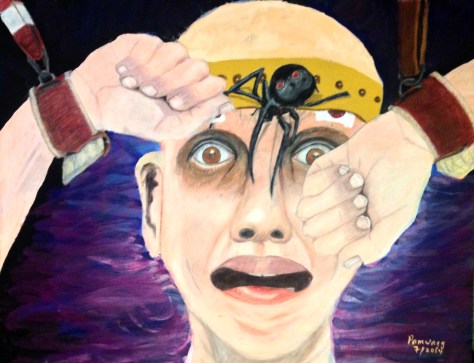
Tag Archives: mental illness

THANK YOU, MICHAEL EDWARD BALKUNAS, MD FOR EVERYTHING!!!! Along with my GOOGLE + REVIEW of NEW BRITAIN GENERAL HOSPITAL

I would put my entire New Britain General Hospital chart online except that i only have access at this time to a small portion of my MAY–JUNE 2014  record as they decided that 1000 pages was too many to send to my psychiatrist the first time around. She  requested the entire chart, but lazily they sent the discharge summary and the ED chart. In the meantime we have put in an immediate request for the rest and they said they are sending those ASAP.

Interestingly, the first page of the ED report states that availability of Advance Directive is “unknown.” Nevertheless, the ED triage notes state, with apparent disapproval and resentment, that “pt presents with details instructions [sic] on how to provide her care..” ie the advance directive (which it seems was immediately disregarded as an insult to their knowledge)…

ED Nurses note by “Seneilya… RN Assumed care of patient. Patient arrived via EMS after VNA called for increased anxiety. EMS reports patient refused to speak but wrote down, “Sunglasses block hate. I don’t want to hurt anybody.” On admissions patient refused to speak to this RN. Patient pointed at her head when asked why she was here. Patient nodded “yes” when asked if she was hearing voices but refused to answer other questions. …(next sentence indecipherable)

Report given to Beth RN who assumed care of patient…

At 15:19 Beth RN wrote the following:

“Pt not responding verbally to this nurse, this nurse looked through her art book and placed it back on her stretcher then pt picked it up and slammed it down on the stretcher and pointed her finger at the book. Unable to get pt to communicate. Pt pulled sheets over her head. Pt still in street clothes, will pt [sic] as is until examined by MD.”

What is not said here is that this nurse, “Beth” never asked me whether she might look at my artbook. She simply took it as her right to look at it, and then did so. She refused to allow me any means of communication, however, but demanded that I speak to her. When I was unable to do this, she did not inquire in any fashion as to why I was not speaking nor apparently make any inquiries from anyone else as to why this was so. If she had provided me with means to write I might have been able to tell her what had happened in the previous two weeks at home. Instead, she was so furious at my lack of speech that she belligerently refused to permit any other mode of communication but made assumptions that were extremely detrimental.

I was later given a hospital gown and told to dress myself or I would be forcibly assisted in doing so.

This is what Beth RN records what happened after I was provided with a meal that I could not eat because it was not vegetarian. Note that before this, I had begged gesturally for a means to communicate and all such implements had been outright refused me. This had led to my slamming the artbook on the stretcher in frustration and pulling the sheets over my eyes, effectively silenced.

Now with my meal, I at last had a means to write.

“Pt ate nothing,” Beth RN reports, “[but she] wrote messages with ketchup and French fries, ‘I need a crayon.” This nurse told pt she needs to speak because she can, pt threw everything on her table on the floor, food juice, etc. Pt then picked up fries from the floor and started eating them and gathered more and putting them in the bed with her and kicked the other food away in the OBS area.”

“Pt went to the BR, seen coming from the BR with paper towels then pt observed writing with her finger on a paper towel with something, first thinking it must be ketchup, then maybe jelly, then this nurse go up to check and pt found to be writing with her own feces, some paper was able to be removed, other paper with large piece of BM pt through at this nurse. Pt moved to room 42 [seclusion] then pt got OOB and snuck around corner and tried to attack this nurse from behind, public safety was able to get to pt first, pt to be medicated and restrained. Pt licking feces off fingers, would not let nurse wash her hands…”

Now I want to tell my side of this story because they invented this story out of whole cloth. Yes, parts of it are true, but out of order and not the way Beth related it. This is important because the way she wrote it makes me seem like I spontaneously attacked her out of the blue, which never happened. However, I was also privy to a conversation by the so called Public Safety officers, AKA Guards, who in front of me decided to create this story in order to justify restraining me, because they simply wanted an excuse.

What really happened was that due to my needing to communicate, I wrote my needs with ketchup on the paper box the meal came in, but that was taken away from me, and Beth, rather than telling/asking me to speak came up to me with a NOTE she had written to me (the irony of this is beyond belief except that it is true!) saying, “I will not speak to you or give you anything to write with until you start speaking to me…” Oh GOD! It was incredible. At this point, I was livid and also desperate to write so I had no choice but to use my own feces, which didn’t strike me as awful as it might have…What other choices did I have???? None at all.

So I did as she wrote and I tried to write journal entries about what was happening to me on paper towels with my own fecal material. This of course did not go over too well. However, I never snuck up behind Beth and tried to assault her. What happened was what I wrote in the second rap song. She snuck up on me and simply SNATCHED my artwork book out from under me and raced away with it, holding it up in triumph. I was so furious, without even a thought as to any possible consequences, that I raced behind her intending only to snatch it back. That was all. I never assaulted her, I never so much as touched her. I only grabbed for the book that she had not asked for from me. PERIOD.

That was when they dragged me to “Room 42” and when the guards, holding me down, decided they wanted an excuse to restrain me, and though one of them cautioned that they really had no reason to do so, the other told him not to worry, “we’ll find a reason.” And as I learned shortly thereafter from accusations made by Dr Balkunas, they did so.

But an accusation made isn’t necessarily true, as we all know, and just because Dr Balkunas accused me of LYING or of making up a story doesn’t mean that was true either. He never asked me what did happen. He never tried to find out the real events of that evening, he simply designated me as manipulative and “volitional” essentially a prime-time liar…Which meant that this started a snowball of a disaster in the making. Because by the time he finally saw me on the W-1 Psych Unit the next day, he had already made the decision not to let me communicate by writing and therefore he meant not to let me tell him what was going on from the first. He had decided not to recognize the extreme state of desperation and frustration this induced, but to see only violence and willfulness and to deal with this by punishing me with torture. PERIOD.

But I am getting ahead of myself. Michael E Balkunas, MD , the self- proclaimed god of W-1, claimed to have been there when this happened, when the guards said that I just shot up off the gurney and attacked Beth, the nurse, from behind. But the record does not bear this out. In fact, he never saw me at all until the next day and all the orders were written by other physicians. Dr Balkunas’s name is not even mentioned until the afternoon of May 13 when it says only that he was at my bedside to evaluate me. Even then, from what I recall, I was so sedated after multiple forced meds that I was unable to answer any question. I was unable to speak in any event, so given the face that he refused me the tools to write with, this was as unproductive an evaluation as possible.

I was to be admitted to W-1 on the basis of his snap judgments from that evaluation,: from which he drew the diagnosis that I had a probable “borderline personality disorder.”

How could he possibly diagnose a personality disorder, something that takes time to discern in a person, after seeing me after such an extremely traumatic circumstance, for less than three minutes? In point of fact, what likely happened was that he took an immediate disliking to me, and decided to diagnose me with something that in his mind justified his egregious treatment of me as well as his immediately not allowing me to write instead of speaking. I cannot otherwise explain his behavior . Nor can I understand his apparent surprise at mine when I did not respond to him as he expected. Why did he think I would respond positively when he refused to speak to me unless I was verbal? Why did he think that coercion would bring about a positive reaction? Did he truly think this would be helpful and restorative? I doubt it. I think he just didn’t like me and so he opted as most men do to abuse and punishe me out of rage. Because he was fed up, he lost his temper with me from the get-go…

I recall thinking about the rage  in his voice and how out of control he sounded as he sent me to “Seclusion! Seclusion! “ He actually screamed this directive to the guards as they deliberately grabbed my torn rotator cuff which they had been told about in the emergency room (so they would use it to their advantage) propelling me headlong down the hallway. “Restraints! Restraints!” he shouted in a shrill and angry voice.This was retributive and nothing else. He was furious and I was going to learn not to fuck with Michael Edward Balkunas, head of the W-I general psychiatry unit in the Hospital of Central Connecticut in New Britain or he would know the reason why!

But don’t let me put words in Dr. Michael Edward Balkunas’s mouth. Here is what he wrote, in his words. He wrote, surprise, surprise that “while in seclusion I would often scream” . Yet he states with apparent resentment that I had brought items with me “such as a large advanced directive” The nursing notes repeat this as if this is an evil thing, and proceed to disregard every item on it with relish. Not only that but Balkunas from the first accuses me of behaving with “volition” although he does not actually adduce any facts or observations to back up this thinking, except that I brought with me the large advance directive and a published book of the art work I had done.

This artbook, by the way, was was kept from me the entire time I was on the unit on the pretext that it would be very harmful for  the other patients if they were to see it.I was led to believe that the mere glimpse of my artwork would hurt them. This was emphasized to me so many times that I felt  guilty not only for having brought it with me, but for having drawn the pictures at all. The RNs seemed to enjoy my feeling so bad about it….

Balkunas further claims that he “asked if I would like to speak to him, PLEASE” but what he fails to note is that he refused to permit me any mode of communication other than verbally and that he peremptorily walked out on me when I could not utter a word. He notes that, Yes, I did throw my bed-clothes at him, but does not mention that he would not even look at my gestures in response.. Instead, he stood up in disgust and turned on his heels and strode out.

I admit that having already been so abused in the ED I was hideously upset at being unable to make him stay, unable even to make him HEAR me, that I did the only thing I could do to MAKE ANY NOISE at all, WHICH WAS TO THROW THINGS…

Both my brother and my psychiatrist claim that they told him pointblank not to draw baseless and dangerous conclusions from my traumatized behavior, that he would be making a mistake and would injure me badly if he did so. But he was of course the superman that all in-hospital psychiatrists are, the MR RIGHT that can finally fuck* you and get it right. SO he took one look at me and said, THAT IS OBVIOUSLY A CASE OF BPD if ever I saw one… Of course! And NATURALLY Michael E Balkunas is MR RIGHT, The one who fucks* you and you finally thank him for it, OF COURSE!

So THANK YOU Michael E Balkunas, You FUCKED* me OVER royally and you must have enjoyed it, because you fucked* me up the ass too. And I had to thank you in the end, didn’t I? Thanking you for fucking* me was the only I could earn my way to discharge, You forced* me to bend over and beg you to fuck* me up the ass and then Thank you again for abusing me just like any asshole who abuses women. You murdered* me, and halfway through slicing* my throat you made me beg you to fuck* me, and I did because it was the only hope I had that you might let me off with my life…Finally, with my throat half sliced* and my asshole fucked* wide open, you said, OKAY, now you can leave, you are free, you can go home now. I have had my way with you so go away…

So THANK YOU FOR FUCKING* WITH ME MICHAEL EDWARD BALKUNAS MD, GOD, THANK YOU FOR LETTING ME GO….I owe you my life, because you let me go and you didn’t in fact murder my body, I am still alive, though barely, you only tortured me and you only fucked* me and murdered my soul. You killed my spirit but you did leave my body somewhat intact so I could walk out of there and for that I had to pretend to be grateful and to thank you every day for a week, so I mouthed the words, Thank you Michael Balkunas for fucking* me and letting me leave stll alive….

But I wish you had killed me dead. Instead, you manipulated me into thanking you, for fucking* me over. You didn’t kill me quite. You made me thank you and thank you and thank you…and so now what do I do, you asshole- fucker*, but live with the torture you inflicted and wish you would crawl into your early grave somewhere and explode into a ball of maggotry.

*metaphorically, of course, but in a very real way nonetheless…So I feel it every day and wish I were dead! Note that in every other instance where an * is missing I usually mean my words literally and without any sense of metaphor whatsoever.

NOTE that this is the link to my  GOOGLE + review that I posted shortly after my stay at New Britain General Hospital..I think I was rather measured in my appraisal, after all was said and done.

https://plus.google.com/u/0/109362057307724485552/posts/ak5CU7s3qL1
MICHAEL E. BALKUNAS, MD: LISTEN TO THIS RAP – YOU MUTHA FUCKA!

Okay so here is another rap lyric. I suggest that you try to play it on an apple or iphone/ipad device as people have said that these won’t play with Internet Explorer. Perhaps because they are created through Garage Band and with ITunes? Anyhow good luck! (This is a TRUE STORY about what happened in the New Britain General Hospital in May 2014, Hospital of Central Connecticut…NOTHING IS IMAGINED OR MADE UP IN fact things were much worse even than this song describes….) If these end up being popular enough, I will redo them with a good microphone and perhaps a video…

DR. MICHAEL E. BALKUNAS, SHRUNKEN-HEAD MUTHAFUCKA RAP

Doctor Balkunas, you think you can fuck with me?

Doctor Balkunas, you think you can punish me?

Doctor Balkunas you head shrunken mofucker

G’wan, have another headfucking think on it, mofo…
They brought me by ambulance, silent and broken

Terrified, mute, and on an “involuntary”

Not even speaking and mentally ill

I could make no choices, every word unspoken.

Do you know what it means when I say I was mute,

when I could not speak and words did not work

and the world was too loud and my head was too full

and there was no bridge and no hand to pull

me out from that in-between. Even security

wasn’t there to protect me, only nurses and from me

and even the first nurse who coldly appraised me

grabbed my one book and then took my phone and fled

as if she were plotting to fuck with my head

because she had only to ask me and take it politely,

and promise to take care of things, and do it nicely.

Such fierce flames of outrage surged in me, and anger!

So not even thinking, I went running after her

wanting just to reach her and grab my book back from her

Little did I know the reaction if I touched her.

Mike Balkunas, you thought you could fuck with me?

Mike Balkunas, you thought you could punish me?

Mike Balkunas, you thought you could shit on me?

Mikey, you mofo, have a new headshrinking think on it.

Quicker than quicker everyone was sicked on me,

from the aides to the orderlies, even the nurses.

Burly armed guards went piling up hard on me,

and the worst of the worst was patients made versus me

a 100-pound 60-year old lady of five foot three

upset that my two last possessions were snatched from me

without any reason or rhyme in the world really

by the usual criminal in the ER, the head RN

who knew I was powerless alone in that warren

of ER rooms, so she had me dragged me to seclusion.

where I had to bare-knuckle the dark in confusion

battling anguish and fear, with the voices’ profusion.

So to get someone to come in and hear my screaming

I pulled all my clothing off, for clothes had no meaning.

Mike Balkunas, you think you can fuck with me?

Mike Balkunas, you think you punish with impunity?

Mike Balkunas, you really think you can shit on me?

G’wan, Mofo, Have another headshrinking think, now, Mikey…

I screamed from the base of my lungs for an hour

but was utterly ignored by all who had power

to relent or release me. I hadn’t a notion

of what else to do, to get help or attention

or have them return to the room, but to start

hitting my head and even tearing apart

things I could throw, chair, clothes and chart.

Then came the goon squad of six beefy men

who easily brought me facedown on the floor again

I screamed and I struggled but it did me no good,

if you fight them they justify all that they would.

Much better to lie still and let them abuse you

and get discharged and hope against hope you can sue.

The ER in peril from the dangers I posed

such a monster as me, poorly muscled, unclothed,

they wanted me, mute, completely shut up.

so they rammed three injectables into my butt.

Mike Balkunas, honey, you thought you could fuck with me?

Mike Balkunas, sweetie, you believed you could punish me?

Mike Balkunas, sweetheart, you thought you could shit on me?

Aw, little boy, Balkie, do your headshrinking mofo thing with it…

Mikey? Mikey? Mofo…I’ll bet you won’t forget me for a lo-o-o-ooong time, will you?

Ha ha ha!

I wish to god I could forget you. You mofo. You mother fucker. Let this rap song be a lesson to you, not to fuck with poets and writers or you’ll get written into a history you might rather be forgotten.

Doctor Michael Balkunas, dare you fuck with me now?

Doctor Michael Balkunas, dare you punish me now?

Doctor Michael Balkunas, you head shrunken muthafucka

Mofo, Mikey go fuck another headshrinker and think on it.

MICHAEL EDWARD BALKUNAS, MD, YOU MURDERED ME!

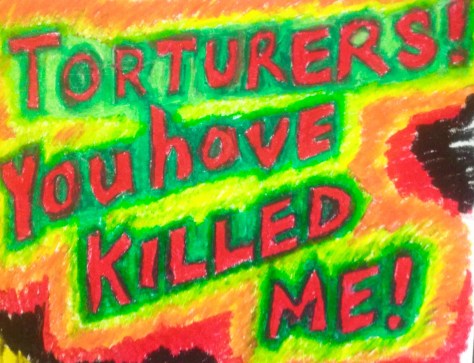
TORTURERS AT NEW BRITAIN GENERAL HOSPITAL: YOU HAVE KILLED ME!

READ THIS, Michael Edward Balkunas, MD of Hospital of Central Connecticut in New Britain, CT, Before You Throw Another Psychiatric Patient Into Your Supermax Seclusion Cells!

Hospital Seclusion Room
Hospital Seclusion Room (Supermax Cell at New Britain General Hospital)

This is from the Special Rapporteur to the UNITED NATIONS CONVENTION ON TORTURE 2013:

As the previous Special Rapporteur stated: “Torture, as the most serious violation of the human right to personal integrity and dignity, presupposes a situation of powerlessness, whereby the victim is under the total control of another person.”14 Deprivation of legal capacity, when a person’s exercise of decision-making is taken away and given to others, is one such circumstance, along with deprivation of liberty in prisons or other places (A/63/175, para. 50).

32. The mandate has recognized that medical treatments of an intrusive and irreversible nature, when lacking a therapeutic purpose, may constitute torture or ill-treatment when enforced or administered without the free and informed consent of the person concerned (ibid., paras. 40, 47). This is particularly the case when intrusive and irreversible, non- consensual treatments are performed on patients from marginalized groups, such as persons with disabilities, notwithstanding claims of good intentions or medical necessity. For example, the mandate has held that the discriminatory character of forced psychiatric interventions, when committed against persons with psychosocial disabilities, satisfies both intent and purpose required under the article 1 of the Convention against Torture, notwithstanding claims of “good intentions” by medical professionals .

Medical care that causes severe suffering for no justifiable reason can be considered cruel, inhuman or degrading treatment or punishment, and if there is State involvement and specific intent, it is torture.

63. The mandate has previously declared that there can be no therapeutic justification for the use of solitary confinement and prolonged restraint of persons with disabilities in psychiatric institutions; both prolonged seclusion and restraint may constitute torture and ill-treatment (A/63/175, paras. 55-56). The Special Rapporteur has addressed the issue of solitary confinement and stated that its imposition, of any duration, on persons with mental disabilities is cruel, inhuman or degrading treatment (A/66/268, paras. 67-68, 78). Moreover, any restraint on people with mental disabilities for even a short period of time may constitute torture and ill-treatment.78 It is essential that an absolute ban on all coercive and non-consensual measures, including restraint and solitary confinement of people with psychological or intellectual disabilities, should apply in all places of deprivation of liberty, including in psychiatric and social care institutions. The environment of patient powerlessness and abusive treatment of persons with disabilities in which restraint and seclusion is used can lead to other non-consensual

Domestic legislation allowing forced interventions

64. The mandate continues to receive reports of the systematic use of forced interventions worldwide. Both this mandate and United Nations treaty bodies have established that involuntary treatment and other psychiatric interventions in health-care facilities are forms of torture and ill-treatment.79 Forced interventions, often wrongfully justified by theories of incapacity and therapeutic necessity inconsistent with the Convention on the Rights of Persons with Disabilities, are legitimized under national laws, and may enjoy wide public support as being in the alleged “best interest” of the person concerned. Nevertheless, to the extent that they inflict severe pain and suffering, they violate the absolute prohibition of torture and cruel, inhuman and degrading treatment (A/63/175, paras. 38, 40, 41). Concern for the autonomy and dignity of persons with disabilities leads the Special Rapporteur to urge revision of domestic legislation allowing for forced interventions.treatment, such as forced medication and electroshock procedures.

JUST THOUGHT YOU SHOULD KNOW,  MICHAEL EDWARD BALKUNAS, MD, YOU MOTHERFUCKER…BUT THEN YOU ALREADY KNOW THIS, BECAUSE YOU DO WHAT YOU DO TO PATIENTS DELIBERATELY AND WITH PURPOSE!

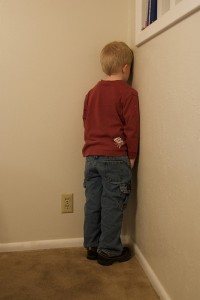
“Punishment is Just Abuse with An Excuse”

THis is how abused children become abusers, or how spanking gets engrained in culture as appropriate to do to "things" smaller than ourselves...
THis is how abused children become abusers, or how spanking gets engrained in culture as appropriate to do to “things” smaller than ourselves…


We think this TIME OUT punishment is better for children, less violent, but behind it is the THREAT of corporal punishment, ALWAYS...
We think this TIME OUT punishment is better for children, less violent, but behind it is the THREAT of corporal punishment, ALWAYS…

spanking


See the website Punishment Hurts Everyone, at http://abusewithanexcuse.com. This is an amazingly brave site with writing and thoughtful insights that might upset those who think that spanking kids is good for them, but for most of us, who know it only traumatizes and harms them, it will be an illuminating page indeed. Check it out! Great stuff here from a man who has put his ideas into practice and never once punished his own children, teens now and well-adjusted and happy to boot. Who’da thunk it could be done? (Well I did, for one, and maybe you too!)

For Sensitive Bodies and Sensory Overload: A Weighted Blanket

When I first spent time at Natchaug Hospital, at the time when Sharon Hinton, APRN, was still the director of nursing and it was a decent non-abusive hospital (in 2011 and 2012), I learned about weighted blankets and the amazing benefits to be gained from their use when stressed, upset, and in need of self-soothing or calming. Not everyone benefits, I gather, but if you suffer from PTSD or any of these other disorders. you might find a weighted blanket useful.

  • ADHD/ADD
  • Alzheimer’s
  • Anxiety Disorder
  • Aspergers Syndrome
  • Autism or ASD
  • Bi-Polar Disorder
  • Brain Trauma Injuries
  • Cerebral Palsy
  • Dementia
  • Down’s Syndrome
  • Epilepsy and Seizure Disorders
  • Fetal Alcohol Syndrome (FAS)
  • Insomnia
  • Parkinson’s Disease
  • Pervasive Development Disorder
  • PTSD
  • Restless Leg Syndrome
  • Rett Syndrome
  • Sensory Integration
  • Sensory Processing Disorder
  • Tourette’s Syndrome

One problem with buying  a weighted blanket for most of us however is the cost. If you don’t have $400.00 dollars on hand, it can be prohibitive to get the best or even a full-size heavy blanket. I don’t know about you, but a mere lap-size thing doesn’t do it for me, even though they tout the uses. I tried one at Yale for lack of anything better, and it did nothing at all but feel like a pillow on my lap. This was ridiculous. They would have done much, much better if they had handed me a real live cat and not pretended to be doing something useful with that silly piece of fabric.

The heavy full-size blanket, on the other hand, was great. It felt like a cocoon or a huge hug that held my entire body without restraining me. I could move around in it, and yet it held me warmly and gently. Nothing kept me in against my will and I could get out from under whenever I wanted to. In fact, the nurses made me leave before I was ready. They actually took it away after twenty minutes which was silly. This was way too short and arbitrary a time in which to keep the blanket on me. I was NOT used to it by then or calmer. Not at all. I wanted to stay inside it  and needed it on me longer. But they said the protocol was for 20 minutes on and 20 minutes off so the person didn’t accommodate to the weight. Silly reasoning. Why didn’t they ask if I felt better or was calmer? Or ask me some other question.

Anyhow, here are the directions and photos for making your own homemade weighted blanket. It is quite easy and inexpensive, and you only need to do a little hand-sewing, or if you prefer, just use some heavy-duty glue (E6000 is the best), and velcro. Both ways are fully washable.

Directions for Making A 15 pound Weighted Blanket:

The first two photos show half of the “inside, or under side, of a kingsized coverlet that I sewed Dollar Store (2 for $1) microfiber washcloths onto, making pockets. (BTW pay no attention to the the shoelace ties and buttons, which never worked but were part of a first experiment…) I placed the fuzzy side of the washcloths facedown. This is important because when I glued velcro’s stiff bristled half, face up, to the blanket at the pocket tops, the microfiber washcloth gripped it perfectly, so there was no need  for the softer side of velcro on the inside of the pocket itself.

Handmade weighted blanket with microfiber pockets for rice bags
Handmade weighted blanket

Next, (see the close-up photo) I filled quart size freezer bags (a box for  $1 at The Dollar Store) with 1/2 to 1 pound of raw rice, depending on the weight wanted, and then double-bagged these. Note: my blanket has 15 pockets but I’ve found that 15 pounds of rice is actually heavier than I personally want, despite what I thought…).Depending on your own body weight, you could prefer between 10-25 pounds of rice. The chart I found said that a person weighing 112 pounds might need 10-15 pounds and a person weighing 185 pounds would need approximately 25 pounds of weight. On the other hand, the hospital never allowed anything more than a mere 10 pounds, erring on what i consider an absurd side of caution for all…So you can gauge your needs from that.

Be aware however, that despite what a 15 pound bag of raw rice might saw on its side, it usually contains much more than 15 pounds so weigh each bag you fill carefully, don’t just divvy up a bag of rice into equal parts.

Rice Bag for weighted blanket

Fill the pockets with the rice bags and press-seal the washcloths against the velcro. Flap the other half of the blanket (final photo) over the pocketed half and use as a twin size weighted blanket. It works fine like this, but you could add velcro to the blanket sides themselves if you  wanted to seal it up completely.

Weighted Blanket Open


Weighted Blanket, Closed
Weighted Blanket, Folded Closed

By the way, for gluing the velcro I used the E6000 glue, outside on the driveway on a plastic sheet, on a sunny day…I would not use anything else, but don’t do it inside without plenty of good ventilation as it is poisonous and you use a lot.

Good luck and feel free to email me or comment if you need help or have any questions. Sorry if I didn’t provide enough details but I didn’t want to overwhelm you here. I would be happy to provide more privately or in the comment section if anyone is interested.

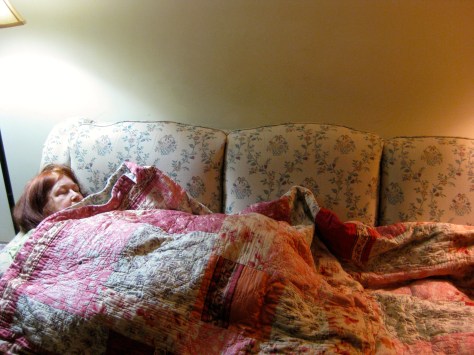
M sleeping under my homemade weighted blanket


Made It Through the Night…PLUS Temporal Lobe Epilepsy versus Schizophrenia

This flower, whose name, Self-Heal or Heal-All, says everything, and it is not insignificant that this was the first wildflower that started me on my Field Botany path, and was also the agent of my natural history conversion experience:

Self-Heal or Heal-all (My first wild flower and the one that changed everything)


Last night was a very difficult night, as you know.

I did not believe the nurse when she told me this morning that E–, who was an animal lover, would never have killed herself, leaving her beloved parrots to fend for themselves. She said it simply went against the grain of most animal people to kill themselves while their “children” still needed them. It turned out, though it took me a while to “grok” this, that E– apparently died of a combination of diabetes type 1 and asthma. The details are unclear and unnecessary but I was assured by both nurse and the building social worker that it was not suicide. Thank god.

However, early this morning things were not well, and I wonder if what  happened later on was not at work last night as well. Let me explain:

I had an appointment to see my psychiatrist, Dr Angela, at 10 a.m. and as usual I got up to drive myself there, a short distance over the bridge to the next town, maybe 6 miles away tops. It is a trip I have done dozens and dozens of times, perhaps hundreds now.

This time, however, things were different. Halfway there, on a stretch of road — I’m talking back roads not highway — a road that I know like the palm of my  hand, I was suddenly overcome by a feeling, an intense almost nauseating feeling of “jamais vu.” This is the opposite of “deja vu” — that sense that things you have never done have happened before. Jamais vu is the sense that while you are in familiar places or with familiar people, they seem strange or new or utterly unfamiliar. I have had deja vu many times, as have a lot of people, and I think it is a fairly common experience to feel as if something has “happened before” even though it is really a new experience.


But never before, at least not since I was ill, severely and neurologically ill, with Lyme disease, have I felt this intense feeling of non-familiarity in a situation that I know I knew very well. I was terrified, if briefly. I was not at all certain where I was. I mean, I kept driving, because my instincts told me to keep going, that my hands would make the proper turns. But my conscious brain had no recognition of where I was and no conscious notion that wherever I was I had ever been before. It was, as I said, terrifying and very, very strange.

Luckily, within minutes things had resolved enough so I knew that I had arrived at the Whole Foods parking lot, which my doctor’s office and the doctors’ complex shares. I still felt very weird. I felt in fact that I was not completely embodied, even though I carried a heavy enough bag to embody or burden down anyone.

When I got to Dr Angela’s office, the first thing i told her was that something was wrong. Yes, I had sent her the email I mentioned here yesterday, but I did not mean that. I meant the foreign feeling, the jamais vu intensity, which though faded still scared me. Thinking back, when i was so ill with Lyme it was actually deja vu, in an incredibly brilliant and vivid form, that afflicted me rather than the alienating jamais vu, but I knew that both deja and jamais vu can be commonly a symptom of either an aura or a seizure itself. Especially the much rarer experience of jamais vu.

I have had several different kinds of seizures in my life, and I have just been taken off Topamax, an anti epilepsy drug I have taken for years. I did this in preparation for a neuro-ophthalmology appointment in October (not sure why I thought it had to be stopped). So i have and had some sense that it was the d/c of this anti-convulsant that was the proximate cause if not the absolute cause for my symptoms.

But I was terrified that this jamais vu would generalize into a full-blown seizure, which I couldn’t bear the thought of. Dr Angela was quite responsive and suggested that I 1) take an immediate Ativan, .5mg as that is reasonably effective as an anticonvulsant, though better IV than oral and 2) when we found that I had stashed 100mg of Topamax in my pill compact, she had me take that as well, figuring I would get back to my usual 200-300mg within a week or two.

The appointment went — well, I don’t remember much about it, frankly. All I recall is leaving, promising to get a cup of coffee before I drove home, then realizing once I got to the parking lot that there was no way I could drive, coffee or not. I felt simply too weird. And weirded out. Too scared of having a full blown seizure, whether temporal lobe or otherwise to get in the car.

To my great luck, when I contacted my case manager, Rebecca, who works in next town over, she was immediately available and came to pick me up. That was a huge relief. I didn’t even have to wait more than 5 minutes. More, the Whole Foods grocery store people didn’t bat an eyelash when I asked if I could leave my car in the lot overnight.

Later on, Tim went and got my car for me, so I didn’t even have to do that. I simply went home and took a  nap. When I got up I felt at least ten times better. Not so weird, not so seizure-y. Less scared, and finally able to be convinced that the huge balloon of misery and terror from last night was just that, a balloon, a mistaken notion…a fiction. I was wrong, that was all. Even though the conviction and certainty felt as real as anything, they were only FEELINGS, and as so many people including my brother assured me, those feelings would change if I hung in there.

Lo and they did change and have changed. Thank heavens.


Now it occurs to me that perhaps even that huge balloon of certainty may have been seizure-related. I don’t have any real reason to think otherwise. I know, I know, my shrink brother has his theories. But I felt so UN-conflicted about it, so hugely convinced, that the explanation of seizure activity, comparable to the certainty that I “have never been here before” of jamais vu even though I knew I had, and also knew, as I said, that I had not caused the putative suicide…this explanation simply makes more sense and feels  “more right” to me. After all, why would I suddenly feel like I did anything to E— who was not all that important to me, or no more than anyone else in the building really. It felt morever just so hugely compelling, in precisely the same way that impending doom feeling of a temporal lobe seizure feels — it isn’t real but it is unshakable, utterly unshakable.

I don’t know, of course. The shrinks — and I include Dr Angela and my brother — would like to make it all about me, all about my conflicts and my mental illness however they want to define that. But I wonder now how much my ongoing (but unofficially diagnosed, that is, only by psychiatrists) TLE has affected me all along. I wrote about this conflict, this contamination of any schizophrenia diagnosis with temporal lobe epilepsy, and months ago. It seems strange that so many have “both”…|

Nevertheless, I have never had my seizure feelings checked out, largely because I do not want anyone curtailing my voluntary driving. And I don’t like doctors having that power over me. I also do not trust them to take me seriously, as a NON-psychiatric patient. I do take AEDs to prevent olfactory hallucinations, (NOT as mood stabilizers) and such, but why see a neurologist who might tell me I can’t drive a car for any length of time when I have never even had a fender bender from this? Or who might, and this would feel just as bad, tell me it is “all in my mind” not in my brain…!

“Protection and Advocacy” Agency in Connecticut is a Crock of Shit…

CT PAIMI What a Crock of Shit


Dear Attorney General George Jepson and DMHAS Commissioner Patricia Rehmer,

I was a client of Mr Wiley Rutledge at the Connecticut Office of Protection and Advocacy, PAIMI, (Protection and Advocacy for Individuals with Mental Illness) for several years, ever since I was held in seclusion and put into four-point restraints as disciplinary measures at the Behavioral Health Unit at Middlesex Hospital in 2010. In July 2014, while he was attempting to get my complete medical records, unsuccessfully despite many attempts, from the Institute of Living at Hartford Hospital for my January-February 2013 stay, as well as records from my Yale New Haven Hospital 1971 stay, which he claimed to have obtained, he dropped out of the picture altogether. I emailed him and called but got no response. Finally I called the P&A office and was told he was “on leave.”
 I was given no explanation, told nothing. Instead, Mr Bruce Garrison, his supervisor, simply sent me all the files that he found in Mr Rutledge’s office, then he summarily dumped me. He has offered no substitute or anyone else to take up my case at CT PAIMI despite all these unresolved issues that are still pending. I wrote him that Mr Rutledge and I had been filing a case in Superior Court against Hospital of Central Connecticut  in New Britain for dragging me into a horrific seclusion cell numerous times when I was never violent or dangerous to self or others, in other words, as retribution and punishment. Also, the male guards forcibly stripped me naked while putting me in seclusion then placed me naked in four-point restraints.
All that said, Mr Garrison, had no response but to drop me from the caseload. Then in addition to the scant files that he sent, without the information from either Yale or the IOL that he promised, he sent me the case files of someone else. I now have the most private information on a certain A— H—- who was psychiatrically evaluated by Centegra on 12/17/02. How this could have happened I do not know but it should not have and I believe that action needs to be taken to see that it never happens again.
I want to know who will be working with me from now on at PAIMI because I cannot afford a lawyer (never did have any legal representation even from CT PAIMI) and why I have been summarily dropped from PAIMI case loads, after working with them so patiently for so many years.
Thank you for your urgent assistance in this matter.
Pamela Spiro Wagner

A Poem for My Aging Mother

My poor mother is suffering from dementia at 87 and it is very sad and difficult to watch her decline. I will write more if I can at some later time about it but for now I want just to post a poem I wrote for her years ago and then rewrote completely recently.


Over the years we have had some troubled times. Because my father disowned me for some thirty-five years, she had to make a choice between him and me, essentially, and the one she made was obvious. I was out of the house by then and I am not sure it ever really occurred to her to make any other choice, but who knows? I do not. In any event, I bear her no bad feelings for this, I do not think. Though had I been “her son” with schizophrenia i believe the outcome and her choices might well have been very different, as they always were when it came to my brother.


But that is water under the bridge. The choice was made and I was sacrificed. That said, perhaps it is a good thing, I dunno. If she had given up her life for me,  I might never have developed any independence at all, or written the poems and books I have.  I might never have discovered my art abilities. Who knows? No one knows, of course, what their “alternate futures” might have  held. We can only work with what we have and the cards we are dealt. We can’t make others choose on our behalf. Much as we might wish them to.


I never wanted my mother to give up her life for me. I felt guilty enough, just for being the way I was. The worst thing in the world would have been for her to make any sacrifice for me at all. For anyone to have done so would have been damaging to me. So I am glad that everyone went on their way, because otherwise I would have had to kill myself in apology.


I could say much more but I am sleepy so without further fanfare, the poem:


PHONE CALL TO MY MOTHER AT SIXTY


I have not thought of you all day.

A March wind rattles the wires,

wishing you a belated happy birthday.

You are sixty, my grandfather ninety,

my younger sister thirty,

but if there is significance in that,

a syzygy, some conjunction in the heavens

I have yet to figure it out.

Your husband answers, my father,

aligned against me north-north,

between us implacable silence.

So we sidestep confidences,

suspecting he is listening in

until in the distance the line clicks

like a playing card in the spokes.

But even so, how carefully we speak,

expelling words of fragile allegiance

each of us pretending not to know

what the other is thinking.


Suddenly you confide, you feel old:

the baby is thirty, you don’t like

your new job, you miss teaching,

the exuberant children, their bright

and lazy charm. There is so much to do,

so little time. Before it is too late


you want to captain a boat to the Azores,

learn cabinet-making — you have the tools,

a lathe, a power saw, inherited from your deaf father

who never heard you speak

but built you a fabulous dollhouse

and taught you, at ten, to sink the eight ball.


Could I ever confide that I, too, feel old? At thirty-five

you had a husband, four children,

a career in the wings. Older by a decade, I rent

a single room and have no prospects

beyond the next day’s waking.

Instead I carefully quote Joseph Campbell’s

advice: follow your bliss.

And I remind you Aquarians always step

to a different drum’s thunder.

You like these clichés,

and laugh, repeating them, then you say

with a sudden spontaneous sincerity

that moves me how good it is to talk with me.

I think of all the times we have not spoken,

how at sixty it would be nice

to have a daughter to talk with

instead of friends wakened in the night,

reaching over husbands or wives,

to answer the phone, “Hello? Hello?”

their wary voices expecting

death or disaster.


You are tired, you say now,

you have an early appointment.

We promise each other a date for lunch.

But I will not call for a long time.

Or perhaps I will call the next day.

Before you hang up, you let slip

it’s your wedding anniversary, one

marked by some mundane substance —

stone, carbon, foil, rope.

Should I congratulate you, I wonder,

or console you? Finally, we say good-bye.

Across the wires I think I hear

your voice crack, but it could be the wind

or a bad connection.

Trauma and Its Sequelae: A Hospital Poem on Abuse by Michael Edward Balkunas MD

TRAUMA AND ITS SEQUELAE…


Written months after my 4-week admission to the psychiatric unit, W-1, at New Britain General Hospital/ Hospital of Central Connecticut, in 2014 where I was “treated” and abused by Dr. Michael Edward Balkunas, MD


Nine days after your worst hospital stay ever

you are still wearing the shades

that protect others from you

though no one else believes they are in danger

Those staff however wrote you up

as “assaultive” and dangerous to self

and others. But they didn’t mean it the way

you do now and their description of your

behavior was neither accurate nor truthful

Often they lied, as liars do,

just for the sake of convenience.


Now you are a week away from meeting new “cousins”

who await your vacation in northeastern Vermont,

a place magically named the Kingdom

and the recuperation your mind-body badly needs.

Still unable to let go, you perseverate over

the half-nelson grip of sadistic guards

bent on eliciting pain.

What happened to the nurses’

“healing touch,”

their concern for “the dignity, worth,

and uniqueness of every individual”,

or their “primary commitment

to the patient?”


When the guards forcibly stripped

then four-pointed you to an bare mattress

they were just replaying their favorite rape

yanking each limb wide

to expose, degrade, humiliate.

Never mind the nurses’ vow to protect

the vulnerable. The official hands-off policy

protected only their own asses.


So how do Truth and Forgiveness Programs proceed

when so many refuse to acknowledge wrong?

The hospital broke every humane rule;

they only stopped short of murder

because you submitted,

nick of time. Yet they had the last word:

stuffing your screams

when they muted the intercom

and slammed the door between you

and the mandatory one-to-one observer.


No one ever is there to bear witness, is there?

That point has always been the point,

from Daddy to doctors.

and all the hairdressers and nurses in between.

They’ve made a religion of secrecy

and no one wants to know

what they don’t want to know.


Call it “our family’s business,”

call it “a private cut and shampoo,”

or just call it, discreetly, “treatment”–

but they can always do what they want to, to you.                          .

When they break you, they declare

you’re just “one of the family,”

no different from anyone else,

now that they’ve finally fixed you for good.

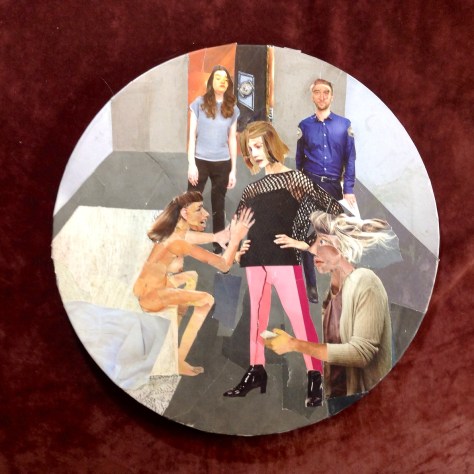
Trio of Psychiatric Abuse Collages: encounter, restraint and seclusion

Encounter in Seclusion Room - collage of torn paper
Encounter in Seclusion Room – collage of torn paper
Hospital Seclusion Room


Nude Schizophrenic IN restraints While Bored nurse Looks On


you get the idea….no violence, just a scornful set of nurses and aides and a security guard willing to do anything he was asked…and chaos broke loose with terrible consequences.

Hospital Seclusion Room…plus

Hospital Seclusion Room


When I was at New Britain General Hospital in the spring of 2014, the security guards stripped me naked and left me in the freezing and barren seclusion room…This is a depiction of a younger woman largely because no one gives a damn about what happens to a 61 year old woman anywhere..but the seclusion room is pretty danged accurate.


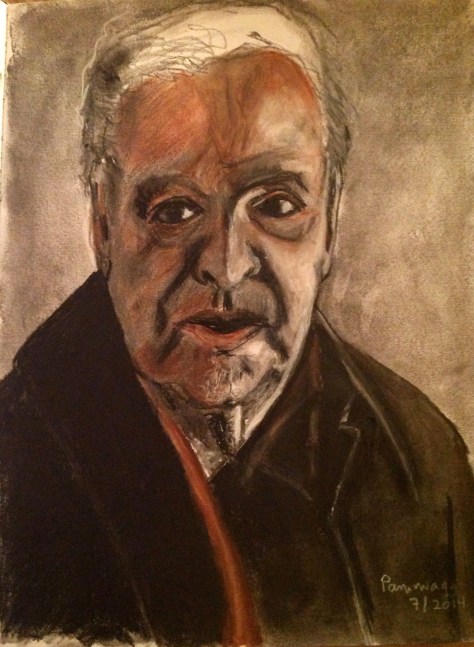
Old Movie Star in conte crayon and charcoal

New Poem: On Not Speaking

ON NOT SPEAKING


When I went temporarily mute at age sixty,

it sparked no visual wonders.

After decades schooled by dictionaries,

vocabulary categorized the world:

“precipice,” “acrid,” “blanch;”

words even defined my senses.

But one can fall into

speechlessness for reasons

beyond pathology

though these may not seem reasonable

to people who believe that only talking things out

or about them makes sense.

Speaking or not, I knew

when silence was less insane

than trying to be heard

by those who would rather hurt me

than pay attention.

But if, as they say, silence is so eloquent,

why couldn’t anyone hear

what I so desperately didn’t say?


Beyond Recovery: Stage Five

I want to reblog this brilliant post by Anne C. Woodlen and then i will add my own editorial comments if i can in a later post or edit. In the meantime, i think it speaks for itself and says just about what i would want to tell a lot of young people newly diagnosed with bpd or did or add or even bipolar disorder and getting on disability, preparing for a life “in the system” – it sucks and it isn’t worth it unless you are floridly psychotic. And even then, don’t believe what they tell you about antipsychotic drugs. There ain’t no such medication, only sedatives that may or may not quiet things down temporarily. The only way out is through, if you can do it with a wise and caring guide and community. Don’t get stuck as i am, on multiple antipsychotic drugs, addicted to them so that getting off them only means you get more psychotic than ever. Psychosis need not be a lifelong problem, but it certainly will be if you keep taking high doses of the drugs and never explore other options.

annecwoodlen's avatarBehind the Locked Doors of Inpatient Psychiatry

Hello,

My name is Dustin and I live in Michigan. When I was seventeen years old my mother put me in a psychiatric hospital called Forest View. The abuse I felt violated me to the core! I felt like I was being raped having to submit to all the rules, the bullying and the emotional abuse. To have your dignity removed when you are an innocent patient and just want genuine, kind, gentle care, and get unprofessional jerks who you can tell are fake and just care about getting paid is a horrible experience.   If anything it only caused me more traumas with the trauma that I already had. I am now twenty-two years old and live on disability while also living my life as a hermit because now I am afraid of people due to the awful treatment I endured.  I was diagnosed with Borderline Personality Disorder by a REAL…

View original post 856 more words

Terrified Patient in Restraints

Patient In Restraints, Terrified

AUDIO Interview with Pamela Spiro Wagner: WNPR on Connecticut Hospitals’ Use of Restraints and Seclusion

(***SEE PAMELA’S COMMENTS AT BOTTOM OF PAGE…)

Connecticut Hospitals Responding to Psychiatric Restraint Numbers

“They don’t want you to get out. They pull [restraints] as tight as possible to the sides of the bed.”
Pamela Spiro Wagner

Pamela Spiro Wagner’s apartment is full of art she’s made while in psychiatric care. One piece dominates the room. It looks like a painting at first. It shows a threadbare seclusion room and a restraining bed.

“That’s made of Vogue magazines. If you look at it, you’ll see there’s a little label of Prada leather on the leather restraints, which was done on purpose,” Wagner said. She made it while alone in a hospital seclusion room. The magazines were the only art supplies she had.

Wagner has schizophrenia. She’s been in and out of Connecticut hospitals for decades, and she knows what it’s like to be restrained. “They use leather, or rubber, or plastic, or whatever restraints that they wrap around your wrists, usually tight because they don’t want you to get out. They pull them as tight as possible to the sides of the bed,” she said.

Wagner was put in four-point restraints. That means each limb is bolted to the bed, and she said she’s stayed there for nearly a day at a time. “I would just scream from the base of my lungs,” she said, “like the screams that if you had any heart, your heart would break if you heard me scream.”

“Restraint is Pretty Traumatic”

Patricia Rehmer, Commissioner of the Connecticut Department of Mental Health and Addiction Services, said the department has cut down on restraint since receiving a federal grant in 2008. “We know,” she said. “The literature is clear; the clients are clear. Seclusion and restraint is usually a pretty traumatic event. If we had our way, there would be no seclusion and restraint. We’d love to get to zero, but that’s not always possible.”

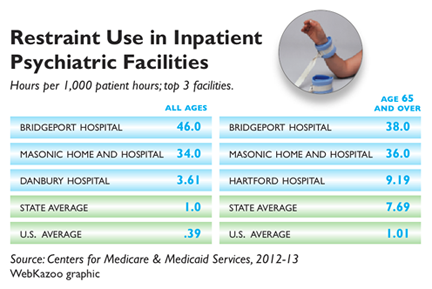
Credit WebKazoo / Connecticut Health I-Team

The Department of Mental Health and Addiction Services oversees state hospitals in Bridgeport, New Haven, Hartford, and Middletown. Rehmer said that because patients stay longer at state hospitals, doctors and nurses have more time to work with them on ways to avoid restraint. “Frankly, there are differences between our hospitals, our hospital beds, and general hospital beds, for example,” she said.

Read C-HIT Report: State Restrains Psychiatric Patients at High Rate

Restraining or secluding patients used to be commonplace in psychiatric facilities, but ten years after a series of deaths nationwide, there’s been a push to lessen the time patients spend restrained. Federal data released earlier this month showed that Connecticut’s rates of restraint are still high compared to most of the country – more than double the national average. The state ranks eleventh nationwide, and third for use of restraints among the elderly.

Connecticut Institutions Adapt

Bridgeport Hospital topped the list statewide. The hospital has a large geriatric unit, and the numbers were high for elderly patients.

“We realized about a year and a half ago that we were really having a problem,” said Ryan O’Connell, Bridgeport Hospital’s vice president of performance and risk management. He pointed out that the numbers only go up to the middle of 2013, and said that the hospital started changing its practices since then. “It was much more common for us to go to some type of restraint,” he said.

O’Connell said the image of the barren room and four leather straps is all wrong at Bridgeport. They’re mostly trying to keep patients with dementia from wandering off and into danger. “I think it’s really important,” he said, “that nobody thinks that we were tying people down [by their] hands and feet.”

Bridgeport is moving toward something called comfort rooms, with colorful wallpaper, toys, games, or comfortable furniture. They’re becoming common alternatives in a lot of institutions, like Connecticut Valley Hospital in Middletown — a state hospital that cut back on using restraints by about 88 percent in the past decade.

In 2002, a patient died after being restrained at CVH. The hospital conducted investigations after the death, but Director Charles Dike said they’d already decided to make a change before it happened. “Our target is to make sure we use it as sparingly as possible, only when it is absolutely necessary, and that we discontinue it as quickly as possible,” he said.

CVH started using comfort rooms years ago. Dike said that instead of putting a patient in restraints, they try to encourage a patient to spend a little time alone doing something relaxing. He said, “If somebody says to me, when I’m not doing so well, I like to go into my room and play music, and that helps me calm down…” He said that nurses will remember, and bring it up if the patient starts to lose control.

Dike doesn’t expect to stop using restraints. He said there will always be outliers — patients who come straight from emergency rooms and prisons.

Ellen Blair is the nurse director at Hartford’s Institute of Living, which is part of the Hartford Hospital system. Figures for 2013 show Hartford Hospital restrains patients at a little over the state average, but she said they’ve cut back since then thanks to new training programs and more comfort rooms.

Blair said that when a patient does go into restraints, they’re looked after. “I personally go and make sure I know that patient,” she said. “We all talk about it at least every couple of hours, because we don’t want to keep it going any longer than we have to.” She said patients aren’t left alone, and that restraint is only used as a last resort when patients are dangerous to themselves or others.

“Every day,” Blair said, “we come here thinking, okay, we’re going to have a good day. We’re going to prevent people from getting agitated and having to go to that level.” Restraint, however, remains a last resort these hospitals said they don’t plan to take off the table entirely.

AVENGING ANGEL: NEW ART

Avenging Angel in Gouache - Abstract approximately 7 by 8 inches
Avenging Angel in Gouache – Abstract approximately 7 by 8 inches


Lots to say about the situation I am in up here in Vermont, where my assistant, the person hired to help me and make sure things go okay turned out to be a common criminal. But I am too tired and worn out by having to deal with the mess left in her wake to write about it. Suffice it to say that she stole my debit/credit card number and racked up multiple charges, was apparently drinking even in the mornings without my knowing it, and driving me at the same time. She had a hand bag full of narcotics not all of them prescribed to her, but even if they had been, what was she doing, taking narcotics and drinking and driving?!


Things were even worse than that, but as I said, I am exhausted and cannot go into it all now. Needless to say, she has been fired and is gone, is out of here…But she has left a mess and misery in her wake all around. What a mess maker! And I think she was the one who was stealing from me all the while last winter when I had people staying with me to prevent a hospitalization…Why did  I once trust her implicitly? Where do I find these people and WHY do I trust them at all?


I should have known something was wrong when I saw her handbag full of Percocet and Xanax and VIcodin and fentanyl patches etc. It was ridiculous…and then to have her buy a case of beer? But I thought “well, a beer once in a while is harmless.”…I didn’t know she was drinking at breakfast and also while driving…I am such a dimwit!

Avatar therapy for persecutory auditory hallucinations: Can It Work?

Sometimes the voices are so loud, you just have to scream...Collage made at Yale Psychiatric Hospital 2013, from scraps of magazines and glue.
Sometimes the voices are so loud, you just have to scream…

Novel ‘Avatar Therapy’ May Silence Voices in Schizophrenia

Deborah Brauser

July 03, 2014

LONDON ― A novel treatment may help patients with schizophrenia confront and even silence the internal persecutory voices they hear, new research suggests.

Avatar therapy allows patients to choose a digital face (or “avatar”) that best resembles what they picture their phantom voice to look like. Then, after discussing ahead of time the things the voice often says to the patient, a therapist sits in a separate room and “talks” through the animated avatar shown on a computer monitor in a disguised and filtered voice as it interacts with the patient.

In addition, the therapist can also talk by microphone in a normal voice to coach the patient throughout each session.

In a pilot study of 26 patients with treatment-resistant psychosis who reported auditory hallucinations, those who received 6 half-hour sessions of avatar therapy reported a significant reduction in the frequency and volume of the internal voices ― and 3 reported that the voices had disappeared altogether.

“Opening up a dialogue between a patient and the voice they’ve been hearing is powerful. This is a way to talk to it instead of only hearing 1-way conversations,” lead author and creator of the therapy program Julian Leff, MD, FRCPsych, emeritus professor at the Institute of Psychiatry in London, told meeting attendees.

Dr. Julian Leff

“As the therapist, I’m sharing the patient’s experience and can actually hear what the patient hears. But it’s important to remind them that this is something that they created and that they are in a safe space,” Dr. Leff told Medscape Medical Newsafter his presentation.

Two presentations were given here at the International Congress of the Royal College of Psychiatrists (RCPsych) 2014 the day after the study results were released in the print edition of Psychosis.

Regaining Control

According to the investigators, 1 in 4 people who hear phantom voices fail to respond to antipsychotic medication.

Dr. Leff explained that this program started a little more than 3 years ago, after he had retired “and could start thinking clearly again.” He had been interested in the phenomenon of phantom voices for more than 40 years.

“Our mind craves meaningful input. That’s its nourishment. And if it’s deprived of nourishment, it pushes out something into the outside world,” he said. “The aim of our therapy is to give the patient’s ego back its mastery over lost provinces of his mental life.”


The researchers used the “off-shelf programs” Facegen for the creation of the avatar faces and Annosoft LIP-SYNC for animating the lips and mouth. They also used a novel real-time voice-morphing program for the voice matching and to let the voice of a therapist to be changed.

In fact, Dr. Leff reported that one option the program provided changed his voice into that of a woman.

After a patient chose a face/avatar from among several options, the investigators could change that face. For example, 1 patient spoke of hearing an angel talk to him but also talked about wanting to live in a world of angels. So the researchers made the avatar very stern and grim so that the patient would be more willing to confront it.

Another patient chose a “red devil” avatar and a low, booming voice to represent the aggressiveness that he had been hearing for 16 years.

For the study, 26 participants between the ages of 14 and 74 years (mean age, 37.7 years; 63% men) were selected and randomly assigned to receive either avatar therapy or treatment as usual with antipsychotic medication.

The length of time for hearing voices ranged from 3.5 years to more than 30 years, and all of the patients had very low self-esteem. Those who heard more than 1 voice were told to choose the one that was most dominant.

Pocket Therapist

Dr. Julian Leff shows examples of faces used in avatar therapy at RCPsych 2014.


During the sessions, the therapist sat in a separate room and played dual roles. He coached the participants on how to confront and talk with the avatars in his own voice, and he also voiced the avatars. All of the sessions were recorded and given to the participants on an MP3 recorder to play back if needed, to remind the patients how to confront and talk to the auditory hallucination if it reappeared.

“We told them: It’s like having a therapist in your pocket. Use it,” said Dr. Leff.

All of the avatars started out appearing very stern; they talked loudly and said horrible things to match what the patients had been reportedly experiencing. But after patients learned to talk back to the faces in more confident tones, the avatars began to “soften up” and discuss issues rationally and even offer advice.

Most of the participants who received avatar therapy went on after the study to be able to start new jobs. In addition, most reported that the voices went down to whispers, and 3 patients reported that the voices stopped completely.

The patient who confronted the red devil avatar reported that the voice had disappeared after 2 sessions. At the 3-month follow-up, he reported that the voice had returned, although at night only; he was told to go to bed earlier (to fight possible fatigue) and to use the MP3 player immediately beforehand. On all subsequent follow-ups, he reported that the voice was completely gone, and he has since gone on to work abroad.

Another patient who reported past experiences of abuse asked that his avatar be created wearing sunglasses because he could not bear to look at its eyes. During his sessions, Dr. Leff told him through the avatar that what had happened to the patient was not his fault. And at the end of 5 sessions, the phantom voice disappeared altogether.

Although 1 female patient reported that her phantom voice had not gone away, it had gotten much quieter. “When we asked her why, she said, ‘The voice now knows that if it talks to me, I’ll talk back,’ ” said Dr. Leff.

“These people are giving a face to an incredibly destructive force in their mind. Giving them control to create the avatar lets them control the situation and even make friends with it,” he added.

“The moment that a patient says something and the avatar responds differently than before, everything changes.”

In addition, there was a significant reduction in depression scores on the Calgary Depression Scale for Schizophrenia and in suicidal ideation for the avatar participants at the 3-month follow-up assessment.

A bigger study with a proposed sample size of 140 is currently under way and is “about a quarter of the way complete,” Dr. Leff reports. Of these patients, 70 will receive avatar therapy, and 70 will receive supportive counseling.

“In order for others to master this therapy, it is necessary to construct a treatment manual and this has now been completed, in preparation for the replication study,” write the investigators.

“One of its main aims is to determine whether clinicians working in a standard setting can be trained to achieve results comparable to those that emerged from the pilot study,” they add.

“Fascinating” New Therapy

“I think this is really exciting. It’s a fascinating, new form of therapy,” session moderator Sridevi Kalidindi, FRCPsych, consultant psychiatrist and clinical lead in rehabilitation at South London and Maudsley NHS Foundation Trust in the United Kingdom, told Medscape Medical News.

Dr. Sridevi Kalidindi

“I think it is a novel way of approaching these very challenging symptoms that people have. From the early results that have been presented, it provides hope for people that they may actually be able to improve from all of these symptoms. And we may be able to reduce their distress in quite a different way from anything we’ve ever done before.”

Dr. Kalidindi, who is also chair of the Rehabilitation Faculty for the Royal College of Psychiatrists, was not involved with this research.

She added that she will be watching this ongoing program “with great interest.”

“I was very enthused to learn that more research is going on with this particularly complex group,” said Dr. Kalidindi.

“This could be something for people who have perhaps not benefitted from other types of intervention. Overall, it’s fantastic.”

International Congress of the Royal College of Psychiatrists (RCPsych) 2014. Presented in 2 oral sessions on June 26, 2014.

Psychosis. 2014;6:166-176. Full text

Original Article From MEDSCAPE:

http://www.medscape.com/viewarticle/827797?nlid=60566_2051&src=wnl_edit_medn_psyc&uac=63563AN&spon=12

Seclusion Room: Cell or Sanctuary — Amazing Article from 1959

This supermax prison cell is better appointed than the seclusion rooms I have been put in...NO toilet or sink or blanket or bedding!
This supermax PRISON cell is better appointed than the HOSPITAL seclusion rooms I have been put into naked…which had NO toilet or sink or blanket or bedding, and was freezing cold!

THE SECLUSION ROOM – CELL OR SANCTUARY?

By HUMPHRY OSMOND, M.D., 1959

Superintendent The Saskatchewan Hospital, Weyburn

SECLUSION ROOMS, found in most psychiatric hospitals, too often look as if they were intended as temporary quarters for wild animals, or perhaps as storerooms for dangerous chemicals, rather than as shelters for sick and distressed humans.

Yet, the purpose of seclusion is clear and admirable. It is intended to reduce interaction following a rupture in interpersonal relationships between the patient who is being secluded and other patients, or members of the hospital staff.

Seclusion usually occurs when there has been acting out or a threat of it. While skilled psychiatric nurses can often handle such situations without using seclusion, it is proper that a patient, in an explosive situation, should have an opportunity to withdraw to a suitable spot to be alone for a time or in the company of someone he trusts.

When children quarrel with siblings or parents, they are often sent or asked to go to their room and be alone with toys and playthings. Adults retire to a bedroom, a study or even to the toilet. Although it was once common practice, it is no longer thought admirable to lock a child in a dark cupboard. In his own room, he gets comfort from his toys, just as an adult will soothe himself with a book, a pet animal, possibly with music, or just by being alone.

The mentally ill person, who has had a rupture of interpersonal relationships, likewise needs space under his own control where he can “pick up the bits.” The best place would be a room of his own, with familiar furnishings and his personal possessions easily visible. Wherever his retreat, it should give external stimulation as well as support and comfort.

Bare, Drab Rooms Affect Perception


Seclusion rooms in many hospitals are built to some stereotyped plan, and are poorly-lit, bare, drab rooms of a curious cube-like construction which makes them seem unduly high. There is little or no furniture, often only a mattress. Walls are usually tiled in one color only, and this sometimes white. Windows covered with heavy screening, ceiling lighting often high and remote beyond the patient’s control, heavy imprisoning doors sometimes the same color as the walls, and in the middle of the floor a brass grating over a drain hole―no wonder these rooms are suggestive and frightening. Such rooms strongly resemble the reduced environment described by Hebb* in which even well people can experience major 18 changes in thinking,. perception and mood, larked in certain non-experimental situations, notably brain washing, such environments are deliberately used. to. encourage alterations in perception. Surely then it is un-wise to place psychotic people in a situation which, since it will not afford them even minimal external stimulation, is likely to increase the perceptual disorder which many of them already have.

The need for sufficient stimulation, particularly of a visuo-auditory type, combined with carefully selected tactile and olfactory stimulation, is strongly suggested by Goldfarb’s recent work at the Ittleson Family Center with children. His work indicates that many schizophrenic children tend to inhabit a tactile-olfactory world, rather than the more common and culturally acceptable visuo-auditory one. It seems probable that schizophrenic adults may be in much the same position.

Clearly then we must provide our disturbed patient with an adequate amount of pleasurable visuo-auditory experience while in seclusion, and also let his environment be rich in socially acceptable tactile-olfactory pleasures, lest he seek the only remaining gratification―tactile-olfactory ones from his own body. Specifically, let us imagine a patient, greatly disturbed, shut up in a bare room, with bare walls, little or no clothing, and possibly only a mattress or blanket as furnishings. The visuo-auditory and tactile-olfactory enjoyments to be obtained from such surroundings are very small. Is it surprising, therefore, if his seclusion results in apsophilic (auto-erotic) activity, in the tactile experience of staff members or even in reviving a tactile and olfactory interest in his own body products of urine and feces?

These apsophilic activities, the touching and snuffling on the nursing staff, and the handling of feces and urine are likely to produce great anxiety and great resentment in those who must care for the patient. He will naturally interpret this as dislike and rejection, and a vicious circle is established. He is driven deeper and deeper into his tactile-olfactory experiences, and probably also into full hallucinatory experience. Since we are woefully short of really sophisticated staff, we must make .very vigorous efforts to see that this type of “reduced environment” seclusion is banished from the mental hospital as quickly as possible.

The seclusion room, therefore, must be not merely pleasant, but the very best room on any ward. There are several reasons for this. For one thing, if the room is pleasant, it will take away the idea of punishment―not merely by a verbal gesture, but by a change in the attitude of everyone on the ward, patients and nurses, who will both be far more impressed by the fact that the seclusion room is the best on the ward than if there is simply lip service to the effect that seclusion is not punishment. Money invested in making this room conspicuously better than other rooms “because it is for those who are the most unwell” will indicate to both nurses and patients that the hospital particularly concerns itself with those who are the sickest. The fact that the room is an object of pleasure and satisfaction to all the patients on the ward will exert considerable pressure on the disturbed patient to use this joint possession properly. This pressure will be extremely effective in preserving the room from damage.

Dimensions and Decor Important

What, then, should this “best room in the ward” be like? Particular attention must be given to its size and proportions. A small room of great height is extremely oppressive to most people. and if such a room must be used, perhaps a false ceiling should be built in. The lighting must be good, and must, at least in part, be under the patient’s own control. The walls should be pleasantly painted in bright and reassuring colors. There should be pictures on the wall, and a mirror (a metal or unbreakable mirror is permissible). The bed should be comfortable and the bed cover pleasant. Sheets, pillows and mattress must of course be provided. There should be chairs and a desk, the chairs self-colored and if possible, textured. Patterned material is best avoided, since it may have a disturbing, Rorschach-like effect. (Until we know more about the effect of patterns on patients’ perceptions, we should be cautious about patterned materials.) A carpet or rug, preferably nylon, should be on the floor, which may be of tile or linoleum, but should be light in color. To avoid uncertainty about the passage of time, a clock and a calendar should be clearly displayed. If a toilet cannot be readily available, a modern commode chair may substitute, if it is explained to the patient.

It is important here, as elsewhere in the hospital, for the furniture to be light, strong and elegant, rather than heavy or cumbersome. Heavy furniture quickly becomes a challenge to some patients to see if it can be broken. It encourages all patients to lose one of the most important skills which we all acquire in childhood―the ability to maneuver through complicated mazes of furniture. This ability includes all sorts of skills, especially subliminal psychomotor movement. Mental patients frequently lose this ability through disuse, and all too often the arrangements in the mental hospital give them no opportunity to re-acquire it, or what is even more important, to correct early the tendency to lose it. Experimental work shows that, given the opportunity, people frequently correct perceptual errors on their own. But a bare room, fitted with one massive piece of furniture affords neither encouragement nor motive for correcting an error of any sort.

In the seclusion room, the patient should have diversions from the very start. Games, books, perhaps a slide projector, a television or record player under his control are all possibilities. Cut flowers and potted plants should decorate the room. Writing materials should of course be available, and if the patient has difficulty in writing, as some psychotic people do, he might be provided with chinagraph (grease) pencils and an ample supply of paper. Part of the wall might be processed for drawing. which people sometimes find pleasant when they are upset. Plasticine and paint should be provided. A way might also be devised for the patient to brew his own coffee or tea. A tape recorder could be provided to allow the patient to hear his own voice, and get accustomed to the fact that he really is there, though this should be handled with caution, because some people find it rather a disturbing experience.

All these measures must, of course, be combined with friendly interaction with a member of the hospital staff, one with whom the patient feels comfortable and can speak freely, but who, like the room itself, will keep him as close to reality as possible.

In brief, the seclusion room is ideally a place where the patient, after a rupture in interpersonal relation-ships, can re-assert his adultness and recover his poise, rather than a place of punishment where he is treated like an abandoned child in a dark cupboard or a bear in a pit.

(See link to original article for photo of music therapy session.)

*Dr. Donald Hebb, McGill University, conducted experiments in which the subject was placed on a bed in an air-conditioned box with arms and hands restrained with cardboard sleeves and eyes covered completely with translucent ski goggles. Hallucinations and delusions of various sorts developed, mostly in those who could stay longer than two days. Many subjects left at about twenty-four hours

http://journals.psychiatryonline.org/data/Journals/PSS/20510/18.pdf

Thoughts on DESIDERATA and More

Desiderata
Desiderata

Desiderata

© Max Ehrmann 1927 ?

Go placidly amid the noise and haste, and remember what peace there may be in silence.
As far as possible without surrender be on good terms with all persons.
Speak your truth quietly and clearly; and listen to others, even the dull and ignorant; they too have their story.
Avoid loud and aggressive persons, they are vexations to the spirit.
If you compare yourself with others, you may become vain and bitter;
for always there will be greater and lesser persons than yourself.

Enjoy your achievements as well as your plans.
Keep interested in your career, however humble; it is a real possession in the changing fortunes of time.
Exercise caution in your business affairs; for the world is full of trickery.
But let this not blind you to what virtue there is; many persons strive for high ideals;
and everywhere life is full of heroism.

Be yourself.
Especially, do not feign affection.
Neither be critical about love; for in the face of all aridity and disenchantment it is as perennial as the grass.

Take kindly the counsel of the years, gracefully surrendering the things of youth.
Nurture strength of spirit to shield you in sudden misfortune. But do not distress yourself with imaginings.
Many fears are born of fatigue and loneliness. Beyond a wholesome discipline, be gentle with yourself.

You are a child of the universe, no less than the trees and the stars;
you have a right to be here.
And whether or not it is clear to you, no doubt the universe is unfolding as it should.

Therefore be at peace with God, whatever you conceive Him to be,
and whatever your labors and aspirations, in the noisy confusion of life keep peace with your soul.
With all its sham, drudgery and broken dreams, it is still a beautiful world. Be careful. Strive to be happy.


“Desiderata” defined means things wanted or needed. A partial version of the poem hangs on the wall of the place where I will be staying for a while and while the piece is well-known, and indeed I have seen it before, the painted version here caught my eye and moved me. For some reason, however, I suspected that this particular version was a quotation only in part, so I looked up the entire poem. What I found struck me to tears.


Tears? Why?


Well, let me explain.


There are important lines that are missing in the poem on the wall here (important to me):


“You are a child of the universe, no less than the trees and the stars;
you have a right to be here.
And whether or not it is clear to you, no doubt the universe is unfolding as it should.”


Also this stanza is followed by the critical word, “Therefore…be at peace with God…” whereas on the wall, the “therefore” has been taken out. But what a difference it makes to keep it in.


The important thing to me in reading the poem in its entirety is that I do not feel I have a right to be here, do not feel I am in any sense “a child of the universe.” I feel instead that I have ruined the universe, and that if I had not been born the world would have been better off by far. That is one critical thing.


The other salient point the poet makes, which made me weep, was his belief, stated well before anyone thought about global warming, but presumably he would have said the same thing even so, if he truly had the courage of his convictions that “no doubt the universe is unfolding as it should.”


TO the contrary, it feels to me completely tragic that the world should be ending in our geologic time, that we should be living in the end days, not something that was meant to be or unfolding as it should. ( I say “end times” without any religious intention to those words, only the sense that we have brought about the end of the living world upon ourselves by over-consumption and massively pig-headed over-population.) Of course, the “universe” is much bigger than humanity or even generally speaking the living blue planet called earth, but as a human living on it I have no other way to feel or see but from my puny human perspective. To lose Life on earth, all or most of it at any rate, to global warming feels utterly devastating. Who or what gave humans the right to destroy what might have been the tiniest fraction of a chance at existence, life itself, to throw it all away through the over-consumption of fossil fuel (in the brief span of 2 centuries) and making too many babies, and eating too many cows?


It sickens me that I am so much at fault, that I ought not to have existed at all, that much of this could have been avoided by my never having been born. But it also sickens me that as a species, humans have collectively, since my birth, ignored all the consequences of our “eating the earth” and now we have no earth for our children’s children to inherit…


Vis a vis another line in the poem, I cannot “be gentle” with myself. I do not deserve gentleness! That way disaster lies!


“With all its sham, drudgery and broken dreams, it is still a beautiful world.” Maybe… But the world is fast losing its beauty and sometimes i think it is only beautiful to those wealthy enough to be able to willfully blind themselves to all the ugliness and injustice around them: blinding themselves to the dying oceans and all the starving homeless people…to name just two out of many.


Nevertheless, the poem is still a miracle of inspiration and remains so after nearly a century. Though not really new to me, it newly struck a chord, though I am sure that  people in the know would call it an “old chestnut” of a poem, nearly hackneyed and familiar as that other O.C., “Invictus”by William Ernest Henley, though I suggest Desiderata has always been far better written than Henley’s “chest-beater” of a poem (for all that it is a favorite of many thousands..).