Tag Archives: mental hospital

Mental Illness and Authority: Part II

I started the post below as a response to a very kind email from “Mary” but it eventually got so long and involved that it became more of an essay than a letter. I hope she will understand why I put it here, rather than sending it to her alone!

_____________________________________

First, here is her letter to me:


Thanks, Pam.   I learned from your very well written account, “On Psychiatry and Authority.”  I felt like I was in the room with you, it was so descriptive.  I recently had a call from a man who is bipolar.  He said while off his meds, he was in an encounter with his girlfriend and was arrested on domestic violence or disturbing the peace charges.  He told the officers he was a psychiatric patient, but of course, jails have become America’s answer to mental illness.  The police threw him into a cell after booking him, then released a police dog on him in the isolated cell rather than simply locking the door.  He said the dog ravaged his leg, exposing bone, and he was taken to the hospital.  There may have been a time when only black mental patients were treated this badly, but the caller was white.  I wrote about more murders and abuses against mentally challenged people in my blog – Letter to Mary Neal’s Terrorists – http://freespeakblog.blogspot.com/2010/10/letter-to-mary-neals-terrorists.html

I am still undergoing much censorship, Pam, likely because my advocacy to decriminalize mental illness is a threat to the private prison industry.  Over half the inmates in America are mentally ill.  If they are released to community care under AOT programs or treated as hospital inpatients rather than prison inmates, depending on their offenses and functionality, it would not be more expensive for taxpayers, but it would negatively impact prison profits.

As I read about your brutal treatment in the hospital, I was so sad.  Here I am advocating hospitals rather than prison, and you were treated that way by psychiatric professionals.  The only way I can continue after learning what happened to you and others who were in abusive hospital environments is by thinking about people like my caller who was not only tossed in an isolated cell naked, but a vicious dog was sent in to attack him after that.  I also think about my brother Larry who was murdered under secret arrest because police were fed up with being his psychiatric caretakers.  Although hospital care is only marginally more humane than incarceration in some cases, there are fewer permanent physical injuries and murders among hospitalized patients.

Thanks for sharing your experiences.

Mary Neal
Assistance to the Incarcerated Mentally Ill
http://www.Care2.com/c2c/group/AIMI

And my response:

Thanks so much for your email and sympathetic understanding of the traumatic aspects of my so-called “treatment” at Muddlesax Hospital last April. Such treatment was, at other hospitals especially in the 80s and 90s and even in the early 2000s, so much worse — I mean in terms of real physical violence perpetrated against me while being literally, bodily, forced into restraints — that I was almost reluctant to write about such a relatively mild incident. But the humiliation of having to put myself into restraints was almost more unbearable than the, in some sense, honorable freedom to resist! It just riles me completely…How dare they put me in such an untenable position? Then again, I suspect it was intentional.

Nevertheless, I am very much aware that in Connecticut hospitals way too many people have died while they were in restraints, and this in the not so distant past. In fact it was investigative reporters at the Hartford Courant back in the late 90s —and their article entitled, I believe, Deadly Restraint — that served as a national catalyst in getting hospitals to stop the wholesale use of seclusion and restraints. At the very least it started a national discussion about the use and abuses of force in psychiatric hospitals and (I think) juvenile detention centers. (God forbid anyone at all should care about jails and prisons however…Those people obviously deserve it, they are criminals after all… Right?)

But even though most hospitals in Connecticut claim to have reduced the use of force to the most extreme cases, (they will force medication though, through the use of forced medication hearings) I do not believe that can be so. Because I cannot believe that I alone “deserve” seclusion and restraints and yet I have been subjected to such abuse time and time again. Until 2005, I was put in S + R at least once almost every time I was hospitalized and quite often multiple times, for many long hours. After 2005, I would say the incidence was reduced by about half. That means that half the hospitals still indulged in this abuse, one of them, as I wrote earlier in this blog, employing them almost every day for a week and a half!

Of the hospitals that did not physically restrain me,  most were still abusive, but more subtle about it…For instance, they would put me on Constant Observation, but then tell the “sitter” not to speak to me. Or they would institute the common but for all the commonness of it, still abusive policy, of making the one-to-one person being ignored sleep with her hands and head completely uncovered. Now, all hospitals are freezing these days, I do not know why. But it was well known that you had to bring a sweater or sweatshirt everywhere, because the air-conditioning would be out of control and everyone was too cold no matter the season. So to have to keep your hands exposed all night was cruel. But the reason that they insisted on it clearly had nothing to do with it being “safer” for the patient. No, it was punishment. That is ALL. The whole purpose of one-o-one in those places was punishment. You could not talk to the sitter, one, and the sitter had to follow you even into the toilet. And all the while deliberately ignoring you if you spoke to her..So what was the point, if they kept the close eye on you they were supposed to, they knew you could not hurt yourself.  So the point was simply to humiliate and torment the patient so they would beg for “freedom” and pretend or at least mouth the words “I am safe.” Those magic three words were all that were needed, but you had to say them so that the nurses could hear.

For many years, I believed that this was a hospitals-wide, state-wide, business as usual policy, the no-talking, hands exposed rules, and that it was reasonable. Until I went to Natchaug and Sharon told me that Natchaug didn’t believe that one-to-one should be “punitive” in any way. And by the way, she said that word, “punitive,” not I. Nevertheless, at Natchaug, no one made me sleep with my hands outside of the covers and the sitters freely spoke with me. In fact, once they understood that I needed them not to share their own lives with me, because then I would feel the need to take care of them, something that would not be helpful to me, they wanted to find out specifically how they could help me.

But back to the use of restraints. I am only 5’ 3” and from 2005 until 2010, I weighed between 92-105 pounds. Surely I could not have been that great a threat to anyone. In fact, at one hospital, one I will not name, fearing them so much I wouldn’t put it past them to take revenge, they had a somewhat better policy of dealing with agitated patients.  At a Code Orange, staff members from every unit converged on the “victim” (sorry but that is how it felt) and  “held” her until she could calm herself. Now, this “holding” often consisted of pinning her bodily to the floor, which itself could be anxiety provoking. And at least once, in my case, a male nurse who openly detested me, tried to pin me to the floor on my stomach, which I had read was something to be avoided as people had died when held down prone, as opposed to supine (on the back)! But in general the technique worked, if the victim was held down long enough. Basically, if he fought, there were enough people holding him down to allow him to exhaust himself without doing anyone harm. And then, when exhausted, he would calm down and either take PRN medication, or assure the head nurse that he would be okay now. It worked, though, no matter what I thought about it, or of the people doing it. And it did avoid all use of restraints, though of course by itself it is already a form of restraining people, it just avoided the use of mechanical restraints. That though, still makes a big difference…

Forgive me if I segue again into another digressive subject for a minute or two, but the subject of 2010, which recently turned the decade corner into 2011, brought to mind the fact that having taken Zyprexa (most of the time) since then has caused me to gain a fair amount of weight, another subject that is near if not dear to my heart. Oh, the damage that psychoactive drugs do! How dare doctors blame us, the people with schizophrenia, for it? Don’t we have enough trouble without being blamed for the side effects of the very medications that they prescribe? Do you know that for decades, and sanctified as Truth in psychiatry textbooks, they insisted, without any reason and making less sense, that schizophrenia itself was the cause for so many of us to be obese? That was utter nonsense to my way of thinking. Every single memoir about sz that I ever read revealed that the author had been thin UNTIL she or he was treated with antipsychotic drugs, and then, blammo, food becomes the enemy. Yet the shrinks actually insisted, against all the evidence, that it was the illness and not the drugs that was behind the huge % of patients exhibiting this “signal obesity”.

Well, all along I thought they were full of shit, pardon my french. No, I didn’t just think it, I KNEW it. I had not a doubt in the world. And you know what? I was right. The latest research has borne out precisely what I’d asserted all along: when investigators looked at a population of people with schizophrenia that for one reason or another had never taken antipsychotic drugs, they discovered that this neuroleptic-naive group was thinner than average, and that it was in fact the drugs that had made us obese, sometimes massively so, rather than schizophrenia. And it just infuriates me, not just the obesity, it is not just the weight gain the drugs cause, it is the fact that we patients have been blamed for something that they, the doctors and nurses and their GD drugs, inflicted on us. Maybe it is especially difficult for me, with my history of anorexia and my intense wish simply to disappear, but what about those who will die from drug-induced heart disease or diabetes?

I know, I know, Mary, you may be on the other side of this argument, or it might appear that way, because you want more treatment to be available, not less. I do in general agree with you: Prisons are overflowing with the mentally ill, who should never have been there in the first place. In fact, I think the prisons are overflowing with an awful lot of people, especially those of a certain darker-hued skin, for little reason more than the very color of their skin! I mean, tell me why Robert Downey Jr and Lindsey Lohan, aside from their celebrity status, get caught again and again with drugs and cocaine etc, yet are sent off to posh rehab centers, with a smile. But should you happen to be an unknown, POOR, god forbid mentally ill person of a darker hued skin (and let’s face it, a light/white South African immigrant would not be treated the same way as a dark-skinned someone with Nigerian roots!) if you are that person and you offend in some way just 3 times, well, then, you are sent away to one of California’s really “posh” ha ha ha penitentiaries FOR LIFE! Things like that just make my blood BOIL. And don’t get me started on the insanity of our drug laws!

But forgive me for going so far astray. It is just that the whole subject of prisons and what we do to people in them is a really sore point with me, and not just how we treat the mentally ill there, though that is about as atrocious as it can get…Need I even mention the “extra beds” in unused supermax prisons being used to house “unruly” MI prisoners? It makes me want to scream and throw up at the same time.

Well, no doubt this “essay” is both incoherent, in the sense that it doesn’t cohere properly, and just plain incoherent! I admit to a bit of laziness, as it is late at night, and i need to take my MEDS and go to bed. So, at the moment, I am not going to polish and fix it. I am going to pretend that since this is “only” a blog I can get away with shoddy ill-organized writing, and call it a night. Which is what I am doing forthwith…Good night, and thanks, Mary N, thanks a million again.

PW
On Psychiatry and Authority

My writers group gets together once a month, when we discuss the single page of prose nonfiction or fiction, or usually in my case a poem, that we have written to the one or two word “prompt” chosen the month before. While I had to miss this month’s meeting, due to exhaustion, I did write (or rewrite) an essay as well as a poem. The poem I cannot share, for reasons I have reiterated many times: if I publish it here, I won’t be able to do so in any hard-copy journal. However, I feel comfortable putting the essay here, since it is mostly a rewritten and reworked piece of an earlier blog post…So if it seems very familiar, it is. I wrote it in fact not so long ago, but I have polished it and turned it into a piece of writing with a beginning a middle and an end, with a few other details I have discovered from sources like my journal since then.

PS I apologize if I repeat myself on this topic once again, but you can see by the repetition itself how much trauma incidents like this one, but also most of the others, which were much worse for being truly violent, inflict upon people…

========================================

S & R

Maybe I was disruptive. Perhaps I frightened other patients. I do not know why otherwise they would have forced me into that barrenness known as the “Quiet Room.” That it was just the same old seclusion room, prettified with another name did not escape me. I begged for a blanket, but no deal. Freezing, I pulled the thin mattress over me instead. They yanked it off in the typical psychiatric nano-second then eliminated it from the room altogether. Now I had only two hospital johnnies and my rage to keep me warm.

I remember that I yelled a lot, and that I wouldn’t stretch out on the cold linoleum to “calm myself.”  I begged the one-to-one nurse to talk to me. She only turned away and told me to lie down on the floor. I complained again that I was cold. She said nothing, only barred the doorway. Getting no response and still agitated, I tried to push my way out. Two “guards,” who though deliberately keeping just out of sight, were on alert, and they shoved me away from her. I yelled again and shoved back. One of them asked what was wrong with me, why didn’t I just ask to talk with the nurse instead of physically resisting? I did ask to talk, I told him, but she refused to, they all did. He wrinkled his brow as if confused by this answer, but with a shrug that said it wasn’t his job either, he ordered me to stay inside the seclusion room and to “just lie down and stop making trouble, if you want to get out of here.”

About what happened next, I remember little. I only know that suddenly I found myself face down on the floor and with a commotion of people around me. Some man had pinned my arms behind my back and he was angrily mashing the left side of my face into the floor.

When they let me up, I yelled that I was not in prison and they had no right to treat me that way. But at least, I discovered, I was finally allowed to talk to the nurse and to stand out in the hall with her. That was progress, I thought. Then I heard staff in low and serious discussion some distance away. Someone sprinted down the hall in the opposite direction. I had a bad feeling about it and asked my one-to-one nurse, “What’s going on, what are they doing?” She responded, “They’re making up a bed for you.” “A bed? What sort of bed?” That’s when I understood that she meant a restraint bed.  “Wait a minute. You can’t restrain me! I am out here, calmly talking to you. You haven’t even offered me a PRN and I am willing to take one. But I am not a danger to myself or others, and you cannot legally put me in restraints.” The nurse remained silent. She refused to look at me. My heart began to race. I shouted down the hall, “I will not let you use restraints on me. I am calm and you are not allowed to do this.”

When finally staff members approached and asked me to follow them, I complied. I knew that if I didn’t they would have reason to say I “deserved” whatever they did. In my room, I found there attached to the bedframe were the straps and shackles of four-point restraints.

“Listen, I am calm and I am not a danger to myself or others,” I carefully declared. “I will take PRN medication. I do not need restraints.”

“Lie down on the bed, Pamela,” one nurse told me. Again, I refused, saying that this was punishment pure and simple. They had neither cause to do this nor any legal right.  She responded, “We will ask you one more time to lie down on the bed, Pam, or the security team will assist you.”

At this point, I understood that they were going to use restraints as a form of discipline and would do so no matter what I said. It was completely illegal but they were out to get revenge and they would use any reason I gave them to excuse such measures. If I “made” them force me into the restraints, it would only prove that I deserved them. More humiliated than I have ever been in my life, I sat on the bed.

Ignoring my protests, they went ahead and shackled me to the bed, my arms below the mattress and my legs to each lower corner  and then without a word, they left. Except for an aide monitoring me through the door, partially ajar, I was utterly alone: humiliated, degraded, helpless. I couldn’t help it. Against my every determination to stay strong, resolute, and angry, I let out a lung-bursting howl. I didn’t care who heard me, who I frightened, who I disturbed. I howled for myself and against all the injustices and cruelties that had ever been perpetrated against me. And I howled for every other so-called mental patient that had ever been shackled to a bed by medical professionals who claimed to be helping them. Who thought they could justify brutality by calling it therapeutic.

Natchaug Hospital Stay #3: New Artwork

Click on pictures to see them better…


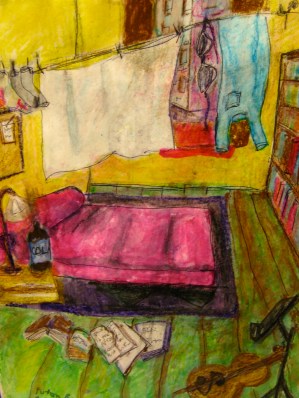
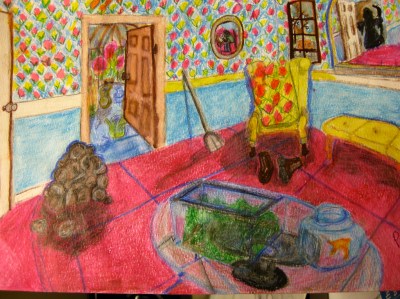
Okay, here are some more “interiors” of various sorts and with varying success. I tend to use mirrors and windows to say something, but what I have no idea. In any event, the entire picture has not always made it into the photo, but if it has, then you must look carefully at the details sometimes to figure out what is really going on…

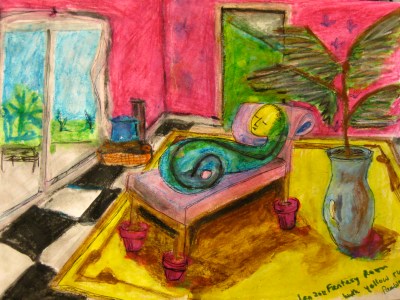
Curled Woman on Chaise

Interior #2, above

Interior #3: Red Futon with Laundry
Interior #5: Moving Day Unable to Move

Person at lower left is seen from above and behind — weird perspective in entire picture. The rest must be deciphered by viewer! 8)

Interior #6: Medicine Chest and Ambivalent Husband

You have to look at the details of this carefully, if you can see them. The man in the mirror is not exactly as harmless as his electric razor would have him seem. Clue: check out other mirror at upper right!

Don't throw stones at Glass Houses

Alas, my pile of stones does not look too much like stones but the glass houses are both the terrarium and the fish bowl, but also the conservatory seen through the center door. Note the figure coming in the other door (seen in the right hand mirror) and the artist herself in the round mirror — if you can make her out!

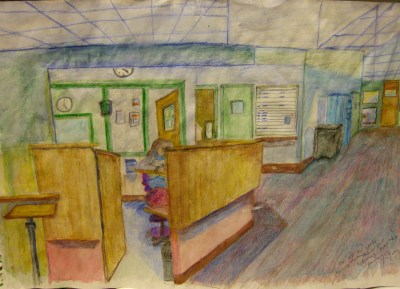
Natchaug Hospital Nursing Station

Done in watercolor paper on crude sketch paper but a copy on card stock given to the nurses…

And there were more but that is it for now.

Check out two posts below if you have not seen them as all three of these were posted tonight!

Natchaug Hospital Stay and Comfort Room

I have been away since December 17th, in the hospital yet again. This time the experience – at Natchaug Hospital in Willimantic — was vastly better than the previous two and not abusive at all. I want to tell you about this, but first let me go back to what happened to get me there.

In the beginning of December I began to have trouble again. The “people” came back with their jeering and mockery and commands. A general confusion assailed me. In my journal I recorded many “cries” of MATOOTAM! : “Kill the Ogre that Ate Manhattan” which many of you know means me. I also began to burn myself under the influence of those command hallucinations. I still believe this was all a Lyme disease relapse, but I had been on antibiotics  previously for 8 years – with positive tests for Lyme and other tick-borne illnesses intermittently during that time — without being cured, so there was and continues to be nothing but symptomatic treatment. This means, as my new psychiatrist, Dr C, argues, at least temporary use of the hated, and loved, atypical antipsychotic, Zyprexa. I already am taking Abilify and Geodon, as well as Lamictal for mood stabilization and possible temporal lobe seizure activity. However, as has happened before, these were not effective enough to carry me through such a crisis, which is why I was encouraged to take Zyprexa, 20 mg to head off anything worse. Despite my resistance – I really hate the immediate increase of appetite and weight that accompanies taking it – I did so, I assure you. But the damage was already done and the crisis took on a life of its own, so to speak. By mid-December, I was  no longer “safe,” the code word my visiting nurse among others uses for my listening to the commands the “people” give me. She didn’t know how true that was, though, until I finally admitted it after four days of what I will only describe as obedience to those same commands.  I saw Dr C that Thursday, and though she was uncertain of my safety, she decided that I would talk with her every evening until I saw her again the following Tuesday.


The truth is, I do not really recall most of this, neither intellectually nor emotionally. I have had to be told and to refer to my journal in order to recount all of the preceding. However, I do remember what happened next. In addition to the reappearance of the People, I began to experience what I called “brain blips.” These were very brief episodes in which I felt as if my brain suddenly did a somersault, a little like the feeling when your heart skips a beat, except that it was in my brain and accompanied by a terrible dread and feelings of impending doom. After the fraction of a second in which the blip occurred, I would come back to myself – it felt as if for an instant I lost consciousness, but the blip was so very brief that it didn’t seem possible. These episodes were terribly frightening, even though nothing ever happened during or after them, not at least of the dreadful sort I feared.


That Friday evening, my heart racing and my mind itself awry, I was in another world, so confused that I wasn’t quite sure what was going on. I managed to call Dr C, who prescribed Ativan. It was too late to call the nurse to pick it up for me so I got in the car to drive the mile to CVS but as soon as I pulled out of the parking lot, the other world took over completely. I do not know how I actually got to the drugstore. I recall only that I could barely hear or see for the pandemonium in my mind but that I was aware enough of the danger to drive only 20 mph the entire way. Once there, however, I didn’t know what to do. I didn’t know how to get home and I forgot about getting the Ativan altogether. Somehow I managed to tell the pharmacist that something was wrong, that I couldn’t drive home, but she thought I meant that the car had broken down, and called a cab for me. I went outside to smoke a cigarette and wait for it, but I was so scared of the shoppers who came and went – the drugstore was open 24 hours a day so anyone in the area who needed something after 10pm came there – that I was unable to take more than a few drags, hiding behind a pillar. I returned to the pharmacist and whispered that there was something terribly wrong, with my brain, that as I felt, bugs had infested it and that I was in another world. Finally she understood and called an ambulance.


I won’t go into the drive to the ER except to say that I was so “out of it” that I wasn’t even upset that the EMTs made me get on the stretcher right in the middle of CVS and that everyone saw me being taken out of there. Once in the vehicle, I tried to explain to them that despite the large wound they would discover on my leg, there was something wrong with my brain itself, that this was not a purely psychiatric matter and that I needed medical, neurological care. Indeed, I still feel that way, but much good that did. Once a “mental patient” always a “mental patient” it seems. I admit, though, that having burned my leg did not help much. Still, I tried to explain that I needed an MRI of my brain, that something was wrong, a bleed or parasites or something! You can guess their response: of course, they summarily dismissed all of that and quickly had me packed off to the psych section of the emergency room. Although this is a very comfortable, large and separate unit of the ER, with single cubicles for each patient and a TV but also a video camera in each one, I waited 3 days before a bed was available for me, some 25 miles or more away at Natchaug Hospital, a psychiatric hospital in Mansfield Center, in Connecticut.


I name the hospital openly – as opposed to the others I have written about — because it was  amazing in so many ways that I want both to sing its praises and to “advertise” it so to speak, to describe what a really good psychiatric hospital ought to be like. It is true that most people were in for a very short time, Connecticut having virtually no long term beds any longer, not even in the state hospital, but whether acute care or for somewhat longer stays, Natchaug was quite simply the best place I have ever been. From the food, to the – well, let me go into more detail rather than a mere summary (though in my opinion, the food was indeed a cut above that in any place I have been in, both in availability, and, with a salad bar at every meal, quality.)


Upon admission there was, to my dismay, a requisite “clothing and body search.” This procedure was done in such a way as to preserve as much dignity and privacy of one’s person as possible but I feared at first that it boded ill for the rest of my stay. Also, I discovered that although there were, I think, two private rooms, I had been assigned a double, a semi-private room, with a roommate already installed. This was upsetting to me, as I had almost always had a single, or been moved to one because the unit staff either felt I was too disruptive or unable to tolerate the stress of a roommate. However, when I saw how the semi-private rooms were carefully partitioned with a floor to ceiling wall in between the bed areas, I was much reassured. Although I eventually did for a short time have a private room, or a double that was designated as private – I frankly do not remember why! – I was not bothered by either roommate that I had while there. The one who did try to get me to – Oh, I dunno. I just am no longer one to “socialize” with other patients and I simply did not feel like getting to know her, or to excessively “sympathize” or otherwise expend my limited energy on her problems. I feel a little bad about this, but this one roommate, the second one, at first tried to involve me in her “stuff” and even left a journal or something next to my bed “for you to read to find out more about me.” Well, this was so very intrusive, and nothing I had asked for at all, that I rudely, but decisively said, “Why would I want to do that?”


I know that I would have been terribly hurt and humiliated by someone’s saying such a thing to me, but on the other hand, I would never have been so forward with a complete stranger either. In any event, she quickly took the papers back and left the room. However, a day later, she seemed to have no hard feelings, and we got along, if distantly at least as well as I wanted to.


Where was I? Well, I will tell you that the worst thing about my stay, and I suppose unavoidable, since I was there over the holidays, was that I had three different doctors for the three weeks I was there. but the best things were two, or more, but two in particular. One was that there was NO seclusion room, that is to say, the seclusion room that they used to have was not only now designated at the Comfort Room, but in fact was comfortable, and open at most times for use by anyone needing comfort. In it, there were thick mats on the floor, a Grandma Moses-like mural painted on all four walls by artist staff members and best of all a “therapy chair.” This is a very large and comfortable rocking recliner that is built in such a way as to elevate your legs, while you recline against the back, and let your feet dangle over the end. This allows the person to position the very lightweight chair near a wall so as to be able to lightly touch the wall with the feet and keep the chair rocking with little effort all the while lying back and relaxing. Their next improvement planned is to get headphones, wireless, or MP3 players with a  selection of music for additional relaxation and comforting.


I usually tell staff at hospitals that they “cannot keep me safe” and indeed “prove” it by obeying in some fashion the commands the People give me…This never exactly endears me to anyone, and in fact has more often than not earned me a reputation as very difficult, even as having a “borderline personality” as an Axis 2 diagnosis (not true). Be that as it may, I was in fact kept safe at Natchaug, and when I was not, I was on a very helpful rather than punitive 1:1 or constant observation. At Natucahug, one-to-one staff were supposed to talk to me, rather than kept from doing so as at other hospitals, “so that you won’t come to like the attention too much.” The few times I became very upset, screaming, just screaming, at the top of my lungs, and rather than choosing to go on my own was escorted to the Comfort Room, by “staff assist” people (there is no “Dr Strong” goon squad of uniformed security guards), the door to the room was open and someone talked to me the entire time. Thus, when I left, on my own, when I felt calmer, I also felt that the reasons that I had been so distraught were also alleviated.


Also, although Natchaug, like any other hospital, did have a restraints policy, they did not use them a single time the entire three weeks I was there. In fact, though there was a very disruptive, troubling patient there the entire time (for once it was not I) I do not believe they even came close to considering using them. This time I believe it when they said that they almost never have to use them at all.


But the very best thing about my stay was something quite serendipitous: it turned out that the Director of Nursing for the whole hospital is Sharon H, the very same APRN who had been head nurse during my many stays at a Hartford hospital, and who had taken upon herself to supervise my care, or at least seemed to have in some sense “taken me under her wing.” Sharon is, and always was, both extremely bright and compassionate beyond words. She is also insightful in a way that I found the first two doctors I had were not, and if the third was, I did not have a chance to find out because I saw her only 4 times. It is true that Sharon had the advantage of having known me well, if 17 years ago, but still, she seems to have this ability to size up a situation, at least with me, and both to calm me if necessary and to suggest a solution that simply fits…I have to say that I felt especially well taken care of. Sharon made sure she saw me every afternoon, though this was above and beyond the call of any duty.


This description scarcely does my stay at this hospital justice. Although, like any hospitalization, it was not an easy stay, nonetheless I can only say that I cannot thank Sharon and the Natchaug staff enough for all that she and they did for me.

(PS Forgive any typos I have not yet corrected but it is getting late and I am too tired to go back and check for them at the present time…Lazy me!)

Schizophrenia and Traumatic Treatment: Continued Use of Restraints and Seclusion

Please note: For my final take on what happened at Middlesex, please jump to this link: https://wagblog.wordpress.com/2012/05/15/useless-psychiatric-mediation-and-a-poem/   (added in September 2012)

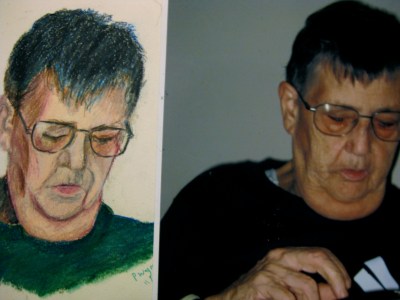
First, before I start my post today, I wanted to share my newest artwork, which is a colored pencil “painting” of a woman who lives in my building, whom I will call Rose. She did not ask me to paint her; she was simply someone who sits quietly for many hours in the community room, and so was a good subject for a portrait, and a photo. I also happen to find her a very agreeable person, one of the nicer ones here (most are gossips and backbiters, or if not most, then the most vociferous and visible of the residents). I think she will be quite pleased with how it turned out, so long as she does not expect anything but a portrait that is faithful to life, rather than an idealized one. I believe, however, that Rose is very down to earth and knows what she looks like, and will appreciate what I have painted.

Rose, intent on her needlework
Rose intent on rugmaking
Rose comparison of painting with photo

_______________________________________________________

Now I want to discuss, yet again, the use of restraints in Connecticut psychiatric units, particularly as it pertains to my treatment there. As I recall, I have not gone into much detail about the last hospital stay, back in April and May, largely I think because it again was so traumatic and in many ways similar to the previous one, that I could not bear to contemplate it.

However, as very little as I recall, I do remember more of the stay than the complete amnesia I still experience for the stay in Manchester, back in October or November of 2009. When I say I have a loss of memory with regards to this other hospital stay in the spring of 2010– in Middletown — I meant it more for the specifics of certain episodes. And for any of the people there who staffed the unit. (Except for Christabel the OT).  With regard to much that occurred I believe a lot could be brought back to me, under the right circumstances. I do, for instance, continue to have an overall memory of what the place looks like and where my room was and some details about what happened. What I do not, and did not remember, not even the next day, was most of what precipitated the use of restraints and seclusion during this stay. Or at least, of the two or three incidents of S and R two are jumbled together, so that it takes some mental probing for me to straighten out any of it. but one incident remains too clear in my mind for comfort though even at the time, or immediately afterward, as well as now, I have no idea what was the actual precipitant.

Anyhow, what I recall of  that episode is this: I had been taken off Geodon, which I took regularly with my  Abilify up till then, both in order to boost its antipsychotic properties as well as to temper any Abilify-induced irritability. The irritability was physical as much as mental — and with the resultant tendency to get into verbal fights and arguments with anyone who, as my mother used to put it, looked at me crosswise. I have no idea why they did this, took me off Geodon, given that I know I explained the rationale for the use of two antipsychotics. But many MDs seem to find this objectionable, however effective. Perhaps they considered the 20mg Zyprexa, which they had talked me into taking on an acute basis, would be an adequate substitute for the calming effect of the Geodon. They had wanted to stop the Abilify, too, using Metformin, a diabetes drug, for weight control, but I had insisted on taking it both in an effort to combat Zyprexa’s tendency to cause weight gain, but also because I believe that it is the Abilify that has so massively enhanced my creativity.

So there I was, on Abilify untempered by Geodon, and taking Zyprexa, which induces its own “upsetness” when my weight invariably increases…I assume that I must have been hostile, loud, and disruptive, for I do not know why else they would have made me go into the seclusion room. I do remember that I could not calm down, and that in the flimsy johnnies they had clothed me in, I was freezing, so that even when the nurse doing constant observation told me to lie down and rest, I was unable to do so for all my shivering. I begged for a blanket, but no deal. I pulled the entire bare mattress over me as a covering. Well, this was apparently seen as a self-destructive act, or something, as immediately they pulled it off me and dragged the mattress itself from the room. Now I had nothing for warmth, except my own anger at having been treated  in such a fashion.

I remember that I was yelling a lot, and that I wouldn’t lie down on the cold linoleum and “calm myself.” No, I wanted to talk, and begged the nurse to do so. Instead, she only turned away and told me again to lie down on the floor. Well, this enraged me, and I went to the door to complain again. She said nothing, only stood in front of the open door so that I could not leave. Finally, getting no response, and still anxious and “het up” I suppose you could say, or over-activated by the Abilify, I tried to push my way through her into the opening. Immediately two “guards” pushed me back into the room. I yelled at them, and pushed back. One of them asked me what was wrong with me, why I didn’t just ask to talk with the nurses instead of resisting physically…I looked at him and said that I did ask to talk, and she refused. He seemed somewhat surprised by that. Nevertheless, he ordered me to go back into the room and lie down.

I was having none of this dictatorial behavior on their part, and as I recall, at one point — no, I do not remember what happened. I only know that suddenly the guards were on top of me, and one had pinned my arms behind my back and was pushing my face into the linoleum floor. It was as if I were a recalcitrant inmate of a prison and this was a cell “take-down.” I was hurt and I was furious.

When they let me up (and why they had pinned me to the ground I have no recollection, only that when they let me up, I was finally allowed to talk to the nurse nad stand out in the hall with her. I heard some talking behind my back and a commotion, followed by feet going down the hall away from us. I had a bad feeling about it, and asked the nurse, “What are they doing?” She responded, ominously, “They are preparing a bed for you.” “a bed? what sort of bed? She remained silent and I understood that they were putting restraints on my bed…”You can’t restrain me, I am out here calmly talking to you. You haven’t even offered me a PRN and I will tell you now that I would be more than willing to take one. But I am NOT a danger to myself or others, and you cannot legally put me in restraints.” The nurse continued to remain silent. My heart began to race. I called down the hall, “I will not let you use restraints on me, I am calm and this is not allowed.”

Some of the staff approached me and told me to come down to my bed room with them. I complied, because I knew that if I didn’t they would have some reason to say I “deserved” to be restrained. When I got to the room,   I found I had been correct: there on my bed were the straps and shackles of four-point restraints, attached to the bed frame.

“I am calm and I am not a danger to myself or others,” I carefully declared. I will take medication and I do not need restraints.”

“Lie down on the bed, Pamela” someone told me. I refused, saying that this was punishment pure and simple and that they had no cause to do this nor any legal right. “I will ask you one more time to lie down on the bed, Pam, or the security team will help you do so.”

At this point, I understood that they were going to use this form of discipline on me no matter what I did. That they were out to get revenge and that they would use any excuse to excuse such measures. So if I “made” them force me into the restraints, that would by itself prove that I “deserved” them. So, more humiliated than I believe I have ever been in my life, I sat down on the bed, then lay down on my back and said out loud, “I am now placing my limbs into four-point restraints, and I want a record of the fact that I am calm and not resisting and that I have asked for a PRN instead.”

It was no use, though, as they went ahead and shackled me, then left me alone in the room, except for a staff member monitoring me through the door, left partially ajar. My heart was racing with rage, and I could feel the pain of such profound humiliation surging through me. But I did and said nothing, I think, because I was going to prove to them that the drastic measures and punishment they had inflicted on me was WRONG. After about an hour and a half someone came back and let me out. I was neither compliant now, nor placated and as soon as I was free and out of that room, I let it be known, loudly  that I intended to file a complaint. But no one said a thing, no even spoke to me the rest of the night…

THAT is what I remain so traumatized by, at least with respect to  this time: the utter humiliation of what you might call “cutting my own switch,” along with the clear understanding — even mutual acknowledgment — that they were punishing me.

This continues to preoccupy me, that is when I allow myself to think about it, or when I continue to try to read the records of that stay, which records I only a week ago obtained (having sent for them many weeks ago…). I cannot help but re-experience the same brutality and the same extreme and exquisite humiliation, and once again it hurts beyond belief. The worst thing perhaps is that when I told my family about what the staff had done to me they didn’t come to my support, they didn’t unconditionally defend me. They didn’t even  seem to care, or to believe, that I had done nothing to “deserve” four-point restraints (as if anyone deserves them). Another family would have automatically come to their member’s defense and declare that NO one deserves such brutality, and that as their family member I should never have been treated that way. Another family would have done  –oh forget it!  No, my family is always so eager to please the staff and to believe that I am in the ‘wrong” at these hospitals, to believe that I am at fault, (this is the story of my life!) that they simply told me I must have caused their use of such brutal methods of control by my own behavior, I surely deserved it, and besides “what else could they do?” Shackling me, calm and rational, me to a bed was clearly the only option and entirely justified…So much for MY family’s loyalty and compassionate support, huh?

Well, bitterness solves nothing, so I won’t dwell on the last subject, but I will say that if I can, I intend to file an unoffical complaint, or barring that, an official one. The problem with the latter is that I will not then be able to confront my persecutors. whereas if I did so unofficially, it might yet be possible, if only to avoid a messy public affair. After all, I could easily write something…No, I won’t go there. For now, I only wanted to describe what continues to occur at Connecticut psychiatric units, despite the regulations and general disavowal of the use of cruelty in the treatment of those with mental illness. It still goes on, it just happens behind the closed doors of the hospital and the continued use pf seclusion and restraints as discipline and as a salve for frustration, depends on the assumption that no patient will bother, after the fact of discharge, to do anything about it, except try to forget.

Things are better than this, but do not feel it!
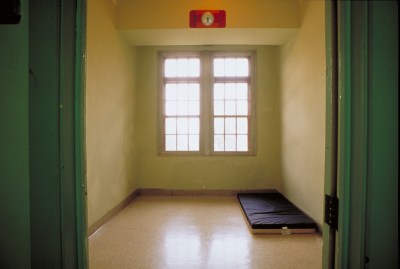
Note the linoleum and bare mattress. I have never seen a windowed seclusion room!

The Painted Woman, Poem for 350.org, plus yada yada

My newest artwork is what I call The Painted Woman, for I think obvious reasons.

The Painted Woman, in all her glory

It is not meant to be a parody or an insult to any sort of woman, just a study of an overly made-up  “older” woman who might drink a bit too much and get loose around the edges when she does. I think it is clear that she has had plastic surgery, though it hasn’t done a lot for her, with  her artificially plumped lips, which do not work at all with her boozy aged face that the exaggerated make-up only serves to enhance in the worst sense of the word. If her botoxed brow doesn’t disguise her real age, neither do her drawn-in eyebrows, which is something women do that I never did understand: Isn’t any sort of eyebrow better than the kind that are just a line drawn or painted on? even Frida Kahlo’s eyebrows!

Frida Kahlo, with her eyebrows, of which she was NOT ashamed...She was proud to paint them and did so without shame or trying to disguise them. In fact, she even painted herself with the mustache...

I love those eyebrows, full of character and strength, and the portraits, which could be seen as brave and wonderfully lacking in vanity,  I prefer to think Kahlo painted because she saw herself simply as beautiful, eyebrows and mustache and all, and painted herself on that account, not at all “in spite of” her flaws…

That said, I do not believe that my painted woman is beautiful, perhaps for much the same reason that I hope Kahlo felt herself to indeed be beautiful: this, my pictured woman, is not only artificial, she is desperate, pathetic and even tragic…I feel sorry for her, who is, after all, my own creation!

_______________________________________________________________

All that aside, the reasons that I have not written are several, including my having to get that poetry book manuscript rewritten and out by the 15th of October (not that I have a chance to win a contest that is judged non-anonymously, but it does no harm to try, so long as it doesn’t tie the book up for the next 6 months…). Then I had that Life Drawing class at the Creative Arts Workshop, which is still difficult for me, partly because I cannot see well, and cannot translate what I see to a large piece of paper on an easel…I don’t have any difficulty with the gestural drawing, the loosening up exercises, actually, I have more difficulty with the longer drawing periods. The trouble is that I do not want to take the time to do a drawing for only 30 minutes that I know I cannot do in that short a “long” period, and also, I find it hard to stand on my feet for that long. The class is 3 hours long in fact, and all of it is standing at easels, while when I do my portraits I mostly just sit in my recliner or at a table with my paints and canvas on a table or at most at a little broken table easel that I bought at the CAW tag sale and fixed myself.

Nevertheless, it has been a good experience, if exhausting.  I drive to New Haven then stay overnight and drive home on Tuesday morning. So the night spent away from home feels like a big deal every week, not just a mere evening away…though I could treat it as such, I suppose.

ALSO, Dr C wants to see me twice a week for the time being — actually for more than just “the time being.” It is a very complicated situation that I cannot go into here, but this 2X a week set-up may not continue, I dunno, I would like to, and I know it kept me out of the hospital in October, but but but…I am simply getting very mixed messages from certain people (decidedly not Dr C) about it, and it is hard to know what to do. I sometimes think that it was easier for people to have me in the hospital twice a year, despite their protestations, than to keep me out if keeping me out entails my seeing Dr C 2X a week. It is certainly less expensive to hospitalize me, since it saves money coming out of their pockets ( I am not a drain on the “system” otherwise, because I do not need public mental health services or ask for anything from those strained agencies, for which fact they ought to be grateful…though not for my hospital stays, of course).

But no more on that subject, which is utterly confusing to me and frightening to boot. I cannot bear the thought of ever being forced into a hospital again, where I am ALWAYS ABUSED and BATTERED by the staff, despite being tortured by myself and my own demons already. Even thinking about it makes me tremble…

Will be returning to Wisdom House in two weeks, for another weekend. I hope to write some more poetry, and perhaps “fix” the ms, by writing up an introduction and putting in some divisions between groups of poems, rather than the vague segues I have now. I thought  they were obvious, but others do not seem to “get” why one poems transitions to another…So I will group them better, and put what feels like artificial divisions between them. That way, readers will feel there is some shape to the book, a clumping, rather than a thread that one must follow…

There is much I would like to say, but it is already 2:45 in the morning, so I needs must cease and desist and get to bed. I will try to write as soon as I can, but if nothing else, I promise to write when I am at Wisdom House on the 19-21 of November.

The following is a poem I wrote last year, and put one version here then, after I went to a vigil for the organization 350.org, a website devoted to the cause of getting our atmospheric CO2 levels down to 350 parts per million, because that is the level at which life continues to be possible…whereas if we continue to let it go up, global warming will continue to such an extent that life on the planet will be impossible.

But that said, here is the poem, for what it is worth. If it sounds familiar, it is, but I have also reworked and changed a lot of it…


FRIDAY NIGHT VIGIL

Shivering in the wind, we fight to light our candles
as we gather in the darkness of an approaching storm.
But the icy blow keeps snuffing out each flicker
so we just stand, our signs alone aloft to passing traffic,
standing for the stand we take: for the changing world,
for a last chance at change. We smiling stand for photos,
taken from across the streaming street –
and smile into the night, display our handmade signs.
One car beeps, a driver gives the V-sign in support.
But most drive on without a single word or sign
that they have heard or seen a thing, or even recognized
we’re standing here for something save a hopeless cause.
My hands freeze stiff, release their glass and candle with a crash,
a glint of shards, a splash upon the sidewalk. Someone
with safer gloves stoops to sweep the shards away…
I think, How lovely is the world today, even dying.
Though it’s all we have (and lord knows, it’s more
than we can handle) we stand here in this freezing dark
against the darkness and light one candle.

Collage of Christabel: Middlesex Occupational Therapist (finished)

Finally I have finished the collage here with the background completed and the candy foil earring (I saved foil from innumerable chocolates…and they have no come in handy as I know eventually they would.  What do they say? Everything can be an art supply, looked at with a creative spirit. Who says that? Well, I dunno, I guess I do! 8D

I call her Christabel, who was one of the occupational therapists in the hospital this past April and May (all of the OTs were great.) She was a wonderful woman who was the one person who consistently treated me like a human being at a place where I was often not treated much better than an animal or a bad child. Consequently, I never once, as I recall, had occasion nor impulse to scream at her in rage or frustration. Lkewise she never felt it incumbent upon her to withhold from me such ridiculous items as gluesticks or magazines, the sort of carrots with which the nurses attempted to “tame” me. That is, negatively, by taking them away from me until I ‘behaved’ according to their rigid standards. Never once did they acknowledge what I had begged them to understand from the moment I walked in there, which was that I suffered from Lyme disease-induced schizophrenia, and that both the rage episodes and my impulsivity were uncontrollable, (i.e. literally OUT of my control, and “not me” — as the weekend doc herself, Faye H., who knew me well from treating me for years in the past, noted several times in dismay).

Be that as it may, when the nurses, or one of them, the one who really hated me, refused to grant me permission to use a gluestick one afternoon in order to work on this collage, it was Christabel who came to my rescue, by bringing some from the OT office, without so much as a word or caveat to “not tell the nurses.” She simply handed them to me, along with a handful of new magazines to tear colored scraps from, so I could continue work on my face, which I had only just begun.

Everyone asked me, as it was coming together, if I was modeling it on  anyone. But the truth is, though I call it Christabel, it is more in honor of her, than intended to be a true likeness. True, she is African American, and has very close cropped hair, but that is as far as the similarities go. In fact, the face is pretty much imaginary and generic. I took the features from, well, my mind, mostly, though I used various faces from magzines to give me an idea of how the light would fall and create shadows, and how the various contours of the features would look. Also to give me a better idea of proportions. The nice thing about these kinds of collages is that paper is very forgiving, so if I made a huge mistake, and made the nose too big or put the lips too close to the nostrils or, as I did, make the eyes too small and close together, all I needed to do was paper them over and start again. In fact, the more layers I used, the stiffer the underlying “post-it note” kind of thin paper foundation became, which proved a good thing when it came to finishing off the edges and finding a way to hang it. I cannot f rame it, as it is 46 inches by 32inches, approximately, and formally framing it would cost a mint. but I polyurethaned it, one, so it would not distintegrate, and bound the edges neatly, and think I will attach a dowel or piece of thin wood at the top to which I can affix a wire and hang it by that. The person, the woman who runs the solo shows every month at DHMAS in Hartford, said that though everything was supposed to be framed, basically as long as it can be hung by a wire, my plans sound fine.

Well enough of this. I think the new photo shows how I finished the face better. Though I could not get the bound edges into the photo alas.

Saphris trial plus Poem

Sorry for the long absence. I was in yet another Connecticut hospital for 6 weeks,  and as usual it was horrible. I admit that they — the staff — must have hated me as much as I hated most of them as well. I do not think that they understood quite how much I was “not myself”  most of the time I was there. Luckily, perhaps, the weekend doctor was one who had treated me years ago and for several years at that, and she said quite openly that she had never seen me like that and knew something was wrong. But the other staff did not know me and so they took my rage and irritability as “bad behavior,” as one nurse called it. Why it didn’t occur to them that there was something strange about the fact that I didn’t even remember from day to day what had happened or what “I did” I do not know.

Anyhow, now I am  on a trial of Saphris but I do not think it is going well. I cannot motivate myself to do much of anything, including writing, reading or any kind of art. I even look at my beads and wonder what on earth ever possessed me to want to do jewelry making. I am hoping that I will be switched back to Abilify soon (not Zyprexa on which, after the hospital, I gained at least 10 pounds). At the very least it must be added to the mix. Otherwise I do not know what I will do. Dr B and the visiting nurse probably will not agree, feeling as they do that it does not work for me. But I think it does and frankly I will not take anything else, so it is the Abilify and the Geodon, or the Abilify and the Saphris, or nothing at all.  There is nothing else that works at all that I will take.

I will also add that after struggling to feel that Dr B was helping me, and that he “cared,” I have decided that we do not work well together. Maybe some other male psychiatrist and I would, but for now I am switching over to a female doctor, Dr C.. She seems very nice, and if she and I do not work out, there is yet another that seems promising. But so far I felt very good about Dr C right from the start.

So for now that is all that I have the energy to write. For the short time that I was on Zyprexa right out of the hospital I wrote a poem called, “How to Swim: Poetry Manual #2”, and I wish I could share it here, but I have sent it out for possible publication and I do not think the magazine would appreciate it if I printed it here first (they are fussy about things like that, alas.) So I will leave you with one that I think will go into my second book but which I probably won’t publish before then instead.

ARTICLES OF FAITH

Black ice. An accident’s chain-

reaction like toppled dominoes,

and you steer into a skid

on the frictionless slick

missing, by the merest sleet needle,

a chrome-crumpler 28 cars long. It’s night,

your face glows dashboard green

touched with gold as we pass

streetlights in review.

Someone up there

must be watching out

for us, you say, meaning you,

me, and this carcass of a 1986 Chevy,

in ‘03 still too good to let go.

But it is something more than

mischief in me when I remind you

of the 28 drivers whose cars accordioned

in the whiplash of impact.

Was the the big guy upstairs

not watching out for them, then,

or worse, deliberate in his neglect?

But this is not a theological poem,

it is only a prayer whistled

devil-may-care into the void

by a nonbeliever who knows nothing

is guaranteed save that none of us

will survive our lives. The pile-up

behind us, we’re wowed breathless

by the nearness of our miss

and though there’s still

the matter of those hapless 28,

even I whisper Thank God!

to still my trembling hands.

(When I pasted that in it came out in double space, but it was meant to be single spaced. Not sure  how it will appear in the blog…)

That’s all I have the energy for tonight. When I have a little more, I will get back to you. Please do not give up on me. Thanks.

Pam

The Mentally Ill in Prison and Out-patient Commitment Laws

Dear Pam,

Thank you for the link to the Dr. Manny Show. There are indeed many faces of mental illness. Some people have mild cases and are able to work and function at the same level as anyone else.

Congress passed mental health legislation in 2008 providing for workers who have psychiatric dysfunctions to be covered under their employers’ health insurance at the same rate as employees with physical illness (certain exclusions apply). That was a positive step. However, acute mental patients do not benefit by that law, because severe mental illness is often too debilitating for victims to work, especially without the psychiatric treatment they need. In fact, people with acute schizophrenia, bipolar disorder, PTSD, and other conditions frequently resist treatment even when it is available to them.

Unfortunately, 1.25 million mentally ill Americans are currently imprisoned for offenses ranging from simple vandalism or disturbing the peace to murders. Last January, Rep. Eddie Johnson (D-TX 30) introduced H.R. 619, a congressional bill to resume Medicaid coverage for inpatient psychiatric care for patients in crisis and for people who require long-term containment in a secure treatment environment (such as patients who have done violence).

H.R. 619 is an important bill that deserves our support. It was largely the removal of Medicaid funding several decades ago that led to criminalizing mental illness. That in turn led to many other problems, such as overcrowded prisons and a burdensome prison budget. Hundreds of thousands of acute patients were “de-institutionalized” in the 60’s and 70’s only to become homeless and/or prisoners. Thousands of acute mental patients continue to be dismissed from mental hospitals and prisons without subsistence assistance and provisions for continuous monitoring and treatment under programs like Kendra’s Law.

Assisted Outpatient Programs like Kendra’s Law have been proved to reduce homelessness, arrests, hospitalizations, and incarcerations by up to 85% (among New York participants, compared to their circumstances three years before becoming program participants). The impressive rate of reduced arrests and incarcerations also indicates that community safety was improved significantly as less crime was done, and it also follows that the prison budget was lessened by helping patients with living arrangements and mandating continuous psychiatric care for ex-offenders and former inpatients who often lack the wherewithal to make wise treatment choices and avoid psychiatric crises.

Assistance to the Incarcerated Mentally Ill (AIMI) supports Rep. Johnson’s bill, H.R. 619, as well as NAMI, Treatment Advocacy Center, and many other mental health advocates who believe resuming funding for inpatient treatment is best for patients and for America. In fact, 100% of police officers I polled agree that prison is not the place for severe mental patients, where they comprise 60% of the inmates kept naked in solitary confinement cells.

I solute Congresswoman Johnson, a former psychiatric nurse, for introducing H.R. 619, and I hope everyone who is concerned about human and civil rights will support the bill and end the discriminatory practice of punishing Americans for being sick. I pray for another bill to be introduced to address the second cause of mental illness having been criminalized in America – the lack of continuous care and subsistence assistance for released prisoners and former inpatients. Kendra’s Law should be applied nationwide so that acute mental patients will be treated, not punished, for having a common, treatable health condition that requires monitoring and care just as diabetics and heart patients receive.

Inpatient hospitalization was not included under the national health care plan, so it is very important to pass H.R.619 as a separate bill. Please write an email to your representatives tomorrow and ask them to co-sponsor the resumption of Medicaid for psychiatric hospitalization and to institute Assisted Outpatient Treatment progams, which would not only be more fair and humane to sick people and their families, but would also save taxpayers billions each year as our prison rolls decrease.

Thank you, Pam, for this forum and for the useful information that WagBlog always has. I will share the link to the Dr. Manny Show with many people at my Care2 Sharebook and at FreeSpeakBlog, where we often publish mental health news as well as other matters that have to do with promoting human rights for prisoners.

Mary Neal
Assistance to the Incarcerated Mentally Ill
http://www.Care2.com/c2c/group/AIMI

PS Please VOTE for H.R.619 to replace prisons w/ hospitals for acute mental patients. The link below will take you to OpenCongress.org where you can use your voice to say to our elected officials, “We care about the least of these, His brethren: naked, sick prisoners.” (Matt.25:36) http://www.opencongress.org/bill/111-h619/show

While many Americans celebrate the health care reform bill’s victory, please agree that millions of citizens should not be left imprisoned or live under the threat of prison because their health care needs were omitted. Put the “NATIONAL” into health care reform by supporting H.R.619: Medicaid funding for psychiatric hospitals instead of prison cells for mentally challenged people – a change that will save money and restore lives!

Thanks in advance for voting. Please invite others!

___________________________________________________

Dear Mary

I think you know that I was quite ill until starting in 1996 when Zyprexa came out, but not truly until 2005,  when a complete transformation occurred. However, when I relapse, I “relapse good” — as my medical record from the October hospitalization attests, with nearly constant locked seclusion or restraints for 6-8 days etc. Nevertheless, I am with you, though reluctantly, as I also know how terrible the side effects are of some of the older medications are as well as the newer ones, and the horrible state of affairs when a harried or burned out psychiatrist simply rams them down your throat without consultation at least after the acute psychosis resolves and you are able to discuss such things.

When I was in Manchester Hospital, I begged to be put back on my anti-convulsants and the Abilify/Geodon combination that had served me well for many months, believing, with reason, that I was suffering from a flare-up of my neurological Lyme disease, an illness that had always and invariably produced severe psychiatric symptoms. I needed, I knew, an increase of those drugs rather than a wholesale change to the “old drug” Trilafon. But did the doctor listen to me? No, he did not, despite my  ability to say as much to him, my psychosis consisting not of incoherence but of paranoia and command hallucinations to  harm myself in order to atone for being the Devil…I could and did argue with him, vehemently, and steadfastly, refusing to take the Trilafon, until he instituted a standing restraints order for every time I was non-compliant.

These are the sorts of things that trouble me about  forced treatment and/or outpatient commitment laws. It is not that I think people suffering from severe psychiatric illness do not need or deserve treatment, only that the treatments available are not always effective or tolerable. And until they are, I am not sure that the only way to go is only to force medication on everyone willy-nilly, not, at least against their protestations of extreme discomfort. At the very least every effort must be made to find a medication or medication combo that keep the psychosis at bay while making the person as comfortable as is humanely possible…which is difficult when a psychiatrist is saddled with a hundred patients to see in a week. It took Dr O and me six years or more to find  the right combination of drugs, and to titrate them precisely enough to treat my symptoms,  reducing them significantly while keeping unpleasant side effects to a minimum.

There is much about the treatment of the mentally ill that is so disgusting I cannot begin to cover them all here, though your comment is very thorough, which is why I have put it up  as a regular post. I appreciate your links to sites that do so as well. You did not mention one horrific situation: where under-utilized supermax prisons now house “uncooperative mentally ill prisoners” whose lack of compliance or cooperation is due solely to their illness. Though it is well-known that such brutal conditions drive “normal” or reasonably sane prisoners to insanity, can you imagine the brutality of forcing a psychotic individual to reside in such isolation? (Note however that in years past, as you know, isolation and seclusion of disruptive patients in hospitals was also the norm, since “overstimulation” from the outside world was considered to cause their agitation…I have been in hospitals where, in bare seclusion rooms, I was not permitted access to letters or phone calls, visitors or even reading material. As for restraints, they too were inhumane as I was shackled SPREAD- EAGLE, to the four corners of the bed and not, as even then was considered proper, with my legs straight and my arms in position by my side. This treatment moreover was considered normative for agitated psychotic patients rather than cruel in the extreme  as recently as the 1980s in some municipal hospitals in Connecticut.

I  recommend the book, THE DAY THE VOICES STOPPED, by the late Ken Steele, who wrote of his experience as a 14 year old with the savage isolation policies in NY hospitals in the 60s and 70s,  treatment that today seems literally incredible.

Well, I thank you for your contribution to my blog, Mary. You are welcome here at any time. I will post as many of your comments as I can.

Sincerely,

Pam W

Seclusion and Restraints: Observations from the other side

Here’s what my friend Josephine knows about what happened in October, having been my designated “contact person”:


According to Jo, I was admitted on Wednesday around noon. Apparently the nursing staff called her, as well as Lynnie, as my emergency medical sheet instructs.


She comes up to see me that evening, bringing with her some clothing and toiletry items etc. and while she is there she makes it clear to the staff that she is my “caretaker” and is to be told everything so that she can contact my family, when the need arises…(This seems to work, as it turns out, as she will be kept in the loop, thank god.) Anyhow, I am doing relatively fine, though the nurses say I refuse to take the medication the doctor prescribed, which concerns them. Apparently there are plans already being made for a hearing to force me to do so.


Before I fast forward to the weekend, when Josephine next sees me. I want to interlace here what I do recall, which is one conversation with the doctor, in his office, during which he tells me that he wants me to take Zyprexa.  “Have you heard of that drug before?” But then memory gets fuzzy, because I am back in bed,  in a bedroom I think is a double, though I am not sure, because I know that for most of my stay it is a single right off the nurses station where they can keep an eye on me, and just as he leaves, I raise up on one arm and scream, “I will NOT take Zyprexa, you F—ing bastard!” Dr Z stops in his tracks, looks back at me, and says, rather mildly, “That’s not very nice.” I finish off with, “Fu– you!” He has heard this before, clearly, turns on his heel and leaves.


The next memory I have must occur also before Josephine returns. I am sitting in a room with Dr Z  and someone I think is a judge or a hearing officer. A woman sits on my left, perhaps a patient advocate or a nurse, I do not know.  I recall specifically that Dr Z (whose name I only learn after I am discharged) seems to have spoken to the folks down at N hospital where Dr O practiced because he quotes what I recognize is their Axis II diagnosis, word for word.  This was created specifically for me by Dr O. in addition to paranoid schizophrenia and always struck me as  malarky but was a sore point too, and cruel as it seemed to blame my illness on me. (I had many words with her about it, and I challenged her  to prove it was true. She agreed it did not hold water, since it was only “true” in hospital, and so was just a convenience to satisfy  staff unhappy with my uncontrollable behavior — yes, there too, and equally unremembered!)


Nevertheless, it was written in my chart at N hospital and so now it is repeated as if gospel. In addition, the doc decides that he has seen, in two or threee days and five to ten minute interviews with me, “absolutely no evidence of narcolepsy, and no reason to treat for it.” He believes that my sister’s attempts to influence my treatment,  giving him my history of medication responses etc. constitutes improper interference and should not be permitted under any circumstances.


After that, I lose all interest in the discussion, knowing it is not going to go in any direction that will be in my interest, that I am being treated by someone who neither knows me nor cares to learn enough to treat me properly. Furthermore, having been taken off all the medications I have come in on (except oddly enough for my Lyme disease antibiotics) as having been “ineffective, by definition, otherwise you would not be here,” I am already feeling drowsy and distant, at a remove from the proceedings and not quite caring what happens. The proceedings come to an end when the hearing officer, or whoever he is rules in favor of the doctor, who wants to force me to take, not Zyprexa but Trilafon, 8 mg BID (twice a day) or Haldol by injection if I refuse. I may object and say I will not do so and will only take the damned Haldol kicking and screaming. Or perhaps I say nothing.  I don’t really know.  I may  only think this, but it is a prescient remark, or thought, in any event.


Memory becomes a series of refrigerator-dim flashes. I vaguely recall one incident: literally kicking and screaming while being held down for an injection by any number of security personnel…But even this memory constitutes no more than just an impulse of light on the confrontation, as if I am looking down on my body as I struggle with the guards, no more. Then just blankness.


What Joesphine tells me next is that she returns on Saturday, bringing my poetry book. She is appalled at the change in me and asks the nurses, “What happened to Pam?!” I am not merely irascible, she says, but explosive. I am mean and I am violent to the point that I will not let anyone  come near me. If they attempt to I lash out, not just verbally but physically as well, any number of times actually slapping, smacking or in some fashion hitting the nurse of aide trying to take my vital signs or give me medication. She tells me that even when I appear to be deep in thought, sleepy or sedated, I can in an instant rouse myself to fury and explode, launching into a tirade of invective and even physical abuse.


At the same time, I am ataxic ( one nurse gives me red  slipper sock to warn staff that I constitute a “risk of falling” but these are soon lost and not replaced) and while I can be wild and have the strength of a rabid animal, at times I have trouble simply getting myself out of a chair. Once, a big security guard, seeing Josephine struggle to help pull me up from the recesses of a deep armchair, comes over to help and I go berserk. Suddenly violent, I take a swing at him, swearing  and screaming at him as if he were the one to have attacked me, rather than the other way around.


Once Josephine looked into my bedroom before she was shooed into the day area with me, where all visiting was supposed to take place, she saw that restraints — big leather cuffs — had been placed on my bed. According to her, they were used as frequently as every time I got medication or even every night in order to keep me from — well, I do not know what! But I can only imagine, given how she tells me I behaved. I do know that restraints are only supposed to be used in cases when violence is imminent or uncontrollable by any other means. Now she does assure me that they were, so far as she could see, only two-point restraints, the wrist ones, but that they were actually placed on my regular bed horrifies me, since it implies that they were to be at the ready and expected to be used, i.e. they were not simply an emergency appliance to be acquired from a rarely used, locked cabinet unopened for months at a time.


As an aside, I discovered when I arrived home, many just healing scars on my left leg that were not there before I was hospitalized. Yet I also remembered telling a nurse at the hospital that of all the places I had been, their unit was definitely the most safe, the most secure. I felt that it would be most difficult indeed to hurt myself there, as there were very few opportunities and almost no chances were taken…So how can I square that with these scars? I cannot remember when or how I acquired them. I only know that the summaries of my chart mention that I did injure myself, early on, which resulted in four-point restraints at least once (another being the slip-knot episode already described). But with what, and why I have no idea. Probably because of command hallucinations, and self-hatred. But that is only my surmise.


I “came to,” I rose to the surface of my insanity only once or twice that I recall, once to see my father sitting by my bed (why was he allowed  to visit in my room?) and Josephine standing there while I screamed something. I remember she abruptly left. After that, the darkness closed over me again.


The only other time I surfaced was when they dropped me on the seclusion room linoleum…about which I have written in some detail. But even then, I cannot really remember if it was one whole incident, or two or three amalgamated by a trick of the brain’s confabulatory instinct, and  the passage of time into a single coherent tale.


Then there is my journal , which tells a story that in its own way corroborates this one. Usually when I am hospitalized at least in recent years I  keep a detained record of everything going on around me for reasons of paranoia if nothing else. Because of this, I can read back afterwards and understand what I was thinking or doing. This has not always been true, and during some hospitalizations, further back, I was unable to do so,  and thus do not have such a record, but I am glad when I do because it helps me piece together what happened during times that I otherwise experienced later as blanks.


However, during the two and half weeks and longer during which I was  literally out of my mind this past October (Josephine insists that I wasn’t “right” even when I got home, and that it took a good two weeks before I was truly myself again)  there is no written record, not in my journal. I wrote a little during the first few days,  going from a self-loathing that speaks of a desire to burn my face (“deface my face and face up to my sins”) mingled with psychotic ramblings to utter confusion. This is almost indecipherable and devolves suddenly on Thursday to nothing at all, represented vividly if accidentally by two blank pages. It is only on briefly on Saturday and then on Sunday, October 18th and Monday the 19th (which may have been only a continuation on Sunday, as I was still confused as to the date and time), which I firmly believe all day is “Monday the 20th,”  that I apparently find the strength and clarity to “steal” a felt marker from OT and then a memo pencil to write with. All writing utensils but crayons have been denied me previous to this, I remember that much, though I also have not been able to, have not wanted to write either or I would have done so even with a crayon.


Now, to my pleasure this marker and then the pencil is not  taken from me as too dangerous for me to have in my possession.d I begin to write. I write all day, literally. I write and write, 41 pages in one or two days. I write down everything that happens, and I write as if I know what has been happening, but really without the slightest inkling. It is clear that I have no idea what I have been through, nor what I have been like. I write of a nurse, one I clearly like, telling me I am “doing great” and my consternation at this, because I do not understand why she is telling me how I feel rather than asking me…


I write of my impending discharge, and I believe I write about how I don’t remember the last two weeks, but it doesn’t seem to bother me much. What does bother me is why no one on staff will talk to me, why people seem to avoid me, and why one male nurse seems bent on being nasty to me “for no reason.” (I may have made a point of hurting him during my weeks of insanity, that is all I can surmise as a reason for his animosity…).  I am paranoid — at one point I interpret the constant opening and closing of the weekend Dr H’s door, which I can hear from my room near the nursing station, as deliberate torture, intended to “get back at me.” When I finally get a glimpse of Dr H, I scream at him “You think I don’t know what you are doing, but I do, I do!”  He gives me a truly bemused look. I am thrown into confusion, not sure how to read it.  I  remain fairly certain, however, that he is “doing a number on me.”


(End of Part 1. I want to reread the rest of what I wrote during my last three days on the unit before discharge — then I will continue with Part 2.)

Seclusion and Restraints: How it feels

I remember, I remember, well, I remember very little, except in flashes of dim light, like a candle held up by which to read the fading pages of an ancient diary. I remember a sign with my name on it, taped to the door of a room, and how hard it was to find my way back, no matter how many times I made the trip. I remember a nurse with blond hair named “Patty,” whose real name, Lil, I learned only the second to last day I was there. I think I liked her, or that she treated me with kindness, and another nurse named Mary Ellen, who was kinder still, but not always there to save me.

I remember too, but again in uncertain flashes that tell me only that something happened but not exactly what: Being carried by arms and legs into a cold, empty room lined with linoleum, dropped onto my back on the floor, dressed in just two hospital johnnies and pajama pants and locked in there alone. I remember begging for a mattress, then screaming in outrage when I was refused.

This is how it goes: There is nothing in the room but me and air conditioning turned on full bore, though it is October and in the 50s outside. Why do I need johnnies or the huge pajama pants that are falling off me without ties to hold them up? Alone in that room, I take them all off, then squat to pee and take a dump. Good, that feels better. Blankness. Cold, cold. Again I scream for a blanket. Of course, nobody answers. I try to push the johnnies under me to cushion my bones so I can sleep, but the shivers prevent me from relaxing. I have to do something.

I make a long rope of the silky acetate pants then form a slip-knot and put the O over my head with the knot to one side. I pull tight, figuring it won’t take long. I sit to one side of the little window in the door, so no one sees me immediately. Finally they come running. But they don’t understand it is a slip-knot and that pulling at it only tightens it  more. I am struggling for air. A nurse yells for scissors, bandage scissors the only ones available and they cut the pants free. Still, I am in big trouble. I would tell them I only wanted to get their attention, that I just wanted a mattress and a blanket, but what good would that do? Still, do they really think their act of violence, which will follow, will solve anything? Blankness. I have been thrown onto a bed in another seclusion room. As staff and goon squad wrestle my wrists and ankles into padded cuffs, I kick and bite in protest, all of which will be written up as my being “assaultive.” In the end, it is no use.  I scream and scream until the usual injections – 5 mg Haldol and 2 mg Ativan – take the scream out of me and I finally fall asleep.

That should have been the end of it. “Wake up calm and they take you out of restraints.” That’s the name of the game. But this time, I wake and I am still in full 4-points. I ask the nurse why. “Doctor’s orders,” he says. “But that’s punishment!” I answer, shocked. “No,” he says, “restraints are therapeutic. We never use them as punishment.” “Bullshit! Dr Z is punishing me because he doesn’t like me and you know it. He is a sadist.” The nurse doesn’t answer immediately and when he does, he just says, “Go to sleep.”

I remember how they kept me in restraints for 12 hours that time. The chart summary tells me more, that I spent a good part of 5-7 days in seclusion and/or restraints, so there is a lot I do not remember. Am I better off for not knowing? That’s what some people tell me. How would you feel? Would you want to know, or not to know?

————————————————————————————

I realize that the above is simply a restatement of an earlier more detailed post, so it must be obvious that I am still very troubled by what happened. Indeed I am. I am even more troubled by my lack of memory the rest of the three weeks there…which fact was noted even in the summary of my stay, which Dr B (Li) got from the hospital the other day (in lieu of what he requested, which was my entire chart.) Memory loss has dogged me for many many years. Only now can I acknowledge it, and only because Lynnie and others witnessed it. But for so many years I felt desperately  troubled and, well, desperate to hide it, afraid lest anyone know how little I could remember of what happened from day to day. This was especially extreme when I was in hospital but even afterwards it was troubling to me; sometimes I felt I was missing half my life! People — that is to say,  doctors. nurses,aides — expected me to remember ordinary happenings, because they obviously  thought that I was responsible for what I did from one day to the next, which you are not, not in the same way, if your memory is impaired. This expectation was so stringent that I dared not admit how little I did remember of events after they passed. I thought the scant trace they left would somehow prove my evil, prove that I was a shameful deficient person. So  I desperately took cues from others about what they wanted me to “remember,” tried to “pick their brains” about whatever it was that had happened, or that I had presumably done, whatever it was that they expected me to recall. Sometimes a concrete clue might help me piece things together – say for instance if I had scars or wounds that hinted at recent self-injurious behaviors or if there were scribbling on the walls that suggested another sort…But if there were no cues, it was much harder to ferret out what was wrong. Sometimes I might have to come right out and ask, “And you are referring to…?” But I didn’t dare do that often or it would have given my lack of memory away, something I didn’t dare permit…

Now here is the other side of the story, which I find hard to square with my experience in October: one  psychiatric nurse’s account of how situations involving restraints can look to staff.


Hospital, Hypomania and How Hope Eventually Returned…

Pretty tame for a seclusion room, but this one is in a school so it has carpeting not linoleum...The thought that little kids are held captive inside is pretty disgusting through.

I wrote in the post below that for three weeks in October I was in Manchester Memorial hospital (a new unit for me. To explain, the hospital you are sent to in this state these days is a total crapshoot. Sometimes the ER can admit you to theirs, but if it is full, as it so often is, they can send you literally to any hospital in the state that has an empty bed.. With the governor having decided to close one of the few state facilities still open and the municipal hospitals so over-utilized that an average stay was 5-7 days only, you can imagine how inadequate any attempts at treatment are. I do not mean to diss the hospital staff in general. Some do mean well and are appalled at what their jobs have devolved into, others however seem not to care that they are no more than warders in double-locked secure psychiatric units where few are admitted truly voluntarily or at least only on an emergency basis and yet no one can stay until healed. Generally speaking, one stays only until such a time as they are either no longer acutely suicidal or no longer a danger to others… That said, I have to be somewhat circumspect about what I say and the judgments I make as I was and tend to be when in any hospital so paranoid that I simply cannot draw any reasoned or reasonable conclusion about the staff or the treatment there, since it is always more or less (and usually more) through the lens of my sense of  personal attack and persecution. In truth, I scarcely remember any of the details or even the gross facts of this particular hospital stay. In fact, I have had to be told second hand, or even third hand, most of what I did there and/or of what happened.

I can say a few things from memory, though, and the picture I posted above is relevant to that: I remember being hauled off to the seclusion room and more than once. (I do not have even the slightest scrap of memory why…which is unnerving, and yet also a relief, as it protects me, possibly, from memories I might not wish to have…I hasten to add however that my lack of memory is not psychological, but neurological: we were warned by my Lyme neurologist that I should not have ECT while I still had CNS Lyme disease as it was likely to produce untoward CNS effects that could not be controlled or predicted. Since then, my short term memory has been particularly affected, among other things (e.g. olfactory hallucinations).  IN other hospitals, the seclusion room usually had a mattress in it, something upon which you could lie down, and were expected to, in fact, since you were given medication and expected to calm down and sleep in general. At other hospitals, I stayed in the seclusion room for an extended period of time, either because I was extremely disruptive (NOTE: see posts about Natchaug Hospital regarding this) or extremely psychotic. At those times I was usually permitted other items in the room, such as magazines and some small personal things to pass the time with…But during the month that is ending, I was literally manhandled into the room and dumped on the floor — hard linoleum — stripped, forced into a johnnie coat (I had to beg for 2), and summarily left behind, the door locked decisively between me and whoever was posted at the observation window.

I remember screaming, I remember begging for a mattress to sleep on, I remember begging for something to cover myself with for warmth or at a minimum for the heat to be turned up as I was thin and it was notoriously cold on that unit, and there was nothing whatsoever in the seclusion room to buffer the air conditioning. No deal. They just told me to be quiet; actually, I do not believe they even said that, but just, No. I do not remember much more than that. In fact, though I have been told the next, I do not actually remember it: there was of course no bathroom facility, and not even a bedpan in the room. Someone told me later that I defecated into a cup…But I do not see how that is more reasonable than that I did so into a bed pan…Why would I have a cup in there  if I did not have a bedpan…No, I believe that in both instances I have been told about, I peed and defecated directly onto the linoleum. If I did so, I cannot explain it. Perhaps I was simply desperate and they did not provide any other mode of relief. Maybe I was angry at them, and did it to “get back at them”? (This was suggested to me as a motive by the person who told me that I was not the first and would not be the last person to do this in that room…which was both a small source of relief, to not be unique, and yet to have done it as a kind of revenge?!  I did not want to believe that I would or could be so primal in my anger…But then, I have done it before, if you recall…

After that — and my memory wants to “see” this, feels it almost can and almost does, but I cannot be sure that it is memory rather than a mere confabulation  after the fact, having been told the bare bones of it by Carolyn (Lynnie) and others, who themselves only heard about it but did not see it either…after that I believe I crossed the room to , hoping there was no slant in the floor that would make the puddle slide towards me, and lay down in a heap and fell asleep.

Or did I? Did I? Or were there consequences to my act? I know that at some point in my “stay” — seems so mild to call the brutality of my hospitalization merely a “stay,” as if at a spa —  I was put into restraints and kept there a very long time. Was it for a separate incident, or was it connected to…Aahhh, wait a minute, yes, I do know, I do know…I remember now…For some reason, and I do not quite remember why, except possibly I was just so sick of everything that was happening, and so…I remember taking off the hospital pajama pants that were way too big for me anyway, and never stayed up and had no ties to pull around my waist and so were useless. I pulled them off and wound them into a narrow rope, which was easy as they were made of very thin material, then I formed them into a kind of slipknot,  fitted it over my head and around my neck and pulled on the  one end that had to be pulled for the knot to tighten, holding the other  like a kind of ballast (I don’t remember entirely how I did this only that it felt dreamlike, how easy it was to accomplish). I have forgotten what I was thinking, if I thought at all. Probably I did not think, I was that far beyond any rational thinking, even beyond any rational “wanting” in the sense of really wanting to die or not.

In any event, it seemed to take a long while before anyone noticed, and then a whole crowd of people were suddenly upon me, and they didn’t seem to know how to get the noose off  or how to loosen it. I held the end that slipped tightly in my fist, having no desire to relinquish it, though at the same time having I suspect no real desire to die either, that they could not easily free it. I heard someone yell to cut the knot. I remember thinking that was silly, why didn’t they just untie it? But it seemed that that was not possible, or at least that it was taking too long.  Then there was a pair of scissor up at my throat where the knot was — it seemed that  only bandage scissors could be found and those were not easily accessed — and someone was ripping at it, and then it was torn away and my neck was freed.

Stop. I have to stop here. Memory now fails me. I can only speculate what happened after that, because it literally blurs into nothingness. Goes blank. Goes back into the vault wherever all my lost memories go, perhaps never to be retrieved, if never fully or adequately formed. All I can do is try to reconstruct what might have happened next. I am pretty certain that it was after this that I was put in restraints. It would make sense. After all, what else could they do, and what would make sense? If I wasn’t safe in a seclusion room, in a hospital that in fact DID resort  to seclusion and restraints, it seems only likely that restraints would be the next measure taken. So I have to assume that it was for that reason I was put in four point restraints. Also, since the doctor I had been assigned to, thought a sadist by many on the unit, was  also the director of it, it was likely his call that led me to being kept there for more than 12 hours, and maybe as many as 18…I honestly have no idea in the end how long he kept me in such a fashion, only that I was not released even after I had fallen asleep…

That is almost the sum total of what I can, as a kind of “hard copy” memory, remember on my own. As you can see, even with those few memories, I had trouble and some help in recalling them.  I have some vague sense that a great deal went on during those 2 and a half weeks when I was largely insensible to what I did (at least to the extent that I did not recall it from moment to moment). During the last half week when I finally cracked the paranoia that kept me imprisoned, my memory did not improve, only my temper and the distance I kept from and my anger towards those who I had earlier felt were working in cahoots to hurt me. My impression then was only that some people were angry with me, but I did not know why, that some people resented me…But I could not figure out why. The ones who seemed to brighten when I smiled and help nothing against me told me gently a little about what I had done or how angry etc I had been, but only vaguely. They did not seem to understand that I had literally no memory of the previous 2 and a half weeks, or if they did, they did not seem to want to refresh my memories, perhaps feeling that it would be unkind, I dunno.  In any event, I learned a little about the “Pam” that some thought they knew, or that some people thought they had met and known for those 18 days…and that others had believed was in there all along and were now  glad to see emerging…But it was very confusing. And in all that confusion, I also had to deal with the fact that the new doc who had taken over after the sadist doc was removed from my “case” thanks to Lynnie’s intervention,  had decided that his philosophy of short hospitalizations would take precedence over whether or not I was fit for discharge, and so I was to leave on Tuesday…I had no choice, and so as I prepared to leave, I also had to “prepare a face to meet the faces that you meet.” (a quote from “The Love song of J Alfred Prufrock” by TS Eliot). But I was also growing more and more revved, more and more anxious. and I had no one I trusted enough to talk about it with. I certainly could not tell the day nurse. (I don’t think I did, but I do not actually recall one way or another). I knew she disliked me intensely, for all that she tried to pretend otherwise.

In the end, I did leave that Tuesday, though even as I got into Josephine’s car and she pulled out into traffic, she told me I didn’t seem right to her, that she didn’t think I was well or ready to leave. That fact seemed clear to almost everyone I saw that day. And not long after that I grew so talkative and revved that no one could get a word in edgewise…This was so emphatically not like me that thank heavens everyone put up with me, and no one, NO ONE, rejected me or gave up on me for it. I do not remember anyone being cruel or saying, GO away, you talk too much, or you are being too egocentric etc. I recall in fact only kindness and some humor injected into the situation, but mostly kindness. They all, my friends, as well as Elissa, the RN, seemed concerned as I rocketed higher, and yet seemed to feel uncomfortable and not at all happy with how fast I was speeding. Sure, Dr B diagnosed it a hypomania, but I  had thought hypomania was an enjoyable state, not this unpleasant adrenalinized racy state that felt so terrible to me. I hadn’t taken Ritalin in 3 weeks, but I didn’t even want to now. No, taking stimulants for Narcolepsy was nothing like this. This felt terrible and  neither Ritalin nor even Adderal had ever felt so terrible. There was no pleasure or even alertness that made me want to do things and study and write involved now. I got a little more cleaning done, true, but only because I was trying to exercise off anxiety, not because I had pleasureable energy. In fact, had I been able to slow down, I would have gone to bed to sleep it off!

Eventually, Dr B upped the Topomax and I think we had already increased the Lamictal and eventually over the course of the next week, I came down to my usual state of semi-sleepiness and was able to restart the Ritalin (after some discussion about why I take it…He is still new to the situation and my narcolepsy)

Well, that is about all I can tell you about the hospitalization just passed. But there was more to it, and what I know about it, though the facts are vague, is that there was something massively wrong…It felt like the Y2K meltdown in some ways, esp in my lack of contact with — reality, memory? Is there a difference? I feel that this was very different from my usual post-lyme hospitalizations, that I was in a different state, and so did others. It frightened me more, and it was more violent. Certainly the treatments were more violent, but that also implies that I was too. Lynnie keeps telling me she will talk to me about it. But so far, she has not… Do I really want her to?

Mary Neal Tells Her Story

I am going to try to embed the youtube videos of Mary Neal telling the story of what happened to her severely mentally ill (but non-violent) brother Larry M Neal in Shelby County Jail, TN, but I am not sure if it will embed or not. Here goes nothing! Ah! It did work, So the top one is first and the second one is last. PLEASE WATCH. and then go to the website mentioned in the post below this one and see more details of what is going on. This never ought to happen in the United States, it is evil, but it does, and it happens far too often. I think Johnnie Cochran would turn over in his grave if he knew what had happened to and within his firm after his death…

Thanks, everyone!

The Icarus Project and Mad Pride

This is how Newsweek begins its article about the Icarus Project and Mad Pride:

We don’t want to be normal,” Will Hall tells me. The 43-year-old has been diagnosed as schizophrenic, and doctors have prescribed antipsychotic medication for him. But Hall would rather value his mentally extreme states than try to suppress them, so he doesn’t take his meds. Instead, he practices yoga and avoids coffee and sugar. He is delicate and thin, with dark plum polish on his fingernails and black fashion sneakers on his feet, his half Native American ancestry evident in his dark hair and dark eyes. Cultivated and charismatic, he is also unusually energetic, so much so that he seems to be vibrating even when sitting still. http://www.newsweek.com/id/195694

Readers will note two things immediately: It is not common for someone diagnosed with schizophrenia these days to be “delicate and thin” — despite articles claiming to prove a supposed link between schizophrenia the illness and obesity, most of us would say that weight gain went right along with taking meds from the get go. And that most of us were originally either of normal weight or even thin compared to “normals.” the other striking thing, I think, is Will Hall’s level of energy. Most of those with schizophrenia, at least those on meds that I know, have a much lower level than normal of energy and motivation, which again is attributed to the illness itself. Now of course negative symptoms might be an effect of the illness, yes. But I also know that at least when I took the older drugs, like thorazine and mellaril, they added tremendously to any inner listlessness I might have felt. Indeed, what else is the infamous Thorazine shuffle but a drug side effect that practically screams medication-induced psychomotor retardation?

In any event, it may be that some of my readers with schizophrenia, and many of the mothers (and in my experience when caregivers visit this site it is often mothers who do though sometimes fathers do as well) of those with schizophrenia, may well disapprove of my posting this link. But I feel it deserves a viewing. Too many of us suffer the effects of medication without benefiting from its advantages not to offer another form of hope. As long as someone is not a danger to him or herself or others, why should they not be offered the experience of Mad Pride, should they prefer it? In these later stages of my own “condition” I too long to be off meds and to experience my experience, to do art unencumbered by the effect of meds that fatigue me if nothing else. But if I feel enabled now, and emboldened by some inner force to do art, I just might be liberated to unknown heights once off the meds, and if I can control the dangers I used to put myself in vis a vis cigarettes and such, why should i not be permitted such an experiment. Alas, no one here would ever allow it. I would have to endure such remonstrations and scolding and worse from relatives and others it is simply not worth it, or else I simply could not bear the bitterness of fighting with them…SO I am stuck, stuck on these deadening and dangerous medications until such a time as I feel free enough to move away, leave town and move elsewhere. Until such a time as universal health care enables me the freedom to leave the benefits Connecticut so generously provides me as a Medicaid/Medicare patient, and live elsewhere, I am simply forced to live in my same old tiny apartment and change nothing.

But some of you might be wanting to make that change and be more capable of it, be more able to maintain 1) stability and 2) a family support network, rather than a state of constant resentful watchfulness and remonstrations of such bitterness that make it not worth the effort. I know my friends would definitely support me, but I need my family to as well, or feel I do…I am not yet ready to say I can do without it at any rate…And so I remain in thrall to their demands on me, despite the fact that for many years I had no ties to them at all, and neither help nor obligations bound us. If it is good now between us, and I love that part of it, it also means that I feel that I must live up to expectations I could disregard before…and that is so hard, and often such a burden.

Nevertheless, I love them, insofar as I am capable of the emotion of love (see posts below for an explanation of that caveat). And if I am not, then I feel for them as mu9ch as I am capable of feeling for anyone…which is all they can ask.

But I have diverged from my initial subject matter which was Mad Pride. Tomorrow I give a talk and a poetry reading at the House where I live of 250 residents, though only a handful are expected to attend.  IN the talk I finish by answering the question, do I link mental illness and creativity, and my answer is, Maybe, but even so, in most cases the best work, mine at any rate, is done “best when I am better.” I mean by this that deep in psychosis I cannot write anything decent, if I write at all nor do any decent art, because I am no longer motivated nor able to concentrate well enough to do so. Perhaps in a manic state I have been able to, but those have sadly (yes!) been too few. Otherwise my more extreme moods  have been called a mixed state or major depression. In any of those moods, and certainly when extremely or even moderately paranoid, I do little work at all. And when hearing “bad voices” ditto, since that is when I am most likely to be concentrating on acts of self-harm and least on self-nurturing activities such as art. So you see why I say what I do, that only when I am at least getting better do I do my best work?

Moreover, I believe this is true of most people. It seems to me that even in the case of the Mad Pride artwork at the Newsweek site, those artists were not in fact psychotic at the time they did their art, Oh, perhaps they were depressed, but clearly not catatonicly depressed, by definition. And I cannot believe that they were disorganized even if their diagnosis was schizophrenia, because however weird the artwork, there was recognizable order and ordering in each and every one…

Welp, I am getting fatigued just writing this, so I will leave you with that short disquisition and the link to The Icarus Project. I am not endorsing or not- endorsing it, only expressing my interest and indicating my plan to continue to read up and find out more. Somewhat not surprisingly, there is an active ? branch in Northampton,  MA, which is the town I have wanted to move to for a number of years, but have not yet had the nerve. Nor has there been the financial or medical feasibility. Now there might be, but it is still not possible. Oh, I wish I could move, but there is Joe to consider, and I would not leave him now.

That said, here is the Icarus Project Link. Enjoy? Comments will all be read and appreciated. I will respond if I can.

http://theicarusproject.net/

Two Poems: The Middle of Nowhere

Although this poem, under  a slightly shortened title, will be in my soon to be released book, WE MAD CLIMB SHAKY LADDERS, I showed the rewritten version to my writers group tonight . It is basically a true story, about the friend whose recitation of a Gerard Manley Hopkins poem instantaneously converted me from a poetry skeptic to a poetry lover…but read on and you will see what happened.


The second poem was sparked by my recent hospital stay but not based on it, rather it is based on the misinformation purveyed by movies such as the ones mentioned in the beginning of the poem, and also in the books from which the movies were made.


YOU WERE A POET ONCE (NOW YOU ARE

LOST IN THE MIDDLE OF NOWHERE…)


You were a poet once. You touched my soul

with the gift of poems, teaching me to read and write–

oh, inevitably to write them, for writing made me whole

and I could never not write. I had no special goal,

only to “pour out a poem” and work it right.


That took me years. I was such a fool —

dreamy cups of poems, quote unquote, only wasted good ink…

But I was speaking of you. You gave me the tools

to teach myself; you should have returned to school.

You found vodka: you could not, after one drink,


stop. And though it seemed deliberate, a choice,

I suppose you couldn’t help it. On conversion day

you recited Hopkins’ “Spring and Fall,” your voice

for once not blurred by Popov. (Still, I didn’t dare rejoice.).

You were so sure, so caught up in what you had to say.


It changed me utterly. Few experiences work such magic.

Why you quit poetry for drink I’ll never understand.

Life made you querulously unhappy, so there’s a logic

in your refusal to live. But I’ll never not think it tragic

how your gift to me soured in your own hands.


REALITY CHECK


First, you have an address, a 9-digit zip code

and two free patient telephones, so you’re not lost

in the middle of nowhere, this is not the movies.

Not Cuckoo’s Nest at any rate, nor the I-Never-

Promised-You-a-Rose-Garden rose garden.

And that Girl, Interrupted? No, it is definitely not

her giant sleepover with hair rollers, gossip

and steaming hot chocolate. For one thing,

hospital tap water isn’t hot enough for cocoa

and unless your roommate, the anorexic

with fruity breath and ironed tee shirts

becomes your best pal, that’s it for the party,

no one else gets in your room. Even in a single,

the checker disturbs you every 15 minutes.

Now, I know that keys play a big role in film:

someone always swipes a set for the night

to go AWOL or wreak havoc. In reality,

“insurance cured,” most want to stay longer

than leave shorter. Going AWOL is more

the impulsive leap through briefly opened doors

than planned absconding at midnight

with a stolen keycard everyone is watching for.

Too bad paranoids still suffer, unable to trust

the good of best intentions. As for having

enough free time for the ward sociopath

to “wrap the catatonics in toilet tissue,”

there are too many groups and too many aides

with a job to do and you are it, so get moving.

Besides, catatonics are not allowed to stay

catatonic, what with medication and better care, 

so very quickly slowly they move too.