
 Dreamscape — not the best photo — colored pencil drawing
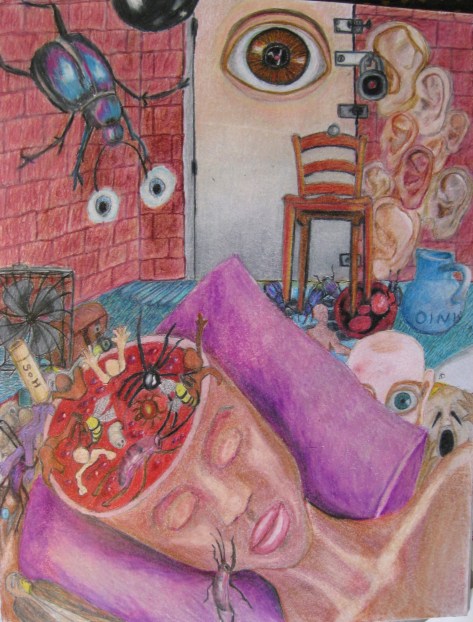

Dreamscape — not the best photo — colored pencil drawing
Just wanted to update you on where I have been and how I am: I spent 6 weeks at Natchaug Hospital in Willimantic, Connecticut this past July and August and though I was discharged as much improved, I am still having a difficult time, both readjusting and well, simply having a hard time of it. Although in the hospital they did a little adjusting of meds, increasing both the Geodon and the Zoloft, I am not convinced that either one made much of a difference nor that it did less harm and more good on balance. In any event, Dr C and I (at my request) soon eliminated the 25mg increase in Zoloft, and are now dropping the 80mg increase in Geodon. She is concerned that the 240mg is making me very irritable and more upset and frantic rather than providing enough relief to make it worthwhile. Yes, the voices are much improved, but that could be the passage of time and perhaps due to a general decrease in paranoia, who knows? All I can say is that I cannot take this general state of overwrought irascibility, a tendency to snap at anyone who “looks at me crosseyed,” as my mother used to say.
Natchaug Hospital remains a very good place, the best I know, and just as I remembered, not least because they have a philosophy of kindness and compassion towards patients. In fact, they are excellent because they have a philosophy and are not simply flying by the seat of their pants, hiring whoever comes along needing a job, burned out or not. Not only is their philosophy based on compassion and not on controlling the patient, but they see no point in rules for the sake of rules. It is clear that if there is something in the unit set-up that doesn’t serve a particular patient, the Natchaug staff will bend it as far as they can and try to accommodate each patient’s particular needs. As I was frequently told, why make someone miserable when you can make them happy? It is difficult to be happy in a psychiatric unit, and many patients are miserable because of their illnesses, but not once did I ever see a staff member add to that misery willfully and certainly not to mine. (I frankly could not say this of two Connecticut area hospitals, one in Manchester and the other in Middletown.)
One thing that makes many patients happy at Natchaug, by the way, is that caffeinated coffee is provided at breakfast, a rare blessing in in-patient psychiatric settings. And since everything is served cafeteria style, so you can have all you want.
They used to provide hot decaf coffee on the unit itself, which was a treat. Because one very ill patient tossed a cup of coffee at a staff member, however, and she was injured, and because for some reason they decided that that patient could not be restricted individually from having hot coffee, now no one is permitted hot drinks on the unit at all. Yet, I suspect that even he would have not thought it unfair to be kept from the coffee pot! I know that in other hospitals I have had restrictions placed on me that others have not, and no one thought it wrong or unfair to me…Anyhow, I dunno what to think, but it was their policy, a misguided one, perhaps, but who am I to say? I know everyone went nuts for a while about having to drink lukewarm “swill.” Finally, though, the patients simply gave up on the “coffee” machine and did without. Anyhow, I have to admit that when I first saw the hot coffee machine, I couldn’t believe it, not because I was thrilled — though I was — but because I saw an “accident”or worse already in the making…
Note: one of the few hard and fast rules at Natchaug is one they cannot change because they will lose accreditation: no smoking. Smoking is simply not allowed, not even on hospital grounds. While certain patients have tantrums about this and might cause an uproar from time to time in order to try to force the staff to allow them to use the courtyard to smoke “just one cigarette, just this once, please, I am absolutely desperate!” it is simply not possible. But people are allowed the patch and gum and every effort is made to help smokers quit. Even though some staff acknowledge that the policy is unfortunate, even unfair, nothing can be done about it.
I was not, however, comfortable for most of my stay there, and was paranoid a great deal of the time. Of course, I did not understand that the staff was aware of this, so when I began to come out of my delusions of persecution, it surprised me mightily to discover that they knew that paranoia was the reason for my hostility all along. Nevertheless, up to the very day I was discharged, I was hearing people talk about me up and down the hall and at the nurses’ station.
Well, that is all I am going to write for today because I am, as of a week ago, in the middle of writing my new memoir, and as the days progress I plan to put parts of it up here, for comments and for suggestions. Feel free to do both!
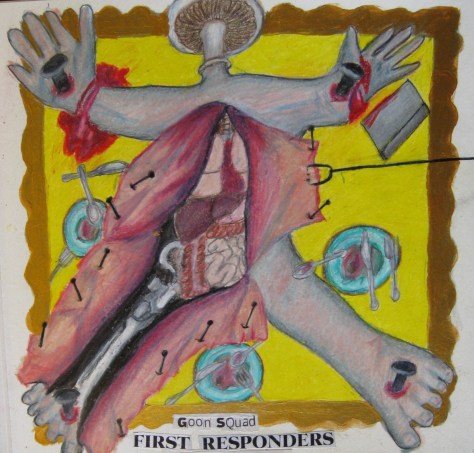
I will finish here with one of my latest drawings, which represents how I felt when I was restrained at Middlesex Hospital, both the time I described in a recent blog post, and the other(s) (for which I have amnesia) when Josephine told me I was more or less “out of control”…to which I can only respond: Violence begets violence, and perhaps if they had not perpetrated on me what they did, things might not have gotten out of hand, But then, that hospital is one that is guided by the Control for Control’s Sake philosophy and the nurses were bitter and angry people…Needlesstosay, they hated me if only because I refused to roll over and play dead, if not die.
Forthwith the picture.
You know what they say, that happiness is not to be found in how much money you have or in the things you own or can buy, nor even in how many friends surround you or how many people love you. The poem about Richard Cory, upon which Simon and Garfunkel (remember them?) based a once well-known song, just about says it all:
RICHARD CORY
By Edwin Arlington Robinson
Whenever Richard Cory went down town,
We people on the pavement looked at him:
He was a gentleman from sole to crown,
Clean-favoured and imperially slim.
And he was always quietly arrayed,
And he was always human when he talked;
But still he fluttered pulses when he said,
“Good Morning!” and he glittered when he walked.
And he was rich, yes, richer than a king,
And admirably schooled in every grace:
In fine — we thought that he was everything
To make us wish that we were in his place.
So on we worked and waited for the light,
And went without the meat and cursed the bread,
And Richard Cory, one calm summer night,
Went home and put a bullet in his head.
We all know it’s true, both the cautionary tale of Richard Cory, and that money doesn’t buy happiness. At least we know it with the left sides of our brains. Alas, this is still the side that does the intellectual calculations of how many friends or about the nice car we’ll need to have before we will finally be happy. And if we didn’t know it before, all we have to do is listen to the news because nearly every week it seems there is yet another story about a celebrity who seemed to have it all – money, beauty, acclaim, adoring fans – who ended up destroying himself on drugs and alcohol or who committed suicide (“no one had any idea she was so depressed…”) at the height of her career.
But if money and things and friends who love you don’t offer a path to happiness, what does? Is there a map, a guide, an instruction manual, a recipe? One look at the number of books on the market purporting to teach you how to be happy tells me there are lots of people making lots of money trying to tell you they have the secret. And given the number of books they sell, an awful lot of people out there are desperate enough to spring for them. If you have bought any of these books and found their secrets to be The Secret, or even to be one effective secret that worked for you, I would love to hear about it. Truly, I am not being sarcastic. I am a writer, and I believe that writers are for the most part sincere. Not all of them, mind you, but most of them. And so when a writer writes a book promising happiness, I believe that he or she probably believes it. I just don’t happen to think most of it ends up being effective.
But maybe it’s me, I dunno.
Let me explain. I have had many, many struggles with self-acceptance and self-regard over my lifetime (I am 58 years old at this writing, so you can see that I am far from young) and I assure you that I am far from winning the battle. My self-esteem is very low. So low in fact that I hesitate to say more… But at any rate, when I say my self, I mean my inner self, my soul, my – well, whatever it is that one might want to distinguish from the “self-that-produces,” the working self. What I mean is, I know that I write well, and I am learning to become a better artist as the days go on. But those skills have not fundamentally affected my self-esteem, only my level of confidence. And there’s a big difference between the two. I have a lot more confidence in my abilities than I did years ago, partly due to greater skill and long experience – though only in my writing — and partly due to caring less what others think, because there is less at stake at my age. My self-esteem on the other hand remains utterly unconnected to this, and largely unaffected by it. Whether or not I love or utterly despise myself has little or no bearing at all on whether or not I am able to write or paint or draw well. All it might do is affect what I write well or paint or draw about.
And I can be proud of my poem or essay or my drawing, proud of what I produced, without that having the least effect on how much I fundamentally love or hate myself.
But, and here is the thing: I do not believe that hating or loving yourself matters in the search for happiness. Or at any rate, it is not the sine qua non, the primary requirement before you can be happy. In fact, I think in the happiness department, self-regard is over-rated. It is not that I want other people to feel badly about themselves so much as that oddly enough I think it has little to do with whether or not one can find happiness.
Maybe I should amend the word happiness to contentment. I do not like the first word all that much, as it smacks of little yellow smilie faces and balloons and other inanities. Happiness is decidedly not inane, but our emphasis on the importance of it has made it seem so. Contentment as a word and concept has been all but forgotten in the rush towards the seemingly bigger motherlode of happiness.
So let’s switch gears and say that we are on the search for contentment, which also is not found in money or friends or in being loved by others. So where do I think you can find contentment? (Clearly I write this with my own agenda in mind…why else write it at all?)
I think contentment – indeed, even happiness – does come from within, and it starts with forgiveness.
Forgiveness? Why that of all things, you ask? It seems like so many other emotions and “emotional acts” should be more important – like loving yourself and others and being compassionate etc. But I assure you that without forgiveness, you can have and be and do none of those.
Kindness and generosity were always supreme values to me, even when I was a child. It hurt me inside to see anyone going without something that I had it in my power to give them. But it was many years before I understood that forgiveness was also a crucial value, that it not only partakes of both compassion and generosity but presupposes both. Not only is forgiveness an act of kindness but it is freely given and therefore an act of extreme generosity. You cannot force forgiveness any more than you can force a “sincere apology” despite what our parents might have thought when they made us “say you are sorry and you better sound like you mean it.”
Okay, so forgiveness is critical for contentment, maybe, but forgive what or whom? And why? First of all, everyone is scarred by their pasts, everyone has baggage from childhood. In fact, while some people had more than less happy childhoods, everyone has bad memories that they cannot shake, that have stayed with them and in effect traumatized them. Second, scars are simply an unavoidable fact of life. You can’t get through life without them, and childhood I’m afraid is a rough and tumble place where you pick up the bulk of them. Three, who “caused” our childhoods, for most of us? Answer: our parents, or whoever took the place of our parents. That is why our first job is to forgive them. I’m serious, and while we are at it, we have to forgive childhood itself, all of it. It doesn’t matter what happened, or how terrible, it really doesn’t. If you do not forgive it, if you do not forgive everything that happened to you, you cannot let your childhood go and get on with the present, which is where happiness, where contentment lies. Contentment is not in the past, that much we know, and no one knows a single thing about the future. But if you cannot forgive the past, and especially the childhood where you got all those scars you carry around now, you will never move beyond it to experience an undefiled present.
Look, I believe that forgiveness comes from inside the brain, but heals a place in the brain we like to call the heart. And I believe that forgiveness is more healing for the person who forgives than the forgiven. So I wish you could forgive all those people who harmed you too. All the people, relatives, friends, lovers, rapists, molesters, thiefs, betrayers and more…because I truly believe it would be good for you and for your heart. But I think it is essential at a minimum if you want to be happy to forgive your childhood, the entire experience of it, not the individuals or the single events, just the fact that you were a child and had to go through it. Once you can forgive it, you see, you can let it go just as it has and be gone.
After you have forgiven your parents or parent-stand-ins, and your childhood, you are well on your way. Many people would say that this is a step towards self-acceptance here, and that is how you reach happiness, but whether it is or not, is not important to me. In some ways, self-acceptance is not what I am after so much as acceptance of the world, both of the past and of the present. And when I say “acceptance” I mean such utter acceptance of it that you can forgive it. Because only when you can forgive, so I believe, can you really accept the world. And when you can accept and forgive the world both past and present, then you can be happy.
( I realize that I have put my poem below on this blog before, but clearly it belongs here, though it is for a second time. And dang, I do not understand why this program will not allow me to get it single spaced!)
TO FORGIVE IS…
to begin
and there is so much to forgive:
for one, your parents, one and two,
out of whose dim haphazard coupling
you sprang forth roaring, indignantly alive.
For this, whatever else followed,
innocent and guilty, forgive them.
If it is day, forgive the sun
its white radiance blinding the eye;
forgive also the moon for dragging the tides,
for her secrets, her half heart of darkness;
whatever the season, forgive it its various
assaults — floods, gales, storms
of ice — and forgive its changing;
for its vanishing act, stealing what you love
and what you hate, indifferent,
forgive time; and likewise forgive
its fickle consort, memory, which fades
the photographs of all you can’t remember;
forgive forgetting, which is chaste
and kinder than you know;
forgive your age and the age you were
when happiness was afire in your blood
and joy sang hymns in the trees;
forgive, too, those trees, which have died;
and forgive death for taking them,
inexorable as God; then forgive God
His terrible grandeur, His unspeakable
Name; forgive, too, the poor devil
for a celestial fall no worse than your own.
When you have forgiven whatever is of earth,
of sky, of water, whatever is named,
whatever remains nameless,
forgive, finally, your own sorry self,
clothed in temporary flesh,
the breath and blood of you
already dying.
Dying, forgiven, now you begin.
I recently wrote a post on my About Schizophrenia blog that addresses this question.
“Recovery, recovery, recovery, what a whale of a word. And by whale I mean a big whale, a white whale, a veritable Moby Dick of an obsession, only it is one that it seems no one is able to define in any quantifiable way. Not at least so that makes sense to me. “Recovery is a process.” You have heard that one, no doubt. I have used it in talks any number of times myself. Well and good, but so is digestion and so is having a heart attack, and in the first case you let it go on about its business in the background, whereas in the second, you definitely want to interrupt the process as soon as possible. So, okay, recovery is a process, as I blithely voice to my audiences, but what do I in fact mean by that?…”
You can read the entire post here:
http://aboutschizophrenia.blogspot.com/2011/05/recovery-recovery-recovery.html

My longtime dear friend, Joe Cornelio, died at the end of April, after living with, and I mean, living with, ALS (Lou Gehrig’s disease) for five years. Although he spent the last four of those years in a chronic care hospital on a ventilator and virtually helpless, he never once gave up on life or stopped loving it. He was a miracle of a man and even at the end I believe he would have continued to fight to live, even if all he could do was move one eyeball to say yes or no. It is entirely possible that he would have wanted to live even without that ability, but we will never know.
It is difficult for me to write about the day he died, or about how it came to pass that he was removed from his ventilator, but if you will bear with me, it may do some good (for me at any rate) to put the pieces together and get it onto paper.
I believe that Joe was misdiagnosed for many many years with schizophrenia, when in fact he had had Asperger’s from childhood. Now, that’s a long story in itself and though I could make a case for it, I cannot prove it. But I am not the only one who knew him well to notice that he never once exhibited signs of psychosis or even real delusions or true paranoia. Furthermore, from what I gather, the only reason the diagnosis came about or “took” was because he was put on Trilafon by a well-known psychiatric incompetent who was later “defrocked” and when Joe looked the drug up in the PDR and read what it was used for, he concluded that that meant he must have schizophrenia. From then on, so his story was, he told subsequent doctors this diagnosis, and apparently they simply took it on faith. In fact, for all the years thereafter until his terminal illness of ALS, the one doctor he saw not only never questioned this, but also never even reconsidered his absurd concomitant Dx as bipolar, even though Joe clearly had one of the most placid temperament possible and certainly wasn’t the slightest bit moody. No one so far as I know ever even considered that there might be something else going on. Even when I once went with him to see his non-medical therapist, did she really seem even to want to think about the possibility, as if it might be too much trouble…Perhaps, though I cannot recall, it was too late, if in fact this was after Joe’s ALS diagnosis.
But as I said, that is a long story, and not being a doctor, I suppose I can’t make the diagnosis, except that as his closest friend, I do and I feel that a great injustice was done. Not only was he saddled with a serious psychiatric diagnosis, and a stigmatizing one at that, but that particular neuroleptic medication rendered him much too tired to work as an engineer. All his adult life that was what he really wanted to do. Work. But the drug sapped his stamina…Worst of all, although eventually on Zyprexa which helped what might have been poor social skills due to Asperger’s, after he had been on it for years it caused the diabetes that ultimately cost him his life.
Speaking of engineering, all the years I knew him, Joe thought, breathed and ate engineering in one fashion or another. It is not that he was an automaton or a bore so much as that he applied engineering thinking to every problem that came up in life, even to our quarrels. Or better to put it, to my various emotional upsets. Whenever I got in some sort of “state” his approach was always to remain calm and to break things down into little pieces and to try figure out, or to help me figure out what was wrong and (just like a man) how to fix things. The beauty of this approach was that it so often worked! He never fed the fires, and he never took things personally, which was pure magic. Sure, he could be irritating for the same reasons, since when he was the source of my irritation, he rarely responded and he never listened to anything I had to say, unless someone in authority said the same thing, and then they got the credit. This hurt my feeligns time and time again, for I felt that he never took me seriously, and discounted everything I said as being worthless for my lack of degreed expertise. However, I came to accept that and by the end it was just a joke between us. I would find him a real expert to tell him what I already knew, just so he would believe it.
Anyhow, for all his faults, and even the dead are not blameless, he managed his last illness with amazing gracefulness and not a word of complaint. The day before he was hospitalized with the pneumonia that put him permanently on a ventilator, he saw a new doctor, who actually gave him a clean bill of health, so to speak, and said his lungs were clear! Joe came away from that hour and a half appointment not saying a word, even though he could not breathe well, and had been to see him because of it. The doctor must be right, no? After all, he was a doctor. (So much for medical degrees and expertise…) It was only later that evening when he went into a breathing crisis that Karen drove him to the ER where they found him suffering from aspiration pnsumonia, a common result of ALS when the throat muscles are too weak to prevent saliva and food and liquid from entering the lungs. He was immediately taken to the ICU and spent 3 months there, first with the aspiration pneumonia that almost killed him, and then, just as he was being weaned off the ventilator, with 2 more cases of hospital acquired bacterial pneumonia, which made it impossible.
After that, it was four years in the Hospital for Special Care in New Britain, where the care was indeed special. They were wonderful to him there, and I believe he would never have survived as long as he did without them. But in the end, Zyprexa had caused diabetes, which he did not even know he had until the ICU tested his blood sugar, and it was uncontrollable even during the years at the HFSC. During the final year the tissue around his tracheostomy started breaking down and would not heal, which is not unusual in diabetic skin wounds. Eventually the hole that held the tube grew so large that the air began leaking so much that he was not getting enough oxygen without the pressure beign increased dangerously, and during his last week, his lungs began to bleed, probably as a result. He went in and out of consciousness, according to whether or not he had had a transfusion.
Amazingly enough, though, one of the last times I saw him completely alert, conscious and able to communicate, he told me by moving his eyes and indicating letters on a letter board ( he had lost the ability to control his computer, which for years had spoken what he spelled with the gaze of his eyes) that he was “still chugging along.” When I asked him if his life was still worth it, and if he was still happy with it, he answered without hesitating, YES.
He knew he was dying, but he begged me to make sure no one killed him, that no one just pulled the plug on him or let him die through neglect. I promised him that, and asked his cousin, who was in charge of funds to hire an aide, just for someone to sit with him during hours when the hospital might be short staffed. This man, Ben, turned out to be an angel in disguise, apparently, though I met him only on the final day.
Why the final day even came as it did I will never know, I suppose. I still do not understand the rush, when the very day before from all reports Joe had been quite conscious alert and seemingly content. All I know is that I got a call the next morning that he was going to be taken off the ventilator that afternoon. I asked first if he was unconscious, and was told, um, yes…but it didn’t sound convincing. Then I asked if this was his wish. The response was that it had been pre-arranged back when he had first become ill.
I wanted to say more, but I was up against two strong men, his cousin and the doctor. And under the pressure of the moment, I forgot that I had any rights in the matter, if I did still. I forgot that at least in Joe’s living will I had been designated at one of the medical representatives, and that the cousin was supposed to consult with me before making any end of life decisions for Joe, and then only if Joe were in a persistent vegetative state or completely and permanently unable to communicate. But so far as I could tell, neither of those conditions were true, had not been true up until now and could not be shown to be true within the space of one day. Yet the announcement was so sudden and so abrupt and definite, that I had no chance to say, Wait a minute, what is the rush?! I simply stammered that I would be there asap. I now wish to god I had stood up for Joe. I know he was conscious when I got there, I know that he could have communicated with me and probably have indicated whether or not he wanted this done. But I didn’t dare ask him, or even bring it up, lest they kill him anyway and my letting him know in advance only increase his terror…Would they have done it expressly against his will? I had no idea! I was terrified that indeed they would have. I didn’t know what to do… I had brought in music for Joe to listen to, because I thought that he was unconscious, but he didn’t seem so to me and though he couldn’t respond, he did seem to see me. And even his cousin talked to him with the same apparent understanding.
But it was all grotesque, because I knew what we all did, and were dancing around not saying, which was that Joe was going to die within the next ten minutes. NO one even said a word. (I admit that I did, privately, indicate to Joe when all were out of the room, that I would be there all of the afternoon, for as long as he needed me, but I didn’t tell him exactly why. Well yes, I did say that the plans he had agreed to at the start of his illness– I cannot recall what I in fact said, but I let him know as gently as I could what was going on. Was I cruel, unintentionally? Well, get this: The doctor who was going to pull the plug came in and in front of Joe, as if he could not hear him, told us all what was going to happen, how he would make Joe unconscious with morphine and then turn off the ventilator, and related each stage that Joe would go through as he died…He told us this blow by blow right in front of Joe, right as I am sitting there at Joe’s side. But when I asked him to speak directly to Joe, he said, “No, not in Joe’s frame of mind, that wouldn’t be helpful.”
HUH????? What was that supposed to mean?
I will probably be asking that for a long time. Why did he not act like the compassionate physician he was supposed to be? Where was any shred of compassion? For god’s sake, if he was “helping Joe not suffer” where the hell was his empathy for his mental suffering? Did he think that just killing him was not going to cause suffering? I mean, what the hell?
Well, I cannot go further with the details, except to say that I left after Joe was essentially no longer Joe, once he was in a coma. All through his illness, Joe had never seemed any different to me, had never looked or become anyone any different from my old friend. But at the moment I looked up from his hand as I stroked it, I realized that he was gone (though technically alive) and that Joe was not there. I bolted then and there, realizing that I wanted not to see anything more.
Joe is gone now, and I had a really hard time for several weeks. The funeral was held very quickly an hour away in his home town, so few of his friends who had stuck by him could go, if any. However, a few weeks later, we had a memorial service for him in the hospital, a service I personally found somewhat hurtful, but that is another long story. In any event, I wrote two poems for him, which I read for it. Only one can I print here, as I hope to publish the other before I put it in my third book.
for Joe Cornelio
When you die,
let there be lightness in your limbs, so they can rise
to lift you from your bed.
May there be clarity in your speech
so your tongue can once more speak the names
of those you love. Let those syllables wash
your tired face. Take up your hands, reach for mine.
You can wipe your eyes now.
Let your smile widen and shine as it can.
When the perigee moon rises above the water
let it pour gold through the trees,
let the fish leap in the blue ripples of evening
and the frogs that are left sleep in the cool mud.
Wherever you are, may you remember
both the friends who stayed and the friends
who scared, for all of us loved you,
blankets to your chin, and let that warm you.
And should the light fail at the end of the tunnel,
remember: only when it’s dark
can you see the stars.
Due to a personal tragedy, I have been off line for a long time. Please go to my other blog to read this review, just written tonight. I will be back here soon.
http://aboutschizophrenia.blogspot.com/search/label/Latuda
Thanks all,
Pam

I took an image off the internet and substantially changed it (enough so that I made it my own, according to those in the know). I wanted to see how to draw folds in fabric, especially how it draped around the human body. It also interested me to continue to study the hand, and I enjoyed drawing these. Josephine told me they were too big. One person said they made the woman look like a man, even a drag queen, but my response to that was, well, it only adds a nice bit of ambiguity, which is fine by me! In fact I prefer that to the clarity of the following piece, much as I know that my brother will love it, and that is is “better” than the drawing that preceded it in this blog (see the entry below).

Both of these drawing are done entirely in colored pencils. I used a colorless blender sometimes, but mostly used either white or a lighter color on top of the other colors in order to “smooth” out certain surfaces, and on others, like the black fleecy top that Adriane wears, I used only the technique of drawing tiny circles in black on top of indigo blue, to imitate the texture of nubbly fleece.
BTW, I still see some flaws, which I aim to fix before sending it on to my brother, but I won’t masochistically point them out this time…Why flagellate myself if no one else will necessarily be stunned into unconsciousness by them?
I want to write about Joe, but it has been very upsetting, so I am trying to draw a dream I had about him a couple of nights ago…If I am successful, I will post it here. Or I will write about it in time.
In truth, of the following poems one is not really new, since it was published some years ago in a volume called “Three Poets” (no longer available) put out by the Tunxis Poetry Review of Tunxis Community College in Connecticut. But I have always liked it. I will be including both in my second poetry collection, so I am putting them here as a kind of enticement, even though neither is about mental illness and/or schizophrenia. (Those I hope to “pre-publish” before the book is out…maybe…)
BTW: A few notes for clarity and in case you are not familiar with a few words, forgive me: “lieder” means Romantic songs, in German, “Bawds” comes from the same root as “bawdy” and means, essentially, “bawdy women”, “a water strider” is an insect… “la nostalgie de la boue” translates as “a longing to be back in the mud.” Also, I am sorry that I could not space it better, but the cut and paste option did not allow it.
who
night and day
belches “jug-o-rum”
to a teetotaling
bog; whose noisy
lieder of drink
and bawds last all
summer long;
who nibbles
asterisks
of water striders
dimpling the surface
of the black pond
and ensnares
tangy damselflies
with the quick ribbon
of his tongue;
who after all
is not a Prince
in disguise; who
suffers himself to be
pithed for science;
who sculls
through sweet
mud in la nostalgie
de la boue; who
is Frog among frogs;
who needs no god;
who does not know
he will die.
The other poem, which is new but which I do not believe I will publish before I publish the book, is this one, a “nature poem” of a sort. It was written for my writing group “prompt” on the word “song or singing” as I recall…
“For the listener, who listens in the snow...Wallace Stevens
In those days I was always cold
as I had been a long time, mindful of winter
even at the solstice of my high summer days
always, always the crumb and crust of loss
and near-loss of everything held dear
before the saison d’enfers and the ice to come
There was always the wind
There was the wind making music,
and I, at one with the quirky stir of air
bowing the suppliant trees
bowing the branches of those trees for the sound
of songs long held in their wood
Changes change us: rings of birth, death, another season
and we hold on for nothing and no reason
but to sing.
Joe has rallied some, yes! yet again, though he is clearly in a terminal decline. Last Thursday, a week ago, we thought he might survive only a day or two, as he was in and out of consciousness and looked frankly terrible. But the following Saturday he was surprisingly alert again, and so it goes.
I was unable to visit him until yesterday, due to sheer exhaustion, and an inability to get a ride there so that I didn’t have to drive myself in an unsafe state. But when I saw him — that is, Friday — he was actually able to manage a bit of a smile, and appeared happy to see me. His first words in fact, spelled out on the letter board, were not about him but instead were, “You are beautiful” — what a sweetheart! When I asked him how he was, he spelled only that he was tired. He did tell me that he had trouble hearing, and when I offered to get the nurse to clean out his ear and fix the towel that blocked his other ear, he was grateful. But we couldn’t talk long as he grew weary after a scant twenty minutes. I offered to cut my visit short and return on Monday. That turns out to be easier on both of us anyhow as the letterboard is difficult for each of us in different ways.
joe’s level of consciousness remains variable. The irreparable and growing leak in his stoma (a “stoma” literally means a hole, which in this case is the hole in his throat and trachea that holds the tube through which air flows from the machine into his lungs) means that his O2 — oxygen — levels vary tremendously. The fact that he is also very “tired” is also an indication of lowered O2 concentration, though he may not understand this.
He did as I reported last time agree to the DNR designation (Dr O, with whom I have been in touch, because she was so helpful with Joe early in his illness, told me that this is now called AND — Allow Natural Death). I do not think he completely understood its meaning, though, as he asked me two days later. I had to tell him it meant no heroic measures “like cracking his chest and massaging his heart” to make it truly clear to him, even though, if true, it also sounds a little extreme…After all, artificial ventilation is already a heroic measure!
As it is, unless the fistula forms (in his case a pathological kind of tube or passageway) forms between an artery that branches off of his aorta, and his weakened tracheal walls, which would cause nearly immediate death (with hopefully immediate unconsciousness without suffocation or any “drowning in his own blood” sensation), it looks like he will die of slow oxygen depletion and carbon dioxide build up. This would probably be the best way…Although his cousin tells horror stories about “hypercapnia” I think he has been researching traumatic and acute cases of such carbon dioxide excess and not the slowly developing kind that Joe is experiencing. From all I muyself have read about ALS and respiratory failure, Joe’s dying should be painless and “easy.”. Especially if he only gets more and more tired and simply falls asleep…
I have been very weepy about this, esp when Joe has not been able to be very alert and it looked like death was near. But on Friday though he was “tired” he actually spent more time asking me how I was doing than talking about himself…He “talks” mind you, by spelling via the letterboard. Which means that he looks at me to say yes, and away to say no, while I go down the board by row, and then across the letters, saying them by name…It is very laborious, less so for me because I have memorized the board, than for him because it is clearly tiring. I no longer stay more than a half hour, and try to keep it to 15 minutes. I try also to visit more often than once a week, and if I can, I go every two days or so. Still, as you can imagine, it can get exhausting.
I hope I haven’t repeated myself several times in the above, but if I have, forgive me. I too am tired, though hardly as tired as Joe and not for anything near the same reasons. It is only the stress of having two dear friends “in extremis” so to speak, Joe near death, and Cy seemingly having surrendered to “fading away.” I know that Cy is 92 and lost his beloved wife three years ago, and it is, I suppose, his right to want to “fade away” but goddam it, his physical health is pretty damn good, but for his own deliberate neglect of it. And it pains me to see that, if nothing else, he is just allowing himself to abdicate living and not even trying to accept treatment, either for his physical ailments nor for any depression.
Anyhow, I myself am not depressed at all, sad, yes, weepy as I said, yes, but in general just tired, sometimes headachey, but well enough. I just need to carve out enough time for myself to recuperate each week and NOT visit so much that I cannot do so. I know I need to find enough time to write and do art, as both replenish me in ways that spending time talking with others does not always do, much as I love my many friends. Hey, just writing here has done something towards that end. So thanks for listening, all you, and I’ll be Bach if you’ll be Beethoven for me…(okay that’s a stretch but I hope you’ll be waiting for me, nonetheless.)
Actually, these lovely young women are my nieces, my brothers’ daughters, and I scarcely do them justice here. But rather than their appearances singly, it is the wonderful and loving relationship that I aimed to show more than anything else. Their mutual devotion is so very clear, the younger Adriane on the right and her older sister Claire on the left. I think the photo that this drawing was taken from is surely one of the most delightful I have seen, at least in terms of any recent photo of my extended family.
I am aware of the misalignment of the eyes and of other faults large and small, but to me it is the expression of love and affection between the girls that is much more important than these imperfections (plus, frankly, I have to admit I ruined the original portrait entirely trying to “fix” it, trying to “perfect” the placement of those eyes..I ought to have known better.)

This is the conclusion of a recent article from The Atlantic Magazine article:
“Science is a noble endeavor, but it’s also a low-yield endeavor,” he says. “I’m not sure that more than a very small percentage of medical research is ever likely to lead to major improvements in clinical outcomes and quality of life. We should be very comfortable with that fact.”
http://www.theatlantic.com/magazine/print/2010/11/lies-damned-lies-and-medical-science/8269
Have we been sold a bill of goods about the usefulness of psychotropic medications? Are we really taking more or less placebo drugs, or medications that have not truly been proven effective except anecdotally? I feel for example, that Zyprexa helps me — to read and feel enthusiastic about life etc, but who is to say that I would not feel the same off all antipsychotic drugs, after a slow weaning period? I do not mean to suggest that everyone should stop taking their meds, I only wonder, after reading this article and others if we really know much about the research that has gone into “proving” the efficacy of what we are being told to take for “our own good.”
Here is my own comment on the article above, which you will see at the bottom, if you read that far: “Haven’t read all comments but if it has not been already stated, chaos theory is relevant here: sensitive dependence on initial conditions means that especially with regard to weather, it is impossible to predict the behavior of large systems even a day in advance, as we in New England know all too well. In terms of medical research, this holds as well, and indeed, it is all too often the case that what a researcher predicts is precisely what she or he “discovers”. Real scientific research should aim to falsify the hypothesis, rather than “prove” it true. Science can never prove anything absolutely true, it can only evaluate the relative usefulness of a hypothesis by the fact that so far no one has shown or proven it to be wrong.”
It is the last part that is particularly relevant: no one tries to prove their research hypotheses WRONG any longer. They only want to prove them correct. But that is easy. You simply manipulate a little data, or eliminate those irritating bits of information that aren’t as pretty as the those that look really good when published in respectable journals or when advertised in glossy two page ads to the public. But truly scientific studies ought to try to show that a hypothesis, say that Zyprexa is an effective treatment for schizophrenia (a “squishy” diagnosis in itself) is in fact not true, and ought to do this many times in many different ways. If many studies fail to show that Zyprexa is not ineffective in treating schizophrenia, then doctors might be justified in using it as a treatment, for the time being, until, at any rate, it is shown – if indeed it ever is — to be ineffective, or less effective than some other treatment. That is the correct use and usefulness of the scientific method. But research rarely proceeds that way any longer. All researchers care about these days is getting “proof” something is “true” that is, that something “works” which they do in all too many cases by massaging the facts and data.
If anyone is interested in discussing this article, please add your comments to this blog’s comment section and I will post them below, with my own responses. I would very much like to hear from you, esp with regard to anything you have to say about psychotropic drugs and your own experiences and knowledge of relevant research.
No words needed. You can interpret this as you please. No offense intended in the slightest. I just felt it needed color!

I just received this notice in my in-box and wanted to pass it along. Although the article comes from Australia (despite its mention of a Maori man, typically of New Zealand) and it does not appear that “Demon Shot” is available here, many other energy drinks are. And most of them are based on caffeine, the content of which in such drinks generally ranges from the amount in a cup of strong coffee to nearly 3X as much. If three cans are consumed in a short time, that means one has ingested about 900mg of caffeine.
Energy drink ‘triggers psychosis’
Danny Rose, AAP Medical Writer | 22nd February 2011
CAFFEINATED energy drinks may trigger a psychotic episode in people with mental illness, an expert has warned after documenting the case of a young man with schizophrenia.
The 27-year-old Maori man had two separate psychotic events a week apart linked to his intake of the drink Demon Shot.
Professor David Menkes said these events occurred at a time when the man, who was prone to persecutory thought and hallucinations, was otherwise responding well to anti-psychotic medication.
In the first instance, the man drank two 60ml bottles of Demon Shot and later reported experiencing recurrent thoughts, over several hours, of “people wanting to harm him”.
“One week later, he drank three Demon Shots over 15 minutes,” said Prof Menkes, who is Associate Professor of Psychiatry at Auckland University.
“He was observed to be emotionally labile (moving from one point to another) – initially laughing and talkative, later becoming restless, withdrawn and argumentative.”
Other symptoms included a rapid pulse and insomnia, which took 24 hours to subside.
The man described again having had paranoid thoughts over several hours and an experience “consistent with a psychotic episode”.
“The fact that our patient had the same reaction on two distinct occasions is important,” Prof Menkes said.
He said there was known cases where a high intake of caffeine may exacerbate a psychotic condition though this appeared to be the first linked to consuming energy drinks.
The man’s case was “evidence that some patients with treated schizophrenia may be vulnerable to exacerbation of their illness by caffeine-containing energy drinks”, he said.
Demon Shot drinks are widely available in Australia and New Zealand and they contain 200mg caffeine plus taurine, B vitamins and guarana, which may have other stimulant properties.
According to its website, each Demon Shot provides a “massive energy hit that delivers up to six hours of concentrated mental and physical responsiveness”.
The drinks also carry a warning, which says it should not be consumed by people sensitive to caffeine, and no more than two drinks a day.
I loved this small gem of a poem, which I hope Brad doesn’t mind my stealing off his site and posting here. It can also be found at Brad’s site: http://bradolsonwriting.wordpress.com/
For Grace
The day you were born
I held you swaddled
in the crook of my arm.
Now, 10 months later,
you turn your head
as I try to wipe your nose.
I could hold your head still,
but, to do that,
I’d have to put you down . . .
I don’t look forward to the day
when you’re too grown up
to carry from one place to another.
© 2011 by Brad P. Olson. All Rights Reserved.
I started the post below as a response to a very kind email from “Mary” but it eventually got so long and involved that it became more of an essay than a letter. I hope she will understand why I put it here, rather than sending it to her alone!
_____________________________________
First, here is her letter to me:
Thanks, Pam. I learned from your very well written account, “On Psychiatry and Authority.” I felt like I was in the room with you, it was so descriptive. I recently had a call from a man who is bipolar. He said while off his meds, he was in an encounter with his girlfriend and was arrested on domestic violence or disturbing the peace charges. He told the officers he was a psychiatric patient, but of course, jails have become America’s answer to mental illness. The police threw him into a cell after booking him, then released a police dog on him in the isolated cell rather than simply locking the door. He said the dog ravaged his leg, exposing bone, and he was taken to the hospital. There may have been a time when only black mental patients were treated this badly, but the caller was white. I wrote about more murders and abuses against mentally challenged people in my blog – Letter to Mary Neal’s Terrorists – http://freespeakblog.blogspot.com/2010/10/letter-to-mary-neals-terrorists.html
I am still undergoing much censorship, Pam, likely because my advocacy to decriminalize mental illness is a threat to the private prison industry. Over half the inmates in America are mentally ill. If they are released to community care under AOT programs or treated as hospital inpatients rather than prison inmates, depending on their offenses and functionality, it would not be more expensive for taxpayers, but it would negatively impact prison profits.As I read about your brutal treatment in the hospital, I was so sad. Here I am advocating hospitals rather than prison, and you were treated that way by psychiatric professionals. The only way I can continue after learning what happened to you and others who were in abusive hospital environments is by thinking about people like my caller who was not only tossed in an isolated cell naked, but a vicious dog was sent in to attack him after that. I also think about my brother Larry who was murdered under secret arrest because police were fed up with being his psychiatric caretakers. Although hospital care is only marginally more humane than incarceration in some cases, there are fewer permanent physical injuries and murders among hospitalized patients.
Thanks for sharing your experiences.
Mary Neal
Assistance to the Incarcerated Mentally Ill
http://www.Care2.com/c2c/group/AIMI
And my response:
Thanks so much for your email and sympathetic understanding of the traumatic aspects of my so-called “treatment” at Muddlesax Hospital last April. Such treatment was, at other hospitals especially in the 80s and 90s and even in the early 2000s, so much worse — I mean in terms of real physical violence perpetrated against me while being literally, bodily, forced into restraints — that I was almost reluctant to write about such a relatively mild incident. But the humiliation of having to put myself into restraints was almost more unbearable than the, in some sense, honorable freedom to resist! It just riles me completely…How dare they put me in such an untenable position? Then again, I suspect it was intentional.
Nevertheless, I am very much aware that in Connecticut hospitals way too many people have died while they were in restraints, and this in the not so distant past. In fact it was investigative reporters at the Hartford Courant back in the late 90s —and their article entitled, I believe, Deadly Restraint — that served as a national catalyst in getting hospitals to stop the wholesale use of seclusion and restraints. At the very least it started a national discussion about the use and abuses of force in psychiatric hospitals and (I think) juvenile detention centers. (God forbid anyone at all should care about jails and prisons however…Those people obviously deserve it, they are criminals after all… Right?)
But even though most hospitals in Connecticut claim to have reduced the use of force to the most extreme cases, (they will force medication though, through the use of forced medication hearings) I do not believe that can be so. Because I cannot believe that I alone “deserve” seclusion and restraints and yet I have been subjected to such abuse time and time again. Until 2005, I was put in S + R at least once almost every time I was hospitalized and quite often multiple times, for many long hours. After 2005, I would say the incidence was reduced by about half. That means that half the hospitals still indulged in this abuse, one of them, as I wrote earlier in this blog, employing them almost every day for a week and a half!
Of the hospitals that did not physically restrain me, most were still abusive, but more subtle about it…For instance, they would put me on Constant Observation, but then tell the “sitter” not to speak to me. Or they would institute the common but for all the commonness of it, still abusive policy, of making the one-to-one person being ignored sleep with her hands and head completely uncovered. Now, all hospitals are freezing these days, I do not know why. But it was well known that you had to bring a sweater or sweatshirt everywhere, because the air-conditioning would be out of control and everyone was too cold no matter the season. So to have to keep your hands exposed all night was cruel. But the reason that they insisted on it clearly had nothing to do with it being “safer” for the patient. No, it was punishment. That is ALL. The whole purpose of one-o-one in those places was punishment. You could not talk to the sitter, one, and the sitter had to follow you even into the toilet. And all the while deliberately ignoring you if you spoke to her..So what was the point, if they kept the close eye on you they were supposed to, they knew you could not hurt yourself. So the point was simply to humiliate and torment the patient so they would beg for “freedom” and pretend or at least mouth the words “I am safe.” Those magic three words were all that were needed, but you had to say them so that the nurses could hear.
For many years, I believed that this was a hospitals-wide, state-wide, business as usual policy, the no-talking, hands exposed rules, and that it was reasonable. Until I went to Natchaug and Sharon told me that Natchaug didn’t believe that one-to-one should be “punitive” in any way. And by the way, she said that word, “punitive,” not I. Nevertheless, at Natchaug, no one made me sleep with my hands outside of the covers and the sitters freely spoke with me. In fact, once they understood that I needed them not to share their own lives with me, because then I would feel the need to take care of them, something that would not be helpful to me, they wanted to find out specifically how they could help me.
But back to the use of restraints. I am only 5’ 3” and from 2005 until 2010, I weighed between 92-105 pounds. Surely I could not have been that great a threat to anyone. In fact, at one hospital, one I will not name, fearing them so much I wouldn’t put it past them to take revenge, they had a somewhat better policy of dealing with agitated patients. At a Code Orange, staff members from every unit converged on the “victim” (sorry but that is how it felt) and “held” her until she could calm herself. Now, this “holding” often consisted of pinning her bodily to the floor, which itself could be anxiety provoking. And at least once, in my case, a male nurse who openly detested me, tried to pin me to the floor on my stomach, which I had read was something to be avoided as people had died when held down prone, as opposed to supine (on the back)! But in general the technique worked, if the victim was held down long enough. Basically, if he fought, there were enough people holding him down to allow him to exhaust himself without doing anyone harm. And then, when exhausted, he would calm down and either take PRN medication, or assure the head nurse that he would be okay now. It worked, though, no matter what I thought about it, or of the people doing it. And it did avoid all use of restraints, though of course by itself it is already a form of restraining people, it just avoided the use of mechanical restraints. That though, still makes a big difference…
Forgive me if I segue again into another digressive subject for a minute or two, but the subject of 2010, which recently turned the decade corner into 2011, brought to mind the fact that having taken Zyprexa (most of the time) since then has caused me to gain a fair amount of weight, another subject that is near if not dear to my heart. Oh, the damage that psychoactive drugs do! How dare doctors blame us, the people with schizophrenia, for it? Don’t we have enough trouble without being blamed for the side effects of the very medications that they prescribe? Do you know that for decades, and sanctified as Truth in psychiatry textbooks, they insisted, without any reason and making less sense, that schizophrenia itself was the cause for so many of us to be obese? That was utter nonsense to my way of thinking. Every single memoir about sz that I ever read revealed that the author had been thin UNTIL she or he was treated with antipsychotic drugs, and then, blammo, food becomes the enemy. Yet the shrinks actually insisted, against all the evidence, that it was the illness and not the drugs that was behind the huge % of patients exhibiting this “signal obesity”.
Well, all along I thought they were full of shit, pardon my french. No, I didn’t just think it, I KNEW it. I had not a doubt in the world. And you know what? I was right. The latest research has borne out precisely what I’d asserted all along: when investigators looked at a population of people with schizophrenia that for one reason or another had never taken antipsychotic drugs, they discovered that this neuroleptic-naive group was thinner than average, and that it was in fact the drugs that had made us obese, sometimes massively so, rather than schizophrenia. And it just infuriates me, not just the obesity, it is not just the weight gain the drugs cause, it is the fact that we patients have been blamed for something that they, the doctors and nurses and their GD drugs, inflicted on us. Maybe it is especially difficult for me, with my history of anorexia and my intense wish simply to disappear, but what about those who will die from drug-induced heart disease or diabetes?
I know, I know, Mary, you may be on the other side of this argument, or it might appear that way, because you want more treatment to be available, not less. I do in general agree with you: Prisons are overflowing with the mentally ill, who should never have been there in the first place. In fact, I think the prisons are overflowing with an awful lot of people, especially those of a certain darker-hued skin, for little reason more than the very color of their skin! I mean, tell me why Robert Downey Jr and Lindsey Lohan, aside from their celebrity status, get caught again and again with drugs and cocaine etc, yet are sent off to posh rehab centers, with a smile. But should you happen to be an unknown, POOR, god forbid mentally ill person of a darker hued skin (and let’s face it, a light/white South African immigrant would not be treated the same way as a dark-skinned someone with Nigerian roots!) if you are that person and you offend in some way just 3 times, well, then, you are sent away to one of California’s really “posh” ha ha ha penitentiaries FOR LIFE! Things like that just make my blood BOIL. And don’t get me started on the insanity of our drug laws!
But forgive me for going so far astray. It is just that the whole subject of prisons and what we do to people in them is a really sore point with me, and not just how we treat the mentally ill there, though that is about as atrocious as it can get…Need I even mention the “extra beds” in unused supermax prisons being used to house “unruly” MI prisoners? It makes me want to scream and throw up at the same time.
Well, no doubt this “essay” is both incoherent, in the sense that it doesn’t cohere properly, and just plain incoherent! I admit to a bit of laziness, as it is late at night, and i need to take my MEDS and go to bed. So, at the moment, I am not going to polish and fix it. I am going to pretend that since this is “only” a blog I can get away with shoddy ill-organized writing, and call it a night. Which is what I am doing forthwith…Good night, and thanks, Mary N, thanks a million again.
PW
My writers group gets together once a month, when we discuss the single page of prose nonfiction or fiction, or usually in my case a poem, that we have written to the one or two word “prompt” chosen the month before. While I had to miss this month’s meeting, due to exhaustion, I did write (or rewrite) an essay as well as a poem. The poem I cannot share, for reasons I have reiterated many times: if I publish it here, I won’t be able to do so in any hard-copy journal. However, I feel comfortable putting the essay here, since it is mostly a rewritten and reworked piece of an earlier blog post…So if it seems very familiar, it is. I wrote it in fact not so long ago, but I have polished it and turned it into a piece of writing with a beginning a middle and an end, with a few other details I have discovered from sources like my journal since then.
PS I apologize if I repeat myself on this topic once again, but you can see by the repetition itself how much trauma incidents like this one, but also most of the others, which were much worse for being truly violent, inflict upon people…
========================================
Maybe I was disruptive. Perhaps I frightened other patients. I do not know why otherwise they would have forced me into that barrenness known as the “Quiet Room.” That it was just the same old seclusion room, prettified with another name did not escape me. I begged for a blanket, but no deal. Freezing, I pulled the thin mattress over me instead. They yanked it off in the typical psychiatric nano-second then eliminated it from the room altogether. Now I had only two hospital johnnies and my rage to keep me warm.
I remember that I yelled a lot, and that I wouldn’t stretch out on the cold linoleum to “calm myself.” I begged the one-to-one nurse to talk to me. She only turned away and told me to lie down on the floor. I complained again that I was cold. She said nothing, only barred the doorway. Getting no response and still agitated, I tried to push my way out. Two “guards,” who though deliberately keeping just out of sight, were on alert, and they shoved me away from her. I yelled again and shoved back. One of them asked what was wrong with me, why didn’t I just ask to talk with the nurse instead of physically resisting? I did ask to talk, I told him, but she refused to, they all did. He wrinkled his brow as if confused by this answer, but with a shrug that said it wasn’t his job either, he ordered me to stay inside the seclusion room and to “just lie down and stop making trouble, if you want to get out of here.”
About what happened next, I remember little. I only know that suddenly I found myself face down on the floor and with a commotion of people around me. Some man had pinned my arms behind my back and he was angrily mashing the left side of my face into the floor.
When they let me up, I yelled that I was not in prison and they had no right to treat me that way. But at least, I discovered, I was finally allowed to talk to the nurse and to stand out in the hall with her. That was progress, I thought. Then I heard staff in low and serious discussion some distance away. Someone sprinted down the hall in the opposite direction. I had a bad feeling about it and asked my one-to-one nurse, “What’s going on, what are they doing?” She responded, “They’re making up a bed for you.” “A bed? What sort of bed?” That’s when I understood that she meant a restraint bed. “Wait a minute. You can’t restrain me! I am out here, calmly talking to you. You haven’t even offered me a PRN and I am willing to take one. But I am not a danger to myself or others, and you cannot legally put me in restraints.” The nurse remained silent. She refused to look at me. My heart began to race. I shouted down the hall, “I will not let you use restraints on me. I am calm and you are not allowed to do this.”
When finally staff members approached and asked me to follow them, I complied. I knew that if I didn’t they would have reason to say I “deserved” whatever they did. In my room, I found there attached to the bedframe were the straps and shackles of four-point restraints.
“Listen, I am calm and I am not a danger to myself or others,” I carefully declared. “I will take PRN medication. I do not need restraints.”
“Lie down on the bed, Pamela,” one nurse told me. Again, I refused, saying that this was punishment pure and simple. They had neither cause to do this nor any legal right. She responded, “We will ask you one more time to lie down on the bed, Pam, or the security team will assist you.”
At this point, I understood that they were going to use restraints as a form of discipline and would do so no matter what I said. It was completely illegal but they were out to get revenge and they would use any reason I gave them to excuse such measures. If I “made” them force me into the restraints, it would only prove that I deserved them. More humiliated than I have ever been in my life, I sat on the bed.
Ignoring my protests, they went ahead and shackled me to the bed, my arms below the mattress and my legs to each lower corner and then without a word, they left. Except for an aide monitoring me through the door, partially ajar, I was utterly alone: humiliated, degraded, helpless. I couldn’t help it. Against my every determination to stay strong, resolute, and angry, I let out a lung-bursting howl. I didn’t care who heard me, who I frightened, who I disturbed. I howled for myself and against all the injustices and cruelties that had ever been perpetrated against me. And I howled for every other so-called mental patient that had ever been shackled to a bed by medical professionals who claimed to be helping them. Who thought they could justify brutality by calling it therapeutic.
 This is the first time I have tried to do a truly realistic pencil portrait, and I guess for the first attempt it is okay, but I can see only the flaws in it! I have been informed that this image may have been taken from a copyrighted photo, so I may have to take it down. But for now, I assume that I have few enough readers that no one will object to my exhibiting such an amateurish attempt, and one done purely for my own pleasure as well self-training!
 Here is a colored pencil nighttime interior, wholly imagined and done without model objects to work from except that the red chair happens to be one that “lives” in my room. You may not be able to tell, but the large mirror on the table reflects one that is meant to be implicit behind the person drawing (the hand in the foreground) which in turn reflects the one on the table, and that reflects it, and so on…). Also, on the table is a photo that purports also to be, and is in fact, one of the artist — me — drawing as well. So you see there are a lot of tricks involved, though I do not think the picture is very expert. The perspective was not meant to be accurate, by the way. It is sorta folky…I simply am trying things I have never done before, like furniture and scenes. After all, you have to start somewhere.
I am also working on learning “realistic pencil portrait drawing” which is equally difficult but in a different way as it involves minute observation and challenges my eyesight too, at least at the moment. In fact, learning both skills are good for me.
I wrote a new poem two nights ago, but alas, I cannot share it here yet as then I could not submit it to a journal. I can only advise those interested in my poetry who have not read it and who have not seen my book WE MAD CLIMB SHAKY LADDERS, to check out the page I have set up (see above) with a number of poems taken from it. I you like those you may also be interested enough to perhaps purchase a copy (and make me a wealthy — hah! — woman in the process). I am hoping eventually to find a publisher for LEARNING TO SEE IN THREE DIMENSIONS, but I admit that I haven’t really tried. In fact, I have been so busy that I haven’t tried at all! I just keep writing and adding to it.
Anyhow, I do not know how many of you know of my best friend, Joe C, (the old blog readers did) but he is dying of ALS, Lou Gehrig’s Disease, after 4 years, 3.5 of them approximately, on a ventilator ( that is to say breathing by means of a tracheostomy tube attached to a mechanical respirator). I do not know how long he has, though the situation is really dire in a way that is difficult to talk about. He refuses to agree to a Do Not Resuscitate (DNR) order, though there is nothing they will be able to do for him except torture him if he does not…Oh god, he is in such awful straits, yet so wants to live! It is so tragic… The only good thing right now is that Dr O, that wonderful woman and my former psychiatrist, who was so kind and helpful to him, and of course was to me for so many years, was ordained a minister after she moved away from CT and she is going to visit him tomorrow, if she can…and see if she can help him.
You know, my absolutely biggest fear for Joe is not his dying, but of his being afraid, and that is where I think she can talk to him in a way that he will profit from, because he listens to her, and always has, in a way that he never has listened to me.
Joe basically responds best to female authority figures, which is strange given that he has a terrible relationship, really none at this point, with his mother. I no longer mind this, I am used to his not taking what I say as having any merit. But if Dr O is able to help, I just want him to get to that place where he can accept his approaching death and is not scared…
All this is by way of saying that if I am silent here for a while, please think of Joe and of me, and send him your prayers? Thank you, all of you.
I am putting up a photo Joe and me just after he was diagnosed, when we were at the Lahey Clinic for one of his appointments there, and then one of the few that I have with him at the hospital where he currently lives. One when he was still able to smile. You will be able to see the extreme changes in him, but to me, I have always only seen the “same ole Joe!”
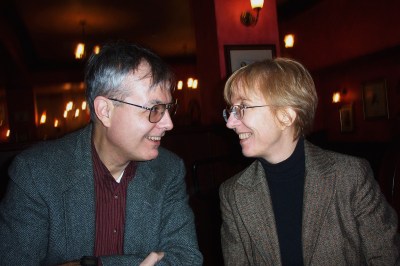
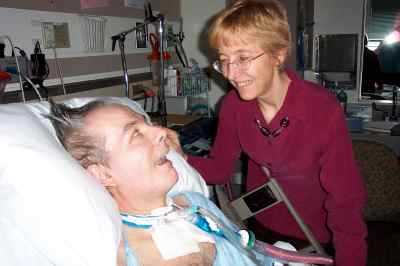
Click on pictures to see them better…
Okay, here are some more “interiors” of various sorts and with varying success. I tend to use mirrors and windows to say something, but what I have no idea. In any event, the entire picture has not always made it into the photo, but if it has, then you must look carefully at the details sometimes to figure out what is really going on…
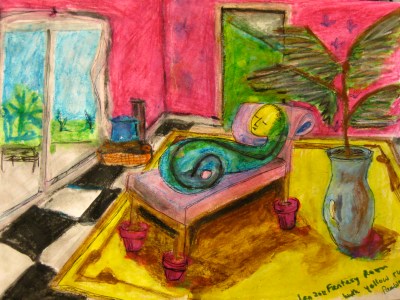
Interior #2, above
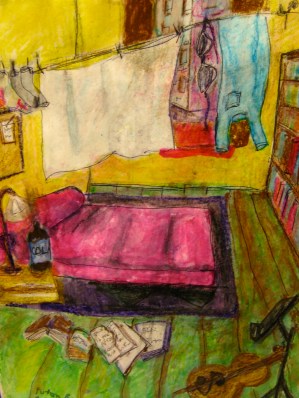

Person at lower left is seen from above and behind — weird perspective in entire picture. The rest must be deciphered by viewer! 8)

You have to look at the details of this carefully, if you can see them. The man in the mirror is not exactly as harmless as his electric razor would have him seem. Clue: check out other mirror at upper right!
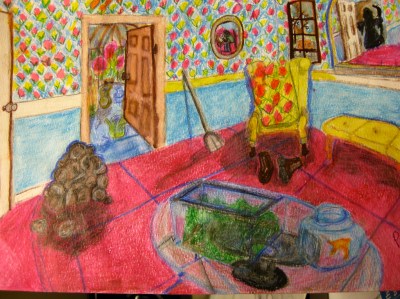
Alas, my pile of stones does not look too much like stones but the glass houses are both the terrarium and the fish bowl, but also the conservatory seen through the center door. Note the figure coming in the other door (seen in the right hand mirror) and the artist herself in the round mirror — if you can make her out!
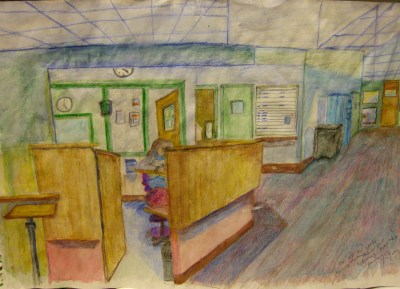
Done in watercolor paper on crude sketch paper but a copy on card stock given to the nurses…
And there were more but that is it for now.
Check out two posts below if you have not seen them as all three of these were posted tonight!
I did these and many more at Natchaug Hospital. The portraits are in pencil, but the most colorful — interiors, which I have never done before — were done with Crayola watercolor pencils, a medium I have  never used.
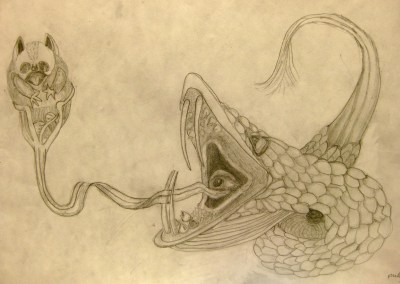
A dragon with a, hmmm, long tongue and eye in its mouth…

Most of these images, but not all, were taken, or copied from photos in National Geographic. Once in a while — the dragon for instance — I “made them up.”
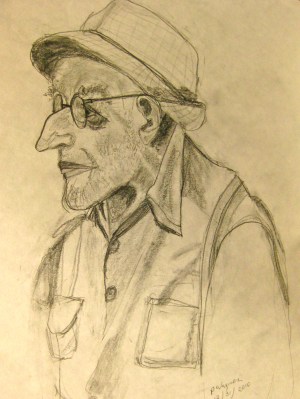
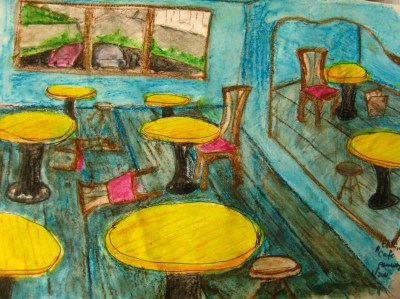
The above was the first interior I ever tried to do. It is a bit crude, and not all of it made it into the photograph, but hey! Anyhow, I am not sure how many photos I can put into a wordpress post, so I will stop here and do a third entry above. If you have not read about my Natchaug Hospital stay, it is in the post below, which I wrote tonight as well.
Be well,
Pam
I have been away since December 17th, in the hospital yet again. This time the experience – at Natchaug Hospital in Willimantic — was vastly better than the previous two and not abusive at all. I want to tell you about this, but first let me go back to what happened to get me there.
In the beginning of December I began to have trouble again. The “people” came back with their jeering and mockery and commands. A general confusion assailed me. In my journal I recorded many “cries” of MATOOTAM! : “Kill the Ogre that Ate Manhattan” which many of you know means me. I also began to burn myself under the influence of those command hallucinations. I still believe this was all a Lyme disease relapse, but I had been on antibiotics previously for 8 years – with positive tests for Lyme and other tick-borne illnesses intermittently during that time — without being cured, so there was and continues to be nothing but symptomatic treatment. This means, as my new psychiatrist, Dr C, argues, at least temporary use of the hated, and loved, atypical antipsychotic, Zyprexa. I already am taking Abilify and Geodon, as well as Lamictal for mood stabilization and possible temporal lobe seizure activity. However, as has happened before, these were not effective enough to carry me through such a crisis, which is why I was encouraged to take Zyprexa, 20 mg to head off anything worse. Despite my resistance – I really hate the immediate increase of appetite and weight that accompanies taking it – I did so, I assure you. But the damage was already done and the crisis took on a life of its own, so to speak. By mid-December, I was no longer “safe,” the code word my visiting nurse among others uses for my listening to the commands the “people” give me. She didn’t know how true that was, though, until I finally admitted it after four days of what I will only describe as obedience to those same commands. I saw Dr C that Thursday, and though she was uncertain of my safety, she decided that I would talk with her every evening until I saw her again the following Tuesday.
The truth is, I do not really recall most of this, neither intellectually nor emotionally. I have had to be told and to refer to my journal in order to recount all of the preceding. However, I do remember what happened next. In addition to the reappearance of the People, I began to experience what I called “brain blips.” These were very brief episodes in which I felt as if my brain suddenly did a somersault, a little like the feeling when your heart skips a beat, except that it was in my brain and accompanied by a terrible dread and feelings of impending doom. After the fraction of a second in which the blip occurred, I would come back to myself – it felt as if for an instant I lost consciousness, but the blip was so very brief that it didn’t seem possible. These episodes were terribly frightening, even though nothing ever happened during or after them, not at least of the dreadful sort I feared.
That Friday evening, my heart racing and my mind itself awry, I was in another world, so confused that I wasn’t quite sure what was going on. I managed to call Dr C, who prescribed Ativan. It was too late to call the nurse to pick it up for me so I got in the car to drive the mile to CVS but as soon as I pulled out of the parking lot, the other world took over completely. I do not know how I actually got to the drugstore. I recall only that I could barely hear or see for the pandemonium in my mind but that I was aware enough of the danger to drive only 20 mph the entire way. Once there, however, I didn’t know what to do. I didn’t know how to get home and I forgot about getting the Ativan altogether. Somehow I managed to tell the pharmacist that something was wrong, that I couldn’t drive home, but she thought I meant that the car had broken down, and called a cab for me. I went outside to smoke a cigarette and wait for it, but I was so scared of the shoppers who came and went – the drugstore was open 24 hours a day so anyone in the area who needed something after 10pm came there – that I was unable to take more than a few drags, hiding behind a pillar. I returned to the pharmacist and whispered that there was something terribly wrong, with my brain, that as I felt, bugs had infested it and that I was in another world. Finally she understood and called an ambulance.
I won’t go into the drive to the ER except to say that I was so “out of it” that I wasn’t even upset that the EMTs made me get on the stretcher right in the middle of CVS and that everyone saw me being taken out of there. Once in the vehicle, I tried to explain to them that despite the large wound they would discover on my leg, there was something wrong with my brain itself, that this was not a purely psychiatric matter and that I needed medical, neurological care. Indeed, I still feel that way, but much good that did. Once a “mental patient” always a “mental patient” it seems. I admit, though, that having burned my leg did not help much. Still, I tried to explain that I needed an MRI of my brain, that something was wrong, a bleed or parasites or something! You can guess their response: of course, they summarily dismissed all of that and quickly had me packed off to the psych section of the emergency room. Although this is a very comfortable, large and separate unit of the ER, with single cubicles for each patient and a TV but also a video camera in each one, I waited 3 days before a bed was available for me, some 25 miles or more away at Natchaug Hospital, a psychiatric hospital in Mansfield Center, in Connecticut.
I name the hospital openly – as opposed to the others I have written about — because it was amazing in so many ways that I want both to sing its praises and to “advertise” it so to speak, to describe what a really good psychiatric hospital ought to be like. It is true that most people were in for a very short time, Connecticut having virtually no long term beds any longer, not even in the state hospital, but whether acute care or for somewhat longer stays, Natchaug was quite simply the best place I have ever been. From the food, to the – well, let me go into more detail rather than a mere summary (though in my opinion, the food was indeed a cut above that in any place I have been in, both in availability, and, with a salad bar at every meal, quality.)
Upon admission there was, to my dismay, a requisite “clothing and body search.” This procedure was done in such a way as to preserve as much dignity and privacy of one’s person as possible but I feared at first that it boded ill for the rest of my stay. Also, I discovered that although there were, I think, two private rooms, I had been assigned a double, a semi-private room, with a roommate already installed. This was upsetting to me, as I had almost always had a single, or been moved to one because the unit staff either felt I was too disruptive or unable to tolerate the stress of a roommate. However, when I saw how the semi-private rooms were carefully partitioned with a floor to ceiling wall in between the bed areas, I was much reassured. Although I eventually did for a short time have a private room, or a double that was designated as private – I frankly do not remember why! – I was not bothered by either roommate that I had while there. The one who did try to get me to – Oh, I dunno. I just am no longer one to “socialize” with other patients and I simply did not feel like getting to know her, or to excessively “sympathize” or otherwise expend my limited energy on her problems. I feel a little bad about this, but this one roommate, the second one, at first tried to involve me in her “stuff” and even left a journal or something next to my bed “for you to read to find out more about me.” Well, this was so very intrusive, and nothing I had asked for at all, that I rudely, but decisively said, “Why would I want to do that?”
I know that I would have been terribly hurt and humiliated by someone’s saying such a thing to me, but on the other hand, I would never have been so forward with a complete stranger either. In any event, she quickly took the papers back and left the room. However, a day later, she seemed to have no hard feelings, and we got along, if distantly at least as well as I wanted to.
Where was I? Well, I will tell you that the worst thing about my stay, and I suppose unavoidable, since I was there over the holidays, was that I had three different doctors for the three weeks I was there. but the best things were two, or more, but two in particular. One was that there was NO seclusion room, that is to say, the seclusion room that they used to have was not only now designated at the Comfort Room, but in fact was comfortable, and open at most times for use by anyone needing comfort. In it, there were thick mats on the floor, a Grandma Moses-like mural painted on all four walls by artist staff members and best of all a “therapy chair.” This is a very large and comfortable rocking recliner that is built in such a way as to elevate your legs, while you recline against the back, and let your feet dangle over the end. This allows the person to position the very lightweight chair near a wall so as to be able to lightly touch the wall with the feet and keep the chair rocking with little effort all the while lying back and relaxing. Their next improvement planned is to get headphones, wireless, or MP3 players with a selection of music for additional relaxation and comforting.
I usually tell staff at hospitals that they “cannot keep me safe” and indeed “prove” it by obeying in some fashion the commands the People give me…This never exactly endears me to anyone, and in fact has more often than not earned me a reputation as very difficult, even as having a “borderline personality” as an Axis 2 diagnosis (not true). Be that as it may, I was in fact kept safe at Natchaug, and when I was not, I was on a very helpful rather than punitive 1:1 or constant observation. At Natucahug, one-to-one staff were supposed to talk to me, rather than kept from doing so as at other hospitals, “so that you won’t come to like the attention too much.” The few times I became very upset, screaming, just screaming, at the top of my lungs, and rather than choosing to go on my own was escorted to the Comfort Room, by “staff assist” people (there is no “Dr Strong” goon squad of uniformed security guards), the door to the room was open and someone talked to me the entire time. Thus, when I left, on my own, when I felt calmer, I also felt that the reasons that I had been so distraught were also alleviated.
Also, although Natchaug, like any other hospital, did have a restraints policy, they did not use them a single time the entire three weeks I was there. In fact, though there was a very disruptive, troubling patient there the entire time (for once it was not I) I do not believe they even came close to considering using them. This time I believe it when they said that they almost never have to use them at all.
But the very best thing about my stay was something quite serendipitous: it turned out that the Director of Nursing for the whole hospital is Sharon H, the very same APRN who had been head nurse during my many stays at a Hartford hospital, and who had taken upon herself to supervise my care, or at least seemed to have in some sense “taken me under her wing.” Sharon is, and always was, both extremely bright and compassionate beyond words. She is also insightful in a way that I found the first two doctors I had were not, and if the third was, I did not have a chance to find out because I saw her only 4 times. It is true that Sharon had the advantage of having known me well, if 17 years ago, but still, she seems to have this ability to size up a situation, at least with me, and both to calm me if necessary and to suggest a solution that simply fits…I have to say that I felt especially well taken care of. Sharon made sure she saw me every afternoon, though this was above and beyond the call of any duty.
This description scarcely does my stay at this hospital justice. Although, like any hospitalization, it was not an easy stay, nonetheless I can only say that I cannot thank Sharon and the Natchaug staff enough for all that she and they did for me.
(PS Forgive any typos I have not yet corrected but it is getting late and I am too tired to go back and check for them at the present time…Lazy me!)
Ceterum censeo MAGA esse delendam.
The opinions expressed are those of the author. You go get your own opinions.
Kate Greenough's daily drawings
Réussissez toutes vos certifications de langues
Not your third grade paper mache
Portrait Art and Paintings by Jon Amdall
Books, papers and blogs by Joanna Moncrieff
"While I breathe, I hope"
My Life After Narcissistic Abuse
An intellectual, emotional and spiritual spittoon.
The latest news on WordPress.com and the WordPress community.
Everything Matters
Ceterum censeo MAGA esse delendam.
The opinions expressed are those of the author. You go get your own opinions.
Kate Greenough's daily drawings
Réussissez toutes vos certifications de langues
Not your third grade paper mache
Portrait Art and Paintings by Jon Amdall
Books, papers and blogs by Joanna Moncrieff
"While I breathe, I hope"
My Life After Narcissistic Abuse
An intellectual, emotional and spiritual spittoon.
The latest news on WordPress.com and the WordPress community.
Everything Matters
 WAGblog: Dum Spiro Spero