Category Archives: Mental Health

Mental Hospital: Psychiatric “Treatment” and Abuse II (Continued)

I was admitted last Tuesday night, the 17th of July I believe it was, to the Institute of Living, the psychiatric division of Hartford Hospital in central Connecticut. I do not remember this. The fact that I have amnesia for it and for most of the Wednesday following only occurred to me on Thursday, a day and a half later, when I wondered — the train of thought must have had to do with the seclusion episode that took place Wednesday evening and which I described in yesterday’s blog post — why they had been so violent with me, why they had so quickly secluded and threatened me with restraints in a situation that didn’t come within miles of “requiring” them. Surely, I thought, the staff member who admitted me, whoever that had been, had asked me a critical question, which is on every  admissions questionnaire upon entering a psych unit or hospital these days: have you ever experienced trauma or sexual assault? (or words to that effect). I could not, and still cannot, for the life of my body or soul remember anything asked or answered at that time. There’s little left in my memory beyond a vague “snapshot” of being wheeled into The Institute of Living (hence forward to be called by its nickname The Toot or by its initials, The IOL) and my understanding that I had been transferred out of the ER. Then the memory  goes blank until many hours later. Understanding only as late as Thursday that I had this gap, and pained by the violence dealt me the night before, I went up to my “contact person” and asked about my admission. Could I find out whether this question was ever asked me, and what my answers were?  At first, naturally and as a matter of course, she refused. That was SOP. Refuse, refuse, and refuse.  So as I stood there, earnest in my request, she seemed about to summarily dismiss it as just another bothersome demand from a too-demanding patient already much disliked by all. What did I expect, cooperation? But to my surprise, her misgivings and the flicker of irritation that had crossed her face at first changed to a flattened look of resignation. She agreed to read my answers to the questions to me. But that was all she would do, so don’t go expecting more than that.

As she read from the top, a few memories stirred and woke, but only temporarily.  I fear they soon faded again into the all-white-out of oblivion. Only the trauma memories remain, for they apparently are stronger than thieving Ativan. Can I push myself to remember what her reading my answers back to me recalled to mind? She told me…what? She said that I told the admitting staff member, whom I do not remember a thing about, do not even recall if that person was male or female, doctor or nurse or what…I told that person I was not homicidal, not suicidal, not hearing voices, and that I didn’t need to be in the hospital. Three answers were true, or true enough by then. After having been nearly killed in the ER the people in my head/outside of it, who tell me to do things to myself were not so relentlessly horrible in their demands…so I was indeed no longer suicidal, homicidal or in need of hospitalization. I just wanted to get out of there and go on my upcoming writing-retreat vacation.

As I recall the little I recall now, this nurse, my “contact person” read to herself a lot of the paperwork and relatively little aloud, despite her promises. I kept asking what she had read, and prompting her to read out loud, but she let forth only a few phrases. I still do not know why… though I can guess that pretty bad things are written there about me. That would not surprise me one iota. I do not really care. They will largely be lies or descriptions of that awful scene in the ER from one very biassed point of view. No one will tell MY side of the story, that’s for damn sure. Whatever is said there will be based on what the ER personnel and the guard-thugs did to me, but if my contact person believed them reading them, and never bothered to find out the half of it, then who knows what they all thought about me, or believed…Anyhow, I do not care, because they too were thuggish, professionally and psychologically.

But the big question was yet unanswered. Had I ever in fact been asked about past experience of trauma or sexual assault? Contact Person, whom I won’t name as she was at least marginally decent to me, now seemed interested in this too, having paged through the lengthy document and not found it. She seemed puzzled, said she knew it was a standard question. She started perusing the thing again from the beginning. A minute or two later, she poked a page.

“Ah, here it is. And your answer is blank.”

“So the person just skipped over it. They just skipped it!”

“It appears so. Do you want to answer it now?” She took out her pen.

“Yes, and yes. I have experienced sexual assault three times. And severe trauma due to seclusion and restraints in many hospitals.” I looked at her. She was writing. “Tell me what you wrote.

“Experienced sexual assault. Has issues with seclusion and restraint.”

“NO! I said, it was severe trauma. I have PTSD, ask my doctor. Ask, I dunno, give me a test. I cry just talking about it. My heart rate goes up just thinking about it, even though it happened more than two years ago. It was trauma, and you cannot do it to me again!” She wrote something on the paper but didn’t read it to me. She just clicked her pen off and stood.

“Now you have your answer. I have things to do. Let’s go.” With that, and no discussion of what had taken place on Wednesday night, let alone in the ER, she hurried me out of the side office so she could go back to the nursing station to do some “real work.”

——————————

I suppose there must have been some incidents of relative kindness at the Toot. There must have been exceptions to the Hartford Hospital IOL “coal dust standard.” But only Albert, a tech, stands out. Because they injected me with too much Ativan on Wednesday pm and I was discharged Friday noon, I had very little time between the ER’s monster dose and D3South’s equally large dose of Ativan-it-Away to retain much of anything but what stood out enough to stick, and really stick tight. Their puny kindnesses mostly did not, except for Albert.

On the other hand, the sheer meanness of the staff was astounding. I had a semi-meaningful interaction — though unpleasant  – in all that time with only one individual who was not programmed to speak with me. And even that started out with nastiness, though I admit it was sparked by something that was “my fault,” as you will see.

Friday morning I needed migraine meds and my 8am pills. I went to desk at 7:55 and asked for them. A nurse or tech or someone –I never knew and no one ever bothered to tell me who or what they were — lingering at the desk said that the med nurse somewhere in the back would get them. I wandered off, figuring it would take some time and she would bring them to me, which is what they did at every single place I have ever been. But no, by the time I thought about it again, realizing that she had never brought them, it was 8:45 and people were lined up for their 9:00am meds already. I signaled above them to the nurse at the med window that I had not gotten mine for 8:00am yet. She told me that of course not: I left the med station; why should she go after me? Then she indicated that I should get in line to be next…even though that meant stepping in front of someone else. Okay, so I got in line, and  – oh, I do not remember all that happened except that I became angrier and angrier with her, resenting her attitude. As a consequence, I did everything I could do to irritate her. She poured the meds at the computer, where I couldn’t see them, saying their names softly to herself so I asked to see the packaging. I didn’t trust her not to withhold or add something I didn’t want. Because I had asked for Imitex an hour before I sensed she would not include it. Well, lo and behold: No Imitrex! So I took the pills, but asked her for the Imitrex as well.

Ah, revenge time! “I will get the Imitrex at 9:00 am sharp, when it is due. That is 10 minutes from now. You can come back and wait in line then.” I just stood there, not budging. I would never stoop so low as to impugn a person’s person, but I probably let loose a few curses and most certainly raised my already angry voice a few decibels. Finally, speaking in a calm, respectful voice, a man whose name I learned was Albert came up to me asking in such a polite manner that I even looked him in the eye, to “please just lower your voice” so he could hear me tell him what the problem was.” Well, treated in such a fashion I understood he would wait for me to calm and not get angry back so I was able to take a few breaths and then make him understand what she was doing…He said, with the med nurse standing well within earshot, though I do not think he intended any manipulation, “It’s okay, don’t worry. It’s nearly nine, and I’m sure the med nurse will get your medication for you.” (I was sure of quite the opposite but harrumph! Well, what could that SOB, excuse me, DOS — daughter of a stud (med-nurse) do but give me the Imitrex now?) I might have crowed, but instead, thanks to Albert and in respect for him, I took it without a fuss and thanked him again.

This sort of treatment gives the lie to what so many providers – both individuals and insitutions — say about the goal of “empowering patients.” What bloviated BS! What they really want are not empowered patients but cowering patients, people too scared and drugged up to object or make trouble in the first place and then who continue to cower before the establishment MD’s power structures all the way to the last place.


My butt hurts from sitting slouched on a bed all day. I need a break. So I am going to post this and go outside in the cooling darkness of the Litchfield hills and drink the air. Since I have nothing I have to do here but write, I will post tomorrow about that single meaningful encounter I had while imprisoned at The Institute of Living. If I still feel it is worth writing about, which as I think about it, it may not be.

Oh, what the heck: Basically, it concerned an encounter with this female tech, a woman who in passing me in the hallway, the first time she had spoken to me so far as I knew, accused me of moral turpitude (not in those words), made a statement shaming me for my behavior on Friday morning at the medication window. What had I done?  By talking too loudly, I had made “the poor man behind [me]” cover his ears and point at his skull to communicate his displeasure. PLUS, I had made everyone wait a good 30 minutes…I knew the 30 minutes was an exaggeration, so I didn’t even touch that, but the shaming tactic got to me. I went back a few minutes later and said I wanted to speak with her. We went to a couple of lounge chairs in the hall and sat down.

“What precisely did I do that was morally wrong this morning?”

“Do you know you talked so loudly this morning that the poor little man behind you was covering his ears and pointing at his head?”

“So I should have talked more softly, but I do not have eyes in the  back of my head to see him. I could not know he was communicating by pointing at his head. It is not morally wrong not to have eyes in the back of your head, nor is it morally wrong to speak in a loud voice.”

She reiterated the case of “the poor little man behind you pointing at his head.” But I continued to press her on what was morally wrong because I didn’t have eyes to see behind me. Finally she granted that I could not help not seeing him and that it wasn’t actually a morally wrong thing to do, to yell or talk too loudly. At this point I said to her, nearly in tears because just having a calm conversation had taken such effort on my part, “Be careful what you say to someone on this unit you know nothing about. Words have power and you should use that power with care. You have NO idea how those words you spoke affected me, no possible idea…”

She gave me an intent look, almost a fearful one, as if afraid that — well, no, I don’t think she gave a damn whether or not she caused me any emotional harm. She no doubt despised me along with the rest of the nursing staff. But perhaps she suddenly appreciated how even her words were important and powerful, and carried weight and could do some good but could also do just as much psychological damage and maybe more sometimes than the loud voice that damaged mostly ear drums.


Psychiatric Crisis Intervention: How to Avoid Restraints and Violence


*Note that when I write of a psychiatric crisis, I mean a patient who is not actively on street drugs. I cannot speak to any situation where someone has been taking unknown quantities of unknown chemicals. In such a situation I have absolutely no experience.

That said, I would like to tell you a few simple things about dealing with an unarmed, undrugged person who seems agitated and paranoid. It is true that I speak of myself, but I believe that the only difference between me and a two hundred fifty pound man, is only size and the fear factor. I think that there is no reason on earth why he would not respond to the following interactions just as well as I know I would.

First all of, remember that the person you are dealing with is indeed agitated, and is if paranoid  by definition terrified. Keep that uppermost in your mind, because everything you do will be evaluated by her in terms of what threat it poses. If you frighten her or threaten her, she will become much more  unpredictable, and the probability of violence increases enormously.

Never approach such a person with a show of force.Not even if she is being “loud” and disruptive. You gain nothing by such brute force methods, and you lose a great deal…Ganging up on a patient who is paranoid only puts her in the “fight” mode. After all, she is already frightened and you have cut off her only perceived avenue of “flight.”  Why  escalate a crisis situation, making it worse, upping the potential for a violent response. If the situation has already devolved into accusations, yelling and swearing — all three signs of increasing anger and desperation — that is a signal that whatever you are doing is making the paranoia worse; at such a time the best thing to do is NOT to worsen the situation by pushing back, responding with equal anger, and making demands and ultimatums. No, instead back off and WAIT. The person most likely has not had access to a weapon or anything to hurt herself or others, so patience is a virtue and can be put to good use here.

Usually a patient who is paranoid will not do anything of her own accord but try to escape the situation. But if you force the issue, if you prevent her from escaping to a comforting place or from her own feelings of fear by permitting her what she needs to calm herself, or worse, attempt to do something to her that she could perceive as an attack – for instance, if you try to force medication, or grab her or simply threaten her with a group of staff or guards approaching en masse, you may very well provoke her to respond as anyone would when attacked, i.e. with self defensive maneuvers.

Why be surprised, when several people try to rush her and grab her to hold her down for IM medication, or simply gang up on her in some misguided attempt “to calm her down,” if she then responds with apparent aggression? After all, it is several of you against the one of her and it is surely understandable that she feels threatened. Her life feels in danger and in such a situation all bets are off as to what she thinks she must do to preserve her safety.

If you really want the situation to end well, refrain from threatening or attacking her, no matter how impatient you may feel. Instead, choose one calm, unthreatened and unthreatening person, preferably of the same sex or somehow compatible with the paranoid patient’s personality, and have that person approach to a safe distance (safe for the paranoid patient, not just “safe” for the staff person or for lack of a better term, “negotiator.” The negotiator is safe so long as he or she does not threaten or attack the patient, who is much more frightened than the negotiator.

Approach to a safe distance and possibly sit down, calmly and in a relaxed position, so that she understands that you are not scared of her but also not angry or threatening. If necessary, you might indicate that the patient is speaking too loudly for you to hear her, or too rapidly, but that you are there to listen and talk, when she can lower her voice or slow down. Do not speak loudly or angrily yourself. Talk about anything at first. Don’t talk about the patient or what is going on and do not argue or demand. order or talk  about your expectations of or for her. Try to talk about calming external things. Does she like nature, art, sports, reading? Is she cold? Hungry? Can she take some deep breaths? Maybe she would like to sit down now, too? Finally, when she can, would she like to tell you what is going on? There is plenty of time, no hurry. It is important to find out what the problem is…

It may be you fear that she will attempt to self-harm or hurt someone impulsively. If the latter, keep everyone a safe distance away. And emphasize the possibility of violence so that they will stay  away until the all-clear.  Then talk to the person in a soft voice and gently remind her that you know she doesn’t want to hurt anyone, not even herself, that she is already in enough pain…What does she need, right at this very moment, to help her feel better? Then negotiate a way to get it for her, or something that will do as a substitute or an approximation.

It isn’t that hard to negotiate a calm solution to this sort of crisis, without violence or retribution, when you don’t threaten the person and are truly on her side. But you must never lie to her or to swoop down upon her immediately afterwards to put her in restraints. The point is to bring the crisis to a peaceful resolution. It is not a contest you must somehow win, and then punish her because you were scared and got angry. Exacting retribution  is unconscionable and if that is your impulse you need to have a talk with your supervisor. Negotiators and other employees who do such things need to be reassigned to other areas or other jobs. They do not belong in crisis intervention settings.

Now I am certain that you can think of other scenarios where four point restraints are absolutely essential. If so, I would like to have you describe one. We can discuss this because I am becoming more and more convinced that Seclusion and Restraints CAUSE more mental illness and suffering than they relieve. How would you feel if you found out that by putting a patient in four point restraints even once, you may have caused enough  trauma to induce more self-injurious behavior, plus PTSD? I believe this happens. I also believe that it is terribly dangerous for the sense of self and the self–esteem and the relationship between the patient and ANY  health care provider of any sort at all.  I see nothing good to come from restraints. NOTHING. I do not even see them as providing safety, not in the long run and scarcely in the short run since those who are restrained tend to become more violent not less. Why will people not learn that the “catch more flies with honey than vinegar” works with people in every instance?

But talk to me. Let me know what you think. A confession:  I once wrote an Op-Ed  for the biggest  state paper around her that suggested that restraints could be an okay form of treatment if patients were taught to ask for them voluntarily! (I cring just thinking how I toed my sister’s “party line” about the helpfulness of restraints. She learned that sort of thinking from being the attending psychiatrist at Y__ Psychiatric Institute where they taught patients to ask for wet packs or to have their wrists chained to their belts all day long… The difference between us is that she still believes in that sort of  brutality.)

“The Scream” plus an update…

  
In the midst of re-experiencing trauma, sometimes all you can do is scream, even if it is silently and only in paint…I hope this speaks to some of you who may feel as I do, often or even just once in a while. It took a lot to get this out, but I felt I did convey what I felt.

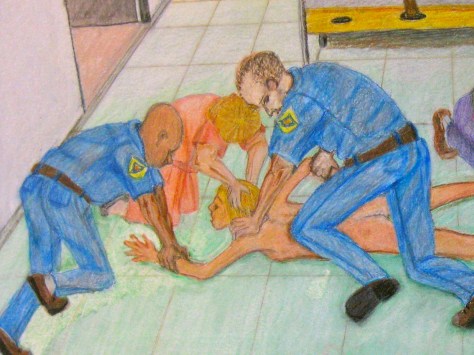
I am reposting the next one, a very painful if a not very skilled drawing, because I made some changes. I put a very mean smirk on the face of the woman in the front, who is meant to be facing us and pointing over her shoulder, though it was hard to get this in, given how little space I’d left myself… Also, I wanted to change the face of the man kneeling on me, and strength the look of the grip of the hands on me. If you compare the old version to this one, you will also note that I am purely naked here where as in the other, I have underpants on. This is the accurate one, but I didn’t understand that at the time I started the drawing. Alas, or perhaps this is good, I am rapidly recalling things I had not for two years about my experience at Middlesex. At least I remember stuff that happened BEFORE April 28th. For the other two restraints incidents, I still have no recall whatsoever or what I suspect is mostly confabulation drawn from what I read in my chart, though of course I cannot be certain. In any event, what I am remembering is not good at all, and I cry a lot…it is very difficult, and I feel so very very alone, because NO ONE understands and can talk to me, or more to the point can even stand to listen to me talk or cry about it. But it is difficult even to keep it under wraps all the time. If you have survived trauma, I think you know how it is. And that is why I avoid people when I think I cannot be “good enough company.” I don’t want to bring my friends down, but I cannot control the tears and shakes when they start…But the picture forthwith. Although it is disturbing as is, be aware that in the real incident, there was a great deal more violence, and more guards and staff members involved…these are just a paltry few. I simply didn’t know how to draw a crowd or a crowded room yet!

This is the incident before they used 4 point restraints on me that I so obsessively describe in Wagblog…Of course I take some poetic license with drawing the bed there and at the ready, as it was not there or ready or even in that room and I was quite calm and certainly no danger to anyone by the time they decided to punish me 
Takedown on N-7 Prone Restraint Detail: Me, naked — and this is a hospital?

This next picture I did as an attempt to express the guilt and shame I feel over having been traumatized at all. But I do not think I succeeded at all. Why? Because it became too intellectualized, with symbols like the Scarlet A and the guilt-crucifix, and even the hands wringing in shame, rather than pure expression…I want to do it over again if I get inspired to do so.

Shame Guilt and Ghosts is my attempt to portray my feelings of guilt at even having felt traumatized by so small an injury…but this doesn’t do it successfully, not so it seems to me at any rate.

The next three drawings were just “fun” or for practice ones. The first two are presents for Tim, simply because he likes cars and is so wonderful to me. The third was an exercise in drawing two people together, and was copied from an “old master”, the name of  whom I simply cannot recall at the moment. It might have been — nope I don’t dare guess! I would have to get up and search for the book, and I ain’t gonna do that at the moment — too danged lazy. Anyhow, here are 1) two  1973 Volvo Sportswagon ES 1800 2) jaguar XJS and 3) the sketch taken from the old master’s painting.

1973 Volvo ES 1800 with British Racing Green “colour” in the background to represent the color of Tim’s car.

My third car drawing for Tim, a Jaguar XJS (I forget the date but I believe it is the mid 80s (if I am not mistaken).
Herr Goose after revisitation for repairs…Click on the photo to make a close up and you will notice neck “feathers and the difference it makes with old fully decorated version.
I sketched this detail from an old master’s painting found in an art book. Wanted to capture the two women together, and the angle of their heads (I actually didn’t do a very good job but there you are!)

____________________________________

NOTE: As I wrote this, “dream” talk, that is to say, nonsensical writings seemed to keep appearing in the middle of what I wrote. I seemed to find myself in another world every few minutes. I would write about that world, then “come to” and start writing about the subject below again as if nothing had happened. But when I reread the paragraph it made no earthly sense whatsoever, being an amalgam of two entirely different trains of thought. So a caveat: if some of what follows devolves into gibberish at any time, forgive me, and be patient. You can email me to alert me, if you wish, that would help. But otherwise, know that I will eventually come back more able to proofread and catch such idiocies…and fix them. For now though, you are on your own.  (The reason for these  brain blips, I think, may be, but may not, the  fact that I took a very small amount of Zyprexa today in order to be able to read and concentrate. 2.5 mg 2X a week should not make me gain weight, according to Dr C, But we thought it might do some good, without doing the usual harm. So I agreed to try it out once more, just at the minimal level as a PRN. Well, I find that I am very sleepy, have been ever since I took the pill, except for when I took a walk and for about 1/2 hour afterwards…and I do think that I slip into dreamworld while awake, and literally dream while writing this. Hence the gibberish.

*********

I have put the statement I read to the CEO and various administrators etc of Middlesex hospital on Youtube if anyone is interested in hearing it read outloud. Do a search for “Psychiatric restraints and seclusion abuse” and you should be able to find it if this link doesn’t work:  http://www.youtube.com/watch?v=vhZybDwMbzA  (I realize that I read it without much feeling, but it is hard to do so accurately and also look up at camera, and read without losing my place. Anyhow, it might be worthwhile to check it out.

The newest sorta development in the “case” this week was that a lawyer from the hospital, or someone who told my advocate he was a Middlesex Hospital lawyer, asked Wiley R (who is behind me 100%) “what does Pam want, what can we do to have her drop the complaint or withdraw her complaint to the DOJ and Joint Commission?”

Now everyone I told this to almost to a one, and immediately said this meant, “We are willing to pay handsomely in order to buy a gag order from her” I had trouble digesting such crassness, but to a one, those to whom I related the words of this inquiry told me the lawyer was insinuating something about paying me off. I mean: money. I felt slimed, completely slimed. For a few days this was the sole topic of my conversation, but to make a long story short, after I had decided to ask for several sessions with the hospital psych unit staff, educational sessions with me, to teach them how better to deal with patients, and have them experience forced restraints themselves…and so forth, my brother and I met with WR my advocate from the Protection and Advocacy (for persons with disabilities and mental illness) Office, and he informed us that the lawyer really was offering nothing, not even an official apology. Clearly, if so, then my real desire, to do hands on, face to face work with the staff that had so tortured me, was going to be out of the question, utterly forbidden. So we just decided in practically the same words, to let them “swing” in the wind.

In point of fact, when WR said that the DOJ might bring them up “on charges” if it was warranted, I asked him why I didn’t do that myself. He looked at me, and then narrowed his vision looking at a point beyond me. “Hmm, let me ask around and I’ll see what we can do.” I hastened to assure him that it wasn’t malpractice I was after. I knew that I had no real case, even if the statute of limitations hadn’t just run out a week or a few weeks ago. After all, what lawyer is going to take me on  one a contingency basis, and what jury would find for me in any event, seeing as how I did not die in their “care” nor suffer “grievous BODILY injury” which of course is all that counts…as usual. I am not sure what sort of case I would have in any sense of the word now at all…But as I told him, that is in his hands, and certainly is his bailiwick  (and if not his than that of  my lawyer-friend, Sharon Pope’s. If there are other “cases” to be made of any sort, I am more than game, I am ready and on alert to go and do whatever is needed in the pursuit of justice and reform of the Middlesex Hospital psychiatric system. It was really shameful, and despite the Public Health Department’s so called investigation, it was such a shameful joke, that despite WR’s impassioned plea to investigate MY case, and the psych unit in particular, they did no such thing. All they did was go back to spring 2011 (ie looked at the records of the entire hospital, or one of two representative records from most of the units, except for Psych so far as I could determine…) and do a random case study to look for general evidence of irregularities. Sure, they found some, and one case even involved the ER use of unnecessary or at least excessive use of restraints in a dually diagnosed young man…

But NOTHING was even looked at that had anything to do with what they did to me, or even the psych unit in particular. NOTHING was specific to my complaint, so I don’t know how they expected this  evaluation to give them any sort of reasonable results. They may or may not have censured or sanctioned the hospital. I did not read the entire huge file of support the bill got over the years. But I got the drift and the worst punishment meted out for repeated violations seemed to me to be a whipping on the wrist with a flimp ramen. Period.

Yet I was punished by the psych unit staff time and time again.

I know, I know! I was loud, I was angry, I was impossible to “handle” — I know this. Partly this was par for the course for a Lyme disease flare up for me. But I think Lyme wasn’t all of it. Why else was I so irascible (aside from them giving me Abilify without the requisite Geodon…) if not in response to perceived and real threats from them? I am not generally irritable and snappy at Natchaug, and never was at Hartford Hospital in the 80s and 90s. ONLY at hospitals where the standards of care are coercion and control and abuse is the name of the game do I react with anger and hostility…I wonder why.

More to tell, more to say, but as I wrote in the first paragraph above, sleep is overwhelming my desire to do just about anything. I will try to get back to this asap.

Different kind of artwork for me: Car Picture for Tim

Okay, this is for the boys!

1956 Mercedes Benz 300c 4-door sedan: What can I say, except Tim owns one and it is truly a cool car, if you care about cars! Anyhow it is my very first car drawing, so I am rawther proud of it.

_____________________________________________________

Some sad news that I only feel able to share now, is that  I had to put my beloved cat of 17 years to sleep on Friday last…and it was truly awful. I didn’t understand that it would be so fast. The vet injected something in Eemie’s vein, and she lifted her head as if in curiosity — then put it down — I asked how long it would take, and the vet said softly, “She’s gone…” I burst into tears, having had no understanding that in fact she wasn’t curious, she had been taking her long last breath. Oh god, I miss her so. I keep wondering where she is when I get up in the morning, and when I get home from wherever I have gone out to, I feel that someone is missing, that I need to feed her, and find her… and then I realize I don’t have a companion any longer, that Eemie is no longer…I am tearful even as I write this, and I wish I could post the video that a friend made of us a week or two before she became seriously disabled. She was ill, yes, but you couldn’t really tell on the video since we just cuddle. I am so glad that the friend had the foresight to encourage it. Because now I have that to remember Eemie by. I know it wouldn’t mean much to anyone else. But like any doting grieving mother, I would post it because I still feel the grief and feel somehow that everyone else would want to see it too. (Which of course would be silly but the grieving do silly things. I know that.)

To lose Eemie on top of my father, Leo, and Joe too just exactly one year ago April 27th feels like really too many losses piled on top of one another. But one gets through or breaks and I cannot let that happen. I do believe that I am strong enough in general to get through it, and while I did take Haldol for a few days it had more to do with the Middlesex stress (yes, a little to do with Eemie I admit) than anything else…Okay, it did have to do with Eemie, but I think without Middlesex coming up I might have weathered Eemie better.

But I got through it and I stopped taking Haldol on Monday, haven’t needed it since then, or have slogged through without it. Did the car picture since then, so things could not have been too too bad. Artwork is always good therapy anyway. Better than drugs if I can get myself out of bed and organized enough to do it.

By the way, my art show is up and on exhibit at the WETHERSFIELD LIBRARY right now. I have work on three walls, plus the display case, for those of you who live near enough to Wethersfield or Hartford to stop by and see it. If not, you can always check out Photobucket and see what is there, though you lose a great deal by not seeing things “in person” of course. It cannot be helped, naturally!

Enough for now. I hope last night’s post was not too negative, not too mean-spirited and revengeful. I was very angry, and very upset. The very idea that the director of the Middlesex Hospital psychiatric unit said anything at all, rather than simply remaining silence just incensed me. I think that was a grave mistake, and he likely regretted it afterwards. I suspect that the CEO probably told him that it was not something he should have indulged in…But what he said is said, and it only retraumatized me if anything. The notion that he, who wasn’t even there during the episode, and ought to have been appalled, simply took the side of my torturers was to me itself disgusting and appalling. But he will get his comeuppance, one can only hope, and I won’t have to do anything about it, since presumably the Joint Commission and the DOJ will do it all.

Enough of that. I am really tired and need to eat something. Ta ta for now.

Shock Treatment/ ECT – Therapy or Torture?

Freud and an angry God, hmm, I mean Doctor, electro-shocking a poor ant. Drawing by Pamela Spiro Wagner, 2012 (all rights reserved)

Although most of this post was written and posted back in 2011, I have both edited it and written an addendum, especially for the students in Holly C’s course, with whom I will be doing a Skype class on Monday. If others do not want to reread the post and wish to skip to the end where I have placed the addendum, feel free.

First though, please be aware that descriptions and names of places and so forth have been changed back to their originals except for the names of some people involved, such as my doctors. Those names are somewhat similar, but still disguised. In Divided Minds, we were forced by the publishers to completely disguise everyone, including their physical descriptions, and to make amalgams in some cases, taking two doctors and blending them into one. In Blacklight, by contrast, I am determined that my descriptions of people, previously altered in order to “protect them,” will be honest and forthright,  rewritten so that while their names may be changed, their descriptions are as aboveboard as memory makes possible. After all, I write nothing but the truth as I remember it. I wrote a fair amount in my journals at the time and I referred back to my notes there in writing this. What is more, I intend no libel  and in fact, I want only to be  fair and to bend over backwards in giving as much credit as possible where it is due.

The Ogre Has ECT: 2004

I am delivered like a piece of mail to the Hospital of St Raphael’s, on a stretcher, bound up in brown wool blankets like a padded envelope. It’s the only way the ambulance will transfer me between Norwalk Hospital and this one. The attendants disgorge me into a single room where de-cocooned, I climb down and sit on the bed. All my bags have been left at the nurses’ station for searching; this is standard procedure but I hope they don’t confiscate too much. An aide follows me in to take my BP and pulse, and bustles out, telling me someone will be back shortly. I sit quietly for a half an hour, listening to the constant complaint of the voices, which never leave me, sometimes entertaining me, most of the time ranting and carping and demanding. A thin, 30-something woman with curly blonde hair, rimless glasses and residual acne scars that give her a kind of “I’ve suffered too” look of understanding, knocks on the door-frame..

“May I come in?” she asks politely.

“I can’t stop you.” My usual. Don’t want to seem too obliging or cooperative at first.

“Well, I do need to take a history, but I can come back when you’re feeling more disposed…”

“Nah, might as well get it over with.” Then, nicer, I explain, “I was just being ornery on principle.”

“What principle is that?”

“If you’re ornery they won’t see you sweat.”

“Aah…”

“And they won’t expect you to be medication-compliant right off the bat.” I shrug my shoulders but grin, I want to think, devilishly.

“I see you have a sense of humor.”

“You should see me…”

“I’m sure we all will. A sense of humor is very healthy. But it worries me that you already plan not to take your meds.”

“I’ll only refuse the antipsychotic. Look at the blimp it’s turned me into.” I haul my extra-large tee-shirt away from my chest to demonstrate. Fatso, Lardass! Someone snipes. She doesn’t know it but you really believe you’re thin. Ha ha, you’re a house! Look at yourself! LOOK at yourself! Ha ha ha ha! The voices are telling the truth: I know the number of pounds I weigh is high, outrageously high for me, having been thin all my life, but I haven’t lost my self-image as a skinny shrimp, so I can’t get used to being what others see. The voices love to remind me how fat I really am. Only the mirror, or better, a photograph, reminds me of the honest to god truth, and I avoid those. I avert my eyes, or search the concrete for fossils, when approaching a glass door. Anything not to be shocked by what I’ve become. Pig! Glutton! It seems they don’t want to stop tonight…

I realize suddenly that I’ve lost track of the conversation.

“I don’t think they’ll allow you to do that for long.”

“Do what?”

“Don’t you remember what we were talking about? Were your voices distracting you?”

“Just thoughts, you know, plus some added insults.”

“You’ll have to take all your meds eventually.”

“Then they’ll have to switch me to a different pill, even if it’s less effective.”

She sucks the top of her pen and looked down at her clipboard. “So,” she starts the formal intake. “What brings you here to St Raphael’s?”

The voices break in there, again, confusing me. When I can get my bearings I tell her what made me transfer from Norwalk Hospital and why I opted for shock treatments. She takes a closer look at the mark of Cain I’ve burned into my forehead, writes something, then corrects me.

“We like to refer to them as ECT here. ‘Shock treatments’ brings to mind  the terrible procedures of the past. These days you feel nothing, you just go to sleep and wake up gently. I know. I assist at the ECT clinic.

“Oh, I know, I know. I’ve had ECT before. I know what it’s like and it’s a snap. I asked for this transfer because I hope it will help again.”

We talk some more about why I’m here and what I’ve been through and the voices keep to a minimum so there’s not too much interference. She says she’s going to be my primary nurse and that she thinks we’ll work well together. I nod, thinking she’s pretty okay, for a nurse.

I’ve arrived after lunch, which is served at 11:30am so someone brings me a tray and I pick at it in my room. People come in and out of my room but only speak to me a second or two before they leave, a doctor does a cursory physical, someone takes me down the hall to weigh and measure me. I return to my room, too scared to do otherwise, constrained by the Rules of the voices. The first break in the afternoon is medications in the late afternoon, when someone tells me to line up in front of a little window near the nurse’s station. When it’s my turn, I look at the pills in my cup. Ugh, 20mg of Zyprexa, an increase, plus a host of other pills I can’t remember the names of. I hand the pill back to the med nurse. I’m not taking this, it makes me fat, I say. Give me Geodon. at least I don’t put on weight with Geodon.

“Sorry, Dr Kroeder has ordered this one. We can’t just go around changing doctor’s orders. You either take it or you refuse.”

I was in a quandary. I hadn’t even met the doctor and already I was fighting with her? Should I take it and argue with her later? But then I’ll eat my whole dinner tray and more. Better to start off with my principles intact, so she knows what I’ll take and what I won’t take. I hand the pill back. ”Sorry, I won’t take it.”

“If you decompensate further we will have to give you a shot, you know that, don’t you?”

“I’ll be fine.” I do a little dance step.

“Yeah, and look what you’ve done to your face. Come closer.”

Wondering what she wants, I lean in gingerly, fearing her touch, but she only takes a tongue depressor and smears some ointment on the big oozing sore.

“You’re done.Go eat some supper.”

At 4:30? That’s pretty early. I can’t cross the threshold of the dining room, the Rules the voices make forbid it. I cannot enter the milling crowd, suffering little electric shocks every time my body makes contact with another. Instead I retreat to my room. Sitting on the edge of my bed again, I wonder what to do. How can I get supper, or any meal, if the voices won’t let me go into the dining room?

Just then, the thin blonde nurse with the glasses, what’s her name, leans into my room. “Aren’t you hungry? There’s a tray for you waiting outside the dining room.”

“They made a rule I can’t eat with other people, and I can’t get in the dining room…So I can’t eat.” I read her name tag. “Prisca.”

She smiles and glances down at the tag on her chest.  ”Oh, just call me Prissy, everyone else does. I hate it, but what can you do? What are you talking about? There’s no such rule. For now, I guess I’ll let you eat in your room, but that  is against the rules and we’ll have to get you into the dining room eventually, whatever the voices tell you.

She brings in the tray: white bread with two slices of bologna and a slice of cheese tossed on top, a packet of mayonnaise, a small green salad in a separate bowl, with a plastic slip of French dressing, and a packaged Hostess brownie for dessert. I didn’t eat lunch, though they brought it in, so even this impoverished repast looks good to me and I eat everything, despite not having taking the hated Zyprexa. I curse myself for it, of course, and do some  leg lifts and crunches for exercise afterwards. Ever since I’ve been refusing the drug, I have lost weight. Now I am down to 155 lbs from 170 the last time I weighed myself and I intend to get much thinner, since I started at 95 before medications over the years slowly put weight on me.

After supper the voices start in again, louder and louder, telling me how fat I am, how disgusting and terrible I am. I notice the clock hanging on the wall, which ticks audibly punctuating each sentence. The voices were carping, now they are threatening, and demanding…Finally, their all too familiar sequence segues into telling me I’m the most evil thing, and they don’t say person, on the planet. I’m the Ogre that ate Manhattan, I’m Satan, I’m a mass murderer, I killed Kennedy and deserve to die, die, die!

I’m wearing a heavy pair of clogs with wooden soles and almost before I can think about it, I know what to do. I heave one up at the clock, hitting it dead center. It crashes to the floor. Scrambling to grab a shard of the clear plastic cover before the staff comes running in, I lunge towards where I saw the largest piece fall, one with a long jagged point. I have my hand closed around it when someone tackles me from behind. He’s not very big and I can feel him struggling to keep me pinned. I almost succeed in stabbing myself, but he manages to engulf my hand with his two and press them closed against the flat sides of the shard.

Other people  crowd into the room now and they pry the shard from me and grab my arms and legs so I’m completely immobilized. Then at a word murmured by one of the male aides who have materialized out of nowhere, they swing me up onto the bed, like pitching a sand bag onto a levee. I scream but they ignore me and strap my ankles and wrists into leather cuffs which have been rapidly attached to the bed frame: four point restraints.

I continue to scream and scream, but nobody pays attention. A nurse comes at me with a needle,  saying it is Haldol and Ativan and proceeds to inject me. Although I am still crying that I want to die, that I’m Satan, the Ogre that ate Manhattan, that I killed Kennedy, I’m the evil one, the room then empties, except for a heavy-set café-au-lait sitter, who hollers louder than I do that her name is Caledonia. She pulls up a chair in the doorway, pulls out a cosmetics bag and proceeds to do her nails in spite of me.

I am told by Prissy that I scream most of the evening and keep the whole unit awake until given a sleeping pill and another shot. All I remember is restless twilight sleep coming at last, broken when a short sandy-haired woman, dressed in a sweater set and skirt, comes in and takes my pulse. I’m groggy with medication but she speaks to me nonetheless.

“I’m , Dr Kroeder, your doctor. You’ve had a bad night I see. Well, perhaps tomorrow we’ll get a chance to talk.”

“Get me out of these things!” I mumble angrily. I can’t sleep like this!”

“”Not yet. You’re not ready. But try your best to sleep now. We’ll re-evaluate things in the morning.”

Then she turns and is gone.

As I get to know her, I will like Dr Kroeder for her kindness, toughness and honesty, but I will hate her too for opposite reasons and it will be a long time before I  know whether the liking or the hating or something else entirely wins out.

The first thing that makes me know ECT is going to be different at St Raphael’s than where I had it before is that we all have to get there on under own steam rather than travel in wheelchairs, the way I’ve known since childhood all hospital patients must travel. We walk there, all of us, down interminable corridors, around several corners, through doors to more of the same. In short by the time we get there I have no idea where we are.  I said it was a snap when I had it before, but now I feel like a prisoner going to the hangman, a “dead man walking.” Something about our going there in a group voluntarily, by choice and yet somehow not totally by choice, makes it feel like punishment, like having to cut your own switch, not a medical procedure at all. This sets my nerves on edge. When we finally get to the rooms clearly marked “ECT Suite,” instead of the doctor being ready for us, no time to anticipate or fear what is ahead, we have to wait and wait and wait. We’re told the outpatients have to be “finished up” first. My apprehension grows. I’m used to getting to the ECT rooms and immediately climbing up on the table and getting it over with. Waiting and having time to think about it brings me close to tears.

Finally four in-patients are to be taken. I think the nurse calling us in senses I am too anxious to wait any longer, for she makes sure I’m with the first group. I clamber up on the table, and see Dr Kroeder looking down at me, smiling. I notice how white her teeth are and the little gap in her shirt across her chest as she bends over me, strapping something over my forehead as Prissy puts a needle into the heplock already in my arm. I feel my arms and legs quickly cuffed down by others in the team, a mask clamps down over my face and I’m told to breathe, breathe in deeply and I breathe and breathe and a chasm in hell opens and the demons reach out and scream as I plummet past into a terrible inky blackness…

I wake up a second later and immediately vomit into a kidney basin hastily held out by a nurse. “Why didn’t you do it?” I cry out, confused. “Why didn’t you do it, why did you made me wait? I can’t go through this again!”

Strangely, Dr Kroeder has disappeared, and so have Prissy and the nurses that had surrounded me just an instant before. Instead a plump, baby-faced older nurse smiles as she takes away the kidney basin and says, kindly, “You’ve been sleeping  soundly for an hour. They did the treatment already and you’re waking up. How about trying to sit up now?” Slowly, I push myself to a sitting position and swing my legs over the edge of the table. No dizziness, no more nausea. I feel okay, except for a slight headache. So I slide off the table and ask where to go. Surely they won’t make me stay a long while this time. The nurse leads me to a wheelchair and asks an aide to take me back to the unit. Ah, a chair at last. At least I’m not expected to walk on my own after that ordeal.

ECT Takes place on Monday, Wednesday and Friday each week and though I vomit many times upon waking up, that is the least of it. What I dread most is the anesthesia, how I plunge from perfect alertness into the dark pit and feel like I wake a second later, sick and confused. I grow more and more afraid until, at the end of a series of 8 sessions, I refuse to go on to a second series. I thwart this by grabbing something to eat every morning, which is forbidden as you cannot have ECT if you have eaten or drunk anything within 12 hours of hte procedure. Because my symptoms are still severe and Caledonia comes to sit with me one to one more often than not, Dr Kroeder tries to persuade me, but I am adamant. I am not depressed (quite despite what she tries to convince me of). ECT hasn’t helped my obsessive intrusive thoughts/hallucinations this time so no more of it. No more! Then she threatens to have the next series court-ordered  and to add insult to injury, she says she will force me to take Zyprexa as well, the drug I so hate. I explode.

“What! You f—ing can’t do that! I’m a free citizen, I’m not a danger to myself or anyone else.”

“In fact, I can do it, and I am going to do it, whether you like it or not. You need more ECT and unfortunately you refuse the only drug that is effective for you. Pam, look, how can you say you’re not a danger to yourself? Look at your forehead! That’s not the mark of  I  it’s just self-mutilation. Look at where you carved that mark into your hand when we weren’t watching you carefully enough. Isn’t that danger enough?”

“But I’m NOT going to kill myself. I don’t want to die. I just want to be disfigured so no one will want to be around me and they’ll stay safe and uncontaminated.”

Dr Kroeder’s eyes suddenly glitter and she has to blink a couple of times. “Well, I’m not going to let you continue to do what you want. Period.”

She was standing at the foot of my bed, one foot on a lower rung, casually holding a clipboard. But she moves closer to me, standing to one side, the clipboard clasped business-like across her chest. Gazing intently at me, she shakes her head in what appears to be sadness.  I’m not sad, I know what I have to do. I don’t understand why she feels this is so terrible, but I know enough to remain quiet. Finally, she turns and quietly slips out of the room.

This alarms me; it shocks me. I know she means what she says. Worst of all, Dr O’Maloney, my outpatient psychiatrist, has signed off on it well, agreeing  it is the only thing left to do, that already I’ve been in the hospital two months and little has changed, that the situation is desperate. Their only problem is that to get a court order they have to get me a conservator who will agree to it. They want to appoint my twin sister and they discuss with her whether or not she’ll agree to forcing more ECT on me, in addition to Zyprexa. Despite fearing that I’ll hate her, she too is convinced there are no other options.

So Dr Kroeder wins and I endure eight more ECT sessions. Finally I’m discharged a month later, much improved, so everyone says. As a condition of my release, I promise that I’ll continue to take Zyprexa. Forced to, I do promise, even though my history clearly suggests that I will not.  I’m also supposed to return once every two weeks for maintenance ECT treatments and Dr Kroeder threatens me with a police escort if I don’t comply. But this time I thumb my nose at her. So, she’s going to get both the Hartford and the New Haven police involved? She thinks they are going to bother to arrest me just to drive me down to the hospital for ECT, something they themselves probably consider barbaric? J’en doute fort. I doubt that big time! In fact, after a call to the Legal Rights Project, I learn that any conservatorship was dissolved the moment I was discharged from St Raphael’ s and that the doctor has no power over me at all now, zilch. So I write Dr Kroeder a nice apologetic letter — sorry, doc, but no more of your ECT for me. Ever.

Several months later, hearing command hallucinations, I pour lighter fluid over my left leg and set it on fire. So much for the restorative powers of shock torture, excuse me, electro- convulsive therapy.

————————————————————————

Addendum: not part of Blacklight

ECT in 2003 (after DIVIDED MINDS ends)

The first time I had ECT was in 2003 at John Dempsey Hospital, which is connected to the University of Connecticut’s medical school. There, in desperation, because of an “obsession” — and I say that advisedly, because I was not so much obsessed as consumed — with the face  that I saw in the biohazard sign (which we  called the biohazmat man in DIVIDED MINDS) as well as a little red figure I saw running through it, I asked whether something like ECT might help me. The head psychiatrist of the unit wasn’t certain, it wasn’t commonly used for that. But he was willing to try it nonetheless. It took some doing. I was very scared, and the procedure scared me even more, as it turned out that a “heplock” had to be placed in your arm hours beforehand, so a needle could be easily inserted and anesthesia given later during the procedure. But this frightened me and I balked. I also balked at signing various papers. I almost backed out, and rescinded permission at least once. But finally I went through with it.

The actual ECT was near torture, both because of my terror of anestheisa and also because at Dempsey Hospital absolutely no attention was given to the comfort of in-patients, so that we were made to wait until afternoon before our treatments, meaning that we could eat neither breakfast nor lunch on those days. Or at least we could not eat until the treatments were given. Since meals in-hospital loom large in importance, especially when there is little else to do and one’s medications induce hunger, this was a huge problem, particularly when I was already very apprehensive. I never did understand the rationale behind this. It seemed to be particularly bad planning to have any ECT patient have to have treatment so late in the day, given that fasting was essential. But hey, who was I but a mere mental patient? I had no rights, I just had to do what I was told!

Anyhow, I suffered the agonies of hell, but I went through with it, hating each session, until, after I’d undergone five of them, I began to complain that my memory was being affected. I decided to stop, but I noted at the same time, strangely enough, that the biohazmat man had also disappeared from my radar. Weird! It seemed to have worked, ECT had broken the back of what had been consuming me. In point of fact, ECT at that time worked so well that the biohazard sign has never bothered me again in such a fashion. Which is close to a miracle in my book.

Involuntary Outpatient Commitment or Assisted Outpatient Treatment: Kendra’s Law

Please note that this post, while distinctly against such excuses for treatment as Involuntary Outpatient Commitment, AOT or anything like it, it intends no disrespect for unfortunate victims of crime like Kendra and others for whom these eponymous laws have been named.

____________________________________

This afternoon, I testified against a bill raised in the Connecticut judiciary committee, which proposed Involuntary Outpatient Commitment. The provisions of this bill were so egregious, so outrageously discriminatory against those of us with psychiatric illnesses, and carried such potential to cause more harm and trauma than treatment, that despite my grief and exhaustion, I felt I had to write something for the judiciary members to read, and then to cut it down to a 3 minute oral presentation to read before them today…

First of all, let me recap the worse provisions of the bill, rather than making you read the whole thing (Though it is actually a revision of a bill, and so is not long, a paraphrase is always easier on the eyes, so to speak.) First of all, instead of the two psychiatrists needed to commit a person to the inpatient stay of 15 days observation — a PEC or physician’s emergency certificate, which is the first step of any inpatient stay — an outpatient commitment requires only a single psychiatric opinion, and the doctor need have one year’s post medical school experience to be considered competent enough to evaluate any patient for such purposes. Not only that, but he or she can evaluate a patient at much at 10 days before the hearing and that would suffice as valid, even though everyone knows much can change in 10 days. After all, people are admitted to hospitals inpatient these days and are expected to be discharged within 2-5 days on average, at least in Connecticut. Then, the next outrage against a psychiatric patient’s civil rights is that the treatment providers will be permitted to speak to ANY family member or anyone who knows the patient well, about the patient’s issues and treatment history. No matter that the provider may not know anything about this family or these friends, nor what their relationship with the patient is like!

Worst of all, get this: Once a conservator is assigned, and forced medication is arranged, the police or ambulance may be called and the patient transported to a location where he or she will be forcibly medicated against their will, i.e. restrained if necessary and injected in the buttocks (“dignity preserved” hah!) most likely with some depot drug like Prolixin or depot Risperdal that, no matter how horrible the side effects are, will remain in the patient for a long time.

Despite this, the provision remains that this can remain in effect at most 120 days. Go figger. You can forcibly medicate a person for 4 months, and presumably (I doubt it) get them well for that long by brutalizing them. But after that, they can do as they wish, which likely will be to NOT take the humiliating injections or the medication by mouth either. So what was the point? Usually, a person will take a drug that makes them feel better, barring painful side effects. So if the drug is rejected, 75% of the time it has been shown to be because of intolerable side effects or simply because the drug doesn’t work….So what good is IOC then?

So, in response to this proposed — well it is outrageous, ill-conceived, unjust, and just plain stupid… I wrote the next 2 pieces. The first is my oral testimony, which I cut out and edited from the second, my longer written testimony, which I had to leave with the judiciary committee as it went on much longer than the 3 minutes oral testimony time each person was allotted. Also, when I wrote the written testimony, I had not been aware that there was actually a proposal to physically restrain and inject an outpatient. So there are those differences between the oral and the written forms of testimony. Both were extraordinarily difficult to write and to read as you will see, and will no doubt understand why, especially if you are a long time reader and remember all that I have written about the traumas I have experienced at two hospitals in CT that begin with M…

________________________________________________________

Oral Testimony before the judiciary committee

March 29, 2012

Opposing sb No. 452

an act concerning the care and treatment of persons with psychiatric disabilities

Good  Afternoon, members of the Judiciary Committee.  My name is Pamela Spiro Wagner. I am a lifelong resident of Connecticut, currently living in a suburb of Hartford. As a Brown University graduate, elected to Phi Beta Kappa in 1975, I  attended ____ Medical School until psychiatric difficulties, later diagnosed at schizophrenia, forced me to leave. In 2005, I co-authored  the memoir, Divided Minds: Twin Sisters and their Journey through Schizophrenia, which was a finalist for the CT book award. I also wrote a book of poems, published in 2009.  As a visual artist, my work has been exhibited in Norwich, Hartford, Wethersfield and on the internet. I am here today to oppose SB 452, an act concerning the care and treatment of persons with psychiatric disabilities. This bill  proposes to introduce involuntary outpatient commitment to CT.

Involuntary treatment doesn’t work, period; it usually causes more harm than good.

In 2009,  deemed psychotic and dangerous to self, I was hospitalized against my will at Manchester Hospital.  Instead of my usual medications, I was given  Zyprexa, which has severe side effects. I refused it and decompensated. The psychiatrist decided a judge would force me to take Trilafon, a drug that made me miserable. If I refused I would get  an injection of Haldol in the buttocks.

Nonetheless, I refused. I also refused to take down my pants for a needle full of Haldol, so I fought them when they approached. After a few such encounters they started calling a code — “Dr Strong” — to bring in the security team of men and women who invariably assaulted, subdued, then stripped my clothing off, restrained and injected me, despite my terrified screaming and fighting. These confrontations along with liberal use of 4-point restraints to shackle me to the bed, or solitary confinement in a locked and freezing seclusion room without even a mat on the floor, happened so often that I literally lost track of time. As a result of these traumas I now suffer from PTSD.

This is what involuntary treatment leads to. According to SB 452 , police could be called to transport a patient to a location where she could be restrained and forcibly injected. That is inhumane. Involuntary Outpatient Commitment is just coercion and brutality masquerading as help.  This is not how Connecticut should be delivering its mental health care.

Thank you for your time and attention.  I would be more than happy to answer questions.

__________________________________________________

Note: I wrote this before I learned that the SB 452 bill actually proposes to permit the involuntary transportation and forcible restraint and injection of an OUTpatient…

Written Testimony before the judiciary committee

March 29, 2012

Opposing sb No. 452

an act concerning the care and treatment of persons with psychiatric disabilities

Good morning members of the Judiciary Committee. My name is Pamela Spiro Wagner. I am a lifelong resident of Connecticut, currently living in a suburb of Hartford . As a Brown University graduate, elected to Phi Beta Kappa in 1975, I  attended  _____Medical School until psychiatric difficulties, later diagnosed at schizophrenia, forced me to leave. In 2005, I co-authored  the memoir, Divided Minds: Twin Sisters and their Journey through Schizophrenia, which was a finalist for the Connecticut book award. I also wrote a book of poems, published in 2009.  As a visual artist, my work has been exhibited in Norwich, Hartford, Wethersfield and on the internet. I am here today to oppose SB 452, an act concerning the care and treatment of persons with psychiatric disabilities. This bill  proposes to introduce involuntary outpatient commitment to CT.

Involuntary treatment does not work.  Over the short run, you can make a person take medication (which is what this is all about). You can threaten to hospitalize her “or else” and frighten her into swallowing a pill for a while. And you can medicate her forcibly if she ends up in an inpatient setting.  You can do so despite the horrendous side effects she may experience – from intolerable sedation or enormous weight gain and diabetes to the agonizing restlessness known as akathisia, the potential development of a disfiguring movement disorder like tardive dyskinesia, or just seemingly minor problems such as increased dental caries resulting from a chronically dry mouth. Not to mention a score of other severe side effects I haven’t even mentioned.  It may be that in the short run, the patient will break down in the face of such measures and begin to accept treatment “voluntarily” – or seem to. Perhaps she may even seem to “get better.” But I am here to tell you that despite appearances of success, involuntary treatment is the worst possible thing you can do to a person with a chronic psychiatric condition. Symptom improvement is usually temporary.  For any number of reasons, as soon as you cease forcing a person to take pills, she is more than likely to stop taking them, especially if side effects are objectionable or coercion a major factor in her decision to take them in the first place. If she has been treated against her will, either as an in-patient or in an outpatient setting, the effects of the trauma involved  may be permanent. I know, because I have been there.

Although I am in outpatient therapy, I have not always been and am not now always compliant with medications, especially those that make me feel deadened or bad, even when they seem to alleviate the worst of my symptoms. If a medication makes me feel horrible or worse, makes me feel nothing inside, I usually refuse to take it. I tend to agree with those who say that sometimes the treatment can be worse than the disease. Still, while in-patient, I have  often been subjected to “forced medication hearings,” which I lost, the deck being inevitably stacked against me. In 2004, at the Hospital of St Raphael’s in New Haven, I was not only forced to take Zyprexa, a drug that induces severe obesity, high cholesterol and diabetes, but in addition, the probate judge, on the instigation of the in-patient psychiatrist, ordered that I undergo involuntary ECT, otherwise known as electro-shock treatments. All of this was in the name of  “helping me.” No matter that I did not want it, nor that my neurologist was completely against it, fearing brain damage. Nothing mattered but the wishes of that one psychiatrist. That single psychiatrist, whose word and opinions counted far more than anyone’s though she had known me all of 3 weeks.

One of my most recent experiences with involuntary treatment was at Manchester Hospital. This was so horrendous that in combination with an even more brutal experience, 6 months later, at Middlesex Hospital in Middletown, I developed PTSD, posttraumatic stress disorder. Because Middlesex Hospital has already been investigated and cited by the Office of Protection and Advocacy and the Department of Public Health for improper use of restraints and seclusion because of what they did to me, I would like to tell you about the Manchester Hospital experience, as I believe it will give you a better “taste” of where Involuntary Outpatient Commitment, when taken to its logical conclusion, can and must lead.

I was  hospitalized against my will at Manchester Hospital in 2009 on a 15-day physicians emergency certificate (PEC).  In the first few days there, I was summarily taken off the two-antipsychotic drug combination, plus the anti-seizure meds and an anti-depressant I came in on. This  “cocktail” had worked for me since 2007 without side effects so it was one that I was willing to take. I also felt it helped me function better than I had in years. The psychiatrist at this hospital decided, however, that “since you are here, your current meds aren’t working, so I am going to put you on something else.” Did it matter to him that I had already been tried on nearly every other antipsychotic drug on the market, old and new, and none worked as well and with as few side effects as the two I had been taking? No, he was the doctor and he knew better than I what was what. Moreover, whatever he said became law.

So the “offending meds” were removed and I was again told I had to take Zyprexa, a drug that I hated because of the severe side effects. Over the next few days, I continued to refuse it, and naturally, I decompensated further, especially since by then I was taking no antipsychotics at all. A hearing with the judge was scheduled and the psychiatrist decided at the very last minute that they would force me to take one of the oldest neuroleptics in the PDR, Trilafon, a medication he had no reason to believe worked for me. Had he asked I would have readily explained to him it made me exquisitely miserable, even at the lowest dose. Instead, he said only that if I refused it, I would be given an IM injection of Haldol in the buttocks –as punishment. Or so I felt.

It may seem that I am making unfounded statements about this psychiatrist’s intentions, but think about it: when one is told that the “consequences” of refusing to take a pill will be an injection of another awful drug, how else is one to “read” it but as a threat of punishment? How would YOU read it?

Well, I was not going to take Trilafon, not when I knew how horrible the side effects were that I would suffer as a result. So I refused the pills. I also refused to lower my pants for a needle full of Haldol, so I fought them when they approached. After a few such encounters they started calling a code — “Dr Strong” — to bring in the security team of men and women who invariably assaulted, subdued, then stripped my clothing off, restrained and injected me, despite my terrified screaming and fighting. These confrontations along with liberal use of 4-point restraints to shackle me to the bed, or solitary confinement in a locked and freezing seclusion room without so much as a mat on the floor, happened so often that I literally lost track of time. As a result of these traumas I now suffer from PTSD.

Why do I tell you this? Because this is what forced medication and involuntary treatment can lead to much more often than you want to believe. If sb 452 passes and Involuntary Outpatient Commitment is instituted, how do you propose to treat someone who does not want outpatient treatment? You cannot assault an outpatient and brutally medicate them using 4-point restraints and IM injections. All you can do is bully and threaten. Involuntary Outpatient Commitment only serves to re- traumatize those with psychiatric disorders.  In my opinion it is just coercion and cruelty masquerading as treatment. But it won’t help anyone.  It will only drive the would-be consumer as far away from so-called  “treatment” as they can get. This is not how Connecticut should be delivering its mental health care.

Thank you for your time and attention to this matter.

Illness and death have dogged me…

I was in hospital for a month, the decent hospital but a bad time. The day I was discharged a good friend of mine died two thousand miles away and two days after I was discharged my beloved father died in the Connecticut Hospice after a brief unexpected illness. I am bereft and distraught, and don’t know what to do…Terrified that I cannot live or survive without the person who, for the last 7 years, seemed to me to keep me together. Not my twin (HAH!) not my other family members, but my father, who after 30 years of silence returned to me and spent 7 years trying and largely succeeding in “making up for lost time.” I will write more later but right now I have to get through the memorial service on March 24th (next Saturday).

Here is the official obituary which should come out today in various nation-wide papers.

My Father, Howard Spiro MD, who died March 11, 2012
Howard Spiro MD, professor emeritus at Yale Medical School, dead at 87 on March 11, 2012


Howard Marget Spiro, MD, 87, of New Haven and Madison died on March 11, 2012 at the Connecticut Hospice after a brief illness. Dr. Spiro was born in Boston, MA on March 23, 1924 to Thomas and Martha Spiro. He was raised in Newton, MA, attended Harvard College and Harvard Medical School and married his wife,  Marian, in 1951. He spent two years in the Army and subsequently moved to New Haven in 1954 where he was asked to establish and head the division of Gastroenterology at Yale Medical School. After writing a major textbook, Clinical Gastroenterology, Dr. Spiro became an internationally recognized clinician and travelled extensively, teaching other doctors not just the science but the art of clinical medicine.  In 1982, Dr. Spiro stepped down as Chief of Gastroenterology and took a sabbatical at Stanford’s Center for Advanced Studies in the Behavioral Sciences, a well-deserved respite which reminded him that physicians are above all human beings. After he returned to Yale in 1983 and founded Yale’s program on Humanities in Medicine, perhaps a natural move having majored in English in college, he wrote several books in which he attempted to bridge the divide between the humanities and clinical medicine. These books covered such diverse topics as the placebo effect, doctors’ experiences with their own illnesses, empathy in medicine and medical history. An active clinician and educator, Dr. Spiro continued to teach and see patients until he formally retired in 2009 at the age of 85.

Respected for his scholarship and admired for his optimism, Dr. Spiro was also known for his wit, maverick opinions and love of repartee. One notable if uncommon position he held was that knowledge of organic chemistry is unnecessary to enter medical school. He once claimed, “Neurobiologists are convinced they’ll find everything if they measure everything and chase down everything.  But will they find ambition, will they find greed?  How are we going to explain the seven deadly sins by the biology of the cell?” He will be missed not just by his family, his co-workers, his students and his patients, but by the international clinical community.

Dr. Spiro is survived by Marian, his wife of 61 years and his four children. He also leaves six grandchildren, a sister and two stepsisters and several nieces, nephews and cousins. [I took out their names for privacy’s sake]

A memorial service will be held at 11:00 on Saturday March 24, 2012 at the Unitarian Society of New Haven on 700 Hartford Turnpike, Hamden, CT.  A reception will be held at the same location following the ceremony. In lieu of flowers please make donations to the Howard Spiro Fund for Medicine and the Humanities at The Yale Medical School. This fund is dedicated to continuing Dr. Spiro’s dream of marrying the humanities and clinical medicine in order to improve patient care.

———-


I will write more as soon as I am able, but for now I cannot do much more than alert you to why I have been absent lo these long 4-5 weeks. I promise to get back to writing, but I suspect that may not be for another week or two.


Thanks for your patience. I really appreciate it.

In-Patient Psychiatric Abuse Can Be Subtle (and not so)

I will be rewriting this for my new memoir, but wanted to try out the episode here, in part, though I have not yet rewritten it…I have been rereading my many journals that I have retrieved from storage in preparation for really seriously writing this thing, and it was one of the first events recorded that I happened to dip into. It is in a relatively recent journal, but I was reading randomly and I just happened upon it. It very much upset me, as just as I read it, I remembered it very clearly. I had no amnesia, it was only that I have been in so many hospitals in the past 3 decades that I cannot separate out one from another, nor tell what happened where or when.

Subtle abuse? In fact, I don’t know that the episode I relate here is an example of subtle anything. I can only say that at the time I had no idea that it was abusive. I felt that perhaps I deserved it.  I had no idea that it should have been reported, that someone should have defended me, that anyone…Well, you will get the drift upon reading the following brief description of one incident, among the way-too-many that have happened to me over the past 5-10 years in Connecticut hospitals. All I can be sure of is that if hospital staff do these things to me, I am fairly certain that they must do them to others…In which case, that Hartford Courant article in 1998, “Deadly Restraints” which was supposed to have changed everything both in Connecticut and around the country in terms of in-patient treatment of the mentally ill, that article did little to nothing. I would say, in fact, that treatment has gotten markedly worse over the decade. Compared to my treatment in the two decades before this past one, I was never abused as much in the 80s and 90s as I have been since Y2K and 2000.

For once, what I write of here does not involve restraints per se, at least not immediately, but as you will see it involves abuse, physical abuse, just the same. I have transcribed this from my journal from a few years ago. I have edited it, but most of the edits I made were for clarity or to convert partial sentences to full ones, though in a couple of places I had to flesh things out more. But here ’tis, what happened to me at a general hospital I spent a fair amount of time in, in Fairfield County, where my twin lives:

“After a run-in with Karen again, I apologized and we had a decent talk. I took off my coat for once, went to Wendy’s communication group and did okay. Then I was sitting in the alcove talking with Mark about my dread at every anniversary of JFK’s assassination when a hullabaloo started near room 306 at the other end of the hall. It seems a woman was having a heart attack. I immediately felt the floor fall beneath me: I was to blame, my inattentiveness, my raucous, hyena laughter, my evil had killed her!

I knew that I needed to take my 4 o’clock medication for what little it would do, but no one called to announce them or for me to take them. My ears rang, booming! The air was full of blaming and criticizing voices, so maybe I didn’t hear, but I think they just didn’t call me. I rang the intercom buzzer at 6:45 and was told that Jamie, the medication nurse that night, would be back from supper around 7 o’clock. I rang back at 7:05 but he was still gone, so I waited another 15 minutes since no one told me that he had returned.Finally at 7:20 I pushed the intercom button to ask if I was supposed to skip all my 4 o’clock and 6 o’clock medications. They now said Jamie was waiting for me. But why hadn’t he called to let me know he’d gotten back from dinner? Slowly I managed to shuffle up to the medication door again, zipped to the mouth in my coat and balaclava hood, verging on stuckness, only to find there was no Geodon in my cup.

“So I don’t get my 4 PM medications,” I whispered in stunned panic, too afraid to simply ask for it.

“Nope” was Jamie’s only answer.

I was flabbergasted, completely stunned. My second prescribed dose of BID Geodon was what I’d been waiting patiently for ever since the patient in room 306 had her heart attack. After Jamie ignored me, giving me no explanation, I just turned, took my 6pm Ritalin, then dropped the DIxie cup of water and all the other pills on the carpet. In a daze, it took everything in me to start making my way down the hall towards my room again.

Then I heard footsteps pounding up behind me and suddenly Jamie was in front of me, blocking my way. “You’ll go back there and clean up the mess you made right this instant!” he bellowed and pushed me towards the med station. I stared through him, tried to walk away, but he blocked me again and again pushed me backwards until finally I gave in, relaxed and let myself succumb to his pushing. I didn’t walk though, I merely fell backwards to the floor, saved from injury only because he grabbed the front of my coat as I fell, and lowered me to the floor. I curled up in a ball like a porcupine, hoping not to be killed. Well, he was in a rage and forced my hands down, away from my shoulders, and unzipped my coat. Then he ordered me to get up and clean up the mess again — what mess really? A few pills on the floor, and a little water that would dry? I refused. I curled up on my side and closed my eyes, responding to nothing. He threatened me with restraints. At that, I gave up resisting, knowing resistance would give him the excuse he wanted. I let him pull my coat off my limp body. And I remained limp as he carried me to my bedroom where he dumped me coatless on the bed and thundered away. I was triumphant, however. No restraints! I’d figured it out. If you refuse to resist, if you don’t fight back against their power plays, they have no excuse to justify putting you in restraints. They cannot put someone who is completely silent and limp into 4-point restraints. What would be the point?

Nevertheless,  I was cold and felt exposed in only my T-shirt and jeans, and with no coat to protect me, nor others from me. So I got up and grabbed a sweater and started bundling myself into hat and  hooded scarf. Suddenly Jamie barged in again. I backed away and fell onto the bed behind me. In a fury that was unbelievable to me, he leapt onto the bed and pinned me down, knelt so his knees trapped me and I couldn’t move. Then he unbuttoned my sweater and tore it off me, ripped off my hat and scarf, then without a word proceeded to empty the room of any clothing that could possibly cover me, including my shoes.

This was too much to bear. But I said and did nothing in protest. How could I? I had no words, no sense that I had rights of any sort. All I did was huddle against the wall under a blanket and whimper, “I didn’t mean to kill her. I didn’t mean to cause a problem.” Jamie, who had left with all my things, stormed back in and angrily lectured me on how I was guilty of  “just wanting attention!” I wept silently. All I’d wanted that entire afternoon had been my 4:00 pm medication, and to be left alone to deal with repercussions of having killed the  patient in 306. I was too stunned to respond and could only whimper over and over, “didn’t mean to kill her, didn’t mean to cause a problem.” Still furious, but getting nothing from me and spent, Jamie finally left for good.  After a while, I looked around at the nearly empty room, and there on the night table was the pen Lynnie had left behind that afternoon. Jamie had overlooked it in his rampage. I had no energy to get off the floor, and no paper to write on, so I did the only thing I could, and  I began writing on the wall. “I didn’t mean to kill her, didn’t mean to cause a problem,”  I wrote and wrote. I wrote until I physically could not write any longer, I wrote until my hand gave out.

That was not the end of the evening, but it was the end of the interchange with Jamie, RN and it’s all I wanted to go into for tonight as it is getting late, very late and I needs must go to sleep.

Psychiatry and Abuse: restraint chair in hospital?

They restrain prisoners in this dangerous chair
Perople have died in this restraint chair -- in Guantanamo, yet they made me sit in one in Manchester Hospital in Connecticut, 2009

Some memories are returning. Not a great many but this one was triggered by something I heard briefly on television the other day, simply the mention  in some other context, of the words “restraint chair” and in an instant I flashed back (and I use those two words advisedly, since I do not actually know what is meant by a “flashback”) on something that happened when I was a priso…excuse me, patient, albeit involuntary, at Manchester Hospital in the fall of 2009.

This had been an extremely brutal stay up till then. When I was admitted the psychiatrist I was assigned to Dr BZ — I have written of this elsewhere so I won’t recap the whole thing, as memory is fickle and I may have misremembered it by now — stopped most or all of my meds, saying that if I was there, clearly they didn’t work. Then he swore I would take the one drug I refused to take: Zyprexa, and he scheduled a forced medication hearing, which naturally I would lose, having no power and only my word against his as to whether or not I needed it. Well, I did lose it, but inexplicably, and sadistically, instead of forcing on me a drug that by all accounts helped me, he changed this to TRILAFON, an old drug that did nothing for me and only made me completely miserable.

The upshot was that every time they came to me with medications, I flatly refused to take the Trilafon, even under the threat of a Haldol injection, The goon squad was called, and since I refused to quietly accept my punishment, they assaulted me, stripped me, and  forcibly injected me. This got to the point that they started four point restraining me to the bed, just to inject me…And it because such a routine that to avoid the “tiresome process” of getting out the restraints they simply left them attached to my bed. I know this not because i remember it but because my friend Josephine told me she saw them.

Me? I was so snowed by Haldol most of the time, that I could never even find my room, and had a sign in large letters taped to the door so I would simply recognize it when and if I managed to find it. Also, I was so dazed that I had to wear red slipper socks as a fall risk…but no one ever decided that maybe this was due to the drugs they were giving me!

Anyhow, one day, one day…and here is where memory kicked in after hearing those awful words on TV: one day the nurse who was most in charge of the daily torment, came to the door with another nurse pushing this large chair, and i recognized what it was at once. I had seen them before, having reviewed a book a long time before for the LA Weekly on the treatment of the mentally ill both in hospitals and prisons, a book, moreover decrying “barbaric treatments” of the past.

“You aren’t going to put me in that, are you? I’m not coming anywhere near it!” I shrank away from them and ran to the other side of my bed.

“We won’t restrain you, not  if you behave. But we want you to sit in it for today. There are no restraints on it now. It is just a comfortable chair. Come, sit down. The student nurse will be with you all day today.”

Then they essentially forced me to sit down and stay in the chair. Or else…I was terrified. and the student nurse knew it. Luckily, she would turn out to be a kind and wonderful young woman (her experience at Manchester almost drove her away from psych nursing, but  as it turned out she discovered Natchaug Hospital, and became one of their most beloved nurses). As she told me later — because memory mostly fails me here, but for her reminders — she did Reiki with me, the practice of nearly touching a person but not quite, and moving her hands along my body, not sure how it works or worked, but she later told me, at Natchaug, that I responded well to it, and stayed calm all day. I even as she said, took my meds. Which means I actually swallowed the Trilafon, probably because I couldn’t bear to have another fight in front of her.

Whatever was the case, if Reiki is as I described it, no wonder I responded well, as it was a NON-physical therapeutic way of dealing with me, non-assaultive, gentle, non-trespassing and non-brutal. Why the rest of them could not have followed suit or come up with some other way to treat me as she did, I will never know. Clearly they learned nothing from her; she left and likely they are back to treating others as they did me.

I believe they would indeed have used that chair as a restraint chair on me. I do not think they brought it in just as a comfortable chair, I believe it was to intimidate me, to cow me, but I think too that they were in fact prepared to use it. I do not have the slightest doubt. I would put nothing past those people who so brutalized me as to put me in four point restraints over and over during more than 8 days. For all I know it might have been more than eight days. I simply do NOT know, as amnesia has sealed up much more than memory preserved.

Enough for now. I need to write tomorrow about the Versatile Blogger Award that DogKisses gave to me. I am shamefully late in thanking her. And I do not know how to place the badge on my site, but she was such a lovely blogger to do so, that I do owe her her own post of thanks and appreciation.

More tomorrow.

Use, Overuse and Abuse of Psychotropic Medication: the risks and the facts

Please note about the post below that I already accept that some people will  object to all I say, even accuse me of encouraging people not to take their “meds.” I have not done any of that. Education is education, and if you or your loved one needs to be kept ignorant in order to obediently accept being medicated, please don’t read this or let them read it either, that’s my best and only advice.


If you want to know someone else’s arguments on the subject, read THE ANATOMY OF AN EPIDEMIC, by Robert Whittaker. I do not agree with everything he writes there, but it certainly was a springboard for my thinking.


So! This post deals with what I see as a gross failing in 21st century psychiatry, the over-prescription of psychotropic drugs. Sometimes driven by psychiatric practitioners who have neither the time nor interest or training to do “talk therapy” or even basic counseling, sometimes driven by the desires of consumers/patients themselves for a no-trouble, “quick fix” for their problems (not all of which are strictly speaking pathological), it is driven certainly by the demands of pharmaceutical companies for profit.


This last, Big Pharma’s requirement for increased profit, has led to massive advertising campaigns and the legal and not so legal encouragement of “off-label” uses, a band wagon upon which both practitioners and, I would add, eager consumers leap. It is not without consequence that both the drug companies and many if not most psychiatrists / prescribers would have consumers believe that psychotropic drugs “treat” illness, that is to say that the drugs target a specific neurotransmitter that has been conclusively shown to cause a given condition and to be measurably “out of balance” compared to levels in so-called normal persons.


THIS IS NOT THE TRUTH. I repeat: It is not true that psychotropic drugs treat illness, not the way antibiotics treat infectious diseases. An antipsychotic or antidepressant drug is NOT a silver bullet specifically targeted at a pathological culprit. These drugs are prescribed to alleviate symptoms, to alleviate, for instance, hallucinations or delusions, and maybe, sometimes, to elevate a person’s mood when pathologically depressed. They may be prescribed for other “reasons” as well, though to call a drug that is used by a doctor/patient for a presumed condition a “treatment” is not the equivalent of saying that the drug is either indicated or effective. It only says that someone has decided to use it as if its purpose were to treat a supposed condition.


What do I mean? Well, take, for instance, antibiotics. Most of us know by now that they are useful and indeed curative in many cases of bacterial infection. We also know that sometimes ABs are prescribed i.e. used, in cases of viral infections and illnesses. But antibiotics can neither treat nor alleviate conditions caused by viruses. So if a physician gives a person a prescription for penicillin in the case of a cold or flu, (and for whatever reason) he or she may be said to “use” the drug for such and such, yes, but it says nothing about whether the drug is useful or effective or necessary. Which of course in such cases it is not.


Ditto some prescriptions for APs and ADs. Ditto maybe ALL such prescriptions: yes, they can use APs and ADs as if they targeted a “mental illness” but just because one takes a pill “for something” does not mean or definitively indicate that the drug is useful, helpful or harmless.

I know, I know, many people who will object that such drugs have helped them function in life much better than before, when they were self-described (or otherwise) “basket cases.” I cannot take that away or even deny that a couple of APs seem to have helped me more than they harmed me. Although I now swallow the APs Abilify and Geodon together (I cannot take them separately without ill effect) taking one AP, Zyprexa, seemed to me to have near miraculous consequences in my life –I have detailed these elsewhere but “take my word for it” I felt like life’s lights had been switched on in my brain. At the same time, Zyprexa’s other effects were devastating: obesity, high cholesterol and triglycerides, pre-diabetic blood glucose levels yada yada yada. (By the way, why is one effect a “treatment” and the others “side effects” and therefore discountable? Aren’t all effects of drugs effects of the drugs?)


So I am not saying that the drugs do “no good” ever or at all. And I am emphatically not advising anyone to stop taking whatever they have been prescribed. For one thing, abruptly stopping medications, particularly psychotropic ones, can be a prescription for disaster. Not only could the physical consequences be unpleasant, but to suddenly stop a med only sets one up for what looks like “relapse.” If your body is used to taking a drug, and it is abruptly and completely withdrawn, doesn’t it make sense that you will feel untoward effects similar to those the drug is supposed to treat? I used to take Inderal for headache prevention and akathisia, but another effect of it was that it lowered my blood pressure and slowed my heart rate. In one hospital, for some unknown reason, they stopped giving me Inderal (propranolol)  — one day I was taking 40mg three times a day, and the next day I was taking, well, zilch.


Is it any wonder that within the next day or two, my “vitals”, though normal before I ever took the Inderal, rebounded way over normal limits, my heart racing painfully and my BP sky-high? Of course not. This was no proof that my heart-rate was pathologically rapid nor that I “had” high blood pressure. Of course, the doctor tried to tell me so, but in fact all it proved was that carelessly and rapidly stopping a beta blocker drug resulted — like a rubber ball dropped onto the pavement – in what was essentially withdrawal and temporary rebound.


So if you abruptly stop your meds because you think my argument here “holds water” you will be setting yourself up for two things: 1) apparent relapse of illness even if it is really just withdrawal or rebound symptoms, 2) possibly mistaken evidence that you need the drug. However, if you and your doctor decide that you might do okay without the medication, and you very, very slowly reduce it, then you have a much better chance of not inducing a relapse, and/or “proving” that the drug is essential to your mental health.


Note that whether a given medication really helps or not is up to you and your doc to ascertain. All I mean to say is this: do not drop any AP or AD without considering all the consequences of stopping it without a gradual taper.


Now I want to segue into some information from “reputable sources” so-called so you can see where I am coming from. Please continue below the following if you already know all this. I neither endorse it nor argue with it. I am just providing this official “information” – true or not so true — in order to further my argument below it.


For the purposes of the discussion, I deal only with antipsychotic drugs (APs) and antidepressants (ADs) of the SSRI, SNRI and tricyclic variety. I know there are other important medications used in psychiatric settings and treatment but for space and energy’s sake, I will limit this post to those two categories because for good or ill they are often prescribed together.

__________________________________________


Forgive me, NIMH, but I need to crib a short section from your website on the side effects of various psychotropic drugs http://www.nimh.nih.gov/health/publications/mental-health-medications/complete-index.shtml before I begin my discussion about them. Any emphasis (italics) or bracketed word/s are my own.


First NIMH (National Institute on Mental Health) has this to say about “anti-psychotic drugs”:


“Some people have side effects when they start taking these [antipsychotic] medications. Most side effects go away after a few days and often can be managed successfully. People who are taking antipsychotics should not drive until they adjust to their new medication. Side effects of many antipsychotics include:

  • Drowsiness
  • Dizziness when changing positions
  • Blurred vision
  • Rapid heartbeat
  • Sensitivity to the sun
  • Skin rashes
  • Menstrual problems for women.


“Atypical antipsychotic medications can cause major weight gain and changes in a person’s metabolism. This may increase a person’s risk of getting diabetes and high cholesterol.1 A person’s weight, glucose levels, and lipid levels should be monitored regularly by a doctor while taking an atypical antipsychotic medication.


“Typical antipsychotic medications can cause side effects related to physical movement, such as:

  • Rigidity
  • Persistent muscle spasms
  • Tremors
  • Restlessness.


“Long-term use of typical antipsychotic medications may lead to a condition called tardive dyskinesia (TD). TD causes muscle movements a person can’t control. The movements commonly happen around the mouth. TD can range from mild to severe, and in some people the problem cannot be cured. Sometimes people with TD recover partially or fully after they stop taking the medication.


“Every year, an estimated 5 percent of people taking typical antipsychotics get TD.”


ANTIDEPRESSANTS


Antidepressants are common psychotropic drugs frequently prescribed. Here

is  a block of quotes from the NIMH site regarding the use and side effects of SSRIs, SNRIs, and tricyclics. MAOIs are also mentioned, though they are far less often prescribed than in the past.


“Depression is commonly treated with antidepressant medications. Antidepressants work to balance some of the natural chemicals in our brains.* [see discussion that follows] These chemicals are called neurotransmitters, and they affect our mood and emotional responses. Antidepressants work on neurotransmitters such as serotonin, norepinephrine, and dopamine.

“The most popular types of antidepressants are called selective serotonin reuptake inhibitors (SSRIs). These include:

  • Fluoxetine (Prozac)
  • Citalopram (Celexa)
  • Sertraline (Zoloft)
  • Paroxetine (Paxil)
  • Escitalopram (Lexapro).

“Other types of antidepressants are serotonin and norepinephrine reuptake inhibitors (SNRIs). SNRIs are similar to SSRIs and include venlafaxine (Effexor) and duloxetine (Cymbalta). Another antidepressant that is commonly used is bupropion (Wellbutrin). Bupropion, which works on the neurotransmitter dopamine, is unique in that it does not fit into any specific drug type.

“SSRIs and SNRIs are popular because they do not cause as many side effects as older classes of antidepressants. Older antidepressant medications include tricyclics, tetracyclics, and monoamine oxidase inhibitors (MAOIs). For some people, tricyclics, tetracyclics, or MAOIs may be the best medications.

What are the side effects?

“Antidepressants may cause mild side effects that usually do not last long. Any unusual reactions or side effects should be reported to a doctor immediately.

“The most common side effects associated with SSRIs and SNRIs include:

  • Headache, which usually goes away within a few days.
  • Nausea (feeling sick to your stomach), which usually goes away within a few days.
  • Sleeplessness or drowsiness, which may happen during the first few weeks but then goes away. Sometimes the medication dose needs to be reduced or the time of day it is taken needs to be adjusted to help lessen these side effects.
  • Agitation (feeling jittery).
  • Sexual problems, which can affect both men and women and may include reduced sex drive, and problems having and enjoying sex. [Note that this side effect is NOT listed as temporary, as indeed it is not, and this is extremely important to understand…]

“Tricyclic antidepressants can cause side effects, including:

  • Dry mouth.
  • Constipation.
  • Bladder problems. It may be hard to empty the bladder, or the urine stream may not be as strong as usual. Older men with enlarged prostate conditions may be more affected.
  • Sexual problems, which can affect both men and women and may include reduced sex drive, and problems having and enjoying sex.
  • Blurred vision, which usually goes away quickly.
  • Drowsiness. Usually, antidepressants that make you drowsy are taken at bedtime.

“People taking MAOIs need to be careful about the foods they eat and the medicines they take. Foods and medicines that contain high levels of a chemical called tyramine are dangerous for people taking MAOIs. Tyramine is found in some cheeses, wines, and pickles. The chemical is also in some medications, including decongestants and over-the-counter cold medicine.

“Mixing MAOIs and tyramine can cause a sharp increase in blood pressure, which can lead to stroke. People taking MAOIs should ask their doctors for a complete list of foods, medicines, and other substances to avoid. An MAOI skin patch has recently been developed and may help reduce some of these risks. A doctor can help a person figure out if a patch or a pill will work for him or her.”

___________________________

First of all, do ADs treat a chemical imbalance? Is that statement even true, or just a fiction made up to “prove” that ADs work? If true, what does a “normal” balance consists of? Does anyone know how to measure the levels of these neurotransmitters, and if so, please let me know — give me numbers — where and what the “imbalance” ADs are correcting is.]


So all right, thems the “facts.”. Note that I say nothing about efficacy in what follows; I speak only of the side effects. But what about these so-called side effects? It seems to me to be hardly inconsequential when an AD, taken to improve the quality of one’s life and increase ones ability to feel pleasure, which is often absent in depression, simultaneously blurs ones vision (so you cannot read), causes weight gain (as tricyclics tend to do) and has sexual side effects that include reduced sex drive, and problems having and enjoying sex. For many people, maybe even most people, sex is one of the greater pleasures in life, at least sometimes. It certainly promotes better intimate relationships for most people and lets face it, people like it. So what is one to think of a drug that “treats” depression by inducing reduced sex drive, and problems having and enjoying sex. Is the reduction of pleasure in sex without importance? Or is the doctor saying, well, you can give up sex and sexual pleasure, what does it matter?


The thing is, reducing any pleasure, especially in a person who has trouble feeling pleasure at all, is not, in my considered opinion good treatment. Who has the right to tell a patient that if she or he takes an AD that they will have include reduced sex drive, and problems having and enjoying sex but that this isn’t important in the general picture. Of course it is important. Think of all the men who are devastated by “simple” impotence. To clinically induce impotence or the female equivalent, to clinically, biochemically reduce the ability to enjoy sex or to enjoy pretty much anything, is not just bad treatment it seems to me nearly criminal. How many people who have taken ADs and found themselves experiencing reduced sex drive, and problems having and enjoying sex actually got better? Well, okay, if perhaps you are not told and so do not understand that the drug itself causes this effect you might just say, “Ah well, I dunno why but sex is not important, I don’t really give a damn about it anymore..”. In short, you might “forget” — having no sex drive tends to do this — that sex was pleasurable and attribute it to your natural state. But in that sense you simply are denying that what you “don’t know” or feel any longer was ever important or a source of pleasure because you do not feel it now. Instead, you might accept that it is and always was a trivial concern.


But no one has told the millions of users of ADs that while they might feel some increase in pleasure elsewhere in their lives, their intimate lives will be fraught with reduced sex drive, and problems having and enjoying sex. How many people now feel utterly depressed because of their unexplainable reduced sex drive, and problems having and enjoying sex? Do they even understand that is is not “they themselves” not some inner deficiency, but a side effect of the drug that is/was supposed to make them “feel better.” If I were more paranoid than I am at the moment, I would say it sounds like some sort of ugly conspiracy by doctors and drug companies to avoid even informing patients of these serious consequences lest they refuse the drugs in the first place…So I ask you, how many of you, or how many people in general, would voluntarily, not to mention eagerly take a pill the effects of which include reduced sex drive, and problems having and enjoying sex?


Argh, it is getting very late and this has been a long treatise, impassioned in a curious way for someone who has never, drugged or undrugged, cared about sex…I so wanted to get to the APs and the dangers of adding them willy nilly to an AD “cocktail.” If reduced sex drive weren’t bad enough, is anyone telling these people who are being prescribed an AP either off-label or unnecessarily that it will almost certainly cause some weight gain, with all the usual concomitant consequences, and may even induce diabetes? Is anyone telling them about how it feels to suffer from akathisia, a very common effect of APs?  Drug companies may discount it as mere “restlessness” but akathisia does not mean that you simply want to take a walk every afternoon…it is completely agonizing, those of us who have experienced it will with alacrity tell you. No one simply accepts akathisia – restlessness, hah! – and ignoresit. You cannot ignore it and it is devastating to all feelings of pleasure and all sources of enjoyment, should you, after losing your sex drive, have any left.


But as I wrote above, it is getting too late at night for me to write more, and perhaps I have said enough. You might accuse me of having “done enough damage” too, I dunno. But I believe these things and I think they need to be said, whether or not anyone takes them seriously.


From Memoir Sequel — A Little Bit to Entice?

Maybe not my book, but hands holding her favorite book!

You should know that what follows is just a tiny scribble of what I have written, and it might not even make the final cut once I finish writing the book. But I put it here as a little enticement for readers, a tempting snack to “grow the appetite for more” when it comes out. That said, I must warn that in addition to alerting you that the passage below might end up on the cutting floor, if it does not, it still may not start the book. But here I am hemming and hawing and making excuses. Nothing wrong with posting what I have for now, for the nonce, even though I may remove it later on. Comments on subtitle would be greatly appreciated. If you have suggestions for improving it — the subtitle, i mean — so much the better.

___________________________________________________

BLACKLIGHT:  a memoir of one woman’s fight to recover from schizophrenia

Blacksoup,  tarstew, coffeecombs – submerged in the darkness of things I cannot face by light, inky, skeletal, reaching-out things that pinch and grasp and touch, I fight to swim away, even though away means into a blinding headache. I am sucked down again and then again, until through pounding surf, someone calls my name, almost too faint to hear. Desperate, I thrash upward, cracking the surface of the day and open my eyes. It’s well after dawn yet all the lamps in the room burn brightly.

“Pam, wake up. Unlock the door. I’m here,” someone shouts. The door thunders on.

What time is it? What day is it? I must have plunged into sleep the night before without awareness, for all I know is that I break into daylight like a common mole nosing into what feels like leaf litter and detritus, the remains of an old picnic. Popcorn is strewn across my lap and chair in a white rash.  Resting on its side halfway off the night table, a cup of coffee, now empty, its contents on the carpet. I hoist myself off the recliner with a groan, trying to shake off my shoulders the gargoyles of nightmare. I sleep in my clothes but I never go barefoot –too liable to be bitten by the inanimate fang of a tack or discarded fork– so it takes me a minute before I can home in on my flip-flops.

“Sorry, sorry, sorry,” Wrenching the deadbolt, I yank the door open. “I didn’t hear you. You’re early today.”

“It’s 8:30. No earlier than usual.” Elissa, her dark hair pulled back from her face, carries her big nursing bag and tablet computer. She wears slim, tight jeans and a ruched tee shirt that make her look thirty-five at most, not the forty-something she rarely admits to. She assesses me quickly before coming in and asking, “How did you sleep? And did you eat last night?”

Almost every morning begins this way, not with the bleep, blurt or blare of an alarm, on which I can mash the snooze button. Not even with the sweet sun-rising tones of my favorites song on iTunes, no, my morning begins with this won’t-take-no-for-an-answer Thor at the door. It’s not Elissa’s fault. Sometimes I leave my door unlocked before I cliff-fall into sleep so she can come in on her own the next morning and gently wake me. But not always, and then what can she do but hammer at the doorway of Oneiros, because nothing else will rouse me.

Elissa has been my primary visiting nurse for more than 10 years and she is the one who checks on me every morning, rain or shine, snow or hailstorm. She can read me by now the way a farmer reads the sky, and just one look or something in the tone of my voice tells her when things are copacetic and when they are not. She has seen me well and she’s seen me precariously ill and she’s the first to recognize when I’m somewhere in-between, headed in the wrong direction. Her main job is to keep track of and make sure I take my medications, but when paranoid, I have yelled at her or been snappy and high strung and irritable. She has never taken it personally. I no doubt have driven her nearly to distraction but she flicks all away as no big deal. I must say though that even though I wouldn’t admit it at the time, she has in more than one instance saved my life.

She keeps returning with a smile nevertheless and now instead of telling her how glad I am to see her, I turn away, mumbling that I had a lousy night. It’s true, but I feel like a lout for saying so. Or at least for saying so first thing.

_______________________________________________________

Argh, now all I can see are the faults, but I will leave it as is, and not panic or take it down at once. I have learned that there is no terrible tragedy is letting people see rough drafts or the work-in-progress, though it be only that, a rough draft, not the polished version. If nothing else, it proves that I too am  a human being who must write and make mistakes before editing and rewriting my copy. In fact, I rewrite a zillion times before I am happy with what I have written. Each poem takes at least 20 rewrites, at a minimum, and most take at least 50 while some over 100. As for prose, well, I cannot even begin to estimate how often I rewrite or revise each passage. but needless to say it is well over 50-100!

Not only is there no shame in revision, I take great pride in how much rewriting and revision I do. It is a point of honor with me that I take this much time with my writing and do not hurry it — ever.  People who believe that the first words that come out of their pen or mouth or computer are sacrosanct are likely to not be real writers, only dilettantes who play at writing, but never take it seriously. Who want to write, but who never really do so, except for in the pages of a journal or doggerel between friends and family.

Do not get me wrong, I do not disparage this sort of writing. In a sense ALL writing counts as writing. And all writing is good for a person. But not all writing is publishable or suitable for the public consumption, and that is what I mean by writing done by a “real writer.” Someone for whom writing is what life is all about. Someone for whom life would not be worth while if she could not continue to write. Someone who knows the value of editing and revising and rewriting and who knows that a good editor can a writer’s best friend.

ART SHOW IN HARTFORD

Open Studio Hartford is a Hartford regional event that celebrates the arts!

This celebration of the arts combines art of all types and presents it to the community. For a full weekend in November, artists open their studios to the public or show in Hartford locations. Their wish is to inspire the community, make others aware of their work, and sell their art. Visitors enjoy the opportunity to meet local artists at studios, galleries and creative spaces in and around Hartford to browse and buy locally created art. The public also experiences live artistic entertainment at some locations!

2011 Opening Reception & Kick-off
Thursday, November 3rd, 6pm – 8pm
ArtSpace Gallery, 555 Asylum Street, Hartford, CT 06105
This year’s theme is “Double Digits”.
Parking: Park at Union Station, discounted rate provided by the Greater Hartford Transit District
The reception, featuring live music, will be produced by Artists in Real Time, Inc. and sponsored by local restaurants.

22nd Annual Open Studio Weekend in Hartford
Saturday & Sunday, November 12 & 13, 11 AM -5 PM
A self-guided tour of creative spaces that has taken place annually for 22 years, Open Studio Weekend is a creative showcase for local artists, produced by the nonprofit 501(c)3 organization, Artists in Real Time, Inc. Locations are open around the city and greater Hartford Region; thousands of attendees are expected.
FREE Event!
Parking: Park at Union Station, discounted rate provided by the Greater Hartford Transit District


Needless to say, I think, I will be exhibiting my artwork here, some of it about schizophrenia, some of it from schizophrenia, and a great deal of it about and in recovery. If you are able to attend, look for me on the 4th floor of ArtSpace, Hartford. Hope to see some of you there!

Video of Poem: “How to Read a Poem” plus Update

I am not sure what to think of this video. I certainly did not give permission for it to be used, nor did I approve of the final product. But I would welcome all opinions, should anyone wish to share. Please do not click on Like or Dislike buttons to give opinions. That only tells me you dislike my posting it, not the video itself…But maybe I am too sensitive.

I see that it will not insert directly here so I am placing the link to it here instead.

HOW TO READ A POEM: BEGINNER’S MANUAL


First, forget everything you have learned,

that poetry is difficult,

that it cannot be appreciated by the likes of you,

with your high school equivalency diploma

and steel-tipped boots,

your white collar misunderstandings.

Do not assume meanings hidden from you:

the best poems mean what they say and say it.

To read poetry requires only courage

enough to leap from the edge

and trust.

Treat a poem like dirt,

humus rich and heavy from the garden.

Later on it will become the fat tomatoes

and golden squash piled high upon your kitchen table.

Poetry demands surrender,

language saying what is true

doing holy things to the ordinary.

Read just one poem a day.

Someday a book of poems may open in your hands

like a daffodil offering its cup

to the sun.

When you can name five poets

without including Bob Dylan,

when you exceed your quota

and don’t even notice,

close this manual.

Congratulations.

You can now read poetry.

https://www.facebook.com/video/video.php?v=1759323499617

_______________________________________________________

As for the update, well, I sent most of the important material from which I derived the last blog post about the restraints episode to the Office of Protection and Advocacy and by the afternoon of that very same day, I got a call from them telling me that they were going to do an investigation! Not maybe, but yes. This was quite a surprise. I did not expect to hear from them so soon, much less so definitively. They do not take every case after all,  but pick and choose from the many complaints that come their way. I have run into so many roadblocks that I was afraid that there too I would be shoved aside for other more important matters. But no, I think they too found this matter outrageous.

So I will keep you posted as to what happens. They want access to my chart, which I will give them, but I will also fax them the pages from my journal too, as I want them to have contradictory accounts to counter what the “official” record says. Though that says enough that is not quite legal by itself.

I have been cleaning my apartment for 2 days and it is still a wreck, but I need to frame all my artwork for a show I will be doing in early November, at OpenStudio Hartford and I cannot do anything until I have space in my apartment. It is getting better, at least there are “paths” to walk through! But there is still a lot to be done, and I am already very tired of cleaning. How on earth do I make such an atomic mess of things so often? So needless to say I cannot write  much today, but I did want to let you know of this latest development.

TTFN or TaTa For Now

Psychiatry and Authority: Restraints Update


I want to update my “On Psychiatry and Authority” post, especially about what they did to me at “MIddlesex Hospital, which I can now do with more accurate data. I gleaned a lot of the following directly from my records, meaning both the nursing and progress notes and the “event” notes, which should have been written after each and every incident in which they felt obliged to use measures against me involving involuntary seclusion or restraints, including such things as: physical/bodily/painful holds, physical/bodily/forced escorts, physically preventing me from leaving a “time-out” room, i.e. a seclusion room, as well as a locked door seclusion or the dreaded four-point restraints . I have also used my own journal writings here as counterpoint, some entries of which were penned as soon after these things happened as possible — that is, when I could obtain a writing implement.

The first time I wrote about the particular incident I focus on here, I did not understand why I was naked. Having read my entire medical record from the stay, I now understand more about what happened, so I will start this account where it really began, somewhat earlier in the day. Also, and this is important, while they perpetrated a criminal act on me in this incident, there were others later ones as well. During those, I am described in words that make me sound as if I have gone something near berserk…though not in those words of course. Now, there is no context given, nothing is said, not a word, of what the staff is doing TO me or with me at the time that I am going so wild, but nevertheless, the chart describes me as biting and kicking and screaming and peeing on the floor and smearing urine all over the walls…and then there are repeated use of restraints and locked seclusion where neither were “necessary” and were always destructive and traumatizing. Well, unfortunately I have no journal entries after that first time. Why? Perhaps because by then they had drugged me up on Keppra (having decided I could not take the 2 separate ones I came in on though they worked fine and without side effects ) an anti-seizure med that made me so dizzy I literally could not walk, and my vision so blurry that I could not write even if they had not prohibited the use of all writing equipment. So I can recount here only the most egregious incident, the one that I believe triggered for all the others that followed, the one after which “all bets were off” as to any future “behavior” on my part, and from which I emerged so traumatized that I didn’t give a hoot what they did to me after that…

Before I get to  it though, I want to briefly recap where I am in my struggle to recover from the trauma that this stay at Middlesex Hospital occasioned, which only increased the trauma already inflicted 6 months before at Manchester hospital. Up until the night before last, as you know, my state of terrible upset had been growing worse and worse, so that I’d gotten to the point where I could scarcely think about my 6 week stay at Middlesex without becoming nearly hysterical with trembling and anger and anxiety and terror all mixed up together. I  felt as if death impended, my heart pounding wildly,  fear screeching like a car swerving at high speed until it nearly hit a bridge abutment. Every night, every day it comes back even now (new edits 3/2012) as if happening again. Then one night, I wrote the blog entry about Trauma and Acceptance, and I began to try to think about things differently. I realized that I could parcel out thinking about Middlesex little by little so the trauma of it didn’t have to eat me alive. I realized that I might be able to save my sanity, and spare my life from total destruction at the same time, if I decided to accept what I could not change, the first step of the Serenity Prayer.

Wonder of wonders, after two days of not letting the trauma appear on my radar screen, except insofar as I gave a talk about it for the Farmington, CT, NAMI book club last night, which included reading the Acceptance blog entry as its conclusion, I have made an astonishing discovery. Up till now I had had almost complete amnesia for the Middlesex hospitalization. However, it seems that as I remain or try to remain calmer, certain episodes are coming back to me. Not fresh, not by themselves, no, but when I read in my journal or even in the records something that I did not recall on my own nor even believe was true it feels, well, possibly real, and I can just begin to “get” a sense that indeed it feels familiar, that perhaps I did do that, did say that, that it did happen, even if I would not have remembered it without the journal jogging my memory. I am wary of induced false memories, but in this case since I have records of the bare bones of what did in fact happen, I have to try to trust that at least some of what I am retrieving is not pure confabulation woven from only my imagination.

I cannot bring my mind any further down that memory path yet. But I suspect now that I formed some memories after all, that they are simply buried for some reason, and that perhaps the trauma and fear have kept them from me. Now that I can relax a bit and not feel so angry and terrorized by my amnesia and by the one clear memory I have, perhaps some, if not all, will slowly return. Since I prize my memories — they are all I have and without them I have had no life, — I want them back, as many as possible bad as well as good.

Now let me continue on to the account of  Middlesex hospital in late April, 2010 and the first time they put me in 4-point restraints.

During the MD visit the morning before, Dr N wrote: “Patient later ..(?) ..to me that she didn’t trust anyone, that no one wants to help her and she is being punished by staff. I repeatedly said that she is not being punished and she is projecting….Patient escalating tension with staff. Rigid. Wants to die. Wants to sign 3-day paper to leave.” (It is not clear what he means by “later” — did he write this after the episode of restraints, when I did in fact tell him that they punished me? It seems likely. IN which case he did not listen to anything I said…)

RN note 1:30 PM: “Alteration in thought: Patient continues on constant observation. Continues negative, irritable, testing limits. Refused initially to shower, then changed mind and agreed to, then wanted to walk out of shower into dayroom naked. Agreed to dress after informed security called to unit…”

About these notes: one, what was I projecting in thinking they wanted to punish me? What? And it is typical that Dr N blamed me for “escalating tension” with staff. I wonder if he ever saw how they worked, saw in action the mechanism by which they’d cause an  escalation. 2) Most likely, in this case, I was threatened that if I did not shower I would not get off 1:1, so I “changed my mind.” And it seems to me that if someone “wanted” to get out of shower and walk into dayroom naked, it is a matter that the nurses could handle and ought to. I weighed all of maybe 98 pounds then. And if they had closed the door and made me dress, they could have. Why call security unless they wanted to threaten me, terrify me? That was neither compassionate nor caring. Methinks it was, aha, punishment.)

Moving right along…

All the details  that follow are “accurate” insofar as they are derived from official documents or my journal. Accurate in that sense. But remember that in the records, NO context is ever given, the behavior of the staff is rarely described, or only in the briefest and most self-serving ways. NO context is even given to MY behavior.

The nurse who wrote up the night’s notes says that I was angry the entire evening and demanded continuously that she call the on-call doc to discontinue my 1:1 status.  For some reason she writes that I was “unable to follow directions” when she tried to assess me for, I presume, safety, perhaps so I can get off 1:1. I don’t know what she is talking about here, but it is typical that the nurses cared only about a patient’s taking orders and following directions.

Anyhow, at around 7:30, she wrote that I “walked into the dayroom” and according to the RN notes, without any provocation (which is highly doubtful) began shoving and turning over chairs and then picked up the patient trash can and put it over my head. Although at that point the staff told me to “walk with them to the “time out room” I refused and “went to bed instead.” (That was written in the chart: I WENT TO BED INSTEAD.) Now, you would think that this would be fine, after all, would not they want me to go to bed and calm down? But no, I had not “followed directions” and so of course “security was called and patient required security to carry her to time-out room as she refused to move or walk.” Remember that this “time-out room” is exactly the same thing as the “seclusion room” — it is the same room, with the same “withouts” — without heat, without windows, without anyone to talk to, without blankets, without a toilet, without anything to make one comfortable…just a thin mat on the linoleum floor, unless they have taken it out. So they barged into my room where I had gone to calm myself down, and picked me up bodily and carried me to the seclusion room. That means by definition that they physically restrained me and physically, forcibly escorted me to the seclusion room where they prevented me from leaving, all of which are NOT permitted except in the case of “severe and imminent danger to self or others”…(so an event note should have been written up and a physician’s orders should have been gotten). There I took their Ativan and was told that I had to stay in the room for 30 minutes.  Why not in my own room for 30 minutes?  Because time spent in the time-out room is a punishment. Parents make children stay in a time-out room (usually their bedrooms!) when they don’t obey. Why? Because that’s their punishment. But staff doesn’t punish. No, they don’t punish…

Now this is how I remembered it the next morning in my journal: “I had been told to go to the time-out room, which I did voluntarily…” (apparently I did not remember that I had been physically carried there, but there is some confusion in the records too, because I went and then left and then was carried back…). “But it was cold and they wouldn’t give me a blanket so I didn’t stay long…This only led to more goons pushing me back into that cold and sterile room, this time strong-arming me and forcing me to a seated position on the mattress before quickly leaving but not locking the door.”

The nurse wrote it this way: “Patient refused to stay in time-out room, attempted to shove staff, kicked at staff to get out of room. Patient was instructed several times to sit on mattress and stop pushing at and kicking staff. Patient refused. Seclusion door locked at 7:55pm…”.

At this point both records agree that I stripped off all my clothing. But the official records state only that fact, and that I “was changed into hospital garb” but in my journal I write something entirely different and rather revealing: Left alone in that cold and sterile room, I decide “they’d have to give me a blanket if I was [naked] so I quickly undressed and just hid under the mattress for warmth. This caused a stir for some reason and I was forced to put on hospital pj’s and lie down on the mattress. This would not do, not without a blanket which they continued to refuse me so once again I got up and tried to push through the woman barring the unlocked door. She called for reinforcements and they came en masse. (Note: I spelled this “unmasse” — a dyslexic spelling of the first order. This is a symptom of my acute neuro-Lyme disease, since I was always a first-rate speller and would never have had difficulty with “en masse” had I not been in the middle of a flare up… as they knew full well).

“At this point” my journal continues, “they again subdued me and told/asked me why I was fighting. I said [it was] because i needed someone to talk to. That was all I wanted, just someone to talk to. The security guard seemed taken aback. All these personnel hours wasted when all I wanted was one half hour of one person’s time? It seemed to strike him as ludicrous as it did me….

“Why don’t you just ask to use this room when you feel anxious or upset?” he then asked me.

“I do, I have!” I replied

“Well?

“They always say it has to be reserved for an emergency.

He seemed completely flummoxed by that reasoning but there was no arguing with Policy so he fell quiet. Finally they decided to leave, telling me to be quiet and lie down.

I did. I did. But I was cold and I begged for a blanket.

“Sorry, it is too dangerous. You will have to sleep without one.”

That was it, I’d had enough! I dashed at them head first and they parted, only to grab my arms and try to stop me. Someone twisted my right arm and held it behind my back, but I knew how to get him to stop it, so I tried to bite him and he briefly loosened his grip. I twisted my own arm back to me and my left pinky, held, closed tightly onto something, hooked so tightly it wouldn’t budge. My legs, the right one, grabbed the thin leg of a woman behind me, making her lean back off-balance and lose her grip on me. Then I switched to holding both my legs in a death grip around the legs in front of me. It didn’t matter one iota that [I had taken off my clothes again to get a blanket and] was naked…Anyhow, they eventually overpowered me and got me onto the hard floor, my cheek on the dirty linoleum and breathing dust. At first I struggled but then I realized that the less I did so, the less they applied pressure (there must have been six people or more holding me face down on the floor,  one of them practically sitting on me…).

Finally I stopped resisting and they let me sit up, finally giving me a blanket or sheet to cover myself with. The room cleared as everyone left except for one nurse, who was on one to one with me. She apparently was now allowed to talk with me and we conversed calmly. The door to the seclusion room was also now open.

However, there was some soft talking outside the door and I heard someone walking down the hall and opening a cabinet. I had a bad feeling about it and asked the 1:1 nurse what was going on. “Don’t worry. They are just getting you some meds or making up a bed for you.”  This gave me a very bad feeling, and I suddenly understood what was going on, “Uh uh, they can’t put me in restraints, I am calm and it is illegal to restrain someone who is calm. You know that.” I said that again loudly, loud enough so whoever was down the hall could hear me.  I began to tremble, but forced myself to remain as composed as I could. Another staff member then came into the room and asked me to come down the hall. Did I need an escort or could I do so myself. “Oh I can walk by myself. But you can’t put me in restraints, I am calm and it is illegal.” Nevertheless, I followed her to the empty room — I felt like “dead man walking” when I saw indeed that they had fastened restraints on the bed. The room was filled with staff members and security guards. I told them over and over that I was calm and willing to take PRN meds. I said I knew they were punishing me and that they knew it too. No one said anything except to reiterate that they would assist me if I did not lie down on the bed myself. I was so terrified that they would assault me and hurt me, terrified of the fear itself, that I simply got it over with, lay down on the bed, naked, and let them do what they wanted to do, gritting my teeth when they removed the blanket that was covering me. Well, here is what I did not remember, the account after that from my journal:

“Well, you know that despite my complete lack of resistance, they shackled me 4 points (badly as their restraints did not actually fit the bed — restraints are supposed to keep the arms at your sides not below the level of the bed, and your legs are not supposed to be spread-eagled! I protested this fact but not so loud as to disturb others [when they released me] my back hurt so badly I could barely walk and once more my scapula muscles felt as if they had been separated.”

“I plan to sue you for doing this to me.” I said calmly to all as I left the room. Nobody reacted…I woke in severe pain, the muscles in my chest felt torn from those that connect it to the shoulder, the pain went clear through to the scapula.”

Nursing notes were rather different, and I think were written after the fact, and hastily, perhaps not exactly ‘fact-checked” for accuracy after all. [Did a family practice doctor really see me? I do not believe so…why else would I not tell anyone about the pain, which she reports as non-existent.) But here is what she writes about the “scuffle” in the seclusion room:

“Patient was changed into hospital garb which she also stripped off. she demanded a blanket which was not given due to concerns about her tying it around her neck. [Note that I was ALWAYS under one to one surveillance!] She was encouraged to put the johnny back on and she refused. After staff left the seclusion room, patient placed mattress over herself where no staff including her 1:1 could visualize her. When staff entered room and removed mattress, patient again darted toward staff and attempted to flee. Pushed at staff, then kicked at staff, and attempted to trip staff  wrapping her legs around RN’s leg. During the scuffle patient ripped bandage off her leg and yelled, “I have AIDS. I didn’t tell anyone that before!” She refused to remain in locked seclusion without attempting to harm others. Patient covered with sheet and walked to empty patient room where 4 point restraints were applied. Patient continued agitated initially then was quiet lying still.” [Patient can come out of restraints when able to refrain from aggressive behavior towards staff and property and can follow directions.]

Now you get the picture. I was put into restraints as punishment, but as an excuse for it, they made up a reason, which is is how I can get out of them: stop being aggressive towards, 1) staff ( remember who dragged me into seclusion room? I had gone to my room and they dragged me out of it just to teach me a lesson in the punishment room! 2) property – I was a danger to property… I do not think somehow that danger to property is one of the reasons a person can be put in restraints in this state or this country. And the danger was that I had put a wastebasket over my head! 3)  following directions, well I won’t even go there. Just look at those “justifications” for keeping me in restraints and you will see just why I know they “had it in for me” that particular episode, but in fact were trying to get me most of the time I was there.

Be that as it may, I have contacted the Commissioner of Mental Health, and hope to contact the Office of Protection and Advocacy, which oversees the private hospitals in the state as opposed to the state hospitals, though I do not see why the commissioner is not involved in any hospital that takes state money, as all the private ones do…And seeing as I am a Medicaid patient when hospitalized, I would be a state patient were it not for the private hospitals being forced to take such patients in this economy, whereas years ago they could pick and choose, and did.

Finally, the MD’s “event note” observes upon exam in the restraint room that  the patient is “generally agitated, very verbal, lying in bed with the help of staff and security to calm her down…” I beg your pardon? Calm her down?! I was being restrained, one, and two, I was being tied to the bed with my arms over the edges of the bed, below the level of the mattress, and my legs were spread-eagled –I was naked, remember? and all of them knew it.

So that is all I have to write tonight. I am appalled. What sort of people could do that to anyone? Who were they once, and how did they become so jaded and cruel? Surely, as nurses, they must have once been idealistic and good-hearted and compassionate. Most people who go into nursing are and I doubt that many go into it for the money or for any other reason than that they care about people. I simply have never met any young nurse who was not idealistic and caring, but I suppose there might be one or two. So what happened to this group? Could it be their own “society” is not supportive, is backbiting and so lacking in cohesiveness that they take out their own frustrations and lack of positive feedback on those patients who least please them?

I dunno, I have been told that this mechanism is sometimes at work on units where staff behavior is out of control in such a way. But what made them in fact so much into control and coercion at all? Why were they not themselves empowered by compassion and kindness, which would have fed them better as it fed the patients better as well? How did it come about that they learned the wrong lessons? I don’t know, and probably will never know. But I did catch a sense of these strengths in one or two of the nurses, just buried in fatigue or long ago burned out…

Too many were too personally invested in the patients liking them or in behaving for them in such a way that made their jobs easy! That was stupid and nonsensical. Why should the patients have to be or do anything for the nurses? The patients cannot control their illnesses and staff forgot that in their own need to be in control and to have their own need met by their patients. I think  that is what it comes down to: at Middlesex, the staff’s needs were not being met by each other, or by the supervisors and colleagues, so they looked outward, and who did they expect to meet their needs but their patients, who could not, and could never do so. So they tried to make them, force them to. Or at least to toe the line and make each day quiet and easy to get through. What a farce. What a lousy place to be sick in, what a sick place to try to get well in…

That’s enough for tonight.

Trauma and Acceptance


Snowdrops accept the snow, grow through it, are first to see the spring

These past several weeks have been pure hell for me. In fact, despite some of my “up” posts, these past 18 months have been hell. I have found it nearly impossible to move beyond my experience and the trauma and degradation, the deliberateness with which they were visited upon me by people who should have not only known better but should have…

Wait, I have determined not to go there, not to revisit that dark place in my mind any longer, or not for now, after I can handle it better than I can at the moment. It serves no purpose, one, and two, it only feeds the fever of despair and revenge-seeking, an emotion that can eat you alive if you let it.

It was the notion, the actual feeling of wanting revenge and Dr Angela’s dismay when I said so this morning that brought me up hard against my own deficit of forgiveness, my own inability to accept that which I cannot change. I suddenly understood not only the horrendous feeling that parents must have when a child is murdered, how they must want to see the murderer killed, and how they must want the death penalty for the killer…I felt that much anger for my torturers. And at the very same time, I suddenly saw how useless it was, that nothing could be done, that in fact they would and had “gotten away with it” but that my only recourse was not revenge but to accept it and move on, because not to was to get mired in fury and bitterness and the morass of despair that was weighing on me and driving me nearly to madness every day. I had to stop, I had to stop and find a different way to deal with it, or I would die. Simple as that.

So I considered that family of the murdered child, and I understood that if that killer were executed to serve their revenge fantasies, would it actually bring closure and peace to them? Time after time, that has been promised, and time after time, people have not found peace in the killing of another human being because it never works. Violence to revenge violence cannot relieve the trauma of loss, or make anyone feel less awful. It would be far better for that family, and for me, too, to learn better ways to cope, to breathe through the despair I suppose, or even to work so that others do not go through what they or I have experienced, as long as doing would not reignite the trauma for us.

I am not sure I am ready to do that sort of thing just yet. I do not want to get angry on behalf of anyone else at the moment, for fear that I will only get angry, and anger by itself for its own sake will not help me. But already I speak out about these things, say what happened to me but in my speeches I try to end with words that segue into messages that bring hope to my audience. I could never speak about those traumas without something that would bring it full circle to recovery from trauma or I would leave them in despair and myself as well. As in a poem, you start with darkness but leave with at least the assumption that light is on or just below the horizon, headed in the right direction.

So there I was in Dr Angela’s office, and even though I was sobbing about this trauma that I could not surmount, that was eating me alive, the picture of that angry but grieving family appeared in my mind’s eye, and I realized that I had to find a way to help them, to heal them…and how would I do that? I would, I would, I would…First I would help them stop ruminating about the killing, since rumination is itself a way of making the injury or trauma worse, like continually picking at a scab. I would have them open up to the world and see what is around them, see what remains alive, what has not died. For me, I would look and see what in myself was not violated, what I can do in spite of what they did to me, understand that I still write and draw and paint, that in fact they did not take those things from me.

They hurt me, but they did not kill me. They only degraded my feelings, they only humiliated my feelings, they only frightened me. They made me feel as if they might hurt me when they attacked me and pushed me to the floor. I felt scared but they did not do anything that permanently injured my body or caused irremediable damage to my brain. I am still alive and in fact can still do what I used to do. I only feel hurt, feel traumatized. Feelings are feelings, and while they are not nothing, you can change your feelings. I might not be able to change an injury that led to an amputation or brain damage and I certainly could not if they had killed me.

I need to think about this differently in order to change how I feel. I need to think about what I can do, both constructively and creatively. What I can do about it and what I can do instead of thinking about it day and night. Well, tonight what I can do is prepare my speech for the Farmington Library tomorrow, and pick out the poems I am going to read. And tomorrow I will be cleaning my apartment and then meeting my ride and going to the library early. I won’t have time to brood or ruminate. I will bring my sketchpad and pencils, so I will have something to do while I wait.

One thing I won’t do is leave myself time to think, no, that will not be an option I am going to allow myself. If the Commissioner of Mental Health contacts me after reading the letter and documents I sent her, so be it, I will leave the issue in her hands. But otherwise, the case is closed, at least for now. I have a life to live, and I need to get on with it. If one of those people who deliberately hurt me, just one of them, went home that night with a bad conscience, ashamed of herself, ashamed of herself as a nurse, I am glad. But it may not have happened and in any event I will never know. But i will not brood over it, and I am not going to think about any of it tonight.

One day at a time, just take it one day at a time.

Happiness is….

You know what they say, that happiness is not to be found in how much money you have or in the things you own or can buy, nor even in how many friends surround you or how many people love you. The poem about Richard Cory, upon which Simon and Garfunkel (remember them?) based a once well-known song, just about says it all:

RICHARD CORY

By Edwin Arlington Robinson

Whenever Richard Cory went down town,
We people on the pavement looked at him:
He was a gentleman from sole to crown,
Clean-favoured and imperially slim.

And he was always quietly arrayed,
And he was always human when he talked;
But still he fluttered pulses when he said,
“Good Morning!” and he glittered when he walked.

And he was rich, yes, richer than a king,
And admirably schooled in every grace:
In fine — we thought that he was everything
To make us wish that we were in his place.

So on we worked and waited for the light,
And went without the meat and cursed the bread,
And Richard Cory, one calm summer night,
Went home and put a bullet in his head.

We all know it’s true, both the cautionary tale of Richard Cory, and that money doesn’t buy happiness. At least we know it with the left sides of our brains. Alas, this is still the side that does the intellectual calculations of how many friends or about the nice car we’ll need to have before we will finally be happy. And if we didn’t know it before, all we have to do is listen to the news because nearly every week it seems there is yet another story about a celebrity who seemed to have it all – money, beauty, acclaim, adoring fans – who ended up destroying himself on drugs and alcohol or who committed suicide (“no one had any idea she was so depressed…”) at the height of her career.

But if money and things and friends who love you don’t offer a path to happiness, what does? Is there a map, a guide, an instruction manual, a recipe? One look at the number of books on the market purporting to teach you how to be happy tells me there are lots of people making lots of money trying to tell you they have the secret. And given the number of books they sell, an awful lot of people out there are desperate enough to spring for them. If you have bought any of these books and found their secrets to be The Secret, or even to be one effective secret that worked for you, I would love to hear about it. Truly, I am not being sarcastic. I am a writer, and I believe that writers are for the most part sincere. Not all of them, mind you, but most of them. And so when a writer writes a book promising happiness, I believe that he or she probably believes it. I just don’t happen to think most of  it ends up being effective.

But maybe it’s me, I dunno.

Let me explain. I have had many, many struggles with self-acceptance and self-regard over my lifetime (I am 58 years old at this writing, so you can see that I am far from young) and I assure you that I am far from winning the battle. My self-esteem is very low. So low in fact that I hesitate to say more… But at any rate, when I say my self, I mean my inner self, my soul, my – well, whatever it is that one might want to distinguish from the “self-that-produces,” the working self. What I mean is, I know that I write well, and I am learning to become a better artist as the days go on. But those skills have not fundamentally affected my self-esteem, only my level of confidence. And there’s a big difference between the two. I have a lot more confidence in my abilities than I did years ago, partly due to greater skill and long experience – though only in my writing — and partly due to caring less what others think, because there is less at stake at my age. My self-esteem on the other hand remains utterly unconnected to this, and largely unaffected by it. Whether or not I love or utterly despise myself has little or no bearing at all on whether or not I am able to write or paint or draw well. All it might do is affect what I write well or paint or draw about.

And I can be proud of my poem or essay or my drawing, proud of what I produced, without that having the least effect on how much I fundamentally love or hate myself.

But, and here is the thing: I do not believe that hating or loving yourself matters in the search for happiness. Or at any rate, it is not the sine qua non, the primary requirement before you can be happy. In fact, I think in the happiness department, self-regard is over-rated. It is not that I want other people to feel badly about themselves so much as that oddly enough     I think it has little to do with whether or not one can find happiness.

Maybe I should amend the word happiness to contentment. I do not like the first word all that much, as it smacks of little yellow smilie faces and balloons and other inanities. Happiness is decidedly not inane, but our emphasis on the importance of it has made it seem so. Contentment as a word and concept has been all but forgotten in the rush towards the seemingly bigger motherlode of happiness.

So let’s switch gears and say that we are on the search for contentment, which also is not found in money or friends or in being loved by others. So where do I think you can find contentment? (Clearly I write this with my own agenda in mind…why else write it at all?)

I think contentment – indeed, even happiness – does come from within, and it starts with forgiveness.

Forgiveness? Why that of all things, you ask? It seems like so many other emotions and “emotional acts” should be more important – like loving yourself and others and being compassionate etc. But I assure you that without forgiveness, you can have and be and do none of those.

Kindness and generosity were always supreme values to me, even when I was a child. It hurt me inside to see anyone going without something that I had it in my power to give them. But it was many years before I understood that forgiveness was also a crucial value, that it not only partakes of both compassion and generosity but presupposes both. Not only is forgiveness an act of kindness but it is freely given and therefore an act of extreme generosity. You cannot force forgiveness any more than you can force a “sincere apology” despite what our parents might have thought when they made us “say you are sorry and you better sound like you mean it.”

Okay, so forgiveness is critical for contentment, maybe, but forgive what or whom? And why? First of all, everyone is scarred by their pasts, everyone has baggage from childhood. In fact, while some people had more than less happy childhoods, everyone has bad memories that they cannot shake, that have stayed with them and in effect traumatized them.  Second, scars are simply an unavoidable fact of life. You can’t get through life without them, and childhood I’m afraid is a rough and tumble place where you pick up the bulk of them. Three, who “caused” our childhoods, for most of us? Answer: our parents, or whoever took the place of our parents. That is why our first job is to forgive them. I’m serious, and while we are at it, we have to forgive childhood itself, all of it. It doesn’t matter what happened, or how terrible, it really doesn’t. If you do not forgive it, if you do not forgive everything that happened to you, you cannot let your childhood go and get on with the present, which is where happiness, where contentment lies. Contentment is not in the past, that much we know, and no one knows a single thing about the future. But if you cannot forgive the past, and especially the childhood where you got all those scars you carry around now, you will never move beyond it to experience an undefiled present.

Look, I believe that forgiveness comes from inside the brain, but heals a place in the brain we like to call the heart. And I believe that forgiveness is more healing for the person who forgives than the forgiven. So I wish you could forgive all those people who harmed you too. All the people, relatives, friends, lovers, rapists, molesters, thiefs, betrayers and more…because I truly believe it would be good for you and for your heart. But I think it is essential at a minimum if you want to be happy to forgive your childhood, the entire experience of it, not the individuals or the single events, just the fact that you were a child and had to go through it. Once you can forgive it, you see, you can let it go just as it has and be gone.

After you have forgiven your parents or parent-stand-ins, and your childhood, you are well on your way. Many people would say that this is a step towards self-acceptance here, and that is how you reach happiness, but whether it is or not, is not important to me. In some ways, self-acceptance is not what I am after so much as acceptance of the world, both of the past and of the present. And when I say “acceptance” I mean such utter acceptance of it that you can forgive it. Because only when you can forgive, so I believe, can you really accept the world. And when you can accept and forgive the world both past and present, then you can be happy.

( I realize that I have put my poem below on this blog before, but clearly it belongs here, though it is for a second time. And dang, I do not understand why this program will not allow me to get it single spaced!)

TO FORGIVE IS…

to begin

and there is so much to forgive:

for one, your parents, one and two,

out of whose dim haphazard coupling

you sprang forth roaring, indignantly alive.

For this, whatever else followed,

innocent and guilty, forgive them.

If it is day, forgive the sun

its white radiance blinding the eye;

forgive also the moon for dragging the tides,

for her secrets, her half heart of darkness;

whatever the season, forgive it its various

assaults — floods, gales, storms

of ice — and forgive its changing;

for its vanishing act, stealing what you love

and what you hate, indifferent,

forgive time; and likewise forgive

its fickle consort, memory, which fades

the photographs of all you can’t remember;

forgive forgetting, which is chaste

and kinder than you know;

forgive your age and the age you were

when happiness was afire in your blood

and joy sang hymns in the trees;

forgive, too, those trees, which have died;

and forgive death for taking them,

inexorable as God; then forgive God

His terrible grandeur, His unspeakable

Name; forgive, too, the poor devil

for a celestial fall no worse than your own.

When you have forgiven whatever is of earth,

of sky, of water, whatever is named,

whatever remains nameless,

forgive, finally, your own sorry self,

clothed in temporary flesh,

the breath and blood of you

already dying.

Dying, forgiven, now you begin.

Natchaug Hospital Stay and Comfort Room

I have been away since December 17th, in the hospital yet again. This time the experience – at Natchaug Hospital in Willimantic — was vastly better than the previous two and not abusive at all. I want to tell you about this, but first let me go back to what happened to get me there.

In the beginning of December I began to have trouble again. The “people” came back with their jeering and mockery and commands. A general confusion assailed me. In my journal I recorded many “cries” of MATOOTAM! : “Kill the Ogre that Ate Manhattan” which many of you know means me. I also began to burn myself under the influence of those command hallucinations. I still believe this was all a Lyme disease relapse, but I had been on antibiotics  previously for 8 years – with positive tests for Lyme and other tick-borne illnesses intermittently during that time — without being cured, so there was and continues to be nothing but symptomatic treatment. This means, as my new psychiatrist, Dr C, argues, at least temporary use of the hated, and loved, atypical antipsychotic, Zyprexa. I already am taking Abilify and Geodon, as well as Lamictal for mood stabilization and possible temporal lobe seizure activity. However, as has happened before, these were not effective enough to carry me through such a crisis, which is why I was encouraged to take Zyprexa, 20 mg to head off anything worse. Despite my resistance – I really hate the immediate increase of appetite and weight that accompanies taking it – I did so, I assure you. But the damage was already done and the crisis took on a life of its own, so to speak. By mid-December, I was  no longer “safe,” the code word my visiting nurse among others uses for my listening to the commands the “people” give me. She didn’t know how true that was, though, until I finally admitted it after four days of what I will only describe as obedience to those same commands.  I saw Dr C that Thursday, and though she was uncertain of my safety, she decided that I would talk with her every evening until I saw her again the following Tuesday.


The truth is, I do not really recall most of this, neither intellectually nor emotionally. I have had to be told and to refer to my journal in order to recount all of the preceding. However, I do remember what happened next. In addition to the reappearance of the People, I began to experience what I called “brain blips.” These were very brief episodes in which I felt as if my brain suddenly did a somersault, a little like the feeling when your heart skips a beat, except that it was in my brain and accompanied by a terrible dread and feelings of impending doom. After the fraction of a second in which the blip occurred, I would come back to myself – it felt as if for an instant I lost consciousness, but the blip was so very brief that it didn’t seem possible. These episodes were terribly frightening, even though nothing ever happened during or after them, not at least of the dreadful sort I feared.


That Friday evening, my heart racing and my mind itself awry, I was in another world, so confused that I wasn’t quite sure what was going on. I managed to call Dr C, who prescribed Ativan. It was too late to call the nurse to pick it up for me so I got in the car to drive the mile to CVS but as soon as I pulled out of the parking lot, the other world took over completely. I do not know how I actually got to the drugstore. I recall only that I could barely hear or see for the pandemonium in my mind but that I was aware enough of the danger to drive only 20 mph the entire way. Once there, however, I didn’t know what to do. I didn’t know how to get home and I forgot about getting the Ativan altogether. Somehow I managed to tell the pharmacist that something was wrong, that I couldn’t drive home, but she thought I meant that the car had broken down, and called a cab for me. I went outside to smoke a cigarette and wait for it, but I was so scared of the shoppers who came and went – the drugstore was open 24 hours a day so anyone in the area who needed something after 10pm came there – that I was unable to take more than a few drags, hiding behind a pillar. I returned to the pharmacist and whispered that there was something terribly wrong, with my brain, that as I felt, bugs had infested it and that I was in another world. Finally she understood and called an ambulance.


I won’t go into the drive to the ER except to say that I was so “out of it” that I wasn’t even upset that the EMTs made me get on the stretcher right in the middle of CVS and that everyone saw me being taken out of there. Once in the vehicle, I tried to explain to them that despite the large wound they would discover on my leg, there was something wrong with my brain itself, that this was not a purely psychiatric matter and that I needed medical, neurological care. Indeed, I still feel that way, but much good that did. Once a “mental patient” always a “mental patient” it seems. I admit, though, that having burned my leg did not help much. Still, I tried to explain that I needed an MRI of my brain, that something was wrong, a bleed or parasites or something! You can guess their response: of course, they summarily dismissed all of that and quickly had me packed off to the psych section of the emergency room. Although this is a very comfortable, large and separate unit of the ER, with single cubicles for each patient and a TV but also a video camera in each one, I waited 3 days before a bed was available for me, some 25 miles or more away at Natchaug Hospital, a psychiatric hospital in Mansfield Center, in Connecticut.


I name the hospital openly – as opposed to the others I have written about — because it was  amazing in so many ways that I want both to sing its praises and to “advertise” it so to speak, to describe what a really good psychiatric hospital ought to be like. It is true that most people were in for a very short time, Connecticut having virtually no long term beds any longer, not even in the state hospital, but whether acute care or for somewhat longer stays, Natchaug was quite simply the best place I have ever been. From the food, to the – well, let me go into more detail rather than a mere summary (though in my opinion, the food was indeed a cut above that in any place I have been in, both in availability, and, with a salad bar at every meal, quality.)


Upon admission there was, to my dismay, a requisite “clothing and body search.” This procedure was done in such a way as to preserve as much dignity and privacy of one’s person as possible but I feared at first that it boded ill for the rest of my stay. Also, I discovered that although there were, I think, two private rooms, I had been assigned a double, a semi-private room, with a roommate already installed. This was upsetting to me, as I had almost always had a single, or been moved to one because the unit staff either felt I was too disruptive or unable to tolerate the stress of a roommate. However, when I saw how the semi-private rooms were carefully partitioned with a floor to ceiling wall in between the bed areas, I was much reassured. Although I eventually did for a short time have a private room, or a double that was designated as private – I frankly do not remember why! – I was not bothered by either roommate that I had while there. The one who did try to get me to – Oh, I dunno. I just am no longer one to “socialize” with other patients and I simply did not feel like getting to know her, or to excessively “sympathize” or otherwise expend my limited energy on her problems. I feel a little bad about this, but this one roommate, the second one, at first tried to involve me in her “stuff” and even left a journal or something next to my bed “for you to read to find out more about me.” Well, this was so very intrusive, and nothing I had asked for at all, that I rudely, but decisively said, “Why would I want to do that?”


I know that I would have been terribly hurt and humiliated by someone’s saying such a thing to me, but on the other hand, I would never have been so forward with a complete stranger either. In any event, she quickly took the papers back and left the room. However, a day later, she seemed to have no hard feelings, and we got along, if distantly at least as well as I wanted to.


Where was I? Well, I will tell you that the worst thing about my stay, and I suppose unavoidable, since I was there over the holidays, was that I had three different doctors for the three weeks I was there. but the best things were two, or more, but two in particular. One was that there was NO seclusion room, that is to say, the seclusion room that they used to have was not only now designated at the Comfort Room, but in fact was comfortable, and open at most times for use by anyone needing comfort. In it, there were thick mats on the floor, a Grandma Moses-like mural painted on all four walls by artist staff members and best of all a “therapy chair.” This is a very large and comfortable rocking recliner that is built in such a way as to elevate your legs, while you recline against the back, and let your feet dangle over the end. This allows the person to position the very lightweight chair near a wall so as to be able to lightly touch the wall with the feet and keep the chair rocking with little effort all the while lying back and relaxing. Their next improvement planned is to get headphones, wireless, or MP3 players with a  selection of music for additional relaxation and comforting.


I usually tell staff at hospitals that they “cannot keep me safe” and indeed “prove” it by obeying in some fashion the commands the People give me…This never exactly endears me to anyone, and in fact has more often than not earned me a reputation as very difficult, even as having a “borderline personality” as an Axis 2 diagnosis (not true). Be that as it may, I was in fact kept safe at Natchaug, and when I was not, I was on a very helpful rather than punitive 1:1 or constant observation. At Natucahug, one-to-one staff were supposed to talk to me, rather than kept from doing so as at other hospitals, “so that you won’t come to like the attention too much.” The few times I became very upset, screaming, just screaming, at the top of my lungs, and rather than choosing to go on my own was escorted to the Comfort Room, by “staff assist” people (there is no “Dr Strong” goon squad of uniformed security guards), the door to the room was open and someone talked to me the entire time. Thus, when I left, on my own, when I felt calmer, I also felt that the reasons that I had been so distraught were also alleviated.


Also, although Natchaug, like any other hospital, did have a restraints policy, they did not use them a single time the entire three weeks I was there. In fact, though there was a very disruptive, troubling patient there the entire time (for once it was not I) I do not believe they even came close to considering using them. This time I believe it when they said that they almost never have to use them at all.


But the very best thing about my stay was something quite serendipitous: it turned out that the Director of Nursing for the whole hospital is Sharon H, the very same APRN who had been head nurse during my many stays at a Hartford hospital, and who had taken upon herself to supervise my care, or at least seemed to have in some sense “taken me under her wing.” Sharon is, and always was, both extremely bright and compassionate beyond words. She is also insightful in a way that I found the first two doctors I had were not, and if the third was, I did not have a chance to find out because I saw her only 4 times. It is true that Sharon had the advantage of having known me well, if 17 years ago, but still, she seems to have this ability to size up a situation, at least with me, and both to calm me if necessary and to suggest a solution that simply fits…I have to say that I felt especially well taken care of. Sharon made sure she saw me every afternoon, though this was above and beyond the call of any duty.


This description scarcely does my stay at this hospital justice. Although, like any hospitalization, it was not an easy stay, nonetheless I can only say that I cannot thank Sharon and the Natchaug staff enough for all that she and they did for me.

(PS Forgive any typos I have not yet corrected but it is getting late and I am too tired to go back and check for them at the present time…Lazy me!)

The OCD Project on VH1

I have to tell you that I do not usually watch VH1. In fact, thinking that it was always and only a music channel, and moreover that it featured music of the sort I do not generally enjoy, I have never watched it. But I was up all night last night because I couldn’t fall asleep and I was channel surfing, trying to “bore myself to sleep,” only to come across their amazing program, The OCD Project. Yes, it is comes under the rubric of a “reality show” and the OCD sufferers featured might in fact be “on stage” in the same way that I suspect those  “Housewives of New Jersey” on Bravo Channel are (the dames in that show must be acting, they are so ridiculous!). But it is hard to believe this is the case. Even if I am wrong, it doesn’t matter, because if they are performing in any sense of the word, the enactment of the disorder of OCD is so compelling and the treatment so gritty and potentially life-changing that I am going to recommend it to everyone who happens across this post.

Please, whether or not you have schizophrenia, bipolar or Lyme and you have come to this site because of those: if you have any interest in or symptoms of OCD, check out THE OCD PROJECT at the following link. Once there, scroll down to the links to the full episodes. Click on Episode 101 first, then the clips to 102, then the full episode 103 and you will be all set for Episode 104 when it appears either on TV or on the website.

Good viewing! I think you will be impressed and may learn a lot. I know I did. Let me know what you think.

Perhaps more important, let the producers of the show and of VH1 know your feelings, because such programming about mental illness is so very important and their efforts in that direction ought to be encouraged.

http://www.vh1.com/shows/the_ocd_project/series.jhtml

___________________________________________________________________________________________________

Brief update:

The Saphris and Abilify continue to do me good without causing any particular harm or objectionable side effects. Except for the pills’ bad taste and brief oral anesthesia after taking Saphris –surely a tiny price to pay for what seem to be big benefits — I can’t think of anything I would improve about it. Perhaps it would be good to feel inspired to get back to “doing artwork” again, which has not happened. Not yet.  But I think this may be due to the fact that I have been focusing on writing poetry to the exclusion of almost everything else. On the other hand, I can read, a little, which is good, though it takes some effort to sit with a book and concentrate. When I decide to make the time and do it, I can. I am also, I think, losing the weight I gained on Zyprexa, slowly but surely, which is only to be expected, since the Abilify has all but caused my appetite to vanish completely. I am back to forgetting to eat, rather than emptying the fridge at all hours of the day and night.

That brings me to the subject of another post I will write soon: how drugs affect the appetite and how my experiences with Zyprexa and Abilify make me certain that while appetite may be all in the brain, it is “brain-chemistry” for everyone, even for those who do not take medications. It has virtually nothing to do with so-called willpower.

Saphris trial plus Poem

Sorry for the long absence. I was in yet another Connecticut hospital for 6 weeks,  and as usual it was horrible. I admit that they — the staff — must have hated me as much as I hated most of them as well. I do not think that they understood quite how much I was “not myself”  most of the time I was there. Luckily, perhaps, the weekend doctor was one who had treated me years ago and for several years at that, and she said quite openly that she had never seen me like that and knew something was wrong. But the other staff did not know me and so they took my rage and irritability as “bad behavior,” as one nurse called it. Why it didn’t occur to them that there was something strange about the fact that I didn’t even remember from day to day what had happened or what “I did” I do not know.

Anyhow, now I am  on a trial of Saphris but I do not think it is going well. I cannot motivate myself to do much of anything, including writing, reading or any kind of art. I even look at my beads and wonder what on earth ever possessed me to want to do jewelry making. I am hoping that I will be switched back to Abilify soon (not Zyprexa on which, after the hospital, I gained at least 10 pounds). At the very least it must be added to the mix. Otherwise I do not know what I will do. Dr B and the visiting nurse probably will not agree, feeling as they do that it does not work for me. But I think it does and frankly I will not take anything else, so it is the Abilify and the Geodon, or the Abilify and the Saphris, or nothing at all.  There is nothing else that works at all that I will take.

I will also add that after struggling to feel that Dr B was helping me, and that he “cared,” I have decided that we do not work well together. Maybe some other male psychiatrist and I would, but for now I am switching over to a female doctor, Dr C.. She seems very nice, and if she and I do not work out, there is yet another that seems promising. But so far I felt very good about Dr C right from the start.

So for now that is all that I have the energy to write. For the short time that I was on Zyprexa right out of the hospital I wrote a poem called, “How to Swim: Poetry Manual #2”, and I wish I could share it here, but I have sent it out for possible publication and I do not think the magazine would appreciate it if I printed it here first (they are fussy about things like that, alas.) So I will leave you with one that I think will go into my second book but which I probably won’t publish before then instead.

ARTICLES OF FAITH

Black ice. An accident’s chain-

reaction like toppled dominoes,

and you steer into a skid

on the frictionless slick

missing, by the merest sleet needle,

a chrome-crumpler 28 cars long. It’s night,

your face glows dashboard green

touched with gold as we pass

streetlights in review.

Someone up there

must be watching out

for us, you say, meaning you,

me, and this carcass of a 1986 Chevy,

in ‘03 still too good to let go.

But it is something more than

mischief in me when I remind you

of the 28 drivers whose cars accordioned

in the whiplash of impact.

Was the the big guy upstairs

not watching out for them, then,

or worse, deliberate in his neglect?

But this is not a theological poem,

it is only a prayer whistled

devil-may-care into the void

by a nonbeliever who knows nothing

is guaranteed save that none of us

will survive our lives. The pile-up

behind us, we’re wowed breathless

by the nearness of our miss

and though there’s still

the matter of those hapless 28,

even I whisper Thank God!

to still my trembling hands.

(When I pasted that in it came out in double space, but it was meant to be single spaced. Not sure  how it will appear in the blog…)

That’s all I have the energy for tonight. When I have a little more, I will get back to you. Please do not give up on me. Thanks.

Pam

The Mentally Ill in Prison and Out-patient Commitment Laws

Dear Pam,

Thank you for the link to the Dr. Manny Show. There are indeed many faces of mental illness. Some people have mild cases and are able to work and function at the same level as anyone else.

Congress passed mental health legislation in 2008 providing for workers who have psychiatric dysfunctions to be covered under their employers’ health insurance at the same rate as employees with physical illness (certain exclusions apply). That was a positive step. However, acute mental patients do not benefit by that law, because severe mental illness is often too debilitating for victims to work, especially without the psychiatric treatment they need. In fact, people with acute schizophrenia, bipolar disorder, PTSD, and other conditions frequently resist treatment even when it is available to them.

Unfortunately, 1.25 million mentally ill Americans are currently imprisoned for offenses ranging from simple vandalism or disturbing the peace to murders. Last January, Rep. Eddie Johnson (D-TX 30) introduced H.R. 619, a congressional bill to resume Medicaid coverage for inpatient psychiatric care for patients in crisis and for people who require long-term containment in a secure treatment environment (such as patients who have done violence).

H.R. 619 is an important bill that deserves our support. It was largely the removal of Medicaid funding several decades ago that led to criminalizing mental illness. That in turn led to many other problems, such as overcrowded prisons and a burdensome prison budget. Hundreds of thousands of acute patients were “de-institutionalized” in the 60’s and 70’s only to become homeless and/or prisoners. Thousands of acute mental patients continue to be dismissed from mental hospitals and prisons without subsistence assistance and provisions for continuous monitoring and treatment under programs like Kendra’s Law.

Assisted Outpatient Programs like Kendra’s Law have been proved to reduce homelessness, arrests, hospitalizations, and incarcerations by up to 85% (among New York participants, compared to their circumstances three years before becoming program participants). The impressive rate of reduced arrests and incarcerations also indicates that community safety was improved significantly as less crime was done, and it also follows that the prison budget was lessened by helping patients with living arrangements and mandating continuous psychiatric care for ex-offenders and former inpatients who often lack the wherewithal to make wise treatment choices and avoid psychiatric crises.

Assistance to the Incarcerated Mentally Ill (AIMI) supports Rep. Johnson’s bill, H.R. 619, as well as NAMI, Treatment Advocacy Center, and many other mental health advocates who believe resuming funding for inpatient treatment is best for patients and for America. In fact, 100% of police officers I polled agree that prison is not the place for severe mental patients, where they comprise 60% of the inmates kept naked in solitary confinement cells.

I solute Congresswoman Johnson, a former psychiatric nurse, for introducing H.R. 619, and I hope everyone who is concerned about human and civil rights will support the bill and end the discriminatory practice of punishing Americans for being sick. I pray for another bill to be introduced to address the second cause of mental illness having been criminalized in America – the lack of continuous care and subsistence assistance for released prisoners and former inpatients. Kendra’s Law should be applied nationwide so that acute mental patients will be treated, not punished, for having a common, treatable health condition that requires monitoring and care just as diabetics and heart patients receive.

Inpatient hospitalization was not included under the national health care plan, so it is very important to pass H.R.619 as a separate bill. Please write an email to your representatives tomorrow and ask them to co-sponsor the resumption of Medicaid for psychiatric hospitalization and to institute Assisted Outpatient Treatment progams, which would not only be more fair and humane to sick people and their families, but would also save taxpayers billions each year as our prison rolls decrease.

Thank you, Pam, for this forum and for the useful information that WagBlog always has. I will share the link to the Dr. Manny Show with many people at my Care2 Sharebook and at FreeSpeakBlog, where we often publish mental health news as well as other matters that have to do with promoting human rights for prisoners.

Mary Neal
Assistance to the Incarcerated Mentally Ill
http://www.Care2.com/c2c/group/AIMI

PS Please VOTE for H.R.619 to replace prisons w/ hospitals for acute mental patients. The link below will take you to OpenCongress.org where you can use your voice to say to our elected officials, “We care about the least of these, His brethren: naked, sick prisoners.” (Matt.25:36) http://www.opencongress.org/bill/111-h619/show

While many Americans celebrate the health care reform bill’s victory, please agree that millions of citizens should not be left imprisoned or live under the threat of prison because their health care needs were omitted. Put the “NATIONAL” into health care reform by supporting H.R.619: Medicaid funding for psychiatric hospitals instead of prison cells for mentally challenged people – a change that will save money and restore lives!

Thanks in advance for voting. Please invite others!

___________________________________________________

Dear Mary

I think you know that I was quite ill until starting in 1996 when Zyprexa came out, but not truly until 2005,  when a complete transformation occurred. However, when I relapse, I “relapse good” — as my medical record from the October hospitalization attests, with nearly constant locked seclusion or restraints for 6-8 days etc. Nevertheless, I am with you, though reluctantly, as I also know how terrible the side effects are of some of the older medications are as well as the newer ones, and the horrible state of affairs when a harried or burned out psychiatrist simply rams them down your throat without consultation at least after the acute psychosis resolves and you are able to discuss such things.

When I was in Manchester Hospital, I begged to be put back on my anti-convulsants and the Abilify/Geodon combination that had served me well for many months, believing, with reason, that I was suffering from a flare-up of my neurological Lyme disease, an illness that had always and invariably produced severe psychiatric symptoms. I needed, I knew, an increase of those drugs rather than a wholesale change to the “old drug” Trilafon. But did the doctor listen to me? No, he did not, despite my  ability to say as much to him, my psychosis consisting not of incoherence but of paranoia and command hallucinations to  harm myself in order to atone for being the Devil…I could and did argue with him, vehemently, and steadfastly, refusing to take the Trilafon, until he instituted a standing restraints order for every time I was non-compliant.

These are the sorts of things that trouble me about  forced treatment and/or outpatient commitment laws. It is not that I think people suffering from severe psychiatric illness do not need or deserve treatment, only that the treatments available are not always effective or tolerable. And until they are, I am not sure that the only way to go is only to force medication on everyone willy-nilly, not, at least against their protestations of extreme discomfort. At the very least every effort must be made to find a medication or medication combo that keep the psychosis at bay while making the person as comfortable as is humanely possible…which is difficult when a psychiatrist is saddled with a hundred patients to see in a week. It took Dr O and me six years or more to find  the right combination of drugs, and to titrate them precisely enough to treat my symptoms,  reducing them significantly while keeping unpleasant side effects to a minimum.

There is much about the treatment of the mentally ill that is so disgusting I cannot begin to cover them all here, though your comment is very thorough, which is why I have put it up  as a regular post. I appreciate your links to sites that do so as well. You did not mention one horrific situation: where under-utilized supermax prisons now house “uncooperative mentally ill prisoners” whose lack of compliance or cooperation is due solely to their illness. Though it is well-known that such brutal conditions drive “normal” or reasonably sane prisoners to insanity, can you imagine the brutality of forcing a psychotic individual to reside in such isolation? (Note however that in years past, as you know, isolation and seclusion of disruptive patients in hospitals was also the norm, since “overstimulation” from the outside world was considered to cause their agitation…I have been in hospitals where, in bare seclusion rooms, I was not permitted access to letters or phone calls, visitors or even reading material. As for restraints, they too were inhumane as I was shackled SPREAD- EAGLE, to the four corners of the bed and not, as even then was considered proper, with my legs straight and my arms in position by my side. This treatment moreover was considered normative for agitated psychotic patients rather than cruel in the extreme  as recently as the 1980s in some municipal hospitals in Connecticut.

I  recommend the book, THE DAY THE VOICES STOPPED, by the late Ken Steele, who wrote of his experience as a 14 year old with the savage isolation policies in NY hospitals in the 60s and 70s,  treatment that today seems literally incredible.

Well, I thank you for your contribution to my blog, Mary. You are welcome here at any time. I will post as many of your comments as I can.

Sincerely,

Pam W