Tag Archives: Schizophrenia

Amazingly Accurate Depiction of Voices and Paranoia…

Article From New Haven Register On Connecticut’s Excessive Use of Restraints, With Full Commentary…

http://www.nhregister.com/general-news/20140601/connecticut-hospitals-restrain-psychiatric-patients-at-double-national-average#comment-1424593756

FROM: THE NEW HAVEN REGISTER May 31, 2014

Connecticut hospitals restrain psychiatric patients at double national average


As Connecticut works to improve its mental health system, new federal data shows that hospitals in the state restrain psychiatric patients at more than double the average national rate, with elderly patients facing restraint at a rate seven times the national average.


In addition, the state lags behind in providing adequate post-discharge continuing care plans for psychiatric patients, especially teens and the elderly. Connecticut’s 28 inpatient psychiatric units and hospitals developed continuing-care plans for fewer than 70 percent of patients they discharged from October 2012 to March 2013 — indicating that thousands of patients may have left facilities without adequate treatment and medication plans.


A C-HIT analysis of the federal data, released by the Centers for Medicare & Medicaid Services for the first time, shows that Connecticut ranks in the top fourth of states (11th highest) in the use of physical restraints in inpatient psychiatric facilities — and is the third highest state in restraining patients 65 and older.


Two psychiatric units — at Bridgeport Hospital and Masonicare Health Center in Wallingford — have the 10th and 12th highest rates of restraint use, respectively, among the 1,753 psychiatric facilities nationwide that are included in the federal reports, which cover October 2012 through March 2013.


State and federal guidelines — tightened over the past 15 years, partly in reaction to deaths in Connecticut facilities — say that restraints should be used only in cases of imminent physical danger to a patient or others. They call for less restrictive interventions when patients are acting out aggressively.


But the data show that Bridgeport Hospital, Masonicare and three other Connecticut hospitals — Waterbury, Hartford, Danbury — restrain patients at more than triple the national rate.


James McGaughey, director of the state Office of Protection and Advocacy for Persons with Disabilities, said he was disturbed by both the high rate of restraint use and the low rate of post-discharge plans.


“The numbers are pretty compelling,” he said. “Some of our hospitals have done a significant amount of work on this, but clearly there’s more to be done.”


He suggested that the Department of Public Health, which oversees hospitals and is charged with reviewing annual reports of restraint and seclusion, should “get a little less timid in looking at this.” Hospitals rarely have been cited or penalized in recent years for improperly using restraints, a review of inspection reports shows.


McGaughey noted that the state-run Connecticut Valley Hospital in Middletown has pursued a reduction in restraints and seclusion that has cut its restraint rate significantly in the last five years. The new data show CVH’s rate at .52 hours per 1,000 patient hours — below the statewide rate of 1 hour per 1,000. The national average is .39.


“It’s ironic that our one remaining large state hospital has done such a good job of reducing restraint and seclusion, but you have some very different results at private institutions,” McGaughey said of CVH, which was cited for excessive restraint use in 2007 by the U.S. Justice Department. “What it shows is that it’s possible to address this issue, but you need leadership to effect this kind of culture change.”


Mental health advocates say seclusion and restraint should be avoided because they are traumatic and dangerous to patients and staff.


Alternatives include individualized aggression-management plans, the use of “comfort rooms” or time-out spaces, and one-on-one interventions. Among the innovations at CVH are 22 “comfort rooms,” designed to calm agitated patients, and a reduction in the time interval that a physician’s order of restraint or seclusion can remain in effect, according to a state report.


Yale-New Haven Hospital has a restraint rate of .36 hours per 1,000 patient hours — just below the national average of .39 hours. But its rate of developing care plans for discharged patients is relatively low — 50.36 percent, compared to a national average of 73.5 percent of cases.


Officials at Connecticut hospitals with high rates of restraint say they are working to reduce those incidents, and they stressed that even minimal mobility restrictions, such as soft wrist restraints or brief therapeutic holds, are counted in the federal numbers.


Robert Bernstein, executive director of the Bazelon Center for Mental Health Law, a national advocacy group that successfully sued Connecticut in 2006 to stop housing psychiatric patients in three nursing homes, said he worried that progress made in the early 2000s to reduce restraints might be slipping in some hospitals because of staff shortages and “pushback” from clinicians.


“Some of the procedures put in place may have been weakened, because it’s a lot of work” to use alternative interventions, he said.


Although patients subjected to improper restraint can file complaints, few speak out, Bernstein and others said. Among the exceptions in Connecticut is Pamela Spiro Wagner, a Wethersfield writer and artist with schizophrenia who has cycled in and out hospitals.


In an April “open letter” to the director of a Connecticut psychiatric hospital, Wagner readily conceded that she is a difficult patient — “easily roused to irritability and hostility” — but insisted that her behavior has not warranted her repeatedly being placed in restraints and seclusion, for hours at a time.


“Once you allow staff to use restraints a little, it only takes a little to use them a lot.”


CONNECTICUT VS. THE NATION


Nationally, the states with the highest restraint use are Minnesota, Washington, South Dakota, Tennessee and New Hampshire. For patients 65 and older, only Nevada and New Hampshire have rates higher than Connecticut, which restrains elderly patients at an average of 7.69 hours per 1,000 hours. Thirty-five states have rates of less than 1 per 1,000 hours; the national average is 1.01 hours per 1,000 hours.


The U.S. facility with the highest restraint rate is Park Ridge Health in North Carolina, which reports 722 hours of restraint use per 1,000 patient hours overall. Among facilities that report serving children ages 2 to 12, Lakeland Regional Medical Center in Florida has the highest restraint use, at 200 hours.


The federal data shows Connecticut psychiatric facilities fare well in some categories, including lower-than-average rates of restraint for children and teenagers. Five hospitals reported no use of restraints for any age group: Sharon, MidState Medical Center, Bristol, John Dempsey and Natchaug hospitals.


And Connecticut’s rate of keeping patients in seclusion is lower than the national average, with half of the state’s psychiatric facilities reporting that they did not use seclusion at all. Nationally, South Dakota, Montana and Washington report the highest use of seclusion, defined as involuntary confinement where a patient is prevented from leaving.


But the state’s over-65 restraint rate is fueled by excessive rates at Masonicare (35.99 hours), Bridgeport Hospital (37.92) and Hartford’s Institute of Living (9.19).


Officials at those hospitals say they have taken steps in the year since the data-reporting period ended to reduce restraint use.


This is the first time that quality measures from psychiatric facilities have been made available by CMS. The federal agency does not penalize facilities for high rates of restraint or inadequate discharge plans. Instead, an agency spokeswoman said, the public reporting is intended to encourage quality improvements and help consumers to make informed decisions.


At Bridgeport Hospital, Dr. Ryan O’Connell, vice president for performance and risk management, said the hospital’s geriatric psychiatric unit serves many patients with dementia and behavioral problems that cannot be managed in other facilities. About 18 months ago, he said, the hospital put in place an “action plan” to reduce restraints, including using “comfort” rooms. Also, in January, a new policy was implemented requiring that the nurse manager be called before any patient is restrained.


“We realized we were going in the wrong direction with restraints” and have since seen a “dramatic drop” in their usage, O’Connell said.


Hartford Hospital’s Institute of Living (IOL), which has a geriatric unit for complex dementia patients, has made similar changes over the past few years, nursing director Ellen Blair said. She said restraints are now rarely used, and only for patient safety. The IOL requires that a physician’s restraint order be reviewed every two hours, rather than every four, which is the standard of care.


“We look at our data every single day” to ensure that restraint and seclusion are being used only as “a last resort,” Blair said.


Masonicare’s acute psychiatric unit serves geriatric patients who frequently are referred because of difficult behaviors and aggression, said spokeswoman Margaret Steeves. When restraints are needed, the hospital uses “the least restrictive restraint, which is typically a seat belt,” she said. Masonicare has an interdisciplinary team reviewing restraint use.


Statewide, the Connecticut Hospital Association has been working with the state Department of Public Health to minimize the use of restraints, said Dr. Mary Cooper, the group’s vice president and chief quality officer. She said the new federal data “indicate that there is more work to be done in this area” and will help to identify best practices.


Nationally, the federal government tightened rules on the use of restraints and seclusion between 2001 and 2007, including time limits on physician orders and strict documentation requirements. The changes were prompted by a series in The Hartford Courant, “Deadly Restraint,” which documented restraint-related deaths in psychiatric facilities nationwide.


In 2007, the U.S. Department of Justice cited the state-run CVH for excessive overuse of unnecessary restraint and seclusion. Since then, policy and training initiatives have significantly reduced restraint episodes — from 26,290 hours in 2000, to 529 hours in 2012 — a state report shows.


State DPH spokesman Bill Gerrish said the agency collects restraint and seclusion reports from hospitals and works to “ensure that care is appropriate.”


LAGS IN DISCHARGE PLANNING


McGaughey and Bernstein said they were especially troubled by the failure of many hospitals to develop continuing care plans for discharged patients, and to transmit those plans to the next level of care.


Statewide, Connecticut facilities developed adequate discharge plans 69.4 percent of the time — lower than the national average of 73.5 percent. For teens, hospitals transmitted care plans only 55 percent of the time — lower than the national average of 74 percent — and for seniors, just 42.7 percent of the time, below the national average of 56 percent.


Discharged patients are supposed to receive care plans containing their diagnoses, reasons for hospitalization, medications and treatment recommendations.


The federal data shows that 10 Connecticut hospitals, including Waterbury Hospital, Masonicare and Yale-New Haven Hospital, properly transmitted care plans to the next provider in less than half of cases.


A few hospitals — St. Mary’s, Bristol, Norwalk, Natchaug Hospital and Southwest Connecticut Mental Health — transmitted care plans more than 90 percent of the time.


McGaughey said that without continuing care plans directing further treatment, many discharged patients may languish in nursing homes, shelters or land back in the hospital.


“The lack of continuity of care, to me, is a huge issue,” he said. “It’s a pretty brutal business — insurance companies want you to medicate and discharge as fast as possible. The question is, what happens after they’re out?”


Bernstein said the lack of attention to continuing care plans was “jaw-dropping.”


“Those numbers should be at 100 percent,” Bernstein said. “It’s shameful.”


Hospitals with low rates of discharge care plans blamed much of that lag on their failure to document that the paperwork was done.


At Masonicare, for example, Steeves said the 31.3 percent rate of developing care plans was due to problems with the “tracking of the discharge document . . . not that it wasn’t actually sent.”


This story was reported under a partnership with the Connecticut Health I-Team (www.c-hit.org).


COMMENT:

This is the comment that I posted online at the paper a few days after the article was published, (as it happened, while I was a patient being tortured at the former New Britain General Hospital, the present day, Hospital Of Central Connecticut).


Pamela Spiro Wagner: “As someone who has been subjected to more use of seclusion and four-point restraints over the past “decade of change” than in the two decades previous it boggles my mind that anyone would even dare to state that things are improving in CT mental health care institutions. During my nearly month-long captivity in the winter of 2013, the Institute of Living in Hartford regularly restrained me to a bed for as long as 19 hours at a time, without ever releasing me for so much as a bathroom break — I had to defecate in my clothing. I was not even released to eat. When I was not in four point restraints “for not following directions, I was in seclusion, which they called the “Quiet Room” and not seclusion, but by CMS definitions, it was seclusion as I was separated from the rest of the patient population by force, and was not permitted to leave the room I was isolated in.

The one time I did actually saunter away, walk down the hall to look out the window, and return to my non-seclusion Quiet Room, I was punished with immediate use of four point restraints, into which I was placed without a struggle, hoping that would make it easier to win my freedom. Alas, for me, there was no way to earn freedom from restraints I never “deserved.” The entire point was discipline, and that would last as long as the staff wanted me to be in shackles to learn my lesson. There was literally nothing I could do, –stay calm, sleep, quietly ask for release — nothing, until they were finally satisfied that I was submissive enough to obey their orders, some 6-19 hours later. But I had to cry Uncle, and submit to a set of degrading humiliating “debriefing questions” that assured them that I took responsibility for my own being restrained and that my behavior would henceforth conform to their norms.

I was surprised to see Natchaug Hospital being given good ratings of any sort. One of their chief psychiatrists on the Adult Unit, a longtime presence their Emeritus psychiatrist you might say, was so insouciant about this job as to be nearly incompetent, but probably hard to fire even for negligence. HIs name I will not mention. He routinely did drive-by visits with his patients– a wave in the hallway might not be a completely standard morning meeting, but it happened often enough that peatients knew that would be all of this doctor they would see for the day. He routinely discharged patients with GAF scores at or around 60, the highest “global assessment of functioning” that one can have and still be rated “disabled” — not because he knew this level of functioning to be the case, but because it made him and his psychiatric ministrations at Natchaug look good. After all, if person comes in with a GAF in the 20s, and barely able to function, and you discharge him or her a week or two and some drive-by counseling sessions later with a GAF of 60, you must be doing a terrific job, esp for a 75 year old doctor not too keen on using anything like trauma-informed or patient-centered care. I had never left a hospital before Natchaug with a GAF higher than 40, but suddenly I rated a 60….by a doctor with whom I never spoke.

Natchaug Hospital, when the nursing director was Sharon B Hinton, APRN, was a decent place, because she made certain that abuses like restraints and seclusion rarely to almost never happened under her watch. I know, because I was there about three times during her administration. I also knew her when she was Hartford Hospital’s psychiatric Head Nurse at CB-3, where she and her never failing humanity and respect for the dignity of every patient made all the difference in the world. I might have come from an abusive hospital in the early 90s, like University of Connecticut’s Dempsey Hospital, which in those days four-pointed people to an iron bedstead, by shackling them spreadeagled to the four corners of the bed, a stress position that is not just tantamount to but is in fact torture. But I would be rescued by someone finding me a bed at Hartford Hospital, where Sharon would discover me arriving there in tears and tell me, unfailingly,”Its not you, Pam, you did nothing wrong, It is the hospital that treats you badly…We don’t have any problem with you, because we treat you well and you respond to it. When they treat you with cruelty, you respond badly…That’s very normal.”

But as to Natchaug…Bravo if they have done away with restraints completely. They had not done so when I was there last in 2012. Nor with seclusion, which was imposed in mostly a disciplinary and arbitrary fashion. Largely it was used to force medication on loud obstreperous patients or for angry fed-up senior nurses to take out their peeves on patients they didn’t particularly like (e.g. me). I still remember one APRN demanding that I be dragged to locked seclusion, and left there alone (despite all Sharon’s previous assurances that such would NEVER happen, that someone would ALWAYS remain in that room with me if I ever ended up there.. Alas, Sharon had left by then, so rogue nurses like D could have their way…) and when I peed on the floor in panic, and took off my clothes they rushed in to take them away from me, and inject me with punishment drugs, then made me stay for an hour alone on the pee-soaked mats, freezing cold, pretending to sleep and calm myself just to convince them I could leave and not bother anyone. I managed to do so, or at least the APRN D. got over her fit of pique and finally released me, but I was not really calm, and when they finally draped two johnnies over my naked body so I could decently traverse the distance to my room, I left, disrobing as I went…Who gave a damn about my flabby flat behind? I certainly did not. And it served them right if everyone got an eyeful…served them right..

Natchaug’s biggest problem was and probably still is a lack of staff cohesiveness and bad morale between the staff nurses and the well-educated techs/mental health workers who were all very dedicated college grads but were treated like grunts…The MHW’s did most of the important patient contact, but were not trusted to write patient notes, or the notes they wrote were never read, or accorded any import. This was not just despicable but very unfortunate in more than one instance during my stay, as the notes they took personally might have saved me from some terrible misunderstandings and outrageous misdiagnoses that harmed me terribly..

Most places use techs who are trained by shadowing for a day or two, which means, badly trained, if at all…

You have to take all such in-hospital diagnoses with such a heavy grain of salt, you know, even when they are labeled with the words, “THIS IS A LEGAL DOCUMENT.” Because they get so much of fact-checkable, factual material garbled that you cannot believe a word it says. And as for diagnosis, well it is all of it opinion, one, and two, it depends largely upon whether you are a likable patient or a disliked one, what they finally say about you on any given day. No one should have that sort of power over another human being, frankly. And the idea that they can brand one for life with certain psychiatric diagnoses just sickens me.

Be that as it may, my recent last experience was beyond the beyond, at Hospital of Central Connecticut, The old New Britain General…and I expect to go back to talk to someone there about it. I always do And I have much to say to them, after the pain and rawness have worn off a little. They considered it SOP to strip me naked and leave me alone in a freezing seclusion cell without any access to human contact, unless they chose to speak to me over a loudspeaker hidden in the ceiling. If not, I was utterly abandoned, no contact or even view of another human being for as long as they wanted to keep me secluded. They also restrained me, having male security guards four-point me stark naked to the bed, before they had the decency to cover me with a light sheet, even though I begged for a blanket for warmth. (A nurse manager came in and shivered, saying “Brrr its cold in here!” but did they relent and let me have a blanket…No, clearly I was not human, didn’t need warmth.)

This is just the tip of the SR iceberg in CT in the current years, Remember this is happening right now, not ten years ago, or before the so-called reforms. Nothing is getting better. Things are worse than ever, And when you are a patient in these hospitals, you have no help, no recourse, anything and everything can be done to you and you have no way to refuse or say “no”. No one will help you, or offer assistance. They can just grab you and seclude you or restrain you without your having the power to stop them or any recourse to make them pause and reconsider. You are powerless to stop anything…And so they get away with it every time. And once it is done, who will fight for you? What lawyer will take your case if the guards hurt your shoulder rotator cuff, or bruise you up, or degrade or humiliate you? No one….so you are deprived of your human and civil rights, completely, but the hospital knows that no one cares enough to fight for you, so they get away with it each and every time, and they know this when they do it. They have nothing to worry about,….You are just another mental patient, a nobody, a nothing.

That’s what you are if you are diagnosed with schizophrenia and hospitalized in CT hospitals in 2014. A nobody that the hospitals can abuse with impunity and will. Just wait and see if any of this changes…I doubt it highly. They have no motivation to change. They don’t think they are doing anything wrong now.”

New Poem: About Mutism

Bird in Cage - Papier mach by Pamwagg
Standish Bird in Cage – Papier mache by Pamwagg

PHILOMELA* edited after months of mutism

I haven’t spoken out loud in several weeks

bullied into a frightened by myself silence.

Though what does “speechless” mean

in these days of text-to-speech software,

with its choice of Vikki or Samantha or Victoria voices,

Or when I’m possessed of a blogging platform

and writing fluency enough to speak my mind to my heart’s content?

Still, being mute is not a manner of speaking.

i tell you I could speak, I can talk. Nothing physical impedes

my tongue, or locks my lips,

except my brain’s hallucinated snarls, like Jerry Mahoney

and Charlie McCarthy thrown into surrounding shadows

ordering up this stoppage, blockage, blockade.

Now, like that fire-fangled bird at the end of the mind

feathered unlucky, tarred, locked in golden cage

my voice remains only a memento

of everything that I wanted
to say, but couldn’t get out, I couldn’t get out, I couldn’t get it out…

*In the Greek myth, Philomela is raped and has her tongue cut out by Tereus, the husband of her sister Procne. Rendered mute, Philomela weaves a tapestry detailing the crime to inform her sister, who, enraged, takes revenge on Tereus. At the end of the story, both Procne and Philomela are transformed into birds.  Some versions have Philomela become a nightingale, the female of which does not sing. In other versions she becomes a swallow, which is a non-singing bird.

A Blog Post Reply to “Alice”

Broken... This is what abuse and bullying does to a person
Broken… Because this is what abuse and bullying does to a person

I think it is time to explain the trigger for my being mute these five days now, and what happened to start the voices unloosing their barrage of hatred on me. In order to do so, I take a huge risk, because I may unleash more of what happened rather than less. But at least part of what happened was real, the trigger was at least, and it disturbed me deeply. I need also to say that when I tagged yesterday’s  audio file “abuse” as well as “health” I meant it. It is almost always abuse of some sort, verbal, emotional or physical abuse that triggers the voices and self-hatred has in the past triggered muteness.


So let me be up front: It was “Alice’s” comment five days ago in which she said, “I think you are a bit of a bully”…which was the specific trigger for all of this. Now, as I read through it — reposted below — I see that nothing she wrote has any bearing on either the post she commented under (which I didn’t write) or anything else I have had to say. But first let me take it point by point. Note that Alice’s comments, for clarity, are in color.


Alice, you wrote: “I must say there is no consistency in your writings. You say about how well Yale New Haven Psychiatric – Hospital treated you and the next entry indicates the opposite- how awful they were to you.”


I must write about inconsistencies and the facts as they happened, and I am sorry if that discomfits you, Alice. But the first experience in the early spring was very gentle and positive, and the other, as I wrote before, was brutal. Nonetheless that is not an “inconsistency in my writing” just an inconsistency in my treatment. You must be someone who is very unhappy with the world as the world tends to be “inconsistent.” Even the weather has a habit of changing, at least  it is famously so in New England and I suspect that nowhere in the US has entirely “consistent weather.” Of course there are those people who need hobgoblins…


Alice continues on the issue of consistency: “You say you don’t like anti-psychotic medications yet you take them (and you also don’t like anti-depressants – yet you take them…”


In my defense,I think mature adults often do things they don’t like, even taking medications they don’t like. Most cancer patients hate chemotherapy but take the pills etc anyway. I don’t think merely disliking a medication is reason by and of itself not to take it. Nor to criticize anyone for being inconsistent. There are plenty of reasons to do things you may not like. Many people don’t like eating vegetables, but they sure as shooting ought to eat them!


On one other hand, I more than dislike antipsychotic drugs, I deeply distrust them. I do not believe they work. I do not believe they were developed on any scientific basis or are necessary on any but the shortest of short term bases, if that.


That said, on the other other hand, I both took and was forced to take antipsychotic drugs for decades, from the oldest Thorazine and Mellaril at doses up to 1500mg, to weekly IM injections of Prolixin, then on to Clozaril, which nearly killed me, transitioning to seizure-inducing Seroquel  to catatonia-inducing Risperdal then eventually to 35 mg of Zyprexa, which made me gain 70 pounds. Given this history, I think I can be excused from blame for withdrawal-induced psychosis when I try to stop my present two anti-psychotic meds, a very real and difficult situation that a growing number of researchers and physicians now acknowledge, including Robert Whitaker and Joanna Moncrieff among others.


Alice notes: “for example why would you need your Zoloft reinstated when you had your sudden “depression” after it was taken away. )I thought these pills didn’t work.”


What I said was that SSRI’s do not work as their developers state they do. They do not relieve depression by selectively inhibiting serotonin re-uptake at the pre-synaptic neuron. Yes, they DO selectively inhibit this process, but it isn’t necessary, and it isn’t an anti-depressant mechanism. Why? Because the serotonin levels in depressed people’s brains have been shown NOT to be lower than anyone else’s. If you had read what I wrote, you would have understood that I indicated that SSRIs are not placebos, they are not inactive substances, so they do something. They are psycho-active, after all they alter serotonin levels! So they change something in the brain, and that change — any change – may make a depressed person feel better, temporarily. But I have never met anyone who felt permanently better on a single level dose of an SSRI and no one knows for certain what these drugs are doing. I think this is problematic. But I especially think it is FOUL and dangerous to tell a depressed person that they have a chemical imbalance of serotonin that the drug is regulating. That is just a downright lie.


As for my sudden “depression” when my dose of 75mg of Zoloft was lowered? Who can say what happened? It may have been that the nurse/director who was my protector at the hospital was away for a few days too at the time, and I sensed the difference…All I know is, well, what happened. I only report the events, neither justifying them nor attempting to make the case that Zoloft “works.” In fact, 6 months later at Yale, when I was down to 50 mg of Zoloft, Dr Milstein felt that I should just come off it entirely, which I did without difficulty. I have no wish to start it again


Oh yes, Ritalin you take but that’s for a “physical” problem so that’s Okay.

Yes, in fact that is the case. My question is, why is it any of your business and why do you care?


Alice, you then proceeded out of the blue to write: “I think you are a bit of a bully and I think that you think you are profoundly smart. But I’m not taken in…………”

First I want to say, Alice, that I’m not too concerned about my intelligence…I’m certainly not worried about you think about my intelligence, in any event. But it was here, where you called me a bully, that the voices were triggered. Instantly, specifically, instantaneously. In fact, the minute I read those words, the trouble began. And even though I managed to pen a calm enough response, my heart started beating rapidly and the  voices muttering louder and louder in the background even as I wrote. I cannot explain — though of course this whole post is trying to — just what happened.  I felt my ears explode with the pressure of deep sea diving and as if a huge bell were clanging in my head.

You called me a bully. Me, a bully? Why? Were you just reaching for the worst name you could call me? Certainly, it incorporates my worst fear in the world and it was as if you just knifed my jugular… I didn’t know how to defend myself. Before I knew it, the first thing that happened was that the voices zeroed in for an attack, snarling, blaming me for everything wrong I’d ever done. Believe me, they remember every detail! And more and worse, they blamed me for everything wrong ANYONE had ever done! Before I knew it, I was Dr Mengele, Heinrich Himmler, and Adolf Hitler rolled into one.

Did you, Alice, know this? Did you intend for this to happen? Did you want this shit to hit the fan and intend for me to feel so terrible? Did you want me to feel in fact God-forsaken? I sensed that you did. I sensed that you wanted me to feel desperate, and desperately alone. I sensed then that you wanted me to HATE myself and perhaps even to KILL myself as a response…After all, you called me a bully! You would only do that if you wanted repercussions to ensue: Bullies make people commit suicide, so wouldn’t the punishment for bullies be to kill themselves in turn? What else can they do to make up for the evil that they have caused? (NOTE: I would never ask anyone else to so punish themselves; only I myself can never be forgiven for the evil I have done. I am unforgivable, nothing I do can ever be forgiven…But you, Alice, who know me so well, knew this, didn’t you?)

You see, Alice, what you unleashed? Do you see?

No, you wouldn’t see. You couldn’t possibly see. You would have no idea, because you don’t know me at all. You don’t know anything about me, not in the way you pretend you do…The person “Pam” you think you know is all in your mind, a fantasy created out of your imagination to suit your own angry needs and purposes.

But the thing is, Alice, you know what? It is not I who am the bully in the end. I understand this now. I may be a lot of things, and I may be Evil, but I am not a bully. You do not know me. You know nothing of me but my writings. Even if lurking incognito on my blog you are actually one of the staff members at Yale or Hartford Hospital, pursuing me, you would still know nothing about me, not really, and would never be qualified to call me a bully. None of my friends have ever called me a bully. No one who has ever met me socially even briefly or just once has ever called me a bully. Why? Because I am nothing even remotely like a bully.


Instead, Alice. you have proved yourself to be an abusive person who lashes out at strangers and who says harmful and hurtful things to vulnerable strangers, regardless of whether you know these things to be true or not. Look in the mirror, Alice. Look  yourself square in the face because you are angry and you are bitter, and you, Alice, YOU ARE THE BULLY.


Now,  let me tell you something else. You think you can get away with it because you did not use your last name, safely tucked away at several states distance or at least protected by your anonymity.,. That because I don’t know who you are, I can do nothing about it.  But ALICE, I have my methods of investigating and I know your last name. I also have two photographs of you — and I will post them and name you publicly right here on my blog if you EVER write anything cruel or abusive like this to or about me or to or about anyone else on my blog again.


I hope I make myself perfectly clear on this.


Now, you know what? I was going to go on to “disprove” the rest of your comment, but suddenly I realized I don’t have anything more to say you. Nothing you wrote holds any value .


I’m tired, and it has been a long devastating night. I am going to bed…We will see what the day brings. Whether it will bring back speech or more devastating voices I do not want to say. I can only hope things improve…If not, at the very least you know where I stand.

Pam

I Haven’t Spoken A Word in Four days…


I know this audio file may be difficult to understand, but this is what happens when the voices go haywire…I can’t speak. And I cannot even tell you what triggered it, but something did. I tried to go to a Voice Hearers workshop on Tuesday about Taboo and Dangerous voices, but i could scarcely enter the building. I had to “get permission” just to open the door, and when I did, I could not stay…Just could not stay. Forget it. I’m worthless.

THE BITTEREST PILLS ARE ANTI-PSYCHOTIC DRUGs but if they work…

FOur Different Atypical Antipsychotic drugs
 FOur Different Atypical Antipsychotic drugs
and they really work for you, then don’t listen to me, keep taking them and the more power to you.

Do you work at a job and earn a living while you take anti-psychotic drugs? Do you support a family or take care of one while your wage-earner partner can keep her or his job without worrying about your sanity? Good, then the “anti-psychotic” pills you take (or I’ll add in for good measure, god help us all, the “anti-depressant” pills) are doing what we were always told they were supposed to do. Or if you don’t work or care for a family, if not, do you at least live a fulfilling single’s life, with good capable friends and family and a worthwhile occupying activity that keeps your mind free of craziness and despondency the preponderance of the time? Terrific!Then those pills, whether they be antipsychotic or anti-depressant pills actually function and you are one lucky dude or chick. I say to you, whoever you are, All Cheers and GO FOR IT! Please do not worry about anything further I say in this or any other blog post. Whatever I write from here on in, whatever I say that you do not agree with, IT IS NOT INTENDED FOR YOU. Why? Because by your report, YOUR PILLS WORK and they do a bloody good job of it. So who’s to tell you to change anything? You have no complaints and aside from the possibility that your brain might sustain a little shrinkage, if  research about such things proves correct, you have nothing to worry about. In truth, most aging brains shrink and sustain bits of damage along the way. Lots of things can happen…most of them not drug related at all. One simply cannot worry about a “what if” future, when the present is so bright.

So I repeat, IF you happen to be one of those lucky ones I have described and actually have no complaints, IF, better than that, if you find that your anti-psychotic drug or anti-depressant pills work terrifically well, you have had no relapses, suffer no terrible trade-offs in terms of side effects, then stop reading this blog post right this minute. Why? Because I have nothing to offer you and nothing to say to you. Okay? You don’t need me, and you won’t want to hear what I am going to say to the others of us out there whose experience has been somewhat to radically different.

But this is a SHOUT OUT to you, there, who don’t like your drugs and don’t want to take them. Or find them minimally helpful, or wonder frankly whether they really do any of what the docs tell you they do,  forewarned is forearmed…This post is going to be about the charade of anti-psychotic drugs, for the most part, about the fact that they do not in fact function in the anti-schizophrenia fashion that you have been told.  (I likely won’t have the time or energy at this point, being on AP drugs myself, to get into the appalling farce of what are called anti-depressants…You could turn to MAD IN AMERICA by Robert Whitaker for a take on those — just check out his chapter on Prozac for a taste…) It isn’t that AP drugs do nothing at all. They do attack the brain’s neurotransmitter levels, in some fashion or another. And not just the vaunted dopamine and or serotonin levels either. No, most atypical antipsychotic drugs have effects on histamine, glutamine, noradrenaline and acetylcholine and likely a whole host of other brain chemicals we haven’t even scratched the surface of, in the sense of knowing their function in the brain, or in any part of the brain for that matter.

Do you know, did you know, that the Dopamine Hypothesis, the fundmental reason why there are antipsychotic drugs out there now in so many burgeoning numbers was always bogus? It never held water, ever. There was NEVER any reason to believe that dopamine caused schizophrenia, or that a dyspfucntional level of dopamine lay behind the majority of schizophrenic symptoms. It was a bold-faced and bald-pated lie, that’s because it is as old as the hills and as tiring. You don’t have schizophrenia the way one has diabetes, because you have a chemical imbalance in your neurotrnamitters that these neat little AP drugs resolve and rebalance. Sorry, folks, but that has been baloney ever since we all started developing parkinsonism and KNEW, just KNEW that something was terribly wrong with these miracle drugs that made us feel so terrible.

Did you know that it used to be the criteria for a true neuroleptic, the only way they knew they had a functioning adequate drug, was because it successfully induced parkinsonism in patients. That is, if it induced adequate BRAIN DAMAGE, then they knew it would “work” against schizophrenia. Because the theory was, both in ECT and insulin coma,  as it was in early AP drugs like Thorazine and Haldol that you had to induce brain damage to get a therapeutic effect in the illness. Crazy no? No, not at all, not when you stood to make ZILLIONS and Gazilliions of dollars on these drugs. Not only could you treat a hospialized crazy person with these drugs, and make them “better” and push them out of the hospital, but you could set up a plan for future care, AFTER CARE, that specified that JUST like diabetes, a person had to keep taking these drugs. You never just recovered from an illness like schizophrenia, no. The drugs were miracles yes, but not like antibiotics, They never cured you. they just were a treatment that you had to keep taking. The Gift that keeps on giving…at least for the Pharmaceutical companies who dreamed up the protocol. If they could get a person onto the AP drugs, once, and mandate legally or via a persuasive mental health system that the patient stay on them for life, well then, what a system, and what a money maker!

Oh my eye! What a load of hog wash. All they ever did was dream up neuroleptic (“brain seizing”) drugs that physically subdued people and made them more amenable to nursing. So the hospital nurses could be more nursey nursey and kinder, and more kindly disposed to patients who were now drooling and dulled and seemed much genuinely sick, and the patients could be seen as more ill and less hostile and unpleasant to be around, less difficult to treat qua patients..

But it was a strange transformation, because the more sick the patients were made by taking these neuroleptic drugs, the less they were treated like the troubled and suffering PEOPLE they were to begin with. Once a patient, they assumed that role, and the whole cycle began and has never stopped to this day. “Schizophrenia is an illness just like diabetes.” That was the canard I was told in 1980 — we are still being handed the same disgusting lie! — when I was first officially diagnosed with the condition, or told the name to my face at any rate. “You’ll never recover, and you will likely have relapses, but you won’t be a back wards patient if you take these pills like a good girl, and do as I tell you. No schizophrenia isn’t a death sentence these days but it IS a life sentence…” So what did I do? I swallowed my 500mg of Melleril, yes i did, and I told the doctor I was feeling much better, yes I did. Because frankly I didn’t know how I felt and I felt OBLIGED to tell the doctor what he wanted to hear. How else was I going to get out of the hospital and get off those horrible pills that made me put on 20 pounds in three weeks and made me feel so dull and sluggish and tired all the time? Besides, how could I possibly, in those conditions, KNOW how I felt, when the nurses themsevlves colluded to tell me how much better I looked and was doing? I knew I couldn’t read or think for myself any longer. But they told me that that was my negative symptoms and had nothing to do with the drugs. It was a problem I would have to come to terms with by talking with a therapist…which was a good thing, that they suggested I see a therapist. Back in those days, it was often frowned upon that ANYONE with schizophrenia actually do any talking to anyone at all. After all, if you talked about yourself or your illness, you might upset yourself or the whole applecart…You might actually go crazy again, you were that UNSTABLE! No talk therapy was usually frowned upon for “schizophrenics.” It was seen as not good for them, and destabilizing. What we needed was daily meds and mouth checks and maybe day treatment with a hours job to do each day, like capping test tubes for the lab to keep us busy. Lucky was he or she who could function as a bus boy or table setter. Most of us barely made it to day treatment on time, before sacking out on a couch somewhere for a long snooze to let the morning’s dose of thorazine 1000mg or Melleril 800mg wear off a little before coffee hour or lunch time.

Some of us actually turned blue on high doses of Chlorpromazine, and she eventually died, at the age of 28. There was a lot of relapses and some suicides, but NO ONE actually went out and got a job and quit the hospital and got better. No, because the whole damned system was set up in such a way that once you were set up on anti-psychotic drugs, with a diagnosis of schizophrenia, you were put on social security disability payments for life,..and drugs for life followed, and the trap ensued that meant your whole life was a rolling down hill of poverty and more drug taking and relapses…until maybe something amazing happened to get you out of the systematic rut the psychiatric system had placed you in.

MAYBE you found someone you fell in love with, someone who not only would take care of you, but who hated to see you dull and passionless and sexless on the drugs and encouraged you to SLOWLY wean yourself off of them. And maybe it happened to a few of us that it was a success, because love can really conquer all, even the notion that schizophrenia is a life-long hopeless illness. If you got off the drugs in the right way, slowly, and stopped seeing the doctor who told you you would definitely relapse, maybe just maybe you didn’t. Maybe your sex life came back and you found out it was better than Haldol and thorazine, and better than being dulled by the system’s poverty and being sick. And once in a while that person’s husband was so loving and encouraging that they got married and moved away and she stayed well enough to take up a hobby that turned out to make a little money by itself. So she turned it into a business, and miracle of miracles, she didn’t fall into the trap of SSDI  after all but stayed well without the AP drugs and became a businesswoman without enough time to think about being schizophrenic again…

But alas, that didn’t happen very often. Not nearly often enough. There were far too many tragedies compared to the rare success story. Too many people getting diagnosed with schizopohrenia, and then when the fads for multiple personality disorder came, with that, and all the other fads that had to happen because the drug companies had drugs that they needed to sell use on people and they had to have diagnosese to fit the pharmaceutical picture so they could sell the drugs they had on hand. ADHD, autism are only the latest two…

But I digress, I digress, so let me tell me my own story, if I have the time and energy.

I got sucked in. I did. I was hospitalized in 1980, and even before them. But in 1980, as far as I can now recall, I was up late at night, for the third night, in the hospital kitchenette in an absolute sweating panic about my hands. Why? Because I had this strong delusional belief that they were not my own, but that my twin sister had taken them over and controlled them. I could feel them, and in a sense I could see this process happening. And I heard voices telling me that I was in danger. A nurse came in, and asked me why I was up, and in a panic, i told her. I said, somethings wrong with my hands! They aren’t mind, my sister has control of them! And I can’t sleep, I can’t sleep!

Now, the nurse was a kind woman and I think she meant to help, but she couldnt do anything for me but tell me she would call the doctor, who came, in his fashion, running. I was sweating bullets by then, sitting at the empty lunch table, mumbling about my sister and my stolen hands. What could he do, given his own pharma-company training, but offer me some drug assistance and promise me that it would help, that it was what I “needed” in the throes of my illness?

I believed him, I did. And when he came back the next morning, after I had been dosed three times that night with increasing amounts of Melleril until I finally slept, he pronounced that I suffered from the mental version of diabetes. schizophrenia…The rest, well, if it isn’t everyone’s history, it is a version of it. And  it involves SSDI and even SSI because I had never been able to work a full time job even before then. And none of the many drugs I took after that ever did anything for me but disable me more than before. And I would stop them and be hospitalized again with what they now suspect is withdrawal psychosis, or could have been. And I would be started back on the drugs, or a long-acting injection that was supposed to prevent hospitalization. It never did much good…I was a basket case, a basket case. I never washed or changed my clothing, or even took off my shoes, not even to go to bed. NO I wore those hiking boots for a good year and a half before they even saw me take off the socks I wore underneath them…

So how much did the AP drugs help me? And when they started to restrain me for paranoid fears and trying to escape a locked unit, did I then say Enough is enough,  you cannot torture me, I have schizophrenia? No, I accepted mechanical restraints for three days at a ttime as a form of treatment. One doctor actually told me that schizophrenics don’t respond badly to being tied to a bed for a long time, it helps them, he said, by reducing stimulation…So they did that, and they kept me in seclusion for weeks at a time…until finally I would cry Uncle and take the drug they wanted me on, and go home again, prepared for the next certain relapse, because what else was there….I had a life, yes, but it wasn’t much. It was just hospitals and restraints and drugs that never helped me and cruelty from nurses that didn’t know they were hurting me. And doctors who were damaging me without thinking twice about it. And I didn’t even have the mental wherewithal to know that the drugs were the prime offenders. The PRIME offenders.

It is now 5:30am and I have been up all night. My shoulder hurts, from where i have a slightly torn rotator cuff and frozen shoulder tendonitis… I don’t have a bed, only a recliner I should not sleep in…I am a mess, and  I am also NOT going to continue to take my Abilify and Geodon much longer…I cannot. I cannot. I do not know what will  happen, but I am too afraid of what will happen if I take it, to take them, though I have never felt they did me more harm than good. I just don;t know what real GOOD they do me.

More later, or on another day. Sorry this was so impassioned.

My only Sweetheart, Dead, and a Poem About Her…


She died soon thereafter
Eemie on top of her house,…She died soon thereaft


WHOM IS IT REALLY WE KILL? OF WHOM IS IT REALLY WE DREAM?


Is it only two years the little cat’s dead now?

She persists

not in an innocent’s dream

but at my door, so real


I can feel her fur in my tears.

Whoever called the injections

by which we kill our animals “sleep”

had no conscience.


Euphemisms hide facts

but they do not change them, for surely

if my brain believed there was good in her death,


Eemie would not reappear like Banquo’s ghost,

reproaching with her presence


telling me truths I already know:

Even cats can die of loneliness

and she had had enough of being left to fend for herself.


Of course, there was food and water,

but after my father’s death,

she gave up waiting for some density of me

to return, to connect.


Then she gave up wanting me or food.

And when her liver failed

it was too late for anyone’s love to save her.


But what of her last look-around at the stainless world?

How could I think it curiosity,

that sudden raised head,


when it was only a reflex to euthanasia?

How could I not understand such plain table truth?

I asked the vet how long it would take.

“She’s already gone,” the vet said.

Daniel Mackler’s Amazing Movie on Recovery From Schizophrenia

TAKE THESE BROKEN WINGS…

This is an incredible video, which, though long, is well worth watching. For anyone who believes that recovery without medications is impossible or not likely, you should watch this with at least half an open mind. And for anyone who has given up hope, this should give you a lot of hope. I usually cannot watch entire videos half this long, but I watched this one all the way through, even though I admit I had to take breaks because (Yes, I take meds myself) my attention span is short…But it was worth it to learn that one of the women featured not only recovered from her severe schizophrenia without taking psychiatric medication, she remained absolutely psychosis free and became a psychiatric nurse for 30 years. What I would give to speak to her about the sorts of treatment, or abuse that passes for treatment here in CT! But be that as it may, do watch this if you can. It is absolutely astonishing. And beautiful too.

PSYCHIATRIC ADVANCED DIRECTIVE -2014 – Words to Caregivers (Short and Simple)

I am uploading my new PAD, IN ORDER TO AVOID INJURIES SUCH AS THESE, brought on in Jan 2013 at Hartford Hospital’s Institute of Living. and photographed the very day I was released.

Now I have a torn left rotator cuff..anything to do with this, I wonder? from IOL 4 point restraints
Left shoulder,,,
Left shoulder,,, caused by brutality  or four point restraints at IOL
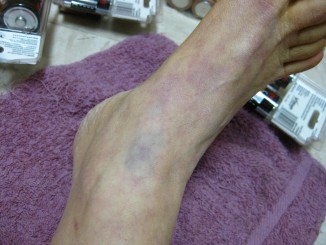
Bruises from locked leather retraint cuffs on for many hours, immobilizing me
Bruises on bare ankle from long term use of 4-point  leather restraint cuffs, locked so tightly i could not move. — from IOL 2013

Although I brought the PAD both to the Institute of Living in Jan 2013 and to Yale in Aug 2013, I don’t know what happened that it was abrogated so deeply and so widely. At Yale, they forced medication on me, holding me down three times daily at times, resulting in such psychic regression that as you have all read, I routinely stripped naked, defecated on the floor and smeared feces all over the wall. That I was at one and the same time attempting to communicate with these people, by WRITING WORDS IN MY SHIT, was utterly disregarded by all at the time. But I assure you that if I was regressed and psychotic in doing such things, I was nevertheless still verbal! I am also virtually certain that had they not grabbed me, pinned me to the floor and held me down for three painful injections in the buttocks of a drug that Soviet dissidents have long called pure torture (Haldol in the 60s/70s was the subject of many a televised congressional hearing, and discussed in just such terms…) my response would have been very very diffferent indeed. 


That said, they did what they claimed they had to do, and when I left, I left feeling absolutely convinced that my life was and had been mortally threatened, that I could NEVER return, that I would literally be murdered if ever I dared.   Nothing more need be said about such sadistic places as the Institute of Living at Hartford Hospital. Even in the Patient Care Guide and Journal, they are at pains to make it clear that any loud or out of control behavior will be dealt with swiftly and severely, with seclusion, restraints, and even charges pressed by the local authorities! (NO attempts to soothe the traumatized patient or act on what CMS has urged be the best practices of trauma-informed and patient-centered-care at the IOL. No, at Hartford Hospital, it is all about NO SWEARING and staying quiet, non-disruptive. The “Or else” threat behind it all is not even implied but openly stated in their rules and obligations section. Why ANYONE would want to set themselves up for treatment in such a place is beyond me…They have even edited out any attempts at kindness from the old handbook that I was given just a year ago.   Yale at least attempted to live up to a policy of Trauma-informed  and Patient-centered care. When they said No Restraints policy, I believe they meant it, at least in terms of NO MECHANICAL leather and shackles restraints.


And I believe that had Robert Ostroff MD, NOT been in charge of my care during the week or two that Robert Milstein MD was away, some of the brutality might not have occurred at Yale and I might be writing less devastated things about the Washington Square 2 unit, a place I had once so hopefully described as a “soft, gentle place to land in a psychiatric crisis.” But as much as because of my outrageous and disruptive behavior in response to their trauma as because of their repetitive violence and cruelty, I can never return there…a sad thing I suppose, since there is literally no safe place in Connecticut for me.* *more on this later or in another post.  What I have posted here is an update in order to Keep me OUT of the hospital as much as to direct my care if I am put inside, It is not the whole thing, only the first two or three pages, I would be happy to upload the whole thing so you can see how I did it, if anyone indicates interest. Let me know. So far it was always the first three pages that got people’s attention.   ______________________________________________________

Pamela Wagner’s

PSYCHIATRIC ADVANCE DIRECTIVE 2014


FOR WHEN I AM HOSPITALIZED OR INFORMATION TO HELP TO AVOID IT


Miss Wagner has experienced multiple episodes of severe psychological and physical trauma, including date rape, the suicide of two friends, and domestic abuse by caregivers. She should NOT be subjected to restraints, involuntary seclusion, or forced medication. The use of these inevitably leads to re-traumatizing and injury, regression and severe worsening of her psychiatric symptoms.


HOW TO INTERVENE IN A CRISIS:

  • DE-ESCALATION IS ESSENTIAL  
  • DO NOT TOUCH ME OR GRAB ME.
  • DO NOT LAUGH AT ME.
  • I WILL CALM DOWN IF YOU REMEMBER THAT:


  1. I AM SCARED AND PARANOID. I ONLY FIGHT IF I FEEL UNDER ATTACK.  DO NOT USE A SHOW OF FORCE, AS THIS WILL FRIGHTEN ME MORE.


  1. DON’T ISSUE ULTIMATUMS…That will push us all into a corner and serve nothing
  1.  AN UNRUFFLED PERSON SHOULD ASK ME TO TAKE A DEEP BREATH, and try other verbal calming techniques. I am always grateful for people remaining calm when I am upset.


  1.  NEVER LEAVE ME ALONE IN A BARREN (seclusion) ROOM.


  1. A WEIGHTED OR WARMED-UP BLANKET SOOTHES ME. SOMETHING ICY TO EAT CAN ALSO HELP.


  1. PLEASE LISTEN TO WHAT I HAVE TO SAY.  Medication may not be needed if you hear what the problem is.


  1.  IF NECESSARY, YOU MAY PERSUADE ME TO TAKE ORAL MEDICATION, if you negotiate this with dignity and kindness. Keep speaking to me calmly and explain your reasoning.


*I cannot reiterate enough that if you utilize 4-point restraints or seclusion, it is virtually guaranteed that you will see regression, increased hostility and aggressiveness as a result. Please don’t do something everyone will regret.


ADDITIONAL STATEMENT TO CAREGIVERS (PLEASE READ)

It is important that you understand that I do not have a personality disorder (you can confirm this with Dr Angela C——, or any of my longtime outpatient providers and friends and family members). If my behavior/emotions seem out of control, it is because I am out of control – temporarily.

I have had tertiary CNS Lyme disease, which I was informed after multiple positive PCR and Western Blots during treatment was likely incurable. During my initial illness, my brain developed MRI lesions which may predispose me to temporary emotional and behavioral abnormalities but these are NOT my norm. Anyone who knows me well would tell you that, if you ask them.

I am not always able to communicate my fear but because I feel so threatened and unable to communicate clearly about it (lest there be consequences to me) I may become very angry at the hospital situation. I am not an angry person, but I do have trauma issues, as many people do.

Please be aware that I am sometimes mute, in frustration and overwhelmed by circumstances. You can provide me with a pad and pen to facilitate communication, but berating me into speaking will no purpose and may only precipitate anger.

Ascertain from me whether the information you have at hand is correct. Too many records and hospital charts have been drawn up on faulty information from earlier charts or information gleaned from others but not from me, and the consequences to my treatment have been devastating.

I would prefer NOT to take any medications and will resist them. I want to experience my LIFE AND MY FEELINGS. If you insist on meds, the ones that work best are _______.

I will not take any drug that induces weight gain. If you force it, know that I will fight you, tooth and nail.


Open Letter to Harold I. Schwartz, MD, Psychiatrist and Director in Chief of the Institute of Living at Hartford Hospital Behavioral Healthcare

April 16, 2014

Dear Harold Schwartz, Director of the Institute of Living at Hartford Hospital

I believe that I was profoundly harmed by the treatment I received in 2013 on Donnelly 2 South at the Institute of Living at Hartford Hospital, and that what the staff did to me was not only unethical and cruel but that it crossed the line into illegality from the very first. Psychiatric patient abuse is a pattern in Connecticut hospitals, but it was most egregious at the Institute of Living because the staff told me that they knew what they were doing was wrong but that they would get away with it anyway.

That I know I was a difficult patient never justified staff behavior towards me. I was loud and upset and hard for them to deal with, yes. That is precisely why my Psychiatric Advance Directive (PAD) was written out the way it was, and why I made my medical and psychiatric history online so available. When ill, I am frightened and paranoid, which makes me easily roused to irritability and hostility. I know this, from a distance as it were. But knowing this now does not mean I was in control of my emotions. I am by nature neither temperamental nor prone to temper eruptions or throwing things. In addition, I am extremely modest, hardly one to disrobe or urinate in public. My friends and family have at times variously labeled me “stoic” and “peacemaker,” which should tell you a lot. But that I disrobed and urinated on the floor on Donnelly 2 South both horrifies me and concerns me because these behaviors point to something going on distinct from my psychosis: they point to my having been subject to abuse and trauma at the hospital itself.

Let me make it very clear that if I have behaved in such ways before it was only in response to similar extreme circumstances – as when i was subjected over and over to restraints and seclusion in a horrific and sadistic fashion at Manchester Hospital in 2009 and similarly at Middlesex Hospital in 2010. It is too bad that when Sanjay Banerjee MD and Amy Taylor MD took it upon themselves to violate my HIPAA privacy rights and investigate my previous admissions, without my permission (which I expressly refused to grant) they failed to make the connection between the abuse, and my subsequent behaviors…It turns out all they drew as a conclusion was that if those hospitals could use restraints and seclusion ad libitum, so could they. It didn’t seem to matter to Dr Taylor in particular that in 2009 and 2010 measures such as seclusion and restraints not only didn’t work, they made things worse. Not surprisingly, when Dr Taylor followed these examples I regressed completely, just as my PAD predicted.

I was admitted to Donnelly 2 South, and I came in with a very detailed Psychiatric Advanced Directive as I said. I made it very clear that my online electronic medical record was also available. It included documents such as my narcolepsy diagnostic consult and special documentation assessing my need for a higher than usual dosage of Ritalin, written by my former sleep specialist, Mary B O’Malley, MD PHD who was also my psychiatrist from 2000-2009. Included as well was a letter she wrote to my present psychiatrist, Dr Angela Cappiello, explicitly stating her conviction that I do not have a personality disorder, NOS, borderline traits, or otherwise.

According to Dr. Sanjay Banerjee he read every page of these documents. That is what he told me. He even praised me, saying he wished every patient would come so prepared. Moreover, when he spoke with Dr. Cappiello, he brushed off my concerns about anyone misperceiving me as having a personality disorder. My brother, Philip Spiro, MD, himself a psychiatrist, brought up the same matter when in discussion with Laurie Denenberg, LCSW, but her response was much the same: “Personality disorders are not a part of the picture here. We intend to honor her PAD. We are glad that she has had the foresight to prepare such a document.”

If this was so, then how did it come to pass that Amy Taylor, MD wrote on my history and discharge summary that I have a “long history of Borderline personality disorder” and herself diagnosed “Personality disorder NOS with borderline traits”? I was being treated for four weeks for an active psychotic disorder Axis 1. In any event, she could have no way of knowing whether or not I had a personality disorder, given an active an Axis I diagnosis.

On or around February 4, 2013, I walked in frustration away from the quiet room where I had been held captive for nearly three weeks, strolled down the hall, looked out the window and slowly retraced my steps back to the quiet room, which I had been expressly told was NOT a seclusion room (the definition at Hartford Hospital’s Institute of Living of a seclusion room is a “room to which the door is locked.”) But when I arrived I was confronted by a cohort of staff who proceeded to 4-point restrain me to the bed, even though I was quiet and put up no resistance. Not wanting to give them any reason or justification, I passively lay down on the bed and placed my own limbs out for the restraint cuffs, saying, (I quote my journal entry made later that evening): “For shame. You ought to be ashamed of yourselves. I am not and never was a danger to myself or others.” Their response was “ You refuse to follow directions so we do not know what you will do. This is not punishment, Pamela, this is what your behavior brings on every time.”

From that point on, the threshold for restraints was extremely low. They always restrained me, spread-eagled, so tightly I couldn’t move a muscle. They never permitted bathroom breaks or even used a bedpan, instead they made me defecate in my clothing. They never even let my hands free to eat. I would fall asleep rapidly after three routine punishment needles in the buttocks: Haldol, Ativan and Benadryl—whether I just had my regular meds or not, and they would invent reasons to maintain me in restraints even after I had been asleep for hours. When I woke, groggy and hardly dangerous to anyone, they would grill me with questions that I could not answer. They would then use my inability to respond as reason not to let me out, even when I asked, as the chart recorded, in a “soft sedated voice” for release. They would re-inject me, to put me back to sleep instead.

In the evening on Jan 5th, for the second time that day, they brutally restrained me for throwing half a graham cracker at the wall. Then, as usual, they left me like that for six hours, even after I fell asleep. But in point of fact, though, I could never earn my way to release from restraints by good behavior or quietly, calmly asking for release. I had never done anything to earn my way into them in the first place. I was never violent until they threatened me. They refused to release me until I literally cried, “Uncle” when they told me to.

As to those vaunted “shows of force” what did they expect? Presented with a cohort of threatening staff personnel I saw one thing: an impending assault.  I know they anticipated my panic; they said as much in my chart. Isn’t that the point of a planned “show of force” – to induce fear and panic? Why else do it? So why should it be any surprise, when I defended myself when they forcibly, physically grabbed me? When they stuffed me into a body bag and were trying to tighten the straps, surely you can understand why anyone would bite the hand of an attacker whose digits came near the face. I had done nothing but refuse to enter the body bag willingly. I simply was passive. I did not fight or resist until they grabbed my body and assaulted me.

But none of it should have happened. My Advanced Directive explained in exquisite detail exactly what to do and what I respond to better than fear tactics and force. In fact, It is beyond me, knowing that one of the admission diagnoses I came in with was PTSD, how anyone could possibly approve in advance, permission to use restraints and seclusion “just in case they are needed”. Why not counsel the person asking for this advance “right to restrain” to do all in his power not to restrain me and to work with the PAD instead?

Here’s what SAMHSA the substance abuse and mental health services administration publication has to say on seclusion and trauma:

“Studies suggest that restraints and seclusion can be harmful and is often re-traumatizing for an individual who has suffered previous trauma…

“Further, there is a common misconception that seclusion and restraint are used only when absolutely necessary as crisis response techniques. In fact, seclusion and restraint are most commonly used to address loud, disruptive, noncompliant behavior and generally originate from a power struggle between consumer and staff. The decision to apply seclusion or restraint techniques is often arbitrary, idiosyncratic, and generally avoidable.

“Moreover, some studies indicate that seclusion and restraint use leads to an increase in the behaviors that staff members are attempting to control or eliminate.

I have been traumatized, and not just by hospitals. I was date-raped three times in my twenties and experienced traumatic domestic abuse by a long-term roommate. The cover sheet on the PAD made very clear that due to these trauma issues, I could not tolerate being secluded or restrained without serious consequences: regression and serious worsening of symptoms. Unfortunately, as soon as the staff saw fit to use physical methods of coercion and control on me from the first time a staff member grabbed me and pushed me with his lower torso, I ceased improving, and my symptoms went downhill. Did they really think they were being kind and compassionate?

Staff violence begets violence….

I tried to get help even when on the unit, at least I tried when I was free to, to make calls or leave my seclusion… that is to say, forced three -week-long stay in the quiet room last winter. I made many calls to the hospital’s patient advocate office, but the sole time anyone made contact was when the advocate came to hand me some paperwork – I believe I was actually in 4-point restraints at the time — papers I could not read about the forced medication hearing. I needed her advocacy, but she never responded to my panicked calls in any way that was helpful to me. I wanted her help, but she never came by to ask me what I needed. She was less than useful, the fact that I had to go through her, essentially a hospital employee, and her refusal to respond, contributed to my ongoing panic and desperate feelings of aloneness and depression. No wonder Dr. Sanjay Banerjee attempted to force ECT on me, without any prior discussion of it with me whatsoever.

And where did the ECT discussion come from? My PAD states in no uncertain terms that I will refuse ECT under any and every circumstance. My brother would be my conservator if Banerjee had sought to go down that road, and he would never have made any decision to counter my wishes on that subject. If Banerjee really read my PAD, he would have known that. I have already had FORCED ECT and it traumatized me terribly. Also it failed to work.

Banerjee had stopped my 75mg of the antidepressant Zoloft during the first or second week I was there. “Do you really need that?” he had asked, “You don’t seem depressed to me.” Obedient, and in any event glad to get off any medication at any time, I shook my head, assenting to the change.  A week later, instead of reinstating the Zoloft, Banerjee blamed my sudden “depression” on my refusal of the anti-seizure medication, Lamictal, a drug I had not taken in 6 months. Now he was applying to force me to take ECT, something I was terrified of, and to have calculated brain damageIt was this threat, and the brutality with which the decision was handed down, that started the downhill course of my IOL stay.

The very next weekday, all hell broke loose. When I entered the conference room, I pushed some important notes across the table that I wanted Dr Banerjee and Laurie Dennenberg to read. They refused, claiming that I threw the papers at them. Instead, Dr Banerjee proceeded to berate me, and told me how he had consulted with other hospitals and providers and had read my records against my instructions and Advance Directive, thus violating my HIPAA rights. Moreover, he threatened me with a behavioral treatment plan that would not permit me to do art or writing unless I “behaved.”

I hit the roof, telling him I would sue the hospital and complain to JCAHO, then summarily left, slamming the door, an act that stemmed from feelings of utter impotence, because I couldn’t actually say in words anything more effective.

It could have ended there. I could have been left alone, to cool down and calm myself. But, no, Dr Banerjee had to write for stat meds again, and even though I was on the phone and trying to find someone to talk to, to calm myself, I had to be physically dragged off the chair I sat on, away from the phone and brought to the floor in a physical struggle (because they had attacked first, i.e. physically grabbed me, I defended myself, instinctually). They could have waited for me to finish the call. They could have waited to see if I calmed myself. I was not hurting anyone or even threatening anyone or myself with harm. All that I had done, in terms of physical threats, was to throw a lightweight chair at the wall. And that, it was clear to everyone, was intended not as a threat to anyone. Furthermore, it was done and over with. I had left that area and gone to my room. I had then come back and now sat on the chair by the phone, speaking to my interlocutor on the other end. There was no need to pick a fight or encourage a struggle. A wait-and-see policy could have successfully guided the situation to a better resolution not only for the situation at hand but for the entire hospital stay. As the poem by Dylan Thomas goes: “After the first death, there is other.” Once they decided to use four—point restraints, there was no going back. The first time broke everything,  So they used them again, and again, and more and more freely and without justification but for convenience and punishment.

Back to Feb 5 or 6, after sleeping for six hours, I was taken out of restraints  conveniently just in time for a visit from Dr. Angela Cappiello, my outside psychiatrist. Observed by my 1:1 monitor, I only dared whisper and dared not tell the doctor the full extent of the abuse that had been happening. Nevertheless, she took one look at Amy Taylor MD’s behavioral treatment plan posted on my wall, and told me that it would be impossible for anyone, even someone who was well, to follow it properly. She was so worried about me, and about my ability to complete the treatment plan’s requirements, even for the required “24 hours,” that she intervened. The next day, the single day that Dr. Taylor planned to be out of town, Dr. Cappiello asked Dr. Mehendru to evaluate me for discharge, telling her that she feared a power struggle had been set up that I could never win.

When Dr. Mehendru came to see me, at first I was angry, as the chart indicates, thinking she was just another Taylor flunky, preparing to use more restraints and seclusion, But when she asked if I would like to go home, I took one look at her, saw sincerity in her eyes, and burst into a smile, ready to say yes to anything. Miraculously “cured,” I left the IOL that very same day, less than 12 hours after being released from 4-point restraints and not 4 hours out of seclusion.

However, I was not well. Within two weeks time, I was back in the hospital, this time admitted to Yale New Haven Psychiatric Hospital, via their emergency room. Over the next 3 weeks I experienced an entirely different kind of care. At Yale I did not find a staff ready to fight or try to seclude or restrain me.

I was still the same person with the same problems, loud and angry at times, even “violent” to property in my frustration, and still psychotic, yet they never responded with a show of force. Why would they? At Yale it would be absolutely anathema to deliberately frighten a patient. What would be the purpose in that, they would think. They also never pushed me into a seclusion room or strapped me down in punitive 4-point restraints, or any of the other ill-advised responses that my PAD explains are the worst things to do to anyone who is struggling, scared and paranoid. In point of fact, Yale Psychiatric Hospital’s Washington Square unit does not have a seclusion room. They also have a “restraints-free” policy, so they didn’t use those at all either.

The Institute of Living on the other hand with its “We only use restraints and seclusion if we have to” policy, restrained me countless times, and for many more hours than was even legal. When I woke up that last morning, the room opposite me was occupied by yet another person in 4-point restraints! That is because once you allow staff to use restraints a little, it only takes a little to use them a lot. And once you sanction the use of restraints and seclusion at all, it is only time before someone abuses them and abuse becomes the norm.


I would like your response to this letter, I have sent it to many people within the state government and outside of it, But you may have the first response. Also you may be interested in the youtube video of my artwork  which can be found at this site:

Prior to when you allowed the staff to body bag and restrain me, when I had done nothing wrong but leave the non seclusion quiet room, and you refused to come to my assistance, you had asked to see my artwork. Instead you left me to be tortured. Well, here is some of the art you might have seen had you rescued me from my abusers.:

Sincerely

Pamela Spiro Wagner

The final one you never saw in featured in the post below this one.

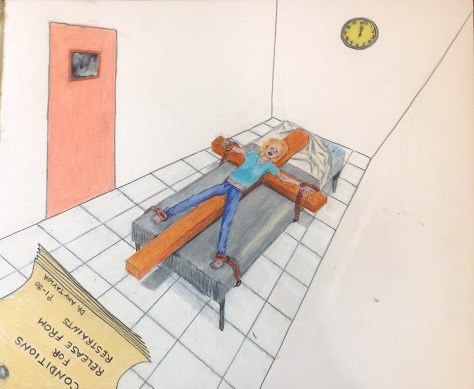
Four-point Restraints at the Institute of Living, Hartford Hospital for 19 hours +

Restrained at the Institute of LIving for Not Following Directions....Dr Amy Taylor presiding
In Restraints at the Institute of Living, Hartford Hospital, 2013, for Not Following Directions….Dr Amy Taylor presiding

YouTube Video: Mental Hospital Treatment and Abuse -Reality in Art

http://youtu.be/TftG2AzPx1k

This time you should be able to view this on an Iphone or Ipad.

Why I am Opposed to Involuntary Outpatient Commitment or IOC

Takedown on N-7


I have been diagnosed with schizophrenia for nearly forty years and was forcibly medicated and involuntarily hospitalized many times over those decades. Ordering me to take an “anti-psychotic” medication and then physically compelling me to submit to IM injections never got me to a point where I saw the “error of my ways” much less helped me to recover. How can that be? Take my 3-week stay at Yale New Haven Psychiatric Hospital in the summer of 2013. Because I refused the prescribed Zyprexa, I was repeatedly held down and forcibly injected with IM Haldol, a so-called first-generation “anti-psychotic.” Call Haldol an antipsychotic if you will or be honest and  just call it a behavioral management drug, it subdued me, yes, it did indeed. It stupefied me. And in the end I cried “Uncle.” But before I surrendered and submitted to their demands, I only got worse, regressing to a degree so pathetic I find it hard to believe it now. But that this happened was a connection the doctors and staff never made,, not even when after I was forcibly injected, I would strip, defecate and write on the wall with my feces.


It seems obvious, at least from my experiences, long and manifold, that involuntary treatment does not work, at least not the way people think it will or should. Over the short run, you can indeed make a person take medication (which is what this is all about in the end, drugs, not something like psychotherapy being forced on anyone…). You can threaten a person with hospitalization “or else,” and frighten her into swallowing pills. And if she does refuse, you can hospitalize someone for refusing and medicate her against will just as you do now to certain in-patients.


You can, if coercion is your game, put certain involuntary in-patients into 4-point restraints, pretending that her very resistance makes her a danger to others, punishing her for fighting the team that holds her down. You can even inject her with so-called “depot” drugs that once in the system continue to work for as long as a month.


Clearly, people break, faced with threats and coercion and many eventually come to accept treatment “voluntarily,” at least for a time. They may even appear to “get better”. Nevertheless this sort of improvement is often shaky at best.


Involuntary — forced — treatment is the worst possible thing you can do to a person with a serious psychiatric condition, especially schizophrenia. Symptom improvement will likely be temporary, even with medication “on board.” I have yet to meet anyone who actually gained that magical “insight” via coerced medication… And given the side effects of all the known drugs, very few people who are not voluntarily in the system consent to take them for long — for good reason.


Moreover, as recent research has shown, there is every reason to suspect that psychoactive drugs, especially the so-called antipsychotic drugs, are far less efficacious in promoting real and permanent recovery than we have been told. However, the effects of trauma and the aftermath of involuntary treatment can be disabling, even permanent. I know; I have been there. As a result of my experiences with forced treatment I now suffer from PTSD in addition to the diagnosis of schizophrenia.


Although at present I choose to attend outpatient treatment, I do not always comply with taking medication, especially when it make me feel bad. I won’t even take meds that others claim alleviate my symptoms. If a drug makes me feel horrible inside, I assert the right to refuse it.  Sometimes treatment can be worse than the disease. Alas, because of this, I have, while in-patient, all too frequently been subjected to forced medication hearings, hearings which I believe I was pre-determined to lose, the deck being stacked against me.


At the former Hospital of St Raphael’s in New Haven in 2004, I was not only forced to take the atypical antipsychotic drug Zyprexa, despite the fact that the medication had caused me to gain 60 pounds, elevated my cholesterol and triglycerides sky-high, and made me pre-diabetic. The probate judge, on the instigation of my in-patient psychiatrist, also ordered that I undergo involuntary ECT otherwise known as electro-shock treatments. I was so terrified of the side effects and the real brain damage ECT was inflicting on me, that I literally awoke,mornings, with excrement in my underwear.


In the more recent past, my experience at Manchester Memorial Hospital ECHN in Manchester, CT was just as horrendous. This, along with an equally brutal experience, at Middlesex Hospital in Middletown, Connecticut 6 months later combined to such trauma that I was diagnosed with the additional problem of PTSD. As recently as the winter of 2013, at Hartford Hospital’s Institute of Living, I was threatened with forced ECT, kept in seclusion for three weeks and restrained for nearly twenty hours multiple times. Why? Because as the record states, I was unpredictable and “did not follow directions.”


I would like to tell you about the Manchester Hospital experience in a little detail, as I believe it will give you a “taste” of where IOC, when taken to its logical conclusion, can and  will lead.


I was admitted there on a 15-day physician’s emergency certificate (PEC), and the attending,  a certain Dr Benjamin Zigun,  summarily took me off the two-antipsychotic drug combination, plus an anti-seizure medication and the anti-depressant I had come in on. This drug  “cocktail” had worked for me since 2007 without  distressing side effects. I was not only willing to take it but I felt it helped me function better than I had in years. But the psychiatrist at Manchester Hospital decided, and I quote, “since you are here, by definition your current meds aren’t working. I will put you on something else.” Did it matter to him that I had already been tried on nearly every other drug on the market, old and new, and none worked as well and with as few side effects as the Abilify/Geodon combination I was then taking? No, he was the doctor and the doctor’s decree was law.


As a result of his ministrations, the “offending meds” were removed  and I was again  ordered to take Zyprexa, despite its known and severe side effects. Over the next few days, I continued to refuse it. Naturally, having been abruptly withdrawn from all my usual medications, I began to decompensate further, having nothing in my system.  A forced medication hearing was held. For some reason, Dr Zigun decided I would not be given Zyprexa after all, but one of the oldest neuroleptics in the PDR, Trilafon. When I objected, he said only that if I refused even a single dose, I would be injected in the buttocks with 5mg Haldol.


All too familiar with Trilafon’s side effects — from akathisia’s maddening restlessness to a constant fine tremor in my fingers, I refused to swallow the pills. But neither would I willingly lie down to take a needle full of “vitamin H,” Haldol being a drug just as awful as Trilafon if not worse. So I resisted, physically, when it came to the nursing staff grabbing me and pinning me to the floor. I fought them when they so much as approached me with the punishment hypodermic.


At first, they just overpowered me, injected me and walked away. But after a few such tussles they started calling “a code” to bring in the goon squad.  I do not know how many times this happened but the goon squad consisted of several people including uniformed security guards . Without a pause, they would barge into the room, assault, restrain and inject me, despite my terrified screams.


This sort of violent encounter happened so many times, along with predictable and regular use of 4-point restraints and/or solitary confinement, where I would be locked in their dark, cold seclusion room, that I literally lost track of time. Indeed, but for whatever I managed to record in my journal after each episode, and from their single-viewpoint one-sided hospital chart, I would have no idea what happened during most of that entire three week period at Manchester Hospital, though from my bodily reaction when thinking about it, I know something very bad happened.


Why do I tell you this? Because this sort of aggression, even torture is what forced medication and involuntary treatment lead to much more often than you may want to believe.


If H.R. 4302 passes in the Senate and expanded IOC is instituted in the states where it is now allowed, how precisely do people intend to treat a person with a “mental illness” who does not to want treatment? If a person refuses to leave her apartment to be hospitalized, and is able bodied and physically strong, do they propose to assault, even Taser her, though innocent of a crime? Once she is unconscious and no longer able to resist, do they then intend to hospitalize her against her will so that she can be forcibly medicated, with the threat of  4-point restraints as a back-up if she continues to resist. Or perhaps they expect that trauma itself to scare any individual into compliance?


I am not against all psychiatric treatment. I am definitely not against all psychiatric residential treatment facilities ( including hospital psych units…) But we have curtailed the availability of in-patient beds at present to our detriment, even as we have allowed drug company research scientists and providers to focus almost to the point of tunnel vision on the medical model. This has brought us right to this notion that if we institute IOC, and can force a given individual to take medication, we will be working on a problem that has a real and objectively verified solution. In point of fact, however, there is absolutely no proof that antipsychotic drugs lower violence on the streets or have any effect at all on the incidence of violent crime.  That said, if a national IOC law mandated forced treatment, and hospitalization, where are the psychiatric beds to follow through on that mandate? Downsized, in most states to ghosts of their former abundance.


If this is what supporters of H.R, 4302 anticipate and believe in: IM injections, four-point restraints and all, then  I must ask: When will you learn that you cannot treat anyone with violence and expect the outcome to be a desirable one?  What you propose to do is to subject persons with psychiatric disorders to more trauma and violence than ever. You want to expose them to a“treatment” that is just euphemism for brutality.


I fought back, tooth and nail, biting and clawing the goon squads that descended upon me and attacked me, intending to shackle me by the wrists and ankles to a bed, because as they told me, “ I didn’t follow directions.  Yes, I resisted. Who would not have? I was terrified. What did they expect me to do, politely thank them?


This sort of coercion and cruelty masquerading as care doesn’t help anyone get better, it only chases them the heck out of Dodge and as far away from “treatment” as they can get. Oddly enough, little do “Escapees” from treatment such as these know that they might be the lucky ones. As longitudinal studies of treated and untreated individuals with schizophrenia are coming to light, it has become apparent –even Thomas Insel, head of the NIMH admitted this on his blog — that treating – medicating — schizophrenia long-term has had unintended consequences, one of which has been to inhibit complete recovery. By contrast, those persons who walked out or were forced out of treatment, “back wards patients,” seemingly hopeless — it turns out that these people to a much greater degree than those who stayed in the system, recovered on their own, without help, largely by stopping their medications.

A majority of these “lost souls” found themselves only after they ceased taking medication and ceased consuming mental health services. Because they became wage-earning, productive citizens and not mental health service users, many are now “lost” to the mental health system. To experience so few symptoms as to be unknown the to  provider community despite past illness, surely this must be accounted the best of all possible outcomes.


IOC works — or doesn’t work — according to a medical model that imposes medication on the unwilling, with no end point, insisting that mental illness is no different from diabetes. But as Dr Insel has admitted, this is not true and apparently never was. New models are needed. Violence is no solution, nor does it cure anyone to impose treatments of dubious value and great harm on those who are different from some mythical “norm. ”


(I sent a version of this to Connecticut’s Senator Blumenthal and several other people, including the New York Times, without response, so I am posting it here for public consumption and comment.)

Dreamrly’s COLLECTIVE Dream Art Magazine Has Launched

Kelli in Fractured Colors
Kelli being Drawn by Artist, in Fractured Colors – a blind contour study filled with color

I received the announcement below from Kayla Bowen today and thought I would pass it on. Dreamrly’s COLLECTIVE magazine is available either in print on demand or in a digital format. While I am one of the featured artists / poets, that is not the only reason I publicize the launch. I believe that dreams speak volumes, both to us and about our selves, and if we learned to listen to them, we might learn a great deal…

COLLECTIVE 2014 Launch Edition is Now Available

Launch edition 2014 features 108 full color pages, including:

  • Submissions from 40 contributors from all over the world
  • Three distinct galleries of visual art work
  • Interview with archetypal dreamwork analyst Laura Smith
  • Collaborative dreamwork feature with blogger Rita Kowats
  • An excerpt from Painted Over White, a novel by Katie Abrams
  • An excerpt from The Magic Pattern screenplay by Maria Isabel Pita and Dr. James Kroll
  • A complete section of poetry

Head over to www.collectivedreamartsmag.com to check it out!

You’re Invited! COLLECTIVE Launch Event

If you are in the Nashville, Tennessee area, consider coming out to join us Sunday, April 6 from 2 – 4 pm at Art & Soul on 12th Avenue.

 Copies of the magazine and launch poster will be available for purchase. We’ll have snacks, networking with other dream and creative arts enthusiasts, two interactive dream art stations, and an opportunity to see the cover art installation and meet cover artist Wayne Brezinka in person.

Do you have questions about the event or need more information? Email editor@collectivedreamartsmag.com.

Also a new Dreamrly/COLLECTIVEARTS contest:

“Fall Awake” Poster Series Campaign

COLLECTIVE is launching a poster series to raise funds for the magazine and to raise awareness about dream work and the visual arts.

The launch poster is available now on the web site.

COLLECTIVE is also hosting a poster design contest to select three additional poster designs to complete the series. Winners will receive $50 and 5 poster prints of their design.

Are you interested in submitting your design for the series?  Learn more.

Chained: New Art

Chained - colored pencil painting
Chained – colored pencil painting

Original Art: How NOT to Treat Schizophrenia: with sound


Trying again…

Still not playable on ipads or iphones, not sure why.  I think the sound will work. for what its worth…

Youtube video with sound available for all devices here:

How Not to Treat Schizophrenia or any other Mental Illness: Slide Show

No music or sound, sorry. Best viewed in small screen as the conversion to Quick-time made the files smaller and hence less crisp when seen on a large screen…I’m sorry but this doesn’t seem to be viewable on an ipad..Dunno about android devices. At least I notice that the controls are unavailable on my ipad at any rate…Will try to find another format that will work and re do it…SO SORRY!


Youtube video with sound here :

Sometimes it Takes a Village …to avoid the Hospital

Sometimes it takes a village...of caregivers
Sometimes it takes a village…of caregivers


I swore that after I left Hartford Hospital’s Institute of Living last January, 2013, having spent the better part of a month in seclusion and many many hours brutally and punitively four-point restrained, I swore I would never go anywhere that would treat me like such an animal again. But then, having twice been treated at Yale New Haven Psychiatric Hospital once in early 2013 and finally later on that same year, discharged with piriformis syndrome from having been forcibly held down and injected in the buttocks  over and over with 3 different drugs, Haldol, Ativan and Benadryl, I said that I would NEVER again permit such torture in the name of treatment anywhere, no matter what they called it. No not even at Yale.

Given the massive traumas I have experienced these past five to ten years in Connecticut mental hospitals, abusive practices that have only increased since my first hospital stays in the 70s, I decided last August, post Yale: never again. Never again  would I go to  ANY hospital whatsoever.


To that end, my family, my family of origin, since I never married and have no money of my own, has taken it upon themselves to hire for me (or let me arrange for myself the hiring of) several personal staff members to “come on board” for me in my apartment 24/7 starting in late December and if necessary work through January, if there is a crisis. I haven’t gotten through any January without a hospital stay in several years, so it is a good thing to be prepared, on the one hand. But the very fact that I need not fear the hospital now might also mean I can avert the worst of any crisis! Who can tell? All I know is that we are all talking about how to help me primarily stay safe from what the voices command me to do, and how to do so without panicking or calling 911.


One thing I insisted upon was NOT using any agency, because while they serve a function, I suppose, they also pay their workers shit. And someone who is paid $8 an hour is not going to want to do the same quality of job for me, while sitting with me in my tiny apartment as someone who is getting the entire $20/hour, if you get my drift. And why would they? I need people who are committed to keeping me safe from myself at the height of any craziness that might assert itself, and if the voices command me to grab a pencil and suddenly stab myself with it, as they frequently have, I NEED to know that the person I have hired will be right there with me, ready to grab it from me, not in the other room reading a book, or cooking, or yammering on the phone to a friend. For $20/hour I think it might not be too much to ask. At $8/hour it might be.


For $20 an hour, a person can stay awake all night and not need to work another job immediately upon going home, so I will know that if I wake up in my recliner and hear command hallucinations to set myself on fire, she or he will be right there to stop me. Because that is how it happens, has in fact happened just like that.


It is the only way to do it. Unless $20 somehow is not enough to cut it, pay wise, (and I cannot afford to pay more, over all) (the people I hired are also already not working other jobs either…) I think it is not a bad wage, is it? Honestly now, tell me. I am not asking for much else but for someone to sit with me, talk with me IF i feel like it, and watch me to make sure I stay safe. The worst thing would be boredom I imagine.  But I don’t usually bore people even when ill. THat is not often their problem.  The problems are other things, for me at any rate, and those are that the people that sit with me in hospitals have NOT done their jobs properly at all, and have ignored all the warning signs, even my open pleas to please please “do your jobs. I am on “one to one” for a reason!


No, in the hospital, the aides just turn their backs and stand in the doorway, facing outward, away from the room i am in, and gab with the other aides, completely  ignoring the person they are supposed to keep their eyes on at all times. It is crazy. I remember a woman named Jennifer deliberately turned her back to me no matter where I stood in the room, and if I went in to the bathroom, she left the outer room entirely…which was such a rule breaker. She knew what was happening, I think she was playing a game to see if I was truly dangerous to myself or not…Or really just didn’t give a damn.


Is it any wonder that at one point at one hospital, I  asked to get off that status. It was simple: I just told them I was safe and they were so glad to reduce their workload they stopped the one-to- one immediately. The next thing I knew the voices had me begging to use my makeup compact. the one with a small glass mirror in it.


“Sure, you can. Just make sure you bring it back to the nurses station in five minutes,” said the Nurses Secretary, handing me the little black plastic thing.


Well it took all of three seconds for me to stamp on it with a hard soled shoe, break the mirror and slice up my left wrist bad…


Of course, they punished me for that. Or they would have, I know. But I remember, I wrapped a huge wad of paper towels around all the blood and told no one for hours, so when I realized that I needed stitches and had to admit to what I had done, it was too late for them to respond with the punishment of 4-point restraints…


The point is, the aides weren’t evil. Not all of them, or at least their lackadaisical attitude was borne out of a lack of caring which itself was spawned by being paid little to nothing. Why should they care? It was just a job to most of them, and little better paid that flipping burgers at a restaurant. Worse than that, because they had no perks and no tips.


So when I hire someone to sit with me, talk with me, keep me safe both from myself and hospital abuse, I pay them $20 per hour (and even $30 per hour over time during snow storms etc), I expect them to be responsive and not lackadaisical. I do not think that is too much to ask or demand. My life and health and bodily integrity depend on it.

NaNoWriMo – 3rd Installment, November Novel: We Are Hope’s Family

Feder spoke into the darkness of Hope Ouestelle’s apartment. No one answered. “Hope?” Again there was no answer. He peered through the dimness of black and gray shapes that he hoped were just her papier mache people and creatures. “HOPE! Where are you? “ He stepped inside and moved forward, fumbling blindly for something to guide his way. Just then, his hand fell upon a lamp and he was about to pull the cord, when Hope yelled out from the bathroom.

“Don’t try to turn on the lights! I am doing something here and any light will ruin it! Just wait a goldarned minute, okay?”

Happy to hear her voice, Feder felt for a chair, slid into it and rested. At least Hope had lights, which meant that she had not lost her utilities the way some of the buildings tenants had, not yet at any rate. Not the way he had. Feder was ashamed of himself and was half afraid to admit it to Hope that he had spent too much money this month.  On  important things, yes, but also things that experience told him most people would not understand, like repeatedly paying to go through the turnstile at the Parkland, just to feel the rolling thump of the bars against his body. Why did he like this and why did he do this? He didn’t know what it was about that admission turnstile but there was a moment, right inside it, when the bars felt like they locked and might not release him, and he felt such anxiety it was almost pleasure, and then they did, they let go and that was so  — what? It was so mysterious a pleasure that he had to do it again. Yes, he knew that there had been a rate increase in the electricity bill this month, that he had to pay $30 more, but somehow entering the turnstile had used up that $30 and he hadn’t been able to pay his bill and now his apartment had neither lights nor heat.

What was Hope going to say when he told her? He wasn’t going to ask her for money. She wouldn’t have any extra in any event. He just hoped that she would let him eat with her in the evenings, and cook his supper in her apartment with her the way she had the last time this happened. She might even, maybe, perhaps, let him sleep in a chair in her artroom/living room if it got really cold in his apartment. That’s what she had done the last time and he could only hope she would do it again.

But he remembered what she had said to him the last time he slept there the previous spring, before he left for his apartment, after the weather turned warm again and daylight savings time returned. ”Feder, I cannot keep rescuing you from yourself. What am I doing? Am I helping you or hurting you by letting you stay here? I honestly do not know.”

Feder hadn’t known what to answer. How could she hurt him by letting him cook his food in a lighted kitchen or sleep where it was warm? How could it hurt him to help him? But Hope had her own ways of thinking and he had to keep that in mind. She did not understand the draw of the turnstile, and he knew she would think it strange to the point of bizarre. Everyone did. Everything he did looked strange to people. He was bad. Bizarre was bad, bizarre could get you taken away. But Hope should understand that. She was regularly taken away herself for what others thought was bizarre behavior: sitting in her artroom, talking to herself or to her papier mache people, or listening to voices of people no one else could hear, and doing what they told her to do, harmful things to herself, things like putting out cigarettes on her skin or cutting off pieces of herself with the sharpest of scissors. Talk about bizarre.

Feder at least had never been taken away. Not since he was a kid. But he would not think about those days. To think about those terrible days in the screaming room was to invite trouble, the many hours tied down to a bed because he wouldn’t – couldn’t – stop spinning. The times the teacher pinched his arm to stop him from reciting names after names of things she did not have the same need to know and hear…His need to tell her the dates of everything that ever happened to him and her need not to hear him, to silence him. How she had so much power to do so. No! Mustn’t think about those bad times, black times, screaming times…Mustn’t think. Mustn’t think. He had to think about something else. Think about the turnstile, the turnstile. How the heavy rollers came across to stop a person from crossing, then how they caught him and held him ever so briefly—that strange mechanism he was never sure he saw properly – and then how they always gently released him safely to the other side. He would think about the turnstile if he had to, until Hope came out of the bathroom.

But then thinking about the turnstile reminded him of the fact that he had not paid, could not pay, his electricity bill and how there was neither heat nor lights in his apartment. He did not want to admit this to Hope…The need to recite took hold, as it always did when anxiety got the best of him and he seized the information that was closest at hand: His name was Feder Prisma  and he was 31, born Jan 5, 1979, a Friday. Hope Outestelle, his best friend was age 57, born Sept 16, 1954, which was a Thursday, the 259th day of the year. Premjit Mukherjee, was their friend, and the building manager, aged 47, born on April 1, 1964, a Wednesday, the 92nd day of the year. Stashu Weissman, was from Poland, aged 79, b orn in 1931, Dec 25, a Friday 359th day of the year. Giorgio Ciabatta, the auto mechanic, at age 43 born, in Italy, Feb 19, 1968 on a Monday. Beatrice Bean age 84, was born on Sunday May 1, 1927, the 121st day of the year. Their Landlord Mr. Mukherjee, was age 71. He was born on Sunday, April 27, 1941, the 117th day of the year. On the fourth floor, Bryony Leurile aged 44 was born on the 82nd day of the year, Sunday, 1967, March 23rd. Then there was Kashinda Whitmore, age 27, who was born on the 305th day of the year, in 1984, on Halloween, a Wednesday. Darryl Strakesley aged 31 was born on  a Saturday, the 255th day of the year 1981, Sept 12th. Lupita Villareal, aged 62 was born on Sunday, the156th day of 1949, June 5. There were others, but he did not know their birthdays yet, so he started repeating the dates to himself. Hope  Oestelle, his best friend, was born on Sept 16, 1954, she was 57 now. It was on a Thursday–

“So, what do you think of this?” asked Hope, appearing suddenly in the equally sudden explosion of lights that came on all together when she flipped the apartment’s main circuit breaker.

Feder started.

He hated it when people wanted him to notice something. It was always a test he failed at. He guessed. “Your hair?”

Now that he said it, he looked to see if it was true that her hair was different. She had cut her hair as short as a man’s, yes. Not only that but it seemed that she had dyed it as well, a persimmon red.

“No, not my hair. That was just an experiment. Look.” She held out her hands, dangling papers for him to look at more closely.

It looked that she had been developing photographs, but these were very strange ones. So dark as to be nearly black, with purple streaks and outlines of leaves and circles.

“Kirlian photographs.”

“Yes! You know! Well, sort of. I am doing electro-photography, and developing the Polaroids myself. I wanted to see if I could make this camera out of things I bought at GoodWill, and it turns out I could, mostly. But Feder, I’m really disappointed. The photos are awful. I was expecting something different. These are ugly. I think auras should be beautiful…” She retracted the photos instead of handing them to Feder, and tossed them aside with a shrug. “You win some, you lose some. At least I didn’t spring for a real Kirlian camera. Those cost $500. I only wasted maybe fifty bucks, making mine. At least I can say that I built a working aura photography device, for all the good it did me.”

Just at that moment, Feder’s stomach took the opportunity to announce its hunger with a rumble. Hope heard. She looked at her watch with a frown.

“Haven’t you eaten, Feder? Do you want to have supper with me? I’m sure we can scrounge up something.”

Feder made a rueful face but nodded. “Yeah, I’m pretty hungry. Maybe you have some cereal I could put milk on? Captain Crunch?”

“Nah, I never eat cereal, Fayd, you know that. I could make you some oatmeal, but you hate my oatmeal. How about a peanut butter and banana sandwich and diet ginger-ale? I have some really good bread and about three bananas.”

Feder’s eyes lit up at the mention of his favorite sandwiches and he smiled for the first time that evening.

“Good. I’ll make the sandwiches if you peel the bananas and pour ginger-ale into glasses for us. Okay?”

Feder followed Hope’s carroty buzz-cut into the tiny kitchen and between the two of them they made short work of preparing their meal, then carried their plates out to where Hope’s art work occupied most of the living room. Hope pushed aside the Kirlian photographs and made room for Feder on the sofa, then flipped on the 12”  television propped on a stool on a milk crate in front of them. Eating intently, they hunched forward as the PBS show Nova’s logo blazed across the little screen.

“Oh, good, I was afraid we’d missed it, but we’re just in time,” Hope murmured between bites of sandwich. Feder never spoke while a television played; even when the programming failed to absorb his interest, the interchange of light and shadow on the screen never did. Television had calmed him from an early age, and his mother always placed his crib in front of a late night movie when he couldn’t sleep. Knowing she couldn’t talk with him now, Hope turned her attention to the program, hoping it would be about something interesting, something that would give her ideas for art.

People sometimes thought it strange that Hope, who was passionately an artist when she wasn’t ill, but who found it difficult to read or even concentrate listening to books on tape, nevertheless devoured television shows and documentaries on science. From natural history to physics, from geology to chaos theory and beyond, everything scientific intrigued and fascinated her, and she used what she learned in her art, in a multiplicity of ways. “What else is art for if not to express what science teaches?” She had said this to Prem one day when he asked her why she used cell motifs when painting her sculptures. “It makes no sense to separate them. If art does not serve science, what good does it do? Art can’t serve art. That would be silly, like a translator translating from one language into the same language. A waste of time. No, maybe art has other purposes too, but one of them I am certain is to interpret science, to express it for those who do not understand it any other way.”

When she had finished she looked up at Prem, as if surprised by her own words.. Not by the thought, but by the passion with which she had shared them, and the fact that she had spoken at length about such things to anyone, and even more so, to Prem, the landlord’s son. She remembered she had backed away, eyeing him warily. What did he care why she made art or what it meant to her? He wouldn’t give a damn. Why didn’t she just learn to keep her mouth shut and leave people alone? Now she would pay, that much she knew. He’d soon be spreading gossip about the know-it-all in Building 22, second floor apartment B, the one who makes the crappy art and couldn’t even read a book to save her life. It was true, her art was crap, pure crapola, and she knew it. If she was any good, well, she would be better at selling it, now wouldn’t she? And it was painfully true that she didn’t read, hadn’t read a book in years, simply could not. If she so much as opened a book she fell asleep. The rare times she didn’t, the words – indeed the letters themselves—soon swam and danced before her eyes impenetrably confusing, impossible to put them together in any sensible way and make them into single words, let alone string into sentences and paragraphs that made sense. She wanted to read books, but the books escaped her. The refused her eyes. They fled from her, as if defying her and mocking her. Nyah, nyah, they scolded. Eat your heart out, but you can’t have us! It was such a struggle, and Hope could do nothing, say nothing. She could not even complain or feel sorry for herself. Why? Why? Because…because…She didn’t know why. It was all her fault, all her fault. Everything was her fault and deserved punishment. No wonder the voices had for years told her to burn herself with cigarettes and intermittently wanted her to set herself on fire or cut off pieces of herself. No wonder. She was the scum of the scummiest. She was the scum of the earth. She was the devil incarnate. Hope pounded her fist on the arm of the sofa, forgetting that Feder was sprawled next to her. Luckily, he had fallen nearly asleep after the program ended. He raised his head at the sound.

“It’s nothing, Feder” Hope said, standing up and pulling a throw over him. “I dropped something. Stretch out now, and go back to sleep. I’m going to bed too,”

As he lay down, Feder called out to Hope, “Hey, Hope! What are you going to do with the electro-camera?”

“I dunno. I was going to take it apart. Why? Do you want it?”

Feder, half-asleep but serious, responded, “Yah, I have some ideas…Let me use it. I’ll pay you back if they work out.”

Hope, heading towards her bedroom, beating her head with her fists in a private frustration Feder failed to notice, replied as calmly as she could, “No problem, you can keep it for as long as you want it.” Then she closed the door between them.

“Thanks,” Feder mumbled to himself, tumbling into sleep.

“Jackass, you asshole…” Hope derided herself in angry mutters, still occasionally giving herself stiff thumps across the head. “You evil son of a bitch. Who do you think you are? You are the devil, the killer of the world.” She paused, stared blankly at something unapparent to anyone who might have been watching the scene, and mumbled a word or two. Nodded. Stared. Nodded again. Then she looked around, as if searching for something she had misplaced. She got up and padded across the bedroom to her dresser where she extracted a half-open pack of cigarettes. Approaching the bed, she stopped again as if listening to something. Again she nodded, twice. “Yes, I promise, I promise,” she muttered, then added, cryptically. “I will, if you will.”

Sitting on the edge of the bed, Hope pulled off her jeans. She extracted three cigarettes and lit them. Without hesitating she drew deeply on all three then immediately applied them firmly to the skin of her upper thigh, holding them in such a way that they burned but didn’t quite go out until she finally crushed the heads against her. Quickly, she repeated the maneuver, and again a third time. Finally, she pulled her jeans back on, drew her T-shirt down and hastily hid the remains of the extinguished cigarettes underneath the papers in the bottom of her wastebasket.

Calmer, but a bit dazed and still not ready to sleep, the cigarette lighter and pack in full view on her bed, Hope sat on the edge of the bed quietly, her head bowed, her hands in her lap. Her face, usually so mobile, was still and blank. But it was not a serene blankness. Rather, it was a blankness of confusion, as if she were not quite sure what had just happened. After about a half hour, she lifted her head, took a deep breath, frowned, and stood to clear away the debris of her recent actions. No point leaving any evidence around for Feder or anyone else to see. She could take care of her own wounds, and anyway, three times three wasn’t so terrible. She had done much worse before. No one ever died from nine cigarette burns, she just had to shut them up for a while…

It was well after midnight before Hope finally lay down under the covers and turned off her lights to sleep. And when she did sleep it was fitfully and to a book of troubled dreams. But sleep finally came and she didn’t wake until after Feder had left for the morning. She didn’t wake until the knocking at her door became outright banging.

Tuscany “Palazzo Podere”: New Art and Fewer Meds

Drawn from a photo...of a real "castle farm" -- I wonder if the owners will find me?
Drawn from a photo…of a real “castle farm” — I wonder if the owners will find me?


This is a photo of my large drawing of a place in Tuscany named Palazzo Podere or as translated, “Castle Farm.” I only uploaded a small file…Sorry… the details are fuzzy but them’s the breaks.

Things have been up and down, but the last two days were better than before. Largely because of an art therapy session that I found amazingly cathartic. It involved my being asked to make a “three dimensional sculpture” from a sheet of paper, a pair of scissors and some clear tape. I had no idea what to make, nor what would come from it. In fact, I dithered for a while, stymied, rolling a bit of the blue construction paper into a little tube and taping it, desultorily, waiting for inspiration. Nothing. Then suddenly it slammed me. YES! I was making, YES! a bullet for, YES, my very own Glock 9 semi-automatic handgun.

I proceeded to craft a crude gun with a bullet or two and a clip of ammo until I was finally satisfied that I had what I wanted. When I was through, Margaret, the therapist, handed me a sheet of paper on which she had written, “I am” five times. She asked me to look at my paper gun and ammo clip, at any angle I wanted to, and complete the five sentences as I wished. Well, I won’t  tell you in great detail, because my answers were were rather gross and violent, what I wrote, except to assure you that when I was through, and it took a while, she asked me, How do you feel?

I had been somewhat tearful as we talked and earlier in the week had been extremely upset and angry, but I now looked at Margaret and with a little surprised smile said, well, you know, I feel…better!


And I did. In fact, when I saw Dr Angela the next day, she noticed the difference immediately. Whereas before I had been nearly screaming, and not looking at her, now I could smile and make eye contact for the first time in months.

__________________________________

Progress on the medication front: Am off all Abilify. Now am dropping the Geodon, slowly. Down 40mg from 160mg. Will be dropping 40mg every 2 weeks. I think. Unless that feels too fast. If I run into trouble , I will slow it down, but Geodon never seemed to do much of anything for me…Maybe I am wrong, it could be I’m unaware of what it does. But in my experience it did little positive for me, and so it should not be too hard to get off it. I just need to be careful not to stop anything too quickly, no matter how eager I am to be off all meds.


I still take some small amounts of Ritalin and Xyrem for narcolepsy, though hugely reduced  now that I am not so sedated on antipsychotics and antidepressants and only take 200mg of Topamax. I dunno about that last. I may try to stop it too. But it depends on the olfactory hallucinations and whether or not my migraines are under control.


IN the meantime, I have been busy hiring people to stay with me 24/7 come January, in the event of a crisis, which I have to assume will happen since it always has…So long as I know people will come in and prevent a hospitalization I feel okay about it. Otherwise I would be panicking, thinking that I would ever have to go through such torture. NEVER would I let them do what they did to me at Yale or the IOL again. I will kill myself before they get their hands on me another time. But it won’t happen, because  i have aides/nurses/various people hired to help me out now in my own apartment, and they will take care of things so no hospital will be waiting in the wings to torture me. The only thing I need to be sure of is that who ever it is that is going to be with me, they MUST be on board with the NO MEDS thing. NO ONE is going to force meds  on me in my own apartment — I don’t  care who they are. If they don’t agree with that, if they have a pro-medication agenda, then they are not going to be part of my plan…