Tag Archives: restraints

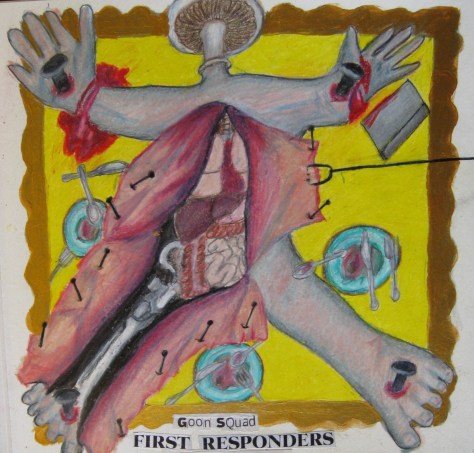
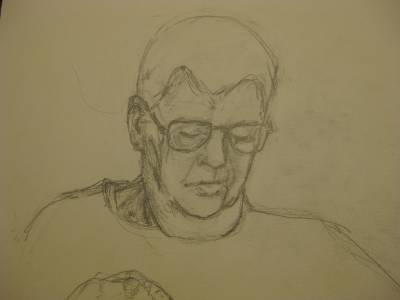
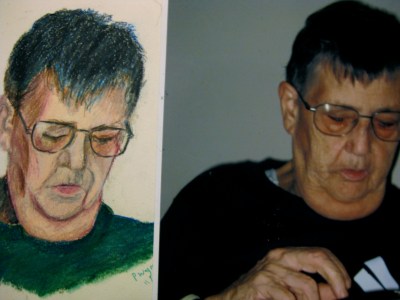
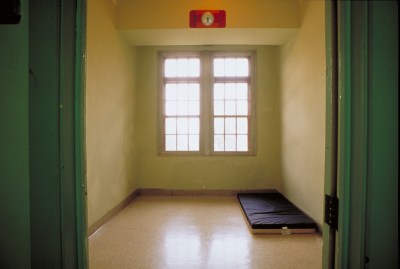
Art created at the Torture Chamber called the Institute of Living at Hartford Hospital

104_3377


I was a prisoner at Hartford Hospital’s Institute of Living’s Donnelly 2 South from January 10th until February 7th, 2013, the day before the east coast blizzard, and I only “escaped” because the torturing doctor went on a four day vacation and the substitute decided that I was not actually psychotic any longer and did not need seclusion or restraints after all…and opted to let me go the very day I was freed from both.


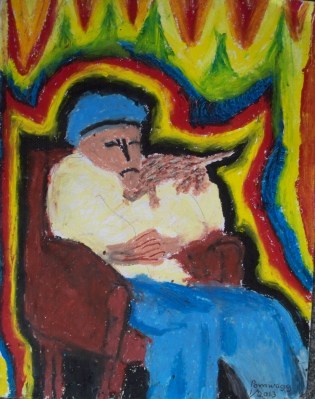
Good thing too, because it was a Thursday and all travel stopped the very next day and for several days after that. The picture above is one that Shedana, RN liked very much. She said it captured her “physique” and while the flooring is imaginary, the unit was structured much as it is pictured. At least while I had a bed on the unit, with my door facing the med room and another bedroom opposite. Shedana was a “good egg” but of course it didn’t help when they decided to attack me in force and secluded me for two weeks and worse…But more on that later.


The first doctor I had merely convinced me to take, semi-voluntarily, a fairly stiff dose of Zyprexa. which I tried to do with regularity. I soon found, however, that far from being the miracle drug it had once been, mixed with Abilify and Geodon it induced a state of apathy and boredom. As if the Intake and Feeding drug, the drug on which I used to feel enthusiasm to learn and read, Zyprexa, simply mixed very badly with the Output drugs of Geodon and Abilify, such that I neither could read and learn, nor do art or write. In any event, this abysmal lethargy pushed me out of desperation to paint this, in oil pastels.


104_3389


After that, I simply started refusing to take the Zyprexa, and refusing a lot of other things…A great deal of abuse happened. But I did this picture before all my art supplies were confiscated for no reason other than punishment (you cannot damage yourself or others with soft oil pastels)


104_3404


Before I tell you some of what happened, without naming names, lest a legal case be made against them, as there might possibly be a chance to do, let me show you most of the rest of the art I did there, though one of them is unfinished and may never end up being finished, since it was hospital art and may stay that way.


104_3410


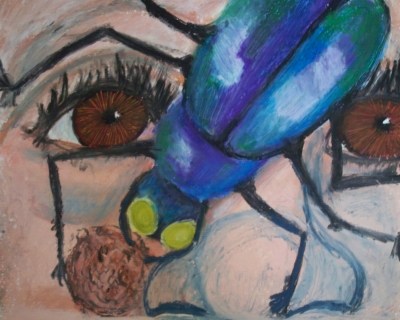
This one is an oil pastel, me with a dung beetle pushing a ball of shit around on my cheek…Says enough just that, doesn’t it.


104_3402


This one can be turned any which way to see all sorts of things buried in the picture. It was the one I started first and never did get to finish. What I can point you towards is the central object at the very bottom, which you can trace up to the blue figure and see what is happening. It should tell you something…The hand on the upper left is pointing at this process. Also, the exploding biohazard ball is part of it all, representing me, the all-polluting biohazard…But you have to look at the picture carefully. There is a Boat To Nowhere, and there are a couple of turtles, why, I don’t know…yadda yadda.


Finally, the very last time I had access to any art supplies, and I do not recall whether it was my last morning or some other time, I painted this one with oil pastels. I believe it speaks for itself.


104_3412


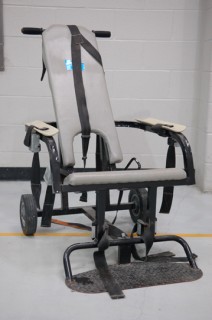
What happened was that they were routinely, literally routinely restraining me “for not following directions” as they would quite openly state. Four-point restraints, in a tight no movement position, for many many hours at a time, with absolutely no indication of how, just how, I might “earn” my freedom. Of course they wouldn’t tell me what I could do to “be good” because I hadn’t done anything to ‘deserve” restraints to begin with as they knew perfectly well. For example,. and this was typical, but it was one of the few opportunities I managed to document because they ha removed all my writing materials, illegally, but I forgot that I had a right to a crayon and paper until Feb 6th. That afternoon, I simply walked away from my seclusion room. I had had enough of them saying it was “merely a side room” not a seclusion room, then preventing me bodily from leaving it. So when I could do so without someone actually wanting to fight me, I walked away, and proceeded to enter the unit and walk down the hall to the end and look out the window, I took a deep breath, heard THEM behind me, and sauntered back to the proper end of the hall, the “lost end” where they kept anyone from seeing me or knowing what they were doing to me. Once I got there, they descended on me, the horde of the goon squad, some staff I knew, but most I did not. I did not bother to look at who was doing what to me. I simply lay passively on the bed, and put my arms out so they could do what I knew they would do. Tightly, they shackled my wrists out past my hips so there was no play in the restraints and I could not turn on my side or do anything but lie stiffly on my back. At the same time, others jerked my feet apart and just as tightly shackled my ankles to the lower corners of bed. Then came the coup de grace. They pinioned me on my side somehow, pulled down my pants, and injected me with three drugs: Haldol 5mg, Ativan 2mg, and Benadryl 50mg. Why, except as punishment I do not know. because I had, just a half hour before, been doped up on involuntary Zyprexa 10mg.


But of course it was punishment. The very fact that they told me it was “not punishment” but “what your behavior brings on every time, Pamela” only proves my point. At first and usually they only said, it was because I “didn’t follow directions” so if they were not punishing me, what were they doing? They most certainly were not following Centers for Medicare and Medicaid regulations for the use of Restraints and Seclusion only in cases where a person is in imminent danger or harming self or others! Indeed, the best they could do, when I protested, passively, saying just those words, was to respond, “You are not safe” as if that proved somehow that I was in danger or posed any imminent threat to the safety of anyone.


No, I did not. I didn’t threaten or harm anyone. I merely walked the length of the hall and looked out the window and then went back to my solitary confinement. But it was enough to trigger their retaliation, and that started at 1pm. I was not released, not even to use the bathroom or eat supper, no never even was a single hand freed to permit me to eat supper — until 7pm.


THEN, at 8:30pm, I became upset and frustrated because — well, I do not know now why, but I “threw a half a graham cracker at the wall” as I recorded later. And the goon squad descended on this dangerous patient again, not only with the strait jacket of four point restraints, but with the same 3 drug IM-in-the-ass cocktail.


This time, however, passive as I was as they trussed me up — and I said only, “For shame, for shame. You ought to be ashamed of yourselves, doing this to me…” — passive as I was, allowing them to seize my limbs and tightly shackle me yet again in truth I dared not resist, as that would only have justified their violence, and i already had my share of bruises. Bur I had come to my limit of the abuse i would silently tolerate. They could restrain and seclude me but they had up till now only silenced me in restraints because iu wanted to earn my way free quickly. THis time I didn’t give a damn. It was nearly nine o clock and no one knew what they had done to me. Everyone was getting their bedtime meds and going to bed without any understanding of what was going on. I was a stranger to most people on the unit, who had no idea I even existed. THAT was a situation that had to change. NOW.


After they trooped out of the room, stationing a 1:1 sitter at the door as usual, I stopped my merely silent and passive resistance and started to scream. I wanted to be heard. I wanted to scare people. I wanted them to wonder, Who is that person,. and what in god’s name are they doing to her? Are they torturing her? And I wanted them to ask questions of the staff that the staff could not answer. I screamed and I screams in desolation and despair, feeling like my life was at an end. The plan they had set up for me was impossible for me to live up to. In nearly 10 days I had not even earned my way to a pencil and my journal. Only to restraints and more restraints. I saw no way out of the hospital. So I screamed, long blood-curdling, heart-wrenching screams that I assume did the job of scaring all, as eventually they closed my door, much to the disgruntlement of the sitter who was forced to come inside with me and was no longer free to socialize. But not for a while. I kept on screaming until my voice gave out and I felt asleep.


The next day the substitute doctor freed me, I dunno why or how, but she did. and I thank my lucky stars as the staff doctor was a sadist and never would have. I have a lot more to say, but for now I am hoping to hear from a sympathetic lawyer who will take on my case for some reason for some purpose…Unlikely to happen. despite my bruised body and joints that are so out of whack I cannot sit indian fashion or cross my legs. Why won’t they help me or respond? I didn’t die, so they won’t earn a lot of money from my case, nobody gives a damn about mental patient abuse…


You really know when you are a third class citizen when you only MIGHT be worth more to them dead than alive.


SISTERS OF NO MERCY

POEM IN WHICH I SPEAK FRANKLY, FORGIVE ME

GOMER: ER-speak for a troublesome, unwanted person in the emergency department, acronym for Get Out of My Emergency Room

So many times gurneyed in by ambulance and police escort
“dangerous to self or others,” and too psychotic
to cooperate or scribble consent, you suspect by now
you are just a GOMER to the snickering scrubs in the ER
who whisk you in back with the other disruptives
lying in beds, waiting for “beds.”

One time you dip paranoid into the inkwell of your purse
extracting a paring knife more amulet than effective protection,
they strip-search you, then, unblinking, eyeball you all night
through a bulletproof plexiglass window.
In the morning, 15-day-papered so you can’t leave,
they send you ominously upstairs.

Later, at home, the voices decree your left leg
should go up in flames to atone for the evil within,
and you listen, and you do it, you do it:
the searing flare of cobalt actually crackles.
This time you tell no one, the char too deep for pain,
until fear of worse trumps your fear of being taken away.

This is not the story of your life.
It’s not the story of your life–
but every time a hulking goon squad clamps restraints
around your flailing wrists and ankles, threatening
to prosecute you for biting those hands that shackle you,
you wonder if there will be any other…

© Pamela Spiro Wagner. All rights reserved (Please note that I request that you do not reblog, reprint this poem or save this poem for anything but personal use. The rest of this blog post may be used if you credit Wagblog properly.)

________________________________________________________

A new reader, Rachel, has had training as a nurse, and is not reluctant to share her insights from the other side of the gurney, so to speak. Her comments have been enormously illuminating to me and contain so much helpful information that I have asked her if I might post them on Wagblog itself so others might have the opportunity to read them “first hand.” I have collected all of the ones here at Wagblog (there are others on my http://www.aboutschizophreni.blogspot.com site) and will try to provide some context for each one so they make sense, if they do not by themselves.

This first comment was in response to my post, AM I CRAZY…Nov 4, 2012 — when I doubted the veracity, of fact if not experientially, of what happened to me at the ED last summer.

Here is what Rachel wrote:

“OH….. Pam. I completely relate to this post…

Is anything more traumatizing than not being able to trust your own perceptions? I don’t think so.

I have so much swirling around in my head that I could say about all this, it’s hard for me to sort it all out, but I will try.

15 years ago I went through nursing school. One of the things that was greatly impressed upon us in our training was the fact that medical charts are Legal Documents – therefore, you must be ultra-careful about what you write in the charts! Also, there is so much charting and other paperwork required, to meet the legal demands of insurance, etc., that it is truly impossible to do the charts “right,” and still find time to do the actual job of patient care. So… just because important happenings are not recorded in your medical chart, that should by no means be taken as proof that it did not in fact happen, in some fashion.

As for that security guard…. sigh… I’ve led a strange life… about 20 years ago, for part of one year, I worked as a security guard in a bank. The security guard who trained me was one very scary dude. All he did was talk about his wonderful collection of guns, and his beloved hobby of shooting those guns, and bragging that he would have made a satisfying career out of being a hit man, if it weren’t for these pesky laws against being paid big money to commit murder! I became so alarmed by this fellow’s homicidal rants and ramblings that I told our boss all about it. The male boss, a retired U.S. Marine, dismissed my concerns out of hand. “People who talk about killing never do it,” he said.

A few months after I left that job, the hit man wannabe shot his fiancée. It was an accident, of course, he having so little experience with guns….

I am so sorry for this latest cruel trauma you have endured, Pam. Just being treated so roughly is enough to put any person at risk of losing touch with reality. As the late Viktor Frankl, MD, PhD, survivor of nearly 3 years in Nazi concentration camps, said in his life-changing book, Man’s Search for Meaning: “An abnormal reaction to an abnormal situation is normal behavior.”

I believe that is probably what happened with you this past July. You were thrust against your will into an abnormal, traumatizing, soul-annihilating situation, which undoubtedly unleashed multiple memories of similar traumatic indignities in the past. You were being treated, not with the kindness and compassion that you needed and deserved, but with palpable disdain. Harsh thoughts and hateful emotions are communicated, far more than with words, via body language, facial expressions, the eyes, the tone of voice, the “vibes” – even a so-called dumb animal instinctively knows when it is not safe, when the people in charge are not to be trusted.

A nurse, concentrating on giving injections in the proper way and in the proper amount, is not going to be paying any attention to what exactly a security guard is doing, or saying. Also, if she realizes after the fact that she gave an injection for which the order had already been cancelled, I am sorry to say that too many nurses, AND nurse instructors, are NOT going to admit that in the chart. I know this, for I’ve witnessed it firsthand. It’s sad, it’s illegal, immoral, and potentially deadly dangerous , yet it is true.

As for having a run-in with a security guard who has a homicidal attitude? I’m sorry to say that they are not at all uncommon, either.

Did your terrified, traumatized mind fill in the blanks with words he did not actually say, as a way to make some kind of sense from what he had done to you? Maybe. But the fact remains that your autonomy, your power, your rights as a human being, were taken away from you, and you were thrust into a terrifying, traumatizing, abnormal situation. For you to be put into such an extremely abnormal situation, particularly in light of all the old trauma memories it undoubtedly evoked in your mind, an abnormal reaction on your part in such an abnormal situation is, really, truly, Normal Behavior.

Rachel

My response to her comment:

All I can say to these things, Rachel, is WOW! I may have to rethink my blog post. Maybe some of what I thought was not delusional but did in fact happen. For instance, I wrote so often that I got those 3 shots. Now I am thinking, maybe i did indeed get them, because why would I pass out so immediately from a mere 20mg of Geodon and 1 mg of Ativan. But with 5 mg of Haldol added it would make more sense.

As for the guard (I refuse to call them security guards as they provide NO security and are in my opinion out of control thugs) I think he may indeed have compressed my neck, if only by holding me down in such a way as to restrain me roughly. Whether or not he intended to strangle or kill me, I dunno. And I have no idea whether or not he said those words, only that they do echo precisely what those nurses said or I hallucinated they said over the hospital PA system about my phone call, which they claimed to have recorded and were also replaying over the same PA system…So if those were the same words, perhaps it was only a hallucination. But perhaps only the words, not the rest of it. Thank you SO very much for validating as much as you have. I truly appreciate your contribution to this site and hope you will continue to offer what you know and have experienced. It is so welcome!

Pam

Rachel’s next comment was in response to my two new artworks: first the Killer Nurse collage, and then the Monet “take-off” of Argenteuil boats at evening…:

…Killer Nurse, HAHAHAHA! When I was in nursing school, a group of my fellow students dubbed themselves (oh you are going to love this): “Sisters of No Mercy.”

They were, too! By the way, I was elected class president by my fellow nurse students, an honor I did not seek out. When I realized by the end of the first semester that I am not cut out to be a nurse, I thought I could not let down my much-younger classmates who had honored me so, by dropping out! Thus I kept slogging doggedly away, and made it through to the bitter end, making all A’s or 4.0s, I’ve forgotten now how we were graded. Then I took the final big test that determined one’s eligibility to get a license, shocked myself by scoring in the top 1% in the entire nation, gave the big Class President year-end speech at graduation, got my diploma, obtained my license, and…. I worked 3 or 4 days as a nurse, hoping to get my money’s worth out of my costly education, but I still wasn’t emotionally cut out to do the hard job of a nurse and I knew it, so I abruptly quit, and let my license expire.

If you have to be a “Sister of No Mercy” to make it in that profession, you can count me out!

Rachel

Then her latest comment is again in response to my blog entry titled AM I CRAZY? and  my response to her first comment.

You are most welcome, Pam, I’m so glad my words could help.

I just want to add this, though: most of the security guards I worked with so long ago were very good people. There was only a small percentage of guards who had that scary macho-swagger itching-for-trouble attitude. You find people like that in every segment of the population, as I’m sure you know. But it truly did seem to me that a higher-than-average percentage of such types are drawn to work that allows them to wear a uniform and carry a weapon and push people around. These types are more like children playing at cops-and-robbers, than adults doing a serious job.

On a typical day, standing around in a security guard’s uniform watching the world go by is the most boring job on the planet. When finally “something happens,” these “Make My Day” gung-ho types come alive, and in the worst way.

As for the job of nursing… that’s a very different thing. I worked for a couple of years as a nurse’s assistant, before I finally went to nursing school. Nursing is HARD. Really, it’s an almost impossible job. There are never enough nurses, meaning most hospitals and nursing homes are chronically understaffed, and therefore there is never enough time to get everything done that needs doing. The work is absolutely overwhelming at times. You can work your entire shift at a flat-out RUN and STILL not be able to do it all, and do it “right.” You need 6 hands, you need a stomach made of cast iron, you need a backbone made of steel, and you need feet that can take an unbelievable pounding.

A person can go into nursing with a heart of pure gold, caring and compassionate and empathetic to the max, and the day-in-day-out unrelenting MISERY you see all around you will either kill you, or make you harden your heart in self-defense. As a nurse in a busy hospital, a nursing home, and most especially in an emergency room, the world is one big gaping aching wound, a bottomless pit of sorrow and need, and nothing you do is ever nearly enough. You need to be in 10 places at once, doing 10 different things, and almost everyone demands and criticizes, if not the patients, then very often their family does the complaining.

Stay in nursing long enough, and it is almost impossible to hang on to both your sanity, and your heart. This is why I could not do it! I only worked one week in an emergency room, this was as part of my nurse’s training, and that one week of non-stop, often life and death emergencies, almost did me in!

As I read your vivid, beautifully written description of what you endured last July, I could SEE it in my mind. In the eyes of the nurses, you were not a suffering human being with worth and dignity and rights no less important than their own, you were merely an unwelcome interruption, a problem to be dealt with, quickly and firmly and with a minimum of fuss and paperwork. This was not YOUR fault, it was the fault of the system, for want of a better word.

But knowing how HARD nursing is, does not in any way excuse the harsh, hateful, disrespectful attitude you were shown.. yet it does, in my mind at least, explain it. I have seen and experienced it myself, from BOTH sides of the medical charts, this harsh, disdainful attitude.

I have witnessed this, both as a nurse-in-training, and as a patient. When you’ve been called from the bedside of a child whose body was crushed less than an hour ago in an automobile accident, and his mother is dead, his father is hanging by a thread, and if the child survives, he will most likely never walk again… and here is a patient who has nothing visible wrong with her, only she is “inexplicably” freaking out – the disdainful, put-upon attitude from the medical personnel who simply do not “get” the first thing about the very real horror of psychological distress, is very real. It’s not your imagination, and it’s not your fault, either. It’s just that they don’t get it, and they are overworked and exhausted and stressed and overwhelmed with the horrors of life in the trenches.

I hope you know what I am trying to say here? To you, in your time of extreme duress and suffering, the snappy bitchiness and cold-heartedness of the medical personnel, coupled with the terrifying physical roughness of the guard, must have felt so very personal. But YOU were not the real target, in my opinion. The nurse was probably (inexcusably!) bitchy because she was already behind in her duties when you were brought in with your immediate pressing needs, and the guard was probably an overgrown boy playing macho-cop-wannabe, who finally got to see some adrenalin-pumping ACTION.

Someday, if they live long enough, that guard, and the nurses, will become old and infirm, and they will most likely experience, in some fashion, what it is like to be the one who is disempowered, hurting, fearful, and in need of compassionate help, while being treated like they are nothing more than an unwelcome interruption, a pain in the ass, an unimportant, non-person. Someday, I believe, it all comes back around. At least, that’s my hope!

Rachel

Finally, the following comment concerns my post “Open Letter to Dr Deborah Weidner (Sept. 9, 2012)”

The memories this post brings back…. I was shaking inside as I read it. It was hard enough going through this kind of mistreatment as a powerless teenage girl in a state mental institution, I can’t imagine going through this now, at the age of almost-60. I’m so sorry you were put through this. Until I read this just now, I thought your emergency room mistreatment of last July was the worst you had gone through recently. But this…. I don’t know how you came through it. I think if this had been done to me, I would have permanently checked out of reality.

Your feistiness is what’s keeping you alive. The very thing in you that the “wardens” of the mentally ill want to drug and shame and torture out of you, that undying spirit of yours is why you are still here, still breathing, still functioning, and still able to coherently tell your story. You are amazing.

Rachel

Psychiatric Crisis Intervention: How to Avoid Restraints and Violence


*Note that when I write of a psychiatric crisis, I mean a patient who is not actively on street drugs. I cannot speak to any situation where someone has been taking unknown quantities of unknown chemicals. In such a situation I have absolutely no experience.

That said, I would like to tell you a few simple things about dealing with an unarmed, undrugged person who seems agitated and paranoid. It is true that I speak of myself, but I believe that the only difference between me and a two hundred fifty pound man, is only size and the fear factor. I think that there is no reason on earth why he would not respond to the following interactions just as well as I know I would.

First all of, remember that the person you are dealing with is indeed agitated, and is if paranoid  by definition terrified. Keep that uppermost in your mind, because everything you do will be evaluated by her in terms of what threat it poses. If you frighten her or threaten her, she will become much more  unpredictable, and the probability of violence increases enormously.

Never approach such a person with a show of force.Not even if she is being “loud” and disruptive. You gain nothing by such brute force methods, and you lose a great deal…Ganging up on a patient who is paranoid only puts her in the “fight” mode. After all, she is already frightened and you have cut off her only perceived avenue of “flight.”  Why  escalate a crisis situation, making it worse, upping the potential for a violent response. If the situation has already devolved into accusations, yelling and swearing — all three signs of increasing anger and desperation — that is a signal that whatever you are doing is making the paranoia worse; at such a time the best thing to do is NOT to worsen the situation by pushing back, responding with equal anger, and making demands and ultimatums. No, instead back off and WAIT. The person most likely has not had access to a weapon or anything to hurt herself or others, so patience is a virtue and can be put to good use here.

Usually a patient who is paranoid will not do anything of her own accord but try to escape the situation. But if you force the issue, if you prevent her from escaping to a comforting place or from her own feelings of fear by permitting her what she needs to calm herself, or worse, attempt to do something to her that she could perceive as an attack – for instance, if you try to force medication, or grab her or simply threaten her with a group of staff or guards approaching en masse, you may very well provoke her to respond as anyone would when attacked, i.e. with self defensive maneuvers.

Why be surprised, when several people try to rush her and grab her to hold her down for IM medication, or simply gang up on her in some misguided attempt “to calm her down,” if she then responds with apparent aggression? After all, it is several of you against the one of her and it is surely understandable that she feels threatened. Her life feels in danger and in such a situation all bets are off as to what she thinks she must do to preserve her safety.

If you really want the situation to end well, refrain from threatening or attacking her, no matter how impatient you may feel. Instead, choose one calm, unthreatened and unthreatening person, preferably of the same sex or somehow compatible with the paranoid patient’s personality, and have that person approach to a safe distance (safe for the paranoid patient, not just “safe” for the staff person or for lack of a better term, “negotiator.” The negotiator is safe so long as he or she does not threaten or attack the patient, who is much more frightened than the negotiator.

Approach to a safe distance and possibly sit down, calmly and in a relaxed position, so that she understands that you are not scared of her but also not angry or threatening. If necessary, you might indicate that the patient is speaking too loudly for you to hear her, or too rapidly, but that you are there to listen and talk, when she can lower her voice or slow down. Do not speak loudly or angrily yourself. Talk about anything at first. Don’t talk about the patient or what is going on and do not argue or demand. order or talk  about your expectations of or for her. Try to talk about calming external things. Does she like nature, art, sports, reading? Is she cold? Hungry? Can she take some deep breaths? Maybe she would like to sit down now, too? Finally, when she can, would she like to tell you what is going on? There is plenty of time, no hurry. It is important to find out what the problem is…

It may be you fear that she will attempt to self-harm or hurt someone impulsively. If the latter, keep everyone a safe distance away. And emphasize the possibility of violence so that they will stay  away until the all-clear.  Then talk to the person in a soft voice and gently remind her that you know she doesn’t want to hurt anyone, not even herself, that she is already in enough pain…What does she need, right at this very moment, to help her feel better? Then negotiate a way to get it for her, or something that will do as a substitute or an approximation.

It isn’t that hard to negotiate a calm solution to this sort of crisis, without violence or retribution, when you don’t threaten the person and are truly on her side. But you must never lie to her or to swoop down upon her immediately afterwards to put her in restraints. The point is to bring the crisis to a peaceful resolution. It is not a contest you must somehow win, and then punish her because you were scared and got angry. Exacting retribution  is unconscionable and if that is your impulse you need to have a talk with your supervisor. Negotiators and other employees who do such things need to be reassigned to other areas or other jobs. They do not belong in crisis intervention settings.

Now I am certain that you can think of other scenarios where four point restraints are absolutely essential. If so, I would like to have you describe one. We can discuss this because I am becoming more and more convinced that Seclusion and Restraints CAUSE more mental illness and suffering than they relieve. How would you feel if you found out that by putting a patient in four point restraints even once, you may have caused enough  trauma to induce more self-injurious behavior, plus PTSD? I believe this happens. I also believe that it is terribly dangerous for the sense of self and the self–esteem and the relationship between the patient and ANY  health care provider of any sort at all.  I see nothing good to come from restraints. NOTHING. I do not even see them as providing safety, not in the long run and scarcely in the short run since those who are restrained tend to become more violent not less. Why will people not learn that the “catch more flies with honey than vinegar” works with people in every instance?

But talk to me. Let me know what you think. A confession:  I once wrote an Op-Ed  for the biggest  state paper around her that suggested that restraints could be an okay form of treatment if patients were taught to ask for them voluntarily! (I cring just thinking how I toed my sister’s “party line” about the helpfulness of restraints. She learned that sort of thinking from being the attending psychiatrist at Y__ Psychiatric Institute where they taught patients to ask for wet packs or to have their wrists chained to their belts all day long… The difference between us is that she still believes in that sort of  brutality.)

“The Scream” plus an update…

  
In the midst of re-experiencing trauma, sometimes all you can do is scream, even if it is silently and only in paint…I hope this speaks to some of you who may feel as I do, often or even just once in a while. It took a lot to get this out, but I felt I did convey what I felt.

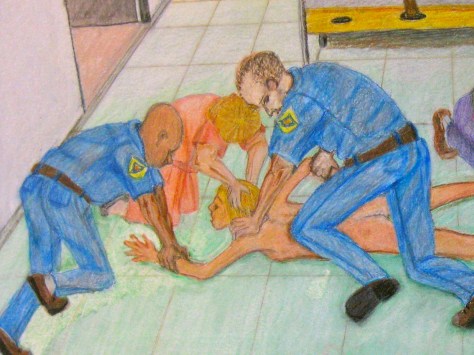
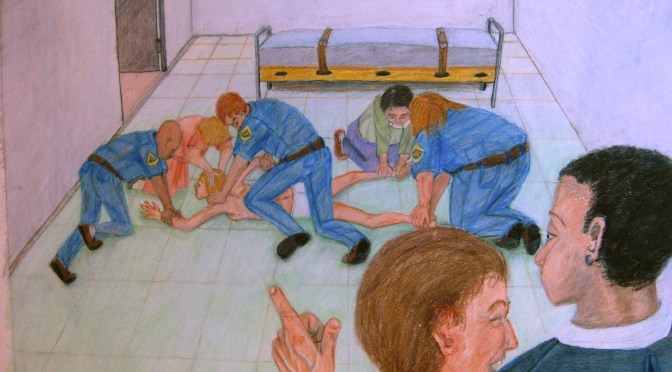
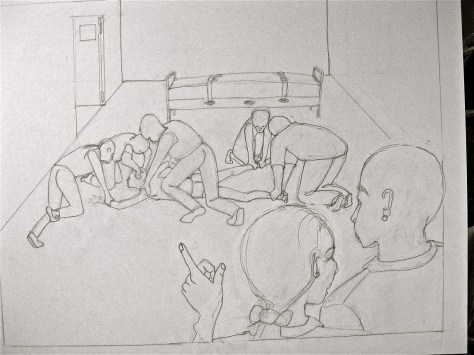
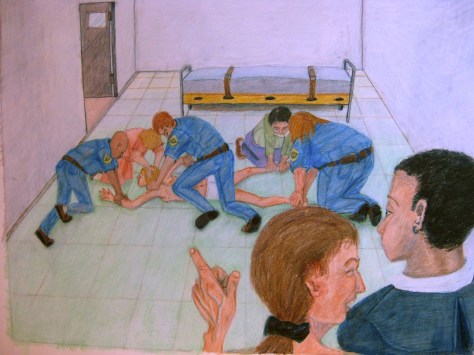
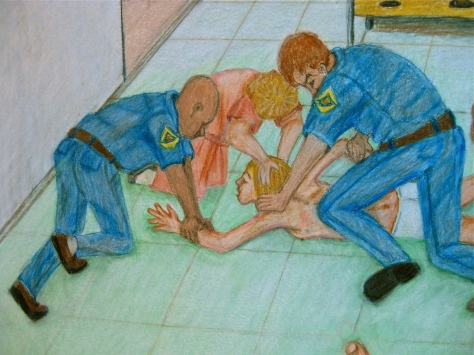
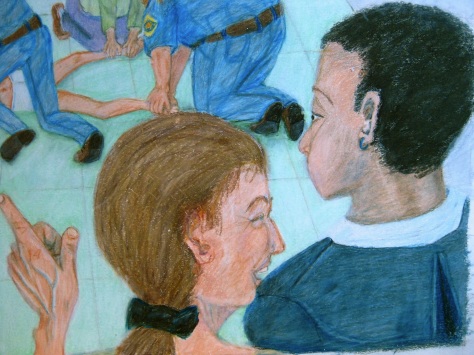
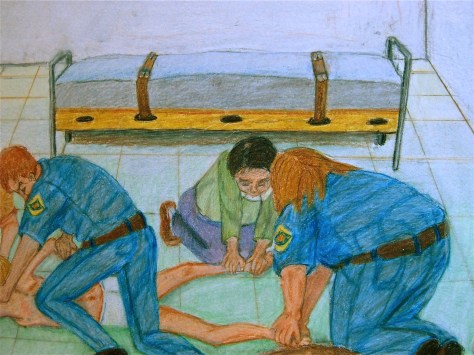
I am reposting the next one, a very painful if a not very skilled drawing, because I made some changes. I put a very mean smirk on the face of the woman in the front, who is meant to be facing us and pointing over her shoulder, though it was hard to get this in, given how little space I’d left myself… Also, I wanted to change the face of the man kneeling on me, and strength the look of the grip of the hands on me. If you compare the old version to this one, you will also note that I am purely naked here where as in the other, I have underpants on. This is the accurate one, but I didn’t understand that at the time I started the drawing. Alas, or perhaps this is good, I am rapidly recalling things I had not for two years about my experience at Middlesex. At least I remember stuff that happened BEFORE April 28th. For the other two restraints incidents, I still have no recall whatsoever or what I suspect is mostly confabulation drawn from what I read in my chart, though of course I cannot be certain. In any event, what I am remembering is not good at all, and I cry a lot…it is very difficult, and I feel so very very alone, because NO ONE understands and can talk to me, or more to the point can even stand to listen to me talk or cry about it. But it is difficult even to keep it under wraps all the time. If you have survived trauma, I think you know how it is. And that is why I avoid people when I think I cannot be “good enough company.” I don’t want to bring my friends down, but I cannot control the tears and shakes when they start…But the picture forthwith. Although it is disturbing as is, be aware that in the real incident, there was a great deal more violence, and more guards and staff members involved…these are just a paltry few. I simply didn’t know how to draw a crowd or a crowded room yet!

This is the incident before they used 4 point restraints on me that I so obsessively describe in Wagblog…Of course I take some poetic license with drawing the bed there and at the ready, as it was not there or ready or even in that room and I was quite calm and certainly no danger to anyone by the time they decided to punish me 
Takedown on N-7 Prone Restraint Detail: Me, naked — and this is a hospital?

This next picture I did as an attempt to express the guilt and shame I feel over having been traumatized at all. But I do not think I succeeded at all. Why? Because it became too intellectualized, with symbols like the Scarlet A and the guilt-crucifix, and even the hands wringing in shame, rather than pure expression…I want to do it over again if I get inspired to do so.

Shame Guilt and Ghosts is my attempt to portray my feelings of guilt at even having felt traumatized by so small an injury…but this doesn’t do it successfully, not so it seems to me at any rate.

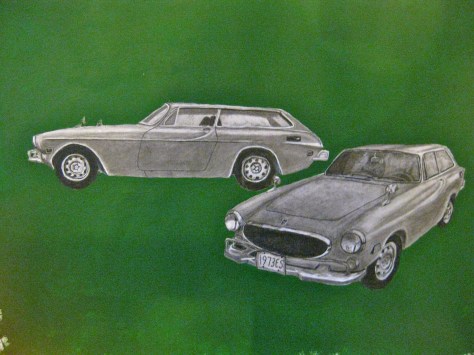
The next three drawings were just “fun” or for practice ones. The first two are presents for Tim, simply because he likes cars and is so wonderful to me. The third was an exercise in drawing two people together, and was copied from an “old master”, the name of  whom I simply cannot recall at the moment. It might have been — nope I don’t dare guess! I would have to get up and search for the book, and I ain’t gonna do that at the moment — too danged lazy. Anyhow, here are 1) two  1973 Volvo Sportswagon ES 1800 2) jaguar XJS and 3) the sketch taken from the old master’s painting.

1973 Volvo ES 1800 with British Racing Green “colour” in the background to represent the color of Tim’s car.

My third car drawing for Tim, a Jaguar XJS (I forget the date but I believe it is the mid 80s (if I am not mistaken).
Herr Goose after revisitation for repairs…Click on the photo to make a close up and you will notice neck “feathers and the difference it makes with old fully decorated version.
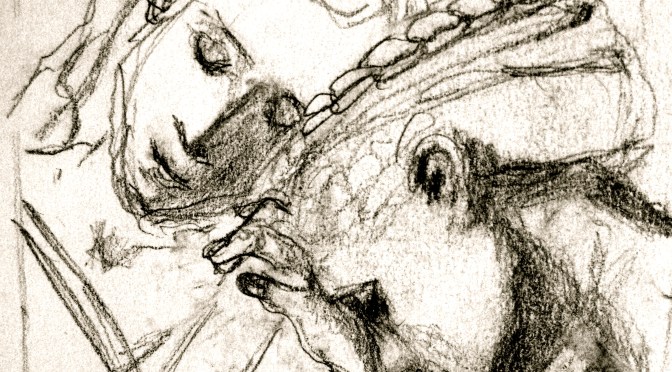
I sketched this detail from an old master’s painting found in an art book. Wanted to capture the two women together, and the angle of their heads (I actually didn’t do a very good job but there you are!)

____________________________________

NOTE: As I wrote this, “dream” talk, that is to say, nonsensical writings seemed to keep appearing in the middle of what I wrote. I seemed to find myself in another world every few minutes. I would write about that world, then “come to” and start writing about the subject below again as if nothing had happened. But when I reread the paragraph it made no earthly sense whatsoever, being an amalgam of two entirely different trains of thought. So a caveat: if some of what follows devolves into gibberish at any time, forgive me, and be patient. You can email me to alert me, if you wish, that would help. But otherwise, know that I will eventually come back more able to proofread and catch such idiocies…and fix them. For now though, you are on your own.  (The reason for these  brain blips, I think, may be, but may not, the  fact that I took a very small amount of Zyprexa today in order to be able to read and concentrate. 2.5 mg 2X a week should not make me gain weight, according to Dr C, But we thought it might do some good, without doing the usual harm. So I agreed to try it out once more, just at the minimal level as a PRN. Well, I find that I am very sleepy, have been ever since I took the pill, except for when I took a walk and for about 1/2 hour afterwards…and I do think that I slip into dreamworld while awake, and literally dream while writing this. Hence the gibberish.

*********

I have put the statement I read to the CEO and various administrators etc of Middlesex hospital on Youtube if anyone is interested in hearing it read outloud. Do a search for “Psychiatric restraints and seclusion abuse” and you should be able to find it if this link doesn’t work:  http://www.youtube.com/watch?v=vhZybDwMbzA  (I realize that I read it without much feeling, but it is hard to do so accurately and also look up at camera, and read without losing my place. Anyhow, it might be worthwhile to check it out.

The newest sorta development in the “case” this week was that a lawyer from the hospital, or someone who told my advocate he was a Middlesex Hospital lawyer, asked Wiley R (who is behind me 100%) “what does Pam want, what can we do to have her drop the complaint or withdraw her complaint to the DOJ and Joint Commission?”

Now everyone I told this to almost to a one, and immediately said this meant, “We are willing to pay handsomely in order to buy a gag order from her” I had trouble digesting such crassness, but to a one, those to whom I related the words of this inquiry told me the lawyer was insinuating something about paying me off. I mean: money. I felt slimed, completely slimed. For a few days this was the sole topic of my conversation, but to make a long story short, after I had decided to ask for several sessions with the hospital psych unit staff, educational sessions with me, to teach them how better to deal with patients, and have them experience forced restraints themselves…and so forth, my brother and I met with WR my advocate from the Protection and Advocacy (for persons with disabilities and mental illness) Office, and he informed us that the lawyer really was offering nothing, not even an official apology. Clearly, if so, then my real desire, to do hands on, face to face work with the staff that had so tortured me, was going to be out of the question, utterly forbidden. So we just decided in practically the same words, to let them “swing” in the wind.

In point of fact, when WR said that the DOJ might bring them up “on charges” if it was warranted, I asked him why I didn’t do that myself. He looked at me, and then narrowed his vision looking at a point beyond me. “Hmm, let me ask around and I’ll see what we can do.” I hastened to assure him that it wasn’t malpractice I was after. I knew that I had no real case, even if the statute of limitations hadn’t just run out a week or a few weeks ago. After all, what lawyer is going to take me on  one a contingency basis, and what jury would find for me in any event, seeing as how I did not die in their “care” nor suffer “grievous BODILY injury” which of course is all that counts…as usual. I am not sure what sort of case I would have in any sense of the word now at all…But as I told him, that is in his hands, and certainly is his bailiwick  (and if not his than that of  my lawyer-friend, Sharon Pope’s. If there are other “cases” to be made of any sort, I am more than game, I am ready and on alert to go and do whatever is needed in the pursuit of justice and reform of the Middlesex Hospital psychiatric system. It was really shameful, and despite the Public Health Department’s so called investigation, it was such a shameful joke, that despite WR’s impassioned plea to investigate MY case, and the psych unit in particular, they did no such thing. All they did was go back to spring 2011 (ie looked at the records of the entire hospital, or one of two representative records from most of the units, except for Psych so far as I could determine…) and do a random case study to look for general evidence of irregularities. Sure, they found some, and one case even involved the ER use of unnecessary or at least excessive use of restraints in a dually diagnosed young man…

But NOTHING was even looked at that had anything to do with what they did to me, or even the psych unit in particular. NOTHING was specific to my complaint, so I don’t know how they expected this  evaluation to give them any sort of reasonable results. They may or may not have censured or sanctioned the hospital. I did not read the entire huge file of support the bill got over the years. But I got the drift and the worst punishment meted out for repeated violations seemed to me to be a whipping on the wrist with a flimp ramen. Period.

Yet I was punished by the psych unit staff time and time again.

I know, I know! I was loud, I was angry, I was impossible to “handle” — I know this. Partly this was par for the course for a Lyme disease flare up for me. But I think Lyme wasn’t all of it. Why else was I so irascible (aside from them giving me Abilify without the requisite Geodon…) if not in response to perceived and real threats from them? I am not generally irritable and snappy at Natchaug, and never was at Hartford Hospital in the 80s and 90s. ONLY at hospitals where the standards of care are coercion and control and abuse is the name of the game do I react with anger and hostility…I wonder why.

More to tell, more to say, but as I wrote in the first paragraph above, sleep is overwhelming my desire to do just about anything. I will try to get back to this asap.

Different kind of artwork for me: Car Picture for Tim

Okay, this is for the boys!

1956 Mercedes Benz 300c 4-door sedan: What can I say, except Tim owns one and it is truly a cool car, if you care about cars! Anyhow it is my very first car drawing, so I am rawther proud of it.

_____________________________________________________

Some sad news that I only feel able to share now, is that  I had to put my beloved cat of 17 years to sleep on Friday last…and it was truly awful. I didn’t understand that it would be so fast. The vet injected something in Eemie’s vein, and she lifted her head as if in curiosity — then put it down — I asked how long it would take, and the vet said softly, “She’s gone…” I burst into tears, having had no understanding that in fact she wasn’t curious, she had been taking her long last breath. Oh god, I miss her so. I keep wondering where she is when I get up in the morning, and when I get home from wherever I have gone out to, I feel that someone is missing, that I need to feed her, and find her… and then I realize I don’t have a companion any longer, that Eemie is no longer…I am tearful even as I write this, and I wish I could post the video that a friend made of us a week or two before she became seriously disabled. She was ill, yes, but you couldn’t really tell on the video since we just cuddle. I am so glad that the friend had the foresight to encourage it. Because now I have that to remember Eemie by. I know it wouldn’t mean much to anyone else. But like any doting grieving mother, I would post it because I still feel the grief and feel somehow that everyone else would want to see it too. (Which of course would be silly but the grieving do silly things. I know that.)

To lose Eemie on top of my father, Leo, and Joe too just exactly one year ago April 27th feels like really too many losses piled on top of one another. But one gets through or breaks and I cannot let that happen. I do believe that I am strong enough in general to get through it, and while I did take Haldol for a few days it had more to do with the Middlesex stress (yes, a little to do with Eemie I admit) than anything else…Okay, it did have to do with Eemie, but I think without Middlesex coming up I might have weathered Eemie better.

But I got through it and I stopped taking Haldol on Monday, haven’t needed it since then, or have slogged through without it. Did the car picture since then, so things could not have been too too bad. Artwork is always good therapy anyway. Better than drugs if I can get myself out of bed and organized enough to do it.

By the way, my art show is up and on exhibit at the WETHERSFIELD LIBRARY right now. I have work on three walls, plus the display case, for those of you who live near enough to Wethersfield or Hartford to stop by and see it. If not, you can always check out Photobucket and see what is there, though you lose a great deal by not seeing things “in person” of course. It cannot be helped, naturally!

Enough for now. I hope last night’s post was not too negative, not too mean-spirited and revengeful. I was very angry, and very upset. The very idea that the director of the Middlesex Hospital psychiatric unit said anything at all, rather than simply remaining silence just incensed me. I think that was a grave mistake, and he likely regretted it afterwards. I suspect that the CEO probably told him that it was not something he should have indulged in…But what he said is said, and it only retraumatized me if anything. The notion that he, who wasn’t even there during the episode, and ought to have been appalled, simply took the side of my torturers was to me itself disgusting and appalling. But he will get his comeuppance, one can only hope, and I won’t have to do anything about it, since presumably the Joint Commission and the DOJ will do it all.

Enough of that. I am really tired and need to eat something. Ta ta for now.

Useless Psychiatric Mediation and a Poem

(Before I write this blog entry, I want to send this message:To certain people from Middlesex Hospital who read this and are following developments in my case against you please be aware that I know who you are and I am watching you. You do not and will not get away with what you did nor with what you are doing now.)

That said, let me tell all the others of you out there what happened at the mediation- meeting-that- wasn’t, this morning at Middlesex Hospital.

As you know, I have been wanting this meeting for a long time, but when I got there not only did I discover that they were playing the game of “Oh, I had no idea that you wanted a mediation meeting, I didn’t know what this meeting was about at all…” but that the CEO had actually cancelled on last Friday the people that he had arranged to meet with me.  So in fact the only people who came were administrators, not anyone who had treated or dealt with me on the unit itself, except the doctor who saw me for the last 11 days of my 6 week stay. He may have been the director of the unit, but he was hardly the main doctor I saw, despite what he claimed.

Anyhow, the meeting was extremely  — well, first of all, it was largely a waste of time, because NOTHING was said of interest to me. Except that Dr Grillo, the unit director, after I read what follows, actually had the gall to claim that restraints were  entirely appropriate…He said nothing whatsoever about what they did to me. OTOH, I can understand why. After all, he had already been told that we were writing the Department of Justice and the Joint Commission regarding his unit, so he must have felt supremely threatened. Naturally he could not have admitted wrong- doing. Not that any god, excuse me, doctor that I have ever met has ever admitted doing anything wrong or ever apologized. God forbid, a doctor apologize! No, that would be too hard and too demeaning for them to ever do.  Better that they go along and permit torture and abuse than that they admit that there was wrong done to a patient on their watch, much less that they personally even made so small a thing as a leetle eensy meestake…

Well, I know what they did to me and I know it was abusive and wrong, and so far, except for Dr Grillo and that lot, NO ONE I have ever met outside of Middlesex Hospital has ever ever agreed with him and said, Yes, in fact the use of restraints was proper and necessary, and they were right to do what they did to you.

So take that, you watchers from MH. I hope you tremble in your boots for torturing me so. Because you never apologized, and wouldn’t’ meet with me to talk about it, it serves you right whatever happens now. I came down there today , and it took all the courage I   could summon up to do so. I came down there, after two nights without sleep, just to meet with you and talk about what happened on April 28, 2012. But you couldn’t be bothered to deal with me, and so now you will deal with the DOJ and JCAHO. And too bad for you if that means that heads roll and some of you lose your gd jobs. I do not care any more. I tried, I tried to reconcile and talk with you about it, but you didn’t have the courage to do so, you wouldn’t deal with me, and so now you can deal with the powerful ones, and not me. Now I don’t give a damn what happens to you.

Meanwhile, this is what I was going to read to all of you, and what I did read to the hospital CEO and the administrative personnel, and what the advocates are sending along with the letter to the DOJ and JCAHO.

STATEMENT TO N-7 TREATMENT TEAM & CEO OF MIDDLESEX HOSPITAL et al.

Although I have a longer statement, I first want to read you a poem that I wrote about my experience here. It is only half a page long, but like any decent poem, it says a great deal in few words. The expression “Long pig” means a human being intended for eating.

TO MY PROTECTORS

I came to you fractured,

splintered to syllables,

all-fired to incinerate

the house of my body

where the devil lived.

But I was not nice,

not nice, not nice, no,

I was not nice enough

for balm and kindness,

or to win back my art

or my writing supplies,

so I upended a trashcan

on top of my head

and uniforms nailed

me, naked X, to a bed.

It gouged my brain.

Freight train. Tank.

Two years: still blank.

Nurses, doctors,

thieves: you knew, you

knew. You made of me

pulled pork, long pig

X-posed and pinioned,

not quite a specimen

for your knew the subject

and your objective  :

your satisfaction showed

as you struggled to hide

your smiles.

I was admitted to North-7 in extremis: confused, psychotic, and traumatized. Exquisitely vulnerable, my sole comforts were doing art and writing. These were also my strengths. Yet instead of using these to help me, you consistently employed them against me–withholding supplies as punishment when you felt I was not behaving nicely and worse, using loss of them as a stick when they were most needed. The first time this happened was on April 9th, nine days after I had been admitted. I had been using glue sticks freely to make a large collage for several days. Angry at me for yelling at her, one of the senior nurses whom I won’t name, decided to withhold them. She would no longer give them to me until, as she put it, “the team puts them on your treatment plan.” This frankly felt like such gratuitous punishment, and so unnecessary, not to mention counterproductive, that I could see nothing in it but petty revenge. Nevertheless, not myself and not in control, I screamed, “Fuck you!” and ran to my room. Luckily, Christobelle from OT, the one person who consistently treated me not only with understanding and kindness but with respect and dignity as well, came in shortly thereafter carrying two gluesticks. I do not know whether she knew of these new restrictions or not, but I was grateful.

On another later occasion, I had been using my soft felt-tipped markers, which my old treatment plan permitted me until 10pm. That treatment plan had been changed, however, and the new, more relaxed one said nothing about markers, so it seemed to me that I was now allowed markers in my room just like anyone else. However, around 10pm, someone called Bob came in demanding them. He threatened that if he had to ask, quote, “a 3rd time you’re in for trouble.” My pulse ratcheted upward. Uh, oh, uh oh. Why was he doing this? Was he deliberately baiting me, trying to pick a fight? He could so easily have discussed my understanding of the new plan. It wouldn’t have been so hard to figure out a compromise. After all, they were just Crayolas, not carbon steel knives. I was sick of the power plays, and sick of the way staff just wanted to control me instead of talk to me and of how they insisted on domination at all costs. Well, this time I was not going to give up without a fight, and it seemed that a fight was what Bob was itching for. Instead of negotiation and attempting to find a compromise, Bob reached out to grab me, which I construed as an assault. I screeched, “Don’t touch me!” Someone else grabbed me from behind. I kicked and punched. Someone told me later it was Ruth I kicked. In my journal I wrote this: “she was furious enough to lie and scream that I caused an uproar ‘every single night and I’m sick to death of it!’…”

I fought them then, clawing and screaming, trying in vain to resist, my body flailing as the chart itself notes, my heart hammering. Why were they doing this to me over a few markers?! I wanted to scream. Why were they being such bullies? They were hurting me! But of course there were several of them against the one of me and they were much stronger than I at 102 pounds so naturally they overpowered me. They literally dragged me to the so-called time-out room and dumped me on the floor, ordering me to calm down. Then they closed the door. No they didn’t lock it, but they kept me from leaving by leaning against the door.

You know, I don’t know why you bothered calling it a time-out room. No one could use it at will. And when you put me there, I didn’t ask to go – I was forcibly dragged there — and I didn’t want to stay: you kept me there by force so it was the same thing as seclusion, literally and legally. Time-outs have to be voluntary, you have to be able to come and go if and when you want to. When it is forced, it is by definition a seclusion. Period. That cold barren room was not a time-out room. Who did you think you were you kidding?

And listen, did it never occur to you that it was always your treatment of me that generated my behavior, yes, the negative behaviors as well as when I was in control? You could have found out what was going on by talking with me. Instead, you decided to dismiss everything I said and did as manipulative and acting out so you didn’t need to listen to me. Perhaps you thought this disregard was kept secret from me, but I knew it   at the time and it caused me enormous anguish. All I wanted was to be treated like a human being. All I wanted was to talk to someone and be listened to. But all you did was make assumptions. You never checked them out with me to find out if they were true and they almost never were. Assume makes an ass out of U and me…But mostly it does terrible damage when the assumptions are wrong. I was so afraid, I was so terribly afraid, but you never knew the half of it. All you did was to dehumanize me, ignore my pain and order me to shut up and be quiet. I know I was difficult for you to quote unquote “handle.” Hell, I was difficult for ME to handle. But I do not have a personality disorder. Ask anyone who knows me. Ask my family. Ask the psychiatrist who saw me from 2000 until 2009, ask the psychiatrist I see now. But you decided that you could detect borderline traits (somehow transmogrified into the full-blown disorder upon discharge…) despite the presence of an active psychosis. By decreeing that I had such a disorder, you put me in an utterly untenable position, because then you had a justification, so you thought, for taking nothing I said at face value. To me it felt like nothing less than soul murder and I will tell you that this particular form of soul murder makes a person want to die. It makes a person want to bash their brains out in public just to get someone to acknowledge them and take them seriously.

April 28.. April 28, 2010. You wrote in my chart your interpretations of my behavior that day and of what happened. Yes, your nursing and physician notes were supposed to be objective but dispassionate as they may have attempted to sound, all observation is but interpretation. I repeat: All observation is interpretation. Now I want you to know what happened from my point of view. (I know that some of you have been snooping around, reading my blog just as you did during my hospital stay, but you will have to sit through this anyway…)

At around 7:30pm, so the evening nurse reported in my chart, I “walked into the dayroom” and if one can believe this, without any provocation I “began shoving and turning over chairs. I then, quote, “picked up the patient trash can and put it over my head.” Staff ordered me to what they called the “time-out room.” Nursing notes report that I refused and, I quote, “went to bed instead.” Because I had not followed her direct order, the nurse wrote that “security was called and patient required security to carry her to time-out room as she refused to move or walk.” No, I simply lay on my bed, mute, trembling with terror when the phalanx of guards roared in.

Despite my lack of resistance, the guards physically took hold of me – unconcerned apparently with my known history of rape and of recent trauma — and took me from my bed where I was calming myself in the least restrictive environment. They physically carried me to the seclusion room and together with staff they forcibly prevented me from leaving.

This is what I wrote in my journal: “It was (freezing in that room) and they wouldn’t give me a blanket so I didn’t stay long…This only led to more goons pushing me back… this time strong-arming me and forcing me to a seated position on the mattress before quickly leaving but not locking the door.”

The nurse wrote this: “Patient refused to stay in time-out room… Patient attempted to shove staff, kicked at staff to get out of room. Patient was instructed several times to sit on mattress and stop pushing at and kicking staff. Patient refused. Seclusion door locked at 7:55pm.”

At this point both records state that I stripped off all my clothing. But the official records record only that fact, and that I then “was changed into hospital garb” and that I immediately stripped these off too. In my journal I wrote something else in addition that is rather revealing: Left alone in that room, I decided, and I quote, “they’d have to give me a blanket if I was [naked] so I quickly undressed and just hid under the mattress for warmth. This caused a stir for some reason and I was forced to put on hospital pj’s and lie down on the mattress. This would not do, not without a blanket which they continued to refuse me.” So once again I took them off and got up and tried to push through the woman barring the [temporarily] unlocked door. She called for reinforcements and they came. In fact, they came en masse.

“At this point” my journal continues, “they again subdued me and told/asked me why I was fighting. I said [it was] because I needed someone to talk to. That was all I wanted, just someone to talk to. One guard seemed taken aback. All these personnel hours wasted when all I wanted was a half hour of one person’s time? It seemed to strike him as ludicrous as it did me….

“Why don’t you just ask to use this room when you feel anxious or upset?” he then asked me.

“I do, I have!” I replied

“Well?

“They always say it has to be reserved for an emergency.”

He seemed completely flummoxed by that reasoning but there was no arguing with Policy so he fell quiet. Finally they decided to leave, telling me to be quiet and lie down.

I did. I did. But I was cold and I begged for a blanket.

“Sorry, it is too dangerous. You will have to sleep without one.””

Why was it so dangerous when I was on one to one and had an observer at all times? It made no sense. And why wouldn’t they just give me a sweatshirt and socks then? Or turn up the heat. How did they expect me to sleep, I was too cold!”

But this last categorical refusal was just too much. No, no blanket, no nothing. Just shut up and freeze. “That was it, I’d had enough! I dashed at them head-first and they parted, only to grab my arms and try to stop me. Someone twisted my right arm and held it behind my back, but I knew how to get him to stop it, so I tried to bite him and he briefly loosened his grip. I twisted my own arm back to me and my left pinky, held, closed tightly onto something, hooked so tightly it wouldn’t budge. My legs, the right one, grabbed the thin leg of a woman behind me, making her lean back off-balance and lose her grip on me. Then I switched to holding both my legs in a death grip around the legs in front of me. It didn’t matter one iota that [I had taken off my clothes again to get a blanket and] was naked…Anyhow, they eventually overpowered me.”

As one guard shoved me onto my stomach on the hard floor, his knee in my back, he muttered in my ear, “You bite me, I’ll teach you a lesson you won’t forget!” Then he mashed my cheek hard against the dirty linoleum till I was breathing dust.

I knew he was capable of hurting me, they all were. I also knew that people can die during prone restraint as the Hartford Courant and others have documented. Adrenalin flooded me, my pulse threatened to rocket out of control but I knew I had to calm down. Very deliberately, I forced myself to lie still, barely breathing.

Fortunately, when I stopped resisting, they released me and let me sit up. Someone gave me a sheet to cover me. The room cleared, except for a tech who was on 1:1 with me. She apparently was now allowed to talk with me, and for this I was supremely grateful. We conversed calmly. The door to the seclusion room had been left open, a big relief.

However, people were still talking in low voices outside the door. I heard someone trot down the hall, heard the open-and-shut of a cabinet door. I asked my 1:1 what was going on. “Don’t worry. They are just getting you some meds or making up a bed for you.”

“A bed?” I said. That gave me a bad feeling…Then I understood what was going on.  “Uh, uh. They can’t put me in restraints, I am calm and it is illegal to restrain someone who is not a danger to self or others. You know that.” I repeated it loudly, loud enough so the other staff could hear me. I began to tremble, but forced myself to remain as composed as I could, mustering all the arguments I could against the use of restraints. A nurse entered the room then and asked me to come down the hall. Did I need an escort or could I walk there by myself. “Oh I can walk by myself. But you can’t put me in restraints, I am calm.” I was barely able to speak. I felt dizzy and short of breath but I tried desperately not to show it because I was afraid that if she knew how terrified and upset I was that it would actually give them justification. Nevertheless, I followed her to the empty room — my heart went cold, I could feel urine leak — I felt like “dead man walking” when I saw that in fact they had fastened four-point restraints to the bed.

I entered the room filled with staff members and guards. I told them over and over that I was calm and willing to take PRN meds. I said I knew they were punishing me and that they knew it too. No one contradicted me. The nurse in charge ordered me to lie down on the bed. I protested. She threatened that if I didn’t “they would assist me.” I was terrified of another assault. In fact I was so terrified just of the physiological consequences of fear itself – the flood of adrenalin and painful tachycardia — that I made myself get it over with. I lay down on the bed. Gritting my teeth, I said nothing even when they pushed aside most of the sheet that covered me.

I meant to remain silent. I meant to remain completely still in order to shame them. But when they pulled my wrists right over the edges of the bed, shackling them painfully below the level of the mattress, and spread- eagled my ankles to the corners of the bed, I broke that silence and objected — vociferously. I was appalled at their barbarity but my protests did nothing. I fell silent and let them do what they wanted. Finally satisfied, they trooped out, some of them actually smiling, leaving me alone in the room. I fell asleep quickly, a narcoleptic stress reaction. Nevertheless, no one returned for an hour. They extracted a pledge of obedience from me before taking off the shackles.

“When they released me,” I wrote in my journal, “my back hurt so badly I could barely walk and…my scapula muscles felt as if they had been separated. ‘I plan to sue you for doing this to me.’ I said as calmly as I could as I left the room. Nobody reacted.”  As I wrote in my journal the next morning, “I woke in severe pain, the muscles in my chest felt torn from those that connect it to the shoulder… the pain went clear through to the scapula.”

That was not the end of it. Once you treat a human being in such a fashion, all bets are off as to how she behaves from then on. I no longer cared what you did to me after that. When you threatened me with restraints a few days later, I dared you to do it. I egged you on and so you did. My capitulation showed subsequently when I stripped naked multiple times, even voided on the seclusion room floor and smeared urine on the walls. You reduced me to an animal. I hope you were pleased with the results.

From what I witnessed, many of you — on the nursing staff at any rate– took no pleasure in your jobs. You apparently didn’t want to work in psychiatry, and wanted nothing more than peace and quiet and an easy day’s work. When one of you actually screamed at me, after that staff assault occasioned because I didn’t hand in my crayons on time, that you were “sick and tired” of listening to me every night, that was stupid and nonsensical. How can any hospitalized psychiatric patient be expected to worry about what makes a nurse comfortable?  By rights it should be the other way around.

I think what it comes down to at the North-7 secure unit is that you expected patients to meet your needs and make you happy and you tried to force us to. In my case, and in at least one other patient’s that I witnessed, you even tried to physically assault us into doing so. But what a farce. Patients in the outer unit warned me to get out of there; they told my friends they were worried staff would hurt me. They were right. By the time I was discharged, I had almost no memory of what had happened over the previous 6 weeks. It is only in the last couple of months that anything has returned to me. Yet every single day since my discharge, when I least expect it, something triggers a thought or bodily memory of my stay here and instantaneously my heart starts hammering, I get dizzy because I can’t breathe, and I tremble and cry just thinking about it because I’m right back in that seclusion room and April 28th is happening all over again…

Now, I don’t expect to recognize any of you. How could I? I still don’t remember much except those episodes I wrote about, and some little snippets here and there. I am told that some of you will be nursing staff on N-7 and some my so-called treatment team. Well, if you were my treatment team and you just turned a blind eye to what went on, for that you are just as guilty as if you accomplished the acts yourselves. Of course, the worst of it mostly took place in the evenings, in relative secrecy and when few were around. But if you knew it was happening nonetheless and If you approved, well, then, I have nothing to say except shame on all of you.

I felt helpless and utterly alone. Frightened beyond belief. No one defended me, no one helped me or came to my rescue. No one except Christobelle Payne. Christobelle treated me with compassion and kindness. She always made sure that I had gluestix and magazines for my artwork, even when your every impulse was to withhold them as punishment. I cannot tell her how grateful I was and how grateful I remain to her for treating me so humanely. I have never forgotten the oasis of kindness she provided in your North-7 desert.

Apparently no one else on the unit understood how to behave humanely or to treat patients with respect, or no one else gave a damn.

Punishment is the nature of what you did to me. You lost your tempers and you punished me.  The result was that you permanently damaged and traumatized me. I believe you did what you did absolutely on purpose and I believe you did not care what the consequences would be to me.

Some of you deserve to lose your jobs because of it and because of what I’d venture to guess you have been doing for a long time to other patients.  Perhaps you will. You all need to be thoroughly retrained, if that is even possible. Certainly the secure side of the unit needs to be completely reorganized and re-staffed. But that is not my job. You’ll find out what will happen after the Department of Justice and the Joint Commission do their thing.

I hope you remember me and what you did to me for a very long time. Unfortunately, I know I may never be able to forget you. I wish I could, believe me, I wish I could.



Shock Treatment/ ECT – Therapy or Torture?

Freud and an angry God, hmm, I mean Doctor, electro-shocking a poor ant. Drawing by Pamela Spiro Wagner, 2012 (all rights reserved)

Although most of this post was written and posted back in 2011, I have both edited it and written an addendum, especially for the students in Holly C’s course, with whom I will be doing a Skype class on Monday. If others do not want to reread the post and wish to skip to the end where I have placed the addendum, feel free.

First though, please be aware that descriptions and names of places and so forth have been changed back to their originals except for the names of some people involved, such as my doctors. Those names are somewhat similar, but still disguised. In Divided Minds, we were forced by the publishers to completely disguise everyone, including their physical descriptions, and to make amalgams in some cases, taking two doctors and blending them into one. In Blacklight, by contrast, I am determined that my descriptions of people, previously altered in order to “protect them,” will be honest and forthright,  rewritten so that while their names may be changed, their descriptions are as aboveboard as memory makes possible. After all, I write nothing but the truth as I remember it. I wrote a fair amount in my journals at the time and I referred back to my notes there in writing this. What is more, I intend no libel  and in fact, I want only to be  fair and to bend over backwards in giving as much credit as possible where it is due.

The Ogre Has ECT: 2004

I am delivered like a piece of mail to the Hospital of St Raphael’s, on a stretcher, bound up in brown wool blankets like a padded envelope. It’s the only way the ambulance will transfer me between Norwalk Hospital and this one. The attendants disgorge me into a single room where de-cocooned, I climb down and sit on the bed. All my bags have been left at the nurses’ station for searching; this is standard procedure but I hope they don’t confiscate too much. An aide follows me in to take my BP and pulse, and bustles out, telling me someone will be back shortly. I sit quietly for a half an hour, listening to the constant complaint of the voices, which never leave me, sometimes entertaining me, most of the time ranting and carping and demanding. A thin, 30-something woman with curly blonde hair, rimless glasses and residual acne scars that give her a kind of “I’ve suffered too” look of understanding, knocks on the door-frame..

“May I come in?” she asks politely.

“I can’t stop you.” My usual. Don’t want to seem too obliging or cooperative at first.

“Well, I do need to take a history, but I can come back when you’re feeling more disposed…”

“Nah, might as well get it over with.” Then, nicer, I explain, “I was just being ornery on principle.”

“What principle is that?”

“If you’re ornery they won’t see you sweat.”

“Aah…”

“And they won’t expect you to be medication-compliant right off the bat.” I shrug my shoulders but grin, I want to think, devilishly.

“I see you have a sense of humor.”

“You should see me…”

“I’m sure we all will. A sense of humor is very healthy. But it worries me that you already plan not to take your meds.”

“I’ll only refuse the antipsychotic. Look at the blimp it’s turned me into.” I haul my extra-large tee-shirt away from my chest to demonstrate. Fatso, Lardass! Someone snipes. She doesn’t know it but you really believe you’re thin. Ha ha, you’re a house! Look at yourself! LOOK at yourself! Ha ha ha ha! The voices are telling the truth: I know the number of pounds I weigh is high, outrageously high for me, having been thin all my life, but I haven’t lost my self-image as a skinny shrimp, so I can’t get used to being what others see. The voices love to remind me how fat I really am. Only the mirror, or better, a photograph, reminds me of the honest to god truth, and I avoid those. I avert my eyes, or search the concrete for fossils, when approaching a glass door. Anything not to be shocked by what I’ve become. Pig! Glutton! It seems they don’t want to stop tonight…

I realize suddenly that I’ve lost track of the conversation.

“I don’t think they’ll allow you to do that for long.”

“Do what?”

“Don’t you remember what we were talking about? Were your voices distracting you?”

“Just thoughts, you know, plus some added insults.”

“You’ll have to take all your meds eventually.”

“Then they’ll have to switch me to a different pill, even if it’s less effective.”

She sucks the top of her pen and looked down at her clipboard. “So,” she starts the formal intake. “What brings you here to St Raphael’s?”

The voices break in there, again, confusing me. When I can get my bearings I tell her what made me transfer from Norwalk Hospital and why I opted for shock treatments. She takes a closer look at the mark of Cain I’ve burned into my forehead, writes something, then corrects me.

“We like to refer to them as ECT here. ‘Shock treatments’ brings to mind  the terrible procedures of the past. These days you feel nothing, you just go to sleep and wake up gently. I know. I assist at the ECT clinic.

“Oh, I know, I know. I’ve had ECT before. I know what it’s like and it’s a snap. I asked for this transfer because I hope it will help again.”

We talk some more about why I’m here and what I’ve been through and the voices keep to a minimum so there’s not too much interference. She says she’s going to be my primary nurse and that she thinks we’ll work well together. I nod, thinking she’s pretty okay, for a nurse.

I’ve arrived after lunch, which is served at 11:30am so someone brings me a tray and I pick at it in my room. People come in and out of my room but only speak to me a second or two before they leave, a doctor does a cursory physical, someone takes me down the hall to weigh and measure me. I return to my room, too scared to do otherwise, constrained by the Rules of the voices. The first break in the afternoon is medications in the late afternoon, when someone tells me to line up in front of a little window near the nurse’s station. When it’s my turn, I look at the pills in my cup. Ugh, 20mg of Zyprexa, an increase, plus a host of other pills I can’t remember the names of. I hand the pill back to the med nurse. I’m not taking this, it makes me fat, I say. Give me Geodon. at least I don’t put on weight with Geodon.

“Sorry, Dr Kroeder has ordered this one. We can’t just go around changing doctor’s orders. You either take it or you refuse.”

I was in a quandary. I hadn’t even met the doctor and already I was fighting with her? Should I take it and argue with her later? But then I’ll eat my whole dinner tray and more. Better to start off with my principles intact, so she knows what I’ll take and what I won’t take. I hand the pill back. ”Sorry, I won’t take it.”

“If you decompensate further we will have to give you a shot, you know that, don’t you?”

“I’ll be fine.” I do a little dance step.

“Yeah, and look what you’ve done to your face. Come closer.”

Wondering what she wants, I lean in gingerly, fearing her touch, but she only takes a tongue depressor and smears some ointment on the big oozing sore.

“You’re done.Go eat some supper.”

At 4:30? That’s pretty early. I can’t cross the threshold of the dining room, the Rules the voices make forbid it. I cannot enter the milling crowd, suffering little electric shocks every time my body makes contact with another. Instead I retreat to my room. Sitting on the edge of my bed again, I wonder what to do. How can I get supper, or any meal, if the voices won’t let me go into the dining room?

Just then, the thin blonde nurse with the glasses, what’s her name, leans into my room. “Aren’t you hungry? There’s a tray for you waiting outside the dining room.”

“They made a rule I can’t eat with other people, and I can’t get in the dining room…So I can’t eat.” I read her name tag. “Prisca.”

She smiles and glances down at the tag on her chest.  ”Oh, just call me Prissy, everyone else does. I hate it, but what can you do? What are you talking about? There’s no such rule. For now, I guess I’ll let you eat in your room, but that  is against the rules and we’ll have to get you into the dining room eventually, whatever the voices tell you.

She brings in the tray: white bread with two slices of bologna and a slice of cheese tossed on top, a packet of mayonnaise, a small green salad in a separate bowl, with a plastic slip of French dressing, and a packaged Hostess brownie for dessert. I didn’t eat lunch, though they brought it in, so even this impoverished repast looks good to me and I eat everything, despite not having taking the hated Zyprexa. I curse myself for it, of course, and do some  leg lifts and crunches for exercise afterwards. Ever since I’ve been refusing the drug, I have lost weight. Now I am down to 155 lbs from 170 the last time I weighed myself and I intend to get much thinner, since I started at 95 before medications over the years slowly put weight on me.

After supper the voices start in again, louder and louder, telling me how fat I am, how disgusting and terrible I am. I notice the clock hanging on the wall, which ticks audibly punctuating each sentence. The voices were carping, now they are threatening, and demanding…Finally, their all too familiar sequence segues into telling me I’m the most evil thing, and they don’t say person, on the planet. I’m the Ogre that ate Manhattan, I’m Satan, I’m a mass murderer, I killed Kennedy and deserve to die, die, die!

I’m wearing a heavy pair of clogs with wooden soles and almost before I can think about it, I know what to do. I heave one up at the clock, hitting it dead center. It crashes to the floor. Scrambling to grab a shard of the clear plastic cover before the staff comes running in, I lunge towards where I saw the largest piece fall, one with a long jagged point. I have my hand closed around it when someone tackles me from behind. He’s not very big and I can feel him struggling to keep me pinned. I almost succeed in stabbing myself, but he manages to engulf my hand with his two and press them closed against the flat sides of the shard.

Other people  crowd into the room now and they pry the shard from me and grab my arms and legs so I’m completely immobilized. Then at a word murmured by one of the male aides who have materialized out of nowhere, they swing me up onto the bed, like pitching a sand bag onto a levee. I scream but they ignore me and strap my ankles and wrists into leather cuffs which have been rapidly attached to the bed frame: four point restraints.

I continue to scream and scream, but nobody pays attention. A nurse comes at me with a needle,  saying it is Haldol and Ativan and proceeds to inject me. Although I am still crying that I want to die, that I’m Satan, the Ogre that ate Manhattan, that I killed Kennedy, I’m the evil one, the room then empties, except for a heavy-set café-au-lait sitter, who hollers louder than I do that her name is Caledonia. She pulls up a chair in the doorway, pulls out a cosmetics bag and proceeds to do her nails in spite of me.

I am told by Prissy that I scream most of the evening and keep the whole unit awake until given a sleeping pill and another shot. All I remember is restless twilight sleep coming at last, broken when a short sandy-haired woman, dressed in a sweater set and skirt, comes in and takes my pulse. I’m groggy with medication but she speaks to me nonetheless.

“I’m , Dr Kroeder, your doctor. You’ve had a bad night I see. Well, perhaps tomorrow we’ll get a chance to talk.”

“Get me out of these things!” I mumble angrily. I can’t sleep like this!”

“”Not yet. You’re not ready. But try your best to sleep now. We’ll re-evaluate things in the morning.”

Then she turns and is gone.

As I get to know her, I will like Dr Kroeder for her kindness, toughness and honesty, but I will hate her too for opposite reasons and it will be a long time before I  know whether the liking or the hating or something else entirely wins out.

The first thing that makes me know ECT is going to be different at St Raphael’s than where I had it before is that we all have to get there on under own steam rather than travel in wheelchairs, the way I’ve known since childhood all hospital patients must travel. We walk there, all of us, down interminable corridors, around several corners, through doors to more of the same. In short by the time we get there I have no idea where we are.  I said it was a snap when I had it before, but now I feel like a prisoner going to the hangman, a “dead man walking.” Something about our going there in a group voluntarily, by choice and yet somehow not totally by choice, makes it feel like punishment, like having to cut your own switch, not a medical procedure at all. This sets my nerves on edge. When we finally get to the rooms clearly marked “ECT Suite,” instead of the doctor being ready for us, no time to anticipate or fear what is ahead, we have to wait and wait and wait. We’re told the outpatients have to be “finished up” first. My apprehension grows. I’m used to getting to the ECT rooms and immediately climbing up on the table and getting it over with. Waiting and having time to think about it brings me close to tears.

Finally four in-patients are to be taken. I think the nurse calling us in senses I am too anxious to wait any longer, for she makes sure I’m with the first group. I clamber up on the table, and see Dr Kroeder looking down at me, smiling. I notice how white her teeth are and the little gap in her shirt across her chest as she bends over me, strapping something over my forehead as Prissy puts a needle into the heplock already in my arm. I feel my arms and legs quickly cuffed down by others in the team, a mask clamps down over my face and I’m told to breathe, breathe in deeply and I breathe and breathe and a chasm in hell opens and the demons reach out and scream as I plummet past into a terrible inky blackness…

I wake up a second later and immediately vomit into a kidney basin hastily held out by a nurse. “Why didn’t you do it?” I cry out, confused. “Why didn’t you do it, why did you made me wait? I can’t go through this again!”

Strangely, Dr Kroeder has disappeared, and so have Prissy and the nurses that had surrounded me just an instant before. Instead a plump, baby-faced older nurse smiles as she takes away the kidney basin and says, kindly, “You’ve been sleeping  soundly for an hour. They did the treatment already and you’re waking up. How about trying to sit up now?” Slowly, I push myself to a sitting position and swing my legs over the edge of the table. No dizziness, no more nausea. I feel okay, except for a slight headache. So I slide off the table and ask where to go. Surely they won’t make me stay a long while this time. The nurse leads me to a wheelchair and asks an aide to take me back to the unit. Ah, a chair at last. At least I’m not expected to walk on my own after that ordeal.

ECT Takes place on Monday, Wednesday and Friday each week and though I vomit many times upon waking up, that is the least of it. What I dread most is the anesthesia, how I plunge from perfect alertness into the dark pit and feel like I wake a second later, sick and confused. I grow more and more afraid until, at the end of a series of 8 sessions, I refuse to go on to a second series. I thwart this by grabbing something to eat every morning, which is forbidden as you cannot have ECT if you have eaten or drunk anything within 12 hours of hte procedure. Because my symptoms are still severe and Caledonia comes to sit with me one to one more often than not, Dr Kroeder tries to persuade me, but I am adamant. I am not depressed (quite despite what she tries to convince me of). ECT hasn’t helped my obsessive intrusive thoughts/hallucinations this time so no more of it. No more! Then she threatens to have the next series court-ordered  and to add insult to injury, she says she will force me to take Zyprexa as well, the drug I so hate. I explode.

“What! You f—ing can’t do that! I’m a free citizen, I’m not a danger to myself or anyone else.”

“In fact, I can do it, and I am going to do it, whether you like it or not. You need more ECT and unfortunately you refuse the only drug that is effective for you. Pam, look, how can you say you’re not a danger to yourself? Look at your forehead! That’s not the mark of  I  it’s just self-mutilation. Look at where you carved that mark into your hand when we weren’t watching you carefully enough. Isn’t that danger enough?”

“But I’m NOT going to kill myself. I don’t want to die. I just want to be disfigured so no one will want to be around me and they’ll stay safe and uncontaminated.”

Dr Kroeder’s eyes suddenly glitter and she has to blink a couple of times. “Well, I’m not going to let you continue to do what you want. Period.”

She was standing at the foot of my bed, one foot on a lower rung, casually holding a clipboard. But she moves closer to me, standing to one side, the clipboard clasped business-like across her chest. Gazing intently at me, she shakes her head in what appears to be sadness.  I’m not sad, I know what I have to do. I don’t understand why she feels this is so terrible, but I know enough to remain quiet. Finally, she turns and quietly slips out of the room.

This alarms me; it shocks me. I know she means what she says. Worst of all, Dr O’Maloney, my outpatient psychiatrist, has signed off on it well, agreeing  it is the only thing left to do, that already I’ve been in the hospital two months and little has changed, that the situation is desperate. Their only problem is that to get a court order they have to get me a conservator who will agree to it. They want to appoint my twin sister and they discuss with her whether or not she’ll agree to forcing more ECT on me, in addition to Zyprexa. Despite fearing that I’ll hate her, she too is convinced there are no other options.

So Dr Kroeder wins and I endure eight more ECT sessions. Finally I’m discharged a month later, much improved, so everyone says. As a condition of my release, I promise that I’ll continue to take Zyprexa. Forced to, I do promise, even though my history clearly suggests that I will not.  I’m also supposed to return once every two weeks for maintenance ECT treatments and Dr Kroeder threatens me with a police escort if I don’t comply. But this time I thumb my nose at her. So, she’s going to get both the Hartford and the New Haven police involved? She thinks they are going to bother to arrest me just to drive me down to the hospital for ECT, something they themselves probably consider barbaric? J’en doute fort. I doubt that big time! In fact, after a call to the Legal Rights Project, I learn that any conservatorship was dissolved the moment I was discharged from St Raphael’ s and that the doctor has no power over me at all now, zilch. So I write Dr Kroeder a nice apologetic letter — sorry, doc, but no more of your ECT for me. Ever.

Several months later, hearing command hallucinations, I pour lighter fluid over my left leg and set it on fire. So much for the restorative powers of shock torture, excuse me, electro- convulsive therapy.

————————————————————————

Addendum: not part of Blacklight

ECT in 2003 (after DIVIDED MINDS ends)

The first time I had ECT was in 2003 at John Dempsey Hospital, which is connected to the University of Connecticut’s medical school. There, in desperation, because of an “obsession” — and I say that advisedly, because I was not so much obsessed as consumed — with the face  that I saw in the biohazard sign (which we  called the biohazmat man in DIVIDED MINDS) as well as a little red figure I saw running through it, I asked whether something like ECT might help me. The head psychiatrist of the unit wasn’t certain, it wasn’t commonly used for that. But he was willing to try it nonetheless. It took some doing. I was very scared, and the procedure scared me even more, as it turned out that a “heplock” had to be placed in your arm hours beforehand, so a needle could be easily inserted and anesthesia given later during the procedure. But this frightened me and I balked. I also balked at signing various papers. I almost backed out, and rescinded permission at least once. But finally I went through with it.

The actual ECT was near torture, both because of my terror of anestheisa and also because at Dempsey Hospital absolutely no attention was given to the comfort of in-patients, so that we were made to wait until afternoon before our treatments, meaning that we could eat neither breakfast nor lunch on those days. Or at least we could not eat until the treatments were given. Since meals in-hospital loom large in importance, especially when there is little else to do and one’s medications induce hunger, this was a huge problem, particularly when I was already very apprehensive. I never did understand the rationale behind this. It seemed to be particularly bad planning to have any ECT patient have to have treatment so late in the day, given that fasting was essential. But hey, who was I but a mere mental patient? I had no rights, I just had to do what I was told!

Anyhow, I suffered the agonies of hell, but I went through with it, hating each session, until, after I’d undergone five of them, I began to complain that my memory was being affected. I decided to stop, but I noted at the same time, strangely enough, that the biohazmat man had also disappeared from my radar. Weird! It seemed to have worked, ECT had broken the back of what had been consuming me. In point of fact, ECT at that time worked so well that the biohazard sign has never bothered me again in such a fashion. Which is close to a miracle in my book.

In-Patient Psychiatric Abuse Can Be Subtle (and not so)

I will be rewriting this for my new memoir, but wanted to try out the episode here, in part, though I have not yet rewritten it…I have been rereading my many journals that I have retrieved from storage in preparation for really seriously writing this thing, and it was one of the first events recorded that I happened to dip into. It is in a relatively recent journal, but I was reading randomly and I just happened upon it. It very much upset me, as just as I read it, I remembered it very clearly. I had no amnesia, it was only that I have been in so many hospitals in the past 3 decades that I cannot separate out one from another, nor tell what happened where or when.

Subtle abuse? In fact, I don’t know that the episode I relate here is an example of subtle anything. I can only say that at the time I had no idea that it was abusive. I felt that perhaps I deserved it.  I had no idea that it should have been reported, that someone should have defended me, that anyone…Well, you will get the drift upon reading the following brief description of one incident, among the way-too-many that have happened to me over the past 5-10 years in Connecticut hospitals. All I can be sure of is that if hospital staff do these things to me, I am fairly certain that they must do them to others…In which case, that Hartford Courant article in 1998, “Deadly Restraints” which was supposed to have changed everything both in Connecticut and around the country in terms of in-patient treatment of the mentally ill, that article did little to nothing. I would say, in fact, that treatment has gotten markedly worse over the decade. Compared to my treatment in the two decades before this past one, I was never abused as much in the 80s and 90s as I have been since Y2K and 2000.

For once, what I write of here does not involve restraints per se, at least not immediately, but as you will see it involves abuse, physical abuse, just the same. I have transcribed this from my journal from a few years ago. I have edited it, but most of the edits I made were for clarity or to convert partial sentences to full ones, though in a couple of places I had to flesh things out more. But here ’tis, what happened to me at a general hospital I spent a fair amount of time in, in Fairfield County, where my twin lives:

“After a run-in with Karen again, I apologized and we had a decent talk. I took off my coat for once, went to Wendy’s communication group and did okay. Then I was sitting in the alcove talking with Mark about my dread at every anniversary of JFK’s assassination when a hullabaloo started near room 306 at the other end of the hall. It seems a woman was having a heart attack. I immediately felt the floor fall beneath me: I was to blame, my inattentiveness, my raucous, hyena laughter, my evil had killed her!

I knew that I needed to take my 4 o’clock medication for what little it would do, but no one called to announce them or for me to take them. My ears rang, booming! The air was full of blaming and criticizing voices, so maybe I didn’t hear, but I think they just didn’t call me. I rang the intercom buzzer at 6:45 and was told that Jamie, the medication nurse that night, would be back from supper around 7 o’clock. I rang back at 7:05 but he was still gone, so I waited another 15 minutes since no one told me that he had returned.Finally at 7:20 I pushed the intercom button to ask if I was supposed to skip all my 4 o’clock and 6 o’clock medications. They now said Jamie was waiting for me. But why hadn’t he called to let me know he’d gotten back from dinner? Slowly I managed to shuffle up to the medication door again, zipped to the mouth in my coat and balaclava hood, verging on stuckness, only to find there was no Geodon in my cup.

“So I don’t get my 4 PM medications,” I whispered in stunned panic, too afraid to simply ask for it.

“Nope” was Jamie’s only answer.

I was flabbergasted, completely stunned. My second prescribed dose of BID Geodon was what I’d been waiting patiently for ever since the patient in room 306 had her heart attack. After Jamie ignored me, giving me no explanation, I just turned, took my 6pm Ritalin, then dropped the DIxie cup of water and all the other pills on the carpet. In a daze, it took everything in me to start making my way down the hall towards my room again.

Then I heard footsteps pounding up behind me and suddenly Jamie was in front of me, blocking my way. “You’ll go back there and clean up the mess you made right this instant!” he bellowed and pushed me towards the med station. I stared through him, tried to walk away, but he blocked me again and again pushed me backwards until finally I gave in, relaxed and let myself succumb to his pushing. I didn’t walk though, I merely fell backwards to the floor, saved from injury only because he grabbed the front of my coat as I fell, and lowered me to the floor. I curled up in a ball like a porcupine, hoping not to be killed. Well, he was in a rage and forced my hands down, away from my shoulders, and unzipped my coat. Then he ordered me to get up and clean up the mess again — what mess really? A few pills on the floor, and a little water that would dry? I refused. I curled up on my side and closed my eyes, responding to nothing. He threatened me with restraints. At that, I gave up resisting, knowing resistance would give him the excuse he wanted. I let him pull my coat off my limp body. And I remained limp as he carried me to my bedroom where he dumped me coatless on the bed and thundered away. I was triumphant, however. No restraints! I’d figured it out. If you refuse to resist, if you don’t fight back against their power plays, they have no excuse to justify putting you in restraints. They cannot put someone who is completely silent and limp into 4-point restraints. What would be the point?

Nevertheless,  I was cold and felt exposed in only my T-shirt and jeans, and with no coat to protect me, nor others from me. So I got up and grabbed a sweater and started bundling myself into hat and  hooded scarf. Suddenly Jamie barged in again. I backed away and fell onto the bed behind me. In a fury that was unbelievable to me, he leapt onto the bed and pinned me down, knelt so his knees trapped me and I couldn’t move. Then he unbuttoned my sweater and tore it off me, ripped off my hat and scarf, then without a word proceeded to empty the room of any clothing that could possibly cover me, including my shoes.

This was too much to bear. But I said and did nothing in protest. How could I? I had no words, no sense that I had rights of any sort. All I did was huddle against the wall under a blanket and whimper, “I didn’t mean to kill her. I didn’t mean to cause a problem.” Jamie, who had left with all my things, stormed back in and angrily lectured me on how I was guilty of  “just wanting attention!” I wept silently. All I’d wanted that entire afternoon had been my 4:00 pm medication, and to be left alone to deal with repercussions of having killed the  patient in 306. I was too stunned to respond and could only whimper over and over, “didn’t mean to kill her, didn’t mean to cause a problem.” Still furious, but getting nothing from me and spent, Jamie finally left for good.  After a while, I looked around at the nearly empty room, and there on the night table was the pen Lynnie had left behind that afternoon. Jamie had overlooked it in his rampage. I had no energy to get off the floor, and no paper to write on, so I did the only thing I could, and  I began writing on the wall. “I didn’t mean to kill her, didn’t mean to cause a problem,”  I wrote and wrote. I wrote until I physically could not write any longer, I wrote until my hand gave out.

That was not the end of the evening, but it was the end of the interchange with Jamie, RN and it’s all I wanted to go into for tonight as it is getting late, very late and I needs must go to sleep.

Psychiatry and Abuse: restraint chair in hospital?

They restrain prisoners in this dangerous chair
Perople have died in this restraint chair -- in Guantanamo, yet they made me sit in one in Manchester Hospital in Connecticut, 2009

Some memories are returning. Not a great many but this one was triggered by something I heard briefly on television the other day, simply the mention  in some other context, of the words “restraint chair” and in an instant I flashed back (and I use those two words advisedly, since I do not actually know what is meant by a “flashback”) on something that happened when I was a priso…excuse me, patient, albeit involuntary, at Manchester Hospital in the fall of 2009.

This had been an extremely brutal stay up till then. When I was admitted the psychiatrist I was assigned to Dr BZ — I have written of this elsewhere so I won’t recap the whole thing, as memory is fickle and I may have misremembered it by now — stopped most or all of my meds, saying that if I was there, clearly they didn’t work. Then he swore I would take the one drug I refused to take: Zyprexa, and he scheduled a forced medication hearing, which naturally I would lose, having no power and only my word against his as to whether or not I needed it. Well, I did lose it, but inexplicably, and sadistically, instead of forcing on me a drug that by all accounts helped me, he changed this to TRILAFON, an old drug that did nothing for me and only made me completely miserable.

The upshot was that every time they came to me with medications, I flatly refused to take the Trilafon, even under the threat of a Haldol injection, The goon squad was called, and since I refused to quietly accept my punishment, they assaulted me, stripped me, and  forcibly injected me. This got to the point that they started four point restraining me to the bed, just to inject me…And it because such a routine that to avoid the “tiresome process” of getting out the restraints they simply left them attached to my bed. I know this not because i remember it but because my friend Josephine told me she saw them.

Me? I was so snowed by Haldol most of the time, that I could never even find my room, and had a sign in large letters taped to the door so I would simply recognize it when and if I managed to find it. Also, I was so dazed that I had to wear red slipper socks as a fall risk…but no one ever decided that maybe this was due to the drugs they were giving me!

Anyhow, one day, one day…and here is where memory kicked in after hearing those awful words on TV: one day the nurse who was most in charge of the daily torment, came to the door with another nurse pushing this large chair, and i recognized what it was at once. I had seen them before, having reviewed a book a long time before for the LA Weekly on the treatment of the mentally ill both in hospitals and prisons, a book, moreover decrying “barbaric treatments” of the past.

“You aren’t going to put me in that, are you? I’m not coming anywhere near it!” I shrank away from them and ran to the other side of my bed.

“We won’t restrain you, not  if you behave. But we want you to sit in it for today. There are no restraints on it now. It is just a comfortable chair. Come, sit down. The student nurse will be with you all day today.”

Then they essentially forced me to sit down and stay in the chair. Or else…I was terrified. and the student nurse knew it. Luckily, she would turn out to be a kind and wonderful young woman (her experience at Manchester almost drove her away from psych nursing, but  as it turned out she discovered Natchaug Hospital, and became one of their most beloved nurses). As she told me later — because memory mostly fails me here, but for her reminders — she did Reiki with me, the practice of nearly touching a person but not quite, and moving her hands along my body, not sure how it works or worked, but she later told me, at Natchaug, that I responded well to it, and stayed calm all day. I even as she said, took my meds. Which means I actually swallowed the Trilafon, probably because I couldn’t bear to have another fight in front of her.

Whatever was the case, if Reiki is as I described it, no wonder I responded well, as it was a NON-physical therapeutic way of dealing with me, non-assaultive, gentle, non-trespassing and non-brutal. Why the rest of them could not have followed suit or come up with some other way to treat me as she did, I will never know. Clearly they learned nothing from her; she left and likely they are back to treating others as they did me.

I believe they would indeed have used that chair as a restraint chair on me. I do not think they brought it in just as a comfortable chair, I believe it was to intimidate me, to cow me, but I think too that they were in fact prepared to use it. I do not have the slightest doubt. I would put nothing past those people who so brutalized me as to put me in four point restraints over and over during more than 8 days. For all I know it might have been more than eight days. I simply do NOT know, as amnesia has sealed up much more than memory preserved.

Enough for now. I need to write tomorrow about the Versatile Blogger Award that DogKisses gave to me. I am shamefully late in thanking her. And I do not know how to place the badge on my site, but she was such a lovely blogger to do so, that I do owe her her own post of thanks and appreciation.

More tomorrow.

Trauma: Exposure Therapy or Salt on Wound?

Caveat Lector or Warning to the Reader:

Although it is only 10:30pm, I seem to be falling into dreamtalk as I write this…I must be sleepier than I know, and half asleep or falling asleep every so often as  I write. I say this because I came to a couple of times already, only to find a paragraph of weird gobbledygook on my post. If this happens again, and I do not recognize it until tomorrow, forgive me for sleeping and writing this with the consciousness of a bad dream only. I plan to proofread this entire thing tomorrow, just to vet what I did write.

The subject of this post says it all. I have been exposing myself to “the problem” ruthlessly for months now, and to no avail. I still suffer from the same symptoms of what would be PTSD (had not the good doctors redefined the word “trauma”) and I cannot in truth say that they are any better. Yes, I do remember a little bit of what happened, more than I did before (for those who do not understand the reference, see my Oct 7, 2011 post titled “Psychiatry and Authority: Restraints Update”). At least it can be recalled to me by other means and I can assent to it with some sense of Yes, I do remember that happening…But as to the tears and trembling and heart racing etc I see no improvement, and if no- improvement after these many months of self-treatment is less than to be expected, then I would say that not only has exposure therapy not helped me, it has made things worse. Rather than being literally therapy, it has only added “insult to injury” or as I put it, laid salt on the wound.

I do not know what to do about this. I find myself irritable, even irascible, especially with family members who I believe did not care enough to rescue me from the clutches of malignancy when they knew it was going on. Indeed, they in fact did not either care or do so. But that is the same old story and I can beat myself over the head with their inadequacies as family members, or I can simply wave them away as inadequate in such matters and go on…Ah, but how to go on? How do I continue to live despite these horrendous feelings and constant on-the-verge tears? Even Dr C seems at a loss, though I am not sure why. Surely she must have dealt with trauma — or “trauma-like situations” (since this wasn’t Katrina or the tsunami, so by definition it wasn’t trauma…) before now. Surely she ought to know what to do about this situation. Why then does she seem so helplessly unable to tell me what to do or to help me get over this? Why won’t she give me any advice or help? I can barely go on some days and yet she never offers anything but a mirror to myself, to what I might think or feel. I tell you, I can hear the professional technique in her voice sometimes, even as I fall for it.

Yet I really like her and I don’t know why. Is it because she does NOT order me around the way Dr O did? Is it because she is NOT authoritarian and directive the way Mary was? I dunno I just know that she listens to me and takes me seriously, does not consign every idea I have to the dustbin of delusion as Dr O (Mary) did.

Nevertheless, I still do not know what to do or how to get over this problem, and even though the OPA has decided in my favor and is sending my case on to the the Dept of Public Health for further action, even that doesn’t relieve me or help my anxiety and anguish abate. Why should it? What is done is done, and the consequences are as they are. My problem is how to go on, how to survive, how to deal with the result and get on with life. But so far I have not figured out how. Despite my talk of forgiveness and acceptance, I have not reached that state yet, not perfectly, not even adequately. If I had I would not be so torn apart. I believe in forgiveness as the healer of all, but when push comes to shove, I cannot seem to take my own advice any more than most other people can.


Yet I see that I resent so very much and it does not all have to do with the restraints issue. Some of it is much larger and concerns a general anger or resentment towards how certain people and family members have treated me  over these past decades, issues that have not even yet been resolved. This — my anger — doesn’t endear me to anyone, and it solves nothing to go there, to decide and then rage against whoever did “this” to me.


I do go there, of course, or I wouldn’t be complaining of how they tortured me. I torture myself with these things. And I get irate and start sobbing and write angry emails that likely no one understands the genesis of, though I make the assumptions that they will be obvious to the person on the receiving end. Yet the grievances are real. It is just that it is useless to bring them up, not so much with others as for me. What good does it do to cry over what happened twenty or thirty years ago, even if it continues to happen now with the same person? I ought to have learned something over those intervening years and that is that the person is not going to change and that their injurious nature, their manner of hurting me is going to continue no matter what I do or say to them. Either they do not care or they simply have no idea or understanding of the impact of what they do or say (or do not do or say) has on me. But in the end it is I who must continue, must soldier on, and I should have learned to do so without their support or confidence.


I have, I have. It is just that a little improvement in things fooled me yet again into expecting real change, a real difference, a genuine affection and positive behavior towards me. Instead, in both cases, I get the same old,  same old, just dressed up in affability and pretend benevolence until I cross them. In one case, it is egregious, and the reaction is fury, the greater the truth I point out, the more massive the indignation and rage. In the other case, the sheer oblivion to the hurt caused is cause for massive hurt itself. And both people continue to pang me today, either on purpose or because they cannot help it. In the one case, I believe it is in fact deliberate. In the other, perhaps not so, but from personal weakness. I can try to forgive the latter, but the former is just too galling and it behooves me to stay the hell away from that person…as that is the best I seem to be able to do to protect myself at this point.


Well, without respect to the above discussion, which was vague in the extreme because I do not believe I have real privacy here and you never know who might linger around to read, despite all that, I want to show you a new piece of art I did over the last two days. As art it is nothing, though it is the first time I have attempted a scene with multiple “characters” actively engaged in physical activity, so in that sense it was st least personally challenging. But the scene itself may be instructive, if horrifying to some people.

 
I am only going to post the initial sketch and the final version, plus some details from the drawing as it is good to get a closer look at parts of it that a monitor-size photo cannot give you. The original is at least 24″ by 17″ so it is reasonably large and has room for more details than my usual 11″ by 14″ drawings.


Just had to erase a paragraph of complete “dreamtalk” here, and fearing that I may descend to such incomprehensible language again, I will hereby cease and desist in the verbal production department and just upload the two photos. First the sketch and then the final colored pencil product. Both are very closely connected with the trauma that I wrote of at the outset and the drawing was part of my next attempt to “expose” it out of me. Whether it did or did not, I will find out on Jan 6 -9, 2012, when i go back to Wisdom House to write for the weekend. If I cannot do more than continue in this vein, then I will have an idea of how little I managed to help myself. But I am hopeful that this will finally prove to be a working solution — to draw what happened on paper but then to write about dealing with my anger and resentment and other feelings, which is really what is important at this point, not with the “mere” facts of what happened. If it is, I will be very proud of resolving at least part of the problem on my own.

First of all, I’ll post the sketch, as it will print out above the text as follows.

Who is Smiling at this Image of Torture?

A picture in graphite and later in colored pencil depicting with absolutely accuracy the sort of thing that a “take-down” by a hospital goon squad can entail before they force a person into four-point restraints. The nearly naked person in this depiction is, of course, me at a certain hospital…I am afraid that as I look at this version (correctable) the smile has turned into a grimace on the face of the white woman in the foreground. THat needs to be tweaked a bit…I also note that there are NO SHADOWS… But this is almost more of an illustration than a real drawing, so I will forgive that lapse. Next to come I hope will be a painting.

Here are some photos of details:Detail of Restraints drawing: me


Detail #2 of Restraints drawing


I realize that it looks like “I” am lying both on my back and on my stomach, but that is an illusion of the photo. In reality those are the backs of the legs, not the front.


Enough for now. I need to wake up  and then I want to discuss the book, ANATOMY OF AN EPIDEMIC. Perhaps in my next post.


Artwork from Hospital

If the window is open, what does the mirror outside see inside the room?

As may be obvious from the brown paper at the sides, this collage is very much unfinished, both as to content and as to medium. What I mean is, this is a kind of painting with paper, so I am so far dissatisfied with, say, the blue curtain with yellow lining, because it still looks rough and is not clearly a curtain blowing in the air coming through the open window. Ditto, the open window, which is not clearly even a window, except by virtue of my titling it such. But when I finish with it, I hope all these mysteries will be clearer, including the surreal placement of a hand mirror outside an upper story window! (I said it was surreal, didn’t I?) But what I cannot help is whether or not the viewer recognizes what it is that is on the bed. Some people simply do not know what restraints look like, and have variously interpreted them as guitars or snakes or what have you. To me, it is obvious. But I guess most people have not been in such a situation, and have no conception of what they might be looking at. Perhaps a more suggestive title would help?

Another important feature of the “painting” is the frosted glass window, with the mysterious something going on behind it, again left up to the interpretation of the viewer. If you understand that this is a restraints bed, and that the window is open…what could be going on outside the seclusion room? And why is the window open? Should the bed be empty? If you could see this very large collage – 5 feet by 5 feet — up close, you would see that the mirror overhangs a very detailed garden, with all the trappings of well designed backyard floribundance, so to speak. There is a little table and benches and other accoutrements, but also a path leading up to — a garden gate, which opens onto a field and freedom.

As I worked on this collage, I was in a state of acute anxiety — with tremors and shaking and palpitations I did not understand. And every night I would weep with bodily but not conscious memories of the recent brutalities I experienced at Manchester and Middlesex Hospitals. At Natchaug they understood how degrading and traumatizing such treatment had been, and indeed how re-traumatizing. Because indeed, I had already been traumatized many times before in the 80s and 90s and early to mid 2000’s by what I thought was SOP use of such measures. Instead, when those recent hospitals used them,  cruelly and inappropriately, at a time when I knew their use was frowned upon and had been severely curtailed, it not only re-awakened the original trauma, but in a very real sense put me in emotional touch with it, the pain, the terror, the horrendous humiliation for the very first time.

I am not by any means over it. As I work on my memoir sequel, BLACKLIGHT, I am also slowly going over my hospital records with Dr Angela, aka Dr C, and it is a gut-wrenching task that leaves me drained and tremulous. But if it succeeds in returning my memories to me, all of them, I shall consider it worthwhile.

Natchaug Hospital Stay #2 and Update with Picture

Just wanted to update you on where I have been and how I am: I  spent 6 weeks at Natchaug Hospital in Willimantic, Connecticut this past July and August and though I was discharged as much improved, I  am still having a difficult time, both readjusting and well, simply having a hard time of it. Although in the hospital they did a little adjusting of meds, increasing both the Geodon and the Zoloft, I am not convinced that either one made much of a difference nor that it did less harm and more good on balance. In any event, Dr C and I (at my request) soon eliminated the 25mg increase in Zoloft, and are now dropping the 80mg increase in Geodon. She is concerned that the 240mg is making me very irritable and more upset and frantic rather than providing enough relief  to make it worthwhile. Yes, the voices are much improved, but that could be the passage of time and perhaps due to a general decrease in paranoia, who knows? All I can say is that I cannot take this general state of overwrought irascibility, a tendency to snap at anyone who “looks at me crosseyed,” as my mother used to say.

Natchaug Hospital remains a very good place, the best I know, and just as I remembered, not least because they have a philosophy of kindness and compassion towards patients. In fact, they are excellent because they have a philosophy and are not simply flying by the seat of their pants, hiring whoever comes along needing a job, burned out or not. Not only is their philosophy based on compassion and not on controlling the patient, but they see no point in rules for the sake of rules. It is clear that if there is something in the unit set-up that doesn’t serve a particular patient, the Natchaug staff will bend it as far as they can and try to accommodate each patient’s particular needs. As I was frequently told, why make someone miserable when you can make them happy? It is difficult to be happy in a psychiatric unit, and many patients are miserable because of their illnesses, but not once did I ever see a staff member add to that misery willfully and certainly not to mine. (I frankly could not say this of two Connecticut area hospitals, one in Manchester and the other in Middletown.)

One thing that makes many patients happy at Natchaug, by the way, is that caffeinated coffee is provided at breakfast, a rare blessing in in-patient psychiatric settings.  And since everything is served cafeteria style, so you can have all you want.

They used to provide hot decaf coffee on the unit itself, which was a treat. Because one very ill patient tossed a cup of coffee at a staff member, however, and she was injured, and because for some reason they decided that that patient could not be restricted individually from having hot coffee, now no one is permitted hot drinks on the unit at all. Yet, I suspect that even he would have not thought it unfair to be kept from the coffee pot! I know that in other hospitals I have had restrictions placed on me that others have not, and no one thought it wrong or unfair to me…Anyhow, I dunno what to think, but it was their policy, a misguided one, perhaps, but who am I to say? I know everyone went nuts for a while about having to drink lukewarm “swill.” Finally, though, the patients simply gave up on the “coffee” machine and did without. Anyhow, I have to admit that when I first saw the hot coffee machine, I couldn’t believe it, not because I was thrilled — though I was — but because I saw an “accident”or worse already in the making…

Note: one of the few hard and fast rules  at Natchaug is one they cannot change because they will lose accreditation: no smoking. Smoking is simply not allowed, not even on hospital grounds. While certain patients have tantrums about this and might cause an uproar from time to time in order to try to force the staff to allow them to use the courtyard to smoke “just one cigarette, just this once, please, I am absolutely desperate!” it is simply not possible. But people are allowed the patch and gum and every effort is made to help smokers quit. Even though some staff acknowledge that the policy is unfortunate, even unfair, nothing can be done about it.

I was not, however, comfortable for most of my stay there, and was paranoid a great deal of the time. Of course, I did not understand that the staff was aware of this, so when I began to come out of my delusions of persecution, it surprised me mightily to discover that they knew that paranoia was the reason for my hostility all along. Nevertheless, up to the very day I was discharged, I was hearing people talk about me up and down the hall and at the nurses’ station.

Well, that is all I am going to write for today because I am, as of  a week ago, in the middle of writing my new memoir, and as the days progress I plan to put parts of it up here, for comments and for suggestions. Feel free to do both!

I will finish here with one of my latest drawings, which represents how I felt when I was restrained at Middlesex Hospital, both the time I described in a recent blog post, and the other(s) (for which I have amnesia) when Josephine told me I was more or less “out of control”…to which I can only respond: Violence begets violence, and perhaps if they had not perpetrated on me what they did, things might not have gotten out of hand, But then, that hospital is one that is guided by the Control for Control’s Sake philosophy and the nurses were bitter and angry people…Needlesstosay, they hated me if only because I refused to roll over and play dead, if not die.

Forthwith the picture.

Pam as Dead Meat: Let's Eat!

Mental Illness and Authority: Part II

I started the post below as a response to a very kind email from “Mary” but it eventually got so long and involved that it became more of an essay than a letter. I hope she will understand why I put it here, rather than sending it to her alone!

_____________________________________

First, here is her letter to me:


Thanks, Pam.   I learned from your very well written account, “On Psychiatry and Authority.”  I felt like I was in the room with you, it was so descriptive.  I recently had a call from a man who is bipolar.  He said while off his meds, he was in an encounter with his girlfriend and was arrested on domestic violence or disturbing the peace charges.  He told the officers he was a psychiatric patient, but of course, jails have become America’s answer to mental illness.  The police threw him into a cell after booking him, then released a police dog on him in the isolated cell rather than simply locking the door.  He said the dog ravaged his leg, exposing bone, and he was taken to the hospital.  There may have been a time when only black mental patients were treated this badly, but the caller was white.  I wrote about more murders and abuses against mentally challenged people in my blog – Letter to Mary Neal’s Terrorists – http://freespeakblog.blogspot.com/2010/10/letter-to-mary-neals-terrorists.html

I am still undergoing much censorship, Pam, likely because my advocacy to decriminalize mental illness is a threat to the private prison industry.  Over half the inmates in America are mentally ill.  If they are released to community care under AOT programs or treated as hospital inpatients rather than prison inmates, depending on their offenses and functionality, it would not be more expensive for taxpayers, but it would negatively impact prison profits.

As I read about your brutal treatment in the hospital, I was so sad.  Here I am advocating hospitals rather than prison, and you were treated that way by psychiatric professionals.  The only way I can continue after learning what happened to you and others who were in abusive hospital environments is by thinking about people like my caller who was not only tossed in an isolated cell naked, but a vicious dog was sent in to attack him after that.  I also think about my brother Larry who was murdered under secret arrest because police were fed up with being his psychiatric caretakers.  Although hospital care is only marginally more humane than incarceration in some cases, there are fewer permanent physical injuries and murders among hospitalized patients.

Thanks for sharing your experiences.

Mary Neal
Assistance to the Incarcerated Mentally Ill
http://www.Care2.com/c2c/group/AIMI

And my response:

Thanks so much for your email and sympathetic understanding of the traumatic aspects of my so-called “treatment” at Muddlesax Hospital last April. Such treatment was, at other hospitals especially in the 80s and 90s and even in the early 2000s, so much worse — I mean in terms of real physical violence perpetrated against me while being literally, bodily, forced into restraints — that I was almost reluctant to write about such a relatively mild incident. But the humiliation of having to put myself into restraints was almost more unbearable than the, in some sense, honorable freedom to resist! It just riles me completely…How dare they put me in such an untenable position? Then again, I suspect it was intentional.

Nevertheless, I am very much aware that in Connecticut hospitals way too many people have died while they were in restraints, and this in the not so distant past. In fact it was investigative reporters at the Hartford Courant back in the late 90s —and their article entitled, I believe, Deadly Restraint — that served as a national catalyst in getting hospitals to stop the wholesale use of seclusion and restraints. At the very least it started a national discussion about the use and abuses of force in psychiatric hospitals and (I think) juvenile detention centers. (God forbid anyone at all should care about jails and prisons however…Those people obviously deserve it, they are criminals after all… Right?)

But even though most hospitals in Connecticut claim to have reduced the use of force to the most extreme cases, (they will force medication though, through the use of forced medication hearings) I do not believe that can be so. Because I cannot believe that I alone “deserve” seclusion and restraints and yet I have been subjected to such abuse time and time again. Until 2005, I was put in S + R at least once almost every time I was hospitalized and quite often multiple times, for many long hours. After 2005, I would say the incidence was reduced by about half. That means that half the hospitals still indulged in this abuse, one of them, as I wrote earlier in this blog, employing them almost every day for a week and a half!

Of the hospitals that did not physically restrain me,  most were still abusive, but more subtle about it…For instance, they would put me on Constant Observation, but then tell the “sitter” not to speak to me. Or they would institute the common but for all the commonness of it, still abusive policy, of making the one-to-one person being ignored sleep with her hands and head completely uncovered. Now, all hospitals are freezing these days, I do not know why. But it was well known that you had to bring a sweater or sweatshirt everywhere, because the air-conditioning would be out of control and everyone was too cold no matter the season. So to have to keep your hands exposed all night was cruel. But the reason that they insisted on it clearly had nothing to do with it being “safer” for the patient. No, it was punishment. That is ALL. The whole purpose of one-o-one in those places was punishment. You could not talk to the sitter, one, and the sitter had to follow you even into the toilet. And all the while deliberately ignoring you if you spoke to her..So what was the point, if they kept the close eye on you they were supposed to, they knew you could not hurt yourself.  So the point was simply to humiliate and torment the patient so they would beg for “freedom” and pretend or at least mouth the words “I am safe.” Those magic three words were all that were needed, but you had to say them so that the nurses could hear.

For many years, I believed that this was a hospitals-wide, state-wide, business as usual policy, the no-talking, hands exposed rules, and that it was reasonable. Until I went to Natchaug and Sharon told me that Natchaug didn’t believe that one-to-one should be “punitive” in any way. And by the way, she said that word, “punitive,” not I. Nevertheless, at Natchaug, no one made me sleep with my hands outside of the covers and the sitters freely spoke with me. In fact, once they understood that I needed them not to share their own lives with me, because then I would feel the need to take care of them, something that would not be helpful to me, they wanted to find out specifically how they could help me.

But back to the use of restraints. I am only 5’ 3” and from 2005 until 2010, I weighed between 92-105 pounds. Surely I could not have been that great a threat to anyone. In fact, at one hospital, one I will not name, fearing them so much I wouldn’t put it past them to take revenge, they had a somewhat better policy of dealing with agitated patients.  At a Code Orange, staff members from every unit converged on the “victim” (sorry but that is how it felt) and  “held” her until she could calm herself. Now, this “holding” often consisted of pinning her bodily to the floor, which itself could be anxiety provoking. And at least once, in my case, a male nurse who openly detested me, tried to pin me to the floor on my stomach, which I had read was something to be avoided as people had died when held down prone, as opposed to supine (on the back)! But in general the technique worked, if the victim was held down long enough. Basically, if he fought, there were enough people holding him down to allow him to exhaust himself without doing anyone harm. And then, when exhausted, he would calm down and either take PRN medication, or assure the head nurse that he would be okay now. It worked, though, no matter what I thought about it, or of the people doing it. And it did avoid all use of restraints, though of course by itself it is already a form of restraining people, it just avoided the use of mechanical restraints. That though, still makes a big difference…

Forgive me if I segue again into another digressive subject for a minute or two, but the subject of 2010, which recently turned the decade corner into 2011, brought to mind the fact that having taken Zyprexa (most of the time) since then has caused me to gain a fair amount of weight, another subject that is near if not dear to my heart. Oh, the damage that psychoactive drugs do! How dare doctors blame us, the people with schizophrenia, for it? Don’t we have enough trouble without being blamed for the side effects of the very medications that they prescribe? Do you know that for decades, and sanctified as Truth in psychiatry textbooks, they insisted, without any reason and making less sense, that schizophrenia itself was the cause for so many of us to be obese? That was utter nonsense to my way of thinking. Every single memoir about sz that I ever read revealed that the author had been thin UNTIL she or he was treated with antipsychotic drugs, and then, blammo, food becomes the enemy. Yet the shrinks actually insisted, against all the evidence, that it was the illness and not the drugs that was behind the huge % of patients exhibiting this “signal obesity”.

Well, all along I thought they were full of shit, pardon my french. No, I didn’t just think it, I KNEW it. I had not a doubt in the world. And you know what? I was right. The latest research has borne out precisely what I’d asserted all along: when investigators looked at a population of people with schizophrenia that for one reason or another had never taken antipsychotic drugs, they discovered that this neuroleptic-naive group was thinner than average, and that it was in fact the drugs that had made us obese, sometimes massively so, rather than schizophrenia. And it just infuriates me, not just the obesity, it is not just the weight gain the drugs cause, it is the fact that we patients have been blamed for something that they, the doctors and nurses and their GD drugs, inflicted on us. Maybe it is especially difficult for me, with my history of anorexia and my intense wish simply to disappear, but what about those who will die from drug-induced heart disease or diabetes?
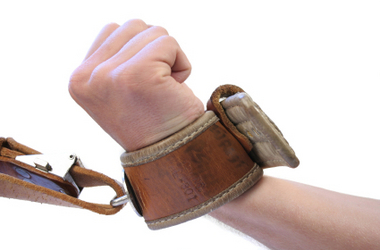
I know, I know, Mary, you may be on the other side of this argument, or it might appear that way, because you want more treatment to be available, not less. I do in general agree with you: Prisons are overflowing with the mentally ill, who should never have been there in the first place. In fact, I think the prisons are overflowing with an awful lot of people, especially those of a certain darker-hued skin, for little reason more than the very color of their skin! I mean, tell me why Robert Downey Jr and Lindsey Lohan, aside from their celebrity status, get caught again and again with drugs and cocaine etc, yet are sent off to posh rehab centers, with a smile. But should you happen to be an unknown, POOR, god forbid mentally ill person of a darker hued skin (and let’s face it, a light/white South African immigrant would not be treated the same way as a dark-skinned someone with Nigerian roots!) if you are that person and you offend in some way just 3 times, well, then, you are sent away to one of California’s really “posh” ha ha ha penitentiaries FOR LIFE! Things like that just make my blood BOIL. And don’t get me started on the insanity of our drug laws!

But forgive me for going so far astray. It is just that the whole subject of prisons and what we do to people in them is a really sore point with me, and not just how we treat the mentally ill there, though that is about as atrocious as it can get…Need I even mention the “extra beds” in unused supermax prisons being used to house “unruly” MI prisoners? It makes me want to scream and throw up at the same time.

Well, no doubt this “essay” is both incoherent, in the sense that it doesn’t cohere properly, and just plain incoherent! I admit to a bit of laziness, as it is late at night, and i need to take my MEDS and go to bed. So, at the moment, I am not going to polish and fix it. I am going to pretend that since this is “only” a blog I can get away with shoddy ill-organized writing, and call it a night. Which is what I am doing forthwith…Good night, and thanks, Mary N, thanks a million again.

PW

On Psychiatry and Authority

My writers group gets together once a month, when we discuss the single page of prose nonfiction or fiction, or usually in my case a poem, that we have written to the one or two word “prompt” chosen the month before. While I had to miss this month’s meeting, due to exhaustion, I did write (or rewrite) an essay as well as a poem. The poem I cannot share, for reasons I have reiterated many times: if I publish it here, I won’t be able to do so in any hard-copy journal. However, I feel comfortable putting the essay here, since it is mostly a rewritten and reworked piece of an earlier blog post…So if it seems very familiar, it is. I wrote it in fact not so long ago, but I have polished it and turned it into a piece of writing with a beginning a middle and an end, with a few other details I have discovered from sources like my journal since then.

PS I apologize if I repeat myself on this topic once again, but you can see by the repetition itself how much trauma incidents like this one, but also most of the others, which were much worse for being truly violent, inflict upon people…

========================================

S & R

Maybe I was disruptive. Perhaps I frightened other patients. I do not know why otherwise they would have forced me into that barrenness known as the “Quiet Room.” That it was just the same old seclusion room, prettified with another name did not escape me. I begged for a blanket, but no deal. Freezing, I pulled the thin mattress over me instead. They yanked it off in the typical psychiatric nano-second then eliminated it from the room altogether. Now I had only two hospital johnnies and my rage to keep me warm.

I remember that I yelled a lot, and that I wouldn’t stretch out on the cold linoleum to “calm myself.”  I begged the one-to-one nurse to talk to me. She only turned away and told me to lie down on the floor. I complained again that I was cold. She said nothing, only barred the doorway. Getting no response and still agitated, I tried to push my way out. Two “guards,” who though deliberately keeping just out of sight, were on alert, and they shoved me away from her. I yelled again and shoved back. One of them asked what was wrong with me, why didn’t I just ask to talk with the nurse instead of physically resisting? I did ask to talk, I told him, but she refused to, they all did. He wrinkled his brow as if confused by this answer, but with a shrug that said it wasn’t his job either, he ordered me to stay inside the seclusion room and to “just lie down and stop making trouble, if you want to get out of here.”

About what happened next, I remember little. I only know that suddenly I found myself face down on the floor and with a commotion of people around me. Some man had pinned my arms behind my back and he was angrily mashing the left side of my face into the floor.

When they let me up, I yelled that I was not in prison and they had no right to treat me that way. But at least, I discovered, I was finally allowed to talk to the nurse and to stand out in the hall with her. That was progress, I thought. Then I heard staff in low and serious discussion some distance away. Someone sprinted down the hall in the opposite direction. I had a bad feeling about it and asked my one-to-one nurse, “What’s going on, what are they doing?” She responded, “They’re making up a bed for you.” “A bed? What sort of bed?” That’s when I understood that she meant a restraint bed.  “Wait a minute. You can’t restrain me! I am out here, calmly talking to you. You haven’t even offered me a PRN and I am willing to take one. But I am not a danger to myself or others, and you cannot legally put me in restraints.” The nurse remained silent. She refused to look at me. My heart began to race. I shouted down the hall, “I will not let you use restraints on me. I am calm and you are not allowed to do this.”

When finally staff members approached and asked me to follow them, I complied. I knew that if I didn’t they would have reason to say I “deserved” whatever they did. In my room, I found there attached to the bedframe were the straps and shackles of four-point restraints.

“Listen, I am calm and I am not a danger to myself or others,” I carefully declared. “I will take PRN medication. I do not need restraints.”

“Lie down on the bed, Pamela,” one nurse told me. Again, I refused, saying that this was punishment pure and simple. They had neither cause to do this nor any legal right.  She responded, “We will ask you one more time to lie down on the bed, Pam, or the security team will assist you.”

At this point, I understood that they were going to use restraints as a form of discipline and would do so no matter what I said. It was completely illegal but they were out to get revenge and they would use any reason I gave them to excuse such measures. If I “made” them force me into the restraints, it would only prove that I deserved them. More humiliated than I have ever been in my life, I sat on the bed.

Ignoring my protests, they went ahead and shackled me to the bed, my arms below the mattress and my legs to each lower corner  and then without a word, they left. Except for an aide monitoring me through the door, partially ajar, I was utterly alone: humiliated, degraded, helpless. I couldn’t help it. Against my every determination to stay strong, resolute, and angry, I let out a lung-bursting howl. I didn’t care who heard me, who I frightened, who I disturbed. I howled for myself and against all the injustices and cruelties that had ever been perpetrated against me. And I howled for every other so-called mental patient that had ever been shackled to a bed by medical professionals who claimed to be helping them. Who thought they could justify brutality by calling it therapeutic.

Schizophrenia and Traumatic Treatment: Continued Use of Restraints and Seclusion

Please note: For my final take on what happened at Middlesex, please jump to this link: https://wagblog.wordpress.com/2012/05/15/useless-psychiatric-mediation-and-a-poem/   (added in September 2012)

First, before I start my post today, I wanted to share my newest artwork, which is a colored pencil “painting” of a woman who lives in my building, whom I will call Rose. She did not ask me to paint her; she was simply someone who sits quietly for many hours in the community room, and so was a good subject for a portrait, and a photo. I also happen to find her a very agreeable person, one of the nicer ones here (most are gossips and backbiters, or if not most, then the most vociferous and visible of the residents). I think she will be quite pleased with how it turned out, so long as she does not expect anything but a portrait that is faithful to life, rather than an idealized one. I believe, however, that Rose is very down to earth and knows what she looks like, and will appreciate what I have painted.

Rose, intent on her needlework
Rose intent on rugmaking
Rose comparison of painting with photo

_______________________________________________________

Now I want to discuss, yet again, the use of restraints in Connecticut psychiatric units, particularly as it pertains to my treatment there. As I recall, I have not gone into much detail about the last hospital stay, back in April and May, largely I think because it again was so traumatic and in many ways similar to the previous one, that I could not bear to contemplate it.

However, as very little as I recall, I do remember more of the stay than the complete amnesia I still experience for the stay in Manchester, back in October or November of 2009. When I say I have a loss of memory with regards to this other hospital stay in the spring of 2010– in Middletown — I meant it more for the specifics of certain episodes. And for any of the people there who staffed the unit. (Except for Christabel the OT).  With regard to much that occurred I believe a lot could be brought back to me, under the right circumstances. I do, for instance, continue to have an overall memory of what the place looks like and where my room was and some details about what happened. What I do not, and did not remember, not even the next day, was most of what precipitated the use of restraints and seclusion during this stay. Or at least, of the two or three incidents of S and R two are jumbled together, so that it takes some mental probing for me to straighten out any of it. but one incident remains too clear in my mind for comfort though even at the time, or immediately afterward, as well as now, I have no idea what was the actual precipitant.

Anyhow, what I recall of  that episode is this: I had been taken off Geodon, which I took regularly with my  Abilify up till then, both in order to boost its antipsychotic properties as well as to temper any Abilify-induced irritability. The irritability was physical as much as mental — and with the resultant tendency to get into verbal fights and arguments with anyone who, as my mother used to put it, looked at me crosswise. I have no idea why they did this, took me off Geodon, given that I know I explained the rationale for the use of two antipsychotics. But many MDs seem to find this objectionable, however effective. Perhaps they considered the 20mg Zyprexa, which they had talked me into taking on an acute basis, would be an adequate substitute for the calming effect of the Geodon. They had wanted to stop the Abilify, too, using Metformin, a diabetes drug, for weight control, but I had insisted on taking it both in an effort to combat Zyprexa’s tendency to cause weight gain, but also because I believe that it is the Abilify that has so massively enhanced my creativity.

So there I was, on Abilify untempered by Geodon, and taking Zyprexa, which induces its own “upsetness” when my weight invariably increases…I assume that I must have been hostile, loud, and disruptive, for I do not know why else they would have made me go into the seclusion room. I do remember that I could not calm down, and that in the flimsy johnnies they had clothed me in, I was freezing, so that even when the nurse doing constant observation told me to lie down and rest, I was unable to do so for all my shivering. I begged for a blanket, but no deal. I pulled the entire bare mattress over me as a covering. Well, this was apparently seen as a self-destructive act, or something, as immediately they pulled it off me and dragged the mattress itself from the room. Now I had nothing for warmth, except my own anger at having been treated  in such a fashion.

I remember that I was yelling a lot, and that I wouldn’t lie down on the cold linoleum and “calm myself.” No, I wanted to talk, and begged the nurse to do so. Instead, she only turned away and told me again to lie down on the floor. Well, this enraged me, and I went to the door to complain again. She said nothing, only stood in front of the open door so that I could not leave. Finally, getting no response, and still anxious and “het up” I suppose you could say, or over-activated by the Abilify, I tried to push my way through her into the opening. Immediately two “guards” pushed me back into the room. I yelled at them, and pushed back. One of them asked me what was wrong with me, why I didn’t just ask to talk with the nurses instead of resisting physically…I looked at him and said that I did ask to talk, and she refused. He seemed somewhat surprised by that. Nevertheless, he ordered me to go back into the room and lie down.

I was having none of this dictatorial behavior on their part, and as I recall, at one point — no, I do not remember what happened. I only know that suddenly the guards were on top of me, and one had pinned my arms behind my back and was pushing my face into the linoleum floor. It was as if I were a recalcitrant inmate of a prison and this was a cell “take-down.” I was hurt and I was furious.

When they let me up (and why they had pinned me to the ground I have no recollection, only that when they let me up, I was finally allowed to talk to the nurse nad stand out in the hall with her. I heard some talking behind my back and a commotion, followed by feet going down the hall away from us. I had a bad feeling about it, and asked the nurse, “What are they doing?” She responded, ominously, “They are preparing a bed for you.” “a bed? what sort of bed? She remained silent and I understood that they were putting restraints on my bed…”You can’t restrain me, I am out here calmly talking to you. You haven’t even offered me a PRN and I will tell you now that I would be more than willing to take one. But I am NOT a danger to myself or others, and you cannot legally put me in restraints.” The nurse continued to remain silent. My heart began to race. I called down the hall, “I will not let you use restraints on me, I am calm and this is not allowed.”

Some of the staff approached me and told me to come down to my bed room with them. I complied, because I knew that if I didn’t they would have some reason to say I “deserved” to be restrained. When I got to the room,   I found I had been correct: there on my bed were the straps and shackles of four-point restraints, attached to the bed frame.

“I am calm and I am not a danger to myself or others,” I carefully declared. I will take medication and I do not need restraints.”

“Lie down on the bed, Pamela” someone told me. I refused, saying that this was punishment pure and simple and that they had no cause to do this nor any legal right. “I will ask you one more time to lie down on the bed, Pam, or the security team will help you do so.”

At this point, I understood that they were going to use this form of discipline on me no matter what I did. That they were out to get revenge and that they would use any excuse to excuse such measures. So if I “made” them force me into the restraints, that would by itself prove that I “deserved” them. So, more humiliated than I believe I have ever been in my life, I sat down on the bed, then lay down on my back and said out loud, “I am now placing my limbs into four-point restraints, and I want a record of the fact that I am calm and not resisting and that I have asked for a PRN instead.”

It was no use, though, as they went ahead and shackled me, then left me alone in the room, except for a staff member monitoring me through the door, left partially ajar. My heart was racing with rage, and I could feel the pain of such profound humiliation surging through me. But I did and said nothing, I think, because I was going to prove to them that the drastic measures and punishment they had inflicted on me was WRONG. After about an hour and a half someone came back and let me out. I was neither compliant now, nor placated and as soon as I was free and out of that room, I let it be known, loudly  that I intended to file a complaint. But no one said a thing, no even spoke to me the rest of the night…

THAT is what I remain so traumatized by, at least with respect to  this time: the utter humiliation of what you might call “cutting my own switch,” along with the clear understanding — even mutual acknowledgment — that they were punishing me.

This continues to preoccupy me, that is when I allow myself to think about it, or when I continue to try to read the records of that stay, which records I only a week ago obtained (having sent for them many weeks ago…). I cannot help but re-experience the same brutality and the same extreme and exquisite humiliation, and once again it hurts beyond belief. The worst thing perhaps is that when I told my family about what the staff had done to me they didn’t come to my support, they didn’t unconditionally defend me. They didn’t even  seem to care, or to believe, that I had done nothing to “deserve” four-point restraints (as if anyone deserves them). Another family would have automatically come to their member’s defense and declare that NO one deserves such brutality, and that as their family member I should never have been treated that way. Another family would have done  –oh forget it!  No, my family is always so eager to please the staff and to believe that I am in the ‘wrong” at these hospitals, to believe that I am at fault, (this is the story of my life!) that they simply told me I must have caused their use of such brutal methods of control by my own behavior, I surely deserved it, and besides “what else could they do?” Shackling me, calm and rational, me to a bed was clearly the only option and entirely justified…So much for MY family’s loyalty and compassionate support, huh?

Well, bitterness solves nothing, so I won’t dwell on the last subject, but I will say that if I can, I intend to file an unoffical complaint, or barring that, an official one. The problem with the latter is that I will not then be able to confront my persecutors. whereas if I did so unofficially, it might yet be possible, if only to avoid a messy public affair. After all, I could easily write something…No, I won’t go there. For now, I only wanted to describe what continues to occur at Connecticut psychiatric units, despite the regulations and general disavowal of the use of cruelty in the treatment of those with mental illness. It still goes on, it just happens behind the closed doors of the hospital and the continued use pf seclusion and restraints as discipline and as a salve for frustration, depends on the assumption that no patient will bother, after the fact of discharge, to do anything about it, except try to forget.

Things are better than this, but do not feel it!
Note the linoleum and bare mattress. I have never seen a windowed seclusion room!

Seclusion and Restraints: How it feels

I remember, I remember, well, I remember very little, except in flashes of dim light, like a candle held up by which to read the fading pages of an ancient diary. I remember a sign with my name on it, taped to the door of a room, and how hard it was to find my way back, no matter how many times I made the trip. I remember a nurse with blond hair named “Patty,” whose real name, Lil, I learned only the second to last day I was there. I think I liked her, or that she treated me with kindness, and another nurse named Mary Ellen, who was kinder still, but not always there to save me.

I remember too, but again in uncertain flashes that tell me only that something happened but not exactly what: Being carried by arms and legs into a cold, empty room lined with linoleum, dropped onto my back on the floor, dressed in just two hospital johnnies and pajama pants and locked in there alone. I remember begging for a mattress, then screaming in outrage when I was refused.

This is how it goes: There is nothing in the room but me and air conditioning turned on full bore, though it is October and in the 50s outside. Why do I need johnnies or the huge pajama pants that are falling off me without ties to hold them up? Alone in that room, I take them all off, then squat to pee and take a dump. Good, that feels better. Blankness. Cold, cold. Again I scream for a blanket. Of course, nobody answers. I try to push the johnnies under me to cushion my bones so I can sleep, but the shivers prevent me from relaxing. I have to do something.

I make a long rope of the silky acetate pants then form a slip-knot and put the O over my head with the knot to one side. I pull tight, figuring it won’t take long. I sit to one side of the little window in the door, so no one sees me immediately. Finally they come running. But they don’t understand it is a slip-knot and that pulling at it only tightens it  more. I am struggling for air. A nurse yells for scissors, bandage scissors the only ones available and they cut the pants free. Still, I am in big trouble. I would tell them I only wanted to get their attention, that I just wanted a mattress and a blanket, but what good would that do? Still, do they really think their act of violence, which will follow, will solve anything? Blankness. I have been thrown onto a bed in another seclusion room. As staff and goon squad wrestle my wrists and ankles into padded cuffs, I kick and bite in protest, all of which will be written up as my being “assaultive.” In the end, it is no use.  I scream and scream until the usual injections – 5 mg Haldol and 2 mg Ativan – take the scream out of me and I finally fall asleep.

That should have been the end of it. “Wake up calm and they take you out of restraints.” That’s the name of the game. But this time, I wake and I am still in full 4-points. I ask the nurse why. “Doctor’s orders,” he says. “But that’s punishment!” I answer, shocked. “No,” he says, “restraints are therapeutic. We never use them as punishment.” “Bullshit! Dr Z is punishing me because he doesn’t like me and you know it. He is a sadist.” The nurse doesn’t answer immediately and when he does, he just says, “Go to sleep.”

I remember how they kept me in restraints for 12 hours that time. The chart summary tells me more, that I spent a good part of 5-7 days in seclusion and/or restraints, so there is a lot I do not remember. Am I better off for not knowing? That’s what some people tell me. How would you feel? Would you want to know, or not to know?

————————————————————————————

I realize that the above is simply a restatement of an earlier more detailed post, so it must be obvious that I am still very troubled by what happened. Indeed I am. I am even more troubled by my lack of memory the rest of the three weeks there…which fact was noted even in the summary of my stay, which Dr B (Li) got from the hospital the other day (in lieu of what he requested, which was my entire chart.) Memory loss has dogged me for many many years. Only now can I acknowledge it, and only because Lynnie and others witnessed it. But for so many years I felt desperately  troubled and, well, desperate to hide it, afraid lest anyone know how little I could remember of what happened from day to day. This was especially extreme when I was in hospital but even afterwards it was troubling to me; sometimes I felt I was missing half my life! People — that is to say,  doctors. nurses,aides — expected me to remember ordinary happenings, because they obviously  thought that I was responsible for what I did from one day to the next, which you are not, not in the same way, if your memory is impaired. This expectation was so stringent that I dared not admit how little I did remember of events after they passed. I thought the scant trace they left would somehow prove my evil, prove that I was a shameful deficient person. So  I desperately took cues from others about what they wanted me to “remember,” tried to “pick their brains” about whatever it was that had happened, or that I had presumably done, whatever it was that they expected me to recall. Sometimes a concrete clue might help me piece things together – say for instance if I had scars or wounds that hinted at recent self-injurious behaviors or if there were scribbling on the walls that suggested another sort…But if there were no cues, it was much harder to ferret out what was wrong. Sometimes I might have to come right out and ask, “And you are referring to…?” But I didn’t dare do that often or it would have given my lack of memory away, something I didn’t dare permit…

Now here is the other side of the story, which I find hard to square with my experience in October: one  psychiatric nurse’s account of how situations involving restraints can look to staff.