Tag Archives: mental hospital

TO MY “PROTECTOR” AT THE MENTAL HOSPITAL: NO THANKS!

 Mushroom-Head in Four-point Restraints: Cannibalism as RAPE by Michael Edward Balkunas, MD, the instigator…

Raped at New Britain General Hospital thanks to  Michael Balkunas MD's orders...
Raped at New Britain General Hospital thanks to Michael Balkunas MD’s orders…

TO MY “PROTECTORS” AT THE MENTAL HOSPITAL

You nurses who, wanting a quiet shift, shackled me into four-point restraints: you ought to have known better: violence only begets more violence…

I came to you, broken —

speaking only splinters of syllables –

“ma-ta-o-tam, ma-ta-o-tam..”

on fire to burn down

the house of my body,

for the meaning of my life

but I was not nice,

not nice, not nice, no,

I was not nice and quiet enough

for the balm of art supplies and human kindness.

Your uniforms ex-cruciated me, tying me

me naked to the four corners of a bed

so your eyes could flay me, the silent shame

gouging my brain to a darkness

years later still vacuumed blank.

Nurses, healers, thieves,

racked there, I lay helpless before you,

even as you raped what was left

of my human dignity.

So intent on getting satisfaction,

you violated my soul

with your smirks

and conspiratorial smiles.

MICHAEL EDWARD BALKUNAS, MD, YOU MURDERED ME!

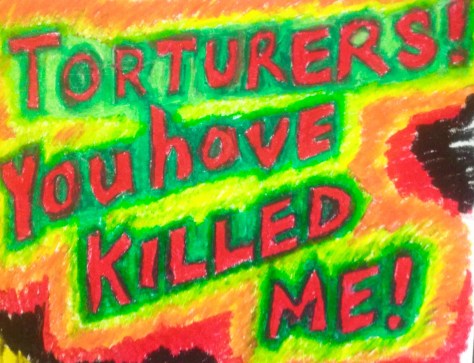
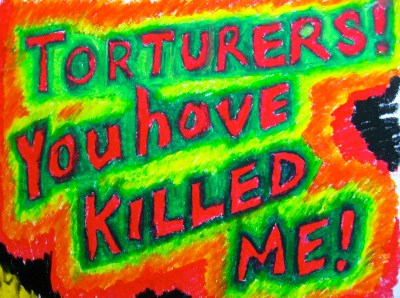
TORTURERS AT NEW BRITAIN GENERAL HOSPITAL: YOU HAVE KILLED ME!

Mental Patient Anti-Psychiatry Rap

AAC FILE (MIGHT PLAY WITH INTERNET EXPLORER

TRY ON IPHONE OR IPAD OR APPLE …DOES NOT WORK ON INTERNET EXPLORER…Okay, this may not please everyone and it isn’t exactly ready for Primetime, but if you can’t hear the lyrics (and in any rap song it is difficult to catch all of them the first time, you can read them along below…Enjoy?? Or at least you  will understand, if you are familiar with Wagblog, where I am coming from. Please let me know if this file does NOT play for any reason.

Mental Patient Rap

by P.Wagg

CHORUS:

C-c-c-crazy, l-l-l-lazy, c-c-c-crazy, mad and bad.

C-c-c-crazy, l-l-l-lazy, I ain’t nothing but a nomad

in the white-coats’ lab.

They say fake it till you make it, so I take it, take it, take it,

Careening through a maze of rules that make me wanna break shit.

Sanity won’t save me, nor all the pills they gave me.

Their remedy’s my enemy, so we mad go fucking crazy.

C-c-c-crazy, l-l-l-lazy, c-c-c-crazy, mad and bad.

C-c-c-crazy, l-l-l-lazy, I ain’t nothing but a nomad

in the white-coats’ lab

VERSE 1:

I remember being locked in, tied down, drugged up,

nurses in control of me, rushing me, coercing me.

Worse than their forcing me was all the pills they pushed on me

then Thorazine or Stelazine jammed into my ass cheeks.

Abuse was inexcusable. Psychiatric orderlies

cuffed my wrists and ankles to a bed when I refused them.

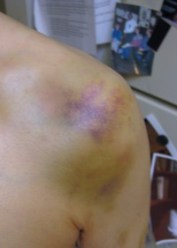
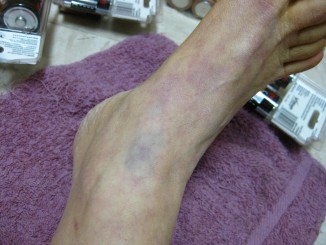
Bruising me, mis-using me — and black and blues-ing me,

A/C cold as ice; retaliation taken twice.

Tied down, naked, there, I shit myself but who cared?

Just another everyday mental patient nightmare.

CHORUS:

C-c-c-crazy, l-l-l-lazy, c-c-c-crazy, mad and bad.

C-c-c-crazy, l-l-l-lazy, I ain’t nothing but a nomad

in the white-coats’ lab

They say fake it till you make it, so I take it, take it, take it,

Careening through a maze of rules that make me wanna break shit.

Sanity won’t save me, nor all the pills they gave me.

Their remedy’s my enemy, we mad go fucking crazy.

C-c-c-crazy, l-l-l-lazy, c-c-c-crazy, mad and bad.

C-c-c-crazy, l-l-l-lazy I ain’t nothing but a nomad

in the white-coats’ lab

VERSE 2:

As bad as leather cuff restraints their isolation cell was hell.

so supermax it made me faint, don’t tell me they meant it well.

No one should have dumped me there, hearing voices, terrified

they stripped my clothing off then left me locked alone inside.

and told me that they had the right to keep me there both day and night

or as long as it would take, for me to learn from their mistakes

I might never get out, never get out, never get out, never get out–

but I started freaking out. I shouted, “I will not bow down

to those with nothing more to do than cause me pain, you cowards, you

you have no heart, you’re inhumane. You torture me to entertain.

CHORUS:

C-c-c-crazy, l-l-l-lazy, c-c-c-crazy, mad and bad.

C-c-c-crazy, l-l-l-lazy, I ain’t nothing but a nomad

in the white-coats’ lab.

They say fake it till you make it, so I take it, take it, take it,

Careening through a maze of rules that make me wanna break shit.

Sanity won’t save me, nor all the pills they gave me.

Their remedy’s my enemy, so we mad go fucking crazy.

C-c-c-crazy, l-l-l-lazy, c-c-c-crazy, mad and bad.

C-c-c-crazy, l-l-l-lazy, c-c-c-crazy, I ain’t nothing but a nomad

in the white-coats’ lab

Verse 3:

Let’s sing ring around the posey-o: “Hospital Guantanamo!”

Isolation, prison SHU, and mental patients just like me who

traumatized and tortured just go c-c-c-crazy, too.

Abuse is S.O.P. from doctors of psychiatry,

Pusher docs who love to dish out electro-shock therapy

and chemical lobotomies, but it’s all about their money.

Crocks of shit! You’re so wack. You psycho-quacks, you pricks

sized us up and tricked us. But didn’t we wise up quick?

We won’t take no more horseshit, we won’t take no more crap

Take your fucking psycho-meds and ram them up your —-!

CHORUS:

C-c-c-crazy, l-l-l-lazy, c-c-c-crazy, mad and bad.

C-c-c-crazy, l-l-l-lazy, I ain’t nothing but a nomad

in the white-coats’ lab

They say fake it till you make it, so I take it, take it, take it,

Careening through a maze of rules that make me wanna break shit.

Sanity won’t save me, nor all the pills they gave me.

Their remedy’s my enemy, so we mad go fucking crazy

C-c-c-crazy, l-l-l-lazy, c-c-c-crazy, mad and bad.

C-c-c-crazy, l-l-l-lazy, I ain’t nothing but a nomad

in the white-coats’ lab

Oh, you know, you know, yes I know you know,

that I ain’t nothing, never been nothing, never been nothing…

I’ve never been nothing, except a lonely nomad

in the white-coated doctors of psychiatry lab

Spoken CODA:

PT:“I want outta here.”

RN: “Uh uh, not so fast. We’ve got your ass for fifteen days.”

PT: “Fifteen days?! No way, José. You can’t keep me here. I want a lawyer!”

RN: “Doctor, we need to calm her pronto. She’s disturbing the whole unit.”

MD: “I agree. Give her 20mg, IM Haldol, stat.”

PT: “What do you want? What’s going on?! No no! Don’t touch me…Wait!

He-e-e-elp! Help me! Please somebody! Help! Help me…!”

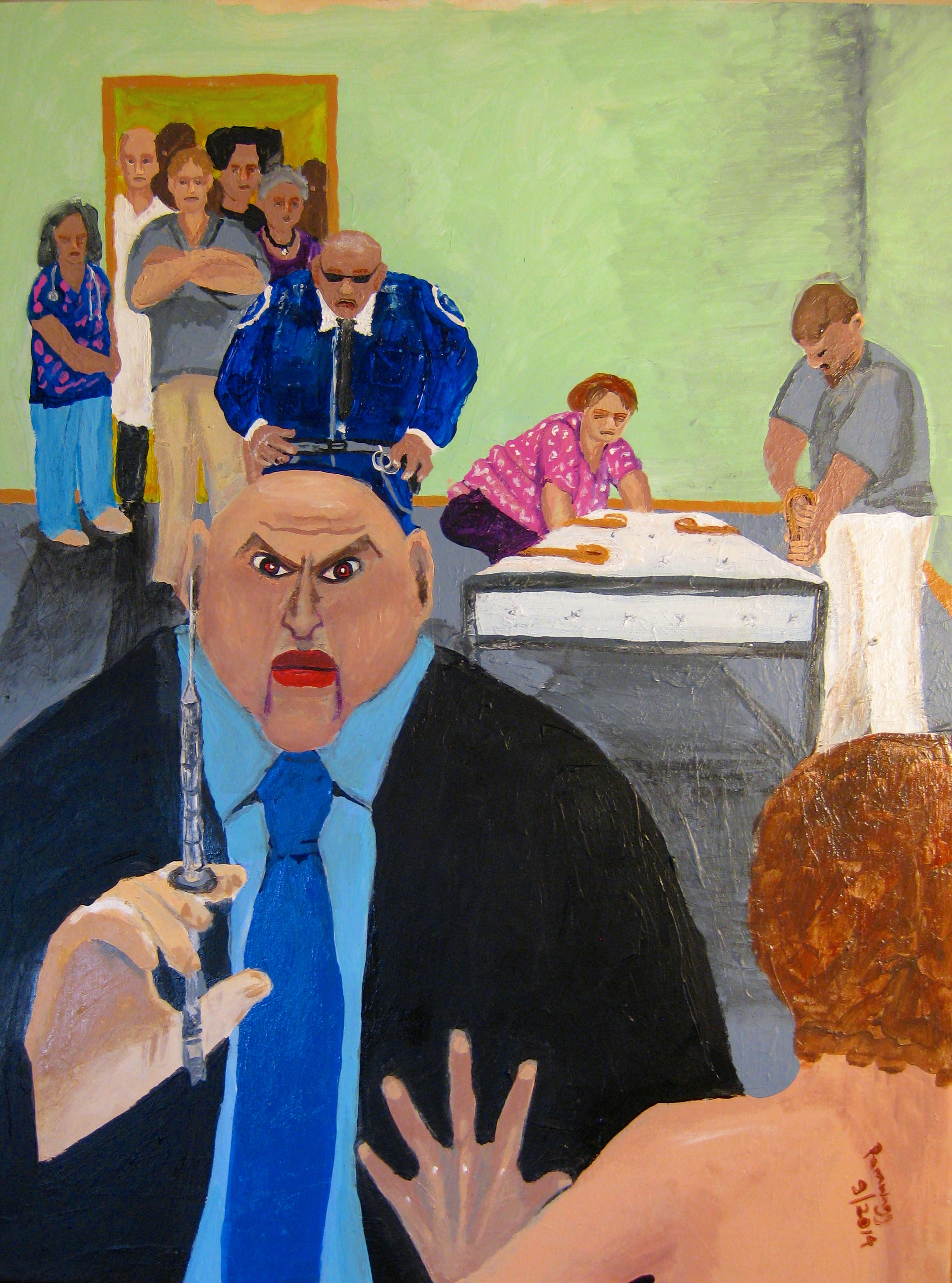
New Art: Doctor Threatens Restraints and Shot of Haldol

Doctor Threatens Restraints and Shot of Haldol - Painting in acrylics c. 18 by 27 inches
Doctor Threatens Restraints and Shot of Haldol – Painting in acrylics c. 18 by 27 inches

This is a larger size painting than I am used to doing. I usually draw and I am scared of painting. When I have painted I have usually restricted myself to tiny sizes or just portraits. This is my first attempt at a real crowd scene or any scene at all. (I am tempted to redo the foreground doctor, to make him less cartoonish and more realistic, but for now, I will keep him as originally done. However, I don’t like the illustration quality of this painting, and want to learn how to be more painterly, so to speak!)

“Protection and Advocacy” Agency in Connecticut is a Crock of Shit…

CT PAIMI What a Crock of Shit


Dear Attorney General George Jepson and DMHAS Commissioner Patricia Rehmer,

I was a client of Mr Wiley Rutledge at the Connecticut Office of Protection and Advocacy, PAIMI, (Protection and Advocacy for Individuals with Mental Illness) for several years, ever since I was held in seclusion and put into four-point restraints as disciplinary measures at the Behavioral Health Unit at Middlesex Hospital in 2010. In July 2014, while he was attempting to get my complete medical records, unsuccessfully despite many attempts, from the Institute of Living at Hartford Hospital for my January-February 2013 stay, as well as records from my Yale New Haven Hospital 1971 stay, which he claimed to have obtained, he dropped out of the picture altogether. I emailed him and called but got no response. Finally I called the P&A office and was told he was “on leave.”
 I was given no explanation, told nothing. Instead, Mr Bruce Garrison, his supervisor, simply sent me all the files that he found in Mr Rutledge’s office, then he summarily dumped me. He has offered no substitute or anyone else to take up my case at CT PAIMI despite all these unresolved issues that are still pending. I wrote him that Mr Rutledge and I had been filing a case in Superior Court against Hospital of Central Connecticut  in New Britain for dragging me into a horrific seclusion cell numerous times when I was never violent or dangerous to self or others, in other words, as retribution and punishment. Also, the male guards forcibly stripped me naked while putting me in seclusion then placed me naked in four-point restraints.
All that said, Mr Garrison, had no response but to drop me from the caseload. Then in addition to the scant files that he sent, without the information from either Yale or the IOL that he promised, he sent me the case files of someone else. I now have the most private information on a certain A— H—- who was psychiatrically evaluated by Centegra on 12/17/02. How this could have happened I do not know but it should not have and I believe that action needs to be taken to see that it never happens again.
I want to know who will be working with me from now on at PAIMI because I cannot afford a lawyer (never did have any legal representation even from CT PAIMI) and why I have been summarily dropped from PAIMI case loads, after working with them so patiently for so many years.
Thank you for your urgent assistance in this matter.
Pamela Spiro Wagner

Trauma and Its Sequelae: A Hospital Poem on Abuse by Michael Edward Balkunas MD

TRAUMA AND ITS SEQUELAE…


Written months after my 4-week admission to the psychiatric unit, W-1, at New Britain General Hospital/ Hospital of Central Connecticut, in 2014 where I was “treated” and abused by Dr. Michael Edward Balkunas, MD


Nine days after your worst hospital stay ever

you are still wearing the shades

that protect others from you

though no one else believes they are in danger

Those staff however wrote you up

as “assaultive” and dangerous to self

and others. But they didn’t mean it the way

you do now and their description of your

behavior was neither accurate nor truthful

Often they lied, as liars do,

just for the sake of convenience.


Now you are a week away from meeting new “cousins”

who await your vacation in northeastern Vermont,

a place magically named the Kingdom

and the recuperation your mind-body badly needs.

Still unable to let go, you perseverate over

the half-nelson grip of sadistic guards

bent on eliciting pain.

What happened to the nurses’

“healing touch,”

their concern for “the dignity, worth,

and uniqueness of every individual”,

or their “primary commitment

to the patient?”


When the guards forcibly stripped

then four-pointed you to an bare mattress

they were just replaying their favorite rape

yanking each limb wide

to expose, degrade, humiliate.

Never mind the nurses’ vow to protect

the vulnerable. The official hands-off policy

protected only their own asses.


So how do Truth and Forgiveness Programs proceed

when so many refuse to acknowledge wrong?

The hospital broke every humane rule;

they only stopped short of murder

because you submitted,

nick of time. Yet they had the last word:

stuffing your screams

when they muted the intercom

and slammed the door between you

and the mandatory one-to-one observer.


No one ever is there to bear witness, is there?

That point has always been the point,

from Daddy to doctors.

and all the hairdressers and nurses in between.

They’ve made a religion of secrecy

and no one wants to know

what they don’t want to know.


Call it “our family’s business,”

call it “a private cut and shampoo,”

or just call it, discreetly, “treatment”–

but they can always do what they want to, to you.                          .

When they break you, they declare

you’re just “one of the family,”

no different from anyone else,

now that they’ve finally fixed you for good.

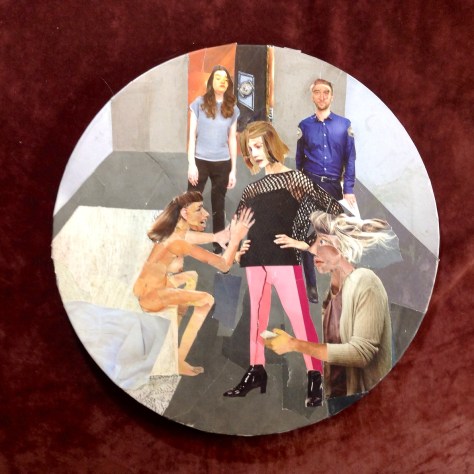
Trio of Psychiatric Abuse Collages: encounter, restraint and seclusion

Encounter in Seclusion Room - collage of torn paper
Encounter in Seclusion Room – collage of torn paper
Hospital Seclusion Room


Nude Schizophrenic IN restraints While Bored nurse Looks On


you get the idea….no violence, just a scornful set of nurses and aides and a security guard willing to do anything he was asked…and chaos broke loose with terrible consequences.

Nude Schizophrenic in Restraints While Bored Nurse Looks On

Actually I “deserved” four-point restraints. I was “violent.”

Nude Schizophrenic IN restraints While Bored nurse Looks On
Nude Schizophrenic patient in 4-point restraints

But I want to explain what “deserving” restraints and being “violent” at New Britain General Hospital (Hospital of Central Connecticut) means in 2014.


I also want to tell you something else even more important: In Connecticut, the staff at almost every psychiatric unit or hospital will insist that “we only use seclusion and restraints when essential, when a patient is absolutely out of control and extremely violent, and cannot be controlled in any other way.”


Trust me, I know, because they have said this to me.


But what you need to know is that they are NOT talking about some 300 pound man hopped up on PCP, waving a machete. For one thing, that person, whom I believe to be largely mythical at least in ordinary psych units, or if real now largely confined to correctional and law enforcement settings, the person they are talking about, the rule, not the exception to the rule of the “extremely violent” person whom they claim must be restrained due to lack of any other method of control, is, to put it grammatically correctly, I.


And let me tell you about me. I will turn 62 years of age in November. I am 5 feet  3 inches tall, weigh, maybe 110 pounds on a good day, and have been consistently described as “poorly muscled.” I am also unable to use my left arm for much of anything, due to injuries sustained at the Institute of Living in 2013, including a small tear in my rotator cuff and possibly more than that– a fact the HOCC nurses/security guards knew and used to their advantage when subduing me.   I also want you to know that I am a decades-long vegetarian on the principle of non-violence — to people as well as to animals. I have opposed the death penalty since I was a nine year old child (when I first learned of it) and do not even believe in the principle of prisons, or in treating our convicted “criminals” the way we do now.


Yet in every single hospital I have been in since 2000, and of course for years before then (“before they knew better”) I have been brutally secluded and restrained multiple times as “OOC” — out of control — and “violent.” In addition to either physically holding me down by brute force, one person to each limb and one to my torso (this was at the only 2 hospitals  that did not actually resort to mechanical four-point restraints– compared to the dozen others that did), they would routinely inject me with one to three drugs as chemical restraints.


I am the rule, not the exception to it, of their supposedly “extremely violent mental patient” who is so OOC — out of control — that Connecticut hospitals refuse to eliminate the use of restraints and seclusion, because they “might need them.” I am the typical example of the person they claim they absolutely must have the right to resort to violence against, for their own safety and mine.


Okay, so am I truly violent? What did I do to deserve their brutality? Or should we say, their “protective measures?” Well, at HOCC, in the Emergency Department, this is what happened, and I kid you not: I came in by ambulance, involuntarily, in the sense that I did not want to go but was brought in by EMTs and given the “either the easy way or the hard way” choice by police. But I did not resist it or fight. I was not restrained in the ambulance. in fact, I was mute and merely handed them my med sheet and my detailed Advanced Directive, on the first 2 pages of which is the important information about my trauma history and the critical need to know points about how to deal with me.


When I arrived I was quickly shunted to the psychiatric crisis section and into a curtained off cubicle. No one took my cell phone from me, or the single book of my artwork that I had managed to bring with me. So I texted everyone I could for as long as I could. For a while I tried to obtain a crayon to communicate with, eventually and in desperation, writing with ketchup on the outer carton of my dinner container, begging for something to write with. Instead of helping me out, the head ER nurse penned me a note saying that I would not get anything to write with, that either I spoke out loud or she would not listen to me. How very odd and evil that she wrote this to me! She didn’t speak to me, she wrote it, as if I were deaf, even while saying that she knew I could speak and would not talk with me unless I did so… The idiocy of that act just sends sparks of rage through my brain even now.   She later spied my art book next to me on the gurney, and suddenly rushed me, snatched it out from under my thigh and raced away with it, holding it triumphantly as if she had won a prize. I was incensed. Why hadn’t she just asked me for it? And how did I know what she was going to do with it? Would she keep it safe and sound? Actually, though, I mostly just reacted instinctively: Someone had stolen the only thing I had of my own in my possession, and she had simply snatched it away from me, without a word or even a polite request. So I did as anyone would do, I think. I  raced up behind her and snatched it back!   Well, that was a mistake. That was bad, that was bad bad bad. I heard people groan and swear. I was grabbed from behind by two security guards and the book was wrenched from me again.


Remember, I was mute so I couldn’t say anything, but I tried to resist, tried to gesture that the book was mine and she had no right too take it from me. Instead of explaining that she would protect  it and take care of my things, people started talking about how I had attacked the nurse, had assaulted her…She told them to put me in seclusion. The guards dragged me, resisting in panic, towards this hidden room, and I heard another nurse warn them of my medical history with a torn left rotator cuff. Hearing this, the guard on my left side, grabbed my shoulder and wrenched it higher until I let out  a blood curdling scream, wordless but vocal. “Aha! I thought you could make sounds!” he said in triumph, wrenching me again until I sobbed in agony. Then they dumped me in the seclusion room, with only a hospital johnnie on me, and locked the door behind them.


Even though I had no words to speak my rage and panic, I screamed and screamed. They came through the door with needles, held me down and injected me. Then, when in a rage reaction, I disrobed, they decided to four-point restrain me. I heard a guard say, “we really have no reason to restrain her, you know.” But the other said, “It doesn’t matter, we will find a reason.” So they did . Terrified, I did not resist, because they held me down by the left shoulder causing me so much pain I was afraid they would hurt me permanently. I also hoped upon hope that if I didn’t resist, they would let me out quickly.   Believe me, I had been through this routine enough to know what to try to do to minimize the consequences and the damage…


Fast forward to my being sent to the psych unit, about which I no longer had any choice, being labelled violent now and OOC as well as mute and schizophrenic (I hate that word but they used it).   When the doctor who admitted me, Dr. Michael Balkunas, came to see me the next day, I was still mute. He asked me how I was and I gestured my need for a writing implement to answer his questions. He coldly told me that he would not speak with me if I would not talk out loud. Then he got up and walked out the door, with nothing more to say. I was by then so upset and outraged that I got up off the bed, which was the only furniture in the room, and slammed the door after him. I meant only to make a noise to express my frustration, but unfortunately it caught him in the shoulder. This was not intentional, not that I recall, though I confess I was so enraged by his dismissal of me, especially after the violence inflicted on me not once but twice the night before in the ER on his orders, that it is possible I wanted the door to make contact with him. What I know is that I most certainly did not intend to injure him. I only wanted him to know, before he walked away from me, that I was angry and “speaking” to him the only way I could.   Dr. Balkunas’s reaction was itself swift and violent in the extreme, and extremely personal.  Enraged, his face beet-red, he bellowed at the nurses to order guards to force me into “Seclusion! Seclusion! Restraints! Restraints!”


Before I could do anything or even assent to walk there, I was bodily dragged down the hall by my injured shoulder, to one of the most horrifying seclusion suites I have ever seen. A set of two cells, each lockable from the outside, completely barren and cold except for a concrete bed set into the concrete wall, with a plastic mattress on it. Nothing else. No commode, no bed pan, nothing but two obvious cameras in the ceiling, but no obvious way for me to communicate with anyone. They locked me in, locked the second door a room away, so I was thoroughly alone and soundproofed from the rest of the unit, and walked away.   I panicked immediately, and urinated on the floor in my panic. I took off my clothes. I screamed — wanting someone to talk to me, I wanted warm dry clothing to wear, but there was no response. I screamed and screamed. Nothing. Not a word. I did not even understand at that time that there was an intercom they could hear me through. I thought I was completely alone and abandoned, but for the eye of the camera. So I did what I had to. I KNEW what would happen, I knew this because it was SOP. But I was freezing in there, with the A/C on full bore and at 110 pounds and a history of frost bite I cannot tolerate being cold. I also had NO inkling as to how long they would keep me there, one hour or sixteen. All I knew was that I could not tolerate the isolation, one, and I would not survive the freezing temperature, two.


So I took the urine-wet johnnie I had taken off and I rolled it into a rope and tied it around my neck. I pulled on it as if to strangle myself. It was useless of course, because I couldn’t keep pulling it without letting go and then I would breathe. And I didn’t want to die, I just wanted it to LOOK as if I were strangling myself so someone would come in and I could explain that I was COLD!   Well, finally the intercom crackled to life and someone said, “Pamela, take that away from your neck now.” I gestured something that clearly indicated, “I’m freezing cold!” The voice spoke again, “If you don’t remove that from your neck, we will restrain you.” I answered silently but in clear gestures, “I need something warm to wear!”   Well, this was a battle I was destined to lose, of course. And eventually but not so quickly as to indicate that they were seriously concerned about my safety, guards and nurses entered the room, along with a gurney, and they did as they had threatened,  injuring me in the process. They grabbed me and hoisted me onto the gurney and locked me into leather restraint cuffs, in a painful and illegal spread-eagle position, despite my groans of pain and protest, then they refused even to cover me with a blanket. Someone threw a small towel over my lower torso and that was all. They they positioned an aide at the door and trooped out.  I screamed my lungs out, and gestured my desperate need for water and warmth, but the aide simply ignored me, saying she wasn’t permitted to talk to me, and couldn’t get me what I needed.   That was how violent I was. And that is how the most violent patients are treated and why they MUST be restrained, for their own safety and the safety of others…Right? NOT!   ALL the other times I was secluded it was because i was disturbing the peace of the unit. I was loud and complaining, or simply “agitated” because i walked the halls too much.


That was it. That is the rule not the exception, and if you read my posts about my incarceration at the Hartford Hospital Institute of Living in the winter of 2013 you will get a similar picture. I am not the 300 pound crazed man on PCP wielding a weapon, no, I am a small, elderly woman who is non-compliant with the unit milieu and wants only to be warm…that is about it. But each and every hospital claimed that I had to be restrained, that they had NO alternative, that I was so violent that they had no choice, even though it often took only one or two people to do so, because I didn’t  resist or  say a word, just lay there while they pinioned me to the bed.   Now you tell me that restraints and seclusion are necessary ‘modalities of treatment” that cannot be done away with because they might be needed in an emergency. Emergency schmergency. I am that emergency and they were and are NEVER needed, EVER.

Hospital Seclusion Room…plus

Hospital Seclusion Room


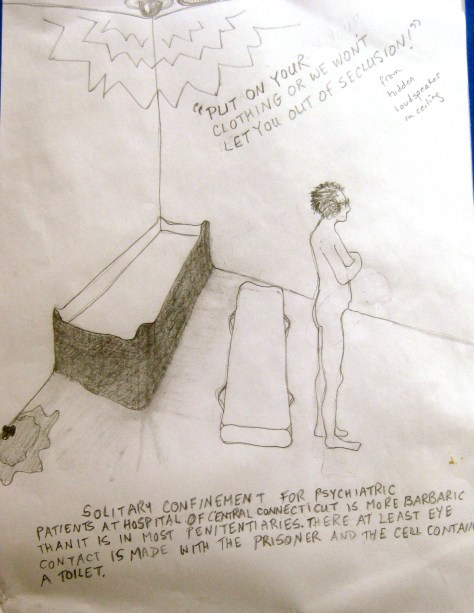
When I was at New Britain General Hospital in the spring of 2014, the security guards stripped me naked and left me in the freezing and barren seclusion room…This is a depiction of a younger woman largely because no one gives a damn about what happens to a 61 year old woman anywhere..but the seclusion room is pretty danged accurate.


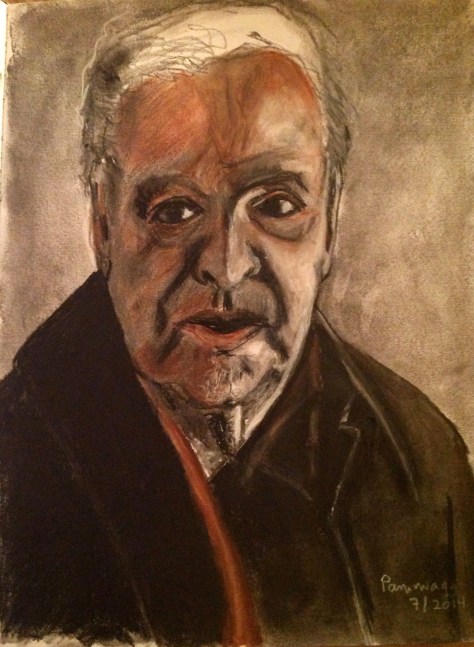
Old Movie Star in conte crayon and charcoal

New Poem: On Not Speaking

ON NOT SPEAKING


When I went temporarily mute at age sixty,

it sparked no visual wonders.

After decades schooled by dictionaries,

vocabulary categorized the world:

“precipice,” “acrid,” “blanch;”

words even defined my senses.

But one can fall into

speechlessness for reasons

beyond pathology

though these may not seem reasonable

to people who believe that only talking things out

or about them makes sense.

Speaking or not, I knew

when silence was less insane

than trying to be heard

by those who would rather hurt me

than pay attention.

But if, as they say, silence is so eloquent,

why couldn’t anyone hear

what I so desperately didn’t say?


Beyond Recovery: Stage Five

I want to reblog this brilliant post by Anne C. Woodlen and then i will add my own editorial comments if i can in a later post or edit. In the meantime, i think it speaks for itself and says just about what i would want to tell a lot of young people newly diagnosed with bpd or did or add or even bipolar disorder and getting on disability, preparing for a life “in the system” – it sucks and it isn’t worth it unless you are floridly psychotic. And even then, don’t believe what they tell you about antipsychotic drugs. There ain’t no such medication, only sedatives that may or may not quiet things down temporarily. The only way out is through, if you can do it with a wise and caring guide and community. Don’t get stuck as i am, on multiple antipsychotic drugs, addicted to them so that getting off them only means you get more psychotic than ever. Psychosis need not be a lifelong problem, but it certainly will be if you keep taking high doses of the drugs and never explore other options.

annecwoodlen's avatarBehind the Locked Doors of Inpatient Psychiatry

Hello,

My name is Dustin and I live in Michigan. When I was seventeen years old my mother put me in a psychiatric hospital called Forest View. The abuse I felt violated me to the core! I felt like I was being raped having to submit to all the rules, the bullying and the emotional abuse. To have your dignity removed when you are an innocent patient and just want genuine, kind, gentle care, and get unprofessional jerks who you can tell are fake and just care about getting paid is a horrible experience.   If anything it only caused me more traumas with the trauma that I already had. I am now twenty-two years old and live on disability while also living my life as a hermit because now I am afraid of people due to the awful treatment I endured.  I was diagnosed with Borderline Personality Disorder by a REAL…

View original post 856 more words

AUDIO Interview with Pamela Spiro Wagner: WNPR on Connecticut Hospitals’ Use of Restraints and Seclusion

(***SEE PAMELA’S COMMENTS AT BOTTOM OF PAGE…)

Connecticut Hospitals Responding to Psychiatric Restraint Numbers

“They don’t want you to get out. They pull [restraints] as tight as possible to the sides of the bed.”
Pamela Spiro Wagner

Pamela Spiro Wagner’s apartment is full of art she’s made while in psychiatric care. One piece dominates the room. It looks like a painting at first. It shows a threadbare seclusion room and a restraining bed.

“That’s made of Vogue magazines. If you look at it, you’ll see there’s a little label of Prada leather on the leather restraints, which was done on purpose,” Wagner said. She made it while alone in a hospital seclusion room. The magazines were the only art supplies she had.

Wagner has schizophrenia. She’s been in and out of Connecticut hospitals for decades, and she knows what it’s like to be restrained. “They use leather, or rubber, or plastic, or whatever restraints that they wrap around your wrists, usually tight because they don’t want you to get out. They pull them as tight as possible to the sides of the bed,” she said.

Wagner was put in four-point restraints. That means each limb is bolted to the bed, and she said she’s stayed there for nearly a day at a time. “I would just scream from the base of my lungs,” she said, “like the screams that if you had any heart, your heart would break if you heard me scream.”

“Restraint is Pretty Traumatic”

Patricia Rehmer, Commissioner of the Connecticut Department of Mental Health and Addiction Services, said the department has cut down on restraint since receiving a federal grant in 2008. “We know,” she said. “The literature is clear; the clients are clear. Seclusion and restraint is usually a pretty traumatic event. If we had our way, there would be no seclusion and restraint. We’d love to get to zero, but that’s not always possible.”

Credit WebKazoo / Connecticut Health I-Team

The Department of Mental Health and Addiction Services oversees state hospitals in Bridgeport, New Haven, Hartford, and Middletown. Rehmer said that because patients stay longer at state hospitals, doctors and nurses have more time to work with them on ways to avoid restraint. “Frankly, there are differences between our hospitals, our hospital beds, and general hospital beds, for example,” she said.

Read C-HIT Report: State Restrains Psychiatric Patients at High Rate

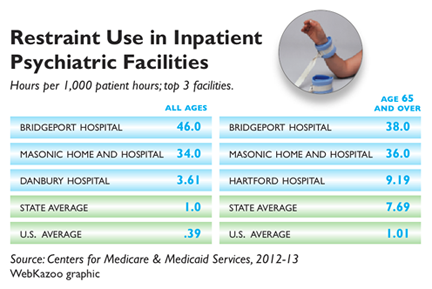
Restraining or secluding patients used to be commonplace in psychiatric facilities, but ten years after a series of deaths nationwide, there’s been a push to lessen the time patients spend restrained. Federal data released earlier this month showed that Connecticut’s rates of restraint are still high compared to most of the country – more than double the national average. The state ranks eleventh nationwide, and third for use of restraints among the elderly.

Connecticut Institutions Adapt

Bridgeport Hospital topped the list statewide. The hospital has a large geriatric unit, and the numbers were high for elderly patients.

“We realized about a year and a half ago that we were really having a problem,” said Ryan O’Connell, Bridgeport Hospital’s vice president of performance and risk management. He pointed out that the numbers only go up to the middle of 2013, and said that the hospital started changing its practices since then. “It was much more common for us to go to some type of restraint,” he said.

O’Connell said the image of the barren room and four leather straps is all wrong at Bridgeport. They’re mostly trying to keep patients with dementia from wandering off and into danger. “I think it’s really important,” he said, “that nobody thinks that we were tying people down [by their] hands and feet.”

Bridgeport is moving toward something called comfort rooms, with colorful wallpaper, toys, games, or comfortable furniture. They’re becoming common alternatives in a lot of institutions, like Connecticut Valley Hospital in Middletown — a state hospital that cut back on using restraints by about 88 percent in the past decade.

In 2002, a patient died after being restrained at CVH. The hospital conducted investigations after the death, but Director Charles Dike said they’d already decided to make a change before it happened. “Our target is to make sure we use it as sparingly as possible, only when it is absolutely necessary, and that we discontinue it as quickly as possible,” he said.

CVH started using comfort rooms years ago. Dike said that instead of putting a patient in restraints, they try to encourage a patient to spend a little time alone doing something relaxing. He said, “If somebody says to me, when I’m not doing so well, I like to go into my room and play music, and that helps me calm down…” He said that nurses will remember, and bring it up if the patient starts to lose control.

Dike doesn’t expect to stop using restraints. He said there will always be outliers — patients who come straight from emergency rooms and prisons.

Ellen Blair is the nurse director at Hartford’s Institute of Living, which is part of the Hartford Hospital system. Figures for 2013 show Hartford Hospital restrains patients at a little over the state average, but she said they’ve cut back since then thanks to new training programs and more comfort rooms.

Blair said that when a patient does go into restraints, they’re looked after. “I personally go and make sure I know that patient,” she said. “We all talk about it at least every couple of hours, because we don’t want to keep it going any longer than we have to.” She said patients aren’t left alone, and that restraint is only used as a last resort when patients are dangerous to themselves or others.

“Every day,” Blair said, “we come here thinking, okay, we’re going to have a good day. We’re going to prevent people from getting agitated and having to go to that level.” Restraint, however, remains a last resort these hospitals said they don’t plan to take off the table entirely.

Seclusion Room: Cell or Sanctuary — Amazing Article from 1959

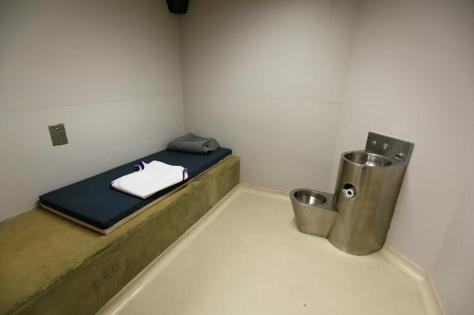
This supermax prison cell is better appointed than the seclusion rooms I have been put in...NO toilet or sink or blanket or bedding!
This supermax PRISON cell is better appointed than the HOSPITAL seclusion rooms I have been put into naked…which had NO toilet or sink or blanket or bedding, and was freezing cold!

THE SECLUSION ROOM – CELL OR SANCTUARY?

By HUMPHRY OSMOND, M.D., 1959

Superintendent The Saskatchewan Hospital, Weyburn

SECLUSION ROOMS, found in most psychiatric hospitals, too often look as if they were intended as temporary quarters for wild animals, or perhaps as storerooms for dangerous chemicals, rather than as shelters for sick and distressed humans.

Yet, the purpose of seclusion is clear and admirable. It is intended to reduce interaction following a rupture in interpersonal relationships between the patient who is being secluded and other patients, or members of the hospital staff.

Seclusion usually occurs when there has been acting out or a threat of it. While skilled psychiatric nurses can often handle such situations without using seclusion, it is proper that a patient, in an explosive situation, should have an opportunity to withdraw to a suitable spot to be alone for a time or in the company of someone he trusts.

When children quarrel with siblings or parents, they are often sent or asked to go to their room and be alone with toys and playthings. Adults retire to a bedroom, a study or even to the toilet. Although it was once common practice, it is no longer thought admirable to lock a child in a dark cupboard. In his own room, he gets comfort from his toys, just as an adult will soothe himself with a book, a pet animal, possibly with music, or just by being alone.

The mentally ill person, who has had a rupture of interpersonal relationships, likewise needs space under his own control where he can “pick up the bits.” The best place would be a room of his own, with familiar furnishings and his personal possessions easily visible. Wherever his retreat, it should give external stimulation as well as support and comfort.

Bare, Drab Rooms Affect Perception


Seclusion rooms in many hospitals are built to some stereotyped plan, and are poorly-lit, bare, drab rooms of a curious cube-like construction which makes them seem unduly high. There is little or no furniture, often only a mattress. Walls are usually tiled in one color only, and this sometimes white. Windows covered with heavy screening, ceiling lighting often high and remote beyond the patient’s control, heavy imprisoning doors sometimes the same color as the walls, and in the middle of the floor a brass grating over a drain hole―no wonder these rooms are suggestive and frightening. Such rooms strongly resemble the reduced environment described by Hebb* in which even well people can experience major 18 changes in thinking,. perception and mood, larked in certain non-experimental situations, notably brain washing, such environments are deliberately used. to. encourage alterations in perception. Surely then it is un-wise to place psychotic people in a situation which, since it will not afford them even minimal external stimulation, is likely to increase the perceptual disorder which many of them already have.

The need for sufficient stimulation, particularly of a visuo-auditory type, combined with carefully selected tactile and olfactory stimulation, is strongly suggested by Goldfarb’s recent work at the Ittleson Family Center with children. His work indicates that many schizophrenic children tend to inhabit a tactile-olfactory world, rather than the more common and culturally acceptable visuo-auditory one. It seems probable that schizophrenic adults may be in much the same position.

Clearly then we must provide our disturbed patient with an adequate amount of pleasurable visuo-auditory experience while in seclusion, and also let his environment be rich in socially acceptable tactile-olfactory pleasures, lest he seek the only remaining gratification―tactile-olfactory ones from his own body. Specifically, let us imagine a patient, greatly disturbed, shut up in a bare room, with bare walls, little or no clothing, and possibly only a mattress or blanket as furnishings. The visuo-auditory and tactile-olfactory enjoyments to be obtained from such surroundings are very small. Is it surprising, therefore, if his seclusion results in apsophilic (auto-erotic) activity, in the tactile experience of staff members or even in reviving a tactile and olfactory interest in his own body products of urine and feces?

These apsophilic activities, the touching and snuffling on the nursing staff, and the handling of feces and urine are likely to produce great anxiety and great resentment in those who must care for the patient. He will naturally interpret this as dislike and rejection, and a vicious circle is established. He is driven deeper and deeper into his tactile-olfactory experiences, and probably also into full hallucinatory experience. Since we are woefully short of really sophisticated staff, we must make .very vigorous efforts to see that this type of “reduced environment” seclusion is banished from the mental hospital as quickly as possible.

The seclusion room, therefore, must be not merely pleasant, but the very best room on any ward. There are several reasons for this. For one thing, if the room is pleasant, it will take away the idea of punishment―not merely by a verbal gesture, but by a change in the attitude of everyone on the ward, patients and nurses, who will both be far more impressed by the fact that the seclusion room is the best on the ward than if there is simply lip service to the effect that seclusion is not punishment. Money invested in making this room conspicuously better than other rooms “because it is for those who are the most unwell” will indicate to both nurses and patients that the hospital particularly concerns itself with those who are the sickest. The fact that the room is an object of pleasure and satisfaction to all the patients on the ward will exert considerable pressure on the disturbed patient to use this joint possession properly. This pressure will be extremely effective in preserving the room from damage.

Dimensions and Decor Important

What, then, should this “best room in the ward” be like? Particular attention must be given to its size and proportions. A small room of great height is extremely oppressive to most people. and if such a room must be used, perhaps a false ceiling should be built in. The lighting must be good, and must, at least in part, be under the patient’s own control. The walls should be pleasantly painted in bright and reassuring colors. There should be pictures on the wall, and a mirror (a metal or unbreakable mirror is permissible). The bed should be comfortable and the bed cover pleasant. Sheets, pillows and mattress must of course be provided. There should be chairs and a desk, the chairs self-colored and if possible, textured. Patterned material is best avoided, since it may have a disturbing, Rorschach-like effect. (Until we know more about the effect of patterns on patients’ perceptions, we should be cautious about patterned materials.) A carpet or rug, preferably nylon, should be on the floor, which may be of tile or linoleum, but should be light in color. To avoid uncertainty about the passage of time, a clock and a calendar should be clearly displayed. If a toilet cannot be readily available, a modern commode chair may substitute, if it is explained to the patient.

It is important here, as elsewhere in the hospital, for the furniture to be light, strong and elegant, rather than heavy or cumbersome. Heavy furniture quickly becomes a challenge to some patients to see if it can be broken. It encourages all patients to lose one of the most important skills which we all acquire in childhood―the ability to maneuver through complicated mazes of furniture. This ability includes all sorts of skills, especially subliminal psychomotor movement. Mental patients frequently lose this ability through disuse, and all too often the arrangements in the mental hospital give them no opportunity to re-acquire it, or what is even more important, to correct early the tendency to lose it. Experimental work shows that, given the opportunity, people frequently correct perceptual errors on their own. But a bare room, fitted with one massive piece of furniture affords neither encouragement nor motive for correcting an error of any sort.

In the seclusion room, the patient should have diversions from the very start. Games, books, perhaps a slide projector, a television or record player under his control are all possibilities. Cut flowers and potted plants should decorate the room. Writing materials should of course be available, and if the patient has difficulty in writing, as some psychotic people do, he might be provided with chinagraph (grease) pencils and an ample supply of paper. Part of the wall might be processed for drawing. which people sometimes find pleasant when they are upset. Plasticine and paint should be provided. A way might also be devised for the patient to brew his own coffee or tea. A tape recorder could be provided to allow the patient to hear his own voice, and get accustomed to the fact that he really is there, though this should be handled with caution, because some people find it rather a disturbing experience.

All these measures must, of course, be combined with friendly interaction with a member of the hospital staff, one with whom the patient feels comfortable and can speak freely, but who, like the room itself, will keep him as close to reality as possible.

In brief, the seclusion room is ideally a place where the patient, after a rupture in interpersonal relation-ships, can re-assert his adultness and recover his poise, rather than a place of punishment where he is treated like an abandoned child in a dark cupboard or a bear in a pit.

(See link to original article for photo of music therapy session.)

*Dr. Donald Hebb, McGill University, conducted experiments in which the subject was placed on a bed in an air-conditioned box with arms and hands restrained with cardboard sleeves and eyes covered completely with translucent ski goggles. Hallucinations and delusions of various sorts developed, mostly in those who could stay longer than two days. Many subjects left at about twenty-four hours

http://journals.psychiatryonline.org/data/Journals/PSS/20510/18.pdf

Pencil Art done under Barbaric Conditions at Hospital of Central CT: Brutal Aversive Conditioning.

CLICK ON THE PICTURES TO ENLARGE THEM.


There were few rewards for behavior that toed the line at New Britain General Hospital (HOCC). Mostly it was punishment. If I was found with even a stub of a forbidden pencil, I was carried off to the Supermax seclusion cell, stripped naked and left alone.


At that point, being teeth-chatteringly blue with cold, I would swat a nurse in such a way that she would feel assaulted and bring on the goon squad of “I want to hurt someone today” guards to put me in four point restraints.


Why would I induce this? Because then they would at least cover me up afterwards with the mercy of a sheet, for modesty not warmth mind you, and I would beg for a blanket in vain. But at least my body would be protected from head to toe from the blasts of the A/C up full bore, and I could rest after I had had screamed out my lungs and my despair for a lonely twenty minutes or more.


No one cared, no one heard or paid any attention. The doors were double, and the cell was utterly soundproof. NO one ever even knew I was locked in there. When my screaming was too heart-wrenching for the softer ones of the staff down the hall in the room where they had retired to, they simply turned down the monitor and intercom so they didn’t have to listen.


I know, because I heard when the telephone rang, telling the person sitting outside the inner door they could turn it back on now (after I had quieted down). This was brutality of the nth degree. But they always called it treatment for safety, though I mentioned the CMS regs to the security guards one day as they were inflicting their usual pain in order to bring me to the room, and they stopped in their tracks.

“You’re kidding,” one said, “Its true that the only legal reason for seclusion is Imminent Danger to self or others?” (I had been brought there for disturbing the peace…)


I nodded, Look it up. She looked gravely at the others. but proceeded o do what she had been ordered to do anyway. And I proceeded to behave in a wildly immodest and terrified fashion likewise…knowing I would be left alone and freezing for at least two to three hours, no matter how fast I calmed myself.


They didn’t care. it was PROTOCOL…

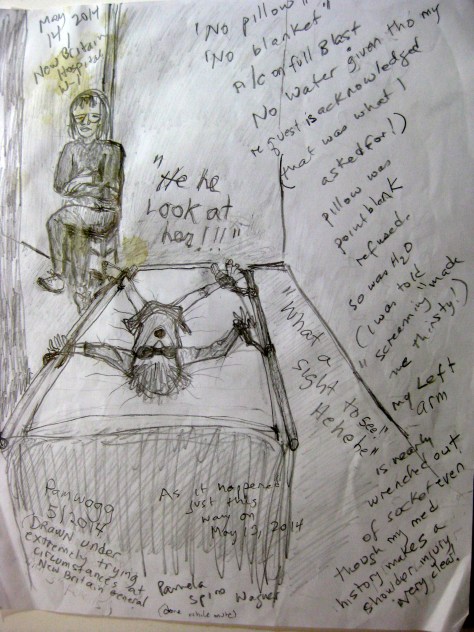
 Angry at me, the doctor put me in Four point restraints the first day I was there, freezing cold and thirsty , in physical pain, and mute...No one responded to my plight.
Angry at me, possibly justifiably, for slamming the door on him (I had been brutally restrained and secluded in the ER for NO reason the night before) the doctor put me in four point restraints the first day I was there, freezing cold and thirsty , in physical pain, and mute…No one responded to my plight. This drawing picture got stained from my efforts to save it from the trash, because every time they put me in seclusion the nurses would tell Housekeeping to throw my art and journals away. “It ‘s just trash” they would tell the cleaning woman, even though I begged them to preserve my work. Finally I wised up and mailed out everything I wrote and drew to my friends on the outside. Also I should mention that my rage at Dr Balkunas stemmed from his walking in to my room and pointblank telling me he would not let me communicate with a pen and paper, and would not sit with me at all unless I spoke with him…so my  rage, both from the restraints the night before and his  brutal dismissal of me, just exploded.


No one could hear me or see me in the Supermax Seclusion Room, or so I felt..since no one ever communicated with me in my agony...
No one could hear me or see me in the Supermax Seclusion Room, or so I felt..since no one ever communicated with me  when I screamed in cold or pain…only to tell me to shut up or lie down.
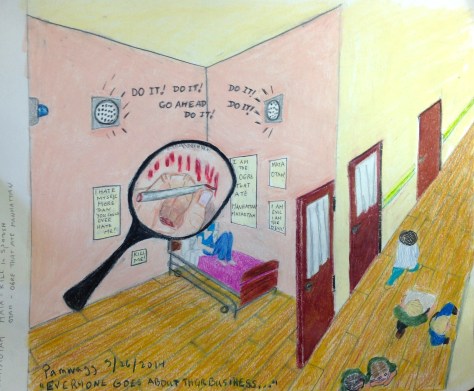
This is what the voices really instructed me to do...
This is what the voices really instructed me to do…
The Behavioral Care Plan was so torturous that if I was found with even a magazine or a pencil stub I was put back to Square one, no matter how far I had come...this happened at least ten times in 3.5 weeks.
The Behavioral Care Plan was so torturous that if I was found with even a magazine or a pencil stub I was put back to Square one, no matter how far I had come…this happened at least ten times in 3.5 weeks.
They had a camera in my room, supposedly to monitor me all the time, so how did this happen? I thought they were telling me to do it!
They had a camera in my room, supposedly to monitor me all the time, so how did this happen? I thought they were telling me to do it! Nevertheless, all heads and backs are turned away from me, and the room is empty.but for the hospital bed, which could be conveniently used for four-point restraints and often was.

Hospital Of Central CT: Smearing Shit at W1: An Angry Poem but an Honest one.

HOLY SHITE AND URINE TEAM


Her cool wordless RN face expresses nothing

as she scoops the ice cream turd  and quickly disinfects.

But I think for her, thinking, knowing this:

“Asshole, shithead, you think

your shit don’t stink…” While I have no working sense of smell,

I know I’m an unofficial pain in the ass here

because no one can be officially PIA

on a psychiatric ward, not even I, the wild shit smearer

who knows no disgust first hand

for not smelling it.


What I know well and sadly is

the consequences of disgusting others,

the distancing, the shunning,

how killing the ultimate loneliness is, double-locked away

in a soundproof seclusion cell.

Shackled naked into leather 4-point restraints, I shriek my soul away,

from the bottom of my lungs for 20 minutes straight.

The illegally silenced intercom remains dumb.

Even the 1:1 monitor positioned behind the door.

peering lazily  through the judas-eye of a small plexi-port-hole,

doesn’t really pay attention. Why bother, the shit smearer

gets what she deserves.


Oh, I know I disgust them, what with my out of control turd throwing

and my illegible scribbling with my feces on the wall

but they refuse me so much as a marker and board,

and they won’t sit down to listen when I speak.

Mute for 16 days, I will be heard now, one way or another.

But this is no way to think, and i think without thinking, just do with do do, mindlessly, enraged by trauma.

I foul myself because no one cares,

because their disgust is threaded, even so heat-felted with hatred

they have long forgotten I’m just another patient

with problems bigger than the shit I fling.

Instead, cucumber skinned nurses sneer their disgust,

Bad dog! Bad, bad dog!


But I know dog is just God spelled backwards.

And God created the living world

from dust and mud and excrement.

I am no god, I am Live backwards to Evil:

I create chaos from utter chaos within.

There are always turds to form and fling.

And in the end all they can do is kill me.

Fuck me! Do me a favor you turds, kill me!

But first, you have to silence the hate on your faces,

 clean the smeared walls,

and pretend I am nothing to you.


When you came in to take me down,

restrain me for any excuse, even for just wanting a blanket.

you had to breath in my shit, that fear,

and knew what it could do to you.

You’d heard the stories, deadly E-coli, C diff.

Something in me might kill you,

I don’t know what scared you more, my wildyelling

or my excrement.


That was always the struggle. Shit stinks. I stank.

You hated me for my smell. You feared me for what I did.

I know your fear. It was: what would happen if you

lost control of yourself.

Would you, control freaks,

too  dance naked in dung?

Hospital Of Central Connecticut’s Psychiatry Unit W-1: Dr Michael E. Balkunas


I understand now why Dr. Michael E. Balkunas, the psychiatrist at New Britain General Hospital (Hospital of Central Connecticut) W-1, general psychiatry, gave up on me. He decided, even after eliciting my brother’s opinion both from a professional and a personal standpoint, and Dr Angela’s equally professional opinion that I do not suffer from Borderline Personality Disorder, to diagnosis me secondarily as exhibiting that disorder.


Oh, he knew I had come in with an acute exacerbation of schizophrenia and that I had PTSD. He knew that I had in my electronic medical record documents stating from other psychiatrists that I do not and never did have any personality disorder, despite in-hospital “behaviors.” But I know why Dr Balkunas diagnosed one. He did it for the same reason the other hospitalist psychiatrists have done it in the past: 1) in order to justify the use of a Behavioral “Treatment” Plan that was tantamount to torture and 2) to excuse his liberal use of seclusion and restraints in instances when they went against all CMS regulatory guidelines. And 3) in order to dismiss me and call my behaviors “manipulative and devious” instead of taking me and what I said seriously.


I also suspect, for all the second shift RN Barbara’s telling me that Michael Balkunas MD is a caring man and “never gives up on a patient” that he DID in fact give up on me. In fact I suspect that he never really tried to deal with or treat me at all, that from the first time he resorted to seclusion and restraints, he knew he had opted to terminate any treatment alliance.


But how did I figure this out? Well, it isn’t as if there ever had been any kind of alliance between us. From the first day after he admitted me from the ER, when he came into my room while I was still mute, he just walked away, saying dismissively, “I won’t talk with you unless you speak.” Immediately I understood that this man was willing to jeopardize everything about me and about my treatment in order to assert his power.


The same thing came into play after I began speaking about a week later. Now the issue was that he would not speak to me, would not deal with me at all but would immediately leave the room if I became angry and spoke with anything resembling a raised voice. (Argh, this was so many shades of Amy Taylor MD at the Institute of Living last year! — and Dr Balkunas tortured me in similar ways with predictable ineffectiveness — but powerful people behave in predictable ways, right? It seems I must have threatened their sense of entitlement. Why else take it out on me? Who am I? I’m a big fat nobody! They could have ignored me or just treated and released me, like anyone else. But instead they did their damnedest to crush me and destroy me. Why? Because in the end, I think I must have triggered some underlying feelings of resentment and impotence in these two psychiatrists and you know you do not threaten to unearth the feelings of a psychiatrist, or at least not with Michael Balkunas MD or with Amy Taylor MD …)


I learned very quickly, but not quickly enough, that everything about the Hospital of Central Connecticut W-1 Unit at New Britain was about coercion and control. Not about trauma-informed, patient-centered care. I don’t know how other patients managed to be discharged from there within a few days, but it would never have been possible for me. Mostly because I was simply too out of control to BE controlled by people who used such methods to undermine any possible calm and stability I might have achieved in those early days. They did NOTHING to help me but take away the very coping methods and objects that might have helped me. They used the carrot-and-stick method liberally, but mostly they used sticks. The very fact that the ED staff had seen fit to seclude me, give me IM meds twice and also to four-point restrain me naked to a bed tells you something about the brutality that reigns supreme there.


You know the very first thing I did was give the ER and the W1 staff a Psychiatric Advanced Directive. It was supposed to help them to help me. But instead they seemed to resent my knowing myself, and wanting them to know how to help me. They reacted badly and worked against it in every way possible, instead helping me. It appeared to anger them that I knew myself, and instead of using it, they did everything in their power to abrogate each and every section of it, right up to the section where it asked them to notify my doctor and my brother when and if they used seclusion and/or restraints despite the warnings.


No one ever called anyone in each instance that they chose to restrain or seclude me, even though I begged them to verbally at the time as well, and this document, which was at the front of my chart all along, stated in no uncertain terms that I wanted both people to be notified.


It was the worst hospitalization I have ever had, and I say that having had many serious and difficult stays. I was not just a difficult patient, I was a pain in the ass, but this was a direct result of the trauma I experienced in the ED and immediately following it on the floor. If I had not been traumatized, on the unit and in the ED, I feel certain that my “behavior,” outrageous, “disgusting,” and out of control as it was, would never have been so damaged. But because everyone saw fit to go against everything advised in the PAD, and do everything they could to re-traumatize me– even after I had a conversation with a nurse about my three experiences with date rape, even after that, she decided to seclude me, involving the forcible removal of me from my room by brute guards who bodily threw me into a cell without any mean s of communication with the world — because of this, they got the regression and degeneration and worsening of symptoms that my PAD predicted would happen. What did they expect? That I would simply thank them?!


I realized, though, the Monday morning of the week he discharged me when he came into my room and asked me how I was doing, that Dr Balkunas, who “never gave up on a patient,” had given up on me. Now, my brother had indicated to him that the “kindness” Dr Balkunas was offering to me by means of involuntary commitment to CVH would be devastating and destructive to the max. I think “Balkie” had had to think about the wisdom of actually sending me there. So he also had to think about whether he actually had any tools at all to “fix me” or cure me as he had promised. Indeed he was no miracle worker and had never held out anything, NOTHING AT ALL, by way or therapy or treatment modalities beside commitment to the state hospital to help me…so without that threat he had nothing to offer me.


The man never once sat down and even talked to me calmly and caringly. I say this because when he sallied forth with his usual opening that Monday morning, How are you? (I had decided finally, with my brother’s encouragement to “play the game.”) I answered with the socially acceptable, “fake” answer, my game plan, not expecting any real psychiatrist worth his salt to accept it, but trying to “play the game” anyway, as I was desperate to be discharged. My answer?


“I’m fine, thank you. How are you?”


Balkunas really didn’t bat an eyelash, the completely social answer was good enough for him, because he had given up trying to help me. Indeed, he had never even tried. So he proceeded, “How are you eating?”


“Fine.”


“How are you sleeping?”


“Fine.”


“Well, if things continue this way and there are no meltdowns I think you can go home on Friday.”


There were indeed meltdowns, even the night before I was discharged I had a meltdown over my supper tray. But Dr B was not on the floor much and didn’t hear of those, and everyone was so sick of me that they didn’t write them up, knowing I was to go home. And I persisted in answering those three magic questions “correctly.” Socially, as I had been taught, against my will, years ago. He never asked me a single other thing, and never talked about anything else at all after that.


The day of discharge came, and the great and caring Dr. Michael Balkunas popped his head into the room. “How are you?”


“I’m fine thank you. How are you?”


“Okay, I will write your discharge papers now.”


The very minute he said that and turned to leave, I put my sunglasses back on, as I saw that taking them off a week prior had served its purpose and it mattered not whether I wore them from that point on or not. I still wear them today, to protect people from my evil…


Dr. Michael Balkunas may talk a great game about helping people but he has very few tools to do so and really it is all pretence. He has medications, which are by and large bogus (though he has been educated by Big Pharma for so long he fails to understand this), and he had commitment proceedings to the state hospital, unless he happens upon a millionaire family willing to spend on their family member. I was not one of those, nor worth it. CVH – for those who are not in the know, CVH—Connecticut Valley Hospital is the last state hospital and the only long term facility for adults on Medicaid in Connecticut – being sent there would have killed me and he and my brother both knew it.


The difference was that my bother was decent enough to care while Balkunas honestly thought it would be good for me to lose my life there. And that was his treatment? Bullshit. He was a bad doctor and despite the cant, he gave up on me to boot. Well, thank god he did.


But you know, I do not forgive his accepting my social “I am fine thank you. How are you” so easily. That was insulting. He was sick of me, and considered me willfully manipulative and devious, otherwise he would not have diagnosed me with the damning BPD diagnosis, which in his hospital means just that you are a PIA, no less and no more. But he might have at least pretended to be a psychiatrist and not just a social buddy. How are you? Fine thank you, How are you? What sort of answer is that? ON the other hand, if he had asked me, what could I have said? We both know I had to get out of there and there was nowhere to go but home. He was not interested in finding out how I was, in talking to me. Not from the first. All he wanted was to medicate me. Which he did. So fuck me. How are you, I am fine thank you how are you? And it wouldn’t have made a rat’s ass worth of difference if I had not been okay, which I wasn’t, so long as I said I was fine, thank you, how are you’


Like I said, it was a game. That was the name of it, Play the Game…


So fuck Michael Balkunas. He is worthless to me, and his add-on personality disorder diagnosis means less than a fig to me. He knew I had schizophrenia and PTSD. He knew the hospital was abusing me. He knows nothing about me, never spent more than 3 minutes with me on any given day. He knows nothing. And I don’t give a flying femtogram about HOCC (the former New Britain General Hospital) except insofar as they ought to ask me back to educate them and improve the situation vis a vis their abusive use of seclusion and restraints, not trauma-informed patient-centered care at all. However since even supposedly trained Nurse Manager Jessica came around to not objecting, and approving their use, I can see that it might be hopeless to do so. Willing though I would be.


Barbara, RN on the second shift. You alone were a lifesaver and a light in a dark tunnel. I wrote in the scraps of paper I called a journal of your kindnesses again and again, and I forgive your being blind to the cruelty of seclusion and restraints, because you have lived with that culture too long, You just need to be re-educated. But you saved my life. Had you not been on duty that weekend before I was discharged, I might not have calmed enough to say to Dr. Balkunas the socially acceptable “I-am-fine-thank-you-how-are- you” mantra that was the magic ticket out of there.


I know no one on W-1 remembers me with anything but relief that I am gone and a great deal of disgust and anger. Ditto for me. I still wake screaming from nightmares about the place and a great deal of anger that I don’t want to let go of. I want to hold onto it long enough to fix the situation of W1, before I forgive anyone. Then we will see.


But for now I am off to Vermont for six weeks to stay with relatives. I hope to heal. I hope I can heal…


Take care of yourself Barbara. You would do well to find a kinder and better place to work and train. I thank YOU for everything. I mean it when I say you saved my life and sanity.


Blessings on you alone, Barbara, the rest of you can FYandGTH.


Miss Wagner

Article From New Haven Register On Connecticut’s Excessive Use of Restraints, With Full Commentary…

http://www.nhregister.com/general-news/20140601/connecticut-hospitals-restrain-psychiatric-patients-at-double-national-average#comment-1424593756

FROM: THE NEW HAVEN REGISTER May 31, 2014

Connecticut hospitals restrain psychiatric patients at double national average


As Connecticut works to improve its mental health system, new federal data shows that hospitals in the state restrain psychiatric patients at more than double the average national rate, with elderly patients facing restraint at a rate seven times the national average.


In addition, the state lags behind in providing adequate post-discharge continuing care plans for psychiatric patients, especially teens and the elderly. Connecticut’s 28 inpatient psychiatric units and hospitals developed continuing-care plans for fewer than 70 percent of patients they discharged from October 2012 to March 2013 — indicating that thousands of patients may have left facilities without adequate treatment and medication plans.


A C-HIT analysis of the federal data, released by the Centers for Medicare & Medicaid Services for the first time, shows that Connecticut ranks in the top fourth of states (11th highest) in the use of physical restraints in inpatient psychiatric facilities — and is the third highest state in restraining patients 65 and older.


Two psychiatric units — at Bridgeport Hospital and Masonicare Health Center in Wallingford — have the 10th and 12th highest rates of restraint use, respectively, among the 1,753 psychiatric facilities nationwide that are included in the federal reports, which cover October 2012 through March 2013.


State and federal guidelines — tightened over the past 15 years, partly in reaction to deaths in Connecticut facilities — say that restraints should be used only in cases of imminent physical danger to a patient or others. They call for less restrictive interventions when patients are acting out aggressively.


But the data show that Bridgeport Hospital, Masonicare and three other Connecticut hospitals — Waterbury, Hartford, Danbury — restrain patients at more than triple the national rate.


James McGaughey, director of the state Office of Protection and Advocacy for Persons with Disabilities, said he was disturbed by both the high rate of restraint use and the low rate of post-discharge plans.


“The numbers are pretty compelling,” he said. “Some of our hospitals have done a significant amount of work on this, but clearly there’s more to be done.”


He suggested that the Department of Public Health, which oversees hospitals and is charged with reviewing annual reports of restraint and seclusion, should “get a little less timid in looking at this.” Hospitals rarely have been cited or penalized in recent years for improperly using restraints, a review of inspection reports shows.


McGaughey noted that the state-run Connecticut Valley Hospital in Middletown has pursued a reduction in restraints and seclusion that has cut its restraint rate significantly in the last five years. The new data show CVH’s rate at .52 hours per 1,000 patient hours — below the statewide rate of 1 hour per 1,000. The national average is .39.


“It’s ironic that our one remaining large state hospital has done such a good job of reducing restraint and seclusion, but you have some very different results at private institutions,” McGaughey said of CVH, which was cited for excessive restraint use in 2007 by the U.S. Justice Department. “What it shows is that it’s possible to address this issue, but you need leadership to effect this kind of culture change.”


Mental health advocates say seclusion and restraint should be avoided because they are traumatic and dangerous to patients and staff.


Alternatives include individualized aggression-management plans, the use of “comfort rooms” or time-out spaces, and one-on-one interventions. Among the innovations at CVH are 22 “comfort rooms,” designed to calm agitated patients, and a reduction in the time interval that a physician’s order of restraint or seclusion can remain in effect, according to a state report.


Yale-New Haven Hospital has a restraint rate of .36 hours per 1,000 patient hours — just below the national average of .39 hours. But its rate of developing care plans for discharged patients is relatively low — 50.36 percent, compared to a national average of 73.5 percent of cases.


Officials at Connecticut hospitals with high rates of restraint say they are working to reduce those incidents, and they stressed that even minimal mobility restrictions, such as soft wrist restraints or brief therapeutic holds, are counted in the federal numbers.


Robert Bernstein, executive director of the Bazelon Center for Mental Health Law, a national advocacy group that successfully sued Connecticut in 2006 to stop housing psychiatric patients in three nursing homes, said he worried that progress made in the early 2000s to reduce restraints might be slipping in some hospitals because of staff shortages and “pushback” from clinicians.


“Some of the procedures put in place may have been weakened, because it’s a lot of work” to use alternative interventions, he said.


Although patients subjected to improper restraint can file complaints, few speak out, Bernstein and others said. Among the exceptions in Connecticut is Pamela Spiro Wagner, a Wethersfield writer and artist with schizophrenia who has cycled in and out hospitals.


In an April “open letter” to the director of a Connecticut psychiatric hospital, Wagner readily conceded that she is a difficult patient — “easily roused to irritability and hostility” — but insisted that her behavior has not warranted her repeatedly being placed in restraints and seclusion, for hours at a time.


“Once you allow staff to use restraints a little, it only takes a little to use them a lot.”


CONNECTICUT VS. THE NATION


Nationally, the states with the highest restraint use are Minnesota, Washington, South Dakota, Tennessee and New Hampshire. For patients 65 and older, only Nevada and New Hampshire have rates higher than Connecticut, which restrains elderly patients at an average of 7.69 hours per 1,000 hours. Thirty-five states have rates of less than 1 per 1,000 hours; the national average is 1.01 hours per 1,000 hours.


The U.S. facility with the highest restraint rate is Park Ridge Health in North Carolina, which reports 722 hours of restraint use per 1,000 patient hours overall. Among facilities that report serving children ages 2 to 12, Lakeland Regional Medical Center in Florida has the highest restraint use, at 200 hours.


The federal data shows Connecticut psychiatric facilities fare well in some categories, including lower-than-average rates of restraint for children and teenagers. Five hospitals reported no use of restraints for any age group: Sharon, MidState Medical Center, Bristol, John Dempsey and Natchaug hospitals.


And Connecticut’s rate of keeping patients in seclusion is lower than the national average, with half of the state’s psychiatric facilities reporting that they did not use seclusion at all. Nationally, South Dakota, Montana and Washington report the highest use of seclusion, defined as involuntary confinement where a patient is prevented from leaving.


But the state’s over-65 restraint rate is fueled by excessive rates at Masonicare (35.99 hours), Bridgeport Hospital (37.92) and Hartford’s Institute of Living (9.19).


Officials at those hospitals say they have taken steps in the year since the data-reporting period ended to reduce restraint use.


This is the first time that quality measures from psychiatric facilities have been made available by CMS. The federal agency does not penalize facilities for high rates of restraint or inadequate discharge plans. Instead, an agency spokeswoman said, the public reporting is intended to encourage quality improvements and help consumers to make informed decisions.


At Bridgeport Hospital, Dr. Ryan O’Connell, vice president for performance and risk management, said the hospital’s geriatric psychiatric unit serves many patients with dementia and behavioral problems that cannot be managed in other facilities. About 18 months ago, he said, the hospital put in place an “action plan” to reduce restraints, including using “comfort” rooms. Also, in January, a new policy was implemented requiring that the nurse manager be called before any patient is restrained.


“We realized we were going in the wrong direction with restraints” and have since seen a “dramatic drop” in their usage, O’Connell said.


Hartford Hospital’s Institute of Living (IOL), which has a geriatric unit for complex dementia patients, has made similar changes over the past few years, nursing director Ellen Blair said. She said restraints are now rarely used, and only for patient safety. The IOL requires that a physician’s restraint order be reviewed every two hours, rather than every four, which is the standard of care.


“We look at our data every single day” to ensure that restraint and seclusion are being used only as “a last resort,” Blair said.


Masonicare’s acute psychiatric unit serves geriatric patients who frequently are referred because of difficult behaviors and aggression, said spokeswoman Margaret Steeves. When restraints are needed, the hospital uses “the least restrictive restraint, which is typically a seat belt,” she said. Masonicare has an interdisciplinary team reviewing restraint use.


Statewide, the Connecticut Hospital Association has been working with the state Department of Public Health to minimize the use of restraints, said Dr. Mary Cooper, the group’s vice president and chief quality officer. She said the new federal data “indicate that there is more work to be done in this area” and will help to identify best practices.


Nationally, the federal government tightened rules on the use of restraints and seclusion between 2001 and 2007, including time limits on physician orders and strict documentation requirements. The changes were prompted by a series in The Hartford Courant, “Deadly Restraint,” which documented restraint-related deaths in psychiatric facilities nationwide.


In 2007, the U.S. Department of Justice cited the state-run CVH for excessive overuse of unnecessary restraint and seclusion. Since then, policy and training initiatives have significantly reduced restraint episodes — from 26,290 hours in 2000, to 529 hours in 2012 — a state report shows.


State DPH spokesman Bill Gerrish said the agency collects restraint and seclusion reports from hospitals and works to “ensure that care is appropriate.”


LAGS IN DISCHARGE PLANNING


McGaughey and Bernstein said they were especially troubled by the failure of many hospitals to develop continuing care plans for discharged patients, and to transmit those plans to the next level of care.


Statewide, Connecticut facilities developed adequate discharge plans 69.4 percent of the time — lower than the national average of 73.5 percent. For teens, hospitals transmitted care plans only 55 percent of the time — lower than the national average of 74 percent — and for seniors, just 42.7 percent of the time, below the national average of 56 percent.


Discharged patients are supposed to receive care plans containing their diagnoses, reasons for hospitalization, medications and treatment recommendations.


The federal data shows that 10 Connecticut hospitals, including Waterbury Hospital, Masonicare and Yale-New Haven Hospital, properly transmitted care plans to the next provider in less than half of cases.


A few hospitals — St. Mary’s, Bristol, Norwalk, Natchaug Hospital and Southwest Connecticut Mental Health — transmitted care plans more than 90 percent of the time.


McGaughey said that without continuing care plans directing further treatment, many discharged patients may languish in nursing homes, shelters or land back in the hospital.


“The lack of continuity of care, to me, is a huge issue,” he said. “It’s a pretty brutal business — insurance companies want you to medicate and discharge as fast as possible. The question is, what happens after they’re out?”


Bernstein said the lack of attention to continuing care plans was “jaw-dropping.”


“Those numbers should be at 100 percent,” Bernstein said. “It’s shameful.”


Hospitals with low rates of discharge care plans blamed much of that lag on their failure to document that the paperwork was done.


At Masonicare, for example, Steeves said the 31.3 percent rate of developing care plans was due to problems with the “tracking of the discharge document . . . not that it wasn’t actually sent.”


This story was reported under a partnership with the Connecticut Health I-Team (www.c-hit.org).


COMMENT:

This is the comment that I posted online at the paper a few days after the article was published, (as it happened, while I was a patient being tortured at the former New Britain General Hospital, the present day, Hospital Of Central Connecticut).


Pamela Spiro Wagner: “As someone who has been subjected to more use of seclusion and four-point restraints over the past “decade of change” than in the two decades previous it boggles my mind that anyone would even dare to state that things are improving in CT mental health care institutions. During my nearly month-long captivity in the winter of 2013, the Institute of Living in Hartford regularly restrained me to a bed for as long as 19 hours at a time, without ever releasing me for so much as a bathroom break — I had to defecate in my clothing. I was not even released to eat. When I was not in four point restraints “for not following directions, I was in seclusion, which they called the “Quiet Room” and not seclusion, but by CMS definitions, it was seclusion as I was separated from the rest of the patient population by force, and was not permitted to leave the room I was isolated in.

The one time I did actually saunter away, walk down the hall to look out the window, and return to my non-seclusion Quiet Room, I was punished with immediate use of four point restraints, into which I was placed without a struggle, hoping that would make it easier to win my freedom. Alas, for me, there was no way to earn freedom from restraints I never “deserved.” The entire point was discipline, and that would last as long as the staff wanted me to be in shackles to learn my lesson. There was literally nothing I could do, –stay calm, sleep, quietly ask for release — nothing, until they were finally satisfied that I was submissive enough to obey their orders, some 6-19 hours later. But I had to cry Uncle, and submit to a set of degrading humiliating “debriefing questions” that assured them that I took responsibility for my own being restrained and that my behavior would henceforth conform to their norms.

I was surprised to see Natchaug Hospital being given good ratings of any sort. One of their chief psychiatrists on the Adult Unit, a longtime presence their Emeritus psychiatrist you might say, was so insouciant about this job as to be nearly incompetent, but probably hard to fire even for negligence. HIs name I will not mention. He routinely did drive-by visits with his patients– a wave in the hallway might not be a completely standard morning meeting, but it happened often enough that peatients knew that would be all of this doctor they would see for the day. He routinely discharged patients with GAF scores at or around 60, the highest “global assessment of functioning” that one can have and still be rated “disabled” — not because he knew this level of functioning to be the case, but because it made him and his psychiatric ministrations at Natchaug look good. After all, if person comes in with a GAF in the 20s, and barely able to function, and you discharge him or her a week or two and some drive-by counseling sessions later with a GAF of 60, you must be doing a terrific job, esp for a 75 year old doctor not too keen on using anything like trauma-informed or patient-centered care. I had never left a hospital before Natchaug with a GAF higher than 40, but suddenly I rated a 60….by a doctor with whom I never spoke.

Natchaug Hospital, when the nursing director was Sharon B Hinton, APRN, was a decent place, because she made certain that abuses like restraints and seclusion rarely to almost never happened under her watch. I know, because I was there about three times during her administration. I also knew her when she was Hartford Hospital’s psychiatric Head Nurse at CB-3, where she and her never failing humanity and respect for the dignity of every patient made all the difference in the world. I might have come from an abusive hospital in the early 90s, like University of Connecticut’s Dempsey Hospital, which in those days four-pointed people to an iron bedstead, by shackling them spreadeagled to the four corners of the bed, a stress position that is not just tantamount to but is in fact torture. But I would be rescued by someone finding me a bed at Hartford Hospital, where Sharon would discover me arriving there in tears and tell me, unfailingly,”Its not you, Pam, you did nothing wrong, It is the hospital that treats you badly…We don’t have any problem with you, because we treat you well and you respond to it. When they treat you with cruelty, you respond badly…That’s very normal.”

But as to Natchaug…Bravo if they have done away with restraints completely. They had not done so when I was there last in 2012. Nor with seclusion, which was imposed in mostly a disciplinary and arbitrary fashion. Largely it was used to force medication on loud obstreperous patients or for angry fed-up senior nurses to take out their peeves on patients they didn’t particularly like (e.g. me). I still remember one APRN demanding that I be dragged to locked seclusion, and left there alone (despite all Sharon’s previous assurances that such would NEVER happen, that someone would ALWAYS remain in that room with me if I ever ended up there.. Alas, Sharon had left by then, so rogue nurses like D could have their way…) and when I peed on the floor in panic, and took off my clothes they rushed in to take them away from me, and inject me with punishment drugs, then made me stay for an hour alone on the pee-soaked mats, freezing cold, pretending to sleep and calm myself just to convince them I could leave and not bother anyone. I managed to do so, or at least the APRN D. got over her fit of pique and finally released me, but I was not really calm, and when they finally draped two johnnies over my naked body so I could decently traverse the distance to my room, I left, disrobing as I went…Who gave a damn about my flabby flat behind? I certainly did not. And it served them right if everyone got an eyeful…served them right..

Natchaug’s biggest problem was and probably still is a lack of staff cohesiveness and bad morale between the staff nurses and the well-educated techs/mental health workers who were all very dedicated college grads but were treated like grunts…The MHW’s did most of the important patient contact, but were not trusted to write patient notes, or the notes they wrote were never read, or accorded any import. This was not just despicable but very unfortunate in more than one instance during my stay, as the notes they took personally might have saved me from some terrible misunderstandings and outrageous misdiagnoses that harmed me terribly..

Most places use techs who are trained by shadowing for a day or two, which means, badly trained, if at all…

You have to take all such in-hospital diagnoses with such a heavy grain of salt, you know, even when they are labeled with the words, “THIS IS A LEGAL DOCUMENT.” Because they get so much of fact-checkable, factual material garbled that you cannot believe a word it says. And as for diagnosis, well it is all of it opinion, one, and two, it depends largely upon whether you are a likable patient or a disliked one, what they finally say about you on any given day. No one should have that sort of power over another human being, frankly. And the idea that they can brand one for life with certain psychiatric diagnoses just sickens me.

Be that as it may, my recent last experience was beyond the beyond, at Hospital of Central Connecticut, The old New Britain General…and I expect to go back to talk to someone there about it. I always do And I have much to say to them, after the pain and rawness have worn off a little. They considered it SOP to strip me naked and leave me alone in a freezing seclusion cell without any access to human contact, unless they chose to speak to me over a loudspeaker hidden in the ceiling. If not, I was utterly abandoned, no contact or even view of another human being for as long as they wanted to keep me secluded. They also restrained me, having male security guards four-point me stark naked to the bed, before they had the decency to cover me with a light sheet, even though I begged for a blanket for warmth. (A nurse manager came in and shivered, saying “Brrr its cold in here!” but did they relent and let me have a blanket…No, clearly I was not human, didn’t need warmth.)

This is just the tip of the SR iceberg in CT in the current years, Remember this is happening right now, not ten years ago, or before the so-called reforms. Nothing is getting better. Things are worse than ever, And when you are a patient in these hospitals, you have no help, no recourse, anything and everything can be done to you and you have no way to refuse or say “no”. No one will help you, or offer assistance. They can just grab you and seclude you or restrain you without your having the power to stop them or any recourse to make them pause and reconsider. You are powerless to stop anything…And so they get away with it every time. And once it is done, who will fight for you? What lawyer will take your case if the guards hurt your shoulder rotator cuff, or bruise you up, or degrade or humiliate you? No one….so you are deprived of your human and civil rights, completely, but the hospital knows that no one cares enough to fight for you, so they get away with it each and every time, and they know this when they do it. They have nothing to worry about,….You are just another mental patient, a nobody, a nothing.

That’s what you are if you are diagnosed with schizophrenia and hospitalized in CT hospitals in 2014. A nobody that the hospitals can abuse with impunity and will. Just wait and see if any of this changes…I doubt it highly. They have no motivation to change. They don’t think they are doing anything wrong now.”

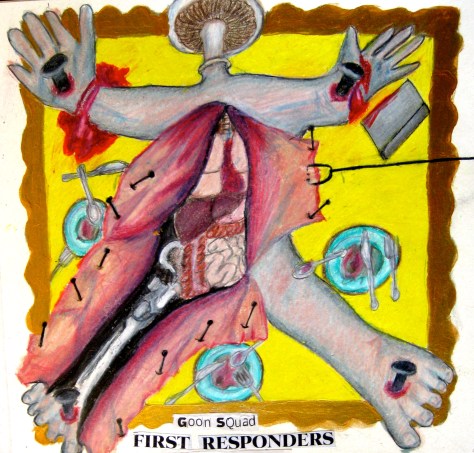
THE BITTEREST PILLS ARE ANTI-PSYCHOTIC DRUGs but if they work…

FOur Different Atypical Antipsychotic drugs
 FOur Different Atypical Antipsychotic drugs
and they really work for you, then don’t listen to me, keep taking them and the more power to you.

Do you work at a job and earn a living while you take anti-psychotic drugs? Do you support a family or take care of one while your wage-earner partner can keep her or his job without worrying about your sanity? Good, then the “anti-psychotic” pills you take (or I’ll add in for good measure, god help us all, the “anti-depressant” pills) are doing what we were always told they were supposed to do. Or if you don’t work or care for a family, if not, do you at least live a fulfilling single’s life, with good capable friends and family and a worthwhile occupying activity that keeps your mind free of craziness and despondency the preponderance of the time? Terrific!Then those pills, whether they be antipsychotic or anti-depressant pills actually function and you are one lucky dude or chick. I say to you, whoever you are, All Cheers and GO FOR IT! Please do not worry about anything further I say in this or any other blog post. Whatever I write from here on in, whatever I say that you do not agree with, IT IS NOT INTENDED FOR YOU. Why? Because by your report, YOUR PILLS WORK and they do a bloody good job of it. So who’s to tell you to change anything? You have no complaints and aside from the possibility that your brain might sustain a little shrinkage, if  research about such things proves correct, you have nothing to worry about. In truth, most aging brains shrink and sustain bits of damage along the way. Lots of things can happen…most of them not drug related at all. One simply cannot worry about a “what if” future, when the present is so bright.

So I repeat, IF you happen to be one of those lucky ones I have described and actually have no complaints, IF, better than that, if you find that your anti-psychotic drug or anti-depressant pills work terrifically well, you have had no relapses, suffer no terrible trade-offs in terms of side effects, then stop reading this blog post right this minute. Why? Because I have nothing to offer you and nothing to say to you. Okay? You don’t need me, and you won’t want to hear what I am going to say to the others of us out there whose experience has been somewhat to radically different.

But this is a SHOUT OUT to you, there, who don’t like your drugs and don’t want to take them. Or find them minimally helpful, or wonder frankly whether they really do any of what the docs tell you they do,  forewarned is forearmed…This post is going to be about the charade of anti-psychotic drugs, for the most part, about the fact that they do not in fact function in the anti-schizophrenia fashion that you have been told.  (I likely won’t have the time or energy at this point, being on AP drugs myself, to get into the appalling farce of what are called anti-depressants…You could turn to MAD IN AMERICA by Robert Whitaker for a take on those — just check out his chapter on Prozac for a taste…) It isn’t that AP drugs do nothing at all. They do attack the brain’s neurotransmitter levels, in some fashion or another. And not just the vaunted dopamine and or serotonin levels either. No, most atypical antipsychotic drugs have effects on histamine, glutamine, noradrenaline and acetylcholine and likely a whole host of other brain chemicals we haven’t even scratched the surface of, in the sense of knowing their function in the brain, or in any part of the brain for that matter.

Do you know, did you know, that the Dopamine Hypothesis, the fundmental reason why there are antipsychotic drugs out there now in so many burgeoning numbers was always bogus? It never held water, ever. There was NEVER any reason to believe that dopamine caused schizophrenia, or that a dyspfucntional level of dopamine lay behind the majority of schizophrenic symptoms. It was a bold-faced and bald-pated lie, that’s because it is as old as the hills and as tiring. You don’t have schizophrenia the way one has diabetes, because you have a chemical imbalance in your neurotrnamitters that these neat little AP drugs resolve and rebalance. Sorry, folks, but that has been baloney ever since we all started developing parkinsonism and KNEW, just KNEW that something was terribly wrong with these miracle drugs that made us feel so terrible.

Did you know that it used to be the criteria for a true neuroleptic, the only way they knew they had a functioning adequate drug, was because it successfully induced parkinsonism in patients. That is, if it induced adequate BRAIN DAMAGE, then they knew it would “work” against schizophrenia. Because the theory was, both in ECT and insulin coma,  as it was in early AP drugs like Thorazine and Haldol that you had to induce brain damage to get a therapeutic effect in the illness. Crazy no? No, not at all, not when you stood to make ZILLIONS and Gazilliions of dollars on these drugs. Not only could you treat a hospialized crazy person with these drugs, and make them “better” and push them out of the hospital, but you could set up a plan for future care, AFTER CARE, that specified that JUST like diabetes, a person had to keep taking these drugs. You never just recovered from an illness like schizophrenia, no. The drugs were miracles yes, but not like antibiotics, They never cured you. they just were a treatment that you had to keep taking. The Gift that keeps on giving…at least for the Pharmaceutical companies who dreamed up the protocol. If they could get a person onto the AP drugs, once, and mandate legally or via a persuasive mental health system that the patient stay on them for life, well then, what a system, and what a money maker!

Oh my eye! What a load of hog wash. All they ever did was dream up neuroleptic (“brain seizing”) drugs that physically subdued people and made them more amenable to nursing. So the hospital nurses could be more nursey nursey and kinder, and more kindly disposed to patients who were now drooling and dulled and seemed much genuinely sick, and the patients could be seen as more ill and less hostile and unpleasant to be around, less difficult to treat qua patients..

But it was a strange transformation, because the more sick the patients were made by taking these neuroleptic drugs, the less they were treated like the troubled and suffering PEOPLE they were to begin with. Once a patient, they assumed that role, and the whole cycle began and has never stopped to this day. “Schizophrenia is an illness just like diabetes.” That was the canard I was told in 1980 — we are still being handed the same disgusting lie! — when I was first officially diagnosed with the condition, or told the name to my face at any rate. “You’ll never recover, and you will likely have relapses, but you won’t be a back wards patient if you take these pills like a good girl, and do as I tell you. No schizophrenia isn’t a death sentence these days but it IS a life sentence…” So what did I do? I swallowed my 500mg of Melleril, yes i did, and I told the doctor I was feeling much better, yes I did. Because frankly I didn’t know how I felt and I felt OBLIGED to tell the doctor what he wanted to hear. How else was I going to get out of the hospital and get off those horrible pills that made me put on 20 pounds in three weeks and made me feel so dull and sluggish and tired all the time? Besides, how could I possibly, in those conditions, KNOW how I felt, when the nurses themsevlves colluded to tell me how much better I looked and was doing? I knew I couldn’t read or think for myself any longer. But they told me that that was my negative symptoms and had nothing to do with the drugs. It was a problem I would have to come to terms with by talking with a therapist…which was a good thing, that they suggested I see a therapist. Back in those days, it was often frowned upon that ANYONE with schizophrenia actually do any talking to anyone at all. After all, if you talked about yourself or your illness, you might upset yourself or the whole applecart…You might actually go crazy again, you were that UNSTABLE! No talk therapy was usually frowned upon for “schizophrenics.” It was seen as not good for them, and destabilizing. What we needed was daily meds and mouth checks and maybe day treatment with a hours job to do each day, like capping test tubes for the lab to keep us busy. Lucky was he or she who could function as a bus boy or table setter. Most of us barely made it to day treatment on time, before sacking out on a couch somewhere for a long snooze to let the morning’s dose of thorazine 1000mg or Melleril 800mg wear off a little before coffee hour or lunch time.

Some of us actually turned blue on high doses of Chlorpromazine, and she eventually died, at the age of 28. There was a lot of relapses and some suicides, but NO ONE actually went out and got a job and quit the hospital and got better. No, because the whole damned system was set up in such a way that once you were set up on anti-psychotic drugs, with a diagnosis of schizophrenia, you were put on social security disability payments for life,..and drugs for life followed, and the trap ensued that meant your whole life was a rolling down hill of poverty and more drug taking and relapses…until maybe something amazing happened to get you out of the systematic rut the psychiatric system had placed you in.

MAYBE you found someone you fell in love with, someone who not only would take care of you, but who hated to see you dull and passionless and sexless on the drugs and encouraged you to SLOWLY wean yourself off of them. And maybe it happened to a few of us that it was a success, because love can really conquer all, even the notion that schizophrenia is a life-long hopeless illness. If you got off the drugs in the right way, slowly, and stopped seeing the doctor who told you you would definitely relapse, maybe just maybe you didn’t. Maybe your sex life came back and you found out it was better than Haldol and thorazine, and better than being dulled by the system’s poverty and being sick. And once in a while that person’s husband was so loving and encouraging that they got married and moved away and she stayed well enough to take up a hobby that turned out to make a little money by itself. So she turned it into a business, and miracle of miracles, she didn’t fall into the trap of SSDI  after all but stayed well without the AP drugs and became a businesswoman without enough time to think about being schizophrenic again…

But alas, that didn’t happen very often. Not nearly often enough. There were far too many tragedies compared to the rare success story. Too many people getting diagnosed with schizopohrenia, and then when the fads for multiple personality disorder came, with that, and all the other fads that had to happen because the drug companies had drugs that they needed to sell use on people and they had to have diagnosese to fit the pharmaceutical picture so they could sell the drugs they had on hand. ADHD, autism are only the latest two…

But I digress, I digress, so let me tell me my own story, if I have the time and energy.

I got sucked in. I did. I was hospitalized in 1980, and even before them. But in 1980, as far as I can now recall, I was up late at night, for the third night, in the hospital kitchenette in an absolute sweating panic about my hands. Why? Because I had this strong delusional belief that they were not my own, but that my twin sister had taken them over and controlled them. I could feel them, and in a sense I could see this process happening. And I heard voices telling me that I was in danger. A nurse came in, and asked me why I was up, and in a panic, i told her. I said, somethings wrong with my hands! They aren’t mind, my sister has control of them! And I can’t sleep, I can’t sleep!

Now, the nurse was a kind woman and I think she meant to help, but she couldnt do anything for me but tell me she would call the doctor, who came, in his fashion, running. I was sweating bullets by then, sitting at the empty lunch table, mumbling about my sister and my stolen hands. What could he do, given his own pharma-company training, but offer me some drug assistance and promise me that it would help, that it was what I “needed” in the throes of my illness?

I believed him, I did. And when he came back the next morning, after I had been dosed three times that night with increasing amounts of Melleril until I finally slept, he pronounced that I suffered from the mental version of diabetes. schizophrenia…The rest, well, if it isn’t everyone’s history, it is a version of it. And  it involves SSDI and even SSI because I had never been able to work a full time job even before then. And none of the many drugs I took after that ever did anything for me but disable me more than before. And I would stop them and be hospitalized again with what they now suspect is withdrawal psychosis, or could have been. And I would be started back on the drugs, or a long-acting injection that was supposed to prevent hospitalization. It never did much good…I was a basket case, a basket case. I never washed or changed my clothing, or even took off my shoes, not even to go to bed. NO I wore those hiking boots for a good year and a half before they even saw me take off the socks I wore underneath them…

So how much did the AP drugs help me? And when they started to restrain me for paranoid fears and trying to escape a locked unit, did I then say Enough is enough,  you cannot torture me, I have schizophrenia? No, I accepted mechanical restraints for three days at a ttime as a form of treatment. One doctor actually told me that schizophrenics don’t respond badly to being tied to a bed for a long time, it helps them, he said, by reducing stimulation…So they did that, and they kept me in seclusion for weeks at a time…until finally I would cry Uncle and take the drug they wanted me on, and go home again, prepared for the next certain relapse, because what else was there….I had a life, yes, but it wasn’t much. It was just hospitals and restraints and drugs that never helped me and cruelty from nurses that didn’t know they were hurting me. And doctors who were damaging me without thinking twice about it. And I didn’t even have the mental wherewithal to know that the drugs were the prime offenders. The PRIME offenders.

It is now 5:30am and I have been up all night. My shoulder hurts, from where i have a slightly torn rotator cuff and frozen shoulder tendonitis… I don’t have a bed, only a recliner I should not sleep in…I am a mess, and  I am also NOT going to continue to take my Abilify and Geodon much longer…I cannot. I cannot. I do not know what will  happen, but I am too afraid of what will happen if I take it, to take them, though I have never felt they did me more harm than good. I just don;t know what real GOOD they do me.

More later, or on another day. Sorry this was so impassioned.

Daniel Mackler’s Amazing Movie on Recovery From Schizophrenia

TAKE THESE BROKEN WINGS…

This is an incredible video, which, though long, is well worth watching. For anyone who believes that recovery without medications is impossible or not likely, you should watch this with at least half an open mind. And for anyone who has given up hope, this should give you a lot of hope. I usually cannot watch entire videos half this long, but I watched this one all the way through, even though I admit I had to take breaks because (Yes, I take meds myself) my attention span is short…But it was worth it to learn that one of the women featured not only recovered from her severe schizophrenia without taking psychiatric medication, she remained absolutely psychosis free and became a psychiatric nurse for 30 years. What I would give to speak to her about the sorts of treatment, or abuse that passes for treatment here in CT! But be that as it may, do watch this if you can. It is absolutely astonishing. And beautiful too.

PSYCHIATRIC ADVANCED DIRECTIVE -2014 – Words to Caregivers (Short and Simple)

I am uploading my new PAD, IN ORDER TO AVOID INJURIES SUCH AS THESE, brought on in Jan 2013 at Hartford Hospital’s Institute of Living. and photographed the very day I was released.

Now I have a torn left rotator cuff..anything to do with this, I wonder? from IOL 4 point restraints
Left shoulder,,,
Left shoulder,,, caused by brutality  or four point restraints at IOL
Bruises from locked leather retraint cuffs on for many hours, immobilizing me
Bruises on bare ankle from long term use of 4-point  leather restraint cuffs, locked so tightly i could not move. — from IOL 2013

Although I brought the PAD both to the Institute of Living in Jan 2013 and to Yale in Aug 2013, I don’t know what happened that it was abrogated so deeply and so widely. At Yale, they forced medication on me, holding me down three times daily at times, resulting in such psychic regression that as you have all read, I routinely stripped naked, defecated on the floor and smeared feces all over the wall. That I was at one and the same time attempting to communicate with these people, by WRITING WORDS IN MY SHIT, was utterly disregarded by all at the time. But I assure you that if I was regressed and psychotic in doing such things, I was nevertheless still verbal! I am also virtually certain that had they not grabbed me, pinned me to the floor and held me down for three painful injections in the buttocks of a drug that Soviet dissidents have long called pure torture (Haldol in the 60s/70s was the subject of many a televised congressional hearing, and discussed in just such terms…) my response would have been very very diffferent indeed. 


That said, they did what they claimed they had to do, and when I left, I left feeling absolutely convinced that my life was and had been mortally threatened, that I could NEVER return, that I would literally be murdered if ever I dared.   Nothing more need be said about such sadistic places as the Institute of Living at Hartford Hospital. Even in the Patient Care Guide and Journal, they are at pains to make it clear that any loud or out of control behavior will be dealt with swiftly and severely, with seclusion, restraints, and even charges pressed by the local authorities! (NO attempts to soothe the traumatized patient or act on what CMS has urged be the best practices of trauma-informed and patient-centered-care at the IOL. No, at Hartford Hospital, it is all about NO SWEARING and staying quiet, non-disruptive. The “Or else” threat behind it all is not even implied but openly stated in their rules and obligations section. Why ANYONE would want to set themselves up for treatment in such a place is beyond me…They have even edited out any attempts at kindness from the old handbook that I was given just a year ago.   Yale at least attempted to live up to a policy of Trauma-informed  and Patient-centered care. When they said No Restraints policy, I believe they meant it, at least in terms of NO MECHANICAL leather and shackles restraints.


And I believe that had Robert Ostroff MD, NOT been in charge of my care during the week or two that Robert Milstein MD was away, some of the brutality might not have occurred at Yale and I might be writing less devastated things about the Washington Square 2 unit, a place I had once so hopefully described as a “soft, gentle place to land in a psychiatric crisis.” But as much as because of my outrageous and disruptive behavior in response to their trauma as because of their repetitive violence and cruelty, I can never return there…a sad thing I suppose, since there is literally no safe place in Connecticut for me.* *more on this later or in another post.  What I have posted here is an update in order to Keep me OUT of the hospital as much as to direct my care if I am put inside, It is not the whole thing, only the first two or three pages, I would be happy to upload the whole thing so you can see how I did it, if anyone indicates interest. Let me know. So far it was always the first three pages that got people’s attention.   ______________________________________________________

Pamela Wagner’s

PSYCHIATRIC ADVANCE DIRECTIVE 2014


FOR WHEN I AM HOSPITALIZED OR INFORMATION TO HELP TO AVOID IT


Miss Wagner has experienced multiple episodes of severe psychological and physical trauma, including date rape, the suicide of two friends, and domestic abuse by caregivers. She should NOT be subjected to restraints, involuntary seclusion, or forced medication. The use of these inevitably leads to re-traumatizing and injury, regression and severe worsening of her psychiatric symptoms.


HOW TO INTERVENE IN A CRISIS:

  • DE-ESCALATION IS ESSENTIAL  
  • DO NOT TOUCH ME OR GRAB ME.
  • DO NOT LAUGH AT ME.
  • I WILL CALM DOWN IF YOU REMEMBER THAT:


  1. I AM SCARED AND PARANOID. I ONLY FIGHT IF I FEEL UNDER ATTACK.  DO NOT USE A SHOW OF FORCE, AS THIS WILL FRIGHTEN ME MORE.


  1. DON’T ISSUE ULTIMATUMS…That will push us all into a corner and serve nothing
  1.  AN UNRUFFLED PERSON SHOULD ASK ME TO TAKE A DEEP BREATH, and try other verbal calming techniques. I am always grateful for people remaining calm when I am upset.


  1.  NEVER LEAVE ME ALONE IN A BARREN (seclusion) ROOM.


  1. A WEIGHTED OR WARMED-UP BLANKET SOOTHES ME. SOMETHING ICY TO EAT CAN ALSO HELP.


  1. PLEASE LISTEN TO WHAT I HAVE TO SAY.  Medication may not be needed if you hear what the problem is.


  1.  IF NECESSARY, YOU MAY PERSUADE ME TO TAKE ORAL MEDICATION, if you negotiate this with dignity and kindness. Keep speaking to me calmly and explain your reasoning.


*I cannot reiterate enough that if you utilize 4-point restraints or seclusion, it is virtually guaranteed that you will see regression, increased hostility and aggressiveness as a result. Please don’t do something everyone will regret.


ADDITIONAL STATEMENT TO CAREGIVERS (PLEASE READ)

It is important that you understand that I do not have a personality disorder (you can confirm this with Dr Angela C——, or any of my longtime outpatient providers and friends and family members). If my behavior/emotions seem out of control, it is because I am out of control – temporarily.

I have had tertiary CNS Lyme disease, which I was informed after multiple positive PCR and Western Blots during treatment was likely incurable. During my initial illness, my brain developed MRI lesions which may predispose me to temporary emotional and behavioral abnormalities but these are NOT my norm. Anyone who knows me well would tell you that, if you ask them.

I am not always able to communicate my fear but because I feel so threatened and unable to communicate clearly about it (lest there be consequences to me) I may become very angry at the hospital situation. I am not an angry person, but I do have trauma issues, as many people do.

Please be aware that I am sometimes mute, in frustration and overwhelmed by circumstances. You can provide me with a pad and pen to facilitate communication, but berating me into speaking will no purpose and may only precipitate anger.

Ascertain from me whether the information you have at hand is correct. Too many records and hospital charts have been drawn up on faulty information from earlier charts or information gleaned from others but not from me, and the consequences to my treatment have been devastating.

I would prefer NOT to take any medications and will resist them. I want to experience my LIFE AND MY FEELINGS. If you insist on meds, the ones that work best are _______.

I will not take any drug that induces weight gain. If you force it, know that I will fight you, tooth and nail.