Tag Archives: Memory

In-Patient Psychiatric Abuse Can Be Subtle (and not so)

I will be rewriting this for my new memoir, but wanted to try out the episode here, in part, though I have not yet rewritten it…I have been rereading my many journals that I have retrieved from storage in preparation for really seriously writing this thing, and it was one of the first events recorded that I happened to dip into. It is in a relatively recent journal, but I was reading randomly and I just happened upon it. It very much upset me, as just as I read it, I remembered it very clearly. I had no amnesia, it was only that I have been in so many hospitals in the past 3 decades that I cannot separate out one from another, nor tell what happened where or when.

Subtle abuse? In fact, I don’t know that the episode I relate here is an example of subtle anything. I can only say that at the time I had no idea that it was abusive. I felt that perhaps I deserved it.  I had no idea that it should have been reported, that someone should have defended me, that anyone…Well, you will get the drift upon reading the following brief description of one incident, among the way-too-many that have happened to me over the past 5-10 years in Connecticut hospitals. All I can be sure of is that if hospital staff do these things to me, I am fairly certain that they must do them to others…In which case, that Hartford Courant article in 1998, “Deadly Restraints” which was supposed to have changed everything both in Connecticut and around the country in terms of in-patient treatment of the mentally ill, that article did little to nothing. I would say, in fact, that treatment has gotten markedly worse over the decade. Compared to my treatment in the two decades before this past one, I was never abused as much in the 80s and 90s as I have been since Y2K and 2000.

For once, what I write of here does not involve restraints per se, at least not immediately, but as you will see it involves abuse, physical abuse, just the same. I have transcribed this from my journal from a few years ago. I have edited it, but most of the edits I made were for clarity or to convert partial sentences to full ones, though in a couple of places I had to flesh things out more. But here ’tis, what happened to me at a general hospital I spent a fair amount of time in, in Fairfield County, where my twin lives:

“After a run-in with Karen again, I apologized and we had a decent talk. I took off my coat for once, went to Wendy’s communication group and did okay. Then I was sitting in the alcove talking with Mark about my dread at every anniversary of JFK’s assassination when a hullabaloo started near room 306 at the other end of the hall. It seems a woman was having a heart attack. I immediately felt the floor fall beneath me: I was to blame, my inattentiveness, my raucous, hyena laughter, my evil had killed her!

I knew that I needed to take my 4 o’clock medication for what little it would do, but no one called to announce them or for me to take them. My ears rang, booming! The air was full of blaming and criticizing voices, so maybe I didn’t hear, but I think they just didn’t call me. I rang the intercom buzzer at 6:45 and was told that Jamie, the medication nurse that night, would be back from supper around 7 o’clock. I rang back at 7:05 but he was still gone, so I waited another 15 minutes since no one told me that he had returned.Finally at 7:20 I pushed the intercom button to ask if I was supposed to skip all my 4 o’clock and 6 o’clock medications. They now said Jamie was waiting for me. But why hadn’t he called to let me know he’d gotten back from dinner? Slowly I managed to shuffle up to the medication door again, zipped to the mouth in my coat and balaclava hood, verging on stuckness, only to find there was no Geodon in my cup.

“So I don’t get my 4 PM medications,” I whispered in stunned panic, too afraid to simply ask for it.

“Nope” was Jamie’s only answer.

I was flabbergasted, completely stunned. My second prescribed dose of BID Geodon was what I’d been waiting patiently for ever since the patient in room 306 had her heart attack. After Jamie ignored me, giving me no explanation, I just turned, took my 6pm Ritalin, then dropped the DIxie cup of water and all the other pills on the carpet. In a daze, it took everything in me to start making my way down the hall towards my room again.

Then I heard footsteps pounding up behind me and suddenly Jamie was in front of me, blocking my way. “You’ll go back there and clean up the mess you made right this instant!” he bellowed and pushed me towards the med station. I stared through him, tried to walk away, but he blocked me again and again pushed me backwards until finally I gave in, relaxed and let myself succumb to his pushing. I didn’t walk though, I merely fell backwards to the floor, saved from injury only because he grabbed the front of my coat as I fell, and lowered me to the floor. I curled up in a ball like a porcupine, hoping not to be killed. Well, he was in a rage and forced my hands down, away from my shoulders, and unzipped my coat. Then he ordered me to get up and clean up the mess again — what mess really? A few pills on the floor, and a little water that would dry? I refused. I curled up on my side and closed my eyes, responding to nothing. He threatened me with restraints. At that, I gave up resisting, knowing resistance would give him the excuse he wanted. I let him pull my coat off my limp body. And I remained limp as he carried me to my bedroom where he dumped me coatless on the bed and thundered away. I was triumphant, however. No restraints! I’d figured it out. If you refuse to resist, if you don’t fight back against their power plays, they have no excuse to justify putting you in restraints. They cannot put someone who is completely silent and limp into 4-point restraints. What would be the point?

Nevertheless,  I was cold and felt exposed in only my T-shirt and jeans, and with no coat to protect me, nor others from me. So I got up and grabbed a sweater and started bundling myself into hat and  hooded scarf. Suddenly Jamie barged in again. I backed away and fell onto the bed behind me. In a fury that was unbelievable to me, he leapt onto the bed and pinned me down, knelt so his knees trapped me and I couldn’t move. Then he unbuttoned my sweater and tore it off me, ripped off my hat and scarf, then without a word proceeded to empty the room of any clothing that could possibly cover me, including my shoes.

This was too much to bear. But I said and did nothing in protest. How could I? I had no words, no sense that I had rights of any sort. All I did was huddle against the wall under a blanket and whimper, “I didn’t mean to kill her. I didn’t mean to cause a problem.” Jamie, who had left with all my things, stormed back in and angrily lectured me on how I was guilty of  “just wanting attention!” I wept silently. All I’d wanted that entire afternoon had been my 4:00 pm medication, and to be left alone to deal with repercussions of having killed the  patient in 306. I was too stunned to respond and could only whimper over and over, “didn’t mean to kill her, didn’t mean to cause a problem.” Still furious, but getting nothing from me and spent, Jamie finally left for good.  After a while, I looked around at the nearly empty room, and there on the night table was the pen Lynnie had left behind that afternoon. Jamie had overlooked it in his rampage. I had no energy to get off the floor, and no paper to write on, so I did the only thing I could, and  I began writing on the wall. “I didn’t mean to kill her, didn’t mean to cause a problem,”  I wrote and wrote. I wrote until I physically could not write any longer, I wrote until my hand gave out.

That was not the end of the evening, but it was the end of the interchange with Jamie, RN and it’s all I wanted to go into for tonight as it is getting late, very late and I needs must go to sleep.
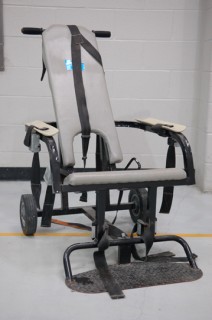
Psychiatry and Abuse: restraint chair in hospital?

They restrain prisoners in this dangerous chair
Perople have died in this restraint chair -- in Guantanamo, yet they made me sit in one in Manchester Hospital in Connecticut, 2009

Some memories are returning. Not a great many but this one was triggered by something I heard briefly on television the other day, simply the mention  in some other context, of the words “restraint chair” and in an instant I flashed back (and I use those two words advisedly, since I do not actually know what is meant by a “flashback”) on something that happened when I was a priso…excuse me, patient, albeit involuntary, at Manchester Hospital in the fall of 2009.

This had been an extremely brutal stay up till then. When I was admitted the psychiatrist I was assigned to Dr BZ — I have written of this elsewhere so I won’t recap the whole thing, as memory is fickle and I may have misremembered it by now — stopped most or all of my meds, saying that if I was there, clearly they didn’t work. Then he swore I would take the one drug I refused to take: Zyprexa, and he scheduled a forced medication hearing, which naturally I would lose, having no power and only my word against his as to whether or not I needed it. Well, I did lose it, but inexplicably, and sadistically, instead of forcing on me a drug that by all accounts helped me, he changed this to TRILAFON, an old drug that did nothing for me and only made me completely miserable.

The upshot was that every time they came to me with medications, I flatly refused to take the Trilafon, even under the threat of a Haldol injection, The goon squad was called, and since I refused to quietly accept my punishment, they assaulted me, stripped me, and  forcibly injected me. This got to the point that they started four point restraining me to the bed, just to inject me…And it because such a routine that to avoid the “tiresome process” of getting out the restraints they simply left them attached to my bed. I know this not because i remember it but because my friend Josephine told me she saw them.

Me? I was so snowed by Haldol most of the time, that I could never even find my room, and had a sign in large letters taped to the door so I would simply recognize it when and if I managed to find it. Also, I was so dazed that I had to wear red slipper socks as a fall risk…but no one ever decided that maybe this was due to the drugs they were giving me!

Anyhow, one day, one day…and here is where memory kicked in after hearing those awful words on TV: one day the nurse who was most in charge of the daily torment, came to the door with another nurse pushing this large chair, and i recognized what it was at once. I had seen them before, having reviewed a book a long time before for the LA Weekly on the treatment of the mentally ill both in hospitals and prisons, a book, moreover decrying “barbaric treatments” of the past.

“You aren’t going to put me in that, are you? I’m not coming anywhere near it!” I shrank away from them and ran to the other side of my bed.

“We won’t restrain you, not  if you behave. But we want you to sit in it for today. There are no restraints on it now. It is just a comfortable chair. Come, sit down. The student nurse will be with you all day today.”

Then they essentially forced me to sit down and stay in the chair. Or else…I was terrified. and the student nurse knew it. Luckily, she would turn out to be a kind and wonderful young woman (her experience at Manchester almost drove her away from psych nursing, but  as it turned out she discovered Natchaug Hospital, and became one of their most beloved nurses). As she told me later — because memory mostly fails me here, but for her reminders — she did Reiki with me, the practice of nearly touching a person but not quite, and moving her hands along my body, not sure how it works or worked, but she later told me, at Natchaug, that I responded well to it, and stayed calm all day. I even as she said, took my meds. Which means I actually swallowed the Trilafon, probably because I couldn’t bear to have another fight in front of her.

Whatever was the case, if Reiki is as I described it, no wonder I responded well, as it was a NON-physical therapeutic way of dealing with me, non-assaultive, gentle, non-trespassing and non-brutal. Why the rest of them could not have followed suit or come up with some other way to treat me as she did, I will never know. Clearly they learned nothing from her; she left and likely they are back to treating others as they did me.

I believe they would indeed have used that chair as a restraint chair on me. I do not think they brought it in just as a comfortable chair, I believe it was to intimidate me, to cow me, but I think too that they were in fact prepared to use it. I do not have the slightest doubt. I would put nothing past those people who so brutalized me as to put me in four point restraints over and over during more than 8 days. For all I know it might have been more than eight days. I simply do NOT know, as amnesia has sealed up much more than memory preserved.

Enough for now. I need to write tomorrow about the Versatile Blogger Award that DogKisses gave to me. I am shamefully late in thanking her. And I do not know how to place the badge on my site, but she was such a lovely blogger to do so, that I do owe her her own post of thanks and appreciation.

More tomorrow.

Reflection on Room 101 in Ward D

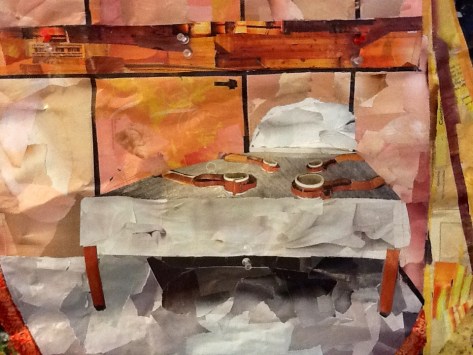
Here is the sign I posted above the collage as it was finally presented today at Artspace:


REFLECTIONS ON ROOM 101* IN  WARD D

Collage, available as is or finished with bound edges

$1800.00/$2000.00


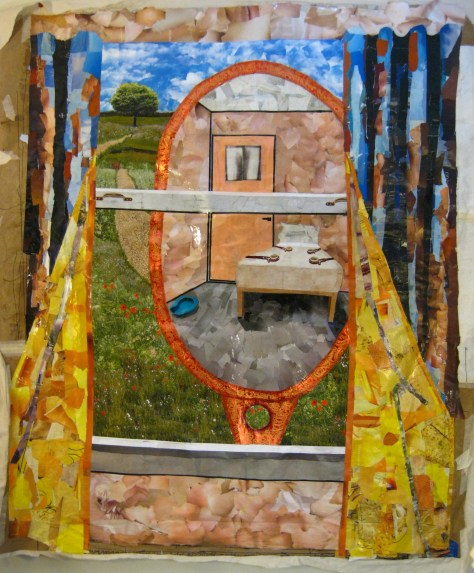
I started this collage at Natchaug Hospital in Willimantic, using scraps torn from magazines and glued onto a large sheet of brown paper. This was my effort to deal with the emotional trauma associated with other hospitals where I had been far too frequently shackled in four-point restraints. Although I have tried to depict a seclusion room realistically, I have also taken some artistic license: in a real such situation, the restraint bed would be facing the door, so that an aide or nurse monitoring the patient would be able to see his or her face clearly. And here, of course, the window is neither heavily grated nor closed. Instead, it has been opened (how? by whom?) and we see a winding path that leads far away…

*In George Orwell’s book 1984, Room 101 in the Ministry of Love is where recalcitrant prisoners are tortured, the instrument being whatever it is they are most afraid of.

mirror view into a seclusion room with a restraints bed.

You  really need to stand back from it to get the full effect, but this wasn’t possible, despite my wall being on a T intersection of hallways as someone had planted a bright torchiere lamp down the perpendicular hall. This was helpful for other displays but unfortunatley caught the light in such a way as to cause my collage to reflect it, leading to glare and poor visibility of necessary features. Ah well, live and learn, live and learn. Had I known this would happen, I would not have used a gloss finish on the mirror section, even though I wanted to in order to make it look “mirrory” compared to the non-mirrored “flat” or matte parts…

I have a few other things to say about my experience at the OpenStudio show and sale today — I was quite uncomfortable despite appearances. Or at least I think I presented a comfortable and at ease appearance. But in point of fact there were three or four women in my hallway who were talking about me and who did not want me there. I think the woman who was almost directly across from me, except for the space where the T opened up to the other perpendicular hall, was particularly upset with me and trying to marshall support from others against me. I don’t know what I did to bother her, but she clearly had conceived an antipathy to me. She was the one I believe who won the award at the group show. I thought her paintings, decent, glowing and colorful, and skilled to a nice degree, though not all that creative to my eye. Highly colored oil paintings, likeable but somehow a bit lifeless I cannot quite say why because everyone else seemed very impressed.

Be that as it may, I do not trust her and frankly I believe she is likely bad-mouthing me as I write this. I had the distinct impression that she was enlisting support from those others to get rid of me at the exhibit, and even harm me in some fashion. Every time I left for one reason or another, or walked down that hall to get to the stairs, I felt watched and heard them whispering. Damn her and damn them. I could have had a reasonably okay time, had they not taken to tormenting me…though in point of fact, had not a few visitors talked to me a bit, I would have sat in silence all day long, except for when my family came. No other neighboring artist spoke to me all the day and no one even so much as introduced themselves. If anyone did anything — conversed with me, introduced themselves, started a conversation, it was I who had to do it, and then it seemed as if they responded only reluctantly.

However, I should cease and desist at this for now as I left out my “business” cards, and so I guess any artist there could have, though I doubt it, picked one up and could now be “listening in.”

In any event, I am doing a little drawing at the moment, small cards, “trading card-size” drawings. Dunno if I will give those away, trade them, or not. But it is fun to work on such a small scale nonetheless.

The only thing I would give away free this time for sure, though I have given and donated a lot previously, is Christabel, the portrait collage. If the real Christabel came along and introduced herself (with proof that she is who she is, because my amnesia for that hospital stay is such that despite my remembering her kindness I do not actually remember her face or anything else about her) if she came to see the show and saw her portrait finished, I would happily give her the collage wall-hanging for free. So Christabel, that is my offer. (I won’t know you, but if you remember me and come to the show, find me and find your portrait.)

Enough for now. Just wanted to let my readers see the final “product” in case it sells. Fat chance of that though. It looks as if I will be going home with literally everything I brung with me…Well, it is a learning experience. And it has been that to the max.

Photos from “Reflections on a Psychiatric Seclusion Room”

Reflection of Seclusion and Restraint : There is hope and freedom somewhere.

NOTE: this is a link to the finished collage, sans border of which I have no photo: https://wagblog.wordpress.com/2011/11/13/reflection-on-room-101-in-ward-d/

I now call this Reflections on Room 101 in The Ministry of Love, as a reference to Room 101 in the book “1984” by George Orwell. The place where recalcitrant prisoners faced torture with the things they feared most in the world.


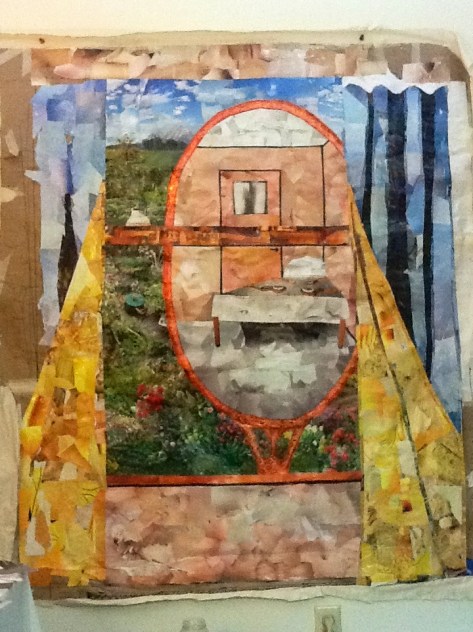
I want to post today some photos from the progress I have made on my large collage of the restraint room (seclusion room) in a psychiatric unit. I must say that it gives me the shakes whenever I work on it, or at least whenever I look at it afterwards, and certainly when I photograph it. But I think that the fear and heart-racing palpitations are slightly diminished compared to this time a month ago. Possibly. That is what I am hoping for at any rate. The process of doing this is my attempt at “exposure therapy” I suppose, because I cannot live with what feels like PTSD any longer. (I know, I know, according to the New Rules, you cannot, by definition, have PTSD unless your life was mortally threatened; unless you experienced a tsunami or earthquake, mass murderer, or Hurricane Katrina, it does not count as “real trauma,” so say the doctors, and they should know, right? After all, they are the ones who defined the illness, and keep redefining it, and who made it up! Well, since they have the initials MD after their names, standing for Missed Diagnoses, I dunno if we can trust them on anything as important as deciding for us what it is that counts as traumatic. It seems to me that WE ought to be the ones telling THEM, no?) Be that as it may, let me change paragraphs and resume the discussion I left off so abruptly above.

Whatever the case, I do suffer with heart-racing fear and sweats and tremors that make it difficult even to take a clear photo of the collage after working on it but whether it is PTSD, I care not.  All I care about is 1) communicating the experience, or at least what the rooms look like, and 2) purging myself of the residual fear.

I don’t want to go on any further with that. It truly does cause me great anxiety. And I prefer to work on the collage and on forgiving the specific people who did those things to me. It is likely that they had grown to hate me, forgetting that I was a troubled and profoundly ill person because I was also loud and frustrating and violent…(treated with violence didn’t make me any more docile, I might add). So  things only escalated and escalated, when from the start their goal was to have a quiet unit that ran smoothly and had everyone get discharged in a matter of days, no questions asked. They did this by helping no one, by talking to no one, and by questioning no one. All they cared about was making sure that everyone stayed “safe” for as long as they were in their clutches. And that they would say so until they left. BUT I said I was working on forgiving them, and trying to see them as tired human beings, flawed but human. It does me no good to get all riled up again.

so I will leave it here, with the photos of the art. I will add only that I plan to redo the curtains, since as it is the blue competes with the sky. Also there will be a curtain rod, and such…But as you can see, it is still a work in progress!

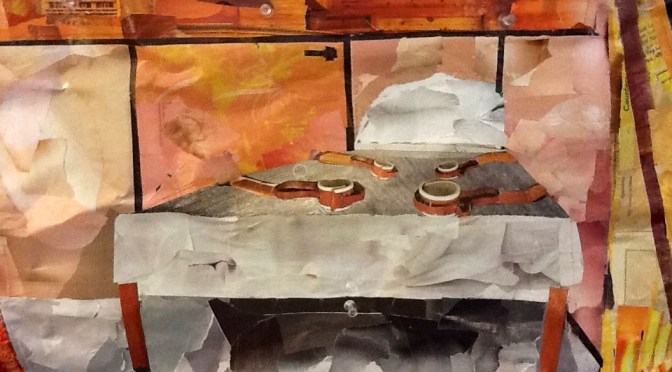
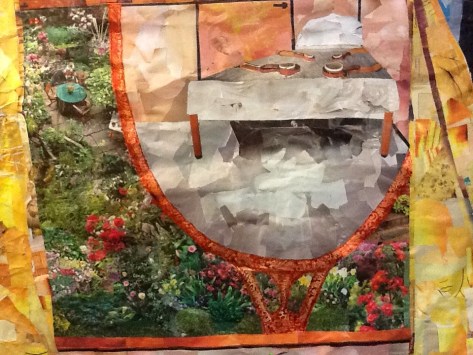
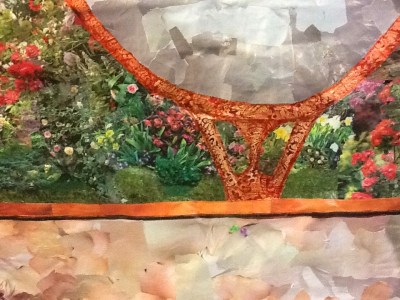
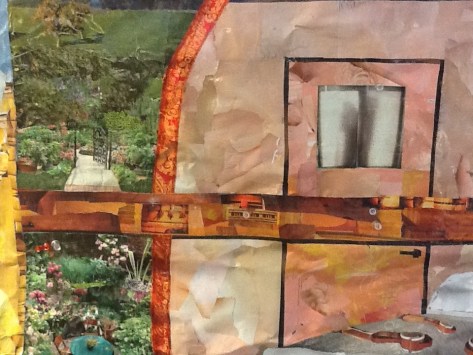
You see the mirror now, and the bed with the restraints? The garden below the window?
No those are not “banjos” on the bed…Look closer. This is a psychiatric unit…
But so is everything it sees and reflects…
Behind the mirror, beyond the window, an open garden gate…

Artwork from Hospital

If the window is open, what does the mirror outside see inside the room?

As may be obvious from the brown paper at the sides, this collage is very much unfinished, both as to content and as to medium. What I mean is, this is a kind of painting with paper, so I am so far dissatisfied with, say, the blue curtain with yellow lining, because it still looks rough and is not clearly a curtain blowing in the air coming through the open window. Ditto, the open window, which is not clearly even a window, except by virtue of my titling it such. But when I finish with it, I hope all these mysteries will be clearer, including the surreal placement of a hand mirror outside an upper story window! (I said it was surreal, didn’t I?) But what I cannot help is whether or not the viewer recognizes what it is that is on the bed. Some people simply do not know what restraints look like, and have variously interpreted them as guitars or snakes or what have you. To me, it is obvious. But I guess most people have not been in such a situation, and have no conception of what they might be looking at. Perhaps a more suggestive title would help?

Another important feature of the “painting” is the frosted glass window, with the mysterious something going on behind it, again left up to the interpretation of the viewer. If you understand that this is a restraints bed, and that the window is open…what could be going on outside the seclusion room? And why is the window open? Should the bed be empty? If you could see this very large collage – 5 feet by 5 feet — up close, you would see that the mirror overhangs a very detailed garden, with all the trappings of well designed backyard floribundance, so to speak. There is a little table and benches and other accoutrements, but also a path leading up to — a garden gate, which opens onto a field and freedom.

As I worked on this collage, I was in a state of acute anxiety — with tremors and shaking and palpitations I did not understand. And every night I would weep with bodily but not conscious memories of the recent brutalities I experienced at Manchester and Middlesex Hospitals. At Natchaug they understood how degrading and traumatizing such treatment had been, and indeed how re-traumatizing. Because indeed, I had already been traumatized many times before in the 80s and 90s and early to mid 2000’s by what I thought was SOP use of such measures. Instead, when those recent hospitals used them,  cruelly and inappropriately, at a time when I knew their use was frowned upon and had been severely curtailed, it not only re-awakened the original trauma, but in a very real sense put me in emotional touch with it, the pain, the terror, the horrendous humiliation for the very first time.

I am not by any means over it. As I work on my memoir sequel, BLACKLIGHT, I am also slowly going over my hospital records with Dr Angela, aka Dr C, and it is a gut-wrenching task that leaves me drained and tremulous. But if it succeeds in returning my memories to me, all of them, I shall consider it worthwhile.

Happiness is….

You know what they say, that happiness is not to be found in how much money you have or in the things you own or can buy, nor even in how many friends surround you or how many people love you. The poem about Richard Cory, upon which Simon and Garfunkel (remember them?) based a once well-known song, just about says it all:

RICHARD CORY

By Edwin Arlington Robinson

Whenever Richard Cory went down town,
We people on the pavement looked at him:
He was a gentleman from sole to crown,
Clean-favoured and imperially slim.

And he was always quietly arrayed,
And he was always human when he talked;
But still he fluttered pulses when he said,
“Good Morning!” and he glittered when he walked.

And he was rich, yes, richer than a king,
And admirably schooled in every grace:
In fine — we thought that he was everything
To make us wish that we were in his place.

So on we worked and waited for the light,
And went without the meat and cursed the bread,
And Richard Cory, one calm summer night,
Went home and put a bullet in his head.

We all know it’s true, both the cautionary tale of Richard Cory, and that money doesn’t buy happiness. At least we know it with the left sides of our brains. Alas, this is still the side that does the intellectual calculations of how many friends or about the nice car we’ll need to have before we will finally be happy. And if we didn’t know it before, all we have to do is listen to the news because nearly every week it seems there is yet another story about a celebrity who seemed to have it all – money, beauty, acclaim, adoring fans – who ended up destroying himself on drugs and alcohol or who committed suicide (“no one had any idea she was so depressed…”) at the height of her career.

But if money and things and friends who love you don’t offer a path to happiness, what does? Is there a map, a guide, an instruction manual, a recipe? One look at the number of books on the market purporting to teach you how to be happy tells me there are lots of people making lots of money trying to tell you they have the secret. And given the number of books they sell, an awful lot of people out there are desperate enough to spring for them. If you have bought any of these books and found their secrets to be The Secret, or even to be one effective secret that worked for you, I would love to hear about it. Truly, I am not being sarcastic. I am a writer, and I believe that writers are for the most part sincere. Not all of them, mind you, but most of them. And so when a writer writes a book promising happiness, I believe that he or she probably believes it. I just don’t happen to think most of  it ends up being effective.

But maybe it’s me, I dunno.

Let me explain. I have had many, many struggles with self-acceptance and self-regard over my lifetime (I am 58 years old at this writing, so you can see that I am far from young) and I assure you that I am far from winning the battle. My self-esteem is very low. So low in fact that I hesitate to say more… But at any rate, when I say my self, I mean my inner self, my soul, my – well, whatever it is that one might want to distinguish from the “self-that-produces,” the working self. What I mean is, I know that I write well, and I am learning to become a better artist as the days go on. But those skills have not fundamentally affected my self-esteem, only my level of confidence. And there’s a big difference between the two. I have a lot more confidence in my abilities than I did years ago, partly due to greater skill and long experience – though only in my writing — and partly due to caring less what others think, because there is less at stake at my age. My self-esteem on the other hand remains utterly unconnected to this, and largely unaffected by it. Whether or not I love or utterly despise myself has little or no bearing at all on whether or not I am able to write or paint or draw well. All it might do is affect what I write well or paint or draw about.

And I can be proud of my poem or essay or my drawing, proud of what I produced, without that having the least effect on how much I fundamentally love or hate myself.

But, and here is the thing: I do not believe that hating or loving yourself matters in the search for happiness. Or at any rate, it is not the sine qua non, the primary requirement before you can be happy. In fact, I think in the happiness department, self-regard is over-rated. It is not that I want other people to feel badly about themselves so much as that oddly enough     I think it has little to do with whether or not one can find happiness.

Maybe I should amend the word happiness to contentment. I do not like the first word all that much, as it smacks of little yellow smilie faces and balloons and other inanities. Happiness is decidedly not inane, but our emphasis on the importance of it has made it seem so. Contentment as a word and concept has been all but forgotten in the rush towards the seemingly bigger motherlode of happiness.

So let’s switch gears and say that we are on the search for contentment, which also is not found in money or friends or in being loved by others. So where do I think you can find contentment? (Clearly I write this with my own agenda in mind…why else write it at all?)

I think contentment – indeed, even happiness – does come from within, and it starts with forgiveness.

Forgiveness? Why that of all things, you ask? It seems like so many other emotions and “emotional acts” should be more important – like loving yourself and others and being compassionate etc. But I assure you that without forgiveness, you can have and be and do none of those.

Kindness and generosity were always supreme values to me, even when I was a child. It hurt me inside to see anyone going without something that I had it in my power to give them. But it was many years before I understood that forgiveness was also a crucial value, that it not only partakes of both compassion and generosity but presupposes both. Not only is forgiveness an act of kindness but it is freely given and therefore an act of extreme generosity. You cannot force forgiveness any more than you can force a “sincere apology” despite what our parents might have thought when they made us “say you are sorry and you better sound like you mean it.”

Okay, so forgiveness is critical for contentment, maybe, but forgive what or whom? And why? First of all, everyone is scarred by their pasts, everyone has baggage from childhood. In fact, while some people had more than less happy childhoods, everyone has bad memories that they cannot shake, that have stayed with them and in effect traumatized them.  Second, scars are simply an unavoidable fact of life. You can’t get through life without them, and childhood I’m afraid is a rough and tumble place where you pick up the bulk of them. Three, who “caused” our childhoods, for most of us? Answer: our parents, or whoever took the place of our parents. That is why our first job is to forgive them. I’m serious, and while we are at it, we have to forgive childhood itself, all of it. It doesn’t matter what happened, or how terrible, it really doesn’t. If you do not forgive it, if you do not forgive everything that happened to you, you cannot let your childhood go and get on with the present, which is where happiness, where contentment lies. Contentment is not in the past, that much we know, and no one knows a single thing about the future. But if you cannot forgive the past, and especially the childhood where you got all those scars you carry around now, you will never move beyond it to experience an undefiled present.

Look, I believe that forgiveness comes from inside the brain, but heals a place in the brain we like to call the heart. And I believe that forgiveness is more healing for the person who forgives than the forgiven. So I wish you could forgive all those people who harmed you too. All the people, relatives, friends, lovers, rapists, molesters, thiefs, betrayers and more…because I truly believe it would be good for you and for your heart. But I think it is essential at a minimum if you want to be happy to forgive your childhood, the entire experience of it, not the individuals or the single events, just the fact that you were a child and had to go through it. Once you can forgive it, you see, you can let it go just as it has and be gone.

After you have forgiven your parents or parent-stand-ins, and your childhood, you are well on your way. Many people would say that this is a step towards self-acceptance here, and that is how you reach happiness, but whether it is or not, is not important to me. In some ways, self-acceptance is not what I am after so much as acceptance of the world, both of the past and of the present. And when I say “acceptance” I mean such utter acceptance of it that you can forgive it. Because only when you can forgive, so I believe, can you really accept the world. And when you can accept and forgive the world both past and present, then you can be happy.

( I realize that I have put my poem below on this blog before, but clearly it belongs here, though it is for a second time. And dang, I do not understand why this program will not allow me to get it single spaced!)

TO FORGIVE IS…

to begin

and there is so much to forgive:

for one, your parents, one and two,

out of whose dim haphazard coupling

you sprang forth roaring, indignantly alive.

For this, whatever else followed,

innocent and guilty, forgive them.

If it is day, forgive the sun

its white radiance blinding the eye;

forgive also the moon for dragging the tides,

for her secrets, her half heart of darkness;

whatever the season, forgive it its various

assaults — floods, gales, storms

of ice — and forgive its changing;

for its vanishing act, stealing what you love

and what you hate, indifferent,

forgive time; and likewise forgive

its fickle consort, memory, which fades

the photographs of all you can’t remember;

forgive forgetting, which is chaste

and kinder than you know;

forgive your age and the age you were

when happiness was afire in your blood

and joy sang hymns in the trees;

forgive, too, those trees, which have died;

and forgive death for taking them,

inexorable as God; then forgive God

His terrible grandeur, His unspeakable

Name; forgive, too, the poor devil

for a celestial fall no worse than your own.

When you have forgiven whatever is of earth,

of sky, of water, whatever is named,

whatever remains nameless,

forgive, finally, your own sorry self,

clothed in temporary flesh,

the breath and blood of you

already dying.

Dying, forgiven, now you begin.

Schizophrenia and Traumatic Treatment: Continued Use of Restraints and Seclusion

Please note: For my final take on what happened at Middlesex, please jump to this link: https://wagblog.wordpress.com/2012/05/15/useless-psychiatric-mediation-and-a-poem/   (added in September 2012)

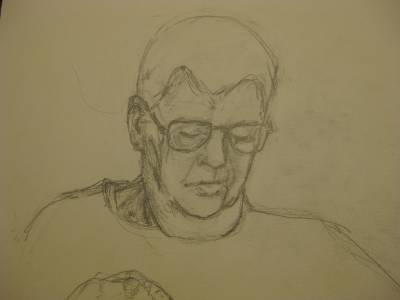
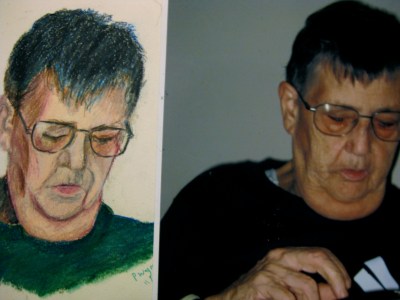
First, before I start my post today, I wanted to share my newest artwork, which is a colored pencil “painting” of a woman who lives in my building, whom I will call Rose. She did not ask me to paint her; she was simply someone who sits quietly for many hours in the community room, and so was a good subject for a portrait, and a photo. I also happen to find her a very agreeable person, one of the nicer ones here (most are gossips and backbiters, or if not most, then the most vociferous and visible of the residents). I think she will be quite pleased with how it turned out, so long as she does not expect anything but a portrait that is faithful to life, rather than an idealized one. I believe, however, that Rose is very down to earth and knows what she looks like, and will appreciate what I have painted.

Rose, intent on her needlework
Rose intent on rugmaking
Rose comparison of painting with photo

_______________________________________________________

Now I want to discuss, yet again, the use of restraints in Connecticut psychiatric units, particularly as it pertains to my treatment there. As I recall, I have not gone into much detail about the last hospital stay, back in April and May, largely I think because it again was so traumatic and in many ways similar to the previous one, that I could not bear to contemplate it.

However, as very little as I recall, I do remember more of the stay than the complete amnesia I still experience for the stay in Manchester, back in October or November of 2009. When I say I have a loss of memory with regards to this other hospital stay in the spring of 2010– in Middletown — I meant it more for the specifics of certain episodes. And for any of the people there who staffed the unit. (Except for Christabel the OT).  With regard to much that occurred I believe a lot could be brought back to me, under the right circumstances. I do, for instance, continue to have an overall memory of what the place looks like and where my room was and some details about what happened. What I do not, and did not remember, not even the next day, was most of what precipitated the use of restraints and seclusion during this stay. Or at least, of the two or three incidents of S and R two are jumbled together, so that it takes some mental probing for me to straighten out any of it. but one incident remains too clear in my mind for comfort though even at the time, or immediately afterward, as well as now, I have no idea what was the actual precipitant.

Anyhow, what I recall of  that episode is this: I had been taken off Geodon, which I took regularly with my  Abilify up till then, both in order to boost its antipsychotic properties as well as to temper any Abilify-induced irritability. The irritability was physical as much as mental — and with the resultant tendency to get into verbal fights and arguments with anyone who, as my mother used to put it, looked at me crosswise. I have no idea why they did this, took me off Geodon, given that I know I explained the rationale for the use of two antipsychotics. But many MDs seem to find this objectionable, however effective. Perhaps they considered the 20mg Zyprexa, which they had talked me into taking on an acute basis, would be an adequate substitute for the calming effect of the Geodon. They had wanted to stop the Abilify, too, using Metformin, a diabetes drug, for weight control, but I had insisted on taking it both in an effort to combat Zyprexa’s tendency to cause weight gain, but also because I believe that it is the Abilify that has so massively enhanced my creativity.

So there I was, on Abilify untempered by Geodon, and taking Zyprexa, which induces its own “upsetness” when my weight invariably increases…I assume that I must have been hostile, loud, and disruptive, for I do not know why else they would have made me go into the seclusion room. I do remember that I could not calm down, and that in the flimsy johnnies they had clothed me in, I was freezing, so that even when the nurse doing constant observation told me to lie down and rest, I was unable to do so for all my shivering. I begged for a blanket, but no deal. I pulled the entire bare mattress over me as a covering. Well, this was apparently seen as a self-destructive act, or something, as immediately they pulled it off me and dragged the mattress itself from the room. Now I had nothing for warmth, except my own anger at having been treated  in such a fashion.

I remember that I was yelling a lot, and that I wouldn’t lie down on the cold linoleum and “calm myself.” No, I wanted to talk, and begged the nurse to do so. Instead, she only turned away and told me again to lie down on the floor. Well, this enraged me, and I went to the door to complain again. She said nothing, only stood in front of the open door so that I could not leave. Finally, getting no response, and still anxious and “het up” I suppose you could say, or over-activated by the Abilify, I tried to push my way through her into the opening. Immediately two “guards” pushed me back into the room. I yelled at them, and pushed back. One of them asked me what was wrong with me, why I didn’t just ask to talk with the nurses instead of resisting physically…I looked at him and said that I did ask to talk, and she refused. He seemed somewhat surprised by that. Nevertheless, he ordered me to go back into the room and lie down.

I was having none of this dictatorial behavior on their part, and as I recall, at one point — no, I do not remember what happened. I only know that suddenly the guards were on top of me, and one had pinned my arms behind my back and was pushing my face into the linoleum floor. It was as if I were a recalcitrant inmate of a prison and this was a cell “take-down.” I was hurt and I was furious.

When they let me up (and why they had pinned me to the ground I have no recollection, only that when they let me up, I was finally allowed to talk to the nurse nad stand out in the hall with her. I heard some talking behind my back and a commotion, followed by feet going down the hall away from us. I had a bad feeling about it, and asked the nurse, “What are they doing?” She responded, ominously, “They are preparing a bed for you.” “a bed? what sort of bed? She remained silent and I understood that they were putting restraints on my bed…”You can’t restrain me, I am out here calmly talking to you. You haven’t even offered me a PRN and I will tell you now that I would be more than willing to take one. But I am NOT a danger to myself or others, and you cannot legally put me in restraints.” The nurse continued to remain silent. My heart began to race. I called down the hall, “I will not let you use restraints on me, I am calm and this is not allowed.”

Some of the staff approached me and told me to come down to my bed room with them. I complied, because I knew that if I didn’t they would have some reason to say I “deserved” to be restrained. When I got to the room,   I found I had been correct: there on my bed were the straps and shackles of four-point restraints, attached to the bed frame.

“I am calm and I am not a danger to myself or others,” I carefully declared. I will take medication and I do not need restraints.”

“Lie down on the bed, Pamela” someone told me. I refused, saying that this was punishment pure and simple and that they had no cause to do this nor any legal right. “I will ask you one more time to lie down on the bed, Pam, or the security team will help you do so.”

At this point, I understood that they were going to use this form of discipline on me no matter what I did. That they were out to get revenge and that they would use any excuse to excuse such measures. So if I “made” them force me into the restraints, that would by itself prove that I “deserved” them. So, more humiliated than I believe I have ever been in my life, I sat down on the bed, then lay down on my back and said out loud, “I am now placing my limbs into four-point restraints, and I want a record of the fact that I am calm and not resisting and that I have asked for a PRN instead.”

It was no use, though, as they went ahead and shackled me, then left me alone in the room, except for a staff member monitoring me through the door, left partially ajar. My heart was racing with rage, and I could feel the pain of such profound humiliation surging through me. But I did and said nothing, I think, because I was going to prove to them that the drastic measures and punishment they had inflicted on me was WRONG. After about an hour and a half someone came back and let me out. I was neither compliant now, nor placated and as soon as I was free and out of that room, I let it be known, loudly  that I intended to file a complaint. But no one said a thing, no even spoke to me the rest of the night…

THAT is what I remain so traumatized by, at least with respect to  this time: the utter humiliation of what you might call “cutting my own switch,” along with the clear understanding — even mutual acknowledgment — that they were punishing me.

This continues to preoccupy me, that is when I allow myself to think about it, or when I continue to try to read the records of that stay, which records I only a week ago obtained (having sent for them many weeks ago…). I cannot help but re-experience the same brutality and the same extreme and exquisite humiliation, and once again it hurts beyond belief. The worst thing perhaps is that when I told my family about what the staff had done to me they didn’t come to my support, they didn’t unconditionally defend me. They didn’t even  seem to care, or to believe, that I had done nothing to “deserve” four-point restraints (as if anyone deserves them). Another family would have automatically come to their member’s defense and declare that NO one deserves such brutality, and that as their family member I should never have been treated that way. Another family would have done  –oh forget it!  No, my family is always so eager to please the staff and to believe that I am in the ‘wrong” at these hospitals, to believe that I am at fault, (this is the story of my life!) that they simply told me I must have caused their use of such brutal methods of control by my own behavior, I surely deserved it, and besides “what else could they do?” Shackling me, calm and rational, me to a bed was clearly the only option and entirely justified…So much for MY family’s loyalty and compassionate support, huh?

Well, bitterness solves nothing, so I won’t dwell on the last subject, but I will say that if I can, I intend to file an unoffical complaint, or barring that, an official one. The problem with the latter is that I will not then be able to confront my persecutors. whereas if I did so unofficially, it might yet be possible, if only to avoid a messy public affair. After all, I could easily write something…No, I won’t go there. For now, I only wanted to describe what continues to occur at Connecticut psychiatric units, despite the regulations and general disavowal of the use of cruelty in the treatment of those with mental illness. It still goes on, it just happens behind the closed doors of the hospital and the continued use pf seclusion and restraints as discipline and as a salve for frustration, depends on the assumption that no patient will bother, after the fact of discharge, to do anything about it, except try to forget.

Things are better than this, but do not feel it!
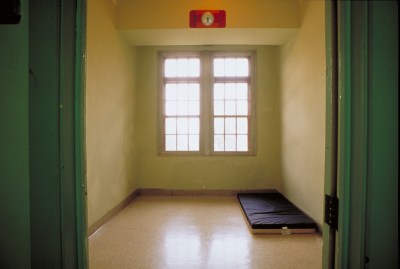
Note the linoleum and bare mattress. I have never seen a windowed seclusion room!

Collage of Christabel: Middlesex Occupational Therapist (finished)

Finally I have finished the collage here with the background completed and the candy foil earring (I saved foil from innumerable chocolates…and they have no come in handy as I know eventually they would.  What do they say? Everything can be an art supply, looked at with a creative spirit. Who says that? Well, I dunno, I guess I do! 8D

I call her Christabel, who was one of the occupational therapists in the hospital this past April and May (all of the OTs were great.) She was a wonderful woman who was the one person who consistently treated me like a human being at a place where I was often not treated much better than an animal or a bad child. Consequently, I never once, as I recall, had occasion nor impulse to scream at her in rage or frustration. Lkewise she never felt it incumbent upon her to withhold from me such ridiculous items as gluesticks or magazines, the sort of carrots with which the nurses attempted to “tame” me. That is, negatively, by taking them away from me until I ‘behaved’ according to their rigid standards. Never once did they acknowledge what I had begged them to understand from the moment I walked in there, which was that I suffered from Lyme disease-induced schizophrenia, and that both the rage episodes and my impulsivity were uncontrollable, (i.e. literally OUT of my control, and “not me” — as the weekend doc herself, Faye H., who knew me well from treating me for years in the past, noted several times in dismay).

Be that as it may, when the nurses, or one of them, the one who really hated me, refused to grant me permission to use a gluestick one afternoon in order to work on this collage, it was Christabel who came to my rescue, by bringing some from the OT office, without so much as a word or caveat to “not tell the nurses.” She simply handed them to me, along with a handful of new magazines to tear colored scraps from, so I could continue work on my face, which I had only just begun.

Everyone asked me, as it was coming together, if I was modeling it on  anyone. But the truth is, though I call it Christabel, it is more in honor of her, than intended to be a true likeness. True, she is African American, and has very close cropped hair, but that is as far as the similarities go. In fact, the face is pretty much imaginary and generic. I took the features from, well, my mind, mostly, though I used various faces from magzines to give me an idea of how the light would fall and create shadows, and how the various contours of the features would look. Also to give me a better idea of proportions. The nice thing about these kinds of collages is that paper is very forgiving, so if I made a huge mistake, and made the nose too big or put the lips too close to the nostrils or, as I did, make the eyes too small and close together, all I needed to do was paper them over and start again. In fact, the more layers I used, the stiffer the underlying “post-it note” kind of thin paper foundation became, which proved a good thing when it came to finishing off the edges and finding a way to hang it. I cannot f rame it, as it is 46 inches by 32inches, approximately, and formally framing it would cost a mint. but I polyurethaned it, one, so it would not distintegrate, and bound the edges neatly, and think I will attach a dowel or piece of thin wood at the top to which I can affix a wire and hang it by that. The person, the woman who runs the solo shows every month at DHMAS in Hartford, said that though everything was supposed to be framed, basically as long as it can be hung by a wire, my plans sound fine.

Well enough of this. I think the new photo shows how I finished the face better. Though I could not get the bound edges into the photo alas.

Seclusion and Restraints: Observations from the other side

Here’s what my friend Josephine knows about what happened in October, having been my designated “contact person”:


According to Jo, I was admitted on Wednesday around noon. Apparently the nursing staff called her, as well as Lynnie, as my emergency medical sheet instructs.


She comes up to see me that evening, bringing with her some clothing and toiletry items etc. and while she is there she makes it clear to the staff that she is my “caretaker” and is to be told everything so that she can contact my family, when the need arises…(This seems to work, as it turns out, as she will be kept in the loop, thank god.) Anyhow, I am doing relatively fine, though the nurses say I refuse to take the medication the doctor prescribed, which concerns them. Apparently there are plans already being made for a hearing to force me to do so.


Before I fast forward to the weekend, when Josephine next sees me. I want to interlace here what I do recall, which is one conversation with the doctor, in his office, during which he tells me that he wants me to take Zyprexa.  “Have you heard of that drug before?” But then memory gets fuzzy, because I am back in bed,  in a bedroom I think is a double, though I am not sure, because I know that for most of my stay it is a single right off the nurses station where they can keep an eye on me, and just as he leaves, I raise up on one arm and scream, “I will NOT take Zyprexa, you F—ing bastard!” Dr Z stops in his tracks, looks back at me, and says, rather mildly, “That’s not very nice.” I finish off with, “Fu– you!” He has heard this before, clearly, turns on his heel and leaves.


The next memory I have must occur also before Josephine returns. I am sitting in a room with Dr Z  and someone I think is a judge or a hearing officer. A woman sits on my left, perhaps a patient advocate or a nurse, I do not know.  I recall specifically that Dr Z (whose name I only learn after I am discharged) seems to have spoken to the folks down at N hospital where Dr O practiced because he quotes what I recognize is their Axis II diagnosis, word for word.  This was created specifically for me by Dr O. in addition to paranoid schizophrenia and always struck me as  malarky but was a sore point too, and cruel as it seemed to blame my illness on me. (I had many words with her about it, and I challenged her  to prove it was true. She agreed it did not hold water, since it was only “true” in hospital, and so was just a convenience to satisfy  staff unhappy with my uncontrollable behavior — yes, there too, and equally unremembered!)


Nevertheless, it was written in my chart at N hospital and so now it is repeated as if gospel. In addition, the doc decides that he has seen, in two or threee days and five to ten minute interviews with me, “absolutely no evidence of narcolepsy, and no reason to treat for it.” He believes that my sister’s attempts to influence my treatment,  giving him my history of medication responses etc. constitutes improper interference and should not be permitted under any circumstances.


After that, I lose all interest in the discussion, knowing it is not going to go in any direction that will be in my interest, that I am being treated by someone who neither knows me nor cares to learn enough to treat me properly. Furthermore, having been taken off all the medications I have come in on (except oddly enough for my Lyme disease antibiotics) as having been “ineffective, by definition, otherwise you would not be here,” I am already feeling drowsy and distant, at a remove from the proceedings and not quite caring what happens. The proceedings come to an end when the hearing officer, or whoever he is rules in favor of the doctor, who wants to force me to take, not Zyprexa but Trilafon, 8 mg BID (twice a day) or Haldol by injection if I refuse. I may object and say I will not do so and will only take the damned Haldol kicking and screaming. Or perhaps I say nothing.  I don’t really know.  I may  only think this, but it is a prescient remark, or thought, in any event.


Memory becomes a series of refrigerator-dim flashes. I vaguely recall one incident: literally kicking and screaming while being held down for an injection by any number of security personnel…But even this memory constitutes no more than just an impulse of light on the confrontation, as if I am looking down on my body as I struggle with the guards, no more. Then just blankness.


What Joesphine tells me next is that she returns on Saturday, bringing my poetry book. She is appalled at the change in me and asks the nurses, “What happened to Pam?!” I am not merely irascible, she says, but explosive. I am mean and I am violent to the point that I will not let anyone  come near me. If they attempt to I lash out, not just verbally but physically as well, any number of times actually slapping, smacking or in some fashion hitting the nurse of aide trying to take my vital signs or give me medication. She tells me that even when I appear to be deep in thought, sleepy or sedated, I can in an instant rouse myself to fury and explode, launching into a tirade of invective and even physical abuse.


At the same time, I am ataxic ( one nurse gives me red  slipper sock to warn staff that I constitute a “risk of falling” but these are soon lost and not replaced) and while I can be wild and have the strength of a rabid animal, at times I have trouble simply getting myself out of a chair. Once, a big security guard, seeing Josephine struggle to help pull me up from the recesses of a deep armchair, comes over to help and I go berserk. Suddenly violent, I take a swing at him, swearing  and screaming at him as if he were the one to have attacked me, rather than the other way around.


Once Josephine looked into my bedroom before she was shooed into the day area with me, where all visiting was supposed to take place, she saw that restraints — big leather cuffs — had been placed on my bed. According to her, they were used as frequently as every time I got medication or even every night in order to keep me from — well, I do not know what! But I can only imagine, given how she tells me I behaved. I do know that restraints are only supposed to be used in cases when violence is imminent or uncontrollable by any other means. Now she does assure me that they were, so far as she could see, only two-point restraints, the wrist ones, but that they were actually placed on my regular bed horrifies me, since it implies that they were to be at the ready and expected to be used, i.e. they were not simply an emergency appliance to be acquired from a rarely used, locked cabinet unopened for months at a time.


As an aside, I discovered when I arrived home, many just healing scars on my left leg that were not there before I was hospitalized. Yet I also remembered telling a nurse at the hospital that of all the places I had been, their unit was definitely the most safe, the most secure. I felt that it would be most difficult indeed to hurt myself there, as there were very few opportunities and almost no chances were taken…So how can I square that with these scars? I cannot remember when or how I acquired them. I only know that the summaries of my chart mention that I did injure myself, early on, which resulted in four-point restraints at least once (another being the slip-knot episode already described). But with what, and why I have no idea. Probably because of command hallucinations, and self-hatred. But that is only my surmise.


I “came to,” I rose to the surface of my insanity only once or twice that I recall, once to see my father sitting by my bed (why was he allowed  to visit in my room?) and Josephine standing there while I screamed something. I remember she abruptly left. After that, the darkness closed over me again.


The only other time I surfaced was when they dropped me on the seclusion room linoleum…about which I have written in some detail. But even then, I cannot really remember if it was one whole incident, or two or three amalgamated by a trick of the brain’s confabulatory instinct, and  the passage of time into a single coherent tale.


Then there is my journal , which tells a story that in its own way corroborates this one. Usually when I am hospitalized at least in recent years I  keep a detained record of everything going on around me for reasons of paranoia if nothing else. Because of this, I can read back afterwards and understand what I was thinking or doing. This has not always been true, and during some hospitalizations, further back, I was unable to do so,  and thus do not have such a record, but I am glad when I do because it helps me piece together what happened during times that I otherwise experienced later as blanks.


However, during the two and half weeks and longer during which I was  literally out of my mind this past October (Josephine insists that I wasn’t “right” even when I got home, and that it took a good two weeks before I was truly myself again)  there is no written record, not in my journal. I wrote a little during the first few days,  going from a self-loathing that speaks of a desire to burn my face (“deface my face and face up to my sins”) mingled with psychotic ramblings to utter confusion. This is almost indecipherable and devolves suddenly on Thursday to nothing at all, represented vividly if accidentally by two blank pages. It is only on briefly on Saturday and then on Sunday, October 18th and Monday the 19th (which may have been only a continuation on Sunday, as I was still confused as to the date and time), which I firmly believe all day is “Monday the 20th,”  that I apparently find the strength and clarity to “steal” a felt marker from OT and then a memo pencil to write with. All writing utensils but crayons have been denied me previous to this, I remember that much, though I also have not been able to, have not wanted to write either or I would have done so even with a crayon.


Now, to my pleasure this marker and then the pencil is not  taken from me as too dangerous for me to have in my possession.d I begin to write. I write all day, literally. I write and write, 41 pages in one or two days. I write down everything that happens, and I write as if I know what has been happening, but really without the slightest inkling. It is clear that I have no idea what I have been through, nor what I have been like. I write of a nurse, one I clearly like, telling me I am “doing great” and my consternation at this, because I do not understand why she is telling me how I feel rather than asking me…


I write of my impending discharge, and I believe I write about how I don’t remember the last two weeks, but it doesn’t seem to bother me much. What does bother me is why no one on staff will talk to me, why people seem to avoid me, and why one male nurse seems bent on being nasty to me “for no reason.” (I may have made a point of hurting him during my weeks of insanity, that is all I can surmise as a reason for his animosity…).  I am paranoid — at one point I interpret the constant opening and closing of the weekend Dr H’s door, which I can hear from my room near the nursing station, as deliberate torture, intended to “get back at me.” When I finally get a glimpse of Dr H, I scream at him “You think I don’t know what you are doing, but I do, I do!”  He gives me a truly bemused look. I am thrown into confusion, not sure how to read it.  I  remain fairly certain, however, that he is “doing a number on me.”


(End of Part 1. I want to reread the rest of what I wrote during my last three days on the unit before discharge — then I will continue with Part 2.)

Seclusion and Restraints: How it feels

I remember, I remember, well, I remember very little, except in flashes of dim light, like a candle held up by which to read the fading pages of an ancient diary. I remember a sign with my name on it, taped to the door of a room, and how hard it was to find my way back, no matter how many times I made the trip. I remember a nurse with blond hair named “Patty,” whose real name, Lil, I learned only the second to last day I was there. I think I liked her, or that she treated me with kindness, and another nurse named Mary Ellen, who was kinder still, but not always there to save me.

I remember too, but again in uncertain flashes that tell me only that something happened but not exactly what: Being carried by arms and legs into a cold, empty room lined with linoleum, dropped onto my back on the floor, dressed in just two hospital johnnies and pajama pants and locked in there alone. I remember begging for a mattress, then screaming in outrage when I was refused.

This is how it goes: There is nothing in the room but me and air conditioning turned on full bore, though it is October and in the 50s outside. Why do I need johnnies or the huge pajama pants that are falling off me without ties to hold them up? Alone in that room, I take them all off, then squat to pee and take a dump. Good, that feels better. Blankness. Cold, cold. Again I scream for a blanket. Of course, nobody answers. I try to push the johnnies under me to cushion my bones so I can sleep, but the shivers prevent me from relaxing. I have to do something.

I make a long rope of the silky acetate pants then form a slip-knot and put the O over my head with the knot to one side. I pull tight, figuring it won’t take long. I sit to one side of the little window in the door, so no one sees me immediately. Finally they come running. But they don’t understand it is a slip-knot and that pulling at it only tightens it  more. I am struggling for air. A nurse yells for scissors, bandage scissors the only ones available and they cut the pants free. Still, I am in big trouble. I would tell them I only wanted to get their attention, that I just wanted a mattress and a blanket, but what good would that do? Still, do they really think their act of violence, which will follow, will solve anything? Blankness. I have been thrown onto a bed in another seclusion room. As staff and goon squad wrestle my wrists and ankles into padded cuffs, I kick and bite in protest, all of which will be written up as my being “assaultive.” In the end, it is no use.  I scream and scream until the usual injections – 5 mg Haldol and 2 mg Ativan – take the scream out of me and I finally fall asleep.

That should have been the end of it. “Wake up calm and they take you out of restraints.” That’s the name of the game. But this time, I wake and I am still in full 4-points. I ask the nurse why. “Doctor’s orders,” he says. “But that’s punishment!” I answer, shocked. “No,” he says, “restraints are therapeutic. We never use them as punishment.” “Bullshit! Dr Z is punishing me because he doesn’t like me and you know it. He is a sadist.” The nurse doesn’t answer immediately and when he does, he just says, “Go to sleep.”

I remember how they kept me in restraints for 12 hours that time. The chart summary tells me more, that I spent a good part of 5-7 days in seclusion and/or restraints, so there is a lot I do not remember. Am I better off for not knowing? That’s what some people tell me. How would you feel? Would you want to know, or not to know?

————————————————————————————

I realize that the above is simply a restatement of an earlier more detailed post, so it must be obvious that I am still very troubled by what happened. Indeed I am. I am even more troubled by my lack of memory the rest of the three weeks there…which fact was noted even in the summary of my stay, which Dr B (Li) got from the hospital the other day (in lieu of what he requested, which was my entire chart.) Memory loss has dogged me for many many years. Only now can I acknowledge it, and only because Lynnie and others witnessed it. But for so many years I felt desperately  troubled and, well, desperate to hide it, afraid lest anyone know how little I could remember of what happened from day to day. This was especially extreme when I was in hospital but even afterwards it was troubling to me; sometimes I felt I was missing half my life! People — that is to say,  doctors. nurses,aides — expected me to remember ordinary happenings, because they obviously  thought that I was responsible for what I did from one day to the next, which you are not, not in the same way, if your memory is impaired. This expectation was so stringent that I dared not admit how little I did remember of events after they passed. I thought the scant trace they left would somehow prove my evil, prove that I was a shameful deficient person. So  I desperately took cues from others about what they wanted me to “remember,” tried to “pick their brains” about whatever it was that had happened, or that I had presumably done, whatever it was that they expected me to recall. Sometimes a concrete clue might help me piece things together – say for instance if I had scars or wounds that hinted at recent self-injurious behaviors or if there were scribbling on the walls that suggested another sort…But if there were no cues, it was much harder to ferret out what was wrong. Sometimes I might have to come right out and ask, “And you are referring to…?” But I didn’t dare do that often or it would have given my lack of memory away, something I didn’t dare permit…

Now here is the other side of the story, which I find hard to square with my experience in October: one  psychiatric nurse’s account of how situations involving restraints can look to staff.


Hospital, Hypomania and How Hope Eventually Returned…

Pretty tame for a seclusion room, but this one is in a school so it has carpeting not linoleum...The thought that little kids are held captive inside is pretty disgusting through.

I wrote in the post below that for three weeks in October I was in Manchester Memorial hospital (a new unit for me. To explain, the hospital you are sent to in this state these days is a total crapshoot. Sometimes the ER can admit you to theirs, but if it is full, as it so often is, they can send you literally to any hospital in the state that has an empty bed.. With the governor having decided to close one of the few state facilities still open and the municipal hospitals so over-utilized that an average stay was 5-7 days only, you can imagine how inadequate any attempts at treatment are. I do not mean to diss the hospital staff in general. Some do mean well and are appalled at what their jobs have devolved into, others however seem not to care that they are no more than warders in double-locked secure psychiatric units where few are admitted truly voluntarily or at least only on an emergency basis and yet no one can stay until healed. Generally speaking, one stays only until such a time as they are either no longer acutely suicidal or no longer a danger to others… That said, I have to be somewhat circumspect about what I say and the judgments I make as I was and tend to be when in any hospital so paranoid that I simply cannot draw any reasoned or reasonable conclusion about the staff or the treatment there, since it is always more or less (and usually more) through the lens of my sense of  personal attack and persecution. In truth, I scarcely remember any of the details or even the gross facts of this particular hospital stay. In fact, I have had to be told second hand, or even third hand, most of what I did there and/or of what happened.

I can say a few things from memory, though, and the picture I posted above is relevant to that: I remember being hauled off to the seclusion room and more than once. (I do not have even the slightest scrap of memory why…which is unnerving, and yet also a relief, as it protects me, possibly, from memories I might not wish to have…I hasten to add however that my lack of memory is not psychological, but neurological: we were warned by my Lyme neurologist that I should not have ECT while I still had CNS Lyme disease as it was likely to produce untoward CNS effects that could not be controlled or predicted. Since then, my short term memory has been particularly affected, among other things (e.g. olfactory hallucinations).  IN other hospitals, the seclusion room usually had a mattress in it, something upon which you could lie down, and were expected to, in fact, since you were given medication and expected to calm down and sleep in general. At other hospitals, I stayed in the seclusion room for an extended period of time, either because I was extremely disruptive (NOTE: see posts about Natchaug Hospital regarding this) or extremely psychotic. At those times I was usually permitted other items in the room, such as magazines and some small personal things to pass the time with…But during the month that is ending, I was literally manhandled into the room and dumped on the floor — hard linoleum — stripped, forced into a johnnie coat (I had to beg for 2), and summarily left behind, the door locked decisively between me and whoever was posted at the observation window.

I remember screaming, I remember begging for a mattress to sleep on, I remember begging for something to cover myself with for warmth or at a minimum for the heat to be turned up as I was thin and it was notoriously cold on that unit, and there was nothing whatsoever in the seclusion room to buffer the air conditioning. No deal. They just told me to be quiet; actually, I do not believe they even said that, but just, No. I do not remember much more than that. In fact, though I have been told the next, I do not actually remember it: there was of course no bathroom facility, and not even a bedpan in the room. Someone told me later that I defecated into a cup…But I do not see how that is more reasonable than that I did so into a bed pan…Why would I have a cup in there  if I did not have a bedpan…No, I believe that in both instances I have been told about, I peed and defecated directly onto the linoleum. If I did so, I cannot explain it. Perhaps I was simply desperate and they did not provide any other mode of relief. Maybe I was angry at them, and did it to “get back at them”? (This was suggested to me as a motive by the person who told me that I was not the first and would not be the last person to do this in that room…which was both a small source of relief, to not be unique, and yet to have done it as a kind of revenge?!  I did not want to believe that I would or could be so primal in my anger…But then, I have done it before, if you recall…

After that — and my memory wants to “see” this, feels it almost can and almost does, but I cannot be sure that it is memory rather than a mere confabulation  after the fact, having been told the bare bones of it by Carolyn (Lynnie) and others, who themselves only heard about it but did not see it either…after that I believe I crossed the room to , hoping there was no slant in the floor that would make the puddle slide towards me, and lay down in a heap and fell asleep.

Or did I? Did I? Or were there consequences to my act? I know that at some point in my “stay” — seems so mild to call the brutality of my hospitalization merely a “stay,” as if at a spa —  I was put into restraints and kept there a very long time. Was it for a separate incident, or was it connected to…Aahhh, wait a minute, yes, I do know, I do know…I remember now…For some reason, and I do not quite remember why, except possibly I was just so sick of everything that was happening, and so…I remember taking off the hospital pajama pants that were way too big for me anyway, and never stayed up and had no ties to pull around my waist and so were useless. I pulled them off and wound them into a narrow rope, which was easy as they were made of very thin material, then I formed them into a kind of slipknot,  fitted it over my head and around my neck and pulled on the  one end that had to be pulled for the knot to tighten, holding the other  like a kind of ballast (I don’t remember entirely how I did this only that it felt dreamlike, how easy it was to accomplish). I have forgotten what I was thinking, if I thought at all. Probably I did not think, I was that far beyond any rational thinking, even beyond any rational “wanting” in the sense of really wanting to die or not.

In any event, it seemed to take a long while before anyone noticed, and then a whole crowd of people were suddenly upon me, and they didn’t seem to know how to get the noose off  or how to loosen it. I held the end that slipped tightly in my fist, having no desire to relinquish it, though at the same time having I suspect no real desire to die either, that they could not easily free it. I heard someone yell to cut the knot. I remember thinking that was silly, why didn’t they just untie it? But it seemed that that was not possible, or at least that it was taking too long.  Then there was a pair of scissor up at my throat where the knot was — it seemed that  only bandage scissors could be found and those were not easily accessed — and someone was ripping at it, and then it was torn away and my neck was freed.

Stop. I have to stop here. Memory now fails me. I can only speculate what happened after that, because it literally blurs into nothingness. Goes blank. Goes back into the vault wherever all my lost memories go, perhaps never to be retrieved, if never fully or adequately formed. All I can do is try to reconstruct what might have happened next. I am pretty certain that it was after this that I was put in restraints. It would make sense. After all, what else could they do, and what would make sense? If I wasn’t safe in a seclusion room, in a hospital that in fact DID resort  to seclusion and restraints, it seems only likely that restraints would be the next measure taken. So I have to assume that it was for that reason I was put in four point restraints. Also, since the doctor I had been assigned to, thought a sadist by many on the unit, was  also the director of it, it was likely his call that led me to being kept there for more than 12 hours, and maybe as many as 18…I honestly have no idea in the end how long he kept me in such a fashion, only that I was not released even after I had fallen asleep…

That is almost the sum total of what I can, as a kind of “hard copy” memory, remember on my own. As you can see, even with those few memories, I had trouble and some help in recalling them.  I have some vague sense that a great deal went on during those 2 and a half weeks when I was largely insensible to what I did (at least to the extent that I did not recall it from moment to moment). During the last half week when I finally cracked the paranoia that kept me imprisoned, my memory did not improve, only my temper and the distance I kept from and my anger towards those who I had earlier felt were working in cahoots to hurt me. My impression then was only that some people were angry with me, but I did not know why, that some people resented me…But I could not figure out why. The ones who seemed to brighten when I smiled and help nothing against me told me gently a little about what I had done or how angry etc I had been, but only vaguely. They did not seem to understand that I had literally no memory of the previous 2 and a half weeks, or if they did, they did not seem to want to refresh my memories, perhaps feeling that it would be unkind, I dunno.  In any event, I learned a little about the “Pam” that some thought they knew, or that some people thought they had met and known for those 18 days…and that others had believed was in there all along and were now  glad to see emerging…But it was very confusing. And in all that confusion, I also had to deal with the fact that the new doc who had taken over after the sadist doc was removed from my “case” thanks to Lynnie’s intervention,  had decided that his philosophy of short hospitalizations would take precedence over whether or not I was fit for discharge, and so I was to leave on Tuesday…I had no choice, and so as I prepared to leave, I also had to “prepare a face to meet the faces that you meet.” (a quote from “The Love song of J Alfred Prufrock” by TS Eliot). But I was also growing more and more revved, more and more anxious. and I had no one I trusted enough to talk about it with. I certainly could not tell the day nurse. (I don’t think I did, but I do not actually recall one way or another). I knew she disliked me intensely, for all that she tried to pretend otherwise.

In the end, I did leave that Tuesday, though even as I got into Josephine’s car and she pulled out into traffic, she told me I didn’t seem right to her, that she didn’t think I was well or ready to leave. That fact seemed clear to almost everyone I saw that day. And not long after that I grew so talkative and revved that no one could get a word in edgewise…This was so emphatically not like me that thank heavens everyone put up with me, and no one, NO ONE, rejected me or gave up on me for it. I do not remember anyone being cruel or saying, GO away, you talk too much, or you are being too egocentric etc. I recall in fact only kindness and some humor injected into the situation, but mostly kindness. They all, my friends, as well as Elissa, the RN, seemed concerned as I rocketed higher, and yet seemed to feel uncomfortable and not at all happy with how fast I was speeding. Sure, Dr B diagnosed it a hypomania, but I  had thought hypomania was an enjoyable state, not this unpleasant adrenalinized racy state that felt so terrible to me. I hadn’t taken Ritalin in 3 weeks, but I didn’t even want to now. No, taking stimulants for Narcolepsy was nothing like this. This felt terrible and  neither Ritalin nor even Adderal had ever felt so terrible. There was no pleasure or even alertness that made me want to do things and study and write involved now. I got a little more cleaning done, true, but only because I was trying to exercise off anxiety, not because I had pleasureable energy. In fact, had I been able to slow down, I would have gone to bed to sleep it off!

Eventually, Dr B upped the Topomax and I think we had already increased the Lamictal and eventually over the course of the next week, I came down to my usual state of semi-sleepiness and was able to restart the Ritalin (after some discussion about why I take it…He is still new to the situation and my narcolepsy)

Well, that is about all I can tell you about the hospitalization just passed. But there was more to it, and what I know about it, though the facts are vague, is that there was something massively wrong…It felt like the Y2K meltdown in some ways, esp in my lack of contact with — reality, memory? Is there a difference? I feel that this was very different from my usual post-lyme hospitalizations, that I was in a different state, and so did others. It frightened me more, and it was more violent. Certainly the treatments were more violent, but that also implies that I was too. Lynnie keeps telling me she will talk to me about it. But so far, she has not… Do I really want her to?

Schizophrenia and Temporal Lobe Epilepsy

I want to begin by quoting two websites on the symptoms of each. First the Mayo Clinic on the symptoms of schizophrenia and then Richard Restak’s excellent article on TLE.


Schizophrenia Symptoms

By Mayo Clinic staff

In general, schizophrenia symptoms include:

* Beliefs not based on reality (delusions), such as the belief that there’s a conspiracy against you

* Seeing or hearing things that don’t exist (hallucinations), especially voices

* Incoherent speech

* Neglect of personal hygiene

* Lack of emotions

* Emotions inappropriate to the situation

* Angry outbursts

* Catatonic behavior

* A persistent feeling of being watched

* Trouble functioning at school and work

* Social isolation

* Clumsy, uncoordinated movements

In addition to the general schizophrenia symptoms, symptoms are often categorized in three ways to help with diagnosis and treatment:

Negative signs and symptoms

Negative signs and symptoms represent a loss or decrease in emotions or behavioral abilities. They may include:

* Loss of interest in everyday activities

* Appearing to lack emotion

* Reduced ability to plan or carry out activities

* Neglecting hygiene

* Social withdrawal

* Loss of motivation

Positive signs and symptoms

Positive signs and symptoms are unusual thoughts and perceptions that often involve a loss of contact with reality. These symptoms may come and go. They may include:

* Hallucinations, or sensing things that aren’t real. In schizophrenia, hearing voices is a common hallucination. These voices may seem to give you instructions on how to act, and they sometimes may include harming others.

* Delusions, or beliefs that have no basis in reality. For example, you may believe that the television is directing your behavior or that outside forces are controlling your thoughts.

* Thought disorders, or difficulty speaking and organizing thoughts, such as stopping in midsentence or jumbling together meaningless words, sometimes known as “word salad.”

* Movement disorders, such as repeating movements, clumsiness or involuntary movements.

s

Cognitive symptoms involve problems with memory and attention. These symptoms may be the most disabling in schizophrenia because they interfere with the ability to perform routine daily tasks. They include:

* Problems making sense of information

* Difficulty paying attention

* Memory problems

Complex Partial Seizures Present Diagnostic Challenge

Quotes from Richard Restak’s article in Psychiatric Times (Sept 1,1995)

Since the condition [Temporal Lobe Epilepsy] may involve gross disorders of thought and emotion, patients… frequently come to the attention of psychiatrists. But since symptoms may occur in the absence of generalized grand mal seizures, physicians may often fail to recognize the epileptic origin of the disorder.

In most instances, the emotion experienced as part of the seizure is a disturbing one variously described as dread or a feeling of impending doom; in others, the emotion may be experienced as pleasant or euphoric…Descriptions such as “a wave,” “something flowing upward” are often employed.

Controversy continues as to the validity of a so-called temporal lobe personality… Outbursts of irritability, rather than frank violence, are hallmarks of TLE.

[R]are presentations include anorexia nervosa (Signer and Benson 1990), multiple personality (Schenk and Bear.

Most common is a global hyposexuality (deficit of desire and feeling]…

TLE also may be responsible for chronic rather than just acute psychoses. While any of the symptoms of schizophrenia may be encountered, paranoid traits are the most common. TLE patients can be distinguished from schizophrenic patients by the maintenance, when not acutely ill, of warm affect and good rapport…

The treatment of TLE is complicated by the fact that many times improved seizure control via anticonvulsants leads to deterioration of the neuropsychiatric status. Schizophrenia-like epileptic psychoses often emerge when anticonvulsants are normalizing or improving the seizure activity…

While the illness is an epileptic one and treated by neurologists, many neurologists remain unfamiliar with and even uninterested in its neuropsychiatric components. But by ignoring the experiential symptoms, the neurologist deprives the patient of the opportunity to coherently integrate all aspects of the epilepsy. It may also cement the patient’s misconception that in addition to the epilepsy, he or she suffers from a “mental illness.”

—————————————————————————-

I was going to go into a deeper discussion of this, but cannot at this hour (11:15pm as I must go to bed now. But I plan if I can to do so tomorrow. And if not then, well, then ASAP. Meanwhile, I would have told my schizophrenia.com readers to think back on all that I’d written over the years, and tell ME what is going on…but you cannot do that, not knowing me as well as all that. Needless to say, however, I do think there is reason to suspect that the second diagnosis might have some possible validity, though it is hard to see how all of my symptoms can have been only TLE…But wow, would I be relieved to have a name for it if they were!

TTFN

There is an interesting discussion about schizophrenia and TLE etc here: Schizophrenia and spiritual experiences: Is there a link? http://livewithwonder.wordpress.com/2011/10/19/schizophrenia-and-spiritual-experiences-is-there-a-link/

Changing Therapists and Current Concerns

When I was in the hospital this past February, I made the tentative decision to leave Dr O, despite having seen her and indeed depended upon her for nine years. At the time, I was feeling, I dunno, burned? Not in the sense of angry but in the sense of, uh, oh, I’d better cut out while I am not too hated, because soon she really will be sick of me and won’t remember anything about me but how much she hated me…Where did that come from? Well, you might laugh, but I did not. It came from having called her on her cell phone, as she has encouraged me to do, on a working day, and reached her instead of her answering machine. I had wanted to know if she had informed the book publisher about my hospitalization. I was taken aback by the sharpness and peremptory note in her voice as she answered. It did not sound like her .

“I, uh, it’s me, Pam, I was calling to –”

“Yes, Pam, what do you want?”

“It sounds like you are sick. I’ll call back later. I was expecting your answering machine anyway.”

“Tell me now. I don’t want to have to answer my machine or call back later.”

“But it is clear you are in a bad mood. I don’t want to talk to you now…”

“I’m not in a bad mood, I’m ill and you are calling me at home.”

“How was I to know that. It is a work day and this is your cell phone, you shouldn’t have picked up if you are sick. You are allowed to be sick you know…”

“Why did you call?”

So I told her, then when she said she would call the Press, I hung up. But I felt terrible, because it was clear that she was angry and it felt personal, felt as though she was angry at me. But I didn’t know why, could only imagine, and so I did, I came up with 100 reasons why she might be angry with me, hate me, want to get rid of me or leave me…This is important, that reasoning, because is lies directly beneath my first impulse to leave her, though it is not and was not in the end my primary motivation. Because I feared she wanted to leave me, I determined to leave her first. It was an old old story, and not a healthy one at all.

But as I said, in the final analysis, it was not really the reason I wanted to find another doctor. No, that was for two other more reasonable, um, reasons: one was that I did not want to have to traverse the state to see her any longer. It took me all the morning and part of the afternoon to do so, which ended up exhausting me for the rest of the day. That, plus the fact that I did not even drive myself, so it cost me extra to pay Josephine to drive me there and back. But more than that was the fact that the doc at the hospital was so – what? not into power, not into authority, or at least played it that way. He would ASK me what drugs worked for me and at what dose. And then proceed to prescribe precisely those drugs, not just ask me and then ignore what I said. Dr O never asked me what drug I wanted or what drug worked for me, simply decreed what I would take and then asked me to take them. She only listened to me when i refused to take them, perforce.

Now, this is not to make Dr O seem like any sort of dictator, because in fact I was very resistant and noncompliant, and often refused any med at all that seemed to help, so I could be infuriating. Also I was in and out of the hospital when not taking her meds. It was only she who had the patience to work with me for 6 years to finally find a combo that worked for me without any undesirable side effects (except a little sleepiness) so that I’ll take it willingly. Nevertheless, I think she is so used to my being ill that she cannot actually treat me like an equal, and someone who might be getting better..For instance, I really need to be able to call my shrink by his or her first name, esp if they call me Pam, which i would insist upon (because I cannot feel comfortable sharing personal information with someone who still calls me Miss Wagner!). It is patently ridiculous at my age that I should call someone twenty years younger than me by a title when they do not use one for me…But I would rather be Miss W than Pam if he or she is going to be Dr so and so at age 35-45!

Anyhow, where was I? Reasons why I was leaving Dr O. Yes, well, be that as it may, I had a feeling as well that she herself was not going to be staying. Don’t know why, but I just had this strange niggling feeling that somehow it was time, or would be. Then I mentioned, in my first appointment post-hospital that I might need to have some help finding a local therapist. She did not seem surprised or if she did, did not object at all, mentioned in fact that she was leaving her sleep practice in June, which precluded my continuing on as her sleep patient in any event. That gave me the first indication. Then when I returned two weeks later, which was last week, I said to myself, I know she is ending her practice of psychiatry as well, because she is moving, moving away, moving, well, inland…I knew this with absolute conviction, not delusionally. I knew I could be wrong, and I was hoping I was. But somewhere deep down I suspected I was not.

I was so exactly on the money it was uncanny. She was moving, was ending her practice. I asked her if she was moving inland. She made light of it, said she wasn’t going closer to the coast if that’s what I meant, but that wasn’t the point of moving. I said I doubted that…And she said nothing. But it scared me, as it always does, because I still feel that I will drown when Antarctica and Greenland melt, as they will MUCH sooner than any scientist now predicts…

I will not continue on that path at this time, however. I was speaking of changing therapists. So now I have made an appointment to see someone new, and only 10 mintues away from me, close enough that I can actually drive there myself. Very close, in fact, to the Vision Therapist I used to see. I do not know how to interview a prospective psychiatrist, or to doctor shop. All the other switches have simply been handed me, and they stuck, or I stuck with them as they seemed reasonably good, and i liked them. But this time, I have no one to hand me someone with their imprimatur and am on my own. I don’t know how to do this. Will I know who is good, who I can trust? I am very bad at that, trusting all the wrong people. Well, this person at least comes recommended by someone Dr O knows well, or at least knows. That ought to count for something. But it is a he, and I have not seen a male shrink in many years, nor had a good experience yet. Dunno how that will go.

But things change and so do people. The doc in the hospital was male, both of them were, and I liked them both. So maybe this time I could tolerate it. Dunno, but we’ll see. If I can, I will write again on April 1, which is when I have the consultation. Will let you know how it went, if it turns out to have been productive in any fashion.

Note: All the information that I have been reading points to two things that I find very disturbing: one is that Inderal (propranolol) which I take for akathisia, a side effect of many psychotropics but for me of Geodon, apparently and quite effectively “blocks traumatic memory.” Now this would be fine, except that it seems to block the formation of emotional memories of ALL bad events, or at least block the bad emotional memories of the events, such that if you recall the event, you cannot actually go back and feel the way you did at the time. Now I imagine that this would be desirable for most people, who usually do not want to suffer from their memories, but I feel deprived of so much of my life, having been on Inderal or a beta blocker (the same class of drugs) for thirty years. I never knew why i could not quite feel the memories I wrote about the way others seemed to be able to feel their memories…I can see them, but I am outside of them, looking on. I feel nothing. I literally look in and see myeslf from the outside, that is how detached I am from the person I used to be, all because, as i believe, I have no emotional recall of the event. Which is why I want to stop taking the inderal…If my blood pressure rises (it is also effective for that) then I will deal with it another way, but I need to see if not taking the Inderal brings back something vital to my memory.

Number two is much more problematic, because it involves the very medications that keep most of usw with this ilness sane and this side of an institution: most antipsychotics and even the SSRI antidepressants block dopamine to a greater or lesser degree. Now no one knows where or even if people with schizophrenia are actually suffering from an excess in dopamine. That is the theory and it may be that dopamine is involved in some fashion but it is not the whole story, The newest drugs are now working on glutamate, another neurotransmitter entirely. Either neurottransmitter may not affect the entire brain the same way. What is certain is that the drugs tamp the dopamine levels down. Supposedly this is only down to a “normal” level, but who knows what a normal level of dopamine is? We know that dopamine is the pleasure molecule, that without enough of it people become thrill seekers, needing highly exciting situations in order to experience pleasure. But what does it mean that many SSRIs cause sexual dysfunction and/or loss of interest in sex? It implies that with suppression of dopamine (and cure of depression?) the dopamine falls below “normal” producing this lowering of normal pleasure and pleasure-seeking.

It is well known that many fewer people with schizophrenia marry, have children or even fall in love…I myself feel detached and cool, feel no particular sexual urge or even the desire to meet a significant other, let alone pursue someone with marriage in mind. Now I’m wondering if this was not me, not really, so much as the anti-dopamine drugs I’ve been taking most of my life…What a tragedy if the reason I feel no love for anyone is the lack of dopamine the drugs forced on me! What a pity if the coldness I feel towards all of my life and all people in truth, is due more to my drugs, the inderal as well as the anti-dopamines than to any deficient genetic make-up . It’s like the wind farms and the sonar of nuclear submarines etc. We build them as if they are reasonably green, having zero effect on the enironment. only to find out years later that the effect was devastating. (I suspect that the wind currents and subsonic vibrations given off by mega-windfarms might be discombobulating our honeybees and even undermining the vitality of our bats (both dying off alarmingly in 2009). What I mean is, we have developed all these so-called miracle drugs for schizophrenia and depression etc but do we really know what they do to the person, quite apart from the alleged antipsychotic effects? What about other costs to the individual? What are they and has anyone thought to look for them? Does anyone have a choice in the matter? Is it fair? (Obviously no, it is not fair, but then life isn’t fair, so that is a silly question…) Should they have a say, a choice?

These are notions that currently concern me. I wonder if anyone else has been pondering them…If the honeybees and bats and dying whales and dolphins deserve our attention, as most surely surely they do, the highest priority, I would hope that somewhere down the pecking order we with schizophrenia might deserve someone taking a good hard look at just what the suppression of dopamine might be doing to us in the larger picture as well as the smalller one. Just as schizophrenia, I am convinced , does NOT condemn one to obestiy, but the drugs do, just so I believe that the drugs do a number on us the full nature of which we have no inkling of.

Note: this is NOT to encourage anyone to stop taking their medication. Obviously I still take mine, fearing psychosis and the return of the voices far more than I want some dopamine at this point. But I ‘d like some input in the matter, too, and wish they’d develop some better drug or treatment protocol than the present one. Surely I can still be human even with schizophrenia. What with Inderal and the antipsychotics etc I feel more like an automaton, or Mr Spock or Data.

On Writing and Memory

I am trying to start a new book, another memoir. This is an exciting endeavor but I’ve gotten stuck on the problem, a perennial one I imagine, of how much does one really remember, and how much does the mind “make up,” that is, remember improperly? I know that some writers of autobiography — to my mind a more stringent form, requiring research and some historical context –and memoir make the claim that every word they have written is factually accurate, to the extent that they have checked each one against the memories and records of others. Then there are the infamous ones who have played so fast and loose with the truth as to have lost all semblance of it. These have produced literary scandals (as well as books that probably earned their authors much more income than if they had actually stuck to the facts) and more or less short-lived discourses by the punditry on the nature of truth and memory: what can we really know? Since I am something of a sucker I tend to take both of these at their words, when in fact I daresay that neither of them ought to be. True enough, the one has done more work than the other, and has made an honest effort to search for the “real facts” in his or her history, but my question is this: Can it be done, one, and two, why should the collective memories of say, ten people chosen by the author (biassed) be more “objectively real” than the simple truth of what the author herself remembers? Yes, you might build up a larger group of pieces-of-the-elephant if you have ten blind people who feel only one part. But unless you have someone who knows how the pieces fit together, you still only have elephant pieces…And so ten pieces are no better than the one in the end.

What I am saying is this: the author, the person who lived the life has to be the one to make sense of it. She might have a thousand “elephant pieces” — memories given her by ten people, yes, or only her own memories but in the end she must construct what the elephant – her life–looked like out of them. In some sense, there are facts and there are facts, but the work, and the life, and the living is all in the interpretation; always was and always will be.

That said, I am having trouble getting started, because I don’t know whether I want to use more “objective” sources or evidence this time, or not. I am perfectly comfortable using what is close at hand: my journals, my photos, the people I can easily consult. And I do feel very uncomfortable with mining deeper records: I do not particularly want to see what is written on my hospital charts during months-long stays when I was ranting and screaming for days, or engaging in outrageous behaviors like taking a dump on the floor of the seclusion room, or disrobing and…I can scarcely bear to think I did such things, frankly, and do not want to read what was written about me at the time, knowing nothing can be corrected or updated to show them the “new me”. A sad fact about hospital records and workers: they only see you when you are at your worst; they rarely get to know if you get better. Much less get to know you when you are well. And if you ever wanted to sit down and tell them what was actually going through your brain at the time they believed XYZ, but in fact QRS was happening, well, forget it.

So, I am loathe to overturn those stones, growing mossy as they nearly are now, some four years later. It pains me even to bring my mind across the memories of them. I have no wish to flagellate myself. My own journals say little, but it’s about all that I want to know. At the same time, my own brow-beating conscience tells me, NO, you must do what you do not want to do. The very fact that you do not want to do it means that you should. No pain, no gain—

Oh, I just go on and on. I would make this next book a torture to me, nothing of pleasure at all, just to serve my scruples. Be gone! If the writing is only to torture me, why do it? I’d be better off with my artwork and sculpture. But writing nurtures me, so long as I do not let my illness turn it into a punishment. Is there any need for me to use the historical records in telling the tale of my life? Did my first book lose anything in my not doing so? I would change a lot in DIVIDED MINDS, if I could go back and do so — add scenes here, take out one or two, most certainly make better transitions — but except for appending a much clearer discussion of this very issue, and also a better disclaimer, I wouldn’t change the way we wrote it.

So I might have talked myself to a place from which I can start, allowing myself the freedom not to have to delve into the official records or consult professionals involved in my care unless I am currently in treatment with them.

Your past after all resides as much in what you remember as it does in anything documented. You are mostly what you remember, and what you remember is sculpted by time and changes over time. If you think your memories remain the same, read back in a diary you haven’t read before, and recover the accounting of a incident you thought you’d recalled with accuracy…You’ll see how inaccurate your “memory” was and how formative this memory had been nevertheless. Then remember that the accounting is itself a memory, tainted by emotion and interpretation and consider those “ten people with their elephant pieces” who tried to give you objective memories of your history. Were they truly objective? Were their memories, even collectively, any more factual and objective than your memories?

In the end, memory is fiction, as someone once wrote in The New Yorker magazine, memory is, well, made up, not real, imagined. I agree, but it is all we have. Literally. Without memory we would be without anything at all, no culture, no civilization, no nuthin’. So let’s not pretend that the fact that memory is fiction isn’t critical. We need memory, and memory is, well, fundamentally untrustworthy, which is why we need thinking, and thinkers and writers to interpret history and memory… Memory is the most important thing we have, the most important attribute we can impart to anything: in almost every sense of the word, when we remember something we keep it alive. Maybe not literally, but then again, it is memory that keeps a conversation going on longer than five minutes. If you forgot what you were talking about ten minutes ago, or to whom you were speaking, nothing much would get said…