Category Archives: Writing

Poem about Forgiveness,Translated into Chinese

TO FORGIVE IS

To begin  要寬恕的實是太多

and there is so much to forgive:  頭一樁要算

for one, your parents, one and two,  你父母那麼偶然的一或二次

out of whose dim haphazard coupling  於幽暗中的契合

you sprang forth roaring, indignantly alive. 你呱呱來臨,憤然降世

For this, whatever else followed, 為此, 為這帶來的一切

innocent and guilty, forgive them.  無意也好作孽也罷,寬恕他們.

If it is day, forgive the sun  若是白天,寬恕太陽

its white radiance blinding the eye;  原宥它的奪目光芒

forgive also the moon for dragging the tides,  亦要寬恕月亮帶來的潮汐

for her secrets, her half heart of darkness;原宥它的弔詭.它的暗晦

whatever the season, forgive it its various  管他冬夏秋春.寬恕季節的多端侵擊

assaults—floods, gales, storms  水患,疾風,暴風雪

of ice—and forgive its changing;  原宥它的更替變易

for its vanishing act, stealing what you love  它的掠奪行徑

and what you hate, indifferent,  把你所愛所恨無情的奪去

forgive time; and likewise forgive its fickle  寬恕時間

consort, memory, which fades  同樣地原宥它的變易不忠,連記憶也不放過

the photographs of all you can’t remember;  以至你把擁有的拍照忘得一乾二淨

forgive forgetting, which is chaste  寬恕失憶

and kinder than you know;  它實是忠貞和比你所認知的仁厚得多

forgive your age and the age you were  寬怒年齡

when happiness was afire in your blood  原宥當年的你,那時幸福在血液沸騰

and joy sang hymns in the trees;  喜樂在樹 叢間高唱聖歌

forgive, too, those trees, which have died;  寬恕那些逝去的樹木

and forgive death for taking them,  原宥奪走它們的死亡

inexorable as God, then forgive God  若感上主不仁,則寬恕上主

His terrible grandeur, His unspeakable原宥祂畏人的堂皇和禁說的名字

Name; forgive, too, the poor devil  亦勿忘寬恕那倒霉的撒旦

for a celestial fall no worse than your own.  他那屬天的失足並不比你的過犯糟糕

When you have forgiven whatever is of earth,  當你把地上天上水裡

of sky, of water, whatever is named,  有名的無名的

whatever remains nameless,  通通寬恕了

forgive, finally, your own sorry self,  最後切記寬恕

clothed in temporary flesh  那包裝在短暫肉體內

the breath and blood of you  血氣正在消亡的

already dying.  悔疚的你

Dying, forgiven, now you begin.  垂死,被寬恕的你,現在要重新開始.


By Pamela Spiro Wagner, “Divided Minds” 胡思亂想

Chinese Recreation/Translation by Kenneth Leung Sep 3rd 2012, Labour Day Scarborough,  Ontario


—————————————–

I received the email below very recently, explaining the poem above. The only thing missing is the translation of the title, which segues on purpose directly into the first line, and so it too is essential. I hope that Jackie’s father might one day provide that title line. Nevertheless, I am thrilled that anyone likes the poem enough to translate it. Thank you so very much, Kenneth Leung. And thank you Jackie, for sharing it with me and allowing me to share it here.

“Hi Pamela,

“I recently picked up your book “Divided Minds” and I couldn’t put it down.  Thank you for sharing your story with the world.  I’m an Occupational Therapist working in community mental health on an ACT team, so I interact regularly with people with schizophrenia.  Your story allowed me to see how difficult it is to first accept a diagnosis of schizophrenia, and then the difficulties of adhering to treatment.  I especially love your poem on forgiveness and shared it with my dad, who translated it into Chinese.  I thought you might be interested in posting it on your blog so Chinese readers can enjoy it.

“Blessings,

“Jackie Leung”

Think Before You Press Send!

Do you really want to press that Send button?

“Woe is money,” I once wrote to someone in a nearly somnolent state, before my handwriting drizzled down slant into a puddle of Bic blots. Now, you could say such a thought was  brilliant, not the dreamtalk of a narcoleptic letter-writer. But narcoleptic I am, and I learned over the years not to trust my sleepy brain to spew brilliance when I am not fully alert.

However, once email came along, maintaining such discipline became more difficult. As an author, a blogger and formerly an inveterate letter-writer, I correspond easily and with many people. But night-owling and narcolepsy go down about as well as swallowing a piece of hair; many is the time I have carelessly pressed “Send” and out went, well, nonsense instead of carefully conceived coherency.

I’ve had too many computers and lost too many of those emails to quote them directly, but here is an example that should give you pause: “We had been in the next room when suddenly the woman I sat next to…Where is it? Too much snow having to get out of the No, no not me, not me! Godawful smell the bumper rubber, the, the, oh it’s Manny, from TV, the foxes. Ha ha, I’m joking with the mostest hostess… [Coming to] where was I?”

Anger is another reason I’ve learned not to press Send. I recently responded to emails from my family with some thoughtless expletives that were ill-chosen and unnecessary. Since my father estranged himself from me for 35 years before reconciling seven years before his recent death, I know how feuds can become a family tradition and might have ignited another. No need to oxygenate any flickerings. As the slogan goes: Anger is like holding a hot coal in your mouth…Think about it. Better to scribble that anger, and those expletives, by hand in a journal…It’s good exercise and burns the fire of that energy and will hurt no one.

Email is a quick axe, a guillotine, but like any honed blade, it can kill. Save any email for forgiveness and understanding. It will make the journey – yes, in packets, but in that miracle of email they will reunite for peacemaking. That is worth years of goodwill with people you love more than you hate, trust me.

But why should you trust me? Because I’m the one who wrote “Woe is money” and dreamtalk or not, it is sort of brilliant after all. Maybe I didn’t send it out, but then, there was no Send button in those days or perhaps I would have. Too bad. It might have gone viral and become an expression of common currency.

Shock Treatment/ ECT – Therapy or Torture?

Freud and an angry God, hmm, I mean Doctor, electro-shocking a poor ant. Drawing by Pamela Spiro Wagner, 2012 (all rights reserved)

Although most of this post was written and posted back in 2011, I have both edited it and written an addendum, especially for the students in Holly C’s course, with whom I will be doing a Skype class on Monday. If others do not want to reread the post and wish to skip to the end where I have placed the addendum, feel free.

First though, please be aware that descriptions and names of places and so forth have been changed back to their originals except for the names of some people involved, such as my doctors. Those names are somewhat similar, but still disguised. In Divided Minds, we were forced by the publishers to completely disguise everyone, including their physical descriptions, and to make amalgams in some cases, taking two doctors and blending them into one. In Blacklight, by contrast, I am determined that my descriptions of people, previously altered in order to “protect them,” will be honest and forthright,  rewritten so that while their names may be changed, their descriptions are as aboveboard as memory makes possible. After all, I write nothing but the truth as I remember it. I wrote a fair amount in my journals at the time and I referred back to my notes there in writing this. What is more, I intend no libel  and in fact, I want only to be  fair and to bend over backwards in giving as much credit as possible where it is due.

The Ogre Has ECT: 2004

I am delivered like a piece of mail to the Hospital of St Raphael’s, on a stretcher, bound up in brown wool blankets like a padded envelope. It’s the only way the ambulance will transfer me between Norwalk Hospital and this one. The attendants disgorge me into a single room where de-cocooned, I climb down and sit on the bed. All my bags have been left at the nurses’ station for searching; this is standard procedure but I hope they don’t confiscate too much. An aide follows me in to take my BP and pulse, and bustles out, telling me someone will be back shortly. I sit quietly for a half an hour, listening to the constant complaint of the voices, which never leave me, sometimes entertaining me, most of the time ranting and carping and demanding. A thin, 30-something woman with curly blonde hair, rimless glasses and residual acne scars that give her a kind of “I’ve suffered too” look of understanding, knocks on the door-frame..

“May I come in?” she asks politely.

“I can’t stop you.” My usual. Don’t want to seem too obliging or cooperative at first.

“Well, I do need to take a history, but I can come back when you’re feeling more disposed…”

“Nah, might as well get it over with.” Then, nicer, I explain, “I was just being ornery on principle.”

“What principle is that?”

“If you’re ornery they won’t see you sweat.”

“Aah…”

“And they won’t expect you to be medication-compliant right off the bat.” I shrug my shoulders but grin, I want to think, devilishly.

“I see you have a sense of humor.”

“You should see me…”

“I’m sure we all will. A sense of humor is very healthy. But it worries me that you already plan not to take your meds.”

“I’ll only refuse the antipsychotic. Look at the blimp it’s turned me into.” I haul my extra-large tee-shirt away from my chest to demonstrate. Fatso, Lardass! Someone snipes. She doesn’t know it but you really believe you’re thin. Ha ha, you’re a house! Look at yourself! LOOK at yourself! Ha ha ha ha! The voices are telling the truth: I know the number of pounds I weigh is high, outrageously high for me, having been thin all my life, but I haven’t lost my self-image as a skinny shrimp, so I can’t get used to being what others see. The voices love to remind me how fat I really am. Only the mirror, or better, a photograph, reminds me of the honest to god truth, and I avoid those. I avert my eyes, or search the concrete for fossils, when approaching a glass door. Anything not to be shocked by what I’ve become. Pig! Glutton! It seems they don’t want to stop tonight…

I realize suddenly that I’ve lost track of the conversation.

“I don’t think they’ll allow you to do that for long.”

“Do what?”

“Don’t you remember what we were talking about? Were your voices distracting you?”

“Just thoughts, you know, plus some added insults.”

“You’ll have to take all your meds eventually.”

“Then they’ll have to switch me to a different pill, even if it’s less effective.”

She sucks the top of her pen and looked down at her clipboard. “So,” she starts the formal intake. “What brings you here to St Raphael’s?”

The voices break in there, again, confusing me. When I can get my bearings I tell her what made me transfer from Norwalk Hospital and why I opted for shock treatments. She takes a closer look at the mark of Cain I’ve burned into my forehead, writes something, then corrects me.

“We like to refer to them as ECT here. ‘Shock treatments’ brings to mind  the terrible procedures of the past. These days you feel nothing, you just go to sleep and wake up gently. I know. I assist at the ECT clinic.

“Oh, I know, I know. I’ve had ECT before. I know what it’s like and it’s a snap. I asked for this transfer because I hope it will help again.”

We talk some more about why I’m here and what I’ve been through and the voices keep to a minimum so there’s not too much interference. She says she’s going to be my primary nurse and that she thinks we’ll work well together. I nod, thinking she’s pretty okay, for a nurse.

I’ve arrived after lunch, which is served at 11:30am so someone brings me a tray and I pick at it in my room. People come in and out of my room but only speak to me a second or two before they leave, a doctor does a cursory physical, someone takes me down the hall to weigh and measure me. I return to my room, too scared to do otherwise, constrained by the Rules of the voices. The first break in the afternoon is medications in the late afternoon, when someone tells me to line up in front of a little window near the nurse’s station. When it’s my turn, I look at the pills in my cup. Ugh, 20mg of Zyprexa, an increase, plus a host of other pills I can’t remember the names of. I hand the pill back to the med nurse. I’m not taking this, it makes me fat, I say. Give me Geodon. at least I don’t put on weight with Geodon.

“Sorry, Dr Kroeder has ordered this one. We can’t just go around changing doctor’s orders. You either take it or you refuse.”

I was in a quandary. I hadn’t even met the doctor and already I was fighting with her? Should I take it and argue with her later? But then I’ll eat my whole dinner tray and more. Better to start off with my principles intact, so she knows what I’ll take and what I won’t take. I hand the pill back. ”Sorry, I won’t take it.”

“If you decompensate further we will have to give you a shot, you know that, don’t you?”

“I’ll be fine.” I do a little dance step.

“Yeah, and look what you’ve done to your face. Come closer.”

Wondering what she wants, I lean in gingerly, fearing her touch, but she only takes a tongue depressor and smears some ointment on the big oozing sore.

“You’re done.Go eat some supper.”

At 4:30? That’s pretty early. I can’t cross the threshold of the dining room, the Rules the voices make forbid it. I cannot enter the milling crowd, suffering little electric shocks every time my body makes contact with another. Instead I retreat to my room. Sitting on the edge of my bed again, I wonder what to do. How can I get supper, or any meal, if the voices won’t let me go into the dining room?

Just then, the thin blonde nurse with the glasses, what’s her name, leans into my room. “Aren’t you hungry? There’s a tray for you waiting outside the dining room.”

“They made a rule I can’t eat with other people, and I can’t get in the dining room…So I can’t eat.” I read her name tag. “Prisca.”

She smiles and glances down at the tag on her chest.  ”Oh, just call me Prissy, everyone else does. I hate it, but what can you do? What are you talking about? There’s no such rule. For now, I guess I’ll let you eat in your room, but that  is against the rules and we’ll have to get you into the dining room eventually, whatever the voices tell you.

She brings in the tray: white bread with two slices of bologna and a slice of cheese tossed on top, a packet of mayonnaise, a small green salad in a separate bowl, with a plastic slip of French dressing, and a packaged Hostess brownie for dessert. I didn’t eat lunch, though they brought it in, so even this impoverished repast looks good to me and I eat everything, despite not having taking the hated Zyprexa. I curse myself for it, of course, and do some  leg lifts and crunches for exercise afterwards. Ever since I’ve been refusing the drug, I have lost weight. Now I am down to 155 lbs from 170 the last time I weighed myself and I intend to get much thinner, since I started at 95 before medications over the years slowly put weight on me.

After supper the voices start in again, louder and louder, telling me how fat I am, how disgusting and terrible I am. I notice the clock hanging on the wall, which ticks audibly punctuating each sentence. The voices were carping, now they are threatening, and demanding…Finally, their all too familiar sequence segues into telling me I’m the most evil thing, and they don’t say person, on the planet. I’m the Ogre that ate Manhattan, I’m Satan, I’m a mass murderer, I killed Kennedy and deserve to die, die, die!

I’m wearing a heavy pair of clogs with wooden soles and almost before I can think about it, I know what to do. I heave one up at the clock, hitting it dead center. It crashes to the floor. Scrambling to grab a shard of the clear plastic cover before the staff comes running in, I lunge towards where I saw the largest piece fall, one with a long jagged point. I have my hand closed around it when someone tackles me from behind. He’s not very big and I can feel him struggling to keep me pinned. I almost succeed in stabbing myself, but he manages to engulf my hand with his two and press them closed against the flat sides of the shard.

Other people  crowd into the room now and they pry the shard from me and grab my arms and legs so I’m completely immobilized. Then at a word murmured by one of the male aides who have materialized out of nowhere, they swing me up onto the bed, like pitching a sand bag onto a levee. I scream but they ignore me and strap my ankles and wrists into leather cuffs which have been rapidly attached to the bed frame: four point restraints.

I continue to scream and scream, but nobody pays attention. A nurse comes at me with a needle,  saying it is Haldol and Ativan and proceeds to inject me. Although I am still crying that I want to die, that I’m Satan, the Ogre that ate Manhattan, that I killed Kennedy, I’m the evil one, the room then empties, except for a heavy-set café-au-lait sitter, who hollers louder than I do that her name is Caledonia. She pulls up a chair in the doorway, pulls out a cosmetics bag and proceeds to do her nails in spite of me.

I am told by Prissy that I scream most of the evening and keep the whole unit awake until given a sleeping pill and another shot. All I remember is restless twilight sleep coming at last, broken when a short sandy-haired woman, dressed in a sweater set and skirt, comes in and takes my pulse. I’m groggy with medication but she speaks to me nonetheless.

“I’m , Dr Kroeder, your doctor. You’ve had a bad night I see. Well, perhaps tomorrow we’ll get a chance to talk.”

“Get me out of these things!” I mumble angrily. I can’t sleep like this!”

“”Not yet. You’re not ready. But try your best to sleep now. We’ll re-evaluate things in the morning.”

Then she turns and is gone.

As I get to know her, I will like Dr Kroeder for her kindness, toughness and honesty, but I will hate her too for opposite reasons and it will be a long time before I  know whether the liking or the hating or something else entirely wins out.

The first thing that makes me know ECT is going to be different at St Raphael’s than where I had it before is that we all have to get there on under own steam rather than travel in wheelchairs, the way I’ve known since childhood all hospital patients must travel. We walk there, all of us, down interminable corridors, around several corners, through doors to more of the same. In short by the time we get there I have no idea where we are.  I said it was a snap when I had it before, but now I feel like a prisoner going to the hangman, a “dead man walking.” Something about our going there in a group voluntarily, by choice and yet somehow not totally by choice, makes it feel like punishment, like having to cut your own switch, not a medical procedure at all. This sets my nerves on edge. When we finally get to the rooms clearly marked “ECT Suite,” instead of the doctor being ready for us, no time to anticipate or fear what is ahead, we have to wait and wait and wait. We’re told the outpatients have to be “finished up” first. My apprehension grows. I’m used to getting to the ECT rooms and immediately climbing up on the table and getting it over with. Waiting and having time to think about it brings me close to tears.

Finally four in-patients are to be taken. I think the nurse calling us in senses I am too anxious to wait any longer, for she makes sure I’m with the first group. I clamber up on the table, and see Dr Kroeder looking down at me, smiling. I notice how white her teeth are and the little gap in her shirt across her chest as she bends over me, strapping something over my forehead as Prissy puts a needle into the heplock already in my arm. I feel my arms and legs quickly cuffed down by others in the team, a mask clamps down over my face and I’m told to breathe, breathe in deeply and I breathe and breathe and a chasm in hell opens and the demons reach out and scream as I plummet past into a terrible inky blackness…

I wake up a second later and immediately vomit into a kidney basin hastily held out by a nurse. “Why didn’t you do it?” I cry out, confused. “Why didn’t you do it, why did you made me wait? I can’t go through this again!”

Strangely, Dr Kroeder has disappeared, and so have Prissy and the nurses that had surrounded me just an instant before. Instead a plump, baby-faced older nurse smiles as she takes away the kidney basin and says, kindly, “You’ve been sleeping  soundly for an hour. They did the treatment already and you’re waking up. How about trying to sit up now?” Slowly, I push myself to a sitting position and swing my legs over the edge of the table. No dizziness, no more nausea. I feel okay, except for a slight headache. So I slide off the table and ask where to go. Surely they won’t make me stay a long while this time. The nurse leads me to a wheelchair and asks an aide to take me back to the unit. Ah, a chair at last. At least I’m not expected to walk on my own after that ordeal.

ECT Takes place on Monday, Wednesday and Friday each week and though I vomit many times upon waking up, that is the least of it. What I dread most is the anesthesia, how I plunge from perfect alertness into the dark pit and feel like I wake a second later, sick and confused. I grow more and more afraid until, at the end of a series of 8 sessions, I refuse to go on to a second series. I thwart this by grabbing something to eat every morning, which is forbidden as you cannot have ECT if you have eaten or drunk anything within 12 hours of hte procedure. Because my symptoms are still severe and Caledonia comes to sit with me one to one more often than not, Dr Kroeder tries to persuade me, but I am adamant. I am not depressed (quite despite what she tries to convince me of). ECT hasn’t helped my obsessive intrusive thoughts/hallucinations this time so no more of it. No more! Then she threatens to have the next series court-ordered  and to add insult to injury, she says she will force me to take Zyprexa as well, the drug I so hate. I explode.

“What! You f—ing can’t do that! I’m a free citizen, I’m not a danger to myself or anyone else.”

“In fact, I can do it, and I am going to do it, whether you like it or not. You need more ECT and unfortunately you refuse the only drug that is effective for you. Pam, look, how can you say you’re not a danger to yourself? Look at your forehead! That’s not the mark of  I  it’s just self-mutilation. Look at where you carved that mark into your hand when we weren’t watching you carefully enough. Isn’t that danger enough?”

“But I’m NOT going to kill myself. I don’t want to die. I just want to be disfigured so no one will want to be around me and they’ll stay safe and uncontaminated.”

Dr Kroeder’s eyes suddenly glitter and she has to blink a couple of times. “Well, I’m not going to let you continue to do what you want. Period.”

She was standing at the foot of my bed, one foot on a lower rung, casually holding a clipboard. But she moves closer to me, standing to one side, the clipboard clasped business-like across her chest. Gazing intently at me, she shakes her head in what appears to be sadness.  I’m not sad, I know what I have to do. I don’t understand why she feels this is so terrible, but I know enough to remain quiet. Finally, she turns and quietly slips out of the room.

This alarms me; it shocks me. I know she means what she says. Worst of all, Dr O’Maloney, my outpatient psychiatrist, has signed off on it well, agreeing  it is the only thing left to do, that already I’ve been in the hospital two months and little has changed, that the situation is desperate. Their only problem is that to get a court order they have to get me a conservator who will agree to it. They want to appoint my twin sister and they discuss with her whether or not she’ll agree to forcing more ECT on me, in addition to Zyprexa. Despite fearing that I’ll hate her, she too is convinced there are no other options.

So Dr Kroeder wins and I endure eight more ECT sessions. Finally I’m discharged a month later, much improved, so everyone says. As a condition of my release, I promise that I’ll continue to take Zyprexa. Forced to, I do promise, even though my history clearly suggests that I will not.  I’m also supposed to return once every two weeks for maintenance ECT treatments and Dr Kroeder threatens me with a police escort if I don’t comply. But this time I thumb my nose at her. So, she’s going to get both the Hartford and the New Haven police involved? She thinks they are going to bother to arrest me just to drive me down to the hospital for ECT, something they themselves probably consider barbaric? J’en doute fort. I doubt that big time! In fact, after a call to the Legal Rights Project, I learn that any conservatorship was dissolved the moment I was discharged from St Raphael’ s and that the doctor has no power over me at all now, zilch. So I write Dr Kroeder a nice apologetic letter — sorry, doc, but no more of your ECT for me. Ever.

Several months later, hearing command hallucinations, I pour lighter fluid over my left leg and set it on fire. So much for the restorative powers of shock torture, excuse me, electro- convulsive therapy.

————————————————————————

Addendum: not part of Blacklight

ECT in 2003 (after DIVIDED MINDS ends)

The first time I had ECT was in 2003 at John Dempsey Hospital, which is connected to the University of Connecticut’s medical school. There, in desperation, because of an “obsession” — and I say that advisedly, because I was not so much obsessed as consumed — with the face  that I saw in the biohazard sign (which we  called the biohazmat man in DIVIDED MINDS) as well as a little red figure I saw running through it, I asked whether something like ECT might help me. The head psychiatrist of the unit wasn’t certain, it wasn’t commonly used for that. But he was willing to try it nonetheless. It took some doing. I was very scared, and the procedure scared me even more, as it turned out that a “heplock” had to be placed in your arm hours beforehand, so a needle could be easily inserted and anesthesia given later during the procedure. But this frightened me and I balked. I also balked at signing various papers. I almost backed out, and rescinded permission at least once. But finally I went through with it.

The actual ECT was near torture, both because of my terror of anestheisa and also because at Dempsey Hospital absolutely no attention was given to the comfort of in-patients, so that we were made to wait until afternoon before our treatments, meaning that we could eat neither breakfast nor lunch on those days. Or at least we could not eat until the treatments were given. Since meals in-hospital loom large in importance, especially when there is little else to do and one’s medications induce hunger, this was a huge problem, particularly when I was already very apprehensive. I never did understand the rationale behind this. It seemed to be particularly bad planning to have any ECT patient have to have treatment so late in the day, given that fasting was essential. But hey, who was I but a mere mental patient? I had no rights, I just had to do what I was told!

Anyhow, I suffered the agonies of hell, but I went through with it, hating each session, until, after I’d undergone five of them, I began to complain that my memory was being affected. I decided to stop, but I noted at the same time, strangely enough, that the biohazmat man had also disappeared from my radar. Weird! It seemed to have worked, ECT had broken the back of what had been consuming me. In point of fact, ECT at that time worked so well that the biohazard sign has never bothered me again in such a fashion. Which is close to a miracle in my book.

Memory is Fiction and Fiction, Memory

Where is Memory?

Memory is fiction. I  wrote that in 2005, believing I read it in the New Yorker somewhere. Memory is fiction. It’s not that we make our memories out of whole cloth; we believe we remember things clearly, but the mind is a funny thing and what we recall happened, and what “really” did are two different things. Of course, in the end, there is little way of knowing what is correct, unless the event was a public one and well-documented. Unless? Hah. Just think of one of the most public and most highly documented events of the 20th century, the assassination of John Fitzgerald Kennedy and try to come to some conclusion from the “evidence, the facts, about what “really” happened. The truth is, no one can tell you what really happened  because everyone’s memory is different, and in that sense even though the objective evidence supposedly remains the same, each witness interprets it differently, through a different viewpoint and a different political and sociological lens. So where lie the facts of “true memory” and where is the bosh of “mere fiction” in that public event, those historically documented facts? Answer that and I am certain there must be a big prize out there somewhere for you.

But I suspect the truth is that this notion of “really happened”  is just a big brainwash by those in power who have cornered the market on their own version of it. In truth (and these words all get so sticky here), if I believe something happened one way, and this belief has informed my life and behavior, isn’t that the most important thing about the event, more important than any theoretical “facts” of the matter? Given than no agreement has been reached about something so public that it ought to be obvious, Who killed President Kennedy? how can anyone tell me that an XYZ in my own little life that I remember clearly, happened rather in the fashion that they recall and not as I do? What gives their memories more weight than my own?

You can indeed turn it around and say Fiction is memory, and be just as correct, meaning that in all the stories we make up about the world reside parts of ourselves and our lives, that nothing is ever truly “made up” or completely foreign to our experience, however outlandish the characters or strange the events described . There is a truth behind the settings and deeds that derives from one’s center, making fiction a personal memory of the deepest sort.

People have asked how I could recall with such clarity events that happened 20, 30 or 40 years ago, even down to dialogue, the way I’ve written it in DIVIDED MINDS or prospectively in BLACKLIGHT, and all I can say is — aside from the fact that out of 40 years I remember very little all told, even though what I do recall, I recall with great vividness — that I feel I remember every event I recount as clearly as if it happened yesterday. There is no guarantee, mind you, if indeed memory is fiction, that I recall anything with factual accuracy, whatever that is! I can only claim to capture what memory remains of those years, to capture my memories, no matter how time has embellished or hardened them, or in fact hardened the embellishments.

As to DIVIDED MINDS, I remembered a great deal more than what I wrote, until the book project was finished, at which point I pretty much lost it all. Once it set the years down as “my story” I feel as if I mentally deleted all other remembered events as less important, therefore forgettable…I wish this hadn’t happened as there was much I used to and wished to recall. Perhaps I have earlier versions of my book without such deletions, on my hard drive to jog my memory, but it is as Annie Dillard, author of Pilgrim at Tinker Creek wrote, (I paraphrase) If you prize your memories, don’t write them down (because that solidifies them forever in a form that freezes out all others).

Nevertheless, not a word I have written either in DIVIDED MINDS or in BLACKLIGHT has been deliberately fictionalized. I remember each and everything that I have written about, though whether my memory be factually accurate or not is anyone’s guess.


As an aside, I know all too well how false memories may be unconsciously confabulated. When I lived at the Transitional Living Facility in Hartford in the 90s, the staff there and at the nearby hospitals were so intent on ferreting out “multiples,” the newest fad diagnosis, short for persons with Multiple Personality Disorder, that I am absolutely convinced they induced many if not most of the residents there to “remember” early childhood sexual traumas, incidents which they might never have “remembered” and which likely never happened. For instance, my friend Joe latched onto the “fact” that his father “molested” him — but the only evidence he ever gave for that was that he put his hand on his knee once while driving…Now, I never bought it, since it seemed a fatherly thing to do, a father putting his hand on the knee of a young boy! And Joe never once said that anything else ever happened between them. In fact, he always said that his father was a womanizer, if anything. Be that as it may, the residents were made to confabulate these false memories and this was a necessary prerequisite for the psychologists there to proceed to “uncover” the desired dissociative disorders, i.e. closet multiple personalities. I am telling you, it was a huge fad, and MPDs were coming out of the woodworks. I am convinced that many so-called multiples today, most of them, are residual from that terrible decade of the 90s, and they have not been able to let go of that diagnosis. Furthermore, no one, no doctor or therapist has been brave enough to deal with the lie that they were induced, even forced to buy into, and so the “fiction” is being perpetuated and their lives and no doubt others connected to them destroyed.


Forgive that tangent, but it is one aspect of memory — induced false memory — that does upset me, because it has destroyed so many lives, continues to, and no one is held accountable.


Nevertheless, for most and in most lives, those not deliberately ruined by multiple-personality-mad psychiatrists and/or overzealous psychologists, the “facts” whatever they may be don’t matter as much as  one’s memories, as I’ve pointed out. Certainly for me, I’ve lived my life through my memories, and the memories have been what has influenced me, affected me, changed me and made me into the person I am today, for good or ill.


I have some other thoughts on this, but it is getting very late so I must quit for now and go to bed…TTFN (ta ta for now).

Recovery: A New Definition

My comments on this article will follow it. If I can I may highlight points that I particularly wish to discuss.

New Working Definition of ‘Recovery’ from Mental Disorders and Substance Use Disorders

ScienceDaily (Jan. 5, 2012) — A new working definition of recovery from mental disorders and substance use disorders is being announced by the Substance Abuse and Mental Health Services Administration (SAMHSA). The definition is the product of a year-long effort by SAMHSA and a wide range of partners in the behavioral health care community and other fields to develop a working definition of recovery that captures the essential, common experiences of those recovering from mental disorders and substance use disorders, along with major guiding principles that support the recovery definition. SAMHSA led this effort as part of its Recovery Support Strategic Initiative.


The new working definition of Recovery from Mental Disorders and Substance Use Disorders is as follows: A process of change through which individuals improve their health and wellness, live a self-directed life, and strive to reach their full potential.

“Over the years it has become increasingly apparent that a practical, comprehensive working definition of recovery would enable policy makers, providers, and others to better design, deliver, and measure integrated and holistic services to those in need,” said SAMHSA Administrator, Pamela S. Hyde. “By working with all elements of the behavioral health community and others to develop this definition, I believe SAMHSA has achieved a significant milestone in promoting greater public awareness and appreciation for the importance of recovery, and widespread support for the services that can make it a reality for millions of Americans.”

A major step in addressing this need occurred in August 2010 when SAMHSA convened a meeting of behavioral health leaders, consisting of mental health consumers and individuals in addiction recovery. Together these members of the behavioral health care community developed a draft definition and principles of recovery to reflect common elements of the recovery experience for those with mental disorders and/or substance use disorders.

In the months that have followed, SAMHSA worked with the behavioral health care community and other interested parties in reviewing drafts of the working recovery definition and principles with stakeholders at meetings, conferences, and other venues. In August 2011, SAMHSA posted the working definition and principles that resulted from this process on the SAMHSA blog and invited comments from the public via SAMHSA Feedback Forums. The blog post received 259 comments, and the forums had over 1000 participants, nearly 500 ideas, and over 1,200 comments on the ideas. Many of the comments received have been incorporated into the current working definition and principles.

Through the Recovery Support Strategic Initiative, SAMHSA has also delineated four major dimensions that support a life in recovery:

* Health: overcoming or managing one’s disease(s) as well as living in a physically and emotionally healthy way;

* Home: a stable and safe place to live;

* Purpose: meaningful daily activities, such as a job, school, volunteerism, family caretaking, or creative endeavors, and the independence, income and resources to participate in society; and

* Community: relationships and social networks that provide support, friendship, love, and hope.

Guiding Principles of Recovery

Recovery emerges from hope: The belief that recovery is real provides the essential and motivating message of a better future — that people can and do overcome the internal and external challenges, barriers, and obstacles that confront them.

Recovery is person-driven: Self-determination and self-direction are the foundations for recovery as individuals define their own life goals and design their unique path(s).

Recovery occurs via many pathways: Individuals are unique with distinct needs, strengths, preferences, goals, culture, and backgrounds, including trauma experiences that affect and determine their pathway(s) to recovery. Abstinence is the safest approach for those with substance use disorders.

Recovery is holistic: Recovery encompasses an individual’s whole life, including mind, body, spirit, and community. The array of services and supports available should be integrated and coordinated.

Recovery is supported by peers and allies: Mutual support and mutual aid groups, including the sharing of experiential knowledge and skills, as well as social learning, play an invaluable role in recovery.

Recovery is supported through relationship and social networks: An important factor in the recovery process is the presence and involvement of people who believe in the person’s ability to recover; who offer hope, support, and encouragement; and who also suggest strategies and resources for change.

Recovery is culturally-based and influenced: Culture and cultural background in all of its diverse representations, including values, traditions, and beliefs, are keys in determining a person’s journey and unique pathway to recovery.

Recovery is supported by addressing trauma: Services and supports should be trauma-informed to foster safety (physical and emotional) and trust, as well as promote choice, empowerment, and collaboration.

Recovery involves individual, family, and community strengths and responsibility: Individuals, families, and communities have strengths and resources that serve as a foundation for recovery.

Recovery is based on respect: Community, systems, and societal acceptance and appreciation for people affected by mental health and substance use problems — including protecting their rights and eliminating discrimination — are crucial in achieving recovery.

—————————————————————

At first, I admit, I read the basic definition of recovery and was unimpressed, in fact massively under-whelmed. All I could think was: “A process of change through which individuals improve their health and wellness, live a self-directed life, and strive to reach their full potential” pretty much describes how anyone should live life. What is so unique and different, I wondered, that this should say anything about recovery from mental illness or substance abuse or that we should care about it? I almost threw up my hands and neglected to finish the article, which would have been a pity as it was worth reading, even if some of the conclusions were a little “pie in the sky,” given the economy and current attitudes towards “entitlements” and public services.


Health, Home, Purpose, Community. Four essential supports for anyone who is attempting to sustain recovery. But as the red words make obvious, it is hard to have a safe and secure home when you don’t have a job, and it is impossible to find a job when you have never worked before and are only just now entering the workforce years late, even as so many others, vastly more experienced, are being laid off.  So without those, independence, income and resources go out the window, and with them often go the hope that things can change. Surely if this is often the case for “normal” people, we should expect it also for those with substance abuse problems or mental illness.


Poverty is draining, mentally, physically and spiritually. And it does not foster recovery. But it is a fact of life for many of those with addiction problems and/or mental illnesses. As so many researchers, sociologists and psychologists know, raising oneself from poverty, even in good times is difficult. In hard times such as these, unless you happen to be lucky enough to have a family with resources (in which case you are not truly poverty-stricken) or to reside in safe subsidized housing with enough foodstamps to live on, you are out of luck. How can anyone expect recovery to blossom in such circumstances as hunger and homelessness, not to mention a lack of medical care and medications…But I agree, if health and home can be obtained, then purpose and community can be sought, and the four are indeed recovery’s under-structure; without any or all of them, a person’s stability is easily undermined.


I really liked the guiding principles of recovery, though. Hope is the sine qua non of recovery. If you do not believe that you can get better, do something, feel better, then you will never get there. It once helped me, I thought, that others had hope for me, kept hope alive when i had no hope. And perhaps it did. Because it kept me alive, at a minimum. But it did not help me recover. It was only when I started to feel some hope of my own that recovery began to be possible. In fact, I believe it was only when I began to take up art, teach myself something new, and discovered a brand new interest, talent and passion, that suddenly something opened up in me, in my brain and heart and soul, and hope sprang forth. I had a purpose. I had a purpose, for the first time in decades. I had always had writing, but somehow this was different. For a long time I wasn’t sure why. Then it occurred to me: even if I was only drawing at a table, it was physically active, which meant that it woke me up rather than being dependent on my being sedentary and staying alert. That was the first joyous thing about art: it stimulated me, it kept me awake rather than by its sedentary nature putting me to sleep. I loved writing, never get me wrong on that, I used to love reading when I could attend to books, but because of narcolepsy it was so terribly discouraging that whenever I sat down to write or read I had to battle daily the demon of drowsiness. No matter what I did. Nothing ever helped for long, not even Ritalin. Not, exercise, not diet, not sleeping at night, not, well, nothing. I found Zyprexa such a miracle drug, one that helped me attend and read, but that, that was so sedating in and of itself, that without mega doses of Ritalin, I could barely stay awake to read a few pages.


Somehow, though, art found me, and with it hope was  roused. Simple as that.


Or maybe not so simple. First of all, I had to give myself permission to do art. I had to say, it is okay if I don’t write all the time, art is “just as good” as writing, even if my father looks down on it. Many people think art is even better than writing! And I do not have to live to please my father, god knows, though his capacity for devastating judgment is ever mauling my shoulders like a great lion. But what he likes and values, are not absolutes, they are opinions not morals. He is not god, God knows, and I do not need to listen to or absorb what he tries to get me to take in, subliminally or explicitly.


As the next Recovery Principle implies, recovery comes from within, is person-driven, so I had to tell myself that no one could tell me how to do my life but me, and if art kept me alive and awake, so be it. Maybe it wouldn’t be his choice, but so what. It wasn’t his life either, was it?


Recovery cannot be coerced or compelled, only determined by the individual. I would add that treatment too ought to be person-driven, person-determined. That treatment, in-hospital or out-patient should NEVER be coercive  but person-centered and self-determined. Why? For the same reason in both cases: It works best that way. Coercion never works; it may appear to but it only breeds trauma and ill will and resentment. It doesn’t foster either health or recovery. Period


However, that Recovery is holistic? While I agree, I had to laugh at the following: “The array of services and supports available should be integrated and coordinated.” I dunno about the “array of services and supports” in your state, but around here there ain’t no such thing…I mean, there are very basic services, like Foodshare and the Food Pantry and hospital inpatient units. But aside from that, and the visiting nurse service that provides/assures medication administration and that grows more precarious every month, I dunno about anything that counts as an “array of services and supports” in this state. I  do for myself because sure as shooting the state isn’t going to provide it. Array of services and supports, my eye! You get an appointment for medication every 3 months, in a clinic, and that’s it. And as for integrated and coordinated? What a joke. Who is going to do that? That is like the Centers for Medicare and Medicaid setting new strict regs for seclusion and restraints, and making accreditation of hospitals dependent upon their proper use, and then when it comes time for their yearly review, the psychiatry service isn’t counted or even looked at. Anyhow, I am digressing more and more as I go, I apologize.


Finally, as you know if you have followed my blog, I have had many words to say about traumatic experiences, so I am appreciative of these principles taking the role of trauma into account. If I may read between the lives, since they are talking about “services and supports” being “trauma-informed” perhaps they do mean to  speak to the seclusion and restraint issue, as well as the fact that many people have been traumatized and should not be coerced or re-traumatized by treatment. The final passage about respect, however, says it all. No one would have to say a word to anyone providing services and supports about being trauma-informed, if only those needing treatment for substance issues or mental illness had always been treated with respect and dignity.


My apologies for the ineloquence of my writing today. I am coming down with a cold and am not writing up to par. Perhaps the next time I will be back to my usual self.

Psychiatry and Abuse: restraint chair in hospital?

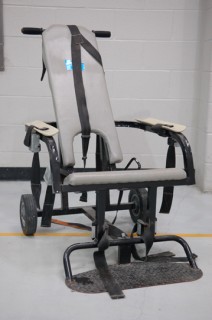
They restrain prisoners in this dangerous chair
Perople have died in this restraint chair -- in Guantanamo, yet they made me sit in one in Manchester Hospital in Connecticut, 2009

Some memories are returning. Not a great many but this one was triggered by something I heard briefly on television the other day, simply the mention  in some other context, of the words “restraint chair” and in an instant I flashed back (and I use those two words advisedly, since I do not actually know what is meant by a “flashback”) on something that happened when I was a priso…excuse me, patient, albeit involuntary, at Manchester Hospital in the fall of 2009.

This had been an extremely brutal stay up till then. When I was admitted the psychiatrist I was assigned to Dr BZ — I have written of this elsewhere so I won’t recap the whole thing, as memory is fickle and I may have misremembered it by now — stopped most or all of my meds, saying that if I was there, clearly they didn’t work. Then he swore I would take the one drug I refused to take: Zyprexa, and he scheduled a forced medication hearing, which naturally I would lose, having no power and only my word against his as to whether or not I needed it. Well, I did lose it, but inexplicably, and sadistically, instead of forcing on me a drug that by all accounts helped me, he changed this to TRILAFON, an old drug that did nothing for me and only made me completely miserable.

The upshot was that every time they came to me with medications, I flatly refused to take the Trilafon, even under the threat of a Haldol injection, The goon squad was called, and since I refused to quietly accept my punishment, they assaulted me, stripped me, and  forcibly injected me. This got to the point that they started four point restraining me to the bed, just to inject me…And it because such a routine that to avoid the “tiresome process” of getting out the restraints they simply left them attached to my bed. I know this not because i remember it but because my friend Josephine told me she saw them.

Me? I was so snowed by Haldol most of the time, that I could never even find my room, and had a sign in large letters taped to the door so I would simply recognize it when and if I managed to find it. Also, I was so dazed that I had to wear red slipper socks as a fall risk…but no one ever decided that maybe this was due to the drugs they were giving me!

Anyhow, one day, one day…and here is where memory kicked in after hearing those awful words on TV: one day the nurse who was most in charge of the daily torment, came to the door with another nurse pushing this large chair, and i recognized what it was at once. I had seen them before, having reviewed a book a long time before for the LA Weekly on the treatment of the mentally ill both in hospitals and prisons, a book, moreover decrying “barbaric treatments” of the past.

“You aren’t going to put me in that, are you? I’m not coming anywhere near it!” I shrank away from them and ran to the other side of my bed.

“We won’t restrain you, not  if you behave. But we want you to sit in it for today. There are no restraints on it now. It is just a comfortable chair. Come, sit down. The student nurse will be with you all day today.”

Then they essentially forced me to sit down and stay in the chair. Or else…I was terrified. and the student nurse knew it. Luckily, she would turn out to be a kind and wonderful young woman (her experience at Manchester almost drove her away from psych nursing, but  as it turned out she discovered Natchaug Hospital, and became one of their most beloved nurses). As she told me later — because memory mostly fails me here, but for her reminders — she did Reiki with me, the practice of nearly touching a person but not quite, and moving her hands along my body, not sure how it works or worked, but she later told me, at Natchaug, that I responded well to it, and stayed calm all day. I even as she said, took my meds. Which means I actually swallowed the Trilafon, probably because I couldn’t bear to have another fight in front of her.

Whatever was the case, if Reiki is as I described it, no wonder I responded well, as it was a NON-physical therapeutic way of dealing with me, non-assaultive, gentle, non-trespassing and non-brutal. Why the rest of them could not have followed suit or come up with some other way to treat me as she did, I will never know. Clearly they learned nothing from her; she left and likely they are back to treating others as they did me.

I believe they would indeed have used that chair as a restraint chair on me. I do not think they brought it in just as a comfortable chair, I believe it was to intimidate me, to cow me, but I think too that they were in fact prepared to use it. I do not have the slightest doubt. I would put nothing past those people who so brutalized me as to put me in four point restraints over and over during more than 8 days. For all I know it might have been more than eight days. I simply do NOT know, as amnesia has sealed up much more than memory preserved.

Enough for now. I need to write tomorrow about the Versatile Blogger Award that DogKisses gave to me. I am shamefully late in thanking her. And I do not know how to place the badge on my site, but she was such a lovely blogger to do so, that I do owe her her own post of thanks and appreciation.

More tomorrow.

Shock Treatment (ECT) in 2004

(Edited in 3/2012 . Note that all names have been changed back to their originals except for names of the people involved. Although in Divided Minds, we were forced by the publishers to disguise everyone, including the hospitals, here descriptions of people once  changed to “protect them” have been undisguised. I write nothing but the truth as I remember it — I wrote a fair amount in my journals at the time and I referred back to my notes there in writing this — and I intend no libel in any event. In fact, I want to be as fair as possible and to bend over backwards in giving as much credit where it is due as possible.

Note, because many may have read this before, I want to

I hope this will be a chapter in BLACKLIGHT, my second memoir and a possible sequel as it were to DIVIDED MINDS.

The Ogre Has ECT: 2004

I am delivered like a piece of mail to the Hospital of St Raphael’s, on a stretcher, bound up in brown wool blankets like a padded envelope. It’s the only way the ambulance will transfer me between Norwalk Hospital and this one. The attendants disgorge me into a single room where de-cocooned, I climb down and sit on the bed. All my bags have been left at the nurses’ station for searching; this is standard procedure but I hope they don’t confiscate too much. An aide follows me in to take my BP and pulse, and bustles out, telling me someone will be back shortly. I sit quietly for a half an hour, listening to the constant complaint of the voices, which never leave me, sometimes entertaining me, most of the time ranting and carping and demanding. A thin, 30-something woman with curly blonde hair, residual acne scars that give her a kind of “I’ve suffered too” look of understanding, and rimless glasses knocks on the door-frame..

“May I come in?” she asks politely.

“I can’t stop you.” My usual. Don’t want to seem too obliging or cooperative at first.

“Well, I do need to take a history, but I can come back when you’re feeling more disposed…”

“Nah, might as well get it over with.” Then, nicer, I explain, “I was just being ornery on principle.”

“What principle is that?”

“If you’re ornery they won’t see you sweat.”

“Aah…”

“And they won’t expect you to be medication-compliant right off the bat.” I shrug my shoulders but grin, I want to think, devilishly.

“I see you have a sense of humor.”

“You should see me…”

“I’m sure we all will. A sense of humor is very healthy. But it worries me that you already plan not to take your meds.”

“I’ll only refuse the antipsychotic. Look at the blimp it’s turned me into.” I haul my extra-large tee-shirt away from my chest to demonstrate. Fatso, Lardass! Someone snipes. She doesn’t know it but you really believe you’re thin. Ha ha, you’re a house! Look at yourself! LOOK at yourself! Ha ha ha ha! The voices are telling the truth: I know the number of pounds I weigh is high, outrageously high for me, having been thin all my life, but I haven’t lost my self-image as a skinny shrimp, so I can’t get used to being what others see. The voices love to remind me how fat I really am. Only the mirror, or better, a photograph, reminds me of the honest to god truth, and I avoid those. I avert my eyes, or search the concrete for fossils, when approaching a glass door. Anything not to be shocked by what I’ve become. Pig! Glutton! It seems they don’t want to stop tonight…

I realize suddenly that I’ve lost track of the conversation.

“I don’t think they’ll allow you to do that for long.”

“Do what?”

“Don’t you remember what we were talking about? Were your voices distracting you?”

“Just thoughts, you know, plus some added insults.”

“You’ll have to take all your meds eventually.”

“Then they’ll have to switch me to a different pill, even if it’s less effective.”

She sucks the top of her pen and looked down at her clipboard. “So,” she starts the formal intake. “What brings you here to St Raphael’s?”

The voices break in there, again, confusing me. When I can get my bearings I tell her what made me transfer from Norwalk Hospital and why I opted for shock treatments. She takes a closer look at the mark of Cain I’ve burned into my forehead, writes something, then corrects me.

“We like to refer to them as ECT here. ‘Shock treatments’ brings to mind  the terrible procedures of the past. These days you feel nothing, you just go to sleep and wake up gently. I know. I assist at the ECT clinic.

“Oh, I know, I know. I’ve had ECT before. I know what it’s like and it’s a snap. I asked for this transfer because I hope it will help again.”

We talk some more about why I’m here and what I’ve been through and the voices keep to a minimum so there’s not too much interference. She says she’s going to be my primary nurse and that she thinks we’ll work well together. I nod, thinking she’s pretty okay, for a nurse.

I’ve arrived after lunch, which is served at 11:30am so someone brings me a tray and I pick at it in my room. People come in and out of my room but only speak to me a second or two before they leave, a doctor does a cursory physical, someone takes me down the hall to weigh and measure me. I return to my room, too scared to do otherwise, constrained by the Rules of the voices. The first break in the afternoon is medications in the late afternoon, when someone tells me to line up in front of a little window near the nurse’s station. When it’s my turn, I look at the pills in my cup. Ugh, 20mg of Zyprexa, an increase, plus a host of other pills I can’t remember the names of. I hand the pill back to the med nurse. I’m not taking this, it makes me fat, I say. Give me Geodon. at least I don’t put on weight with Geodon.

“Sorry, Dr Corner has ordered this one. We can’t just go around changing doctor’s orders. You either take it or you refuse.”

I was in a quandary. I hadn’t even met the doctor and already I was fighting with her? Should I take it and argue with her later? But then I’ll eat my whole dinner tray and more. Better to start off with my principles intact, so she knows what I’ll take and what I won’t take. I hand the pill back. ”Sorry, I won’t take it.”

“If you decompensate further we will have to give you a shot, you know that, don’t you?”

“I’ll be fine.” I do a little dance step.

“Yeah, and look what you’ve done to your face. Come closer.”

Wondering what she wants, I lean in gingerly, fearing her touch, but she only takes a tongue depressor and smears some ointment on the big oozing sore.

“You’re done.Go eat some supper.”

At 4:30? That’s pretty early. I can’t cross the threshold of the dining room, the Rules the voices make forbid it. I cannot enter the milling crowd, suffering little electric shocks every time my body makes contact with another’s. Instead I retreat to my room. Sitting on the edge of my bed again, I wonder what to do. How can I get supper, or any meal, if the voices won’t let me go into the dining room?

Just then, the thin blonde nurse with the glasses, what’s her name, leans into my room. “Aren’t you hungry? There’s a tray for you waiting outside the dining room.”

“They made a rule I can’t eat with other people, and I can’t get in the dining room…So I can’t eat.” I read her name tag. “Prisca.”

She smiles and glances down at the tag on her chest.  ”Oh, just call me Prissy, everyone else does. I hate it, but what can you do? What are you talking about? There’s no such rule. For now, I guess I’ll let you eat in your room, but that  is against the rules and we’ll have to get you into the dining room eventually, whatever the voices tell you.

She brings in the tray: white bread with two slices of bologna and a slice of cheese tossed on top, a packet of mayonnaise, a small green salad in a separate bowl, with a plastic slip of French dressing, and a packaged Hostess brownie for dessert. I didn’t eat lunch, though they brought it in, so even this impoverished repast looks good to me and I eat everything, despite not having taking the hated Zyprexa. I curse myself for it, of course, and do some  leg lifts and crunches for exercise afterwards. Ever since I’ve been refusing the drug, I have lost weight. Now I am down to 155 lbs from 170 the last time I weighed myself and I intend to get much thinner, since I started at 95 before medications over the years slowly put weight on me.

After supper the voices start in again, louder and louder, telling me how fat I am, how disgusting and terrible I am. I notice the clock hanging on the wall, which ticks audibly punctuating each sentence. The voices were carping, now they are threatening, and demanding…Finally, their all too familiar sequence segues into telling me I’m the most evil thing, and they don’t say person, on the planet. I’m the Ogre that ate Manhattan, I’m Satan, I’m a mass murderer, I killed Kennedy and deserve to die, die, die!

I’m wearing a heavy pair of clogs with wooden soles and almost before I can think about it, I know what to do. I heave one up at the clock, hitting it dead center. It crashes to the floor. Scrambling to grab a shard of the clear plastic cover before the staff comes running in, I lunge towards where I saw the largest piece fall, one with a long jagged point. I have my hand closed around it when someone tackles me from behind. He’s not very big and I can feel him struggling to keep me pinned. I almost succeed in stabbing myself, but he manages to engulf my hand with his two and press them closed against the flat sides of the shard.

Other people  crowd into the room now and they pry the shard from me and grab my arms and legs so I’m completely immobilized. Then at a word murmured by one of the male aides who have materialized out of nowhere, they swing me up onto the bed, like pitching a sand bag onto a levee. I scream but they ignore me and strap my ankles and wrists into leather cuffs which have been rapidly attached to the bed frame: four point restraints.

I continue to scream and scream, but nobody pays attention. A nurse comes at me with a needle,  saying it is Haldol and Ativan and proceeds to inject me. Although I am still crying that I want to die, that I’m Satan, the Ogre that ate Manhattan, that I killed Kennedy, I’m the evil one, the room then empties, except for a heavy-set café-au-lait sitter, who hollers louder than I do that her name is Caledonia. She pulls up a chair in the doorway, pulls out a cosmetics bag and proceeds to do her nails in spite of me.

I am told by Prissy that I scream most of the evening and keep the whole unit awake until given a sleeping pill and another shot. All I remember is restless twilight sleep coming at last, broken when a short sandy-haired woman, dressed in a sweater set and skirt, comes in and takes my pulse. I’m groggy with medication but she speaks to me nonetheless.

“I’m , Dr Corner, your doctor. You’ve had a bad night I see. Well, perhaps tomorrow we’ll get a chance to talk.”

“Get me out of these things!” I mumble angrily. I can’t sleep like this!”

“”Not yet. You’re not ready. But try your best to sleep now. We’ll re-evaluate things in the morning.”

Then she turns and is gone.

As I get to know her, I will like Dr Corner for her kindness, toughness and honesty, but I will hate her too for opposite reasons and it will be a long time before I  know whether the liking or the hating or something else entirely wins out.

The first thing that makes me know ECT is going to be different at St Raphael’s than the to the ECT suite in wheelchairs, the way I’ve known since childhood all hospital patients must travel. We walk there, all of us, down interminable corridors, around several corners, through doors to more of the same. In short by the time we get there I have no idea where we are.  I said it was a snap when I had it before, but now I feel like a prisoner going to the hangman, a “dead man walking.” Something about our going there in a group, under our own steam, makes it feel like punishment, like having to cut your own switch, not a medical procedure at all. This sets my nerves on edge. Then, when we finally get to the rooms clearly marked “ECT Suite,” instead of the doctor being ready for us so there’s no time to anticipate or fear what is ahead, we have to wait and wait and wait: we’re told the outpatients have to be “finished up” first. My apprehension grows. I’m used to getting to the ECT rooms and immediately climbing up on the table and getting it over with. Waiting and having time to think about it brings me close to tears.

Finally four in-patients are to be taken. I think the nurse calling us in senses I am too anxious to wait any longer, for she makes sure I’m with the first group. I clamber up on the table, and see Dr Corner looking down at me, smiling. I notice how white her teeth are and the little gap in her shirt across her chest as she bends over me, strapping something over my forehead as Prissy puts a needle into the heplock already in my arm. I feel my arms and legs quickly cuffed down by others in the team, a mask clamps down over my face and I’m told to breathe, breathe in deeply and I breathe and breathe and a chasm in hell opens and the demons reach out and scream as I plummet past into a terrible inky blackness…

I wake up a second later and immediately vomit into a kidney basin hastily held out by a nurse. “Why didn’t you do it?” I cry out, confused. “Why didn’t you do it, why did you made me wait? I can’t go through this again!”

Strangely, Dr Corner has disappeared, and so have Prissy and the nurses that had surrounded me just an instant before. Instead a plump, baby-faced older nurse smiles as she takes away the kidney basin and says, kindly, “You’ve been sleeping  soundly for an hour. They did the treatment already and you’re waking up. How about trying to sit up now?” Slowly, I push myself to a sitting position and swing my legs over the edge of the table. No dizziness, no more nausea. I feel okay, except for a slight headache. So I slide off the table and ask where to go. Surely they won’t make me stay a long while this time. The nurse leads me to a wheelchair and asks an aide to take me back to the unit. Ah, a chair at last. At least I’m not expected to walk on my own after that ordeal.

ECT Takes place on Monday, Wednesday and Friday each week and though I vomit many times upon waking up, that is the least of it. What I dread most is the anesthesia, how I plunge from perfect alertness into the dark pit and feel like I wake a second later, sick and confused. I grow more and more afraid until, at the end of a series of 8 sessions, I refuse to go on to a second, even though my symptoms are still severe and Caledonia comes to sit with me one to one more often than not. Dr Corner tries to persuade me, but I am adamant, No more ECT. Then she threatens to have the next series court-ordered  and to add insult to injury, she says she will force me to take Zyprexa as well, the drug I so hate. I explode.

“What! You f—ing can’t do that! I’m a free citizen, I’m not a danger to myself or anyone else.”

“In fact, I can do it, and I am going to do it, whether you like it or not. You need more ECT and unfortunately you refuse the only drug that is effective for you. Pam, look, how can you say you’re not a danger to yourself? Look at your forehead! That’s not the mark of  I  it’s just self-mutilation. Look at where you carved that mark into your hand when we weren’t watching you carefully enough. Isn’t that danger enough?”

“But I’m NOT going to kill myself. I don’t want to die. I just want to be disfigured so no one will want to be around me and they’ll stay safe and uncontaminated.”

Dr Corner’s eyes suddenly glitter and she has to blink a couple of times. “Well, I’m not going to let you continue to do what you want. Period.”

She was standing at the foot of my bed, one foot on a lower rung, casually holding a clipboard. But she moves closer to me, standing to one side, the clipboard clasped business-like across her chest. Gazing intently at me, she shakes her head in what appears to be sadness.  I’m not sad, I know what I have to do. I don’t understand why she feels this is so terrible, but I know enough to remain quiet. Finally, she turns and quietly slips out of the room.

This alarms me; it shocks me. I know she means what she says. Dr Corner never lies. Worst of all, Dr O’Hayley, my outpatient psychiatrist, has signed off on it well, agreeing  it is the only thing left to do, that already I’ve been in the hospital two months and little has changed, that the situation is desperate. The problem is that to get a court order I have to have a conservator who will agree to it. They appoint my twin sister and they discuss with her whether or not she’ll agree to forcing more ECT on me, in addition to Zyprexa. Despite fearing that I’ll hate her, she too is convinced there are no other options.

So Dr Corner wins and I endure eight more ECT sessions. Finally I’m discharged, much improved, so everyone says, a month later, promising, as a condition of my release, that I’ll continue to take Zyprexa. I do promise, even though my history clearly suggests that I will not.  I’m also supposed to return once every two weeks for maintenance ECT treatments and Dr Corner threatens me with a police escort if I don’t comply. But this time I thumb my nose at her. So, she’s going to get both the Hartford and the New Haven police involved? She thinks they are going to bother to arrest me just to drive me down to the hospital for ECT, something they themselves probably consider barbaric? J’en doute fort. I doubt that big time! In fact, after a call to the Legal Rights Project, I learn that any conservatorship was dissolved the moment I was discharged from St Raphaels and that the doctor has no power over me at all now, zilch. So I write Dr Corner a nice apologetic letter, but sorry, doc, no more ECT for me. Ever.

Several months later I pour lighter fluid over my left leg and set it on fire. So much for the restorative powers of electroshock treatments.

From Memoir Sequel — A Little Bit to Entice?

Maybe not my book, but hands holding her favorite book!

You should know that what follows is just a tiny scribble of what I have written, and it might not even make the final cut once I finish writing the book. But I put it here as a little enticement for readers, a tempting snack to “grow the appetite for more” when it comes out. That said, I must warn that in addition to alerting you that the passage below might end up on the cutting floor, if it does not, it still may not start the book. But here I am hemming and hawing and making excuses. Nothing wrong with posting what I have for now, for the nonce, even though I may remove it later on. Comments on subtitle would be greatly appreciated. If you have suggestions for improving it — the subtitle, i mean — so much the better.

___________________________________________________

BLACKLIGHT:  a memoir of one woman’s fight to recover from schizophrenia

Blacksoup,  tarstew, coffeecombs – submerged in the darkness of things I cannot face by light, inky, skeletal, reaching-out things that pinch and grasp and touch, I fight to swim away, even though away means into a blinding headache. I am sucked down again and then again, until through pounding surf, someone calls my name, almost too faint to hear. Desperate, I thrash upward, cracking the surface of the day and open my eyes. It’s well after dawn yet all the lamps in the room burn brightly.

“Pam, wake up. Unlock the door. I’m here,” someone shouts. The door thunders on.

What time is it? What day is it? I must have plunged into sleep the night before without awareness, for all I know is that I break into daylight like a common mole nosing into what feels like leaf litter and detritus, the remains of an old picnic. Popcorn is strewn across my lap and chair in a white rash.  Resting on its side halfway off the night table, a cup of coffee, now empty, its contents on the carpet. I hoist myself off the recliner with a groan, trying to shake off my shoulders the gargoyles of nightmare. I sleep in my clothes but I never go barefoot –too liable to be bitten by the inanimate fang of a tack or discarded fork– so it takes me a minute before I can home in on my flip-flops.

“Sorry, sorry, sorry,” Wrenching the deadbolt, I yank the door open. “I didn’t hear you. You’re early today.”

“It’s 8:30. No earlier than usual.” Elissa, her dark hair pulled back from her face, carries her big nursing bag and tablet computer. She wears slim, tight jeans and a ruched tee shirt that make her look thirty-five at most, not the forty-something she rarely admits to. She assesses me quickly before coming in and asking, “How did you sleep? And did you eat last night?”

Almost every morning begins this way, not with the bleep, blurt or blare of an alarm, on which I can mash the snooze button. Not even with the sweet sun-rising tones of my favorites song on iTunes, no, my morning begins with this won’t-take-no-for-an-answer Thor at the door. It’s not Elissa’s fault. Sometimes I leave my door unlocked before I cliff-fall into sleep so she can come in on her own the next morning and gently wake me. But not always, and then what can she do but hammer at the doorway of Oneiros, because nothing else will rouse me.

Elissa has been my primary visiting nurse for more than 10 years and she is the one who checks on me every morning, rain or shine, snow or hailstorm. She can read me by now the way a farmer reads the sky, and just one look or something in the tone of my voice tells her when things are copacetic and when they are not. She has seen me well and she’s seen me precariously ill and she’s the first to recognize when I’m somewhere in-between, headed in the wrong direction. Her main job is to keep track of and make sure I take my medications, but when paranoid, I have yelled at her or been snappy and high strung and irritable. She has never taken it personally. I no doubt have driven her nearly to distraction but she flicks all away as no big deal. I must say though that even though I wouldn’t admit it at the time, she has in more than one instance saved my life.

She keeps returning with a smile nevertheless and now instead of telling her how glad I am to see her, I turn away, mumbling that I had a lousy night. It’s true, but I feel like a lout for saying so. Or at least for saying so first thing.

_______________________________________________________

Argh, now all I can see are the faults, but I will leave it as is, and not panic or take it down at once. I have learned that there is no terrible tragedy is letting people see rough drafts or the work-in-progress, though it be only that, a rough draft, not the polished version. If nothing else, it proves that I too am  a human being who must write and make mistakes before editing and rewriting my copy. In fact, I rewrite a zillion times before I am happy with what I have written. Each poem takes at least 20 rewrites, at a minimum, and most take at least 50 while some over 100. As for prose, well, I cannot even begin to estimate how often I rewrite or revise each passage. but needless to say it is well over 50-100!

Not only is there no shame in revision, I take great pride in how much rewriting and revision I do. It is a point of honor with me that I take this much time with my writing and do not hurry it — ever.  People who believe that the first words that come out of their pen or mouth or computer are sacrosanct are likely to not be real writers, only dilettantes who play at writing, but never take it seriously. Who want to write, but who never really do so, except for in the pages of a journal or doggerel between friends and family.

Do not get me wrong, I do not disparage this sort of writing. In a sense ALL writing counts as writing. And all writing is good for a person. But not all writing is publishable or suitable for the public consumption, and that is what I mean by writing done by a “real writer.” Someone for whom writing is what life is all about. Someone for whom life would not be worth while if she could not continue to write. Someone who knows the value of editing and revising and rewriting and who knows that a good editor can a writer’s best friend.

Poems about Schizophrenic Symptoms: Word Salad and Delusions of Grandeur

Poems can express many ideas and experiences. In my first book of poems, We Mad Climb Shaky Ladders, part of CavanKerry Press’ Laurel Books literature of illness series, I tried to express how I felt both during psychosis and afterwards. I also often tried to put myself into the experience of others who experienced symptoms that I might not, but which I could imagine.

One thing I know, having had this illness for so long, is that misinterpretation is rife. I mean things when I do things, just as anyone else does. But people simply make assumptions about my behavior and forget that they might need to ask why I do what I do. I have often asked others why they did whatever strange or seemingly outrageous thing they did, and lo and behold there has always been an understandable rationale behind it. For instance, when I stripped naked in that freezing seclusion room, I was neither “acting out” nor totally around the bend, no, my reasoning was that if I were naked they would have to give me something to cover myself with, i.e. a blanket, which is what I had been begging for all along. But they never asked me why I had taken off my clothing — a flimsy tee shirt and lightweight jeans. They just assumed — whatever they assumed. Ditto for almost every other interaction I had with them, and the same almost uniformly went for other people when they behaved in a way that was somehow contrary to expectations. The meaning of their actions was reasonable, given the context.

I tell you this because in my poem, Word Salad, even though it appears to be, well, “word salady” and incomprehensible, in truth there is “method” to it, and in fact if you read it with a mind towards understanding the links, you would appreciate them. But you might have to “surrender” to getting it, and let it in without trying to rationally, intellectually understand. Only afterwards could you perhaps try to figure out what precisely is being done and said in the poem. One clue you might need, if you have not been subjected to this directly is that often, at least in the past, “patients” of a certain kind were asked to interpret proverbs. “Can you tell me what, ‘A rolling stone gathers no moss’ means?” or “What does ‘People in glass houses shouldn’t throw stones’ mean?”

As for Grandiose, the same thing holds. Read it aloud and try to get the sense of it, how it reads. Then you may in fact understand what is going on “in one blow,”  so to speak. It is full of double entendres, on purpose. Remember that “live” can be pronounced in two ways. Both of these hold.

WORD SALAD

“Word salad,” a term used for the completely disjointed, incomprehensible language sometimes seen in schizophrenia

Unpinned, words scatter, moths in the night.                                                                      The sense of things loses hold, demurs.                                                                     Everything means. Numbers soldier
with colors and directions, four by four
in a pinwheel: this is the secret wisdom.
I inscribe it on sacred sheets of paper.
The Oxford Dictionary holds not a candle.
The self reduced to a cipher, a scribble,
the Eye is all, with a Freemason’s lash,
and 26 runic hieroglyphs to share
how a stitch in time saved the cat
and if a messy rock gathers no stones,
clams must surely be lifted higher
by the same rising boats. Why, why not throw
glass tomes at grass huts? It is a question
of propriety: grass is too dignified to lie down
before gloss. Whirligig! How to pull the center
back into the world? It would take all
the OED to recapture the moths, all Harcourt’s
English Grammar to pin them again.

GRANDIOSE 

He says:
I was always more important than you though
with your cutting me down to size quarrel
about just who I thought I was. I thought I was
with my long dark hair and beard and rough
working clothes John the Baptist, prophet of God
wild man of the wilderness and would have
to preach the word of a savior I didn’t quite
believe in. I mentioned my conviction to a friend
who told me to make friends with a mirror,
discover which John I really re-incarnated. Lo,
I looked and saw the more famous than Jesus
John staring with his small important eyes
behind his too small eye-glasses at me staring
into the mirror at myself, yes, I wrote the songs
you grew up on: Yesterday, Give Peace A Chance,
Eleanor Rigby— yes, I was the one you swooned
over and screamed for, yet now you only shriek
at me, taking me down from a peg on the wall.
Why do you yell, Get lost, baby? Imagine all the people
who would rejoice to see me live once more.

Psychiatry and Authority: Restraints Update


I want to update my “On Psychiatry and Authority” post, especially about what they did to me at “MIddlesex Hospital, which I can now do with more accurate data. I gleaned a lot of the following directly from my records, meaning both the nursing and progress notes and the “event” notes, which should have been written after each and every incident in which they felt obliged to use measures against me involving involuntary seclusion or restraints, including such things as: physical/bodily/painful holds, physical/bodily/forced escorts, physically preventing me from leaving a “time-out” room, i.e. a seclusion room, as well as a locked door seclusion or the dreaded four-point restraints . I have also used my own journal writings here as counterpoint, some entries of which were penned as soon after these things happened as possible — that is, when I could obtain a writing implement.

The first time I wrote about the particular incident I focus on here, I did not understand why I was naked. Having read my entire medical record from the stay, I now understand more about what happened, so I will start this account where it really began, somewhat earlier in the day. Also, and this is important, while they perpetrated a criminal act on me in this incident, there were others later ones as well. During those, I am described in words that make me sound as if I have gone something near berserk…though not in those words of course. Now, there is no context given, nothing is said, not a word, of what the staff is doing TO me or with me at the time that I am going so wild, but nevertheless, the chart describes me as biting and kicking and screaming and peeing on the floor and smearing urine all over the walls…and then there are repeated use of restraints and locked seclusion where neither were “necessary” and were always destructive and traumatizing. Well, unfortunately I have no journal entries after that first time. Why? Perhaps because by then they had drugged me up on Keppra (having decided I could not take the 2 separate ones I came in on though they worked fine and without side effects ) an anti-seizure med that made me so dizzy I literally could not walk, and my vision so blurry that I could not write even if they had not prohibited the use of all writing equipment. So I can recount here only the most egregious incident, the one that I believe triggered for all the others that followed, the one after which “all bets were off” as to any future “behavior” on my part, and from which I emerged so traumatized that I didn’t give a hoot what they did to me after that…

Before I get to  it though, I want to briefly recap where I am in my struggle to recover from the trauma that this stay at Middlesex Hospital occasioned, which only increased the trauma already inflicted 6 months before at Manchester hospital. Up until the night before last, as you know, my state of terrible upset had been growing worse and worse, so that I’d gotten to the point where I could scarcely think about my 6 week stay at Middlesex without becoming nearly hysterical with trembling and anger and anxiety and terror all mixed up together. I  felt as if death impended, my heart pounding wildly,  fear screeching like a car swerving at high speed until it nearly hit a bridge abutment. Every night, every day it comes back even now (new edits 3/2012) as if happening again. Then one night, I wrote the blog entry about Trauma and Acceptance, and I began to try to think about things differently. I realized that I could parcel out thinking about Middlesex little by little so the trauma of it didn’t have to eat me alive. I realized that I might be able to save my sanity, and spare my life from total destruction at the same time, if I decided to accept what I could not change, the first step of the Serenity Prayer.

Wonder of wonders, after two days of not letting the trauma appear on my radar screen, except insofar as I gave a talk about it for the Farmington, CT, NAMI book club last night, which included reading the Acceptance blog entry as its conclusion, I have made an astonishing discovery. Up till now I had had almost complete amnesia for the Middlesex hospitalization. However, it seems that as I remain or try to remain calmer, certain episodes are coming back to me. Not fresh, not by themselves, no, but when I read in my journal or even in the records something that I did not recall on my own nor even believe was true it feels, well, possibly real, and I can just begin to “get” a sense that indeed it feels familiar, that perhaps I did do that, did say that, that it did happen, even if I would not have remembered it without the journal jogging my memory. I am wary of induced false memories, but in this case since I have records of the bare bones of what did in fact happen, I have to try to trust that at least some of what I am retrieving is not pure confabulation woven from only my imagination.

I cannot bring my mind any further down that memory path yet. But I suspect now that I formed some memories after all, that they are simply buried for some reason, and that perhaps the trauma and fear have kept them from me. Now that I can relax a bit and not feel so angry and terrorized by my amnesia and by the one clear memory I have, perhaps some, if not all, will slowly return. Since I prize my memories — they are all I have and without them I have had no life, — I want them back, as many as possible bad as well as good.

Now let me continue on to the account of  Middlesex hospital in late April, 2010 and the first time they put me in 4-point restraints.

During the MD visit the morning before, Dr N wrote: “Patient later ..(?) ..to me that she didn’t trust anyone, that no one wants to help her and she is being punished by staff. I repeatedly said that she is not being punished and she is projecting….Patient escalating tension with staff. Rigid. Wants to die. Wants to sign 3-day paper to leave.” (It is not clear what he means by “later” — did he write this after the episode of restraints, when I did in fact tell him that they punished me? It seems likely. IN which case he did not listen to anything I said…)

RN note 1:30 PM: “Alteration in thought: Patient continues on constant observation. Continues negative, irritable, testing limits. Refused initially to shower, then changed mind and agreed to, then wanted to walk out of shower into dayroom naked. Agreed to dress after informed security called to unit…”

About these notes: one, what was I projecting in thinking they wanted to punish me? What? And it is typical that Dr N blamed me for “escalating tension” with staff. I wonder if he ever saw how they worked, saw in action the mechanism by which they’d cause an  escalation. 2) Most likely, in this case, I was threatened that if I did not shower I would not get off 1:1, so I “changed my mind.” And it seems to me that if someone “wanted” to get out of shower and walk into dayroom naked, it is a matter that the nurses could handle and ought to. I weighed all of maybe 98 pounds then. And if they had closed the door and made me dress, they could have. Why call security unless they wanted to threaten me, terrify me? That was neither compassionate nor caring. Methinks it was, aha, punishment.)

Moving right along…

All the details  that follow are “accurate” insofar as they are derived from official documents or my journal. Accurate in that sense. But remember that in the records, NO context is ever given, the behavior of the staff is rarely described, or only in the briefest and most self-serving ways. NO context is even given to MY behavior.

The nurse who wrote up the night’s notes says that I was angry the entire evening and demanded continuously that she call the on-call doc to discontinue my 1:1 status.  For some reason she writes that I was “unable to follow directions” when she tried to assess me for, I presume, safety, perhaps so I can get off 1:1. I don’t know what she is talking about here, but it is typical that the nurses cared only about a patient’s taking orders and following directions.

Anyhow, at around 7:30, she wrote that I “walked into the dayroom” and according to the RN notes, without any provocation (which is highly doubtful) began shoving and turning over chairs and then picked up the patient trash can and put it over my head. Although at that point the staff told me to “walk with them to the “time out room” I refused and “went to bed instead.” (That was written in the chart: I WENT TO BED INSTEAD.) Now, you would think that this would be fine, after all, would not they want me to go to bed and calm down? But no, I had not “followed directions” and so of course “security was called and patient required security to carry her to time-out room as she refused to move or walk.” Remember that this “time-out room” is exactly the same thing as the “seclusion room” — it is the same room, with the same “withouts” — without heat, without windows, without anyone to talk to, without blankets, without a toilet, without anything to make one comfortable…just a thin mat on the linoleum floor, unless they have taken it out. So they barged into my room where I had gone to calm myself down, and picked me up bodily and carried me to the seclusion room. That means by definition that they physically restrained me and physically, forcibly escorted me to the seclusion room where they prevented me from leaving, all of which are NOT permitted except in the case of “severe and imminent danger to self or others”…(so an event note should have been written up and a physician’s orders should have been gotten). There I took their Ativan and was told that I had to stay in the room for 30 minutes.  Why not in my own room for 30 minutes?  Because time spent in the time-out room is a punishment. Parents make children stay in a time-out room (usually their bedrooms!) when they don’t obey. Why? Because that’s their punishment. But staff doesn’t punish. No, they don’t punish…

Now this is how I remembered it the next morning in my journal: “I had been told to go to the time-out room, which I did voluntarily…” (apparently I did not remember that I had been physically carried there, but there is some confusion in the records too, because I went and then left and then was carried back…). “But it was cold and they wouldn’t give me a blanket so I didn’t stay long…This only led to more goons pushing me back into that cold and sterile room, this time strong-arming me and forcing me to a seated position on the mattress before quickly leaving but not locking the door.”

The nurse wrote it this way: “Patient refused to stay in time-out room, attempted to shove staff, kicked at staff to get out of room. Patient was instructed several times to sit on mattress and stop pushing at and kicking staff. Patient refused. Seclusion door locked at 7:55pm…”.

At this point both records agree that I stripped off all my clothing. But the official records state only that fact, and that I “was changed into hospital garb” but in my journal I write something entirely different and rather revealing: Left alone in that cold and sterile room, I decide “they’d have to give me a blanket if I was [naked] so I quickly undressed and just hid under the mattress for warmth. This caused a stir for some reason and I was forced to put on hospital pj’s and lie down on the mattress. This would not do, not without a blanket which they continued to refuse me so once again I got up and tried to push through the woman barring the unlocked door. She called for reinforcements and they came en masse. (Note: I spelled this “unmasse” — a dyslexic spelling of the first order. This is a symptom of my acute neuro-Lyme disease, since I was always a first-rate speller and would never have had difficulty with “en masse” had I not been in the middle of a flare up… as they knew full well).

“At this point” my journal continues, “they again subdued me and told/asked me why I was fighting. I said [it was] because i needed someone to talk to. That was all I wanted, just someone to talk to. The security guard seemed taken aback. All these personnel hours wasted when all I wanted was one half hour of one person’s time? It seemed to strike him as ludicrous as it did me….

“Why don’t you just ask to use this room when you feel anxious or upset?” he then asked me.

“I do, I have!” I replied

“Well?

“They always say it has to be reserved for an emergency.

He seemed completely flummoxed by that reasoning but there was no arguing with Policy so he fell quiet. Finally they decided to leave, telling me to be quiet and lie down.

I did. I did. But I was cold and I begged for a blanket.

“Sorry, it is too dangerous. You will have to sleep without one.”

That was it, I’d had enough! I dashed at them head first and they parted, only to grab my arms and try to stop me. Someone twisted my right arm and held it behind my back, but I knew how to get him to stop it, so I tried to bite him and he briefly loosened his grip. I twisted my own arm back to me and my left pinky, held, closed tightly onto something, hooked so tightly it wouldn’t budge. My legs, the right one, grabbed the thin leg of a woman behind me, making her lean back off-balance and lose her grip on me. Then I switched to holding both my legs in a death grip around the legs in front of me. It didn’t matter one iota that [I had taken off my clothes again to get a blanket and] was naked…Anyhow, they eventually overpowered me and got me onto the hard floor, my cheek on the dirty linoleum and breathing dust. At first I struggled but then I realized that the less I did so, the less they applied pressure (there must have been six people or more holding me face down on the floor,  one of them practically sitting on me…).

Finally I stopped resisting and they let me sit up, finally giving me a blanket or sheet to cover myself with. The room cleared as everyone left except for one nurse, who was on one to one with me. She apparently was now allowed to talk with me and we conversed calmly. The door to the seclusion room was also now open.

However, there was some soft talking outside the door and I heard someone walking down the hall and opening a cabinet. I had a bad feeling about it and asked the 1:1 nurse what was going on. “Don’t worry. They are just getting you some meds or making up a bed for you.”  This gave me a very bad feeling, and I suddenly understood what was going on, “Uh uh, they can’t put me in restraints, I am calm and it is illegal to restrain someone who is calm. You know that.” I said that again loudly, loud enough so whoever was down the hall could hear me.  I began to tremble, but forced myself to remain as composed as I could. Another staff member then came into the room and asked me to come down the hall. Did I need an escort or could I do so myself. “Oh I can walk by myself. But you can’t put me in restraints, I am calm and it is illegal.” Nevertheless, I followed her to the empty room — I felt like “dead man walking” when I saw indeed that they had fastened restraints on the bed. The room was filled with staff members and security guards. I told them over and over that I was calm and willing to take PRN meds. I said I knew they were punishing me and that they knew it too. No one said anything except to reiterate that they would assist me if I did not lie down on the bed myself. I was so terrified that they would assault me and hurt me, terrified of the fear itself, that I simply got it over with, lay down on the bed, naked, and let them do what they wanted to do, gritting my teeth when they removed the blanket that was covering me. Well, here is what I did not remember, the account after that from my journal:

“Well, you know that despite my complete lack of resistance, they shackled me 4 points (badly as their restraints did not actually fit the bed — restraints are supposed to keep the arms at your sides not below the level of the bed, and your legs are not supposed to be spread-eagled! I protested this fact but not so loud as to disturb others [when they released me] my back hurt so badly I could barely walk and once more my scapula muscles felt as if they had been separated.”

“I plan to sue you for doing this to me.” I said calmly to all as I left the room. Nobody reacted…I woke in severe pain, the muscles in my chest felt torn from those that connect it to the shoulder, the pain went clear through to the scapula.”

Nursing notes were rather different, and I think were written after the fact, and hastily, perhaps not exactly ‘fact-checked” for accuracy after all. [Did a family practice doctor really see me? I do not believe so…why else would I not tell anyone about the pain, which she reports as non-existent.) But here is what she writes about the “scuffle” in the seclusion room:

“Patient was changed into hospital garb which she also stripped off. she demanded a blanket which was not given due to concerns about her tying it around her neck. [Note that I was ALWAYS under one to one surveillance!] She was encouraged to put the johnny back on and she refused. After staff left the seclusion room, patient placed mattress over herself where no staff including her 1:1 could visualize her. When staff entered room and removed mattress, patient again darted toward staff and attempted to flee. Pushed at staff, then kicked at staff, and attempted to trip staff  wrapping her legs around RN’s leg. During the scuffle patient ripped bandage off her leg and yelled, “I have AIDS. I didn’t tell anyone that before!” She refused to remain in locked seclusion without attempting to harm others. Patient covered with sheet and walked to empty patient room where 4 point restraints were applied. Patient continued agitated initially then was quiet lying still.” [Patient can come out of restraints when able to refrain from aggressive behavior towards staff and property and can follow directions.]

Now you get the picture. I was put into restraints as punishment, but as an excuse for it, they made up a reason, which is is how I can get out of them: stop being aggressive towards, 1) staff ( remember who dragged me into seclusion room? I had gone to my room and they dragged me out of it just to teach me a lesson in the punishment room! 2) property – I was a danger to property… I do not think somehow that danger to property is one of the reasons a person can be put in restraints in this state or this country. And the danger was that I had put a wastebasket over my head! 3)  following directions, well I won’t even go there. Just look at those “justifications” for keeping me in restraints and you will see just why I know they “had it in for me” that particular episode, but in fact were trying to get me most of the time I was there.

Be that as it may, I have contacted the Commissioner of Mental Health, and hope to contact the Office of Protection and Advocacy, which oversees the private hospitals in the state as opposed to the state hospitals, though I do not see why the commissioner is not involved in any hospital that takes state money, as all the private ones do…And seeing as I am a Medicaid patient when hospitalized, I would be a state patient were it not for the private hospitals being forced to take such patients in this economy, whereas years ago they could pick and choose, and did.

Finally, the MD’s “event note” observes upon exam in the restraint room that  the patient is “generally agitated, very verbal, lying in bed with the help of staff and security to calm her down…” I beg your pardon? Calm her down?! I was being restrained, one, and two, I was being tied to the bed with my arms over the edges of the bed, below the level of the mattress, and my legs were spread-eagled –I was naked, remember? and all of them knew it.

So that is all I have to write tonight. I am appalled. What sort of people could do that to anyone? Who were they once, and how did they become so jaded and cruel? Surely, as nurses, they must have once been idealistic and good-hearted and compassionate. Most people who go into nursing are and I doubt that many go into it for the money or for any other reason than that they care about people. I simply have never met any young nurse who was not idealistic and caring, but I suppose there might be one or two. So what happened to this group? Could it be their own “society” is not supportive, is backbiting and so lacking in cohesiveness that they take out their own frustrations and lack of positive feedback on those patients who least please them?

I dunno, I have been told that this mechanism is sometimes at work on units where staff behavior is out of control in such a way. But what made them in fact so much into control and coercion at all? Why were they not themselves empowered by compassion and kindness, which would have fed them better as it fed the patients better as well? How did it come about that they learned the wrong lessons? I don’t know, and probably will never know. But I did catch a sense of these strengths in one or two of the nurses, just buried in fatigue or long ago burned out…

Too many were too personally invested in the patients liking them or in behaving for them in such a way that made their jobs easy! That was stupid and nonsensical. Why should the patients have to be or do anything for the nurses? The patients cannot control their illnesses and staff forgot that in their own need to be in control and to have their own need met by their patients. I think  that is what it comes down to: at Middlesex, the staff’s needs were not being met by each other, or by the supervisors and colleagues, so they looked outward, and who did they expect to meet their needs but their patients, who could not, and could never do so. So they tried to make them, force them to. Or at least to toe the line and make each day quiet and easy to get through. What a farce. What a lousy place to be sick in, what a sick place to try to get well in…

That’s enough for tonight.

Artwork and a Word about my Self-Portraits

I wanted to write a bit about the artworks that I posted yesterday without any explanation. The first one was the only one I planned in any sense of the word, and even then I cannot say I really knew what I was going to do when I started it. My process in these drawings is to simply start with an image, say, in the first one, I started by drawing an eye, and then to see where my subconscious takes me. Once I have established enough  images  – just a few usually — that are coherently related to one another on the paper (or not) then I look to see what is in the “negative” spaces, which fill up with images too. You can see this most clearly in the middle  and third works.  I know how the pictures were made, since I drew them, but in looking at them objectively now, I can see that an observer might not see anything conspicuously “unintended.” And of course, what does “unintended” mean when it comes to the subconscious?


But in the picture I will post below, this “technique” if you will, predominates. (You either like it or you hate it) I hesitate to call it a technique because that sounds like something consciously adopted, where I feel it simply reflects an unconscious change, something that happened co-incidental with Joe’s final days and then took on a life of its own after the trauma of his death. But let me post the picture I am talking about, the one that I started on the very day they took him off the ventilator, and then I will continue.


Death comes in brilliant colors -- look more closely to see what is there.

All I can say about this is that a person here is cutting the cord that is connected to a heart and a pot and is not plugged in…and the person with the scissors is a little excited by this in a way that implies pleasure…I am saying no more, except to reiterate that I drew it, or started it the day Joe died or more accurately was killed.


After that, I started doing more and more “honest” pictures, pictures where I did not try to please anyone, but was simply drawing and painting what I felt like. The next one after this one was the Beauty SLeeping with Bugs one, which was in the post yesterday. And then the self-portrait series, which began with the earlier Dead Meat one, Goon Squad: First Responders. In that notebook, I endeavor to draw only “self-portraits” though not likenesses. I am not sure what to call them, conceptual self-portraits perhaps? The second one is a very loosely drawn portrait of me as an animal, done in a different sketchy style (I haven’t photographed it or I would post it.) The third is Pam as Ornament, which I will post below, and once again I had nothing in mind when I started it, except the concept. The Santas came out of nowhere, esp the one that is only a head on a tray!


I guess I have nothing more to add for now.


I have been working on my memoir, which I have tentatively titled “BlackLight: a Memoir of Madness and One Woman’s Struggle for Recovery” — so far after only about 5 days work I have 27 pages done (more, really, just not organized and polished). Would be happy to hear any comments or suggestions for a better title (which I believe is a request I have made previously).


Thanks all.

Brad P. Olson’s New Poem: a Must-Read

I loved this small gem of a poem, which I hope Brad doesn’t mind my stealing off his site and posting here. It can also be found at Brad’s site:  http://bradolsonwriting.wordpress.com/

The Day You Were Born

For Grace

The day you were born

I held you swaddled
in the crook of my arm.

Now, 10 months later,

you turn your head
as I try to wipe your nose.

I could hold your head still,

but, to do that,
I’d have to put you down . . .

I don’t look forward to the day
when you’re too grown up

to carry from one place to another.

© 2011 by Brad P. Olson. All Rights Reserved.

The Painted Woman, Poem for 350.org, plus yada yada

My newest artwork is what I call The Painted Woman, for I think obvious reasons.

The Painted Woman, in all her glory

It is not meant to be a parody or an insult to any sort of woman, just a study of an overly made-up  “older” woman who might drink a bit too much and get loose around the edges when she does. I think it is clear that she has had plastic surgery, though it hasn’t done a lot for her, with  her artificially plumped lips, which do not work at all with her boozy aged face that the exaggerated make-up only serves to enhance in the worst sense of the word. If her botoxed brow doesn’t disguise her real age, neither do her drawn-in eyebrows, which is something women do that I never did understand: Isn’t any sort of eyebrow better than the kind that are just a line drawn or painted on? even Frida Kahlo’s eyebrows!

Frida Kahlo, with her eyebrows, of which she was NOT ashamed...She was proud to paint them and did so without shame or trying to disguise them. In fact, she even painted herself with the mustache...

I love those eyebrows, full of character and strength, and the portraits, which could be seen as brave and wonderfully lacking in vanity,  I prefer to think Kahlo painted because she saw herself simply as beautiful, eyebrows and mustache and all, and painted herself on that account, not at all “in spite of” her flaws…

That said, I do not believe that my painted woman is beautiful, perhaps for much the same reason that I hope Kahlo felt herself to indeed be beautiful: this, my pictured woman, is not only artificial, she is desperate, pathetic and even tragic…I feel sorry for her, who is, after all, my own creation!

_______________________________________________________________

All that aside, the reasons that I have not written are several, including my having to get that poetry book manuscript rewritten and out by the 15th of October (not that I have a chance to win a contest that is judged non-anonymously, but it does no harm to try, so long as it doesn’t tie the book up for the next 6 months…). Then I had that Life Drawing class at the Creative Arts Workshop, which is still difficult for me, partly because I cannot see well, and cannot translate what I see to a large piece of paper on an easel…I don’t have any difficulty with the gestural drawing, the loosening up exercises, actually, I have more difficulty with the longer drawing periods. The trouble is that I do not want to take the time to do a drawing for only 30 minutes that I know I cannot do in that short a “long” period, and also, I find it hard to stand on my feet for that long. The class is 3 hours long in fact, and all of it is standing at easels, while when I do my portraits I mostly just sit in my recliner or at a table with my paints and canvas on a table or at most at a little broken table easel that I bought at the CAW tag sale and fixed myself.

Nevertheless, it has been a good experience, if exhausting.  I drive to New Haven then stay overnight and drive home on Tuesday morning. So the night spent away from home feels like a big deal every week, not just a mere evening away…though I could treat it as such, I suppose.

ALSO, Dr C wants to see me twice a week for the time being — actually for more than just “the time being.” It is a very complicated situation that I cannot go into here, but this 2X a week set-up may not continue, I dunno, I would like to, and I know it kept me out of the hospital in October, but but but…I am simply getting very mixed messages from certain people (decidedly not Dr C) about it, and it is hard to know what to do. I sometimes think that it was easier for people to have me in the hospital twice a year, despite their protestations, than to keep me out if keeping me out entails my seeing Dr C 2X a week. It is certainly less expensive to hospitalize me, since it saves money coming out of their pockets ( I am not a drain on the “system” otherwise, because I do not need public mental health services or ask for anything from those strained agencies, for which fact they ought to be grateful…though not for my hospital stays, of course).

But no more on that subject, which is utterly confusing to me and frightening to boot. I cannot bear the thought of ever being forced into a hospital again, where I am ALWAYS ABUSED and BATTERED by the staff, despite being tortured by myself and my own demons already. Even thinking about it makes me tremble…

Will be returning to Wisdom House in two weeks, for another weekend. I hope to write some more poetry, and perhaps “fix” the ms, by writing up an introduction and putting in some divisions between groups of poems, rather than the vague segues I have now. I thought  they were obvious, but others do not seem to “get” why one poems transitions to another…So I will group them better, and put what feels like artificial divisions between them. That way, readers will feel there is some shape to the book, a clumping, rather than a thread that one must follow…

There is much I would like to say, but it is already 2:45 in the morning, so I needs must cease and desist and get to bed. I will try to write as soon as I can, but if nothing else, I promise to write when I am at Wisdom House on the 19-21 of November.

The following is a poem I wrote last year, and put one version here then, after I went to a vigil for the organization 350.org, a website devoted to the cause of getting our atmospheric CO2 levels down to 350 parts per million, because that is the level at which life continues to be possible…whereas if we continue to let it go up, global warming will continue to such an extent that life on the planet will be impossible.

But that said, here is the poem, for what it is worth. If it sounds familiar, it is, but I have also reworked and changed a lot of it…


FRIDAY NIGHT VIGIL

Shivering in the wind, we fight to light our candles
as we gather in the darkness of an approaching storm.
But the icy blow keeps snuffing out each flicker
so we just stand, our signs alone aloft to passing traffic,
standing for the stand we take: for the changing world,
for a last chance at change. We smiling stand for photos,
taken from across the streaming street –
and smile into the night, display our handmade signs.
One car beeps, a driver gives the V-sign in support.
But most drive on without a single word or sign
that they have heard or seen a thing, or even recognized
we’re standing here for something save a hopeless cause.
My hands freeze stiff, release their glass and candle with a crash,
a glint of shards, a splash upon the sidewalk. Someone
with safer gloves stoops to sweep the shards away…
I think, How lovely is the world today, even dying.
Though it’s all we have (and lord knows, it’s more
than we can handle) we stand here in this freezing dark
against the darkness and light one candle.

African American Woman — FInished Drawing

Sophronsie in white hat

This is how the final version of the unfinished sketch that I posted below finally turned out. I managed to print out the photo of the sketch using a photosmart inkjet printer and watercolor paper, spray that with fixative so the ink wouldn’t smudge under erasures, then draw on top of it as if it were indeed my original sketch. In such a fashion, I was able to re-complete it “better” as it were than the original “wrecked” version. And indeed, I believe it is a great deal better than the version as shown below, for all that it is a complicated combination of photographic print-out of the original sketch, combined with an overlaid color pencil drawing. The strange thing is that in the end, because of the rather poor quality of the original sketch-photograph, the background came out this dull, slightly  green color (due to the lighting, not the paper it was on, which was actually white. Nevertheless, it turned out to be a perfect background for the finished drawing, and so I did nothing in the end but finish the portrait against that greenish background.

A technique I am learning/teaching myself is  one I thought I would never understand, let alone be able to do and that is how to do a kind of underpainting of whites or light colors, the highlights, before adding the darker tones.  I do not know, of course, if one is actually supposed to do that with colored pencils, but I did so anyway, figuring it might be time to try it. So given the original sketch to work with, I then heavily applied light peach and white tones where you can now see the lighter areas on the face, and only much later softened them with the darker chestnut browns and darker umbers, though clearly much peach shows through where the light is meant to strike the face on the left.

A  “real artist” would know how to do this beforehand, I expect, but I had to learn as I went, so it was all a process of delightful discovery, which is why I hope you will forgive me the foregoing description. It always amazes me to find out how many colors there really are in what seems to be a solid colored expanse, when you really look at it. I used blues and greens in Sophronsie’s skin tones as well as the peach-tones and whites. There are also some yellows and reds. And in some places I even used a silver pencil. It took me a while before I could even understand that the whites of the eyes are not white at all, not even slightly blue all over, but all sorts of colors, and that only if you painted them in a kind of pale multi-color would they begin to seem realistic. What is also interesting is that comparing the “white” skin on the child that I did in the earlier picture, or any of the other “white” portraits compared to the African American portraits, there is really not a great deal of difference in the colors I used. In fact, I start out with the very same peach and white for both skin colors, and only towards the end does this change, when I add darker tones for the darker skin, but it really only takes a little, and then not a great deal. This is so striking because it seems to say, in some profound way, that when you really look at all of us, “under the skin” (which skin people take for being so different) we really are all the same.  Of course in every real sense we are the same, despite our differences as individual human beings: genetically this is true, and philosophically, and morally and spiritually and in every other sense that matters, at least to me. We are all human and of the same “stuff” and nothing else matters. Nothing.

__________________________________

(There are not supposed to be any gaps in the following poem but for some reason it doesn’t cut and paste as it should and so it appears with the spaces…ignore them..)

HOW CAN YOU EVEN THINK SUCH A THING?

There’s no excuse for it, I know, there’s none at all, but reading

about the death of the famous poet’s poet wife from cancer,
so cachectic and etiolated her limbs are thinner than a Giacometti
I find myself disgustingly hungry and envious, both.

It is not that I want to die, not even slowly, not even

an after-the-fact-romantic death recalled for years

by other poets. No, I like life, I even like living.
But I want this house, yes, I want this small empty apartment
filled with food rich and fattening as truffles, dark, creamy truffles
made of French chocolate and wrapped in tissue-thin edible gold
so expensive it’s a mortal sin to eat even one as long
as Africa starves and cholera saps the strength of flood victims
in Pakistan. Except that leaving them to melt and flow molten

on the August windowsill feeds no one while I, longing,

linger over my dish of celery and one small onion, lusting
to taste a life I can never enjoy, to taste a lust not for chocolate
exactly, but for the life that rich chocolate represents,
appetite throwing wide its arms and crying, Yes, yes, yes!

GREETINGS FROM WISDOM HOUSE! (Plus an unrelated word or two about PARANOIA)

Photo by Sr Jo-Ann Iannotti OP

I hope I am not encroaching on Sr Jo-Ann Iannotti’s copyright, by sharing this photo, but if I am I trust she will let me know. In any event, this is one of hers  and it is everywhere at Wisdom House. I believe it is a beautiful example (if that is the proper word for it) of the spirit of Wisdom House. Of course, the physical labyrinth, is stunning by itself, but somehow this photo captures the experience of walking it  and the process of meditating and “being there” in a way that mere words describing likely could not. Surely, if nothing else,  this photo alone is a wonderful way to “advertise” Wisdom House, if it ever needed such a thing.  If you can, visit http://www.wisdomhouse.org and look at the virtual tour photo gallery. That way, you will get a good idea of what the place looks like, and perhaps get something of the flavor of people’s first impression. I know that even the first time I came here, despite my misery concerning all that silence, I knew it was a special place…

Jo-Ann says she has no idea who the woman in the labyrinth center is, that it was a fortuitous shot and nothing more. Frankly, though, I suspect getting the photo took more than mere luck, even just to have been there to capture it!  It exquisitely represents both the spirituality of this place as well as peace and peacefulness.

Clearly, you can tell where I am: at Wisdom House again, having a good time this time. I only wish I did not have to depart tomorrow.Even though I spend most of my time alone, the mere presence of other people, laughing and talking and obviously having a great time, buoys my own spirits and makes me laugh aloud myself. I think it is great that they are laughing so uproariously, and it is great to see everyone with their doors wide open, people, women my age, sitting on each other’s beds, gabbing like college girls. The lovely thing too, about Wisdom House in general is the absolute faith in people’s basic trustworthiness: NO one has a key to their rooms, and no one seems to feel worried about anyone entering or stealing a thing. I frequently leave my computer and writing equipment right out in the open on the sun porch, without the least qualm, feeling secure in the knowledge that everything will be just as I left it when I return. Indeed, the sense of trust that I know Jo-Ann has in people is infectious, and I somehow know that everyone who comes here is trustworthy at least for as long as they are here, even if they might not be all the time when they are not.

Now, I may be naive, but I too have been known to be overly trusting, and I think that is a better option than not trusting people. At the same time, though, I can be extremely paranoid as you know, and I do mean “at the same time…” I suppose that is difficult to comprehend: I will simultaneously give away whatever I can, if I feel I own too much and yet also feel as if people are secretly stealing from me, taking things I need out from under me, without even asking or telling me, which makes me angry, because I am already generous, and never ask for a single thing in return, but I’m sorry and feel bad to admit it, but somethings I am not ready to simply have things taken from me without my say so! I feel guilty about this, though, as if I am so attached to material things that I cannot part with something that someone else needs more than I do (for why else would someone resort to stealing it???). Why do I need to be so attached to anything, that is, to any mere object? It will never save your life or your soul!

I am drifting though…forgive me.

One great thing about this weekend here is that despite my having slept till noon today (after spending several days before last night with very little sleep, and even last night beginning to fear for my brain and my sanity due to sleeplessness as I was up till 4am involuntarily) I have pretty much gotten the book organized and put together. Now, that means only that I have made the organizational decisions, which is the major part of the problem. But I needs must (!) still go through the actual computer manuscript and change it, to make it conform to these editorial decisions. Not extremely difficult, just time consuming. At the same time, certain poems need editing and some rewriting/fixing. This I enjoy, the perfecting of the lines I don’t feel are quite right yet, but it takes time and energy. (I even have a two relatively new poems to add!) Alas, I will not be able to come up here to take the time for myself to do nothing else. Too bad, as it has been very convenient and much more than that. It has been, well, useful in the sense that I have been productive “to the max,” able to say NO to email and phone calls, not even walking with Diane L or doing laundry or cleaning or shopping, just writing all day. I suppose taking my usual 2 miles walk would be a good thing, but for just a weekend here, I would rather not…And although I brought art supplies just in case, I haven’t even taken out my sketch book, that is how good the writing, and the editing, have been going!

—————————————————————————-

Speaking of the labyrinth at Wisdom House as I did at the top of the post, let me segue into a few words about paranoia: I have not walked the labyrinth, nor even approached it. The closest I have come is to sit at the top of the stairs looking down at it relatively from afar. The very idea of “doing it” makes me feel both rather shy and then scared to do so. I am in fact scare that God might strike me down, should I have such temerity as to try it.  I am also squeamish, not sure I could relax and not feel paranoid, not feel so much on display  that I could not concentrate or let myself be “unaware of being observed” — whether I am in fact under observation or not.

That of course is the essence of paranoia: it matters not a fig whether something is really happening, it matters not another fig if someone’s really after you or really against you: if you feel it, if your amygdala is working overtime to generate that feeling, the intense feeling of fear that it is meant to generate, well, that’s it. That is how you are going to feel. And “the feeling is primary.” That’s what Dr O told me time and time again. You feel the fear first, and primarily, and then the story or reason for feeling it attaches to it. But if the fear  gets entrenched or doesn’t go away, the story,, that is, the brain’s explanation for the feelings of fear only gets more entrenched, because how else can you deal with fear? It is extremely difficult to feel fear unmitigated without somehow understanding it as coming from somewhere, or being stimulated by something, having a cause or reason. The brain always wants to make sense of things, and it does this whether one “wants to” or not.

So even though I am aware of what paranoia is, I have never been able to control my thoughts when it is happening. It is only after the fact that I can, now, sometimes, look back on a difficult situation and with a clearer head understand how I might in fact have been paranoid in my behavior due to my fear- induced understanding of what was going on. It is very very difficult to override such feelings, esp on such  a fundamental level.

I wish I could write more now, but I’d better to get back to my writing before I have to get back to sleep. As it is, it is 1:50 A.M. and we — Ann W drove here with me — the other fellowship person — have to drive home tomorrow around noon. I wish dearly it were not so, but there you have it. For now, I will leave you with a poem that will go into the manuscript of my second book of poems, which I call at least for now (several people have been enthusiastic about the title, except my father), LEARNING TO SEE IN THREE DIMENSIONS. I share it with you now, because while still unpublished, I do not think I will seek publication for it elsewhere, separately…The first one, for my old (and former, but possibly dead now) friend Roland, was previously published, but in a much different version. I apologize if the lines come out with large spaces between them, but the cut and pasting function never seems to allow single spaces… OR stanzas for that matter, as this poem was originally broken up inot five different stanzas but now appears to be in only one long one… The second poem is about Joe, and describes my own encounter with fear of botulism, which has similar symptoms to ALS — so I feared — and my nostalgia for his voice, which I will never hear again, except on his answering machine, and on one or two micro-cassette tapes we made some years ago…

FOR A FRIEND SUCCUMBING TO AIDS, 1980s

For Roland

This could be your whole life,

thumbing a ride to wherever the cars are going,

the casual, tossed out hellos and good-byes

that turn around the axle of your quick life —

that far, just that far, and then you will stay,

forcing a stranger’s town into the shape of home.

Yet you’ve lived a dozen lives — in the Keys

with the one you finally loved, in western Portugal,

Nova Scotia. Last year, already marked, you spent

the winter in your bed,which just fit in a backyard shed

in Vernon, Connecticut. And there was a life

to accommodate each place, its sweetness and pain.

When we met, you taught me the local architecture,

the difference between Georgian and Greek Revival,

and you thanked me for the poems you gave me.

Then you called late one night, drunk enough to over-

dose. Thoughtlessly, I rescued you, a dying man…

You never forgave nor spoke to me again.

Now once in a while a car slows, pondering

your beard, your emaciation, the known and unknown

risks, sees you finally, and explodes away from the shoulder

where you stand, all its doors locked simultaneously

against those Kaposi’s inflorescences that stain

your dying…Roland, Roland, don’t you know

we all die in shame and alone? We die, perhaps,

not far from home, or perhaps, like you, wandering,

waiting for the one car to cross the bridge

whose toll is so high we all pay with our lives.

WORRYWART

Tonight I’m up late worrying

about a badly canned chestnut puree

and botulism, which is useless

since I’ll know soon enough from

what the Merck Manual describes as

“difficulty speaking or swallowing,

drooping eyelids, double vision,

lassitude and weakness progressing

to paralysis” that I have it

or not. Not very likely with only

130 cases in the U.S. in a year,

but as I said, I worry, and worry attaches

to anything: leprosy, asteroids falling

from the sky, dirt on your hands.

Most people worry too much

about things that won’t matter

after six months. My friend doesn’t

have to worry about those. He is

losing his speech to Lou Gehrig’s. In six

months who knows what won’t work

any longer or which will matter

most. His assistive device says

the words he types, but how I miss

the sound of his voice, which I’ve forgotten

except when I call and the old

machine picks up: Joe speaking.

I can’t answer the phone right now

but I’ll call you back as soon as I can.

Back to Wisdom House: Another Try…

Yes, I am going to visit Wisdom House again, this coming Friday and stay the weekend…

But I haven’t even told you about the first time there, so forthwith I will make up that lapse.

I had no difficulty driving up to Litchfield from the Hartford area, despite my usual tendency towards sleepiness,. This was largely I think because I left home at 8:30 a.m, an hour after waking, and got there by 9:30, well before my 11 a.m. sleepy hour when I ought never to be on the road (unless well medicated, and armed with a strong cup of coffee to boot). Barely had I gotten my suitcase out of the car and was deciding which door to roll it towards, when I heard a voice call, Hello, and saw an arm wave over the hedge.

Sr Jo-Ann is, well, I do not want to say cherubic, because that isn’ the word I want. If I use it, it would only be in reference to her size, and her positive demeanor. Very cheerful, so far as I could tell she was never without a kind smile for everyone. As for her size, well, I am not quite 5’3″ but in comparison to this tiny, tiny Dominican sister, I felt like a giantess! I do not often tower over people, but in Jo-Ann’s case, that wasn’t hard to do. 8D

Be that as it may, we went by elevator to the third floor of what used to be the convent (?) I suppose you would call it, of the Daughters of Wisdom community, first built in the 1940s as a residence and then later with a college added on to it. I must have “lucked out”  because it turned out that I had been assigned a room with a private bath; it seemed that the room had once housed a mother superior or at least a fully professed and senior nun/sister, as opposed to a novice, postulant etc. Now, the dormitories have all been refurbished and turned into single or double rooms as well, so none of the accommodations are anything but just as comfortable, but some do share bath. I had assured them I had no objections whatsoever to doing so. But as it turned out, it didn’t seem that there were many people housed very close to one another, so that shared bathrooms or no, it would have posed a problem either way.

Mother Superior’s room or not, it was just perfect for me,  and really nice. I dunno what I was expecting, a room  perhaps like what I’d gotten when I found myself at that horrible YMCA in New York City (back in the early 1990s when I was so ill and on my way “to Orlando” —   a long story) which was almost literally a cell, just a closet of a room, with a cot, a sink and a hard wooden chair, and that was it. The bed had a stinking blanket and ripped sheets and the walls were dirty and stained as well. The window looked down on a grit-filled air shaft…SO when I saw this room, with a window looking out onto the woods and grass, and a full bed with a nice bedspread, a desk and chair and a small arm chair, I frankly was in love with it immediately. Plain, yes, but exactly my “cup of tea”.

The first words I said to Jo-Ann were “Oh, how lovely,” and I hope she knows I meant it.  Sure, having done some public speaking in various places now, I know that a few hotels, like the Hilton, can be “fancier”, but in terms of where I have been most comfortable, Wisdom House beats them all. The hotels are always too cold, and too, I dunno, cold in every sense of the word, I guess…

But there is more to talk about that just the bedroom, and it is getting late so let me move on. We went for a tour of the building then, and I was astonished at how many little nooks and crannies there seemed to be for a person to hole up in and write or be alone. Now that may have been an illusion of sorts, because I was overwhelmed and it was all new to me. But it seemed that every other room that Sr Jo-Ann pointed out to me was another one she said could be used for quiet times or writing or reading. I was also very pleased by the fact that there were several places where coffee and tea was available literally 24 hours a day.

I had come a day later than others, though, so the quietness of the silent retreat was in full force. This did not prevent Jo-Ann from talking to me, not at all, though we did speak in low voices so as not to disturb the retreatants. But I came to understand that a silent retreat did not mean no one was allowed to talk, only that silence was to be respected and honored as much as possible, or at least that quiet was. But at meals, the spiritual directors usually sat in the talking dining room as did I and Joanne the other writer and Jo-Ann as well.

The first day went all right, as I recall. At least, I had lunch and sort of enjoyed meeting the sisters who were “running” the retreat, in the sense that they were acting as the spiritual directors, and it was interesting to listen to them talk. I had never had any opportunity to be in the presence of “religious” before so it was simply an experience to observe them. And hear what they talked about. But at the same time, for some reason, I felt I had to make sure that Joanne was not left out, because she was younger than I, and I always feel responsible for people. So I would ask her about herself and what she was writing and where she came from etc. And I dunno, all this socializing was tiring to me, and I was glad at least when she left to go upstairs, so I could just sit and listen to the sisters. Until I realized that they were just being polite and waiting for me to get up so they could too! At that, I immediately stood and took my plate to the kitchen, apologizing for keeping them. Which of course, they denied, but what else could they do?

The next day, well, I can barely recall Monday, in truth, except that it was harder to stay sociable and not feel ugly, not feel that I was contaminating and upsetting everyone. At one point, I even left the table abruptly, and clearly upset, not because they had done anything to me or to upset ME, but because I felt I had upset or oppressed them, obtruded in on them, and had to betake mysefl elsewhere so they would have some breathing room. That was when I began to feel I could not stand it any longer. Already the silence had begun to take its toll. I had less trouble at night, because I enjoy the nighttime quiet. But it was during the day, when people were around, but ignoring me, and I suppose ignoring everyone else as well, that it was difficult (the retreatants each had a meeting every day to speak to their spriritual advisors, but I had no one at all to talk with…which was a big problem) Finally, on Tuesday late afternoon, I had had enough, or at least I was crumbling, and called Josephine in tears. I didn’t call for any reason in particular except to hear someone’s voice and talk. But when she heard me she said, “Why are you staying if you are so upset? You don’t need to prove anything to anyone. If you do not like beiing there, just come home, they do not care, and no one wants you to be miserable there. Just come home!”

You know, ordinarily, I would not have listened to her. I would have felt that there was indeed something to prove, that I did have to stay and make myself do what I did not want to do, to “prove to myself” if to no one else, that I could force myself to do what I did not want to do…i.e. punish myself, discipline myself, stick it out, despite my discomfort and misery…all the old sadistic childhood lessons. and because I think if it feels bad, if it is hard for me, it is probably GOOD for me, rather than just simply something I do not enjoy…

For some reason, though, this time I heard Josephine, I heard the sense she made when she said that NO ONE CAREs if I proved anything…No one wanted me to prove anything and I was NOT in fact proving anything to anyone by staying. She was right. She was absolutely right. All I was proving that I could make myself miserable yet again. “Go ahead, pack the car and call me when you are leaving,” she said, and I finally answered, “Okay, you are right, I am on my way. I’ll call you when I am in the car.”

Luckily, I thought, everyone was at afternoon mass for the first half-hour of my packing up and carrying things to the car. It was only during the final trip to the parking lot, when I carried my pillow and sweater out, that anyone saw me. I kept my eyes averted and my head down, pretending nothing was wrong. Why make eye contact now, when it was too late? But I did catch a glimpse of Joanne, the writer, sneaking her dinner on a plate and bringing it upstairs to her room. I wondered whether she was too busy writing to eat in the dining room, or if perhaps she was as miserable as I was…

Finally I was ready to drive off. Just as I was about to  call Josephine to tell her I was on my way, I thought  about Sr Jo-Ann and decided I really ought to tell her I was leaving. I knew in my heart that she would not try to make me stay and would not reproach me for leaving, but I was embarrassed for her to see that I was quitting, frankly. And I didn’t want to be a burden on her. That was what stopped me from trying to find her in the first place. I called her this time though.

“Pam, is that you? Would you mind if I came out to the parking lot to say good-bye?” Jo-ann asked.

“No, not at all.”

I stood up outside the car so she could find me, and by the time she approached me, I was in tears all over again. I am afraid I cannot now remember why, except that partly what upset me so, aside from the sheer loneliness and isolation, was that being there with all the sisters and the religious aspects of the place, had brought up a lot of memories and old feelings in me. Maybe some not so old feelings as well. I had been reading Thomas Merton, or trying to, and yet the very fiirst pages of his journal, Entering the Silence, about his “becoming a writer and a monk” were so terribly disturbing and even destructive to me that I could not bear reading any further.

I spoke to Jo-Ann about all this, and about Joe as well, and about our small argument and my big reaction to it, my exhaustion and inability to decide how to have a life in the light of his Lou Gehrigs disease and whether I had a right to one at all…Well, needless to say, if she hadn’t been enormously supportive and wonderful, I would not have made it clear that I would love to come back there for a “second chance” this weekend. No silent retreat this time, either. This time the N.E. Choristers and singing will fill the rafters. Which should be jolly  to the max. I look forward to it, but if for any reason I can’t stand it again, (which I surely hope will not be the case) I now know that I can seek out Jo-Ann, one, and, two, that it is perfectly okay to say, Enough is enough, and go home.

“NEW” POEMS FOR WAGBLOG

These are admittedly older poems once-published, but they are the best I can offer at the moment for the reasons I explained, that contests and publications insist that any poem one sends to them never have appeared anywhere else before, including on the internet. Needless to say this is a major bummer, since my blog can hardly count as publication nor pose as wide distribution, seeing as how I get maybe 100 hits max a day (mark you, all, including you, my loyal lurkers, are oh so valuable to me, and if you remain my site’s only visitors, so be it. At least you are there and if so, that will be enough for me.)

The first poem describes a real, which is to say, factual incident that happened to me some years ago, while the second concerns, as may be obvious, a complete fantasy, but one embedded in the real  exercise of learning CPR. I describe it literally, as it was taught back in the 80s without so much as a dummy to practice on. I will continue to add others, either at the end or later, if I can find others that have already been published, or that I am certain I will not try for. For now, I hope these have some merit, despite their age.

POEM FOR REGINALD

It is winter, four o’clock in the afternoon.

A drunk, not yet dead on his feet,

accosts me, says,

“Hey, are you a college girl?”

I am not a student anymore—

It has been years since I went by bells

from room to room,

scribbled frantic exams

in booklets bound in blue.

I look young, I know that. My hair is not

yet gray, and perhaps that is why

he asks the question.

“I read books, too,” he tells me,

falling into step beside me

though he had met me coming the opposite way

and I am hurrying to be out of Dutch Point by nightfall.

He walks me all the way up to Main Street.

accompanying me through the backyards of tenements

past lounging men who might have wished me

less than well.

Though he insists on staying on my right side

like a gentleman, some primitive fear

urges me to shift my purse

to my left shoulder.

He is a genius he tells me, and I believe him

But he is an alcoholic and his breath smells

as if he has been drinking.

Still, I am not afraid of him

and when he asks, I tell him my name.

There is something sad about him.

He says he thinks I can cure him,

could marry him.

His name is Reginald.

He speaks like an old friend

and suddenly I am lonely too.

That is all. There is no moral to this tale.

I am thirty-five, single, childless, and lonely as a drunk

offering me company at Christmastide.

We come to my building. He leans closer.

When he hugs me

I hold on tight.

ON LEARNING CPR, 1986

So many things can go wrong

and it is surely a wonder

we live at all.

Playing dead, my partner, my spouse

does not answer when I

jostle him at the shoulder

speak his name

and I in more terror

than my own body needs

this being a dry run

and he healthy as apples.

But he has taken on

the “death-like appearance”

necessary for this role

and I must act,

pretending dexterity and expertise

when my own heart

threatens to shudder and fail

if I can’t get it right.

According to the booklet

the Red Cross has given us,

brain damage occurs

after four minutes without

oxygen. It is up to me.

And so I do as I must,

feigning compressions of his chest

making his heart beat for me

at the rhythm I choose.

I scarcely brush his lips

with my own in pretended ventilation,

but breathe on his cheek

and scout his chest

for  signs of life returning

So much I have taken for granted—

I am scared by the awful fragility

in the balance of one life before me.

Then miraculously, he revives.

I can see his chest rise and fall.

I feel a pulse in his neck

and moist air on my cheek and ear.

“Thanks, love,” he whispers,

with a smile no one else sees

and sits up.

It is over.

But tonight while he sleeps

I will count his breaths.

I will touch the pulse in his neck

gently, gently. I will know

the miracle when I see it.

Trip to Wisdom House

I have decided, with Sr Jo-Ann’s help, to arrive at the Writer’s Fellowship on Sunday morning, rather than Saturday evening, so that she can meet me, rather than have me face a crowd of fifty (silent) people alone. It was in fact her idea, but she offered to take me individually on a tour, and show me where to go and so forth, introduce me, which she thought she would have more time for on Sunday morning than on Saturday when everyone else was arriving. This also was a relief for the simple fact that I am so frantic with things I have to get done that it helps to know I have all of Saturday simply to relax and if I haven’t done so before, to pack. It isn’t as if I am bringing a great deal, not many clothes or “stuff”– after all, I am mainly going there to write. But that in itself entails bringing such things as my computer, a printer and a ream of paper at a minimum, and I want to bring a small hot pot and cup and coffee as well, since I cannot rely simply on sheer excitement to keep me awake, no more than I ever can. Not even Ritalin, which as you may know I have taken for decades to combat the nearly constant and excessive daytime sleepiness of narcolepsy, really keeps me alert. In fact, often coffee does a better job…On the other hand, I intend to take Zyprexa every day I am there too, which is sedating. This is just so that I know I will be able to read and stay as unafraid of things as possible. Once I get home, I’ll stop taking it, but why not keep on top of things as long as I am there?

I have written several poems in just the last week, but alas, I am unable to share them here.  I have learned that many contests and publications do not allow the appearance on the web of poems you want to submit to them or enter there, or else they will be disqualified. Thus I can only post ones that I am certain I will not try to publish or else that have already appeared in my book or previously in another journal, review or magazine. I wish that were not so, as I am thrilled with some of these poems. I also wish that I had not been so quick to enter a few of them into a certain contest, as with a little more rewriting, say, the 110th version rather than the 100th, I might have felt even better about them. Ah well, too late for recriminations. If a given poem is not accepted where I sent it, there are a thousand other venues that might take it when I submit it again.

Enough for now, it is already late and I needs must (how’s that for an archaic expression?) get to work finishing up the dishes and printing out poems. I will need at least 60 for my second book and I have to have copies I can work on at Wisdom House. There are a dozen other things to do before I go to bed tonight…zo I will bid you adieu, au revoir…

I hope I can post something from Wisdom House next week, but if not, I will do so when I get back. Hasta la vista!

Delusions of Grandeur

To all whose websites I had linked to, I had to take them down because my email was hacked, but I will post them again soon. The email problem is completely resolved now.

________________________________________________________

First I will paste in what I wrote back in 2006 about Delusions of Grandeur, henceforth  reduced to the easy-to-understand shorthand, DoG. (Sorry, all you dog-lovers out there!) Then I will elaborate and/or explain where I differ in my thinking now.

From July 2006, then (with a few edits for easier reading):

Delusions of Grandeur

Where do they come from? Mine were usually of a negative grandeur as you know. I was  the devil, the most evil person in the world, I needed to kill myself or burn myself to a crisp in order to save the world from my poison. I even went so far as to set my leg on fire, prelude to setting myself on fire in order to do this, and burned marks on my forehead to prove I was Cain, so people would be warned and stay away…as a result I have had ECT, been restrained, isolated, locked up for months and all the other humiliating things they do to people they think might seriously hurt themselves or others. And obviously I might have, and did. But whence came this sort of thought? And why do others believe they are God or Jesus Christ or as one person I met claimed, the song-writer who provided John Lennon with his music. Their delusions may seem more positive than mine, yet I know they suffered much as I did, probably because they too went unbelieved and scoffed-at. Where does this kind of false belief, clung to in the face of so much evidence to the contrary, come from?

I’m not completely sure but DoG seem, both in their positive and negative incarnations, to derive from a terrible feeling that you lack self-worth in the world, your secret knowledge — if you have SZ or another devastating mental illness, that it has robbed you of everything you were supposed to have, be and do, that you are entirely useless and empty and without value in life. The illness itself produces this feeling, and the feeling is secondarily strengthened as a result of having the illness. People who develop DoG respond to their feelings of worthlessness  with the conscious or unconscious fantasy of a powerful false-self to make up for the lack of real power — to do, to be, to create in life. Others, like me, accept our lack of value, only we exaggerate it until it becomes the dominant factor in our lives and colors everything, so that we cannot but refer everything to it and see all through its lens. We become convinced that if everything in our lives is contaminated by our worthlessness, maybe everything in the entire world is contaminated as well.

I don’t understand the transition from feelings of worthlessness to actual belief in false and grandiose facts, the transition to delusion. But I believe the connection is there, from lack of any sense of self-esteem transitioning somehow to delusions of grandeur. And that either positive or negative delusions all derive from a negative feeling, a lack of positive self-regard. I don’t think anyone who truly feels good about him or herself would ever suffer in such a way…

_______________________________________________________

I must have gotten tired near the end there, as it feels to me as if I simply gave up midway, and relinquished my train of thought, and my pen, so to speak, before I’d even tried to finish. Be that as it may, on rereading the piece, my first impression, the first thing that struck me and struck me with a punch was my use of the past tense when I was describing my own experiences with DoG. This seems to me, even now, as stranger than strange. Does it mean that there was actually a time, and relatively recent to boot, when I did not believe myself to be the devil, not feel that I was evil, did not secretly want, though in a controllable way (controllable in the sense that I will not do it, so fearful am I that it would eventuate in another terror-filled hospital stay…) to destroy myself via the flames? So it seems, but if so, I have as assuredly forgotten how that felt, how such thinking was as an experience, as I have the entire 6 weeks I spent in the hospital this past April and May. Which is to say, “utterly and completely.”

What I can say now, is that it is much harder to write about DoG at any distance, or with any real so-called insight into myself (despite reading my own words) because the feelings of evil and worthlessness I wrote about in the past tense then are so strong now, in the 2010 present. I won’t, at this time, ask (rhetorically) What happened? That is for another essay. But I will admit that for me to continue with this discussion I will have to refer to what I have observed about others and their DoG, rather than any I may or may not experience myself.

Zo! Here are basic definitions, lest you have forgotten them. For my nutshells, I quote the online Free Dictionary (thefreedictionary.com).

Delusion: an idiosyncratic false belief that is firmly maintained in spite of incontrovertible and obvious proof or evidence to the contrary.

Delusion of Grandeur or Grandiose delusion delusional conviction of one’s own importance, power, or knowledge or that one is, or has a special relationship with, a deity or a famous person.

delusion of persecution a delusion that one is being attacked, harassed, persecuted, cheated, or conspired against.
delusion of reference a delusional conviction that ordinary events, objects, or behaviors of others have particular and unusual meanings specifically for oneself.
Now, thinking about the problem I had when I first wrote about DoG, take that fellow I met, the putative song-writer of all John Lennon’s songs. He was not a happy guy. He gave not the slightest appearance of being thrilled that his songs were so popular and that Lennon had chosen them out of all the offerings he could have picked to sing and record. He claimed that he had given them freely, and wanted neither fame nor fortune, as I recall. But what troubled him, it seemed to me, what that “we,” the — I dunno what you would call “us” — ordinary people, not the rich and famous, not the celebrities with whom Lennon would have hobnobbed, but the (where did I get this word?) lumpen-prole. Actually, I think it was rather much smaller than that, even. I think what troubled him was that  other patients and staff members in the hospital (at that particular time) didn’t care, appreciate, value or even believe his great contribution to the musical world. Nevertheless, despite the use of very controversial ECT (shock treatments — which were rarely used in schizophrenia, and even today are not used often for SZ) his delusion persisted throughout his stay, and by the time I was ready for discharge after 2 months, he was being transferred to a longer stay facility.
Needless to say, whether a delusion of grandeur is “positive”, which is to say that the power one arrogates to oneself is “good” –one is God or Michelangelo or John Lennon’s songwriter, or whether it is “negative” in the sense that one believes one has the power of The Black Plague, the Great Influenza or Satan etc, there can on occasion be little else to distinguish them. Unbelieved, scoffed at, dismissed, ignored,  no one thrives. For some reason too, and again this is solely from the point of view of my experience, people with schizophrenia experience this dismissal, this isolation (from and by others) much more often than those with bipolar illness. This is not so incomprehensible either.
Someone who experiences mania may and often does espouse vastly grandiose delusions, but they can at first be so ebullient, so enormously cheerful and expansive (I think of poets such as Walt Whitman, whose Leaves of Grass, written and rewritten so many times, and so long and expansive itself it almost screams manic-depression — if you can forgive an exceedingly amateur diagnosis) that people are drawn to them, at least at first and for a time. In the grips of mania, a person can convince “anyone to do anything” they are that persuasive and indeed charming, in every sense of the word. But at a minimum, most do not drive everyone away from them, not at least in the beginning. So when a manic person says they wrote the songs that John Lennon sang, one is tempted to at least half believe them, and say, “Hey, you did? Cool! Tell me more.” But that fellow in the hospital, no one so much as listened to him, nor gave him the time of day when he went into his “thing” about Lennon’s songs, and so he was simply left alone to talk to himself.
Hmmm, have I wandered off the topic, or gone too far astray from where I was supposed to be heading? Well, if I have, forgive me. It’s the sort of thing I do all the time in my journal, and frankly it is far too late at night for me to remedy it, alas. So I will stop here, take a stab at proofreading, and hope I have written at least a few things for you to ponder.
As you know, I will be away from the 14th through the 21st, at the Writers’ Fellowship, so if I do not write before then, never fear. I shall write when I get home. (On the other hand, since a Silent Retreat will be going on at the same time, and since there is also Wi-Fi connectivity in the main social area or somewhere — and no one there to socialize with, who knows, I might even avail myself of the internet, and post something from there!)
Get to bed and sleep tight, all youse who are still up with me.
PS I do not know why the paragraphs in the last half keep running together but they simply will not separate no matter how many spaces I edit in between them…sorry!

Writing Fellowship at Interfaith Center

Sorry for my  long silence. Things have been busy at best, sometimes just plain hectic.

On the good side, though, this: the Writing Fellowship. A place called Wisdom House in the northwest hills of Connecticut offered free fellowships of 2-10 days for low-income writers from this area to come and stay to work on a writing project. I applied immediately, wanting time to organize, come up with a title, and send out my second book of poems to the Barnard women’s second book contest. Well, after speaking to my references and to my new psychiatrist, they accepted me, the sister in charge calling me last night at 9pm to give me the news. (As my friend, Leila, put it when I told her how late the director called, “nuns do not keep bankers’ hours!”)

Now the only reservation I have vis a vis the fellowship is that it is going to be held while the rest of the center is on a “silent retreat”. This means that everyone else,  aside from the two other writers and me, will voluntarily not be talking the entire time. According to Leila, they will not be looking at others or even raising their eyes. While I wanted time to write, I have to admit I anticipated a more convivial atmosphere, or at least a less daunting one. This does not sound exactly friendly. Spiritual, yes, but not friendly. Sr Jo-Ann does, on the other hand, and she has offered her help in any way she can (since I have been more than open about my illness) but I don’t know that she understands quite how difficult I may find this. Even the problem of getting to the dining hall, the speaking one or the silent one, or eating with other people, should I manage to get into the building wherever it is, may pose a huge obstacle, if my experience at the art and crafts center two years ago is any predictor.

Well, I am determined to go, so I will not let my reservations, nor even the tears I shed last night in sheer terror stop me. I must confess however that I am not without mixed emotions in face of this overwhelming silence — and the resulting loneliness or something much worse — I fear I may confront.

On a somewhat brighter note, for six week, I took an art class in New Haven, at the Creative Arts Workshop. I wanted to learn the rock bottom basics, which I figured I needed to start with. Even though I have successfully painted some portraits, I know I need to learn fundamental techniques, both in drawing and painting so I’m not just floundering around, painting more in hope than with real confidence and skill. But getting to the class meant that I had to drive to New Haven — on the interstate —  for the first time in more than 20 years. Unable to drive home that same night, I spent two days a week there, staying at my parents’ condo, usually with my father there (my mother was usually at the shore, at the other house). I enjoyed that part of it almost as much as the class. We were so long estranged that I love just seeing him and getting to talk with him, no matter what we talk about.

The class might easily have been too much for me. Three hours of drawing could have sapped all my energy and taken the enjoyment out of it. Instead, somehow the time just winged away, and after the first class, which was the most tiring because I had not yet adjusted to how long a span of time 3 hours was, I got into the rhythm, and never once left early. In fact, I often left with the teacher, just so I talk with her about art.

Now, I say all that as if it were easy and not problematic at all. Certainly no one in the class would have any idea that I feel as I do, but in truth I became quite certain, and remain so, that the teacher soon grew– how do I put it? — sick of me. Overwhelmed by me. Found me overbearing and overly enthusiastic and therefore unpleasant. I know my presence was too much for her to take and so I tried to tone it down, tried not to ask too many questions or talk too much so I stopped staying after class, or showing her what I had done during the week…And frankly, I am a little scared that if I sign up for her next class, which will be a continuation of the last one, it will upset her and she won’t want me there.

In point of fact, I felt the entire class was laughing at me most of the time, that they agreed with her and that they mocked me whenever I left to use the bathroom or to wash my hands of the charcoal that we used so often.

It was only just before the final class, when I brought my sketch pad and showed two people what I had been practicing, that they seemed to realize that I was serious about drawing and art, and not just a foolish older woman taking a class for entertainment. One young woman, Jennie, actually talked to me then, and said I was “very talented.” When she asked for my Facebook page, I gave her the name Pam Wagner, which of course she will never be able to locate me with, alas, as I would be happy to communicate with her.

Nevertheless, I remain wary of the teacher, and of taking her next class, lest I be more than unwelcome. Lest I be bothersome and actively hated. I feel it incumbent upon me to spread myself around, spread the burden around, spread the miasma I cause as wide and therefore as thinly as possible so as not to sicken anyone seriously. The only real solution I can think of though is to completely shut up and be as minimal a presence there as I can. To not be visible in any way, to make no sound or impression…To do the work, and learn what I can, without, so to speak, making a mark. That way I won’t bother anyone or disturb the peace, or anyone’s peace of mind.

Then there are less positive aspect of being “busy” — Well, no, I cannot dig into this at the moment, except to say that I need to take a break from seeing Joe. Joe, if you recall, is my long-time friend (24+ years), who has Lou Gehrig’s Disease and has been in hospital for 3 years, mostly paralyzed and on a ventilator. I have visited him almost every week, sometimes twice a week, all of that time, but now I need to take some time for myself, take some time to think about what to do.. It is true that I have sometimes been away for as many as 6 weeks, but that was when I was hospitalized, and while to Joe it may feel only as if I am absent — who cares why!– to me it is not voluntary time off and certainly no vacation!

I love Joe, but only as a friend, not as a girlfriend despite what people think. And if the people in the hospital believe otherwise, it is only because I told Joe when he first became ill, that I would “be his girlfriend” — the one dream he always cherished and held out for and hoped would come to pass for some 24 years! And mostly because it was the one gift I could give him, knowing that it was a dying man’s wish-come-true.

The problem is that when he was in fact dying, when he had terrible aspiration pneumonia and could not breathe without assistance (at which point, most people with ALS, or Lou Gehrig’s, opt to die, knowing what the future holds) he asked to be put on a ventilator. Hence, for the past 3 years, I have had to act the part of devoted “girlfriend” (completely non-sexual, though, just as our relationship has always been). And it has long been assumed that my love for Joe is the sole driver behind my visits. Not pure loyalty, mind you, but in some sense my own selfish need to be with him. It seems not to have occurred to anyone that maybe I do it mostly for him, to help him and keep him company…rather than because I myself want anything from it at all.

This is not to say that I don’t enjoy seeing Joe, or that I resent spending time with him. Most of the time I do not, or when I do, it is only because I feel I cannot say, No, I cannot come today, or worse, No, I do not want to come today, not even when I haven’t slept and am utterly exhausted. Usually when or after I visit, I feel better in some sense — at least about us. I feel less guilty and more needed (a double-edged sword!)

But I admit that it is extremely tiring to have to stand up the entire visit — an hour or two — and pay exquisitely close attention in order to understand what his  computer (which takes eons to do it)  translates from his spelling into speech. When I finally get home after the 30 minute ride back with Josephine, I am wiped out for hours. Even on a good day, the rest of the afternoon is shot just because of visiting him, and that is true even when I only stay an hour.

Well, I said I wasn’t going to go into it, esp not with details, so I will leave that alone, except to say that recently we had a big — what was it? Altercation? Spat? Misunderstanding? Who knows what to call it, but it left me me feeling unappreciated, taken for granted, and most of all, just plain angry. Worse, it induced this exhausted feeling in me that left me hopeless and desperate. That is why I wrote Joe and told him I needed some time off, needed time to reflect and think about things. I did not ask him for it, nor tell him what I needed it for, nor how long it would take. I did reassure him I would be back. But otherwise I simply stated my needs and informed him what I was going to do about it.

I haven’t heard from him since, but unless he is still upset or angry with me, which would be unlike him, he is simply giving me the space I need.

That is all I have the energy and time for tonight. I hope to go out for another of the 2 mile walks that a friend and I have set for ourselves to do as often as we can. We are trying to get in 10 miles a week, but so far I think the best we have done is maybe 8 miles. Still, that is MUCH better than doing nothing at all, which was my usual, until we got together to spur each other on. Usually it is she who gets me up and over to the park to meet her, and I who keeps her going at a great clip. So we help one another and get our gabbing done into the bargain.

Thanks for your patience. I have another entry planned, and hope to work on it tonight for posting tomorrow or the next day — about delusions of grandeur and other symptoms.