Category Archives: Health

Recovery: A New Definition

My comments on this article will follow it. If I can I may highlight points that I particularly wish to discuss.

New Working Definition of ‘Recovery’ from Mental Disorders and Substance Use Disorders

ScienceDaily (Jan. 5, 2012) — A new working definition of recovery from mental disorders and substance use disorders is being announced by the Substance Abuse and Mental Health Services Administration (SAMHSA). The definition is the product of a year-long effort by SAMHSA and a wide range of partners in the behavioral health care community and other fields to develop a working definition of recovery that captures the essential, common experiences of those recovering from mental disorders and substance use disorders, along with major guiding principles that support the recovery definition. SAMHSA led this effort as part of its Recovery Support Strategic Initiative.


The new working definition of Recovery from Mental Disorders and Substance Use Disorders is as follows: A process of change through which individuals improve their health and wellness, live a self-directed life, and strive to reach their full potential.

“Over the years it has become increasingly apparent that a practical, comprehensive working definition of recovery would enable policy makers, providers, and others to better design, deliver, and measure integrated and holistic services to those in need,” said SAMHSA Administrator, Pamela S. Hyde. “By working with all elements of the behavioral health community and others to develop this definition, I believe SAMHSA has achieved a significant milestone in promoting greater public awareness and appreciation for the importance of recovery, and widespread support for the services that can make it a reality for millions of Americans.”

A major step in addressing this need occurred in August 2010 when SAMHSA convened a meeting of behavioral health leaders, consisting of mental health consumers and individuals in addiction recovery. Together these members of the behavioral health care community developed a draft definition and principles of recovery to reflect common elements of the recovery experience for those with mental disorders and/or substance use disorders.

In the months that have followed, SAMHSA worked with the behavioral health care community and other interested parties in reviewing drafts of the working recovery definition and principles with stakeholders at meetings, conferences, and other venues. In August 2011, SAMHSA posted the working definition and principles that resulted from this process on the SAMHSA blog and invited comments from the public via SAMHSA Feedback Forums. The blog post received 259 comments, and the forums had over 1000 participants, nearly 500 ideas, and over 1,200 comments on the ideas. Many of the comments received have been incorporated into the current working definition and principles.

Through the Recovery Support Strategic Initiative, SAMHSA has also delineated four major dimensions that support a life in recovery:

* Health: overcoming or managing one’s disease(s) as well as living in a physically and emotionally healthy way;

* Home: a stable and safe place to live;

* Purpose: meaningful daily activities, such as a job, school, volunteerism, family caretaking, or creative endeavors, and the independence, income and resources to participate in society; and

* Community: relationships and social networks that provide support, friendship, love, and hope.

Guiding Principles of Recovery

Recovery emerges from hope: The belief that recovery is real provides the essential and motivating message of a better future — that people can and do overcome the internal and external challenges, barriers, and obstacles that confront them.

Recovery is person-driven: Self-determination and self-direction are the foundations for recovery as individuals define their own life goals and design their unique path(s).

Recovery occurs via many pathways: Individuals are unique with distinct needs, strengths, preferences, goals, culture, and backgrounds, including trauma experiences that affect and determine their pathway(s) to recovery. Abstinence is the safest approach for those with substance use disorders.

Recovery is holistic: Recovery encompasses an individual’s whole life, including mind, body, spirit, and community. The array of services and supports available should be integrated and coordinated.

Recovery is supported by peers and allies: Mutual support and mutual aid groups, including the sharing of experiential knowledge and skills, as well as social learning, play an invaluable role in recovery.

Recovery is supported through relationship and social networks: An important factor in the recovery process is the presence and involvement of people who believe in the person’s ability to recover; who offer hope, support, and encouragement; and who also suggest strategies and resources for change.

Recovery is culturally-based and influenced: Culture and cultural background in all of its diverse representations, including values, traditions, and beliefs, are keys in determining a person’s journey and unique pathway to recovery.

Recovery is supported by addressing trauma: Services and supports should be trauma-informed to foster safety (physical and emotional) and trust, as well as promote choice, empowerment, and collaboration.

Recovery involves individual, family, and community strengths and responsibility: Individuals, families, and communities have strengths and resources that serve as a foundation for recovery.

Recovery is based on respect: Community, systems, and societal acceptance and appreciation for people affected by mental health and substance use problems — including protecting their rights and eliminating discrimination — are crucial in achieving recovery.

—————————————————————

At first, I admit, I read the basic definition of recovery and was unimpressed, in fact massively under-whelmed. All I could think was: “A process of change through which individuals improve their health and wellness, live a self-directed life, and strive to reach their full potential” pretty much describes how anyone should live life. What is so unique and different, I wondered, that this should say anything about recovery from mental illness or substance abuse or that we should care about it? I almost threw up my hands and neglected to finish the article, which would have been a pity as it was worth reading, even if some of the conclusions were a little “pie in the sky,” given the economy and current attitudes towards “entitlements” and public services.


Health, Home, Purpose, Community. Four essential supports for anyone who is attempting to sustain recovery. But as the red words make obvious, it is hard to have a safe and secure home when you don’t have a job, and it is impossible to find a job when you have never worked before and are only just now entering the workforce years late, even as so many others, vastly more experienced, are being laid off.  So without those, independence, income and resources go out the window, and with them often go the hope that things can change. Surely if this is often the case for “normal” people, we should expect it also for those with substance abuse problems or mental illness.


Poverty is draining, mentally, physically and spiritually. And it does not foster recovery. But it is a fact of life for many of those with addiction problems and/or mental illnesses. As so many researchers, sociologists and psychologists know, raising oneself from poverty, even in good times is difficult. In hard times such as these, unless you happen to be lucky enough to have a family with resources (in which case you are not truly poverty-stricken) or to reside in safe subsidized housing with enough foodstamps to live on, you are out of luck. How can anyone expect recovery to blossom in such circumstances as hunger and homelessness, not to mention a lack of medical care and medications…But I agree, if health and home can be obtained, then purpose and community can be sought, and the four are indeed recovery’s under-structure; without any or all of them, a person’s stability is easily undermined.


I really liked the guiding principles of recovery, though. Hope is the sine qua non of recovery. If you do not believe that you can get better, do something, feel better, then you will never get there. It once helped me, I thought, that others had hope for me, kept hope alive when i had no hope. And perhaps it did. Because it kept me alive, at a minimum. But it did not help me recover. It was only when I started to feel some hope of my own that recovery began to be possible. In fact, I believe it was only when I began to take up art, teach myself something new, and discovered a brand new interest, talent and passion, that suddenly something opened up in me, in my brain and heart and soul, and hope sprang forth. I had a purpose. I had a purpose, for the first time in decades. I had always had writing, but somehow this was different. For a long time I wasn’t sure why. Then it occurred to me: even if I was only drawing at a table, it was physically active, which meant that it woke me up rather than being dependent on my being sedentary and staying alert. That was the first joyous thing about art: it stimulated me, it kept me awake rather than by its sedentary nature putting me to sleep. I loved writing, never get me wrong on that, I used to love reading when I could attend to books, but because of narcolepsy it was so terribly discouraging that whenever I sat down to write or read I had to battle daily the demon of drowsiness. No matter what I did. Nothing ever helped for long, not even Ritalin. Not, exercise, not diet, not sleeping at night, not, well, nothing. I found Zyprexa such a miracle drug, one that helped me attend and read, but that, that was so sedating in and of itself, that without mega doses of Ritalin, I could barely stay awake to read a few pages.


Somehow, though, art found me, and with it hope was  roused. Simple as that.


Or maybe not so simple. First of all, I had to give myself permission to do art. I had to say, it is okay if I don’t write all the time, art is “just as good” as writing, even if my father looks down on it. Many people think art is even better than writing! And I do not have to live to please my father, god knows, though his capacity for devastating judgment is ever mauling my shoulders like a great lion. But what he likes and values, are not absolutes, they are opinions not morals. He is not god, God knows, and I do not need to listen to or absorb what he tries to get me to take in, subliminally or explicitly.


As the next Recovery Principle implies, recovery comes from within, is person-driven, so I had to tell myself that no one could tell me how to do my life but me, and if art kept me alive and awake, so be it. Maybe it wouldn’t be his choice, but so what. It wasn’t his life either, was it?


Recovery cannot be coerced or compelled, only determined by the individual. I would add that treatment too ought to be person-driven, person-determined. That treatment, in-hospital or out-patient should NEVER be coercive  but person-centered and self-determined. Why? For the same reason in both cases: It works best that way. Coercion never works; it may appear to but it only breeds trauma and ill will and resentment. It doesn’t foster either health or recovery. Period


However, that Recovery is holistic? While I agree, I had to laugh at the following: “The array of services and supports available should be integrated and coordinated.” I dunno about the “array of services and supports” in your state, but around here there ain’t no such thing…I mean, there are very basic services, like Foodshare and the Food Pantry and hospital inpatient units. But aside from that, and the visiting nurse service that provides/assures medication administration and that grows more precarious every month, I dunno about anything that counts as an “array of services and supports” in this state. I  do for myself because sure as shooting the state isn’t going to provide it. Array of services and supports, my eye! You get an appointment for medication every 3 months, in a clinic, and that’s it. And as for integrated and coordinated? What a joke. Who is going to do that? That is like the Centers for Medicare and Medicaid setting new strict regs for seclusion and restraints, and making accreditation of hospitals dependent upon their proper use, and then when it comes time for their yearly review, the psychiatry service isn’t counted or even looked at. Anyhow, I am digressing more and more as I go, I apologize.


Finally, as you know if you have followed my blog, I have had many words to say about traumatic experiences, so I am appreciative of these principles taking the role of trauma into account. If I may read between the lives, since they are talking about “services and supports” being “trauma-informed” perhaps they do mean to  speak to the seclusion and restraint issue, as well as the fact that many people have been traumatized and should not be coerced or re-traumatized by treatment. The final passage about respect, however, says it all. No one would have to say a word to anyone providing services and supports about being trauma-informed, if only those needing treatment for substance issues or mental illness had always been treated with respect and dignity.


My apologies for the ineloquence of my writing today. I am coming down with a cold and am not writing up to par. Perhaps the next time I will be back to my usual self.
Shock Treatment (ECT) in 2004

(Edited in 3/2012 . Note that all names have been changed back to their originals except for names of the people involved. Although in Divided Minds, we were forced by the publishers to disguise everyone, including the hospitals, here descriptions of people once  changed to “protect them” have been undisguised. I write nothing but the truth as I remember it — I wrote a fair amount in my journals at the time and I referred back to my notes there in writing this — and I intend no libel in any event. In fact, I want to be as fair as possible and to bend over backwards in giving as much credit where it is due as possible.

Note, because many may have read this before, I want to

I hope this will be a chapter in BLACKLIGHT, my second memoir and a possible sequel as it were to DIVIDED MINDS.

The Ogre Has ECT: 2004

I am delivered like a piece of mail to the Hospital of St Raphael’s, on a stretcher, bound up in brown wool blankets like a padded envelope. It’s the only way the ambulance will transfer me between Norwalk Hospital and this one. The attendants disgorge me into a single room where de-cocooned, I climb down and sit on the bed. All my bags have been left at the nurses’ station for searching; this is standard procedure but I hope they don’t confiscate too much. An aide follows me in to take my BP and pulse, and bustles out, telling me someone will be back shortly. I sit quietly for a half an hour, listening to the constant complaint of the voices, which never leave me, sometimes entertaining me, most of the time ranting and carping and demanding. A thin, 30-something woman with curly blonde hair, residual acne scars that give her a kind of “I’ve suffered too” look of understanding, and rimless glasses knocks on the door-frame..

“May I come in?” she asks politely.

“I can’t stop you.” My usual. Don’t want to seem too obliging or cooperative at first.

“Well, I do need to take a history, but I can come back when you’re feeling more disposed…”

“Nah, might as well get it over with.” Then, nicer, I explain, “I was just being ornery on principle.”

“What principle is that?”

“If you’re ornery they won’t see you sweat.”

“Aah…”

“And they won’t expect you to be medication-compliant right off the bat.” I shrug my shoulders but grin, I want to think, devilishly.

“I see you have a sense of humor.”

“You should see me…”

“I’m sure we all will. A sense of humor is very healthy. But it worries me that you already plan not to take your meds.”

“I’ll only refuse the antipsychotic. Look at the blimp it’s turned me into.” I haul my extra-large tee-shirt away from my chest to demonstrate. Fatso, Lardass! Someone snipes. She doesn’t know it but you really believe you’re thin. Ha ha, you’re a house! Look at yourself! LOOK at yourself! Ha ha ha ha! The voices are telling the truth: I know the number of pounds I weigh is high, outrageously high for me, having been thin all my life, but I haven’t lost my self-image as a skinny shrimp, so I can’t get used to being what others see. The voices love to remind me how fat I really am. Only the mirror, or better, a photograph, reminds me of the honest to god truth, and I avoid those. I avert my eyes, or search the concrete for fossils, when approaching a glass door. Anything not to be shocked by what I’ve become. Pig! Glutton! It seems they don’t want to stop tonight…

I realize suddenly that I’ve lost track of the conversation.

“I don’t think they’ll allow you to do that for long.”

“Do what?”

“Don’t you remember what we were talking about? Were your voices distracting you?”

“Just thoughts, you know, plus some added insults.”

“You’ll have to take all your meds eventually.”

“Then they’ll have to switch me to a different pill, even if it’s less effective.”

She sucks the top of her pen and looked down at her clipboard. “So,” she starts the formal intake. “What brings you here to St Raphael’s?”

The voices break in there, again, confusing me. When I can get my bearings I tell her what made me transfer from Norwalk Hospital and why I opted for shock treatments. She takes a closer look at the mark of Cain I’ve burned into my forehead, writes something, then corrects me.

“We like to refer to them as ECT here. ‘Shock treatments’ brings to mind  the terrible procedures of the past. These days you feel nothing, you just go to sleep and wake up gently. I know. I assist at the ECT clinic.

“Oh, I know, I know. I’ve had ECT before. I know what it’s like and it’s a snap. I asked for this transfer because I hope it will help again.”

We talk some more about why I’m here and what I’ve been through and the voices keep to a minimum so there’s not too much interference. She says she’s going to be my primary nurse and that she thinks we’ll work well together. I nod, thinking she’s pretty okay, for a nurse.

I’ve arrived after lunch, which is served at 11:30am so someone brings me a tray and I pick at it in my room. People come in and out of my room but only speak to me a second or two before they leave, a doctor does a cursory physical, someone takes me down the hall to weigh and measure me. I return to my room, too scared to do otherwise, constrained by the Rules of the voices. The first break in the afternoon is medications in the late afternoon, when someone tells me to line up in front of a little window near the nurse’s station. When it’s my turn, I look at the pills in my cup. Ugh, 20mg of Zyprexa, an increase, plus a host of other pills I can’t remember the names of. I hand the pill back to the med nurse. I’m not taking this, it makes me fat, I say. Give me Geodon. at least I don’t put on weight with Geodon.

“Sorry, Dr Corner has ordered this one. We can’t just go around changing doctor’s orders. You either take it or you refuse.”

I was in a quandary. I hadn’t even met the doctor and already I was fighting with her? Should I take it and argue with her later? But then I’ll eat my whole dinner tray and more. Better to start off with my principles intact, so she knows what I’ll take and what I won’t take. I hand the pill back. ”Sorry, I won’t take it.”

“If you decompensate further we will have to give you a shot, you know that, don’t you?”

“I’ll be fine.” I do a little dance step.

“Yeah, and look what you’ve done to your face. Come closer.”

Wondering what she wants, I lean in gingerly, fearing her touch, but she only takes a tongue depressor and smears some ointment on the big oozing sore.

“You’re done.Go eat some supper.”

At 4:30? That’s pretty early. I can’t cross the threshold of the dining room, the Rules the voices make forbid it. I cannot enter the milling crowd, suffering little electric shocks every time my body makes contact with another’s. Instead I retreat to my room. Sitting on the edge of my bed again, I wonder what to do. How can I get supper, or any meal, if the voices won’t let me go into the dining room?

Just then, the thin blonde nurse with the glasses, what’s her name, leans into my room. “Aren’t you hungry? There’s a tray for you waiting outside the dining room.”

“They made a rule I can’t eat with other people, and I can’t get in the dining room…So I can’t eat.” I read her name tag. “Prisca.”

She smiles and glances down at the tag on her chest.  ”Oh, just call me Prissy, everyone else does. I hate it, but what can you do? What are you talking about? There’s no such rule. For now, I guess I’ll let you eat in your room, but that  is against the rules and we’ll have to get you into the dining room eventually, whatever the voices tell you.

She brings in the tray: white bread with two slices of bologna and a slice of cheese tossed on top, a packet of mayonnaise, a small green salad in a separate bowl, with a plastic slip of French dressing, and a packaged Hostess brownie for dessert. I didn’t eat lunch, though they brought it in, so even this impoverished repast looks good to me and I eat everything, despite not having taking the hated Zyprexa. I curse myself for it, of course, and do some  leg lifts and crunches for exercise afterwards. Ever since I’ve been refusing the drug, I have lost weight. Now I am down to 155 lbs from 170 the last time I weighed myself and I intend to get much thinner, since I started at 95 before medications over the years slowly put weight on me.

After supper the voices start in again, louder and louder, telling me how fat I am, how disgusting and terrible I am. I notice the clock hanging on the wall, which ticks audibly punctuating each sentence. The voices were carping, now they are threatening, and demanding…Finally, their all too familiar sequence segues into telling me I’m the most evil thing, and they don’t say person, on the planet. I’m the Ogre that ate Manhattan, I’m Satan, I’m a mass murderer, I killed Kennedy and deserve to die, die, die!

I’m wearing a heavy pair of clogs with wooden soles and almost before I can think about it, I know what to do. I heave one up at the clock, hitting it dead center. It crashes to the floor. Scrambling to grab a shard of the clear plastic cover before the staff comes running in, I lunge towards where I saw the largest piece fall, one with a long jagged point. I have my hand closed around it when someone tackles me from behind. He’s not very big and I can feel him struggling to keep me pinned. I almost succeed in stabbing myself, but he manages to engulf my hand with his two and press them closed against the flat sides of the shard.

Other people  crowd into the room now and they pry the shard from me and grab my arms and legs so I’m completely immobilized. Then at a word murmured by one of the male aides who have materialized out of nowhere, they swing me up onto the bed, like pitching a sand bag onto a levee. I scream but they ignore me and strap my ankles and wrists into leather cuffs which have been rapidly attached to the bed frame: four point restraints.

I continue to scream and scream, but nobody pays attention. A nurse comes at me with a needle,  saying it is Haldol and Ativan and proceeds to inject me. Although I am still crying that I want to die, that I’m Satan, the Ogre that ate Manhattan, that I killed Kennedy, I’m the evil one, the room then empties, except for a heavy-set café-au-lait sitter, who hollers louder than I do that her name is Caledonia. She pulls up a chair in the doorway, pulls out a cosmetics bag and proceeds to do her nails in spite of me.

I am told by Prissy that I scream most of the evening and keep the whole unit awake until given a sleeping pill and another shot. All I remember is restless twilight sleep coming at last, broken when a short sandy-haired woman, dressed in a sweater set and skirt, comes in and takes my pulse. I’m groggy with medication but she speaks to me nonetheless.

“I’m , Dr Corner, your doctor. You’ve had a bad night I see. Well, perhaps tomorrow we’ll get a chance to talk.”

“Get me out of these things!” I mumble angrily. I can’t sleep like this!”

“”Not yet. You’re not ready. But try your best to sleep now. We’ll re-evaluate things in the morning.”

Then she turns and is gone.

As I get to know her, I will like Dr Corner for her kindness, toughness and honesty, but I will hate her too for opposite reasons and it will be a long time before I  know whether the liking or the hating or something else entirely wins out.

The first thing that makes me know ECT is going to be different at St Raphael’s than the to the ECT suite in wheelchairs, the way I’ve known since childhood all hospital patients must travel. We walk there, all of us, down interminable corridors, around several corners, through doors to more of the same. In short by the time we get there I have no idea where we are.  I said it was a snap when I had it before, but now I feel like a prisoner going to the hangman, a “dead man walking.” Something about our going there in a group, under our own steam, makes it feel like punishment, like having to cut your own switch, not a medical procedure at all. This sets my nerves on edge. Then, when we finally get to the rooms clearly marked “ECT Suite,” instead of the doctor being ready for us so there’s no time to anticipate or fear what is ahead, we have to wait and wait and wait: we’re told the outpatients have to be “finished up” first. My apprehension grows. I’m used to getting to the ECT rooms and immediately climbing up on the table and getting it over with. Waiting and having time to think about it brings me close to tears.

Finally four in-patients are to be taken. I think the nurse calling us in senses I am too anxious to wait any longer, for she makes sure I’m with the first group. I clamber up on the table, and see Dr Corner looking down at me, smiling. I notice how white her teeth are and the little gap in her shirt across her chest as she bends over me, strapping something over my forehead as Prissy puts a needle into the heplock already in my arm. I feel my arms and legs quickly cuffed down by others in the team, a mask clamps down over my face and I’m told to breathe, breathe in deeply and I breathe and breathe and a chasm in hell opens and the demons reach out and scream as I plummet past into a terrible inky blackness…

I wake up a second later and immediately vomit into a kidney basin hastily held out by a nurse. “Why didn’t you do it?” I cry out, confused. “Why didn’t you do it, why did you made me wait? I can’t go through this again!”

Strangely, Dr Corner has disappeared, and so have Prissy and the nurses that had surrounded me just an instant before. Instead a plump, baby-faced older nurse smiles as she takes away the kidney basin and says, kindly, “You’ve been sleeping  soundly for an hour. They did the treatment already and you’re waking up. How about trying to sit up now?” Slowly, I push myself to a sitting position and swing my legs over the edge of the table. No dizziness, no more nausea. I feel okay, except for a slight headache. So I slide off the table and ask where to go. Surely they won’t make me stay a long while this time. The nurse leads me to a wheelchair and asks an aide to take me back to the unit. Ah, a chair at last. At least I’m not expected to walk on my own after that ordeal.

ECT Takes place on Monday, Wednesday and Friday each week and though I vomit many times upon waking up, that is the least of it. What I dread most is the anesthesia, how I plunge from perfect alertness into the dark pit and feel like I wake a second later, sick and confused. I grow more and more afraid until, at the end of a series of 8 sessions, I refuse to go on to a second, even though my symptoms are still severe and Caledonia comes to sit with me one to one more often than not. Dr Corner tries to persuade me, but I am adamant, No more ECT. Then she threatens to have the next series court-ordered  and to add insult to injury, she says she will force me to take Zyprexa as well, the drug I so hate. I explode.

“What! You f—ing can’t do that! I’m a free citizen, I’m not a danger to myself or anyone else.”

“In fact, I can do it, and I am going to do it, whether you like it or not. You need more ECT and unfortunately you refuse the only drug that is effective for you. Pam, look, how can you say you’re not a danger to yourself? Look at your forehead! That’s not the mark of  I  it’s just self-mutilation. Look at where you carved that mark into your hand when we weren’t watching you carefully enough. Isn’t that danger enough?”

“But I’m NOT going to kill myself. I don’t want to die. I just want to be disfigured so no one will want to be around me and they’ll stay safe and uncontaminated.”

Dr Corner’s eyes suddenly glitter and she has to blink a couple of times. “Well, I’m not going to let you continue to do what you want. Period.”

She was standing at the foot of my bed, one foot on a lower rung, casually holding a clipboard. But she moves closer to me, standing to one side, the clipboard clasped business-like across her chest. Gazing intently at me, she shakes her head in what appears to be sadness.  I’m not sad, I know what I have to do. I don’t understand why she feels this is so terrible, but I know enough to remain quiet. Finally, she turns and quietly slips out of the room.

This alarms me; it shocks me. I know she means what she says. Dr Corner never lies. Worst of all, Dr O’Hayley, my outpatient psychiatrist, has signed off on it well, agreeing  it is the only thing left to do, that already I’ve been in the hospital two months and little has changed, that the situation is desperate. The problem is that to get a court order I have to have a conservator who will agree to it. They appoint my twin sister and they discuss with her whether or not she’ll agree to forcing more ECT on me, in addition to Zyprexa. Despite fearing that I’ll hate her, she too is convinced there are no other options.

So Dr Corner wins and I endure eight more ECT sessions. Finally I’m discharged, much improved, so everyone says, a month later, promising, as a condition of my release, that I’ll continue to take Zyprexa. I do promise, even though my history clearly suggests that I will not.  I’m also supposed to return once every two weeks for maintenance ECT treatments and Dr Corner threatens me with a police escort if I don’t comply. But this time I thumb my nose at her. So, she’s going to get both the Hartford and the New Haven police involved? She thinks they are going to bother to arrest me just to drive me down to the hospital for ECT, something they themselves probably consider barbaric? J’en doute fort. I doubt that big time! In fact, after a call to the Legal Rights Project, I learn that any conservatorship was dissolved the moment I was discharged from St Raphaels and that the doctor has no power over me at all now, zilch. So I write Dr Corner a nice apologetic letter, but sorry, doc, no more ECT for me. Ever.

Several months later I pour lighter fluid over my left leg and set it on fire. So much for the restorative powers of electroshock treatments.

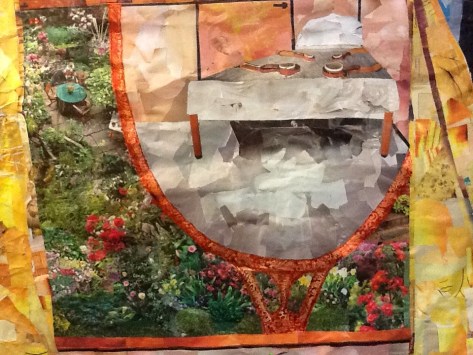
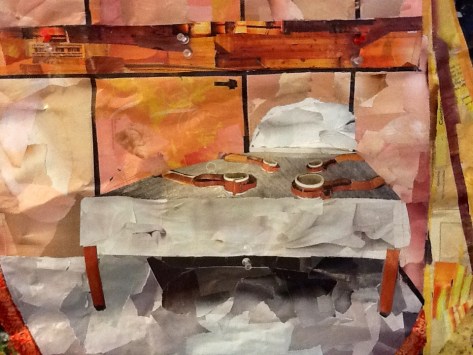
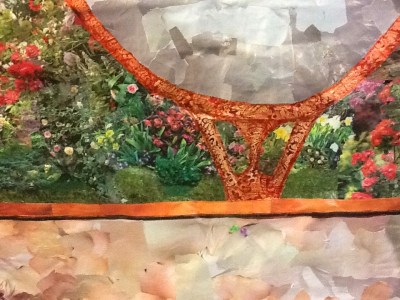
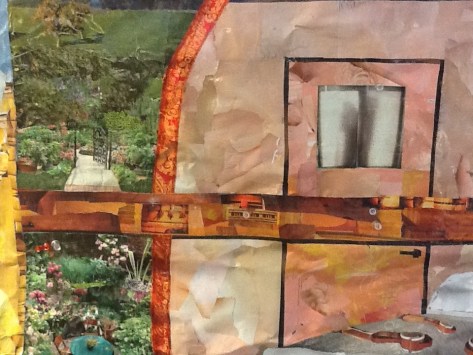
Photos from “Reflections on a Psychiatric Seclusion Room”

Reflection of Seclusion and Restraint : There is hope and freedom somewhere.

NOTE: this is a link to the finished collage, sans border of which I have no photo: https://wagblog.wordpress.com/2011/11/13/reflection-on-room-101-in-ward-d/

I now call this Reflections on Room 101 in The Ministry of Love, as a reference to Room 101 in the book “1984” by George Orwell. The place where recalcitrant prisoners faced torture with the things they feared most in the world.


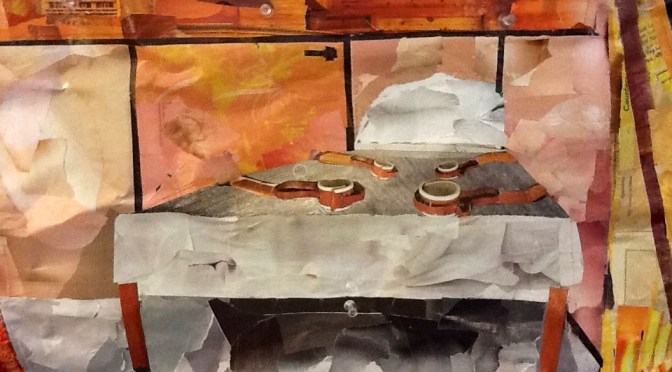
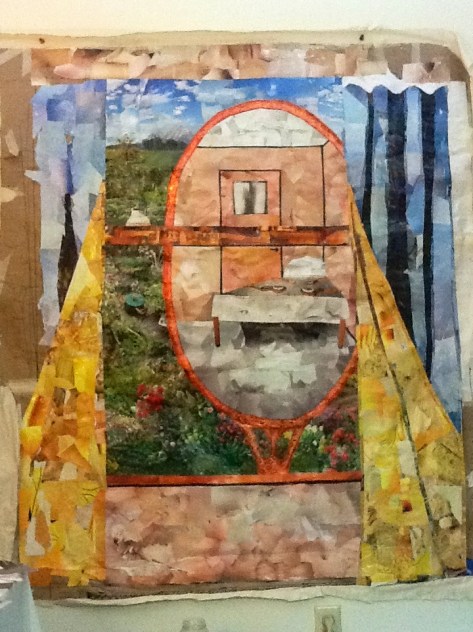
I want to post today some photos from the progress I have made on my large collage of the restraint room (seclusion room) in a psychiatric unit. I must say that it gives me the shakes whenever I work on it, or at least whenever I look at it afterwards, and certainly when I photograph it. But I think that the fear and heart-racing palpitations are slightly diminished compared to this time a month ago. Possibly. That is what I am hoping for at any rate. The process of doing this is my attempt at “exposure therapy” I suppose, because I cannot live with what feels like PTSD any longer. (I know, I know, according to the New Rules, you cannot, by definition, have PTSD unless your life was mortally threatened; unless you experienced a tsunami or earthquake, mass murderer, or Hurricane Katrina, it does not count as “real trauma,” so say the doctors, and they should know, right? After all, they are the ones who defined the illness, and keep redefining it, and who made it up! Well, since they have the initials MD after their names, standing for Missed Diagnoses, I dunno if we can trust them on anything as important as deciding for us what it is that counts as traumatic. It seems to me that WE ought to be the ones telling THEM, no?) Be that as it may, let me change paragraphs and resume the discussion I left off so abruptly above.

Whatever the case, I do suffer with heart-racing fear and sweats and tremors that make it difficult even to take a clear photo of the collage after working on it but whether it is PTSD, I care not.  All I care about is 1) communicating the experience, or at least what the rooms look like, and 2) purging myself of the residual fear.

I don’t want to go on any further with that. It truly does cause me great anxiety. And I prefer to work on the collage and on forgiving the specific people who did those things to me. It is likely that they had grown to hate me, forgetting that I was a troubled and profoundly ill person because I was also loud and frustrating and violent…(treated with violence didn’t make me any more docile, I might add). So  things only escalated and escalated, when from the start their goal was to have a quiet unit that ran smoothly and had everyone get discharged in a matter of days, no questions asked. They did this by helping no one, by talking to no one, and by questioning no one. All they cared about was making sure that everyone stayed “safe” for as long as they were in their clutches. And that they would say so until they left. BUT I said I was working on forgiving them, and trying to see them as tired human beings, flawed but human. It does me no good to get all riled up again.

so I will leave it here, with the photos of the art. I will add only that I plan to redo the curtains, since as it is the blue competes with the sky. Also there will be a curtain rod, and such…But as you can see, it is still a work in progress!

You see the mirror now, and the bed with the restraints? The garden below the window?
No those are not “banjos” on the bed…Look closer. This is a psychiatric unit…
But so is everything it sees and reflects…
Behind the mirror, beyond the window, an open garden gate…

Poems about Schizophrenic Symptoms: Word Salad and Delusions of Grandeur

Poems can express many ideas and experiences. In my first book of poems, We Mad Climb Shaky Ladders, part of CavanKerry Press’ Laurel Books literature of illness series, I tried to express how I felt both during psychosis and afterwards. I also often tried to put myself into the experience of others who experienced symptoms that I might not, but which I could imagine.

One thing I know, having had this illness for so long, is that misinterpretation is rife. I mean things when I do things, just as anyone else does. But people simply make assumptions about my behavior and forget that they might need to ask why I do what I do. I have often asked others why they did whatever strange or seemingly outrageous thing they did, and lo and behold there has always been an understandable rationale behind it. For instance, when I stripped naked in that freezing seclusion room, I was neither “acting out” nor totally around the bend, no, my reasoning was that if I were naked they would have to give me something to cover myself with, i.e. a blanket, which is what I had been begging for all along. But they never asked me why I had taken off my clothing — a flimsy tee shirt and lightweight jeans. They just assumed — whatever they assumed. Ditto for almost every other interaction I had with them, and the same almost uniformly went for other people when they behaved in a way that was somehow contrary to expectations. The meaning of their actions was reasonable, given the context.

I tell you this because in my poem, Word Salad, even though it appears to be, well, “word salady” and incomprehensible, in truth there is “method” to it, and in fact if you read it with a mind towards understanding the links, you would appreciate them. But you might have to “surrender” to getting it, and let it in without trying to rationally, intellectually understand. Only afterwards could you perhaps try to figure out what precisely is being done and said in the poem. One clue you might need, if you have not been subjected to this directly is that often, at least in the past, “patients” of a certain kind were asked to interpret proverbs. “Can you tell me what, ‘A rolling stone gathers no moss’ means?” or “What does ‘People in glass houses shouldn’t throw stones’ mean?”

As for Grandiose, the same thing holds. Read it aloud and try to get the sense of it, how it reads. Then you may in fact understand what is going on “in one blow,”  so to speak. It is full of double entendres, on purpose. Remember that “live” can be pronounced in two ways. Both of these hold.

WORD SALAD

“Word salad,” a term used for the completely disjointed, incomprehensible language sometimes seen in schizophrenia

Unpinned, words scatter, moths in the night.                                                                      The sense of things loses hold, demurs.                                                                     Everything means. Numbers soldier
with colors and directions, four by four
in a pinwheel: this is the secret wisdom.
I inscribe it on sacred sheets of paper.
The Oxford Dictionary holds not a candle.
The self reduced to a cipher, a scribble,
the Eye is all, with a Freemason’s lash,
and 26 runic hieroglyphs to share
how a stitch in time saved the cat
and if a messy rock gathers no stones,
clams must surely be lifted higher
by the same rising boats. Why, why not throw
glass tomes at grass huts? It is a question
of propriety: grass is too dignified to lie down
before gloss. Whirligig! How to pull the center
back into the world? It would take all
the OED to recapture the moths, all Harcourt’s
English Grammar to pin them again.

GRANDIOSE 

He says:
I was always more important than you though
with your cutting me down to size quarrel
about just who I thought I was. I thought I was
with my long dark hair and beard and rough
working clothes John the Baptist, prophet of God
wild man of the wilderness and would have
to preach the word of a savior I didn’t quite
believe in. I mentioned my conviction to a friend
who told me to make friends with a mirror,
discover which John I really re-incarnated. Lo,
I looked and saw the more famous than Jesus
John staring with his small important eyes
behind his too small eye-glasses at me staring
into the mirror at myself, yes, I wrote the songs
you grew up on: Yesterday, Give Peace A Chance,
Eleanor Rigby— yes, I was the one you swooned
over and screamed for, yet now you only shriek
at me, taking me down from a peg on the wall.
Why do you yell, Get lost, baby? Imagine all the people
who would rejoice to see me live once more.

Psychiatry and Authority: Restraints Update


I want to update my “On Psychiatry and Authority” post, especially about what they did to me at “MIddlesex Hospital, which I can now do with more accurate data. I gleaned a lot of the following directly from my records, meaning both the nursing and progress notes and the “event” notes, which should have been written after each and every incident in which they felt obliged to use measures against me involving involuntary seclusion or restraints, including such things as: physical/bodily/painful holds, physical/bodily/forced escorts, physically preventing me from leaving a “time-out” room, i.e. a seclusion room, as well as a locked door seclusion or the dreaded four-point restraints . I have also used my own journal writings here as counterpoint, some entries of which were penned as soon after these things happened as possible — that is, when I could obtain a writing implement.

The first time I wrote about the particular incident I focus on here, I did not understand why I was naked. Having read my entire medical record from the stay, I now understand more about what happened, so I will start this account where it really began, somewhat earlier in the day. Also, and this is important, while they perpetrated a criminal act on me in this incident, there were others later ones as well. During those, I am described in words that make me sound as if I have gone something near berserk…though not in those words of course. Now, there is no context given, nothing is said, not a word, of what the staff is doing TO me or with me at the time that I am going so wild, but nevertheless, the chart describes me as biting and kicking and screaming and peeing on the floor and smearing urine all over the walls…and then there are repeated use of restraints and locked seclusion where neither were “necessary” and were always destructive and traumatizing. Well, unfortunately I have no journal entries after that first time. Why? Perhaps because by then they had drugged me up on Keppra (having decided I could not take the 2 separate ones I came in on though they worked fine and without side effects ) an anti-seizure med that made me so dizzy I literally could not walk, and my vision so blurry that I could not write even if they had not prohibited the use of all writing equipment. So I can recount here only the most egregious incident, the one that I believe triggered for all the others that followed, the one after which “all bets were off” as to any future “behavior” on my part, and from which I emerged so traumatized that I didn’t give a hoot what they did to me after that…

Before I get to  it though, I want to briefly recap where I am in my struggle to recover from the trauma that this stay at Middlesex Hospital occasioned, which only increased the trauma already inflicted 6 months before at Manchester hospital. Up until the night before last, as you know, my state of terrible upset had been growing worse and worse, so that I’d gotten to the point where I could scarcely think about my 6 week stay at Middlesex without becoming nearly hysterical with trembling and anger and anxiety and terror all mixed up together. I  felt as if death impended, my heart pounding wildly,  fear screeching like a car swerving at high speed until it nearly hit a bridge abutment. Every night, every day it comes back even now (new edits 3/2012) as if happening again. Then one night, I wrote the blog entry about Trauma and Acceptance, and I began to try to think about things differently. I realized that I could parcel out thinking about Middlesex little by little so the trauma of it didn’t have to eat me alive. I realized that I might be able to save my sanity, and spare my life from total destruction at the same time, if I decided to accept what I could not change, the first step of the Serenity Prayer.

Wonder of wonders, after two days of not letting the trauma appear on my radar screen, except insofar as I gave a talk about it for the Farmington, CT, NAMI book club last night, which included reading the Acceptance blog entry as its conclusion, I have made an astonishing discovery. Up till now I had had almost complete amnesia for the Middlesex hospitalization. However, it seems that as I remain or try to remain calmer, certain episodes are coming back to me. Not fresh, not by themselves, no, but when I read in my journal or even in the records something that I did not recall on my own nor even believe was true it feels, well, possibly real, and I can just begin to “get” a sense that indeed it feels familiar, that perhaps I did do that, did say that, that it did happen, even if I would not have remembered it without the journal jogging my memory. I am wary of induced false memories, but in this case since I have records of the bare bones of what did in fact happen, I have to try to trust that at least some of what I am retrieving is not pure confabulation woven from only my imagination.

I cannot bring my mind any further down that memory path yet. But I suspect now that I formed some memories after all, that they are simply buried for some reason, and that perhaps the trauma and fear have kept them from me. Now that I can relax a bit and not feel so angry and terrorized by my amnesia and by the one clear memory I have, perhaps some, if not all, will slowly return. Since I prize my memories — they are all I have and without them I have had no life, — I want them back, as many as possible bad as well as good.

Now let me continue on to the account of  Middlesex hospital in late April, 2010 and the first time they put me in 4-point restraints.

During the MD visit the morning before, Dr N wrote: “Patient later ..(?) ..to me that she didn’t trust anyone, that no one wants to help her and she is being punished by staff. I repeatedly said that she is not being punished and she is projecting….Patient escalating tension with staff. Rigid. Wants to die. Wants to sign 3-day paper to leave.” (It is not clear what he means by “later” — did he write this after the episode of restraints, when I did in fact tell him that they punished me? It seems likely. IN which case he did not listen to anything I said…)

RN note 1:30 PM: “Alteration in thought: Patient continues on constant observation. Continues negative, irritable, testing limits. Refused initially to shower, then changed mind and agreed to, then wanted to walk out of shower into dayroom naked. Agreed to dress after informed security called to unit…”

About these notes: one, what was I projecting in thinking they wanted to punish me? What? And it is typical that Dr N blamed me for “escalating tension” with staff. I wonder if he ever saw how they worked, saw in action the mechanism by which they’d cause an  escalation. 2) Most likely, in this case, I was threatened that if I did not shower I would not get off 1:1, so I “changed my mind.” And it seems to me that if someone “wanted” to get out of shower and walk into dayroom naked, it is a matter that the nurses could handle and ought to. I weighed all of maybe 98 pounds then. And if they had closed the door and made me dress, they could have. Why call security unless they wanted to threaten me, terrify me? That was neither compassionate nor caring. Methinks it was, aha, punishment.)

Moving right along…

All the details  that follow are “accurate” insofar as they are derived from official documents or my journal. Accurate in that sense. But remember that in the records, NO context is ever given, the behavior of the staff is rarely described, or only in the briefest and most self-serving ways. NO context is even given to MY behavior.

The nurse who wrote up the night’s notes says that I was angry the entire evening and demanded continuously that she call the on-call doc to discontinue my 1:1 status.  For some reason she writes that I was “unable to follow directions” when she tried to assess me for, I presume, safety, perhaps so I can get off 1:1. I don’t know what she is talking about here, but it is typical that the nurses cared only about a patient’s taking orders and following directions.

Anyhow, at around 7:30, she wrote that I “walked into the dayroom” and according to the RN notes, without any provocation (which is highly doubtful) began shoving and turning over chairs and then picked up the patient trash can and put it over my head. Although at that point the staff told me to “walk with them to the “time out room” I refused and “went to bed instead.” (That was written in the chart: I WENT TO BED INSTEAD.) Now, you would think that this would be fine, after all, would not they want me to go to bed and calm down? But no, I had not “followed directions” and so of course “security was called and patient required security to carry her to time-out room as she refused to move or walk.” Remember that this “time-out room” is exactly the same thing as the “seclusion room” — it is the same room, with the same “withouts” — without heat, without windows, without anyone to talk to, without blankets, without a toilet, without anything to make one comfortable…just a thin mat on the linoleum floor, unless they have taken it out. So they barged into my room where I had gone to calm myself down, and picked me up bodily and carried me to the seclusion room. That means by definition that they physically restrained me and physically, forcibly escorted me to the seclusion room where they prevented me from leaving, all of which are NOT permitted except in the case of “severe and imminent danger to self or others”…(so an event note should have been written up and a physician’s orders should have been gotten). There I took their Ativan and was told that I had to stay in the room for 30 minutes.  Why not in my own room for 30 minutes?  Because time spent in the time-out room is a punishment. Parents make children stay in a time-out room (usually their bedrooms!) when they don’t obey. Why? Because that’s their punishment. But staff doesn’t punish. No, they don’t punish…

Now this is how I remembered it the next morning in my journal: “I had been told to go to the time-out room, which I did voluntarily…” (apparently I did not remember that I had been physically carried there, but there is some confusion in the records too, because I went and then left and then was carried back…). “But it was cold and they wouldn’t give me a blanket so I didn’t stay long…This only led to more goons pushing me back into that cold and sterile room, this time strong-arming me and forcing me to a seated position on the mattress before quickly leaving but not locking the door.”

The nurse wrote it this way: “Patient refused to stay in time-out room, attempted to shove staff, kicked at staff to get out of room. Patient was instructed several times to sit on mattress and stop pushing at and kicking staff. Patient refused. Seclusion door locked at 7:55pm…”.

At this point both records agree that I stripped off all my clothing. But the official records state only that fact, and that I “was changed into hospital garb” but in my journal I write something entirely different and rather revealing: Left alone in that cold and sterile room, I decide “they’d have to give me a blanket if I was [naked] so I quickly undressed and just hid under the mattress for warmth. This caused a stir for some reason and I was forced to put on hospital pj’s and lie down on the mattress. This would not do, not without a blanket which they continued to refuse me so once again I got up and tried to push through the woman barring the unlocked door. She called for reinforcements and they came en masse. (Note: I spelled this “unmasse” — a dyslexic spelling of the first order. This is a symptom of my acute neuro-Lyme disease, since I was always a first-rate speller and would never have had difficulty with “en masse” had I not been in the middle of a flare up… as they knew full well).

“At this point” my journal continues, “they again subdued me and told/asked me why I was fighting. I said [it was] because i needed someone to talk to. That was all I wanted, just someone to talk to. The security guard seemed taken aback. All these personnel hours wasted when all I wanted was one half hour of one person’s time? It seemed to strike him as ludicrous as it did me….

“Why don’t you just ask to use this room when you feel anxious or upset?” he then asked me.

“I do, I have!” I replied

“Well?

“They always say it has to be reserved for an emergency.

He seemed completely flummoxed by that reasoning but there was no arguing with Policy so he fell quiet. Finally they decided to leave, telling me to be quiet and lie down.

I did. I did. But I was cold and I begged for a blanket.

“Sorry, it is too dangerous. You will have to sleep without one.”

That was it, I’d had enough! I dashed at them head first and they parted, only to grab my arms and try to stop me. Someone twisted my right arm and held it behind my back, but I knew how to get him to stop it, so I tried to bite him and he briefly loosened his grip. I twisted my own arm back to me and my left pinky, held, closed tightly onto something, hooked so tightly it wouldn’t budge. My legs, the right one, grabbed the thin leg of a woman behind me, making her lean back off-balance and lose her grip on me. Then I switched to holding both my legs in a death grip around the legs in front of me. It didn’t matter one iota that [I had taken off my clothes again to get a blanket and] was naked…Anyhow, they eventually overpowered me and got me onto the hard floor, my cheek on the dirty linoleum and breathing dust. At first I struggled but then I realized that the less I did so, the less they applied pressure (there must have been six people or more holding me face down on the floor,  one of them practically sitting on me…).

Finally I stopped resisting and they let me sit up, finally giving me a blanket or sheet to cover myself with. The room cleared as everyone left except for one nurse, who was on one to one with me. She apparently was now allowed to talk with me and we conversed calmly. The door to the seclusion room was also now open.

However, there was some soft talking outside the door and I heard someone walking down the hall and opening a cabinet. I had a bad feeling about it and asked the 1:1 nurse what was going on. “Don’t worry. They are just getting you some meds or making up a bed for you.”  This gave me a very bad feeling, and I suddenly understood what was going on, “Uh uh, they can’t put me in restraints, I am calm and it is illegal to restrain someone who is calm. You know that.” I said that again loudly, loud enough so whoever was down the hall could hear me.  I began to tremble, but forced myself to remain as composed as I could. Another staff member then came into the room and asked me to come down the hall. Did I need an escort or could I do so myself. “Oh I can walk by myself. But you can’t put me in restraints, I am calm and it is illegal.” Nevertheless, I followed her to the empty room — I felt like “dead man walking” when I saw indeed that they had fastened restraints on the bed. The room was filled with staff members and security guards. I told them over and over that I was calm and willing to take PRN meds. I said I knew they were punishing me and that they knew it too. No one said anything except to reiterate that they would assist me if I did not lie down on the bed myself. I was so terrified that they would assault me and hurt me, terrified of the fear itself, that I simply got it over with, lay down on the bed, naked, and let them do what they wanted to do, gritting my teeth when they removed the blanket that was covering me. Well, here is what I did not remember, the account after that from my journal:

“Well, you know that despite my complete lack of resistance, they shackled me 4 points (badly as their restraints did not actually fit the bed — restraints are supposed to keep the arms at your sides not below the level of the bed, and your legs are not supposed to be spread-eagled! I protested this fact but not so loud as to disturb others [when they released me] my back hurt so badly I could barely walk and once more my scapula muscles felt as if they had been separated.”

“I plan to sue you for doing this to me.” I said calmly to all as I left the room. Nobody reacted…I woke in severe pain, the muscles in my chest felt torn from those that connect it to the shoulder, the pain went clear through to the scapula.”

Nursing notes were rather different, and I think were written after the fact, and hastily, perhaps not exactly ‘fact-checked” for accuracy after all. [Did a family practice doctor really see me? I do not believe so…why else would I not tell anyone about the pain, which she reports as non-existent.) But here is what she writes about the “scuffle” in the seclusion room:

“Patient was changed into hospital garb which she also stripped off. she demanded a blanket which was not given due to concerns about her tying it around her neck. [Note that I was ALWAYS under one to one surveillance!] She was encouraged to put the johnny back on and she refused. After staff left the seclusion room, patient placed mattress over herself where no staff including her 1:1 could visualize her. When staff entered room and removed mattress, patient again darted toward staff and attempted to flee. Pushed at staff, then kicked at staff, and attempted to trip staff  wrapping her legs around RN’s leg. During the scuffle patient ripped bandage off her leg and yelled, “I have AIDS. I didn’t tell anyone that before!” She refused to remain in locked seclusion without attempting to harm others. Patient covered with sheet and walked to empty patient room where 4 point restraints were applied. Patient continued agitated initially then was quiet lying still.” [Patient can come out of restraints when able to refrain from aggressive behavior towards staff and property and can follow directions.]

Now you get the picture. I was put into restraints as punishment, but as an excuse for it, they made up a reason, which is is how I can get out of them: stop being aggressive towards, 1) staff ( remember who dragged me into seclusion room? I had gone to my room and they dragged me out of it just to teach me a lesson in the punishment room! 2) property – I was a danger to property… I do not think somehow that danger to property is one of the reasons a person can be put in restraints in this state or this country. And the danger was that I had put a wastebasket over my head! 3)  following directions, well I won’t even go there. Just look at those “justifications” for keeping me in restraints and you will see just why I know they “had it in for me” that particular episode, but in fact were trying to get me most of the time I was there.

Be that as it may, I have contacted the Commissioner of Mental Health, and hope to contact the Office of Protection and Advocacy, which oversees the private hospitals in the state as opposed to the state hospitals, though I do not see why the commissioner is not involved in any hospital that takes state money, as all the private ones do…And seeing as I am a Medicaid patient when hospitalized, I would be a state patient were it not for the private hospitals being forced to take such patients in this economy, whereas years ago they could pick and choose, and did.

Finally, the MD’s “event note” observes upon exam in the restraint room that  the patient is “generally agitated, very verbal, lying in bed with the help of staff and security to calm her down…” I beg your pardon? Calm her down?! I was being restrained, one, and two, I was being tied to the bed with my arms over the edges of the bed, below the level of the mattress, and my legs were spread-eagled –I was naked, remember? and all of them knew it.

So that is all I have to write tonight. I am appalled. What sort of people could do that to anyone? Who were they once, and how did they become so jaded and cruel? Surely, as nurses, they must have once been idealistic and good-hearted and compassionate. Most people who go into nursing are and I doubt that many go into it for the money or for any other reason than that they care about people. I simply have never met any young nurse who was not idealistic and caring, but I suppose there might be one or two. So what happened to this group? Could it be their own “society” is not supportive, is backbiting and so lacking in cohesiveness that they take out their own frustrations and lack of positive feedback on those patients who least please them?

I dunno, I have been told that this mechanism is sometimes at work on units where staff behavior is out of control in such a way. But what made them in fact so much into control and coercion at all? Why were they not themselves empowered by compassion and kindness, which would have fed them better as it fed the patients better as well? How did it come about that they learned the wrong lessons? I don’t know, and probably will never know. But I did catch a sense of these strengths in one or two of the nurses, just buried in fatigue or long ago burned out…

Too many were too personally invested in the patients liking them or in behaving for them in such a way that made their jobs easy! That was stupid and nonsensical. Why should the patients have to be or do anything for the nurses? The patients cannot control their illnesses and staff forgot that in their own need to be in control and to have their own need met by their patients. I think  that is what it comes down to: at Middlesex, the staff’s needs were not being met by each other, or by the supervisors and colleagues, so they looked outward, and who did they expect to meet their needs but their patients, who could not, and could never do so. So they tried to make them, force them to. Or at least to toe the line and make each day quiet and easy to get through. What a farce. What a lousy place to be sick in, what a sick place to try to get well in…

That’s enough for tonight.

Imaginary Interior with Mirror and Red Chair…plus

Here is a colored pencil nighttime interior, wholly imagined and done without model objects to work from except that the red chair happens to be one that “lives” in my room. You may not be able to tell, but the large mirror on the table reflects one that is meant to be implicit behind the person drawing (the hand in the foreground) which in turn reflects the one on the table, and that reflects it, and so on…). Also, on the table is a photo that purports also to be, and is in fact, one of the artist — me — drawing as well. So you see there are a lot of tricks involved, though I do not think the picture is very expert. The perspective was not meant to be accurate, by the way. It is sorta folky…I simply am trying things I have never done before, like furniture and scenes. After all, you have to start somewhere.

I am also working on learning “realistic pencil portrait drawing” which is equally difficult but in a different way as it involves minute observation and challenges my eyesight too, at least at the moment. In fact, learning both skills are good for me.

I wrote a new poem two nights ago, but alas, I cannot share it here yet as then I could not submit it to a journal. I can only advise those interested in my poetry who have not read it and who have not seen my book WE MAD CLIMB SHAKY LADDERS, to check out the page I have set up (see above) with a number of poems taken from it. I you like those you may also be interested enough to perhaps purchase a copy (and make me a wealthy — hah! — woman in the process). I am hoping eventually to find a publisher for LEARNING TO SEE IN THREE DIMENSIONS, but I admit that I haven’t really tried. In fact, I have been so busy that I haven’t tried at all! I just keep writing and adding to it.

Anyhow, I do not know how many of you know of my best friend, Joe C, (the old blog readers did) but he is dying of ALS, Lou Gehrig’s Disease, after 4 years, 3.5 of them approximately, on a ventilator ( that is to say breathing by means of a tracheostomy tube attached to a mechanical respirator). I do not know how long he has, though the situation is really dire in a way that is difficult to talk about. He refuses to agree to a Do Not Resuscitate (DNR) order, though there is nothing they will be able to do for him except torture him if he does not…Oh god,  he is in such awful straits, yet so wants to live! It is so tragic… The only good thing right now is that Dr O, that wonderful woman and my former psychiatrist, who was so kind and helpful to him, and of course was to me for so many years, was ordained a minister after she moved away from CT and she is going to visit him tomorrow, if she can…and see if she can help him.

You know, my absolutely biggest fear for Joe is not his dying, but of his being afraid, and that is where I think she can talk to him in a way that he will profit from, because he listens to her, and always has, in a way that he never has listened to me.

Joe basically responds best to female authority figures, which is strange given that he has a terrible relationship, really none at this point, with his mother. I no longer mind this, I am used to his not taking what I say as having any merit. But if Dr O is able to help, I just want him to get to that place where he can accept his approaching death and is not scared…

All this is by way of saying that if I am silent here for a while, please think of Joe and of me, and send him your prayers? Thank you, all of you.

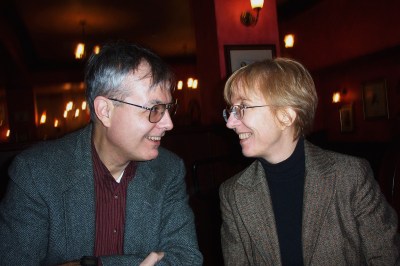
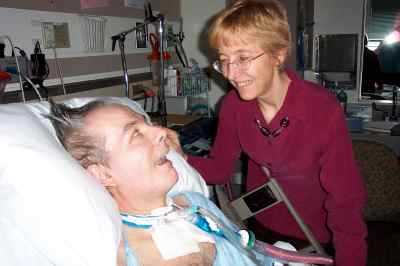
I am putting up a photo Joe and me just after he was diagnosed, when we were at the Lahey Clinic for one of his appointments there, and then one of the few that I have with him at the hospital where he currently lives. One when he was still able to smile. You will be able to see the extreme changes in him, but to me, I have always only seen the “same ole Joe!”

Joe C and Pam in 2006, December
Joe and Pam November 2007