Tag Archives: seclusion

Open Letter to Deborah W., MD, Chief Medical Officer, of N Hospital

It has been a week since my discharge from the Adult Unit at N Hospital. After a week of recuperation and stabilization at home I feel compelled to write you via the open forum of a letter on this blog. It may or may not get your attention directly but I feel certain it will be read by someone on the N staff. Perhaps that way it will eventually reach your eyes. If not, so be it.

Our encounter on Monday the 27th of August was extremely brief and not particularly noteworthy. While I have much to say that never got said then, I owe you nothing, and by the same token, expect nothing from you either. That said, to any of my readers who want to understand the intent: I write partly in my defense against what I feel were gross misunderstandings (leading to unnecessary trauma), and partly to record publicly – on record as it were – what really happened over the last 4-6 weeks.

Please, Dr W, or any other reader: Do not dismiss this letter out of hand as the peevish complaints of a disgruntled but troublesome patient. I understand how you might be tempted to do so, especially because you — or at least Dr P and L.H. APRN – claimed in their infinite wisdom to be able to detect signs of an Axis II Borderline Personality disorder (despite the concomitant presence of an Axis I psychosis ). I know that labelling me “borderline” was always just another way to dismiss me and my concerns as “mere,” that is to say as meaningless or manipulative, the “mere” attention-seeking of a manipulative PITA*.

Nevertheless, it ought to have been obvious, it ought to have been needless to say — but clearly was not — that no one could possibly know what my baseline personality was like from the past four weeks at N nor in fact from any of my past four stays there. What was clear to many early on, including me, was that this hospital stay at N abounded not in norms but in extremes, from start to finish, extremes I might add both on my part and on the part of hospital staff as well.

My friends and family know that I am not generally someone who has screaming fits or throws things or strips naked and parades around in public, all modesty thrown to the wind. So too, N staff: So far as I knew or had seen since 2010, they rarely became physical with patients  and not once in all the times I had been there had physical contact devolved into anything even resembling a fight or violence. Instead, kindness, compassion and empathy were the primary tools. The best staff were as slow to lose their tempers or act on negative emotions as a live gecko was to do a cancan under the noonday desert sun.

I knew those things, and until August I believed it automatically made N a superior place, a sanctuary immune to the sorts of failings I’d found in so many other hospitals.  That was why I insisted on N this time even though it meant waiting two and a half days at W Hospital Emergency Room, never moving off the gurney in the barren cubicle I was placed in, monitored by a camera not so subtly hidden in the large TV screen. I knew of no other hospital where I could be safe, both from myself under the influence of command hallucinations, and just as important, from any staff impulses towards the use of violence to achieve control or discipline.

How could I have known that from the first morning after I arrived, staff behavior was to be stunningly “un-N-like,” as erratic and extreme as my own would turn out to be. My entire stay was in fact characterized by physical assaults by staff, punishment and trauma that began the moment I woke up that first morning.  I responded poorly to this, as anyone might, by regressing into more and more primitive behaviors. But how did “you,” that is to say, the N staff, respond to me? Not by taking a step back and seeing how things could change for the better. No, instead, you, they decided to blame the victim, to say, “She’s misbehaving, she’s ‘doing these things on purpose,’ she is volatile, unpleasant and emotionally unstable…” Et Voila! There I was, diagnosed, improperly but officially with “Borderline Personality Disorder!”

As many of my readers know, I have written extensively here, at wordpress.com, Wagblog, about psychiatric units and hospitals and have until now always held N in the highest esteem. N was always the gold standard, the touchstone against which all other  hospitals in the state were measured. I believed that N had the right ideas, the right philosophy about patient care, hired the right people and trained them properly. I trusted that the hospital understood the critical importance of trauma-informed treatment. Ever since my 1st hospitalization at N in December 2010 -January 2011, when S. H. was director of nursing, I felt I’d found a truly safe place, an asylum in the best sense of the word, where troubled patients would never be brutalized by staff more bent on coercion and a lust for power than compassionate care.

I have been hospitalized at N four times now. The first three times bore out these high expectations, but this last time was unmitigated disaster, revealing how much things have changed, and how, under the auspices of the wrong leaders even N has been willing to permit a few “bad eggs” to damage patients with impunity, rather than take an honest look at burned out employees – including those at the highest levels, RNs and psychiatrists included –keeping them tenured out of a misplaced loyalty, refusing either to re-educate them or to remove them from direct patient contact.

There were three separate instances of physical violence to which I was subjected  between July 31 and August 27th . The very first morning after I had been admitted and placed on one to one for safety, I remember I sleepily turned over in bed and scrunched down again to catch a little more sleep when the person sitting with me suddenly insisted that I place my hands outside the covers where she could see them. This was a strange request, since they had been under the covers all night, right up until that second. Dumbfounded, and freezing cold, I resisted and ignored her, fairly certain that she would not make a federal case of the request once I fell asleep. Instead, she repeated herself, louder and louder. She actually approached the bed and tried to bully me verbally into putting my hands above the bedclothes, telling me that being on constant observation required that my hands be visible at all times. This was news to me. Never in my experience at N had anyone required such a thing. I continued to resist, though any impulse to sleep had left me by then. By this point, it was strictly on principle.

Well, she was intent on winning the battle and instead of negotiating a solution called in reinforcements in the persons of two male mental health workers. Unable to verbally force me to uncover myself, they initiated physical contact, attempting to pry my blanketed fingers away from the blanket in which I had wrapped myself. The female stood aside, but continued to threaten to deprive me of all coverings if I did not comply with her order. The tussle went on. I vehemently kicked at them whenever they laid hands on me, though I spoke not a word the entire time. At last, they gave in and left me alone. I never found out why. Perhaps they saw the brutality they were inflicting on me. Or perhaps they were called off. I do not know. All I know is that that particular rule was never again inflicted on me.

After they left, and a new sitter arrived, I lay in bed, breathing hard and feeling bitterly betrayed. What the F just happened? Dismayed and disappointed, I could scarcely believe I was really at N and not at the torture chamber in the south eastern part of the state again. The consequences of this betrayal left me physically and psychologically speechless. What had happened to “my” N? Try though I might to let myself talk, I remained mute for 8 days.

I won’t go into the long and involved story of the second assault, except to say  that it involved  poor judgment on the part of my social worker and evening nurse. OTOH, an assertion of power by another nurse assigned to me nearly twenty four hours later was overkill and an act of punishment and revenge. She can deny it left, right and silly, and maybe her RN superiors believe it, especially because they have a stake in it. But I know contempt and the smile of sweet revenge when I see it, and I knew the enjoyment in her smile that Wednesday. Assault #2, which involved a rather violent physical altercation and restraint, nevertheless had a bearing on assault #3. What follows is the story of that third assault on my person. In places I quote almost verbatim from my journal entries, which I wrote at the time. When I am not quoting, I assure you that the account is very similar to the journal’s “horse’s mouth” and merely states the same things I wrote there, but with better words and fewer punctuation marks.

I do not remember how it started. I suspect I had been screaming or yelling about something. All I know is that the RN Supervisor for the afternoon, a woman I will called D came into my room after my upset and just stood there. At one point in her obdurate silence, she accused me of an unprovoked attack on it the nurse, K, who had taken revenge on me the day before. She called K  one of her “ best nurses.” Incensed at this I assured her she didn’t know the whole situation. When she said she knew enough, I told her to leave my room.

“I’m staying right here,” she said giving me a baleful look. I pointed out that I already had a 1: 1 and did not need a 2nd person in the room. She only continued glaring at me.

“Get out,” I screamed, “get out of here!”

No response. No reaction, except for a slight recoil from the loudness of my voice.

I threatened her then. I admit it and I am not proud of it. I threatened her. I took up a box of crayons and looked as if to hit her. Everyone cried out, “No, no, P!” And I put it down. But I continued to cry out, “Leave! Leave! Leave me alone!” She only stood her ground and stared.

That’s when I lost it. I picked up a chair and threatened to throw it at her. This is what she’d been waiting for. She could’ve laughed or made a calming gesture or simply backed away and let the mental health workers gently disarm me and all would’ve been well. But no, D liked to escalate rather than de-escalate, so she yelled out, “Escort her to the quiet room!” Before I could offer to walk there myself, Brad and someone else picked me up by the armpits not even allowing me to walk and dragged me.  Because they didn’t even ask me if I would walk freely, under my own steam, I fought them, twining my legs around  theirs as if to try and trip them.  Then to add insult to injury they dragged the blue therapy chair out of the room instead of leaving it there for me to rock in and calm myself. Now, inside the tiny, now empty windowless cell, despite the bright mural painted on the walls, panic rose in me. I looked around, remembering how S H had assured me that no one would ever leave me alone in there unless I wanted them too. I begged D for someone to stay in there with me. S the mental health worker saw the panic and offered to, but D was furious and ordered her out.

“No, she is to stay in here alone!” She made everyone leave, and following them out, she slammed the door shut behind her.

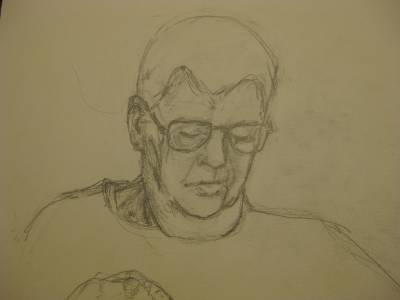
I was horrified. All the memories of locked seclusion returned to me in an avalanche of terror. In my mind, memory told me it would make no difference if I went to the door to beg to be let out, or for a blanket or someone to talk to. Experience, all my long experience had taught me: there was to be no mercy no help nothing would change no one would respond no help nothing no matter what I did. I was and would be abandoned to my punishment until–well–until I had no idea how long it would last. No one told me a thing. Utterly terrified, instead of banging on the door and begging for release, I backed into the farthest corner. I wanted to meld with the wall, shrink back into the wall board as far away from the room as I could get. A howl climbed my throat. I tried to hold it back but I could not. When I screamed, I screamed not to anyone or for anyone but out of sheer mortal terror, the sort of terror that any animal must feels when its leg is smashed in a trap and knows his life is coming to an end. Screaming brought no relief though. Screaming brought nothing, it certainly brought no one into the room to help me. There was only thing I could think of that would that bring relief and that was to relieve myself. So I did, in the only way I could: I stripped off all my clothing and peed a huge puddle of urine on the floor. I had to. I do not know why. Removing my underwear I found inside the crotch a forbidden pencil. I’d not been allowed writing utensils for eight long days and just that afternoon I had used this pencil to sketch my first portrait since I’d been there. I wrapped the pencil in my clothing, knowing that if someone saw it they would confiscate it again.

Too late. A commotion behind the door and they were upon me, all of them, wrestling my naked body to the floor and prying the wad of clothing from me, smashing my glasses in the process so that one lens came out of the frame.  In the melee, someone grabbed my medical bracelet right off my flailing wrist. They pinned me down. I knew what they had in mind. IM meds. But no one had offered me oral medication. “I want oral meds. I’ll take oral meds you can’t inject me, you haven’t even offered me oral meds.” I asked for Zyprexa. Not Haldol or Ativan but Zyprexa, the PRN I had on order.

They refused to get Dr. T, who signed off on the seclusion without ever seeing me, to change the emergency meds — which I didn’t really need but which were going to be ordered anyway, as a mater of course — to Zyprexa despite my psychiatric advance directive distinctly requesting no benzodiazepines of any sort. However, fearing any further confrontation, I swallowed the pills. Everyone got up and left except for the nurse supervisor. I stood up and surveyed the room. Urine ran everywhere.

“How can I stay here?” I asked her. “There’s pee all over the place.”

She surveyed the wet pads and floor. “Deal with it,” she said, and walked out, locking the door behind her again.

I was spent. There was nothing left in me to fight or scream or object. I simply lay down on the mat, amid the puddles of urine and curled up in a fetal position. Sleep never came; it was too cold for that. I just lay there, eyes open, my naked back to the window. 10 minutes passed. 15 minutes. I heard the mental health worker at the window ask the supervisor if she could let me out. “She is lying there calmly, I think she’s sleeping.”

“Give her another 10 minutes,” was the reply.

Another ten minutes went by and another.

The mental health worker kept asking if she could let me out. Finally, about an hour later, the door opened and S entered.  I didn’t bother to turn over or look at her. I scarcely raised my head.

“P?”

In a dull voice, I answered the requisite questionnaire, as if that were adequate debriefing. Then two other staff members attempted to clothe me in hospital issue johnnies, one over my front, one to cover the back. I allowed them to do this but as soon as they let me go and I was free to proceed out of the erstwhile “Comfort,” now Terror Room, I ripped off the johnnie coat covering my naked backside, and walked half-exposed to my room, deliberate and uncaring. Who gave a fork? What could they do to me now? What could anyone do to me? Fork everyone! They were dead to me. I was dead to them. It was over. It was over. I was dead meat. Just meat. I didn’t give a fork about anything.

More than any other incident, this one was the last straw. Whatever repercussions I deserved for threatening the RN supervisor that evening, however evil I felt for being the devil, there remained in me enough human pride to resist such treatment, enough to say that even I did not deserve to be treated as harshly as D had treated me. Not only did she deliberately test me, she lost her temper and I was her victim. I have reason to believe that most of the staff members who witnessed what happened that night believed she went too far. Some would actually say so in as many words to me, though others were cagey and feared repercussions should it get back to her.

All I knew was that I’d been treated like an animal. What did that supervisor or anyone else expect in response? Did she really think I would become docile and obedient, chastened, a meek and compliant patient?  Violence begets violence. It always does. From then on I was not the same. I was not better either, no. I grew markedly worse, and worst of all, no one could predict anything about my behavior. No one knew what would happen next, what I would do, when I would lash out or scream or throw things or push someone or even hurt myself…None of those behaviors were “me” or even close to my usual, or baseline, but I reiterate: what do you expect: treat a person like an animal, and you can pretty much count on getting animal behavior as a result.

Dr. W you do not know me. Dr P, for all his discharge summaries and “progress” notes (the pages of writing are all boilerplate, meaningless, and/or second or third hand information for the most part), he doesn’t know a damned thing about me. I tried to let L. H, APRN, know a little, but by the time she was involved in my treatment, you were all so intent on seeing in me this mythical borderline personality, instead of a person who had been acutely and brutally traumatized at your hospital, that it was useless for me to expect anything.  For all L’s  pretence of understanding, she had made up her mind about me before she met me. She was largely deaf and blind to everything I said that did not fit the tidy diagnostic picture: schizo-affective, with a concomitant borderline personality disorder. How convenient that you could chalk all the unit troubles up to my problem, rather than seeing it as something your hospital staff created! Blame the victim, why’ncha, instead of taking responsibility for a number of incredibly poor judgment calls on your own or your staff’s part?

Of course as many people have asked me, why do I care what you or Dr P or L H think? Well, I do not, in fact, give a flying femptogram… Mostly I care about the decent people there — the mental health workers and the nurses who did like me and made it obvious and treated me very well and made it clear they would welcome me back (though I can never return, not now.) About Dr P and LH  and the others I could give a ratzass.  But I do, or did care about N itself, once the gold standard, for me at any rate. It was the one place where I could tell other people, “Go to N – I know people will take care of you there, people will care about you there, that’s where people will treat you well.”

The even bigger tragedy is that if no one is safe from the hospital staff at N, then the likelihood is that no one is safe in any psychiatric unit or hospital in  this state. Let’s face it. Not much progress, perhaps none at all, has been made since the Hartford Courant’s series of articles in 1998 called “Deadly Restraints.” My sense is, in fact, that since Mnanaged Care took over medicine, things are actually a great deal worse…Oh, sure, I was not four-pointed during the past stay at N, no they managed not to become that brutal, so far… but I was physically restrained and manhandled during all three incidents and I have been four-pointed at nearly every other hospital in the state up till 2010. So I would hardly say that that practice has gone by the wayside. In fact, in the  Hospital Emergency Room back in July of this year, they threatened to four-point me just for making a nuisance of myself and being noisy…

So much for not using restraints. As for not using them as punishment? I believe that in every single case when I was subjected to four-point restraints from 1980-2010, they were used as punishment, as a convenience or in revenge… I state this categorically: that not in a single instance were four-point restraints ever truly necessary to keep me safe. They were only used because they were available and the culture on the unit permitted the employment of torture to control and discipline patients. Period.

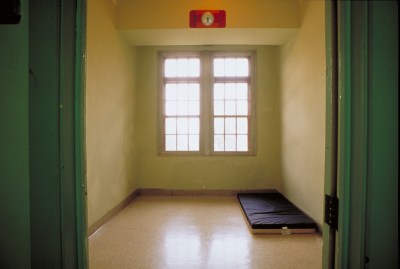
Seclusion? This practice has only increased in usage so far as I can see. The difference is only that staffs are careful to call such barren quarters the Time-out Room, and are rarely apprised as to the legal definition of either seclusion or restraint. (BTW Time-out is a disciplinary measure used to train children to behave properly…since when did psychiatry decide that patients in adult units ought to be treated like misbehaving children and sent to time-out rooms? If you want to talk about empowering patients and not infantilizing them, you do not in the next sentence tell someone to go to the “time-out room” and stay “until I say you can leave.”).

What you, Dr W et al, think about me in the end is of little consequence. I know I do not have BPD and so do the people around me that matter to me. If I care about anything having to do with N it is not your opinion of me nor your judgment or your diagnosis, I care about N because while it could and should be, it is no longer a place I trust, a place where I can direct other people for safety and compassionate treatment. Because if I am not safe from myself at N, if I am not safe from the staff at N, and I mean by staff, the doctors and nurse supervisors as well as any “rogue” RN  or MHW, then no one is safe at N and no one with mental illness is safe in any psychiatric hospital or unit in the state

That, Dr W, is by far the worst tragedy of all .

___________

*PITA = Pain In The Ass
Useless Psychiatric Mediation and a Poem

(Before I write this blog entry, I want to send this message:To certain people from Middlesex Hospital who read this and are following developments in my case against you please be aware that I know who you are and I am watching you. You do not and will not get away with what you did nor with what you are doing now.)

That said, let me tell all the others of you out there what happened at the mediation- meeting-that- wasn’t, this morning at Middlesex Hospital.

As you know, I have been wanting this meeting for a long time, but when I got there not only did I discover that they were playing the game of “Oh, I had no idea that you wanted a mediation meeting, I didn’t know what this meeting was about at all…” but that the CEO had actually cancelled on last Friday the people that he had arranged to meet with me.  So in fact the only people who came were administrators, not anyone who had treated or dealt with me on the unit itself, except the doctor who saw me for the last 11 days of my 6 week stay. He may have been the director of the unit, but he was hardly the main doctor I saw, despite what he claimed.

Anyhow, the meeting was extremely  — well, first of all, it was largely a waste of time, because NOTHING was said of interest to me. Except that Dr Grillo, the unit director, after I read what follows, actually had the gall to claim that restraints were  entirely appropriate…He said nothing whatsoever about what they did to me. OTOH, I can understand why. After all, he had already been told that we were writing the Department of Justice and the Joint Commission regarding his unit, so he must have felt supremely threatened. Naturally he could not have admitted wrong- doing. Not that any god, excuse me, doctor that I have ever met has ever admitted doing anything wrong or ever apologized. God forbid, a doctor apologize! No, that would be too hard and too demeaning for them to ever do.  Better that they go along and permit torture and abuse than that they admit that there was wrong done to a patient on their watch, much less that they personally even made so small a thing as a leetle eensy meestake…

Well, I know what they did to me and I know it was abusive and wrong, and so far, except for Dr Grillo and that lot, NO ONE I have ever met outside of Middlesex Hospital has ever ever agreed with him and said, Yes, in fact the use of restraints was proper and necessary, and they were right to do what they did to you.

So take that, you watchers from MH. I hope you tremble in your boots for torturing me so. Because you never apologized, and wouldn’t’ meet with me to talk about it, it serves you right whatever happens now. I came down there today , and it took all the courage I   could summon up to do so. I came down there, after two nights without sleep, just to meet with you and talk about what happened on April 28, 2012. But you couldn’t be bothered to deal with me, and so now you will deal with the DOJ and JCAHO. And too bad for you if that means that heads roll and some of you lose your gd jobs. I do not care any more. I tried, I tried to reconcile and talk with you about it, but you didn’t have the courage to do so, you wouldn’t deal with me, and so now you can deal with the powerful ones, and not me. Now I don’t give a damn what happens to you.

Meanwhile, this is what I was going to read to all of you, and what I did read to the hospital CEO and the administrative personnel, and what the advocates are sending along with the letter to the DOJ and JCAHO.

STATEMENT TO N-7 TREATMENT TEAM & CEO OF MIDDLESEX HOSPITAL et al.

Although I have a longer statement, I first want to read you a poem that I wrote about my experience here. It is only half a page long, but like any decent poem, it says a great deal in few words. The expression “Long pig” means a human being intended for eating.

TO MY PROTECTORS

I came to you fractured,

splintered to syllables,

all-fired to incinerate

the house of my body

where the devil lived.

But I was not nice,

not nice, not nice, no,

I was not nice enough

for balm and kindness,

or to win back my art

or my writing supplies,

so I upended a trashcan

on top of my head

and uniforms nailed

me, naked X, to a bed.

It gouged my brain.

Freight train. Tank.

Two years: still blank.

Nurses, doctors,

thieves: you knew, you

knew. You made of me

pulled pork, long pig

X-posed and pinioned,

not quite a specimen

for your knew the subject

and your objective  :

your satisfaction showed

as you struggled to hide

your smiles.

I was admitted to North-7 in extremis: confused, psychotic, and traumatized. Exquisitely vulnerable, my sole comforts were doing art and writing. These were also my strengths. Yet instead of using these to help me, you consistently employed them against me–withholding supplies as punishment when you felt I was not behaving nicely and worse, using loss of them as a stick when they were most needed. The first time this happened was on April 9th, nine days after I had been admitted. I had been using glue sticks freely to make a large collage for several days. Angry at me for yelling at her, one of the senior nurses whom I won’t name, decided to withhold them. She would no longer give them to me until, as she put it, “the team puts them on your treatment plan.” This frankly felt like such gratuitous punishment, and so unnecessary, not to mention counterproductive, that I could see nothing in it but petty revenge. Nevertheless, not myself and not in control, I screamed, “Fuck you!” and ran to my room. Luckily, Christobelle from OT, the one person who consistently treated me not only with understanding and kindness but with respect and dignity as well, came in shortly thereafter carrying two gluesticks. I do not know whether she knew of these new restrictions or not, but I was grateful.

On another later occasion, I had been using my soft felt-tipped markers, which my old treatment plan permitted me until 10pm. That treatment plan had been changed, however, and the new, more relaxed one said nothing about markers, so it seemed to me that I was now allowed markers in my room just like anyone else. However, around 10pm, someone called Bob came in demanding them. He threatened that if he had to ask, quote, “a 3rd time you’re in for trouble.” My pulse ratcheted upward. Uh, oh, uh oh. Why was he doing this? Was he deliberately baiting me, trying to pick a fight? He could so easily have discussed my understanding of the new plan. It wouldn’t have been so hard to figure out a compromise. After all, they were just Crayolas, not carbon steel knives. I was sick of the power plays, and sick of the way staff just wanted to control me instead of talk to me and of how they insisted on domination at all costs. Well, this time I was not going to give up without a fight, and it seemed that a fight was what Bob was itching for. Instead of negotiation and attempting to find a compromise, Bob reached out to grab me, which I construed as an assault. I screeched, “Don’t touch me!” Someone else grabbed me from behind. I kicked and punched. Someone told me later it was Ruth I kicked. In my journal I wrote this: “she was furious enough to lie and scream that I caused an uproar ‘every single night and I’m sick to death of it!’…”

I fought them then, clawing and screaming, trying in vain to resist, my body flailing as the chart itself notes, my heart hammering. Why were they doing this to me over a few markers?! I wanted to scream. Why were they being such bullies? They were hurting me! But of course there were several of them against the one of me and they were much stronger than I at 102 pounds so naturally they overpowered me. They literally dragged me to the so-called time-out room and dumped me on the floor, ordering me to calm down. Then they closed the door. No they didn’t lock it, but they kept me from leaving by leaning against the door.

You know, I don’t know why you bothered calling it a time-out room. No one could use it at will. And when you put me there, I didn’t ask to go – I was forcibly dragged there — and I didn’t want to stay: you kept me there by force so it was the same thing as seclusion, literally and legally. Time-outs have to be voluntary, you have to be able to come and go if and when you want to. When it is forced, it is by definition a seclusion. Period. That cold barren room was not a time-out room. Who did you think you were you kidding?

And listen, did it never occur to you that it was always your treatment of me that generated my behavior, yes, the negative behaviors as well as when I was in control? You could have found out what was going on by talking with me. Instead, you decided to dismiss everything I said and did as manipulative and acting out so you didn’t need to listen to me. Perhaps you thought this disregard was kept secret from me, but I knew it   at the time and it caused me enormous anguish. All I wanted was to be treated like a human being. All I wanted was to talk to someone and be listened to. But all you did was make assumptions. You never checked them out with me to find out if they were true and they almost never were. Assume makes an ass out of U and me…But mostly it does terrible damage when the assumptions are wrong. I was so afraid, I was so terribly afraid, but you never knew the half of it. All you did was to dehumanize me, ignore my pain and order me to shut up and be quiet. I know I was difficult for you to quote unquote “handle.” Hell, I was difficult for ME to handle. But I do not have a personality disorder. Ask anyone who knows me. Ask my family. Ask the psychiatrist who saw me from 2000 until 2009, ask the psychiatrist I see now. But you decided that you could detect borderline traits (somehow transmogrified into the full-blown disorder upon discharge…) despite the presence of an active psychosis. By decreeing that I had such a disorder, you put me in an utterly untenable position, because then you had a justification, so you thought, for taking nothing I said at face value. To me it felt like nothing less than soul murder and I will tell you that this particular form of soul murder makes a person want to die. It makes a person want to bash their brains out in public just to get someone to acknowledge them and take them seriously.

April 28.. April 28, 2010. You wrote in my chart your interpretations of my behavior that day and of what happened. Yes, your nursing and physician notes were supposed to be objective but dispassionate as they may have attempted to sound, all observation is but interpretation. I repeat: All observation is interpretation. Now I want you to know what happened from my point of view. (I know that some of you have been snooping around, reading my blog just as you did during my hospital stay, but you will have to sit through this anyway…)

At around 7:30pm, so the evening nurse reported in my chart, I “walked into the dayroom” and if one can believe this, without any provocation I “began shoving and turning over chairs. I then, quote, “picked up the patient trash can and put it over my head.” Staff ordered me to what they called the “time-out room.” Nursing notes report that I refused and, I quote, “went to bed instead.” Because I had not followed her direct order, the nurse wrote that “security was called and patient required security to carry her to time-out room as she refused to move or walk.” No, I simply lay on my bed, mute, trembling with terror when the phalanx of guards roared in.

Despite my lack of resistance, the guards physically took hold of me – unconcerned apparently with my known history of rape and of recent trauma — and took me from my bed where I was calming myself in the least restrictive environment. They physically carried me to the seclusion room and together with staff they forcibly prevented me from leaving.

This is what I wrote in my journal: “It was (freezing in that room) and they wouldn’t give me a blanket so I didn’t stay long…This only led to more goons pushing me back… this time strong-arming me and forcing me to a seated position on the mattress before quickly leaving but not locking the door.”

The nurse wrote this: “Patient refused to stay in time-out room… Patient attempted to shove staff, kicked at staff to get out of room. Patient was instructed several times to sit on mattress and stop pushing at and kicking staff. Patient refused. Seclusion door locked at 7:55pm.”

At this point both records state that I stripped off all my clothing. But the official records record only that fact, and that I then “was changed into hospital garb” and that I immediately stripped these off too. In my journal I wrote something else in addition that is rather revealing: Left alone in that room, I decided, and I quote, “they’d have to give me a blanket if I was [naked] so I quickly undressed and just hid under the mattress for warmth. This caused a stir for some reason and I was forced to put on hospital pj’s and lie down on the mattress. This would not do, not without a blanket which they continued to refuse me.” So once again I took them off and got up and tried to push through the woman barring the [temporarily] unlocked door. She called for reinforcements and they came. In fact, they came en masse.

“At this point” my journal continues, “they again subdued me and told/asked me why I was fighting. I said [it was] because I needed someone to talk to. That was all I wanted, just someone to talk to. One guard seemed taken aback. All these personnel hours wasted when all I wanted was a half hour of one person’s time? It seemed to strike him as ludicrous as it did me….

“Why don’t you just ask to use this room when you feel anxious or upset?” he then asked me.

“I do, I have!” I replied

“Well?

“They always say it has to be reserved for an emergency.”

He seemed completely flummoxed by that reasoning but there was no arguing with Policy so he fell quiet. Finally they decided to leave, telling me to be quiet and lie down.

I did. I did. But I was cold and I begged for a blanket.

“Sorry, it is too dangerous. You will have to sleep without one.””

Why was it so dangerous when I was on one to one and had an observer at all times? It made no sense. And why wouldn’t they just give me a sweatshirt and socks then? Or turn up the heat. How did they expect me to sleep, I was too cold!”

But this last categorical refusal was just too much. No, no blanket, no nothing. Just shut up and freeze. “That was it, I’d had enough! I dashed at them head-first and they parted, only to grab my arms and try to stop me. Someone twisted my right arm and held it behind my back, but I knew how to get him to stop it, so I tried to bite him and he briefly loosened his grip. I twisted my own arm back to me and my left pinky, held, closed tightly onto something, hooked so tightly it wouldn’t budge. My legs, the right one, grabbed the thin leg of a woman behind me, making her lean back off-balance and lose her grip on me. Then I switched to holding both my legs in a death grip around the legs in front of me. It didn’t matter one iota that [I had taken off my clothes again to get a blanket and] was naked…Anyhow, they eventually overpowered me.”

As one guard shoved me onto my stomach on the hard floor, his knee in my back, he muttered in my ear, “You bite me, I’ll teach you a lesson you won’t forget!” Then he mashed my cheek hard against the dirty linoleum till I was breathing dust.

I knew he was capable of hurting me, they all were. I also knew that people can die during prone restraint as the Hartford Courant and others have documented. Adrenalin flooded me, my pulse threatened to rocket out of control but I knew I had to calm down. Very deliberately, I forced myself to lie still, barely breathing.

Fortunately, when I stopped resisting, they released me and let me sit up. Someone gave me a sheet to cover me. The room cleared, except for a tech who was on 1:1 with me. She apparently was now allowed to talk with me, and for this I was supremely grateful. We conversed calmly. The door to the seclusion room had been left open, a big relief.

However, people were still talking in low voices outside the door. I heard someone trot down the hall, heard the open-and-shut of a cabinet door. I asked my 1:1 what was going on. “Don’t worry. They are just getting you some meds or making up a bed for you.”

“A bed?” I said. That gave me a bad feeling…Then I understood what was going on.  “Uh, uh. They can’t put me in restraints, I am calm and it is illegal to restrain someone who is not a danger to self or others. You know that.” I repeated it loudly, loud enough so the other staff could hear me. I began to tremble, but forced myself to remain as composed as I could, mustering all the arguments I could against the use of restraints. A nurse entered the room then and asked me to come down the hall. Did I need an escort or could I walk there by myself. “Oh I can walk by myself. But you can’t put me in restraints, I am calm.” I was barely able to speak. I felt dizzy and short of breath but I tried desperately not to show it because I was afraid that if she knew how terrified and upset I was that it would actually give them justification. Nevertheless, I followed her to the empty room — my heart went cold, I could feel urine leak — I felt like “dead man walking” when I saw that in fact they had fastened four-point restraints to the bed.

I entered the room filled with staff members and guards. I told them over and over that I was calm and willing to take PRN meds. I said I knew they were punishing me and that they knew it too. No one contradicted me. The nurse in charge ordered me to lie down on the bed. I protested. She threatened that if I didn’t “they would assist me.” I was terrified of another assault. In fact I was so terrified just of the physiological consequences of fear itself – the flood of adrenalin and painful tachycardia — that I made myself get it over with. I lay down on the bed. Gritting my teeth, I said nothing even when they pushed aside most of the sheet that covered me.

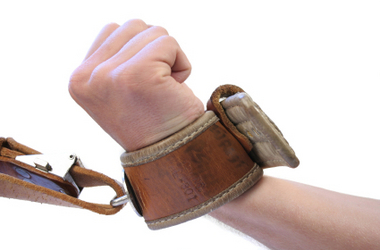
I meant to remain silent. I meant to remain completely still in order to shame them. But when they pulled my wrists right over the edges of the bed, shackling them painfully below the level of the mattress, and spread- eagled my ankles to the corners of the bed, I broke that silence and objected — vociferously. I was appalled at their barbarity but my protests did nothing. I fell silent and let them do what they wanted. Finally satisfied, they trooped out, some of them actually smiling, leaving me alone in the room. I fell asleep quickly, a narcoleptic stress reaction. Nevertheless, no one returned for an hour. They extracted a pledge of obedience from me before taking off the shackles.

“When they released me,” I wrote in my journal, “my back hurt so badly I could barely walk and…my scapula muscles felt as if they had been separated. ‘I plan to sue you for doing this to me.’ I said as calmly as I could as I left the room. Nobody reacted.”  As I wrote in my journal the next morning, “I woke in severe pain, the muscles in my chest felt torn from those that connect it to the shoulder… the pain went clear through to the scapula.”

That was not the end of it. Once you treat a human being in such a fashion, all bets are off as to how she behaves from then on. I no longer cared what you did to me after that. When you threatened me with restraints a few days later, I dared you to do it. I egged you on and so you did. My capitulation showed subsequently when I stripped naked multiple times, even voided on the seclusion room floor and smeared urine on the walls. You reduced me to an animal. I hope you were pleased with the results.

From what I witnessed, many of you — on the nursing staff at any rate– took no pleasure in your jobs. You apparently didn’t want to work in psychiatry, and wanted nothing more than peace and quiet and an easy day’s work. When one of you actually screamed at me, after that staff assault occasioned because I didn’t hand in my crayons on time, that you were “sick and tired” of listening to me every night, that was stupid and nonsensical. How can any hospitalized psychiatric patient be expected to worry about what makes a nurse comfortable?  By rights it should be the other way around.

I think what it comes down to at the North-7 secure unit is that you expected patients to meet your needs and make you happy and you tried to force us to. In my case, and in at least one other patient’s that I witnessed, you even tried to physically assault us into doing so. But what a farce. Patients in the outer unit warned me to get out of there; they told my friends they were worried staff would hurt me. They were right. By the time I was discharged, I had almost no memory of what had happened over the previous 6 weeks. It is only in the last couple of months that anything has returned to me. Yet every single day since my discharge, when I least expect it, something triggers a thought or bodily memory of my stay here and instantaneously my heart starts hammering, I get dizzy because I can’t breathe, and I tremble and cry just thinking about it because I’m right back in that seclusion room and April 28th is happening all over again…

Now, I don’t expect to recognize any of you. How could I? I still don’t remember much except those episodes I wrote about, and some little snippets here and there. I am told that some of you will be nursing staff on N-7 and some my so-called treatment team. Well, if you were my treatment team and you just turned a blind eye to what went on, for that you are just as guilty as if you accomplished the acts yourselves. Of course, the worst of it mostly took place in the evenings, in relative secrecy and when few were around. But if you knew it was happening nonetheless and If you approved, well, then, I have nothing to say except shame on all of you.

I felt helpless and utterly alone. Frightened beyond belief. No one defended me, no one helped me or came to my rescue. No one except Christobelle Payne. Christobelle treated me with compassion and kindness. She always made sure that I had gluestix and magazines for my artwork, even when your every impulse was to withhold them as punishment. I cannot tell her how grateful I was and how grateful I remain to her for treating me so humanely. I have never forgotten the oasis of kindness she provided in your North-7 desert.

Apparently no one else on the unit understood how to behave humanely or to treat patients with respect, or no one else gave a damn.

Punishment is the nature of what you did to me. You lost your tempers and you punished me.  The result was that you permanently damaged and traumatized me. I believe you did what you did absolutely on purpose and I believe you did not care what the consequences would be to me.

Some of you deserve to lose your jobs because of it and because of what I’d venture to guess you have been doing for a long time to other patients.  Perhaps you will. You all need to be thoroughly retrained, if that is even possible. Certainly the secure side of the unit needs to be completely reorganized and re-staffed. But that is not my job. You’ll find out what will happen after the Department of Justice and the Joint Commission do their thing.

I hope you remember me and what you did to me for a very long time. Unfortunately, I know I may never be able to forget you. I wish I could, believe me, I wish I could.


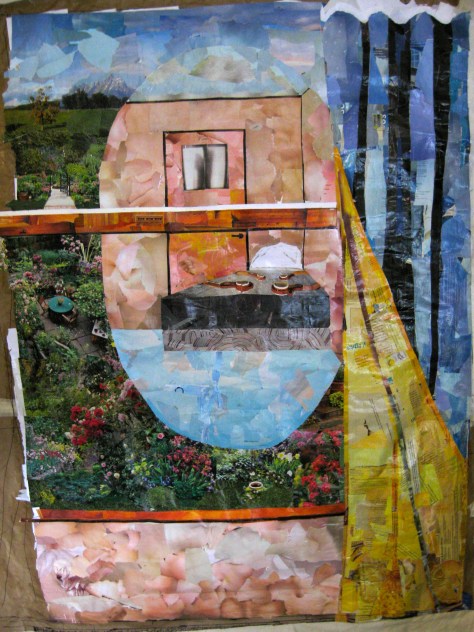
Artwork from Hospital

If the window is open, what does the mirror outside see inside the room?

As may be obvious from the brown paper at the sides, this collage is very much unfinished, both as to content and as to medium. What I mean is, this is a kind of painting with paper, so I am so far dissatisfied with, say, the blue curtain with yellow lining, because it still looks rough and is not clearly a curtain blowing in the air coming through the open window. Ditto, the open window, which is not clearly even a window, except by virtue of my titling it such. But when I finish with it, I hope all these mysteries will be clearer, including the surreal placement of a hand mirror outside an upper story window! (I said it was surreal, didn’t I?) But what I cannot help is whether or not the viewer recognizes what it is that is on the bed. Some people simply do not know what restraints look like, and have variously interpreted them as guitars or snakes or what have you. To me, it is obvious. But I guess most people have not been in such a situation, and have no conception of what they might be looking at. Perhaps a more suggestive title would help?

Another important feature of the “painting” is the frosted glass window, with the mysterious something going on behind it, again left up to the interpretation of the viewer. If you understand that this is a restraints bed, and that the window is open…what could be going on outside the seclusion room? And why is the window open? Should the bed be empty? If you could see this very large collage – 5 feet by 5 feet — up close, you would see that the mirror overhangs a very detailed garden, with all the trappings of well designed backyard floribundance, so to speak. There is a little table and benches and other accoutrements, but also a path leading up to — a garden gate, which opens onto a field and freedom.

As I worked on this collage, I was in a state of acute anxiety — with tremors and shaking and palpitations I did not understand. And every night I would weep with bodily but not conscious memories of the recent brutalities I experienced at Manchester and Middlesex Hospitals. At Natchaug they understood how degrading and traumatizing such treatment had been, and indeed how re-traumatizing. Because indeed, I had already been traumatized many times before in the 80s and 90s and early to mid 2000’s by what I thought was SOP use of such measures. Instead, when those recent hospitals used them,  cruelly and inappropriately, at a time when I knew their use was frowned upon and had been severely curtailed, it not only re-awakened the original trauma, but in a very real sense put me in emotional touch with it, the pain, the terror, the horrendous humiliation for the very first time.

I am not by any means over it. As I work on my memoir sequel, BLACKLIGHT, I am also slowly going over my hospital records with Dr Angela, aka Dr C, and it is a gut-wrenching task that leaves me drained and tremulous. But if it succeeds in returning my memories to me, all of them, I shall consider it worthwhile.

Mental Illness and Authority: Part II

I started the post below as a response to a very kind email from “Mary” but it eventually got so long and involved that it became more of an essay than a letter. I hope she will understand why I put it here, rather than sending it to her alone!

_____________________________________

First, here is her letter to me:


Thanks, Pam.   I learned from your very well written account, “On Psychiatry and Authority.”  I felt like I was in the room with you, it was so descriptive.  I recently had a call from a man who is bipolar.  He said while off his meds, he was in an encounter with his girlfriend and was arrested on domestic violence or disturbing the peace charges.  He told the officers he was a psychiatric patient, but of course, jails have become America’s answer to mental illness.  The police threw him into a cell after booking him, then released a police dog on him in the isolated cell rather than simply locking the door.  He said the dog ravaged his leg, exposing bone, and he was taken to the hospital.  There may have been a time when only black mental patients were treated this badly, but the caller was white.  I wrote about more murders and abuses against mentally challenged people in my blog – Letter to Mary Neal’s Terrorists – http://freespeakblog.blogspot.com/2010/10/letter-to-mary-neals-terrorists.html

I am still undergoing much censorship, Pam, likely because my advocacy to decriminalize mental illness is a threat to the private prison industry.  Over half the inmates in America are mentally ill.  If they are released to community care under AOT programs or treated as hospital inpatients rather than prison inmates, depending on their offenses and functionality, it would not be more expensive for taxpayers, but it would negatively impact prison profits.

As I read about your brutal treatment in the hospital, I was so sad.  Here I am advocating hospitals rather than prison, and you were treated that way by psychiatric professionals.  The only way I can continue after learning what happened to you and others who were in abusive hospital environments is by thinking about people like my caller who was not only tossed in an isolated cell naked, but a vicious dog was sent in to attack him after that.  I also think about my brother Larry who was murdered under secret arrest because police were fed up with being his psychiatric caretakers.  Although hospital care is only marginally more humane than incarceration in some cases, there are fewer permanent physical injuries and murders among hospitalized patients.

Thanks for sharing your experiences.

Mary Neal
Assistance to the Incarcerated Mentally Ill
http://www.Care2.com/c2c/group/AIMI

And my response:

Thanks so much for your email and sympathetic understanding of the traumatic aspects of my so-called “treatment” at Muddlesax Hospital last April. Such treatment was, at other hospitals especially in the 80s and 90s and even in the early 2000s, so much worse — I mean in terms of real physical violence perpetrated against me while being literally, bodily, forced into restraints — that I was almost reluctant to write about such a relatively mild incident. But the humiliation of having to put myself into restraints was almost more unbearable than the, in some sense, honorable freedom to resist! It just riles me completely…How dare they put me in such an untenable position? Then again, I suspect it was intentional.

Nevertheless, I am very much aware that in Connecticut hospitals way too many people have died while they were in restraints, and this in the not so distant past. In fact it was investigative reporters at the Hartford Courant back in the late 90s —and their article entitled, I believe, Deadly Restraint — that served as a national catalyst in getting hospitals to stop the wholesale use of seclusion and restraints. At the very least it started a national discussion about the use and abuses of force in psychiatric hospitals and (I think) juvenile detention centers. (God forbid anyone at all should care about jails and prisons however…Those people obviously deserve it, they are criminals after all… Right?)

But even though most hospitals in Connecticut claim to have reduced the use of force to the most extreme cases, (they will force medication though, through the use of forced medication hearings) I do not believe that can be so. Because I cannot believe that I alone “deserve” seclusion and restraints and yet I have been subjected to such abuse time and time again. Until 2005, I was put in S + R at least once almost every time I was hospitalized and quite often multiple times, for many long hours. After 2005, I would say the incidence was reduced by about half. That means that half the hospitals still indulged in this abuse, one of them, as I wrote earlier in this blog, employing them almost every day for a week and a half!

Of the hospitals that did not physically restrain me,  most were still abusive, but more subtle about it…For instance, they would put me on Constant Observation, but then tell the “sitter” not to speak to me. Or they would institute the common but for all the commonness of it, still abusive policy, of making the one-to-one person being ignored sleep with her hands and head completely uncovered. Now, all hospitals are freezing these days, I do not know why. But it was well known that you had to bring a sweater or sweatshirt everywhere, because the air-conditioning would be out of control and everyone was too cold no matter the season. So to have to keep your hands exposed all night was cruel. But the reason that they insisted on it clearly had nothing to do with it being “safer” for the patient. No, it was punishment. That is ALL. The whole purpose of one-o-one in those places was punishment. You could not talk to the sitter, one, and the sitter had to follow you even into the toilet. And all the while deliberately ignoring you if you spoke to her..So what was the point, if they kept the close eye on you they were supposed to, they knew you could not hurt yourself.  So the point was simply to humiliate and torment the patient so they would beg for “freedom” and pretend or at least mouth the words “I am safe.” Those magic three words were all that were needed, but you had to say them so that the nurses could hear.

For many years, I believed that this was a hospitals-wide, state-wide, business as usual policy, the no-talking, hands exposed rules, and that it was reasonable. Until I went to Natchaug and Sharon told me that Natchaug didn’t believe that one-to-one should be “punitive” in any way. And by the way, she said that word, “punitive,” not I. Nevertheless, at Natchaug, no one made me sleep with my hands outside of the covers and the sitters freely spoke with me. In fact, once they understood that I needed them not to share their own lives with me, because then I would feel the need to take care of them, something that would not be helpful to me, they wanted to find out specifically how they could help me.

But back to the use of restraints. I am only 5’ 3” and from 2005 until 2010, I weighed between 92-105 pounds. Surely I could not have been that great a threat to anyone. In fact, at one hospital, one I will not name, fearing them so much I wouldn’t put it past them to take revenge, they had a somewhat better policy of dealing with agitated patients.  At a Code Orange, staff members from every unit converged on the “victim” (sorry but that is how it felt) and  “held” her until she could calm herself. Now, this “holding” often consisted of pinning her bodily to the floor, which itself could be anxiety provoking. And at least once, in my case, a male nurse who openly detested me, tried to pin me to the floor on my stomach, which I had read was something to be avoided as people had died when held down prone, as opposed to supine (on the back)! But in general the technique worked, if the victim was held down long enough. Basically, if he fought, there were enough people holding him down to allow him to exhaust himself without doing anyone harm. And then, when exhausted, he would calm down and either take PRN medication, or assure the head nurse that he would be okay now. It worked, though, no matter what I thought about it, or of the people doing it. And it did avoid all use of restraints, though of course by itself it is already a form of restraining people, it just avoided the use of mechanical restraints. That though, still makes a big difference…

Forgive me if I segue again into another digressive subject for a minute or two, but the subject of 2010, which recently turned the decade corner into 2011, brought to mind the fact that having taken Zyprexa (most of the time) since then has caused me to gain a fair amount of weight, another subject that is near if not dear to my heart. Oh, the damage that psychoactive drugs do! How dare doctors blame us, the people with schizophrenia, for it? Don’t we have enough trouble without being blamed for the side effects of the very medications that they prescribe? Do you know that for decades, and sanctified as Truth in psychiatry textbooks, they insisted, without any reason and making less sense, that schizophrenia itself was the cause for so many of us to be obese? That was utter nonsense to my way of thinking. Every single memoir about sz that I ever read revealed that the author had been thin UNTIL she or he was treated with antipsychotic drugs, and then, blammo, food becomes the enemy. Yet the shrinks actually insisted, against all the evidence, that it was the illness and not the drugs that was behind the huge % of patients exhibiting this “signal obesity”.

Well, all along I thought they were full of shit, pardon my french. No, I didn’t just think it, I KNEW it. I had not a doubt in the world. And you know what? I was right. The latest research has borne out precisely what I’d asserted all along: when investigators looked at a population of people with schizophrenia that for one reason or another had never taken antipsychotic drugs, they discovered that this neuroleptic-naive group was thinner than average, and that it was in fact the drugs that had made us obese, sometimes massively so, rather than schizophrenia. And it just infuriates me, not just the obesity, it is not just the weight gain the drugs cause, it is the fact that we patients have been blamed for something that they, the doctors and nurses and their GD drugs, inflicted on us. Maybe it is especially difficult for me, with my history of anorexia and my intense wish simply to disappear, but what about those who will die from drug-induced heart disease or diabetes?

I know, I know, Mary, you may be on the other side of this argument, or it might appear that way, because you want more treatment to be available, not less. I do in general agree with you: Prisons are overflowing with the mentally ill, who should never have been there in the first place. In fact, I think the prisons are overflowing with an awful lot of people, especially those of a certain darker-hued skin, for little reason more than the very color of their skin! I mean, tell me why Robert Downey Jr and Lindsey Lohan, aside from their celebrity status, get caught again and again with drugs and cocaine etc, yet are sent off to posh rehab centers, with a smile. But should you happen to be an unknown, POOR, god forbid mentally ill person of a darker hued skin (and let’s face it, a light/white South African immigrant would not be treated the same way as a dark-skinned someone with Nigerian roots!) if you are that person and you offend in some way just 3 times, well, then, you are sent away to one of California’s really “posh” ha ha ha penitentiaries FOR LIFE! Things like that just make my blood BOIL. And don’t get me started on the insanity of our drug laws!

But forgive me for going so far astray. It is just that the whole subject of prisons and what we do to people in them is a really sore point with me, and not just how we treat the mentally ill there, though that is about as atrocious as it can get…Need I even mention the “extra beds” in unused supermax prisons being used to house “unruly” MI prisoners? It makes me want to scream and throw up at the same time.

Well, no doubt this “essay” is both incoherent, in the sense that it doesn’t cohere properly, and just plain incoherent! I admit to a bit of laziness, as it is late at night, and i need to take my MEDS and go to bed. So, at the moment, I am not going to polish and fix it. I am going to pretend that since this is “only” a blog I can get away with shoddy ill-organized writing, and call it a night. Which is what I am doing forthwith…Good night, and thanks, Mary N, thanks a million again.

PW

On Psychiatry and Authority

My writers group gets together once a month, when we discuss the single page of prose nonfiction or fiction, or usually in my case a poem, that we have written to the one or two word “prompt” chosen the month before. While I had to miss this month’s meeting, due to exhaustion, I did write (or rewrite) an essay as well as a poem. The poem I cannot share, for reasons I have reiterated many times: if I publish it here, I won’t be able to do so in any hard-copy journal. However, I feel comfortable putting the essay here, since it is mostly a rewritten and reworked piece of an earlier blog post…So if it seems very familiar, it is. I wrote it in fact not so long ago, but I have polished it and turned it into a piece of writing with a beginning a middle and an end, with a few other details I have discovered from sources like my journal since then.

PS I apologize if I repeat myself on this topic once again, but you can see by the repetition itself how much trauma incidents like this one, but also most of the others, which were much worse for being truly violent, inflict upon people…

========================================

S & R

Maybe I was disruptive. Perhaps I frightened other patients. I do not know why otherwise they would have forced me into that barrenness known as the “Quiet Room.” That it was just the same old seclusion room, prettified with another name did not escape me. I begged for a blanket, but no deal. Freezing, I pulled the thin mattress over me instead. They yanked it off in the typical psychiatric nano-second then eliminated it from the room altogether. Now I had only two hospital johnnies and my rage to keep me warm.

I remember that I yelled a lot, and that I wouldn’t stretch out on the cold linoleum to “calm myself.”  I begged the one-to-one nurse to talk to me. She only turned away and told me to lie down on the floor. I complained again that I was cold. She said nothing, only barred the doorway. Getting no response and still agitated, I tried to push my way out. Two “guards,” who though deliberately keeping just out of sight, were on alert, and they shoved me away from her. I yelled again and shoved back. One of them asked what was wrong with me, why didn’t I just ask to talk with the nurse instead of physically resisting? I did ask to talk, I told him, but she refused to, they all did. He wrinkled his brow as if confused by this answer, but with a shrug that said it wasn’t his job either, he ordered me to stay inside the seclusion room and to “just lie down and stop making trouble, if you want to get out of here.”

About what happened next, I remember little. I only know that suddenly I found myself face down on the floor and with a commotion of people around me. Some man had pinned my arms behind my back and he was angrily mashing the left side of my face into the floor.

When they let me up, I yelled that I was not in prison and they had no right to treat me that way. But at least, I discovered, I was finally allowed to talk to the nurse and to stand out in the hall with her. That was progress, I thought. Then I heard staff in low and serious discussion some distance away. Someone sprinted down the hall in the opposite direction. I had a bad feeling about it and asked my one-to-one nurse, “What’s going on, what are they doing?” She responded, “They’re making up a bed for you.” “A bed? What sort of bed?” That’s when I understood that she meant a restraint bed.  “Wait a minute. You can’t restrain me! I am out here, calmly talking to you. You haven’t even offered me a PRN and I am willing to take one. But I am not a danger to myself or others, and you cannot legally put me in restraints.” The nurse remained silent. She refused to look at me. My heart began to race. I shouted down the hall, “I will not let you use restraints on me. I am calm and you are not allowed to do this.”

When finally staff members approached and asked me to follow them, I complied. I knew that if I didn’t they would have reason to say I “deserved” whatever they did. In my room, I found there attached to the bedframe were the straps and shackles of four-point restraints.

“Listen, I am calm and I am not a danger to myself or others,” I carefully declared. “I will take PRN medication. I do not need restraints.”

“Lie down on the bed, Pamela,” one nurse told me. Again, I refused, saying that this was punishment pure and simple. They had neither cause to do this nor any legal right.  She responded, “We will ask you one more time to lie down on the bed, Pam, or the security team will assist you.”

At this point, I understood that they were going to use restraints as a form of discipline and would do so no matter what I said. It was completely illegal but they were out to get revenge and they would use any reason I gave them to excuse such measures. If I “made” them force me into the restraints, it would only prove that I deserved them. More humiliated than I have ever been in my life, I sat on the bed.

Ignoring my protests, they went ahead and shackled me to the bed, my arms below the mattress and my legs to each lower corner  and then without a word, they left. Except for an aide monitoring me through the door, partially ajar, I was utterly alone: humiliated, degraded, helpless. I couldn’t help it. Against my every determination to stay strong, resolute, and angry, I let out a lung-bursting howl. I didn’t care who heard me, who I frightened, who I disturbed. I howled for myself and against all the injustices and cruelties that had ever been perpetrated against me. And I howled for every other so-called mental patient that had ever been shackled to a bed by medical professionals who claimed to be helping them. Who thought they could justify brutality by calling it therapeutic.

Natchaug Hospital Stay and Comfort Room

I have been away since December 17th, in the hospital yet again. This time the experience – at Natchaug Hospital in Willimantic — was vastly better than the previous two and not abusive at all. I want to tell you about this, but first let me go back to what happened to get me there.

In the beginning of December I began to have trouble again. The “people” came back with their jeering and mockery and commands. A general confusion assailed me. In my journal I recorded many “cries” of MATOOTAM! : “Kill the Ogre that Ate Manhattan” which many of you know means me. I also began to burn myself under the influence of those command hallucinations. I still believe this was all a Lyme disease relapse, but I had been on antibiotics  previously for 8 years – with positive tests for Lyme and other tick-borne illnesses intermittently during that time — without being cured, so there was and continues to be nothing but symptomatic treatment. This means, as my new psychiatrist, Dr C, argues, at least temporary use of the hated, and loved, atypical antipsychotic, Zyprexa. I already am taking Abilify and Geodon, as well as Lamictal for mood stabilization and possible temporal lobe seizure activity. However, as has happened before, these were not effective enough to carry me through such a crisis, which is why I was encouraged to take Zyprexa, 20 mg to head off anything worse. Despite my resistance – I really hate the immediate increase of appetite and weight that accompanies taking it – I did so, I assure you. But the damage was already done and the crisis took on a life of its own, so to speak. By mid-December, I was  no longer “safe,” the code word my visiting nurse among others uses for my listening to the commands the “people” give me. She didn’t know how true that was, though, until I finally admitted it after four days of what I will only describe as obedience to those same commands.  I saw Dr C that Thursday, and though she was uncertain of my safety, she decided that I would talk with her every evening until I saw her again the following Tuesday.


The truth is, I do not really recall most of this, neither intellectually nor emotionally. I have had to be told and to refer to my journal in order to recount all of the preceding. However, I do remember what happened next. In addition to the reappearance of the People, I began to experience what I called “brain blips.” These were very brief episodes in which I felt as if my brain suddenly did a somersault, a little like the feeling when your heart skips a beat, except that it was in my brain and accompanied by a terrible dread and feelings of impending doom. After the fraction of a second in which the blip occurred, I would come back to myself – it felt as if for an instant I lost consciousness, but the blip was so very brief that it didn’t seem possible. These episodes were terribly frightening, even though nothing ever happened during or after them, not at least of the dreadful sort I feared.


That Friday evening, my heart racing and my mind itself awry, I was in another world, so confused that I wasn’t quite sure what was going on. I managed to call Dr C, who prescribed Ativan. It was too late to call the nurse to pick it up for me so I got in the car to drive the mile to CVS but as soon as I pulled out of the parking lot, the other world took over completely. I do not know how I actually got to the drugstore. I recall only that I could barely hear or see for the pandemonium in my mind but that I was aware enough of the danger to drive only 20 mph the entire way. Once there, however, I didn’t know what to do. I didn’t know how to get home and I forgot about getting the Ativan altogether. Somehow I managed to tell the pharmacist that something was wrong, that I couldn’t drive home, but she thought I meant that the car had broken down, and called a cab for me. I went outside to smoke a cigarette and wait for it, but I was so scared of the shoppers who came and went – the drugstore was open 24 hours a day so anyone in the area who needed something after 10pm came there – that I was unable to take more than a few drags, hiding behind a pillar. I returned to the pharmacist and whispered that there was something terribly wrong, with my brain, that as I felt, bugs had infested it and that I was in another world. Finally she understood and called an ambulance.


I won’t go into the drive to the ER except to say that I was so “out of it” that I wasn’t even upset that the EMTs made me get on the stretcher right in the middle of CVS and that everyone saw me being taken out of there. Once in the vehicle, I tried to explain to them that despite the large wound they would discover on my leg, there was something wrong with my brain itself, that this was not a purely psychiatric matter and that I needed medical, neurological care. Indeed, I still feel that way, but much good that did. Once a “mental patient” always a “mental patient” it seems. I admit, though, that having burned my leg did not help much. Still, I tried to explain that I needed an MRI of my brain, that something was wrong, a bleed or parasites or something! You can guess their response: of course, they summarily dismissed all of that and quickly had me packed off to the psych section of the emergency room. Although this is a very comfortable, large and separate unit of the ER, with single cubicles for each patient and a TV but also a video camera in each one, I waited 3 days before a bed was available for me, some 25 miles or more away at Natchaug Hospital, a psychiatric hospital in Mansfield Center, in Connecticut.


I name the hospital openly – as opposed to the others I have written about — because it was  amazing in so many ways that I want both to sing its praises and to “advertise” it so to speak, to describe what a really good psychiatric hospital ought to be like. It is true that most people were in for a very short time, Connecticut having virtually no long term beds any longer, not even in the state hospital, but whether acute care or for somewhat longer stays, Natchaug was quite simply the best place I have ever been. From the food, to the – well, let me go into more detail rather than a mere summary (though in my opinion, the food was indeed a cut above that in any place I have been in, both in availability, and, with a salad bar at every meal, quality.)


Upon admission there was, to my dismay, a requisite “clothing and body search.” This procedure was done in such a way as to preserve as much dignity and privacy of one’s person as possible but I feared at first that it boded ill for the rest of my stay. Also, I discovered that although there were, I think, two private rooms, I had been assigned a double, a semi-private room, with a roommate already installed. This was upsetting to me, as I had almost always had a single, or been moved to one because the unit staff either felt I was too disruptive or unable to tolerate the stress of a roommate. However, when I saw how the semi-private rooms were carefully partitioned with a floor to ceiling wall in between the bed areas, I was much reassured. Although I eventually did for a short time have a private room, or a double that was designated as private – I frankly do not remember why! – I was not bothered by either roommate that I had while there. The one who did try to get me to – Oh, I dunno. I just am no longer one to “socialize” with other patients and I simply did not feel like getting to know her, or to excessively “sympathize” or otherwise expend my limited energy on her problems. I feel a little bad about this, but this one roommate, the second one, at first tried to involve me in her “stuff” and even left a journal or something next to my bed “for you to read to find out more about me.” Well, this was so very intrusive, and nothing I had asked for at all, that I rudely, but decisively said, “Why would I want to do that?”


I know that I would have been terribly hurt and humiliated by someone’s saying such a thing to me, but on the other hand, I would never have been so forward with a complete stranger either. In any event, she quickly took the papers back and left the room. However, a day later, she seemed to have no hard feelings, and we got along, if distantly at least as well as I wanted to.


Where was I? Well, I will tell you that the worst thing about my stay, and I suppose unavoidable, since I was there over the holidays, was that I had three different doctors for the three weeks I was there. but the best things were two, or more, but two in particular. One was that there was NO seclusion room, that is to say, the seclusion room that they used to have was not only now designated at the Comfort Room, but in fact was comfortable, and open at most times for use by anyone needing comfort. In it, there were thick mats on the floor, a Grandma Moses-like mural painted on all four walls by artist staff members and best of all a “therapy chair.” This is a very large and comfortable rocking recliner that is built in such a way as to elevate your legs, while you recline against the back, and let your feet dangle over the end. This allows the person to position the very lightweight chair near a wall so as to be able to lightly touch the wall with the feet and keep the chair rocking with little effort all the while lying back and relaxing. Their next improvement planned is to get headphones, wireless, or MP3 players with a  selection of music for additional relaxation and comforting.


I usually tell staff at hospitals that they “cannot keep me safe” and indeed “prove” it by obeying in some fashion the commands the People give me…This never exactly endears me to anyone, and in fact has more often than not earned me a reputation as very difficult, even as having a “borderline personality” as an Axis 2 diagnosis (not true). Be that as it may, I was in fact kept safe at Natchaug, and when I was not, I was on a very helpful rather than punitive 1:1 or constant observation. At Natucahug, one-to-one staff were supposed to talk to me, rather than kept from doing so as at other hospitals, “so that you won’t come to like the attention too much.” The few times I became very upset, screaming, just screaming, at the top of my lungs, and rather than choosing to go on my own was escorted to the Comfort Room, by “staff assist” people (there is no “Dr Strong” goon squad of uniformed security guards), the door to the room was open and someone talked to me the entire time. Thus, when I left, on my own, when I felt calmer, I also felt that the reasons that I had been so distraught were also alleviated.


Also, although Natchaug, like any other hospital, did have a restraints policy, they did not use them a single time the entire three weeks I was there. In fact, though there was a very disruptive, troubling patient there the entire time (for once it was not I) I do not believe they even came close to considering using them. This time I believe it when they said that they almost never have to use them at all.


But the very best thing about my stay was something quite serendipitous: it turned out that the Director of Nursing for the whole hospital is Sharon H, the very same APRN who had been head nurse during my many stays at a Hartford hospital, and who had taken upon herself to supervise my care, or at least seemed to have in some sense “taken me under her wing.” Sharon is, and always was, both extremely bright and compassionate beyond words. She is also insightful in a way that I found the first two doctors I had were not, and if the third was, I did not have a chance to find out because I saw her only 4 times. It is true that Sharon had the advantage of having known me well, if 17 years ago, but still, she seems to have this ability to size up a situation, at least with me, and both to calm me if necessary and to suggest a solution that simply fits…I have to say that I felt especially well taken care of. Sharon made sure she saw me every afternoon, though this was above and beyond the call of any duty.


This description scarcely does my stay at this hospital justice. Although, like any hospitalization, it was not an easy stay, nonetheless I can only say that I cannot thank Sharon and the Natchaug staff enough for all that she and they did for me.

(PS Forgive any typos I have not yet corrected but it is getting late and I am too tired to go back and check for them at the present time…Lazy me!)

Schizophrenia and Traumatic Treatment: Continued Use of Restraints and Seclusion

Please note: For my final take on what happened at Middlesex, please jump to this link: https://wagblog.wordpress.com/2012/05/15/useless-psychiatric-mediation-and-a-poem/   (added in September 2012)

First, before I start my post today, I wanted to share my newest artwork, which is a colored pencil “painting” of a woman who lives in my building, whom I will call Rose. She did not ask me to paint her; she was simply someone who sits quietly for many hours in the community room, and so was a good subject for a portrait, and a photo. I also happen to find her a very agreeable person, one of the nicer ones here (most are gossips and backbiters, or if not most, then the most vociferous and visible of the residents). I think she will be quite pleased with how it turned out, so long as she does not expect anything but a portrait that is faithful to life, rather than an idealized one. I believe, however, that Rose is very down to earth and knows what she looks like, and will appreciate what I have painted.

Rose, intent on her needlework
Rose intent on rugmaking
Rose comparison of painting with photo

_______________________________________________________

Now I want to discuss, yet again, the use of restraints in Connecticut psychiatric units, particularly as it pertains to my treatment there. As I recall, I have not gone into much detail about the last hospital stay, back in April and May, largely I think because it again was so traumatic and in many ways similar to the previous one, that I could not bear to contemplate it.

However, as very little as I recall, I do remember more of the stay than the complete amnesia I still experience for the stay in Manchester, back in October or November of 2009. When I say I have a loss of memory with regards to this other hospital stay in the spring of 2010– in Middletown — I meant it more for the specifics of certain episodes. And for any of the people there who staffed the unit. (Except for Christabel the OT).  With regard to much that occurred I believe a lot could be brought back to me, under the right circumstances. I do, for instance, continue to have an overall memory of what the place looks like and where my room was and some details about what happened. What I do not, and did not remember, not even the next day, was most of what precipitated the use of restraints and seclusion during this stay. Or at least, of the two or three incidents of S and R two are jumbled together, so that it takes some mental probing for me to straighten out any of it. but one incident remains too clear in my mind for comfort though even at the time, or immediately afterward, as well as now, I have no idea what was the actual precipitant.

Anyhow, what I recall of  that episode is this: I had been taken off Geodon, which I took regularly with my  Abilify up till then, both in order to boost its antipsychotic properties as well as to temper any Abilify-induced irritability. The irritability was physical as much as mental — and with the resultant tendency to get into verbal fights and arguments with anyone who, as my mother used to put it, looked at me crosswise. I have no idea why they did this, took me off Geodon, given that I know I explained the rationale for the use of two antipsychotics. But many MDs seem to find this objectionable, however effective. Perhaps they considered the 20mg Zyprexa, which they had talked me into taking on an acute basis, would be an adequate substitute for the calming effect of the Geodon. They had wanted to stop the Abilify, too, using Metformin, a diabetes drug, for weight control, but I had insisted on taking it both in an effort to combat Zyprexa’s tendency to cause weight gain, but also because I believe that it is the Abilify that has so massively enhanced my creativity.

So there I was, on Abilify untempered by Geodon, and taking Zyprexa, which induces its own “upsetness” when my weight invariably increases…I assume that I must have been hostile, loud, and disruptive, for I do not know why else they would have made me go into the seclusion room. I do remember that I could not calm down, and that in the flimsy johnnies they had clothed me in, I was freezing, so that even when the nurse doing constant observation told me to lie down and rest, I was unable to do so for all my shivering. I begged for a blanket, but no deal. I pulled the entire bare mattress over me as a covering. Well, this was apparently seen as a self-destructive act, or something, as immediately they pulled it off me and dragged the mattress itself from the room. Now I had nothing for warmth, except my own anger at having been treated  in such a fashion.

I remember that I was yelling a lot, and that I wouldn’t lie down on the cold linoleum and “calm myself.” No, I wanted to talk, and begged the nurse to do so. Instead, she only turned away and told me again to lie down on the floor. Well, this enraged me, and I went to the door to complain again. She said nothing, only stood in front of the open door so that I could not leave. Finally, getting no response, and still anxious and “het up” I suppose you could say, or over-activated by the Abilify, I tried to push my way through her into the opening. Immediately two “guards” pushed me back into the room. I yelled at them, and pushed back. One of them asked me what was wrong with me, why I didn’t just ask to talk with the nurses instead of resisting physically…I looked at him and said that I did ask to talk, and she refused. He seemed somewhat surprised by that. Nevertheless, he ordered me to go back into the room and lie down.

I was having none of this dictatorial behavior on their part, and as I recall, at one point — no, I do not remember what happened. I only know that suddenly the guards were on top of me, and one had pinned my arms behind my back and was pushing my face into the linoleum floor. It was as if I were a recalcitrant inmate of a prison and this was a cell “take-down.” I was hurt and I was furious.

When they let me up (and why they had pinned me to the ground I have no recollection, only that when they let me up, I was finally allowed to talk to the nurse nad stand out in the hall with her. I heard some talking behind my back and a commotion, followed by feet going down the hall away from us. I had a bad feeling about it, and asked the nurse, “What are they doing?” She responded, ominously, “They are preparing a bed for you.” “a bed? what sort of bed? She remained silent and I understood that they were putting restraints on my bed…”You can’t restrain me, I am out here calmly talking to you. You haven’t even offered me a PRN and I will tell you now that I would be more than willing to take one. But I am NOT a danger to myself or others, and you cannot legally put me in restraints.” The nurse continued to remain silent. My heart began to race. I called down the hall, “I will not let you use restraints on me, I am calm and this is not allowed.”

Some of the staff approached me and told me to come down to my bed room with them. I complied, because I knew that if I didn’t they would have some reason to say I “deserved” to be restrained. When I got to the room,   I found I had been correct: there on my bed were the straps and shackles of four-point restraints, attached to the bed frame.

“I am calm and I am not a danger to myself or others,” I carefully declared. I will take medication and I do not need restraints.”

“Lie down on the bed, Pamela” someone told me. I refused, saying that this was punishment pure and simple and that they had no cause to do this nor any legal right. “I will ask you one more time to lie down on the bed, Pam, or the security team will help you do so.”

At this point, I understood that they were going to use this form of discipline on me no matter what I did. That they were out to get revenge and that they would use any excuse to excuse such measures. So if I “made” them force me into the restraints, that would by itself prove that I “deserved” them. So, more humiliated than I believe I have ever been in my life, I sat down on the bed, then lay down on my back and said out loud, “I am now placing my limbs into four-point restraints, and I want a record of the fact that I am calm and not resisting and that I have asked for a PRN instead.”

It was no use, though, as they went ahead and shackled me, then left me alone in the room, except for a staff member monitoring me through the door, left partially ajar. My heart was racing with rage, and I could feel the pain of such profound humiliation surging through me. But I did and said nothing, I think, because I was going to prove to them that the drastic measures and punishment they had inflicted on me was WRONG. After about an hour and a half someone came back and let me out. I was neither compliant now, nor placated and as soon as I was free and out of that room, I let it be known, loudly  that I intended to file a complaint. But no one said a thing, no even spoke to me the rest of the night…

THAT is what I remain so traumatized by, at least with respect to  this time: the utter humiliation of what you might call “cutting my own switch,” along with the clear understanding — even mutual acknowledgment — that they were punishing me.

This continues to preoccupy me, that is when I allow myself to think about it, or when I continue to try to read the records of that stay, which records I only a week ago obtained (having sent for them many weeks ago…). I cannot help but re-experience the same brutality and the same extreme and exquisite humiliation, and once again it hurts beyond belief. The worst thing perhaps is that when I told my family about what the staff had done to me they didn’t come to my support, they didn’t unconditionally defend me. They didn’t even  seem to care, or to believe, that I had done nothing to “deserve” four-point restraints (as if anyone deserves them). Another family would have automatically come to their member’s defense and declare that NO one deserves such brutality, and that as their family member I should never have been treated that way. Another family would have done  –oh forget it!  No, my family is always so eager to please the staff and to believe that I am in the ‘wrong” at these hospitals, to believe that I am at fault, (this is the story of my life!) that they simply told me I must have caused their use of such brutal methods of control by my own behavior, I surely deserved it, and besides “what else could they do?” Shackling me, calm and rational, me to a bed was clearly the only option and entirely justified…So much for MY family’s loyalty and compassionate support, huh?

Well, bitterness solves nothing, so I won’t dwell on the last subject, but I will say that if I can, I intend to file an unoffical complaint, or barring that, an official one. The problem with the latter is that I will not then be able to confront my persecutors. whereas if I did so unofficially, it might yet be possible, if only to avoid a messy public affair. After all, I could easily write something…No, I won’t go there. For now, I only wanted to describe what continues to occur at Connecticut psychiatric units, despite the regulations and general disavowal of the use of cruelty in the treatment of those with mental illness. It still goes on, it just happens behind the closed doors of the hospital and the continued use pf seclusion and restraints as discipline and as a salve for frustration, depends on the assumption that no patient will bother, after the fact of discharge, to do anything about it, except try to forget.

Things are better than this, but do not feel it!
Note the linoleum and bare mattress. I have never seen a windowed seclusion room!

Seclusion and Restraints: How it feels

I remember, I remember, well, I remember very little, except in flashes of dim light, like a candle held up by which to read the fading pages of an ancient diary. I remember a sign with my name on it, taped to the door of a room, and how hard it was to find my way back, no matter how many times I made the trip. I remember a nurse with blond hair named “Patty,” whose real name, Lil, I learned only the second to last day I was there. I think I liked her, or that she treated me with kindness, and another nurse named Mary Ellen, who was kinder still, but not always there to save me.

I remember too, but again in uncertain flashes that tell me only that something happened but not exactly what: Being carried by arms and legs into a cold, empty room lined with linoleum, dropped onto my back on the floor, dressed in just two hospital johnnies and pajama pants and locked in there alone. I remember begging for a mattress, then screaming in outrage when I was refused.

This is how it goes: There is nothing in the room but me and air conditioning turned on full bore, though it is October and in the 50s outside. Why do I need johnnies or the huge pajama pants that are falling off me without ties to hold them up? Alone in that room, I take them all off, then squat to pee and take a dump. Good, that feels better. Blankness. Cold, cold. Again I scream for a blanket. Of course, nobody answers. I try to push the johnnies under me to cushion my bones so I can sleep, but the shivers prevent me from relaxing. I have to do something.

I make a long rope of the silky acetate pants then form a slip-knot and put the O over my head with the knot to one side. I pull tight, figuring it won’t take long. I sit to one side of the little window in the door, so no one sees me immediately. Finally they come running. But they don’t understand it is a slip-knot and that pulling at it only tightens it  more. I am struggling for air. A nurse yells for scissors, bandage scissors the only ones available and they cut the pants free. Still, I am in big trouble. I would tell them I only wanted to get their attention, that I just wanted a mattress and a blanket, but what good would that do? Still, do they really think their act of violence, which will follow, will solve anything? Blankness. I have been thrown onto a bed in another seclusion room. As staff and goon squad wrestle my wrists and ankles into padded cuffs, I kick and bite in protest, all of which will be written up as my being “assaultive.” In the end, it is no use.  I scream and scream until the usual injections – 5 mg Haldol and 2 mg Ativan – take the scream out of me and I finally fall asleep.

That should have been the end of it. “Wake up calm and they take you out of restraints.” That’s the name of the game. But this time, I wake and I am still in full 4-points. I ask the nurse why. “Doctor’s orders,” he says. “But that’s punishment!” I answer, shocked. “No,” he says, “restraints are therapeutic. We never use them as punishment.” “Bullshit! Dr Z is punishing me because he doesn’t like me and you know it. He is a sadist.” The nurse doesn’t answer immediately and when he does, he just says, “Go to sleep.”

I remember how they kept me in restraints for 12 hours that time. The chart summary tells me more, that I spent a good part of 5-7 days in seclusion and/or restraints, so there is a lot I do not remember. Am I better off for not knowing? That’s what some people tell me. How would you feel? Would you want to know, or not to know?

————————————————————————————

I realize that the above is simply a restatement of an earlier more detailed post, so it must be obvious that I am still very troubled by what happened. Indeed I am. I am even more troubled by my lack of memory the rest of the three weeks there…which fact was noted even in the summary of my stay, which Dr B (Li) got from the hospital the other day (in lieu of what he requested, which was my entire chart.) Memory loss has dogged me for many many years. Only now can I acknowledge it, and only because Lynnie and others witnessed it. But for so many years I felt desperately  troubled and, well, desperate to hide it, afraid lest anyone know how little I could remember of what happened from day to day. This was especially extreme when I was in hospital but even afterwards it was troubling to me; sometimes I felt I was missing half my life! People — that is to say,  doctors. nurses,aides — expected me to remember ordinary happenings, because they obviously  thought that I was responsible for what I did from one day to the next, which you are not, not in the same way, if your memory is impaired. This expectation was so stringent that I dared not admit how little I did remember of events after they passed. I thought the scant trace they left would somehow prove my evil, prove that I was a shameful deficient person. So  I desperately took cues from others about what they wanted me to “remember,” tried to “pick their brains” about whatever it was that had happened, or that I had presumably done, whatever it was that they expected me to recall. Sometimes a concrete clue might help me piece things together – say for instance if I had scars or wounds that hinted at recent self-injurious behaviors or if there were scribbling on the walls that suggested another sort…But if there were no cues, it was much harder to ferret out what was wrong. Sometimes I might have to come right out and ask, “And you are referring to…?” But I didn’t dare do that often or it would have given my lack of memory away, something I didn’t dare permit…

Now here is the other side of the story, which I find hard to square with my experience in October: one  psychiatric nurse’s account of how situations involving restraints can look to staff.