Tag Archives: paranoia

Natchaug Hospital Stay #2 and Update with Picture

Just wanted to update you on where I have been and how I am: I  spent 6 weeks at Natchaug Hospital in Willimantic, Connecticut this past July and August and though I was discharged as much improved, I  am still having a difficult time, both readjusting and well, simply having a hard time of it. Although in the hospital they did a little adjusting of meds, increasing both the Geodon and the Zoloft, I am not convinced that either one made much of a difference nor that it did less harm and more good on balance. In any event, Dr C and I (at my request) soon eliminated the 25mg increase in Zoloft, and are now dropping the 80mg increase in Geodon. She is concerned that the 240mg is making me very irritable and more upset and frantic rather than providing enough relief  to make it worthwhile. Yes, the voices are much improved, but that could be the passage of time and perhaps due to a general decrease in paranoia, who knows? All I can say is that I cannot take this general state of overwrought irascibility, a tendency to snap at anyone who “looks at me crosseyed,” as my mother used to say.

Natchaug Hospital remains a very good place, the best I know, and just as I remembered, not least because they have a philosophy of kindness and compassion towards patients. In fact, they are excellent because they have a philosophy and are not simply flying by the seat of their pants, hiring whoever comes along needing a job, burned out or not. Not only is their philosophy based on compassion and not on controlling the patient, but they see no point in rules for the sake of rules. It is clear that if there is something in the unit set-up that doesn’t serve a particular patient, the Natchaug staff will bend it as far as they can and try to accommodate each patient’s particular needs. As I was frequently told, why make someone miserable when you can make them happy? It is difficult to be happy in a psychiatric unit, and many patients are miserable because of their illnesses, but not once did I ever see a staff member add to that misery willfully and certainly not to mine. (I frankly could not say this of two Connecticut area hospitals, one in Manchester and the other in Middletown.)

One thing that makes many patients happy at Natchaug, by the way, is that caffeinated coffee is provided at breakfast, a rare blessing in in-patient psychiatric settings.  And since everything is served cafeteria style, so you can have all you want.

They used to provide hot decaf coffee on the unit itself, which was a treat. Because one very ill patient tossed a cup of coffee at a staff member, however, and she was injured, and because for some reason they decided that that patient could not be restricted individually from having hot coffee, now no one is permitted hot drinks on the unit at all. Yet, I suspect that even he would have not thought it unfair to be kept from the coffee pot! I know that in other hospitals I have had restrictions placed on me that others have not, and no one thought it wrong or unfair to me…Anyhow, I dunno what to think, but it was their policy, a misguided one, perhaps, but who am I to say? I know everyone went nuts for a while about having to drink lukewarm “swill.” Finally, though, the patients simply gave up on the “coffee” machine and did without. Anyhow, I have to admit that when I first saw the hot coffee machine, I couldn’t believe it, not because I was thrilled — though I was — but because I saw an “accident”or worse already in the making…

Note: one of the few hard and fast rules  at Natchaug is one they cannot change because they will lose accreditation: no smoking. Smoking is simply not allowed, not even on hospital grounds. While certain patients have tantrums about this and might cause an uproar from time to time in order to try to force the staff to allow them to use the courtyard to smoke “just one cigarette, just this once, please, I am absolutely desperate!” it is simply not possible. But people are allowed the patch and gum and every effort is made to help smokers quit. Even though some staff acknowledge that the policy is unfortunate, even unfair, nothing can be done about it.

I was not, however, comfortable for most of my stay there, and was paranoid a great deal of the time. Of course, I did not understand that the staff was aware of this, so when I began to come out of my delusions of persecution, it surprised me mightily to discover that they knew that paranoia was the reason for my hostility all along. Nevertheless, up to the very day I was discharged, I was hearing people talk about me up and down the hall and at the nurses’ station.

Well, that is all I am going to write for today because I am, as of  a week ago, in the middle of writing my new memoir, and as the days progress I plan to put parts of it up here, for comments and for suggestions. Feel free to do both!

I will finish here with one of my latest drawings, which represents how I felt when I was restrained at Middlesex Hospital, both the time I described in a recent blog post, and the other(s) (for which I have amnesia) when Josephine told me I was more or less “out of control”…to which I can only respond: Violence begets violence, and perhaps if they had not perpetrated on me what they did, things might not have gotten out of hand, But then, that hospital is one that is guided by the Control for Control’s Sake philosophy and the nurses were bitter and angry people…Needlesstosay, they hated me if only because I refused to roll over and play dead, if not die.

Forthwith the picture.
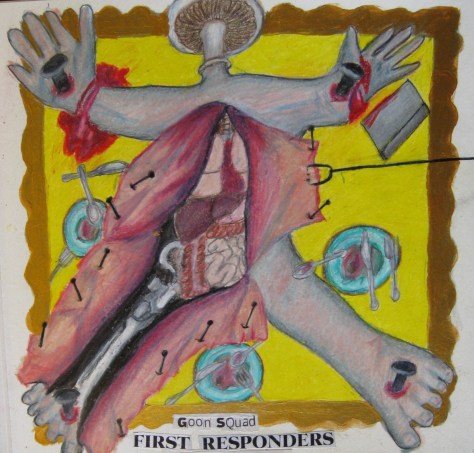
Pam as Dead Meat: Let's Eat!

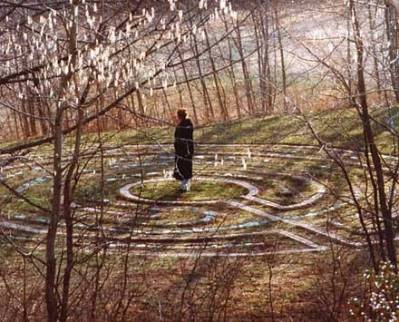
GREETINGS FROM WISDOM HOUSE! (Plus an unrelated word or two about PARANOIA)

Photo by Sr Jo-Ann Iannotti OP

I hope I am not encroaching on Sr Jo-Ann Iannotti’s copyright, by sharing this photo, but if I am I trust she will let me know. In any event, this is one of hers  and it is everywhere at Wisdom House. I believe it is a beautiful example (if that is the proper word for it) of the spirit of Wisdom House. Of course, the physical labyrinth, is stunning by itself, but somehow this photo captures the experience of walking it  and the process of meditating and “being there” in a way that mere words describing likely could not. Surely, if nothing else,  this photo alone is a wonderful way to “advertise” Wisdom House, if it ever needed such a thing.  If you can, visit http://www.wisdomhouse.org and look at the virtual tour photo gallery. That way, you will get a good idea of what the place looks like, and perhaps get something of the flavor of people’s first impression. I know that even the first time I came here, despite my misery concerning all that silence, I knew it was a special place…

Jo-Ann says she has no idea who the woman in the labyrinth center is, that it was a fortuitous shot and nothing more. Frankly, though, I suspect getting the photo took more than mere luck, even just to have been there to capture it!  It exquisitely represents both the spirituality of this place as well as peace and peacefulness.

Clearly, you can tell where I am: at Wisdom House again, having a good time this time. I only wish I did not have to depart tomorrow.Even though I spend most of my time alone, the mere presence of other people, laughing and talking and obviously having a great time, buoys my own spirits and makes me laugh aloud myself. I think it is great that they are laughing so uproariously, and it is great to see everyone with their doors wide open, people, women my age, sitting on each other’s beds, gabbing like college girls. The lovely thing too, about Wisdom House in general is the absolute faith in people’s basic trustworthiness: NO one has a key to their rooms, and no one seems to feel worried about anyone entering or stealing a thing. I frequently leave my computer and writing equipment right out in the open on the sun porch, without the least qualm, feeling secure in the knowledge that everything will be just as I left it when I return. Indeed, the sense of trust that I know Jo-Ann has in people is infectious, and I somehow know that everyone who comes here is trustworthy at least for as long as they are here, even if they might not be all the time when they are not.

Now, I may be naive, but I too have been known to be overly trusting, and I think that is a better option than not trusting people. At the same time, though, I can be extremely paranoid as you know, and I do mean “at the same time…” I suppose that is difficult to comprehend: I will simultaneously give away whatever I can, if I feel I own too much and yet also feel as if people are secretly stealing from me, taking things I need out from under me, without even asking or telling me, which makes me angry, because I am already generous, and never ask for a single thing in return, but I’m sorry and feel bad to admit it, but somethings I am not ready to simply have things taken from me without my say so! I feel guilty about this, though, as if I am so attached to material things that I cannot part with something that someone else needs more than I do (for why else would someone resort to stealing it???). Why do I need to be so attached to anything, that is, to any mere object? It will never save your life or your soul!

I am drifting though…forgive me.

One great thing about this weekend here is that despite my having slept till noon today (after spending several days before last night with very little sleep, and even last night beginning to fear for my brain and my sanity due to sleeplessness as I was up till 4am involuntarily) I have pretty much gotten the book organized and put together. Now, that means only that I have made the organizational decisions, which is the major part of the problem. But I needs must (!) still go through the actual computer manuscript and change it, to make it conform to these editorial decisions. Not extremely difficult, just time consuming. At the same time, certain poems need editing and some rewriting/fixing. This I enjoy, the perfecting of the lines I don’t feel are quite right yet, but it takes time and energy. (I even have a two relatively new poems to add!) Alas, I will not be able to come up here to take the time for myself to do nothing else. Too bad, as it has been very convenient and much more than that. It has been, well, useful in the sense that I have been productive “to the max,” able to say NO to email and phone calls, not even walking with Diane L or doing laundry or cleaning or shopping, just writing all day. I suppose taking my usual 2 miles walk would be a good thing, but for just a weekend here, I would rather not…And although I brought art supplies just in case, I haven’t even taken out my sketch book, that is how good the writing, and the editing, have been going!

—————————————————————————-

Speaking of the labyrinth at Wisdom House as I did at the top of the post, let me segue into a few words about paranoia: I have not walked the labyrinth, nor even approached it. The closest I have come is to sit at the top of the stairs looking down at it relatively from afar. The very idea of “doing it” makes me feel both rather shy and then scared to do so. I am in fact scare that God might strike me down, should I have such temerity as to try it.  I am also squeamish, not sure I could relax and not feel paranoid, not feel so much on display  that I could not concentrate or let myself be “unaware of being observed” — whether I am in fact under observation or not.

That of course is the essence of paranoia: it matters not a fig whether something is really happening, it matters not another fig if someone’s really after you or really against you: if you feel it, if your amygdala is working overtime to generate that feeling, the intense feeling of fear that it is meant to generate, well, that’s it. That is how you are going to feel. And “the feeling is primary.” That’s what Dr O told me time and time again. You feel the fear first, and primarily, and then the story or reason for feeling it attaches to it. But if the fear  gets entrenched or doesn’t go away, the story,, that is, the brain’s explanation for the feelings of fear only gets more entrenched, because how else can you deal with fear? It is extremely difficult to feel fear unmitigated without somehow understanding it as coming from somewhere, or being stimulated by something, having a cause or reason. The brain always wants to make sense of things, and it does this whether one “wants to” or not.

So even though I am aware of what paranoia is, I have never been able to control my thoughts when it is happening. It is only after the fact that I can, now, sometimes, look back on a difficult situation and with a clearer head understand how I might in fact have been paranoid in my behavior due to my fear- induced understanding of what was going on. It is very very difficult to override such feelings, esp on such  a fundamental level.

I wish I could write more now, but I’d better to get back to my writing before I have to get back to sleep. As it is, it is 1:50 A.M. and we — Ann W drove here with me — the other fellowship person — have to drive home tomorrow around noon. I wish dearly it were not so, but there you have it. For now, I will leave you with a poem that will go into the manuscript of my second book of poems, which I call at least for now (several people have been enthusiastic about the title, except my father), LEARNING TO SEE IN THREE DIMENSIONS. I share it with you now, because while still unpublished, I do not think I will seek publication for it elsewhere, separately…The first one, for my old (and former, but possibly dead now) friend Roland, was previously published, but in a much different version. I apologize if the lines come out with large spaces between them, but the cut and pasting function never seems to allow single spaces… OR stanzas for that matter, as this poem was originally broken up inot five different stanzas but now appears to be in only one long one… The second poem is about Joe, and describes my own encounter with fear of botulism, which has similar symptoms to ALS — so I feared — and my nostalgia for his voice, which I will never hear again, except on his answering machine, and on one or two micro-cassette tapes we made some years ago…

FOR A FRIEND SUCCUMBING TO AIDS, 1980s

For Roland

This could be your whole life,

thumbing a ride to wherever the cars are going,

the casual, tossed out hellos and good-byes

that turn around the axle of your quick life —

that far, just that far, and then you will stay,

forcing a stranger’s town into the shape of home.

Yet you’ve lived a dozen lives — in the Keys

with the one you finally loved, in western Portugal,

Nova Scotia. Last year, already marked, you spent

the winter in your bed,which just fit in a backyard shed

in Vernon, Connecticut. And there was a life

to accommodate each place, its sweetness and pain.

When we met, you taught me the local architecture,

the difference between Georgian and Greek Revival,

and you thanked me for the poems you gave me.

Then you called late one night, drunk enough to over-

dose. Thoughtlessly, I rescued you, a dying man…

You never forgave nor spoke to me again.

Now once in a while a car slows, pondering

your beard, your emaciation, the known and unknown

risks, sees you finally, and explodes away from the shoulder

where you stand, all its doors locked simultaneously

against those Kaposi’s inflorescences that stain

your dying…Roland, Roland, don’t you know

we all die in shame and alone? We die, perhaps,

not far from home, or perhaps, like you, wandering,

waiting for the one car to cross the bridge

whose toll is so high we all pay with our lives.

WORRYWART

Tonight I’m up late worrying

about a badly canned chestnut puree

and botulism, which is useless

since I’ll know soon enough from

what the Merck Manual describes as

“difficulty speaking or swallowing,

drooping eyelids, double vision,

lassitude and weakness progressing

to paralysis” that I have it

or not. Not very likely with only

130 cases in the U.S. in a year,

but as I said, I worry, and worry attaches

to anything: leprosy, asteroids falling

from the sky, dirt on your hands.

Most people worry too much

about things that won’t matter

after six months. My friend doesn’t

have to worry about those. He is

losing his speech to Lou Gehrig’s. In six

months who knows what won’t work

any longer or which will matter

most. His assistive device says

the words he types, but how I miss

the sound of his voice, which I’ve forgotten

except when I call and the old

machine picks up: Joe speaking.

I can’t answer the phone right now

but I’ll call you back as soon as I can.

Schizophrenia: Dr Manny Show on FOXNEWS.com (new link)

This is a link to the Foxnews.com Dr Manny show episode that was filmed in January. I think it is self-explanatory. Credit goes to Jessica Mulvihill, who did the interview, which was one of the best I have ever been “subjected” to (I have not yet found a word that adequately describes the process of being an interviewee…What do you call it when you have been interviewed, besides subjected to it? Any suggestions?) Anyhow, it was, despite the word, a very interesting and enjoyable interview experience.

http://video.foxnews.com/v/4056071/the-many-faces-of-mental-illness/?playlist_id=86899

Seclusion and Restraints: Observations from the other side

Here’s what my friend Josephine knows about what happened in October, having been my designated “contact person”:


According to Jo, I was admitted on Wednesday around noon. Apparently the nursing staff called her, as well as Lynnie, as my emergency medical sheet instructs.


She comes up to see me that evening, bringing with her some clothing and toiletry items etc. and while she is there she makes it clear to the staff that she is my “caretaker” and is to be told everything so that she can contact my family, when the need arises…(This seems to work, as it turns out, as she will be kept in the loop, thank god.) Anyhow, I am doing relatively fine, though the nurses say I refuse to take the medication the doctor prescribed, which concerns them. Apparently there are plans already being made for a hearing to force me to do so.


Before I fast forward to the weekend, when Josephine next sees me. I want to interlace here what I do recall, which is one conversation with the doctor, in his office, during which he tells me that he wants me to take Zyprexa.  “Have you heard of that drug before?” But then memory gets fuzzy, because I am back in bed,  in a bedroom I think is a double, though I am not sure, because I know that for most of my stay it is a single right off the nurses station where they can keep an eye on me, and just as he leaves, I raise up on one arm and scream, “I will NOT take Zyprexa, you F—ing bastard!” Dr Z stops in his tracks, looks back at me, and says, rather mildly, “That’s not very nice.” I finish off with, “Fu– you!” He has heard this before, clearly, turns on his heel and leaves.


The next memory I have must occur also before Josephine returns. I am sitting in a room with Dr Z  and someone I think is a judge or a hearing officer. A woman sits on my left, perhaps a patient advocate or a nurse, I do not know.  I recall specifically that Dr Z (whose name I only learn after I am discharged) seems to have spoken to the folks down at N hospital where Dr O practiced because he quotes what I recognize is their Axis II diagnosis, word for word.  This was created specifically for me by Dr O. in addition to paranoid schizophrenia and always struck me as  malarky but was a sore point too, and cruel as it seemed to blame my illness on me. (I had many words with her about it, and I challenged her  to prove it was true. She agreed it did not hold water, since it was only “true” in hospital, and so was just a convenience to satisfy  staff unhappy with my uncontrollable behavior — yes, there too, and equally unremembered!)


Nevertheless, it was written in my chart at N hospital and so now it is repeated as if gospel. In addition, the doc decides that he has seen, in two or threee days and five to ten minute interviews with me, “absolutely no evidence of narcolepsy, and no reason to treat for it.” He believes that my sister’s attempts to influence my treatment,  giving him my history of medication responses etc. constitutes improper interference and should not be permitted under any circumstances.


After that, I lose all interest in the discussion, knowing it is not going to go in any direction that will be in my interest, that I am being treated by someone who neither knows me nor cares to learn enough to treat me properly. Furthermore, having been taken off all the medications I have come in on (except oddly enough for my Lyme disease antibiotics) as having been “ineffective, by definition, otherwise you would not be here,” I am already feeling drowsy and distant, at a remove from the proceedings and not quite caring what happens. The proceedings come to an end when the hearing officer, or whoever he is rules in favor of the doctor, who wants to force me to take, not Zyprexa but Trilafon, 8 mg BID (twice a day) or Haldol by injection if I refuse. I may object and say I will not do so and will only take the damned Haldol kicking and screaming. Or perhaps I say nothing.  I don’t really know.  I may  only think this, but it is a prescient remark, or thought, in any event.


Memory becomes a series of refrigerator-dim flashes. I vaguely recall one incident: literally kicking and screaming while being held down for an injection by any number of security personnel…But even this memory constitutes no more than just an impulse of light on the confrontation, as if I am looking down on my body as I struggle with the guards, no more. Then just blankness.


What Joesphine tells me next is that she returns on Saturday, bringing my poetry book. She is appalled at the change in me and asks the nurses, “What happened to Pam?!” I am not merely irascible, she says, but explosive. I am mean and I am violent to the point that I will not let anyone  come near me. If they attempt to I lash out, not just verbally but physically as well, any number of times actually slapping, smacking or in some fashion hitting the nurse of aide trying to take my vital signs or give me medication. She tells me that even when I appear to be deep in thought, sleepy or sedated, I can in an instant rouse myself to fury and explode, launching into a tirade of invective and even physical abuse.


At the same time, I am ataxic ( one nurse gives me red  slipper sock to warn staff that I constitute a “risk of falling” but these are soon lost and not replaced) and while I can be wild and have the strength of a rabid animal, at times I have trouble simply getting myself out of a chair. Once, a big security guard, seeing Josephine struggle to help pull me up from the recesses of a deep armchair, comes over to help and I go berserk. Suddenly violent, I take a swing at him, swearing  and screaming at him as if he were the one to have attacked me, rather than the other way around.


Once Josephine looked into my bedroom before she was shooed into the day area with me, where all visiting was supposed to take place, she saw that restraints — big leather cuffs — had been placed on my bed. According to her, they were used as frequently as every time I got medication or even every night in order to keep me from — well, I do not know what! But I can only imagine, given how she tells me I behaved. I do know that restraints are only supposed to be used in cases when violence is imminent or uncontrollable by any other means. Now she does assure me that they were, so far as she could see, only two-point restraints, the wrist ones, but that they were actually placed on my regular bed horrifies me, since it implies that they were to be at the ready and expected to be used, i.e. they were not simply an emergency appliance to be acquired from a rarely used, locked cabinet unopened for months at a time.


As an aside, I discovered when I arrived home, many just healing scars on my left leg that were not there before I was hospitalized. Yet I also remembered telling a nurse at the hospital that of all the places I had been, their unit was definitely the most safe, the most secure. I felt that it would be most difficult indeed to hurt myself there, as there were very few opportunities and almost no chances were taken…So how can I square that with these scars? I cannot remember when or how I acquired them. I only know that the summaries of my chart mention that I did injure myself, early on, which resulted in four-point restraints at least once (another being the slip-knot episode already described). But with what, and why I have no idea. Probably because of command hallucinations, and self-hatred. But that is only my surmise.


I “came to,” I rose to the surface of my insanity only once or twice that I recall, once to see my father sitting by my bed (why was he allowed  to visit in my room?) and Josephine standing there while I screamed something. I remember she abruptly left. After that, the darkness closed over me again.


The only other time I surfaced was when they dropped me on the seclusion room linoleum…about which I have written in some detail. But even then, I cannot really remember if it was one whole incident, or two or three amalgamated by a trick of the brain’s confabulatory instinct, and  the passage of time into a single coherent tale.


Then there is my journal , which tells a story that in its own way corroborates this one. Usually when I am hospitalized at least in recent years I  keep a detained record of everything going on around me for reasons of paranoia if nothing else. Because of this, I can read back afterwards and understand what I was thinking or doing. This has not always been true, and during some hospitalizations, further back, I was unable to do so,  and thus do not have such a record, but I am glad when I do because it helps me piece together what happened during times that I otherwise experienced later as blanks.


However, during the two and half weeks and longer during which I was  literally out of my mind this past October (Josephine insists that I wasn’t “right” even when I got home, and that it took a good two weeks before I was truly myself again)  there is no written record, not in my journal. I wrote a little during the first few days,  going from a self-loathing that speaks of a desire to burn my face (“deface my face and face up to my sins”) mingled with psychotic ramblings to utter confusion. This is almost indecipherable and devolves suddenly on Thursday to nothing at all, represented vividly if accidentally by two blank pages. It is only on briefly on Saturday and then on Sunday, October 18th and Monday the 19th (which may have been only a continuation on Sunday, as I was still confused as to the date and time), which I firmly believe all day is “Monday the 20th,”  that I apparently find the strength and clarity to “steal” a felt marker from OT and then a memo pencil to write with. All writing utensils but crayons have been denied me previous to this, I remember that much, though I also have not been able to, have not wanted to write either or I would have done so even with a crayon.


Now, to my pleasure this marker and then the pencil is not  taken from me as too dangerous for me to have in my possession.d I begin to write. I write all day, literally. I write and write, 41 pages in one or two days. I write down everything that happens, and I write as if I know what has been happening, but really without the slightest inkling. It is clear that I have no idea what I have been through, nor what I have been like. I write of a nurse, one I clearly like, telling me I am “doing great” and my consternation at this, because I do not understand why she is telling me how I feel rather than asking me…


I write of my impending discharge, and I believe I write about how I don’t remember the last two weeks, but it doesn’t seem to bother me much. What does bother me is why no one on staff will talk to me, why people seem to avoid me, and why one male nurse seems bent on being nasty to me “for no reason.” (I may have made a point of hurting him during my weeks of insanity, that is all I can surmise as a reason for his animosity…).  I am paranoid — at one point I interpret the constant opening and closing of the weekend Dr H’s door, which I can hear from my room near the nursing station, as deliberate torture, intended to “get back at me.” When I finally get a glimpse of Dr H, I scream at him “You think I don’t know what you are doing, but I do, I do!”  He gives me a truly bemused look. I am thrown into confusion, not sure how to read it.  I  remain fairly certain, however, that he is “doing a number on me.”


(End of Part 1. I want to reread the rest of what I wrote during my last three days on the unit before discharge — then I will continue with Part 2.)

Academy of Medicine – Poetry Reading for a Bunch of Shrinks?

Wowee zowee, who’da thunk it could go so well? I was more worried than usual and I had this profound dread that — I dunno — somehow disapproval and dislike and even hatred of me would reign overall. Worse, that all those shrinks would find my poetry either cold and incredible (but who are they to say?) or somehow incomprehensible at least in part….This is not just self-loathing baring its usual fangs, but my deep fear that a repeat of my encounter with Dr Z in the Hospital in October would occur, writ large, or with so many others over these past 35 years. Truth is, I am terribly frightened of most doctors, of all sorts, and this despite the fact that I am all too aware, intimately so, of how human, how terribly flawed they can be and how despicably they can sometimes behave. Even so I am aware that I “give” them — give most people — way too much power over me (I have never understood that “give” but it must be true, though it feels like they take it, forcibly), power to dominate and judge and make me feel like shit. Moreover, I am so afraid of them and their power, that I become completely paranoid about — well, any doctor, really any health care professional, from technician to nurse to doctor, I need to see these days! and my mind conjures up scenarios about how they intend to harm me, complete with delusions and hallucinations that  corroborate every such feeling.

Just this past week, for instance, when my migraine, along with vomiting up what looked like coffee grounds, put me at the emergency room again, paranoia completely took over. I still believe that they knew everything I felt and perceived, indeed were doing precisely what I “knew” they were doing …. Why I even call it paranoia I do not know, when I believe it was real. Why? Because, because, because…I have to hope and pray it was paranoia. Otherwise life would be unbearable…unbearable! I would at this point much rather be told, reassured, that nothing happened there, at the ER, and that it was “only” my paranoia, than to find out that indeed I was right all along! No, I hope to god I was wrong! And if I need to be labeled paranoid in order to be wrong, then fine, so be it. Better than to be right and find out that what I was so terrified by really was happening there all along…

But where was I? I was speaking of Wednesday night’s reading. I started out — well, the problem began — I was fine up until that point mind you! — when we entered the building because unlike the hotel, it was vast and echoing which produced an immediate physical disorientation on my part, I felt off balance and dizzied, as if under attack and anxious…I wanted to get out from under those echoes and that vastness…So I was scared simply upon entering the building and wanted to get away from it…This did not abate, and being scared almost to muteness beforehand, it only got worse, esp when Mary left me alone in a big room just off the hall where the reception was taking place. I felt then as if I were going to disappear, to implode, to die, to be killed, if she didn’t come back quickly…I didn’t know how to escape and I knew that I would have to, that I would not survive otherwise and immediately. I slunk to the wall near the door, carrying all my things, my coat and bag and my poetry. Adrenalin shot into my chest and poured down my arms and legs, preparing me for flight, when suddenly Mary returned.

I think she realized what a state I was in then, and felt bad. Which only made me feel worse, and I couldn’t talk for a few minutes.  But I made myself pull myself together and I did calm down, and made it clear that to enter the room where the reading would take plaee once full would be much harder than to do so when it was still in the process of filling. So we went in, Mary going first and fending people off (so I felt) and when I finally had a chair beneath me, I could breathe again. Just knowing I could keep my head down and stop anyone from talking to me, even if they recognized me allowed me to relax, which was what I  needed.

In this room, which had some sort of insulation that baffled the echo in the halls and open space downstairs, the disorientation passed almost at once, and the adrenalin seeped away, until it was only at the level of keeping me alert, not so much alarmed and ready to flee. I no longer felt dizzied or on the verge of hyperventilation or even, as I had, such imbalance as to the possiblity of falling. It was weird  to the max but as soon as I left that room after the event was over, I had trouble immediately, having to negotiate the space with great care, using the banister to take the stairs and even so, feeling my feet and legs uncertainly take the steps downward and feeling the alarmed feeling build up and up the longer we remained. I felt even so that I could not hear properly, though all had left and there were scarcely more than 5 or 6 of us left in the building. I was so glad when we finally got outside I barely registered that noisiness by comparison!

But I am ahead of myself! First the “event” took place.

Barbara from the Foundation that sponsors and indeed is the originator of these humanism and medicine events did a brief introduction about the  Foundation itself, then my publisher got up in her striking bright red coat, and spoke, wildly enthusiastic, about my book. In bombastic terms she praised me endlessly, until I cringed and felt no one, least of J herself could possibly believe such drivel….. I can only hope she tones it down tonight as it was way over the top…upsetting me because I felt certain she was lying to herself and making everyone laugh at me as well. Finally, she was through and gave me the signal to do my thing. Luckily I had more than cut my teeth on public speaking with our book tour for Divided Minds, so I was fine, once I got started. Of course beginning with, How to Read a Poem: Beginner’s Manual, and a few words of explanation, put most people at ease. So you better believe I start with that almost without fail. What else?  And after that my spiel and that poem, I had them…as they say — in my hand. But really, they had me! You see, I was no longer terrified, nor intimidated. Instead I was having fun and wanted only to please.

The rest of the reading went swimmingly, with Mary providing a short intro to each chronological section of the book, and me reading about 3 poems from each, That way, I could let her do some of the organizing of the reading and taking some of the pressure off me, and it eased my tension a bit, even though I guess I could have done it myself, seeing as I had done so at Mystic (though I admit, there I had also started weeping near the end, thinking about Joe as I read a poem about him. In fact, it was probably my crying during that poem there that led Marjorie to suggest I stop at the so-called forgiveness poem, rather than continue through till four o’clock as I was scheduled to.)

In fact, I do not mind crying, it is mostly others who seek to save me from my own tears who mind…They are the ones who cannot take it, who think they have to save me from embarrassing myself, them, and the world. when in fact I don’t mind crying in public, any more than I could care less where I sleep! (I have slept in some pretty weird places, including right in the middle of a labyrinth in a public garden….Could simply not walk a foot farther but collapsed into a heap and slept for a couple of hours, oblivious to the fact of people staring or otherwise wondering what I was doing there, and my family having in disgust moved on…) But at the Academy, I was prevented from crying or at least it never became an issue which at moment, is a source of relief though I do not believe it would ever truly have proved a problem to me.

The following night, I was less articulate, possibly more tired, though I hadn’t felt so, just more tongue-tied, and less quick to think or respond…Nevertheless , the audience was very kind and laughed right on cue, which is more than I can say for the shrinks, kind though they were. and which this audience was not made of particularly. They even responded better, in terms of audible laughter to In Memoriam Memoriae. Laughing at the ending, and esp at the pauses where laughter was most welcome.

Oh, I am such a ham…But in truth this is only on stage, and nowhere else. And only in terms of the truth, not as a true actor, which I cannot be for beans…I dunno how to “act act” and wouldn’t want to. What I think I like to do is be myself, but be a goofy me, or a funny me, which others call, Play acting, but is really just being goofy, and me too. Can I not be goofy sometimes, or might i not achieve that state of innocence where one can play and be irresponsible occasionally? Why must one be staid and unimaginative and awkward and nothing always…

Well, I fear I must stop here, finished or no, as my face is coming off and I simply cannot stay awake longer. I have to go to bed because I am fading and losing touch with whatever i am writing.. When the fingers threaten to fall asleep on the keyboard and the keyboard becomes invisible because you are closing your eyes against your will, you know it’s time to sleep…And so I will, myself, take this body off to bed. Sleep well and good night.

Hospital, Hypomania and How Hope Eventually Returned…

Pretty tame for a seclusion room, but this one is in a school so it has carpeting not linoleum...The thought that little kids are held captive inside is pretty disgusting through.

I wrote in the post below that for three weeks in October I was in Manchester Memorial hospital (a new unit for me. To explain, the hospital you are sent to in this state these days is a total crapshoot. Sometimes the ER can admit you to theirs, but if it is full, as it so often is, they can send you literally to any hospital in the state that has an empty bed.. With the governor having decided to close one of the few state facilities still open and the municipal hospitals so over-utilized that an average stay was 5-7 days only, you can imagine how inadequate any attempts at treatment are. I do not mean to diss the hospital staff in general. Some do mean well and are appalled at what their jobs have devolved into, others however seem not to care that they are no more than warders in double-locked secure psychiatric units where few are admitted truly voluntarily or at least only on an emergency basis and yet no one can stay until healed. Generally speaking, one stays only until such a time as they are either no longer acutely suicidal or no longer a danger to others… That said, I have to be somewhat circumspect about what I say and the judgments I make as I was and tend to be when in any hospital so paranoid that I simply cannot draw any reasoned or reasonable conclusion about the staff or the treatment there, since it is always more or less (and usually more) through the lens of my sense of  personal attack and persecution. In truth, I scarcely remember any of the details or even the gross facts of this particular hospital stay. In fact, I have had to be told second hand, or even third hand, most of what I did there and/or of what happened.

I can say a few things from memory, though, and the picture I posted above is relevant to that: I remember being hauled off to the seclusion room and more than once. (I do not have even the slightest scrap of memory why…which is unnerving, and yet also a relief, as it protects me, possibly, from memories I might not wish to have…I hasten to add however that my lack of memory is not psychological, but neurological: we were warned by my Lyme neurologist that I should not have ECT while I still had CNS Lyme disease as it was likely to produce untoward CNS effects that could not be controlled or predicted. Since then, my short term memory has been particularly affected, among other things (e.g. olfactory hallucinations).  IN other hospitals, the seclusion room usually had a mattress in it, something upon which you could lie down, and were expected to, in fact, since you were given medication and expected to calm down and sleep in general. At other hospitals, I stayed in the seclusion room for an extended period of time, either because I was extremely disruptive (NOTE: see posts about Natchaug Hospital regarding this) or extremely psychotic. At those times I was usually permitted other items in the room, such as magazines and some small personal things to pass the time with…But during the month that is ending, I was literally manhandled into the room and dumped on the floor — hard linoleum — stripped, forced into a johnnie coat (I had to beg for 2), and summarily left behind, the door locked decisively between me and whoever was posted at the observation window.

I remember screaming, I remember begging for a mattress to sleep on, I remember begging for something to cover myself with for warmth or at a minimum for the heat to be turned up as I was thin and it was notoriously cold on that unit, and there was nothing whatsoever in the seclusion room to buffer the air conditioning. No deal. They just told me to be quiet; actually, I do not believe they even said that, but just, No. I do not remember much more than that. In fact, though I have been told the next, I do not actually remember it: there was of course no bathroom facility, and not even a bedpan in the room. Someone told me later that I defecated into a cup…But I do not see how that is more reasonable than that I did so into a bed pan…Why would I have a cup in there  if I did not have a bedpan…No, I believe that in both instances I have been told about, I peed and defecated directly onto the linoleum. If I did so, I cannot explain it. Perhaps I was simply desperate and they did not provide any other mode of relief. Maybe I was angry at them, and did it to “get back at them”? (This was suggested to me as a motive by the person who told me that I was not the first and would not be the last person to do this in that room…which was both a small source of relief, to not be unique, and yet to have done it as a kind of revenge?!  I did not want to believe that I would or could be so primal in my anger…But then, I have done it before, if you recall…

After that — and my memory wants to “see” this, feels it almost can and almost does, but I cannot be sure that it is memory rather than a mere confabulation  after the fact, having been told the bare bones of it by Carolyn (Lynnie) and others, who themselves only heard about it but did not see it either…after that I believe I crossed the room to , hoping there was no slant in the floor that would make the puddle slide towards me, and lay down in a heap and fell asleep.

Or did I? Did I? Or were there consequences to my act? I know that at some point in my “stay” — seems so mild to call the brutality of my hospitalization merely a “stay,” as if at a spa —  I was put into restraints and kept there a very long time. Was it for a separate incident, or was it connected to…Aahhh, wait a minute, yes, I do know, I do know…I remember now…For some reason, and I do not quite remember why, except possibly I was just so sick of everything that was happening, and so…I remember taking off the hospital pajama pants that were way too big for me anyway, and never stayed up and had no ties to pull around my waist and so were useless. I pulled them off and wound them into a narrow rope, which was easy as they were made of very thin material, then I formed them into a kind of slipknot,  fitted it over my head and around my neck and pulled on the  one end that had to be pulled for the knot to tighten, holding the other  like a kind of ballast (I don’t remember entirely how I did this only that it felt dreamlike, how easy it was to accomplish). I have forgotten what I was thinking, if I thought at all. Probably I did not think, I was that far beyond any rational thinking, even beyond any rational “wanting” in the sense of really wanting to die or not.

In any event, it seemed to take a long while before anyone noticed, and then a whole crowd of people were suddenly upon me, and they didn’t seem to know how to get the noose off  or how to loosen it. I held the end that slipped tightly in my fist, having no desire to relinquish it, though at the same time having I suspect no real desire to die either, that they could not easily free it. I heard someone yell to cut the knot. I remember thinking that was silly, why didn’t they just untie it? But it seemed that that was not possible, or at least that it was taking too long.  Then there was a pair of scissor up at my throat where the knot was — it seemed that  only bandage scissors could be found and those were not easily accessed — and someone was ripping at it, and then it was torn away and my neck was freed.

Stop. I have to stop here. Memory now fails me. I can only speculate what happened after that, because it literally blurs into nothingness. Goes blank. Goes back into the vault wherever all my lost memories go, perhaps never to be retrieved, if never fully or adequately formed. All I can do is try to reconstruct what might have happened next. I am pretty certain that it was after this that I was put in restraints. It would make sense. After all, what else could they do, and what would make sense? If I wasn’t safe in a seclusion room, in a hospital that in fact DID resort  to seclusion and restraints, it seems only likely that restraints would be the next measure taken. So I have to assume that it was for that reason I was put in four point restraints. Also, since the doctor I had been assigned to, thought a sadist by many on the unit, was  also the director of it, it was likely his call that led me to being kept there for more than 12 hours, and maybe as many as 18…I honestly have no idea in the end how long he kept me in such a fashion, only that I was not released even after I had fallen asleep…

That is almost the sum total of what I can, as a kind of “hard copy” memory, remember on my own. As you can see, even with those few memories, I had trouble and some help in recalling them.  I have some vague sense that a great deal went on during those 2 and a half weeks when I was largely insensible to what I did (at least to the extent that I did not recall it from moment to moment). During the last half week when I finally cracked the paranoia that kept me imprisoned, my memory did not improve, only my temper and the distance I kept from and my anger towards those who I had earlier felt were working in cahoots to hurt me. My impression then was only that some people were angry with me, but I did not know why, that some people resented me…But I could not figure out why. The ones who seemed to brighten when I smiled and help nothing against me told me gently a little about what I had done or how angry etc I had been, but only vaguely. They did not seem to understand that I had literally no memory of the previous 2 and a half weeks, or if they did, they did not seem to want to refresh my memories, perhaps feeling that it would be unkind, I dunno.  In any event, I learned a little about the “Pam” that some thought they knew, or that some people thought they had met and known for those 18 days…and that others had believed was in there all along and were now  glad to see emerging…But it was very confusing. And in all that confusion, I also had to deal with the fact that the new doc who had taken over after the sadist doc was removed from my “case” thanks to Lynnie’s intervention,  had decided that his philosophy of short hospitalizations would take precedence over whether or not I was fit for discharge, and so I was to leave on Tuesday…I had no choice, and so as I prepared to leave, I also had to “prepare a face to meet the faces that you meet.” (a quote from “The Love song of J Alfred Prufrock” by TS Eliot). But I was also growing more and more revved, more and more anxious. and I had no one I trusted enough to talk about it with. I certainly could not tell the day nurse. (I don’t think I did, but I do not actually recall one way or another). I knew she disliked me intensely, for all that she tried to pretend otherwise.

In the end, I did leave that Tuesday, though even as I got into Josephine’s car and she pulled out into traffic, she told me I didn’t seem right to her, that she didn’t think I was well or ready to leave. That fact seemed clear to almost everyone I saw that day. And not long after that I grew so talkative and revved that no one could get a word in edgewise…This was so emphatically not like me that thank heavens everyone put up with me, and no one, NO ONE, rejected me or gave up on me for it. I do not remember anyone being cruel or saying, GO away, you talk too much, or you are being too egocentric etc. I recall in fact only kindness and some humor injected into the situation, but mostly kindness. They all, my friends, as well as Elissa, the RN, seemed concerned as I rocketed higher, and yet seemed to feel uncomfortable and not at all happy with how fast I was speeding. Sure, Dr B diagnosed it a hypomania, but I  had thought hypomania was an enjoyable state, not this unpleasant adrenalinized racy state that felt so terrible to me. I hadn’t taken Ritalin in 3 weeks, but I didn’t even want to now. No, taking stimulants for Narcolepsy was nothing like this. This felt terrible and  neither Ritalin nor even Adderal had ever felt so terrible. There was no pleasure or even alertness that made me want to do things and study and write involved now. I got a little more cleaning done, true, but only because I was trying to exercise off anxiety, not because I had pleasureable energy. In fact, had I been able to slow down, I would have gone to bed to sleep it off!

Eventually, Dr B upped the Topomax and I think we had already increased the Lamictal and eventually over the course of the next week, I came down to my usual state of semi-sleepiness and was able to restart the Ritalin (after some discussion about why I take it…He is still new to the situation and my narcolepsy)

Well, that is about all I can tell you about the hospitalization just passed. But there was more to it, and what I know about it, though the facts are vague, is that there was something massively wrong…It felt like the Y2K meltdown in some ways, esp in my lack of contact with — reality, memory? Is there a difference? I feel that this was very different from my usual post-lyme hospitalizations, that I was in a different state, and so did others. It frightened me more, and it was more violent. Certainly the treatments were more violent, but that also implies that I was too. Lynnie keeps telling me she will talk to me about it. But so far, she has not… Do I really want her to?

Afrikan Queen of Paranoia

Quene of Paranoia

Afrikan Queen of Para--

The Icarus Project and Mad Pride

This is how Newsweek begins its article about the Icarus Project and Mad Pride:

We don’t want to be normal,” Will Hall tells me. The 43-year-old has been diagnosed as schizophrenic, and doctors have prescribed antipsychotic medication for him. But Hall would rather value his mentally extreme states than try to suppress them, so he doesn’t take his meds. Instead, he practices yoga and avoids coffee and sugar. He is delicate and thin, with dark plum polish on his fingernails and black fashion sneakers on his feet, his half Native American ancestry evident in his dark hair and dark eyes. Cultivated and charismatic, he is also unusually energetic, so much so that he seems to be vibrating even when sitting still. http://www.newsweek.com/id/195694

Readers will note two things immediately: It is not common for someone diagnosed with schizophrenia these days to be “delicate and thin” — despite articles claiming to prove a supposed link between schizophrenia the illness and obesity, most of us would say that weight gain went right along with taking meds from the get go. And that most of us were originally either of normal weight or even thin compared to “normals.” the other striking thing, I think, is Will Hall’s level of energy. Most of those with schizophrenia, at least those on meds that I know, have a much lower level than normal of energy and motivation, which again is attributed to the illness itself. Now of course negative symptoms might be an effect of the illness, yes. But I also know that at least when I took the older drugs, like thorazine and mellaril, they added tremendously to any inner listlessness I might have felt. Indeed, what else is the infamous Thorazine shuffle but a drug side effect that practically screams medication-induced psychomotor retardation?

In any event, it may be that some of my readers with schizophrenia, and many of the mothers (and in my experience when caregivers visit this site it is often mothers who do though sometimes fathers do as well) of those with schizophrenia, may well disapprove of my posting this link. But I feel it deserves a viewing. Too many of us suffer the effects of medication without benefiting from its advantages not to offer another form of hope. As long as someone is not a danger to him or herself or others, why should they not be offered the experience of Mad Pride, should they prefer it? In these later stages of my own “condition” I too long to be off meds and to experience my experience, to do art unencumbered by the effect of meds that fatigue me if nothing else. But if I feel enabled now, and emboldened by some inner force to do art, I just might be liberated to unknown heights once off the meds, and if I can control the dangers I used to put myself in vis a vis cigarettes and such, why should i not be permitted such an experiment. Alas, no one here would ever allow it. I would have to endure such remonstrations and scolding and worse from relatives and others it is simply not worth it, or else I simply could not bear the bitterness of fighting with them…SO I am stuck, stuck on these deadening and dangerous medications until such a time as I feel free enough to move away, leave town and move elsewhere. Until such a time as universal health care enables me the freedom to leave the benefits Connecticut so generously provides me as a Medicaid/Medicare patient, and live elsewhere, I am simply forced to live in my same old tiny apartment and change nothing.

But some of you might be wanting to make that change and be more capable of it, be more able to maintain 1) stability and 2) a family support network, rather than a state of constant resentful watchfulness and remonstrations of such bitterness that make it not worth the effort. I know my friends would definitely support me, but I need my family to as well, or feel I do…I am not yet ready to say I can do without it at any rate…And so I remain in thrall to their demands on me, despite the fact that for many years I had no ties to them at all, and neither help nor obligations bound us. If it is good now between us, and I love that part of it, it also means that I feel that I must live up to expectations I could disregard before…and that is so hard, and often such a burden.

Nevertheless, I love them, insofar as I am capable of the emotion of love (see posts below for an explanation of that caveat). And if I am not, then I feel for them as mu9ch as I am capable of feeling for anyone…which is all they can ask.

But I have diverged from my initial subject matter which was Mad Pride. Tomorrow I give a talk and a poetry reading at the House where I live of 250 residents, though only a handful are expected to attend.  IN the talk I finish by answering the question, do I link mental illness and creativity, and my answer is, Maybe, but even so, in most cases the best work, mine at any rate, is done “best when I am better.” I mean by this that deep in psychosis I cannot write anything decent, if I write at all nor do any decent art, because I am no longer motivated nor able to concentrate well enough to do so. Perhaps in a manic state I have been able to, but those have sadly (yes!) been too few. Otherwise my more extreme moods  have been called a mixed state or major depression. In any of those moods, and certainly when extremely or even moderately paranoid, I do little work at all. And when hearing “bad voices” ditto, since that is when I am most likely to be concentrating on acts of self-harm and least on self-nurturing activities such as art. So you see why I say what I do, that only when I am at least getting better do I do my best work?

Moreover, I believe this is true of most people. It seems to me that even in the case of the Mad Pride artwork at the Newsweek site, those artists were not in fact psychotic at the time they did their art, Oh, perhaps they were depressed, but clearly not catatonicly depressed, by definition. And I cannot believe that they were disorganized even if their diagnosis was schizophrenia, because however weird the artwork, there was recognizable order and ordering in each and every one…

Welp, I am getting fatigued just writing this, so I will leave you with that short disquisition and the link to The Icarus Project. I am not endorsing or not- endorsing it, only expressing my interest and indicating my plan to continue to read up and find out more. Somewhat not surprisingly, there is an active ? branch in Northampton,  MA, which is the town I have wanted to move to for a number of years, but have not yet had the nerve. Nor has there been the financial or medical feasibility. Now there might be, but it is still not possible. Oh, I wish I could move, but there is Joe to consider, and I would not leave him now.

That said, here is the Icarus Project Link. Enjoy? Comments will all be read and appreciated. I will respond if I can.

http://theicarusproject.net/

Poems by Pamela Spiro Wagner

Here are a few sample poems from my new book WE MAD CLIMB SHAKY LADDERS, (which, despite what many have been told IS available from Amazon and B & N and upne.com so keep trying if you have been told it is not…I know as I just got some extra copies from amazon). Here is just a teaser to get people interested:

These first two are from the first section, which concerns my childhood and the first intimations of illness. Here are the first indications that touch is difficult, even threatening to me. In the second poem, I describe my twin sister’s wholly different attitude towards her body, how in a more innocent time, wolf whistles by teen age boys were considered harmless, complimentary even, and wearing tight jeans was not an invitation to anything but, as in this poem, pleasure on the part of both young men and the young woman described…

AMBIVALENCE

Touch me. No, no, do not touch.

I mean: be careful —

if I break into a hundred pieces

like a Ming vase falling from the mantle

it will be your fault.

JUNIOR MISS

Cool as Christmas

plump as a wish

and simonpure as cotton

You stroll the avenue

mean in your jeans

and the boys applaud.

You toss off a shrug

like a compliment

with a flicker of disdain

Catching the whistle

in mid-air and

pitching it back again.

“Eating the Earth” is more or less a true story insofar  the little boy in a nearby neighborhood did rub a certain little girl’s face in dirt for telling him where babies came from  and she did dream the dream descrbed. What this all means is up to the reader to decide, however.

EATING THE EARTH

After Tyrone, the little boy next door,

makes her eat a handful of dirt

for telling lies

about where babies come from

her father says it will do her no harm.

You have to eat a peck of dirt

before you die, her father says.

He also says she hadn’t lied:

babies do come that way.

She cries after her father

leaves the room and she sleeps

all night with the lights on.

Her father tells her other things,

that earthworms eat their own weight in dirt

every day and that their do-do

(he says “excrement”)

fertilizes our food.

She makes a face over that

and doesn’t believe him.

Besides, she says, we’re people

not worms.

And we’re so great, huh? he says.

Well, I’d rather be a girl than a worm.

He says nothing.

He is grown up and a doctor,

he doesn’t have to worry about

being a worm.

But she does.

That night she dreams that Tyrone

dumps a jar of worms down her shirt

and that their dreadful undulations

become hers and she begins

eating dirt

and liking it,

the cool coarse grains of sand,

the spicy chips of mica,

the sweet-sour loam become her body

as she lives and breathes,

eating the darkness.


FUSION

It was a frying pan summer.

I was playing croquet by myself,

missing the wickets on purpose,

rummaging my pockets for dime-sized diversions.

It was a summer of solitaire.

I laid the cards out like soldiers.

I was in command.

Then you came out

with a mallet and a stolen voice

that seemed to rise disembodied

from the gorge of your black throat

and you challenged me to a game.

You ate me with your mosquito demands

though I, I didn’t want to play with anyone!

I hid my trembling in my sleeves

refusing to shake your hand.

I thought: this is how the Black Death was

transmitted, palm to palm, hand to hand,

a contagion like money.

You smiled the glassy grimace

practiced for boys all summer in front of a mirror.

If I looked you in the eye I would die.

I knew then all the sharp vowels of fear.

It was late in the afternoon

and I was frightened

when our shadows merged.


OUR MOTHER’S DAUGHTERS

I dreamed my mother cut off

my baby toes, the suturing so perfect

she left no gangrene, no scars, just a fine line

of invisible thread and four toes on each foot

instead of five. The job done, she left me

at the “crutches store” on Whitney Avenue

where I could find no crutches to fit

and so hobbled back toward home

alone and lopsided.

This is true, and she was a good mother

most of the time, which meant

that I never lacked for anything

she could buy, yet still I grew up lame,

disfigured (though not in any

noticeable way) and always with the sense

I had been abandoned before my time.

This has all been said before: our mothers

leave us, then or now, later or sooner,

and we hobble like cripples

toward the women in our lives

who can save us. Or else we limp homeward

knowing we will never make it back

before we wake up. And when we do wake up

we find we, too, are mothers, trying desperately

to save our daughters’ legs

by amputating their smallest least necessary

toes, taking the toes to save the feet

to save the legs they stand on

in a world where we ourselves

are not yet grounded.


PARANOIA

You know something is going on.

It is taking place just beyond the range

of your hearing, inside that house

on the corner needing paint and shutters,

the one with the cluttered yard

you always suspected sheltered friends

in name only. It may be in the cellar

where the radio transmitter is being built

or the satellite. A cabal of intelligence

is involved, CIA, MI-6, Mossad.

It is obvious plans are being made;

didn’t your boss arch his eyebrows

while passing your desk this morning,

grunt hello, rather than his usual

“Howahya?” There are veiled threats

to your life and livelihood. Someone

is always watching you watching

and waiting for whatever is going

to happen to happen.


THE CATATONIC SPEAKS

At first it seemed a good idea not to

move a muscle, to resist without

resistance. I stood still and stiller. Soon

I was the stillest object in that room.

I neither moved nor ate nor spoke.

But I was in there all the time,

I heard every word said,

saw what was done and not done.

Indifferent to making the first move,

I let them arrange my limbs, infuse

IVs, even toilet me like a doll.

Oh, their concern was so touching!

And so unnecessary. As if I needed anything

but the viscosity of air that held me up.

I was sorry when they cured

me, when I had to depart that warm box,

the thick closed-in place of not-caring,

and return to the world. I would

never go back, not now. But

the Butterfly Effect says sometimes

the smallest step leads nowhere,

sometimes to global disaster. I tell you

it is enough to scare a person stiff.

New Psychiatrist – 2nd Appointment

Dear Dr C:


Today when I left your office, I had to get natural bug spray as I walk at the State Park at least once a week and I usually forget to use it for the mosquitoes and ticks…Well, I went in, made a beeline for where I thought the display would be (having really no idea, I had to traverse the whole store before I found it, unfortunately, given that people there — as I told you — were talking and thinking about me and looking at me and wanting me not to buy or to buy certain things as usual…). ButI found it finally. Luckily there were not too many choices and the choice was made for me when I saw the word “local” and “made in Connecticut” as I knew that would please the “locavores” who were monitoring my purchase — a locavore being someone who eats only from local sources.


Despite the fact that it was the most expensive bug spray on the shelf I took the bottle and found the shortest line…No, actually, the line I stood in was the one where the woman before me actually looked at me without a frown, and in so doing gave me permission to stand behind her. I paid with my last ten dollars, though the cashier made everyone wait, impatiently I am sure, because he didn’t believe it cost $9.99 and he “didn’t want to overcharge me.” Hah!


Finally, I emerged from the store safely, shouldered my bag, and headed for the car. But as I stepped near the curb, a red Mini- Cooper drove past me and I understood immediately that this was your car, Dr C, and that you recognized me coming from Whole Foods. This seems entirely reasonable to me, since there was not another patient waiting in the waiting room when I left, so it seems likely that you were heading elsewhere after I departed…And suddenly a red Mini-Cooper seemed only rightly and properly “your car.” But somehow this conjunction boded very ill to me and I immediately became apprehensive, or what my sister, Dr O and my friend Josephine all called paranoid.


On one level I see what they were saying. But on the most profound level, I KNOW that what I know is truer than their objective observations. I was/am certain beyond the faintest doubtful smudge that you are in with Them, capital T. Who are They? They are the osteopaths of H_____, who have had a conspiracy against me for years.

Lynnie – Carolyn — told me I should talk about this with you, so here you are: this is only one of the big problems I have with you at the moment. Another one, which may be insurmountable in the end, is that I want to know why you sit where you do, I mean, way across the room from me. I do not want you to change. Do not suddenly get up and sit elsewhere. I just wonder why your natural choice is to sit, what is it, 10 feet away? Do I, as I fear, repell you? (If yes, is that because of the Osteopaths and what they have shared with you?) Do you fear me? Fear something? I can barely see you. I feel like you cannot see me, which is more to the point.

I need…I need…Oh, Lynnie tells me to do something different from what I “usually do” – be brave enough to ask questions when I should then sit still and listen to the answers, and ask for clarification if I still haven’t understood. To discuss what I feel rather than letting my paranoia get the best of me, not simply accept it and go with it full speed ahead. But I do not know HOW to fight the absolute certainty that things are going on, nor the special knowledge that I have. Zyprexa helped more than anything, but that is utterly unacceptable. Nothing else has made a dent. Except possibly the 35mg of Abilify, which I went back on tonight, just in case…We’ll see.

Enough is enough. I hope you don’t mind that I wrote this. I didn’t want to leave a message on your phone nor ask to have you call me. In fact, though, I may keep this until the 13th and give it to you then, as I am afraid you might consider it a burden to read a letter “off duty.” 


Sincerely,

PW


Now, that is what I wrote him, after the incident recounted in the letter, but in fact, I have found and called an APRN therapist, a female, who sounds and “feels” more to my liking, though I have not yet met her. Maybe I simply get on better with women than men? But that is not true, as I have had male docs in the hospital I preferred over the female therapists by far. I think, as I discussed it with Dr O, I found Dr C not so warm nor “safe” in the end, nor responsive to what I said. I had trouble talking with him, because he did not actually talk with me, only listened, which is not what I want in a  psychiatrist. I do not want that sort of “therapy” — I don’t want to delve into my past or my inner feelings. I have a hard enough time dealing each week with what is happening in my life, let alone the deepest darkest secrets that my mind hides from me and in which I have no interest…My goals in therapy are mainly two: to gain some self-esteem and self-confidence, which despite how I may sound here, I have almost none of, and two, to somehow, somehow, if possible, learn how to cope with and not be so chronically paranoid. Of course, those were Dr O’s aims with me all along, I imagine. But perhaps if I myself commit to them and learn how to work at them, more headway can be made. I sort of think, now that I know what paranoia is and how to recognize it, finally, that I need concrete exercises to practice how not to succumb to my tendency toward it. Ditto self-esteem, which tendency is just as strong, if not stronger, since it produces as much paranoia as grandiosity does. I cannot imagine what form such exercises might take, but I can imagine that they exist. I cannot be the first person to need them, after all.


WE MAD is at the printers but apparently it takes a month to come out from there, so it won’t be finished until May 28th! Geeze, and I thought it would take a week at most…This is going so slow. I cannot see how they could possibly have gotten the book out in February, even had I not been ill and taken a “month off”. At best they would have gotten the book out in April! I should have known that anything a publisher says with a deadline has to be taken with a grain of salt. But I cannot seem to get that through my thick skull and so I still keep on expecting things to be done on time, and keep meeting deadlines that no one else ever does.

Washington, DC and Beyond

Before I relate the tale of my trip to DC I hasten to add one addendum to the discussion below on TLE: Dr C said absolutely nothing about schizophrenia and TLE and possible misdiagnosis. Nothing whatsoever. ALL he mentioned was that my ECT apparently triggered — he used the word kindled — classic TLE in my brain, as evidenced by the pattern of onset of the olfactory hallucinations and their response to treatment. ALL the rest of my theorizing about schizophrenia and TLE has come from my own conjectures and readings that have spun off from that one statement and not from a single thing he said or implied. Please understand this. He may not have meant and may never bring up the subject at all…The question remains, Will I?


_________________________________________________

Now then, about my solo flight, my DC adventure:

On Wednesday, Josephine drove me to New Haven and I took the high speed train, the Acela – going at a rather low rate of speed it seemed to me, most of the way – to Washington DC. The trip down was uneventful, except that in my anxiety to get a seat, I completely forgot to tip the porter who helped me get my bag down and up the  flights of stairs in the station (the escalator wasn’t working). I had a five dollar bill in my pocket all ready for him but at the last minute plum forgot…for which I felt guilty the entire journey right ip until I got back into Jo’s car at the end of it…and even now, a twinge remains.


The four and a half hours passed quickly as I had to review the new edits the copy editor had made. It wasn’t announced that we had arrived. People just stood and started getting their things from the overhead rack. I had to ask if we were in Washington. Finally, off the train, I followed where everyone else seemed to be going, managing not to go near the uniforms with the dog, though it occurred to me that maybe it was where I was supposed to go, because I wasn’t going where the cars were, was i? Luckily just then, Sara waved to me from the opposite door , and I saw and recognized her so that misstep was averted…It occurred to me, however, that we have become like a police state, what with armed guards and police dogs standing around in train stations, only supposedly to protect us (after all, they tell you DO NOT TOUCH THE DOG!)


That first night we spent just getting caught up on Sara’s recent travels as she is head of an “abroad program” at a university there. Then the next day, I slept till 9 and she went off to work. At noon I was picked up by a friend of Sara’s who drove me, with a few mishaps, to the train again, for my trip to MD to talk to a senior psychology class at a small, private college in a town about an hour outside of Baltimore. During the drive to the school, I began to feel weird — thought it was low blood sugar or simple sleepiness– and asked if we could get some coffee once we got there. I felt too fuzzy to even pay for anything, couldn’t think straight to talk, just eating to prevent myself from fainting. Finally, it was time to go to the class, and so I pulled myself together, took a last bite from my muffin and threw the rest of coffee and muffin away. 


In the class I gave my talk and did the Q and A with nothing untoward happening, except that I had to stop when the feelings reoccurred with fatigue near the end, at around 4:15 (the class ended at 4:30 so I made it almost the whole time). All the questions were really good, made me think. The only one I felt I did not do justice to was the one about Lynnie and whether or not she needed therapy and medication (!). If only they knew her and Sal…But in any event, I ought to have explained how psychiatrists are ordinary human beings with ordinary human emotions and flaws and faults, not superhumans, and they get angry and jealous and pissed off etc just as anyone else does. Jealousy in and of itself is not an illness, just an uncomfortable feeling that I know Lynnie has dealt with in her own professional and personal therapy over the years (as I pointed out all psychiatrists see their own therapists first). As for medication, she’d be the first to tell anyone she swears by it, and would not want to do without it!


After that class, I was blitzed completely, and could barely sit up straight in the car heading back to Baltimore and the train, and then my head blossomed into a migraine on the train. When I met Sara in the station again in DC I was utterly exhausted. I ate a little supper but basically fell asleep by 9pm and slept through until 9am.


Friday we took it easy. We drove around the Capitol area and stopped to walk into the Supreme Court, and walk around the White House. But we didn’t spend a great deal of time anywhere as the light was a brilliant blinding white and the temperature pushing 75°F.  Also, that night I had a poetry reading scheduled at the Potter’s House Sounds of Hope gathering


The Potter’s House in DC — a bookstore and home-cooked-food restaurant, with a Let’s All Help Each Other theme…It was great to go in the door and find a seat at the table and know every, or nearly every song sung. I wasn’t scheduled until the last  of the night, and was afraid everyone would leave before then…and they almost did until the MC asked some to stay for “dessert” ie me. So I finally had my reading and I think they liked my stuff…Hope they did, I didn’t hold back or read only easy things at any rate…


THe rest of the visit went supremely well, as Sara and I get along great. We ate in an Ethiopian restaurant one night, and at a Spanish open air market for lunch the next day. Only bad aspect of the visit, and it could not be helped, was that I brought a cold with me all unawares, so I was almost, but not quite, miserable the whole time. In point of fact, I was miserable only ONE night of the four, and miserable not a single day there, thanks to Sara’s good company and hospitality, plenty of kleenex and good food, with no pressure at all to do anything (once the class was over with — which was MY pressure entirely).


All in all, a great trip. Some paranoia developed on trainride home, with feelings/suspicions/knowledge that the people who sat down next to me in the Acela were accusing me of having stolen one of their tickets…to the point that I started talking to myself and had to get all my things and move seats to somewhere I felt more comfortable. Nowhere really felt comfortable after that, though, since everyone was looking at my book and what I was reading, so I had to switch to a harmless magazine. Finally the guy sitting in the single “disabled” seat at the back of the car got off at Grand Central so I quickly snagged that, having a disabled-discounted ticket myself. Things ought to have calmed then, only then I thought people were looking at me and wondering, Why is she sitting there, she doesn’t look very disabled to me!  I was very glad to detrain at New Haven I will tell you that. But how was I to get my heavy “carry on” wheeled bag down the high stairs at the station? No way was I able to lug it myself, especially not carrying two other bags, and one being my purse/tote bag I could not see leaving it alone while I took the bag by itself.


Just then a burly older man, lifting his own carry-on in one hand, stopped and said, Let me get that for you. “Oh, would you? Thank you so very much!” I replied. Without a word, he took my bag by the vertical handle and carried it swiftly down the thirty of more steps to the bottom then walked away before I could thank him again. Oh, what a lovely gesture. I was more relieved than I could say, though it was easy enough for him, and I daresay he is used to doing it. I was very glad to have been today’s recipient of his gallantry! The rest of the way was easy, as I could draw the bag on its wheels and take the escalator the rest of the way. I swear I don’t know how they get away with making these trains to inaccessible to the handicapped. They are practically inaccessible to any but the very young and strong, so far as that goes…And nearly every station had that long staircase leading to the platform, except for, say, DC, which is flat from parking lot to train, and even minus a step getting onto the train  itself.


Welp, that was my much anticipated, much worried about adventure and I’d say it went just swimmingly, despite cold and despite migraine and intense fatigue at the middle to the end of every day. One thing I did learn that was helpful was that eating three meals a day was good for me, rather than letting myself forget to eat until late in the evening and then cramming down the calories. Today I even tried to follow the pattern I did with Sara, and started the day with a healthy brakfast of fruit, cereal and yogurt. Then I did what the visiting nurse has suggested for many many months: I set a timer to remind me of lunchtime: I had an onion roll and dried fruit at one o’clock. At 6:00pm or so I plan to have…well, some mix of green beans and onio ns, cheese and soymilk plus strawberries and black berries with yogurt for dessert. Mainly because that is all I have at the moment. Or I will have Irish oatmeal made with soymilk, plus dessert, which would be a lot easier! I hope I can keep this regimen up, as it cannot but help my stamina, if it does nothing else.

Schizophrenia and Temporal Lobe Epilepsy

I want to begin by quoting two websites on the symptoms of each. First the Mayo Clinic on the symptoms of schizophrenia and then Richard Restak’s excellent article on TLE.


Schizophrenia Symptoms

By Mayo Clinic staff

In general, schizophrenia symptoms include:

* Beliefs not based on reality (delusions), such as the belief that there’s a conspiracy against you

* Seeing or hearing things that don’t exist (hallucinations), especially voices

* Incoherent speech

* Neglect of personal hygiene

* Lack of emotions

* Emotions inappropriate to the situation

* Angry outbursts

* Catatonic behavior

* A persistent feeling of being watched

* Trouble functioning at school and work

* Social isolation

* Clumsy, uncoordinated movements

In addition to the general schizophrenia symptoms, symptoms are often categorized in three ways to help with diagnosis and treatment:

Negative signs and symptoms

Negative signs and symptoms represent a loss or decrease in emotions or behavioral abilities. They may include:

* Loss of interest in everyday activities

* Appearing to lack emotion

* Reduced ability to plan or carry out activities

* Neglecting hygiene

* Social withdrawal

* Loss of motivation

Positive signs and symptoms

Positive signs and symptoms are unusual thoughts and perceptions that often involve a loss of contact with reality. These symptoms may come and go. They may include:

* Hallucinations, or sensing things that aren’t real. In schizophrenia, hearing voices is a common hallucination. These voices may seem to give you instructions on how to act, and they sometimes may include harming others.

* Delusions, or beliefs that have no basis in reality. For example, you may believe that the television is directing your behavior or that outside forces are controlling your thoughts.

* Thought disorders, or difficulty speaking and organizing thoughts, such as stopping in midsentence or jumbling together meaningless words, sometimes known as “word salad.”

* Movement disorders, such as repeating movements, clumsiness or involuntary movements.

s

Cognitive symptoms involve problems with memory and attention. These symptoms may be the most disabling in schizophrenia because they interfere with the ability to perform routine daily tasks. They include:

* Problems making sense of information

* Difficulty paying attention

* Memory problems

Complex Partial Seizures Present Diagnostic Challenge

Quotes from Richard Restak’s article in Psychiatric Times (Sept 1,1995)

Since the condition [Temporal Lobe Epilepsy] may involve gross disorders of thought and emotion, patients… frequently come to the attention of psychiatrists. But since symptoms may occur in the absence of generalized grand mal seizures, physicians may often fail to recognize the epileptic origin of the disorder.

In most instances, the emotion experienced as part of the seizure is a disturbing one variously described as dread or a feeling of impending doom; in others, the emotion may be experienced as pleasant or euphoric…Descriptions such as “a wave,” “something flowing upward” are often employed.

Controversy continues as to the validity of a so-called temporal lobe personality… Outbursts of irritability, rather than frank violence, are hallmarks of TLE.

[R]are presentations include anorexia nervosa (Signer and Benson 1990), multiple personality (Schenk and Bear.

Most common is a global hyposexuality (deficit of desire and feeling]…

TLE also may be responsible for chronic rather than just acute psychoses. While any of the symptoms of schizophrenia may be encountered, paranoid traits are the most common. TLE patients can be distinguished from schizophrenic patients by the maintenance, when not acutely ill, of warm affect and good rapport…

The treatment of TLE is complicated by the fact that many times improved seizure control via anticonvulsants leads to deterioration of the neuropsychiatric status. Schizophrenia-like epileptic psychoses often emerge when anticonvulsants are normalizing or improving the seizure activity…

While the illness is an epileptic one and treated by neurologists, many neurologists remain unfamiliar with and even uninterested in its neuropsychiatric components. But by ignoring the experiential symptoms, the neurologist deprives the patient of the opportunity to coherently integrate all aspects of the epilepsy. It may also cement the patient’s misconception that in addition to the epilepsy, he or she suffers from a “mental illness.”

—————————————————————————-

I was going to go into a deeper discussion of this, but cannot at this hour (11:15pm as I must go to bed now. But I plan if I can to do so tomorrow. And if not then, well, then ASAP. Meanwhile, I would have told my schizophrenia.com readers to think back on all that I’d written over the years, and tell ME what is going on…but you cannot do that, not knowing me as well as all that. Needless to say, however, I do think there is reason to suspect that the second diagnosis might have some possible validity, though it is hard to see how all of my symptoms can have been only TLE…But wow, would I be relieved to have a name for it if they were!

TTFN

There is an interesting discussion about schizophrenia and TLE etc here: Schizophrenia and spiritual experiences: Is there a link? http://livewithwonder.wordpress.com/2011/10/19/schizophrenia-and-spiritual-experiences-is-there-a-link/

Schizophrenia: “Divided Minds” and Recovery

The day our book, “DIVIDED MINDS: Twin Sisters and Their Journey Through Schizophrenia” came out, in mid-August 2005, Carolyn/Lynnie, my twin sister, and I had three engagements scheduled, including a radio interview, a TV appearance, and, that evening, our first public  speaking/reading engagement at a local library. Due to advance publicity and widespread interest, it turned out that the venue had had to be changed to accommodate all the people who had called ahead indicating they planned to attend: instead the usual small room at the library, we were to speak in the auditorium at the Town Hall.


I made it through the day all right, but by evening, I was beginning to become symptomatic, hearing people unseen whispering over my shoulder and seeing familiar dancing red particles I called the “red strychnines.” Nevertheless, I was determined to make it through the final “gig” of the day in one piece. I was, however, getting more and more nervous, despite taking my evening medications early. Finally, Lynnie suggested I take a tiny chip of Ativan, not enough to make me sleepy but enough to calm my anxiety. I resisted up until the last minute, when, finding the stress unbearable, I agreed to it. She ran to get me some water, and came back with two cold bottles that had been set aside for us all along.


Then, we were on. Lynnie had done some speaking before, and seemed to me to be amazingly relaxed in front of the 340 people who overflowed from the first floor onto the balcony above. When she introduced me to read a section of a chapter I had rehearsed over and over until I could do so with the proper ease and feeling, I got up, trembling, and walked to the podium, wondering if my voice would tremble also.


In the book’s margins I had everything written out, from my introduction to the passage to instructions to myself on where to slow down, where to raise my voice, where to pause and so forth. I raised my head and looked at the audience, then looked down at the text and taking a breath, began.


I was surprised to hear my voice sound as strong as it did and wondered how long I could keep it up, knowing how fatigue and awareness of the audience could make it weaken and go tight on me. Indeed, after a particular spot in the book brought painful laughter from some in the audience, I could barely speak. I had coached myself for this eventuality: Breathe, I told myself silently. Breathe through it, keep reading but breathe slowly and calmly as you read and your voice will relax and stay loose. To my intense surprise and relief, it worked. I made it through the entire segment. “Thank you,” I murmured, indicating that I was through,” though it was obvious from the text that the piece had come to its natural end.


The audience burst into applause. People stood up, all of the audience stood and clapped. I didn’t know what to do. They were applauding me? What had I done to deserve this? Even Lynnie was on her feet and smiling. She nodded at me, telling me it was okay. Her eyes seemed to sparkle, as if they were full of tears. My own eyes were wet and I was too embarrassed to wipe them…


Lynnie then gave a speech of her own, a wonderful speech, ending with her asking me to stand up. and this too received a standing ovation. We looked at one another.. Who’da thunk? our eyes asked in pleased but puzzled amazement. Then it was over. But not quite. There was still a long line of well wishers with books to be signed and many people who wanted to talk to us. I was so tired that I let Lynnie field most questions, and   hid behind her or busied myself signing and pretending to pay attention to her, so I didn’t have to talk myself. In truth, I was exhausted, and though elated the evening had gone so well, on the verge of tears from sheer relief…


When we left, there were only a few people remaining in the hall. The library employee who had given us the opportunity to speak, told us it was one of the best attended events he had ever scheduled. We thanked him or Lynnie and Sal, her new boyfriend, did, I mostly lagged behind, and  followed  as if in a trance. Then we headed out into the warmth of the August night.


After the success of that night, the book tour, and later our paid (Lynnie was paid, I was not, as she had to take time off from her practice to do so) engagements became easier and easier, especially after we worked up speeches of our own and developed a rhythm and interaction with one another that seemed to work well. But it was wearying, and I wasn’t always taking my medication as I was supposed to. I still hated Zyprexa, which we had cut to 2.5mg plus Haldol and Geodon, and so I skimped on  it as often as I could, as well as the deadening Haldol. Geodon was the only antipsychotic I was on that seemed to have no objectionable side effects, but it clearly was not effective by itself. So even as we made our way out to Tucson, AZ I was skating on the edge.


2006, fall. I had made it 18 months since my last hospitalization but fatigue and exhaustion and it may be (I do not now recall for certain) not taking all my medications as prescribed conspired to allow in the same hallucinations that had such devastating consequences back in 2003/4. I was to set my whole body on fire, they told me, not to kill myself but to scar myself so badly that all would shun me, leave me alone, which was what I deserved, and what they ought to do in order to be safe. Because I could not promise not to act on these commands, I was hospitalized not far from where Lynnie lived at the time. I spent a month there, a very difficult and painful disruption in my life about which I have written earlier (see the entry about “trust”).


I was hospitalized it seemed every five months after that, until 2008, when I managed another 18 months. But life in between those stays was improving. Although we still did occasional speaking “gigs” we slowed down on those a great deal, so my time was more my own. I had made a papier mache llama once in 2004 when I was hypomanic, and it had taken all year to paint it, after I’d come home from the hospital no longer high. But the fun of it had stuck with me and in 2007 I made a turtle, a huge tortoise and took a couple of months painting it. In between I created some small objects. Then over December 2007 and January 2008 I built and painted my first large human, the Decorated Betsy. I was off and running, with Dr John Jumoke coming in April, May, and June of 2008 and the Shiny Child Ermentrude started in October of 2008 and finished in early January 2009.


Also in this period of time — between 2005-2009 — I put together my first manuscript of poems written over a 20 year period about living with schizophrenia, and another manusript of more recent poems, not about schizophrenia, and sent the first one off to the press which is publishing it, in their series on chronic illness. Once it comes out, probably in March, I will be free to finish work on the second. I will send that one out  and hope it too gets published as I prefer those poems to the ones in the first, though I have had rave reviews on that one, at least from the people who have seen it so far. I, of course, as the author, can only view it through the jaundiced lens of self-criticism and self-hatred…


Plus ça change, plus la meme chose. (and some things never change…)For all the seeming success I have had in these past three years of recovery, I still struggle with abysmal lack of self-regard, and chronic paranoia. If and when I find myself a new therapist (I must soon leave Dr O, as the travel time 1.5 hours there and 1 hour home  has become too much for me, and too it may be that she will no longer be continuing her practice, though I do not know that for certain…But in this economy, I can no longer afford the ride there as well as her fee. And I think too it is time to move on…both for her sake as for mine.) ..if and when I find a new therapist, it is those two things, self-esteem and the very right to have it, and paranoia — how to either end it, or live with it, are my two major goals I want to deal with, head on.


But then, maybe that’s all we have ever done, Dr O and I, dwelt forever on my lack of self-esteem and my paranoia, getting nowhere for all that. Perhaps she had the wrong tactics, the wrong methods, or else perhaps I am hopelessly mired in  my own worthlessness and suspiciousness — for lack of a better word, though paranoia means so much more than that…


In any event, I have tried here to describe in one entry a little of what has gone on for me since the book came out, since the beginning of my recovery. But my recovery truly began when I’d started Xyrem some months before. That is the drug that caused Lynnie to exclaim upon seeing me, two months after I’d started it, “Pammy, you’ve changed. You look wonderful, you’re back.” Xyrem, book, papier mache, poetry…all together gave me parts of a life that became somehow worth living, and it is worth living, even if at times of dark forgetting, as in February, I lose track of the one fact I need most to remember.

Schizophrenia: Recovery and the Reality Test

There have been many stages to my recovery since my first hospitalization at age 18 and really since age 31 when I was formally diagnosed with schizophrenia. While there were countless hospital stays, sometimes 6 in a year, or  2 three-month stays practically back to back, I managed to climb back up to a place where I could go back to the world and function well enough to write poetry, all that I asked of life. With better drugs being available and also better treatment of the mentally ill and improving attitudes towards us, I experienced what you might call a breakthrough each decade. It never quite made me whole or happy, but each mini-recovery lifted me a little higher out of the muck of depression, despair and anhedonia (loss of the ability to feel pleasure)– for a time at least. And each breakthrough gave me lasting tools to deal just a bit better with the next onslaught. I can’t say I learned very well or very quickly, and insight gained with great difficulty abandoned me time and again at the very moments I most needed it. But I became able to write about these episodes after the fact and to learn from them later. At the very least, I felt I could teach others from what I was able to put into the written word.


One of the hardest to learn but most useful tool in my recovery tool box even to this day is what I call: The Reality Test.  It sounds so very simple, consisting of the need to challenge a delusion or hallucination by asking the people involved a question pertaining to the matter, such as, Did you say such and such? Or Did xyz actually happen?or Did you hear what I heard? The key thing is that after you ask the question you must listen to the answer and trust that the person’s answer is the truth. Often I would do everything except for the last part, where I balked, and simply accused allof lying to me unless the other person corroborated my paranoid assumptions.


Until I learned it, and could do it fully, including the trust the truth part, I had no idea that I was living in something other than consensual reality. Even though people told me again and again that I was paranoid and delusional, I figured they were just using such words against me, to hurt me, insult me because they did not like me, because they had hated me from the minute we met. But once one especially frightening delusion dissolved in the light of reality, it became clear to me how much time I had been spending in a fictional world and how often I needed to use that reality test, which is to say, all the time.


Lack of insight. That was the fundamental difficulty. I did not know that I had  a problem. The reality test gave me insight, but it often took me a month long hospitalization to understand how to use it and why. Some people with schizophrenia are fortunate enough never to lack insight; others like me seem to have it, then lose it; have it, then lose it.  This is as true for me in 2009 as it was in 1984. But we all know some who remain unaware of being ill all their lives. If there were a magic wand I could wave to change this, I would tell you where to find it. I have only found insight in the accident of using it. Perhaps it is different for each individual. If you or your loved one cannot understand that there is a problem, do not force it, it will not do any good: you cannot see colors if  your eyes have no cones. What you can do is find a way to have them agree to take medication anyway — as a condition of something else more desirable. Knowing that I stayed out of the hospital for 18 months while on all the meds, I once decided to force myself to take them and started doing so in the hospital where I had been refusing them. I wrote up a contract, signed it along with the charge nurse, and gave it to the staff. It said that if I refused any medication all my writing materials would be confiscated for 24 hours. Since I wrote up to 15 pages in my notebook every day, it was the only threat I knew that had teeth. With that contract in place, the thought of not being able to write so terrified me that I did not refuse medication even once.


          Of course, there has to be some basic alliance with a person for such a contract. It seems to me to be cruel to arbitrarily impose such a thing without consent, though I tacitly agree that where medication is a matter of life and death, or jail versus staying at home, or in other critical circumstances sometimes this can be necessary. I understand that some people with schizophrenia will be horrified by this suggestion, but I, have been around, done things that I wish I had not done, and know this should have been done to me a lot earlier for my own good. In fact, it was. I have been under court order, in the hospital, to take medications I hated and even to accept ECT. But here in Connecticut we have no mandated out-patient treatment law, and so no one could force me to take medication once I was discharged, to my great detriment. So in and out of the hospital I bounced, on and off medications — whether Thorazine, Prolixin, Clozaril or, worst and best of all, Zyprexa, I would never stick to any proposed regimen –about which I was so ambivalent. They should have taken me off Zyprexa and put me on Haldol once and for all. But I loved Zyprexa as much as I hated it, and could never decide to simply give up on it altogether. 


Now I am on 17mg of Abilify twice a day plus a full dose of Geodon. Two antipsychotics. Two anti convulsants. An antidepressant. A stimulant for narcolepsy. A beta blocker for side effects, specificially Geodon induced akathisia, and two antibiotics for Lyme disease. But I take them, supervised by a morning and evening visiting nurse and wow, what a transformation. They are not like Zyprexa, no, my world is not suddenly Imax, or HD compared to the ordinary. I have difficulty reading, for one thing, though I am able to do so and enjoy it for short periods. But I used to struggle to write and found it hard to get over the initial hump that blocked my way.


Now, though, now I write like wild fire. I write and write — pages a day, in my journal, in email, even here, in my blog. I write more often than I ever did and have to control the urge to write here more often than once a day. I even have to curtail the desire to write every day, lest I not do anything else! But it is a wonderful feeling to be so freed up, to have words surge like an electro-chemical river from my brain down through my fingers and pour out into the world!


So I see how medication can have active benefits now, not just side effects. It helps me want to stay on them, insight or no. It is what I wish everyone with this illness could see and understand: that their lives could be better, that they could be less confused and frightened, less tormented by voices and visions or terrifying intrusive thoughts that others label delusional, that the world could offer some happiness with other people in it, if they would but surrender a tiny bit of what? freedom to be crazy? to suffer? and agree to swallow medicine. Then, I must add, it behooves the doctor, knowing this momentous decision has not been taken lightly, to work to find the least uncomfortable most effective regimen, not simply slap on some all-purpose drug or long-acting injection with no regard to the individual taking it.


There has to be an alliance. Let me say this again: there has to be an alliance between the doctor and the patient, and the alliance must be a two-way street. If the doctor wants to trust the patient to take the meds, the patient must be able to trust that the doctor is prescribing the proper medication and is willing to listen to him or her if it proves to be not quite right. If the patient cannot trust the doctor in this, how can he or she learn to trust enough to “get” rather than forget the reality test? 

Delusions and Paranoia: past experiences

During the second part of what I call my Y2K Meltdown, when I was hospitalized for 3 months, first in central and then in southern Connecticut, I was extremely — but what I call serially– paranoid. What I mean by this is that plots occurred to me one after another seemingly without end. A new conspiracy would “appear” out of nowhere, as of course paranoid plots tend to, generated as they are by that two step process, described in the “Paranoia and Hallucination” entry. It would “do its thing” as they say, run its course, wreak its own havoc, then having done so, pop or be defused, and disappear. But almost immediately and, without my having any sense that this was happening or had any pattern, in its place another conspiracy would arise to take its place.


An example: at one point during that same hospital stay, having smelled what I was certain was marijuana coming from the art supplies room, I became convinced that the staff had been infiltrated by drug dealers selling weed and stronger drugs to patients. I’d mentioned the smell — no doubt some innocuous meaningless odor, if it existed at all — to a male nurse, and the look he gave me convinced me that he was involved. As a result, I realized that my knowledge of the presence of drugs on the unit made me dangerous to him and the other dealers. I felt frightened that he might retaliate, threaten me, or worse, hurt me when no one was around or could help me or know he was responsible.

Terrified enough to start talking, I told the doctor, and I called my sister and begged her to come in and sign me out. Please take me anywhere else, I begged. I would agree to any other hospital only get me out of there where I was in mortal danger. It was, I knew, after visiting hours, indeed it was after bedtime, but she had to come in and get me, now, or I might not survive the night.


Incredibly, she actually came in, if only to make sure that the staff was aware of my extreme distress. I knew only that she came to check out the drug situation and was devastated when she left without taking me home with her, though by then she had managed to “talk me down” some, convince me that I was in less danger than I believed, and that at least some of the staff were on my side and would be watching out for me all night.


Somehow, her words got through to me, and by the next day, the matter of the drug  conspiracy was resolved, though I cannot recall exactly how.


All I know is that as the urgency of that situation ebbed, I became aware that a new patient had arrived on the unit. Cally wore a raglan-sleeved sweater made of what I immediately apprehended was a washable wool yarn called “Candide.” Now, I knew only one other person aside from myself who knitted sweaters like that made of Candide yarn and she was the woman who had taught me to do so. “Lisa” not only knitted many such a sweater but did so for her long lost daughter, “Cally,” who had been given away for adoption many years before. The fact that “Cally” lived in North Dakota, last I knew, was of no importance to me. What seemed of paramount, vital and decisive importance was 1) the Candide wool and raglan sleeves, and 2) the fact that Cally appeared to have Lisa’s ballet-slender body type. These two coincidences in fact absolutely clinched the matter. Cally was “Cally,” wasn’t she?


These equivalences might not have been so critical to me, except that, it suddenly seemed that Lisa had died. She had committed suicide, so the message was communicated to me, and I had now to inform Cally of the fact that I’d known her mother way back when. I felt it was incumbent upon me to tell her what she had been like, that was the mission I’d been given. But  first I needed to ascertain beyond a shadow of a doubt that this Cally was indeed Lisa-my-former-friend’s daughter “Cally”…


If this was not a true paranoia that instantly arose following the death of the drug dealing plot, it was a delusion coupled with the felt urgency to act on what I was certain I knew (not so different from the marijuana delusion after all). And it was only one of a long string of plots and serial delusions that followed one upon another almost without a break that winter and spring. Just as I described in my entry of the other day, not once in the midst of any of these conspiracies or delusions was I cognizant of what was going on or able to step back and analyze the situation with any objectivity. At that time, I did not even have the tools I have now to dissect an incident after the fact: I was at the utter mercy of my brain illness, without any insight whatsoever. Now, at least, I can step back after the experience and say, Wow, I must have been really paranoid to think such a thing, or That was a hallucination after all…My goal, and a real triumph would be to recognize these things in medias res, that is, right while they are happening, but so far that does not seem to be possible.


Paranoia and Hallucination

Argh… An incident of paranoia and, hallucination unrecognized by any of us, including me, caused certain people close to me unnecessary distress this week.  I won’t go into the details of that particular incident, except to say that I had absolutely no appreciation for the fact that I was both paranoid and under the influence of false perceptions and so took what I hallucinated as solid reality, with predictable consequences. Since I felt attacked and “heard” corroborating evidence, when I accused the responsible parties, as I felt certain they were, you can imagine how people reacted…Anyhow, I don’t really know how to make things right now, since the accusations themselves seems to reveal a fundamental lack of trust, however paranoid and generated out of the whole cloth that is my imagination going full tilt…I don’t imagine it would  help anyone much to say that this has happened many many times before, and that I have accused so many people of so many outlandish things that it embarrasses me even in the remembering…Nor that some, no, most of the accusations have had utterly NO basis in fact other than the predisposition of my brain at that precise instant in time. They didn’t even reflect any longstanding attitude, so much as a temporary, very fleeting feeling that burst out as full-blown paranoia-of-the-moment.


Be that as it may, instead of dissecting this particular incident, I want to discuss paranoia of the rather prosaic sort that afflicts me these days, rather than the grandiose and global kind — involving the usual suspects like the CIA plus certain shadowy figures known as The Five People — which used to. These days, paranoia — which I’ve been taught to recognize and deal with by my psychiatrist, though success at either task remains elusive as best — reveals itself most often at the grocery store or the post office or the lobby of my “elderly-disabled” apartment complex. Or it might pop up in my suddenly suspecting  theft by someone near and dear, or accusations of malfeasance or betrayal by someone who would have no possible reason or motive for such an act, if an act of that sort were even in the realm of being contemplated. But usually the accusation is so outrageous as to be laughable if it weren’t so insulting or potentially dangerous to reputation or livelihood.


What happens in general is something like this: (and Dr O has broken it down for me, knowing the neurology of paranoia) my brain generates a feeling, that is the amygdala spontaneously, chemically, spurts out neurotransmitters of some sort that spell “fear” or “threat” coupled with a sense of absolute certainty. I don’t know if there has to be a trigger for this amygdala burst or not, but it seems to me that stress does induce it more often than calm does, and that certain stresses bring it on more often than others. But that is not to say that I can ever predict when or if my amygdala will produce an outburst at any given time; it is definitely unpredictable to the max! So imagine that I am, say, visiting someone in the hospital with another friend, and in that stressful situation — crowded hospital, stress of strange place and sick friend and not knowing what to do — my amygdala pours out the fear neurotransmitter. I’m suddenly on alert and feeling threatened. Someone is attacking me, my brain decides, and he or she is right there in the room with me! In fact, I just heard them both conspire against me, the sick friend and the well friend visiting him…They are both in on it and against me! I hate them both, they got me here on false pretenses and now are plotting against me, they want to hurt me, to do something to me, they…And so it goes.


Anyhow, after the primary flood of “threat” feeling (“the feeling is primary” and that feeling is almost always fear in some form or another) the brain’s longer pathway — as I understand it — kicks in and generates an explanation, a storyline to go along with the “threat feeling.” The important thing to know is that the storyline need not make any sense whatsoever. The brain doesn’t give a damn whether there is any evidence outside of it to explain the threat feeling, because the threat feeling is already inside and felt…So anything can explain it, literally anything can seem or feel reasonable, and does. So wherever the mind goes, or tends to go at that moment, will be the form of the storyline that explains the threat-feeling. If one’s brain travels along the line of (I should only be so reasonable) “why do I feel so threatened?  Did they just say something bad about me? Maybe I’d better ASK them! then one is in good shape, because at least then one can check out what is going on, and short circuit any tendency to mistake false perception for reality. But for me, while I do not, often, these days go so far as to opine that cosmic forces are behind my threat-feeling, I do find other less than reasonable sources than reality to explain it: voila paranoia. 


One example, when I am in the grocery store, particularly when alone, I almost always hear and as a result know that I am being followed, and instructed as to what I can and cannot buy. I generally race through the store in an effort to get out, and get away from my pursuers,  or if I do not, suffer from dreadful fear of imminent assault or at least dire consequences. At a minimum, in the best of times, I know that someone is following me and keeping track of what I put in my cart, and will be transmitting the “evidence” to a central authority, which will lead to later consequences that I will regret (which my mind spins into longer more detailed scenarios that change each time I am in the store but which vanish as soon as I am safely back in the car or walking down the hill a distance away…)


So that is both an explanation of how paranoia arises — from Dr O’s mantra, “the feeling is primary” , meaning the fear that is initially and instantly generated from that burst of neurotransmitters or neuroelectricity to the brain’s subsequent confabulation of a narrative, an explanation for that all-compassing feeling of threat and the certainty that the threat is real. And I hope I have given some examples of paranoia, specific examples, where the situation stimulates the content without the two being necessarily significant or significantly related. For example, in the instance of the two friends at the hospital, it is the fear and the feeling of threat and certainty that provides the stimulus for the paranoia, rather than any underlying distrust of the friends. The friends are simply the carriers of the fear and the certainty of the reality of the threat, which would have been borne by almost anyone stepping into the picture at that time…

Schizophrenia and Trust

Today I want to discuss the issue of trust, a specific kind of trust in my case, which is intimately tied to my sense of personal evil and a resultant paranoia that persists to this day. (Note: while I discuss this in the context of schizophrenia, the etiology of my schizophrenic symptoms remains Lyme disease.) Because I am evil, I must assume that people are out to get me, to kill me, to get rid of me by any and all means. This is a logical conclusion even as it leads me to a state of more or less constant fear and suspicion. I worry about where the next attack is going to emanate from. This puts me in a difficult position with most people, who do not like to contemplate the fact that I do not trust them. I must reassure each and every one that they are the exception to the rule, when by and large no one truly is, because I assume that everyone in their heart of hearts despises me! Deep down, deep down, no one really feels for me anything but the purest antipathy and revulsion, and perhaps unconscious to them even, wishes me ill (at a minimum) or like my twin, wants me dead.

That said, I am able to put this awareness aside and deal with people on the as if level, as if they were not my enemies, as if they did not wish me mortal ill, as if I were not somehow a source of scorn and disgust to them. I am aware of it nonetheless, and aware of the double entendres being exchanged, or being sent one way to me. But I do not allow any expression of comprehension to show on my face. That would be breaking the compact of civility. No, I pretend that I didnt “get it” and act insensible to everything but what is said on the surface. but I do get it, and I know what is really being said in the subtext…

Sessions with Dr O are an island of relief for me in all this. I don’t know why talk therapy is so frowned upon for people with schizophrenia. It has been nothing but a blessing for me, despite the many bad experiences I have had with certain incompetent shrinks over the years. Dr O has taught me so much about my symptoms, how to recognize them, what they are and how to handle them, both emotionally and intellectually, how to wrestle them and overcome them, that I cannot but be grateful…And I would never want to have gone the “meds only” route all this time. No, I think that is a terrible mishandling of schizophrenia, and deprives most people with the illness of what might have helped them recover to the best level possible.

But one thing about trust and Dr O is that I need to trust her to take care of herself vis a vis me. I need to know that she will not let me burden her or wear her down. For example, and this is really painful to report, two years ago when I was in the hospital with what turned out to be relapsing CNS Lyme disease, I must have seemed impossible to deal with. I was out of control, on one-to-one almost the entire 4 weeks I was there. I attempted suicide, refused half my medications an hour after agreeing to take all of them…BUT still I knew that when she said she would see me even during her August vacation that it was a poor decision, and I did not want her to do it. I just didn’t know how to tell her, nor if anyone would see me in her place. Well, she made some rotten decisions and got furious with me over things that she ordinarily would have handled better and differently…and finally, to my great relief, took her vacation and got another doc to see me in her stead. But I felt terrible, because she left abruptly and in anger, and it needn’t have happened in the first place if she had taken care of herself and gone on vacation the way any other doctor would have. So I spent the next week and a half in her absence thinking I would not continue to see her. I was too dangerous to her. Because I had not taken proper care to NOT be “too much” even for her…so it was time to leave.

Finally, I was discharged by my demand, no longer committed on the 14 day paper I’d been signed in on in the middle of my stay, not wanting to be still there when she got back. I’d see her in 6 days and for 6 days I deliberated whether or not I would return or find someone new. It wasn’t rancor on my part at all, it was purely fear that I could so misjudge a situation and my effect on things that I’d accidentally allowed myself to over-burden someone before walking away, before saying, Never mind, I’m okay, relieving them of any responsibility or worries. I hadn’t meant to. I hadn’t meant anything by refusing the meds except that I’d wanted to take only one pill of each category, not two or three of each category, and I figured that if I did so while she was away on a long weekend, and was fine when she returned, then I’d have proved it was okay to do so. My memory is SO bad that I simply did not remember that just an hour before that I had agreed to take ALL the meds, including 3 Haldol. This sort of crazy lapse happens to me all the time. The memory simply wasn’t there to hold onto.

In any event, much as I wish it didn’t, that incident haunts me even now. I want to talk about it with Dr O but am afraid to bring it up lest she get angry all over again or refuse to hear my side. And besides, it is not the incident itself that bothers me so much as the fact that I did not protect her from me! I did not protect her from me! And so she was harmed by me, worn out, wearied to the point of exhaustion. True also is that fact that I worry as well that I cannot trust her to protect herself from me! And if she can’t or won’t, and I must, then there’s no point in my seeing her. The only way I can protect anyone is by getting out of the way. Only if I know that someone will protect themselves, take care of themselves vis a vis me and not do things in any special way for me, can I trust them to help me. Otherwise, it always backfires to my detriment.

Potholes on the Recovery Road

Those of you who used to read WAGblog at schizophrenia.com know it has been a long slog — 70+ hospitalizations over the course of almost 40 years means more than 9 years in the hospital. Sometimes even now the road gets potholes and rocks, becomes almost impassable, though I am much better at simply, well, slogging my way through. Still, the year from October 2007-November 2008 has been one of the best I’ve had both in terms of my illness and of my general happiness and productiveness. With regards to the first, I have stayed on my medications and as a result stayed out of the hospital. Indeed, over the year I was able to cope with vicissitudes that might have undone me without them, including the death of a very dear friend. My artwork – large-scale papier mache sculptures – has become very important to me, even life-saving, with jewelry-making on the side which I hope will become one day a source of income if I am lucky. As I told my father a couple of months ago, spontaneously but with a rush of feeling that surprised even me: I enjoy everything I do. I wake up in morning and I can’t wait to get to work on my sculptures or my writing. This is not to say that I have no problems, have no hard times or things I have difficulty with. It is not to say, even, that I don’t dread certain activities like parties and holidays. I am terrified of simply calling a stranger on the phone! But what it means is, in general nothing bores me, everything I do interests me, which is a gift beyond measure. So what I tell myself, before doing something I believe I will find difficult, is: At least you might get a poem out of it. And that is enough to encourage me onward.

I am having some difficulty right now, true. Hypersensitivity to stimulation, increased paranoia and voices — I believe this is all is due to infectious disease recrudescing in my brain, rather than schizophrenia. Which is to say that I believe my schizophrenia has a known cause: Borrelia burgdorferi, or Lyme disease.

[Excuse the tangent here: Certain schizophrenia researchers believe that an infectious origin for schizophrenia is very likely. Why not Lyme? B. burgdorferi is a spirochete bacterium, carried by deer ticks and causing an illness much more common now, at least in southern New England, due to humans encroaching on deer habitat. With deer, which naturally harbor deer ticks, the vector carrying Lyme disease, having to co-exist so closely with humans, no wonder the incidence of Lyme disease has increased in recent years, at least in southern New England. I believe we would find it had sky-rocketed if there were a decent test for it and we actually did widespread testing. But there isn’t and we don’t.

Nevertheless, according to the tests we do have, I have been positive three separate times for Borrelia DNA, the so called “gold standard.” This despite having been in treatment for months. Still, many, even most physicians will tell you that Lyme disease is not chronic and is easily cured with a few weeks’ worth of the right drugs. The whole Lyme disease issue is controversial and deeply politicized. At this point, I would say it is mostly a political football – between the “Yale” school of “there ain’t no such thing as chronic incurable Lyme infection” orthodoxy and the increasingly vocal growing minority of infectious disease specialists who say that there is, and who risk losing medical licenses for treating patients longterm with antibiotics. What runs the risk of getting lost in the controversy is the fact that because no reliable test exists, let alone fully unanimous best practice treatments, there are patients out there who are not being tested and not being treated. I wonder how many are instead being told their neurological symptoms are schizophrenia or bipolar disorder or some other neurological or psychiatric ailment?]

Now, where was I? Ah, yes, I had started out by saying that I believed my symptoms were Lyme-induced. My psychiatrist, Dr O, who is also a sleep specialist treating my narcolepsy, believes moreover that it is lack of a decent night’s sleep, regularly, that has led to this flare-up. She insists that if I do not get a full 8 hours every night, I start decompensating. Then Lyme flares up and between the two everything starts deteriorating. I don’t know what to think, but I do know that I have been skimping on the nighttime medication, taking perhaps only a half of the liquid, so I will go back to taking the full dose religiously at 11pm and 3am, and going to bed at midnight to try to regularize my schedule better. We’ll see what happens.

But precisely what symptoms trouble me at the moment? Mostly hearing things, paranoia, excessive startling at the slightest provocation. All this is especially true when out in public, say in a store or public building. The following is one example: The other day, my father took me grocery shopping at Stop and Shop. From the first step in the door, I was panicked because of people threatening and staring and wanting me out of there. He said, “if people are staring at you, it is because you look so frightened. ” I could not hear him. I was much too fearful to do anything but deal with the situation as I perceived it: People telling me what to do, where to go, what to buy or not to buy, and in general terrorizing me. Every time someone passed me or even just approached from around a corner, I startled, which only upset me further, setting off the tendency to startle again. The whole trip was one of near agony, relieved only by our leaving as soon as possible and getting in the car. Once there, my heart rate immediately slowed and I began at once to calm down. And by the time a half hour had passed at home in my apartment, I was myself again.

That is the sort of thing I am talking about. I can’t say it only happens when I am influenced by the little spirochete bacterium, since grocery shopping is usually difficult for me. But it is not usually such a truly nightmarish experience as it was that day.

Paranoia of the same sort has occurred before and does so more when I am out in public or in the lobby of my building, where people tend to congregate around the mailboxes and community areas, than in my apartment where I am alone and feel relatively safe. So that wasn’t unfamiliar. On the other hand, the excessive startling – the kind my twin sister, a psychiatrist, says resembles an infantile “moro” reflex – is the one symptom I most associate with Lyme, my particular case of neurological Lyme. It alerted me to the fact that any concomitant increase in psychiatric symptoms was also due to the infectious disease. Making this connection has been tremendously helpful to me; it has put everything into a context I can understand and accept, and offers a concrete and simple-to-comprehend explanation for both my schizophrenia and narcolepsy, since the same symptoms are seen in Lyme. Remember the principle of Occam’s razor, which says that if you have a complex and a simple explanation for a phenomenon, the simple one is usually better? The Lyme explanation – ie that Borrelia burgdorferi caused my schizophrenia and my narcolepsy – really makes more sense than the more dubious proposition that I have two relatively unusual diseases and that neither one has yet been deciphered (both schizophrenia and narcolepsy remain mysterious in terms of cause and cure).
Okay, I admit that no one here agrees with me completely, but I much prefer thinking of them this way.
Renaming something can carry real power. Just so, calling my illnesses Lyme makes me feel less victimized than calling myself schizophrenic, however indistinguishable the symptoms are. I might become increasingly paranoid and begin to hear voices, triggering concern in my caregivers that a psychotic episode brews. But if I realize that I am startling at every little thing, acutely dyslexic and subject to sudden rage, and that this means it is a Lyme flare-up, everything falls into place. I become, maybe not less paranoid, but less likely to cling to the delusions once they are pointed out to me as delusions. In addition I might be more able to see how I am misinterpreting the world, at least when someone gives me an alternate and perhaps more reasonable explanation.

I would like to add a word or two about those in Stop and Shop who were staring at me, as my father suggested they might have been. if true, this was stupid and cruel behavior. I myself would never stare at someone who looked frightened. Instead, I would give them lots of space so they wouldn’t feel crammed in and threatened. Many people don’t understand how they might seem threatening to someone who is paranoid. At best they only know that they mean no harm, want only to help and so they have no awareness of the threat that person may perceive in what they do. At worst, they stare and crowd and to a paranoid person this might seem the most dangerous situation of all – to be trapped and threatened and persecuted, even if it is by “persecutors” who have no intent to harm or even frighten.

It seems to me only logical not to exacerbate a person’s obvious fear by staring and crowding, but perhaps I understand this only because I have “been there”. I just don’t get it why people can’t appreciate the obvious: if you crowd or stare at a person who is frightened of everything around her, even if you don’t understand she is paranoid, you threaten her and increase the likelihood of confrontation. Paranoid people don’t mean to hurt anyone, not in the sense of gratuitous injury, but if they attack, they attack — verbally or physically — to defend themselves from what they are convinced beyond shade or shadow of a doubt are threats to their very lives.

So while I can see my father’s point, now, that my frightened mien “caused” people to take interest in me, and “induced” their staring behavior, I think he and others should also take a lesson from what I write here. It is something a lot of people need to understand, including police officers dealing with mentally ill individuals in crisis. Several people or even just one if he or she happens to be the “wrong one”, bearing down on a paranoid, confused and fearful person may play a role in that person’s persecutory delusions. If in a crisis you want to help that person, the best thing you could do, aside from giving the person space and time to calm down if that is possible, is to remain at a reasonable distance, speak softly but clearly, and indicate that you understand the person is frightened. That is the most important thing of all: let them know you know how scared they are. You are not afraid of them, but you know how fearful they are. Do not provoke a confrontation; just make sure they know that you understand where they are. If you can accomplish that, you will be halfway to helping them and resolving the crisis.

With that, I must say good night, TTFN and leave my mark: BD