Tag Archives: mental illness

Sometimes it Takes a Village …to avoid the Hospital

Sometimes it takes a village...of caregivers
Sometimes it takes a village…of caregivers


I swore that after I left Hartford Hospital’s Institute of Living last January, 2013, having spent the better part of a month in seclusion and many many hours brutally and punitively four-point restrained, I swore I would never go anywhere that would treat me like such an animal again. But then, having twice been treated at Yale New Haven Psychiatric Hospital once in early 2013 and finally later on that same year, discharged with piriformis syndrome from having been forcibly held down and injected in the buttocks  over and over with 3 different drugs, Haldol, Ativan and Benadryl, I said that I would NEVER again permit such torture in the name of treatment anywhere, no matter what they called it. No not even at Yale.

Given the massive traumas I have experienced these past five to ten years in Connecticut mental hospitals, abusive practices that have only increased since my first hospital stays in the 70s, I decided last August, post Yale: never again. Never again  would I go to  ANY hospital whatsoever.


To that end, my family, my family of origin, since I never married and have no money of my own, has taken it upon themselves to hire for me (or let me arrange for myself the hiring of) several personal staff members to “come on board” for me in my apartment 24/7 starting in late December and if necessary work through January, if there is a crisis. I haven’t gotten through any January without a hospital stay in several years, so it is a good thing to be prepared, on the one hand. But the very fact that I need not fear the hospital now might also mean I can avert the worst of any crisis! Who can tell? All I know is that we are all talking about how to help me primarily stay safe from what the voices command me to do, and how to do so without panicking or calling 911.


One thing I insisted upon was NOT using any agency, because while they serve a function, I suppose, they also pay their workers shit. And someone who is paid $8 an hour is not going to want to do the same quality of job for me, while sitting with me in my tiny apartment as someone who is getting the entire $20/hour, if you get my drift. And why would they? I need people who are committed to keeping me safe from myself at the height of any craziness that might assert itself, and if the voices command me to grab a pencil and suddenly stab myself with it, as they frequently have, I NEED to know that the person I have hired will be right there with me, ready to grab it from me, not in the other room reading a book, or cooking, or yammering on the phone to a friend. For $20/hour I think it might not be too much to ask. At $8/hour it might be.


For $20 an hour, a person can stay awake all night and not need to work another job immediately upon going home, so I will know that if I wake up in my recliner and hear command hallucinations to set myself on fire, she or he will be right there to stop me. Because that is how it happens, has in fact happened just like that.


It is the only way to do it. Unless $20 somehow is not enough to cut it, pay wise, (and I cannot afford to pay more, over all) (the people I hired are also already not working other jobs either…) I think it is not a bad wage, is it? Honestly now, tell me. I am not asking for much else but for someone to sit with me, talk with me IF i feel like it, and watch me to make sure I stay safe. The worst thing would be boredom I imagine.  But I don’t usually bore people even when ill. THat is not often their problem.  The problems are other things, for me at any rate, and those are that the people that sit with me in hospitals have NOT done their jobs properly at all, and have ignored all the warning signs, even my open pleas to please please “do your jobs. I am on “one to one” for a reason!


No, in the hospital, the aides just turn their backs and stand in the doorway, facing outward, away from the room i am in, and gab with the other aides, completely  ignoring the person they are supposed to keep their eyes on at all times. It is crazy. I remember a woman named Jennifer deliberately turned her back to me no matter where I stood in the room, and if I went in to the bathroom, she left the outer room entirely…which was such a rule breaker. She knew what was happening, I think she was playing a game to see if I was truly dangerous to myself or not…Or really just didn’t give a damn.


Is it any wonder that at one point at one hospital, I  asked to get off that status. It was simple: I just told them I was safe and they were so glad to reduce their workload they stopped the one-to- one immediately. The next thing I knew the voices had me begging to use my makeup compact. the one with a small glass mirror in it.


“Sure, you can. Just make sure you bring it back to the nurses station in five minutes,” said the Nurses Secretary, handing me the little black plastic thing.


Well it took all of three seconds for me to stamp on it with a hard soled shoe, break the mirror and slice up my left wrist bad…


Of course, they punished me for that. Or they would have, I know. But I remember, I wrapped a huge wad of paper towels around all the blood and told no one for hours, so when I realized that I needed stitches and had to admit to what I had done, it was too late for them to respond with the punishment of 4-point restraints…


The point is, the aides weren’t evil. Not all of them, or at least their lackadaisical attitude was borne out of a lack of caring which itself was spawned by being paid little to nothing. Why should they care? It was just a job to most of them, and little better paid that flipping burgers at a restaurant. Worse than that, because they had no perks and no tips.


So when I hire someone to sit with me, talk with me, keep me safe both from myself and hospital abuse, I pay them $20 per hour (and even $30 per hour over time during snow storms etc), I expect them to be responsive and not lackadaisical. I do not think that is too much to ask or demand. My life and health and bodily integrity depend on it.

NaNoWriMo – 3rd Installment, November Novel: We Are Hope’s Family

Feder spoke into the darkness of Hope Ouestelle’s apartment. No one answered. “Hope?” Again there was no answer. He peered through the dimness of black and gray shapes that he hoped were just her papier mache people and creatures. “HOPE! Where are you? “ He stepped inside and moved forward, fumbling blindly for something to guide his way. Just then, his hand fell upon a lamp and he was about to pull the cord, when Hope yelled out from the bathroom.

“Don’t try to turn on the lights! I am doing something here and any light will ruin it! Just wait a goldarned minute, okay?”

Happy to hear her voice, Feder felt for a chair, slid into it and rested. At least Hope had lights, which meant that she had not lost her utilities the way some of the buildings tenants had, not yet at any rate. Not the way he had. Feder was ashamed of himself and was half afraid to admit it to Hope that he had spent too much money this month.  On  important things, yes, but also things that experience told him most people would not understand, like repeatedly paying to go through the turnstile at the Parkland, just to feel the rolling thump of the bars against his body. Why did he like this and why did he do this? He didn’t know what it was about that admission turnstile but there was a moment, right inside it, when the bars felt like they locked and might not release him, and he felt such anxiety it was almost pleasure, and then they did, they let go and that was so  — what? It was so mysterious a pleasure that he had to do it again. Yes, he knew that there had been a rate increase in the electricity bill this month, that he had to pay $30 more, but somehow entering the turnstile had used up that $30 and he hadn’t been able to pay his bill and now his apartment had neither lights nor heat.

What was Hope going to say when he told her? He wasn’t going to ask her for money. She wouldn’t have any extra in any event. He just hoped that she would let him eat with her in the evenings, and cook his supper in her apartment with her the way she had the last time this happened. She might even, maybe, perhaps, let him sleep in a chair in her artroom/living room if it got really cold in his apartment. That’s what she had done the last time and he could only hope she would do it again.

But he remembered what she had said to him the last time he slept there the previous spring, before he left for his apartment, after the weather turned warm again and daylight savings time returned. ”Feder, I cannot keep rescuing you from yourself. What am I doing? Am I helping you or hurting you by letting you stay here? I honestly do not know.”

Feder hadn’t known what to answer. How could she hurt him by letting him cook his food in a lighted kitchen or sleep where it was warm? How could it hurt him to help him? But Hope had her own ways of thinking and he had to keep that in mind. She did not understand the draw of the turnstile, and he knew she would think it strange to the point of bizarre. Everyone did. Everything he did looked strange to people. He was bad. Bizarre was bad, bizarre could get you taken away. But Hope should understand that. She was regularly taken away herself for what others thought was bizarre behavior: sitting in her artroom, talking to herself or to her papier mache people, or listening to voices of people no one else could hear, and doing what they told her to do, harmful things to herself, things like putting out cigarettes on her skin or cutting off pieces of herself with the sharpest of scissors. Talk about bizarre.

Feder at least had never been taken away. Not since he was a kid. But he would not think about those days. To think about those terrible days in the screaming room was to invite trouble, the many hours tied down to a bed because he wouldn’t – couldn’t – stop spinning. The times the teacher pinched his arm to stop him from reciting names after names of things she did not have the same need to know and hear…His need to tell her the dates of everything that ever happened to him and her need not to hear him, to silence him. How she had so much power to do so. No! Mustn’t think about those bad times, black times, screaming times…Mustn’t think. Mustn’t think. He had to think about something else. Think about the turnstile, the turnstile. How the heavy rollers came across to stop a person from crossing, then how they caught him and held him ever so briefly—that strange mechanism he was never sure he saw properly – and then how they always gently released him safely to the other side. He would think about the turnstile if he had to, until Hope came out of the bathroom.

But then thinking about the turnstile reminded him of the fact that he had not paid, could not pay, his electricity bill and how there was neither heat nor lights in his apartment. He did not want to admit this to Hope…The need to recite took hold, as it always did when anxiety got the best of him and he seized the information that was closest at hand: His name was Feder Prisma  and he was 31, born Jan 5, 1979, a Friday. Hope Outestelle, his best friend was age 57, born Sept 16, 1954, which was a Thursday, the 259th day of the year. Premjit Mukherjee, was their friend, and the building manager, aged 47, born on April 1, 1964, a Wednesday, the 92nd day of the year. Stashu Weissman, was from Poland, aged 79, b orn in 1931, Dec 25, a Friday 359th day of the year. Giorgio Ciabatta, the auto mechanic, at age 43 born, in Italy, Feb 19, 1968 on a Monday. Beatrice Bean age 84, was born on Sunday May 1, 1927, the 121st day of the year. Their Landlord Mr. Mukherjee, was age 71. He was born on Sunday, April 27, 1941, the 117th day of the year. On the fourth floor, Bryony Leurile aged 44 was born on the 82nd day of the year, Sunday, 1967, March 23rd. Then there was Kashinda Whitmore, age 27, who was born on the 305th day of the year, in 1984, on Halloween, a Wednesday. Darryl Strakesley aged 31 was born on  a Saturday, the 255th day of the year 1981, Sept 12th. Lupita Villareal, aged 62 was born on Sunday, the156th day of 1949, June 5. There were others, but he did not know their birthdays yet, so he started repeating the dates to himself. Hope  Oestelle, his best friend, was born on Sept 16, 1954, she was 57 now. It was on a Thursday–

“So, what do you think of this?” asked Hope, appearing suddenly in the equally sudden explosion of lights that came on all together when she flipped the apartment’s main circuit breaker.

Feder started.

He hated it when people wanted him to notice something. It was always a test he failed at. He guessed. “Your hair?”

Now that he said it, he looked to see if it was true that her hair was different. She had cut her hair as short as a man’s, yes. Not only that but it seemed that she had dyed it as well, a persimmon red.

“No, not my hair. That was just an experiment. Look.” She held out her hands, dangling papers for him to look at more closely.

It looked that she had been developing photographs, but these were very strange ones. So dark as to be nearly black, with purple streaks and outlines of leaves and circles.

“Kirlian photographs.”

“Yes! You know! Well, sort of. I am doing electro-photography, and developing the Polaroids myself. I wanted to see if I could make this camera out of things I bought at GoodWill, and it turns out I could, mostly. But Feder, I’m really disappointed. The photos are awful. I was expecting something different. These are ugly. I think auras should be beautiful…” She retracted the photos instead of handing them to Feder, and tossed them aside with a shrug. “You win some, you lose some. At least I didn’t spring for a real Kirlian camera. Those cost $500. I only wasted maybe fifty bucks, making mine. At least I can say that I built a working aura photography device, for all the good it did me.”

Just at that moment, Feder’s stomach took the opportunity to announce its hunger with a rumble. Hope heard. She looked at her watch with a frown.

“Haven’t you eaten, Feder? Do you want to have supper with me? I’m sure we can scrounge up something.”

Feder made a rueful face but nodded. “Yeah, I’m pretty hungry. Maybe you have some cereal I could put milk on? Captain Crunch?”

“Nah, I never eat cereal, Fayd, you know that. I could make you some oatmeal, but you hate my oatmeal. How about a peanut butter and banana sandwich and diet ginger-ale? I have some really good bread and about three bananas.”

Feder’s eyes lit up at the mention of his favorite sandwiches and he smiled for the first time that evening.

“Good. I’ll make the sandwiches if you peel the bananas and pour ginger-ale into glasses for us. Okay?”

Feder followed Hope’s carroty buzz-cut into the tiny kitchen and between the two of them they made short work of preparing their meal, then carried their plates out to where Hope’s art work occupied most of the living room. Hope pushed aside the Kirlian photographs and made room for Feder on the sofa, then flipped on the 12”  television propped on a stool on a milk crate in front of them. Eating intently, they hunched forward as the PBS show Nova’s logo blazed across the little screen.

“Oh, good, I was afraid we’d missed it, but we’re just in time,” Hope murmured between bites of sandwich. Feder never spoke while a television played; even when the programming failed to absorb his interest, the interchange of light and shadow on the screen never did. Television had calmed him from an early age, and his mother always placed his crib in front of a late night movie when he couldn’t sleep. Knowing she couldn’t talk with him now, Hope turned her attention to the program, hoping it would be about something interesting, something that would give her ideas for art.

People sometimes thought it strange that Hope, who was passionately an artist when she wasn’t ill, but who found it difficult to read or even concentrate listening to books on tape, nevertheless devoured television shows and documentaries on science. From natural history to physics, from geology to chaos theory and beyond, everything scientific intrigued and fascinated her, and she used what she learned in her art, in a multiplicity of ways. “What else is art for if not to express what science teaches?” She had said this to Prem one day when he asked her why she used cell motifs when painting her sculptures. “It makes no sense to separate them. If art does not serve science, what good does it do? Art can’t serve art. That would be silly, like a translator translating from one language into the same language. A waste of time. No, maybe art has other purposes too, but one of them I am certain is to interpret science, to express it for those who do not understand it any other way.”

When she had finished she looked up at Prem, as if surprised by her own words.. Not by the thought, but by the passion with which she had shared them, and the fact that she had spoken at length about such things to anyone, and even more so, to Prem, the landlord’s son. She remembered she had backed away, eyeing him warily. What did he care why she made art or what it meant to her? He wouldn’t give a damn. Why didn’t she just learn to keep her mouth shut and leave people alone? Now she would pay, that much she knew. He’d soon be spreading gossip about the know-it-all in Building 22, second floor apartment B, the one who makes the crappy art and couldn’t even read a book to save her life. It was true, her art was crap, pure crapola, and she knew it. If she was any good, well, she would be better at selling it, now wouldn’t she? And it was painfully true that she didn’t read, hadn’t read a book in years, simply could not. If she so much as opened a book she fell asleep. The rare times she didn’t, the words – indeed the letters themselves—soon swam and danced before her eyes impenetrably confusing, impossible to put them together in any sensible way and make them into single words, let alone string into sentences and paragraphs that made sense. She wanted to read books, but the books escaped her. The refused her eyes. They fled from her, as if defying her and mocking her. Nyah, nyah, they scolded. Eat your heart out, but you can’t have us! It was such a struggle, and Hope could do nothing, say nothing. She could not even complain or feel sorry for herself. Why? Why? Because…because…She didn’t know why. It was all her fault, all her fault. Everything was her fault and deserved punishment. No wonder the voices had for years told her to burn herself with cigarettes and intermittently wanted her to set herself on fire or cut off pieces of herself. No wonder. She was the scum of the scummiest. She was the scum of the earth. She was the devil incarnate. Hope pounded her fist on the arm of the sofa, forgetting that Feder was sprawled next to her. Luckily, he had fallen nearly asleep after the program ended. He raised his head at the sound.

“It’s nothing, Feder” Hope said, standing up and pulling a throw over him. “I dropped something. Stretch out now, and go back to sleep. I’m going to bed too,”

As he lay down, Feder called out to Hope, “Hey, Hope! What are you going to do with the electro-camera?”

“I dunno. I was going to take it apart. Why? Do you want it?”

Feder, half-asleep but serious, responded, “Yah, I have some ideas…Let me use it. I’ll pay you back if they work out.”

Hope, heading towards her bedroom, beating her head with her fists in a private frustration Feder failed to notice, replied as calmly as she could, “No problem, you can keep it for as long as you want it.” Then she closed the door between them.

“Thanks,” Feder mumbled to himself, tumbling into sleep.

“Jackass, you asshole…” Hope derided herself in angry mutters, still occasionally giving herself stiff thumps across the head. “You evil son of a bitch. Who do you think you are? You are the devil, the killer of the world.” She paused, stared blankly at something unapparent to anyone who might have been watching the scene, and mumbled a word or two. Nodded. Stared. Nodded again. Then she looked around, as if searching for something she had misplaced. She got up and padded across the bedroom to her dresser where she extracted a half-open pack of cigarettes. Approaching the bed, she stopped again as if listening to something. Again she nodded, twice. “Yes, I promise, I promise,” she muttered, then added, cryptically. “I will, if you will.”

Sitting on the edge of the bed, Hope pulled off her jeans. She extracted three cigarettes and lit them. Without hesitating she drew deeply on all three then immediately applied them firmly to the skin of her upper thigh, holding them in such a way that they burned but didn’t quite go out until she finally crushed the heads against her. Quickly, she repeated the maneuver, and again a third time. Finally, she pulled her jeans back on, drew her T-shirt down and hastily hid the remains of the extinguished cigarettes underneath the papers in the bottom of her wastebasket.

Calmer, but a bit dazed and still not ready to sleep, the cigarette lighter and pack in full view on her bed, Hope sat on the edge of the bed quietly, her head bowed, her hands in her lap. Her face, usually so mobile, was still and blank. But it was not a serene blankness. Rather, it was a blankness of confusion, as if she were not quite sure what had just happened. After about a half hour, she lifted her head, took a deep breath, frowned, and stood to clear away the debris of her recent actions. No point leaving any evidence around for Feder or anyone else to see. She could take care of her own wounds, and anyway, three times three wasn’t so terrible. She had done much worse before. No one ever died from nine cigarette burns, she just had to shut them up for a while…

It was well after midnight before Hope finally lay down under the covers and turned off her lights to sleep. And when she did sleep it was fitfully and to a book of troubled dreams. But sleep finally came and she didn’t wake until after Feder had left for the morning. She didn’t wake until the knocking at her door became outright banging.

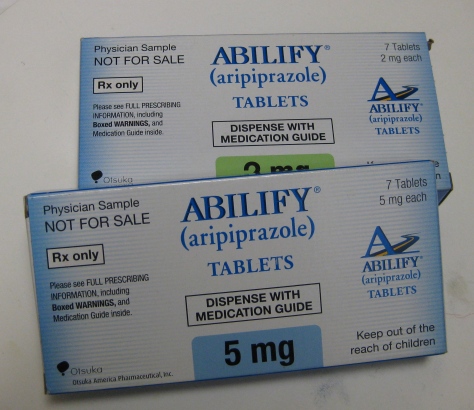
ADD ABILIFY?!

PHYSICIAN ABILIFY SAMPLES
PHYSICIAN ABILIFY SAMPLES – DO NOT ADD  TO ANYTHING! THIS IS NOT AN ANTIDEPRESSANT. THIS IS AN ANTIPSYCHOTIC AND A DANGEROUS DRUG.

I know, I know, you have probably seen the commercials, but I am new to television and I only just started to watch them…and I just saw one that has been running probably for years now with the sad little pill that gets people to “add Abilify” to their so-called “anti-depressant” in order to boost its effectiveness. I learned about this advertisement recently from a friend of mine who innocently enough told me, told me, that Abilify is “just another antidepressant”.

Excuse me? I said to her. Abilify is NOT an antidepressant.

“Yes it is,” she insisted.  “I saw it on TV.”

“No, Abilify is an atypical antipsychotic drug, not unlike Zyprexa or Risperdal. I don’t know what you are talking about, calling it an antidepressant.”

That’s when she told me about the sad little pill commerical. Well, okay, so the pill isn’t sad, the woman in the commercial supposedly is, and when the nice doctor she sees, adds the nice little Abilify pill to her so-called anti-depressant, she perks right up like an obedient child and, wow, the two pills work like magic to make the world right again. WOWEE!

So again the public is sold two lies, or maybe three or maybe half a dozen. First we are sold the lie that antidepressants do something in the first place. WAIT A MINUTE. Okay, they do do something, I admit it. They change the levels of neurotransmitters in the brain, yes, they do that. They alter something. Yes, and doing something, making a difference, altering anything makes people feel DIFFERENT and doing anything to change people’s feelings about ANYTHING when they are depressed can lead them to feel that it is better than doing nothing. ‘

But you have to understand that taking a mind altering substance to do something, anything at all, just to feel different, is not at all the same thing as actually treating a pre-existing chemical imbalance. And they know now that there is no such thing as a serotonin imbalance in the brains of depressed people. NO SUCH THING. In fact, they cannot figure out why people become depressed at all, but they do know that serotonin levels are not involved in any such simplified ways that the SSRI drugs purport to “treat.” Even Prozac researchers have admitted as much. Prozac researchers knew that their drug did not work way back in the 80s when Prozac first came out. They knew it induced suicidality in a large number of people, but they rushed it onto the market because Lilly needed a blockbuster drug, period to pad their pockets.

But that aside, the researchers to this day know that antidepressants do nothing to actually treat depression, because they have admitted that they do not understand what causes depression.

That said, does anyone who takes an anti-depressant understand what they are doing when their friendly psychiatrist or family doctor  “ADDS ABILIFY” to their nice little psychoactive cocktail? Well, in addition to experiencing some or all the terrible  but COMMON side effects of, say, Zoloft or Prozac (these are just those for Zoloft):

Inability to have an Erection Severe
Sexual Problems Severe
Altered Interest in Having Sexual Intercourse Severe
Drowsiness Less Severe
Dizzy Less Severe
Chronic Trouble Sleeping Less Severe
Low Energy Less Severe
Excessive Sweating Less Severe
Involuntary Quivering Less Severe
Loss of Appetite Less Severe
Weight Loss Less Severe
Head Pain Less Severe
Feel Like Throwing Up Less Severe
Gas Less Severe
Diarrhea Less Severe
Stomach Cramps Less Severe
Feeling Weak Less Severe

they might well experience  these COMMON side effect of Abilify:

A Feeling of Restlessness with Inability to Sit Still Severe
Feeling Restless Less Severe
Indigestion Less Severe
Incomplete or Infrequent Bowel Movements Less Severe
Drowsiness Less Severe
Dizzy Less Severe
Chronic Trouble Sleeping Less Severe
Increased Hunger Less Severe
Head Pain Less Severe
Feel Like Throwing Up Less Severe
Throwing Up Less Severe
High Amount of Triglyceride in the Blood Less Severe
Anxious Less Severe

These are the commonly reported side effects from common antidepressants Celexa and Lexapro: in terms of Psychiatric Disorders, to which one might be told to “add Abilfy”:

Frequent: impaired concentration, amnesia, apathy, depression, increased appetite, aggravated depression, suicide attempt, confusion.

Now, I ask you, everyone, DOES THIS SOUND LIKE A RECIPE FOR CURING DEPRESSION?  Any fool would look just at the list of side effects and say, uh, I would be more depressed if I experienced even two of these….But doctors think that people will feel better if they take drugs like these two together, and put up with these side effects, just because they are told  that “by adding abilify” and  their depression will go away.

The point is, the doctors are IN THE DARK. They read mostly what you do, and they see the same commericals you do. Most of them have no more idea whether the drugs work than  you do, and they only know what they are told by the drug reps and the drug companies….DO NOT BELIEVE THEM when they tell you that you have a chemical imbalance. They are either lying to you, or believing a lie they were told by someone else. ASK THEM questions, investigate. Ask  precisely what is the correct balance, what are the correct numbers…Do not be sheep. What were the studies showing any proof? Who did the studies and who  paid for them? Changes are you won’t get good answers, or if you do, your answers won’t make you any more secure than I am. Because drug companies pay for most of their own studies and they only pay for the results they want, ie what they want to hear…They do not want to hear that Abilify hurts patients, or doesn’t actually work, or that Abilify does not boost Zoloft’s anti-depressant IN-efficacy. No, they want to lie and “prove” a lie or else not prove it by not actually doing the study to prove anything. They want to market the drug and advertise things that have NOT BEEN SHOWN TO BE TRUE AT ALL. They want to market a lie, sell a drug and make money, without doing any research to prove anything, and pick up the pieces billions of dollars later, if at all.

I say, BULL SHIT

My advice? Don’t add Abilify. Add only Sunlight and Truth to everything.

Tuscany “Palazzo Podere”: New Art and Fewer Meds

Drawn from a photo...of a real "castle farm" -- I wonder if the owners will find me?
Drawn from a photo…of a real “castle farm” — I wonder if the owners will find me?


This is a photo of my large drawing of a place in Tuscany named Palazzo Podere or as translated, “Castle Farm.” I only uploaded a small file…Sorry… the details are fuzzy but them’s the breaks.

Things have been up and down, but the last two days were better than before. Largely because of an art therapy session that I found amazingly cathartic. It involved my being asked to make a “three dimensional sculpture” from a sheet of paper, a pair of scissors and some clear tape. I had no idea what to make, nor what would come from it. In fact, I dithered for a while, stymied, rolling a bit of the blue construction paper into a little tube and taping it, desultorily, waiting for inspiration. Nothing. Then suddenly it slammed me. YES! I was making, YES! a bullet for, YES, my very own Glock 9 semi-automatic handgun.

I proceeded to craft a crude gun with a bullet or two and a clip of ammo until I was finally satisfied that I had what I wanted. When I was through, Margaret, the therapist, handed me a sheet of paper on which she had written, “I am” five times. She asked me to look at my paper gun and ammo clip, at any angle I wanted to, and complete the five sentences as I wished. Well, I won’t  tell you in great detail, because my answers were were rather gross and violent, what I wrote, except to assure you that when I was through, and it took a while, she asked me, How do you feel?

I had been somewhat tearful as we talked and earlier in the week had been extremely upset and angry, but I now looked at Margaret and with a little surprised smile said, well, you know, I feel…better!


And I did. In fact, when I saw Dr Angela the next day, she noticed the difference immediately. Whereas before I had been nearly screaming, and not looking at her, now I could smile and make eye contact for the first time in months.

__________________________________

Progress on the medication front: Am off all Abilify. Now am dropping the Geodon, slowly. Down 40mg from 160mg. Will be dropping 40mg every 2 weeks. I think. Unless that feels too fast. If I run into trouble , I will slow it down, but Geodon never seemed to do much of anything for me…Maybe I am wrong, it could be I’m unaware of what it does. But in my experience it did little positive for me, and so it should not be too hard to get off it. I just need to be careful not to stop anything too quickly, no matter how eager I am to be off all meds.


I still take some small amounts of Ritalin and Xyrem for narcolepsy, though hugely reduced  now that I am not so sedated on antipsychotics and antidepressants and only take 200mg of Topamax. I dunno about that last. I may try to stop it too. But it depends on the olfactory hallucinations and whether or not my migraines are under control.


IN the meantime, I have been busy hiring people to stay with me 24/7 come January, in the event of a crisis, which I have to assume will happen since it always has…So long as I know people will come in and prevent a hospitalization I feel okay about it. Otherwise I would be panicking, thinking that I would ever have to go through such torture. NEVER would I let them do what they did to me at Yale or the IOL again. I will kill myself before they get their hands on me another time. But it won’t happen, because  i have aides/nurses/various people hired to help me out now in my own apartment, and they will take care of things so no hospital will be waiting in the wings to torture me. The only thing I need to be sure of is that who ever it is that is going to be with me, they MUST be on board with the NO MEDS thing. NO ONE is going to force meds  on me in my own apartment — I don’t  care who they are. If they don’t agree with that, if they have a pro-medication agenda, then they are not going to be part of my plan…


Healing Art as I go down the Rabbit Hole…

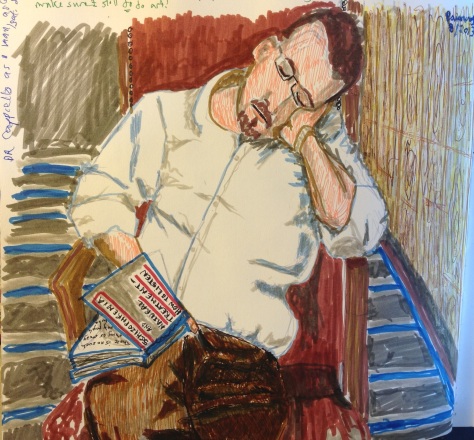
TIm, my best Gay Boyfriend, eating watermelon.


And now for something really different. Cartoons that tell you about my life these days.

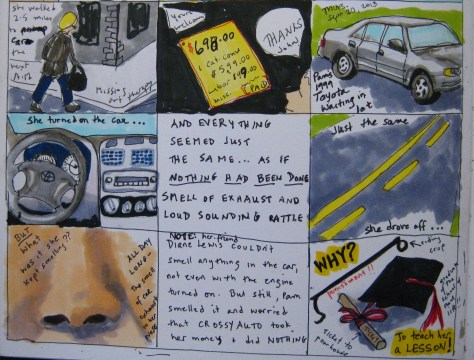
Pam's Having Car trouble
Pam’s Having Car trouble


Hope you can make out the text okay…It is a little difficult,. granted. But I tried to photograph the pages clearly as possible.

The next morning she retrieves the car
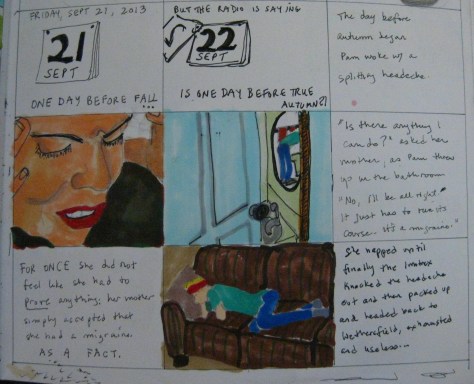
The next morning she retrieves the car and finds the same problems remain…Why?


She's GOt all the dates Wrong
She’s GOt all the dates Wrong and so much more…


Fear is ONLY an Almond...the amygdala in the brain is the NUT that makes us nuts!
Fear is ONLY an Almond…the amygdala in the brain is the NUT that makes us nuts!


Gargantua is the name of a book, and a character in the book. In it someone says, Appetite comes with eating. It helps me to think about that when I find i cannot find a way to put food enough in my mouth to keep going…I need to eat on schedule if only to keep my strength up.


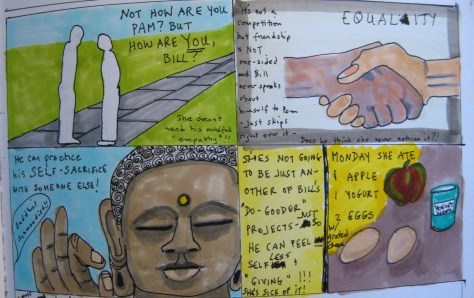
It cannot be Pam Pam Pam al the time. No, he has to start to share of himself or the relationship is off. She CARES about him and it isn't all about HER!
It cannot be Pam Pam Pam al the time. No, he has to start to share of himself or the relationship is off. She CARES about him and it isn’t all about HER!

Meanwhile I am not in a good state at all. Bill wanted to talk about an email I sent him saying as much as the above, but I am much too shaky to be able to deal with it. I just cannot use him to talk TO alone…I have friends with whom we have shared equally all along, and so I do not feel a burden now when I am in trouble. But Bill has ceased talking about himself a long while ago, and I am to blame for letting him withdraw. I felt slighted but felt that perhaps he was reserved and saved his intimate moments for his girlfriend…But no more. I cannot be using HIM as a pair of ears and feel that he shares nothing back. THen I feel guilty and a selfish user! That isn’t fair to me let alone to him…It won’t happen. It won’t be. Not any longer. Hear that, Bill? YOU are an important part of our friendship, as a person,. and if you don’t want to be a person, I do not want a NON-person as a friend.


Enough. I feel like I am going to die. And now even the doc doesn’t want to suggest that I take even a sliver of Abilify now that I am off it…So I am really up a creek..Up a creek because I dunno how long I can tolerate this. I smell rot rising inside me, smell it for real., Like my body is rotting from within…Where is it coming from? I brush my teeth several times a day (unusual for me!) but still the rot smell persists!


I am not a praying person, but I know many of you are. I am in such deep shit. I will be going to art therapy today, perhaps that will bring some relief. in the meantime, if you feel prayer can help, pray for me…?


Thank you , all of you, for hanging in with me. I am NOT a quitter, I am not a quitter!


Trauma and Connection: You Need Not Be Alone

When Monica Cassani posted this video (see below) on her wonderful blog, BEYOND MEDS.com today, I was not sure I would watch it, mostly because I often do not have the patience to watch videos, no matter who recommends them. (Sorry about yesterday’s recommendation, an hourlong one no less, but it is vitally important to me and my topic…I still highly recommend it, if you cannot read Anatomy of an Epidemic…). Nevertheless, something about a video on treating trauma, perhaps the face of McElheran on Youtube, perhaps just my mood at the beginning of this day, impelled me to click on the little triangle that started it playing. I was pulled in almost at once. In fact, I was soon in tears, because McElheran may speak to us all, but most importantly she spoke to me…her words on trauma included me, personally, for once.

That she did so, moved me beyond words, because at that moment she validated my own manifold experiences of trauma, which were mostly NOT of potentially mortal events, even if I may have believed them to be so (when paranoid or psychotic). I will embed the video here, so you can watch it now, and come back to my blog post afterwards if you so choose. Or watch it whenever you like. It is — truly! — only 16 minutes long, and very compelling, so do not worry that it will take a lot of time.

Something about what she talks about reminds me that “Nothing human is alien to me…” We are all capable of everything, and anything, given the proper circumstances. Her compassion for human behavior is astonishing and moving beyond words.

I need to say this because no one who “knows me” thinks I am “capable” of things like calling people such vile names as those I called the aides and nurses regularly at YNHPH, or of stripping and defecating and smearing feces without even thinking or considering the consequences… But those are important words: “without thinking” and “without considering the consequences” because they indicate that I was behaving wildly impulsively, as indeed I was. Think about the situation: Six to eight people, some of them security guards (self-professed former police officers) had just violently and brutally assaulted me, thrown me onto a bed, held me down (causing physical pain to the point that I screamed in reaction) and pulled down my pants, giving me three intramuscular injections into the buttocks, then holding me down some more until they felt “safe” to let go…(One of them actually telling me they would press charges for my kicking her in the stomach while she was restraining my knees!)

Once i was freed, I made a dash to get out of the room, wanting to “do laps” around the “square” hallway that gave the Washington Square 2 unit its name. No deal. They physically prevented me from leaving the small single room, that had nothing in it but a hospital bed and tray table. I recoiled, enraged and manically in need of doing something, anything! Suddenly, I felt my bowels engage, roil, want “to go.” But the bathroom was down the hall…No matter, what the F—! Who gives a shit, in fact.

Without thinking a second thought about it, I simply pulled down my pants, squatted, and unloaded on the floor, to not so silent on-lookers astonishment and incredibility. Then I removed my clothing altogether. But another WTF moment seized me, then. The steaming pile of sh-t was there, and suddenly I “knew” what to do with it…and I did not give a sh-t that this meant using my hands or getting it all over me or anything. I just didn’t give a flying femtogram. I do not know why. I didn’t even smell anything. I just picked up handsful of the feces and smeared it across the walls. But not blindly and wildly, no, I was writing something, I remember now, I wrote something on the walls with it, though I do not know what any longer. And I do not think anyone took the time to read it. I do not believe anyone bothered to notice that I was not merely smearing but writing in shit...

The point is, I did this as a response to trauma, small as you might say it was. I felt traumatized. I felt brutalized. And I felt and was out of control as a result. This is not to say that my impulsive behavior served any purpose other than venting rage and sheer revenge at my abusers. It certainly won me no friends and no compassionate understanding from anyone. It could have, someone might have understood it for what it was, and seen that what they were doing to me was in fact brutality and  traumatizing…They had after all diagnosed me with PTSD, so WTF did they think they were doing?

It doesn’t help, frankly, that “Dr Angela” believes that they were “on my side” and “doing their best” and “actually helping me” all along. I do not agree. I do not believe that. I think they were hidebound in their determination to break me, and if they could not see that they were perpetuating harm, they should have.

Okay, okay, okay Pam. Calm down. Calm down. Remember you are practicing forgiveness, not worrying the sore into an infected mess! 8)

This is hard. It is so difficult to forgive and let go of harm that no one admits to having done, one, and two, claims was actually for my own good. To help me!

Bull feathers! I still have exquisite backside piriformis muscle pain when I move in certain ways or even sit down on my right hip. And if I take off a T-shirt with the usual crossed arm movement, it causes agony in my deltoid muscles from the injections they gave me there too.

But forgive and move on, forgive and move on…I need to take a deep breath. Think about other things. Get ready to go out for coffee as I have made a date with an old friend of mine I haven’t seen since that debacle at the Institute of Living last winter. We always have great talks. It will be good to see her!


Yes, I will leave this on that note. The fact that I do not isolate myself, but that I have lots of friends and do things to keep myself busy and fulfilled and purposeful in life. Trauma and memories and flashbacks of trauma may still get me, and they get me in the gut a lot, but they haven’t got me completely over a barrel the way they might have. There was a time when I was more isolative and friendless but not any more. Not anymore.

I Will Not Be Sick Forever…Schizophrenia is Not A Life Sentence!

In reality, my doctor is a woman, and would never sleep on the job..So i wonder what this picture means unconsciously...The following one is turned upside down so you can read the book's title!
In reality, my doctor is a woman, and would never sleep on the job..So i wonder what this picture means unconsciously…The following one is turned upside down so you can read the book’s title!
Title Revealed: Natural Treatment of schizophrenia is what I want and need...But will anyone listen to me?
Title Revealed: Natural Treatment of schizophrenia is what I want and need…But will anyone listen to me?

Dear Everyone,


I spent more than three weeks at Yale’s psychiatric hospital in August being tortured, if not by seclusion and mechanical restraints (my PAD restricted the use of those and at least at Yale they listened) then being held down by armed security guards (only their guns removed) and injected innumerable times with a multi-injection cocktail of drugs: Haldol 10mg, Ativan 2mg, and Benadryl 50mg, despite my objections that I have a paradoxical reaction to the last one. They said I could not refuse because I would have side effects to the Haldol without it. Understand this please: They deliberately injected me with a large enough dose of Haldol (without any basis to know I needed any more than the usual 5mg or even 2mg) as to knowingly cause side effects, side effects they knew in advance would be so distressing as to not allow me to refuse medication for them before they even happened!


What sort of dastardly drug is this that it hurts as much as it “helps”? Ah, yes, let me remind you, lest you have forgotten, that Haldol is the medication political dissidents in the 1970s were given in the Soviet Union to subdue them after they were diagnosed conveniently with “sluggish schizophrenia,” an illness “everyone” in the West “knew” didn’t exist except in the Soviet political playbook, designed solely for the dissidents. The American Congress, Democrats and Republicans alike objected then vehemently to Soviet treatment measures, calling Haldol injections the dissidents were given nothing less than “torture.” None of the members of congress ever mentioned the widespread use of Haldol in American mental hospitals, though, for that wasn’t torture, was it? “Those people” – American “schizophrenics” need Haldol, they were told by establishment psychiatry, “they aren’t like you or me and don’t feel the same way when they take it…”


Now, I ask you, how can a drug torture one group of human beings but be a decent and humane treatment for another group? Answer: It cannot. Haldol IS torture, pure and simple, for nearly everyone who takes it. Just ask people! You cannot label one group tortured by a drug and the other “humanely treated” who endure the exact same effects. In truth the only group of humans who like Haldol are hospital personnel, who no doubt appreciate the fact that it in fact it does subdue patients into docility…usually. This means they have less work to do and thus they consider it an effective “treatment.” (Alas, in my case, I confess I was more likely to respond to forcible Haldol injections by stripping naked, defecating on the floor and smearing feces on the wall as by becoming more pliant or compliant. Why they managed not to see the resultant worsening of my symptoms and do something about it I do not know but they persisted in “treating me” and made things worse and worse…Indeed, I screamed more each day than not, for most of the three weeks-plus that I was at Yale New Haven Psychiatric Hospital this past August. So how good a “treatment” was Haldol? Aside from causing me exquisite mental and physical torture, I mean? In point of fact, despite megadoses, no injection made me more compliant, made me into a “nicer,” better patient, and easier to handle. The Haldol, even when probated and regularly forced upon me, didn’t work to their purposes…I was an impossible patient for most of the three-plus weeks I was there, Haldol notwithstanding. So what was the point? And why couldn’t ANYONE see that they were making things worse?


However, that is over with, and what I want now is to tell you that things are going to change, and change radically. I may not have your support in all of it, or any of it, perhaps, but I an attaching the video below as a link  because the book it is related to was deeply influential both on what I wanted and did not get at Yale, and on what and why I am doing what I am doing now. The book, as I have mentioned before is Anatomy of an Epidemic, and the video gives a good hour long summary of it. It is a good place to start if you have difficulty reading  a whole book on the subject or simply would like an idea of what you are getting into.


But first of all, the video doesn’t tell you this, “Mad In America” does — Robert Whitaker’s earlier book on the treatment abuses of the mentally ill in America — the foxes are guarding the chicken house. What I mean by this is: the Big doctors, by and large the influential ones who affect how our doctors treat us, are in cahoots with the Big Pharma drug companies in developing and promoting drugs that never worked and basically never had a chance to “work” because they were pushed into production and sales before any real research was done.


Maybe you don’t know this but listen: Thorazine was never a real “anti-psychotic” drug. It was a tranquilizer, a major tranquilizer. That’s what they used to more honestly call it. It calmed and tranquilized patients so they were more amenable to hospital treatment or the lack thereof. This was good for all, because the fact that patients were quieter meant that the nurses and aides got to show their kinder, nicer, nursier nursing sides to these “sick” patients, and the “drugged up” patients stopped fighting and finally appreciated being taken care of. It seemed a better situation for all, all ‘round, at least in the big state hospitals where megadoses of Thorazine were routinely handed out to “chill” patient populations into complacency. Less violent/resistant patients meant that the nursing staff could act a bit more like their job descriptors.


But now, suddenly, because someone was calling Thorazine an “anti-psychotic” drug as a marketing ploy, as if it treated the actual psychosis itself, they began to believe that it did something “anti-psychotic,” which in fact it never did. Not really. Not if you asked anyone who was treated with it. It never really helped anyone’s core symptoms. It just dulled you so profoundly you didn’t give a damn, or worse, it made you so mad with akathisia that you forgot how crazy the voices could make you feel, because you were literally wild with internal restlessness and other “antipsychotic” side effects and you had to pace all day or rock in your chair or do other “really crazy-looking shit” the doctors told you was just a part of your illness. Once Thorazine was thought of as a treatment drug, rather than as a behavioral modification drug, it changed the game altogether. It changed everyone’s thinking about schizophrenia (and by extension all mental illnesses) in a way that seems to have altered the course of American history itself. Certainly it changed American psycho-active drug-manufacturing for good, though I can only wonder at those involved with the actual design of drugs and how they can do what they do, surely being aware on some level that what they do has no foundation in science whatsoever. Let alone in honest research…


What am I talking about? Well, if Thorazine, which was originally used for anesthesia, was really just a behavioral modification drug, really, honestly and truly, and did not, if truth be told, treat or remediate any so-called schizophrenia symptom, then what the hell was all this dopamine hypothesis and research all about in the first and the last place? Because any supposed honest research started with Thorazine’s mode of action on the neuron’s dopamine 2 receptors. Supposedly, said those brilliant researchers, looking to explain how chlorpromazine/Thorazine “treated” schizophrenia symptoms so effectively, the drug works by blocking D2 receptors on the post synaptic neuron (Don’t worry if you don’t know what I am talking about…just keep reading).


The point is, Thorazine and dopamine have been inextricably linked for and to the next four decades of schizophrenia research, and all subsequent drug development stemmed from that link. Once that connection had been made, ridiculous and wrong as it was (schizophrenia and dopamine being related, or even correlated, simply was never shown), the stage was set for the “revolution” in brain illness research that has brought us such travesties as “bipolar infants” as young as 2 years old, and the H-Bomb-mushrooming of ADHD cases that threaten themselves to cluster-bomb into more bipolar disability cases than the country can conceive enough SSDI for…And thence to such further travesties as doctors using a brutally potent “atypical” “antipsychotic” (which is in truth no more “antipsychotic” in action than thorazine) like Zyprexa for “off-label” uses like anxiety disorders. Why? For fear of using benzodiazepines, perhaps, but just as often in conjunction with those drugs from hell. Drugs like Ativan and Xanax and Klonopin that are prescribed for people with “major mental illnesses” and the walking wounded as well, both like water, prescriptions that cause devastation in their wake and much more anxiety than they resolve.


It seems to me that for every MD who knows never to prescribe a benzo for anything but occasional use and refuses to, there are 40 who say, “take this three times a day and don’t call me unless you have problems”…expecting no calls.


But I am side-tracked a bit. Or have never quite gotten to my subject, which as you know is me, my own “illness” and my own future. I do not know frankly what was done to me in the past vis a vis these drugs, that is, what was caused by what. As my good friend Josephine says everyone now says, It is what it is and you can’t change it…So I am me, with whatever I am or have. But  at the same time, i cannot continue to accept the premise that medications are the only and best way to treat me.


After all, I take meds every day and you all know that I have ended up in brutalizing hospitals regularly, quite despite this. I was hospitalized just this past August, in fact and this past winter too…So what good has been my taking meds, including 2, not just one but two atypical antipsychotic drugs, if they do not work to keep me out of the hospital? Not much, I venture to say. Not much…


Well, but…If they have enabled me to do art and write poetry (when I did that) then they were very good drugs for me indeed. For that is my fear: That I can only do art or write, even if just in my journal, when I take these medications. If so, those would be two very good reasons for me to feel it necessary to keep taking them. I cannot live without something worthwhile to do, and I have no family, no children, no purpose, no career, nothing else but art and writing to live for…


That said, what is the proof that my medications are what make me ME? That they make me write and do art? Essentially and absolutely? None at all. And there is much suspicion that the meds can do harm both in the short and long-term. Nothing at all is known about what happens when people take these drugs for decades. I am not sure I want or need to be that particular guinea pig. Now, “Dr Angela” is, as you may or may not know, a psychoanalyst as well as a psychiatrist, so I told her that I wanted essentially what Joanne Greenberg’s “Hannah Green” got from “Dr Fried” (in reality it was Frieda Fromm-Reichmann, the renowned psychoanalyst who successfully treated Greenberg’s schizophrenia) in I Never Promised You A Rose Garden…No promises, perhaps, no rose gardens, but at least the opportunity for cure, recovery, and an end to treatment. And NO MORE MEDICATIONS, WHICH WOULD TIE ME TO HER PERMANENTLY more or less.


I am off the first drug, Zoloft, and have been for more than a month. But it is not easy. I am bone-weary and feel like crying every day. Feel like I have never NOT been tired, never not fought off hopelessness and the feeling that if I were told I had leukemia I would cheer, “Finally! Thank god it’s over!”. That’s the truth, people. I sit in my chair, the same one I sleep in, and I sit in it virtually all day long. And though I am not addicted and do not need to (most of you know how easily I quit smoking when I need or want to) I occasionally smoke a cigarette just to ease the pain…which is physical as much as it is mental and emotional. I may not seem depressed to those of you when you see me, because I rarely “let them see me sweat” and would never burden you with me if I can help myself. But there is also the fact that if and when I see you, just that fact cheers me, lifts my spirits, thank god, and is a rescue and a blessing, so thank you for that much! The nights are hard, but sometimes the days are harder…Nevertheless, Dr Angela has agreed NOT to speak to me of going back to the Zoloft, not unless I ask for it, because she understands that I want to tough it out, and that i believe that antidepressant drugs cause more depression than they cure. I believe if this is a relapse it is solely or largely because I started taking Zoloft again in 2007, when forced to at Mt Sinai, even though I told them I was grieving Lynn L’s death and because of Joe C’s illness and they ought to let me grieve! If I had been taken off it promptly, or never put on it, maybe I would not be such an easy prey to despondency now.


Nevertheless I am going to go on the record of the past predicting the future, and NOT take Zoloft (as of now) and “get through this somehow…”  because despite everything, I haven’t died yet, not of despair, and while i have done a lot of damage to my body, I have managed NOT to kill myself so far…Chances are, then, that I will not. Of course the future is unknown, but all I can say is that I do not want Zoloft or any AD drug at this moment, and can take the pain.


I have cut down on the Topamax, to 200mg but because of recurrent migraines need to keep that where it is for now. The next drug to go will be Abilify. I would rather we stop the Geodon next, but I do not think I can tolerate taking Abilify sans Geodon — not without being incredibly irritable — whereas Geodon without Abilify basically does nothing for me. A steady reduction, not too slow, but not so rapid I cannot tolerate any symptoms that develop. The whole point, in the end, is that should I develop symptoms (and that is not a certainty) we are supposed to be able to deal with them in therapy and not go running to the hospital or back to some drug.


(Okay, this is the point in the argument where even I start getting nervous. But I am determined to do this…I want it, I want it, and I need to try it ONCE in my life before I die. I need to know what I know, what I can know about what I need and do not need in terms of psychoactive medication, if that is even possible… Some much depends on placebo effects you know, and on influences of that sort that I wonder if any of it can be sorted out, and how much is going to be sheer determination?)


Oy, it is getting late, or I would continue. But I need to sleep and so do you. I am certain there is much more I ought to have said or explained and did not. Feel free to ask questions or query me about your own concerns if you have them…I am open to any thing, except anger.


Thank you all for your love and concern and if for nothing else than for simply being there to listen and read this.


Robert Whitaker’s Anatomy of an Epidemic video:

http://www.youtube.com/watch?v=VgS79hz1saI


Love,


pam


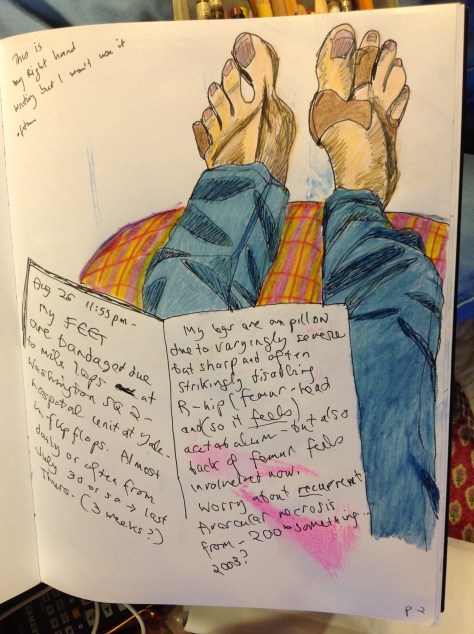
Two Pages from my Art Journal: pain and mess are facts of my life

Piriformis, the muscle you never heard of, can be a real pain in the butt...literally, but at least the problem is neuromuscular, and not in the bones. It turns out to be related to all the forced Haldol injections they gave me at Yale, and something as well to do with this deep piriformis muscle and the sciatic nerve...Dont understand it all, but it all adds up to a huge amount of excruciating Pain with a capital P!
Piriformis, the muscle you never heard of, can be a real pain in the butt…literally, but at least the problem is neuromuscular, and not in the bones. It turns out to be related to all the forced Haldol injections they gave me at Yale, and something as well to do with this deep piriformis muscle and the sciatic nerve…Dont understand it all, but it all adds up to a huge amount of excruciating Pain with a capital P!

I ended up at the local non-hartford ER on Monday/Tuesday morning, in the very wee hours, in so much exquisite agony i could not move off the chair i sleep on.


What do you expect? I sleep in the same chair i eat and read and draw in mostly...and now i am imprisioned in it in pain, why shouldnt i live in filth?  It isnt actually the dirt or not that bothers me, but the constant chaos...i would prefer orderliness, but cannot keep things in any state resembling it, so chaos reigns!  I do not worship the great god Chaos, but no one could guess that from the constant state of affairs chez moi...the drawing i did in my journal doesnt even begin to depict the truth. In fact, i dont know how to do so. It is incredibly difficult to draw the mess and chaos and disorganization of my room. One must define something toi draw it, so by necessity you bring an order to the room in culling it of unnecessaries that it does not have in the realness of my unbeautified life. Pretty as a picture my room is not!
What do you expect? I sleep in the same chair i eat and read and draw in mostly…and now i am imprisoned in it in pain, why shouldnt i live in filth? It isnt actually the dirt or not that bothers me, but the constant chaos…i would prefer orderliness, but cannot keep things in any state resembling it, so chaos reigns! I do not worship the great god Chaos, but no one could guess that from the constant state of affairs chez moi…the drawing i did in my journal doesnt even begin to depict the truth. In fact, i dont know how to do so. It is incredibly difficult to draw the mess and chaos and disorganization of my room. One must define something to draw it, so by necessity you bring an order to the room in culling it of unnecessaries that it does not have in the realness of my unbeautified life. Pretty as a picture my room is not!


One thing you notice in this definitely unprofessional picture is the presence of a single crutch. I hated being at the ER but if I hadn’t called 911 (after pulling my emergency cord and wondering if anyone would ever come to my door…and finding out that someone had actually called 911 for me after the loud buzzer over my door had sounded for at least 1/2 hour…). When I hear someone’s emergency buzzer, I always knock and try to go to the person, find out if I can help them in any way. i dunno who called 911, but why they couldn’t at least let me know they were doing so I dunno. i felt so alone all night, and then at the ER. it was almost worse, because of course I  was treated like an hysterical psychiatric patient largely, and ignored. Truth to tell, my hip pain was not going to kill me, and apparently the testicular pain of the young man in the other part of the cubicle, could have killed him (so says Dr C, but according to her it would kill via “shock” so she means because of the degree of pain…So I am skeptical. I think the reason he was getting so much attention was because “Everyone knows” that testicle pain is horrendously awful and  shockingly painful…”everyone” because of course MEN have experineced it and let us all know how bad it is. Women have experienced childbirth tearing them literally apart for eons but no one goes on and on about how that pain needs to be attended to at all costs. No we just let them scream…SO, ditto me versus the young man with a testicle that did not apparentlhy need surgery but who was, I admit, the subject of a sadistic surgeon’s ministrations, and manipulations, even as the man denied that the young man needed his help. I mean, why stand there, holding a guy’s twisted ball in your hand, manipulating it in such a fashion that you kmow you are causing breathtaking agony, everyone who hears the sucked-in choked-off breaths of the patient knows it, why do that, what are you odoing? when you then in the next breath announce that this testicle is FINE, nothing that needs YOUR attention as a surgeon, in fact, you cannot understand why it is still causing the man so much apparent pain. But it is…The young man is nearly comatose with pain, and the surgeon doesnt’ even apologize. Only says, Well, you are fine, nothing here that needs me. I will check in with you later, but you are not a surgical candidate as far as I am concerned so you are none of my business.


But what I was saying was, sympathetic as I may have been with respects to the  doctor’s sadism and disregard for all human feeeling. Nevertheless, it was apparent that the entire ER had sympathy for testicle pain, and youth, little to none for hip agony in a 60 year old bag of a woman with scars on her legs and arms and face…It was a matter of appearance and what and who was appealing, and I was nothing of the sort. Who did they want to root for or give a damn about? I was just a title 19 patient with nothing to offer, and since I had brought nothing but a key to get back into my aprt with  me, I could not prove otherwise. Could I? Nothing to tell them I was worth anything but scorn and disgust, which they gave freely.


I knew in the end, that is., after 12 hours and very little had been done past a CT scan that showed piriformis inflammation, that I had to prove that I could function well enough to be discharged from the ER. I knew it would involved exquisite agony but it had to be done or they would keep me in the hospital because they would claim I could not function independently. SOMEHOW I had to prove I could get my own jeans back on, and dress myself. I knew that if I could do that they could not keep me, and I was desperate not to have to stay there any longer than I had to…which meant in practice that I wanted to leave ASAP.

It cost me more pain that I can ever express. I literally had to suck in my breath and flrce myself to “break my own hip” or feel as if I were doing so” in order to put my leg inside the pants and then manage to pull them up and zip the zipper. But I did it. SOmehow I did it. It felt as if I were literally stabbing myself in the abdomen each time I forced myself to do any abrupt movement like putting my right foot into the pants leg and pulling them up. But it would do not good to go slowly. A slow agony would never do and would only prolong something I could never tolerate. So I did the “white hot poker routine” of forcing myself to make abrupt changes in position and get things over with. And I managed to get dressed and eventually I was discharged and my dear friend Josephine agreed to come pick me up after she was through with her last housecleaning job, which was just then…


But where am I going with all this? Piriformis Syndrome, you can look that up. It is all very mysterious and not very common. But curable or at least temporary usually and treatable. So I am not dying and not even very ill, though the pain is mentionable! All I have been writing about, basically, is the pain, the dismissive attitude, and this, what finally transpired: I saw my doctor’s office’s APRN, Sara, who is very wonderful and while young doesn’t make me feel old and despised. She put me on a difficult drug to take but one that promises quick pain relief, if I can tolerate it: prednisone. And Soma for a muscle relaxant, which may or may not work. I will start the former tomorrow morning and try the latter as soon as I finish this blog post and can justify inducing sleepiness. She did not minimize anything, and I felt taken at my word and seriously. Neither as if things were being exaggerated for my benefit nor dismissed for the same reason.


I apologize that this blog post has been so boring. I am halfblind with sleepiness, because i have been up since 2:30AM, one, and two, the hospital lost my two pairs of glasses with prisms in them so I am using glasses that do not prevent double vision at the moment. Trying simply to see the screen and the keyboard is an effort that defeats me more often than not. You can imagine the effort to be eloquent or anything else is beyond the beyond.


But mostly I think I am just plain overtired, which makes it triply difficult to focus my eyes on any one object, let only make doubled images fuse into a single image. So I will stop for now. Take the Soma and go to bed. Thanks for your forebearance. If I promised an email to anyone, I will try to get to to. Remind me if you want to. I meet with my siblings Martha and Philip tomorrow so I may be busy for ao while but I hope to be in less pain and more able to get back to people who have written me about things.


Ciao! Cheers! Shalom!

My Challenge to the IOL: Stop Using Restraints and Seclusion NOW

Well, how did it go yesterday? All in all, I would say it was a very successful meeting. Certainly it went better than I expected, and better than the disastrous meeting a year ago at Middlesex Hospital with Dr Grillo et al. I fear I irritated Dr Mucha a bit at least at first. Why? Because I think he felt defensive and tried to tell me how much he did on my behalf and my mobile facial features (I don’t hide my feelings behind a good psychiatrist poker face) let him know at once that I didn’t believe him. Why should I? One, it was completely self-serving for him to tell me — as if he had been some sort of knight in shining armor behind the scenes — how much good he had done for me, when he let them restrain me day after day for many many hours at a time, and keep me in what he himself acknowledged was on-going seclusion for the majority of the hospital stay. How dare he tell me how much he did for me, and then when I said they “tortured me” actually scoff, “Restraints aren’t torture!”

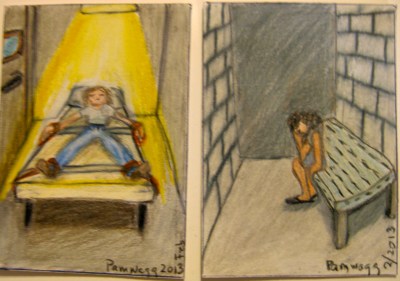
Ask my brother, Phil, an extremely humane psychiatrist who would disagree, and would rather die than be restrained, but I went one better. I quoted Juan Mendez the Special Rapporteur to the Human Rights Council at the UN who just this past March spoke/wrote specifically about psychiatric patients and how the use of solitary confinement of any duration and any use of restraints, forced medication and forced ECT is torture. He didn’t say tantamount to torture he said that are torture, period. And I would remind Dr Mucha and Mrs. Blair that until you have experienced these things — and I defy you to try any of these modes of your so-called treatment– you have no way of knowing. All you have to do is look at the expression on the face of the woman in the picture I did yesterday.

From the way I was treated, under Dr Mucha’s supposedly magnanimous supervision, at the IOL (depicted in that drawing) anyone could tell that the people “caring for me” did not consider that I was truly human or “felt” their torture in the same way they would have. Because if they had believed that, they never would have done what they did to me, unless they really did deliberately, maliciously want to torture me. I don’t know which it is. Dr Mucha and Mrs Blair say the Donnelly 2 South unit staff are good people who wanted to help me….So which is it? That they didn’t consider me a real person, just a diagnosis and not really human, so they thought I didn’t feel the torture (this despite my exquisitely lucid PAD that spells everything out in detail) they inflicted, or they were actually malevolent and wanted me to suffer? I tremble to have to choose between the two!

Either way, the torture was inflicted and despite numerous calls to Carmen Diaz, the patient advocate, (another name for the Hospital employee who works FOR the hospital not the patient, really) no one, not a soul, came to help me. I called outside sources too, but except for my advocate at the dept of Protection and Advocacy, who is not a lawyer and has little power besides that of complaint, there is not an agency or organization in this entire state of CT that can or would help me. Not a legal aid group or a lawyer besides the court appointed one to fight commitment that would even come in and talk to me about what was happening. I was ALL ALONE, yet Dr Mucha’s knickers got in a twist because I didn’t praise and thank him for all his work behind the scenes on my behalf.

Well, I am sorry, but 1) Dr Mucha is the Director of the IOL and he is IN CHARGE. He did not need to work behind the scenes. He could have spoken to Dr Taylor about her treatment of me at ANY time. If he thought she was not treating me well or using restraints in an unnecessary or wrong-headed way, he ought to have spoken out at once, openly. Period. 2) I needed someone on my side OPENLY. I needed someone to come to me and tell me that they were going to stop this nonsense and get me some real help that no one was going to restrain me again. That they knew my advance directive was meaningful and that things had GONE TOO FAR.

None of that happened. None of that happened. And while plenty apparently did behind my back, I am not responsible for what I was not told and did not know. Though I do appreciate it now that I do know. For instance that Bev, the voodoo princess, who I was terrified of, not because of her voodoo, but because she was dangerous to me as a staff member, having taken an intense dislike to me, indeed such a hatred of me that she was conspiring to kill me…she was removed from D2S unbeknownst to me for as long as I was there. Simply because I had expressed such intense fear of her. That was something I did not know about, but I am very grateful they heard me and did something for me in that regard. Took my fear seriously rather than tortured me with her presence. On the other hand, if only, if ONLY they had told me that she would not be back for the duration, I would have slept better! Why not tell me? For nights I slept fearfully, since I had no way of knowing she would not be on the night shift!

I wish Dr Mucha et al would look into the Open Dialogue method of dealing with psychosis. It will never be implemented in full in this country, and certainly not in hospitals. It is not a hospital-based method in any event. In fact, it is anti hospital and empties hospitals rather quickly. But some parts of it would be eye-opening, such as always including the patient in treatment planning, how that helps bring clarity to even the most disturbed person. How it involves their being NO secrets, nothing hidden, not even disagreements between treaters as to how to proceed. How wonderful it would have been for me to have actually heard Dr Mucha in conference with Dr Amy Taylor et al discussing the use of restraints or seclusion…Do you really think anything would have continued to happen, or that things would have proceeded apace if I had been included in those case conferences about me? I highly doubt it! Oh, if only I had been….I could have told them so much, but of course they didn’t even think to include me when talking about me! How stupid of them, how completely stupid. But I wasn’t a person, just an animal, just a diagnosis.

Anyhow, at the end of our meeting, which did go well after we got off the torture topic, Dr Mucha asked me if there was anything I wanted to end on. I thought a minute and said, “Well, you know, I want to go back to the subject of restraints and seclusion. You continue to use them because you won’t stop using them. You say it is a slow process, that it takes time. But it isn’t a slow process. You cannot stop using them as long as you allow their use at all. All it takes to stop using restraints and seclusion is to STOP USING THEM. Period. Once you don’t have the notion that, Oh, well, we can always use restraints on that unruly patient, so it’s okay, we don’t have to plan in advance about how to deal with her or him if things get out of hand…once you can’t resort to restraints at all, then you must think imaginatively in advance about how to deal with patients and you will find a way. You always do. Necessity is the mother of invention.”

So that is my challenge to the Institute of Living. Stop dillydallying around and pretending that you are reducing the use of restraints and seclusion. Don’t tell me that you are only using them in the geriatric population to reduce falls, because that is not true and that is not really the sort of thing that I am talking about and you know it. You don’t use seclusion and restraint to reduce falls for “an hour” anyway…THree times a week is not a reduction. Once a year is a reduction! But I want you to NEVER use restraints or seclusion again. I want you to understand that to restrain a patient or to use a show of force is to torture someone. Get this one thing straight, to deliberately frighten a patient with a “show of force” is an act of  terrorism and has no place in a hospital. (In a prison, maybe, though I would argue against treating any human being like that even in prisons…) And when you torture someone esp a patient who is already suffering and frightened, you make her or him worse, sicker and likely to be MORE violent and less predictable and traumatized, with the subsequent behavior that is known to result after trauma. NOTHING good comes from treating a patient with violence.

I don’t know if the IOL will listen to me, a nobody, a nothing worth less than the paper I am printed on. Not worth a red cent or a paper nickel. No lawyer gives a sh_ t about me, I am not worth their time or effort because I am not worth a stinking dollar. So why would the venerable IOL pay attention to anything I have to say? (I am not stupid for all that, but genius IQs are a dime a dozen, alas… and Mucha and Blair too are no slouches, even if they persist in the delusion that to treat patients with violence is acceptable, and not torture, really.)

LISTEN to ME, LISTEN TO ME! I know what I am talking about. if you don’t you will continue to cause more harm than good. If you do, you will break new ground and start a revolution that cannot but do good. That’s all I have to say.

Open Letter to the Director of the Institute of Living, Dr Theodore Mucha, and Ms Ellen Blair, Director of Nursing

Dear Dr Mucha and Ms Blair,

Forgive me if I must read this instead of simply speaking extemporaneously, but while I may seem collected to you, inside I’m shaking. Indeed, every time I recall what I recall, or reread the nursing notes about what was done to me this past winter here at the IOL, I start crying. I need to stay in control in order to retain some credibility and so I have written this out in advance in order to make sure that happens.

Thank you for meeting with me today. Ever since I was discharged from the IOL in February, I have felt the need to come back here to speak to someone. Yet because of trauma-induced amnesia, it is only now that I have acquired my records and learned the details of what happened that I’m finally able to do so. But at the same time, I wonder why I bother, since it is not as if I expect you to do anything or say anything that will make a difference. You won’t. You can’t. No one ever does, not even when faced with the reality of the most egregious abuses.

 Before I say anything further, I want you to know that I believe that I have been harmed by the treatment I received on Donnelly 2 South, and that what the staff did to me was not only unethical and cruel but that it crossed the line into illegality more than once. I was told to assure you that I do not intend to sue or cause trouble. I do not, not at the moment. However, if I don’t feel that I have been properly heard at this meeting I may in fact file a formal complaint with the Department of Justice. For now, I just want you to listen carefully and hear what I have to say.  When I am through, if you are so inclined, perhaps we might discuss ways in which things might have gone differently and how they might change in the future, for others even if it is no longer possible for me.

Please understand that I know I was a difficult patient. I was loud and upset and hard for some staff to deal with. That is precisely why my Psychiatric Advance Directive was written out the way it was, and why I made my medical and psychiatric history online so available. When ill, I am frightened and paranoid, which makes me easily roused to irritability and hostility. I know this, from a distance as it were. But knowing this now does not mean i was in control of my behavior. I am by nature neither temperamental nor prone to temper eruptions or throwing things. In addition, I am extremely modest, hardly one to disrobe or urinate in public. My friends and family have at times variously labeled me  “stoic” and “peacemaker,” which should tell you a lot. But that I did all these things on Donnelly 2 South both horrifies me and concerns me because these behaviors point to something going on distinct from psychosis: they point to abuse and trauma.

Let me make it very clear that I have behaved in such outrageous ways before, yes, but only in response to extreme circumstances – as when i was subjected over and over to restraints and seclusion in a horrific and sadistic fashion at Manchester and Middlesex hospitals in 2009 and 2010. It is too bad that when Amy Taylor took it upon herself to violate my HIPPAA privacy rights and investigate my previous admissions, without asking my permission (which I never would have granted) she failed to make the connection between their abuse, and my subsequent behaviors there…It turns out all she drew as a conclusion was that if those hospitals could use restraints and seclusion ad libitum, well then, so could she. It didn’t seem to matter to her that in 2009 and 2010 those measures not only didn’t work, they made things worse when Dr Taylor followed their examples, the same results ensued, just as my PAD predicted.

I was admitted to Donnelly 2 South, and I came in with the very detailed Psychiatric Advanced Directiveas as I said. I made it very clear that my online electronic medical record  was available. It included documents such as my narcolepsy diagnostic consult and special documentation proving my need for a higher than usual dosage of Ritalin, written by my former sleep specialist who was also my psychiatrist from 2000-2009. Included as well was a letter she wrote to my present psychiatrist, Dr Angela Cappiello, explicitly stating her conviction that I do not have a personality disorder, borderline or otherwise, and never did.

According to Dr Sanjay Banerjee he read every page of documents that I brought with me. That is what he told me. Moreover, when he spoke with Dr Cappiello, he brushed off my concerns about anyone misperceiving me as having a personality disorder. My brother, Philip Spiro, MD, himself a psychiatrist brought the same matter to the fore again when in discussion with Laurie Denenberg, but her response was much the same: Personality disorders are not a part of the picture here. We intend to honor her PAD. We are glad that she has had the foresight to prepare such an document. If this was so, then how did it come to pass that Amy Taylor wrote on my discharge summary that I have a “long history of Borderline personality disorder” and herself diagnosed “Personality disorder NOS with borderline traits”? I was being treated for four weeks for an active psychotic disorder. She would have no way of knowing whether or not I had any personality disorder, given the axis I diagnosis and you know it. She did too.

Dr Mucha and Ms Blair, you were not there on the unit or in the quiet room with me, so were you even aware of what happened half the time? Did you know for example, that on Februrary 6, I walked away from the quiet room, strolled down the hall, looked out the window and slowly retraced my steps back to the quiet room. But when I arrived I I was confronted by a cohort of staff who proceeded to 4-point me, even though I was quiet and put up no resistance? Not wanting to give them any reason or justification, I passively lay down on the bed and placed my own limbs out for the restraint cuffs, saying, (I quote my journal entry made later that evening): “For shame. You ought to be ashamed of yourselves. I am not and never was a danger to myself or others.” Their response was “ You refuse to follow directions so we do not know what you will do. This is not punishment, Pamela, this is what your behavior brings on every time.”

Were you aware that they always restrained me, spread-eagled, so tightly I couldnt move a muscle? That they never permitted bathroom breaks or even let my hands free to eat? That I would fall asleep rapidly after three injections  –whether calm or not, it was a routine punishment needle in the buttocks: Haldol, Ativan and Benadryland they would invent reasons to maintain me in restraints even after asleep for hours? Or when I woke, groggy and hardly dangerous to anyone, they would grill me with questions that I could not answer, and they would use my inability to respond as reason not to release me?

Later in the evening on Jan 6th, for the second time that day, they restrained me, for throwing half a graham cracker at the wall. Then, as usual, they left me like that for six hours, even after I fell asleep. In point of fact, I could never earn my way to release from restraints by good behavior or quietly, calmly asking for release. Of course not, because I hadn’t done anything to earn my way into them in the first place. They always refused to release me, ALWAYS, until I literally cried, “Uncle” when they told me to.


As to those vaunted shows of force what did you expect? Presented with a cohort of threatening staff personnel I saw one thing: an impending assault.  I know they anticipated my panic; it said as much in my chart. Isn’t that the point of a planned “show of Force” – to induce fear and panic? Why else do it? So why should it be any surprise, when I defended myself as they grabbed me? When they stuffed me into a body bag and were trying to tighten the straps, surely you can understand why anyone would bite the hand of an attacker whose digits came near. It was a matter of life and death!


But none of it should have happened. My PAD explained in exquisite detail exactly what to do and what I respond to better than fear tactics and force. in fact, It is beyond me, knowing that one of the admission diagnoses I came in with was PTSD, how you  Dr Mucha, could possibly approve in advance, the emergency abrogation of my PAD and a “just in case they are needed” use of restraints and seclusion. Why not counsel the person asking for this advance “right to restrain” to do all in his power NOT to restrain me and to work with the PAD instead?


Here’s what SAMHSA the substance abuse and mental health services administration publication has to say on seclusion and trauma:


 “Studies suggest that restraints and seclusion can be harmful and is often re-traumatizing for an individual who has suffered previous trauma…


“Further, there is a common misconception that seclusion and restraint are used only when absolutely necessary as crisis response techniques. In fact, seclusion and restraint are most commonly used to address loud, disruptive, noncompliant behavior and generally originate from a power struggle between consumer and staff. The decision to apply seclusion or restraint techniques is often arbitrary, idiosyncratic, and generally avoidable.


“Moreover, some studies indicate that seclusion and restraint use leads to an increase in the behaviors that staff members are attempting to control or eliminate.


I have been traumatized, and not just by hospitals. I was date-raped three times in my twenties and experienced traumatic domestic abuse by a long-term roommate. The cover sheet on the PAD made very clear that due to these trauma issues, I could not tolerate being secluded or restrained without serious consequences: regression and serious worsening of symptoms. Unfortunately, as soon as the staff saw fit to use physical methods of coercion and control on me, read punishment, from the first time a staff member grabbed me, all bets were off as to how I would behave. I certainly ceased improving, and my symptoms went downhill. Did they really think they were being kind and compassionate? Violence begets violence….

I tried to get help even when on the unit, at least I tried when I was free to make calls or leave my seclusion, err, forced-voluntary time-out two-week-long stay in the quiet room last winter. I made I do not know how many, but many, calls to the patient advocate office, but the sole time anyone made contact was when Carmen Diaz came to hand me some paperwork – I believe I was actually in 4 point restraints at the time — papers  I could not read about the forced medication hearing. I needed her advocacy, but she never responded to my panicked calls in any way that was helpful to me. I wanted her help, but she never came by to ask me what I needed. She was less than useful, the fact that I had to go through her, and her refusal to respond contributed to my ongoing panic and desperate feelings of aloneness and depression. No wonder Dr Banerjee tried to force me into ECT.


And where did the ECT discussion come from? My PAD states in no uncertain terms that  I would refuse ECT under any and every circumstance. My brother would be my conservator if Banerjee had sought to go down that road, and he would never have made any decision to counter my wishes on that subject. If Banerjee really read my PAD, he would have known that, and you too. Because he implicated you, you know. He told me that “Dr Mucha and I have made the decision to force me to have ECT.” Oh, I know, the chart talks about having “discussed the possibility of ECT with me” but that is not how it went down. I recorded the conversation in my journal directly after it happened and Dr Banerjee presented it as a discussion that you and he had, and a decision that you and he had come to, not one that I was privy to. And he presented it as one that I had no choice in.

Nevertheless, let me ask you this: regarding ECT and my so-called depression, were you fully cognizant that Banerjee had stopped my 75mg of the antidepressant Zoloft during the first or second week I was there? “Do you really need that?” he had asked, “You don’t seem depressed to me.” Obedient, and in any event glad to get off any medication at any time, I shook my head, assenting to the change. I remembered having trouble getting down even to 50mg quickly at Natchaug the summer before, I dared not mention this and frankly believed it had been a fluke, the opposite of the placebo effect in a sense…So I went along with Banerjee’s decision to summarily cut the Zoloft and hoped for the best. At least, I thought, if things go haywire, it will not be due to self-fulfilling prophecy, a doctor looking for symptoms he expects to find and conveniently finding them. And at least he will know the reason.

A week later, instead of reinstating the Zoloft, Banerjee blamed my sudden “depression” on my refusal of Lamictal, a drug I had not taken in months. Now he was applying to force me to take ECT, something I was terrified of, and to have calculated brain damage.

It was this threat, and the brutality with which the decision was handed down, that started the downhill course of my IOL stay.

The very next day, all hell broke loose. When I entered the conference room, I pushed some important notes I needed Dr B and Laurie to read across the table in front of them. They refused, claiming that I threw the papers at them. Instead, Dr B proceeded to berate me, and told me how he had consulted with other hospitals and providers and had read my records against my instructions and Advance Directive, thus violating my HIPPAA rights. Moreover, he threatened me with a behavioral treatment plan that would not permit me to do art or writing unless I “behaved.” I hit the roof, telling him I would sue the hospital and complain to JCAHO, then summarily left, slamming the door, an act that stemmed from feelings of utter impotence, because I couldn’t actually say in words anything more effective.

It could have ended there. I could have been left alone, to cool down and calm myself. But no, Dr Banerjee had to write for stat meds again, and even though I was on the phone and trying to find someone to talk to, to calm myself, I had to be physically dragged off the chair I sat on, away from the phone and brought to the floor in a physical struggle (because they had attacked first, ie physically grabbed me, I defended myself, instinctually). They could have waited for me to finish the call. They could have waited to see if I calmed myself. I was NOT hurting anyone or even threatening anyone or myself  with harm. ALL that I had done, in terms of physical threats, was to throw a lightweight chair at the wall. And that, it was clear to everyone, was intended not as a threat to anyone. Furthermore, it was done and over with. I had left that area and gone to my room. I had then come back and now sat on the chair by the phone, speaking to my interlocutor on the other end. There was no need to pick a fight or encourage a struggle. A wait-and-see policy could have successfully guided the situation to a better resolution not only for the situation at hand but for the entire hospital stay. As the poem by Dylan Thomas goes: “After the first death, there is other.” Once they decided to use restraints, there was no going back. The first time broke everything, So they used them again, and again and more and more freely and without justification but for convenience and punishment.

Back to Feb 6, after sleeping for six hours, I was taken out of restraints just in time for a visit from Dr Cappiello. Observed by my 1:1 staff member, I could barely whisper and dared not tell my outside psychiatrist the full extent of the abuse that had been happening. Nevertheless, she took one look at Dr Taylor’s behavioral treatment plan posted on my wall, and told me that it would be impossible for anyone, even someone who was well, to follow it to the T. She was so worried about me, and about my ability to complete the requirements, even for a “mere 24 hours,” that she intervened. The next day was the single day that Dr Taylor planned to be out of town, so Dr Cappiello asked Dr Mehendru to evaluate me for discharge, telling her that she feared a power struggle had been set up that I could never win.


When Dr Mehendru came to see me, at first I was angry, as the chart indicates, thinking she was just another Taylor flunky, preparing to use more restraints and seclusion, But when she asked if I would like to go home, I took one look at her, saw sincerity in her eyes, and burst into a smile, ready to say yes to anything. Miraculously “cured,” I left the IOL that very same day, less than 12 hours after being released from 4-point restraints and not 4 hours out of seclusion.


However, I was not well.  And within two weeks time, I was back in the hospital, this time to be admitted to Yale New Haven Psychiatric Hospital, via their emergency room. Over the next 3 weeks I experienced an entirely different kind of care. At Yale I did not find a staff ready to fight or try to seclude or restrain me. This staff did not need their day to be hassle-free with drugged and cowed patients. Instead, they were trained to remain tolerant, calm and compassionate in the face of sometimes very trying circumstances. It worked. Even when I screamed and yelled and swore, they countered with compassion, and lo, I calmed, no brutality needed, not even IM medication. They had no need or use for cruelty at YNHPH. I felt they sincerely wanted only to understand and help me heal.


Appreciating the shock and trauma of my IOL stay, each staff member I dealt with did everything in his or her power to prove that hospitals do not have to be brutal or abusive. At the IOL they pretend to use “best practices” but in truth it consists only of coercion and control. Treatment at Yale was in fact the “best practice” possible, and it consisted mostly of being consistent. Consistent in being patient-centered, trauma-informed care, consistent in being not cruel and uncaring, consistent in being humane to each and every patient, consistent in extending a compassionate hand and heart to every patient and reacting in a different and more constructive fashion than did the staff at the IOL (or at Middlesex or Manchester etc).

And you know, though I was still the same person with the same problems, loud and angry at times, even “violent” to property in my frustration, and still psychotic, they never responded with a show of force. Why would they? At Yale it would be absolutely anathema to deliberately frighten a patient. What would be the purpose in that, they would think….  They also never showed up at my door with forced medication or pushed me into a seclusion room or strapped me down in punitive 4-point restraints, or any of the other ill-advised responses that my PAD  explains are the worst things to do to anyone who is struggling, scared and paranoid. In point of fact, Yale Psychiatric Hospital’s Washington Square unit does not have a seclusion room. They also have a “restraints-free” policy, so they didn’t use those at all either.

The IOL on the other hand with its “We only use restraints and seclusion if we have to policy, restrained me countless times, and for many more hours than was even legal. When I woke up that last morning I spent there, the room opposite me was occupied by yet another person in restraints! That is because, you know, once you allow a staff to use restraints a little, it only takes a little to use them a lot.  And once you sanction the use of restraints and seclusion at all, it is only time before someone abuses them and abuse becomes the norm.


Some final points:

CMS regulations on use of Restraint and Seclusion


Restraint or seclusion may only be imposed to ensure the immediate physical safety of the patient, a staff member, or others and must be discontinued at the earliest possible time.


(ii) Seclusion is the involuntary confinement of a patient alone in a room or area from which the patient is physically prevented from leaving. Seclusion may only be used for the management of violent or self- destructive behavior. This means that IOLs definition of seclusion as being kept alone in a room to which the door is locked is wrong. I protested that I had been secluded all along, for a good two weeks before they instituted formal seclusion. I was not violent or self-destructive, and certainly not imminently dangerous to self or others…NEVER was anyone in immediate physical danger.) Yet you allowed them to abuse me and seclude me because I was loud and made people uncomfortable…Instead of dealing with me, you let them torture and punish me. WHY? WHY? Why? I want an answer to this question.

“The highest price of all is the price paid by the people who are restrained: their recovery is stalled by a practice that can disempower them, break their spirit, and reignite a sense of helplessness and hopelessness…” from Recovery Innovations


Worst of all, using restraints doesn’t work to make either the patient calmer and safer or the unit a calmer safer environment to work in for staff. In truth, things only go from bad to worse once you restrain an unruly patient…Violence only begets more violence…Moreover, when I was at Natchaug Hospital, i was told by one of their mental health workers that she had wanted to experience the process of being four-pointed herself so she could identify with patients. She was told no, because as the aide informed me, hospital administrators feared it would be too traumatizing.


Where do we go from here? Well, I will never return to the IOL; inflexible IOL policies have no safeguards in place to properly protect patients. I came prepared, Dr Banerjee said so. And yet it did me no good, because all the preparations and advance directives in the world do me no good when staff is given carte blanche by their own director to ignore them.

So where we go from here is largely up to you. You can simply ignore what I have written, tear these sheets up, justify all staff behaviors and throw away my complaint as meaningless information. After all, Dr Mucha, you are retiring in a few days, so you can leave all this behind without a care in the world. Ms Blair, even you don’t need to believe my words, you can simply trust the superficial, documented words on the chart, and if necessary, the lies of staff as to what happened. What you don’t know won’t hurt you. But lies they are, and lies they always were, even as they told me what they were going to write in order to get away with restraining me as punishment. The problem is that not everyone was so clever as to cover her footprints, so once or twice the truth was written down and not corrected later. I will show you those pages if you wish to see the evidence I have.

The problem for you is not that I am going to sue you for malpractice, No lawyer is going to take my case on a contingency basis. No one in this country or anywhere in the world cares about a mental patient who was tortured in an abusive hospital situation but didn’t die. I would be worth money dead, yes, but not alive…Your staff knew this and that is why they knew they could get away with it…No, the problem for you is strictly moral, one of conscience. But if you can live with it, then I cannot change a thing.

The IOL could change, it could adopt a philosophy of patient-centered, trauma-informed care, as Yale has done, but that would require changes that would involve every aspect the unit. I doubt IOL administration has the ethical or moral fiber or the political will to do it.  I think you choose to remain a brutal, backwards and controlling institution because it feels easier and you believe it is cheaper, though both notions are mistaken. Sometimes it just feels easier to think mistaken thoughts than to challenge them and learn to think in new ways, absorb new paradigms. This is unfortunate because in the end the IOL would save money and patients would heal with less trauma, if you implemented changes that actually worked rather than resorting to the old ways of cruelty, coercion and abuse.

That is all I have the time and energy to say, for now.

Sunshine Story of Schizophrenia Recovery…plus

When I saw at the end of this film, part four, before the depressing note that stated all that Indian law might not permit Reshma to do in her life, how she was making a living by painting, all I could think was, WOW! Go for it! At the very least, she is not being held back by the strictures of disability law and Medicare and Medicaid earning limits, or being forced into a permanent sick role because of same, simply in order to have a roof over her head and food to eat. No, she was lucky enough to have a family that both really and truly took care of her in her worst moments and fought for her in the best sense of the word, and also one that let her go when she needed to fly free. Most of us are not so lucky…alas. I think the support that she got all through her illness played an enormous role in her recovery, frankly. And I dunno how many of us get that sort of community or family support, but I wager that it is not many. I certainly did not. I wish I had, but it was very much to the contrary. Instead of support, I was abandoned entirely, both financially and emotionally. Left high and dry, to such an extent that people who met my parents after the break, never knew I existed, not for thirty-five to forty years. Some are only just learning of my existence now, as they meet me when I visit my mother. They didn’t even know or understand that all along Lynnie had a twin!

But I do not wish to dwell on that, except to say that things did not have to be as they were. And we do not have to live as second class rejects in society, except insofar as we accept that role.  And take it on, along with the disability status and payments that we are told we should apply for at the first psychotic break. I disagree. If a person has a work history (and history is the single best predictor of the future, if anything can predict it) and has shown that he or she can hold a job, then why after a psychotic break should they be told they will never work again and that they should apply for social security disability? Disability signifies Permanent and total disability, that’s what it is for. You are not supposed to get better, and it’s meant to be “for good.” No, it is not impossible to get off SSDI and you can in fact earn your way off it. But how many people do? Not a single person I know who ever obtained SSDI payments ever got off it or ever even tried to do so. The best they did was earn just below the legal limits of what one can earn before they  start counting against your disabled status. Which is to say, they worked, yes, but only a little, and only to the extent that it never threatened their standing as a disabled person.

What a crappy system. Someone a few months back when I was in the hospital asked me why I was so angry at the System, and why I counseled anyone under 50 not to go for disability…and this is why. Because it paralyzes a person into doing nothing with his or her life, it keeps them mired in permanent poverty, and it encourages lethargy and breeds depression and recurrent illness. I believe it does NOBODY any good. Frankly. True enough, I cannot say that I am not grateful as hell that I have had a monthly income for all my adult life, as I have never been able to work an 8-hour day regular job. But if, instead, there had been creative rehab or job counseling and creating, maybe someone would have discovered my artistic abilities earlier in my life and got me going, and using them earlier in a more productive and income-earning capacity.

I was never, and never claimed to be, unable to do anything at all. I simply could not follow a routine of any kind or go into an office or workplace from 9-5pm. Since that made me unemployable in their lights, I was “disabled” and put on the SSI and SSDI rolls. But in truth, while it guaranteed me an income, it also sidelined me for life, because I didn’t have to do anything to survive or even to get ahead. And in fact I was not allowed to get ahead or I would have lost the very disabled status that I now needed simply to qualify for housing and food. It was a terrible catch 22 situation that only perpetuated itself once I was caught in it. I could never get out of it once I accepted the first check…

And it only got worse when I moved into the cushiness of subsidized housing. Now, not only can I not move (it is HUD housing not Section 8 so it isn’t even portable) but I am “used” to a piddling rent of 1/3 of my piddling income. I have stopped knowing how to scrimp and save and live on pennies a day…because I do not have to. Everything is guaranteed here. Everything is safe. But I am suffocating, because I have no life, and no prospects for any change or growth or movement because at age 60 my life is at an end…I will live and die in these measly 2 rooms, living on SSDI and SSI, earning nothing, doing art and storing it away for nothing and no one…What good is that?

That, my friend who wanted to know why disability is such a bad deal, is why I counsel anyone who is not close to retirement not to go the disability route, not unless you want to do nothing and live in poverty for the rest of your life, and are content with a life of watching TV and a strict budget, using food-stamps and coupons. Because it will come down to that, that is, if you have a TV. And lucky you if you have a car and can afford to keep it on the road….If not, think about whether or not you can get rides, because the bus can be a drag when it is raining or snowing and you have a lot of groceries to carry. You better keep the car in tip top shape in any event, because you won’t be buying another anytime soon on disability from Social Security…I dunno about you, but no one I know gets much more than $1000.00/month from SSDI and usually we get hundreds of dollars less than that. One car repair bill can rip a monthly check to shreds.

I dunno what most wage-earning people think a life on disability is like, but it isn’t a cushy life of luxury,  not at all. I haven’t bought or been able to buy new clothes in nearly ten years. (I wouldn’t want to anyway, because I like to buy used clothing and not generate new carbon, but do you really think I could afford on my SSDI check the price of any clothing except Walmart’s, that abomination of a store?) I cannot even afford to get food at Stop and Shop, let alone new clothing anywhere. I buy literally everything used, at GOodwill, or I barter or get things free through Freecycle. Or I do without. The only new purchases I make are art supplies, when I cannot get them at tag sales, or through other outlets. And I do not replace my erstwhile beloved pet Eemie, because I know I cannot afford a cat. You make choices in this world. If you choose to go on disability, I believe they should tell you precisely what sort of life you are choosing. Or give you options so that disability is only one of several equally feasible ones. It ought not be simply: go back to work at the same job, at the same level of stress, or go on disability. That is stupid, especially if one has been psychotic. But it also ought not be, You have been psychotic, and we are certain it will recur, so you will never be able to work again.  That is double nonsense. NO ONE can predict the future, or tell a single soul that a psychosis will or will not recur. Only time will tell, and predicting a good prognosis has been shown to pay off with better outcomes than telling a patient that the future looks dire.

Okay, enough for now. I hope I haven’t been too oldy and moldy-sounding. I’m just very discouraged about my own limited and stagnating life. I do not feel as old as the system is making me behave. I could have a good life for the next two decades or more and maybe even a career. After all, Grandma Moses didn’t start painting till she was much older than my mere 60 years, and she had a long painting life ahead of her. No one told her she should just hide her head in the sand and wait to die. Or if they did, she ignored them and went ahead and  painted and painted. I won’t give up on art, but I am frustrated and feel utterly stymied by a system that has clipped and cauterized my wings.

Finally, this is the large Turtle that I owe Tim, as it looks at present. I am going at it very slowly but surely.

IMG_1105

Schizophrenia Video: UVA and DIVIDED MINDS

This video was made during our “book tour” of 2005-6 after DIVIDED MINDS: Twin Sisters and Their Journey through Schizophrenia was published. I had not seen it for several years when my good friend, the poet Mizzy Hanley, located it by chance on YouTube. I am surprised, frankly by how eloquent my speech is, though I cringe, today, at some of the things I said. How differently my talks today are! In any event, much of it still holds true, though  now I would couch things in somewhat different language, and might not so readily give the voice of certainty to such statements as “I suffer from schizophrenia.” Nevertheless, the comments underneath are certainly encouraging, and if it helps anyone for us to have said what we did then good.

Donna’s Story and More Art

P1020796-001


This picture is Tim’s sister in law, Dawn, whom I drew at Christmas, in 2012. It took me about an hour. The elephant below is remarkable only in that it is my first painting, in oils, that I have ever done. And for that matter, almost literally the first time I have painted anything, except for a few portraits. I usually draw, in pencil or oil pastel. I have painted some acrylic portraits, in the past, but none recently, as I told myself I’d better learn to draw a few years back  “before I go any further with painting.” I never ever did anything with oils at all. So if I achieved any success with the elephant it was completely by chance. I find oils very difficult. I do not know how to work with them, nor how to manipulate a brush or the colors, or how to do anything at all with paint. So this is an interesting journey, and transition, if transition it be. I do not know what will happen. Whether I will switch to oils completely, or simply use them desultorily…We will see. I am now working on another elephant painting, just for practice. Both of them started with the use of oil pigment sticks, which enable a sort-of drawing technique, very bluntly, and ended forcing me to paint, using either my fingers or real brushes. So it seems I am being led willy nilly to the brush and paint pot!


IMG_0015


This last picture started as a doodle that I did of another patient at the Institute this winter, but I liked it so much (and the patient hated it!) that I finished it by changing her to make her unrecognizable. I would have given it to her otherwise, but she didn’t want it, so I said nothing more. But I gave it to my friend Bill, who loved it. In the mean time, I figured I would finish it as I wanted to and did. I love it myself, and would gladly have kept it, had no one else expressed interest in it. But once I knew Bill loved it, well, I knew I wanted him to have it. And it meant I took extra care finishing it when I did. I never really knew much about this patient’s story, nor about anyone else there. Nor did they learn much about me. I do not believe they ever knew what the staff was doing to me that last ten days, when they kept putting me into four point restraints. That was the point: I was in seclusion so no one had any idea I even existed by that time. No wonder I ended by screaming non stop and blood curdlingly that last night when they restrained me the second time for no reason. Everyone who had known of me had left by then. All the patients were new, and no one even knew I was there. I was aware of it, and I knew that if I didn’t scream, they would simply four point me for another 8-10 hours and get away with it…Well, enough of that. This patient did not mind my drawing her, for the few hours that I was allowed to be in the general population. In fact, I think she was flattered that I wanted to. Unfortunately, she was not pleased by the results of my efforts when she saw the drawing…and made her feelings clear when she saw the drawing.


Image


___________________________

One of my loyal blog readers, Donna, wrote a long comment the other day, and I asked if I could post it on the blog proper, as I felt it was important for her story to be heard. She said Yes, and so I am reprinting it here.


“I have many personal arguments against taking antipsychotics. First of all, I endured schizophrenia since I was about 10 yrs old without anyone knowing anything about it. Without being diagnosed, that is. Yes, I had been thought of as weird and even retarded by my peers, mostly because of social anxiety and being an extreme introvert that were a result of or in addition to the schizophrenia. But my sanity hung on the fact that I was creative and could physically exercise to the point of exhaustion. I think that exercise (running) was the most potent antipsychotic I have ever experienced, probably due to the release of endorphins and the subjugation of ongoing anxiety for a few hours. The hallucinations never really bothered me because I couldn’t remember being without them. Nevertheless, once doctors knew of the hallucinations, that became their excuse for medicating the hell out of me. And subsequently robbing me of my creativity and the ability to exercise. You can see where this is going.

For one thing there was exercise equipment in the hospitals I began to frequent (after starting on antipsychotics, of course.) but I could not use it without a doctor’s prescription, which was never forthcoming. I guess they didn’t put much stock in exercise. It can’t be patented and marketed and sold as a pharmaceutical. Once I began taking Zyprexa, the option was moot anyway, because I gained so much weight there was no possible way to run anymore.

Although I had schizophrenia, as I said, for many years before diagnosis and treatment, I was always able to read voraciously, retain what I had read, and use that as grist for the mill of creativity. Once I started taking mood stabilizers (which, btw, never stabilized my mood) like Lithium, Depakote, and Tegretol, I began to REALLY suffer mentally. Yes, I could tolerate hallucinations, but what I found intolerable was the side effect of being unable to be intellectually stimulated. I was laid low. I could no longer read and understand the combination of words. I couldn’t sit through a movie because I could no longer process the sensory input — what I saw and heard became separate entities rather than combining seamlessly into a meaningful whole. It was a frightening, assaultive experience. Even music ceased to be soothing. All I wanted to do, and practically all I DID do was to lie in bed just trying to think one clear thought. It couldn’t be done.

After the antidepressant and mood stabilizer failure, ECT was tried. Again, that only made things worse. Then came antipsychotics. The first one I took, Trilafon, was a nightmare. Kind of like what you said, Pam — I then had an inability to tell dreams from reality. The scary kind of hallucinations started, like seeing a gargoyle when I looked in the mirror. And the parade of multiple antipsychotics drifted ineffectually past the window of my consciousness. Finally, when I was given Zyprexa, I “awakened.” Would I have needed awakening if I had never started taking these medications in the first place? I had my doubts. But on Zyprexa, I could read again. I could tolerate movies. I could write creatively. But the weight gain that started with Lithium began to really pile on with Zyrpexa. My weight doubled within a few months. I had always been extremely weight and diet-conscious. With Zyprexa came mind-numbing sedation and a tremendous 24×7 appetite. So I was eating and sleeping, but I was also reading and writing.

Talk about the horns of a dilemma — I could take the medication and regain my ability to think and create but be a slave to the fork, spoon and pillow, or I could stop taking medication and keep my appetite and weight within normal limits and be insane. What I’m wondering now is whether any of this would have been a problem if I had never taken the medications to begin with. I became much more insane after being medicated and stopping the medication. To my way of thinking, medication had stopped the positive symptoms but had made me especially prone to relapse every time I tried to ease back on it. And the hallucinations had never been much of a problem — not nearly the problem of weight gain and intellectual poverty. Zyprexa did at least give me back a portion of my mind. Medication giveth and medication taketh away; blessed be thy name pharmaceuticals.

SInce then, I have tried just about ever atypical on the market, with the exception of Invega, hoping to find the “right” medicaiton. They were all promising at first, but each with an array of intolerable side effects. Anxiety. Hypoglygcemia. Hypothyroidism. Akathisia. Pruritis. Mania. Severe insomnia. And for a long time, I could return (somewhat relieved) to Zyprexa and what had become my standard of recovery — stabilization and the ability to think and sleep again.

Now, however, I refuse to take the previous 40mg of Zyprexa. My psychiatrist seems to believe the higher the dose, the more effective the medication. I have weaned myself down to 2.5mg which is enough to keep me out of the hospital but apparently not enough to keep my appetite so revved up. It does not allow me to lose all this weight, no, but at least I am no longer gaining. I am writing again. And reading. The problem is, this dose of Zyprexa does not solve the problems of anxiety and insomnia, which are pure torture. So I take the minimum dose for several days, then double that for a couple of nights in order to sleep, then back again. I used to just stop taking the Zyprexa completely because the weight gain frustrated me so much. The stigma of mental illness is bad enough without the stigma of obesity. Schizophrenia is bad enough without metabolic syndrome or diabetes.

The real kicker, to me, is that yes I was having problems before I ever started on the psychiatric medication rollercoaster. I had some psychosis, depression, hypomania. I heard voices once in a while. I had a roster of impossible people renting space in my head. But I lived a close-to-normal existence from all outward appearances. I could hold down a stressful job. I managed to keep a marriage together. I was winning regional poetry contests in my spare time. I had my own home. But it was not until I began taking all of these medications that it all went to hell. And now, from what I’ve read and what I have experienced, my body can no longer tolerate being without the medications. Life is worse off of them now than on them. I have to take Zyprexa or go back to the hospital. I have to take it or I may end up living on the streets. I have to take it or risk killing myself. My doctor says oh, but the medication has SAVED you from these horrors. But am I where I am today — on SSDI, unable to work, a slave to my fat-bound body — because of antipsychotics and antidepressants? Or am I able to be independent, sane, and creative again because of them. Or both? Somehow, something doesn’t seem right.

Art from Yale Psychiatric Hospital #3

104_3432

This was the third picture I did at Yale. During the three weeks I was there, I often had a difficult time when I heard another patient yelling or getting angry. At one point, a young woman (younger than I at any rate) did a fair amount of screaming and complaining. And I heard a lot of noise that I thought portended or suggested violence was happening. I became very scared, terrified in fact, not because I thought I would be hurt, or that she would somehow hurt me. I am never ever afraid of other patients. My only fear at any time, aside from fear of the staff behavior towards me, is fear that another patient will be hurt or traumatized by staff use of seclusion or restraints or other violence on them.

Christine Simpson, the LCSW assigned to me on my team, recognized that I was panicking, and at least three times that day sought me out and just sat with me, talking to reassure me both that I was fine and that the other woman was fine, whatever was going on. She even came back before she went home to check on me and make sure I was okay before leaving, well after 5pm. I don’t think I ever thanked her enough for her support in the other posts, so I hope this does so. She was wonderful and I think she went out of her way to make sure I was not only “just okay” but that everything was as good as it could possibly be.

I am so profoundly grateful and remain astonished, both, that YNHPH  has a philosophy of patient-centered care, of dignity and respect for the person, and also practices it so well that it doesn’t need to preach anything to the patient at all. You know, I believe the Washington Square 2 unit “advertises” itself online using the words Dignity and Respect, but I did not know this before I wrote my first blog post about yale or went there. I simply understood it from the way they treated me and everyone else. It was also perfectly obvious to everyone who visited me there.

I have donated picture #2, the one with the red bird of fear (“oiseau de peur”), to Yale Psychiatric Hospital, because of Chris Simpson  and Dr Milstein and everyone else on the team and all the aides and counselors on the unit who work so well together.  A huge thank you, to all of you.


Schizophrenia Medication: Should I or Shouldn’t I?

This is from a 2011 entry on my About Schizophrenia blog. However I have changed it and updated and added to it, so I thought I would post it here. Dunno how many of my wordpress readers might not have seen the first version at all. I have also added a discussion of Xyrem, my sleep medication to the “mix” as I consider it a “minor miracle” that has been underreported and never before used.

Okay, I admit it, I have had my conflicts surrounding schizophrenia and the issue of medication — whether to take it, when to take it and what, if anything, I will take. In fact, I admit that this remains an issue, though less of one so long as there is a medication that I find inoffensive. But more on that later. First let me address the problem of that conflict itself.

In the “old days,” which is to say, during the 1980’s and early 90’s, I was treated with the so-called “typical” neuroleptics like low-potency Thorazine and Mellaril (in doses as high as 1500mg which left me with an eye problem known as chorioretinopathy, which activated once and could reactivate at any time and potentially lead to blindness…). I was later treated with high potency, lower dose drugs like Haldol, Trilafon, and Prolixin, either orally or by long-lasting depot injection. Although I was compliant with these meds for a while, I eventually found them so troublesome that while hospital doctors insisted they “helped” me, more often than not I would take them in order to be released from the hospital, only to stop them again.

This became a pattern that led, familiarly, to what was called the revolving door in and out of psychiatric units. While I understood this only vaguely, I found the dulling side effects, not to mention the physical discomfort of these medications so terrible that even if not taking them meant yet another hospital stay, nevertheless I often refused — in fact I could not bear to take them despite the psychosis that resulted. Had anyone bothered to ask me why, I would have told them that the drugs’ side effects were simply worse than the illness; they were hell and there were no two ways about it.

All the hospital staff and outpatient doctors and nurses believed that no one could possibly wish to choose “madness” over mere drug side effects, but I was someone who frankly preferred the former to the agony of the latter.

Now, while I speak as if I knew I was psychotic, that is not altogether true. All I knew was that I was being hospitalized a great many times, that I had been told that if I took the pills I was given, I would be able to stay out. I did not at the time believe that I had any illness at all, and did not for a very long time believe it. However, what I did want was to avoid the often brutal treatment of various hospitals, and their use of four-point restraints, sometimes for days at a time, spread-eagled tied to the corners of the bed, in the 90’s , and that was what sometimes persuaded me to take them, not the understanding or agreement that I was ill.

But surely I was not alone in feeling that the side effects of the meds were worse than the consequences of not taking them. There would not be so many people with schizophrenia who like me refused them, if so. Whether I believed I was ill and needed to take medication or not, it hardly matters when the pills I was given caused unbearable pain, or so deadened me, I felt, that my life was scarcely worth living…

I know those meds in particular– the older drugs both lower potency and higher potency, at almost any dose, caused me physical side effects and physical suffering. That alone was enough to make me ambivalent about taking them. What I never knew, and still do not really know for certain, was whether the drugs themselves emotionally deadened me, or whether what I came eventually to appreciate might in fact have been illness after all was the cause of my feeling deadened. Did I lack enthusiasm and passion because of the illness or because of the medication side effects?

Through the early 90s, I was on Prolixin as the least distasteful anti-psychotic, and having been more or less forced to take the long-lasting depot medication, I could not “stop” taking it, not once my weekly injection had been given. Then finally, Connecticut’s Medicaid program started paying for Clozaril, and I was among the first people in the state to try it. All went well at first, and I seemed to be off to a good start. But unfortunately, once discharged to home, “all hell broke loose” with devastating side effects that were if anything worse than anything I had experienced on Prolixin or any other older neuroleptic. This may have been unusual, I do not know, but I had horrendous and immediate side effects: sensations of impending doom that made me afraid of falling asleep; then an inability to swallow even my own saliva; a kind of uncontrollable jerking, seizure-like, while I was conscious; and when I was awakened — nearly forcibly — in the morning, I experienced an unbearable sedation that took hours to wear off…

I gave the drug several trials, but I was not disappointed when I developed a very low white cell count and was no longer permitted to take it. After that, it was back to Prolixin, and back to what had never really lifted, not even with the so-called awakening miracle drug of Clozaril: the deadened feeling. I felt hopeless, as if nothing would ever really work better for me, but then again, why should it when I didn’t really suffer from an illness like schizophrenia to begin with?

My therapist, the one who had tried me on Clozaril so many times, left her practice, and I was shunted to a nurse-therapist at the Clinic, one who took an immediate disliking to me. I felt a similar antipathy for her and so with no love lost between us, it was a huge surprise to me when, after she gruffly suggested I try this new drug, called Zyprexa, that I woke up only a few days later feeling, well, not only awake and better, but awakened. Awakened, alive, even reborn. I could read, I could remember what I read, I could study and I felt enthusiastic about it all in a way that before then I could only dream of.

Oh, I knew that I wanted to feel that way, but it had literally only been a dream or a wish before then. I had been vaguely hungry for this, but until I took Zyprexa, it seemed that I had been completely unable to grasp or fulfill my wish to do any of it. On the drug, I could pay attention and concentrate for longer than I had in decades, and learn things and retain what I learned. I felt that I had a whole lifetime to make up for, and started to make up for lost time. What is more, I was so confident in my ability to read and study now that I had found a drug that helped me, it seemed entirely possible to do so.

Why do I tell you this? Because while Zyprexa was the real miracle drug, a medication that did not so much give me back my life as give me a life I truly never had, it was, as I may have said before, also the side effect drug from hell. As I would soon discover, my weight started to increase almost from the first week, and it kept going up and up, despite my longstanding history of strict weight control and a vegetarian diet. Also, it is a very sedating drug, so that I had to fight off sleepiness that added exponentially to the sleepiness that my narcolepsy had caused for years.

Luckily my psychiatrist soon thereafter was also a sleep specialist; she had no problem treating this with the appropriate drug, Ritalin, and so it was not the problem it might have been, but the weight issue was, and is in fact, one of the reasons I have on-going conflicts over taking that particular medication.

Side effects of any sort remain 1) the major reason I will not take a given medication, and 2) the major reason I do take the medications that I take. If this surprises you, let me explain. First the latter: Of my present medication regimen, the salient ones for this discussion are Abilify and Geodon, and I take them not for the reasons my psychiatrist may have prescribed them, but for their “side effects,” at least as I perceive them. For instance, it was only once I started taking Abilify combined with Geodon — I could never tolerate Abilify by itself — that I found myself able to do art, and to write so fluently and so abundantly as to be unable to stop once I start. In fact, I call these two my output combo, medications that make my creative productivity enormous, whereas Zyprexa is just as literally my input drug, my intake drug, insofar as I can read and absorb information, and also eat, eat, eat.

For the same reason, though, I will not take Zyprexa because of its intensely dispiriting side effect of causing obesity and with it diabetes and and the concomitant conditions that go along with that. I wish I could take it: I miss reading terribly, miss the heady feeling of intellectual confidence and the ability to learn and remember and such.

Unfortunately, despite my early paean of praise for Latuda, I have to admit I have reconsidered it, as I found that though I cleaned my apartment regularly, I slowed down on my drawing and writing, and at the same time had not found myself interested in reading, nor even in watching my usual documentaries…It felt like a kind of straitjacket. I had weathered the psychotic crisis, but after that its usefulness seemed to be limited, and limiting. I agreed to take it, if necessary, in a crisis, but aside from then, I did not find that it helped beyond attenuating the worst symptoms.

Actually, in the two years since i took Latuda that one time, i have come to believe that the drug did little or nothing for me. I think that i simply managed to pull myself out of a bad time by myself… It can be done, and most especially when i am not facing that critical six month vulnerability time. And this was in fact in between the six months – during a period of relative strength. So my sense is that the latuda functioned mostly as a placebo, and that i myself pulled myself out of trouble.

In truth, given my druthers, in a crisis and forced to choose between one hell versus another, I might prefer Zyprexa over Latuda, since the benefit of the first outweighs the complete lack of any positive benefit from the latter. Which is to say, even if both happened to treat psychosis, only the Zyprexa has any positive side effect in addition to that. Latuda only has the negative side effect of strait jacketing me in the process.

The next two paragraphs were in my original post…i keep them as is here only so that i can follow up with a “but now” discussion of how things have changed:

One other “benefit” from taking Zyprexa, discovered within just the first week or so, was the realization that a medication made a difference, a huge difference. The conclusion I began to draw from this was not so sudden, and it was reluctant, but eventually I had to decide that perhaps, if a medication made such a radical difference, and a medication, Zyprexa, supposedly “treated an illness called schizophrenia” perhaps, whether it was schizophrenia or not, I did have some illness. Surely, if this medication, which did not help most people, made such an enormous difference for me, it must mean something…

I was reluctant for a long time to answer that further, and still cannot say a lot more without cringing. But if indeed there is a real entity, a real singular illness of schizophrenia, as opposed to a syndrome, and if Zyprexa really is a treatment for it, an effective and appropriate one, then god bless it, I will accept the diagnosis. I might still refuse to take the drug, but I would accept that I have the illness and continue to say that Zyprexa was the best miracle drug from hell I ever took!

But now i still cringe and cannot use the word schizophrenia without wanting to say, Psychiatry is an art of making an opinion…and even more often of making judgments. Two worse things to base a field of so-called medicine on i cannot conceive. Yes, Yale diagnosed schizophrenia, and did NOT decide to diagnose a personality disorder on top of it, which was, truth to tell, a huge relief*, because I KNOW that it is only the abusive hospitals that do that, and they diagnose an Axis II disorder largely to blame the victim, blame me for PTSD behavior that they induced! You simply cannot seclude or 4-point a vulnerable patient, viciously and brutally, and expect that person not to respond with traumatized behavior, which is predictably unpredictable…But can be described and has been.

In any event #1 how interesting that Hartford Hospital, in the 90s, when it was independent of the IOL, and often kept me for months, never saw any personality disorder in me when Sharon Hinton was head nurse…ONLY “schizophrenia, chronic” as I would read upside down on my admission papers. Personality disorders are lifelong and chronic. You do not suddenly develop them midstream in your life. It makes NO sense that Hartford Hospital as the IOL would now suddenly “detect” an axis II borderline disorder that they never did before. No, in fact, what happened was they traumatized me, and then blamed the victim for TRAUMA behavior…Or actually, for no behavior at all, since I never even resisted the restraints except once. And then the last night when I screamed bloody murder. And I did not even know that I would be released the next day. That was purely chance…and good luck.

In any event #2, I also took Zyprexa at Yale Psychiatric Hospital in February and March, and this disturbs me, because while I did some reading, my art output was tremendous as well. And Zyprexa was supposed to be only an INput drug. Of course, I gained ten pounds in two weeks…Worse, ever since I left, and got back on the Abilify and Geodon, and am taking NO Zyprexa, I haven’t done a thing, no poetry, no artwork of any sort. Not even a single trading card.

I do NOT believe in schizophrenia, not for me at any rate. I do not think I even need Zyprexa. But on the other hand, I wish I could take it, because I feel so much better when I take it and I do not know why. I mean, even when I am not fighting voices, I feel better on it. WHy is that? That doesn’t make sense…You should only take Zyprexa for symptoms that’s what I have always felt. Once the voices go away, forget it. Yet, yet, yet…I know my brain works better on it, and always has. It doesn’t seem fair. (Not that life is or should be fair…But I mean, really, my single most hated drug in the arsenal, and it is the one that works best and not only that it works really well…???) CRAP! My biggest fear is gaining weight. I understand how petty that is, and I should be bigger than that spiritually, but I am not. I simply cannot do it.

So there I am, and that’s the picture. Now you know how two-faced and hypocritical I am about medication. I tell people to take theirs. Or not. And I wont even take the one medicine that I know helps me, because it will make me fat. That is really the only reason I do not take it. The only reason. It is that petty, and that simple. But that impossible.

One additional drug that I take now, in addition to Abilify and Geodon and Ritalin is Xyrem, sodium oxybate, an anti-narcolepsy sleep drug, that helps me get delta sleep at night, slow wave deep sleep and to need less Ritalin during the day. As far as I am concerned the less Ritalin I take the better. I have never liked needing it or taking it, but I have always needed it just to stay awake during the course of a normal day. I haven’t gotten through a single day without several periods of sleepiness since college, when I would fall asleep at any time of the day, very unexpectedly.

Now that I take Xyrem at night, twice a night, though, I need fewer pills for alertness during the day, which is great. I also find that my appetite is vastly reduced, which might help with the Zyprexa, except that I could not take the two drugs together, as they are both very sedating and cannot be combined…What it does do is prevent any confusion of dreams with reality. I simply do not remember any dreams, and do not confuse the two any longer, I do not know why. I am not sure if this effect would hold true for all or if it is just for me. It is possible that dreams would increase for others. I only know that I used to have a huge problem, before the Xyrem and the other meds, with nightmares every night and being unable to tell dreams from reality…but now that I no longer dream I simply have neither problem at all.
——————————————————————–

*A huge relief: When I write that I am glad and relieved they did not Dx a borderline personality disorder, I must tell you that I am aware that in the hospitals where I have been abused, they dx such Axis II disorders as a way of communicating to all the staff that a patient is “manipulative and devious” and basically you cannot trust anything they say. I KNOW this to be the case because I have two psychiatrist siblings so I have gotten the lowdown, ie the truth about such terms in hospital REALLY mean. And to be called “A Borderline” in a hospital, is not a good thing. It is shorthand for being called a Royal Pain in the Ass.

Now, having Borderline Personality Disorder is something different from being called A Borderline…And having the disorder means you are suffering a great deal ALL the time. But in the hospital, when they claim to “suddenly detect” borderline personality, it is something wrong with the hospital, not the personality. And my point is that when they have brutally secluded or restrained a patient, that is NOT the time to suddenly be detecting anything except iatrogenic PTSD…

Art Trading Cards at Yale Psychiatric Hospital…plus

These are the trading cards I made at YNHPH…each is only 2.5 by 3.5 inches. I think most need little explanation. I originally offered them for sale, though I usually just give them away, until i read about the new tradition (started in 1996) of artists actually trading these cards and never selling them. So if anyone would like to send me a card they made, in the proper proportions, 2.5 by 3.5 inches, i will send you one back. No requests for any specific cards please, as many are already spoken for or given away. You can ask for a specific subject but no guarantees. B)   That is an emoticon for me in  glasses with a smile!

IMG_0020 IMG_0015 IMG_0035 IMG_0025 IMG_0038 IMG_0021 IMG_0006

I also wanted to repost these two pictures for staff members who wanted to see them…finished. The first has been renamed and is now bound with light brown origami paper on the edges so it is finished and no longer rough.

Reflection on Room 101 in the Ministry of Love, it is approximately 5 feet by 4 feet.

IMG_1326

The other used to be called In Her Hands, and still is, but is also clearly a version of the well-known tradition of Black Madonnas as I ought to have recognized all along. but was too dense in doing my own thing to see…

2.5′ by 3′ approximately, with built on papier mache frame (work is made of papier mache, collage, painting and the kitchen sink…)

20121222-234814.jpg

BLACK MADONNA

At Yale Psychiatric Hospital: Respect, Dignity and Kindness

104_3425

Large picture I did at Yale Psychiatric Hospital, the second one.

The pictures below are actually only 2.5 by 3.5 inches and are artist trading cards. I drew many of them, especially when I did not feel like working on my larger drawings at the hospital.

IMG_0028

In mid-February, after a week out of the hospital  (and you can read about my hospitalization by scrolling down to the previous post, but, in brief, this had been at Hartford Hospital’s Institute of Living, during which I was kept in seclusion for the larger part of a four week stay and put multiple times, sometimes twice a day for many hours in 4-point restraints. Why? Why? Although I ONCE threw a chair, they told me it was for “not following directions.” To add insult to injury, every incident in which they restrained me was accompanied by three injections in the buttocks of Haldol, Ativan and Benadryl, despite my policy of passive, completely non-violent non-resistance.)


In any event, in mid-February, after I had spent just a week at home, I became acutely psychotic again, and in consultation with the only doctor I trust, a friend drove me to Yale New Haven Hospital’s emergency department. There, after a very long and arduous wait  — alas, I cannot say much that is good about Yale’s ED. It felt like the psych/alcohol patients – and there were no discriminations made between the drunks and anyone else — were lined up on their beds in the hallway like buses at a terminal for what felt like “miles.” In fact at one point there was probably a line 15 gurneys long snaking around the corner until I could not see the end.

I was there for two and a half days, maybe longer, I do not recall. In fact, I remember nothing about my ED stay after I was finally “admitted” to the actual psych portion of the ED, as opposed to the hallway. I believe I was finally given medications, but also that I was no longer permitted access to my artist crayons, which meant that I only wanted to sleep and likely did until I was admitted to the Yale Psychiatric Hospital, a street or two away.

To say that my experience at YPH was an order of magnitude better than it had been at the IOL or even at Natchaug Hospital is truly not to give YPH enough credit. I scarcely want to mention the other two hospitals in the same sentence, that is how different Yale is and I say that even though I once considered Natchaug my “gold standard.” No longer, no longer. I think Natchaug was decent once, but only because of the civilizing and humanizing effects that the director of nursing, Sharon Hinton, APRN, had on the hospital. Once she left, the whole place went to pot, as evidenced by my experience during the last two stays, which went progressively from bad to terrible without her there…literally without her protection I was brutalized by a dehumanizing medical staff that had been left to do whatever it wanted to on its own, to hell with the consequences to the patients.

Be that as it may, and we know that the Institute was never humane, Yale took me completely by surprise. I was hard to surprise, and hard to convince that they were for real in their gentleness and kindness, let alone in their determination to treat me and everyone there with respect and dignity. I was certain that they would prove me right, that SOMEONE would be put into restraints, that someone would be violent enough to push their buttons and get 4-pointed. But it never happened, not in the entire three weeks I was there. Not even when a patient threw a punch or a push. Not even when a patient screamed bloody murder or used foul language. Nothing that earned me or anyone else seclusion or restraints elsewhere even came close to pushing the staff’s anger buttons at Yale. Instead, they persisted in using persuasion and gentleness and kindness…and if anyone lost it, if anyone became angry and could not keep it together, so far as I could tell, that staff member took themselves away from the situation to cool down, and did not take it out on the patient.

The most amazing things happened. No one forced me to do anything. Not even to take medication. I agreed to take it, after some discussion with the doctor and social worker…but when I evinced some doubt about the side effects, instead of pooh-poohing them as the doctor had at the Institute, Dr Milstein agreed with me, saying that the Zyprexa definitely increased appetite, and that it was not imaginary or something that was in my control, the way Dr Banerjee did at IOL. Instead, he and the other team members not only agreed to help me control what I ate, but went out of their way – I believe they actually went “Stop and Shopping” – to provide me with my own private supply of raw vegetable snacks in the staff refrigerator to eat at any time of the day…just so I wouldn’t have to be tempted by the hospital snacks of Doritos etc.


Dr Milstein asked me not to worry about what they did or did not do “extra” for me,  and I tried not to. But when two large bottles of brand name Diet Coke kept appearing for me every day, and when the resident was sent to buy me batteries for my personal pencil sharpener (with a grinder not a blade), just so I could continue to do my artwork and not rely on the staff to sharpen my pencils in the back, well, I knew 1) they were truly watching out for me and treating me with TLC, or what certainly felt like extraordinary care, and 2) they were in fact spending “extra” money, if not indeed their own money just to supply these special needs…All of which – or NONE of which would have mattered at any other hospital or to any other staff. If I had no pencil sharpener, who would care? If I had to eat hospital food, who gave a damn? Dr Banerjee basically said it was MY fault and only my fault if I gained weight on Zyprexa, that none of his other patients, the good ones, ever did. But at Yale, all these matters were important to me, and so they were important to Dr Milstein to to Chris Simpson the social worker and to the other team members. Not just as a matter of words, but to be taken care of so I could both take the Zyprexa and do art.

Just as important, Dr Milstein took at least a half hour every single day, and I think sometimes it was more than that, simply to talk with me and listen to what I had to say. Even if it was only to rant about how badly I had been treated at the IOL. He repeatedly told me that he just wanted me to learn to trust again, to believe that not everyone was against me or would hurt me…And if I did not learn that precisely, I did eventually come to believe that the staff at Yale were trustworthy and kind and meant what they said about their NO restraints and NO seclusion policy, for everyone. I may had still had frissons whenever someone screamed or threw a fit, panicking, believing that 4-point restraints were finally going to be resorted to. PTSD is not that easily overcome after all. But I grew more trusting, and by the time of discharge, I was able to thank them all for everything, to know that they had gone out of their way for me,  and not feel too  guilty.

I did  a fair amount of art while I was at Yale Psychiatric Hospital. I will post more in the coming days.

Update: All is well

104_3423

This is the drawing I finally finished that I did at the horrible torture chamber of the Institute of Living. There are all sorts of hidden things in it that you must rotate it to see fully…

Hi Everyone, Sorry to worry Lady Quixote and anyone else. I was in Yale New Haven  Psychiatric Hospital for last several weeks. A much better stay by far of which I have much to say. But I am recuperating for the next few days as I just got home a couple of days ago. Forgive me for being so out of touch, but even making a long distance phone call was nearly impossible from there…Luckily, the staff and doctor treated me and everyone with immense kindness, gentleness and dignity and respect, so I got what I needed, which was some weeks of healing. Praise whatever force of the universe you believe in for that! More to come as soon as I am able to write more and many thanks for all your concern and your patience.

Pam

My Psychiatric Advanced Directive — IGNORED at the Institute of Living at my Expense

These are the first two pages, including a note from the cover page, of my very very detailed Psychiatric Advanced Directive, and I think you will see why what happened at the Institute of Living, the psychiatric section of Connecticut’s Hartford Hospital, NEVER should have happened. Not only did I bring a hard copy of this PAD, but I wore a medical bracelet with a code for a very complete online medical record, with uploaded documented evidence, both of narcolepsy diagnosis and need for medication, proof from longtime outside mental health providers that I do NOT have “borderline personality disorder,” and other such assistive documents…ALL were soon ignored completely in the effort to discipline and punish me “for not following directions” i.e. not getting better fast enough and speaking my mind to the psychiatrist.

__________________

Prominent NOTE on cover page:

Miss Wagner has experienced multiple episodes of severe psychological and physical trauma. She must NOT be subjected to either physical or mechanical restraints or involuntary seclusion at ANY time. The use of either imposes a serious risk of re-traumatizing and injury, leading to regression and severe worsening of symptoms.

Pg 2.

HOW TO INTERVENE IN A CRISIS:

DE-ESCALATION IS ESSENTIAL

  1. 1.    PLEASE REMEMBER: I can calm down if YOU follow these steps and do not threaten me, order me around, or approach me in anger or in fear.
  2. I need one person to talk to. I should be approached calmly, by someone who will speak in a kind and respectful manner, understanding that above all:
  3. I AM SCARED and my anger masks fear. I am not dangerous. I WILL ONLY FIGHT IF YOU ATTACK ME. Please remember that any show of force and people ganging up on me to administer forced medication will be felt as an attack.
  4. I can be persuaded to take oral medication, usually, if this is negotiated with dignity and kindness and not by means of threats.
  5. DO NOT ISSUE ULTIMATUMS you won’t back down from…That will push me into a corner and you too, and will serve nothing but to escalate the crisis.
  6. A calm unthreatening and unthreatened person should ask me calmly and patiently if I can speak in a lower tone of voice, so she can hear me better. Ask me if I can take a deep breath and try breathing techniques that will have flown my head in the moment of crisis.
  7. Should you have a COMFORT room available, you can guide me gently to it but do not close me alone. Make sure I am warm…
  8. ABOVE ALL YOU NEED TO BE PREPARED TO LISTEN TO ME. This is not just a matter of forcing medication. Medication may not even be needed if you hear what is going on and what the problem is.
  9. If you take these simple steps, it is virtually guaranteed that the situation will resolve calmly and without any need to resort to the sorts of violence that would permanently damage and re-traumatize me (or produce secondarily negative behaviors afterwards): seclusion, forcible injections, or mechanical restraints or physical holds.

p 3

STATEMENT TO CAREGIVERS

It is vitally important that you understand that despite a few previous in-hospital assessments, I do not have a personality disorder, borderline or otherwise (you can confirm this with any of my longtime outpatient providers) and that if my behavior seems out of control, it is because I am out of control: I literally do not at the time know what I am doing or why. I am not manipulative or attempting to achieve secondary gain. The fact is I have had tertiary CNS Lyme disease and after positive PCR and Western Blot tests during treatment, I was informed the condition is likely incurable. (Dr ******* of ****** NY, will confirm this.) During the initial illness, my brain developed multiple lesions, visible on MRI, which may predispose me to temporary emotional and behavioral extremes and abnormalities but these are NOT my norm. Anyone who knows me well would confirm this, if you asked them.

You need to understand that I am not always able to communicate the extreme fear I feel, the global paranoia that I experience, but because I feel so threatened and unable to communicate clearly about it I may become very angry at the hospital situation. I am not an angry person. I do have trauma issues, as many people do, which may be exacerbated by being in the hospital.

Please be aware in advance that my “memory in the p.m. for what happened in the a.m.”  is often faulty. That is just how it is. When in crisis, I have little ability to recall from moment to moment what happens. This is why it is essential that I be able to write things down. I have lost many years to this amnesia and if I suffer additional trauma it will only make it worse.

I beg of you, do not make assumptions about me. Do not make assumptions about my state of mind. Do not “put two and two together” in your mind without asking me if the conclusion you have drawn is the correct one. You do not know what is inside my head without asking me.

Ascertain whether the information you have at hand is correct. Too many records and hospital charts have been drawn up (because “patient is not communicating”) on faulty information from earlier charts or information gleaned from others but not from me, and the consequences to my treatment have been devastating. PLEASE CHECK MY INTERACTIVE HEALTH RECORD ONLINE at www. — .com Use code ***** to get access.


I have been traumatized by abuse, sexual assault and by brutal treatment in hospitals, from being deliberately choked and given forced ECT to being kept in four-point restraints for several days at a time. So if I experience seclusion or restraints or even that euphemistic obscenity called a “therapeutic hold” it will be devastating and counterproductive. Such treatment invariably leads to increased anger, regression and worsening of symptoms, and my behavior becomes unpredictable afterwards. This is a response to trauma NOT because of any inborn temperamental disorder. I have already outlined a better way to deal with me and help me on page 2.

I KNOW YOU MAY NOT APPROVE OF POLYPHARMACY. But you need to understand that I must take the antipsychotic drug combination: Abilify 15mg with Geodon 160mg, a TWO-Drug regimen. Monotherapy does not work. I have tried many solo drugs over the course of 4 decades – Thorazine, Mellaril, Haldol, Prolixin, Clozaril, Risperdal, Seroquel, Zyprexa and others – ALL monotherapy has failed.

I will not take any drug that induces weight gain. If you force the issue, know that it will be a useless endeavor because I will stop taking it immediately upon leaving the hospital.

Finally, understand that if I am here in the hospital it is for a reason, and I want only one thing: to get better and be out of here as soon as possible. You can traumatize me and worsen my symptoms and keep me here too long, or you can work with me to achieve my goal, which should be the same as yours. I don’t see any other alternative.

 Respectfully,

Pamela S. Wagner

Now, I think that is about as crystal clear as it can be, no? And indeed, Dr Banerjee, my first psychiatrist LOVED it. Said so, and raved about how complete both were, both the PAD and the online medical history which he downloaded, printed out and brought with him to our first consultation. So what happened? YOU tell me! I will write more about what I think happened later. I am still trying to figure it all out.

Body Bagged, 4-pointed, Secluded and Tortured — All in the name of Treatment?


IMG_0002IMG_0004

The above is are just some bruises of many I received during my month-long course of “psychiatric treatment” at the Hartford Hospital’s Institute of Living, on the unit called Donnelly 2 South. In  Connecticut, the Institute of Living, first known as the Retreat, and once quite famous as a posh sanatarium for the rich and famous though this is no longer true, was first made famous by  Clifford Beers, I believe, who wrote about similiar torture he underwent there just a hundred years ago in the book, A Mind That Found itself.
 

After burning my face with cigars and cigarettes, I spent the last month in Connecticut’s well-known Institute of Living (yeah the dangerous 6th month was JANUARY not February but nobody thought to check my math) being beaten up and trussed like a pig in four-point restraints almost daily for many many hours. Why did they deal me this sort of treatment? Why? Because “You do not follow directions”.


I DID NOT FOLLOW DIRECTIONS so they beat me up and tied me, shackled me with leather and metal cuffs  to a bed for dozens upon dozens of hours.! Get that? I was disobedient, so they shackled me to a bed as an excuse for treatment!


After this experience, I LOST ALL FAITH in the ability of any institution to do anyone any good who has a mental illness or sickness of the mind, or any emotional disorder or whatever you wish to call it. I GIVE UP! I will kill myself if anyone ever tries to send me back to such a cesspit of a place. I do not care if it is appointed like the Taj Mahal. NO ONE who works there is uncontaminated by the evil infecting such places and they are ALL EVIL EVERY SINGLE ONE. I have NEVER been to a hospital where the people are kind and well meaning and where the treatment is actually kind and decent. Once in a  while a single person, such as the Middlesex Hospital occupational therapist  Christobelle Payne, may stand out in memory as being a rare human being of warmth and dignity and  caring, but otherwise, they all to a one fail the test of being decent human specimens and all fail royally to be even normally humanly responsive to suffering persons. They are in it for the money and a cushy job, and don’t you forget it if you go into a psycho hospital, DO not expect to get well there. Expect PILLS, and directions (ie ORDERS) that you HAVE To follow or ELSE.


Get out of there as quickly as possible, because your life depends on it. I am serious. DO NOT LINGER expecting care and treatment or to feel better no matter how helpful it might want to seem.


Furthermore. if you are a young person, do not listen to the sweet seductive advice that some may give you that you woul do well to go for “disability” and social security payments. THAT Is a load of total crapola and the worst thing anyone could tell anyone under the age of 50. I am so angry and broken at the moment that I cannot speak more. But if I can later on, I will say more to explain. At the moment, I have to attend to too many PHYSICAL bruises and to find a way back to sanity on my own, havin been driven to the brink of near extinction by one of the best known hospitals in this state. At the moment I am both rigid with rage and so confused and broken that I scarcely know how to continue, or whether I even want to. Why bother? Why bother? How can people be such  monsters, and in such monstrously powerful places and ways. I hurt so deeply and feel I will never trust an single person ever again when they say, Come let us help you. You need our help.  YOUR help? Like being raped, I need your F—ing help!


GO jump in a lake of snot is what I should say to all of you so called helpers. I’d rather die. Go F— yourself.