Tag Archives: memoir

Am I Crazy? Hallucinations, Delusions or Consensual Reality

What is real? Is anything true and factual? Or are we all just deluded and mad as hatters? This is a serious question.

What I recall and what was written down in my chart about a certain four days in July 2012 are so different it is difficult to figure out whether my experience was fact in any sense of the word or, as “they”claimed, simply paranoid and delusional. Of course there is some truth in paranoia and delusion, since even a paranoid’s beliefs are based in feelings that arise honestly and from a foundation, I firmly believe, in true things sensed but unacknowledged. Feelings always have their own veracity. But whatever the philosophers may say about the fiction of facts, still there is, there must be, something more to the consensual world of what happens than mere perception.

I mean, either that security guard in the Emergency Department last July deliberately attempted to strangle me, or he did not. Either it happened or in some fashion I imagined it. It is that simple, isn’t it? Yes or no, red or green, one or zero. Like a digital configuration, there’s nothing vague about it: either it happened or it didn’t.

There are records. I know what the ones they wrote say, as far as they go. But how to interpret them since so little was written down, and unless my memory is so completely at odds with reality as to have confabulated the entire episode – which by the way, is what they claimed all along – how to explain the discrepancies when so much is not even mentioned. That they whisked my gurney into a seclusion room and assaulted me en masse is my version. In theirs, the room change is noted only in passing, and of the IM medication all that is said is that it was given “NOW”. Nothing else of the incident I recorded in great detail in my journal some days later, and raged about from the first day I was admitted to the day I left. In fact, I’m still outraged, months later.

I wanted to go home, they wanted me to stay. That I was abjectly terrified of being kept there meant to them that I was “paranoid.” I claimed I had no problems and had never been diagnosed with a psychiatric disorder. That was a problem for they had more power than I did as well as my lengthy psychiatric history on their side to prove I must be crazy to make such a claim. Worse, I was loud, demanding, and in my increasing panic, getting angry. They saw my screaming as a threat. Even though I was blind to what was going on, any onlooker could have seen that I could not win and in the end of course I lost mightily.

But let me go back towards the beginning.

It didn’t help that I had arrived at the ED by ambulance and immediately refused to have my “vitals” taken, asserting that I was “fine!” I then accused the nurse of just wanting to get paid for taking them. In short order I was whisked to the so-called “purple pod” where the psych patients were buried for hours until the on-call psychiatrist deigned to come down to see them.

“Here,” someone said, thrusting a hospital johnnie and a pair of pajama pants at me. “Undress and put these on.”

I looked down and saw that I was already wearing pj pants from another hospital. No one ever knew the real nature of what I wore — they simply passed for scrubs — and they were so comfortable that I kept them on day and night. “I’m already wearing pajama pants. I only need to change my shirt,” I said.

“No, you are wearing very nice blue slacks. Now, put on the pajamas, or do you want a couple of strong men to put them on for you?”

“Actually,” I sniped, “they are hospital pajama pants. I pilfered them from –“ and I named the hospital. But I made a show of undoing the snaps so they would see that I was going to comply. The last thing I wanted was anyone touching me or “helping” me undress.

Soon an APRN, came by and I thought, Wow, they are quick here, maybe it isn’t so bad being taken to a big hospital. Maybe I can get discharged from here in no time. Unfortunately, she was there only to do a 15 second “physical exam” that consisted of looking in my mouth and listening to my back with her stethoscope. Period. Pronouncing me cleared for a psychiatric interview, she rushed off to clear someone else. Then I sat on the gurney in my cubicle and waited. And waited.

I remember being cooperative for what felt like a long time. I tried to sleep, and I listened patiently to what was going on around me. I swore that I would simply hold my breath and bide my time until someone saw me, so that, calm, I could present my case and they would see I was safe and sane enough to be sent back home, not admitted or sent to some hospital against my will. But it was taking so long, it was taking hours for someone to see me, and I knew they were doing it to me on purpose. Did they think I, too, was drunk or on drugs just like the others here? I started to complain that I had waited long enough and needed to see someone. I was NOT drunk, did not need to dry out. Where was the doctor? There was nothing wrong with me, I did not need to be here. I wanted to go home!

Things started happening then. Memory fails me however and even the chart, which I just obtained a couple of days ago leaves out way too much. All it says is that I was uncooperative, then irritable, screaming and combative. Meds were “offered”.

I remember this: When I refused to take soul-deadening Haldol by mouth, they descended on me, wheeled my gurney into a solitary room and jumped on me, intending to inject me by brute force. In the struggle, a guard gripped my neck and compressed the arteries, strangling me. I tried to get the nurse’s attention, burbling through forcibly compressed lips that I could not breathe. But her response, attending only to her needles and not even looking at me, was an impatient, “You’re all right!” In a pulse of panic, I jerked away as she started to shove the first needle into my arm.

“Damn!” she cried as a rush of blood spattered us and the needle danced away from my skin. “Hold still!”

I’d hoped to get some respite from strangulation but instead of letting go of me, the guard reasserted his grip on my neck and pressed down harder. I felt the light go black as blood failed to reach my brain. Darkness descended. Sounds grew confused and dim. Suddenly I knew that I could die, that this was how patients had been “accidentally” killed during notorious restraint episodes in Connecticut. I did the only thing I could: I went limp, hoping the nurse would get the injections over with quickly and that the guard would not kill me before she was through.

One, two, and then, astonishingly a third needle punctured my arm. She wiped my deltoid muscle with an alcohol wipe then removed herself from the gurney. “All done,” she said, removing her gloves with a smack and she nodded, indicating the door.

With a cruel leisure, the guard let go of my neck, but he leaned down as he did so and muttered in my right ear: “That’ll teach you a lesson about bringing a JCAHO case against M— Hospital…” Then he and all the others strode out of the room, leaving me alone in what I had already been warned was a soundproof room where you can “scream all you want, but no one will hear you.”

In other circumstances, I would have screamed, soundproof or not, as the door was left open. But nothing was ordinary anymore. A guard –  thuggish bully, no doubt a reject from the police academy — paid to protect people, had just partially strangled me in revenge for – what? What had I done to him? My case against that other hospital should have meant nothing to him. But what was clear to me, trying to get a breath and calm myself, was that I was not only not protected in the this ED, I was in mortal danger. I could not scream or rage in outrage, I could not even complain or demand to see a patient advocate. My life was imperiled. Still panting, trembling, in shock, I lay in the semi-dark of that single room and prayed — not to any god, mind you, but simply for my life, prayed to get out of that ED alive. I promised myself that I would not say or do anything “wrong,” would comply with everything they asked from then on in order to survive the night. But it was a long night ahead of me and I had no idea whether or not the guard would come back and finish the job. I was so terrified my teeth chattered. I felt a hollow coldness inside me of unutterable fear. And there was nothing I could do but lie there and hope he did not return.

__________________________________

I did not name the hospitals in the piece above, though I usually do, and I refrained from doing so because I do not know whether what I am going to write now is indeed true or not. But if it is not, then I do not want certain people being alerted to this blog post and reading it and taunting me with “Yehaw, we got away with it!” Read on, and you will see what I am talking about further on.

So as I said, I am in possession of my chart, the entire thing, 60 pp for a mere four day stay in the hospital about which I speak, including an approximately 10 hour stay in the ED.  In it, there is absolutely no evidence that anyone ever took me or what I had to say seriously at any time. Everything I said was dismissed as paranoid and delusional, grandiose, disorganized or confabulating. (BTW Confabulate does not mean lying, it means to unintentionally “fabricate imaginary experiences as compensation for loss of memory.” But whatever they thought I was confabulating I have not the faintest idea. Or memory. Alas, the chart says nothing of what I spoke about.)

What has completely upset the applecart is my own statement, written in my journal and elsewhere: “Why on earth would that guard care whether or not JCAHO was involved in that other hospital?” On that thought rests everything, because of course, he had to have cared mightily to have wanted to strangle me for it. Or did he? Did he care, and  in fact did he try to strangle me, and did he even say those words in my ear? I am serious.


You have to understand something: Once, years ago, I heard, or hallucinated, hospital nurses announce over the public address system in nearly the same words how they were going to “teach me a lesson” about — whatever it was I had done…and I knew I had heard it, knew I was hearing it at the time, except for the fact that I was on the phone with my sister at that time.  I held out the phone in the air so she could hear it too, but she told me she heard nothing, assured me that I was hallucinating. What I described was not only unlikely but so beyond the realm of the likely that she was certain  it could never have happened. “Its just your voices, Pammy,” she said, “you have to trust me, you are hallucinating.”

So remembering this, it gives me pause. For why would that guard care about JCAHO and that other hospital in the first or even the last place? What could it possibly mean to him? Security guards are usually hired from outside agencies so his over-involved concern with another hospital’s accreditation suddenly seems to me absurd.  And if he did not care, why would he have tried to strangle me? Oh, maybe he did hold me down too hard, and I felt that, yes. But if I could speak, then I know I could breathe, so I was not actually being strangled either.

Perhaps I was simply frightened? And could it be that in fact he never said anything at all? That I “imagined” those words, hallucinated them, and then continued to believe that I heard him say them and that he wanted to kill me, all the time since then? Could it possibly be that some of what the hospital personnel said was true — NOT all of it, but some part of it. That I was in fact hallucinating and delusional? It doesn’t make their behavior right. It doesn’t justify throwing me into seclusion and injecting me with IM meds when I was not a danger to myself or others. It doesn’t even make admitting me to the hospital the proper thing to do in the first place. But, but, but…if I have heard people say things, visible people say things that they simply have not said, when they have not said anything at all, and I know this has been the case, then it is, I admit, just possible that what happened at the ED this summer might be another instance of the same…It pains me to think this. It frightens me to think that I could have been so mistaken for so long.

But what’s more, I worry that I am wrong to believe I might be wrong!  That the guard DID say what I think he said, did intend to strangle me, and that I am giving him what he wanted: I am letting him drive me into believing I was/am crazy!

I do not know what to think. And I may never know for certain what happened. Not about this. However, one fact that I can corroborate in the record I am painfully aware I “knew” for months: I was given 3 IM drugs during that episode. Yet you only have to read my chart to see that I was given only 2: Geodon and Ativan. The third drug, Haldol, was canceled immediately after it was ordered. The records clearly state that only the Geodon and Ativan were ever administered. This is so striking an error of memory  that it too makes me think again about trusting what I was certain I heard in that terrifying room where they held me down and injected me.


I don’t know what to do with this…I don’t know how to handle it or deal with it. It doesn’t feel good, or give me any sense of relief. I dunno how I feel. Just shocked, I guess. And perturbed, because I don’t know what else I have experienced that never “really” happened.


Miracles: Four Life Changing Events

©Jesse Taylor (Own work) [CC-BY-SA-3.0 (http://creativecommons.org/licenses/by-sa/3.0)%5D, via Wikimedia Commons
Okay, so as a friend suggested, maybe there have been five not just four miracles, with the most recent miracle having occurred, and ongoing, about three weeks ago. But more on that later. First, a definition of miracle, so we are all clear on what I mean here.

CS Lewis, a popular Christian writer of the twentieth century and still known for his Narnia Chronicles, wrote that “a miracle is something that comes totally out of the blue…” Now, he meant something extremely unlikely, like a virgin female giving birth to a child. Now, apparently, this has been observed at least once in modern times. If you don’t believe it, and can understand the technical language, you can read the following abstract as proof. Then you can decide whether or not virgin birth still counts as a miracle:

Fertil Steril. 1992 Feb;57(2):346-9 .

Chimerism as the etiology of a 46,XX/46,XY fertile true hermaphrodite.

Source: Department of Obstetrics and Gynecology, Chicago Lying-In Hospital, Illinois.

Abstract

OBJECTIVE: To determine the conceptional events resulting in a 46,XX/46,XY true hermaphrodite and to report the first pregnancy in a 46,XX/46,XY true hermaphrodite with an ovotestis… (see the rest of the abstract at PubMed)

Another thinker, British mathematician John Edensor Littlewood, suggested in what became known as Littlewood’s Law that statistically individuals should expect one-in-a-million events (“miracles”) to happen to them about once a month. By these calculations, seemingly miraculous events are actually commonplace.

And of course there is the dictionary definition of miracle, which is the one commonly accepted by both religious people who believe in miracles, and those who do not believe in their existence, but who do accept the definition of the word.

mir·a·cle/ˈmirikəl/

–A surprising and welcome event that is not explicable by natural or scientific laws and is considered to be of divine origin

OR

–A highly improbable or extraordinary event, development, or accomplishment

I myself would add a third, and relevant definition, or qualifier, which is “if it occurs in an individual person’s life, the event produces changes, beyond any that could have been imagined prior to the miracle, in a positive direction wholly unexpected and therefore regarded as miraculous.” To be cured from a terminal or crippling illness is of course a miracle. But so too to my way of thinking would be remission from a future-destroying addiction or mental compulsion. Needless to say, complete reversal of a severe mental illness would count as a miracle. And I can think of others that might be counted as less effulgent but just as miraculous.

Given those broader categories of miracles, then, I will proceed to tell you of mine. I do not know what the Course on Miracles is all about, nor anything of the Miracle classes offered online. If there are similarities, I dunno what it means, except that we came up with our thoughts completely independently. I have spoken of the following things as miracles for many years now without any familiarly with the C.O.M or any other such program.

So, onward to my First miracle. (Alas, I fear I will have to deal with the Second Miracle and the Third, Fourth and Fifth in following posts as this one is already getting long enough and will be longer by the time I am finished.) The first miracle concerned, as some readers may remember, plants, wild plants, field botany, in short, the wonders of the wild green world. But not just that, no, it was the discovery in myself, utterly unanticipated, of a bizarre and wonderful ability to simply know, almost without any idea how I knew it, any plant I came across. In fact, I must have seen them, if briefly, in some plant book or field guide, but it was truly uncanny, my ability to instantly recognize and categorize whole families and genera and then the species within them just by casually looking at any plant, flower or tree I saw, having but  glanced at a simple sketch or pencil drawing of a plant the night or even a week before seeing it in the wild.

I once wrote about this miracle in my first blog at http://www.schizophrenia.com. Although the essay has a less than happy ending that has nothing to do with miracles, I will reprint the essay in its entirety here. Suffice it to say that the pivotal moment,  the chairotic moment and miracle that surrounds “Prunella,” which I describe early in the piece, changed my life forever.

WILDFLOWERS ON THE ROAD TO DAMASCUS

Thirty years ago, I took the natural history course purely for exercise. I figured, what better way to stay in shape than to get credit for it? At the time, I couldn’t tell a maple from an oak, let alone one old weed from another, and it wouldn’t be easy. But just to keep off the flab would be a benefit in its own right. Since the prospectus promised daily field trips, no mention of love or awe or wonder, the last thing I expected was a miracle.
Showing up for the first day’s trip, I wore old tennis shoes of the thin-canvas Keds variety. I had no idea L.L. Bean’s half-rubber hiking boots were de rigueur for a course of this kind. What god-awful-ugly shoes just to walk in the woods! I thought in horror. Right then, I realized I’d made a huge mistake and it was too late to change my mind — I’d have to stick it out for the whole semester. I knew for sure I was going to be more miserable getting “exercise” than I ever would have with my thighs turning to mush, safe in the college library.

The teacher, Miss G, took off stomping down the path and we tramped on after her. I was last, straggling behind, half-hoping to get lost so at least I could head back to civilization. Before we’d gotten far, she halted, peering intently at something near her feet. She waited for us to catch up and gather round her, then pointed at a weed. “Heal-all. Prunella vulgaris,” she announced sternly and without passion. “Vulgaris means ‘common.’ Learn names of both genus and species. Be forewarned, ‘Heal-all’ by itself will not be an adequate answer on your quizzes.”

She stepped aside so we could take a better look. As instructed, one by one the class dutifully wrote down a description and the two names we’d been given. I was still at the back, waiting my turn without the least enthusiasm, let alone the anticipation of what, in those days, we called a “mind-blowing” experience.
“Come on, now, don’t be shy. Step up and look for yourself,” Miss G scolded me, pushing at my elbow to propel me closer.

Finally the clump of students cleared out and I had a better view. For some reason, I found myself actually kneeling in front of the weed to look at it close up. Then it happened. As if the proverbial light bulb flashed on over my head, I understood what Miss G meant when she’d said: “Weeds are only wildflowers growing where they aren’t wanted.”

Prunella, I know now, is no more than a common mint, found in poorly manicured lawns or waste ground. Yet, with its conical head of iridescent purple-lipped flowers and its square stem – on impulse, I’d reached out to touch it and discovered an amazing fact: the stem wasn’t round! – Heal-all was the single most beautiful thing I’d ever seen. The world went still. There was only me and the flower and the realization I’d fallen in love.

Since one of my other courses concerned the history of early Christianity, I knew immediately what had happened. Like Paul on the road to Damascus, I’d been struck by unexpected lightning. I’d been converted. I put away my notebook, knowing I didn’t need to write down a word, knowing I’d never forget “common Prunella” as long as I lived.

There were other miracles in my life after that, but none came close to the thunderbolt that knocked me flat the afternoon I saw, truly saw, that homely little mint for the first time. “Sedges have edges and rushes are round and grasses have nodes where willows abound.” Yes, I learned such mnemonics, which helped me as much as the next person when a plant was hard to identify. But I discovered in myself an amazing feel for botany that was like sunken treasure thousands of feet beneath the ocean. Once I knew it was there, I had merely to plumb the depths, more or less unconsciously, and gold would magically appear.

I went walking in the woods every chance I got and carried Peterson’s guides with me even into town, checking out the most inconspicuous snippets of green that poked through the sidewalk cracks. The first time I came out with a certain plant’s genus and species before Miss G told the class what we were seeing, she looked at me oddly.  I began repeating this performance until once she even allowed me to argue her into changing her classification of a tricky species. If I still hung back behind the group as we walked, it was no longer from reluctance. I was simply too entranced, looking at each tree, to keep up the pace.

By December, as the semester was coming to a close, Miss G had begun using me as her unofficial assistant, asking my opinion whenever there was a question as to what was before us. Oh, I confess, I never did get the knack of birds. It was the trees and wildflowers that stole my heart entire.

At the end of the semester, we received course evaluations in lieu of letter grades. I opened mine eagerly, expecting praise. Instead, Miss G was terse and unenthusiastic: “Pamela faithfully attended every field trip, but for most of the course she failed to share her insights and established expertise with the rest of the class.” End quote. “Failed to share her established expertise“? What was she talking about? Did she think I’d already known everything she taught us? How could she not understand what she’d done for me, introducing me to little Prunella, how I’d learned everything I knew after that moment, not before?

It was the worst evaluation I’d ever gotten, the injustice of which struck me to the marrow. I went to her office to explain and found a sign on her door saying she’d been called away on a family emergency and would not be returning until the next semester. But I wasn’t returning for the second semester. I was transferring back to my original school.

I caught my ride home, spending four hours crammed into the back of an old Volkswagen bug with two other students, wordless with indignation that replayed and reverberated through my mind. How could she think such a thing? I couldn’t stop writing a letter of protest in my head as the highway flowed endlessly beneath us.

I did write Miss G, finally, explaining all she’d awoken in me, emphasizing the magic I’d discovered in her class, my new-found joy and amazement. At the end of March I got a reply, but no apology, no hint that she understood she’d misunderstood. Not even appreciation for my gratitude towards her and what her course had done for me. Just a brisk, no-nonsense note, little better than a form letter. I had the impression that she didn’t quite remember who I was, that I was just another faceless student writing to her about a natural history course she’d taught perhaps forty times in her long career as a teacher.

Whether she knew who I was or even recognized what she’d done for me mattered little in the end. What did matter was that when I met homely little Prunella, I discovered the whole world in a common weed.

©Pamela Spiro Wagner, 2004

The next posts, or in the following weeks, I hope to cover the other four miracles. If you are interested in them, and I fail to follow through, feel free to “goose” me with a reminder. My mind is a sieve and I rarely remember anything without a string tied to my thumb! 8D

Think Before You Press Send!

Do you really want to press that Send button?

“Woe is money,” I once wrote to someone in a nearly somnolent state, before my handwriting drizzled down slant into a puddle of Bic blots. Now, you could say such a thought was  brilliant, not the dreamtalk of a narcoleptic letter-writer. But narcoleptic I am, and I learned over the years not to trust my sleepy brain to spew brilliance when I am not fully alert.

However, once email came along, maintaining such discipline became more difficult. As an author, a blogger and formerly an inveterate letter-writer, I correspond easily and with many people. But night-owling and narcolepsy go down about as well as swallowing a piece of hair; many is the time I have carelessly pressed “Send” and out went, well, nonsense instead of carefully conceived coherency.

I’ve had too many computers and lost too many of those emails to quote them directly, but here is an example that should give you pause: “We had been in the next room when suddenly the woman I sat next to…Where is it? Too much snow having to get out of the No, no not me, not me! Godawful smell the bumper rubber, the, the, oh it’s Manny, from TV, the foxes. Ha ha, I’m joking with the mostest hostess… [Coming to] where was I?”

Anger is another reason I’ve learned not to press Send. I recently responded to emails from my family with some thoughtless expletives that were ill-chosen and unnecessary. Since my father estranged himself from me for 35 years before reconciling seven years before his recent death, I know how feuds can become a family tradition and might have ignited another. No need to oxygenate any flickerings. As the slogan goes: Anger is like holding a hot coal in your mouth…Think about it. Better to scribble that anger, and those expletives, by hand in a journal…It’s good exercise and burns the fire of that energy and will hurt no one.

Email is a quick axe, a guillotine, but like any honed blade, it can kill. Save any email for forgiveness and understanding. It will make the journey – yes, in packets, but in that miracle of email they will reunite for peacemaking. That is worth years of goodwill with people you love more than you hate, trust me.

But why should you trust me? Because I’m the one who wrote “Woe is money” and dreamtalk or not, it is sort of brilliant after all. Maybe I didn’t send it out, but then, there was no Send button in those days or perhaps I would have. Too bad. It might have gone viral and become an expression of common currency.

Open Letter to Deborah W., MD, Chief Medical Officer, of N Hospital

It has been a week since my discharge from the Adult Unit at N Hospital. After a week of recuperation and stabilization at home I feel compelled to write you via the open forum of a letter on this blog. It may or may not get your attention directly but I feel certain it will be read by someone on the N staff. Perhaps that way it will eventually reach your eyes. If not, so be it.

Our encounter on Monday the 27th of August was extremely brief and not particularly noteworthy. While I have much to say that never got said then, I owe you nothing, and by the same token, expect nothing from you either. That said, to any of my readers who want to understand the intent: I write partly in my defense against what I feel were gross misunderstandings (leading to unnecessary trauma), and partly to record publicly – on record as it were – what really happened over the last 4-6 weeks.

Please, Dr W, or any other reader: Do not dismiss this letter out of hand as the peevish complaints of a disgruntled but troublesome patient. I understand how you might be tempted to do so, especially because you — or at least Dr P and L.H. APRN – claimed in their infinite wisdom to be able to detect signs of an Axis II Borderline Personality disorder (despite the concomitant presence of an Axis I psychosis ). I know that labelling me “borderline” was always just another way to dismiss me and my concerns as “mere,” that is to say as meaningless or manipulative, the “mere” attention-seeking of a manipulative PITA*.

Nevertheless, it ought to have been obvious, it ought to have been needless to say — but clearly was not — that no one could possibly know what my baseline personality was like from the past four weeks at N nor in fact from any of my past four stays there. What was clear to many early on, including me, was that this hospital stay at N abounded not in norms but in extremes, from start to finish, extremes I might add both on my part and on the part of hospital staff as well.

My friends and family know that I am not generally someone who has screaming fits or throws things or strips naked and parades around in public, all modesty thrown to the wind. So too, N staff: So far as I knew or had seen since 2010, they rarely became physical with patients  and not once in all the times I had been there had physical contact devolved into anything even resembling a fight or violence. Instead, kindness, compassion and empathy were the primary tools. The best staff were as slow to lose their tempers or act on negative emotions as a live gecko was to do a cancan under the noonday desert sun.

I knew those things, and until August I believed it automatically made N a superior place, a sanctuary immune to the sorts of failings I’d found in so many other hospitals.  That was why I insisted on N this time even though it meant waiting two and a half days at W Hospital Emergency Room, never moving off the gurney in the barren cubicle I was placed in, monitored by a camera not so subtly hidden in the large TV screen. I knew of no other hospital where I could be safe, both from myself under the influence of command hallucinations, and just as important, from any staff impulses towards the use of violence to achieve control or discipline.

How could I have known that from the first morning after I arrived, staff behavior was to be stunningly “un-N-like,” as erratic and extreme as my own would turn out to be. My entire stay was in fact characterized by physical assaults by staff, punishment and trauma that began the moment I woke up that first morning.  I responded poorly to this, as anyone might, by regressing into more and more primitive behaviors. But how did “you,” that is to say, the N staff, respond to me? Not by taking a step back and seeing how things could change for the better. No, instead, you, they decided to blame the victim, to say, “She’s misbehaving, she’s ‘doing these things on purpose,’ she is volatile, unpleasant and emotionally unstable…” Et Voila! There I was, diagnosed, improperly but officially with “Borderline Personality Disorder!”

As many of my readers know, I have written extensively here, at wordpress.com, Wagblog, about psychiatric units and hospitals and have until now always held N in the highest esteem. N was always the gold standard, the touchstone against which all other  hospitals in the state were measured. I believed that N had the right ideas, the right philosophy about patient care, hired the right people and trained them properly. I trusted that the hospital understood the critical importance of trauma-informed treatment. Ever since my 1st hospitalization at N in December 2010 -January 2011, when S. H. was director of nursing, I felt I’d found a truly safe place, an asylum in the best sense of the word, where troubled patients would never be brutalized by staff more bent on coercion and a lust for power than compassionate care.

I have been hospitalized at N four times now. The first three times bore out these high expectations, but this last time was unmitigated disaster, revealing how much things have changed, and how, under the auspices of the wrong leaders even N has been willing to permit a few “bad eggs” to damage patients with impunity, rather than take an honest look at burned out employees – including those at the highest levels, RNs and psychiatrists included –keeping them tenured out of a misplaced loyalty, refusing either to re-educate them or to remove them from direct patient contact.

There were three separate instances of physical violence to which I was subjected  between July 31 and August 27th . The very first morning after I had been admitted and placed on one to one for safety, I remember I sleepily turned over in bed and scrunched down again to catch a little more sleep when the person sitting with me suddenly insisted that I place my hands outside the covers where she could see them. This was a strange request, since they had been under the covers all night, right up until that second. Dumbfounded, and freezing cold, I resisted and ignored her, fairly certain that she would not make a federal case of the request once I fell asleep. Instead, she repeated herself, louder and louder. She actually approached the bed and tried to bully me verbally into putting my hands above the bedclothes, telling me that being on constant observation required that my hands be visible at all times. This was news to me. Never in my experience at N had anyone required such a thing. I continued to resist, though any impulse to sleep had left me by then. By this point, it was strictly on principle.

Well, she was intent on winning the battle and instead of negotiating a solution called in reinforcements in the persons of two male mental health workers. Unable to verbally force me to uncover myself, they initiated physical contact, attempting to pry my blanketed fingers away from the blanket in which I had wrapped myself. The female stood aside, but continued to threaten to deprive me of all coverings if I did not comply with her order. The tussle went on. I vehemently kicked at them whenever they laid hands on me, though I spoke not a word the entire time. At last, they gave in and left me alone. I never found out why. Perhaps they saw the brutality they were inflicting on me. Or perhaps they were called off. I do not know. All I know is that that particular rule was never again inflicted on me.

After they left, and a new sitter arrived, I lay in bed, breathing hard and feeling bitterly betrayed. What the F just happened? Dismayed and disappointed, I could scarcely believe I was really at N and not at the torture chamber in the south eastern part of the state again. The consequences of this betrayal left me physically and psychologically speechless. What had happened to “my” N? Try though I might to let myself talk, I remained mute for 8 days.

I won’t go into the long and involved story of the second assault, except to say  that it involved  poor judgment on the part of my social worker and evening nurse. OTOH, an assertion of power by another nurse assigned to me nearly twenty four hours later was overkill and an act of punishment and revenge. She can deny it left, right and silly, and maybe her RN superiors believe it, especially because they have a stake in it. But I know contempt and the smile of sweet revenge when I see it, and I knew the enjoyment in her smile that Wednesday. Assault #2, which involved a rather violent physical altercation and restraint, nevertheless had a bearing on assault #3. What follows is the story of that third assault on my person. In places I quote almost verbatim from my journal entries, which I wrote at the time. When I am not quoting, I assure you that the account is very similar to the journal’s “horse’s mouth” and merely states the same things I wrote there, but with better words and fewer punctuation marks.

I do not remember how it started. I suspect I had been screaming or yelling about something. All I know is that the RN Supervisor for the afternoon, a woman I will called D came into my room after my upset and just stood there. At one point in her obdurate silence, she accused me of an unprovoked attack on it the nurse, K, who had taken revenge on me the day before. She called K  one of her “ best nurses.” Incensed at this I assured her she didn’t know the whole situation. When she said she knew enough, I told her to leave my room.

“I’m staying right here,” she said giving me a baleful look. I pointed out that I already had a 1: 1 and did not need a 2nd person in the room. She only continued glaring at me.

“Get out,” I screamed, “get out of here!”

No response. No reaction, except for a slight recoil from the loudness of my voice.

I threatened her then. I admit it and I am not proud of it. I threatened her. I took up a box of crayons and looked as if to hit her. Everyone cried out, “No, no, P!” And I put it down. But I continued to cry out, “Leave! Leave! Leave me alone!” She only stood her ground and stared.

That’s when I lost it. I picked up a chair and threatened to throw it at her. This is what she’d been waiting for. She could’ve laughed or made a calming gesture or simply backed away and let the mental health workers gently disarm me and all would’ve been well. But no, D liked to escalate rather than de-escalate, so she yelled out, “Escort her to the quiet room!” Before I could offer to walk there myself, Brad and someone else picked me up by the armpits not even allowing me to walk and dragged me.  Because they didn’t even ask me if I would walk freely, under my own steam, I fought them, twining my legs around  theirs as if to try and trip them.  Then to add insult to injury they dragged the blue therapy chair out of the room instead of leaving it there for me to rock in and calm myself. Now, inside the tiny, now empty windowless cell, despite the bright mural painted on the walls, panic rose in me. I looked around, remembering how S H had assured me that no one would ever leave me alone in there unless I wanted them too. I begged D for someone to stay in there with me. S the mental health worker saw the panic and offered to, but D was furious and ordered her out.

“No, she is to stay in here alone!” She made everyone leave, and following them out, she slammed the door shut behind her.

I was horrified. All the memories of locked seclusion returned to me in an avalanche of terror. In my mind, memory told me it would make no difference if I went to the door to beg to be let out, or for a blanket or someone to talk to. Experience, all my long experience had taught me: there was to be no mercy no help nothing would change no one would respond no help nothing no matter what I did. I was and would be abandoned to my punishment until–well–until I had no idea how long it would last. No one told me a thing. Utterly terrified, instead of banging on the door and begging for release, I backed into the farthest corner. I wanted to meld with the wall, shrink back into the wall board as far away from the room as I could get. A howl climbed my throat. I tried to hold it back but I could not. When I screamed, I screamed not to anyone or for anyone but out of sheer mortal terror, the sort of terror that any animal must feels when its leg is smashed in a trap and knows his life is coming to an end. Screaming brought no relief though. Screaming brought nothing, it certainly brought no one into the room to help me. There was only thing I could think of that would that bring relief and that was to relieve myself. So I did, in the only way I could: I stripped off all my clothing and peed a huge puddle of urine on the floor. I had to. I do not know why. Removing my underwear I found inside the crotch a forbidden pencil. I’d not been allowed writing utensils for eight long days and just that afternoon I had used this pencil to sketch my first portrait since I’d been there. I wrapped the pencil in my clothing, knowing that if someone saw it they would confiscate it again.

Too late. A commotion behind the door and they were upon me, all of them, wrestling my naked body to the floor and prying the wad of clothing from me, smashing my glasses in the process so that one lens came out of the frame.  In the melee, someone grabbed my medical bracelet right off my flailing wrist. They pinned me down. I knew what they had in mind. IM meds. But no one had offered me oral medication. “I want oral meds. I’ll take oral meds you can’t inject me, you haven’t even offered me oral meds.” I asked for Zyprexa. Not Haldol or Ativan but Zyprexa, the PRN I had on order.

They refused to get Dr. T, who signed off on the seclusion without ever seeing me, to change the emergency meds — which I didn’t really need but which were going to be ordered anyway, as a mater of course — to Zyprexa despite my psychiatric advance directive distinctly requesting no benzodiazepines of any sort. However, fearing any further confrontation, I swallowed the pills. Everyone got up and left except for the nurse supervisor. I stood up and surveyed the room. Urine ran everywhere.

“How can I stay here?” I asked her. “There’s pee all over the place.”

She surveyed the wet pads and floor. “Deal with it,” she said, and walked out, locking the door behind her again.

I was spent. There was nothing left in me to fight or scream or object. I simply lay down on the mat, amid the puddles of urine and curled up in a fetal position. Sleep never came; it was too cold for that. I just lay there, eyes open, my naked back to the window. 10 minutes passed. 15 minutes. I heard the mental health worker at the window ask the supervisor if she could let me out. “She is lying there calmly, I think she’s sleeping.”

“Give her another 10 minutes,” was the reply.

Another ten minutes went by and another.

The mental health worker kept asking if she could let me out. Finally, about an hour later, the door opened and S entered.  I didn’t bother to turn over or look at her. I scarcely raised my head.

“P?”

In a dull voice, I answered the requisite questionnaire, as if that were adequate debriefing. Then two other staff members attempted to clothe me in hospital issue johnnies, one over my front, one to cover the back. I allowed them to do this but as soon as they let me go and I was free to proceed out of the erstwhile “Comfort,” now Terror Room, I ripped off the johnnie coat covering my naked backside, and walked half-exposed to my room, deliberate and uncaring. Who gave a fork? What could they do to me now? What could anyone do to me? Fork everyone! They were dead to me. I was dead to them. It was over. It was over. I was dead meat. Just meat. I didn’t give a fork about anything.

More than any other incident, this one was the last straw. Whatever repercussions I deserved for threatening the RN supervisor that evening, however evil I felt for being the devil, there remained in me enough human pride to resist such treatment, enough to say that even I did not deserve to be treated as harshly as D had treated me. Not only did she deliberately test me, she lost her temper and I was her victim. I have reason to believe that most of the staff members who witnessed what happened that night believed she went too far. Some would actually say so in as many words to me, though others were cagey and feared repercussions should it get back to her.

All I knew was that I’d been treated like an animal. What did that supervisor or anyone else expect in response? Did she really think I would become docile and obedient, chastened, a meek and compliant patient?  Violence begets violence. It always does. From then on I was not the same. I was not better either, no. I grew markedly worse, and worst of all, no one could predict anything about my behavior. No one knew what would happen next, what I would do, when I would lash out or scream or throw things or push someone or even hurt myself…None of those behaviors were “me” or even close to my usual, or baseline, but I reiterate: what do you expect: treat a person like an animal, and you can pretty much count on getting animal behavior as a result.

Dr. W you do not know me. Dr P, for all his discharge summaries and “progress” notes (the pages of writing are all boilerplate, meaningless, and/or second or third hand information for the most part), he doesn’t know a damned thing about me. I tried to let L. H, APRN, know a little, but by the time she was involved in my treatment, you were all so intent on seeing in me this mythical borderline personality, instead of a person who had been acutely and brutally traumatized at your hospital, that it was useless for me to expect anything.  For all L’s  pretence of understanding, she had made up her mind about me before she met me. She was largely deaf and blind to everything I said that did not fit the tidy diagnostic picture: schizo-affective, with a concomitant borderline personality disorder. How convenient that you could chalk all the unit troubles up to my problem, rather than seeing it as something your hospital staff created! Blame the victim, why’ncha, instead of taking responsibility for a number of incredibly poor judgment calls on your own or your staff’s part?

Of course as many people have asked me, why do I care what you or Dr P or L H think? Well, I do not, in fact, give a flying femptogram… Mostly I care about the decent people there — the mental health workers and the nurses who did like me and made it obvious and treated me very well and made it clear they would welcome me back (though I can never return, not now.) About Dr P and LH  and the others I could give a ratzass.  But I do, or did care about N itself, once the gold standard, for me at any rate. It was the one place where I could tell other people, “Go to N – I know people will take care of you there, people will care about you there, that’s where people will treat you well.”

The even bigger tragedy is that if no one is safe from the hospital staff at N, then the likelihood is that no one is safe in any psychiatric unit or hospital in  this state. Let’s face it. Not much progress, perhaps none at all, has been made since the Hartford Courant’s series of articles in 1998 called “Deadly Restraints.” My sense is, in fact, that since Mnanaged Care took over medicine, things are actually a great deal worse…Oh, sure, I was not four-pointed during the past stay at N, no they managed not to become that brutal, so far… but I was physically restrained and manhandled during all three incidents and I have been four-pointed at nearly every other hospital in the state up till 2010. So I would hardly say that that practice has gone by the wayside. In fact, in the  Hospital Emergency Room back in July of this year, they threatened to four-point me just for making a nuisance of myself and being noisy…

So much for not using restraints. As for not using them as punishment? I believe that in every single case when I was subjected to four-point restraints from 1980-2010, they were used as punishment, as a convenience or in revenge… I state this categorically: that not in a single instance were four-point restraints ever truly necessary to keep me safe. They were only used because they were available and the culture on the unit permitted the employment of torture to control and discipline patients. Period.

Seclusion? This practice has only increased in usage so far as I can see. The difference is only that staffs are careful to call such barren quarters the Time-out Room, and are rarely apprised as to the legal definition of either seclusion or restraint. (BTW Time-out is a disciplinary measure used to train children to behave properly…since when did psychiatry decide that patients in adult units ought to be treated like misbehaving children and sent to time-out rooms? If you want to talk about empowering patients and not infantilizing them, you do not in the next sentence tell someone to go to the “time-out room” and stay “until I say you can leave.”).

What you, Dr W et al, think about me in the end is of little consequence. I know I do not have BPD and so do the people around me that matter to me. If I care about anything having to do with N it is not your opinion of me nor your judgment or your diagnosis, I care about N because while it could and should be, it is no longer a place I trust, a place where I can direct other people for safety and compassionate treatment. Because if I am not safe from myself at N, if I am not safe from the staff at N, and I mean by staff, the doctors and nurse supervisors as well as any “rogue” RN  or MHW, then no one is safe at N and no one with mental illness is safe in any psychiatric hospital or unit in the state

That, Dr W, is by far the worst tragedy of all .

___________

*PITA = Pain In The Ass

More Psychiatric Abuse in Mental Hospital and Emergency Room

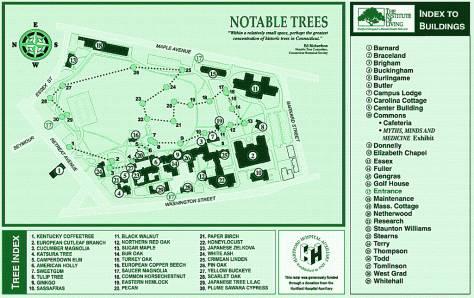
Donnelly Building is #11. But we faced Maple Ave and couldn’t see the magnolia, or the oaks or copper beech that Olmstead planted…

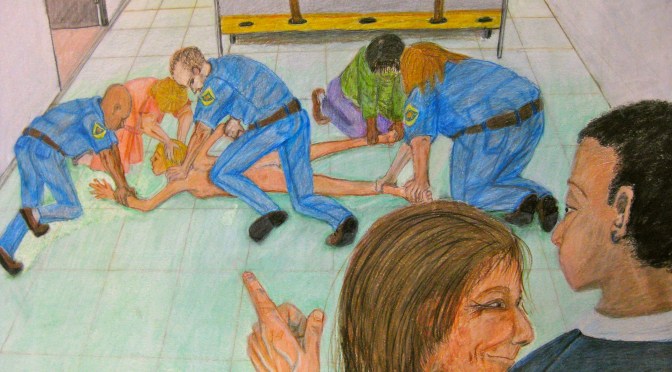
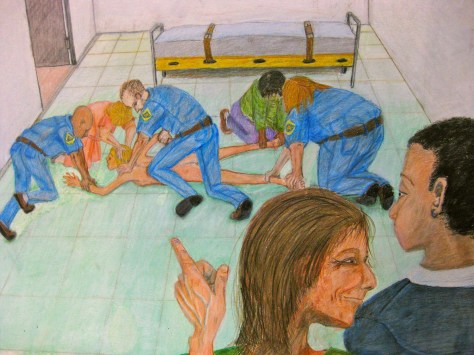
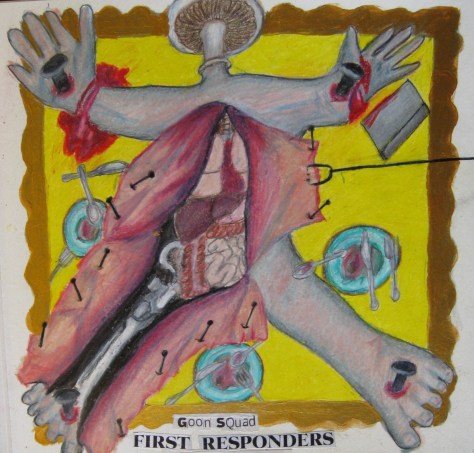
Yes, this is hospital restraint and seclusion – it really happened like this at Middlesex Hospital in 2010 (I am just reprinting it here to reprise it for edification’s sake and because it is relevant.) In fact there were many more personnel and guards involved and more men…I just didn’t know how to draw a crowded scene at the time, so I made it simple!

I admit I was angry. I admit I was loud and irritable. I admit that I may have been perceived as “difficult.” But never once did I make a verbal or gestural threat or even so much as stand on the floor or approach anyone face to face. In fact, for three hours I did nothing but lie on a gurney, quietly, and try to sleep and remain calm, hoping to…But wait. You don’t know the half of it.

Well, if my energy holds out, let me start at the beginning. Except that I do not really recall the beginning, largely I suspect, due to our good friend, Ativan. However, this much I do know: my case manager came to my apartment five days ago after I called her in extremis, just wanting to talk. She offered to come over to see me, which she has done before and left me in better shape than I was when she came. I assented, though I had some doubts about it because she seemed a bit too concerned for my good. I knew I had a writer’s week planned up at Wisdom House again in the NW corner of the state starting this weekend and didn’t want her to push the panic button.

To make that part of the story shorter, push that bright purple button she and an associate did, once they came and found me in a mess, unable to assure them properly that I was not hearing voices telling me to burn myself. Now, my plans were in fact to burn myself somehow, depending on what the voices told me. They had already instructed me to burn my leg that evening. That was partly why I had called the case manager, because I knew I would follow through. I also knew that I could not keep it a secret if I did follow their instructions, which would have ended my vacation plans prontissimo.

But when that other LCSW went out into the hall to use her phone, I knew it was under false pretenses — she said she had to cancel an appointment of hers because she was visiting me but she was clearly lying, I just couldn’t do anything about it. Just as I suspected, she called 911 to summon the police and EMTs. When they came, I objected to going to the ER, but you know of course it was “Pamela, it’s the easy way or the hard way. You are going to the hospital no matter what…” Argh, the usual story.

Worst of all — since I still don’t know whether legally they really had a right to force me — once in the ambulance, when I stated quite clearly that I did not want to go to Hartford Hospital, and this was clearly and prominently stated in my Psychiatric Advance Directive (PAD) of which I had made sure they had a copy, they dispatched me there anyway.  When I screamed my objections from the back of the ambulance van they told me that the police had instructed that they could take away all of my rights with impunity. Oooh, I did not know what to do about this, but it put me in an evaporative fury. I simply had no power.  Disaster nearly followed, and new trauma most certainly did.

Once in the ER, I was taken directly to the so called “purple pod” — the psychiatric section, and shifted onto a gurney in a curtained-off cubicle, told to change into hospital garb, which I did under duress but before I was forcibly changed by the guards, as was the threat, and was told to lie down and be quiet. I did. I submitted to a physical by an APRN that took 15-30 seconds, after which she pronounced me physically sound, ready for a psychiatric interview. Then I waited. And waited. And waited. The room — the  purple pod — began to fill, and doctors and MSWs came and went and talked to people and passed by my cubicle, but none stopped or said a word. I remained silent, still hoping my semi-comatose behavior would bolster my case, earn me a ticket out of the ER without being hospitalized.

Then another woman, middle-edged, bent over from back pain, loudly asked to talk with a doctor, complaining, “I’m tired of waiting! My back hurts!” The response was that she would not get to see Dr So and So until she was sober and the alcohol was out of her system. She returned to her gurney for a time and then again was at the nurses’ station complaining of fatigue and wanting to have her interview so she could get on her way. Once again the same reply.

This jarred me out of my complacency. I grew irritated. Why were they making me wait? I had been there hours already and had not come in drunk or on drugs or anything like it. I had been quiet, submissive, and they just ignored me. Well, I dunno what happened next precisely, but I exploded (but in some sense in a controlled fashion, because I only got down off the gurney once, in order to use the restroom…) Some cropped-haired woman with an official look and a clipboard came by and I started rationally to ask her why I had not been seen yet, and she began an answer. Unfortunately I just barreled on about how I had been waiting hours and was not drunk and not high and, and, and…And well, it snowballed from there because of course nobody at the ER is professionally trained or for that matter paid well enough to care to learn or know how to calm an agitated person down without brutalizing them….This forever surprises me, since surely they must watch TV where such situations are frequently featured.

I take it back, or partly back. They claim to be professionals. They also, get this, several staff members of the ER claimed to have read my PAD, front to back, all 17 pages of it. They volunteered this information. Yet when push came to shove, when I became agitated, which has a PAD page all its own, what happened? Abuse par excellence. First they ganged up on me, a real no-no. Then they screamed back at me. Then they threatened me. One security guard (?nurse or ?aide) actually threatened to “4-point me” just for disturbing his purple pod.  As if doing so would quiet me!

“Oh, you dare put me in restraints,” I threatened, “and I will have your ass so fast you won’t know what hit you. Middlesex Hospital tried that and now they are facing JCAHO and the DOJ so just you watch your step!!!!!” He said nothing more about four-point restraints, I can tell you that. BUT, BUT, BUT… they had other retaliatory measures in store for me, because soon thereafter a whole panoply of guards and nurses came barreling into my cubicle and rolled my gurney headlong into a secure room (soundproof and with a door that locked, a guard assured me). There while a female nurse attempted to inject my upper left arm with three drugs, two of which were on my PAD’s “forbidden drugs” list, and others restrained me, two guards viciously compressed my neck. They squeezed down hard especially on the right side, cutting off the blood supply to my jugular and carotid arteries. I knew this, I felt my eyes pop, felt blackness in my head approach. I tried to alert the nurse injecting me, could barely burble through hard-compressed lips, “I can’t breathe!” which was the only thing at the time I could think of that she would pay attention to.  That they were choking me was a concept that simply didn’t form in my brain…Tough luck. She just ignored them and me and said, “You’re all right…”

I jerked away from her then, trying to get free from the guards. The nurse yelled at me because I dislodged her needle and started bleeding. But the guards only squeezed down harder, tightening their strangulation grip. I felt certain they really were going to kill me. Then the guard closest to my right ear said something along the lines of, “That will teach you about suing a hospital and getting JCAHO involved…” I feel like I have his words verbatim, but maybe I only recall the gist of them. Whatever he actually said,  he clearly harbored enormous resentment about my complaint against Middlesex Hospital and the involvement of the Joint Commission and possibly the DOJ.

When they were through brutalizing me, the guard finally unclenched his fingers from my neck and despite my accusations, they all rushed out of the room, closing the door behind them so no one could hear me. I lay back, stunned, understanding then just how people die during restraint episodes. How close I came to being one of those statistics I can’t venture to guess. “Unfortunate ‘accidents’ happen and nobody is to blame, really, it just happens…” I imagined them saying to my family and friends. At the time it felt like an extremely close call. I knew one thing: what those guards intended, and they intended to hurt me. Perhaps in their angry zeal they would have killed me. They were thugs. They were coarse, vulgar men who had likely been judged unfit for the police academy but still wanted to wear a uniform, have authority and to carry weapons and beat people up. Understanding this and understanding just how much danger I was in was extraordinarily frightening. I do not recall anything else. I must have fallen asleep despite my terror, subdued by the cocktail of drugs I had been given.

The next thing I knew,  they were wheeling me onto a psych floor at the Institute of Living, the psychiatric hospital associated with Hartford Hospital. This Once World-Renowned Retreat for the Rich and Famous closed its doors years ago,  re-opening with the same name but as part of the city hospital. It now caters largely to Medicare and Medicaid patients like me, which is a 180° reversal. Clearly the staff, at least on the floor where they placed me, care about as much about their patients as their meager salaries/wages pay them to. Which from my fairly minimal (I have been there three times, for brief and uniformly miserable stays) but horrendous experience on Donnelly 3 South at any rate tells me cannot be more than a pittance. Either they are paid too little to give a damn about their jobs, or they are mostly all of them jaded, burned out, control freaks. At a minimum it seems they just want a cushy job and a quiet unit with untroubling patients, drugged to the hilt so they will have no problems to deal with, nothing that a seclusion room and IM meds in the butt cannot handle.

They were not prepared for me, not prepared for someone who had nearly been killed in the ER, one, and two, who really did not want to be in the hospital, let alone in their hospital. I was ornery, bitchy, and, to the maximum possible, was not ready to obey their pissant commands. No I was not. I was a human being, a very intelligent human being whatever else was going on, and they were not treating me with dignity or respect, so I would treat them much the same, or worse…Well, that won me a lot of friends, I can tell you, NOT.

They hated me at Donnelly 3 South, they really did. They despised me and made these feelings very clear, very clear indeed, retaliating and punishing me at every opportunity. It would have been, might could have been funny to watch these so-called professional nurses and psychiatric staff behaving so badly, so much like children run-amuck, they were that out-of-control, had I not been so vulnerable and so very much in their power.

But when it came time to force me into a “side room” and try to keep me from leaving it, you better believe they didn’t have an easy target in me. After my experiences in Middlesex and Manchester Hospitals, I have schooled myself on my rights, all my rights vis a vis restraints and seclusion.  And you know that I let them know in no uncertain terms what the Connecticut statutes are, how seclusion is defined and when a restraint is taking place. How they hated me for this, and hated, oh, they –you know, I really have no word strong enough for the look of razorblades in their eyes when I pointed out that they were not following the most recent Standards of Nursing Care, or worse, how Natchaug Hospital nurses do things better, or how they were using seclusion and restraint when they had no “statutory right” to do so. I think the words “statutory right” both meant nothing – “what the heck is a statute anyway?” I could feel some thinking — and everything to them, and was impressive and frightening because of this. In any event, that look of utter negativity went right through me, as if they wanted to stab my eyeballs with an ice-pick.

Needless to say, however, they managed to use seclusion and restraint on me despite my protests. When I got too noisy for them instead of trying de-escalation techniques of any sort, they proceeded first to lead me into and then to push me back to a so-called “side-room.” When I got out, they forced me bodily pushed me back inside, and closed the door against my protests and verbal preferences, vocalized clearly,  to go to the “least restrictive environment” of my bedroom to calm down. That constituted a restraint, and when they would not let me leave that room, it became, as many of my readers will know, by definition a seclusion. Then, when they forcibly held me down for an injection of the three drugs that interact badly in me, and which I had requested specifically not be given to me (alternatives were suggested in my PAD), they abrogated every right I asserted. That in itself constituted a restraint without legal justification, especially since I was nearly sleeping by the time they managed to get the injection ready and no longer even agitated. They had to physically attack me in order to RE-agitate me, to justify giving me a stat dose at all. They kept me in that “side room” guarded by someone all night.

As I freely admit, I was horrible to them, a witch, a bitch, a harridan, but they never once behaved with any professionalism, or tried any of the calming, de-escalation strategies that I suggested in my Psychiatric Advance Directive. Oh, they had a wonderful comfort room, pretty much perfect, but for the lack of a padded floor and muralled wall. But I myself had to ask to use it; it isn’t as if they offered the use of it or suggested that I return to it when agitated. In fact, they seemed pretty cagey about it, acted as if I might possibly want to “over use it” and said I could stay for a “little while.” And when the radio broke down, who gave a damn enough to find one that worked when I returned the broken one, or to get me a weighted blanket when I wanted one. I sat in the comfort room’s therapy chair — arranged backwards so you couldn’t use it to rock yourself by pressing your feet against the wall the way it is supposed to be used! Because it was cold in there (yeah, the other big problem) I asked for a blanket, the aide/tech who found me one walked partially into the room and then threw it at me! Not casually for me to catch, mind you, but at me. As if I weren’t worth the time, trouble, or effort for him to hand it to me. I don’t know what he was thinking, or not thinking, but it seemed clear that at least at that moment he didn’t give a damn about his job. Or perhaps he was sending me a message about personal dislike, which would have been incredibly unprofessional, but what can I say? It has happened before…What a soulless bastard.

If anyone out there reading this is a psych tech or nurse or employee at a psych unit or institution, you should know or must learn that matters like the blanket business, however puny they seem, do matter, they matter a lot. Never at Natchaug Hospital would anyone, tech or nurse or even attentive housekeeper dream of throwing a blanket at a patient, not in bed or in a chair or a therapy chair. No one would throw anything at a patient, not even a tissue, and most certainly not in anger or a fit of pique. Not even in momentary thoughtlessness. No, if a patient needed or wanted a blanket at Natchaug Hospital, it would be gotten, often warm from the drier, opened up and carefully draped just so over the patient’s body.

This has a huge effect and makes a massive difference largely because it is indicative of the fact that Natchaug actually has a philosophy they work with and behave according to, not one of words they just push through their teeth and get lipstick stains on. Almost always at Natchaug the staff member would cover the patient and only leave the room after making sure that same patient was comfortable. The blanket-bringer would know or have been carefully tutored that the job description included an attitude of wanting patients to be happy and to get well because Natchaug believes a troubled person can only get well when well taken care of.

You’d think, and certainly would want each and every psychiatric hospital to operate on such humane and compassionate principles, wouldn’t you? Alas, at least in Connecticut, Natchaug Hospital in Willimantic is definitely the Hope Diamond exception to what remains very much a charcoal rule. Hartford Hospital’s Institute of Living? I wouldn’t rate it much above coal dust.

To be continued…