All posts by Phoebe Sparrow Wagner

Artist, author, poet

100,000 hits…Thank you!

I saw that the counter was reaching 100,000 late on Sunday, but it wasn’t until after Memorial Day that i had a chance to check again and see for myself that, wow! Gee whiz, Thanks! I’ve actually had more than 100,000 visits to my blog. That impressed me – for all of about three seconds. Then i checked my stats and reality’s cold wet towel smacked me in the face. Not that i hadn’t been aware of it, but here’s the thing, and whether it is a problem or not i don’t really know: my blog is supposed to be about schizophrenia and mental illness or at the very least about art and poetry and therapy. However, one day i wrote a WordPress Daily Post challenge – trying to get into Freshly Pressed – for the uptick in traffic that might bring, nothing more. It did not succeed in that mission, but it did bring me by and in itself a whole slew of new visitors. In fact, each and every day i have many more visits and searches for my blog post from that one day, that one post, in specific, than i do for the entire rest of my blogs combined, by far!

On any given day the breakdown could go like this, percentage wise, 90% for that single post, 10% of the searches and visits for all other posts. Strangest of all, it was a very atypical post, having nothing to do with any of my usual topics but about technology. Weird, in the extreme. Now, mind you, i never mind any visits to my blog, all readers are good. And in this case i believe the post has been helpful to a lot of people. But if they searched for the terms they did, they did not find me with any particular interest in the subjects i usually write about, and may not be inclined to return for more.

Or perhaps i am wrong. You never know, do you? After all, MI strikes every family in one fashion or another, and we deal with it in varied ways, some adequately, some not so, and often some very badly. It is just possible that someone landing here, via a search for that DIY posting, actually took a look around, liked what he or she read, and learned something helpful. I would like to think so at any rate.

And, in any event, you, whoever you are, are reading these words now so you did find me, somehow, via whatever search terms or deliberate whim of fate or fancy brought you here. Maybe you will come back to read some more of my words, see a painting or drawing or sculpture you like. In 2014 i may be legally able to sell them, and perhaps you will like that. Whatever is the case, dear reader, thank you for spending the time here long enough to read this post. If you feel like it, click the like button to show me you’ve been here. It is always, always hugely appreciated.

Muchas gracias, grazie mille, danke, kitoksia palmin (not sure how to spell that, my Finnish is rusty…) merci beaucoup, and so forth. Thank you, thank you from the bottom, and the top and middle of my heart…and from the rest of me too.

Therapy Puppets: An Art project

Traumatized Tiffany
Although all the puppets/dolls are handmade, and each takes four hours to complete from start to finish, Tiffany is the only one that is clearly in trouble. She has a black eye and is screaming in pain or outrage or something…She is also the only doll that I decided to leave unreinforced, though I may change my mind after I finish the others. For now, though, I have left her in the simple form, frail and fragile, utterly vulnerable…though for all that, it is only an illusion. These doll puppets aren’t easily breakable. You would have a harder time than you think, trying to tear the heads off.
Beatnik Bob- therapy puppet/doll from 4-6 inches high, like the others.
Therapy Puppet, Bob is completely handmade with a pliable bending body and an exquisite, handmade clay head with hair of embroidery thread.
 Beatnik Bobby, another view
Beatnik Bobby completely handmade with a pliable bending body and an exquisite, handmade clay head with hair of embroidery thread.
JailHouse Jummy
Jimmy is also completely handmade with a pliable bending body and an exquisite, handmade clay head with hair of embroidery thread. I have him fighting his way out of a jail made from a bingo counter bin. (Knew that would come in handy one day!)
Baseball Willy
I call this one BaseBall Willy only because of his cap, but he could be doing anything in his whites. You figure it out for yourself, because that is the point! Willy is also completely handmade with a pliable bending body and instead of hair, he sports a clay baseball cap.
TigerWoman
What else could I call her in such get up? I see this one as confident, even too confident…that’s the story I give her. What do you see in her? completely Like all the others she is handmade with a pliable bending body and an exquisite, handcrafted clay head with hair of embroidery thread.
What do you see in her?
She looks haunted but strolls the avenue like she owns it nonetheless…Or not? Tigerwoman is completely handmade with a pliable bending body and an exquisite, handcrafted clay head with hair of embroidery thread.
A Band of Beatniks
Cute, no? A Band of Beatnik therapy puppets, all handmade, each one takes about four ours to make, from start to finish. even each drum takes at least two hours to make.
Miss Whatsit
Although I did make this figurine female, as opposed to the more clearly male one, that is the only characteristic I gave her. Otherwise, she is supposed to be “blank.”
Female and Male Whatsits
The female has pink lips and the male has brown lips…Otherwise there is little difference. Skin tone is neutral and no race is specified.
He whatsit
Brown lips but neutral skin color, and no noticeable emotions or characteristics. completely handmade with a pliable bending body and a clay head, with recognizable but blank features.
Leather Drum
The drum was made from a piece of a roll that came inside a tube of plastic wrap. I cut off about an inch. Then I cut apart a used leather pocket book I bought at a thrift store and with a piece glued a small piece around the once inch round. Then I tucked the flaps inside on both ends. Finally I sewed a round piece with a running stitch, using a sewing awl, and after I attached it with glue to one side of the drum, pulled the black cord together like a drawstring. I glued a tiny bead to either cord end and voila, a drum for the beatniks to play.


I have created these small creatures, every one of them individually handmade, for use by therapists in counseling. They range from about 4 inches to about 6 or 7 inches high. I started with Beatnik Bob, just for fun, but when I actually found myself comforting the little green girl-like figure with the black eye, which I call for shorthand, Traumatized Tiffany, it was a revelation. It is hard not to want to play with them, in fact. That is what friends tell me when they see them. Weird, because we are all way way too old for dolls and playing with toys, and yet these figurines seem to elicit something in us that made me think therapists could use them in their work.


If any therapists or psychiatrists out there are interested in obtaining some of these creatures, please contact me to discuss fees and shipping. I can make them to specification sort of, but after that, each piece is unique and cannot be replicated. Let me know if you prefer characters or the hairless, non-specific Whatsit figures.


Breaking Icons

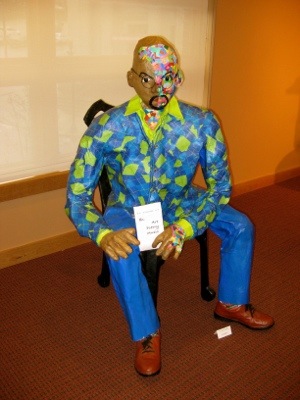
My second human sculpture, Dr John Jumoke, holds a prescription pad that reads,

Rx: Art, Poetry, and Music.20121223-000808.jpg

I think that is a pretty good first line defense for much of what ails the human condition. That and a good dose of empathic understanding from people who eschew employing violence, sarcasm and undermining skepticism in their efforts to help others. Too often people who are diagnosed, as I was, and still am, with “schizophrenia” are rushed into treatment that degrades and humiliates, even as it inflicts terrible effects, not to mention side effects…all without curing the so-called illness. I am not convinced that a person with “schizophrenia,” given the simple luxury of TIME, and a safe place with really good, caring, kind and intelligent people who know how to help without hurting her or him, would not heal better and more effectively than with any of all the so-called miracle anti-psychotic drugs our billion dollar medico-pharma industry has foisted on us. And I say this even though I still feel that Zyprexa was a “miracle drug” for me, once upon a time, (though also the miracle drug from hell…) and that it gave me a life I had never known before. I say this even though I take Abilify and Geodon and do more art and writing than I ever have…I say this even though I am better now than I have been in decades. I think the drugs are only fixing problems that the system largely caused. And had I had the chance, way back when, I wish I had had the chance to fight back without them…

If I could do anything to fix the mental health system, in Connecticut or this country or the world, one small thing, it would be to end ALL use of seclusion and restraints, period. Violence begets violence, in all cases. In ALL cases. In fact, get this, I would change the prison system as well, so that punishment qua punishment would be a thing of the past. Punishment is only a form of revenge and it does nothing to change a person or make them better. It only makes society feel better the way a bully feels better when he or she smacks a victim upside the head for smiling lopsidedly. I mean this. Sure, people can do very bad things. Yes. And certain people may be so damaged that they are too dangerous  to safely release into “normal” society. (I maintain that this is largely because of how we, as a society, treated them, either at large or in prison.) But prisons and penitentiaries, especially in America, should be seen as an abomination on God’s green earth.

They say a society is judged by how it treats its dead? Well, I think we are judged by how we treat our prisoners, and if so, we will be judged poorly indeed for we treat our prisoners like hated animals…Not like cats and dogs that is for certain, nor even like horses…No, because we generally treat cats, dogs and horses well. Rather, we treat prisoners like vermin, like roaches…and then we blame them when they behave like the vermin they have become!

Have I gotten off the subject? Well, some mental institutions are largely prisons to their populations of involuntary or coerced patients, and most patients, involuntary or not, are cowed into doing as they are told for fear of the consequences. So to a degree the prison metaphor is valid. But if you have been restrained and secluded, brutally, and for hours upon hours, for many days, as I have been, the notion that you are a prisoner becomes more reasonable. That said, I will advance yet another idea: that bad behavior should be treated, not punished. Yes, I mean that. We should treat the person guilty of repeated criminal offenses as if he or she has a treatable behavioral disorder, and not punish them.

I know this will earn me some outrage. But think about it. What good does it do to punish a person repeatedly? Does it do anyone any good to torture that person with “the hole” or with repeated cell extractions and mace in the face? Clearly it doesn’t rehabilitate them or teach them the ways of kindness. It only makes them worse, and in our system an in-prison offense can add years to what started as a short sentence. So we create hardened criminals inside our prisons. I ask again, what good did it do?

But if instead we took that person, guilty of an offense and treated them as if they needed help — help learning how to behave better — and all that might entail, perhaps we might end up not only with someone ready to leave the institution at the end of the shorter stay, but someone ready to stay out afterwards! It only makes sense to treat everyone, including prisoners, with kindness and understanding and education, and if you don’t believe this, you should for one reason only: it would cost less money. (Of course, the owners of the private prisons don’t want you to know this, because they MAKE money on all the prisoners who keep coming back or who never get out, in fact there is a whole industry based on keeping as many people in prison, their private prisons, as possible…)

But I don’t believe in prisons either. I think the institution is a nightmare. You put bad people together with one another and what do you get but people learning how to behave worse together! It is a truly ridiculous idea. Analogous to the hospital, which is currently the worst and most dangerous place to go when you get ill (because that is where the most dangerous infections are and are often out of control). In the “old days” prisons were merely waiting stations. Penalties were sure and swift, and brutal. But no one waited for decades in a crowded prison with society pretending that it was humane. Now, we pretend it is..I dunno. Do we pretend anything, or just not care?

Do we care at all that we warehouse so many millions in dead-end lives that only get worse by the day, and then deprive them the more if they manage to leave prison eventually and not return? Oh, we have three strikes laws to put a person in prison for life, but no one gives a damn that there are three strikes against any person who actually earns his or her way OUT of prison. Nowhere to live, no job, no money, and no safety net whatsoever. (Unless you happen to be a former governor of Connecticut, and then you have it made in the shade.)

Enough for now.

UNFIT FOR WORK? Or simply Forced to be Disabled?

NPR’S “UNFIT FOR WORK”

The startling rise of disability in America

By Chana Joffe-Walt

http://www.thisamericanlife.org/radio-archives/episode/490/trends-with-benefits

In One Alabama County, Nearly 1 In 4 Working-Age Adults Is On Disability (click below to play audio)

https://phoebesparrowwagner.com/wp-content/uploads/2013/05/20130322_atc_05.mp3

In One Alabama County, Nearly 1 In 4 Working-Age Adults Is On Disability


Expanded Definition Of Disability Created Million Dollar Opportunity For Lawyers

Moving People From Welfare To Disability Rolls Is A Profitable, Full-Time Job

Kids May Stay On Disability If Their Parents Rely On The Check

Americans On Disability Play An Increasingly Important Role In The Economy

Thanks to Donna for pointing out this story at NPR. You can get the written story by Chana Joffe-Walt if you prefer to read it at: http://apps.npr.org/unfit-for-work/

If anyone feels moved to comment on this story or add to the discussion that I started yesterday under the video of Reshma’s recovery from schizophrenia,  and Donna added to with her comments, please feel more than welcome to do so. If I get enough, I will create a new post out of them.

NOTA BENE: if you are a regular or even intermittent follower of Wagblog, and think that you have something to add here, and would like to contribute a post regularly or simply once in a while, please contact me. I am in the process of inviting contributors to Wagblog, but do not know everyone who might be interested in doing so. So if you are a human, and interested, let me know who you are. Send an introduction with your best writing as I cannot accept contributions I will have to edit to the point of rewriting…and umm, we have certain standards here, ahem, ahem, ahem. 8)   

Sunshine Story of Schizophrenia Recovery…plus

When I saw at the end of this film, part four, before the depressing note that stated all that Indian law might not permit Reshma to do in her life, how she was making a living by painting, all I could think was, WOW! Go for it! At the very least, she is not being held back by the strictures of disability law and Medicare and Medicaid earning limits, or being forced into a permanent sick role because of same, simply in order to have a roof over her head and food to eat. No, she was lucky enough to have a family that both really and truly took care of her in her worst moments and fought for her in the best sense of the word, and also one that let her go when she needed to fly free. Most of us are not so lucky…alas. I think the support that she got all through her illness played an enormous role in her recovery, frankly. And I dunno how many of us get that sort of community or family support, but I wager that it is not many. I certainly did not. I wish I had, but it was very much to the contrary. Instead of support, I was abandoned entirely, both financially and emotionally. Left high and dry, to such an extent that people who met my parents after the break, never knew I existed, not for thirty-five to forty years. Some are only just learning of my existence now, as they meet me when I visit my mother. They didn’t even know or understand that all along Lynnie had a twin!

But I do not wish to dwell on that, except to say that things did not have to be as they were. And we do not have to live as second class rejects in society, except insofar as we accept that role.  And take it on, along with the disability status and payments that we are told we should apply for at the first psychotic break. I disagree. If a person has a work history (and history is the single best predictor of the future, if anything can predict it) and has shown that he or she can hold a job, then why after a psychotic break should they be told they will never work again and that they should apply for social security disability? Disability signifies Permanent and total disability, that’s what it is for. You are not supposed to get better, and it’s meant to be “for good.” No, it is not impossible to get off SSDI and you can in fact earn your way off it. But how many people do? Not a single person I know who ever obtained SSDI payments ever got off it or ever even tried to do so. The best they did was earn just below the legal limits of what one can earn before they  start counting against your disabled status. Which is to say, they worked, yes, but only a little, and only to the extent that it never threatened their standing as a disabled person.

What a crappy system. Someone a few months back when I was in the hospital asked me why I was so angry at the System, and why I counseled anyone under 50 not to go for disability…and this is why. Because it paralyzes a person into doing nothing with his or her life, it keeps them mired in permanent poverty, and it encourages lethargy and breeds depression and recurrent illness. I believe it does NOBODY any good. Frankly. True enough, I cannot say that I am not grateful as hell that I have had a monthly income for all my adult life, as I have never been able to work an 8-hour day regular job. But if, instead, there had been creative rehab or job counseling and creating, maybe someone would have discovered my artistic abilities earlier in my life and got me going, and using them earlier in a more productive and income-earning capacity.

I was never, and never claimed to be, unable to do anything at all. I simply could not follow a routine of any kind or go into an office or workplace from 9-5pm. Since that made me unemployable in their lights, I was “disabled” and put on the SSI and SSDI rolls. But in truth, while it guaranteed me an income, it also sidelined me for life, because I didn’t have to do anything to survive or even to get ahead. And in fact I was not allowed to get ahead or I would have lost the very disabled status that I now needed simply to qualify for housing and food. It was a terrible catch 22 situation that only perpetuated itself once I was caught in it. I could never get out of it once I accepted the first check…

And it only got worse when I moved into the cushiness of subsidized housing. Now, not only can I not move (it is HUD housing not Section 8 so it isn’t even portable) but I am “used” to a piddling rent of 1/3 of my piddling income. I have stopped knowing how to scrimp and save and live on pennies a day…because I do not have to. Everything is guaranteed here. Everything is safe. But I am suffocating, because I have no life, and no prospects for any change or growth or movement because at age 60 my life is at an end…I will live and die in these measly 2 rooms, living on SSDI and SSI, earning nothing, doing art and storing it away for nothing and no one…What good is that?

That, my friend who wanted to know why disability is such a bad deal, is why I counsel anyone who is not close to retirement not to go the disability route, not unless you want to do nothing and live in poverty for the rest of your life, and are content with a life of watching TV and a strict budget, using food-stamps and coupons. Because it will come down to that, that is, if you have a TV. And lucky you if you have a car and can afford to keep it on the road….If not, think about whether or not you can get rides, because the bus can be a drag when it is raining or snowing and you have a lot of groceries to carry. You better keep the car in tip top shape in any event, because you won’t be buying another anytime soon on disability from Social Security…I dunno about you, but no one I know gets much more than $1000.00/month from SSDI and usually we get hundreds of dollars less than that. One car repair bill can rip a monthly check to shreds.

I dunno what most wage-earning people think a life on disability is like, but it isn’t a cushy life of luxury,  not at all. I haven’t bought or been able to buy new clothes in nearly ten years. (I wouldn’t want to anyway, because I like to buy used clothing and not generate new carbon, but do you really think I could afford on my SSDI check the price of any clothing except Walmart’s, that abomination of a store?) I cannot even afford to get food at Stop and Shop, let alone new clothing anywhere. I buy literally everything used, at GOodwill, or I barter or get things free through Freecycle. Or I do without. The only new purchases I make are art supplies, when I cannot get them at tag sales, or through other outlets. And I do not replace my erstwhile beloved pet Eemie, because I know I cannot afford a cat. You make choices in this world. If you choose to go on disability, I believe they should tell you precisely what sort of life you are choosing. Or give you options so that disability is only one of several equally feasible ones. It ought not be simply: go back to work at the same job, at the same level of stress, or go on disability. That is stupid, especially if one has been psychotic. But it also ought not be, You have been psychotic, and we are certain it will recur, so you will never be able to work again.  That is double nonsense. NO ONE can predict the future, or tell a single soul that a psychosis will or will not recur. Only time will tell, and predicting a good prognosis has been shown to pay off with better outcomes than telling a patient that the future looks dire.

Okay, enough for now. I hope I haven’t been too oldy and moldy-sounding. I’m just very discouraged about my own limited and stagnating life. I do not feel as old as the system is making me behave. I could have a good life for the next two decades or more and maybe even a career. After all, Grandma Moses didn’t start painting till she was much older than my mere 60 years, and she had a long painting life ahead of her. No one told her she should just hide her head in the sand and wait to die. Or if they did, she ignored them and went ahead and  painted and painted. I won’t give up on art, but I am frustrated and feel utterly stymied by a system that has clipped and cauterized my wings.

Finally, this is the large Turtle that I owe Tim, as it looks at present. I am going at it very slowly but surely.

IMG_1105

How to Paint A Papier Mache Turtle (Third Try is the Successful Try!)


Sorry this is so unprofessional but I hope it is helpful and at least a little entertaining. I think i at least managed to get the entire 8 plus minutes uploaded to Youtube this time! 8D  (that is an emoticon for me, in round glasses with a big grin)

Too Many Anniversaries and Too Many Memories

Eemie on Bed

One of the anniversaries is my little Eemie’s death last year, at age 17. She was only about 14 in this picture, maybe a bit younger. But she never looked much different from this. Even the day she was “put to sleep” the vet thought she was a very sick 5 year old and not the elderly kitty she really was…She was my all time favorite cat, but i won’t try to replace her, or get another. I cannot do it, and will not try…

Pam and Joe 06 at Lahey

This  photo is of Joe Cornelio and me in 2006, just after he was diagnosed with ALS,  Lou Gehrig’s Disease, which would finally kill him, or complications thereof, two years ago today. I stil miss him dearly.

ERICA Screen that Joe sees

At the height of Joe’s illness, when he was completely paralyzed except for his eyes, and could not speak or move, he was able to use an eye gaze computer known as ERICA to speak with. ERICA registered the glint in his eye and allowed him to spell out each word by looking at the letters of the alphabet, which you can see on the screen in the photo, and then he could ask the computer to speak what he spelled by looking at the “speak” function. It was laborious, yes, but it worked well enough that we could actually have skpye converations by phone when I could not get in to see him in person, and I would set up my computer by my paintings and do some artwork by “videophone” so that he could watch me work while we talked.

Joe using ERIKA

This is  Joe — weird how I never saw the changes in him in life but always saw him as “my old Joe” except in these photos — using the ERICA.

Pam and Joe in HFSC smiling

Pam and Joe, smiling at one another…

facility_restraints

The other anniversary of this month is that three years ago, I was sadistically restrained (the first of several such incidents) on April 24th at Middlesex Hospital, absolutely traumatized by it and have not forgotten it yet. I tried to get redress, and we had JCAHO go in to investigate, but it did no good, because the Joint Commission largely doesn’t care about how often general hospitals use restraints and seclusion on patients in psychiatric units and doesn’t even track their usage. Try and find out about it. It is impossible. They track use of R and S in psychiatric hospitals, pure and simple, that is to say, State Hospitals, and private psychiatric hospitals, but not in general hospital units. So what good is that, I ask you? Most people who have severe psychiatric illnesses (chronic) are not hospitalized in this day and age in private hospitals but on psychiatric units in general hospitals, where the treatment can be tantamount, as I know all too well, to what the UN in March called torture.

Finally I was going to upload a bunch of photos of my tiny apartment but in one fell swoop I erased everything in my iPhoto library, including all the new photos. and, well, that was that! All I have left is whatever was saved in the ipad Photostream, which was precious little when it comes down to it. Stupid me!!

So today is the anniversary of Joe’s terrible death and I am trying not to think about that and all the other anniversaries coming up…It looks like it is going to be a bright sunny day here in Connecticut so I will try to take a walk and maybe do some artwork if I can get up the energy to do so…

April Blahs?

IMG_1016


I realize that doesn’t exactly illustrate the “blahs” but it represents the sum total of all the artwork I have done since I got out of the hospital in mid march…and I did it in one night, on a whim, as a gift to the wonderful social worker who just left a position in our building for the directorship of the community center in town. (I miss her terribly but she needed to move on…)


Anyhow, the point of my post title is mostly to explain why I have not written all month: I have not felt much like doing anything at all. I haven’t done any other art or writing, and all I managed to accomplish was to clean up my apartment, which only serves to paralyze me the more.


I will write more eventually, but for now I just wanted to assure you all that I am okay, just not feeling up to much and so not writing. When I am back up to snuff I will write more. (I might even film a tour through my apartment in desperation, just for something to post here, that is how bad things are…i am scraping the bottom of the barrel!)  In the meantime, please don’t give up on me. I’ll be back…SOON.

Schizophrenia Video: UVA and DIVIDED MINDS

This video was made during our “book tour” of 2005-6 after DIVIDED MINDS: Twin Sisters and Their Journey through Schizophrenia was published. I had not seen it for several years when my good friend, the poet Mizzy Hanley, located it by chance on YouTube. I am surprised, frankly by how eloquent my speech is, though I cringe, today, at some of the things I said. How differently my talks today are! In any event, much of it still holds true, though  now I would couch things in somewhat different language, and might not so readily give the voice of certainty to such statements as “I suffer from schizophrenia.” Nevertheless, the comments underneath are certainly encouraging, and if it helps anyone for us to have said what we did then good.

Donna’s Story and More Art

P1020796-001


This picture is Tim’s sister in law, Dawn, whom I drew at Christmas, in 2012. It took me about an hour. The elephant below is remarkable only in that it is my first painting, in oils, that I have ever done. And for that matter, almost literally the first time I have painted anything, except for a few portraits. I usually draw, in pencil or oil pastel. I have painted some acrylic portraits, in the past, but none recently, as I told myself I’d better learn to draw a few years back  “before I go any further with painting.” I never ever did anything with oils at all. So if I achieved any success with the elephant it was completely by chance. I find oils very difficult. I do not know how to work with them, nor how to manipulate a brush or the colors, or how to do anything at all with paint. So this is an interesting journey, and transition, if transition it be. I do not know what will happen. Whether I will switch to oils completely, or simply use them desultorily…We will see. I am now working on another elephant painting, just for practice. Both of them started with the use of oil pigment sticks, which enable a sort-of drawing technique, very bluntly, and ended forcing me to paint, using either my fingers or real brushes. So it seems I am being led willy nilly to the brush and paint pot!


IMG_0015


This last picture started as a doodle that I did of another patient at the Institute this winter, but I liked it so much (and the patient hated it!) that I finished it by changing her to make her unrecognizable. I would have given it to her otherwise, but she didn’t want it, so I said nothing more. But I gave it to my friend Bill, who loved it. In the mean time, I figured I would finish it as I wanted to and did. I love it myself, and would gladly have kept it, had no one else expressed interest in it. But once I knew Bill loved it, well, I knew I wanted him to have it. And it meant I took extra care finishing it when I did. I never really knew much about this patient’s story, nor about anyone else there. Nor did they learn much about me. I do not believe they ever knew what the staff was doing to me that last ten days, when they kept putting me into four point restraints. That was the point: I was in seclusion so no one had any idea I even existed by that time. No wonder I ended by screaming non stop and blood curdlingly that last night when they restrained me the second time for no reason. Everyone who had known of me had left by then. All the patients were new, and no one even knew I was there. I was aware of it, and I knew that if I didn’t scream, they would simply four point me for another 8-10 hours and get away with it…Well, enough of that. This patient did not mind my drawing her, for the few hours that I was allowed to be in the general population. In fact, I think she was flattered that I wanted to. Unfortunately, she was not pleased by the results of my efforts when she saw the drawing…and made her feelings clear when she saw the drawing.


Image


___________________________

One of my loyal blog readers, Donna, wrote a long comment the other day, and I asked if I could post it on the blog proper, as I felt it was important for her story to be heard. She said Yes, and so I am reprinting it here.


“I have many personal arguments against taking antipsychotics. First of all, I endured schizophrenia since I was about 10 yrs old without anyone knowing anything about it. Without being diagnosed, that is. Yes, I had been thought of as weird and even retarded by my peers, mostly because of social anxiety and being an extreme introvert that were a result of or in addition to the schizophrenia. But my sanity hung on the fact that I was creative and could physically exercise to the point of exhaustion. I think that exercise (running) was the most potent antipsychotic I have ever experienced, probably due to the release of endorphins and the subjugation of ongoing anxiety for a few hours. The hallucinations never really bothered me because I couldn’t remember being without them. Nevertheless, once doctors knew of the hallucinations, that became their excuse for medicating the hell out of me. And subsequently robbing me of my creativity and the ability to exercise. You can see where this is going.

For one thing there was exercise equipment in the hospitals I began to frequent (after starting on antipsychotics, of course.) but I could not use it without a doctor’s prescription, which was never forthcoming. I guess they didn’t put much stock in exercise. It can’t be patented and marketed and sold as a pharmaceutical. Once I began taking Zyprexa, the option was moot anyway, because I gained so much weight there was no possible way to run anymore.

Although I had schizophrenia, as I said, for many years before diagnosis and treatment, I was always able to read voraciously, retain what I had read, and use that as grist for the mill of creativity. Once I started taking mood stabilizers (which, btw, never stabilized my mood) like Lithium, Depakote, and Tegretol, I began to REALLY suffer mentally. Yes, I could tolerate hallucinations, but what I found intolerable was the side effect of being unable to be intellectually stimulated. I was laid low. I could no longer read and understand the combination of words. I couldn’t sit through a movie because I could no longer process the sensory input — what I saw and heard became separate entities rather than combining seamlessly into a meaningful whole. It was a frightening, assaultive experience. Even music ceased to be soothing. All I wanted to do, and practically all I DID do was to lie in bed just trying to think one clear thought. It couldn’t be done.

After the antidepressant and mood stabilizer failure, ECT was tried. Again, that only made things worse. Then came antipsychotics. The first one I took, Trilafon, was a nightmare. Kind of like what you said, Pam — I then had an inability to tell dreams from reality. The scary kind of hallucinations started, like seeing a gargoyle when I looked in the mirror. And the parade of multiple antipsychotics drifted ineffectually past the window of my consciousness. Finally, when I was given Zyprexa, I “awakened.” Would I have needed awakening if I had never started taking these medications in the first place? I had my doubts. But on Zyprexa, I could read again. I could tolerate movies. I could write creatively. But the weight gain that started with Lithium began to really pile on with Zyrpexa. My weight doubled within a few months. I had always been extremely weight and diet-conscious. With Zyprexa came mind-numbing sedation and a tremendous 24×7 appetite. So I was eating and sleeping, but I was also reading and writing.

Talk about the horns of a dilemma — I could take the medication and regain my ability to think and create but be a slave to the fork, spoon and pillow, or I could stop taking medication and keep my appetite and weight within normal limits and be insane. What I’m wondering now is whether any of this would have been a problem if I had never taken the medications to begin with. I became much more insane after being medicated and stopping the medication. To my way of thinking, medication had stopped the positive symptoms but had made me especially prone to relapse every time I tried to ease back on it. And the hallucinations had never been much of a problem — not nearly the problem of weight gain and intellectual poverty. Zyprexa did at least give me back a portion of my mind. Medication giveth and medication taketh away; blessed be thy name pharmaceuticals.

SInce then, I have tried just about ever atypical on the market, with the exception of Invega, hoping to find the “right” medicaiton. They were all promising at first, but each with an array of intolerable side effects. Anxiety. Hypoglygcemia. Hypothyroidism. Akathisia. Pruritis. Mania. Severe insomnia. And for a long time, I could return (somewhat relieved) to Zyprexa and what had become my standard of recovery — stabilization and the ability to think and sleep again.

Now, however, I refuse to take the previous 40mg of Zyprexa. My psychiatrist seems to believe the higher the dose, the more effective the medication. I have weaned myself down to 2.5mg which is enough to keep me out of the hospital but apparently not enough to keep my appetite so revved up. It does not allow me to lose all this weight, no, but at least I am no longer gaining. I am writing again. And reading. The problem is, this dose of Zyprexa does not solve the problems of anxiety and insomnia, which are pure torture. So I take the minimum dose for several days, then double that for a couple of nights in order to sleep, then back again. I used to just stop taking the Zyprexa completely because the weight gain frustrated me so much. The stigma of mental illness is bad enough without the stigma of obesity. Schizophrenia is bad enough without metabolic syndrome or diabetes.

The real kicker, to me, is that yes I was having problems before I ever started on the psychiatric medication rollercoaster. I had some psychosis, depression, hypomania. I heard voices once in a while. I had a roster of impossible people renting space in my head. But I lived a close-to-normal existence from all outward appearances. I could hold down a stressful job. I managed to keep a marriage together. I was winning regional poetry contests in my spare time. I had my own home. But it was not until I began taking all of these medications that it all went to hell. And now, from what I’ve read and what I have experienced, my body can no longer tolerate being without the medications. Life is worse off of them now than on them. I have to take Zyprexa or go back to the hospital. I have to take it or I may end up living on the streets. I have to take it or risk killing myself. My doctor says oh, but the medication has SAVED you from these horrors. But am I where I am today — on SSDI, unable to work, a slave to my fat-bound body — because of antipsychotics and antidepressants? Or am I able to be independent, sane, and creative again because of them. Or both? Somehow, something doesn’t seem right.

Art from Yale Psychiatric Hospital #3

104_3432

This was the third picture I did at Yale. During the three weeks I was there, I often had a difficult time when I heard another patient yelling or getting angry. At one point, a young woman (younger than I at any rate) did a fair amount of screaming and complaining. And I heard a lot of noise that I thought portended or suggested violence was happening. I became very scared, terrified in fact, not because I thought I would be hurt, or that she would somehow hurt me. I am never ever afraid of other patients. My only fear at any time, aside from fear of the staff behavior towards me, is fear that another patient will be hurt or traumatized by staff use of seclusion or restraints or other violence on them.

Christine Simpson, the LCSW assigned to me on my team, recognized that I was panicking, and at least three times that day sought me out and just sat with me, talking to reassure me both that I was fine and that the other woman was fine, whatever was going on. She even came back before she went home to check on me and make sure I was okay before leaving, well after 5pm. I don’t think I ever thanked her enough for her support in the other posts, so I hope this does so. She was wonderful and I think she went out of her way to make sure I was not only “just okay” but that everything was as good as it could possibly be.

I am so profoundly grateful and remain astonished, both, that YNHPH  has a philosophy of patient-centered care, of dignity and respect for the person, and also practices it so well that it doesn’t need to preach anything to the patient at all. You know, I believe the Washington Square 2 unit “advertises” itself online using the words Dignity and Respect, but I did not know this before I wrote my first blog post about yale or went there. I simply understood it from the way they treated me and everyone else. It was also perfectly obvious to everyone who visited me there.

I have donated picture #2, the one with the red bird of fear (“oiseau de peur”), to Yale Psychiatric Hospital, because of Chris Simpson  and Dr Milstein and everyone else on the team and all the aides and counselors on the unit who work so well together.  A huge thank you, to all of you.


Is Sherry West another Susan Smith?

I am trying to embed a video of Sherry West, in the early days of her telling about what happened, just after she was released from the hospital. (NOTE: the video was removed from the internet so I am posting a link to another youtube video which is still up. http://www.youtube.com/watch?v=DdkY1nmMxfU ) Before she got to refine her story about the two young “African American” boys who supposedly shot her infant. If it doesn’t load the first time around, I will get it done tomorrow, after I read up on how to do it. But once you see it, think about it. Does she sound sincere, or look it? Not to me. My first reaction after seeing it was, Oh no, this is just another page of the Susan Smith playbook, writ large…I hear, so to speak, Susan Smith speaking in her voice and I know she is lying about what happened just as I knew Susan Smith was lying the very first time I heard her talk about those “poor dead babies.”

Just to give you a way to see the Sherry West case differently, if you are inclined to think about such things, look at Pamela Meyers’ video on how to spot a liar, at TED lectures, which you can see at this link,   http://www.youtube.com/watch?v=P_6vDLq64gE  Trust me this is better and more helpful than any rapidfire weekly TV show about detectives, and it is only 18 minutes long. You really learn a lot.

Schizophrenia Medication: Should I or Shouldn’t I?

This is from a 2011 entry on my About Schizophrenia blog. However I have changed it and updated and added to it, so I thought I would post it here. Dunno how many of my wordpress readers might not have seen the first version at all. I have also added a discussion of Xyrem, my sleep medication to the “mix” as I consider it a “minor miracle” that has been underreported and never before used.

Okay, I admit it, I have had my conflicts surrounding schizophrenia and the issue of medication — whether to take it, when to take it and what, if anything, I will take. In fact, I admit that this remains an issue, though less of one so long as there is a medication that I find inoffensive. But more on that later. First let me address the problem of that conflict itself.

In the “old days,” which is to say, during the 1980’s and early 90’s, I was treated with the so-called “typical” neuroleptics like low-potency Thorazine and Mellaril (in doses as high as 1500mg which left me with an eye problem known as chorioretinopathy, which activated once and could reactivate at any time and potentially lead to blindness…). I was later treated with high potency, lower dose drugs like Haldol, Trilafon, and Prolixin, either orally or by long-lasting depot injection. Although I was compliant with these meds for a while, I eventually found them so troublesome that while hospital doctors insisted they “helped” me, more often than not I would take them in order to be released from the hospital, only to stop them again.

This became a pattern that led, familiarly, to what was called the revolving door in and out of psychiatric units. While I understood this only vaguely, I found the dulling side effects, not to mention the physical discomfort of these medications so terrible that even if not taking them meant yet another hospital stay, nevertheless I often refused — in fact I could not bear to take them despite the psychosis that resulted. Had anyone bothered to ask me why, I would have told them that the drugs’ side effects were simply worse than the illness; they were hell and there were no two ways about it.

All the hospital staff and outpatient doctors and nurses believed that no one could possibly wish to choose “madness” over mere drug side effects, but I was someone who frankly preferred the former to the agony of the latter.

Now, while I speak as if I knew I was psychotic, that is not altogether true. All I knew was that I was being hospitalized a great many times, that I had been told that if I took the pills I was given, I would be able to stay out. I did not at the time believe that I had any illness at all, and did not for a very long time believe it. However, what I did want was to avoid the often brutal treatment of various hospitals, and their use of four-point restraints, sometimes for days at a time, spread-eagled tied to the corners of the bed, in the 90’s , and that was what sometimes persuaded me to take them, not the understanding or agreement that I was ill.

But surely I was not alone in feeling that the side effects of the meds were worse than the consequences of not taking them. There would not be so many people with schizophrenia who like me refused them, if so. Whether I believed I was ill and needed to take medication or not, it hardly matters when the pills I was given caused unbearable pain, or so deadened me, I felt, that my life was scarcely worth living…

I know those meds in particular– the older drugs both lower potency and higher potency, at almost any dose, caused me physical side effects and physical suffering. That alone was enough to make me ambivalent about taking them. What I never knew, and still do not really know for certain, was whether the drugs themselves emotionally deadened me, or whether what I came eventually to appreciate might in fact have been illness after all was the cause of my feeling deadened. Did I lack enthusiasm and passion because of the illness or because of the medication side effects?

Through the early 90s, I was on Prolixin as the least distasteful anti-psychotic, and having been more or less forced to take the long-lasting depot medication, I could not “stop” taking it, not once my weekly injection had been given. Then finally, Connecticut’s Medicaid program started paying for Clozaril, and I was among the first people in the state to try it. All went well at first, and I seemed to be off to a good start. But unfortunately, once discharged to home, “all hell broke loose” with devastating side effects that were if anything worse than anything I had experienced on Prolixin or any other older neuroleptic. This may have been unusual, I do not know, but I had horrendous and immediate side effects: sensations of impending doom that made me afraid of falling asleep; then an inability to swallow even my own saliva; a kind of uncontrollable jerking, seizure-like, while I was conscious; and when I was awakened — nearly forcibly — in the morning, I experienced an unbearable sedation that took hours to wear off…

I gave the drug several trials, but I was not disappointed when I developed a very low white cell count and was no longer permitted to take it. After that, it was back to Prolixin, and back to what had never really lifted, not even with the so-called awakening miracle drug of Clozaril: the deadened feeling. I felt hopeless, as if nothing would ever really work better for me, but then again, why should it when I didn’t really suffer from an illness like schizophrenia to begin with?

My therapist, the one who had tried me on Clozaril so many times, left her practice, and I was shunted to a nurse-therapist at the Clinic, one who took an immediate disliking to me. I felt a similar antipathy for her and so with no love lost between us, it was a huge surprise to me when, after she gruffly suggested I try this new drug, called Zyprexa, that I woke up only a few days later feeling, well, not only awake and better, but awakened. Awakened, alive, even reborn. I could read, I could remember what I read, I could study and I felt enthusiastic about it all in a way that before then I could only dream of.

Oh, I knew that I wanted to feel that way, but it had literally only been a dream or a wish before then. I had been vaguely hungry for this, but until I took Zyprexa, it seemed that I had been completely unable to grasp or fulfill my wish to do any of it. On the drug, I could pay attention and concentrate for longer than I had in decades, and learn things and retain what I learned. I felt that I had a whole lifetime to make up for, and started to make up for lost time. What is more, I was so confident in my ability to read and study now that I had found a drug that helped me, it seemed entirely possible to do so.

Why do I tell you this? Because while Zyprexa was the real miracle drug, a medication that did not so much give me back my life as give me a life I truly never had, it was, as I may have said before, also the side effect drug from hell. As I would soon discover, my weight started to increase almost from the first week, and it kept going up and up, despite my longstanding history of strict weight control and a vegetarian diet. Also, it is a very sedating drug, so that I had to fight off sleepiness that added exponentially to the sleepiness that my narcolepsy had caused for years.

Luckily my psychiatrist soon thereafter was also a sleep specialist; she had no problem treating this with the appropriate drug, Ritalin, and so it was not the problem it might have been, but the weight issue was, and is in fact, one of the reasons I have on-going conflicts over taking that particular medication.

Side effects of any sort remain 1) the major reason I will not take a given medication, and 2) the major reason I do take the medications that I take. If this surprises you, let me explain. First the latter: Of my present medication regimen, the salient ones for this discussion are Abilify and Geodon, and I take them not for the reasons my psychiatrist may have prescribed them, but for their “side effects,” at least as I perceive them. For instance, it was only once I started taking Abilify combined with Geodon — I could never tolerate Abilify by itself — that I found myself able to do art, and to write so fluently and so abundantly as to be unable to stop once I start. In fact, I call these two my output combo, medications that make my creative productivity enormous, whereas Zyprexa is just as literally my input drug, my intake drug, insofar as I can read and absorb information, and also eat, eat, eat.

For the same reason, though, I will not take Zyprexa because of its intensely dispiriting side effect of causing obesity and with it diabetes and and the concomitant conditions that go along with that. I wish I could take it: I miss reading terribly, miss the heady feeling of intellectual confidence and the ability to learn and remember and such.

Unfortunately, despite my early paean of praise for Latuda, I have to admit I have reconsidered it, as I found that though I cleaned my apartment regularly, I slowed down on my drawing and writing, and at the same time had not found myself interested in reading, nor even in watching my usual documentaries…It felt like a kind of straitjacket. I had weathered the psychotic crisis, but after that its usefulness seemed to be limited, and limiting. I agreed to take it, if necessary, in a crisis, but aside from then, I did not find that it helped beyond attenuating the worst symptoms.

Actually, in the two years since i took Latuda that one time, i have come to believe that the drug did little or nothing for me. I think that i simply managed to pull myself out of a bad time by myself… It can be done, and most especially when i am not facing that critical six month vulnerability time. And this was in fact in between the six months – during a period of relative strength. So my sense is that the latuda functioned mostly as a placebo, and that i myself pulled myself out of trouble.

In truth, given my druthers, in a crisis and forced to choose between one hell versus another, I might prefer Zyprexa over Latuda, since the benefit of the first outweighs the complete lack of any positive benefit from the latter. Which is to say, even if both happened to treat psychosis, only the Zyprexa has any positive side effect in addition to that. Latuda only has the negative side effect of strait jacketing me in the process.

The next two paragraphs were in my original post…i keep them as is here only so that i can follow up with a “but now” discussion of how things have changed:

One other “benefit” from taking Zyprexa, discovered within just the first week or so, was the realization that a medication made a difference, a huge difference. The conclusion I began to draw from this was not so sudden, and it was reluctant, but eventually I had to decide that perhaps, if a medication made such a radical difference, and a medication, Zyprexa, supposedly “treated an illness called schizophrenia” perhaps, whether it was schizophrenia or not, I did have some illness. Surely, if this medication, which did not help most people, made such an enormous difference for me, it must mean something…

I was reluctant for a long time to answer that further, and still cannot say a lot more without cringing. But if indeed there is a real entity, a real singular illness of schizophrenia, as opposed to a syndrome, and if Zyprexa really is a treatment for it, an effective and appropriate one, then god bless it, I will accept the diagnosis. I might still refuse to take the drug, but I would accept that I have the illness and continue to say that Zyprexa was the best miracle drug from hell I ever took!

But now i still cringe and cannot use the word schizophrenia without wanting to say, Psychiatry is an art of making an opinion…and even more often of making judgments. Two worse things to base a field of so-called medicine on i cannot conceive. Yes, Yale diagnosed schizophrenia, and did NOT decide to diagnose a personality disorder on top of it, which was, truth to tell, a huge relief*, because I KNOW that it is only the abusive hospitals that do that, and they diagnose an Axis II disorder largely to blame the victim, blame me for PTSD behavior that they induced! You simply cannot seclude or 4-point a vulnerable patient, viciously and brutally, and expect that person not to respond with traumatized behavior, which is predictably unpredictable…But can be described and has been.

In any event #1 how interesting that Hartford Hospital, in the 90s, when it was independent of the IOL, and often kept me for months, never saw any personality disorder in me when Sharon Hinton was head nurse…ONLY “schizophrenia, chronic” as I would read upside down on my admission papers. Personality disorders are lifelong and chronic. You do not suddenly develop them midstream in your life. It makes NO sense that Hartford Hospital as the IOL would now suddenly “detect” an axis II borderline disorder that they never did before. No, in fact, what happened was they traumatized me, and then blamed the victim for TRAUMA behavior…Or actually, for no behavior at all, since I never even resisted the restraints except once. And then the last night when I screamed bloody murder. And I did not even know that I would be released the next day. That was purely chance…and good luck.

In any event #2, I also took Zyprexa at Yale Psychiatric Hospital in February and March, and this disturbs me, because while I did some reading, my art output was tremendous as well. And Zyprexa was supposed to be only an INput drug. Of course, I gained ten pounds in two weeks…Worse, ever since I left, and got back on the Abilify and Geodon, and am taking NO Zyprexa, I haven’t done a thing, no poetry, no artwork of any sort. Not even a single trading card.

I do NOT believe in schizophrenia, not for me at any rate. I do not think I even need Zyprexa. But on the other hand, I wish I could take it, because I feel so much better when I take it and I do not know why. I mean, even when I am not fighting voices, I feel better on it. WHy is that? That doesn’t make sense…You should only take Zyprexa for symptoms that’s what I have always felt. Once the voices go away, forget it. Yet, yet, yet…I know my brain works better on it, and always has. It doesn’t seem fair. (Not that life is or should be fair…But I mean, really, my single most hated drug in the arsenal, and it is the one that works best and not only that it works really well…???) CRAP! My biggest fear is gaining weight. I understand how petty that is, and I should be bigger than that spiritually, but I am not. I simply cannot do it.

So there I am, and that’s the picture. Now you know how two-faced and hypocritical I am about medication. I tell people to take theirs. Or not. And I wont even take the one medicine that I know helps me, because it will make me fat. That is really the only reason I do not take it. The only reason. It is that petty, and that simple. But that impossible.

One additional drug that I take now, in addition to Abilify and Geodon and Ritalin is Xyrem, sodium oxybate, an anti-narcolepsy sleep drug, that helps me get delta sleep at night, slow wave deep sleep and to need less Ritalin during the day. As far as I am concerned the less Ritalin I take the better. I have never liked needing it or taking it, but I have always needed it just to stay awake during the course of a normal day. I haven’t gotten through a single day without several periods of sleepiness since college, when I would fall asleep at any time of the day, very unexpectedly.

Now that I take Xyrem at night, twice a night, though, I need fewer pills for alertness during the day, which is great. I also find that my appetite is vastly reduced, which might help with the Zyprexa, except that I could not take the two drugs together, as they are both very sedating and cannot be combined…What it does do is prevent any confusion of dreams with reality. I simply do not remember any dreams, and do not confuse the two any longer, I do not know why. I am not sure if this effect would hold true for all or if it is just for me. It is possible that dreams would increase for others. I only know that I used to have a huge problem, before the Xyrem and the other meds, with nightmares every night and being unable to tell dreams from reality…but now that I no longer dream I simply have neither problem at all.
——————————————————————–

*A huge relief: When I write that I am glad and relieved they did not Dx a borderline personality disorder, I must tell you that I am aware that in the hospitals where I have been abused, they dx such Axis II disorders as a way of communicating to all the staff that a patient is “manipulative and devious” and basically you cannot trust anything they say. I KNOW this to be the case because I have two psychiatrist siblings so I have gotten the lowdown, ie the truth about such terms in hospital REALLY mean. And to be called “A Borderline” in a hospital, is not a good thing. It is shorthand for being called a Royal Pain in the Ass.

Now, having Borderline Personality Disorder is something different from being called A Borderline…And having the disorder means you are suffering a great deal ALL the time. But in the hospital, when they claim to “suddenly detect” borderline personality, it is something wrong with the hospital, not the personality. And my point is that when they have brutally secluded or restrained a patient, that is NOT the time to suddenly be detecting anything except iatrogenic PTSD…


Art Trading Cards at Yale Psychiatric Hospital…plus

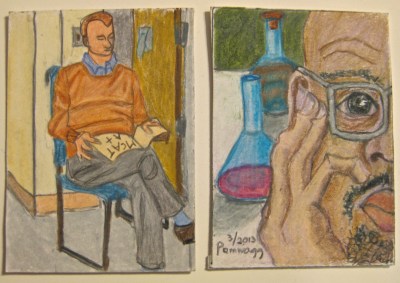
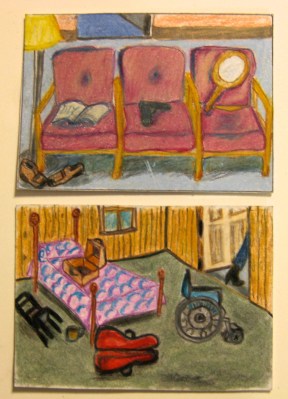
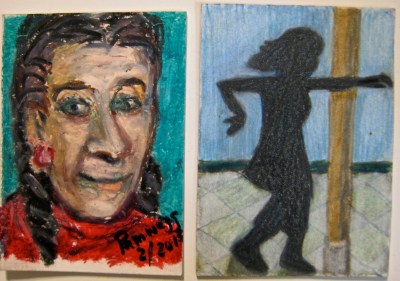
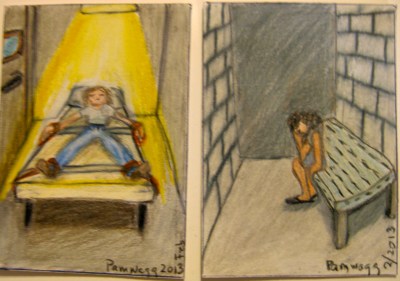
These are the trading cards I made at YNHPH…each is only 2.5 by 3.5 inches. I think most need little explanation. I originally offered them for sale, though I usually just give them away, until i read about the new tradition (started in 1996) of artists actually trading these cards and never selling them. So if anyone would like to send me a card they made, in the proper proportions, 2.5 by 3.5 inches, i will send you one back. No requests for any specific cards please, as many are already spoken for or given away. You can ask for a specific subject but no guarantees. B)   That is an emoticon for me in  glasses with a smile!

IMG_0020 IMG_0015 IMG_0035 IMG_0025 IMG_0038 IMG_0021 IMG_0006

I also wanted to repost these two pictures for staff members who wanted to see them…finished. The first has been renamed and is now bound with light brown origami paper on the edges so it is finished and no longer rough.

Reflection on Room 101 in the Ministry of Love, it is approximately 5 feet by 4 feet.

IMG_1326

The other used to be called In Her Hands, and still is, but is also clearly a version of the well-known tradition of Black Madonnas as I ought to have recognized all along. but was too dense in doing my own thing to see…

2.5′ by 3′ approximately, with built on papier mache frame (work is made of papier mache, collage, painting and the kitchen sink…)

20121222-234814.jpg

BLACK MADONNA

At Yale Psychiatric Hospital: Respect, Dignity and Kindness

104_3425

Large picture I did at Yale Psychiatric Hospital, the second one.

The pictures below are actually only 2.5 by 3.5 inches and are artist trading cards. I drew many of them, especially when I did not feel like working on my larger drawings at the hospital.

IMG_0028

In mid-February, after a week out of the hospital  (and you can read about my hospitalization by scrolling down to the previous post, but, in brief, this had been at Hartford Hospital’s Institute of Living, during which I was kept in seclusion for the larger part of a four week stay and put multiple times, sometimes twice a day for many hours in 4-point restraints. Why? Why? Although I ONCE threw a chair, they told me it was for “not following directions.” To add insult to injury, every incident in which they restrained me was accompanied by three injections in the buttocks of Haldol, Ativan and Benadryl, despite my policy of passive, completely non-violent non-resistance.)


In any event, in mid-February, after I had spent just a week at home, I became acutely psychotic again, and in consultation with the only doctor I trust, a friend drove me to Yale New Haven Hospital’s emergency department. There, after a very long and arduous wait  — alas, I cannot say much that is good about Yale’s ED. It felt like the psych/alcohol patients – and there were no discriminations made between the drunks and anyone else — were lined up on their beds in the hallway like buses at a terminal for what felt like “miles.” In fact at one point there was probably a line 15 gurneys long snaking around the corner until I could not see the end.

I was there for two and a half days, maybe longer, I do not recall. In fact, I remember nothing about my ED stay after I was finally “admitted” to the actual psych portion of the ED, as opposed to the hallway. I believe I was finally given medications, but also that I was no longer permitted access to my artist crayons, which meant that I only wanted to sleep and likely did until I was admitted to the Yale Psychiatric Hospital, a street or two away.

To say that my experience at YPH was an order of magnitude better than it had been at the IOL or even at Natchaug Hospital is truly not to give YPH enough credit. I scarcely want to mention the other two hospitals in the same sentence, that is how different Yale is and I say that even though I once considered Natchaug my “gold standard.” No longer, no longer. I think Natchaug was decent once, but only because of the civilizing and humanizing effects that the director of nursing, Sharon Hinton, APRN, had on the hospital. Once she left, the whole place went to pot, as evidenced by my experience during the last two stays, which went progressively from bad to terrible without her there…literally without her protection I was brutalized by a dehumanizing medical staff that had been left to do whatever it wanted to on its own, to hell with the consequences to the patients.

Be that as it may, and we know that the Institute was never humane, Yale took me completely by surprise. I was hard to surprise, and hard to convince that they were for real in their gentleness and kindness, let alone in their determination to treat me and everyone there with respect and dignity. I was certain that they would prove me right, that SOMEONE would be put into restraints, that someone would be violent enough to push their buttons and get 4-pointed. But it never happened, not in the entire three weeks I was there. Not even when a patient threw a punch or a push. Not even when a patient screamed bloody murder or used foul language. Nothing that earned me or anyone else seclusion or restraints elsewhere even came close to pushing the staff’s anger buttons at Yale. Instead, they persisted in using persuasion and gentleness and kindness…and if anyone lost it, if anyone became angry and could not keep it together, so far as I could tell, that staff member took themselves away from the situation to cool down, and did not take it out on the patient.

The most amazing things happened. No one forced me to do anything. Not even to take medication. I agreed to take it, after some discussion with the doctor and social worker…but when I evinced some doubt about the side effects, instead of pooh-poohing them as the doctor had at the Institute, Dr Milstein agreed with me, saying that the Zyprexa definitely increased appetite, and that it was not imaginary or something that was in my control, the way Dr Banerjee did at IOL. Instead, he and the other team members not only agreed to help me control what I ate, but went out of their way – I believe they actually went “Stop and Shopping” – to provide me with my own private supply of raw vegetable snacks in the staff refrigerator to eat at any time of the day…just so I wouldn’t have to be tempted by the hospital snacks of Doritos etc.


Dr Milstein asked me not to worry about what they did or did not do “extra” for me,  and I tried not to. But when two large bottles of brand name Diet Coke kept appearing for me every day, and when the resident was sent to buy me batteries for my personal pencil sharpener (with a grinder not a blade), just so I could continue to do my artwork and not rely on the staff to sharpen my pencils in the back, well, I knew 1) they were truly watching out for me and treating me with TLC, or what certainly felt like extraordinary care, and 2) they were in fact spending “extra” money, if not indeed their own money just to supply these special needs…All of which – or NONE of which would have mattered at any other hospital or to any other staff. If I had no pencil sharpener, who would care? If I had to eat hospital food, who gave a damn? Dr Banerjee basically said it was MY fault and only my fault if I gained weight on Zyprexa, that none of his other patients, the good ones, ever did. But at Yale, all these matters were important to me, and so they were important to Dr Milstein to to Chris Simpson the social worker and to the other team members. Not just as a matter of words, but to be taken care of so I could both take the Zyprexa and do art.

Just as important, Dr Milstein took at least a half hour every single day, and I think sometimes it was more than that, simply to talk with me and listen to what I had to say. Even if it was only to rant about how badly I had been treated at the IOL. He repeatedly told me that he just wanted me to learn to trust again, to believe that not everyone was against me or would hurt me…And if I did not learn that precisely, I did eventually come to believe that the staff at Yale were trustworthy and kind and meant what they said about their NO restraints and NO seclusion policy, for everyone. I may had still had frissons whenever someone screamed or threw a fit, panicking, believing that 4-point restraints were finally going to be resorted to. PTSD is not that easily overcome after all. But I grew more trusting, and by the time of discharge, I was able to thank them all for everything, to know that they had gone out of their way for me,  and not feel too  guilty.

I did  a fair amount of art while I was at Yale Psychiatric Hospital. I will post more in the coming days.

Update: All is well

104_3423

This is the drawing I finally finished that I did at the horrible torture chamber of the Institute of Living. There are all sorts of hidden things in it that you must rotate it to see fully…

Hi Everyone, Sorry to worry Lady Quixote and anyone else. I was in Yale New Haven  Psychiatric Hospital for last several weeks. A much better stay by far of which I have much to say. But I am recuperating for the next few days as I just got home a couple of days ago. Forgive me for being so out of touch, but even making a long distance phone call was nearly impossible from there…Luckily, the staff and doctor treated me and everyone with immense kindness, gentleness and dignity and respect, so I got what I needed, which was some weeks of healing. Praise whatever force of the universe you believe in for that! More to come as soon as I am able to write more and many thanks for all your concern and your patience.

Pam

My Psychiatric Advanced Directive — IGNORED at the Institute of Living at my Expense

These are the first two pages, including a note from the cover page, of my very very detailed Psychiatric Advanced Directive, and I think you will see why what happened at the Institute of Living, the psychiatric section of Connecticut’s Hartford Hospital, NEVER should have happened. Not only did I bring a hard copy of this PAD, but I wore a medical bracelet with a code for a very complete online medical record, with uploaded documented evidence, both of narcolepsy diagnosis and need for medication, proof from longtime outside mental health providers that I do NOT have “borderline personality disorder,” and other such assistive documents…ALL were soon ignored completely in the effort to discipline and punish me “for not following directions” i.e. not getting better fast enough and speaking my mind to the psychiatrist.

__________________

Prominent NOTE on cover page:

Miss Wagner has experienced multiple episodes of severe psychological and physical trauma. She must NOT be subjected to either physical or mechanical restraints or involuntary seclusion at ANY time. The use of either imposes a serious risk of re-traumatizing and injury, leading to regression and severe worsening of symptoms.

Pg 2.

HOW TO INTERVENE IN A CRISIS:

DE-ESCALATION IS ESSENTIAL

  1. 1.    PLEASE REMEMBER: I can calm down if YOU follow these steps and do not threaten me, order me around, or approach me in anger or in fear.
  2. I need one person to talk to. I should be approached calmly, by someone who will speak in a kind and respectful manner, understanding that above all:
  3. I AM SCARED and my anger masks fear. I am not dangerous. I WILL ONLY FIGHT IF YOU ATTACK ME. Please remember that any show of force and people ganging up on me to administer forced medication will be felt as an attack.
  4. I can be persuaded to take oral medication, usually, if this is negotiated with dignity and kindness and not by means of threats.
  5. DO NOT ISSUE ULTIMATUMS you won’t back down from…That will push me into a corner and you too, and will serve nothing but to escalate the crisis.
  6. A calm unthreatening and unthreatened person should ask me calmly and patiently if I can speak in a lower tone of voice, so she can hear me better. Ask me if I can take a deep breath and try breathing techniques that will have flown my head in the moment of crisis.
  7. Should you have a COMFORT room available, you can guide me gently to it but do not close me alone. Make sure I am warm…
  8. ABOVE ALL YOU NEED TO BE PREPARED TO LISTEN TO ME. This is not just a matter of forcing medication. Medication may not even be needed if you hear what is going on and what the problem is.
  9. If you take these simple steps, it is virtually guaranteed that the situation will resolve calmly and without any need to resort to the sorts of violence that would permanently damage and re-traumatize me (or produce secondarily negative behaviors afterwards): seclusion, forcible injections, or mechanical restraints or physical holds.

p 3

STATEMENT TO CAREGIVERS

It is vitally important that you understand that despite a few previous in-hospital assessments, I do not have a personality disorder, borderline or otherwise (you can confirm this with any of my longtime outpatient providers) and that if my behavior seems out of control, it is because I am out of control: I literally do not at the time know what I am doing or why. I am not manipulative or attempting to achieve secondary gain. The fact is I have had tertiary CNS Lyme disease and after positive PCR and Western Blot tests during treatment, I was informed the condition is likely incurable. (Dr ******* of ****** NY, will confirm this.) During the initial illness, my brain developed multiple lesions, visible on MRI, which may predispose me to temporary emotional and behavioral extremes and abnormalities but these are NOT my norm. Anyone who knows me well would confirm this, if you asked them.

You need to understand that I am not always able to communicate the extreme fear I feel, the global paranoia that I experience, but because I feel so threatened and unable to communicate clearly about it I may become very angry at the hospital situation. I am not an angry person. I do have trauma issues, as many people do, which may be exacerbated by being in the hospital.

Please be aware in advance that my “memory in the p.m. for what happened in the a.m.”  is often faulty. That is just how it is. When in crisis, I have little ability to recall from moment to moment what happens. This is why it is essential that I be able to write things down. I have lost many years to this amnesia and if I suffer additional trauma it will only make it worse.

I beg of you, do not make assumptions about me. Do not make assumptions about my state of mind. Do not “put two and two together” in your mind without asking me if the conclusion you have drawn is the correct one. You do not know what is inside my head without asking me.

Ascertain whether the information you have at hand is correct. Too many records and hospital charts have been drawn up (because “patient is not communicating”) on faulty information from earlier charts or information gleaned from others but not from me, and the consequences to my treatment have been devastating. PLEASE CHECK MY INTERACTIVE HEALTH RECORD ONLINE at www. — .com Use code ***** to get access.


I have been traumatized by abuse, sexual assault and by brutal treatment in hospitals, from being deliberately choked and given forced ECT to being kept in four-point restraints for several days at a time. So if I experience seclusion or restraints or even that euphemistic obscenity called a “therapeutic hold” it will be devastating and counterproductive. Such treatment invariably leads to increased anger, regression and worsening of symptoms, and my behavior becomes unpredictable afterwards. This is a response to trauma NOT because of any inborn temperamental disorder. I have already outlined a better way to deal with me and help me on page 2.

I KNOW YOU MAY NOT APPROVE OF POLYPHARMACY. But you need to understand that I must take the antipsychotic drug combination: Abilify 15mg with Geodon 160mg, a TWO-Drug regimen. Monotherapy does not work. I have tried many solo drugs over the course of 4 decades – Thorazine, Mellaril, Haldol, Prolixin, Clozaril, Risperdal, Seroquel, Zyprexa and others – ALL monotherapy has failed.

I will not take any drug that induces weight gain. If you force the issue, know that it will be a useless endeavor because I will stop taking it immediately upon leaving the hospital.

Finally, understand that if I am here in the hospital it is for a reason, and I want only one thing: to get better and be out of here as soon as possible. You can traumatize me and worsen my symptoms and keep me here too long, or you can work with me to achieve my goal, which should be the same as yours. I don’t see any other alternative.

 Respectfully,

Pamela S. Wagner

Now, I think that is about as crystal clear as it can be, no? And indeed, Dr Banerjee, my first psychiatrist LOVED it. Said so, and raved about how complete both were, both the PAD and the online medical history which he downloaded, printed out and brought with him to our first consultation. So what happened? YOU tell me! I will write more about what I think happened later. I am still trying to figure it all out.

Art created at the Torture Chamber called the Institute of Living at Hartford Hospital

104_3377


I was a prisoner at Hartford Hospital’s Institute of Living’s Donnelly 2 South from January 10th until February 7th, 2013, the day before the east coast blizzard, and I only “escaped” because the torturing doctor went on a four day vacation and the substitute decided that I was not actually psychotic any longer and did not need seclusion or restraints after all…and opted to let me go the very day I was freed from both.


Good thing too, because it was a Thursday and all travel stopped the very next day and for several days after that. The picture above is one that Shedana, RN liked very much. She said it captured her “physique” and while the flooring is imaginary, the unit was structured much as it is pictured. At least while I had a bed on the unit, with my door facing the med room and another bedroom opposite. Shedana was a “good egg” but of course it didn’t help when they decided to attack me in force and secluded me for two weeks and worse…But more on that later.


The first doctor I had merely convinced me to take, semi-voluntarily, a fairly stiff dose of Zyprexa. which I tried to do with regularity. I soon found, however, that far from being the miracle drug it had once been, mixed with Abilify and Geodon it induced a state of apathy and boredom. As if the Intake and Feeding drug, the drug on which I used to feel enthusiasm to learn and read, Zyprexa, simply mixed very badly with the Output drugs of Geodon and Abilify, such that I neither could read and learn, nor do art or write. In any event, this abysmal lethargy pushed me out of desperation to paint this, in oil pastels.


104_3389


After that, I simply started refusing to take the Zyprexa, and refusing a lot of other things…A great deal of abuse happened. But I did this picture before all my art supplies were confiscated for no reason other than punishment (you cannot damage yourself or others with soft oil pastels)


104_3404


Before I tell you some of what happened, without naming names, lest a legal case be made against them, as there might possibly be a chance to do, let me show you most of the rest of the art I did there, though one of them is unfinished and may never end up being finished, since it was hospital art and may stay that way.


104_3410


This one is an oil pastel, me with a dung beetle pushing a ball of shit around on my cheek…Says enough just that, doesn’t it.


104_3402


This one can be turned any which way to see all sorts of things buried in the picture. It was the one I started first and never did get to finish. What I can point you towards is the central object at the very bottom, which you can trace up to the blue figure and see what is happening. It should tell you something…The hand on the upper left is pointing at this process. Also, the exploding biohazard ball is part of it all, representing me, the all-polluting biohazard…But you have to look at the picture carefully. There is a Boat To Nowhere, and there are a couple of turtles, why, I don’t know…yadda yadda.


Finally, the very last time I had access to any art supplies, and I do not recall whether it was my last morning or some other time, I painted this one with oil pastels. I believe it speaks for itself.


104_3412


What happened was that they were routinely, literally routinely restraining me “for not following directions” as they would quite openly state. Four-point restraints, in a tight no movement position, for many many hours at a time, with absolutely no indication of how, just how, I might “earn” my freedom. Of course they wouldn’t tell me what I could do to “be good” because I hadn’t done anything to ‘deserve” restraints to begin with as they knew perfectly well. For example,. and this was typical, but it was one of the few opportunities I managed to document because they ha removed all my writing materials, illegally, but I forgot that I had a right to a crayon and paper until Feb 6th. That afternoon, I simply walked away from my seclusion room. I had had enough of them saying it was “merely a side room” not a seclusion room, then preventing me bodily from leaving it. So when I could do so without someone actually wanting to fight me, I walked away, and proceeded to enter the unit and walk down the hall to the end and look out the window, I took a deep breath, heard THEM behind me, and sauntered back to the proper end of the hall, the “lost end” where they kept anyone from seeing me or knowing what they were doing to me. Once I got there, they descended on me, the horde of the goon squad, some staff I knew, but most I did not. I did not bother to look at who was doing what to me. I simply lay passively on the bed, and put my arms out so they could do what I knew they would do. Tightly, they shackled my wrists out past my hips so there was no play in the restraints and I could not turn on my side or do anything but lie stiffly on my back. At the same time, others jerked my feet apart and just as tightly shackled my ankles to the lower corners of bed. Then came the coup de grace. They pinioned me on my side somehow, pulled down my pants, and injected me with three drugs: Haldol 5mg, Ativan 2mg, and Benadryl 50mg. Why, except as punishment I do not know. because I had, just a half hour before, been doped up on involuntary Zyprexa 10mg.


But of course it was punishment. The very fact that they told me it was “not punishment” but “what your behavior brings on every time, Pamela” only proves my point. At first and usually they only said, it was because I “didn’t follow directions” so if they were not punishing me, what were they doing? They most certainly were not following Centers for Medicare and Medicaid regulations for the use of Restraints and Seclusion only in cases where a person is in imminent danger or harming self or others! Indeed, the best they could do, when I protested, passively, saying just those words, was to respond, “You are not safe” as if that proved somehow that I was in danger or posed any imminent threat to the safety of anyone.


No, I did not. I didn’t threaten or harm anyone. I merely walked the length of the hall and looked out the window and then went back to my solitary confinement. But it was enough to trigger their retaliation, and that started at 1pm. I was not released, not even to use the bathroom or eat supper, no never even was a single hand freed to permit me to eat supper — until 7pm.


THEN, at 8:30pm, I became upset and frustrated because — well, I do not know now why, but I “threw a half a graham cracker at the wall” as I recorded later. And the goon squad descended on this dangerous patient again, not only with the strait jacket of four point restraints, but with the same 3 drug IM-in-the-ass cocktail.


This time, however, passive as I was as they trussed me up — and I said only, “For shame, for shame. You ought to be ashamed of yourselves, doing this to me…” — passive as I was, allowing them to seize my limbs and tightly shackle me yet again in truth I dared not resist, as that would only have justified their violence, and i already had my share of bruises. Bur I had come to my limit of the abuse i would silently tolerate. They could restrain and seclude me but they had up till now only silenced me in restraints because iu wanted to earn my way free quickly. THis time I didn’t give a damn. It was nearly nine o clock and no one knew what they had done to me. Everyone was getting their bedtime meds and going to bed without any understanding of what was going on. I was a stranger to most people on the unit, who had no idea I even existed. THAT was a situation that had to change. NOW.


After they trooped out of the room, stationing a 1:1 sitter at the door as usual, I stopped my merely silent and passive resistance and started to scream. I wanted to be heard. I wanted to scare people. I wanted them to wonder, Who is that person,. and what in god’s name are they doing to her? Are they torturing her? And I wanted them to ask questions of the staff that the staff could not answer. I screamed and I screams in desolation and despair, feeling like my life was at an end. The plan they had set up for me was impossible for me to live up to. In nearly 10 days I had not even earned my way to a pencil and my journal. Only to restraints and more restraints. I saw no way out of the hospital. So I screamed, long blood-curdling, heart-wrenching screams that I assume did the job of scaring all, as eventually they closed my door, much to the disgruntlement of the sitter who was forced to come inside with me and was no longer free to socialize. But not for a while. I kept on screaming until my voice gave out and I felt asleep.


The next day the substitute doctor freed me, I dunno why or how, but she did. and I thank my lucky stars as the staff doctor was a sadist and never would have. I have a lot more to say, but for now I am hoping to hear from a sympathetic lawyer who will take on my case for some reason for some purpose…Unlikely to happen. despite my bruised body and joints that are so out of whack I cannot sit indian fashion or cross my legs. Why won’t they help me or respond? I didn’t die, so they won’t earn a lot of money from my case, nobody gives a damn about mental patient abuse…


You really know when you are a third class citizen when you only MIGHT be worth more to them dead than alive.


Body Bagged, 4-pointed, Secluded and Tortured — All in the name of Treatment?


IMG_0002IMG_0004

The above is are just some bruises of many I received during my month-long course of “psychiatric treatment” at the Hartford Hospital’s Institute of Living, on the unit called Donnelly 2 South. In  Connecticut, the Institute of Living, first known as the Retreat, and once quite famous as a posh sanatarium for the rich and famous though this is no longer true, was first made famous by  Clifford Beers, I believe, who wrote about similiar torture he underwent there just a hundred years ago in the book, A Mind That Found itself.
 

After burning my face with cigars and cigarettes, I spent the last month in Connecticut’s well-known Institute of Living (yeah the dangerous 6th month was JANUARY not February but nobody thought to check my math) being beaten up and trussed like a pig in four-point restraints almost daily for many many hours. Why did they deal me this sort of treatment? Why? Because “You do not follow directions”.


I DID NOT FOLLOW DIRECTIONS so they beat me up and tied me, shackled me with leather and metal cuffs  to a bed for dozens upon dozens of hours.! Get that? I was disobedient, so they shackled me to a bed as an excuse for treatment!


After this experience, I LOST ALL FAITH in the ability of any institution to do anyone any good who has a mental illness or sickness of the mind, or any emotional disorder or whatever you wish to call it. I GIVE UP! I will kill myself if anyone ever tries to send me back to such a cesspit of a place. I do not care if it is appointed like the Taj Mahal. NO ONE who works there is uncontaminated by the evil infecting such places and they are ALL EVIL EVERY SINGLE ONE. I have NEVER been to a hospital where the people are kind and well meaning and where the treatment is actually kind and decent. Once in a  while a single person, such as the Middlesex Hospital occupational therapist  Christobelle Payne, may stand out in memory as being a rare human being of warmth and dignity and  caring, but otherwise, they all to a one fail the test of being decent human specimens and all fail royally to be even normally humanly responsive to suffering persons. They are in it for the money and a cushy job, and don’t you forget it if you go into a psycho hospital, DO not expect to get well there. Expect PILLS, and directions (ie ORDERS) that you HAVE To follow or ELSE.


Get out of there as quickly as possible, because your life depends on it. I am serious. DO NOT LINGER expecting care and treatment or to feel better no matter how helpful it might want to seem.


Furthermore. if you are a young person, do not listen to the sweet seductive advice that some may give you that you woul do well to go for “disability” and social security payments. THAT Is a load of total crapola and the worst thing anyone could tell anyone under the age of 50. I am so angry and broken at the moment that I cannot speak more. But if I can later on, I will say more to explain. At the moment, I have to attend to too many PHYSICAL bruises and to find a way back to sanity on my own, havin been driven to the brink of near extinction by one of the best known hospitals in this state. At the moment I am both rigid with rage and so confused and broken that I scarcely know how to continue, or whether I even want to. Why bother? Why bother? How can people be such  monsters, and in such monstrously powerful places and ways. I hurt so deeply and feel I will never trust an single person ever again when they say, Come let us help you. You need our help.  YOUR help? Like being raped, I need your F—ing help!


GO jump in a lake of snot is what I should say to all of you so called helpers. I’d rather die. Go F— yourself.

“Lady Quixote” on Recovery from Hearing Voices

Today I have a guest poster, someone who has been contributing a lot of comments to my blog and who wrote one that I thought deserved a post of its own. Without a lot of introduction, since she tells it pretty much as it is, I offer the following: one brave woman’s unique and amazing recovery story.

From “LADY QUIXOTE”:

I believe it is a normal part of grief to have moments of hearing and seeing those close to us who have died. This is true of our pets, as well as the people in our lives, who have recently passed on. I’ve experienced it, as have many people I know, most of whom have never been diagnosed with any kind of mental illness.

What I don’t know, of course, is whether these experiences are “real,” meaning do they exist independently of our own grieving mind? I believe that at least some of these ghostly grief visitations may be real. The reason I think this, is because on two separate occasions, with two different deceased loved ones, my paranormal experience was witnessed and experienced simultaneously by other people who were with me at the time.


Life is a mystery. Death, even more so.


When I feel that someone who has recently died may be trying to communicate with me in some way, I tell them that I appreciate their caring enough to contact me, and that I miss them and hope they are in a wonderful place where I will join them someday – but to please refrain from contacting me again, because it is a “trigger” for the schizophrenia I was diagnosed with in 1967. I have not been bothered with continual voices since 1969, and I don’t ever want to go back to that miserable real-life-nightmare, again.


In most cases, when I make this request, the “visitation” immediately and permanently stops. On the rare occasion when it has not stopped, I prayed to my Creator for help and protection, and I also studiously ignore the voice or vision, and in every case it soon stopped.


My voices started when I was 14, shortly after my paternal grandfather died. His spirit seemed to visit me twice, the first time immediately after his death, when I was sitting at my desk in school and had no idea that my grandfather was about to die. Suddenly, I “knew” he was dead. It was so real, that I started to cry, right there in the classroom. When I got home from school that day, my mother met me at the door and said, “I have some bad news…” I stopped her and said, “I already know what it is, my Grandfather ‘R’ died today.” She asked me how I knew, and I said I “just did.”


A few months later a friend of mine introduced me to her Ouija Board. She said it was a tool for contacting the spirits of the dead. I had never heard of such a thing and was eager to try to contact my grandfather through her Ouija Board. We seemed to have success in contacting some kind of spirit, but whatever it was, it wasn’t my loving grandfather


My friend who owned the Ouija Board then decided to hold seances with me and some of our other friends, but nothing much came out of those, except that one girl starting screaming at the top of her lungs during one of the seances, saying that she saw a horrible vision. But no one else could see whatever it was that had her so terrified.


Around that time another school friend told me he had heard about the seances I was involved in, and he loaned me a book which he said gave excellent instructions on how to contact the dead. I don’t remember the name of that book, but it should have been entitled “Spiritism for Dummies,” or better yet: “How To Become A Schizophrenic in 5 Easy Steps!”


That book gave point by point instructions for things like “autonomic” (spirit) handwriting, and also on how to become a medium, so that spirits could use your body and your mouth to speak through. Good grief, what was I thinking when I went ahead and followed those instructions? I really must not have been very bright, when I was 14.


So, naive me, I carefully followed the book’s instructions and put myself into a trance, then I called forth the spirits, and – lo and behold – suddenly my hand was writing words all by itself, and the next thing I knew, I had a head full of loud voices that would not shut up even for a second. My only escape from the nonstop circus in my head, happened when I was asleep. During my waking hours, every moment was a real-life NIGHTMARE.


I begged the voices to PLEASE go away, go back to where they had come from. But they just laughed, cursed, and mocked me. Sometimes they told me to kill myself if I didn’t like my life anymore. They even told me to pray to Satan, since praying to God didn’t seem to help. Truly, I was in a living hell!


In desperation I went to my mother and told her about the Ouija Board, the seances, the How-to-be-a-Medium book, my “success” with autonomic spirit handwriting, and the visions and the voices that would not leave me alone. I desperately wanted help to get rid of those maddening voices, because I couldn’t even go to the bathroom without a crowd watching, mocking, and commenting! I couldn’t have a private thought without a multitude listening to it, and commenting and mocking me for the silly 14-year-old things I thought about! I asked my mother if she knew what I could do to make the horrible spirits go away?


My mother responded by making ME go away. Although I had never tried nor threatened to harm anyone, myself included, she immediately put me into a mental institution. The year was 1967, during that era when the answer to mental illness was to drug you up, lock you up, and throw away the key. My mother assured me that I would only be in the institution for a few weeks, until they made me well. But right after taking me there, as I later learned, she went home and took every item I owned to the town dump. I was never supposed to come out of the insane asylum, you see, because the schizophrenia I had been diagnosed with was “incurable.”


One of the other young teenagers involved in our seances, also ended up hearing voices, seeing visions, diagnosed schizophrenic, and committed to the same insane asylum. He had been trying to contact his mother, who died when he was six.


After nearly 2 years in the asylum, a social worker who saw me periodically because of my young age, asked me why I was there, when I always “seemed” so normal? (I was asked that question a lot, because I was not one of those who went around behaving oddly. I never talked aloud to my voices; I had no need to, since they could hear my thoughts, anyway.)


I told the social worker that I heard voices, and she asked me how the voices had gotten started. So I told her all about the Ouija Board, the seances, and the book on spiritism that had taught me step-by-step how to put myself into an hypnotic trance and contact the dead.


Then this brilliant social worker said, “Well, it seems to me that all you did was hypnotize yourself into hearing voices! You’ve seen hypnotists on TV, haven’t you? How they can hypnotize a person into believing something ridiculous, such as that they are a dog, and the next thing you know that person is barking and behaving like a dog? Then the hypnotist gives them the suggestion that they are no longer a dog, that they are themselves again, and they instantly revert to their normal human behavior. Why don’t you try hypnotizing yourself once more, and while you are under hypnosis, tell yourself that the voices are not real, and that when you wake up, you will not hear those voices, ever again.”


I went back to the ward, got into my bed, and did what she said. I highly doubted it would work, because the voices seemed as real to me as anything – how could I make myself believe via hypnosis that they were not real, when I “knew” better? But, I went ahead and tried the self-hypnosis-reverse-suggestion like my social worker had advised me to do, and…. IT WORKED! When I woke myself out of my self-hypnotic trance, the voices were GONE! There were only a few, very distant, occasional “echoes” of “little voices” now and then, for a brief period of time, but they were so quiet and intermittent that they were very easy for me to ignore, and soon even that stopped.


In this manner I have been free of voices, 99% of the time, since 1969 when I was 16 years old. I have also not taken any anti-psychotic medication since that time. The only exception to my not hearing voices is, like I said at the beginning of this long-winded post, when someone close to me dies. But in every case, I handle it by telling them to please leave me alone, with a brief explanation of why I need for them to leave me, and most do so immediately. Those that do not comply with my request, quickly go away after I pray to the Lord for help, and then I tell the voices to “get behind me,” and after that I ignore them until they get bored enough, I suppose, to go bother someone else. 😉


Today, my residual “mental problems” have to do with my chronic PTSD, general anxiety, and an occasional dark depression. I am in therapy for those things, and I also take a low dose of an antidepressant and an anti-anxiety medication. But I have no schizophrenia, and no psychosis of any kind, not in over 40 years, YAY!


I shared my story here in the hopes that it may help you in some way. You are someone I feel very privileged to call a friend, and I feel sad when you are having a rough time.