Tag Archives: Writing

Wonderful Poem at the Merton Institute

Check out the  http://mertoninstitute.org for the source of this, but in the meantime, I think it is not illegal to reprint it here, a marvelous poem, chosen by our friend and hero, Billy Collins, for the 2008 Merton Prize for the Poetry of the Sacred. As I wrote in a letter to a friend about it: I have this secret fondness for formal poems that hide their form beneath enjambments and nonchalance and (perhaps this may sound weird) humility, as I sense this poem does…I really liked it, found it sort of Frost-like, without its insisting on the likeness. Could not find out anything more about the poet, nor any more of his works, except the single sentence that he has indeed published before…Wonder where and what.

The Orb Web
by David Culwell of Columbus, Ohio

One night I stood inside
And, through the fan-shaped window in
The front door, watched a spider spin
A web to snare, in its tried

Way, some of the mesmerized
Moths fluttering in the porch light’s glow
Like bits of paper people throw
At parties or pint-sized

Satellites. The wheel
Of a web hung beneath the right
Corner of the frame, not quite
But nearly setting a seal

Against my going out
Or someone’s coming in. Indeed
A friend was coming soon to read
My hard-spun lines about

Beauty’s fading bloom.
I need to get the broom, I thought.
But I just stood there gazing, caught
By the eight-legged loom:

An inch or so, with gray-
Brown hairs and legs with bands of brown
and yellow, it hung upside down
Laying a sticky ray.

Like a second hand
It circled, moving inward; soon
the web, which seemed a gauzy moon,
Was done, with every strand

Laid necessarily.
The web itself was like designs
On Persian rugs; I read its lines
As living poetry.

A moth flew into it
At three. It fought, wings flickering,
To free itself, but couldn’t spring
Away from the gripping knit.

The spider scuttled there
And nimbly spun the moth in silk
While another of its ilk
Flew into the snare.

The spider hardly knew,
Of course, that something like a gust
Would sweep away its work like dust
And leave no strand in view.

I looked at my watch: the time
Was near. I didn’t lift my gaze,
But walked away, trying to raise
The mettle for the crime.

Disorderly Vision Produces Disorderly But Productive Thinking? (Or am I just Imagining Things?)

Glasses, glasses, glasses, but none to help me see through the confusion of dancing and doubling of sites, scenes and texts!You would think that one of the many different pairs of glasses, with some specialized  lenses or prisms or bi-focal, or tri-focal or something would help me see through the confusion as I state it in the title above of “dancing and doubling” of images and scenes and texts, oh, especially text, both on-line and hard copy…Or perhaps it simply matters more to me that I cannot read, especially because in two weeks or so I have three or four readings coming up in the space of one week and I fear that I will not be able to simply see my poems on the page. If that should occur, and I do not manage to have each and every poem by heart, what will I do?  It so happens that Dr O, or Mary will be at two of the readings, so I can alert her to the problem and ask her to be prepared to (hmmm?) take over for me, at least until it seems that I might be able to resume — though why I could resume I don’t know, since the problem simply recurs immediately and it is only my ability to cope that matters, and by coping I mean my ability to navigate a page of text that has literally gone wild on me, with one line rising up upon another, obliterating it or merging with it, or most commonly simply interspersing with it so I cannot quite make out either one separately and can only try to peer at the paper sidewise as if that could help me parse them out. It of course does nothing, and the words do not separate themselves into readable lines. No, more likely, the words themselves interact and disperse into bits of words or letters, which themselves dance and double and shimmer.

Oh, it feels hopeless to discuss the matter of vision and what to do about it should I have trouble two weeks from now. So much could happen in those 14 days that nothing is predictable. For instance, I am managing to write this now, without a great deal of tortuous movement and agonizing, though not without trouble — so at this very moment, I could see myself getting through a poetry reading without surrendering to virtual blindness — at this hour of, hmm, at 1AM is it morning or nighttime? Well, I slept from 7:30PM until 11:30PM...Half the night, enough to “take the edge off” my sleepiness. At 11:30 then, for the first time all day,  I took a Ritalin, though I had gotten through from 6:30AM -7:30PM of the previous day without any (why? just to prove I could, but without accomplishing anything too). So why now, at 11:30PM? Why in the middle of the night, which to most people would seem the least logical time?

Why? Because I wanted these hours, my time, to be productive, and for that I had to be truly awake and alert, not merely marginally so. (My touchstone of true alertness for years has been how interested I feel…I now know that in my natural state I am never bored, so when I feel a sudden lack of interest in my usual pursuits, that’s when I know I’m getting sleepy. There is no earthly reason why I should have suddenly lost my ordinary passion or fascination, no reason, except that I have become sleepy and sleepiness persents itself as a lack of focus and interest, i.e. as boredom. I am not really bored, I mean only that as a younger person I associated boredom with sleepiness and so whenever I fell asleep doing something I thought I liked, I took that an as indication that I “didn’t really enjoy it after all,” that obviously it bored me. Otherwise, why else would it make me fall sleep? Despite my initial feelings of interest, I evaluated each choice against the proof positive of my falling asleep (which happened whenever I did anything sedentary, including studying), “proof” that I was — the greater truth — bored by it, “proof” that as John Berryman’s poem about “liking valliant fine art” suggests, I had few “internal resources.” Each time I went in for something I thought might spark an interest or fascinate me, as indeed the initial consideration of it did (I cannot give only a few examples, because even just starting in college the choices overwhelmed me, like a penny candy display before a child who has only five pennies to spend. Likewise, there were too many courses and directions I wanted (passionately) to explore, rather than too few. And I could see myself enjoying every one of them, from philosophy to geology!

That was true for me the unexperienced but so far as I knew or thought about it, alert freshman. I still believed that my falling asleep at the movies and during classical music concerts and even simply listening to music I couldn’t sing along with, or in classes where I was not allowed to knit while I listened to the teacher…

For me the senior, there was no longer any penny candy in the display, only a few largely indigestible rounds of “hard tack” that were the very few requirements my “major” required for graduation. I’d actually chosen my major (“Ancient and Medieval Culture” because of its very few requirements and because I’d already fulfilled most of them without meaning to. But the fact that I graduated at all in 1975, that remains a mystery. I had only 27 Brown credits, with a 28th I was fighting for for Spanish taken at the Yale Summer Language Institute, which Brown had warned me in advance it would not grant credit…no matter how well I did. This was their policy, and since Brown only required 28 credits, one credit per full course, rather than most schools bare minimum of 32 or 36,  they felt they had a right to insist upon all 28 credits all coming from Brown. I don’t want to go into this here, but I did graduate, and I do not know how or what happened, only that a friend called me after my advisor told her to, and while I had no cap or gown and did not attend, I recieved a diploma, Phi Beta Kappa and my advisor’s encouragment (so much for how well he knew me) in my new life as a pre-med student…More sedentary than ever, more proof I was bored, and more ambivalence about what I had chosen for my lifetime career…

But for the most poignant example, because for me the most painful, take that for years, in fact for as long as I remained an active, if amateur, field botanist  (from age 19 until age 39 or even 49 or so, when Lyme disease laid me low), I assumed that while I was devoted, enthusiastic and extremely, even uncannily talented, someone who could recognize and spot a plant I’d never seen before and know everything there was to know about it that one could possibly learn from a glimpse at a guide book, then later a taxonomy chart, and any brief, say 2-page, description as to its medicinal or gustatory uses. Yet I also “knew” that I could never learn plant physiology, or anything technical o biological within plants, such as  genetics (important if I want to explore taxonomy) or biochemisrry (important for just about everything else). I knew this was true largely because they “so bored me, they put me right to sleep.” And so, despite an IQ of around 165, so I’d been told, I felt I could not study botany more deeply than the literal surface of plants, because  it would put me to sleep…i.e. I was so inadequate in my internal resources that a deeper pursuit of understanding bored me to sleep…

Can you can imagine how I felt, coming to self-understanding of such a dismal sort? And believe me, I was devoted to honesty, at least about myself, to myself.

But I have strayed widely, and perhaps have so diverged from my inital topic, which I vaguely recall started with an image of glasses, as to have rendered it irelevant… Hah! But let me see if I can wend my way back. My discussion of glasses no doubt was in reference to whether or not I could successfully accomplish the poetry readings coming up in 2 or 3 weeks. Which somehow lead to a discussion of my being up at — well, it is now nearly 3AM, so I am awake and alert, having taken Ritalin 2+ hours ago, and I do not feel I have mis-used it, writing this. A discussion of being up and taking the Ritalin, no doubt. Taking the Ritalin… and  (althought what follows seems relevant, it was in fact written earlier than all that precedes it) –>

feeling for the first time all day (meaning the entire 24 hour cycle), during the hours when I usually am the most alert and productive, I could not bear wasting time, not even in service of proving to Li that I could in fact forgo Ritalin. (Sure, I am able to do without it, I am not addicted to it I can prove that, if necessary (though to combine doing without it, along with taking Zyprexa is  singularly cruel and unusal punishment. The Zyprexa is incredibly sedating for me, so I could never use the intellectual powers it endows me with, simply because I am too sleepy taking it (this has ALWAYS been the problem, and was one reason why Dr O always increased the Ritalin when I took Zyprexa, rather than attempted to decrease it. Another thing that Li does not understand was that Dr O never decreased my Ritalin or made any effort pro forma to do so. For me it was simply one medicine in her armamentarium, and if it worked the best, so be it. She was not even averse to giving me Adderal when and if I told her I wanted to try it. She was completely agreeable to anything I needed in the battle for alertness, and never once accused me to abusing drugs or worse absusing her willingness to prescribe for me. In point of fact, she was right. Why should she accuse me of anything, when all I wanted was what she wanted? As much alertness and “on” time as possible, within the limits imposed by my narcolepsy coupled with the super-sedating effects of Zyprexa. It was because of her absolute trust in me that I felt I could trust her, i.e. trust that if we lowered the Ritalin dose when I did not need it that would not preclude raising it again, if I needed it again.  Because of that trust, I could tell her when I no longer needed the dose she was giving me and it was in that fashion that we cut it down from a high of some Adderal plus both ER and regular Ritalin five times a day — this was when I was taking some 35mg of Zyprexa — to only 20 mg of regular Ritalin PRN, of which I rarely take all 5 pills. And she was right, I never got addicted…In point of fact, I was not even habituated, as we discovered as I went on cutting back and back.

One thing Dr O always understood was my need to feel secure in terms of this medication, not to feel that I was ever in danger of its being taken away from me because a new doctor had decided I was either addicted or for the umpteenth time and without proof decided I didn’t have narcolepsy. I do not know how to convince anyone but Li at a minimum ought to listen to the taped Voice of Narcolepsy at the New York Times Health section…These patients speak well on behalf of those ordinary people with my condition, Narcolepsy without Cataplexy. So many docs are unwilling to grasp the notion that many many people suffer — and suffering it truly is — from TRUE narcolepsy, even though we do not have cataplexy. Despite the numbers cited, I myself believe that the reverse is true, that N without C is far more prevalent than N with C…And that better tests, shorter and more discriminating diagnostic tests than long stays at a sleep center will find that Narcolepsy is more comon than people ever thought. (Every time I tell someone I have narcolepsy, they tell me of a ceertain person in their family who falls asleep “just like that”…but was never taken to a sleep specialist etc). Few people and fewer doctors are aware that the falling asleep with one’s face falling into a plate of spaghetti is just a myth, and that narcolepsy has many different faces, just as anxiety, or ADHD or schizphrenia does…Why so many seem satisfied with that myth, and do not question it is beyond me, but they don’t, or it is the rare internist or primary care doc who bothers to question the received wisdom that questions the patient’s motives in asking for Ritalin, rather than the doctor’s compassion in failing to  so much as take a sleep history or approach the patient with an open mind…

Dr O knew that I had for way too long been treated as a drug addict when in fact I needed the precise medication other docs considered merely placative. She refused to go that route, and never made it an issue. Even in the hospital, every hospital I went to, she was able to persuade them to give it to me…It was only Li who was not committed to my taking it, disbelieving perhaps that I have narcolepsy (again, again! Why must I put up with this? Is it worth it, or should I go elsewhere, perhaps to a sleep medicine clinic to handle my Ritalin instead of trusting Li to do so…because clearly he cannot be trusted to believe me, to believe Dr O, to believe anything, or even to want to find out!). Why now, when I could have/should have (except that I have spent all the day in a kind of avoidant daze) gone back to sleep, if necessary by taking a dose of Xyrem, as prescribed, why did I take Ritalin at 1AM and stay up writing especially since Li is trying to “wean” me off the Ritalin?

WHY indeed? Why the f–king hell is he trying to “wean me off the Ritalin in the first place, when it was helping me function so well that most people had no idea I had a disability at all? Why question my meds when they are working so well? I’d say to anyone who wants to then interfere, merely for the sake of not using a “potentially addictive drug,” for Chtist’s sake, don’t break what is nicely repaired already. It doesn’t seem necessary, given how well things were going in general. And when they fell apart, I told everyone and him what was wrong: the ABs needed to be changed. I have said that again and again, ever since the hospitalization in February, but nobody is listening to me. I told Dr L then and there that the Bicillin and the Minocycline was not a good combination, that for some reason the two ABs were inadequately treating the three toughstone symptoms, cardinal symptoms in my case, in the sense that if they are taken care of, I seem to be safe from a relapse, but if they are still present, I am not. In point of fact, every single time one of these three symptoms appears or fails to disappear, I eventually wind up in the hospital, either in the spring or in the fall, without fail! (Did I make it through this past spring, or was that when I was in St F/Mt S and trying to tell them that the Minocycline/Bicillin was not aduquate even then? I’d have to look back to see…)

Anyhow, stopping the Ritalin may seem to be fixing something that wasn’t broken, but instead is rather to be breaking something that was functioning extraordinarily well…I mean, if I was writing and doing art and relatively happy and content, why ruin that by stopping one of my essential medications as an outpatient, just because the in-patient docs thought I ought not to take it there? I think Li is in fact trying to stop it for just that reason, because it seemed to be unnecessary inside the hospital, just because there, under those hothouse conditions, having no requirements but sleep, I “did okay.” But doing okay “inside” which is to say, within the protective walls and given the constraints (to say “constraints” is barely a euphemism) of that  sort of an institution is scarcely the same as to do okay or even well outside those walls. I didn’t need to stay awake there, or do anything there, and in fact could sleep at will. And so I did, much of the day in fact, every day! If I then needed to sleep at night, well, I could ask for “something for anxiety” anytime, though in point of fact, I mostly could sleep then too. Much of the three week stay was spent sleeping, and when I did not, I was so paranoid that sheer fear and that adrenalin rush kept me going. Near the end of my stay, I became somewhat manic, hypomanic clinically as Li diagnosed it when he saw me. I couldn’t shut up and my speech was — and I felt this as well — pressured. That is a very good word for it, indeed. There was an internal feeling of pressure to get words out in a rush, an unpleasant need to say things, as if they had especial importance and absolutely had to be expressed, even though if I thought about their content, which of course I could not really do in such a state, there was in fact nothing particularly urgent to them.

Well, I am getting tire finally of writing here, and yet I have not finished. I quickly then let me summarize. Because of this recent pressure of speech, coupled with some manic energy put into actually cleaning up this place, and getting more painting and such done, though still hypo manic not truly manic, Li felt something ought to be done to “bring me down” — I am not quoting him so much as quoting the idea…Anyhow, first he suggested stopping the Ritalin, which was okay temporarily, since I already felt enough adrenalin and did not want to add more to my own felt pressure of speech and heart beat. But I had and have no intention of this being anything but temporary…Then he wanted to increase the Topomax, which he said would also decrease the pressure and help hypomania, at the same time that it might help any appetite increase that came with our adding back some Zyprexa, which in his opinion, and of course Elissa the RN’s insistence, was the best drug for me…So far they have only gotten to 2.5mg but even Li has suggested 5mg if I will agree.  Now that I have summarized the pharmacological plans for me (including with this, the ultimate decreasing to 0 of my Ritalin) Let me say right here and now, that I will not stand for a rigid “fixing” of the Ritalin problem…

Below I have summarized a few absolute requirements for a psychiatrist, if I am to trust him or her, or continue to see him or her:

One requirement of any psychiatrist I see is that he agree the Ritalin is a necessary medication for an illness, which is narcolepsy, with which I was diagnosed by a sleep specialist at the Sleep Disorders Center at Norwalk Hospital (records available) and it needs to be understood between us that he will not in the middle of therapy decide suddenly to meddle with it (unless I agree and do so not under duress, or decide myself not to take it); it needs to be understood absolutely and without any fishiness or unspoken mistrust, that I am NOT a drug seeker, and that I have narcolepsy, a genuine neurological disease, which needs to be treated, independently of any other illness I might suffer from, so that my being given Ritalin is not dependent on whether or not I agree to take any other drug like Zyprexa etc. though taking Zyprexa might in fact influence the dosage of Ritalin needed.The Rx needs to be permanent as well as flexible according to my needs, which may increase as well as decrease as the ilness waxes, wanes and responds to other drugs and illnesses. Ritalin, however, is never to be used as some sort of bargaining chip…

Argh, Icannot write another word, and in fact, I feel as if I am giving up on a personal letter I was writing to a specific someone. If you are that he or she, you know who you are…I do not!

Rest assured, or at least rest. If I made too many typos and other errors of eloquence or diction, I shall clean them up tomorrow, so reread this then, if you read this today…Be forewarned, it will change between the two times.


Added on Oct 31.


I have decided not to redact the above, but to leave it as is, with all its typos and lacunae and infelicities of grammar and thought. I was writing spontaneously, as I believe was evident enough and I don’t see why that is not adequate for a post once in a while. I would just like to add a clarifying detail or two. What I think I forgot to explain was that between the post on Zyprexa/cancer treatment I experienced a three week hospitalization, which happened very suddenly, though of course, as I mentioned, my visiting nurse had been alert to the possibility of it, even perhaps the inevitability, for at least two weeks…If you understand that, some of this discussion and the one to come above, will seem a little more undersandable.


I will now go to a new post and continue there.

New Book Is Out: Poems on Schizophrenia

Yes, I finally hold it in my hands, We Mad Climb Shaky Ladders, published by CavanKerry Press. Below is the cover illustration (minus the Spiro, which is on the final version) and the press release:

We Mad Climb Shaky Ladders: Poems by Pamela Spiro Wagner

NEWS from CavanKerry Press
6 Horizon Road No. 2901 • Fort Lee, New Jersey 07024 • phone/fax 201.670.9065 • cavankerry@optonline.net

FOR IMMEDIATE RELEASE

Contact: Florenz Eisman — 201.670.9065

WE MAD CLIMB SHAKY LADDERS

Poems

Pamela Spiro Wagner
With Introduction and Commentary by Mary B. O’Malley, MD, PhD

Foreword by Baron Wormser

For forty years – longer than her entire adult life – Pamela Spiro Wagner has been affected by paranoid schizophrenia, a plight she eloquently explored in her award-winning book, Divided Minds: Twin Sisters and their Journey Through Schizophrenia, co-written with her twin sister, psychiatrist Carolyn S. Spiro, MD. Also an accomplished poet, Wagner has long utilized the language and emotion of poetry to express the individuality of her mental illness, capturing with vivid candor her singular inner world. In WE MAD CLIMB SHAKY LADDERS, the latest volume from LaurelBooks, CavanKerry’s Literature of Illness imprint, Wagner for the first time collects her poems, presented with commentary by her psychiatrist, Mary B. O’Malley, MD, PhD, that elucidates the clinical roots of the poet’s art.

WE MAD CLIMB SHAKY LADDERS “is much more than a testimony to a diagnosis or pathology or terminology,” writes Baron Wormser in his foreword. “The poems emanate from the place of the poet’s illness but they are resolutely poems—well-written, sensually alert, quick to turn and notice and startlingly honest. They dwell on both sides of the equation of life and art: testifying to the powerful and tenuous links between the two and demonstrating that art is capable of holding its own regardless of circumstances. Some of those circumstances have been shattering. The sheer tenacity that it can take to write poems makes itself felt here in ways that are both uncomfortable and reassuring.”

Wagner’s often harrowing struggle with life, as reflected in these poems, has been marked by psychological turmoil – periods of total debilitation, as well as intervals of recovery and hope. Her battle with paranoia hovers over the work, such as in “Poem in which Paranoia Strikes at the Grocery Store” where the simple act of shopping becomes a waking nightmare: “Who/gave you permission to enter? No one/wants you here. They are all watching….You are being followed./You are on your own.” Wagner captures the voices in her head with terrifying urgency. In “Offering,” Wagner’s very first poem, written in 1984, she writes of her compulsion to burn herself with cigarettes with a haunting remove:

The tip of the cigarette glows and grins
as I lower it to you,
Unlover,
alien body.

At Dr. O’Malley’s urging, Wagner has also included three poems she wrote during the heights of psychosis, and these are filled with scrambled ideas and garish imagery that are shocking in their raw, unguarded unveiling of the poet’s troubled mind.

Divided into five sections, Wagner’s book covers childhood and the earliest indications of illness, the years of illness, recovery, coping, and new beginnings. As with most poetry grounded in autobiography, there are important familial relationships that seep into the poems – father, mother, sister, friends. Here, these relationships are filtered through the poet’s psychosis, colored by hallucinations and delusions, yet grounded in the emotional truths that any complicated relationship engenders. In her most widely known poem, “The Prayers of the Mathematician,” which won First Place in the BBC World Service international poetry competition judged by Wole Soyinke, Wagner moves beyond the personal with an eloquent poem about John Nash, the schizophrenic Nobel Prize winner who was later immortalized in the movie, A Beautiful Mind.

“These poems are the work of a first-rate writer” says surgeon and best-selling writer Richard Selzer of WE MAD CLIMB SHAKY LADDERS, “one who has sounded the well of her own suffering to retrieve the wherewithal to transform pain into the most powerful and moving literature.”

~~~

About Pamela Spiro Wagner

Pam coral and green
Photo of the author in May, 2009

A prize-winning writer and poet who suffers from schizophrenia, Pamela Spiro Wagner attended Brown University and went to medical school for one and a half years before being hospitalized for psychiatric care. She won First Place in the international BBC World Service Poetry Competition in 2002, and co-authored, with her twin sister, Divided Minds: Twin Sisters and their Journey Through Schizophrenia, which won the national NAMI Outstanding Literature Award and was a finalist for the Connecticut Book Award. Currently she writes at http://WAGblog.wordpress.com. She has lived in the Hartford, Connecticut area for 33 years.

CavanKerry Press would appreciate two tearsheets
of any review or feature you publish about this book.

WE MAD CLIMB SHAKY LADDERS by Pamela Spiro Wagner
Publication Date: 2009
Price: $16.00; ISBN: 978-1-933880-10-5
Distributed by: University Press of New England (UPNE), 1-800-421-1561 or 603-448-1533, Ext. 255

Author is available for speaking, readings, and workshops.
Contact: pamwagg@cox.net or pamwagg@yahoo.com
Tel: 860-257-9188

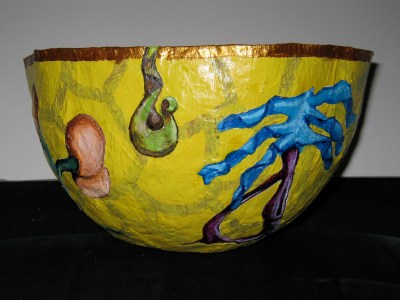
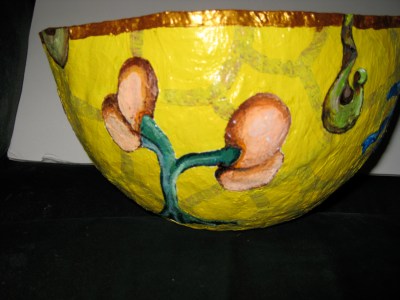
New Papier Mache Artwork

I have been madly completing artwork for the show coming up on the 28th. So far have done three bowls and finished the Sitting Child Trudy…Have two more bowls waiting to be painted…And a goose to make for Ruth. Meanwhile, “The Book” is not yet printed, but it looks like it will be soon…The one poem I hate, Solo for Two, cannot be deleted, so I must settle for it staying in  but the other corrections were made. I wish I had not been told that the book needed no editing, which is patently silly, ALL books need editing! But that is what they told me, so I did not look at it again, until it was too late to do much. I should have known better! I ought to have known better, as that is precisely what Diane K, our erstwhile editor told us about Divided Minds, and so opted out of helping us. But nothing could have been further from the truth, and luckily we knew it. She was basically trying to sabotage the book, even Lynnie thought so. ARGH, that is water down the sluices…What is important now is that the corrections I really needed made in WE MAD were in fact made, and the one poem I do not like may in fact appeal to someone. So I will put up with that one poem staying in, and hope it does not mar the entire thing…

That said, here are the new art works, first the three bowls, which take about a day to paint each, more or less, and then Trudy, which took several months of intermittent work.

Two Bowls, one 4" and one 7" - papier mache
Odd Botany bowl -- these plants are not real anything
Another shot of Odd Botany bowl
Ditto
Ditto
Final side of the Odd Botany bowl


trudyfincopy

Trudy is about three feet tall but on her hassock is somewhat taller. I’d say she is about the size of a seven year old? But I dunno, since I haven’t seen a seven year old in a while. 8)

Two Poems: The Middle of Nowhere

Although this poem, under  a slightly shortened title, will be in my soon to be released book, WE MAD CLIMB SHAKY LADDERS, I showed the rewritten version to my writers group tonight . It is basically a true story, about the friend whose recitation of a Gerard Manley Hopkins poem instantaneously converted me from a poetry skeptic to a poetry lover…but read on and you will see what happened.


The second poem was sparked by my recent hospital stay but not based on it, rather it is based on the misinformation purveyed by movies such as the ones mentioned in the beginning of the poem, and also in the books from which the movies were made.


YOU WERE A POET ONCE (NOW YOU ARE

LOST IN THE MIDDLE OF NOWHERE…)


You were a poet once. You touched my soul

with the gift of poems, teaching me to read and write–

oh, inevitably to write them, for writing made me whole

and I could never not write. I had no special goal,

only to “pour out a poem” and work it right.


That took me years. I was such a fool —

dreamy cups of poems, quote unquote, only wasted good ink…

But I was speaking of you. You gave me the tools

to teach myself; you should have returned to school.

You found vodka: you could not, after one drink,


stop. And though it seemed deliberate, a choice,

I suppose you couldn’t help it. On conversion day

you recited Hopkins’ “Spring and Fall,” your voice

for once not blurred by Popov. (Still, I didn’t dare rejoice.).

You were so sure, so caught up in what you had to say.


It changed me utterly. Few experiences work such magic.

Why you quit poetry for drink I’ll never understand.

Life made you querulously unhappy, so there’s a logic

in your refusal to live. But I’ll never not think it tragic

how your gift to me soured in your own hands.


REALITY CHECK


First, you have an address, a 9-digit zip code

and two free patient telephones, so you’re not lost

in the middle of nowhere, this is not the movies.

Not Cuckoo’s Nest at any rate, nor the I-Never-

Promised-You-a-Rose-Garden rose garden.

And that Girl, Interrupted? No, it is definitely not

her giant sleepover with hair rollers, gossip

and steaming hot chocolate. For one thing,

hospital tap water isn’t hot enough for cocoa

and unless your roommate, the anorexic

with fruity breath and ironed tee shirts

becomes your best pal, that’s it for the party,

no one else gets in your room. Even in a single,

the checker disturbs you every 15 minutes.

Now, I know that keys play a big role in film:

someone always swipes a set for the night

to go AWOL or wreak havoc. In reality,

“insurance cured,” most want to stay longer

than leave shorter. Going AWOL is more

the impulsive leap through briefly opened doors

than planned absconding at midnight

with a stolen keycard everyone is watching for.

Too bad paranoids still suffer, unable to trust

the good of best intentions. As for having

enough free time for the ward sociopath

to “wrap the catatonics in toilet tissue,”

there are too many groups and too many aides

with a job to do and you are it, so get moving.

Besides, catatonics are not allowed to stay

catatonic, what with medication and better care, 

so very quickly slowly they move too.


Schizophrenia: “Divided Minds” and Recovery

The day our book, “DIVIDED MINDS: Twin Sisters and Their Journey Through Schizophrenia” came out, in mid-August 2005, Carolyn/Lynnie, my twin sister, and I had three engagements scheduled, including a radio interview, a TV appearance, and, that evening, our first public  speaking/reading engagement at a local library. Due to advance publicity and widespread interest, it turned out that the venue had had to be changed to accommodate all the people who had called ahead indicating they planned to attend: instead the usual small room at the library, we were to speak in the auditorium at the Town Hall.


I made it through the day all right, but by evening, I was beginning to become symptomatic, hearing people unseen whispering over my shoulder and seeing familiar dancing red particles I called the “red strychnines.” Nevertheless, I was determined to make it through the final “gig” of the day in one piece. I was, however, getting more and more nervous, despite taking my evening medications early. Finally, Lynnie suggested I take a tiny chip of Ativan, not enough to make me sleepy but enough to calm my anxiety. I resisted up until the last minute, when, finding the stress unbearable, I agreed to it. She ran to get me some water, and came back with two cold bottles that had been set aside for us all along.


Then, we were on. Lynnie had done some speaking before, and seemed to me to be amazingly relaxed in front of the 340 people who overflowed from the first floor onto the balcony above. When she introduced me to read a section of a chapter I had rehearsed over and over until I could do so with the proper ease and feeling, I got up, trembling, and walked to the podium, wondering if my voice would tremble also.


In the book’s margins I had everything written out, from my introduction to the passage to instructions to myself on where to slow down, where to raise my voice, where to pause and so forth. I raised my head and looked at the audience, then looked down at the text and taking a breath, began.


I was surprised to hear my voice sound as strong as it did and wondered how long I could keep it up, knowing how fatigue and awareness of the audience could make it weaken and go tight on me. Indeed, after a particular spot in the book brought painful laughter from some in the audience, I could barely speak. I had coached myself for this eventuality: Breathe, I told myself silently. Breathe through it, keep reading but breathe slowly and calmly as you read and your voice will relax and stay loose. To my intense surprise and relief, it worked. I made it through the entire segment. “Thank you,” I murmured, indicating that I was through,” though it was obvious from the text that the piece had come to its natural end.


The audience burst into applause. People stood up, all of the audience stood and clapped. I didn’t know what to do. They were applauding me? What had I done to deserve this? Even Lynnie was on her feet and smiling. She nodded at me, telling me it was okay. Her eyes seemed to sparkle, as if they were full of tears. My own eyes were wet and I was too embarrassed to wipe them…


Lynnie then gave a speech of her own, a wonderful speech, ending with her asking me to stand up. and this too received a standing ovation. We looked at one another.. Who’da thunk? our eyes asked in pleased but puzzled amazement. Then it was over. But not quite. There was still a long line of well wishers with books to be signed and many people who wanted to talk to us. I was so tired that I let Lynnie field most questions, and   hid behind her or busied myself signing and pretending to pay attention to her, so I didn’t have to talk myself. In truth, I was exhausted, and though elated the evening had gone so well, on the verge of tears from sheer relief…


When we left, there were only a few people remaining in the hall. The library employee who had given us the opportunity to speak, told us it was one of the best attended events he had ever scheduled. We thanked him or Lynnie and Sal, her new boyfriend, did, I mostly lagged behind, and  followed  as if in a trance. Then we headed out into the warmth of the August night.


After the success of that night, the book tour, and later our paid (Lynnie was paid, I was not, as she had to take time off from her practice to do so) engagements became easier and easier, especially after we worked up speeches of our own and developed a rhythm and interaction with one another that seemed to work well. But it was wearying, and I wasn’t always taking my medication as I was supposed to. I still hated Zyprexa, which we had cut to 2.5mg plus Haldol and Geodon, and so I skimped on  it as often as I could, as well as the deadening Haldol. Geodon was the only antipsychotic I was on that seemed to have no objectionable side effects, but it clearly was not effective by itself. So even as we made our way out to Tucson, AZ I was skating on the edge.


2006, fall. I had made it 18 months since my last hospitalization but fatigue and exhaustion and it may be (I do not now recall for certain) not taking all my medications as prescribed conspired to allow in the same hallucinations that had such devastating consequences back in 2003/4. I was to set my whole body on fire, they told me, not to kill myself but to scar myself so badly that all would shun me, leave me alone, which was what I deserved, and what they ought to do in order to be safe. Because I could not promise not to act on these commands, I was hospitalized not far from where Lynnie lived at the time. I spent a month there, a very difficult and painful disruption in my life about which I have written earlier (see the entry about “trust”).


I was hospitalized it seemed every five months after that, until 2008, when I managed another 18 months. But life in between those stays was improving. Although we still did occasional speaking “gigs” we slowed down on those a great deal, so my time was more my own. I had made a papier mache llama once in 2004 when I was hypomanic, and it had taken all year to paint it, after I’d come home from the hospital no longer high. But the fun of it had stuck with me and in 2007 I made a turtle, a huge tortoise and took a couple of months painting it. In between I created some small objects. Then over December 2007 and January 2008 I built and painted my first large human, the Decorated Betsy. I was off and running, with Dr John Jumoke coming in April, May, and June of 2008 and the Shiny Child Ermentrude started in October of 2008 and finished in early January 2009.


Also in this period of time — between 2005-2009 — I put together my first manuscript of poems written over a 20 year period about living with schizophrenia, and another manusript of more recent poems, not about schizophrenia, and sent the first one off to the press which is publishing it, in their series on chronic illness. Once it comes out, probably in March, I will be free to finish work on the second. I will send that one out  and hope it too gets published as I prefer those poems to the ones in the first, though I have had rave reviews on that one, at least from the people who have seen it so far. I, of course, as the author, can only view it through the jaundiced lens of self-criticism and self-hatred…


Plus ça change, plus la meme chose. (and some things never change…)For all the seeming success I have had in these past three years of recovery, I still struggle with abysmal lack of self-regard, and chronic paranoia. If and when I find myself a new therapist (I must soon leave Dr O, as the travel time 1.5 hours there and 1 hour home  has become too much for me, and too it may be that she will no longer be continuing her practice, though I do not know that for certain…But in this economy, I can no longer afford the ride there as well as her fee. And I think too it is time to move on…both for her sake as for mine.) ..if and when I find a new therapist, it is those two things, self-esteem and the very right to have it, and paranoia — how to either end it, or live with it, are my two major goals I want to deal with, head on.


But then, maybe that’s all we have ever done, Dr O and I, dwelt forever on my lack of self-esteem and my paranoia, getting nowhere for all that. Perhaps she had the wrong tactics, the wrong methods, or else perhaps I am hopelessly mired in  my own worthlessness and suspiciousness — for lack of a better word, though paranoia means so much more than that…


In any event, I have tried here to describe in one entry a little of what has gone on for me since the book came out, since the beginning of my recovery. But my recovery truly began when I’d started Xyrem some months before. That is the drug that caused Lynnie to exclaim upon seeing me, two months after I’d started it, “Pammy, you’ve changed. You look wonderful, you’re back.” Xyrem, book, papier mache, poetry…all together gave me parts of a life that became somehow worth living, and it is worth living, even if at times of dark forgetting, as in February, I lose track of the one fact I need most to remember.

Prison Abuse: A letter etc.

Edited from a letter to a friend: 


I sent the following message to the White House website — the Office of Public Liaison. It is the beginning of a snail mail campaign (insofar as I am able), geared directly at President Obama asking for a prison and “juvy” reform agenda. So far as I can tell, he has nothing  of the sort at this point and we need one.


This is the very least I can do as I have decided that while I write this blog and books on behalf of my own issues around schizophrenia and mental illness, my political writings and action will be on behalf of a prisoner I am acquainted with who is sentenced to “life without hope of parole.” (I ask you is there a more fiendish mode of inducing despair, desolation and desperation in a soul than such a sentence?)


But my question  submitted on the form available was as follows: “Is there any Obama agenda for humanizing juvenile detention centers and for prison reform?  Abu Ghraib, Guantanamo and other foreign-soil prison abuses  did not come out of nowhere. Abuse and yes, torture of prisoners in “juvy” and US prisons are practices both brutal and common that serve no purpose except to create more violent convicts. Most will one day be released – to no one’s benefit, least of all  society’s. NO ONE CARES about them. They have been forgotten, lost, abandoned. PLEASE help.”


I was limited to 500 words so this had to be very carefully crafted and I wanted to get in some of the most important points. I dunno now about the comment about Abu Ghraib, but it seemed to me to be the important name to cite — an accurate reference for all that, according to my source– to draw attention then to the equation with US maximum/moderate  security prisons.


Anyhow, I don’t expect much of an answer (though the website implies the promise of something along those lines) but it was mostly to introduce the subject, into which I plan to go in greater detail in later letters.  


Towards the same ends, I am reading Christian Parenti’s 1999 book on US prisons and the “correctional system” in general, Lockdown America. I have had the book for years but have never been able to read it, though I wanted to. Now, suddenly, due to interest in this prisoner’s plight, I am slowly plowing through it. I admit it is difficult to get myself to sit down and read, but I really want to and so I persist.


My eyes, I think, continue to rebel. I have found that recently I have had to continually wipe my glasses clean in order to see better, or felt that I had to, without real relief. I am not sure what is going on, though. I believe I can still see 3-D okay. I just feel as if there is a scrim of something, a veil between me and the world…But it is more that than anything, and my usual narcoleptic sleepiness that prevents me from reading. Certainly not lack of interest and dedication. Still it remains very frustrating to me that getting through an entire book takes such a long time while writing is so easy (This is due in large part to my antipsychotic medication, Abilify, which I strongly believe facilitates putting words on paper, if insuring nothing at all about the quality of their ordering).


————————————————————————


Anyhow, truth to tell? The times are grave…I am attempting to work on a poem about Obama as Messiah and the concomitant end of the world. At the same time, I want to move to higher ground as I wrote in the earlier post, as soon as I get a spot in some other complex out of the Valley. That, however, could take years, I am told, as I am low on the waiting list, being disabled not a senior (I’m 56 and need to be 62 to be so classified, though the cut-off may be 65 by now)…


I do not know if the six years till then will be soon enough, and too, why continue to live if there will be social chaos and a catastrophic flood, famine and widespread panic, the predictable breakdown in all civil order…? I’d rather die, and by my own hand than survive to have to worry about being murdered by –

Argh, you don’t need to hear this, I think. But people are already  filling my head if not the halls with screaming and gnashing of teeth. I fear I may need to barricade the door… 

On Writing and Memory

I am trying to start a new book, another memoir. This is an exciting endeavor but I’ve gotten stuck on the problem, a perennial one I imagine, of how much does one really remember, and how much does the mind “make up,” that is, remember improperly? I know that some writers of autobiography — to my mind a more stringent form, requiring research and some historical context –and memoir make the claim that every word they have written is factually accurate, to the extent that they have checked each one against the memories and records of others. Then there are the infamous ones who have played so fast and loose with the truth as to have lost all semblance of it. These have produced literary scandals (as well as books that probably earned their authors much more income than if they had actually stuck to the facts) and more or less short-lived discourses by the punditry on the nature of truth and memory: what can we really know? Since I am something of a sucker I tend to take both of these at their words, when in fact I daresay that neither of them ought to be. True enough, the one has done more work than the other, and has made an honest effort to search for the “real facts” in his or her history, but my question is this: Can it be done, one, and two, why should the collective memories of say, ten people chosen by the author (biassed) be more “objectively real” than the simple truth of what the author herself remembers? Yes, you might build up a larger group of pieces-of-the-elephant if you have ten blind people who feel only one part. But unless you have someone who knows how the pieces fit together, you still only have elephant pieces…And so ten pieces are no better than the one in the end.

What I am saying is this: the author, the person who lived the life has to be the one to make sense of it. She might have a thousand “elephant pieces” — memories given her by ten people, yes, or only her own memories but in the end she must construct what the elephant – her life–looked like out of them. In some sense, there are facts and there are facts, but the work, and the life, and the living is all in the interpretation; always was and always will be.

That said, I am having trouble getting started, because I don’t know whether I want to use more “objective” sources or evidence this time, or not. I am perfectly comfortable using what is close at hand: my journals, my photos, the people I can easily consult. And I do feel very uncomfortable with mining deeper records: I do not particularly want to see what is written on my hospital charts during months-long stays when I was ranting and screaming for days, or engaging in outrageous behaviors like taking a dump on the floor of the seclusion room, or disrobing and…I can scarcely bear to think I did such things, frankly, and do not want to read what was written about me at the time, knowing nothing can be corrected or updated to show them the “new me”. A sad fact about hospital records and workers: they only see you when you are at your worst; they rarely get to know if you get better. Much less get to know you when you are well. And if you ever wanted to sit down and tell them what was actually going through your brain at the time they believed XYZ, but in fact QRS was happening, well, forget it.

So, I am loathe to overturn those stones, growing mossy as they nearly are now, some four years later. It pains me even to bring my mind across the memories of them. I have no wish to flagellate myself. My own journals say little, but it’s about all that I want to know. At the same time, my own brow-beating conscience tells me, NO, you must do what you do not want to do. The very fact that you do not want to do it means that you should. No pain, no gain—

Oh, I just go on and on. I would make this next book a torture to me, nothing of pleasure at all, just to serve my scruples. Be gone! If the writing is only to torture me, why do it? I’d be better off with my artwork and sculpture. But writing nurtures me, so long as I do not let my illness turn it into a punishment. Is there any need for me to use the historical records in telling the tale of my life? Did my first book lose anything in my not doing so? I would change a lot in DIVIDED MINDS, if I could go back and do so — add scenes here, take out one or two, most certainly make better transitions — but except for appending a much clearer discussion of this very issue, and also a better disclaimer, I wouldn’t change the way we wrote it.

So I might have talked myself to a place from which I can start, allowing myself the freedom not to have to delve into the official records or consult professionals involved in my care unless I am currently in treatment with them.

Your past after all resides as much in what you remember as it does in anything documented. You are mostly what you remember, and what you remember is sculpted by time and changes over time. If you think your memories remain the same, read back in a diary you haven’t read before, and recover the accounting of a incident you thought you’d recalled with accuracy…You’ll see how inaccurate your “memory” was and how formative this memory had been nevertheless. Then remember that the accounting is itself a memory, tainted by emotion and interpretation and consider those “ten people with their elephant pieces” who tried to give you objective memories of your history. Were they truly objective? Were their memories, even collectively, any more factual and objective than your memories?

In the end, memory is fiction, as someone once wrote in The New Yorker magazine, memory is, well, made up, not real, imagined. I agree, but it is all we have. Literally. Without memory we would be without anything at all, no culture, no civilization, no nuthin’. So let’s not pretend that the fact that memory is fiction isn’t critical. We need memory, and memory is, well, fundamentally untrustworthy, which is why we need thinking, and thinkers and writers to interpret history and memory… Memory is the most important thing we have, the most important attribute we can impart to anything: in almost every sense of the word, when we remember something we keep it alive. Maybe not literally, but then again, it is memory that keeps a conversation going on longer than five minutes. If you forgot what you were talking about ten minutes ago, or to whom you were speaking, nothing much would get said…