Category Archives: Health

Am I Crazy? Hallucinations, Delusions or Consensual Reality

What is real? Is anything true and factual? Or are we all just deluded and mad as hatters? This is a serious question.

What I recall and what was written down in my chart about a certain four days in July 2012 are so different it is difficult to figure out whether my experience was fact in any sense of the word or, as “they”claimed, simply paranoid and delusional. Of course there is some truth in paranoia and delusion, since even a paranoid’s beliefs are based in feelings that arise honestly and from a foundation, I firmly believe, in true things sensed but unacknowledged. Feelings always have their own veracity. But whatever the philosophers may say about the fiction of facts, still there is, there must be, something more to the consensual world of what happens than mere perception.

I mean, either that security guard in the Emergency Department last July deliberately attempted to strangle me, or he did not. Either it happened or in some fashion I imagined it. It is that simple, isn’t it? Yes or no, red or green, one or zero. Like a digital configuration, there’s nothing vague about it: either it happened or it didn’t.

There are records. I know what the ones they wrote say, as far as they go. But how to interpret them since so little was written down, and unless my memory is so completely at odds with reality as to have confabulated the entire episode – which by the way, is what they claimed all along – how to explain the discrepancies when so much is not even mentioned. That they whisked my gurney into a seclusion room and assaulted me en masse is my version. In theirs, the room change is noted only in passing, and of the IM medication all that is said is that it was given “NOW”. Nothing else of the incident I recorded in great detail in my journal some days later, and raged about from the first day I was admitted to the day I left. In fact, I’m still outraged, months later.

I wanted to go home, they wanted me to stay. That I was abjectly terrified of being kept there meant to them that I was “paranoid.” I claimed I had no problems and had never been diagnosed with a psychiatric disorder. That was a problem for they had more power than I did as well as my lengthy psychiatric history on their side to prove I must be crazy to make such a claim. Worse, I was loud, demanding, and in my increasing panic, getting angry. They saw my screaming as a threat. Even though I was blind to what was going on, any onlooker could have seen that I could not win and in the end of course I lost mightily.

But let me go back towards the beginning.

It didn’t help that I had arrived at the ED by ambulance and immediately refused to have my “vitals” taken, asserting that I was “fine!” I then accused the nurse of just wanting to get paid for taking them. In short order I was whisked to the so-called “purple pod” where the psych patients were buried for hours until the on-call psychiatrist deigned to come down to see them.

“Here,” someone said, thrusting a hospital johnnie and a pair of pajama pants at me. “Undress and put these on.”

I looked down and saw that I was already wearing pj pants from another hospital. No one ever knew the real nature of what I wore — they simply passed for scrubs — and they were so comfortable that I kept them on day and night. “I’m already wearing pajama pants. I only need to change my shirt,” I said.

“No, you are wearing very nice blue slacks. Now, put on the pajamas, or do you want a couple of strong men to put them on for you?”

“Actually,” I sniped, “they are hospital pajama pants. I pilfered them from –“ and I named the hospital. But I made a show of undoing the snaps so they would see that I was going to comply. The last thing I wanted was anyone touching me or “helping” me undress.

Soon an APRN, came by and I thought, Wow, they are quick here, maybe it isn’t so bad being taken to a big hospital. Maybe I can get discharged from here in no time. Unfortunately, she was there only to do a 15 second “physical exam” that consisted of looking in my mouth and listening to my back with her stethoscope. Period. Pronouncing me cleared for a psychiatric interview, she rushed off to clear someone else. Then I sat on the gurney in my cubicle and waited. And waited.

I remember being cooperative for what felt like a long time. I tried to sleep, and I listened patiently to what was going on around me. I swore that I would simply hold my breath and bide my time until someone saw me, so that, calm, I could present my case and they would see I was safe and sane enough to be sent back home, not admitted or sent to some hospital against my will. But it was taking so long, it was taking hours for someone to see me, and I knew they were doing it to me on purpose. Did they think I, too, was drunk or on drugs just like the others here? I started to complain that I had waited long enough and needed to see someone. I was NOT drunk, did not need to dry out. Where was the doctor? There was nothing wrong with me, I did not need to be here. I wanted to go home!

Things started happening then. Memory fails me however and even the chart, which I just obtained a couple of days ago leaves out way too much. All it says is that I was uncooperative, then irritable, screaming and combative. Meds were “offered”.

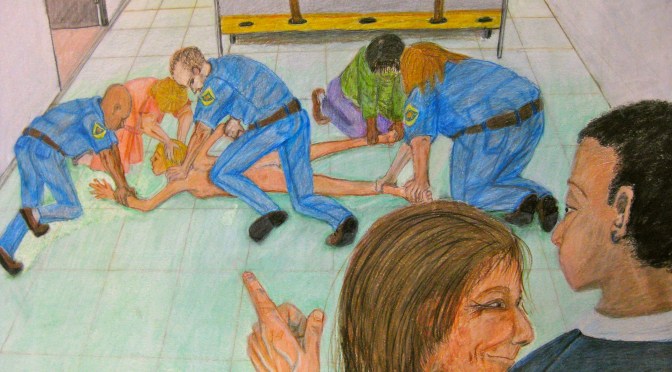
I remember this: When I refused to take soul-deadening Haldol by mouth, they descended on me, wheeled my gurney into a solitary room and jumped on me, intending to inject me by brute force. In the struggle, a guard gripped my neck and compressed the arteries, strangling me. I tried to get the nurse’s attention, burbling through forcibly compressed lips that I could not breathe. But her response, attending only to her needles and not even looking at me, was an impatient, “You’re all right!” In a pulse of panic, I jerked away as she started to shove the first needle into my arm.

“Damn!” she cried as a rush of blood spattered us and the needle danced away from my skin. “Hold still!”

I’d hoped to get some respite from strangulation but instead of letting go of me, the guard reasserted his grip on my neck and pressed down harder. I felt the light go black as blood failed to reach my brain. Darkness descended. Sounds grew confused and dim. Suddenly I knew that I could die, that this was how patients had been “accidentally” killed during notorious restraint episodes in Connecticut. I did the only thing I could: I went limp, hoping the nurse would get the injections over with quickly and that the guard would not kill me before she was through.

One, two, and then, astonishingly a third needle punctured my arm. She wiped my deltoid muscle with an alcohol wipe then removed herself from the gurney. “All done,” she said, removing her gloves with a smack and she nodded, indicating the door.

With a cruel leisure, the guard let go of my neck, but he leaned down as he did so and muttered in my right ear: “That’ll teach you a lesson about bringing a JCAHO case against M— Hospital…” Then he and all the others strode out of the room, leaving me alone in what I had already been warned was a soundproof room where you can “scream all you want, but no one will hear you.”

In other circumstances, I would have screamed, soundproof or not, as the door was left open. But nothing was ordinary anymore. A guard –  thuggish bully, no doubt a reject from the police academy — paid to protect people, had just partially strangled me in revenge for – what? What had I done to him? My case against that other hospital should have meant nothing to him. But what was clear to me, trying to get a breath and calm myself, was that I was not only not protected in the this ED, I was in mortal danger. I could not scream or rage in outrage, I could not even complain or demand to see a patient advocate. My life was imperiled. Still panting, trembling, in shock, I lay in the semi-dark of that single room and prayed — not to any god, mind you, but simply for my life, prayed to get out of that ED alive. I promised myself that I would not say or do anything “wrong,” would comply with everything they asked from then on in order to survive the night. But it was a long night ahead of me and I had no idea whether or not the guard would come back and finish the job. I was so terrified my teeth chattered. I felt a hollow coldness inside me of unutterable fear. And there was nothing I could do but lie there and hope he did not return.

__________________________________

I did not name the hospitals in the piece above, though I usually do, and I refrained from doing so because I do not know whether what I am going to write now is indeed true or not. But if it is not, then I do not want certain people being alerted to this blog post and reading it and taunting me with “Yehaw, we got away with it!” Read on, and you will see what I am talking about further on.

So as I said, I am in possession of my chart, the entire thing, 60 pp for a mere four day stay in the hospital about which I speak, including an approximately 10 hour stay in the ED.  In it, there is absolutely no evidence that anyone ever took me or what I had to say seriously at any time. Everything I said was dismissed as paranoid and delusional, grandiose, disorganized or confabulating. (BTW Confabulate does not mean lying, it means to unintentionally “fabricate imaginary experiences as compensation for loss of memory.” But whatever they thought I was confabulating I have not the faintest idea. Or memory. Alas, the chart says nothing of what I spoke about.)

What has completely upset the applecart is my own statement, written in my journal and elsewhere: “Why on earth would that guard care whether or not JCAHO was involved in that other hospital?” On that thought rests everything, because of course, he had to have cared mightily to have wanted to strangle me for it. Or did he? Did he care, and  in fact did he try to strangle me, and did he even say those words in my ear? I am serious.


You have to understand something: Once, years ago, I heard, or hallucinated, hospital nurses announce over the public address system in nearly the same words how they were going to “teach me a lesson” about — whatever it was I had done…and I knew I had heard it, knew I was hearing it at the time, except for the fact that I was on the phone with my sister at that time.  I held out the phone in the air so she could hear it too, but she told me she heard nothing, assured me that I was hallucinating. What I described was not only unlikely but so beyond the realm of the likely that she was certain  it could never have happened. “Its just your voices, Pammy,” she said, “you have to trust me, you are hallucinating.”

So remembering this, it gives me pause. For why would that guard care about JCAHO and that other hospital in the first or even the last place? What could it possibly mean to him? Security guards are usually hired from outside agencies so his over-involved concern with another hospital’s accreditation suddenly seems to me absurd.  And if he did not care, why would he have tried to strangle me? Oh, maybe he did hold me down too hard, and I felt that, yes. But if I could speak, then I know I could breathe, so I was not actually being strangled either.

Perhaps I was simply frightened? And could it be that in fact he never said anything at all? That I “imagined” those words, hallucinated them, and then continued to believe that I heard him say them and that he wanted to kill me, all the time since then? Could it possibly be that some of what the hospital personnel said was true — NOT all of it, but some part of it. That I was in fact hallucinating and delusional? It doesn’t make their behavior right. It doesn’t justify throwing me into seclusion and injecting me with IM meds when I was not a danger to myself or others. It doesn’t even make admitting me to the hospital the proper thing to do in the first place. But, but, but…if I have heard people say things, visible people say things that they simply have not said, when they have not said anything at all, and I know this has been the case, then it is, I admit, just possible that what happened at the ED this summer might be another instance of the same…It pains me to think this. It frightens me to think that I could have been so mistaken for so long.

But what’s more, I worry that I am wrong to believe I might be wrong!  That the guard DID say what I think he said, did intend to strangle me, and that I am giving him what he wanted: I am letting him drive me into believing I was/am crazy!

I do not know what to think. And I may never know for certain what happened. Not about this. However, one fact that I can corroborate in the record I am painfully aware I “knew” for months: I was given 3 IM drugs during that episode. Yet you only have to read my chart to see that I was given only 2: Geodon and Ativan. The third drug, Haldol, was canceled immediately after it was ordered. The records clearly state that only the Geodon and Ativan were ever administered. This is so striking an error of memory  that it too makes me think again about trusting what I was certain I heard in that terrifying room where they held me down and injected me.


I don’t know what to do with this…I don’t know how to handle it or deal with it. It doesn’t feel good, or give me any sense of relief. I dunno how I feel. Just shocked, I guess. And perturbed, because I don’t know what else I have experienced that never “really” happened.

Miracles: Four Life Changing Events

©Jesse Taylor (Own work) [CC-BY-SA-3.0 (http://creativecommons.org/licenses/by-sa/3.0)%5D, via Wikimedia Commons
Okay, so as a friend suggested, maybe there have been five not just four miracles, with the most recent miracle having occurred, and ongoing, about three weeks ago. But more on that later. First, a definition of miracle, so we are all clear on what I mean here.

CS Lewis, a popular Christian writer of the twentieth century and still known for his Narnia Chronicles, wrote that “a miracle is something that comes totally out of the blue…” Now, he meant something extremely unlikely, like a virgin female giving birth to a child. Now, apparently, this has been observed at least once in modern times. If you don’t believe it, and can understand the technical language, you can read the following abstract as proof. Then you can decide whether or not virgin birth still counts as a miracle:

Fertil Steril. 1992 Feb;57(2):346-9 .

Chimerism as the etiology of a 46,XX/46,XY fertile true hermaphrodite.

Source: Department of Obstetrics and Gynecology, Chicago Lying-In Hospital, Illinois.

Abstract

OBJECTIVE: To determine the conceptional events resulting in a 46,XX/46,XY true hermaphrodite and to report the first pregnancy in a 46,XX/46,XY true hermaphrodite with an ovotestis… (see the rest of the abstract at PubMed)

Another thinker, British mathematician John Edensor Littlewood, suggested in what became known as Littlewood’s Law that statistically individuals should expect one-in-a-million events (“miracles”) to happen to them about once a month. By these calculations, seemingly miraculous events are actually commonplace.

And of course there is the dictionary definition of miracle, which is the one commonly accepted by both religious people who believe in miracles, and those who do not believe in their existence, but who do accept the definition of the word.

mir·a·cle/ˈmirikəl/

–A surprising and welcome event that is not explicable by natural or scientific laws and is considered to be of divine origin

OR

–A highly improbable or extraordinary event, development, or accomplishment

I myself would add a third, and relevant definition, or qualifier, which is “if it occurs in an individual person’s life, the event produces changes, beyond any that could have been imagined prior to the miracle, in a positive direction wholly unexpected and therefore regarded as miraculous.” To be cured from a terminal or crippling illness is of course a miracle. But so too to my way of thinking would be remission from a future-destroying addiction or mental compulsion. Needless to say, complete reversal of a severe mental illness would count as a miracle. And I can think of others that might be counted as less effulgent but just as miraculous.

Given those broader categories of miracles, then, I will proceed to tell you of mine. I do not know what the Course on Miracles is all about, nor anything of the Miracle classes offered online. If there are similarities, I dunno what it means, except that we came up with our thoughts completely independently. I have spoken of the following things as miracles for many years now without any familiarly with the C.O.M or any other such program.

So, onward to my First miracle. (Alas, I fear I will have to deal with the Second Miracle and the Third, Fourth and Fifth in following posts as this one is already getting long enough and will be longer by the time I am finished.) The first miracle concerned, as some readers may remember, plants, wild plants, field botany, in short, the wonders of the wild green world. But not just that, no, it was the discovery in myself, utterly unanticipated, of a bizarre and wonderful ability to simply know, almost without any idea how I knew it, any plant I came across. In fact, I must have seen them, if briefly, in some plant book or field guide, but it was truly uncanny, my ability to instantly recognize and categorize whole families and genera and then the species within them just by casually looking at any plant, flower or tree I saw, having but  glanced at a simple sketch or pencil drawing of a plant the night or even a week before seeing it in the wild.

I once wrote about this miracle in my first blog at http://www.schizophrenia.com. Although the essay has a less than happy ending that has nothing to do with miracles, I will reprint the essay in its entirety here. Suffice it to say that the pivotal moment,  the chairotic moment and miracle that surrounds “Prunella,” which I describe early in the piece, changed my life forever.

WILDFLOWERS ON THE ROAD TO DAMASCUS

Thirty years ago, I took the natural history course purely for exercise. I figured, what better way to stay in shape than to get credit for it? At the time, I couldn’t tell a maple from an oak, let alone one old weed from another, and it wouldn’t be easy. But just to keep off the flab would be a benefit in its own right. Since the prospectus promised daily field trips, no mention of love or awe or wonder, the last thing I expected was a miracle.
Showing up for the first day’s trip, I wore old tennis shoes of the thin-canvas Keds variety. I had no idea L.L. Bean’s half-rubber hiking boots were de rigueur for a course of this kind. What god-awful-ugly shoes just to walk in the woods! I thought in horror. Right then, I realized I’d made a huge mistake and it was too late to change my mind — I’d have to stick it out for the whole semester. I knew for sure I was going to be more miserable getting “exercise” than I ever would have with my thighs turning to mush, safe in the college library.

The teacher, Miss G, took off stomping down the path and we tramped on after her. I was last, straggling behind, half-hoping to get lost so at least I could head back to civilization. Before we’d gotten far, she halted, peering intently at something near her feet. She waited for us to catch up and gather round her, then pointed at a weed. “Heal-all. Prunella vulgaris,” she announced sternly and without passion. “Vulgaris means ‘common.’ Learn names of both genus and species. Be forewarned, ‘Heal-all’ by itself will not be an adequate answer on your quizzes.”

She stepped aside so we could take a better look. As instructed, one by one the class dutifully wrote down a description and the two names we’d been given. I was still at the back, waiting my turn without the least enthusiasm, let alone the anticipation of what, in those days, we called a “mind-blowing” experience.
“Come on, now, don’t be shy. Step up and look for yourself,” Miss G scolded me, pushing at my elbow to propel me closer.

Finally the clump of students cleared out and I had a better view. For some reason, I found myself actually kneeling in front of the weed to look at it close up. Then it happened. As if the proverbial light bulb flashed on over my head, I understood what Miss G meant when she’d said: “Weeds are only wildflowers growing where they aren’t wanted.”

Prunella, I know now, is no more than a common mint, found in poorly manicured lawns or waste ground. Yet, with its conical head of iridescent purple-lipped flowers and its square stem – on impulse, I’d reached out to touch it and discovered an amazing fact: the stem wasn’t round! – Heal-all was the single most beautiful thing I’d ever seen. The world went still. There was only me and the flower and the realization I’d fallen in love.

Since one of my other courses concerned the history of early Christianity, I knew immediately what had happened. Like Paul on the road to Damascus, I’d been struck by unexpected lightning. I’d been converted. I put away my notebook, knowing I didn’t need to write down a word, knowing I’d never forget “common Prunella” as long as I lived.

There were other miracles in my life after that, but none came close to the thunderbolt that knocked me flat the afternoon I saw, truly saw, that homely little mint for the first time. “Sedges have edges and rushes are round and grasses have nodes where willows abound.” Yes, I learned such mnemonics, which helped me as much as the next person when a plant was hard to identify. But I discovered in myself an amazing feel for botany that was like sunken treasure thousands of feet beneath the ocean. Once I knew it was there, I had merely to plumb the depths, more or less unconsciously, and gold would magically appear.

I went walking in the woods every chance I got and carried Peterson’s guides with me even into town, checking out the most inconspicuous snippets of green that poked through the sidewalk cracks. The first time I came out with a certain plant’s genus and species before Miss G told the class what we were seeing, she looked at me oddly.  I began repeating this performance until once she even allowed me to argue her into changing her classification of a tricky species. If I still hung back behind the group as we walked, it was no longer from reluctance. I was simply too entranced, looking at each tree, to keep up the pace.

By December, as the semester was coming to a close, Miss G had begun using me as her unofficial assistant, asking my opinion whenever there was a question as to what was before us. Oh, I confess, I never did get the knack of birds. It was the trees and wildflowers that stole my heart entire.

At the end of the semester, we received course evaluations in lieu of letter grades. I opened mine eagerly, expecting praise. Instead, Miss G was terse and unenthusiastic: “Pamela faithfully attended every field trip, but for most of the course she failed to share her insights and established expertise with the rest of the class.” End quote. “Failed to share her established expertise“? What was she talking about? Did she think I’d already known everything she taught us? How could she not understand what she’d done for me, introducing me to little Prunella, how I’d learned everything I knew after that moment, not before?

It was the worst evaluation I’d ever gotten, the injustice of which struck me to the marrow. I went to her office to explain and found a sign on her door saying she’d been called away on a family emergency and would not be returning until the next semester. But I wasn’t returning for the second semester. I was transferring back to my original school.

I caught my ride home, spending four hours crammed into the back of an old Volkswagen bug with two other students, wordless with indignation that replayed and reverberated through my mind. How could she think such a thing? I couldn’t stop writing a letter of protest in my head as the highway flowed endlessly beneath us.

I did write Miss G, finally, explaining all she’d awoken in me, emphasizing the magic I’d discovered in her class, my new-found joy and amazement. At the end of March I got a reply, but no apology, no hint that she understood she’d misunderstood. Not even appreciation for my gratitude towards her and what her course had done for me. Just a brisk, no-nonsense note, little better than a form letter. I had the impression that she didn’t quite remember who I was, that I was just another faceless student writing to her about a natural history course she’d taught perhaps forty times in her long career as a teacher.

Whether she knew who I was or even recognized what she’d done for me mattered little in the end. What did matter was that when I met homely little Prunella, I discovered the whole world in a common weed.

©Pamela Spiro Wagner, 2004

The next posts, or in the following weeks, I hope to cover the other four miracles. If you are interested in them, and I fail to follow through, feel free to “goose” me with a reminder. My mind is a sieve and I rarely remember anything without a string tied to my thumb! 8D

Florida to execute paranoid schizophrenic tonight absent intervention from Supreme Court

Florida to execute paranoid schizophrenic tonight absent intervention from Supreme Court.


Thanks to the excellent blog, Dispatches from the Underclass, we have the post above. It is disgusting but true that in some – too many states! – “we” are still executing the most severely mentally ill…

To Kill or Not to Kill: Physician-Assisted Suicide?


My brother visited me recently and for some reason we got into a discussion about whether or not we supported physician-assisted suicide. We differed on the fundamentals: Phil, aka Chip, supports assisted suicide in every sense of the word. He thinks that it should be legal for a physician to prescribe a lethal medication essentially for anyone who asks.


This horrified me. Wait, he went on to explain. In his opinion, everyone should have to push a button upon waking in the morning in order to stay alive. If you failed to push it, you die. Meaning that the day would begin with everyone choosing to live, thus having to take responsibility for making that choice. We would start with the premise that every person who “wakes up alive” has chosen to live and cannot claim rightly to be suicidal…I guess that Chip as a psychiatrist, feels too many of his patients do not want to live, but also do not sincerely want to die, and he thinks that they need to acknowledge the latter. That might be good, but I also know that there are those who are so depressed that in their involuntarily mentally incapacitated state, they might not be able to press the “I want to live” button, and thus would die, even though in a healthier frame of mind, they would have chosen to live…

For me, I agree that when terminally ill, a person should have the right to end his or her life, and should be able to do so without interference from authority, legal or medical. I also think that in certain cases, palliative or hospice care helps with this, and already has done, silently and as it were secretly for years: the administration of a sedating dose of morphine when the time is right goes a long way towards assisting a person’s “dying process.” Not a lethal dose mind you, but a dose to “ease breathing” and one from which the physician and all witnesses understand the person will likely never awaken.

(My friend Joe is another case entirely. They turned off his ventilator and dosed him with morphine after 4 years with ALS. I firmly  believe that they murdered Joe outright, against his will…But no more will be said of that at the present time.)


On the other hand, let’s face it, if you really want to commit suicide, it is easy to do so if you are able-bodied and not terminally ill: just jump in front of a bus, or out of a tall building’s window. There are a dozen sure-fire ways and they have been used for millennia as an easy way out. The problem is for those who are physically so debilitated that they literally cannot “jump” or swallow the pills or whatever. Yet  unless they are forcibly nourished and hydrated through a feeding tube, they can always refuse food or liquid, which it seems is not agonizing after all. That is according to what recent research and personal witness (my own) have indicated. When my friend Lynn L died – essentially from not a refusal to take liquids– she did not suffer acutely from deprivation but seemed slowly to cross into a never-never land. She simply drifted off to an endless sleep and passed away.


The idea that a physician could freely prescribe an overdose of a lethal drug to any someone who came asking for it, that just strikes me as the height of 1) irresponsibility and 2) cruelty, by someone whose job, after all, is characterized by the Hippocratic Oath: primum non nocere or “First do no harm.” If killing  a patient is not doing harm, then I do not know what is. I simply do not understand how bloodying one’s hands in the act of killing, no matter how good one’s intentions, cannot but badly affect any so-called healer.


Surely there are other ways to deal with a person’s pain and suffering than to throw up one’s hands and say, well, I cannot help you feel better or live longer, so I will simply shoot or poison or – whatever – you so you feel nothing and don’t have to deal any longer.This completely disregards the inherent value of the struggle itself, and the promise of something worthwhile, if only at the very end  at the moment of dying, in having faced the suffering and undergone it fully.


Look, I do not like or want anyone to suffer agony in the last stages of life, and am all for morphine use, liberal or sparing, depending on the patient’s desires and needs. But there is no absolute value in complete suffering or pain relief, not in my book. For me, I insist that I must feel my own feelings, and in that quest, I must decide to feel the pain, emotional or otherwise, rather than dull it with drugs or anything else. Yes, it hurts, but the hurt somehow feels better because it is mine and real, and not the forced dull nothingness of being drugged out of it.


If you have other thoughts about this, do feel free to share them in the comments section. In the meantime, I found this article on the very same subject at Medscape Psychiatry. It was written by ethicist and psychiatrist, Ronald  W. Pies, MD and may be found in its original form at this link:


http://www.medscape.com/viewarticle/771274

Medscape Psychiatry > Ethics in Psychiatry


Do We Need ‘Thanaticians’ for the Terminally Ill?


Ronald W. Pies, MD


Posted: 09/26/2012


The Ethical Dilemma of Physician-Assisted Suicide

My 89-year-old mother had been losing ground for some years, experiencing what geriatricians sometimes call “the dwindles.” Toward the end of her life, she was beset by a deteriorating heart; an inability to walk; and occasional, severe gastrointestinal pain. My family got her the best medical treatment available — eventually including home hospice care — and she generally maintained a positive attitude throughout her long downhill slide.


But one day, as I sat beside her bed, she seemed unusually subdued. “Honey,” she said, “How do I get out of this mess?” I had a pretty good idea of what she was really asking me, but I deflected her question with another question: “Ma, what ‘mess’ do you mean?” I asked. “It’s all right,” she replied, smiling sadly, “I’ll manage.”

My mother was doing what she had always done: sparing her children from pain. In this case, it was the pain of dealing with the waning days of her life and the frustration of knowing there was no easy escape from the burdens of dying slowly. “Ma, I’ll always make sure you are getting enough treatment for your pain,” I added, taking her hand — knowing that the prospect of unremitting pain is often an underlying fear of terminally ill persons.


Yet, unspoken in my mother’s question was the issue of so-called physician-assisted dying, sometimes called “physician-assisted suicide” — an enormously heated controversy both outside and within the medical profession. In my home state, Massachusetts, the issue has come to the fore, owing to a November ballot initiative for a measure that would allow terminally ill patients to be prescribed lethal drugs.[1] A closely related bill (H.3884) has also come before the Massachusetts Legislature’s Joint Committee on the Judiciary.


Similar to laws already on the books in Oregon and Washington state, the proposed Massachusetts law builds in numerous “safeguards”: For example, patients would be required to submit their request in writing twice, and those requests must be 15 days apart. As reported recently in the New York Times,[2] fears regarding widespread overuse or abuse of the so-called “death with dignity” laws in Oregon and Washington have largely failed to materialize, at least according to some studies.


Nevertheless, the Massachusetts Medical Society (MMS) has long been opposed to physician-assisted suicide. In March 2012, the MMS President, Dr. Lynda Young, testified before the Joint Committee[3] and did not mince her words. Allowing physicians to participate in assisted suicide, she stated, “…would cause more harm than good,” and she argued that “…physician-assisted suicide is fundamentally incompatible with the physician’s role as healer.” Instead, Dr. Young asserted, the physician’s role should be to ensure that the terminally ill patient “…continue[s] to receive emotional support, comfort care, adequate pain control, respect for patient autonomy, and good communication.”


With considerable ambivalence, I agree with Dr. Young. In my view, terminally ill but mentally competent patients should be at liberty not only to refuse further medical treatment, but also to end their own lives — for example, by refusing to accept liquid or solid food. Contrary to a widespread belief, voluntary refusal of food and fluids does not result in an agonizing or painful death, according to a2003 report in the New England Journal of Medicine.[4] Indeed, medical ethicist Dr. Cynthia Geppert informs me that voluntary refusal of food and drink is now considered an accepted approach to dying in palliative care.


As Dr. Thomas Szasz has argued in his book, Fatal Freedom: The Ethics and Politics of Suicide,[5] a liberty is not the same as a right, because the latter entails a reciprocal obligation on someone else’s part. (If I have a right to free speech, the state has a reciprocal obligation to protect that right.) Moreover, the liberty to commit suicide does not entail the “right” to have one’s physician prescribe a lethal dose of medication. Indeed, Dr. Szasz believes that “physician-assisted suicide” is really a euphemism for “medical killing” — more technically, “heterohomicide” on the part of the physician.


While I disagree with Dr. Szasz on many issues in psychiatry, I think his analysis here is essentially correct. Physician-actuated heterohomicide, in my view, is “fundamentally incompatible with the physician’s role as healer.” I believe that permitting physicians to write prescriptions for lethal drugs will eventually erode the trust that all patients should place in their physicians. More than a euphemism, “physician-assisted suicide” may be a contradiction in terms. And in my view, the very concept violates both the implicit ethical contract between physician and patient, and that between the physician and society.

To be clear: None of this means that physicians should collude in the cruel and unnecessary prolongation of dying, as is often seen in hospital settings. As physician and ethicist Dr. Fred Rosner has argued,[6] “To prolong life is a [commandment], to prolong dying is not.” Thus, in the Jewish medicoethical tradition, “removing impediments to death” is sometimes acceptable — that is, discontinuing treatments that needlessly prolong the dying of a suffering, terminally ill patient, but without actively bringing about the patient’s death. (The distinction between “letting” someone die and “making” someone die was supported in the 1997 US Supreme Court case of Vacco v Quill,[7]which upheld New York State’s ban on assisted suicide.)


But what about those suffering, terminally ill, mentally competent patients who will not choose to end their lives by refusing food and drink and instead seek out “assistance” from healthcare professionals? Again, I do not believe that medical professionals should participate in assisting a patient’s suicide. But I sometimes wonder whether society ought to permit somebody to do so.


For lack of a better term, let’s call such a hypothetical individual a “thanatician.” Let’s posit that carefully trained and closely monitored thanaticians would be permitted to provide medically screened, dying patients the same type of lethal medication now prescribed by physicians in Oregon and Washington — under essentially the same restrictions and safeguards.


But wait: Isn’t this proposal a cop-out? Doesn’t it merely place the moral issue of assisted suicide in the lap of the nonphysician, allowing the dying patient’s physician to shuffle off with a clear conscience? Even worse: Would the use of such death-dealing personnel amount to abandonment of the patient, as Dr. Geppert recently suggested to me?


Still other questions arise. As my colleague Dr. James L. Knoll has suggested, might not the training, monitoring, and supervising of thanaticians create more problems and headaches than it would solve? Finally, doesn’t the very notion of “thanaticians” suggest that we have lost faith in what Dr. Knoll rightly calls “the intensely personal journey” of doctor and patient?


I, too, struggle with these questions and find no easy answers. I suspect that at present, the best approach to the dying patient is through the skills of the palliative care physician. Palliative sedation, for many terminally ill patients, may be a viable alternative to managing suffering without ending life. Moreover, a careful psychiatric assessment of patients requesting physician-assisted death is always indicated, because major depression may distort the patient’s judgment as death approaches.


How we deal with terminally ill patients is a painful topic that I never discussed with my mother, who was fortunate enough to have excellent home hospice care in her final days. But I believe this is a discussion we urgently need to have.


Acknowledgment: I wish to thank Cynthia M.A. GeppertMD, PhD, and James L. Knoll IV, MD, for their valuable comments on earlier drafts of this article. The views presented here, however, are solely my own.


Psych Meds: Are We Crazy to Take Them?

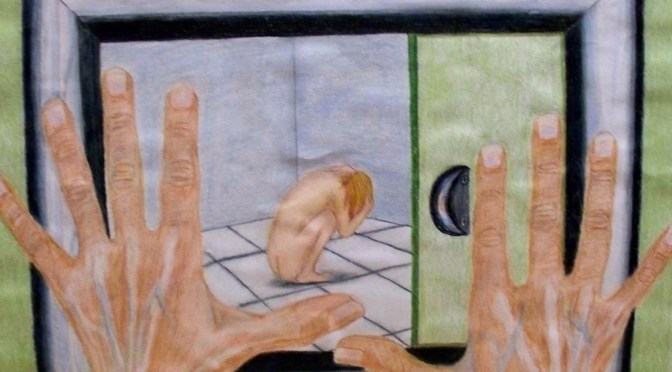
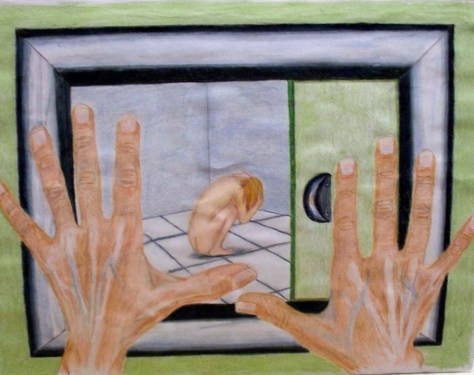
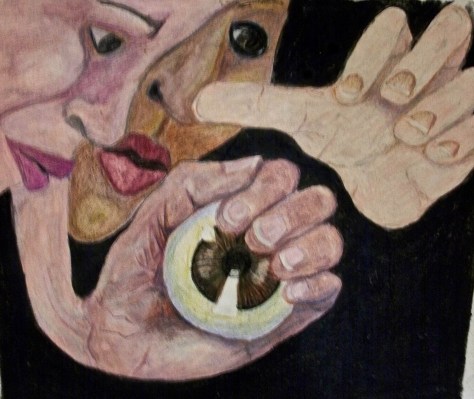
We are broken in so many ways. Here I am naked in the seclusion room in the left lens, and the right lens is broken over the biohazard sign, a symbol that stands for so many dangers…© All rights to this picture are reserved. Please contact me if you want to use it for any reason.

On Medscape yesterday they ran an article/video by a Dr Jeffrey Leiberman, lamenting the failure of three psychotropic drugs –one for the treatment of schizophrenia, and the others  for Alzheimer’s — to pass beyond either phase 3 or phase 2 clinical trials. This is part of what Leiberman had to say (please note that the emphasis is decidedly mine…)


“The brain is an organ that is orders of magnitude more complex than any other organ in the body. The brain has 100 billion cells. Each of the areas of the brain is organized cytoarchitecturally differently, and the cells connect via over 30 trillion synapses. Compare this to the heart, the liver, the gastrointestinal system, or the lungs, and there is no comparison in terms of complexity and intricacy. In addition, given the fact that we are developing treatments for brain disorders that affect mental function and behavior, the animal models that are an essential component of biomedical research and drug development are limited, because how can lower species like rodents model the complexity of human behaviors and mental disorders that we are trying to correct pharmacologically?


“In addition, the biomarkers we use to signal the effect of the treatment or prove the target engagement of a molecule at the desired location in the brain or protein in the brain are still in development and not fully validated. Thus, the complexity of the brain and the limitations of existing tools make the prospects of certainty in drug development [for brain disorders] more questionable than in other organ systems and disease areas. “Certainly the research community and the National Institutes of Health (NIH) understand the importance of redoubling our efforts to develop treatments for this important group of disorders. The NIH has recently established a new Institute, NCATS, or National Center for Advancing Translational Science, which has as part of its core mission drug discovery and development. In addition, various other Institutes have put out RFAs [request for applications]; this includes the National Institute of Mental Health, which has initiated a series of what are called the “fast programs” to identify drugs that exist within the pharmaceutical industry and may no longer be under development, but can be repurposed for study for specific disorders. A quick, rigorous study using a fast-fail strategy can determine whether these agents have the potential for further development.


“New efforts are coming from the biomedical research community as well as the NIH to spur drug development. I hope this will act as a catalyst for the pharmaceutical and biotech industries to not despair or back away from the risk of developing drugs in these areas, but rather to find the resources to support drug-development programs for these disorders.


“What is the benefit? Anyone who works with psychiatric patients knows that there are tremendous unmet clinical needs, whether in schizophrenia, depression, bipolar disorder, autism, or Alzheimer disease. With these needs come tremendous market potential, so for those who stay the course and persevere, there will be very lucrative rewards .To me, this seems like a great opportunity, and I think our partners in the private sector should appreciate this. I look forward to partnering with them to try and work in a way that uses their precious resources most efficiently but still serves our scientific goals and the needs of our patients. Thank you for listening.”


Yes, I noted the last statement, that he wants to serve science and his patients, but i could not help but feel great dismay at the other statements, including the first, that largely states what I already suspected: using animals to prove anything about human brain disorders or states of mind is downright ridiculous. All you can say about a rat’s “schizophrenia” is that it appears to  “behave” in some fashion that looks similar to someone who is psychotic…but how would you know if a rat is psychotic, or hallucinating or thinking in a delusional fashion?


Come on? How would you know if a rat had negative symptoms of schizophrenia, or was depressed, or simply felt lethargic because  it was hungry or drugged or sleepy or some other physiological reason. Well, you likely could not! Using animals that can not communicate with us to model human mental functioning is downright silly, and yet it seems to have only just occurred to Dr Leiberman, perhaps in his own disappointment with the glutamate-dampening anti-schizophrenia drug that just went bust…I dunno.


Once again, having read about how they are using Ketamine to treat 6-12 years olds with bipolar illness (mind you, I am not convinced that the children are actually Bipolar, only that more and more kids are being diagnosed because conveniently shrinks are allowed to drug them with Abilify and Seroquel and other adult antipsychotics and the drug companies push it on them, pay them for using it etc)


I believe that the use of psychoactive drugs and the rampant use of them is more often inappropriate than not. Truly.   The very idea that Abilify and Seroquel are prescribed willy nilly for everything from insomnia to mild anxiety is just plain SCARY. Has anyone out there taking these drugs even bothered to read the side effects, or do they no longer care what they are taking? Obesity no longer scares anyone, but what about diabetes and high blood pressure, nope, I guess not, since those are epidemic too.


It truly astounds me how both  those drugs, not to mention a whole host of other powerful drugs are being pushed on the American public, but we are a public that LOVES to take drugs rather than deal with problems by, well, looking at ourselves and thinking about what our responsibilites are and how we might change things…and doing some hard work and hard thinking about things…No, god forbid, why not just take a pill and forget about everything else, and if the pill doesn’t do anything, well, then, probably we are incurably ill and need to take those useless pills for the rest of our lives, because if we didn’t take them we might might might be even worse than we are taking them, right?


Not! Why do we take drugs that don’t help us, or that we do not notice any benefit from (though the shrinks are always willing to point out to us how much better “you are feeling”), drugs that might even make us feel worse in other ways.


Some people who are depressed lose all sexual enjoyment and functioning from their antidepressants, but refuse to stop the drugs because they are afraid…even though the drugs themselves make little difference in their mood, but their lack of sexual pleasure and responsiveness surely has…in a negative way. Why do they continue taking the pills? Hope? Obedience? Uncertainty? Perhaps all three…They may hope that if they take the antidepressant just a little longer, the side effects will “go away” as their doctor likely assured them, and they naturally want to be an aobedient and good patient, so they keep complying. And of course, depressed as they still are, uncertainty about the future plays a huge role, since how do they know that things wouldn’t get even worse, should they cease taking these pills that the doctor says not only will help them but somehow noticeably is helping them, whether they feel it or not.


Argh. I am reading a book, Rethinking Madness, by Paris Williams,  PhD. and it is a very interesting take on psychosis and the treatment of it. He suggests that it is NOT always a lifelong condition, or that one breakdown means that one needs to be on medication for life, or in fact that even with repeated psychotic episodes, one can be on intermittent medication and at low doses. I have difficulty reading, myself, so I have not read far along, but the first case study discussed a man who became psychotic suddenly in the late 60s or early 70s when he was threatened with the draft. After that he was ill for a long period of time, in and out of madness until he met the “right doctor” at age 28 or so. I believe it was then that he made the slow transition off all medication and since he was 35 or so has been off meds altogether. And has been well. Recovered, in every sense that matters, completely.


Everything about his history would today dictate that he never be taken off meds, and would mitigate against his ever dreaming of working in the mental health system, let alone as a worker in a state hospital. Yet this is where he has been employed for many years…(I may misremember some details, but that is the gist of it.) I could scarcely wrap my mind around such an outcome…it seemed that amazing.


Yet, I cannot be envious, because I know how often I tried to get off my medications, and because I did not know how, I likely induced a recrudescence of psychosis without even understanding that was what was happening. And naturally, they put me back on the drugs again…It was not my fault, just how it was in those days. I didn’t know, and they still don’t! Even now, though, I do not know if I could get off the meds.


But in my case, I am not sure I want to, largely because I function so well on them. I write, I do art, I sleep well, I am not obese, I have no chronic physical health problems because of them…So I have no pressing need to get off the antipsychotics, nor the anti-seizure meds, which I may need due to temporal lobe epilepsy anyhow. I would like to get off the sertraline, yes, and we are working on that. But why fix what ain’t broke at this particular time? I mean, I only got out of the danged hospital a month ago, and it would seem a little, er, crazy to fiddle with things this soon, much as I wish I could. On the other hand, I don’t mind taking these meds, because by and large, I believe, frankly, that my body has re-established some kind of homeostasis and has adapted to the lowered dopamine…so it has ramped up production to a different balance, meaning that I am fine where I am, but would risk a massive overload should I stop cold turkey.


OTOH, I do not yet understand the absolutely immediate improvement in all my mental capabilities when I take Zyprexa. Yes, I eat and eat and eat. But I can read and pay attention to people telling me things to movies and the TV and just “intake” in a way that I cannot now and have not in years…And it is literally within 2 doses. That cannot be a matter of homeostasis so what is it? Can Zyprexa be the ONLY drug that actually has some beneficial effects? I doubt it. So what is it?   Anyhow, any comments on these points would be appreciated. I don’t mind if you want to argue to the contrary, if you feel it strongly. I am here to hear different points of view as well. Though you know of course that I may “argue” with you back! All in friendship and good cheer.

A Mental Health Meeting of the Minds: Natchaug Hospital Administrators Get Gold Stars

This is the front entrance to Natchaug Hospital, a photo I cribbed from their Facebook page. I am trying to paint it, but that will take a while so for now, this will have to do…Hope I am not infringing a copyright. However, as this post is all about Natchaug it is good publicity too!

After I wrote my early September post “Open Letter to Deborah Weidner MD”https://wagblog.wordpress.com/2012/09/02/open-letter-to…chaug-hospital/  ‎about my stay at Natchaug Hospital in August, I received a phone message  one Saturday afternoon not long afterwards from none other than Dr Weidner herself. She left her cell phone number and asked me to call her back. Her voice was neither angry nor upset, quite the contrary, she sounded very pleasant. So, despite my heart’s clangor in my ears at the same time as it drove nearly into my esophagus with its nervous pounding, I sat down and decided to make the call “without further ado.”

“May I speak to Deborah Weidner?” I asked the voice who answered, intentionally using her first name, so she would not think I was calling on unequal terms, i.e. as a patient.

She responded, and addressed me as “Ms Wagner,” which made me feel better at once. Then, before I said a word, and believe you me, I was not going to be the first to speak in any event, she said (and I quote from a less than perfect memory here, so this is not verbatim), “I read your blog post. You are such a gifted writer. It was really a wonderful piece…” Or words to that effect.

I was both stunned and amazed. Certainly I was amazed this was the self-same “head honcho” who had essentially, so I’d felt in August, been against me at the hospital along with so many others in charge, the MD who had – I felt – given up on me, called me “a borderline”*** and gotten rid of me at the earliest possible opportunity. She could, back in August, so easily have tried to help, tried to find out what had gone wrong and make things better. But it seemed to me at the time that she had simply gone along with the general ill-will towards me and dumped me, no matter how troubled I still was.

Note that when I say, “general ill will” I mean exclusively “the management” — the doctors and social workers and APRNs…those who did the diagnosing and disposing. From the nurses and mental health workers I felt nothing but great support and goodwill, almost to a one (minus, of course, my abusers). Even of the nursing supervisors I found only that single really awful one…at least to my face.

But as for Dr Weidner, I’d felt that she too had decided to “blame the victim” instead of taking responsibility for the very real traumas, which certain “bad egg” hospital staff had inflicted on me…

However, be that as it may, it is all water that has sluiced beneath the bridge, and so as I said, I was stunned to receive Weidner’s phone call. I was even more astonished to perceive such humanity and even warmth from this woman against whom I had conceived such animosity and from whom I had felt the same.

Here she was not only praising my writing skills but speaking approvingly of a blog post that concerned my very negative month-long stay in “her” hospital.

We talked for a while. She may not have known it but I was trembling, both with anger and with anxiety. It took me some time to calm myself, to feel safe enough to answer any of her questions. Finally, she said what she evidently had called about to begin with. “I wonder if you would consider coming back to talk with me and a few other interested people here at Natchaug.  I would really love to speak with you.”

I was dumbfounded for a minute. But only for a minute. Then I found my voice, and as soon as I did, I responded with enthusiasm. “Yes, absolutely. I would love to do that. Thank you. I would be more than happy to speak to you and anyone else who would listen to me.”

“Thank you, Ms Wagner. We really want your input, we want to make Natchaug a better place and I think your insights can help us to do that.”

After we hung up, I was beaming. I felt so filled with light that my smile must have been big and bright as a beneficent Halloween pumpkin. I immediately went downstairs to the 7th floor to share the news with my friend of 30 years, a friend who had been appalled when I came home in August in such terrible shape.

_________________________________________________

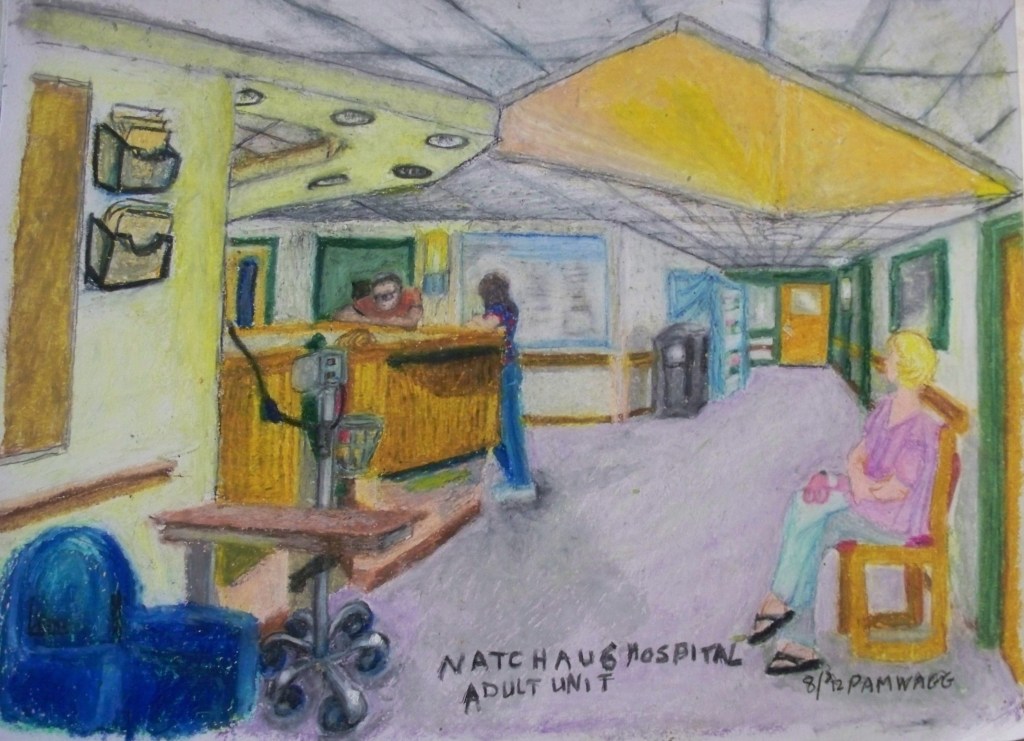
Well, that meeting took place yeseterday, Friday, at 9am. Brityn, my case manager drove me out to Natchaug, and I brought with me the oil pastel painting I’d done while there, the view of the nurses station from my room. I am donating it to the adult unit mental health workers’ breakroom, after Brian, the patient relations advocate, who is both intelligent and caring and an extraordinary listener, displays it somewhere publicly for a time.

When we got there, we were met by the director of nursing, John O, APRN. Shortly thereafter Dr Kline came along and we went into a little room off the lobby. I was a  taken aback at first when, while waiting for Dr W,  John and Dr Kline started talking with Brityn, as if she were the only person in the room, as if, “professional to professional,” they could ignore me, a mere patient once again.

This was unconscionable. I was the person with whom they ought to have been concerned, and instead they directed themselves wholly to Brityn. It also felt infantilizing. Why didn’t they even greet me or ask how I was doing since I’d left Natchaug? They could have at the very least made small talk with me. Instead, they chatted with Brityn, someone who is not only my junior by about 30 years, but with whom they’d had no prior interactions whatsoever and whom they didn’t even know. It was insulting.

I dunno. Maybe I was too sensitive. Maybe they just wanted to include Brityn…But it didn’t feel that way to me. It felt like they were talking to her as a way to avoid talking to me, a way to simply bypass chatting with me.

To their credit, however, when I mentioned it – “You know, I am here and I am a person too. You could at least include me in the conversation…” — they apologized. But even now I do not believe they understood the problem. They thought it was perfectly acceptable — since Brityn had driven me (I wonder how they would have behaved had I simply been able to drive myself!) — to treat me as merely a patient, a “charge,” and to treat Brityn as their equal, the other professional, the only one on equal standing with them. Well fork them…It cost me a lot to go up there, not even to talk about what they did to me. Do they really think I am OVER it? They ought to be ashamed of themselves.

But I will let that go as well.

Soooo, down to tin tacks, which turned out to be the golden glue of the meeting itself.

Dr Weidner, small and blond and –somehow I want to call her “open-faced” — she seemed not to hide a lot, had what looked like a genuinely interested and caring face, though naturally psychiatrists are trained to achieve this appearance. Nevertheless, I did trust her sincerity.

This time I cannot recall if she called me Pam, or nothing at all. I do not think she called me Ms Wagner, though.  I pointed out that since I understood that the post I’d written, the “Open Letter” had essentially “gone viral” in terms of the Natchaug Hospital staff itself, I didn’t feel I needed to talk much about what had happened in August. I had written all about it in detail. Or most of it…Mostly what I thought I should talk about was “How to make Natchaug a better place.”

I did that, and in fairly great detail. I will write a separate blog about all those suggested changes, and changes which would apply in spades to other hospitals. But for now, I just want to report on the meeting itself.

Dr Weidner seemed to take careful notes  and when I had finished I was simply “blown away” when she said, “Pam you have so much to tell us, and are such a good teacher, but there are only the three of us here today. How would you feel about coming back and talking to the entire medical staff? Your experience as a patient and your ability to articulate it would be just invaluable for many more of us to hear.”

Well, I almost laughed in sheer belief and pleasure. “Of course. I would love to. I do public speaking and would have no problem with that. Anything at all that I could do to make Natchaug a better place would be fine with me.”

Dr Weidner also wanted to know what they could have done to make my own stay less traumatic “from the start,” especially how they could have relieved or prevented my becoming mute for so long.

I told her that from the instant that the first episode started, when that nurse or whomever said to me, “Take your hands out from under the blankets!” I felt so betrayed, felt indeed that I was back at Hallbrooke being tortured by those two abusive staff members (who were actually reprimanded for their behavior) that I became mute at that very instant.

Would I have taken Ativan despite my psychiatric advance directive’s proscription against its use? Yes, had someone gently explained its use and suggested I take it to help my mutism, just a small dose, I would have at least considered it.

But no one presented  Ativan as an option…I do not believe anyone even knew about it. Except of course to force it on  me against my will during the Seclusion event I described in the earlier post. Not until Dr Cappiello insisted that I ask Dr Pentz to prescribe it, and that was only after I had been unable to talk for 8 days.

As for the mutism itself? They — Dr Pentz and some of the other docs and APRNs — insisted that I deliberately chose not to speak, that I could have if I wanted to. But in point of fact, I could not get myself to speak, I woke every morning with no “inclination” to speak and no felt ability to break that barrier…and therefore I truly could not speak at all. In fact, it took hours, and maybe two doses of Ativan before I was able to speak at all even when I did take it.

After a few more words of conversation, the meeting broke up and Brityn and I headed towards the car, with the expectation that we would come back again so I could speak to a larger group of Natchaug personnel.

So that was my reconciliation with Natchaug and I left feeling like a million dollars. Even Brityn told me it was the best appointment she had taken anyone to that week.

You know, my sole worry — and I felt a frisson even as we talked about it and my worries were not immediately allayed — was when I asked if I could ever be readmitted, ie as a patient. I know, I know, why would I even want to? Dr Weidner said she didn’t think I’d ever want to come back. According to her, that’s what I’d written in my blog post. But in  fact, what I said was that I didn’t think I would ever be taken back. I was considered such a PITA, why would they want me? And also because I could not see anyone for a doctor but Dr Andrei, and it seems dubious that she would see me. Why I do not know. But so be it. I liked her, never had any problems with her. But I must have done something wrong. This is twice that they have refused to assign me to her.

In truth though, 1) I have NO WHERE ELSE TO GO, no where else I could possibly begin to trust or feel safe, nowhere do I have even a history of feeling and being safe and 2) say that they do change, where else would I want to go?

In any event, since I can work with neithe Pentz nor the other doctor on the unit, because of “conflicts of interest” (i.e. he still has “feelings for me” from our days in med school together) that leaves only Dr Andrei, and I dunno if she would accept me onto her service. So, even if theoretically they would take me back – which didn’t seem at all certain, not from the vibes I got from Dr Weidner — I don’t have any idea who could see me if I were admitted.

(What the fork!  I would be stuck in a snake pit like Hartford Hospital’s Institute of Living only to be brutalized again. When push comes to shove and I might need or want to be re-admitted, frankly I wouldn’t expect the admitting MD Natchaug to give a damn, no matter how many times I’d spoken to people there and how much I might have taught them. As soon as I need their help as a patient,  frankly, I expect I’d simply to be abandoned to my fate somewhere else.)

Well, of course I will still help Natchaug,. How could I not want to help them? I want to help EVERY hospital in the state become as good as Natchaug and even better. But it sucks all the same.

———————————————————————————

*** Finally I want to make a brief comment about the specific words “a borderline” used early in this post, because every time I hear this phrase it makes my blood sizzle. Not only is very insulting, it stigmaties. I may not have borderline personality disorder, but I know what is meant when someone calls a person “a borderline,” and it is invariably  takes the place of PITA, Pain in The Ass.

There is a difference, a huge difference between understanding the very real travails that a person with such a personality disorder undergoes daily, the emotional suffering that afflicts that person, and simply calling them names because you find them troublesome.

Empathy goes a long way, especially with someone who suffers from BPD. The idea of calling someone “a borderline” is tantamount to saying, “I suffer from YOU.” A disgusting statement if ever I heard one, one most often made by mental health professionals. Doctors who use the words, “a borderline” need 1) re-education in language and its nuances, but 2) and much more important, a re-education in COMPASSION.

Of course, that’s just IMHO…and who am I?

I’m Nobody! Who are you?

by Emily Dickinson

I'm Nobody! Who are you?
Are you – Nobody – too?
Then there's a pair of us!
Don't tell! they'd advertise – you know!

How dreary – to be – Somebody!
How public – like a Frog –  
To tell one's name – the livelong June –  
To an admiring Bog!

Natchaug Hospital and Trauma-related artwork (plus…)

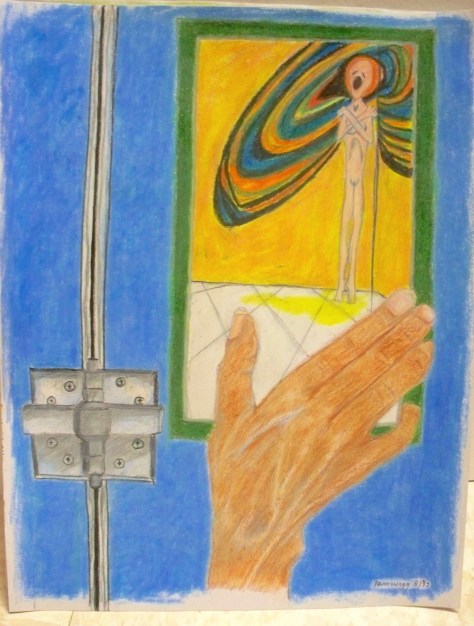
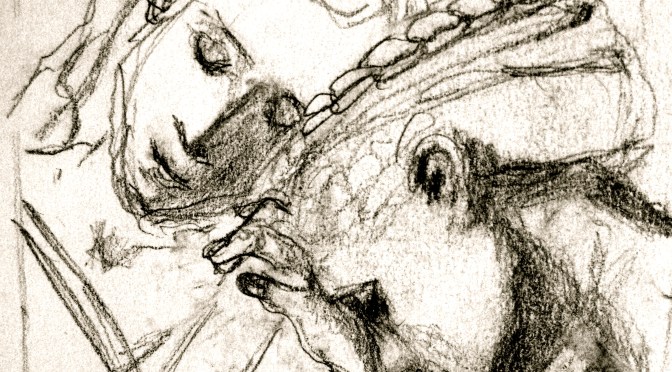
This is how I felt after one incident, #2, which involved a very physical “altercation” and restraint, and actually culminated the next night in that seclusion event I wrote about yesterday.
I call this picture “utter” because 1) I was unable to speak or utter any words for 8 days after the first physical assault on my person, and because I felt utterly — well everything, betrayed, abandoned, impotent, hopeless, helpless once they locked me alone in that seclusion room…
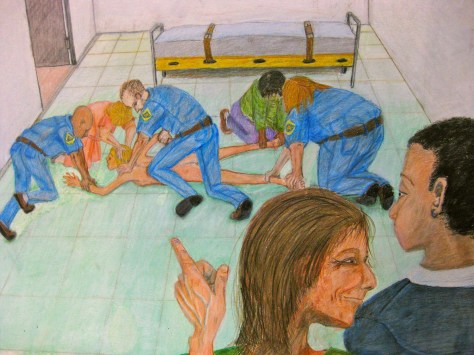
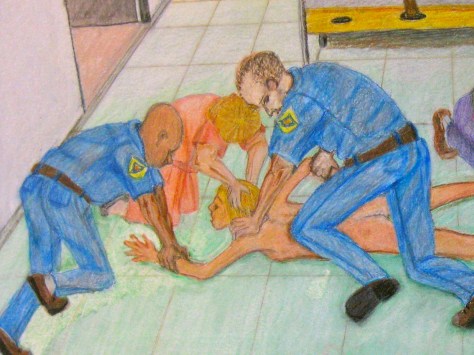
This is a more “controlled” as it were depiction of the seclusion incident, done a few days later, but still obsessed with it (largely because NO ONE would honestly discuss it, or let me. They just wanted me to forget it, leave it alone…No one would even admit taking part it in, but flatly denied even being on duty that night.

This was a picture I finally finished at Natchaug…Not trauma related. I call it Wonder.
“Up for Interpretation” – a birthday present for my friend Tim.


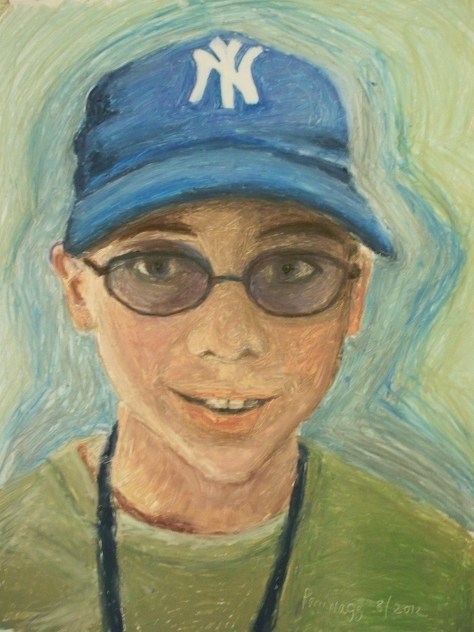
Portrait of her son, and present for my favorite visiting nurse