Tag Archives: Book

New Psychiatrist – 2nd Appointment

Dear Dr C:


Today when I left your office, I had to get natural bug spray as I walk at the State Park at least once a week and I usually forget to use it for the mosquitoes and ticks…Well, I went in, made a beeline for where I thought the display would be (having really no idea, I had to traverse the whole store before I found it, unfortunately, given that people there — as I told you — were talking and thinking about me and looking at me and wanting me not to buy or to buy certain things as usual…). ButI found it finally. Luckily there were not too many choices and the choice was made for me when I saw the word “local” and “made in Connecticut” as I knew that would please the “locavores” who were monitoring my purchase — a locavore being someone who eats only from local sources.


Despite the fact that it was the most expensive bug spray on the shelf I took the bottle and found the shortest line…No, actually, the line I stood in was the one where the woman before me actually looked at me without a frown, and in so doing gave me permission to stand behind her. I paid with my last ten dollars, though the cashier made everyone wait, impatiently I am sure, because he didn’t believe it cost $9.99 and he “didn’t want to overcharge me.” Hah!


Finally, I emerged from the store safely, shouldered my bag, and headed for the car. But as I stepped near the curb, a red Mini- Cooper drove past me and I understood immediately that this was your car, Dr C, and that you recognized me coming from Whole Foods. This seems entirely reasonable to me, since there was not another patient waiting in the waiting room when I left, so it seems likely that you were heading elsewhere after I departed…And suddenly a red Mini-Cooper seemed only rightly and properly “your car.” But somehow this conjunction boded very ill to me and I immediately became apprehensive, or what my sister, Dr O and my friend Josephine all called paranoid.


On one level I see what they were saying. But on the most profound level, I KNOW that what I know is truer than their objective observations. I was/am certain beyond the faintest doubtful smudge that you are in with Them, capital T. Who are They? They are the osteopaths of H_____, who have had a conspiracy against me for years.

Lynnie – Carolyn — told me I should talk about this with you, so here you are: this is only one of the big problems I have with you at the moment. Another one, which may be insurmountable in the end, is that I want to know why you sit where you do, I mean, way across the room from me. I do not want you to change. Do not suddenly get up and sit elsewhere. I just wonder why your natural choice is to sit, what is it, 10 feet away? Do I, as I fear, repell you? (If yes, is that because of the Osteopaths and what they have shared with you?) Do you fear me? Fear something? I can barely see you. I feel like you cannot see me, which is more to the point.

I need…I need…Oh, Lynnie tells me to do something different from what I “usually do” – be brave enough to ask questions when I should then sit still and listen to the answers, and ask for clarification if I still haven’t understood. To discuss what I feel rather than letting my paranoia get the best of me, not simply accept it and go with it full speed ahead. But I do not know HOW to fight the absolute certainty that things are going on, nor the special knowledge that I have. Zyprexa helped more than anything, but that is utterly unacceptable. Nothing else has made a dent. Except possibly the 35mg of Abilify, which I went back on tonight, just in case…We’ll see.

Enough is enough. I hope you don’t mind that I wrote this. I didn’t want to leave a message on your phone nor ask to have you call me. In fact, though, I may keep this until the 13th and give it to you then, as I am afraid you might consider it a burden to read a letter “off duty.” 


Sincerely,

PW


Now, that is what I wrote him, after the incident recounted in the letter, but in fact, I have found and called an APRN therapist, a female, who sounds and “feels” more to my liking, though I have not yet met her. Maybe I simply get on better with women than men? But that is not true, as I have had male docs in the hospital I preferred over the female therapists by far. I think, as I discussed it with Dr O, I found Dr C not so warm nor “safe” in the end, nor responsive to what I said. I had trouble talking with him, because he did not actually talk with me, only listened, which is not what I want in a  psychiatrist. I do not want that sort of “therapy” — I don’t want to delve into my past or my inner feelings. I have a hard enough time dealing each week with what is happening in my life, let alone the deepest darkest secrets that my mind hides from me and in which I have no interest…My goals in therapy are mainly two: to gain some self-esteem and self-confidence, which despite how I may sound here, I have almost none of, and two, to somehow, somehow, if possible, learn how to cope with and not be so chronically paranoid. Of course, those were Dr O’s aims with me all along, I imagine. But perhaps if I myself commit to them and learn how to work at them, more headway can be made. I sort of think, now that I know what paranoia is and how to recognize it, finally, that I need concrete exercises to practice how not to succumb to my tendency toward it. Ditto self-esteem, which tendency is just as strong, if not stronger, since it produces as much paranoia as grandiosity does. I cannot imagine what form such exercises might take, but I can imagine that they exist. I cannot be the first person to need them, after all.


WE MAD is at the printers but apparently it takes a month to come out from there, so it won’t be finished until May 28th! Geeze, and I thought it would take a week at most…This is going so slow. I cannot see how they could possibly have gotten the book out in February, even had I not been ill and taken a “month off”. At best they would have gotten the book out in April! I should have known that anything a publisher says with a deadline has to be taken with a grain of salt. But I cannot seem to get that through my thick skull and so I still keep on expecting things to be done on time, and keep meeting deadlines that no one else ever does.

New Papier Mache Artwork

I have been madly completing artwork for the show coming up on the 28th. So far have done three bowls and finished the Sitting Child Trudy…Have two more bowls waiting to be painted…And a goose to make for Ruth. Meanwhile, “The Book” is not yet printed, but it looks like it will be soon…The one poem I hate, Solo for Two, cannot be deleted, so I must settle for it staying in  but the other corrections were made. I wish I had not been told that the book needed no editing, which is patently silly, ALL books need editing! But that is what they told me, so I did not look at it again, until it was too late to do much. I should have known better! I ought to have known better, as that is precisely what Diane K, our erstwhile editor told us about Divided Minds, and so opted out of helping us. But nothing could have been further from the truth, and luckily we knew it. She was basically trying to sabotage the book, even Lynnie thought so. ARGH, that is water down the sluices…What is important now is that the corrections I really needed made in WE MAD were in fact made, and the one poem I do not like may in fact appeal to someone. So I will put up with that one poem staying in, and hope it does not mar the entire thing…

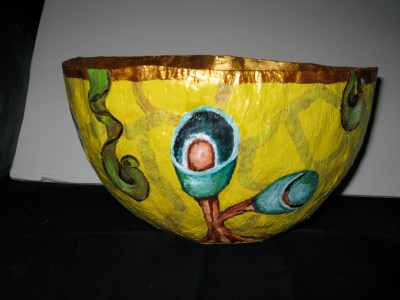
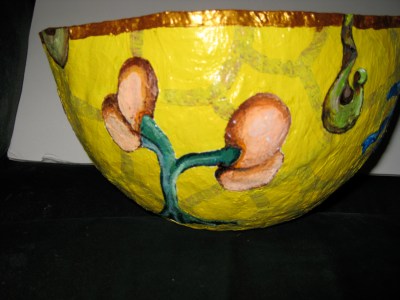
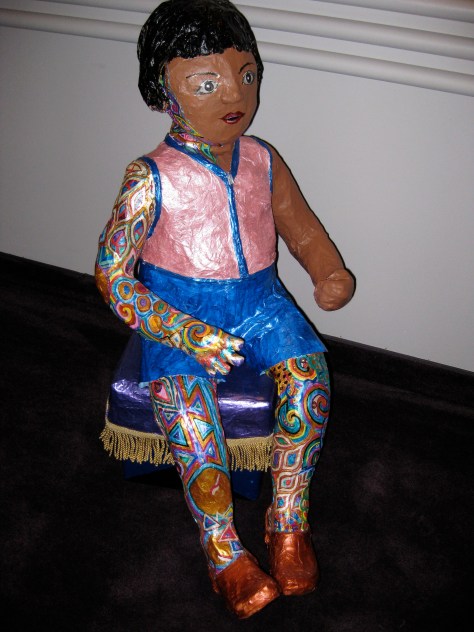
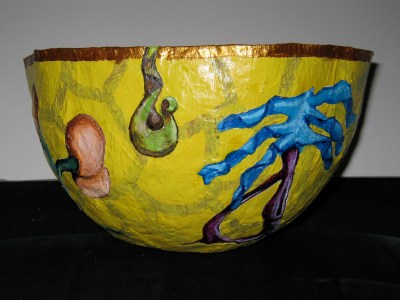
That said, here are the new art works, first the three bowls, which take about a day to paint each, more or less, and then Trudy, which took several months of intermittent work.

Two Bowls, one 4" and one 7" - papier mache
Odd Botany bowl -- these plants are not real anything
Another shot of Odd Botany bowl
Ditto
Ditto
Final side of the Odd Botany bowl


trudyfincopy

Trudy is about three feet tall but on her hassock is somewhat taller. I’d say she is about the size of a seven year old? But I dunno, since I haven’t seen a seven year old in a while. 8)

Schizophrenia: “Divided Minds” and Recovery

The day our book, “DIVIDED MINDS: Twin Sisters and Their Journey Through Schizophrenia” came out, in mid-August 2005, Carolyn/Lynnie, my twin sister, and I had three engagements scheduled, including a radio interview, a TV appearance, and, that evening, our first public  speaking/reading engagement at a local library. Due to advance publicity and widespread interest, it turned out that the venue had had to be changed to accommodate all the people who had called ahead indicating they planned to attend: instead the usual small room at the library, we were to speak in the auditorium at the Town Hall.


I made it through the day all right, but by evening, I was beginning to become symptomatic, hearing people unseen whispering over my shoulder and seeing familiar dancing red particles I called the “red strychnines.” Nevertheless, I was determined to make it through the final “gig” of the day in one piece. I was, however, getting more and more nervous, despite taking my evening medications early. Finally, Lynnie suggested I take a tiny chip of Ativan, not enough to make me sleepy but enough to calm my anxiety. I resisted up until the last minute, when, finding the stress unbearable, I agreed to it. She ran to get me some water, and came back with two cold bottles that had been set aside for us all along.


Then, we were on. Lynnie had done some speaking before, and seemed to me to be amazingly relaxed in front of the 340 people who overflowed from the first floor onto the balcony above. When she introduced me to read a section of a chapter I had rehearsed over and over until I could do so with the proper ease and feeling, I got up, trembling, and walked to the podium, wondering if my voice would tremble also.


In the book’s margins I had everything written out, from my introduction to the passage to instructions to myself on where to slow down, where to raise my voice, where to pause and so forth. I raised my head and looked at the audience, then looked down at the text and taking a breath, began.


I was surprised to hear my voice sound as strong as it did and wondered how long I could keep it up, knowing how fatigue and awareness of the audience could make it weaken and go tight on me. Indeed, after a particular spot in the book brought painful laughter from some in the audience, I could barely speak. I had coached myself for this eventuality: Breathe, I told myself silently. Breathe through it, keep reading but breathe slowly and calmly as you read and your voice will relax and stay loose. To my intense surprise and relief, it worked. I made it through the entire segment. “Thank you,” I murmured, indicating that I was through,” though it was obvious from the text that the piece had come to its natural end.


The audience burst into applause. People stood up, all of the audience stood and clapped. I didn’t know what to do. They were applauding me? What had I done to deserve this? Even Lynnie was on her feet and smiling. She nodded at me, telling me it was okay. Her eyes seemed to sparkle, as if they were full of tears. My own eyes were wet and I was too embarrassed to wipe them…


Lynnie then gave a speech of her own, a wonderful speech, ending with her asking me to stand up. and this too received a standing ovation. We looked at one another.. Who’da thunk? our eyes asked in pleased but puzzled amazement. Then it was over. But not quite. There was still a long line of well wishers with books to be signed and many people who wanted to talk to us. I was so tired that I let Lynnie field most questions, and   hid behind her or busied myself signing and pretending to pay attention to her, so I didn’t have to talk myself. In truth, I was exhausted, and though elated the evening had gone so well, on the verge of tears from sheer relief…


When we left, there were only a few people remaining in the hall. The library employee who had given us the opportunity to speak, told us it was one of the best attended events he had ever scheduled. We thanked him or Lynnie and Sal, her new boyfriend, did, I mostly lagged behind, and  followed  as if in a trance. Then we headed out into the warmth of the August night.


After the success of that night, the book tour, and later our paid (Lynnie was paid, I was not, as she had to take time off from her practice to do so) engagements became easier and easier, especially after we worked up speeches of our own and developed a rhythm and interaction with one another that seemed to work well. But it was wearying, and I wasn’t always taking my medication as I was supposed to. I still hated Zyprexa, which we had cut to 2.5mg plus Haldol and Geodon, and so I skimped on  it as often as I could, as well as the deadening Haldol. Geodon was the only antipsychotic I was on that seemed to have no objectionable side effects, but it clearly was not effective by itself. So even as we made our way out to Tucson, AZ I was skating on the edge.


2006, fall. I had made it 18 months since my last hospitalization but fatigue and exhaustion and it may be (I do not now recall for certain) not taking all my medications as prescribed conspired to allow in the same hallucinations that had such devastating consequences back in 2003/4. I was to set my whole body on fire, they told me, not to kill myself but to scar myself so badly that all would shun me, leave me alone, which was what I deserved, and what they ought to do in order to be safe. Because I could not promise not to act on these commands, I was hospitalized not far from where Lynnie lived at the time. I spent a month there, a very difficult and painful disruption in my life about which I have written earlier (see the entry about “trust”).


I was hospitalized it seemed every five months after that, until 2008, when I managed another 18 months. But life in between those stays was improving. Although we still did occasional speaking “gigs” we slowed down on those a great deal, so my time was more my own. I had made a papier mache llama once in 2004 when I was hypomanic, and it had taken all year to paint it, after I’d come home from the hospital no longer high. But the fun of it had stuck with me and in 2007 I made a turtle, a huge tortoise and took a couple of months painting it. In between I created some small objects. Then over December 2007 and January 2008 I built and painted my first large human, the Decorated Betsy. I was off and running, with Dr John Jumoke coming in April, May, and June of 2008 and the Shiny Child Ermentrude started in October of 2008 and finished in early January 2009.


Also in this period of time — between 2005-2009 — I put together my first manuscript of poems written over a 20 year period about living with schizophrenia, and another manusript of more recent poems, not about schizophrenia, and sent the first one off to the press which is publishing it, in their series on chronic illness. Once it comes out, probably in March, I will be free to finish work on the second. I will send that one out  and hope it too gets published as I prefer those poems to the ones in the first, though I have had rave reviews on that one, at least from the people who have seen it so far. I, of course, as the author, can only view it through the jaundiced lens of self-criticism and self-hatred…


Plus ça change, plus la meme chose. (and some things never change…)For all the seeming success I have had in these past three years of recovery, I still struggle with abysmal lack of self-regard, and chronic paranoia. If and when I find myself a new therapist (I must soon leave Dr O, as the travel time 1.5 hours there and 1 hour home  has become too much for me, and too it may be that she will no longer be continuing her practice, though I do not know that for certain…But in this economy, I can no longer afford the ride there as well as her fee. And I think too it is time to move on…both for her sake as for mine.) ..if and when I find a new therapist, it is those two things, self-esteem and the very right to have it, and paranoia — how to either end it, or live with it, are my two major goals I want to deal with, head on.


But then, maybe that’s all we have ever done, Dr O and I, dwelt forever on my lack of self-esteem and my paranoia, getting nowhere for all that. Perhaps she had the wrong tactics, the wrong methods, or else perhaps I am hopelessly mired in  my own worthlessness and suspiciousness — for lack of a better word, though paranoia means so much more than that…


In any event, I have tried here to describe in one entry a little of what has gone on for me since the book came out, since the beginning of my recovery. But my recovery truly began when I’d started Xyrem some months before. That is the drug that caused Lynnie to exclaim upon seeing me, two months after I’d started it, “Pammy, you’ve changed. You look wonderful, you’re back.” Xyrem, book, papier mache, poetry…all together gave me parts of a life that became somehow worth living, and it is worth living, even if at times of dark forgetting, as in February, I lose track of the one fact I need most to remember.

On Writing and Memory

I am trying to start a new book, another memoir. This is an exciting endeavor but I’ve gotten stuck on the problem, a perennial one I imagine, of how much does one really remember, and how much does the mind “make up,” that is, remember improperly? I know that some writers of autobiography — to my mind a more stringent form, requiring research and some historical context –and memoir make the claim that every word they have written is factually accurate, to the extent that they have checked each one against the memories and records of others. Then there are the infamous ones who have played so fast and loose with the truth as to have lost all semblance of it. These have produced literary scandals (as well as books that probably earned their authors much more income than if they had actually stuck to the facts) and more or less short-lived discourses by the punditry on the nature of truth and memory: what can we really know? Since I am something of a sucker I tend to take both of these at their words, when in fact I daresay that neither of them ought to be. True enough, the one has done more work than the other, and has made an honest effort to search for the “real facts” in his or her history, but my question is this: Can it be done, one, and two, why should the collective memories of say, ten people chosen by the author (biassed) be more “objectively real” than the simple truth of what the author herself remembers? Yes, you might build up a larger group of pieces-of-the-elephant if you have ten blind people who feel only one part. But unless you have someone who knows how the pieces fit together, you still only have elephant pieces…And so ten pieces are no better than the one in the end.

What I am saying is this: the author, the person who lived the life has to be the one to make sense of it. She might have a thousand “elephant pieces” — memories given her by ten people, yes, or only her own memories but in the end she must construct what the elephant – her life–looked like out of them. In some sense, there are facts and there are facts, but the work, and the life, and the living is all in the interpretation; always was and always will be.

That said, I am having trouble getting started, because I don’t know whether I want to use more “objective” sources or evidence this time, or not. I am perfectly comfortable using what is close at hand: my journals, my photos, the people I can easily consult. And I do feel very uncomfortable with mining deeper records: I do not particularly want to see what is written on my hospital charts during months-long stays when I was ranting and screaming for days, or engaging in outrageous behaviors like taking a dump on the floor of the seclusion room, or disrobing and…I can scarcely bear to think I did such things, frankly, and do not want to read what was written about me at the time, knowing nothing can be corrected or updated to show them the “new me”. A sad fact about hospital records and workers: they only see you when you are at your worst; they rarely get to know if you get better. Much less get to know you when you are well. And if you ever wanted to sit down and tell them what was actually going through your brain at the time they believed XYZ, but in fact QRS was happening, well, forget it.

So, I am loathe to overturn those stones, growing mossy as they nearly are now, some four years later. It pains me even to bring my mind across the memories of them. I have no wish to flagellate myself. My own journals say little, but it’s about all that I want to know. At the same time, my own brow-beating conscience tells me, NO, you must do what you do not want to do. The very fact that you do not want to do it means that you should. No pain, no gain—

Oh, I just go on and on. I would make this next book a torture to me, nothing of pleasure at all, just to serve my scruples. Be gone! If the writing is only to torture me, why do it? I’d be better off with my artwork and sculpture. But writing nurtures me, so long as I do not let my illness turn it into a punishment. Is there any need for me to use the historical records in telling the tale of my life? Did my first book lose anything in my not doing so? I would change a lot in DIVIDED MINDS, if I could go back and do so — add scenes here, take out one or two, most certainly make better transitions — but except for appending a much clearer discussion of this very issue, and also a better disclaimer, I wouldn’t change the way we wrote it.

So I might have talked myself to a place from which I can start, allowing myself the freedom not to have to delve into the official records or consult professionals involved in my care unless I am currently in treatment with them.

Your past after all resides as much in what you remember as it does in anything documented. You are mostly what you remember, and what you remember is sculpted by time and changes over time. If you think your memories remain the same, read back in a diary you haven’t read before, and recover the accounting of a incident you thought you’d recalled with accuracy…You’ll see how inaccurate your “memory” was and how formative this memory had been nevertheless. Then remember that the accounting is itself a memory, tainted by emotion and interpretation and consider those “ten people with their elephant pieces” who tried to give you objective memories of your history. Were they truly objective? Were their memories, even collectively, any more factual and objective than your memories?

In the end, memory is fiction, as someone once wrote in The New Yorker magazine, memory is, well, made up, not real, imagined. I agree, but it is all we have. Literally. Without memory we would be without anything at all, no culture, no civilization, no nuthin’. So let’s not pretend that the fact that memory is fiction isn’t critical. We need memory, and memory is, well, fundamentally untrustworthy, which is why we need thinking, and thinkers and writers to interpret history and memory… Memory is the most important thing we have, the most important attribute we can impart to anything: in almost every sense of the word, when we remember something we keep it alive. Maybe not literally, but then again, it is memory that keeps a conversation going on longer than five minutes. If you forgot what you were talking about ten minutes ago, or to whom you were speaking, nothing much would get said…