
I wrote in the post below that for three weeks in October I was in Manchester Memorial hospital (a new unit for me. To explain, the hospital you are sent to in this state these days is a total crapshoot. Sometimes the ER can admit you to theirs, but if it is full, as it so often is, they can send you literally to any hospital in the state that has an empty bed.. With the governor having decided to close one of the few state facilities still open and the municipal hospitals so over-utilized that an average stay was 5-7 days only, you can imagine how inadequate any attempts at treatment are. I do not mean to diss the hospital staff in general. Some do mean well and are appalled at what their jobs have devolved into, others however seem not to care that they are no more than warders in double-locked secure psychiatric units where few are admitted truly voluntarily or at least only on an emergency basis and yet no one can stay until healed. Generally speaking, one stays only until such a time as they are either no longer acutely suicidal or no longer a danger to others… That said, I have to be somewhat circumspect about what I say and the judgments I make as I was and tend to be when in any hospital so paranoid that I simply cannot draw any reasoned or reasonable conclusion about the staff or the treatment there, since it is always more or less (and usually more) through the lens of my sense of personal attack and persecution. In truth, I scarcely remember any of the details or even the gross facts of this particular hospital stay. In fact, I have had to be told second hand, or even third hand, most of what I did there and/or of what happened.
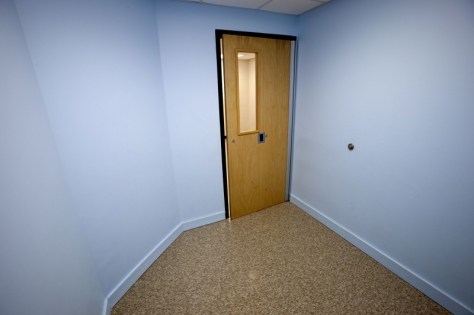
I can say a few things from memory, though, and the picture I posted above is relevant to that: I remember being hauled off to the seclusion room and more than once. (I do not have even the slightest scrap of memory why…which is unnerving, and yet also a relief, as it protects me, possibly, from memories I might not wish to have…I hasten to add however that my lack of memory is not psychological, but neurological: we were warned by my Lyme neurologist that I should not have ECT while I still had CNS Lyme disease as it was likely to produce untoward CNS effects that could not be controlled or predicted. Since then, my short term memory has been particularly affected, among other things (e.g. olfactory hallucinations). IN other hospitals, the seclusion room usually had a mattress in it, something upon which you could lie down, and were expected to, in fact, since you were given medication and expected to calm down and sleep in general. At other hospitals, I stayed in the seclusion room for an extended period of time, either because I was extremely disruptive (NOTE: see posts about Natchaug Hospital regarding this) or extremely psychotic. At those times I was usually permitted other items in the room, such as magazines and some small personal things to pass the time with…But during the month that is ending, I was literally manhandled into the room and dumped on the floor — hard linoleum — stripped, forced into a johnnie coat (I had to beg for 2), and summarily left behind, the door locked decisively between me and whoever was posted at the observation window.
I remember screaming, I remember begging for a mattress to sleep on, I remember begging for something to cover myself with for warmth or at a minimum for the heat to be turned up as I was thin and it was notoriously cold on that unit, and there was nothing whatsoever in the seclusion room to buffer the air conditioning. No deal. They just told me to be quiet; actually, I do not believe they even said that, but just, No. I do not remember much more than that. In fact, though I have been told the next, I do not actually remember it: there was of course no bathroom facility, and not even a bedpan in the room. Someone told me later that I defecated into a cup…But I do not see how that is more reasonable than that I did so into a bed pan…Why would I have a cup in there if I did not have a bedpan…No, I believe that in both instances I have been told about, I peed and defecated directly onto the linoleum. If I did so, I cannot explain it. Perhaps I was simply desperate and they did not provide any other mode of relief. Maybe I was angry at them, and did it to “get back at them”? (This was suggested to me as a motive by the person who told me that I was not the first and would not be the last person to do this in that room…which was both a small source of relief, to not be unique, and yet to have done it as a kind of revenge?! I did not want to believe that I would or could be so primal in my anger…But then, I have done it before, if you recall…
After that — and my memory wants to “see” this, feels it almost can and almost does, but I cannot be sure that it is memory rather than a mere confabulation after the fact, having been told the bare bones of it by Carolyn (Lynnie) and others, who themselves only heard about it but did not see it either…after that I believe I crossed the room to , hoping there was no slant in the floor that would make the puddle slide towards me, and lay down in a heap and fell asleep.
Or did I? Did I? Or were there consequences to my act? I know that at some point in my “stay” — seems so mild to call the brutality of my hospitalization merely a “stay,” as if at a spa — I was put into restraints and kept there a very long time. Was it for a separate incident, or was it connected to…Aahhh, wait a minute, yes, I do know, I do know…I remember now…For some reason, and I do not quite remember why, except possibly I was just so sick of everything that was happening, and so…I remember taking off the hospital pajama pants that were way too big for me anyway, and never stayed up and had no ties to pull around my waist and so were useless. I pulled them off and wound them into a narrow rope, which was easy as they were made of very thin material, then I formed them into a kind of slipknot, fitted it over my head and around my neck and pulled on the one end that had to be pulled for the knot to tighten, holding the other like a kind of ballast (I don’t remember entirely how I did this only that it felt dreamlike, how easy it was to accomplish). I have forgotten what I was thinking, if I thought at all. Probably I did not think, I was that far beyond any rational thinking, even beyond any rational “wanting” in the sense of really wanting to die or not.
In any event, it seemed to take a long while before anyone noticed, and then a whole crowd of people were suddenly upon me, and they didn’t seem to know how to get the noose off or how to loosen it. I held the end that slipped tightly in my fist, having no desire to relinquish it, though at the same time having I suspect no real desire to die either, that they could not easily free it. I heard someone yell to cut the knot. I remember thinking that was silly, why didn’t they just untie it? But it seemed that that was not possible, or at least that it was taking too long. Then there was a pair of scissor up at my throat where the knot was — it seemed that only bandage scissors could be found and those were not easily accessed — and someone was ripping at it, and then it was torn away and my neck was freed.
Stop. I have to stop here. Memory now fails me. I can only speculate what happened after that, because it literally blurs into nothingness. Goes blank. Goes back into the vault wherever all my lost memories go, perhaps never to be retrieved, if never fully or adequately formed. All I can do is try to reconstruct what might have happened next. I am pretty certain that it was after this that I was put in restraints. It would make sense. After all, what else could they do, and what would make sense? If I wasn’t safe in a seclusion room, in a hospital that in fact DID resort to seclusion and restraints, it seems only likely that restraints would be the next measure taken. So I have to assume that it was for that reason I was put in four point restraints. Also, since the doctor I had been assigned to, thought a sadist by many on the unit, was also the director of it, it was likely his call that led me to being kept there for more than 12 hours, and maybe as many as 18…I honestly have no idea in the end how long he kept me in such a fashion, only that I was not released even after I had fallen asleep…
That is almost the sum total of what I can, as a kind of “hard copy” memory, remember on my own. As you can see, even with those few memories, I had trouble and some help in recalling them. I have some vague sense that a great deal went on during those 2 and a half weeks when I was largely insensible to what I did (at least to the extent that I did not recall it from moment to moment). During the last half week when I finally cracked the paranoia that kept me imprisoned, my memory did not improve, only my temper and the distance I kept from and my anger towards those who I had earlier felt were working in cahoots to hurt me. My impression then was only that some people were angry with me, but I did not know why, that some people resented me…But I could not figure out why. The ones who seemed to brighten when I smiled and help nothing against me told me gently a little about what I had done or how angry etc I had been, but only vaguely. They did not seem to understand that I had literally no memory of the previous 2 and a half weeks, or if they did, they did not seem to want to refresh my memories, perhaps feeling that it would be unkind, I dunno. In any event, I learned a little about the “Pam” that some thought they knew, or that some people thought they had met and known for those 18 days…and that others had believed was in there all along and were now glad to see emerging…But it was very confusing. And in all that confusion, I also had to deal with the fact that the new doc who had taken over after the sadist doc was removed from my “case” thanks to Lynnie’s intervention, had decided that his philosophy of short hospitalizations would take precedence over whether or not I was fit for discharge, and so I was to leave on Tuesday…I had no choice, and so as I prepared to leave, I also had to “prepare a face to meet the faces that you meet.” (a quote from “The Love song of J Alfred Prufrock” by TS Eliot). But I was also growing more and more revved, more and more anxious. and I had no one I trusted enough to talk about it with. I certainly could not tell the day nurse. (I don’t think I did, but I do not actually recall one way or another). I knew she disliked me intensely, for all that she tried to pretend otherwise.
In the end, I did leave that Tuesday, though even as I got into Josephine’s car and she pulled out into traffic, she told me I didn’t seem right to her, that she didn’t think I was well or ready to leave. That fact seemed clear to almost everyone I saw that day. And not long after that I grew so talkative and revved that no one could get a word in edgewise…This was so emphatically not like me that thank heavens everyone put up with me, and no one, NO ONE, rejected me or gave up on me for it. I do not remember anyone being cruel or saying, GO away, you talk too much, or you are being too egocentric etc. I recall in fact only kindness and some humor injected into the situation, but mostly kindness. They all, my friends, as well as Elissa, the RN, seemed concerned as I rocketed higher, and yet seemed to feel uncomfortable and not at all happy with how fast I was speeding. Sure, Dr B diagnosed it a hypomania, but I had thought hypomania was an enjoyable state, not this unpleasant adrenalinized racy state that felt so terrible to me. I hadn’t taken Ritalin in 3 weeks, but I didn’t even want to now. No, taking stimulants for Narcolepsy was nothing like this. This felt terrible and neither Ritalin nor even Adderal had ever felt so terrible. There was no pleasure or even alertness that made me want to do things and study and write involved now. I got a little more cleaning done, true, but only because I was trying to exercise off anxiety, not because I had pleasureable energy. In fact, had I been able to slow down, I would have gone to bed to sleep it off!
Eventually, Dr B upped the Topomax and I think we had already increased the Lamictal and eventually over the course of the next week, I came down to my usual state of semi-sleepiness and was able to restart the Ritalin (after some discussion about why I take it…He is still new to the situation and my narcolepsy)
Well, that is about all I can tell you about the hospitalization just passed. But there was more to it, and what I know about it, though the facts are vague, is that there was something massively wrong…It felt like the Y2K meltdown in some ways, esp in my lack of contact with — reality, memory? Is there a difference? I feel that this was very different from my usual post-lyme hospitalizations, that I was in a different state, and so did others. It frightened me more, and it was more violent. Certainly the treatments were more violent, but that also implies that I was too. Lynnie keeps telling me she will talk to me about it. But so far, she has not… Do I really want her to?
 WAGblog: Dum Spiro Spero