Tag Archives: Recovery

Portrait Painting #2

RN painting

New Book Is Out: Poems on Schizophrenia

Yes, I finally hold it in my hands, We Mad Climb Shaky Ladders, published by CavanKerry Press. Below is the cover illustration (minus the Spiro, which is on the final version) and the press release:

We Mad Climb Shaky Ladders: Poems by Pamela Spiro Wagner

NEWS from CavanKerry Press
6 Horizon Road No. 2901 • Fort Lee, New Jersey 07024 • phone/fax 201.670.9065 • cavankerry@optonline.net

FOR IMMEDIATE RELEASE

Contact: Florenz Eisman — 201.670.9065

WE MAD CLIMB SHAKY LADDERS

Poems

Pamela Spiro Wagner
With Introduction and Commentary by Mary B. O’Malley, MD, PhD

Foreword by Baron Wormser

For forty years – longer than her entire adult life – Pamela Spiro Wagner has been affected by paranoid schizophrenia, a plight she eloquently explored in her award-winning book, Divided Minds: Twin Sisters and their Journey Through Schizophrenia, co-written with her twin sister, psychiatrist Carolyn S. Spiro, MD. Also an accomplished poet, Wagner has long utilized the language and emotion of poetry to express the individuality of her mental illness, capturing with vivid candor her singular inner world. In WE MAD CLIMB SHAKY LADDERS, the latest volume from LaurelBooks, CavanKerry’s Literature of Illness imprint, Wagner for the first time collects her poems, presented with commentary by her psychiatrist, Mary B. O’Malley, MD, PhD, that elucidates the clinical roots of the poet’s art.

WE MAD CLIMB SHAKY LADDERS “is much more than a testimony to a diagnosis or pathology or terminology,” writes Baron Wormser in his foreword. “The poems emanate from the place of the poet’s illness but they are resolutely poems—well-written, sensually alert, quick to turn and notice and startlingly honest. They dwell on both sides of the equation of life and art: testifying to the powerful and tenuous links between the two and demonstrating that art is capable of holding its own regardless of circumstances. Some of those circumstances have been shattering. The sheer tenacity that it can take to write poems makes itself felt here in ways that are both uncomfortable and reassuring.”

Wagner’s often harrowing struggle with life, as reflected in these poems, has been marked by psychological turmoil – periods of total debilitation, as well as intervals of recovery and hope. Her battle with paranoia hovers over the work, such as in “Poem in which Paranoia Strikes at the Grocery Store” where the simple act of shopping becomes a waking nightmare: “Who/gave you permission to enter? No one/wants you here. They are all watching….You are being followed./You are on your own.” Wagner captures the voices in her head with terrifying urgency. In “Offering,” Wagner’s very first poem, written in 1984, she writes of her compulsion to burn herself with cigarettes with a haunting remove:

The tip of the cigarette glows and grins
as I lower it to you,
Unlover,
alien body.

At Dr. O’Malley’s urging, Wagner has also included three poems she wrote during the heights of psychosis, and these are filled with scrambled ideas and garish imagery that are shocking in their raw, unguarded unveiling of the poet’s troubled mind.

Divided into five sections, Wagner’s book covers childhood and the earliest indications of illness, the years of illness, recovery, coping, and new beginnings. As with most poetry grounded in autobiography, there are important familial relationships that seep into the poems – father, mother, sister, friends. Here, these relationships are filtered through the poet’s psychosis, colored by hallucinations and delusions, yet grounded in the emotional truths that any complicated relationship engenders. In her most widely known poem, “The Prayers of the Mathematician,” which won First Place in the BBC World Service international poetry competition judged by Wole Soyinke, Wagner moves beyond the personal with an eloquent poem about John Nash, the schizophrenic Nobel Prize winner who was later immortalized in the movie, A Beautiful Mind.

“These poems are the work of a first-rate writer” says surgeon and best-selling writer Richard Selzer of WE MAD CLIMB SHAKY LADDERS, “one who has sounded the well of her own suffering to retrieve the wherewithal to transform pain into the most powerful and moving literature.”

~~~

About Pamela Spiro Wagner

Pam coral and green
Photo of the author in May, 2009

A prize-winning writer and poet who suffers from schizophrenia, Pamela Spiro Wagner attended Brown University and went to medical school for one and a half years before being hospitalized for psychiatric care. She won First Place in the international BBC World Service Poetry Competition in 2002, and co-authored, with her twin sister, Divided Minds: Twin Sisters and their Journey Through Schizophrenia, which won the national NAMI Outstanding Literature Award and was a finalist for the Connecticut Book Award. Currently she writes at http://WAGblog.wordpress.com. She has lived in the Hartford, Connecticut area for 33 years.

CavanKerry Press would appreciate two tearsheets
of any review or feature you publish about this book.

WE MAD CLIMB SHAKY LADDERS by Pamela Spiro Wagner
Publication Date: 2009
Price: $16.00; ISBN: 978-1-933880-10-5
Distributed by: University Press of New England (UPNE), 1-800-421-1561 or 603-448-1533, Ext. 255

Author is available for speaking, readings, and workshops.
Contact: pamwagg@cox.net or pamwagg@yahoo.com
Tel: 860-257-9188

New Psychiatrist – 2nd Appointment

Dear Dr C:


Today when I left your office, I had to get natural bug spray as I walk at the State Park at least once a week and I usually forget to use it for the mosquitoes and ticks…Well, I went in, made a beeline for where I thought the display would be (having really no idea, I had to traverse the whole store before I found it, unfortunately, given that people there — as I told you — were talking and thinking about me and looking at me and wanting me not to buy or to buy certain things as usual…). ButI found it finally. Luckily there were not too many choices and the choice was made for me when I saw the word “local” and “made in Connecticut” as I knew that would please the “locavores” who were monitoring my purchase — a locavore being someone who eats only from local sources.


Despite the fact that it was the most expensive bug spray on the shelf I took the bottle and found the shortest line…No, actually, the line I stood in was the one where the woman before me actually looked at me without a frown, and in so doing gave me permission to stand behind her. I paid with my last ten dollars, though the cashier made everyone wait, impatiently I am sure, because he didn’t believe it cost $9.99 and he “didn’t want to overcharge me.” Hah!


Finally, I emerged from the store safely, shouldered my bag, and headed for the car. But as I stepped near the curb, a red Mini- Cooper drove past me and I understood immediately that this was your car, Dr C, and that you recognized me coming from Whole Foods. This seems entirely reasonable to me, since there was not another patient waiting in the waiting room when I left, so it seems likely that you were heading elsewhere after I departed…And suddenly a red Mini-Cooper seemed only rightly and properly “your car.” But somehow this conjunction boded very ill to me and I immediately became apprehensive, or what my sister, Dr O and my friend Josephine all called paranoid.


On one level I see what they were saying. But on the most profound level, I KNOW that what I know is truer than their objective observations. I was/am certain beyond the faintest doubtful smudge that you are in with Them, capital T. Who are They? They are the osteopaths of H_____, who have had a conspiracy against me for years.

Lynnie – Carolyn — told me I should talk about this with you, so here you are: this is only one of the big problems I have with you at the moment. Another one, which may be insurmountable in the end, is that I want to know why you sit where you do, I mean, way across the room from me. I do not want you to change. Do not suddenly get up and sit elsewhere. I just wonder why your natural choice is to sit, what is it, 10 feet away? Do I, as I fear, repell you? (If yes, is that because of the Osteopaths and what they have shared with you?) Do you fear me? Fear something? I can barely see you. I feel like you cannot see me, which is more to the point.

I need…I need…Oh, Lynnie tells me to do something different from what I “usually do” – be brave enough to ask questions when I should then sit still and listen to the answers, and ask for clarification if I still haven’t understood. To discuss what I feel rather than letting my paranoia get the best of me, not simply accept it and go with it full speed ahead. But I do not know HOW to fight the absolute certainty that things are going on, nor the special knowledge that I have. Zyprexa helped more than anything, but that is utterly unacceptable. Nothing else has made a dent. Except possibly the 35mg of Abilify, which I went back on tonight, just in case…We’ll see.

Enough is enough. I hope you don’t mind that I wrote this. I didn’t want to leave a message on your phone nor ask to have you call me. In fact, though, I may keep this until the 13th and give it to you then, as I am afraid you might consider it a burden to read a letter “off duty.” 


Sincerely,

PW


Now, that is what I wrote him, after the incident recounted in the letter, but in fact, I have found and called an APRN therapist, a female, who sounds and “feels” more to my liking, though I have not yet met her. Maybe I simply get on better with women than men? But that is not true, as I have had male docs in the hospital I preferred over the female therapists by far. I think, as I discussed it with Dr O, I found Dr C not so warm nor “safe” in the end, nor responsive to what I said. I had trouble talking with him, because he did not actually talk with me, only listened, which is not what I want in a  psychiatrist. I do not want that sort of “therapy” — I don’t want to delve into my past or my inner feelings. I have a hard enough time dealing each week with what is happening in my life, let alone the deepest darkest secrets that my mind hides from me and in which I have no interest…My goals in therapy are mainly two: to gain some self-esteem and self-confidence, which despite how I may sound here, I have almost none of, and two, to somehow, somehow, if possible, learn how to cope with and not be so chronically paranoid. Of course, those were Dr O’s aims with me all along, I imagine. But perhaps if I myself commit to them and learn how to work at them, more headway can be made. I sort of think, now that I know what paranoia is and how to recognize it, finally, that I need concrete exercises to practice how not to succumb to my tendency toward it. Ditto self-esteem, which tendency is just as strong, if not stronger, since it produces as much paranoia as grandiosity does. I cannot imagine what form such exercises might take, but I can imagine that they exist. I cannot be the first person to need them, after all.


WE MAD is at the printers but apparently it takes a month to come out from there, so it won’t be finished until May 28th! Geeze, and I thought it would take a week at most…This is going so slow. I cannot see how they could possibly have gotten the book out in February, even had I not been ill and taken a “month off”. At best they would have gotten the book out in April! I should have known that anything a publisher says with a deadline has to be taken with a grain of salt. But I cannot seem to get that through my thick skull and so I still keep on expecting things to be done on time, and keep meeting deadlines that no one else ever does.

Washington, DC and Beyond

Before I relate the tale of my trip to DC I hasten to add one addendum to the discussion below on TLE: Dr C said absolutely nothing about schizophrenia and TLE and possible misdiagnosis. Nothing whatsoever. ALL he mentioned was that my ECT apparently triggered — he used the word kindled — classic TLE in my brain, as evidenced by the pattern of onset of the olfactory hallucinations and their response to treatment. ALL the rest of my theorizing about schizophrenia and TLE has come from my own conjectures and readings that have spun off from that one statement and not from a single thing he said or implied. Please understand this. He may not have meant and may never bring up the subject at all…The question remains, Will I?


_________________________________________________

Now then, about my solo flight, my DC adventure:

On Wednesday, Josephine drove me to New Haven and I took the high speed train, the Acela – going at a rather low rate of speed it seemed to me, most of the way – to Washington DC. The trip down was uneventful, except that in my anxiety to get a seat, I completely forgot to tip the porter who helped me get my bag down and up the  flights of stairs in the station (the escalator wasn’t working). I had a five dollar bill in my pocket all ready for him but at the last minute plum forgot…for which I felt guilty the entire journey right ip until I got back into Jo’s car at the end of it…and even now, a twinge remains.


The four and a half hours passed quickly as I had to review the new edits the copy editor had made. It wasn’t announced that we had arrived. People just stood and started getting their things from the overhead rack. I had to ask if we were in Washington. Finally, off the train, I followed where everyone else seemed to be going, managing not to go near the uniforms with the dog, though it occurred to me that maybe it was where I was supposed to go, because I wasn’t going where the cars were, was i? Luckily just then, Sara waved to me from the opposite door , and I saw and recognized her so that misstep was averted…It occurred to me, however, that we have become like a police state, what with armed guards and police dogs standing around in train stations, only supposedly to protect us (after all, they tell you DO NOT TOUCH THE DOG!)


That first night we spent just getting caught up on Sara’s recent travels as she is head of an “abroad program” at a university there. Then the next day, I slept till 9 and she went off to work. At noon I was picked up by a friend of Sara’s who drove me, with a few mishaps, to the train again, for my trip to MD to talk to a senior psychology class at a small, private college in a town about an hour outside of Baltimore. During the drive to the school, I began to feel weird — thought it was low blood sugar or simple sleepiness– and asked if we could get some coffee once we got there. I felt too fuzzy to even pay for anything, couldn’t think straight to talk, just eating to prevent myself from fainting. Finally, it was time to go to the class, and so I pulled myself together, took a last bite from my muffin and threw the rest of coffee and muffin away. 


In the class I gave my talk and did the Q and A with nothing untoward happening, except that I had to stop when the feelings reoccurred with fatigue near the end, at around 4:15 (the class ended at 4:30 so I made it almost the whole time). All the questions were really good, made me think. The only one I felt I did not do justice to was the one about Lynnie and whether or not she needed therapy and medication (!). If only they knew her and Sal…But in any event, I ought to have explained how psychiatrists are ordinary human beings with ordinary human emotions and flaws and faults, not superhumans, and they get angry and jealous and pissed off etc just as anyone else does. Jealousy in and of itself is not an illness, just an uncomfortable feeling that I know Lynnie has dealt with in her own professional and personal therapy over the years (as I pointed out all psychiatrists see their own therapists first). As for medication, she’d be the first to tell anyone she swears by it, and would not want to do without it!


After that class, I was blitzed completely, and could barely sit up straight in the car heading back to Baltimore and the train, and then my head blossomed into a migraine on the train. When I met Sara in the station again in DC I was utterly exhausted. I ate a little supper but basically fell asleep by 9pm and slept through until 9am.


Friday we took it easy. We drove around the Capitol area and stopped to walk into the Supreme Court, and walk around the White House. But we didn’t spend a great deal of time anywhere as the light was a brilliant blinding white and the temperature pushing 75°F.  Also, that night I had a poetry reading scheduled at the Potter’s House Sounds of Hope gathering


The Potter’s House in DC — a bookstore and home-cooked-food restaurant, with a Let’s All Help Each Other theme…It was great to go in the door and find a seat at the table and know every, or nearly every song sung. I wasn’t scheduled until the last  of the night, and was afraid everyone would leave before then…and they almost did until the MC asked some to stay for “dessert” ie me. So I finally had my reading and I think they liked my stuff…Hope they did, I didn’t hold back or read only easy things at any rate…


THe rest of the visit went supremely well, as Sara and I get along great. We ate in an Ethiopian restaurant one night, and at a Spanish open air market for lunch the next day. Only bad aspect of the visit, and it could not be helped, was that I brought a cold with me all unawares, so I was almost, but not quite, miserable the whole time. In point of fact, I was miserable only ONE night of the four, and miserable not a single day there, thanks to Sara’s good company and hospitality, plenty of kleenex and good food, with no pressure at all to do anything (once the class was over with — which was MY pressure entirely).


All in all, a great trip. Some paranoia developed on trainride home, with feelings/suspicions/knowledge that the people who sat down next to me in the Acela were accusing me of having stolen one of their tickets…to the point that I started talking to myself and had to get all my things and move seats to somewhere I felt more comfortable. Nowhere really felt comfortable after that, though, since everyone was looking at my book and what I was reading, so I had to switch to a harmless magazine. Finally the guy sitting in the single “disabled” seat at the back of the car got off at Grand Central so I quickly snagged that, having a disabled-discounted ticket myself. Things ought to have calmed then, only then I thought people were looking at me and wondering, Why is she sitting there, she doesn’t look very disabled to me!  I was very glad to detrain at New Haven I will tell you that. But how was I to get my heavy “carry on” wheeled bag down the high stairs at the station? No way was I able to lug it myself, especially not carrying two other bags, and one being my purse/tote bag I could not see leaving it alone while I took the bag by itself.


Just then a burly older man, lifting his own carry-on in one hand, stopped and said, Let me get that for you. “Oh, would you? Thank you so very much!” I replied. Without a word, he took my bag by the vertical handle and carried it swiftly down the thirty of more steps to the bottom then walked away before I could thank him again. Oh, what a lovely gesture. I was more relieved than I could say, though it was easy enough for him, and I daresay he is used to doing it. I was very glad to have been today’s recipient of his gallantry! The rest of the way was easy, as I could draw the bag on its wheels and take the escalator the rest of the way. I swear I don’t know how they get away with making these trains to inaccessible to the handicapped. They are practically inaccessible to any but the very young and strong, so far as that goes…And nearly every station had that long staircase leading to the platform, except for, say, DC, which is flat from parking lot to train, and even minus a step getting onto the train  itself.


Welp, that was my much anticipated, much worried about adventure and I’d say it went just swimmingly, despite cold and despite migraine and intense fatigue at the middle to the end of every day. One thing I did learn that was helpful was that eating three meals a day was good for me, rather than letting myself forget to eat until late in the evening and then cramming down the calories. Today I even tried to follow the pattern I did with Sara, and started the day with a healthy brakfast of fruit, cereal and yogurt. Then I did what the visiting nurse has suggested for many many months: I set a timer to remind me of lunchtime: I had an onion roll and dried fruit at one o’clock. At 6:00pm or so I plan to have…well, some mix of green beans and onio ns, cheese and soymilk plus strawberries and black berries with yogurt for dessert. Mainly because that is all I have at the moment. Or I will have Irish oatmeal made with soymilk, plus dessert, which would be a lot easier! I hope I can keep this regimen up, as it cannot but help my stamina, if it does nothing else.

Schizophrenia and Temporal Lobe Epilepsy (cont.)

In my further reading on TLE I have learned that while “TLE hallucinations” can be ecstatic visions or the sight of threatening people or actually hearing voices, usually they are of brightly colored lights or visual distortions, like objects appearing larger or smaller than usual, hearing music, feeling insects running under one’s skin etc. In addition, there is the awareness that these are hallucinations, though not always. A personality seems to be associated with TLE, some people think, though it is not clear to me how established this is as fact. And some with TLE and without it claim that creativity is directly related to it. Hypergraphia, the compulsion to write, write, write is definitely associated with TLE, along with a compulsion to draw or do art or think/talk about religious subjects. Heightened emotional state but reduced sex drive. Something called “stickiness” is described, which I construe as a kind of tendency to glom onto a person or to exhibit an extreme loyalty. Also, there is seen irritability and gross personality change, rages, a tendency to fly off the handle or perform outrageous acts like stripping in public etc. 


In TLE you can have feelings of euphoria and floating as much as feelings of impending doom. A feeling of “rising into something” or of something rising through one’s body is a common concomitant of a TLE seizure or aura. An indescribable feeling according to many.  And you can have psychosis, chronic or acute.

interestingly, while EEG is notoriously poor at picking up TLE, there are often  punctate  signal hyperintensities (precisely the abnormalities I have had at least since Y2K) seen on MRI in those with TLE in the book I am reading — SEIZED, by Eva LaPlante.

Now I do not want to jump the gun, because too many of my symptoms have been chronic and disparate, not following a single pattern of seizure, whereas at least one authority claims that once you have one seizure, all others look similar. Indeed, while you might say that Grey Crinkled Paper arose from a seizure, and the jacksonian seizure with Novocaine were definite, and too the feelings of impending doom were also seizure activity  while I was taking Clozaril and other antipsychotic medications, the others, with different patterns yet, could not have been,since they were more varied even than those. The olfactory hallucinations had to have been seizure  associated too, but then where does it all stop, and where does the notion that one seizure sets the pattern for all others go?


And yet even conservatively I myself would count all those instances as seizures even if I were not going to count anything else as seizure-related right now…So  what to make of them, and the fact that ALL were so distinct and different from one another:?


Does it make the whole thing, the whole illness over all TLE or schizophrenia? Can you in fact have both, or does having TLE  suggest that the schizophrenia was a misdiagnosis all along?  And how does one know? Certainly, I have one trait that points towards the TLE diagnosis: I do well inbetween “attacks” of either illness, and seem to have not suffered any deterioration in brain function cognitively. Not massively. Though my memory and such is faulty, that is often the case in TLE itself!

I don’t have the slightest idea, but I suppose I will find out as the weeks go on and I continue to discuss it with Dr C, as I anticipate I will. I do plan to  see him once Dr O leaves… I liked him enough to do so at any rate, and I liked this idea enough too, to want to pursue it too. I    t will be very interesting to find out what happens, where it leads…If it redefines me entirely, I wonder how I will feel or deal with it?


Three Schizophrenia Blogs plus…

Judy Chamberlin was hospitalized for depression in 1966 and then against her will in a state hospital, which she found horrific. That experience spurred her life work as an advocate for psychiatric patients and better treatment, gentler, more dignified treatment in fact. But I should not tell her story, because I only today found her blog, thanks to Bill W. No, you can read it in part at the Boston Globe here

http://www.boston.com/bostonglobe/ideas/articles/2009/03/22/a_talk_with_judi_chamberlain/

and then follow it in more detail at her blog here:


http://judi-lifeasahospicepatient.blogspot.com/#mce_temp_url#


A WONDERFUL blog is Yin and Yang, Kate K’s blog at http://wanderer62.blogspot.com  


Kate writes of her journey from schizophrenia down the road to become the person she is inside, the person she wants to be. This entails describing in her wonderful, meditative prose her efforts to regain her singing and songwriting, her ongoing painting enterprise and her struggles with weight and fitness, voices, and isolation. Along the way, there are forays into spirituality — both buddhist and otherwise, all laced together with Kate’s careful and exquisitely thoughtful reasoning. 


As for Christina Bruni’s website with articles, memoir and blog, let her speak for herself, because she says it best: “My goal is to be the Rachael Ray of the recovery movement. Have you ever seen this chatty, gregarious cooking expert and lifestyle show host? One day I watched her on TV while I waited in the doctor’s office. Her infectious good humor cheered me so much that I wanted to tape her shows and replay them at night when I got home from work.

It was then that I decided that I want everyone who meets me—whether in person or on paper—to feel good afterwards. I’m open and honest about what happened to me because I believe that people can recover. “Only silence is shame,” to quote the Italian anarchist, Bartolomeo Vanzetti. And if I kept quiet, what would be the point?

I seek to be a force of good in the world, because the illness destroys, and through my recovery I want to create things of beauty and show people a better way.  Quite simply, I couldn’t bear to see someone go through what I did and feel there is no hope, or worse, not get the treatment that works.  If I remained silent, I’d be complicit in perpetuating the stigma.”


http://www.christinabruni.com/index.html


Overcoming Schizophrenia, which is Ashley’s site, is also tremendous. She is in her 20s, an accomplished writer, and though younger than the rest of us, that is an advantage. She can talk about what it is like to recover from a first episode and the hope that recent diagnosis and rapid treatment now offers.


http://overcomingschizophrenia.blogspot.com 


Schizophrenia and Sleep: Is Psychosis a Waking Nightmare?

I believe that I have written before about having narcolepsy as well as schizophrenia, and while it is up for grabs whether or not this sleep disorder as well might be caused by Lyme Disease, at this point it seems moot in both cases. I still seem to need the psych meds as well as the narcolepsy meds, so what difference does it make if the Borrelia bacterium originally caused the disorders? It seems that I have them now, so I must go on from there…


Anyhow, ever since college, at about age 22, I have had a terrible time with daytime sleepiness, no matter how much sleep I got at night. I could never stay awake during the day unless I were walking or physically active. Once I stood still, and god forbid if I sat down, I was immediately subject to an overwhelming urge to sleep and it seems to dream, the latter not always coming after the first.


The dreaming before I feel asleep only grew worse as I aged, until in my late thirties and early forties I began to have to ask others whether I dreamed something or if it really happened, because I could not tell the difference. I did have a kind of a touchstone, the very fact that I had to ask the question, seemed to mean that it did not in fact happen, but I never quite trusted that understanding until after I’d gotten the denial. In my late forties, it was happening every day, and in addition I was hallucinating visually, not scary things, but hallucinations like stories that I could discuss with Dr O objectively, but bizarre enough that she was concerned. It wasn’t clear how much of this was REM-sleep intruding into the waking state, a phenomenon of narcolepsy and how much was schizophrenia, especially when the hallucinations spoke to me and told me to harm myself, and I obeyed them.

The reason I relate all the above is that we eventually solved the problem, at least this one, and while I told the tale on my other schizophrenia site I feel it is important to tell it here as well.

 I haven’t wanted to muddy the waters before now or get people’s hopes up for a drug that might help one person in a million. But who’s to say what might be helpful or not in other cases of schizophrenia. So here, forthwith, is a fuller story of how I recovered.


In 2004, I did something quite desperate. In response to voices telling me to immolate myself, and on an impulse to put an end to their tormenting me, I set fire to my left leg, with the result that I had third degree burns and skin grafting. I had burned most of my forearms before this, but incrementally, and had burned out cigarettes against my face too, but have never done anything quite so dangerous as this. I realized how close I had come, pouring lighter fluid over me, to setting myself on fire, not to mention the building itself. It could not happen again. So the first step, beyond choosing life over death, was vowing to take every medication I was prescribed as prescribed, without fail, until the doctor’s orders changed.


I made up a contract, after I got out of the hospital, and gave it to my visiting nurse, saying that I would not refuse a single dose of medication ever. And in fact, I did not. That certainly stabilized me to the point where I stayed out of the hospital, though I didn’t feel particularly well. Then, I finally agreed to try a drug Dr O had for a year been urging me to take. Xyrem, a night-time drug for narcolepsy, is meant to regulate sleep in narcolepsy, help the patient attain slow wave sleep, and thereby enable her to be more awake during the day. If I could be awake and alert during the day, the theory went, the spells of waking dreaming would  happen less often, I would need fewer stimulants, and the sleep attacks would cease…among other things. 


Xyrem is not a drug without a difficult past. Once known as the “date rape drug” it has faced bitter controversy. Hearing were held in congress over whether it had any therapeutic uses. Luckily, testimony by persons with narcolepsy convinced the powers that be not to ban the drug outright. Thanks to their efforts it is still available, under very special circumstances, and with careful supervision, from one central pharmacy in Michigan or Illinois, as an orphan drug, schedule III or IV.


It is however a difficult drug to take, and I admit that no matter how quickly I get it down, I dread it each time. A liquid, just a tiny amount, maybe 6ml, mixed with water or grape juice or non-acidic kool-ade and taken just before bed. It’s bad tasting — actually on the salty side — so you have to dilute it well, but not more than they say. Then, the worst part, you must pour a second dose, put it on your nightside table, set an alarm for 3-4 hours later, wake and take a second dose, no matter how deeply asleep you already were!


When I first started taking it, falling asleep terrified me, because I just tumbled into blackness after twenty minutes, and the plummeting off that cliff into unconsciousness was precisely what had always made me reluctant to sleep at night. I had a hard time falling asleep for weeks, feeling the bed rock beneath me, my body trembling and my ears roar, and all sorts of unnerving bodily sensations that turned out to be more fear than anything else. After about a month, though, I was able to take the drug without trouble, except for the middle of the night awakening, which bedevils me to this day…


I found a website, MyCalls.com where you can set up a schedule of recorded messages that they will play at a certain time at night when they automatically call you to wake you, but I find that I barely hear the phone after a certain number of calls, and when I do, I simply pick it up, press one, to cancel the call, and hang up, then fall asleep again. Even if I don’t manage to do that much, I know the phone will quit ringing eventually, and that the calls will cease after three repeats. I’m lucky if I manage even to hear them at all; if I’m in a really deep Xyrem-doze at the time I’ll simply sleep right through.


The effects of taking Xyrem can be felt within two weeks if you’re lucky, though it takes months for some, and for me it was a miraclous 12 days. My improvements however, had nothing whatsoever to do with narcolepsy, which was the strangest thing. Improvement in that sphere did take months to appear. What improved were the last symptoms of schizophrenia.


The last little but still important symptoms just fell away: I began to look at Dr O and finally knew what she, and certain other people, looked like; I began to gradually, shade by shade beome desensitized to the color red, which had terrorized me for decades; when the evening visiting nurse asked me if had been hearing any voices that day, I could honestly answer, No. I felt little paranoia, had no trouble distinguishing reality from non-reality, and for the first time began to understand why my delusions were delusions and that  the voices were only false perceptions inside my head.


Since we hadn’t started or stopped or changed any other drug in a long time, it seemed clear that Xyrem was responsible for this miracle. I really don’t have any idea if it would work for anyone else. Dialysis worked for Carol North, a former schizophrenic turned psychiatrist, who wrote WELCOME SILENCE. Since then, according to her,  it has worked for no one else and she does not recommend it. So I might be the ONLY one that Xyrem could help. Nevertheless, a nagging part of me reminds me that psychosis is often described as a waking nightmare, and perhaps this is for a reason. If Xyrem helped this go away, literally, for me, (it is part of narcolepsy), who’s to say what it would do in others with schizophrenia…


Now it is 2009, a couple of years after I wrote most of the above. I would like to add  the following: when I get my 8 hours of good Xyrem-mediated rest at night, with the proper proportion of slow wave delta sleep, I feel like a million dollars the following day.  That does not, however, keep all my symptoms at bay, nor does it enable me to cope with everything as well as I wish I could…My apartment seems to “fall apart” and it is hard to get it together by myself, so Lynnie pays my friend Jo to help me every two weeks (she is also a professional housekeeper) lest it get completely out of hand. My stamina is still limited, so I have to keep a careful watch on how much I commit myself to each day, and in a sense how far from home I go (lest I can’t get back before I get exhausted).


Exhaustion is my biggest fear…that and sleepiness. I am so afraid that I will end up somewhere, as I have, and suddenly find myself overcome with sleepiness, and have nowhere to fall asleep for a half hour. That feeling is such agony, and indeed can be overpowering. What then? is my worst nightmare…And the outcome has sometimes been negative to the max.  I do my best to take my medication both at night and on time during the day to avoid getting sleepy when I can least afford it. ( I’m always sleepy at 11am, and usually sometime between 3-6pm) I have my cell phone set every day at 11am, but too often I ignore it or find myself somewhere too incovenient to stop and take a pill, to my great detriment later when I find myself suddenly drowsy while driving, or feeling a sleep attack coming on while visiting Joe in the hospital…


Nevertheless, Xyrem has been a miracle drug for my schizophrenia (Lyme-induced or not). First of all, the other drug cocktail apparently treated my more florid positive symptoms, but according to my twin, a psychiatrist, the Xyrem treated the negative ones, made me seem normal: all the things I could do truly did knit together. She didn’t know I was on it, but when I appeared at her door after taking it for about a month, she opened the door, took one look at me, stepped back, and said, “Oh. My. God.” Then she rcovered a bit, “You look wonderful, Pammy, normal.” She says I looked her square in the eye, was wearing something colorful for the first time in decades, had curled my hair and was even wearing make-up, (never again!) as if I actually cared how I looked. She couldn’t believe it. She said my walk was almost normal, that I was less awkward in my body. She felt like she had her twin back.


Schizophrenia: “Divided Minds” and Recovery

The day our book, “DIVIDED MINDS: Twin Sisters and Their Journey Through Schizophrenia” came out, in mid-August 2005, Carolyn/Lynnie, my twin sister, and I had three engagements scheduled, including a radio interview, a TV appearance, and, that evening, our first public  speaking/reading engagement at a local library. Due to advance publicity and widespread interest, it turned out that the venue had had to be changed to accommodate all the people who had called ahead indicating they planned to attend: instead the usual small room at the library, we were to speak in the auditorium at the Town Hall.


I made it through the day all right, but by evening, I was beginning to become symptomatic, hearing people unseen whispering over my shoulder and seeing familiar dancing red particles I called the “red strychnines.” Nevertheless, I was determined to make it through the final “gig” of the day in one piece. I was, however, getting more and more nervous, despite taking my evening medications early. Finally, Lynnie suggested I take a tiny chip of Ativan, not enough to make me sleepy but enough to calm my anxiety. I resisted up until the last minute, when, finding the stress unbearable, I agreed to it. She ran to get me some water, and came back with two cold bottles that had been set aside for us all along.


Then, we were on. Lynnie had done some speaking before, and seemed to me to be amazingly relaxed in front of the 340 people who overflowed from the first floor onto the balcony above. When she introduced me to read a section of a chapter I had rehearsed over and over until I could do so with the proper ease and feeling, I got up, trembling, and walked to the podium, wondering if my voice would tremble also.


In the book’s margins I had everything written out, from my introduction to the passage to instructions to myself on where to slow down, where to raise my voice, where to pause and so forth. I raised my head and looked at the audience, then looked down at the text and taking a breath, began.


I was surprised to hear my voice sound as strong as it did and wondered how long I could keep it up, knowing how fatigue and awareness of the audience could make it weaken and go tight on me. Indeed, after a particular spot in the book brought painful laughter from some in the audience, I could barely speak. I had coached myself for this eventuality: Breathe, I told myself silently. Breathe through it, keep reading but breathe slowly and calmly as you read and your voice will relax and stay loose. To my intense surprise and relief, it worked. I made it through the entire segment. “Thank you,” I murmured, indicating that I was through,” though it was obvious from the text that the piece had come to its natural end.


The audience burst into applause. People stood up, all of the audience stood and clapped. I didn’t know what to do. They were applauding me? What had I done to deserve this? Even Lynnie was on her feet and smiling. She nodded at me, telling me it was okay. Her eyes seemed to sparkle, as if they were full of tears. My own eyes were wet and I was too embarrassed to wipe them…


Lynnie then gave a speech of her own, a wonderful speech, ending with her asking me to stand up. and this too received a standing ovation. We looked at one another.. Who’da thunk? our eyes asked in pleased but puzzled amazement. Then it was over. But not quite. There was still a long line of well wishers with books to be signed and many people who wanted to talk to us. I was so tired that I let Lynnie field most questions, and   hid behind her or busied myself signing and pretending to pay attention to her, so I didn’t have to talk myself. In truth, I was exhausted, and though elated the evening had gone so well, on the verge of tears from sheer relief…


When we left, there were only a few people remaining in the hall. The library employee who had given us the opportunity to speak, told us it was one of the best attended events he had ever scheduled. We thanked him or Lynnie and Sal, her new boyfriend, did, I mostly lagged behind, and  followed  as if in a trance. Then we headed out into the warmth of the August night.


After the success of that night, the book tour, and later our paid (Lynnie was paid, I was not, as she had to take time off from her practice to do so) engagements became easier and easier, especially after we worked up speeches of our own and developed a rhythm and interaction with one another that seemed to work well. But it was wearying, and I wasn’t always taking my medication as I was supposed to. I still hated Zyprexa, which we had cut to 2.5mg plus Haldol and Geodon, and so I skimped on  it as often as I could, as well as the deadening Haldol. Geodon was the only antipsychotic I was on that seemed to have no objectionable side effects, but it clearly was not effective by itself. So even as we made our way out to Tucson, AZ I was skating on the edge.


2006, fall. I had made it 18 months since my last hospitalization but fatigue and exhaustion and it may be (I do not now recall for certain) not taking all my medications as prescribed conspired to allow in the same hallucinations that had such devastating consequences back in 2003/4. I was to set my whole body on fire, they told me, not to kill myself but to scar myself so badly that all would shun me, leave me alone, which was what I deserved, and what they ought to do in order to be safe. Because I could not promise not to act on these commands, I was hospitalized not far from where Lynnie lived at the time. I spent a month there, a very difficult and painful disruption in my life about which I have written earlier (see the entry about “trust”).


I was hospitalized it seemed every five months after that, until 2008, when I managed another 18 months. But life in between those stays was improving. Although we still did occasional speaking “gigs” we slowed down on those a great deal, so my time was more my own. I had made a papier mache llama once in 2004 when I was hypomanic, and it had taken all year to paint it, after I’d come home from the hospital no longer high. But the fun of it had stuck with me and in 2007 I made a turtle, a huge tortoise and took a couple of months painting it. In between I created some small objects. Then over December 2007 and January 2008 I built and painted my first large human, the Decorated Betsy. I was off and running, with Dr John Jumoke coming in April, May, and June of 2008 and the Shiny Child Ermentrude started in October of 2008 and finished in early January 2009.


Also in this period of time — between 2005-2009 — I put together my first manuscript of poems written over a 20 year period about living with schizophrenia, and another manusript of more recent poems, not about schizophrenia, and sent the first one off to the press which is publishing it, in their series on chronic illness. Once it comes out, probably in March, I will be free to finish work on the second. I will send that one out  and hope it too gets published as I prefer those poems to the ones in the first, though I have had rave reviews on that one, at least from the people who have seen it so far. I, of course, as the author, can only view it through the jaundiced lens of self-criticism and self-hatred…


Plus ça change, plus la meme chose. (and some things never change…)For all the seeming success I have had in these past three years of recovery, I still struggle with abysmal lack of self-regard, and chronic paranoia. If and when I find myself a new therapist (I must soon leave Dr O, as the travel time 1.5 hours there and 1 hour home  has become too much for me, and too it may be that she will no longer be continuing her practice, though I do not know that for certain…But in this economy, I can no longer afford the ride there as well as her fee. And I think too it is time to move on…both for her sake as for mine.) ..if and when I find a new therapist, it is those two things, self-esteem and the very right to have it, and paranoia — how to either end it, or live with it, are my two major goals I want to deal with, head on.


But then, maybe that’s all we have ever done, Dr O and I, dwelt forever on my lack of self-esteem and my paranoia, getting nowhere for all that. Perhaps she had the wrong tactics, the wrong methods, or else perhaps I am hopelessly mired in  my own worthlessness and suspiciousness — for lack of a better word, though paranoia means so much more than that…


In any event, I have tried here to describe in one entry a little of what has gone on for me since the book came out, since the beginning of my recovery. But my recovery truly began when I’d started Xyrem some months before. That is the drug that caused Lynnie to exclaim upon seeing me, two months after I’d started it, “Pammy, you’ve changed. You look wonderful, you’re back.” Xyrem, book, papier mache, poetry…all together gave me parts of a life that became somehow worth living, and it is worth living, even if at times of dark forgetting, as in February, I lose track of the one fact I need most to remember.

Schizophrenia: Recovery and the Reality Test

There have been many stages to my recovery since my first hospitalization at age 18 and really since age 31 when I was formally diagnosed with schizophrenia. While there were countless hospital stays, sometimes 6 in a year, or  2 three-month stays practically back to back, I managed to climb back up to a place where I could go back to the world and function well enough to write poetry, all that I asked of life. With better drugs being available and also better treatment of the mentally ill and improving attitudes towards us, I experienced what you might call a breakthrough each decade. It never quite made me whole or happy, but each mini-recovery lifted me a little higher out of the muck of depression, despair and anhedonia (loss of the ability to feel pleasure)– for a time at least. And each breakthrough gave me lasting tools to deal just a bit better with the next onslaught. I can’t say I learned very well or very quickly, and insight gained with great difficulty abandoned me time and again at the very moments I most needed it. But I became able to write about these episodes after the fact and to learn from them later. At the very least, I felt I could teach others from what I was able to put into the written word.


One of the hardest to learn but most useful tool in my recovery tool box even to this day is what I call: The Reality Test.  It sounds so very simple, consisting of the need to challenge a delusion or hallucination by asking the people involved a question pertaining to the matter, such as, Did you say such and such? Or Did xyz actually happen?or Did you hear what I heard? The key thing is that after you ask the question you must listen to the answer and trust that the person’s answer is the truth. Often I would do everything except for the last part, where I balked, and simply accused allof lying to me unless the other person corroborated my paranoid assumptions.


Until I learned it, and could do it fully, including the trust the truth part, I had no idea that I was living in something other than consensual reality. Even though people told me again and again that I was paranoid and delusional, I figured they were just using such words against me, to hurt me, insult me because they did not like me, because they had hated me from the minute we met. But once one especially frightening delusion dissolved in the light of reality, it became clear to me how much time I had been spending in a fictional world and how often I needed to use that reality test, which is to say, all the time.


Lack of insight. That was the fundamental difficulty. I did not know that I had  a problem. The reality test gave me insight, but it often took me a month long hospitalization to understand how to use it and why. Some people with schizophrenia are fortunate enough never to lack insight; others like me seem to have it, then lose it; have it, then lose it.  This is as true for me in 2009 as it was in 1984. But we all know some who remain unaware of being ill all their lives. If there were a magic wand I could wave to change this, I would tell you where to find it. I have only found insight in the accident of using it. Perhaps it is different for each individual. If you or your loved one cannot understand that there is a problem, do not force it, it will not do any good: you cannot see colors if  your eyes have no cones. What you can do is find a way to have them agree to take medication anyway — as a condition of something else more desirable. Knowing that I stayed out of the hospital for 18 months while on all the meds, I once decided to force myself to take them and started doing so in the hospital where I had been refusing them. I wrote up a contract, signed it along with the charge nurse, and gave it to the staff. It said that if I refused any medication all my writing materials would be confiscated for 24 hours. Since I wrote up to 15 pages in my notebook every day, it was the only threat I knew that had teeth. With that contract in place, the thought of not being able to write so terrified me that I did not refuse medication even once.


          Of course, there has to be some basic alliance with a person for such a contract. It seems to me to be cruel to arbitrarily impose such a thing without consent, though I tacitly agree that where medication is a matter of life and death, or jail versus staying at home, or in other critical circumstances sometimes this can be necessary. I understand that some people with schizophrenia will be horrified by this suggestion, but I, have been around, done things that I wish I had not done, and know this should have been done to me a lot earlier for my own good. In fact, it was. I have been under court order, in the hospital, to take medications I hated and even to accept ECT. But here in Connecticut we have no mandated out-patient treatment law, and so no one could force me to take medication once I was discharged, to my great detriment. So in and out of the hospital I bounced, on and off medications — whether Thorazine, Prolixin, Clozaril or, worst and best of all, Zyprexa, I would never stick to any proposed regimen –about which I was so ambivalent. They should have taken me off Zyprexa and put me on Haldol once and for all. But I loved Zyprexa as much as I hated it, and could never decide to simply give up on it altogether. 


Now I am on 17mg of Abilify twice a day plus a full dose of Geodon. Two antipsychotics. Two anti convulsants. An antidepressant. A stimulant for narcolepsy. A beta blocker for side effects, specificially Geodon induced akathisia, and two antibiotics for Lyme disease. But I take them, supervised by a morning and evening visiting nurse and wow, what a transformation. They are not like Zyprexa, no, my world is not suddenly Imax, or HD compared to the ordinary. I have difficulty reading, for one thing, though I am able to do so and enjoy it for short periods. But I used to struggle to write and found it hard to get over the initial hump that blocked my way.


Now, though, now I write like wild fire. I write and write — pages a day, in my journal, in email, even here, in my blog. I write more often than I ever did and have to control the urge to write here more often than once a day. I even have to curtail the desire to write every day, lest I not do anything else! But it is a wonderful feeling to be so freed up, to have words surge like an electro-chemical river from my brain down through my fingers and pour out into the world!


So I see how medication can have active benefits now, not just side effects. It helps me want to stay on them, insight or no. It is what I wish everyone with this illness could see and understand: that their lives could be better, that they could be less confused and frightened, less tormented by voices and visions or terrifying intrusive thoughts that others label delusional, that the world could offer some happiness with other people in it, if they would but surrender a tiny bit of what? freedom to be crazy? to suffer? and agree to swallow medicine. Then, I must add, it behooves the doctor, knowing this momentous decision has not been taken lightly, to work to find the least uncomfortable most effective regimen, not simply slap on some all-purpose drug or long-acting injection with no regard to the individual taking it.


There has to be an alliance. Let me say this again: there has to be an alliance between the doctor and the patient, and the alliance must be a two-way street. If the doctor wants to trust the patient to take the meds, the patient must be able to trust that the doctor is prescribing the proper medication and is willing to listen to him or her if it proves to be not quite right. If the patient cannot trust the doctor in this, how can he or she learn to trust enough to “get” rather than forget the reality test? 

Art and Recovery

Art capital A saved my life. More than that. Art gave me a new life, new hope, and something to get up in the morning for. It’s not that I stopped writing. Clearly that is not the case. But I was writing in a vacuum and needed an outlet for my creative urges that involved more than just my brain. Oh sure, writing involves the hands, too. But not in the way I mean. What I needed was, well, what do I mean? I wanted to make things, create objects or works of art that could be seen and touched and even smelled and if scratched or thrown to the ground, heard. And if I were like van Gogh, I might even try to taste them! In short, I wanted to create something physical, not just an imaginary or remembered world.

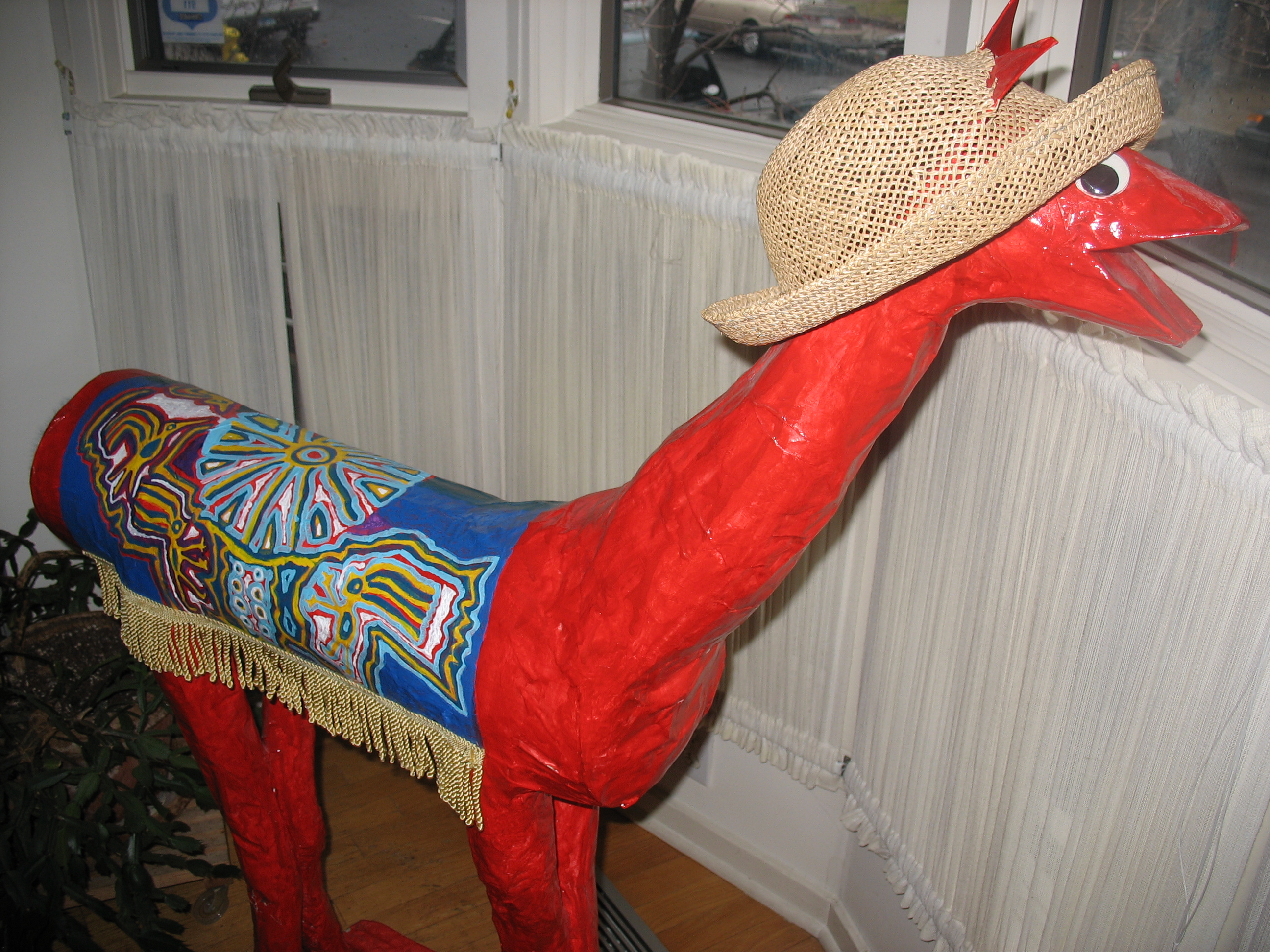
I have always needed to work with my hands, making something or doing some sort of craft or artwork, though I gavitated towards the crafty side of arts and crafts, fearing that I could not “do real art”, that I was not the stuff of which true artists are made. (And pray tell, what stuff is that, Pamela?) So even when I – on a whim – dove into sculpture during a manic episode, creating that llama-in-a-day I have spoken of, the result was mostly folk art, which is to say, unsophisticated, rustic, and at best a craft-like work. Sure, I was pretty proud that I’d made a lifesize animal that actually stood up firmly on its own four legs. But with a deli container head (underneath the papier mache) and huge mailing tube body, scarcely concealed, big enough to have once held a large amateur telescope, it didn’t look much like a llama. In fact, the result was not much more than that tube covered with a few layers of paper and glue, and all of it painted red. Nevertheless, I was proud of “Dolly the llama,” though it took me a year after the mania was treated to finish her. Her saddle blanket fooled many into tugging at the finge to see if it was real or not. a trompe-l’oeil — eye fooling — success that pleased me no end.

But a year was much too much time to complete a sculpture, even a life-size llama. I was almost dreading the work by the time I got to applying the last few strokes of paint. I needed more drive than that to do art, but I didn’t seem to be able to sustain the energey or enthusiasm for much of anything. I wasn’t sure how I managed to write the book, even. Then, during my last hospitalization it seems this obstacle was overcome: on Abilify and Geodon I suddenly had both energy and stamina galore. Or perhaps it is simply that the medications enabled a well me to come out, someone who could sustain an artistic effort, even if it was for the very first time. Given a different life I would have been doing this sort of thing all along had I known it was possible, had I had that kind of stamina… But I didn’t think about this, no, for me there was no looking back.

Over the year and a half since then I have created several pieces, large and small, from a large tortoise to a “crazy fruit” bowl. From a large seated man, to a child detachable from her hassock (not quite finished). My female sculpture, the Decorated Betsy, has even won a NAMI national contest on creativity and mental illness. But why tell you about them. I want to see if I can upload a few photos instead here, but you’ll have to bear with me as I try out the “program”. First, I want to upload a picture of that llama, just so you can get a look at my very first attempt. She now resides in my parents’ bay window, a placement that I regard as an honor.

Looks mighty co-o-o-ld out there!

Here is the Dream Tortoise, otherwise known as Yurtle the Turtle, which is about 3 feet in diameter.

What you lookin' at?
What you lookin’ at?

There are two other large scale sculptures, each a person, plus a work in progress, but it is nearing my bedtime and there will be hell to pay if I do not get my 8 hours of essential-to-my-mental-health sleep. So I will stop here and get back to this tomorrow, posting at least two if not more photos of my artwork then.

————–

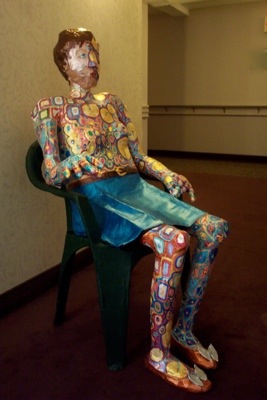
Aw hell, here are two more, but without comment or caption except to say that the prescription that the man holds in his hand reads: Dr John Jumoke Rx: art, poetry, music. But first the earliest human I have done, the Decorated Betsy (note that half her face is also decorated, and since Jumoke was supposed to be her doc, his face is decorated too. Does this perhaps indicate that perhaps he too is- infected?:

Decorated Betsy: Lifesize Papier Mache
Decorated Betsy: Life-Size papier mache sculpture 2008 January by Pamela Spiro Wagner

And now Dr John Jumoke

Life-size and attached to home-made papier mache chair

Potholes on the Recovery Road

Those of you who used to read WAGblog at schizophrenia.com know it has been a long slog — 70+ hospitalizations over the course of almost 40 years means more than 9 years in the hospital. Sometimes even now the road gets potholes and rocks, becomes almost impassable, though I am much better at simply, well, slogging my way through. Still, the year from October 2007-November 2008 has been one of the best I’ve had both in terms of my illness and of my general happiness and productiveness. With regards to the first, I have stayed on my medications and as a result stayed out of the hospital. Indeed, over the year I was able to cope with vicissitudes that might have undone me without them, including the death of a very dear friend. My artwork – large-scale papier mache sculptures – has become very important to me, even life-saving, with jewelry-making on the side which I hope will become one day a source of income if I am lucky. As I told my father a couple of months ago, spontaneously but with a rush of feeling that surprised even me: I enjoy everything I do. I wake up in morning and I can’t wait to get to work on my sculptures or my writing. This is not to say that I have no problems, have no hard times or things I have difficulty with. It is not to say, even, that I don’t dread certain activities like parties and holidays. I am terrified of simply calling a stranger on the phone! But what it means is, in general nothing bores me, everything I do interests me, which is a gift beyond measure. So what I tell myself, before doing something I believe I will find difficult, is: At least you might get a poem out of it. And that is enough to encourage me onward.

I am having some difficulty right now, true. Hypersensitivity to stimulation, increased paranoia and voices — I believe this is all is due to infectious disease recrudescing in my brain, rather than schizophrenia. Which is to say that I believe my schizophrenia has a known cause: Borrelia burgdorferi, or Lyme disease.

[Excuse the tangent here: Certain schizophrenia researchers believe that an infectious origin for schizophrenia is very likely. Why not Lyme? B. burgdorferi is a spirochete bacterium, carried by deer ticks and causing an illness much more common now, at least in southern New England, due to humans encroaching on deer habitat. With deer, which naturally harbor deer ticks, the vector carrying Lyme disease, having to co-exist so closely with humans, no wonder the incidence of Lyme disease has increased in recent years, at least in southern New England. I believe we would find it had sky-rocketed if there were a decent test for it and we actually did widespread testing. But there isn’t and we don’t.

Nevertheless, according to the tests we do have, I have been positive three separate times for Borrelia DNA, the so called “gold standard.” This despite having been in treatment for months. Still, many, even most physicians will tell you that Lyme disease is not chronic and is easily cured with a few weeks’ worth of the right drugs. The whole Lyme disease issue is controversial and deeply politicized. At this point, I would say it is mostly a political football – between the “Yale” school of “there ain’t no such thing as chronic incurable Lyme infection” orthodoxy and the increasingly vocal growing minority of infectious disease specialists who say that there is, and who risk losing medical licenses for treating patients longterm with antibiotics. What runs the risk of getting lost in the controversy is the fact that because no reliable test exists, let alone fully unanimous best practice treatments, there are patients out there who are not being tested and not being treated. I wonder how many are instead being told their neurological symptoms are schizophrenia or bipolar disorder or some other neurological or psychiatric ailment?]

Now, where was I? Ah, yes, I had started out by saying that I believed my symptoms were Lyme-induced. My psychiatrist, Dr O, who is also a sleep specialist treating my narcolepsy, believes moreover that it is lack of a decent night’s sleep, regularly, that has led to this flare-up. She insists that if I do not get a full 8 hours every night, I start decompensating. Then Lyme flares up and between the two everything starts deteriorating. I don’t know what to think, but I do know that I have been skimping on the nighttime medication, taking perhaps only a half of the liquid, so I will go back to taking the full dose religiously at 11pm and 3am, and going to bed at midnight to try to regularize my schedule better. We’ll see what happens.

But precisely what symptoms trouble me at the moment? Mostly hearing things, paranoia, excessive startling at the slightest provocation. All this is especially true when out in public, say in a store or public building. The following is one example: The other day, my father took me grocery shopping at Stop and Shop. From the first step in the door, I was panicked because of people threatening and staring and wanting me out of there. He said, “if people are staring at you, it is because you look so frightened. ” I could not hear him. I was much too fearful to do anything but deal with the situation as I perceived it: People telling me what to do, where to go, what to buy or not to buy, and in general terrorizing me. Every time someone passed me or even just approached from around a corner, I startled, which only upset me further, setting off the tendency to startle again. The whole trip was one of near agony, relieved only by our leaving as soon as possible and getting in the car. Once there, my heart rate immediately slowed and I began at once to calm down. And by the time a half hour had passed at home in my apartment, I was myself again.

That is the sort of thing I am talking about. I can’t say it only happens when I am influenced by the little spirochete bacterium, since grocery shopping is usually difficult for me. But it is not usually such a truly nightmarish experience as it was that day.

Paranoia of the same sort has occurred before and does so more when I am out in public or in the lobby of my building, where people tend to congregate around the mailboxes and community areas, than in my apartment where I am alone and feel relatively safe. So that wasn’t unfamiliar. On the other hand, the excessive startling – the kind my twin sister, a psychiatrist, says resembles an infantile “moro” reflex – is the one symptom I most associate with Lyme, my particular case of neurological Lyme. It alerted me to the fact that any concomitant increase in psychiatric symptoms was also due to the infectious disease. Making this connection has been tremendously helpful to me; it has put everything into a context I can understand and accept, and offers a concrete and simple-to-comprehend explanation for both my schizophrenia and narcolepsy, since the same symptoms are seen in Lyme. Remember the principle of Occam’s razor, which says that if you have a complex and a simple explanation for a phenomenon, the simple one is usually better? The Lyme explanation – ie that Borrelia burgdorferi caused my schizophrenia and my narcolepsy – really makes more sense than the more dubious proposition that I have two relatively unusual diseases and that neither one has yet been deciphered (both schizophrenia and narcolepsy remain mysterious in terms of cause and cure).
Okay, I admit that no one here agrees with me completely, but I much prefer thinking of them this way.
Renaming something can carry real power. Just so, calling my illnesses Lyme makes me feel less victimized than calling myself schizophrenic, however indistinguishable the symptoms are. I might become increasingly paranoid and begin to hear voices, triggering concern in my caregivers that a psychotic episode brews. But if I realize that I am startling at every little thing, acutely dyslexic and subject to sudden rage, and that this means it is a Lyme flare-up, everything falls into place. I become, maybe not less paranoid, but less likely to cling to the delusions once they are pointed out to me as delusions. In addition I might be more able to see how I am misinterpreting the world, at least when someone gives me an alternate and perhaps more reasonable explanation.

I would like to add a word or two about those in Stop and Shop who were staring at me, as my father suggested they might have been. if true, this was stupid and cruel behavior. I myself would never stare at someone who looked frightened. Instead, I would give them lots of space so they wouldn’t feel crammed in and threatened. Many people don’t understand how they might seem threatening to someone who is paranoid. At best they only know that they mean no harm, want only to help and so they have no awareness of the threat that person may perceive in what they do. At worst, they stare and crowd and to a paranoid person this might seem the most dangerous situation of all – to be trapped and threatened and persecuted, even if it is by “persecutors” who have no intent to harm or even frighten.

It seems to me only logical not to exacerbate a person’s obvious fear by staring and crowding, but perhaps I understand this only because I have “been there”. I just don’t get it why people can’t appreciate the obvious: if you crowd or stare at a person who is frightened of everything around her, even if you don’t understand she is paranoid, you threaten her and increase the likelihood of confrontation. Paranoid people don’t mean to hurt anyone, not in the sense of gratuitous injury, but if they attack, they attack — verbally or physically — to defend themselves from what they are convinced beyond shade or shadow of a doubt are threats to their very lives.

So while I can see my father’s point, now, that my frightened mien “caused” people to take interest in me, and “induced” their staring behavior, I think he and others should also take a lesson from what I write here. It is something a lot of people need to understand, including police officers dealing with mentally ill individuals in crisis. Several people or even just one if he or she happens to be the “wrong one”, bearing down on a paranoid, confused and fearful person may play a role in that person’s persecutory delusions. If in a crisis you want to help that person, the best thing you could do, aside from giving the person space and time to calm down if that is possible, is to remain at a reasonable distance, speak softly but clearly, and indicate that you understand the person is frightened. That is the most important thing of all: let them know you know how scared they are. You are not afraid of them, but you know how fearful they are. Do not provoke a confrontation; just make sure they know that you understand where they are. If you can accomplish that, you will be halfway to helping them and resolving the crisis.

With that, I must say good night, TTFN and leave my mark: BD