
|
Tag Archives: Recovery

Original Art: How NOT to Treat Schizophrenia: with sound
Trying again…
Still not playable on ipads or iphones, not sure why. I think the sound will work. for what its worth…
Youtube video with sound available for all devices here:
How Not to Treat Schizophrenia or any other Mental Illness: Slide Show
No music or sound, sorry. Best viewed in small screen as the conversion to Quick-time made the files smaller and hence less crisp when seen on a large screen…I’m sorry but this doesn’t seem to be viewable on an ipad..Dunno about android devices. At least I notice that the controls are unavailable on my ipad at any rate…Will try to find another format that will work and re do it…SO SORRY!
Youtube video with sound here :
NaNoWriMo – 3rd Installment, November Novel: We Are Hope’s Family
Feder spoke into the darkness of Hope Ouestelle’s apartment. No one answered. “Hope?” Again there was no answer. He peered through the dimness of black and gray shapes that he hoped were just her papier mache people and creatures. “HOPE! Where are you? “ He stepped inside and moved forward, fumbling blindly for something to guide his way. Just then, his hand fell upon a lamp and he was about to pull the cord, when Hope yelled out from the bathroom.
“Don’t try to turn on the lights! I am doing something here and any light will ruin it! Just wait a goldarned minute, okay?”
Happy to hear her voice, Feder felt for a chair, slid into it and rested. At least Hope had lights, which meant that she had not lost her utilities the way some of the buildings tenants had, not yet at any rate. Not the way he had. Feder was ashamed of himself and was half afraid to admit it to Hope that he had spent too much money this month. On important things, yes, but also things that experience told him most people would not understand, like repeatedly paying to go through the turnstile at the Parkland, just to feel the rolling thump of the bars against his body. Why did he like this and why did he do this? He didn’t know what it was about that admission turnstile but there was a moment, right inside it, when the bars felt like they locked and might not release him, and he felt such anxiety it was almost pleasure, and then they did, they let go and that was so — what? It was so mysterious a pleasure that he had to do it again. Yes, he knew that there had been a rate increase in the electricity bill this month, that he had to pay $30 more, but somehow entering the turnstile had used up that $30 and he hadn’t been able to pay his bill and now his apartment had neither lights nor heat.
What was Hope going to say when he told her? He wasn’t going to ask her for money. She wouldn’t have any extra in any event. He just hoped that she would let him eat with her in the evenings, and cook his supper in her apartment with her the way she had the last time this happened. She might even, maybe, perhaps, let him sleep in a chair in her artroom/living room if it got really cold in his apartment. That’s what she had done the last time and he could only hope she would do it again.
But he remembered what she had said to him the last time he slept there the previous spring, before he left for his apartment, after the weather turned warm again and daylight savings time returned. ”Feder, I cannot keep rescuing you from yourself. What am I doing? Am I helping you or hurting you by letting you stay here? I honestly do not know.”
Feder hadn’t known what to answer. How could she hurt him by letting him cook his food in a lighted kitchen or sleep where it was warm? How could it hurt him to help him? But Hope had her own ways of thinking and he had to keep that in mind. She did not understand the draw of the turnstile, and he knew she would think it strange to the point of bizarre. Everyone did. Everything he did looked strange to people. He was bad. Bizarre was bad, bizarre could get you taken away. But Hope should understand that. She was regularly taken away herself for what others thought was bizarre behavior: sitting in her artroom, talking to herself or to her papier mache people, or listening to voices of people no one else could hear, and doing what they told her to do, harmful things to herself, things like putting out cigarettes on her skin or cutting off pieces of herself with the sharpest of scissors. Talk about bizarre.
Feder at least had never been taken away. Not since he was a kid. But he would not think about those days. To think about those terrible days in the screaming room was to invite trouble, the many hours tied down to a bed because he wouldn’t – couldn’t – stop spinning. The times the teacher pinched his arm to stop him from reciting names after names of things she did not have the same need to know and hear…His need to tell her the dates of everything that ever happened to him and her need not to hear him, to silence him. How she had so much power to do so. No! Mustn’t think about those bad times, black times, screaming times…Mustn’t think. Mustn’t think. He had to think about something else. Think about the turnstile, the turnstile. How the heavy rollers came across to stop a person from crossing, then how they caught him and held him ever so briefly—that strange mechanism he was never sure he saw properly – and then how they always gently released him safely to the other side. He would think about the turnstile if he had to, until Hope came out of the bathroom.
But then thinking about the turnstile reminded him of the fact that he had not paid, could not pay, his electricity bill and how there was neither heat nor lights in his apartment. He did not want to admit this to Hope…The need to recite took hold, as it always did when anxiety got the best of him and he seized the information that was closest at hand: His name was Feder Prisma and he was 31, born Jan 5, 1979, a Friday. Hope Outestelle, his best friend was age 57, born Sept 16, 1954, which was a Thursday, the 259th day of the year. Premjit Mukherjee, was their friend, and the building manager, aged 47, born on April 1, 1964, a Wednesday, the 92nd day of the year. Stashu Weissman, was from Poland, aged 79, b orn in 1931, Dec 25, a Friday 359th day of the year. Giorgio Ciabatta, the auto mechanic, at age 43 born, in Italy, Feb 19, 1968 on a Monday. Beatrice Bean age 84, was born on Sunday May 1, 1927, the 121st day of the year. Their Landlord Mr. Mukherjee, was age 71. He was born on Sunday, April 27, 1941, the 117th day of the year. On the fourth floor, Bryony Leurile aged 44 was born on the 82nd day of the year, Sunday, 1967, March 23rd. Then there was Kashinda Whitmore, age 27, who was born on the 305th day of the year, in 1984, on Halloween, a Wednesday. Darryl Strakesley aged 31 was born on a Saturday, the 255th day of the year 1981, Sept 12th. Lupita Villareal, aged 62 was born on Sunday, the156th day of 1949, June 5. There were others, but he did not know their birthdays yet, so he started repeating the dates to himself. Hope Oestelle, his best friend, was born on Sept 16, 1954, she was 57 now. It was on a Thursday–
“So, what do you think of this?” asked Hope, appearing suddenly in the equally sudden explosion of lights that came on all together when she flipped the apartment’s main circuit breaker.
Feder started.
He hated it when people wanted him to notice something. It was always a test he failed at. He guessed. “Your hair?”
Now that he said it, he looked to see if it was true that her hair was different. She had cut her hair as short as a man’s, yes. Not only that but it seemed that she had dyed it as well, a persimmon red.
“No, not my hair. That was just an experiment. Look.” She held out her hands, dangling papers for him to look at more closely.
It looked that she had been developing photographs, but these were very strange ones. So dark as to be nearly black, with purple streaks and outlines of leaves and circles.
“Kirlian photographs.”
“Yes! You know! Well, sort of. I am doing electro-photography, and developing the Polaroids myself. I wanted to see if I could make this camera out of things I bought at GoodWill, and it turns out I could, mostly. But Feder, I’m really disappointed. The photos are awful. I was expecting something different. These are ugly. I think auras should be beautiful…” She retracted the photos instead of handing them to Feder, and tossed them aside with a shrug. “You win some, you lose some. At least I didn’t spring for a real Kirlian camera. Those cost $500. I only wasted maybe fifty bucks, making mine. At least I can say that I built a working aura photography device, for all the good it did me.”
Just at that moment, Feder’s stomach took the opportunity to announce its hunger with a rumble. Hope heard. She looked at her watch with a frown.
“Haven’t you eaten, Feder? Do you want to have supper with me? I’m sure we can scrounge up something.”
Feder made a rueful face but nodded. “Yeah, I’m pretty hungry. Maybe you have some cereal I could put milk on? Captain Crunch?”
“Nah, I never eat cereal, Fayd, you know that. I could make you some oatmeal, but you hate my oatmeal. How about a peanut butter and banana sandwich and diet ginger-ale? I have some really good bread and about three bananas.”
Feder’s eyes lit up at the mention of his favorite sandwiches and he smiled for the first time that evening.
“Good. I’ll make the sandwiches if you peel the bananas and pour ginger-ale into glasses for us. Okay?”
Feder followed Hope’s carroty buzz-cut into the tiny kitchen and between the two of them they made short work of preparing their meal, then carried their plates out to where Hope’s art work occupied most of the living room. Hope pushed aside the Kirlian photographs and made room for Feder on the sofa, then flipped on the 12” television propped on a stool on a milk crate in front of them. Eating intently, they hunched forward as the PBS show Nova’s logo blazed across the little screen.
“Oh, good, I was afraid we’d missed it, but we’re just in time,” Hope murmured between bites of sandwich. Feder never spoke while a television played; even when the programming failed to absorb his interest, the interchange of light and shadow on the screen never did. Television had calmed him from an early age, and his mother always placed his crib in front of a late night movie when he couldn’t sleep. Knowing she couldn’t talk with him now, Hope turned her attention to the program, hoping it would be about something interesting, something that would give her ideas for art.
People sometimes thought it strange that Hope, who was passionately an artist when she wasn’t ill, but who found it difficult to read or even concentrate listening to books on tape, nevertheless devoured television shows and documentaries on science. From natural history to physics, from geology to chaos theory and beyond, everything scientific intrigued and fascinated her, and she used what she learned in her art, in a multiplicity of ways. “What else is art for if not to express what science teaches?” She had said this to Prem one day when he asked her why she used cell motifs when painting her sculptures. “It makes no sense to separate them. If art does not serve science, what good does it do? Art can’t serve art. That would be silly, like a translator translating from one language into the same language. A waste of time. No, maybe art has other purposes too, but one of them I am certain is to interpret science, to express it for those who do not understand it any other way.”
When she had finished she looked up at Prem, as if surprised by her own words.. Not by the thought, but by the passion with which she had shared them, and the fact that she had spoken at length about such things to anyone, and even more so, to Prem, the landlord’s son. She remembered she had backed away, eyeing him warily. What did he care why she made art or what it meant to her? He wouldn’t give a damn. Why didn’t she just learn to keep her mouth shut and leave people alone? Now she would pay, that much she knew. He’d soon be spreading gossip about the know-it-all in Building 22, second floor apartment B, the one who makes the crappy art and couldn’t even read a book to save her life. It was true, her art was crap, pure crapola, and she knew it. If she was any good, well, she would be better at selling it, now wouldn’t she? And it was painfully true that she didn’t read, hadn’t read a book in years, simply could not. If she so much as opened a book she fell asleep. The rare times she didn’t, the words – indeed the letters themselves—soon swam and danced before her eyes impenetrably confusing, impossible to put them together in any sensible way and make them into single words, let alone string into sentences and paragraphs that made sense. She wanted to read books, but the books escaped her. The refused her eyes. They fled from her, as if defying her and mocking her. Nyah, nyah, they scolded. Eat your heart out, but you can’t have us! It was such a struggle, and Hope could do nothing, say nothing. She could not even complain or feel sorry for herself. Why? Why? Because…because…She didn’t know why. It was all her fault, all her fault. Everything was her fault and deserved punishment. No wonder the voices had for years told her to burn herself with cigarettes and intermittently wanted her to set herself on fire or cut off pieces of herself. No wonder. She was the scum of the scummiest. She was the scum of the earth. She was the devil incarnate. Hope pounded her fist on the arm of the sofa, forgetting that Feder was sprawled next to her. Luckily, he had fallen nearly asleep after the program ended. He raised his head at the sound.
“It’s nothing, Feder” Hope said, standing up and pulling a throw over him. “I dropped something. Stretch out now, and go back to sleep. I’m going to bed too,”
As he lay down, Feder called out to Hope, “Hey, Hope! What are you going to do with the electro-camera?”
“I dunno. I was going to take it apart. Why? Do you want it?”
Feder, half-asleep but serious, responded, “Yah, I have some ideas…Let me use it. I’ll pay you back if they work out.”
Hope, heading towards her bedroom, beating her head with her fists in a private frustration Feder failed to notice, replied as calmly as she could, “No problem, you can keep it for as long as you want it.” Then she closed the door between them.
“Thanks,” Feder mumbled to himself, tumbling into sleep.
“Jackass, you asshole…” Hope derided herself in angry mutters, still occasionally giving herself stiff thumps across the head. “You evil son of a bitch. Who do you think you are? You are the devil, the killer of the world.” She paused, stared blankly at something unapparent to anyone who might have been watching the scene, and mumbled a word or two. Nodded. Stared. Nodded again. Then she looked around, as if searching for something she had misplaced. She got up and padded across the bedroom to her dresser where she extracted a half-open pack of cigarettes. Approaching the bed, she stopped again as if listening to something. Again she nodded, twice. “Yes, I promise, I promise,” she muttered, then added, cryptically. “I will, if you will.”
Sitting on the edge of the bed, Hope pulled off her jeans. She extracted three cigarettes and lit them. Without hesitating she drew deeply on all three then immediately applied them firmly to the skin of her upper thigh, holding them in such a way that they burned but didn’t quite go out until she finally crushed the heads against her. Quickly, she repeated the maneuver, and again a third time. Finally, she pulled her jeans back on, drew her T-shirt down and hastily hid the remains of the extinguished cigarettes underneath the papers in the bottom of her wastebasket.
Calmer, but a bit dazed and still not ready to sleep, the cigarette lighter and pack in full view on her bed, Hope sat on the edge of the bed quietly, her head bowed, her hands in her lap. Her face, usually so mobile, was still and blank. But it was not a serene blankness. Rather, it was a blankness of confusion, as if she were not quite sure what had just happened. After about a half hour, she lifted her head, took a deep breath, frowned, and stood to clear away the debris of her recent actions. No point leaving any evidence around for Feder or anyone else to see. She could take care of her own wounds, and anyway, three times three wasn’t so terrible. She had done much worse before. No one ever died from nine cigarette burns, she just had to shut them up for a while…
It was well after midnight before Hope finally lay down under the covers and turned off her lights to sleep. And when she did sleep it was fitfully and to a book of troubled dreams. But sleep finally came and she didn’t wake until after Feder had left for the morning. She didn’t wake until the knocking at her door became outright banging.
ADD ABILIFY?!
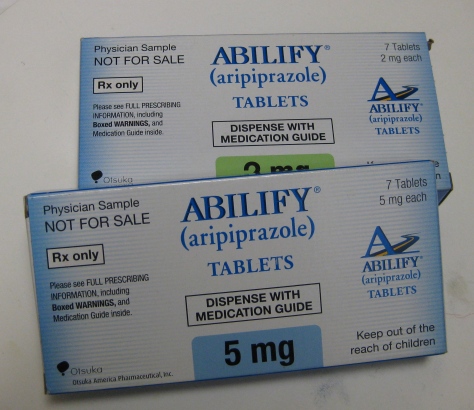
I know, I know, you have probably seen the commercials, but I am new to television and I only just started to watch them…and I just saw one that has been running probably for years now with the sad little pill that gets people to “add Abilify” to their so-called “anti-depressant” in order to boost its effectiveness. I learned about this advertisement recently from a friend of mine who innocently enough told me, told me, that Abilify is “just another antidepressant”.
Excuse me? I said to her. Abilify is NOT an antidepressant.
“Yes it is,” she insisted. “I saw it on TV.”
“No, Abilify is an atypical antipsychotic drug, not unlike Zyprexa or Risperdal. I don’t know what you are talking about, calling it an antidepressant.”
That’s when she told me about the sad little pill commerical. Well, okay, so the pill isn’t sad, the woman in the commercial supposedly is, and when the nice doctor she sees, adds the nice little Abilify pill to her so-called anti-depressant, she perks right up like an obedient child and, wow, the two pills work like magic to make the world right again. WOWEE!
So again the public is sold two lies, or maybe three or maybe half a dozen. First we are sold the lie that antidepressants do something in the first place. WAIT A MINUTE. Okay, they do do something, I admit it. They change the levels of neurotransmitters in the brain, yes, they do that. They alter something. Yes, and doing something, making a difference, altering anything makes people feel DIFFERENT and doing anything to change people’s feelings about ANYTHING when they are depressed can lead them to feel that it is better than doing nothing. ‘
But you have to understand that taking a mind altering substance to do something, anything at all, just to feel different, is not at all the same thing as actually treating a pre-existing chemical imbalance. And they know now that there is no such thing as a serotonin imbalance in the brains of depressed people. NO SUCH THING. In fact, they cannot figure out why people become depressed at all, but they do know that serotonin levels are not involved in any such simplified ways that the SSRI drugs purport to “treat.” Even Prozac researchers have admitted as much. Prozac researchers knew that their drug did not work way back in the 80s when Prozac first came out. They knew it induced suicidality in a large number of people, but they rushed it onto the market because Lilly needed a blockbuster drug, period to pad their pockets.
But that aside, the researchers to this day know that antidepressants do nothing to actually treat depression, because they have admitted that they do not understand what causes depression.
That said, does anyone who takes an anti-depressant understand what they are doing when their friendly psychiatrist or family doctor “ADDS ABILIFY” to their nice little psychoactive cocktail? Well, in addition to experiencing some or all the terrible but COMMON side effects of, say, Zoloft or Prozac (these are just those for Zoloft):
| Inability to have an Erection | Severe |
| Sexual Problems | Severe |
| Altered Interest in Having Sexual Intercourse | Severe |
| Drowsiness | Less Severe |
| Dizzy | Less Severe |
| Chronic Trouble Sleeping | Less Severe |
| Low Energy | Less Severe |
| Excessive Sweating | Less Severe |
| Involuntary Quivering | Less Severe |
| Loss of Appetite | Less Severe |
| Weight Loss | Less Severe |
| Head Pain | Less Severe |
| Feel Like Throwing Up | Less Severe |
| Gas | Less Severe |
| Diarrhea | Less Severe |
| Stomach Cramps | Less Severe |
| Feeling Weak | Less Severe |
they might well experience these COMMON side effect of Abilify:
| A Feeling of Restlessness with Inability to Sit Still | Severe |
| Feeling Restless | Less Severe |
| Indigestion | Less Severe |
| Incomplete or Infrequent Bowel Movements | Less Severe |
| Drowsiness | Less Severe |
| Dizzy | Less Severe |
| Chronic Trouble Sleeping | Less Severe |
| Increased Hunger | Less Severe |
| Head Pain | Less Severe |
| Feel Like Throwing Up | Less Severe |
| Throwing Up | Less Severe |
| High Amount of Triglyceride in the Blood | Less Severe |
| Anxious | Less Severe |
These are the commonly reported side effects from common antidepressants Celexa and Lexapro: in terms of Psychiatric Disorders, to which one might be told to “add Abilfy”:
Frequent: impaired concentration, amnesia, apathy, depression, increased appetite, aggravated depression, suicide attempt, confusion.
Now, I ask you, everyone, DOES THIS SOUND LIKE A RECIPE FOR CURING DEPRESSION? Any fool would look just at the list of side effects and say, uh, I would be more depressed if I experienced even two of these….But doctors think that people will feel better if they take drugs like these two together, and put up with these side effects, just because they are told that “by adding abilify” and their depression will go away.
The point is, the doctors are IN THE DARK. They read mostly what you do, and they see the same commericals you do. Most of them have no more idea whether the drugs work than you do, and they only know what they are told by the drug reps and the drug companies….DO NOT BELIEVE THEM when they tell you that you have a chemical imbalance. They are either lying to you, or believing a lie they were told by someone else. ASK THEM questions, investigate. Ask precisely what is the correct balance, what are the correct numbers…Do not be sheep. What were the studies showing any proof? Who did the studies and who paid for them? Changes are you won’t get good answers, or if you do, your answers won’t make you any more secure than I am. Because drug companies pay for most of their own studies and they only pay for the results they want, ie what they want to hear…They do not want to hear that Abilify hurts patients, or doesn’t actually work, or that Abilify does not boost Zoloft’s anti-depressant IN-efficacy. No, they want to lie and “prove” a lie or else not prove it by not actually doing the study to prove anything. They want to market the drug and advertise things that have NOT BEEN SHOWN TO BE TRUE AT ALL. They want to market a lie, sell a drug and make money, without doing any research to prove anything, and pick up the pieces billions of dollars later, if at all.
I say, BULL SHIT
My advice? Don’t add Abilify. Add only Sunlight and Truth to everything.
Tuscany “Palazzo Podere”: New Art and Fewer Meds

This is a photo of my large drawing of a place in Tuscany named Palazzo Podere or as translated, “Castle Farm.” I only uploaded a small file…Sorry… the details are fuzzy but them’s the breaks.
Things have been up and down, but the last two days were better than before. Largely because of an art therapy session that I found amazingly cathartic. It involved my being asked to make a “three dimensional sculpture” from a sheet of paper, a pair of scissors and some clear tape. I had no idea what to make, nor what would come from it. In fact, I dithered for a while, stymied, rolling a bit of the blue construction paper into a little tube and taping it, desultorily, waiting for inspiration. Nothing. Then suddenly it slammed me. YES! I was making, YES! a bullet for, YES, my very own Glock 9 semi-automatic handgun.
I proceeded to craft a crude gun with a bullet or two and a clip of ammo until I was finally satisfied that I had what I wanted. When I was through, Margaret, the therapist, handed me a sheet of paper on which she had written, “I am” five times. She asked me to look at my paper gun and ammo clip, at any angle I wanted to, and complete the five sentences as I wished. Well, I won’t tell you in great detail, because my answers were were rather gross and violent, what I wrote, except to assure you that when I was through, and it took a while, she asked me, How do you feel?
I had been somewhat tearful as we talked and earlier in the week had been extremely upset and angry, but I now looked at Margaret and with a little surprised smile said, well, you know, I feel…better!
And I did. In fact, when I saw Dr Angela the next day, she noticed the difference immediately. Whereas before I had been nearly screaming, and not looking at her, now I could smile and make eye contact for the first time in months.
__________________________________
Progress on the medication front: Am off all Abilify. Now am dropping the Geodon, slowly. Down 40mg from 160mg. Will be dropping 40mg every 2 weeks. I think. Unless that feels too fast. If I run into trouble , I will slow it down, but Geodon never seemed to do much of anything for me…Maybe I am wrong, it could be I’m unaware of what it does. But in my experience it did little positive for me, and so it should not be too hard to get off it. I just need to be careful not to stop anything too quickly, no matter how eager I am to be off all meds.
I still take some small amounts of Ritalin and Xyrem for narcolepsy, though hugely reduced now that I am not so sedated on antipsychotics and antidepressants and only take 200mg of Topamax. I dunno about that last. I may try to stop it too. But it depends on the olfactory hallucinations and whether or not my migraines are under control.
IN the meantime, I have been busy hiring people to stay with me 24/7 come January, in the event of a crisis, which I have to assume will happen since it always has…So long as I know people will come in and prevent a hospitalization I feel okay about it. Otherwise I would be panicking, thinking that I would ever have to go through such torture. NEVER would I let them do what they did to me at Yale or the IOL again. I will kill myself before they get their hands on me another time. But it won’t happen, because i have aides/nurses/various people hired to help me out now in my own apartment, and they will take care of things so no hospital will be waiting in the wings to torture me. The only thing I need to be sure of is that who ever it is that is going to be with me, they MUST be on board with the NO MEDS thing. NO ONE is going to force meds on me in my own apartment — I don’t care who they are. If they don’t agree with that, if they have a pro-medication agenda, then they are not going to be part of my plan…
Trying to Hold it Together: Doing Art To Save My Life

I also finished a good drawing of a house in Tuscany, Italy and a painting of a child I started a long time ago, which I will post here. (The house drawing is at the framers, where it is being matted because it is too large for a precut mat. I am sorry that I have posted the painting with little faked watermarks on it, but I do not like the fact that people can simply print out my pictures otherwise and not have to pay me for the prints or the paintings…)
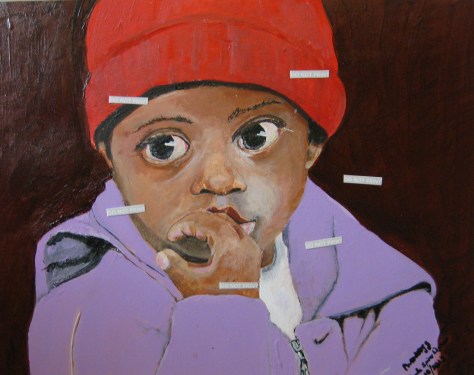
As for the rest, I am coping, that is all I can say. I try to “fake it till I will be able to make it” — meaning that I do not tell people how difficult it is, most of the time, because that only makes it harder. If I can try to ignore as much as possible what is going on that is all for the best. And when I cannot, I stay by myself and try to deal with it. Or i see someone, my therapist or a person I have hired to stay with me. Or I simply tough it out as best I can. Things could be worse. After all, I am not in the hospital and I have to keep telling myself that! 8)
In the meantime, I don’t have a lot to say. Doing art takes all my time and energy, and the rest is spent simply dealing with things and coping. Forgive me. I will be back. I just wanted to post this to allay anyone’s fear that I was back in the bin.
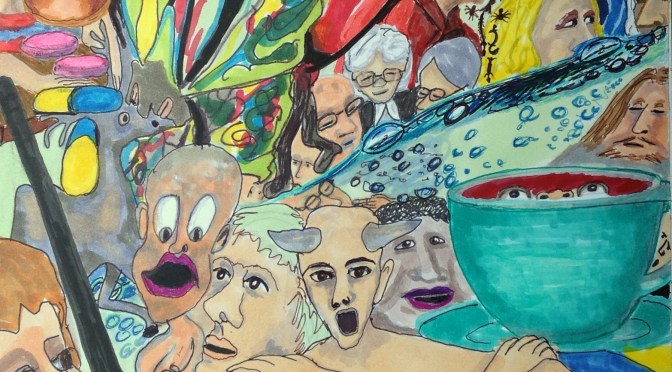
NEW ART AND MEDS REDUCED
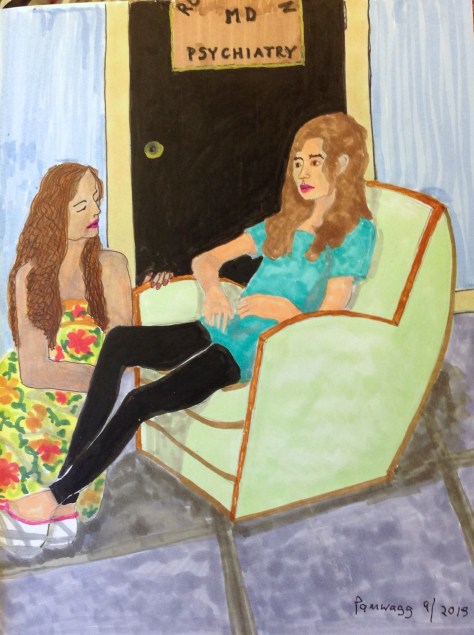

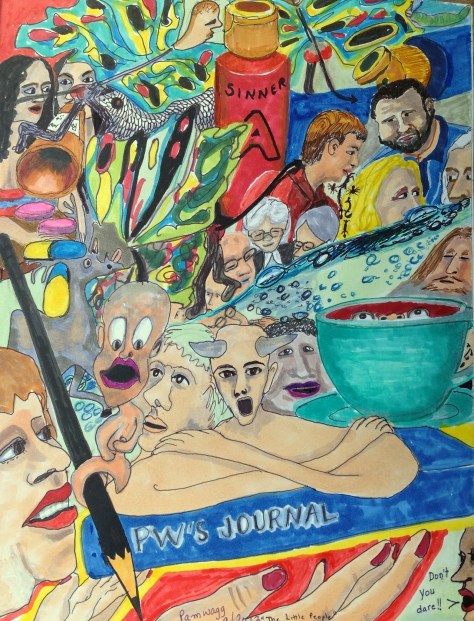
I am assembling my own private, so to speak, “treatment team” for recovery. This is because it turns out that to go to any facility for real no-drug no medication recovery, somewhere like Windhorse in Northampton, Massachusetts, or Cooper-Riis in NorthCarolina, you have essentially to be filthy rich. Neither place so much as returned my application email (supplication) once they knew I “only” had about — well, let’s just say that I could not afford their fees of up to $20,000 per month, and certainly not for the requisite six month program just to start with! So essentially, you have to be wealthy as Croesus in this country to get any help whatsoever to recover, or you are on your own.
Luckily a little family assistance does permit me to hire a few people to help me — which I know some people are not fortunate enough to do. So I did — I hired an art therapist this past week and I meet with her next thursday! This is something I really look forward to. While I do art daily, I do not usually express my feelings easily or spontaneously doing art. I have to think things through doing art. But i want to do it quickly and find out things or learn to let go and feel my way doing art. And I have never done art therapy, at all so I dunno even what it can offer, except that I cannot believe it won’t be helpful, esp now that I am done to 5mg Abilify as of Saturday. And no abilify at all by the following Saturday, if it turns out that I can tolerate the drop to nothing.
Now, I do take Geodon as well, so I think it will be fine. But we will see. So far so good. But I did say that I would take it more slowly if I ran into problems. Once the Abilify is out of my system, I will wait a little while, then start reducing the Geodon. No sense in waiting too long. If I have no difficulties apparent from the loss of Abilify, why wait? THEY thought i decompensated almost immediately at Yale New Haven Hospital from having “nothing on board.” My contention is that I decompensated due to the abuse I suffered at their hands, and as a result of their megadosing me with IM Haldol, torture for anyone.
That’s about all the news I have for now. And it is getting late so I’d better go to bed.
Oh, by the way, if the pictures look a bit different, it is because they are done with markers, copic markers for the most part, and not with colored pencils….So you are noticing my use of a different medium.
Trauma and Connection: You Need Not Be Alone
When Monica Cassani posted this video (see below) on her wonderful blog, BEYOND MEDS.com today, I was not sure I would watch it, mostly because I often do not have the patience to watch videos, no matter who recommends them. (Sorry about yesterday’s recommendation, an hourlong one no less, but it is vitally important to me and my topic…I still highly recommend it, if you cannot read Anatomy of an Epidemic…). Nevertheless, something about a video on treating trauma, perhaps the face of McElheran on Youtube, perhaps just my mood at the beginning of this day, impelled me to click on the little triangle that started it playing. I was pulled in almost at once. In fact, I was soon in tears, because McElheran may speak to us all, but most importantly she spoke to me…her words on trauma included me, personally, for once.
That she did so, moved me beyond words, because at that moment she validated my own manifold experiences of trauma, which were mostly NOT of potentially mortal events, even if I may have believed them to be so (when paranoid or psychotic). I will embed the video here, so you can watch it now, and come back to my blog post afterwards if you so choose. Or watch it whenever you like. It is — truly! — only 16 minutes long, and very compelling, so do not worry that it will take a lot of time.
Something about what she talks about reminds me that “Nothing human is alien to me…” We are all capable of everything, and anything, given the proper circumstances. Her compassion for human behavior is astonishing and moving beyond words.
I need to say this because no one who “knows me” thinks I am “capable” of things like calling people such vile names as those I called the aides and nurses regularly at YNHPH, or of stripping and defecating and smearing feces without even thinking or considering the consequences… But those are important words: “without thinking” and “without considering the consequences” because they indicate that I was behaving wildly impulsively, as indeed I was. Think about the situation: Six to eight people, some of them security guards (self-professed former police officers) had just violently and brutally assaulted me, thrown me onto a bed, held me down (causing physical pain to the point that I screamed in reaction) and pulled down my pants, giving me three intramuscular injections into the buttocks, then holding me down some more until they felt “safe” to let go…(One of them actually telling me they would press charges for my kicking her in the stomach while she was restraining my knees!)
Once i was freed, I made a dash to get out of the room, wanting to “do laps” around the “square” hallway that gave the Washington Square 2 unit its name. No deal. They physically prevented me from leaving the small single room, that had nothing in it but a hospital bed and tray table. I recoiled, enraged and manically in need of doing something, anything! Suddenly, I felt my bowels engage, roil, want “to go.” But the bathroom was down the hall…No matter, what the F—! Who gives a shit, in fact.
Without thinking a second thought about it, I simply pulled down my pants, squatted, and unloaded on the floor, to not so silent on-lookers astonishment and incredibility. Then I removed my clothing altogether. But another WTF moment seized me, then. The steaming pile of sh-t was there, and suddenly I “knew” what to do with it…and I did not give a sh-t that this meant using my hands or getting it all over me or anything. I just didn’t give a flying femtogram. I do not know why. I didn’t even smell anything. I just picked up handsful of the feces and smeared it across the walls. But not blindly and wildly, no, I was writing something, I remember now, I wrote something on the walls with it, though I do not know what any longer. And I do not think anyone took the time to read it. I do not believe anyone bothered to notice that I was not merely smearing but writing in shit...
The point is, I did this as a response to trauma, small as you might say it was. I felt traumatized. I felt brutalized. And I felt and was out of control as a result. This is not to say that my impulsive behavior served any purpose other than venting rage and sheer revenge at my abusers. It certainly won me no friends and no compassionate understanding from anyone. It could have, someone might have understood it for what it was, and seen that what they were doing to me was in fact brutality and traumatizing…They had after all diagnosed me with PTSD, so WTF did they think they were doing?
It doesn’t help, frankly, that “Dr Angela” believes that they were “on my side” and “doing their best” and “actually helping me” all along. I do not agree. I do not believe that. I think they were hidebound in their determination to break me, and if they could not see that they were perpetuating harm, they should have.
Okay, okay, okay Pam. Calm down. Calm down. Remember you are practicing forgiveness, not worrying the sore into an infected mess! 8)
This is hard. It is so difficult to forgive and let go of harm that no one admits to having done, one, and two, claims was actually for my own good. To help me!
Bull feathers! I still have exquisite backside piriformis muscle pain when I move in certain ways or even sit down on my right hip. And if I take off a T-shirt with the usual crossed arm movement, it causes agony in my deltoid muscles from the injections they gave me there too.
But forgive and move on, forgive and move on…I need to take a deep breath. Think about other things. Get ready to go out for coffee as I have made a date with an old friend of mine I haven’t seen since that debacle at the Institute of Living last winter. We always have great talks. It will be good to see her!
Yes, I will leave this on that note. The fact that I do not isolate myself, but that I have lots of friends and do things to keep myself busy and fulfilled and purposeful in life. Trauma and memories and flashbacks of trauma may still get me, and they get me in the gut a lot, but they haven’t got me completely over a barrel the way they might have. There was a time when I was more isolative and friendless but not any more. Not anymore.
I Will Not Be Sick Forever…Schizophrenia is Not A Life Sentence!
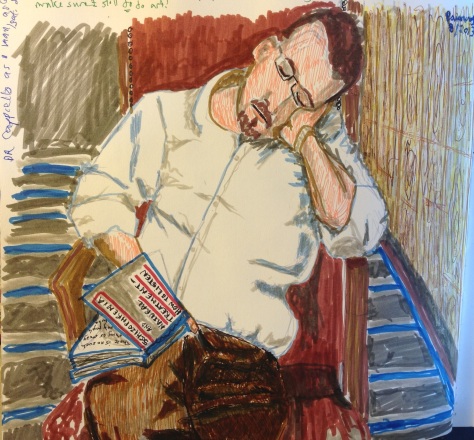

Dear Everyone,
I spent more than three weeks at Yale’s psychiatric hospital in August being tortured, if not by seclusion and mechanical restraints (my PAD restricted the use of those and at least at Yale they listened) then being held down by armed security guards (only their guns removed) and injected innumerable times with a multi-injection cocktail of drugs: Haldol 10mg, Ativan 2mg, and Benadryl 50mg, despite my objections that I have a paradoxical reaction to the last one. They said I could not refuse because I would have side effects to the Haldol without it. Understand this please: They deliberately injected me with a large enough dose of Haldol (without any basis to know I needed any more than the usual 5mg or even 2mg) as to knowingly cause side effects, side effects they knew in advance would be so distressing as to not allow me to refuse medication for them before they even happened!
What sort of dastardly drug is this that it hurts as much as it “helps”? Ah, yes, let me remind you, lest you have forgotten, that Haldol is the medication political dissidents in the 1970s were given in the Soviet Union to subdue them after they were diagnosed conveniently with “sluggish schizophrenia,” an illness “everyone” in the West “knew” didn’t exist except in the Soviet political playbook, designed solely for the dissidents. The American Congress, Democrats and Republicans alike objected then vehemently to Soviet treatment measures, calling Haldol injections the dissidents were given nothing less than “torture.” None of the members of congress ever mentioned the widespread use of Haldol in American mental hospitals, though, for that wasn’t torture, was it? “Those people” – American “schizophrenics” need Haldol, they were told by establishment psychiatry, “they aren’t like you or me and don’t feel the same way when they take it…”
Now, I ask you, how can a drug torture one group of human beings but be a decent and humane treatment for another group? Answer: It cannot. Haldol IS torture, pure and simple, for nearly everyone who takes it. Just ask people! You cannot label one group tortured by a drug and the other “humanely treated” who endure the exact same effects. In truth the only group of humans who like Haldol are hospital personnel, who no doubt appreciate the fact that it in fact it does subdue patients into docility…usually. This means they have less work to do and thus they consider it an effective “treatment.” (Alas, in my case, I confess I was more likely to respond to forcible Haldol injections by stripping naked, defecating on the floor and smearing feces on the wall as by becoming more pliant or compliant. Why they managed not to see the resultant worsening of my symptoms and do something about it I do not know but they persisted in “treating me” and made things worse and worse…Indeed, I screamed more each day than not, for most of the three weeks-plus that I was at Yale New Haven Psychiatric Hospital this past August. So how good a “treatment” was Haldol? Aside from causing me exquisite mental and physical torture, I mean? In point of fact, despite megadoses, no injection made me more compliant, made me into a “nicer,” better patient, and easier to handle. The Haldol, even when probated and regularly forced upon me, didn’t work to their purposes…I was an impossible patient for most of the three-plus weeks I was there, Haldol notwithstanding. So what was the point? And why couldn’t ANYONE see that they were making things worse?
However, that is over with, and what I want now is to tell you that things are going to change, and change radically. I may not have your support in all of it, or any of it, perhaps, but I an attaching the video below as a link because the book it is related to was deeply influential both on what I wanted and did not get at Yale, and on what and why I am doing what I am doing now. The book, as I have mentioned before is Anatomy of an Epidemic, and the video gives a good hour long summary of it. It is a good place to start if you have difficulty reading a whole book on the subject or simply would like an idea of what you are getting into.
But first of all, the video doesn’t tell you this, “Mad In America” does — Robert Whitaker’s earlier book on the treatment abuses of the mentally ill in America — the foxes are guarding the chicken house. What I mean by this is: the Big doctors, by and large the influential ones who affect how our doctors treat us, are in cahoots with the Big Pharma drug companies in developing and promoting drugs that never worked and basically never had a chance to “work” because they were pushed into production and sales before any real research was done.
Maybe you don’t know this but listen: Thorazine was never a real “anti-psychotic” drug. It was a tranquilizer, a major tranquilizer. That’s what they used to more honestly call it. It calmed and tranquilized patients so they were more amenable to hospital treatment or the lack thereof. This was good for all, because the fact that patients were quieter meant that the nurses and aides got to show their kinder, nicer, nursier nursing sides to these “sick” patients, and the “drugged up” patients stopped fighting and finally appreciated being taken care of. It seemed a better situation for all, all ‘round, at least in the big state hospitals where megadoses of Thorazine were routinely handed out to “chill” patient populations into complacency. Less violent/resistant patients meant that the nursing staff could act a bit more like their job descriptors.
But now, suddenly, because someone was calling Thorazine an “anti-psychotic” drug as a marketing ploy, as if it treated the actual psychosis itself, they began to believe that it did something “anti-psychotic,” which in fact it never did. Not really. Not if you asked anyone who was treated with it. It never really helped anyone’s core symptoms. It just dulled you so profoundly you didn’t give a damn, or worse, it made you so mad with akathisia that you forgot how crazy the voices could make you feel, because you were literally wild with internal restlessness and other “antipsychotic” side effects and you had to pace all day or rock in your chair or do other “really crazy-looking shit” the doctors told you was just a part of your illness. Once Thorazine was thought of as a treatment drug, rather than as a behavioral modification drug, it changed the game altogether. It changed everyone’s thinking about schizophrenia (and by extension all mental illnesses) in a way that seems to have altered the course of American history itself. Certainly it changed American psycho-active drug-manufacturing for good, though I can only wonder at those involved with the actual design of drugs and how they can do what they do, surely being aware on some level that what they do has no foundation in science whatsoever. Let alone in honest research…
What am I talking about? Well, if Thorazine, which was originally used for anesthesia, was really just a behavioral modification drug, really, honestly and truly, and did not, if truth be told, treat or remediate any so-called schizophrenia symptom, then what the hell was all this dopamine hypothesis and research all about in the first and the last place? Because any supposed honest research started with Thorazine’s mode of action on the neuron’s dopamine 2 receptors. Supposedly, said those brilliant researchers, looking to explain how chlorpromazine/Thorazine “treated” schizophrenia symptoms so effectively, the drug works by blocking D2 receptors on the post synaptic neuron (Don’t worry if you don’t know what I am talking about…just keep reading).
The point is, Thorazine and dopamine have been inextricably linked for and to the next four decades of schizophrenia research, and all subsequent drug development stemmed from that link. Once that connection had been made, ridiculous and wrong as it was (schizophrenia and dopamine being related, or even correlated, simply was never shown), the stage was set for the “revolution” in brain illness research that has brought us such travesties as “bipolar infants” as young as 2 years old, and the H-Bomb-mushrooming of ADHD cases that threaten themselves to cluster-bomb into more bipolar disability cases than the country can conceive enough SSDI for…And thence to such further travesties as doctors using a brutally potent “atypical” “antipsychotic” (which is in truth no more “antipsychotic” in action than thorazine) like Zyprexa for “off-label” uses like anxiety disorders. Why? For fear of using benzodiazepines, perhaps, but just as often in conjunction with those drugs from hell. Drugs like Ativan and Xanax and Klonopin that are prescribed for people with “major mental illnesses” and the walking wounded as well, both like water, prescriptions that cause devastation in their wake and much more anxiety than they resolve.
It seems to me that for every MD who knows never to prescribe a benzo for anything but occasional use and refuses to, there are 40 who say, “take this three times a day and don’t call me unless you have problems”…expecting no calls.
But I am side-tracked a bit. Or have never quite gotten to my subject, which as you know is me, my own “illness” and my own future. I do not know frankly what was done to me in the past vis a vis these drugs, that is, what was caused by what. As my good friend Josephine says everyone now says, It is what it is and you can’t change it…So I am me, with whatever I am or have. But at the same time, i cannot continue to accept the premise that medications are the only and best way to treat me.
After all, I take meds every day and you all know that I have ended up in brutalizing hospitals regularly, quite despite this. I was hospitalized just this past August, in fact and this past winter too…So what good has been my taking meds, including 2, not just one but two atypical antipsychotic drugs, if they do not work to keep me out of the hospital? Not much, I venture to say. Not much…
Well, but…If they have enabled me to do art and write poetry (when I did that) then they were very good drugs for me indeed. For that is my fear: That I can only do art or write, even if just in my journal, when I take these medications. If so, those would be two very good reasons for me to feel it necessary to keep taking them. I cannot live without something worthwhile to do, and I have no family, no children, no purpose, no career, nothing else but art and writing to live for…
That said, what is the proof that my medications are what make me ME? That they make me write and do art? Essentially and absolutely? None at all. And there is much suspicion that the meds can do harm both in the short and long-term. Nothing at all is known about what happens when people take these drugs for decades. I am not sure I want or need to be that particular guinea pig. Now, “Dr Angela” is, as you may or may not know, a psychoanalyst as well as a psychiatrist, so I told her that I wanted essentially what Joanne Greenberg’s “Hannah Green” got from “Dr Fried” (in reality it was Frieda Fromm-Reichmann, the renowned psychoanalyst who successfully treated Greenberg’s schizophrenia) in I Never Promised You A Rose Garden…No promises, perhaps, no rose gardens, but at least the opportunity for cure, recovery, and an end to treatment. And NO MORE MEDICATIONS, WHICH WOULD TIE ME TO HER PERMANENTLY more or less.
I am off the first drug, Zoloft, and have been for more than a month. But it is not easy. I am bone-weary and feel like crying every day. Feel like I have never NOT been tired, never not fought off hopelessness and the feeling that if I were told I had leukemia I would cheer, “Finally! Thank god it’s over!”. That’s the truth, people. I sit in my chair, the same one I sleep in, and I sit in it virtually all day long. And though I am not addicted and do not need to (most of you know how easily I quit smoking when I need or want to) I occasionally smoke a cigarette just to ease the pain…which is physical as much as it is mental and emotional. I may not seem depressed to those of you when you see me, because I rarely “let them see me sweat” and would never burden you with me if I can help myself. But there is also the fact that if and when I see you, just that fact cheers me, lifts my spirits, thank god, and is a rescue and a blessing, so thank you for that much! The nights are hard, but sometimes the days are harder…Nevertheless, Dr Angela has agreed NOT to speak to me of going back to the Zoloft, not unless I ask for it, because she understands that I want to tough it out, and that i believe that antidepressant drugs cause more depression than they cure. I believe if this is a relapse it is solely or largely because I started taking Zoloft again in 2007, when forced to at Mt Sinai, even though I told them I was grieving Lynn L’s death and because of Joe C’s illness and they ought to let me grieve! If I had been taken off it promptly, or never put on it, maybe I would not be such an easy prey to despondency now.
Nevertheless I am going to go on the record of the past predicting the future, and NOT take Zoloft (as of now) and “get through this somehow…” because despite everything, I haven’t died yet, not of despair, and while i have done a lot of damage to my body, I have managed NOT to kill myself so far…Chances are, then, that I will not. Of course the future is unknown, but all I can say is that I do not want Zoloft or any AD drug at this moment, and can take the pain.
I have cut down on the Topamax, to 200mg but because of recurrent migraines need to keep that where it is for now. The next drug to go will be Abilify. I would rather we stop the Geodon next, but I do not think I can tolerate taking Abilify sans Geodon — not without being incredibly irritable — whereas Geodon without Abilify basically does nothing for me. A steady reduction, not too slow, but not so rapid I cannot tolerate any symptoms that develop. The whole point, in the end, is that should I develop symptoms (and that is not a certainty) we are supposed to be able to deal with them in therapy and not go running to the hospital or back to some drug.
(Okay, this is the point in the argument where even I start getting nervous. But I am determined to do this…I want it, I want it, and I need to try it ONCE in my life before I die. I need to know what I know, what I can know about what I need and do not need in terms of psychoactive medication, if that is even possible… Some much depends on placebo effects you know, and on influences of that sort that I wonder if any of it can be sorted out, and how much is going to be sheer determination?)
Oy, it is getting late, or I would continue. But I need to sleep and so do you. I am certain there is much more I ought to have said or explained and did not. Feel free to ask questions or query me about your own concerns if you have them…I am open to any thing, except anger.
Thank you all for your love and concern and if for nothing else than for simply being there to listen and read this.
Robert Whitaker’s Anatomy of an Epidemic video:
http://www.youtube.com/watch?v=VgS79hz1saI
Love,
pam
Today’s Art Journal Pages:West Farms Mall: You are Here…PLUS
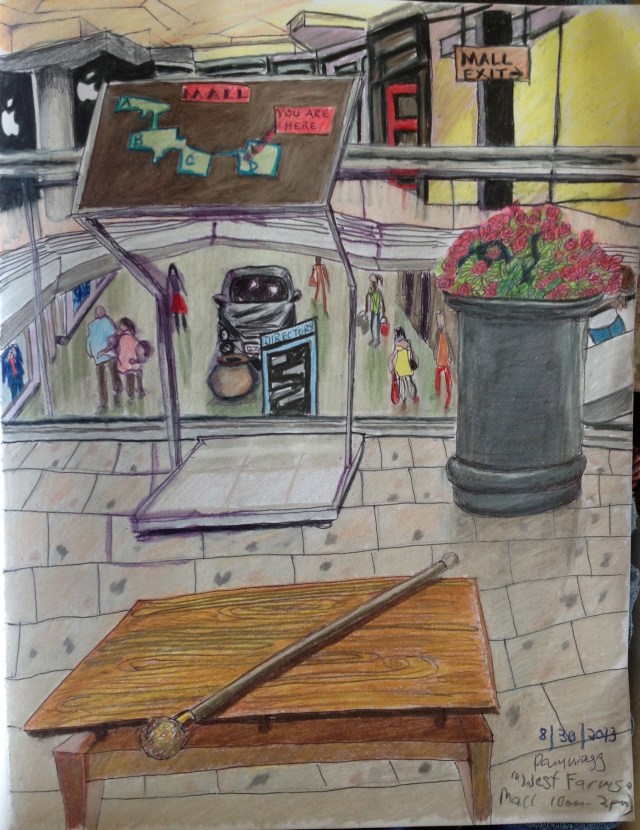
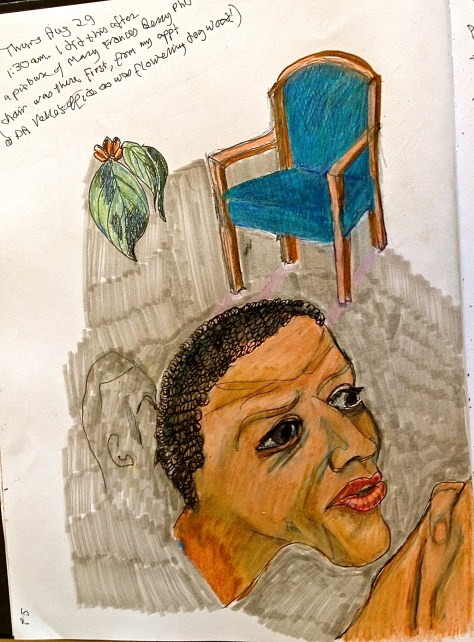
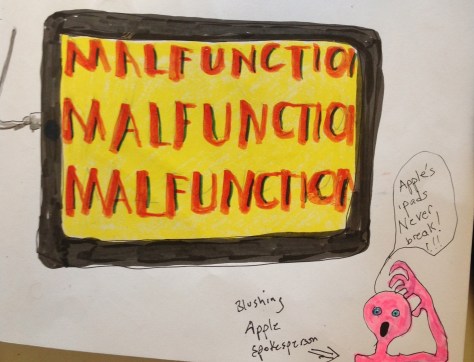
Despite the MALFUNCTION picture above, there was nothing at all wrong with my ipad…I simply didnt understand the three finger tap function. But once i did, all was well. And the geniuses at the Genius bar were blessed again. I left to do the drawing of the West Farms Mall, rather than waste the 25 minute drive it had taken me to get over there.
That said, I need to add that I did one thing this weekend that Martha, my youngest sister picked up on immediately and knew at once was the wrong call, so to speak. She is an emotional genius of the highest order, and I dunno how, but somehow wrote me a text message that gave me permission to solve the problem…
To make the story clear, let me explain that it has LONG been part of my ethic that if I treasure something, especially a THING, I make a practice indeed a habit of giving it away. This is in part so I do not get attached to things, and so that I am not ” allowed to have any particular beloved items” that I need too much or covet too much. A form and practice of self-denial that runs very deep and started when I was remarkably young. I won’t go longer into this practice now except to add that as I wrote in my art journal on one page, one summer a few years ago, I took my very first vacation that was not a “hospital vacation” but was instead a planned stay at a Arts and craft camp called Snow Farm up in Florence, Massachusetts, where I signed up for a metal jewelry course. I already knew how to do the basics, but what this course promised was to teach sawing and riveting and soldering of metals, something I could not do at home.
Martha, who is five years younger than I, lives very close to Snow Farm, and without her support I never would have survived my weeklong stay. Partly because it turned out that I was much too paranoid to eat in the dining room, so she supplied me with enough food to make do with “canned” that is to say mostly fresh and decent food in my single room in the sleeping quarters. Late at night I would creep down to the emptied dining room and make myself a large PB sandwich to supplement these as well, from the supplies that were left out at all hours. But except for the one time the APRN who was then the manager of Snow Farm actually came and got me for supper and the other time that Martha also went with me to eat, I made do alone…
An equal hardship, one I am less able to explain, is that during the entire weeklong course, no one in the class of mostly women, more or less my age, spoke to me. They were a chatty bunch and talked a lot among themselves, but not a person said a thing to me, except I think one woman, towards the end of the week, offered the use of her tools or something, which became the occasion of a final breakthrough. But for the most part it was a lonely awful time.If it hadn’t been for the teacher herself, Abigail, who spent time with me (she knew my background from my application). I’d have withered from sheer isolation, both self- and other-imposed.
The final hardship was that I was very thin at the time, and using a metal saw required that one hold it against the chest wall while tightening any replacement saw bands and at other times as well. For some reason, I kept breaking my saws, which were delicate enough that if you twisted it while sawing a copper sheet, it could snap in a second. But holding the saw in a vise against my chest wall was simply impossible: It caused me exquisite physical pain, and I could not withstand the pain long enough to replace a single blade. So I had to give up learning to saw, and thus never learned to rivet either. Anything that involved the saw was simply beyond me. Either nobody observed the problem, or all decided that it was not worth coming to my aid. In any event, I was left with no alternative but to do the only thing I was able to finally do: to solder silver rings.
Yes, when it turned out that I could with ease hammer silver half-round sterling into a ring shape and solder it together into a permanent ring, and no one placed a limit on how many I made (since we paid for silver materials as we went along) I simply made silver rings for the rest of the week. Then the one woman who was semi-friendly with me gave me a few sterling silver pre-made bezel cups that would hold a 3 mm cabochon, were I to obtain them. And the teacher showed me how to solder the bezel cup onto a couple of my rings finally as well, (I could never learn to make my own bezel cups because that involved sawing…)
I left Snow Farm with about ten rings, two of which had soldered-on bezel cups. Some were big enough for men, the others were varying women’s sizes, but all were 100% sterling silver. None were anything mind you but amateurish, but that mattered little to me or anyone I gave one to. No one knew the difference, and if I did, it ceased to matter. I ordered little cabochons of grade A lapis lazuli, the lovely blue stone that is so famous, and managed to secure two of them into the two rings with bezel cups on them in a fairly decent if untutored manner (no adhesive used, that much I was proud of).
But of course, one of these lapis lazuli rings was in due course given away to a friend who was on and off not a friend. and who verbally abused me in such fashion that it was from her that I learned the awful language and names that I called the nurses and aides at Natchaug and Yale. (I hate the fact that I even have the c__nt word in my working vocabulary. I never did before this friend who is no friend of mine used it on me…But once heard as an name-calling term of verbal abuse, it became “valid,” it became part of my language…much as I wish it had never. And now I confess that when enraged at the people at the hospital, but ONLY then, I call them c––nts and variants on the terms rather freely, because I know what a terribly word it is and what effect it will have on them. (Chip my brother roared with laughter when I told him I called the single nurse restrained me for walking away from the quiet room at the IOL a “snarky little c––nt” and praised me for being able to laugh too. but in truth I wish I did not even have the word in my working vocabulary at all. I would prefer a lack of insults to use on people to being able to hurt anyone with this word…)
Now this “friend” is out of my life and I have the single ring left,..my single remaining treasure from that troublesome perfect vacation.
But what happened at the end of that vacation? Well, the last night, we were told to make something for the camp auction and so I brought earring making equipment and starting making a slew of those, and that, plus the fact that I’d brought over a copy of DIVIDED MINDS, finally just to introduce myself (I think the woman who had given me the bezel cups had asked me a question and elicited the fact that I had written two books…wanted to see them). Well, this was what finally broke the ice. And it did it in a major way. People were really interested, and curious. And they now asked me questions and seemed less scared to talk with me, as if the book’s subject matter somehow explained “everything.” I dunno…Maybe it did and maybe it didn’t. But the last day there , with the auction and the final dinner went fine. and I would say that I “love Snow Farm” despite everything.
Which is why I treasure that one remaining lapis lazuli ring. It means that I actually made something from a situation that could have been unmitigated disaster. I made lemonade from lemons, and I survived a vacation all on my own. SO when I managed to practically beg Martha, my compassionate genius of a younger sister to take this ring from my finger…she was dubious to begin with. For one thing, she has her own two important rings. One is her own gift to herself for surviving Breast Cancer…and it is her most important ring. But I practically made her take my ring from me. I think I have done this to her before…And she didn’t want to take it then either….She KNOWS things, this wonderful sister of mine, and either it is in part that she has these other rings of her own, or that she has inklings about my propensity to give my treasures away to others (I love) she is not and has not been a willing taker of my ring on either occasion.
What a good egg, This night I received an email from her saying she wanted to “trade it back to me” or at least have each of us wear it so she wasn’t taking it from me…But she knew, she knew. I dunno how, but something told her that it was not just ANY ring I made. God knows I have made her things, and she had accepted them. So she isn’t just refusing to take anything I made. no. I made the papier mache hummingbird JUST FOR MARTHA after all. And in point of fact she knew that I didnt want to part with Christobelle or the Using Klimt collages, but felt okay about taking them as long as she paid me the full price that I was asking…. (Actually I feel like shit, not just giving the collages to her! But that is another story.)
But the ring, oh the ring is so different. HOW DID SHE KNOW that the ring was different? It is not that my offer was false. I wanted her to have my treasure. I did. I loved giving it to her. It is just that I also know that I missed the ring, and wanted also to have it too. And in that sense alone I regretted my impulsivity. And the need to impoverish myself and deprive myself just because i had to. WHY? WHy am I not allowed to keep my ring, symbol of so much? Would it kill me to keep it? Would it be such a terrible mortal sin to allow me to keep my ONE treasure? It isn’t that precious, after all. The solder seam is visible on the bottom not under the bezel and it is a pretty shoddy piece of handmade jewelry. Not worth a nickle to anyone, in reality. Even the lapis cost me all of a dollar or two. So why does it cost me so much emotionally to keep it??????
Martha gets it, though. She really did and does. She KNOWS. She knows the real value of the ring is not the monetary value, but what it means to me. And that is why she is uncomfortable keeping it. The ring aint worth shit, not qua ring. It is only worth something as memory and as symbol and then only to me…and to Martha by extension and because of her depth of understanding.
Martha, if you read this, i hope I understood you correctly. You certainly got me on the dime. Thank you from the depths of even my impoverished dried up little heart for understanding. You deserve a ring far better than any crappy lapis ring I could ever make…You are a sister beyond dreams. Thank you…I really love you more than I can say.
Breaking Icons
My second human sculpture, Dr John Jumoke, holds a prescription pad that reads,
Rx: Art, Poetry, and Music.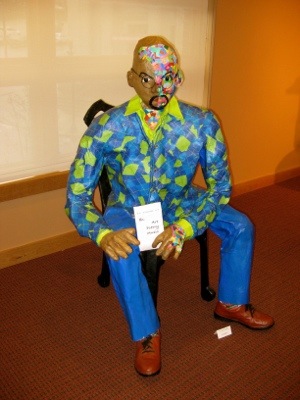
I think that is a pretty good first line defense for much of what ails the human condition. That and a good dose of empathic understanding from people who eschew employing violence, sarcasm and undermining skepticism in their efforts to help others. Too often people who are diagnosed, as I was, and still am, with “schizophrenia” are rushed into treatment that degrades and humiliates, even as it inflicts terrible effects, not to mention side effects…all without curing the so-called illness. I am not convinced that a person with “schizophrenia,” given the simple luxury of TIME, and a safe place with really good, caring, kind and intelligent people who know how to help without hurting her or him, would not heal better and more effectively than with any of all the so-called miracle anti-psychotic drugs our billion dollar medico-pharma industry has foisted on us. And I say this even though I still feel that Zyprexa was a “miracle drug” for me, once upon a time, (though also the miracle drug from hell…) and that it gave me a life I had never known before. I say this even though I take Abilify and Geodon and do more art and writing than I ever have…I say this even though I am better now than I have been in decades. I think the drugs are only fixing problems that the system largely caused. And had I had the chance, way back when, I wish I had had the chance to fight back without them…
If I could do anything to fix the mental health system, in Connecticut or this country or the world, one small thing, it would be to end ALL use of seclusion and restraints, period. Violence begets violence, in all cases. In ALL cases. In fact, get this, I would change the prison system as well, so that punishment qua punishment would be a thing of the past. Punishment is only a form of revenge and it does nothing to change a person or make them better. It only makes society feel better the way a bully feels better when he or she smacks a victim upside the head for smiling lopsidedly. I mean this. Sure, people can do very bad things. Yes. And certain people may be so damaged that they are too dangerous to safely release into “normal” society. (I maintain that this is largely because of how we, as a society, treated them, either at large or in prison.) But prisons and penitentiaries, especially in America, should be seen as an abomination on God’s green earth.
They say a society is judged by how it treats its dead? Well, I think we are judged by how we treat our prisoners, and if so, we will be judged poorly indeed for we treat our prisoners like hated animals…Not like cats and dogs that is for certain, nor even like horses…No, because we generally treat cats, dogs and horses well. Rather, we treat prisoners like vermin, like roaches…and then we blame them when they behave like the vermin they have become!
Have I gotten off the subject? Well, some mental institutions are largely prisons to their populations of involuntary or coerced patients, and most patients, involuntary or not, are cowed into doing as they are told for fear of the consequences. So to a degree the prison metaphor is valid. But if you have been restrained and secluded, brutally, and for hours upon hours, for many days, as I have been, the notion that you are a prisoner becomes more reasonable. That said, I will advance yet another idea: that bad behavior should be treated, not punished. Yes, I mean that. We should treat the person guilty of repeated criminal offenses as if he or she has a treatable behavioral disorder, and not punish them.
I know this will earn me some outrage. But think about it. What good does it do to punish a person repeatedly? Does it do anyone any good to torture that person with “the hole” or with repeated cell extractions and mace in the face? Clearly it doesn’t rehabilitate them or teach them the ways of kindness. It only makes them worse, and in our system an in-prison offense can add years to what started as a short sentence. So we create hardened criminals inside our prisons. I ask again, what good did it do?
But if instead we took that person, guilty of an offense and treated them as if they needed help — help learning how to behave better — and all that might entail, perhaps we might end up not only with someone ready to leave the institution at the end of the shorter stay, but someone ready to stay out afterwards! It only makes sense to treat everyone, including prisoners, with kindness and understanding and education, and if you don’t believe this, you should for one reason only: it would cost less money. (Of course, the owners of the private prisons don’t want you to know this, because they MAKE money on all the prisoners who keep coming back or who never get out, in fact there is a whole industry based on keeping as many people in prison, their private prisons, as possible…)
But I don’t believe in prisons either. I think the institution is a nightmare. You put bad people together with one another and what do you get but people learning how to behave worse together! It is a truly ridiculous idea. Analogous to the hospital, which is currently the worst and most dangerous place to go when you get ill (because that is where the most dangerous infections are and are often out of control). In the “old days” prisons were merely waiting stations. Penalties were sure and swift, and brutal. But no one waited for decades in a crowded prison with society pretending that it was humane. Now, we pretend it is..I dunno. Do we pretend anything, or just not care?
Do we care at all that we warehouse so many millions in dead-end lives that only get worse by the day, and then deprive them the more if they manage to leave prison eventually and not return? Oh, we have three strikes laws to put a person in prison for life, but no one gives a damn that there are three strikes against any person who actually earns his or her way OUT of prison. Nowhere to live, no job, no money, and no safety net whatsoever. (Unless you happen to be a former governor of Connecticut, and then you have it made in the shade.)
Enough for now.
UNFIT FOR WORK? Or simply Forced to be Disabled?
NPR’S “UNFIT FOR WORK”
The startling rise of disability in America
By Chana Joffe-Walt
http://www.thisamericanlife.org/radio-archives/episode/490/trends-with-benefits
In One Alabama County, Nearly 1 In 4 Working-Age Adults Is On Disability (click below to play audio)
In One Alabama County, Nearly 1 In 4 Working-Age Adults Is On Disability
Expanded Definition Of Disability Created Million Dollar Opportunity For Lawyers
Moving People From Welfare To Disability Rolls Is A Profitable, Full-Time Job
Kids May Stay On Disability If Their Parents Rely On The Check
Americans On Disability Play An Increasingly Important Role In The Economy
Thanks to Donna for pointing out this story at NPR. You can get the written story by Chana Joffe-Walt if you prefer to read it at: http://apps.npr.org/unfit-for-work/
If anyone feels moved to comment on this story or add to the discussion that I started yesterday under the video of Reshma’s recovery from schizophrenia, and Donna added to with her comments, please feel more than welcome to do so. If I get enough, I will create a new post out of them.
NOTA BENE: if you are a regular or even intermittent follower of Wagblog, and think that you have something to add here, and would like to contribute a post regularly or simply once in a while, please contact me. I am in the process of inviting contributors to Wagblog, but do not know everyone who might be interested in doing so. So if you are a human, and interested, let me know who you are. Send an introduction with your best writing as I cannot accept contributions I will have to edit to the point of rewriting…and umm, we have certain standards here, ahem, ahem, ahem. 8)
Sunshine Story of Schizophrenia Recovery…plus
When I saw at the end of this film, part four, before the depressing note that stated all that Indian law might not permit Reshma to do in her life, how she was making a living by painting, all I could think was, WOW! Go for it! At the very least, she is not being held back by the strictures of disability law and Medicare and Medicaid earning limits, or being forced into a permanent sick role because of same, simply in order to have a roof over her head and food to eat. No, she was lucky enough to have a family that both really and truly took care of her in her worst moments and fought for her in the best sense of the word, and also one that let her go when she needed to fly free. Most of us are not so lucky…alas. I think the support that she got all through her illness played an enormous role in her recovery, frankly. And I dunno how many of us get that sort of community or family support, but I wager that it is not many. I certainly did not. I wish I had, but it was very much to the contrary. Instead of support, I was abandoned entirely, both financially and emotionally. Left high and dry, to such an extent that people who met my parents after the break, never knew I existed, not for thirty-five to forty years. Some are only just learning of my existence now, as they meet me when I visit my mother. They didn’t even know or understand that all along Lynnie had a twin!
But I do not wish to dwell on that, except to say that things did not have to be as they were. And we do not have to live as second class rejects in society, except insofar as we accept that role. And take it on, along with the disability status and payments that we are told we should apply for at the first psychotic break. I disagree. If a person has a work history (and history is the single best predictor of the future, if anything can predict it) and has shown that he or she can hold a job, then why after a psychotic break should they be told they will never work again and that they should apply for social security disability? Disability signifies Permanent and total disability, that’s what it is for. You are not supposed to get better, and it’s meant to be “for good.” No, it is not impossible to get off SSDI and you can in fact earn your way off it. But how many people do? Not a single person I know who ever obtained SSDI payments ever got off it or ever even tried to do so. The best they did was earn just below the legal limits of what one can earn before they start counting against your disabled status. Which is to say, they worked, yes, but only a little, and only to the extent that it never threatened their standing as a disabled person.
What a crappy system. Someone a few months back when I was in the hospital asked me why I was so angry at the System, and why I counseled anyone under 50 not to go for disability…and this is why. Because it paralyzes a person into doing nothing with his or her life, it keeps them mired in permanent poverty, and it encourages lethargy and breeds depression and recurrent illness. I believe it does NOBODY any good. Frankly. True enough, I cannot say that I am not grateful as hell that I have had a monthly income for all my adult life, as I have never been able to work an 8-hour day regular job. But if, instead, there had been creative rehab or job counseling and creating, maybe someone would have discovered my artistic abilities earlier in my life and got me going, and using them earlier in a more productive and income-earning capacity.
I was never, and never claimed to be, unable to do anything at all. I simply could not follow a routine of any kind or go into an office or workplace from 9-5pm. Since that made me unemployable in their lights, I was “disabled” and put on the SSI and SSDI rolls. But in truth, while it guaranteed me an income, it also sidelined me for life, because I didn’t have to do anything to survive or even to get ahead. And in fact I was not allowed to get ahead or I would have lost the very disabled status that I now needed simply to qualify for housing and food. It was a terrible catch 22 situation that only perpetuated itself once I was caught in it. I could never get out of it once I accepted the first check…
And it only got worse when I moved into the cushiness of subsidized housing. Now, not only can I not move (it is HUD housing not Section 8 so it isn’t even portable) but I am “used” to a piddling rent of 1/3 of my piddling income. I have stopped knowing how to scrimp and save and live on pennies a day…because I do not have to. Everything is guaranteed here. Everything is safe. But I am suffocating, because I have no life, and no prospects for any change or growth or movement because at age 60 my life is at an end…I will live and die in these measly 2 rooms, living on SSDI and SSI, earning nothing, doing art and storing it away for nothing and no one…What good is that?
That, my friend who wanted to know why disability is such a bad deal, is why I counsel anyone who is not close to retirement not to go the disability route, not unless you want to do nothing and live in poverty for the rest of your life, and are content with a life of watching TV and a strict budget, using food-stamps and coupons. Because it will come down to that, that is, if you have a TV. And lucky you if you have a car and can afford to keep it on the road….If not, think about whether or not you can get rides, because the bus can be a drag when it is raining or snowing and you have a lot of groceries to carry. You better keep the car in tip top shape in any event, because you won’t be buying another anytime soon on disability from Social Security…I dunno about you, but no one I know gets much more than $1000.00/month from SSDI and usually we get hundreds of dollars less than that. One car repair bill can rip a monthly check to shreds.
I dunno what most wage-earning people think a life on disability is like, but it isn’t a cushy life of luxury, not at all. I haven’t bought or been able to buy new clothes in nearly ten years. (I wouldn’t want to anyway, because I like to buy used clothing and not generate new carbon, but do you really think I could afford on my SSDI check the price of any clothing except Walmart’s, that abomination of a store?) I cannot even afford to get food at Stop and Shop, let alone new clothing anywhere. I buy literally everything used, at GOodwill, or I barter or get things free through Freecycle. Or I do without. The only new purchases I make are art supplies, when I cannot get them at tag sales, or through other outlets. And I do not replace my erstwhile beloved pet Eemie, because I know I cannot afford a cat. You make choices in this world. If you choose to go on disability, I believe they should tell you precisely what sort of life you are choosing. Or give you options so that disability is only one of several equally feasible ones. It ought not be simply: go back to work at the same job, at the same level of stress, or go on disability. That is stupid, especially if one has been psychotic. But it also ought not be, You have been psychotic, and we are certain it will recur, so you will never be able to work again. That is double nonsense. NO ONE can predict the future, or tell a single soul that a psychosis will or will not recur. Only time will tell, and predicting a good prognosis has been shown to pay off with better outcomes than telling a patient that the future looks dire.
Okay, enough for now. I hope I haven’t been too oldy and moldy-sounding. I’m just very discouraged about my own limited and stagnating life. I do not feel as old as the system is making me behave. I could have a good life for the next two decades or more and maybe even a career. After all, Grandma Moses didn’t start painting till she was much older than my mere 60 years, and she had a long painting life ahead of her. No one told her she should just hide her head in the sand and wait to die. Or if they did, she ignored them and went ahead and painted and painted. I won’t give up on art, but I am frustrated and feel utterly stymied by a system that has clipped and cauterized my wings.
Finally, this is the large Turtle that I owe Tim, as it looks at present. I am going at it very slowly but surely.

How to Paint A Papier Mache Turtle (Third Try is the Successful Try!)
Sorry this is so unprofessional but I hope it is helpful and at least a little entertaining. I think i at least managed to get the entire 8 plus minutes uploaded to Youtube this time! 8D (that is an emoticon for me, in round glasses with a big grin)
Too Many Anniversaries and Too Many Memories

One of the anniversaries is my little Eemie’s death last year, at age 17. She was only about 14 in this picture, maybe a bit younger. But she never looked much different from this. Even the day she was “put to sleep” the vet thought she was a very sick 5 year old and not the elderly kitty she really was…She was my all time favorite cat, but i won’t try to replace her, or get another. I cannot do it, and will not try…

This photo is of Joe Cornelio and me in 2006, just after he was diagnosed with ALS, Lou Gehrig’s Disease, which would finally kill him, or complications thereof, two years ago today. I stil miss him dearly.

At the height of Joe’s illness, when he was completely paralyzed except for his eyes, and could not speak or move, he was able to use an eye gaze computer known as ERICA to speak with. ERICA registered the glint in his eye and allowed him to spell out each word by looking at the letters of the alphabet, which you can see on the screen in the photo, and then he could ask the computer to speak what he spelled by looking at the “speak” function. It was laborious, yes, but it worked well enough that we could actually have skpye converations by phone when I could not get in to see him in person, and I would set up my computer by my paintings and do some artwork by “videophone” so that he could watch me work while we talked.

This is Joe — weird how I never saw the changes in him in life but always saw him as “my old Joe” except in these photos — using the ERICA.

Pam and Joe, smiling at one another…

The other anniversary of this month is that three years ago, I was sadistically restrained (the first of several such incidents) on April 24th at Middlesex Hospital, absolutely traumatized by it and have not forgotten it yet. I tried to get redress, and we had JCAHO go in to investigate, but it did no good, because the Joint Commission largely doesn’t care about how often general hospitals use restraints and seclusion on patients in psychiatric units and doesn’t even track their usage. Try and find out about it. It is impossible. They track use of R and S in psychiatric hospitals, pure and simple, that is to say, State Hospitals, and private psychiatric hospitals, but not in general hospital units. So what good is that, I ask you? Most people who have severe psychiatric illnesses (chronic) are not hospitalized in this day and age in private hospitals but on psychiatric units in general hospitals, where the treatment can be tantamount, as I know all too well, to what the UN in March called torture.
Finally I was going to upload a bunch of photos of my tiny apartment but in one fell swoop I erased everything in my iPhoto library, including all the new photos. and, well, that was that! All I have left is whatever was saved in the ipad Photostream, which was precious little when it comes down to it. Stupid me!!
So today is the anniversary of Joe’s terrible death and I am trying not to think about that and all the other anniversaries coming up…It looks like it is going to be a bright sunny day here in Connecticut so I will try to take a walk and maybe do some artwork if I can get up the energy to do so…
April Blahs?

I realize that doesn’t exactly illustrate the “blahs” but it represents the sum total of all the artwork I have done since I got out of the hospital in mid march…and I did it in one night, on a whim, as a gift to the wonderful social worker who just left a position in our building for the directorship of the community center in town. (I miss her terribly but she needed to move on…)
Anyhow, the point of my post title is mostly to explain why I have not written all month: I have not felt much like doing anything at all. I haven’t done any other art or writing, and all I managed to accomplish was to clean up my apartment, which only serves to paralyze me the more.
I will write more eventually, but for now I just wanted to assure you all that I am okay, just not feeling up to much and so not writing. When I am back up to snuff I will write more. (I might even film a tour through my apartment in desperation, just for something to post here, that is how bad things are…i am scraping the bottom of the barrel!) In the meantime, please don’t give up on me. I’ll be back…SOON.
Schizophrenia Video: UVA and DIVIDED MINDS
This video was made during our “book tour” of 2005-6 after DIVIDED MINDS: Twin Sisters and Their Journey through Schizophrenia was published. I had not seen it for several years when my good friend, the poet Mizzy Hanley, located it by chance on YouTube. I am surprised, frankly by how eloquent my speech is, though I cringe, today, at some of the things I said. How differently my talks today are! In any event, much of it still holds true, though now I would couch things in somewhat different language, and might not so readily give the voice of certainty to such statements as “I suffer from schizophrenia.” Nevertheless, the comments underneath are certainly encouraging, and if it helps anyone for us to have said what we did then good.
At Yale Psychiatric Hospital: Respect, Dignity and Kindness
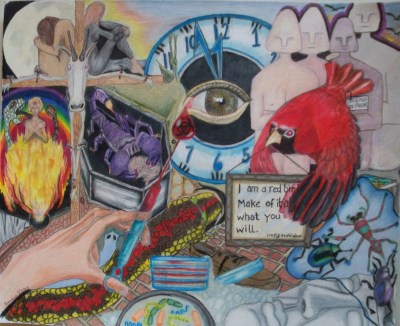
Large picture I did at Yale Psychiatric Hospital, the second one.
The pictures below are actually only 2.5 by 3.5 inches and are artist trading cards. I drew many of them, especially when I did not feel like working on my larger drawings at the hospital.
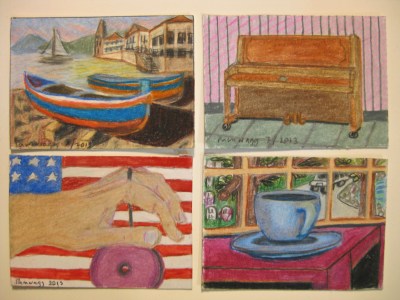
In mid-February, after a week out of the hospital (and you can read about my hospitalization by scrolling down to the previous post, but, in brief, this had been at Hartford Hospital’s Institute of Living, during which I was kept in seclusion for the larger part of a four week stay and put multiple times, sometimes twice a day for many hours in 4-point restraints. Why? Why? Although I ONCE threw a chair, they told me it was for “not following directions.” To add insult to injury, every incident in which they restrained me was accompanied by three injections in the buttocks of Haldol, Ativan and Benadryl, despite my policy of passive, completely non-violent non-resistance.)
In any event, in mid-February, after I had spent just a week at home, I became acutely psychotic again, and in consultation with the only doctor I trust, a friend drove me to Yale New Haven Hospital’s emergency department. There, after a very long and arduous wait — alas, I cannot say much that is good about Yale’s ED. It felt like the psych/alcohol patients – and there were no discriminations made between the drunks and anyone else — were lined up on their beds in the hallway like buses at a terminal for what felt like “miles.” In fact at one point there was probably a line 15 gurneys long snaking around the corner until I could not see the end.
I was there for two and a half days, maybe longer, I do not recall. In fact, I remember nothing about my ED stay after I was finally “admitted” to the actual psych portion of the ED, as opposed to the hallway. I believe I was finally given medications, but also that I was no longer permitted access to my artist crayons, which meant that I only wanted to sleep and likely did until I was admitted to the Yale Psychiatric Hospital, a street or two away.
To say that my experience at YPH was an order of magnitude better than it had been at the IOL or even at Natchaug Hospital is truly not to give YPH enough credit. I scarcely want to mention the other two hospitals in the same sentence, that is how different Yale is and I say that even though I once considered Natchaug my “gold standard.” No longer, no longer. I think Natchaug was decent once, but only because of the civilizing and humanizing effects that the director of nursing, Sharon Hinton, APRN, had on the hospital. Once she left, the whole place went to pot, as evidenced by my experience during the last two stays, which went progressively from bad to terrible without her there…literally without her protection I was brutalized by a dehumanizing medical staff that had been left to do whatever it wanted to on its own, to hell with the consequences to the patients.
Be that as it may, and we know that the Institute was never humane, Yale took me completely by surprise. I was hard to surprise, and hard to convince that they were for real in their gentleness and kindness, let alone in their determination to treat me and everyone there with respect and dignity. I was certain that they would prove me right, that SOMEONE would be put into restraints, that someone would be violent enough to push their buttons and get 4-pointed. But it never happened, not in the entire three weeks I was there. Not even when a patient threw a punch or a push. Not even when a patient screamed bloody murder or used foul language. Nothing that earned me or anyone else seclusion or restraints elsewhere even came close to pushing the staff’s anger buttons at Yale. Instead, they persisted in using persuasion and gentleness and kindness…and if anyone lost it, if anyone became angry and could not keep it together, so far as I could tell, that staff member took themselves away from the situation to cool down, and did not take it out on the patient.
The most amazing things happened. No one forced me to do anything. Not even to take medication. I agreed to take it, after some discussion with the doctor and social worker…but when I evinced some doubt about the side effects, instead of pooh-poohing them as the doctor had at the Institute, Dr Milstein agreed with me, saying that the Zyprexa definitely increased appetite, and that it was not imaginary or something that was in my control, the way Dr Banerjee did at IOL. Instead, he and the other team members not only agreed to help me control what I ate, but went out of their way – I believe they actually went “Stop and Shopping” – to provide me with my own private supply of raw vegetable snacks in the staff refrigerator to eat at any time of the day…just so I wouldn’t have to be tempted by the hospital snacks of Doritos etc.
Dr Milstein asked me not to worry about what they did or did not do “extra” for me, and I tried not to. But when two large bottles of brand name Diet Coke kept appearing for me every day, and when the resident was sent to buy me batteries for my personal pencil sharpener (with a grinder not a blade), just so I could continue to do my artwork and not rely on the staff to sharpen my pencils in the back, well, I knew 1) they were truly watching out for me and treating me with TLC, or what certainly felt like extraordinary care, and 2) they were in fact spending “extra” money, if not indeed their own money just to supply these special needs…All of which – or NONE of which would have mattered at any other hospital or to any other staff. If I had no pencil sharpener, who would care? If I had to eat hospital food, who gave a damn? Dr Banerjee basically said it was MY fault and only my fault if I gained weight on Zyprexa, that none of his other patients, the good ones, ever did. But at Yale, all these matters were important to me, and so they were important to Dr Milstein to to Chris Simpson the social worker and to the other team members. Not just as a matter of words, but to be taken care of so I could both take the Zyprexa and do art.
Just as important, Dr Milstein took at least a half hour every single day, and I think sometimes it was more than that, simply to talk with me and listen to what I had to say. Even if it was only to rant about how badly I had been treated at the IOL. He repeatedly told me that he just wanted me to learn to trust again, to believe that not everyone was against me or would hurt me…And if I did not learn that precisely, I did eventually come to believe that the staff at Yale were trustworthy and kind and meant what they said about their NO restraints and NO seclusion policy, for everyone. I may had still had frissons whenever someone screamed or threw a fit, panicking, believing that 4-point restraints were finally going to be resorted to. PTSD is not that easily overcome after all. But I grew more trusting, and by the time of discharge, I was able to thank them all for everything, to know that they had gone out of their way for me, and not feel too guilty.
I did a fair amount of art while I was at Yale Psychiatric Hospital. I will post more in the coming days.
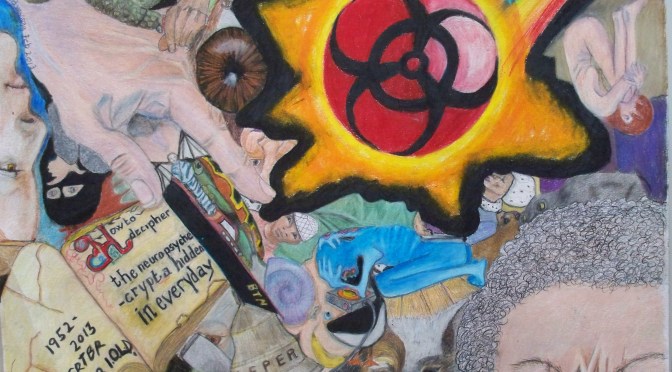
Update: All is well
This is the drawing I finally finished that I did at the horrible torture chamber of the Institute of Living. There are all sorts of hidden things in it that you must rotate it to see fully…
Hi Everyone, Sorry to worry Lady Quixote and anyone else. I was in Yale New Haven Psychiatric Hospital for last several weeks. A much better stay by far of which I have much to say. But I am recuperating for the next few days as I just got home a couple of days ago. Forgive me for being so out of touch, but even making a long distance phone call was nearly impossible from there…Luckily, the staff and doctor treated me and everyone with immense kindness, gentleness and dignity and respect, so I got what I needed, which was some weeks of healing. Praise whatever force of the universe you believe in for that! More to come as soon as I am able to write more and many thanks for all your concern and your patience.
Pam
 WAGblog: Dum Spiro Spero